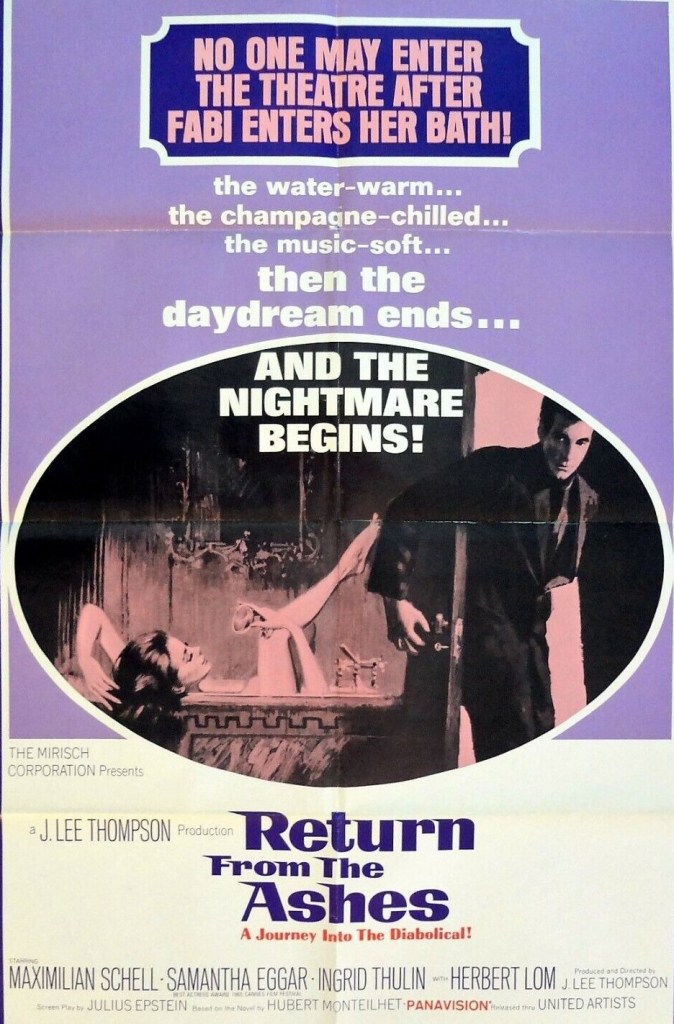
Return from the Ashes (1965) ****

When your starting point is an arcane French inheritance law and the plot revolves around swindling a concentration camp survivor you are immediately on “icky” ground. Throw in a relationship between an adult male and the step-daughter of his deceased wife and the audience might already be backing off.

So it’s a tribute to the acting and that each character is not so much unlikeable as both vulnerable and predatory that this turns into a very involving drama. On the eve of World War Two in Paris Dr Michele Wolf (Ingrid Thulin) buys the love of penniless Polish chess player Stanislaus (Maximilian Schell) but at the cost of abandoning her step-daughter Fabi (Samantha Eggar). For him, love is contingent on wealth, but he marries Michele, a Jew, in a (failed) bid to save her from the clutches of the Nazis. Fabi, shorn of maternal love finds turns to a paternal variation, but is capable of coming up with an ingenious murder plot.

Just quite how hollow Michele has become is demonstrated in a brilliant opening scene set after the end of the war. In a railway carriage, a bored small boy endlessly kicks a door. Pretty much for 90 seconds we either see or hear that door being kicked. Foolishly, his hands wander from the window to the door handle. Next thing, he has fallen out. Cue screams, chaos, shocked passengers racing out of the carriage.

But when the conductor turns up to investigate the incident he finds Michele still sitting in her seat, oblivious to any death, even that of a child. When she returns to Paris, she takes a room in a hotel under a pseudonym, fearing that her ravaged looks make her unattractive, guilty at surviving (by volunteering to work in the camp brothel) when all her relatives were wiped out, unaware that she has unexpectedly inherited all their combined wealth.

So the story begins in a different way. When Stanislaus meets her accidentally under her false name, he immediately assumes she is just a dead ringer for his deceased wife and enrols her in a scheme to win the millions currently held in escrow under this inexplicable French law.

Since she continues to play the part of a different woman, she hears the truth about her relationship with Stanislaus, that although he committed the only unselfish “gallant act” in his life in marrying her nonetheless his prime reason was money. Already Fabi, in full femme fatale mode, is planning to rid the couple of Michele once the money has been legally acquired.

To his credit, Stanislaus initially balks at this notion, but when Michele reveals her true identity and scuppers his relationship with Fabi while at the same time trying to win back the affection of her step-daughter, matters take a deadly turn.

For the most part what we have is a menage a trois, equal parts driven by money and love, but in each instance propelled by innermost desire. Stanislaus is adept at pulling the wool over Michele’s eyes, she only too willingly blinding herself to his sexual deception. But Michele is equally willing, even when she knows his true feelings, to use her money to win him back while Fabi, aware that for her lover money will always trump romance, is determined to use her body to achieve the same effect.

What makes this so compelling is that, unusually, it avoids sentiment. It would have been easy to load each character up with such vulnerability that an audience would not condemn them. Instead, in addition to their individual weaknesses, we are shown their inherent predatory natures.

What makes it so enjoyable is the acting. So often Maximilian Schell is called upon to play stern characters, often typecast from his accent as a villainous German of one kind or another (Judgement at Nuremberg, 1961, The Deadly Affair, 1967), rather than allowing him to invent a more rounded character as he did in Topkapi (1964). This is a wonderfully involving performance,  the wannabe chess grandmaster who uses his considerable charm to buttress his fears of poverty, and is only too aware of his failing, full of joie de vivre, bristling at being a kept man yet at the same time only too ready to financially exploit the situation.  

Where in The Collector (1965) Samantha Eggar was constrained by circumstance and in Walk, Don’t Walk (1966) saddled with an initially cold character, here she is permitted greater freedom to develop a conflicted personality, loving and deadly at the same time, drawn to and hating her step-mother, attracted by the thought of the money that would secure Stanislaus but repulsed by the cost.  

Ingmar Bergman protégé Ingrid Thulin (Wild Strawberries, 1957) is given the least leeway, another of the tormented characters in her intense portfolio. Herbert Lom (Villa Rides, 1968) puts in an appearance as a friend trying to warn her off Stanislaus.  

Director J. Lee Thompson (The Guns of Navarone, 1961) takes the bold approach of allowing characters and situation to develop before moving into thriller mode. There are a couple of quite superb scenes, running the opening segment close is the much-vaunted scene of Fabi in the bath (“No one may enter the theater once Fabi enters her bath” was a famous tagline). It is brilliantly filmed in film noir tones, bright light slashed across eyes rather than through windows, and Johnny Dankworth provides an interesting score. Julius J. Epstein (Casablanca, 1942) wrote the screenplay based on the bestseller by Hubert Monteilhet.

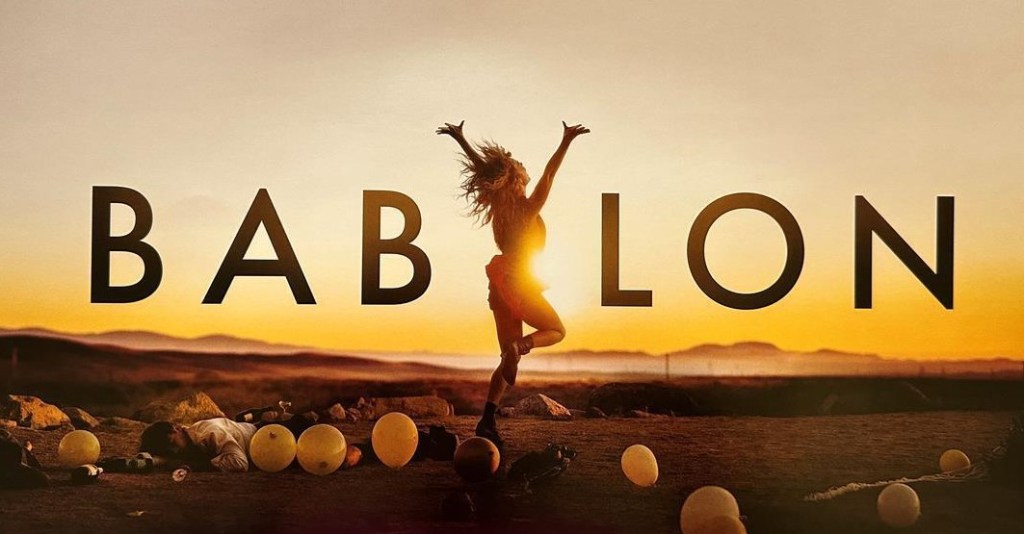
Babylon (2022) **** – Seen at the Cinema

Wild raucous’n’roll rollercoaster that, contrary to expectation, I found totally absorbing, length not an issue. Employing a simple structure of rise and fall, and exploring the upside and downside of Hollywood in the transition from silent to sound, it seemed to me in essence to capture movie-making. A Broadway play could be a hit if seen by 100,000 people, that size of audience constituting a flop for a movie, but the play was viewed by 100,000 of the “right” people, the moneyed elite who could afford the tickets, a movie by the flotsam and jetsam that made up the majority of the American population even when, theoretically, the country was going through the boom times of the “Jazz Age.”

Most films and books concentrate on the downside, the battle to get to the top, the seamy undercurrent, the inevitable collapse, but none capture the giddy heights like this. Silent movies were viewed primarily as technical, nobody had to even talk, much less learn lines or spout Shakespeare. Initially, the stars were drawn from vaudeville so had some proven talent but then it was clear anyone could become a star, such as here Nellie LaRoy (Margot Robbie), or a producer like Manny Torres (Diego Calva) by simply being in the right place at the right time, initiating a gold rush to Los Angeles.

Just as there is no single reason for the camera and audience to turn a person into a star, the same applies when they fall out of favor. In a movie thankfully given little to long lectures on filmmaking beyond aspirations to “form” and wanting to do something good, the best explanation about how/why careers end is delivered in dry tones by columnist Elinor St John (Jean Smart) to disillusioned out-of-favor Jack Conrad (Brad Pitt).

The narrative shuttles between Conrad, LaRoy and Torres, interweaving the lives of trumpet player Sidney Palmer (Jovan Adepo),  Conrad’s multiple wives, LaRoy’s hapless father (Eric Roberts), director Ruth Adler (Olivia Hamilton) studio wunderkind Irving Thalberg (Max Minghella), publishing magnate William Randolph Hearst (Pat Skipper), gangster James McKay (Tobey Maguire) and imperious director Otto (Spike Jonze). Excess is the name of the game whether ostentatious consumption Hollywood-style or the more sedate black tie dinners of caviar and lobster enjoyed by the elite.

The elite looked down their noses on a new class of wealthy individuals who were ill-educated, didn’t talk proper, but had struck gold simply from being able to stand in front of a camera without being able to tell their Ibsen from their Shakespeare and didn’t understand art. 

Surprisingly, this is a pretty good comedy, slapstick sometimes but excelling at setting up visual jokes, though audiences might recoil from a rare reliance on elephant ordure and vomit. Some scenes are pure standout: Nellie’s first talk scene where the sound engineer has tyrannical control; Nellie’s fight with the snake; Manny’s race to find a camera before the director loses the light; the uncontrolled venom of battle scenes; the black Sidney not black enough; and of course the various wild parties although nothing in the Hollywood imagination could match the depravity of one where Manny is the unwilling guest of gangster McKay, as if fiction cannot match reality.

Of course, people who have everything rarely know what they actually want and spend their lives throwing away what they have in pursuit of the unattainable, so Conrad is apt to view wives as disposable, Nellie finds relief in drugs and gambling, Manny’s obsession with Nellie which should lead to ruin paradoxically by happenstance brings him happiness. The rampant unchecked hedonism that runs through the picture could well just be a metaphor for the helter-skelter modus operandi of the movies, enjoy it while you’re hot, cram in as much as you can, because, heaven knows, something from left field (sound, for example) could dramatically upend everything.

Brad Pitt (Bullet Train, 2022) is very good as the often drunk but generally streetwise star. You can hardly take your eyes off Margot Robbie (Amsterdam, 2022), not just for her brazen sexuality, but her ability to cry on cue, awareness of her self-destructive personality, inherited from self-destructive parents, greedy idiotic father, mother committed to an upmarket mental institution. Diego Calva (Beautiful Losers, 2021) is good in a less showy part. Interesting cameos abound.

This has the intensity of Damien Chazelle’s Whiplash (2014) rather than the cleverness of La La Land (2016).

I mentioned in my review of Tar that it could have done with a stronger producer to cut down on the running times and some elements I felt were bound to alienate audiences. I would make the same suggestion here, though not so forcefully. Elephant shit and urination are always, I reckon, going to be a major turn-off for audiences. While I had no trouble with the length, that’s clearly been an issue and it would hardly be a problem for a decent editor to snip chunks out of party scenes or eliminate non-essential characters.

Emotionally and artistically this seems to me to capture the essence of the formative days of Hollywood before the double whammy of the Great Depression and the Hays Code brought about a systematic rethink with studios insisting their stars take more care hiding their proclivities from general view.

Ignore the reviews and check it out.

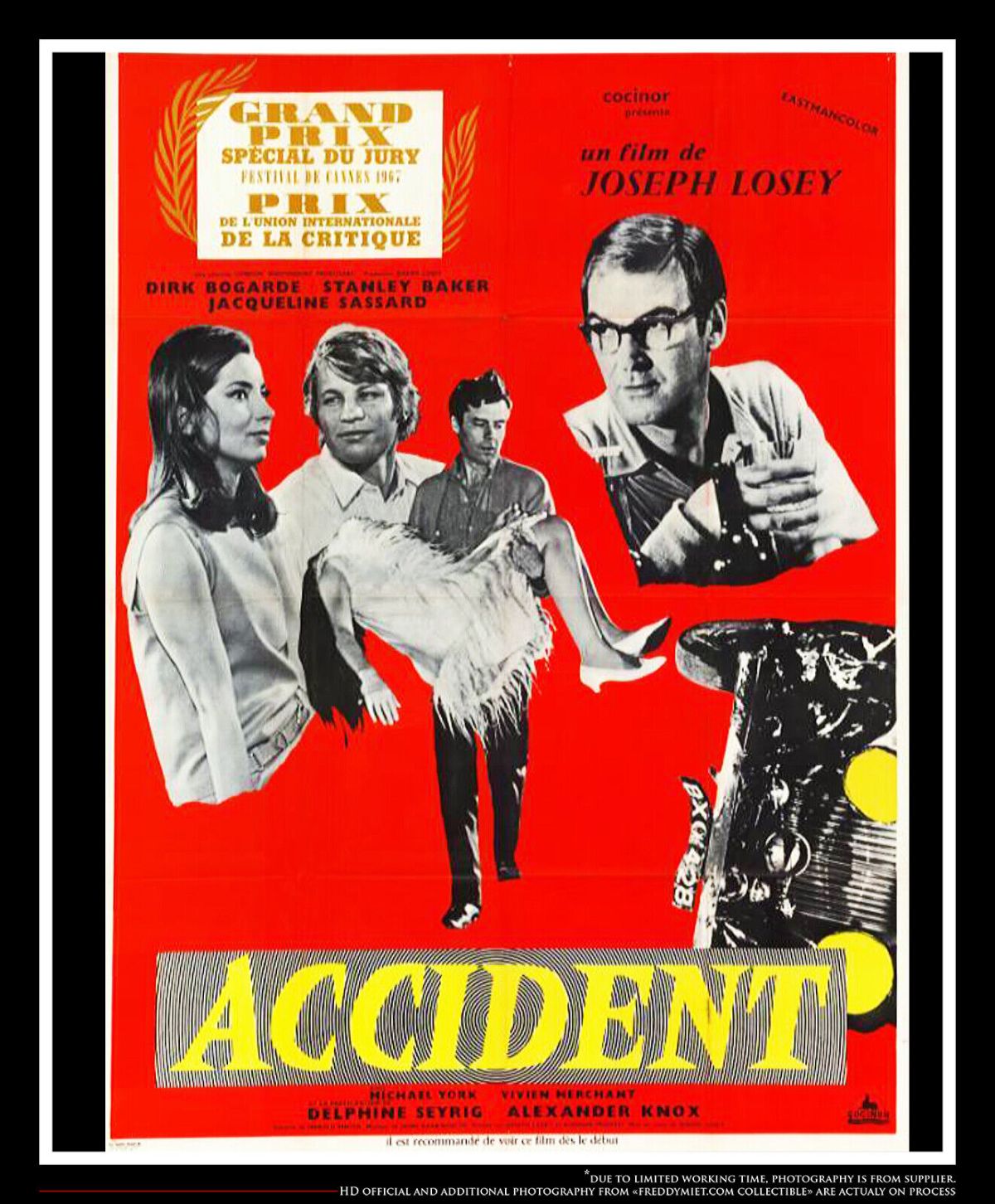
Accident (1966) ****

Intellect can present as powerful a sexual magnetism as wealth. And for young women, unlikely to come into the orbit of powerful movie magnates or wealthy businessmen, they are most likely to experience abuse of power in academia, especially in top-notch universities like Oxford and Cambridge or Harvard and the Sorbonne.

Young students, unsure of their place in the world, depend on praise for their self-esteem. To be on the receiving end of flattery from a renowned scholar, a young person (males included) might be willing to overlook other unwanted attention. For young women and men accustomed to being assessed on looks alone this might be a drug too powerful to ignore.

The British system ensured that potential prey was delivered to potential predators. As well as attending lectures, each student was allocated a tutor and could spend a considerable amount of time with them in private in congenial surroundings behind closed doors. And since essays marked by tutors played a considerable element in an overall mark, there was plenty of opportunity for transactional sex.  

And it was easy for women to think they wielded the sexual power. I once employed a woman who boasted that she had seduced her university tutor, little imagining that that took any opposition on his part, and that, in reality, she was just another easy conquest.

So you might be surprised to learn that when this movie about inappropriate behavior in a university of the caliber of Oxford appeared, nobody gave a hoot about the grooming and exploitation of young Austrian Anna (Jacqueline Sassard) by two professors, Stephen (Dirk Bogarde) and Charley (Stanley Baker).

The story is told in flashback in leisurely fashion. Hearing a car crash outside his substantial house in the country, Stephen finds inside the vehicle an injured Anna and her dead boyfriend William (Michael York). Then we backtrack to Anna’s arrival in Oxford, and how the love quadrangle is created. The presence of William suggests Anna has predatory instincts, but there is no sign of sex in their relationship, rather that he is forever frustrated at being kept on a leash and clearly suspecting he is losing out to others.

Stephen, a professor of philosophy, no higher calling in academe, endless discussion on the meaning of life manna to every student, has a purported happy home life, wife Rosalind (Vivien Merchant) pregnant with their third child. He’s no stranger to infidelity, reviving an affair with the estranged daughter Francesca (Delphine Seyrig) of a college bigwig (Alexander Knox).

But he can’t quite make his move on Anna, despite idyllic walks in the fields and their hands almost touching on a fence. The uber-confident Charley, novelist and television pundit in addition to academic celebrity, has no such qualms and seduces her under the nose of his friend and sometime competitor.

When opportunity does arise for Stephen it does so in the most horrific fashion and, that he takes advantage of the situation, exposes the levels of immorality to which the powerful will stoop without batting an eyelid.

The web Stephen is trying to weave around his potential victim is disrupted by William and Charley and if any anguish shows on Stephen’s face it’s not guilt at the grief he may cause or about his own errant behavior but at the prospect of losing a prize.

Director Joseph Losey (Secret Ceremony, 1968) sets the tale in an idyllic world of dreaming spires, glasses of sherry, tea on the lawn, glorious weather, punting on the river, old Etonian games, the potential meeting of minds and the flowering of young intellect.  The action, like illicit desire, is surreptitious, a slow-burn so laggardly you could imagine the spark of narrative had almost gone out.

Stephen is almost defeated by his own uncontrolled desire, taking advantage of his wife entering hospital for childbirth, the children packed off elsewhere, to have sex with Francesca, not imagining that Charley will take advantage of an empty house.

And the young woman as sexual pawn is given further credence by the fact that at no point do we see the events from her perspective.

Anguish had always been a Dirk Bogarde (Justine, 1969) hallmark and usually it served to invite the moviegoer to share his torment. So it’s kind of a mean trick to play on the audience to discover that this actor generally given to playing worthy characters is in fact a sleekit devious dangerous man. Of course, the persona reversal works very well, as we do sympathise with him, especially when relegated to second fiddle in the celebrity stakes to Charley and humiliated in his own attempts to gain television exposure.

Stanley Baker (Sands of the Kalahari, 1965) was the revelation. Gone was the tough guy of previous movies. In its place a charming confident winning personality with a mischievous streak, a far more attractive persona when up against the more introspective Bogarde.

Jacqueline Sassard (Les Biches, 1968) is, unfortunately, left with little to do but be the plaything. There’s an ambivalence about her which might have been acceptable then, but not now, as if somehow she is, with her own sexual powers, pulling three men on a string. In his debut Michael York (Justine, 1969) shows his potential as a future leading man.

You might wonder if Vivien Merchant (Alfred the Great, 1969) was cast, in an underwritten part I might add,  because husband Harold Pinter (The Quiller Memorandum, 1966) wrote the script and Nicholas Mosley, who had never acted before, put in an appearance because he wrote the original novel.

Losey, a critical fave, found it hard to attract a popular audience until The Go-Between (1971) and you can see why this picture flopped at the time despite the presence of Bogarde and Baker. And although it is slow to the point of infinite discretion, it’s not just a beautifully rendered examination of middle class mores, and a hermetically sealed society, but, way ahead of its time, and possibly not even aware of the issues raised, in exploring abuse of power, a “Me Too” expose of the academic world.

The acting and direction are first class and it will only appear self-indulgent if you don’t appreciate slow-burning pictures.


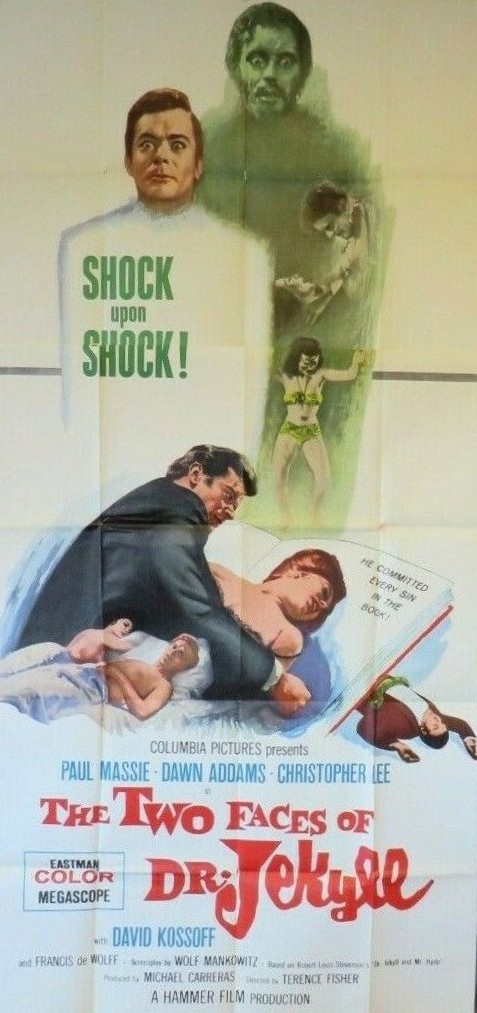
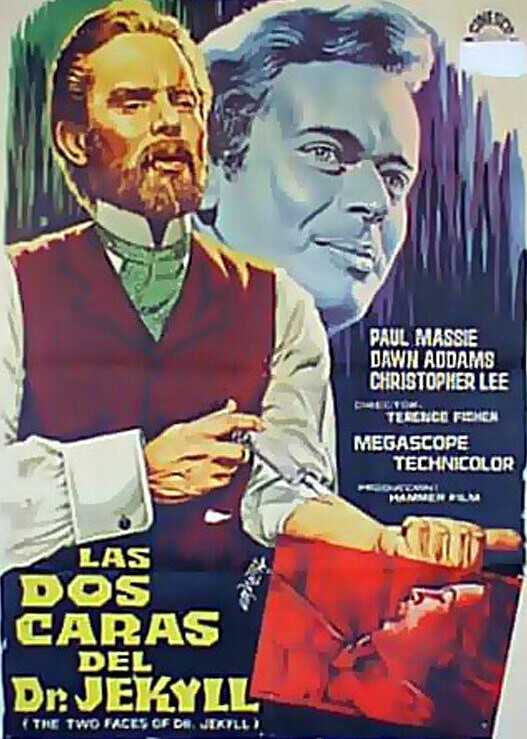
The Two Faces of Dr Jekyll / Jekyll’s Inferno / House of Fright (1960) ****

One of the most shocking films of its day with its unusual focus on sex and violence, this takes the famed Robert Louis Stevenson tale down a different direction in that Dr Jekyll enjoys the base animal instincts he has unleashed with his experiments rather than expressing remorse or guilt. Evil has never been more demonstrably enjoyed.

Dr Jekyll (Paul Massie) is a shy cuckolded scientist when he takes the magic elixir that diverts his dull personality towards a more dynamic, if ultimately perverted, destination. From being fearful of life, he begins to sample its more exotic pleasures under the guidance of louche best friend Paul (Christopher Lee) who is carrying on an affair with the good doctor’s wife Kitty (Dawn Addams).

Not only does the reincarnation of Jekyll as the lusty Hyde consort with prostitutes and manage to snare exotic dancer Maria (Norma Marla), a beautiful woman who would normally be way out of his league,  he develops a fetish for violence, almost beating to death a hooligan (Oliver Reed) in a dodgy club, only prevented from committing his first murder by the intervention of his friend.

Sure, there’s some philosophising about the nature of good and evil and whether violence is inborn or nurtured and there are moments when guilt rears its ugly head, but these are pretty fleeting to be honest, and most of the time he can hardly wait for another draught of his poison in order to shake off his insipid persona and revel in the new creation.

But magic will only take you so far. Believing he is now irresistible to women he fancies his chances with Paul’s amour, who is of course none other than his wife, but she will have none of it, finding him a poor alternative to the charming Paul. In one of the most controversial scenes of the day, and perhaps only ironically acceptable at the time, Hyde proceeds to rape the resisting Kitty. This skirts so close to the edge of taste, not just the worst type of domestic abuse (though husband assaulting wife would be no less unusual in Victorian times than it is now), but almost the neanderthal man taking what he wants, that it makes for uncomfortable viewing, especially as it is presented as a come-uppance for the adulterous hoity-toity Kitty.

Perhaps more interesting is that having won over the cold Maria, a trophy lover on a par with the higher-born Kitty, that’s not enough for Hyde.

Also, for the time, is an extremely risqué scene involving Maria and her snake, especially when having completed the usual survey of her curves, the reptile ends up down her throat. That the Victorians were masters of the art of hypocrisy comes as little surprise, but the extent of it takes the viewer aback.  

There’s another twist. When it becomes apparent that his crimes are about to catch up with him the cunning Jekyll attempts to blame Hyde.   

Sumptuously mounted by Terence Fisher (Dracula, Prince of Darkness, 1966) and with nary an attractive character in sight – none of the innocent victims of the vampire sagas, for example – to leaven the sight of such unmitigated wickedness, the director offers an unique vision of how easy human beings will degenerate given the chance. At the outset Paul appears the most obvious villain, leeching on his friend to pay his gambling debts, while at the same time making hay with his wife. But initial audience sympathy for a wife, presented as a beautiful woman who for the sake of security has made a bad marriage and who needs an outlet for passion, soon dissipates as her true character is revealed.

The refusal to temper the ongoing degeneracy with one good character is a bold choice. Budgetary restrictions eliminated the usual transformation scene but that was probably for the best, since Hyde merges as though from a chrysalis into a stronger personality rather than undergoing some body-wracking physical change. It’s almost as if the director is determined to show how easy, given opportunity, a good but essentially weak man will embrace the dark side.

Accusations that Fisher has failed to bring sufficient suspense to the film I find unfair. Certainly, there’s not the tension of the will-he-be-found-out vein, but since the story is so well-known that appears a redundant course sensibly avoided. The director replaces that with ongoing friction between Jekyll and his friend on the one hand and his wife on the other, both of whom are unaware that the man they know as Jekyll is aware of just what a fool has been made of his alter-ego.

The emphasis instead falls on how and when the cuckold will take his revenge. And although the rape scene is unwelcome, there’s a certain ironic sadness for Jekyll to discover that his new persona is no more attractive to his wife than his old one.

Paul Massie (Call Me Genius, 1961) is of course far removed from an actor like Spencer Tracy (Dr Jekyll and Mr Hyde, 1941) and he relies overmuch on rolling the eyes but even so this is a decent performance. Christopher Lee (Dracula, Prince of Darkness) is the revelation, creating a very believable insidiously charming man who never quite approaches outright villainy. Dawn Addams is excellent as the spoiled entitled wife.

One of the unusual aspects of the picture is that where Hammer had been and would remain a breeding ground for new stars – Christopher Lee a most obvious example – everyone else featured here came to, in cinematic terms only I assure you, an untimely end.

This turned out to be Paul Massie’s only starring role – he only made another three films during the entire decade – and was soon relegated to television. Dawn Addams only managed another nine and, apart from House of Sin/The Liars (1961), spy flick Where the Bullets Fly (1966) might be counted the peak.

David Kossof only made another four, and none beyond 1964. And this was the final film in an extremely brief two-picture career for Norma Marla. Only the uncredited Oliver Reed (Women in Love, 1969) and of course Christopher Lee (Dracula, Prince of Darkness, 1966) went on to bigger and better things.

As did Terence Fisher who helmed most of the best Hammer pictures of the decade. Wolf Mankowitz (The Day the Earth Caught Fire, 1961) wrote the script.

Generally dismissed at the time, this has for good reasons acquired a substantial following and is well worth a look.

Black Butterflies / Les Papillons Noirs (2022) **** – Netflix

Not since Basic Instinct (1992) has there been such an obvious connection between sex and murder. Slow-burn French film noir throwback, every twist, unusually, is matched by emotional resonance. Over six episodes this turns into an absolute cracker with several shocking scenes and, for once, a post-credits scene in the final episode worth waiting for.

You do however need to give this time. The first episode is mostly confusing as it sets up the three main strands. But episode two contains such a revelatory twist thereafter you’re on a rollercoaster.

In the present day ex-con acclaimed but impoverished novelist Adrien (Nicholas Duvauchelle) takes up a not particularly well-paid ghost-writing job listening to grizzled old fella Albert (Niels Arestrup) recount his memoirs. Adrien, on the jealous side, has a tangled relationship with partner Nora (Alice Belaidi). Also in the present day a couple of cops, Carrell (Sami Bouajila) and Mathilde (Marie Denarnaud),  are working on a cold case, the death of renowned photographer Steven Powell.

Running parallel with these two tales we go delving into the romantic past of Albert and in particular his relationship with Solange (Alyzee Costez) back in the 1970s when the entire world was on a massive experimental binge. A couple of other elements pop up from time to time,  a small boy and his mother, Adrien and his stepfather, and an artist/tattoo artist Catherine (Lola Creton).

Eventually, it all comes together and when it does it packs an incredible punch, a real emotional wallop, as the lives of all concerned are turned upside down.

And while there is most definitely twist upon twist upon twist, what raises this above most movies/programs that rely just on twists, is the emotional impact of such changes, and above all, characters seeking identity, trying to work not just who they are but whether they like or are repelled by the characters they have become.

Chock-full of atmosphere, this will have you hooked from the incredible second episode which tumbles full-tilt boogie into a dazzling mysterious past. Mostly, it takes place in France but just for the hell of it we race to Brussels and Genoa, and timewise, there’s an important element that takes place at the conclusion of the Second World War.

Everyone is damaged one way or the other and as the series progresses you realize just how damaged. And one of the best parts of the series is that lives that should collapse under the weight of such heavy emotions find themselves taking an alternative route that occasionally provides solace and occasionally dodges the issues enough to keep them steady. But, of course, nobody can escape the past.  

While this is definitely on the raunchy side, it does set out to show the part sex plays in the lives of the characters, whether emotional crutch, expressing the full joy of falling in love, or desperate measure.

The characters are well-drawn, and as new personality details emerge, they take the story in different directions. In some respects it’s grounded by Albert, the kind of old guy who really knows how to smoke, slipping the cigarette into his mouth old-style, sucking the life out of it, and for all his obvious dodginess a genuine human being seeking respite and redemption.

What Adrien discovers relates only too well to what he suspects about his own instincts and so he is as much disgusted as revelling in each new discovery. An ex-kick boxer, one of the running motifs is not so much being up for the fight, or in true private eye mode being able to hold your own in the fisticuffs department, but willing to accept physical punishment. That is matched by an understanding of the toll emotions can take on your life, especially if you lack the mental capacity to defend yourself against such intrusions.

And at the heart of the story is the mysterious, seductive, beautiful Solange, a different kind of femme fatale, perched atop beguiling innocence, at times unaware of the passions she unleashes, and yet, trying to find a way out of her own spiralling emotions, internal conflict typified by undergoing various abortions while so desperately wanting a child that she plays interminably with a doll’s house, her own reaction to the sexual act buried deep in her past.

I’ll admit the first episode is at timse heavy-going as writer-directors Olivier Abbou (Get In, 2019) and Bruno Merle (The Lost Prince, 2020) set out their complex stall, but the second episode is such a humdinger it more than makes up for it. The contrast between the free-wheeling free-spirited 1970s and the grungy contemporary look where responsibility brings an edge to everything is very well done. But while the violence would do Tarantino proud, contemplation of the creative process is as considered.

It probably helps that I’m unfamiliar with any of the actors because for me they carry no screen baggage. Nicholas Duvauchelle (Lost Bullet, 2020) carries off his first top-billed role superbly, making a terrific transition from a character almost playing a part to one who wishes he had done a better job of remaining an ordinary guy. On the basis of this, Hollywood should come calling for veteran Niels Arestrup (A Prophet, 2009) any time they’re looking for a crusty supporting actor.

Alyzee Costee, in her biggest role to date, certainly announces her presence, presenting the most complicated character of the lot, daughter, lover, mother, possibly the most intriguing female character of all time, beauty matched with fragility matched with toughness matched with an agility to switch persona at dizzying speed. This is what Netflix is best at, investing in foreign television programs, or just sticking their name on them, to bring them to global attention. This is definitely worth a wider audience

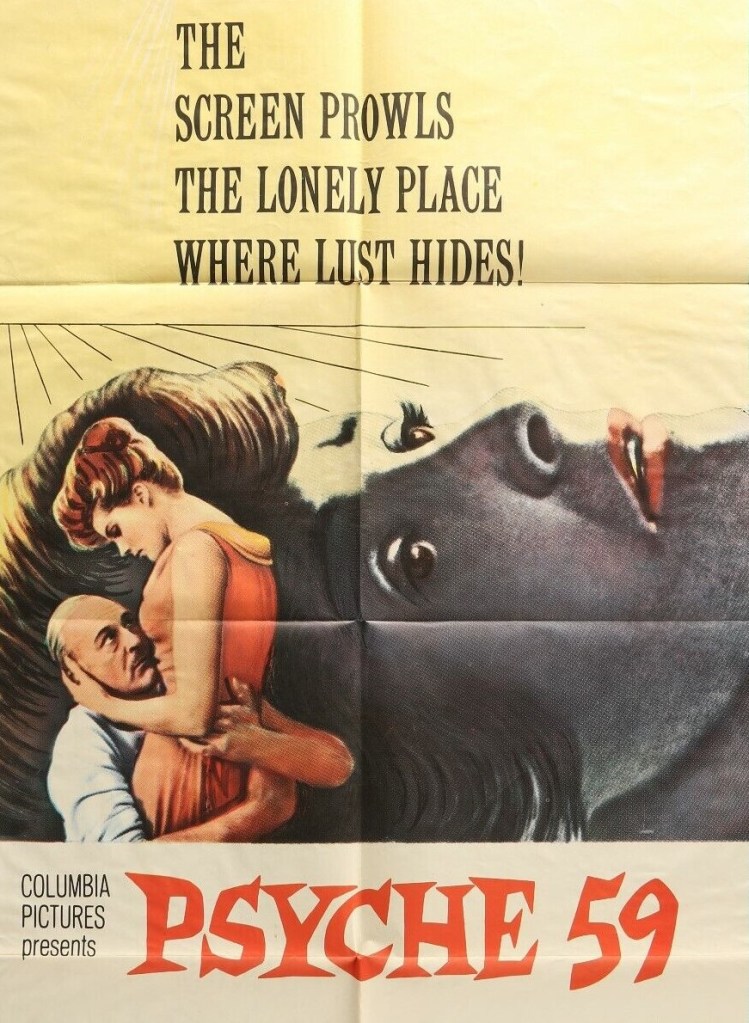
Psyche 59 (1964) ****

This is a low-budget gem, an exploration of the psychological consequences of grooming. You can probably guess from the outset where it is headed but simmering tension has rarely been handled so stylistically.

With the exception of Patricia Neal, an unexpected Best Actress Oscar-winner for her previous film Hud (1963), there were no stars in the cast. Curd Jurgens was only beginning to play characters for whom a German accent was not essential, Samantha Eggar one movie shy of her breakout picture The Collector (1965), Ian Bannen, essentially a character actor, building on his success in Station Six Sahara (1963).

Blinded after an unexplained psychological trauma, Allison (Patricia Neal) welcomes back, over the objections of husband Eric (Curd Jurgens), her much younger sister Robin (Samantha Eggar) to the family home. Family friend Paul (Ian Bannen) cares (possibly overmuch) for Allison while hankering after Robin. The screenplay by veteran Julian Zimet (Saigon, 1947, with Alan Ladd) is taut as a drum, every line a threat, suppressed emotion or piece of exposition that could bring the whole house of cards tumbling down.

The blindness is exceptionally well handled, Allison’s need for physical contact with her husband sensual in its expression. Though she can a ride a horse, her vulnerability is implicit; as she is led across a beach you wonder what would happen were she to be abandoned. What she cannot see becomes central to the movie. That Robin – vivacious but damaged – clearly has some hold over Eric is demonstrated in a tete-a-tete between them but as tensions mount such scenes cannot be kept secret. When Eric grabs Robin’s hair and she retaliates by jabbing him with scissors, neither party emits a sound, leaving Allison oblivious to it all.

Robin takes delight in exposing what has lain on the surface for too long. When Paul begins to fall for Robin, the younger woman astutely remarks to her sister: “Am I taking him away from you?”  Allison, however, is self-aware, convinced she could see if she wanted to, if she was prepared to lift the psychological barrier that keeps the past safely hidden. “I’m afraid to see,” says Allison, “there’s something I’m scared to look at.”

Given the period when it was made there was a lot that could not said – or shown – and even so the film was censored prior to release, but it is the direction by Alexander Singer (A Cold Wind in August, 1961) that lifts the picture up. An acolyte of Stanley Kubrick, the movie teems with imagination, close-ups and extreme close-ups are balanced by long two-shots, a conversation in a car between Eric and Paul mostly direct to camera a prime example.

Emotion is captured at every turn and Singer avoids the cardinal sin of treating Allison like an invalid or focusing on her reaction to what she cannot possibly see, her eyes hidden behind dark glasses for much of the time. Levity is provided by Mrs Crawford (Beatrix Lehmann), Eric’s sci-fi-reading horoscope-obsessed mother and by a couple of excitable children.

The grooming is in the past but the after-effects are very real. In a film like this it is tempting to consider that certain attitudes are dated, but it is clear from this film that nothing has changed, that men believe they can take what they want regardless of the impact on their victims.

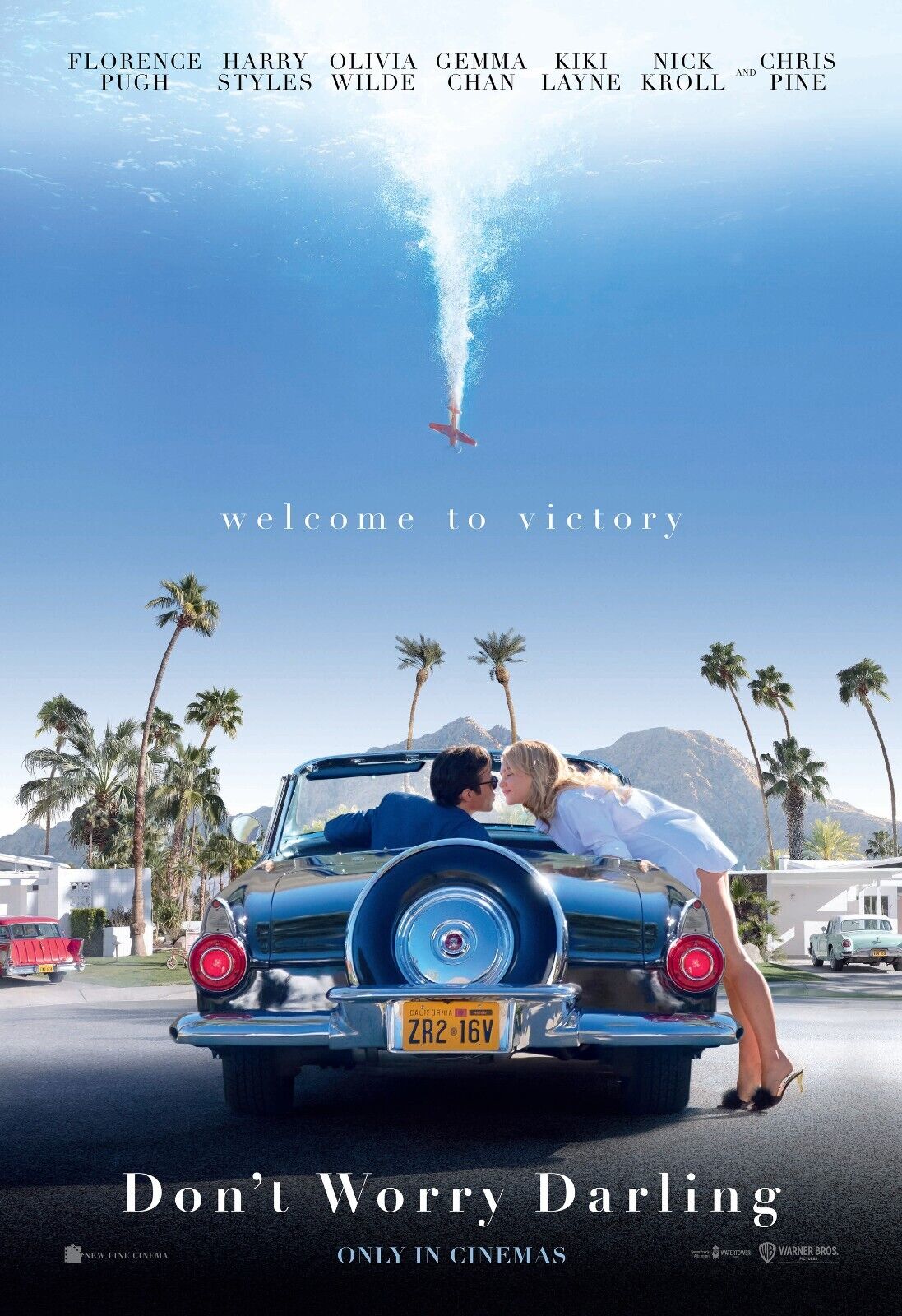
Don’t Worry Darling (2022) *** – Seen at the Cinema

Rejoice: a star is born. But it’s not Florence Pugh (Black Widow, 2021). It’s my habit going to the cinema to sit close to the screen in order to avoid the audience. This time I couldn’t help but noticing the streams of young women, often in large groups taking up an entire row. Out of curiosity, I chatted to quite a few at the end, imagining they might be turning up to support director Olivia Wilde’s new picture. Nope, they were here to see Harry Styles (Dunkirk, 2017). That’s what you call star power.

And he certainly has something. A screen charisma, an electricity, and without going too overboard, something akin to the danger of an early Michael Caine or Sean Connery, other British exports. When he was in a scene, it was easy to forget Florence Pugh. You knew what she’d be doing, emoting like crazy, but he was unpredictable, exactly what the camera adores.

Anyway, what we have here is a throwback, a slow-burn paranoia thriller in The Stepford Wives utopia vein with a dystopian twist. But the ending is a let-down, the kind of baffling logic Christopher Nolan often gets away with, and a rather worn trope of male supremacy.

Happily married couple, still going at sex like rabbits, Alice (Florence Pugh) and Jack (Harry Styles) live in a stylized isolated 1950s community where husbands depart for work every morning and wives stay home to do the housework or endlessly shop and gossip. Every need, basic or more luxurious, is taken care of. The men are employed by the mysterious Victory Project, run by the charismatic and fun-loving Frank (Chris Pine), and beyond their housing estate is a forbidden zone.

But strange images keep zapping into Alice’s head. Eggs crumble into nothing and wrapping Saran Wrap/clingfilm round her mouth is not an acceptable lifestyle choice and when the suicide of neighbor Margaret (Kiki Layne) is denied, and she sees a plane crash into the hills, she decides to investigate. Exactly what she discovers we are never told, but her behavior becomes more paranoid, and men in red overalls are likely to scamper out of the woodwork at the hint of any threat along with a bogus psychiatrist only too keen to prescribe pills.

And although it turns out Jack is willing to try his hand at cooking, Alice is jeopardizing their relationship and without the cunning to outwit the devious Frank.

From the outset you were waiting for this fantasy to unravel, although Alice was a shade too overcooked too quickly, and there was no explanation for some of her terrors, being trapped by a sheet of glass for example, and the ending will far from satisfy. But I found the movie suspenseful overall, enough doubt sown to seed the growing tension, the characters by and large well-drawn, otherwise confident men kept insecure by jostling for recognition from boss Frank, and the playfulness occasionally teetering into the acceptably hedonistic.

However, once Alice got the bit between her teeth, there was too much teeth, flaring nostrils and general over-acting. The cooler Frank achieved more with very little.

Generally, though, quite enjoyable, although if director Olivia Wilde (Booksmart, 2019) intended making wider feminist comment, it’s too facile by far. The something that doesn’t add up emanates from the storyline for otherwise the picture is pretty well done, including a car chase and the sinuously sneaky Frank controlling and destroying lives.

As I said, I felt Florence Pugh was too over-heated but she was also let down by a screenplay by Katie Silberman (Booksmart) that failed to come up with any real answers. Harry Styles stole every scene he was in and Chris Pine (Wonder Woman, 2017), playing against heroic type, was excellent. Although there has been criticism of Styles’ performance, bear in mind that screen stardom has been built on less and it would give the industry a shot in the arm if a new star came out of nowhere. The women I encountered in the audience would certainly agree with giving him a bigger role.

From opening week box office, this looks as if it will do well enough to sustain Olivia Wilde’s career, as here her confident direction and visual skill proves she can handle a bigger budget.   

Blonde (2022) **** – Seen at the Cinema

Stream of consciousness reimagining of Marilyn Monroe’s life mainlining on celebrity, identity, mental illness and vulnerability and held together by a mesmerizing performance by Ana de Armas. Director Andrew Dominik’s slicing and dicing of screen shape, occasional dips into black-and-white and a special effects foetus won’t work at all as well on the small screen. Monroe’s insistence on calling husbands “daddy” and letters from a never-seen potential father that turns into a cruel sucker punch, threaten to tip the picture into an over-obvious direction.  

A very selective narrative based on a work of fiction by novelist Joyce Carol Oates leaves you wondering how much of it is true, and also how much worse was the stuff left out. As you might expect, the power mongers (Hollywood especially) don’t come out of it well, and her story is bookended by abuse, rape as an ingenue by a movie mogul and being dragged “like a piece of meat” along White House corridors to be abused by the President.

A mentally ill mother who tries to drown her in the bath and later disowns sets up a lifetime of instability. Eliminated entirely is her first husband, but the scenes with second husband (Bobby Canavale) and especially the third (Adrien Brody) are touchingly done, Marilyn’s desire for an ordinary home life at odds with her lack of domesticity, and each relationship begins with a spark that soon fades as she grapples with a personality heading out of control.

That she can’t come to grips with “Marilyn,” perceived almost as an alien construct, a larger-than-life screen personality that bewitches men, is central to the celebrity dichotomy, how to set aside the identity on which you rely for a living. It’s hardly a new idea, but celebrity has its most celebrated victim in Monroe.

According to this scenario, she enjoyed a threesome with Charlie Chaplin Jr (Xavier Samuel) and Edward G. Robinson Jr.  (Evan Williams) but otherwise her sexuality, except as it radiated on screen, was muted. The only real problem with Dominik’s take on her life that there is no clear indication of when her life began to spiral out of control beyond the repetition of the same problems. She remains a little girl lost most of the time.

I had no problems with the length (164 minutes) or with the selectivity. Several scenes were cinematically electrifying – her mother driving through a raging inferno – or emotionally heart-breaking (being dumped at the orphanage) and despite the constant emotional turbulence it never felt like too heavy a ride. But you wished for more occasions when she just stood up for herself as when arguing for a bigger salary for Gentlemen Prefer Blondes.

I wondered too if the NC-17 controversy was a publicity ploy because the rape scene is nothing like as brutal as, for example, The Straw Dogs (1971) or Irreversible (2002), and the nudity is not particular abundant nor often sexual. That’s not to say there is much tasteful about the picture, and you couldn’t help but flinch at the rawness of her emotions, her inability to find any peace, the constant gnaw of insecurity, and her abuse by men in power.

Ana de Armas (No Time to Die, 2021) is quite superb. I can’t offer any opinion on how well she captured the actress’s intonations or personality, but her depiction of a woman falling apart and her various stabs at holding herself together is immense. The early scenes by Adrien Brody (See How They Run, 2022) as the playwright smitten by her understanding of his characters are exceptional as is the work of Julianne Nicholson (I, Tonya, 2017) as her demented mother. Worth a mention too are the sexually adventurous entitled self-aware bad boys Xavier Samuel (Elvis, 2022) and Evan Williams (Escape Room, 2017).

While there are no great individual revelations, what we’ve not witnessed before is the depth of her emotional tumult. Apart from an occasional piece of self-indulgence, Andrew Dominik, whose career has been spotty to say the least, delivers a completely absorbing with an actress in the form of her life. Try and catch this on the big screen, as I suspect its power will diminish on a small screen.

Maniac / The Maniac (1963) ****

Such an ingenious thriller you just have to applaud. Opening with a close-up of a predatory eye, this scarcely draws breath as it dashes through a latter-day film noir maze, spawning out auditory and visual cues, beautiful woman luring dupe, twisting the expected narrative round her little finger.

Artist Jeff (Kerwin Mathews) setting up his easel in the Camargue, hardly one of the most tourist-friendly spots in France, eyes up Annette (Liliane Brousse), the daughter of a hotelier Eve (Nadia Gray), but, in extremely opportunistic style, settles for the mother. In true noir fashion she is using him, seducing him into a scheme to free her husband George (Donald Houston), incarcerated in a mental asylum for torturing and killing with a blowtorch the aforementioned predator who raped Annette four years before.

Eve convinces Jeff that in return for his freedom the madman will effectively give his blessing to their affair. It’s a deal only a besotted dupe would fall for. George has an ally inside the asylum, assisting his escape, but when George turns up, and Jeff drives him to Marseilles, he leaves behind the corpse of his criminal associate in the boot. Jeff dumps the body in the river.

Cue the start of a series of strange events. A fired-up blowtorch is discovered in the garage where Georges committed his initial crime. Annette, jealous of her mother’s relationship with Jeff, plans to leave and go with her father.  

And I’m sorry to say that in order to explain the attraction of this neat little picture I’m going to delve into SPOILER ALERT territory.  

All the while of course you are wondering whether George will keep to his side of the bargain, especially as Eve starts to get antsy with Jeff, and the investigating police inspector seems overly suspicious. And it being this kind of picture you expect a twist.

But not one this clever.

George, blowtorch at the ready, traps Jeff in the garage. He has fished the corpse out of the river. He plans to burn the garage to the ground, leaving behind two dead bodies, assuming the police will imagine that in a further bout of psychotic behavior the murderer gave in to his desires and killed again, but in the process accidentally killed himself.

But that’s not the final twist.

One of the victims survives. But which one? He is so badly mutilated as to be rendered unrecognisable and lies in a hospital bed covered head to foot in bandages. Has Eve’s plan backfired? Has she accidentally killed her lover?

But that’s not the final twist.

Eve knows who the man in the bed is. It’s not her lover. Because Jeff is just the dupe. The body dumped in the river was George. All the time Eve was visiting her husband in the mental asylum she was carrying on an affair with one of the guards. The guard killed George after the escape, retrieved the body from the river, left it in the garage and planned to kill off his competition at the same time.  If you’re going to be tabbed a maniac, you better behave like one.

It’s a shame you can’t see the shock on the face of poor Jeff because he is encased in bandages. And this isn’t just the clever villain unable to stop herself boasting about how clever she has been. This is Eve getting into the murder racket. She switches off his oxygen.

But that’s not the final twist.

Jeff ain’t dead. He wasn’t even on a life-support machine. He was just trussed up to tempt Eve in revealing herself. He had escaped the garage inferno and told the police what was going on. So you can guess the rest, but even then there’s one other ironic twist. Just like Jeff, the imposter George is as taken with the daughter as the mother.

The twists are so well done, the narrative so compelling, that would be enough to make a convincing case for entry into the category of cult. What makes an undeniable case is the directorial style. Sights and sounds drive the story as much as anything. The eerie bright light in the garage, the sound of blood dripping on the floor, the bold close-up of the eye, the advancing blow torch, setting it in a bleak rather than scenic area of France, are cinematic notions belonging to classic movies, not to a tawdry B-picture.

Although The Devil Rides Out (1968) is generally considered the top Hammer picture of the decade, I would argue this runs it a close second, and possibly even tops it.  Taking time off from his studio job Michael Carreras (The Lost Continent, 1968), later Hammer’s managing director, delivers a little masterpiece working to an effortlessly clever original screenplay by future director Jimmy Sangster (The Horror of Frankenstein, 1970).

It’s enough that Kerwin Mathews (The 3 Worlds of Gulliver, 1960) is playing against his screen persona as upright hero. The biggest advantage in casting Nadia Gray  (The Naked Runner, 1967) was that she was unknown and didn’t have the kind of onscreen presence that might have you doubting her motives from the start.  Liliane Brousse (Paranoic, 1963), in her penultimate movie, is initially too much all-arched-eyebrow and pout, only coming into her own when she becomes dutiful daughter rather than wannabe seducer. The pretend George, real name Henri, Donald Houston (A Study in Terror, 1965), hidden beneath dark glasses most of the time, is a dab hand at a pretend psychopath.

Surprisingly effective little gem.

Triple Bill Blues: Fall (2022) ***; The Forgiven (2021) **; Three Thousand Years of Longing (2022) ** – Seen at the Cinema

You may be aware that I am partial to a triple bill on my weekly Monday trip to the cinema. I’m rather an indiscriminate cinemagoer and generally just see what’s available, though it’s true return trips to view Top Gun: Maverick have helped paper over cracks in the current distribution malaise. Sometimes a triple bill can reveal unsung gems, sometimes I am rowing against the critical tide in my opinions and sometimes, not too often thank goodness, I end up seeing movies with few redeeming qualities. That was the circumstance this week.

FALL

So now I know. If I need to get a mobile phone dropped 2,000 feet without it breaking into pieces, the thing to do is stuff it inside a cadaver. That’s one of the more outlandish suggestions in this climbing picture two-hander that for most of the time is quite gripping.

So as not to have to spend the first anniversary of her husband’s death sozzled in booze and despair, Becky (Grace Caroline Currey) agrees to partner YouTube click-hound Hunter (Virginia Gardner) in scaling an extremely high disused radio mast. Becky, a mountaineer, had watched her husband fall to his death, so is pretty iffy about the expedition. When they reach the top they can’t get down again since the ladder they climbed has disintegrated. Although there was mobile phone reception at ground level, there’s none this high up. Hunter has 60,000 followers and reckons if only her phone reached the ground it would automatically activate so they toss it down in a shoe stuffed with a bra.

That doesn’t work nor does firing a flare pistol to alert two guys in a nearby RV – all they are alerted to is the girl’s vehicle which they promptly steal. The girls are trapped without water or drone, both stuck 50ft below on radio dishes. At one point you think this is going to go in an entirely different – murderous – direction after Becky discovers Hunter had an affair with her husband. But they manage to get over that hiccup. Recuing their water and drone results in Hunter being out of action as far as further climbing goes and it’s up to Becky to reach the top of the mast and recharge the drone from the power there, fending off a passing vulture.

There’s definitely one weird bit where it turns out that Hunter, who you imagined was up there all the time supporting a defeatist Becky, is already dead. But, luckily, the corpse provides the cavity in which to bury the mobile phone. I’m not sure much of a human body survives a drop of 2,000 ft, certainly not enough to safeguard a phone, but that’s the way this plays out.

A great mountaineering film is always a welcome find in my book. This isn’t great but it’s certainly passable. And while Becky is more interesting than the gung-ho Hunter, the pair, emotions almost spinning out of control, make a very watchable pair.

Grace Caroline Curry aka Grace Fulton (Shazam!, 2019) does well in her first starring role and Virginia Gardner (Monster Party, 2018) is as convincing. Jeffrey Dean Morgan (Rampage, 2018) has a small role. A novel take on the mountaineering sub-genre, it’s kudos to director Scott Mann (Heist, 2015) – who co-wrote the screenplay with Jonathan Frank (Final Score, 2018)  that I spent a lot of time wondering just how the hell they managed to make it look so realistic.

THE FORGIVEN

Note to studios, no matter how much you plan to tart up a modern version of Appointment in Samarra – aka a tale of unavoidable fate – you ain’t going to get anywhere if it’s filled with entitled obnoxious characters. The worst of it is this is well-made.

Functioning alcoholic doctor David Henninger (Ralph Fiennes) knocks down and kills young Muslim boy Driss (Omar Ghazaoui) while on the way with wife Jo (Jessica Chastain) to a hedonistic weekend party in Morocco hosted by Richard Galloway (Matt Smith) and his partner Dally (Caleb Landry Jones). There are hints that Driss was planning to hijack the tourists, but while his death is deemed an accident by the local cops, David agrees to go back with the boy’s father Ismael (Abdellah Taheri) and observe the local funeral rites and possibly pay the father off.

While her husband is away Jo has a one-night stand with serial seducer Tom (Christopher Abbott) while the rest of the party – including Lord Swanthorne (Alex Jennings) and assorted beautiful men and woman – trade bon mots and make racist and sexist remarks. While the arrogant David changes his perspective and accepts his fate, there is not, himself included, a single likeable person in the whole of the tourist contingent which makes it impossible to care what happens to anybody. Written and directed by John Michael McDonagh (Calvary, 2014) it spends all its time trying to make clever points, not realizing the audience has long lost interest.

THREE THOUSAND YEARS OF LONGING

Note to studios, if you’re going to indulge an action director in a vanity project, make sure he hires actors who don’t just drone on. It might also help if the director could decide what story he wants to tell, and not essentially present a voice-over narrative of stuff that happened in the past, no matter how exotic the timescale.

I was astonished to discover there actually is a job called narratologist. Alithea (Tilda Swinton) is a dried-up old stick of a narratologist who summons up the dullest genie/djinn in movie history known – no names, no pack drill – just as The Djinn  (Idris Elba) who proceeds to bore the audience to death with his stories of how he came to end up in a bottle.  

There’s a bundle of academic nonsense about storytelling, a swathe of tales that sound like rejects from The Arabian Nights, and a lot of unconnected characters. The invention of director George Miller (Mad Max: Fury Road, 2015) just isn’t inventive enough and the visuals just aren’t arresting enough. I’m assuming this got greenlit on the basis Miller would turn in a couple more in the Mad Max franchise.

Discover WordPress

A daily selection of the best content published on WordPress, collected for you by humans who love to read.

The Atavist Magazine

by Brian Hannan

WordPress.com News

The latest news on WordPress.com and the WordPress community.