Escape from Zahrain (1962) ***

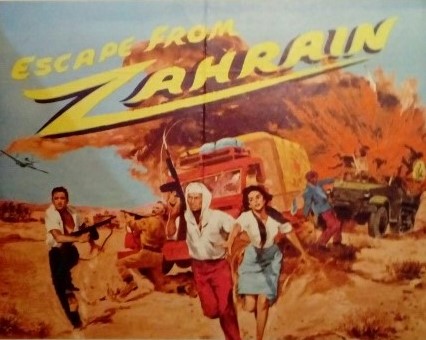
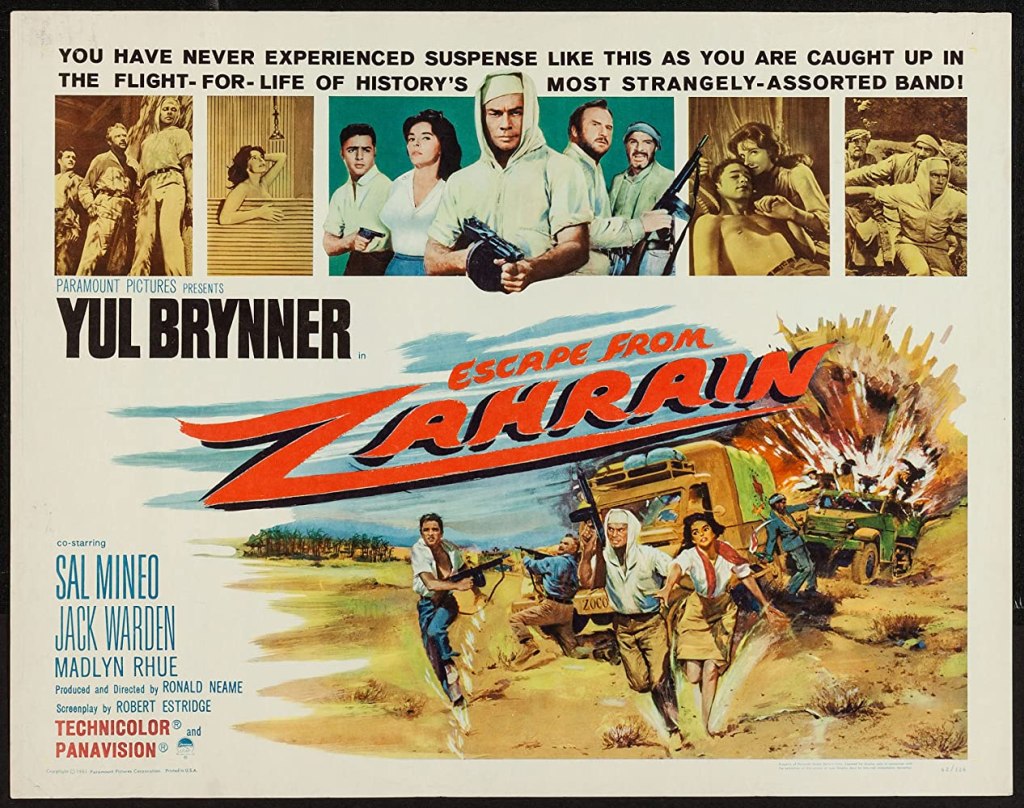
After being attacked by armored cars and strafed by airplanes, stranded in the desert, and overcome various tensions within the small group of escapees, there is still considerable life left in this picture at the end as Jack Warden, making his departure, comes up with a classic last line: “We must do this again sometime.”

In truth, the picture has far more going for it than a mere outline would suggest. In rescuing rebel leader Sharif (Yul Brynner) from a lorry bound for jail, the escapees led by Ahmed (Sal Mineo (Exodus, 1960) in a stolen ambulance also scoop up three convicts including American fraudster and loudmouth Huston (Jack Warden) and all-purpose thug Tahar (Anthony Caruso) plus nurse Laila (Madhlyn Rhue) as a hostage. Like most stranded-in-the-desert films, the storyline is on who will survive and how.
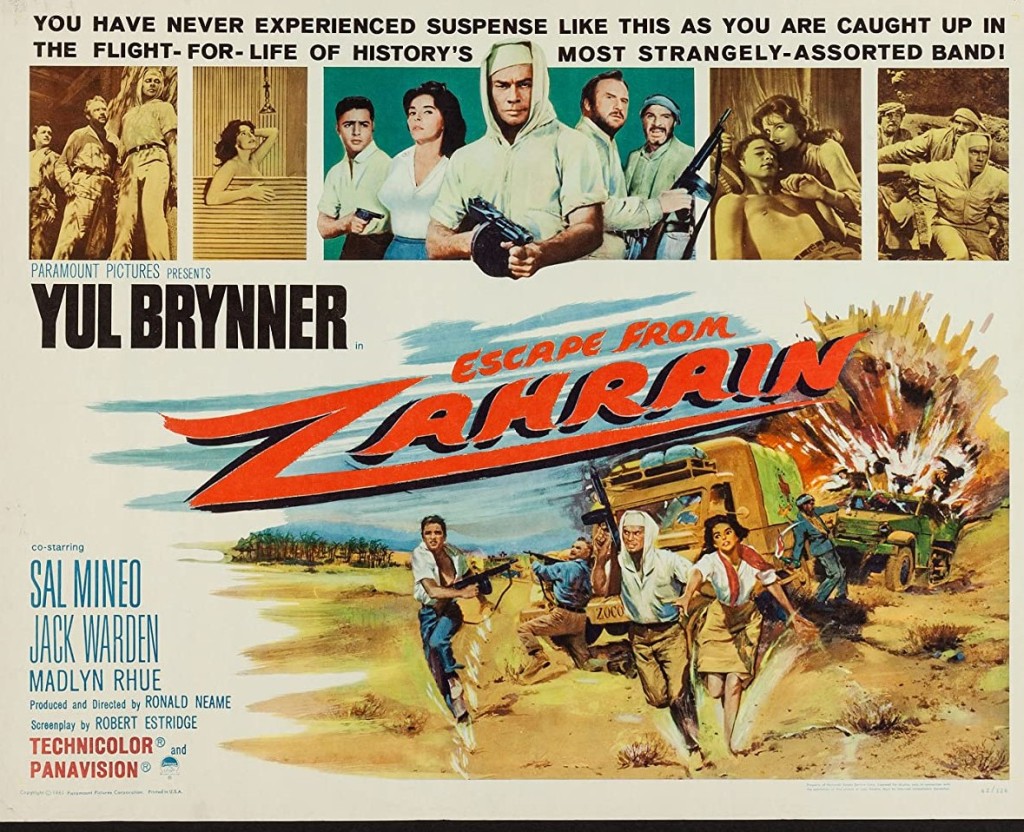
Action is one constant. The threat of failure is another. Supplies are rationed and, of course, someone steals more than their fair share. The members regularly switch allegiance. At various points someone is about to give up Sharif. Their gas tank is punctured so, thanks to Huston’s engineering skills, they just make it to a remote pumping station where they encounter maintenance man (James Mason in an uncredited cameo). Their numbers diminish and despite his recalcitrance Huston’s engineering skills save them again when they reach an oasis.

What makes the film different is that the characters all change. In a country where “half the wealth is stolen by Europeans and half by corruption,” Sharif is the altruistic leader whose ideals are shattered. Laila,  a Muslim, drinks alcohol and questions the number of deaths necessary for a revolution but declines to leave when the opportunity arises. Ahmed who thinks “women should be as free as men” reacts badly when Laila enjoys such freedom. Huston, who has embezzled $200,000, and has loyalty to no one stands by the shambolic crew.

I had always believed Brynner had enjoyed a rare case of beginner’s luck when he won the Oscar for his debut in The King and I (1956) and that once Hollywood became wise to his acting schtick he would never be nominated again – as proved the case. But after watching Brynner in The Magnificent Seven (1960) and its sequel and Invitation to a Gunfighter (1964) and Flight to Ashiya (1964) I have become convinced he is under-rated as an actor. He acts with his eyes and his delivery is far more varied than I had supposed. Here, clothed in Arab costume, there is no bald pate to distract. 

Sal Mineo (Exodus, 1960) can’t compete in the acting stakes with the canny Jack Warden (Blindfold, 1966). Anthony Caruso (a television regular) is lost in the mix but Madhlyn Rhue (A Majority of One, 1961) certainly looked a good prospect.

British director Ronald Neame (Tunes of Glory, 1960) holds the enterprise together, keeping to a tidy pace but allowing tension and character to emerge. Screenplay was courtesy of Robin Estridge (Eye of the Devil, 1966) based on the Michael Barrat novel and with an injection somewhere along the line by Dudley Nichols (Heller in Pink Tights, 1960).

Tight script, taut direction.
https://amzn.to/3Td6m1d

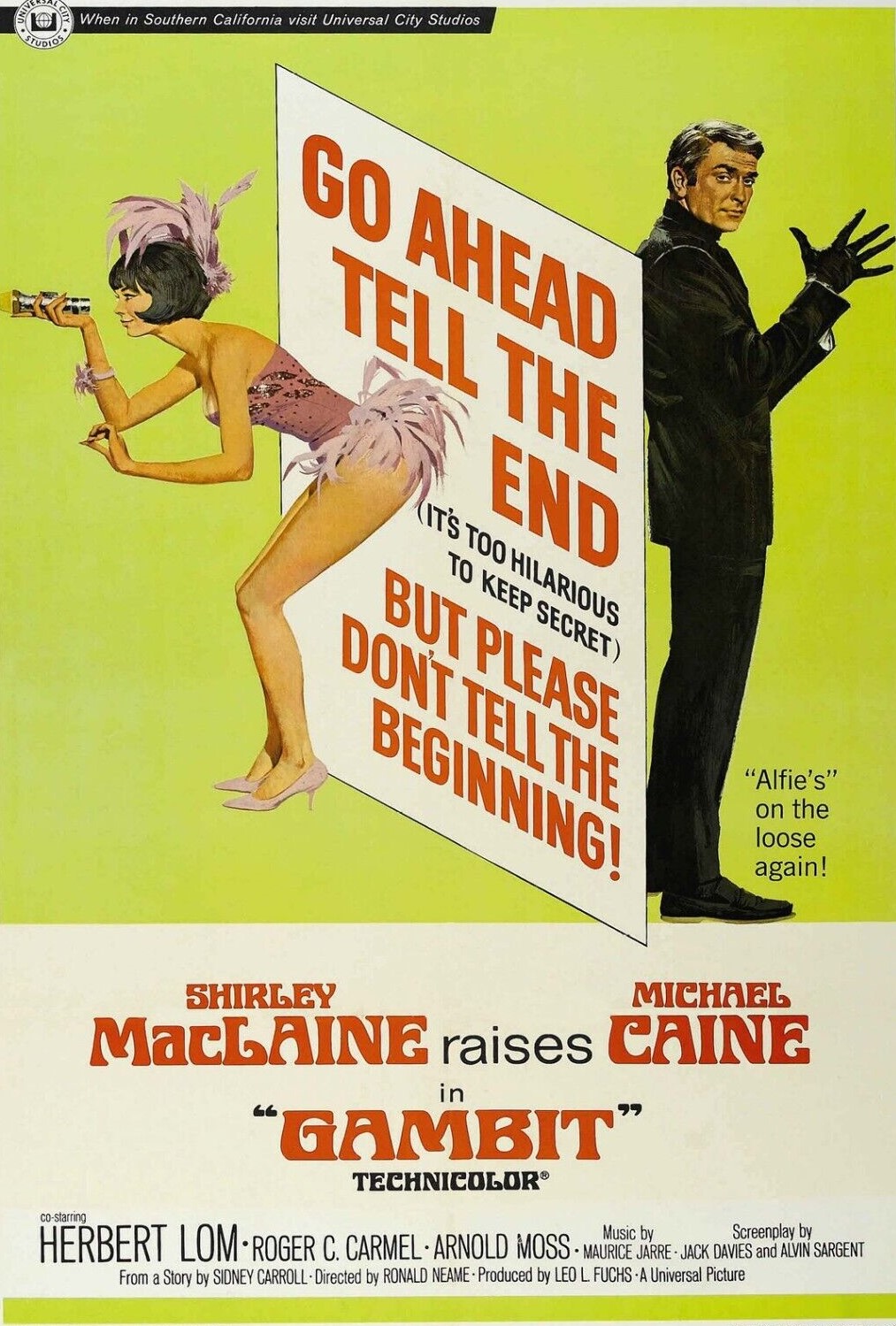
Gambit (1966) ****

The heist movie – as epitomised by The Asphalt Jungle (1950), The Killing (1958) and Jules Dassin’s Rififi (1955) and Topkapi (1954) – had tended to be a relatively low-budget affair. Top-ranking stars steered clear because complicated plot often got in the way of character development  In the highly polished and entertaining Gambit British director Ronald Neame’s riff on the genre involved a narrative shift worthy of Christopher Nolan, Quentin Tarantino and, of course, Akira Kurosawa who had with Rashomon (1950) single-handedly invented the complex point-of-view.

Neame brought another couple of other aces out of the deck. First of all, there was the fun of watching over-confident thief Michael Caine’s apparently foolproof plans come unstuck. Secondly, in a romantic dynamic in the vein of It Happened One Night (1934) the less accomplished female (Shirley MacLaine) proves more accomplished than the male.

Gambit was also a clear demonstration of the power of the female star not just in the plot complications but from the fact that Caine owed his big Hollywood break to MacLaine, the actress having the power of veto over the male lead and, equally, the contractual right to choose her co-star.

The movie had gone through an interesting development phase. The original script by director Bryan Forbes (King Rat, 1965) had Cary Grant in the central (i.e MacLaine) role. Rewritten by Jack Davies (Those Magnificent Men in Their Flying Machines, 1965) and in his movie debut Alvin Sargent (The Stalking Moon, 1968) the main character underwent a gender shift.

After Psycho (1960) audiences had become used to being messed around. Stars could be killed off halfway through or not appear (Operation Crossbow a classic example) until well into the movie. Neame was not quite so bold but what audiences made of the usually garrulous MacLaine being rendered mute during the early part of the picture was anybody’s guess, perhaps the dumb show was a joke in itself.

But lack of dialogue did not prevent MacLaine from stealing the show and proving what an adept comedienne she was, a barrage of submissive looks enough to send an audience into hysterics.

In essence, Caine plays two characters. In the opening segment he is the brash, cocky  English gentleman-thief at the top of his game, bossing MacLaine around, gulling his mark (Herbert Lom) with an audacious plan to steal an expensive sculpture. In his version of events his plan goes off without a hitch. But when we switch to the MacLaine perspective, in which nothing goes according to plan, his cool demeanour is sorely tested and he turns into a frustrated idiot.

Watching the movie now, you can almost imagine that the MacLaine character, with a host of useless facts at her fingertips, was making fun of Caine’s well-known love of trivia, but that predated the actor’s acknowledgement of this aspect of his real-life character.

What makes the movie so much fun is that both parts of the film work and for the same reasons: believable characters; exciting heists and plenty of twists. The initial premise is that Caine recruits Hong Kong dancer MacLaine due to her startling resemblance to the late wife of Arab billionaire Herbert Lom as part of a ploy to relieve him of a priceless artefact.

While Lom is falling for MacLaine, Caine moves in for the kill with an ingenious heist. Mission accomplished he pays her off. But in the real version of the story, as seen through her eyes, Lom does not fall for the ridiculous scam, Caine’s plan fails to work until MacLaine comes to the rescue. Meanwhile, MacLaine has fallen for Caine, but does not want to be in love with a criminal. Although Caine initially resists his own emotions, he, too, takes the romantic plunge except that to win her he may have to lose what he prizes more.

As I mentioned it is awash with twists and the heists themselves are exceptionally well done but the screen chemistry between the two leads is terrific. Caine, who had otherwise been in control in his previous starring roles as the upper-class officer in Zulu (1963), spy Harry Palmer in The Ipcress File (1965) and the womanising Alfie (1966) – The Wrong Box (1966) was an ensemble item – was taking a chance in playing a character who would effectively play second fiddle to the star and in terms of the thief often appears out-of-control. MacLaine was more obviously in her safety zone. Hollywood spent a lot of time investing in screen partnerships, mostly failing, but this pairing certainly succeeded.

Mister Moses (1965) ***

The “lost” Robert Mitchum picture, never seen on VHS or DVD, but now turning up on YouTube.

Elephants have little proven appeal for audiences. From Dumbo (1941), Hannibal (1960), Billy Rose’s Jumbo (1962) and Hannibal Brooks (1968) through to Dumbo (2017) and Babylon (2022), the story is one of negative impact on box office. Baby elephants are maybe a different story – see Hatari! (1962)  – but there’s very little that’s cuddly about the adult version and their main purpose appears to be to annoy a major stars initially and then go on a rampage that either hinders or helps said star. If you’re acquainted with elephants, you’ll notice this is of the tameable Asian variety rather than the untamed African.

The unnamed beast here would fall into the former category except the eponymous Mister Moses (Robert Mitchum) – real name Joe – can talk to the animal in a language it understands and persuade it to show off its parlor tricks, enhancing Moses’s status among a small  community in Kenya. Moses is a con-man-cum-diamond smuggler, rescued from a river, specifically the reeds growing there that offer a Biblical connection to the natives.

The Bible plays a significant role here, though the natives don’t fall for the Noah story as explained by missionary (Alexander Knox). They are, like Native Americans, being driven off their land by the arrival of a dam which will flood their traditional grounds. Their cattle have not been included in the grand plan to airlift the entire community. So they refuse government help, hence the need to embark on a 300-mile trek.

Moses, a dodgy character with “an allergy to badges of authority”, is blackmailed by the missionary’s daughter Julie (Carroll Baker) and ends up doing the job of her fiancé, district commissioner Robert (Ian Bannen), to shift the natives off their land. He’s got some parlor tricks up his sleeve, too, including a flame-thrower which, again the old Biblical touch, he can employ to burn a bush, thus endearing himself as a leader.  

Naturally, enough, though staid, Julie finds herself attracted to Moses, a somewhat laid-back character with quite a line in hip patter. But it’s quite a stretch for Julie to be seduced by his knowledge of classical literature, namely the Andromeda-Perseus tale. Not everyone takes to Moses’ leadership, saboteurs steal the map and the compass.  And it’s no surprise when someone finds another purpose for the flame-thrower. There’s a bad witch doctor Ubi (Raymond St Jacques) to be put in his place, and Joe rises out of his lethargy long enough to dispose of a couple of villains.

With the emphasis on the Biblical, Joe is called upon to “part the waters” Exodus-style. Disappointingly, this is a bit of a parlor trick. It had me wondering how the heck he was going to do that,  with just a flame thrower and an elephant at his disposal, and also given that the sole purpose of rivers in African movie vernacular is so that the leading lady can bathe in one. Since the aforementioned river is nothing more than the outcome of another dam, Moses is clever enough to simply persuade the dam superintendent to – miracle of miracles – to turn off the water.

There’s enough going on to maintain interest and the will-she-won’t-she element is well-handled and there’s a good final line, “What’ll I do for laughs?”

Robert Mitchum has been here before (Rampage, 1963) but this time is on the side of the animals. Of course, the main interest is not how well he gets on with the elephant but whether he strikes sparks with a Carroll Baker (Harlow, 1965) eschewing her normal sexy persona. A cross between Hayley Mills and Deborah Kerr, Baker doesn’t quite suggest bottled-up sexual energy fizzing to get out, but then that wouldn’t be in character. It’s not in The African Queen league in terms of screen partnerships but it’s certainly workable enough.

Ian Bannen (The Flight of the Phoenix, 1965) is at his scowling best although Raymond St Jacques (Uptight, 1968) gives him a run for his money. Director Ronald Neame (Gambit, 1966) proved as adept at handling the big-name stars as the animals without it being acclaimed as a famous “lost” work of Mitchum. The screenplay by Charles Beaumont (Night of the Eagle/Burn, With, Burn, 1962) and Monja Danischewsky (Topkapi, 1964) was based on the novel by Max Catto (Seven Thieves, 1960).

A pleasant enough diversion.

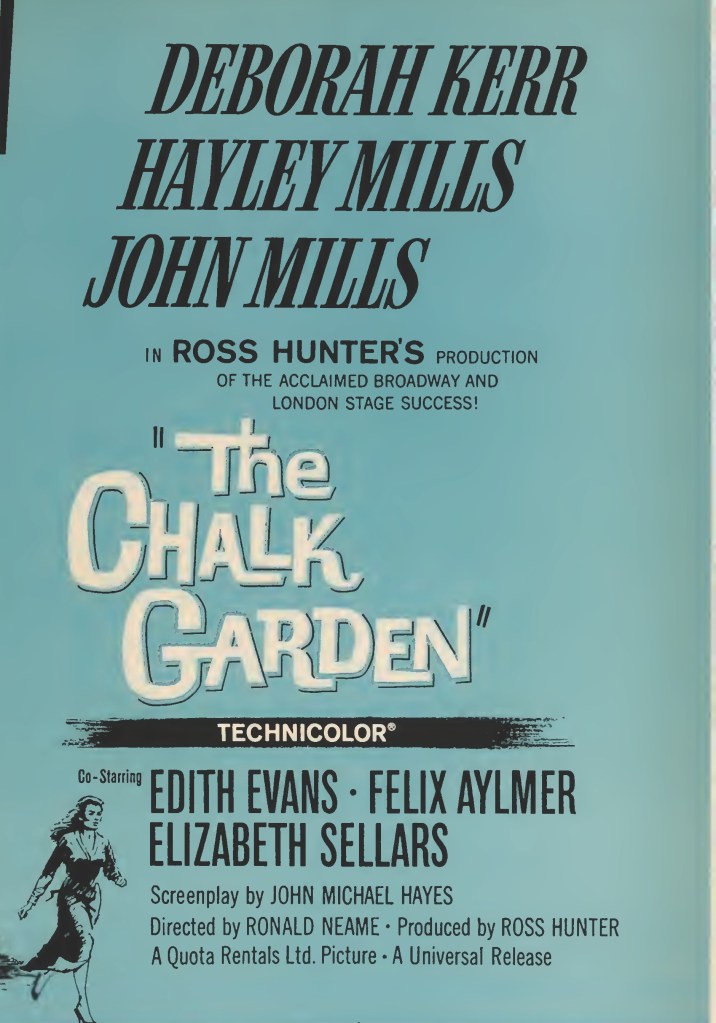
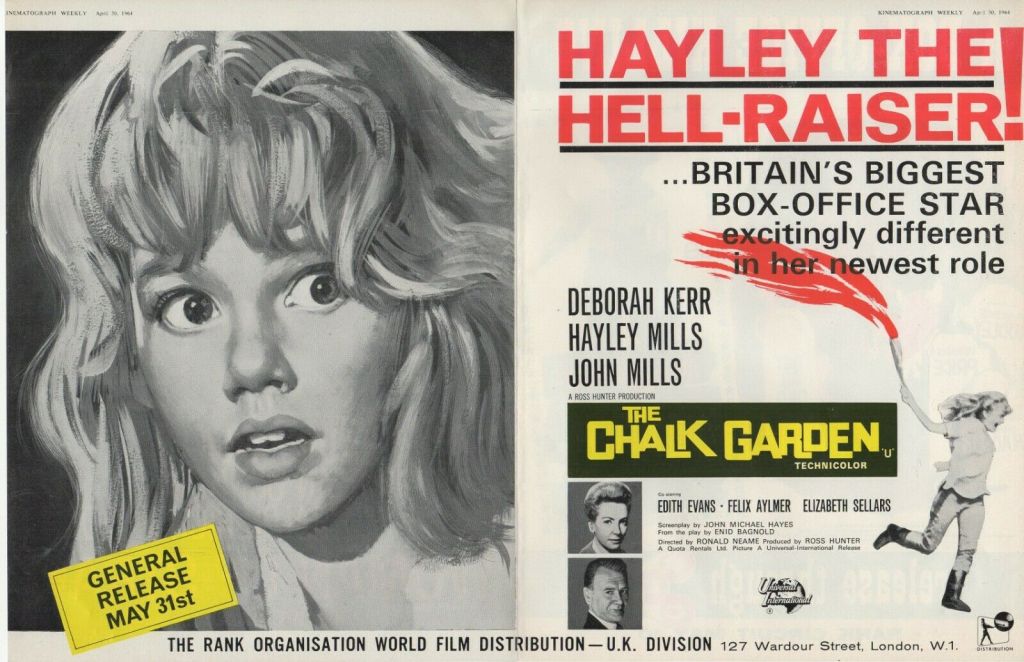
The Chalk Garden (1964) ***

You couldn’t make a movie like this now because (plot spoiler, I’m afraid) even the dottiest of old ladies would make at least a better attempt at collecting a reference from a prospective employee for fear she might be hiring someone disreputable. Though I doubt if many employers would expect a governess to turn out to be a murderess.

That this movie chimes with a contemporary trope – the criminal wanting to prevent others from following in their footsteps – makes it far ahead of its time. Made today, of course, the unruly child rather than merely threatening to unleash her arson impulses would probably have burned the house down.

So it’s more a drama of manners, if you like. Very presentable but clearly down-on-her-luck Miss Madrigal (Deborah Kerr) is taken on by Mrs St Maugham (Edith Evans) as governess for her grandchild Laurel (Hayley Mills) because nobody else wants the job. Laurel’s outrageous behavior has sent a score perfectly well qualified ladies scurrying. Madrigal is hardly fazed by anything Laurel can get up to.

But the child is clearly suffering abandonment issues, her beautiful mother Olivia (Elizabeth Sellars) having gone off with another man. Grandmother incites grandchild to hate the mother. But Olivia’s maternal instincts have kicked in and she wants her child back. While Madrigal can deal with Laurel’s tantrums she is less fortified against the child’s inveterate snooping. Finding a mysterious suitcase leads Laurel to fantasize about Madrigal’s past.

Mostly the film is a four-hander, butler Maitland (John Mills) playing a significant role in proceedings, not least in his effortless management of the wild child. Quite why a such a pragmatic and assured gentleman should end up in this remote mansion is another mystery and thankfully there is no attempt made at playing up the cliff-top location in a suspenseful manner.

Mrs St Maugham is imperious but not entirely practical, either in setting child against mother or in trying to grow flowers in such chalky soil, though Madrigal appears to have sufficient horticultural knowledge to set her straight on the latter and attempt to intervene on the former.

There’s a deadline of sorts. Olivia is coming to remove the child. Whether she goes willingly or not doesn’t matter. Madrigal sees her role as trying to prepare a child to love her mother and be more grown-up than the adults around her and forgive her.  

Madrigal’s guilt unnecessarily causes her to reveal that she had been jailed for murdering her stepsister, having been as resentful and jealous of the girl as Laurel currently is of her mother. Mrs St Maugham had called on old acquaintance Judge (Felix Aylmer ) for legal advice on how to prevent Olivia getting the child. He was the presiding judge in Madrigal’s case. Imagining he had not forgotten the trial – which of course he has – she feels duty bound to blurt out the truth before she is humiliated.  The confession helps Laurel realise how dangerous a path she is on and pushes her towards reconciliation rather than revenge.

It has all the making of a well-made play which is hardly surprising since it is based on Enid Bagnold’s Broadway success, at one time mooted as a film to star Joanne Woodward and Sandra Dee. So it moves along in the traditional three-act manner, plenty space given to establishing characters, introducing the undercurrents and leading to revelation and resolution.

So, mostly, it depends on the acting. Luckily, it is excellent. This was Hayley Mills in transition, far removed from Disney saccharine of The Parent Trap (1961) and about the same distance from the full-blown adult bottom-baring of The Family Way (1966). She projects a great deal more torment than in either of those films and comes across as believable, not exactly a young hoodlum but left to her own devices and starved of parental love only a matter of time before she would commit a crime of some kind.

Deborah Kerr hadn’t made a film in three years but her screen persona had shifted from the passionate – From Here to Eternity (1953), An Affair to Remember (1957), The Sundowners (1960) – to the repressed. Her spinster introduced in The Innocents (1961) had a great deal in common with her spinster of The Night of the Iguana (1965). But this is a different kettle of fish. Here, she exudes capability but with a self-awareness that undercuts such confidence, trying to keep a lid of emotions she struggles to handle.

John Mills (Tunes of Glory, 1960) casts a sardonic eye on the household while Edith Evans (The Whisperers) portrays a sorely wounded matriarch. Director Ronald Neame (Gambit, 1966) cleverly opens up the play, using the cliffs, gardens and rocky beach to considerable effect, but keeps the drama taut. John Michael Hayes (Nevada Smith, 1966) produced a workable screenplay.

Apologies for giving away the story, a good watch more for the acting than the twist.

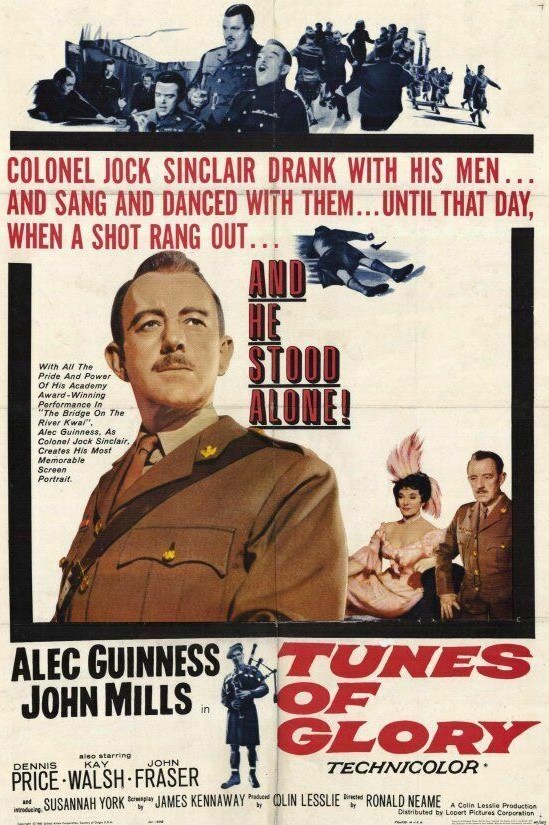
Tunes of Glory (1960) ****

Fans of Succession will appreciate this power struggle in a Scottish army regiment set in 1948. In a reverse of The Godfather (1972) where the Corleones complain about needing a “wartime consigliore,” here the powers-that-be have decided this unnamed distinctly Highlander company requires a commanding officer with skills more appropriate to peace time.

Major Jock Sinclair (Alec Guinness) has been in charge of the battalion since the North Africa campaign in World War Two when the original commander was killed. But he has never been promoted to full Lt. Col. Naturally, having been in charge for six years, he feels the job should be his. At a time when the currency of command was wartime experience he’s less than pleased when he loses out to Col. Barrow (John Mills) who spent most of the war as a Japanese POW.

It doesn’t help that they are complete opposites. Sinclair is a tough, hard-drinking, attention-seeking Scotsman who enlisted as an ordinary soldier and rose through the ranks winning two medals for courage during the conflict. Barrow is Oxford-educated English upper-class, a lecturer at Sandhurst Military Academy, and recalls his war experience with terror rather than the braggadocio of Sinclair. Worse, he doesn’t drink.

It doesn’t take long for the pair to clash. Sinclair, who has ruled as much by preying on weakness as force of personality, is quick to start to look for flaws in his opponent’s make-up. Barrow feels discipline has been slipping and enforces tougher measures. That might make him unpopular but an army is built on discipline so soldiers can hardly complain.

But Barrow slips up by misreading the men. He chooses the worst of all issues to make a stand. For the first post-war official barracks party, Barrow insists the soldiers embark on traditional Highland dancing in regulation fashion rather than in their normal exuberant, not to say rowdy, manner. The soldiers are infuriated when Barrow insists they take lessons.

He has just lit the fuse. Naturally, nothing goes according to plan. Barrow is humiliated, Sinclair triumphant. But victory does not turn out the way Sinclair expected.

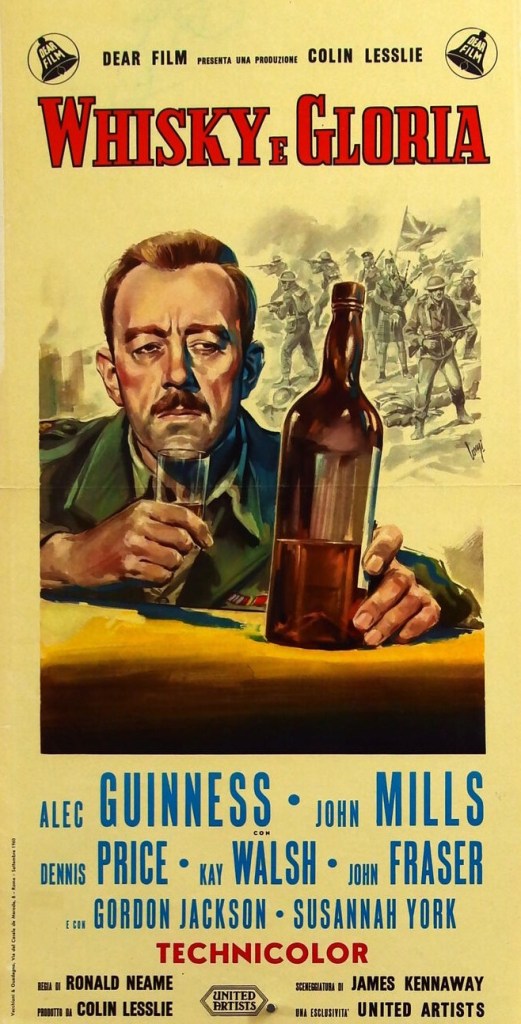
Somewhat cynical rebranding of the film in Italy as “Whisky and Glory,” possibly trying to cash in on the success of “Whisky Galore” and also misleading in suggesting actual conflict with the fighting in the background.

The main thrust of the narrative, as you might expect, is the stand-off between Sinclair and Barrow and the tensions felt all round, as would be the case in any business (Succession, now, of course the classic example) when a new boss takes control. While everyone might expect, and perhaps fear, change, in the military (as in the navy) there is always the danger, should the new broom try to sweep too clean, of mutiny.

This might not amount to a raising of arms. But there are other effective methods of mounting opposition – laxity, questioning or outright refusal to obey orders – or giving the new chief the cold shoulder. Here, in the background, are other simmering tensions. Not everyone is comfortable with Sinclair’s very laddish approach to command, the back-stabbing and double-dealing Major Charles Scott (Dennis Price) ready to pounce at any opportunity.

Sinclair is also having to deal with his daughter Morag (Susannah York) asserting her independence, having the temerity not just to take a boyfriend, Corporal Fraser (John Fraser), but one from the ranks rather than the officer class. And he feels the harsh tongue of his own paramour Mary (Kay Walsh).

Emotional isolation is rarely commented upon in matters of the armed forces and yet it is so much a driving force. If not adequately compensated by camaraderie, a man at the top can be very lonely indeed, and prone to the most vicious self-torment.

Director Ronald Neame (The Prime of Miss Jean Brodie, 1969) superbly invokes an army atmosphere away from the more usual battleground backdrop. The picture is anchored by brilliant performances all round and a roll-call of strong supporting characters. An unflinching look at power, especially leadership and the personal toll it takes. And it was astonishing that the movie could hit the target so well without relying on the usual round of sex, violence or that old stand-by the comic subordinate. It also probes the issues of what happens – in any industry – when the wrong person is put in charge. No less an authority than Alfred Hitchcock called it “one of the best films ever made.”

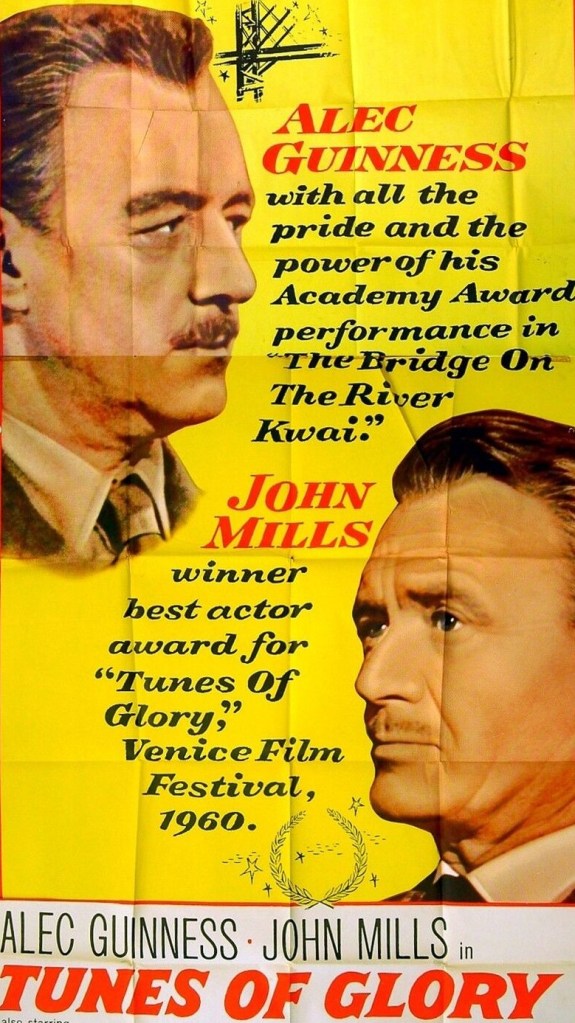
The sparring between Oscar-winning Alec Guinness (The Quiller Memorandum, 1966) and John Mills (The Family Way, 1966), who won the Best Actor Award at the Venice Film Festival for this role, is of the highest quality. Dennis Price (The Comedy Man, 1964) is the pick of the support while Susannah York (Sands of the Kalahari, 1965) makes an auspicious debut.

Few films could boast a better supporting cast: former British leading lady Kay Walsh (A Study in Terror, 1965), Gordon Jackson (The Ipcress File, 1965), Duncan Macrae (Best of Enemies, 1961), John Fraser (Tamahine, 1963), Gerard Harper (Adam Adamant Lives!, 1966-1967, TV series) and Peter McEnery (The Moon-Spinners, 1964).

James Kennaway (The Shoes of the Fisherman, 1968) wrote the screenplay based on his own novel.

A Man Could Get Killed (1966) ****

An unexpected delight. More farce than spoof and more Hitchcockian thriller than espionage adventure, but bursting with laughs. Spinning on the premise of mistaken identity, a New York banker becomes mixed up with diamond smugglers while being pursued by a posse of Europe’s shadiest characters and a very determined femme fatale. All the more enjoyable because identity confusion is very difficult to pull off unless you have a top class cast like Cary Grant and Eva Marie Saint in North by Northwest (1959).

Landing in Lisbon, New York banker William Beddoes (James Garner) is mistaken for the emergency replacement for a recently-deceased British spy. It’s not just embassy officials like Hatton Jones (Robert Coote) who are afflicted by this notion, the villains are so determined to get rid of their man two bombs are planted in his car. Attending his supposed predecessor’s funeral brings Beddoes into contact with glamorous Aurora (Melina Mercouri). Smuggler Steve (Anthony Franciosca) offers his service to Beddoes to help recover $5 million in stolen industrial diamonds. To complicate matters, identity is also an issue for Steve, who while working under an assumed name is outed by Amy (Sandra Dee) who recognizes him as her family’s former gardener.

Unable to convince anyone he is not who he says he is, Beddoes is swept into the conspiracy, his every move under surveillance by rival villains, including Florian (Gregoire Aslan) and Milo the Murderer (Arnold Diamond), while Aurora attempts seduction to bring him to heel.  Eventually, while never ruling out double-cross, Beddoes, Aurora, Steve, Amy and embassy officials work together to decipher a series of clues revolving around rice, azaleas, a red pig and a man who sneezes, none of which align with obvious meanings and naturally are interpreted as something to do Red China or the Iron Curtain.

A picture based on a simple premise is better than a spoof that labors to create a plot and so it’s true here. Everything springs from the mistaken identity and the diamond hunt, and as one twist effortlessly follows another characters with conflicting agendas collide. Beddoes spends all his time trying to escape from kidnap, assassination or seduction. It’s helter-skelter stuff, so no surprise that chases, of the Buster Keaton variety, produce laughs. I found myself laughing out loud at the scene where Steve can’t find anywhere to sit in a café that is not next to a villain, Beddoes getting attacked by drapes, an ambassador (Cecil Parker) more concerned with knotty chess problems than espionage, and a great visual gag where Beddoes  wallops a cop. Escaping pursers, Steve takes a short cut that leads him straight back into danger.

Naturally, the whole enterprise is loaded with confusion, not least because making the wrong decision, taking the wrong turn and making the wrong assumption sets up the next gag. Throw in ambulance theft, Beddoes sitting in a row of hookers in jail, a tape recording turning up in a bread roll and you get the idea.

The cast could have been hand-picked for this kind of picture. James Garner (The Hour of the Gun, 1967) is the  natural successor to Cary Grant in the double-take department. This role is a play on previous ones where he was the trickster and not the patsy. He’s more stiff-upper-lip than the Brits. Comedy skills honed on this one that were put to terrific use in Support Your Local Sherriff (1969). And while Melina Mercouri (Topkapi, 1964) is more than a little over-the-top, the dominant woman from whom ordinarily Beddoes would run a mile, but also possessing the cunning survival instincts lacking in an innocent like him. One scene that depicts their contrasting characters so well is when she runs around half-naked to create a diversion and he chases after trying to cover her up, clearly no idea that distraction is necessary.

Tony Franciosca (The Swinger, 1966) leads with his teeth, his smarminess undercut by Sandra Dee reminding him he is a glorified gardener. Dee (Tammy and the Doctor, 1964), however, never manages to stray from her ingénue roots. An excellent supporting cast includes Robert Coote (The Swinger), Gregoire Aslan (Moment to Monet, 1966), Cecil Parker (A Study in Terror, 1965). This was British actress Dulcie Gray’s final film.

The movie had a fractured genesis. Original director Cliff Owen (The Vengeance of She, 1968) fell out with the stars and was shunted aside in favor of Ronald Neame (Gambit, 1966), more adept at male-female chicanery. The screenplay originated from comedic masters – Richard Breen (Do Not Disturb, 1965) and T.E.B. Clarke (The Lavender Hill Mob, 1951)  – based on the book Diamonds for Danger by David E. Walker. And there are many delightful lines. “I’m my own bait,” spouts Aurora. Trying to placate Amy, Steve explains “It’s unusual to find this many dead spies in one day.”

The movie failed to register with the public which was astonishing. At a time when theme songs helped turn other films like Alfie (1965) into successes, the movie contained the tune that would give Frank Sinatra his first number one single in over a decade, “Strangers in the Night.” Unfortunately, the movie did not carry Sinatra’s imprimatur. The music in the film was an instrumental. Had Sinatra’s voice been heard in the movie it might have turned it into a hit.

For a long time, this under-rated delightful comedy was hard to find. There still is not a Region 1 DVD, but you can find it on Region 2 and YouTube has kindly provided a free copy.

Escape from Zahrain (1962) ***

After being attacked by armored cars and strafed by airplanes, stranded in the desert, and overcome various tensions within the small group of escapees, there is still considerable life left in this picture at the end as Jack Warden, making his departure, comes up with a classic last line: “We must do this again sometime.”

In truth, the picture has far more going for it than a mere outline would suggest. In rescuing rebel leader Yul Brynner from a lorry bound for jail, the escapees led by Sal Mineo (Exodus, 1960) in a stolen ambulance also scoop up three convicts including American fraudster and loudmouth Jack Warden (That Kind of Woman, 1959) and all-purpose thug Anthony Caruso (a television regular) plus a nurse Madhlyn Rhue (A Majority of One, 1961) as a hostage. Like most desert films, the storyline is on who will survive and how.

Action is one constant. The threat of failure is another. Supplies are rationed and, of course, someone steals more than their fair share. The members regularly switch allegiance. At various points someone is about to give up Yul Brynner. Their gas tank is punctured so, thanks to Warden’s engineering skills, they just make it to a remote pumping station where James Mason pops up in a cameo as a maintenance man. Their numbers diminish and despite his recalcitrance Warden’s engineering skills save them again when they reach an oasis.

This was originally intended as a starring vehicle for Clark Gable with Edward Dmytryk in the director’s chair.

What makes the film different is that the characters all change. In a country where “half the wealth is stolen by Europeans and half by corruption,” Brynner is the altruistic leader whose ideals are shattered. Rhue, a Muslim, drinks alcohol and questions the number of deaths necessary for a revolution but declines to leave when the opportunity arises. Mineo who thinks “women should be as free as men” reacts badly when Rhue enjoys such freedom. Warden, who has embezzled $200,000, and has loyalty to no one stands by the shambolic crew.

I had always believed Brynner had enjoyed a rare case of beginner’s luck when he won the Oscar for his debut in The King and I (1956) and that once Hollywood became wise to his acting schtick he would never be nominated again – as proved the case. But after watching Brynner in The Magnificent Seven (1960) and its sequel and Invitation to a Gunfighter (1964) and Flight to Ashiya (1964) I have become convinced he is under-rated as an actor. He acts with his eyes and his delivery is far more varied than I had supposed. Here, clothed in Arab costume, there is no bald pate to distract.  

British director Ronald Neame (Tunes of Glory, 1960) holds the enterprise together, keeping to a tidy pace but allowing tension and character to emerge.

Many of the films from the 1960s are to be found free of charge on TCM and Sony Movies and the British Talking Pictures as well as mainstream television channels. Films tend to be licensed to any of the above for a specific period of time so you might find access has disappeared. But if this film is not available through these routes, then here is the link to the DVD and/or streaming service.

Gambit (1966) ****

The heist movie – as epitomised by The Asphalt Jungle (1950), The Killing (1958) and Jules Dassin’s Rififi (1955) and Topkapi (1954) – had tended to be a relatively low-budget affair. Top-ranking stars steered clear because complicated plot often got in the way of character development  In the highly polished and entertaining Gambit British director Ronald Neame’s riff on the genre involved a narrative shift worthy of Christopher Nolan, Quentin Tarantino and, of course, Akira Kurosawa who had with Rashomon (1950) single-handedly invented the complex point-of-view.

Neame brought another couple of other aces out of the deck. First of all, there was the fun of watching over-confident thief Michael Caine’s apparently foolproof plans come unstuck. Secondly, in a romantic dynamic in the vein of It Happened One Night (1934) the less accomplished female (Shirley MacLaine) proves more accomplished than the male.

Gambit was also a clear demonstration of the power of the female star not just in the plot complications but from the fact that Caine owed his big Hollywood break to MacLaine, the actress having the power of veto over the male lead and, equally, contractual right to choose her co-star. The movie went through an interesting development phase. The original script by director Bryan Forbes (King Rat, 1965) had Cary Grant in the central (i.e MacLaine) role. Rewritten by Jack Davies (Those Magnificent Men in Their Flying Machines, 1965) and in his movie debut Alvin Sargent (The Stalking Moon, 1968) the main character underwent a gender shift.

After Psycho (1960) audiences had become used to being messed around. Stars could be killed off halfway through or not appear (Operation Crossbow a classic example) until well into the movie. Neame was not quite so bold but what audiences made of the usually garrulous MacLaine being rendered mute during the early part of the picture was anybody’s guess, perhaps the dumb show was a joke in itself. But lack of dialogue did not prevent MacLaine from stealing the show and proving what an adept comedienne she was, a barrage of submissive looks enough to send an audience into hysterics.

In essence, Caine plays two characters. In the opening segment he is the brash, cocky  English gentleman-thief at the top of his game, bossing MacLaine around, gulling his mark (Herbert Lom) with an audacious plan to steal an expensive sculpture. In his version of events his plan goes off without a hitch. But when we switch to the MacLaine perspective, in which nothing goes according to plan, his cool demeanour is sorely tested and he turns into a frustrated idiot. Watching the movie now, you can almost imagine that the MacLaine character, with a host of useless facts at her fingertips, was making fun of Caine’s well-known love of trivia, but that predated the actor’s acknowledgement of this aspect of his real-life character.

What makes the movie so much fun is that both parts of the film work and for the same reasons: believable characters, exciting heists and plenty of twists. The initial premise is that Caine recruits Hong Kong dancer MacLaine due to her startling resemblance to the late wife of Arab billionaire Herbert Lom as part of a ploy to relieve him of a priceless artefact. While Lom is falling for MacLaine, Caine moves in for the kill with an ingenious heist. Mission accomplished he pays her off. But in the real version of the story, as seen through her eyes, Lom does not fall for the ridiculous scam, Caine’s plan fails to work until MacLaine comes to the rescue. Meanwhile, MacLaine has fallen for Caine, but does not want to be in love with a criminal. Although Caine initially resists his own emotions, he, too, takes the romantic plunge except that to win her he may have to lose what he prizes more.

As I mentioned it is awash with twists and the heists themselves are exceptionally well done but the screen chemistry between the two leads is terrific. Caine, who had otherwise been in control in his previous starring roles as the upper-class officer in Zulu (1963), spy Harry Palmer in The Ipcress File (1965) and the womanising Alfie (1966) – The Wrong Box (1966) was an ensemble item – was taking a chance in playing a character who would effectively play second fiddle to the star and in terms of the thief often appears out-of-control. MacLaine was more obviously in her safety zone. Hollywood spent a lot of time investing in screen partnerships, mostly failing, but this pairing certainly succeeded.

Discover WordPress

A daily selection of the best content published on WordPress, collected for you by humans who love to read.

The Atavist Magazine

by Brian Hannan

WordPress.com News

The latest news on WordPress.com and the WordPress community.