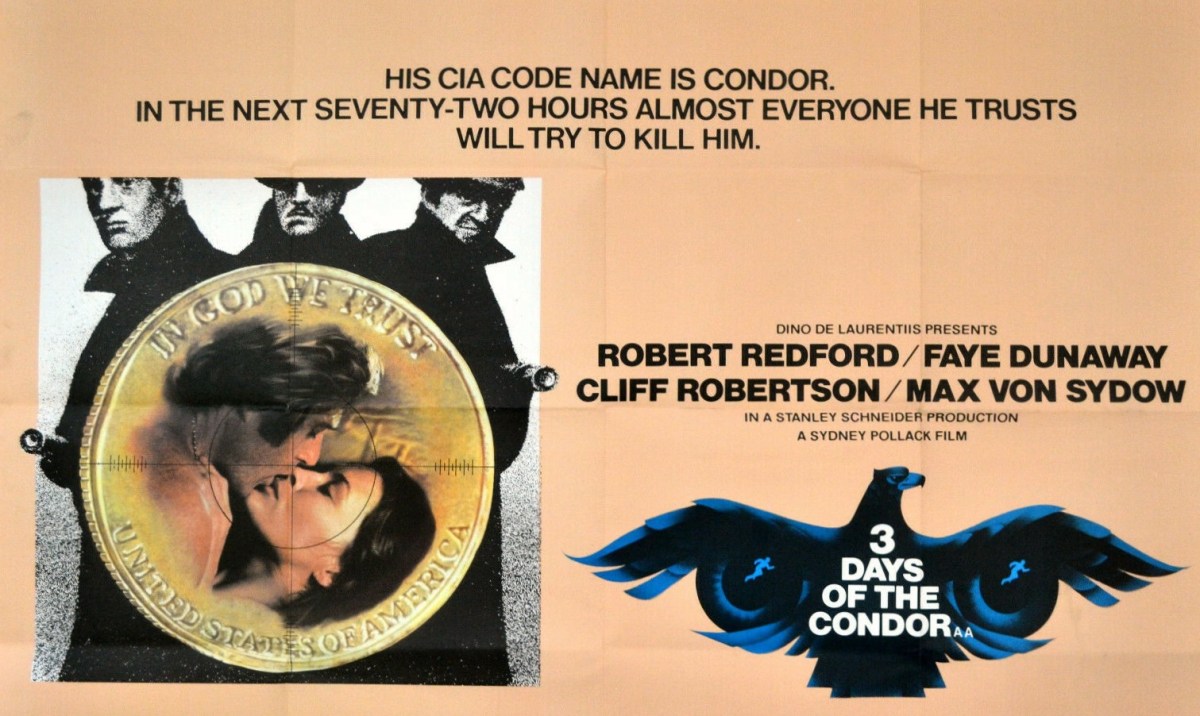
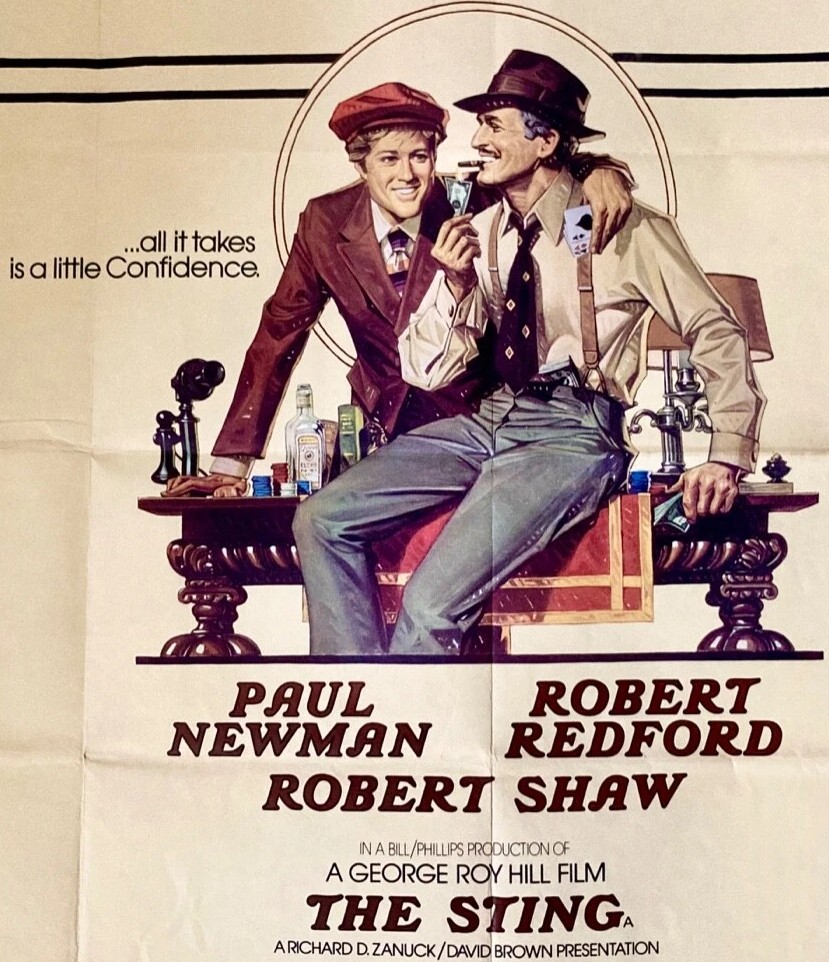
My belated tribute to the recently-deceased Robert Redford. He’s made a bunch of worthier films and his pair with Paul Newman – Butch Cassidy and the Sundance Kid (1969) and The Sting (1973) – take some beating. But this is the one I go back to the most because it combines worthiness with thrills and two stunning performances.
Outstanding thriller in the paranoia vein with Robert Redford delivering one of his best performances. Never mind the terrific score by Dave Grusin (Tell Them Willie Boy Is Here, 1969), the soundtrack to this tale of political chicanery involving the C.I.A. is the chattering of computer printers.
Joe Turner (Robert Redford) is an amiable geek – beanie hat, unfashionable Solex moped – working in an obscure department of the C.I.A. (although one where the receptionist has a gun in her desk drawer) looking for codes in novels. He doesn’t quite conform to type, irritating his rules-conscious colleagues, late for work, illicitly using the back door instead of the front. On returning from collecting lunch, he finds the entire department massacred. His Washington boss Higgins (Cliff Robertson) promises to bring him in but instead arranges an ambush.
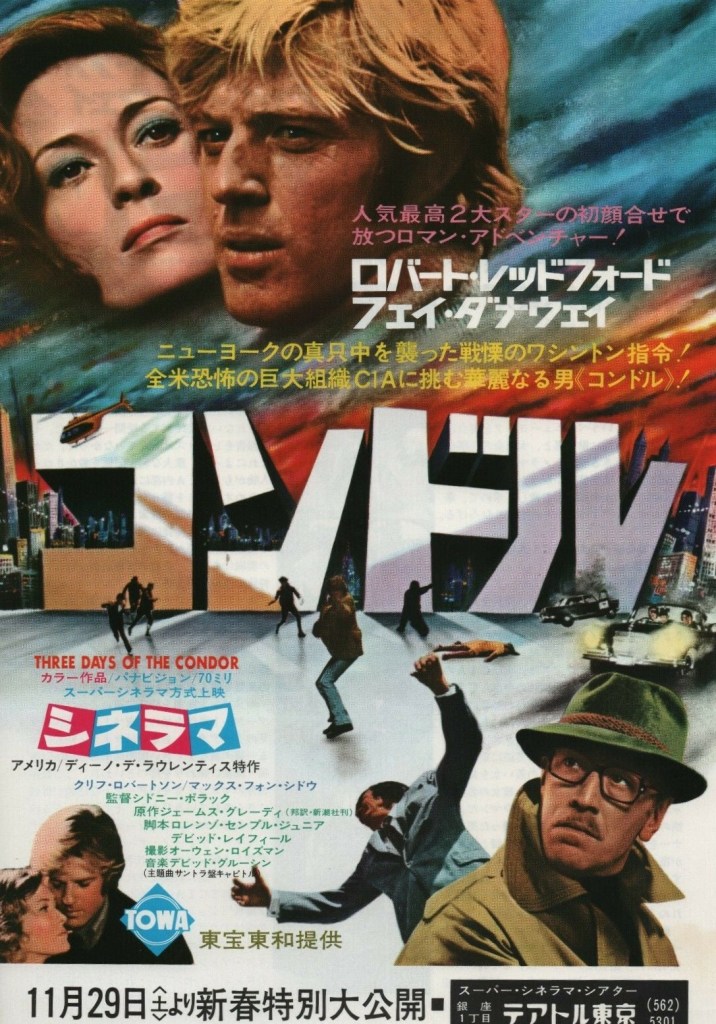
On the run, unable to return to his own apartment, his girlfriend Janice (Tina Chen) among those murdered, he kidnaps photographer Kathy (Faye Dunawaye) at first content to find somewhere to hole up but then using her to help him resolve the issues. It’s soon apparent that Turner, in his desk job, has stumbled upon a secret organisation deep within the C.I.A. In a touch of the Hitchcocks, director Sydney Pollack (The Scalphunters, 1968) lets the audience know what Turner does not, that Higgins and his bosses Wabash (John Houseman) and Atwood (Addison Powell) are out for his blood, assassin Joubert (Max von Sydow) the triggerman.
But as Joubert points out, Turner is an amateur and that makes him unpredictable. The killers believe Turner will easily be dealt with. But he’s not as stupid or unresourceful as they might expect. The opening section reveals just how handy he is: fixing a computer, knowledgeable about plants and for some reason the weather, working out an insoluble murder in a book, and most important of all has learned to trust nobody especially his bosses. It turns out he’s got a few of his own tricks up his sleeve, not least how to work a telephone exchange to his advantage and how to flush out his adversaries.
There’s a terrific game of cat-and-mouse and in possibly the only picture in the early cycle of conspiracy pictures the first character capable of harnessing technology.
You often read about character-driven movies but that’s only usually in the sense of dramatic flaws or preferring exploring personality to action. This is character-driven in an entirely different way. Turner’s life depends on him being able to read character, to notice what’s wrong or false in a given situation, to assess the qualities of those around him. For much of the dialogue, Turner is observing as much as listening, watching for behavioural clues.

Even without the presence of Kathy, this would have been a highly satisfactory thriller. But the tentative romance takes it to another level. Unusually, she is a loner, whose photographic metier is loneliness. That they bond at all is surprising, that they do so with such touching emotion brings unexpected intimacy.
There’s a very contemporary feel to the politics, not just American authorities doing what they want but the idea that liberal values will vanish the moment there is genuine threat to loss of the high living standards citizens enjoy or, worse, oil or gas rationing or famine. “Do we have plans to invade the Middle East?” Turner demands of Higgins. You can’t get more contemporary than that! And at one point Turner uses unsuspecting people as a human shield.
For such a fast-moving picture, time is taken out to understand the characters involved, Higgins not quite as far up the espionage tree as he should be, Joubert’s hobby the meticulous painting of model soldiers. A peck on the cheek is all the information we are given that Tina, a work colleague, is Turner’s girlfriend.
As Kathy moves from indignant captive to welcome participant, you can see that she represents the desire of many liberals to give the authorities a bloody nose. There is one brilliant moment at the end where Turner’s fears overcome his feelings and the devastation of what she perceives as emotional betrayal is seen on her face.
But this is Robert Redford’s picture. He was on an almighty box office roll – Jeremiah Johnson (1972), The Sting (1973), The Way We Were (1973), The Great Gatsby (1974), The Great Waldo Pepper (1975) and on the horizon All the President’s Men (1976). Every minute of the movie his face or body are working hard, eyes constantly involved in the character observation I mentioned. He goes from being light-hearted and handsome at the start to serious and deadly at the end. And there are some superb bits of business. When the rain stops, for example, he checks his watch to see it has ended when he predicted. When he returns after lunch, he peers down over the steps to see that his moped that earlier some kids had tried to steal was still there.
This is probably the quietest you’ll ever see Faye Dunaway (A Place for Lovers, 1968). She is an enigma, the puzzle only uncovered in her photographs. But as a photographer, she is also an observer, and she soon likes what she sees in Turner. The strong supporting cast includes Cliff Robertson (Masquerade, 1965), Max von Sydow (The Quiller Memorandum, 1966), John Houseman (Seven Days in May, 1964), Tina Chen (Alice’s Restaurant, 1969) and Addison Powell (The Thomas Crown Affair, 1968).
Sydney Pollack does an exceptional job, cutting between the pursuers and the pursued. The opening sequence itself is quite superb as the director sets up the massacre which is carried out in silence, machine guns fitted with suppressors, while providing insight into Turner. Based on the bestseller Six Days of the Condor by James Grady, the intelligent screenplay by Lorenzo Semple Jr.(Fathom, 1967, and The Parallax View, 1974) and David Rayfiel (Castle Keep, 1969) keeps everyone on their toes.
More straightforwardly enjoyable than Coppola’s self-conscious The Conversation (1974) and Pakula’s occasionally opaque The Parallax View (1974) with computer surveillance, giving this another contemporary edge, a key factor in the way the tale that switches between pursued and pursuer





 The Magnificent 60s