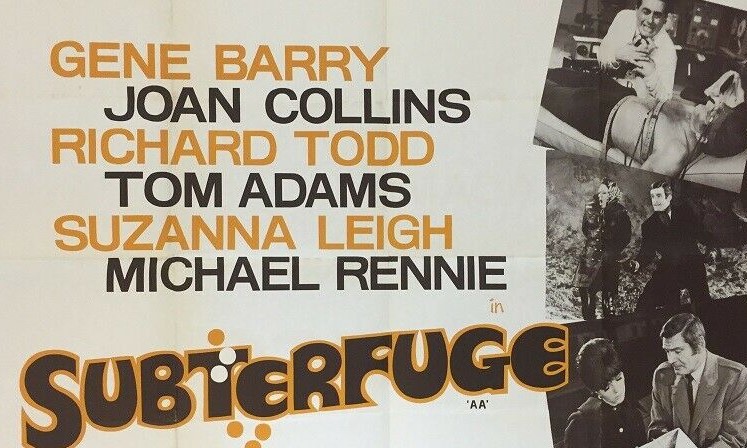
Subterfuge (1968) ***

Worth seeing alone for super-slinky leather-clad uber-sadistic Donetta (Suzanna Leigh) who delights in torturing the daylights out of any secret agent who crosses her path, in this case Michael Donovan (Gene Barry). She’s got a neat line in handbags, too, the poisonous kind. Two stories cross over in this London-set spy drama. American Donovan (Gene Barry) is under surveillance from both foreign powers and British intelligence. When his contact comes into unfortunate contact with a handbag, he finds himself on the sticky end of the attention of Shevik (Marius Goring) while at the same time employed by the British spy chief Goldsmith (Michael Rennie) to find the mole in their camp.

The three potential suspects are top-ranking intelligence officers: Col. Redmayne (Richard Todd), British spy Peter Langley (Tom Adams) and backroom underling Kitteridge (Colin Gordon). On top of this Langley’s wife Anne (Joan Collins) adds conscience to the proceedings, growing more and more concerned that the affairs of the secret state are taking too much precedence over her marriage.

The hunt-the-mole aspect is pretty well-staged. Kitteridge always looks shifty, keenly watching his boss twisting the dials on a huge office safe containing top secret secrets. Langley is introduced as a villain, turning up at Shevik’s with the drugs that are going to send  Donovan to sleep for eight hours for transport abroad in a trunk. But he turns out to be just pretending and aids Donovan’s innovative escape. Charming but ruthless Redmayne is also under suspicion if only because he belongs to the upper-class strata (Burgess, Philby and Maclean etc) that already betrayed their country.

In investigating Langley, Donovan fixes on the wife, now, coincidentally, a potential romantic target since her husband is suing for divorce. She is particularly attracted to Donovan after he saves her son from a difficult situation on the water, although that appears manufactured for the very purpose of making her feel indebted. However, the couple are clearly attracted, although the top of a London bus would not generally be the chosen location, in such glamorous spy pictures, for said romance to develop.

As you will be aware, romance is a weak spot for any hard-bitten spy and Shevik’s gang take easy advantage, putting Anne, her son and Donovan in peril at the same time as the American follows all sorts of clues to pin down the traitor.

This is the final chapter in Gene Barry’s unofficial 1960s movie trilogy – following Maroc 7 (1967) and Istanbul Express (1968) – and London is a more dour and more apt climate for this more down-to-earth drama. Forget bikinis and gadgets, the best you can ask for is Joan Collins dolled up in trendy min-skirt and furs. Gene Barry, only too aware that London has nothing on Morocco or Istanbul in the weather department, dresses as if expecting thunderstorms, so he’s not quite the suave character of the previous two pictures, but that does not seem to dampen his ardor and the gentle romantic banter is well done.
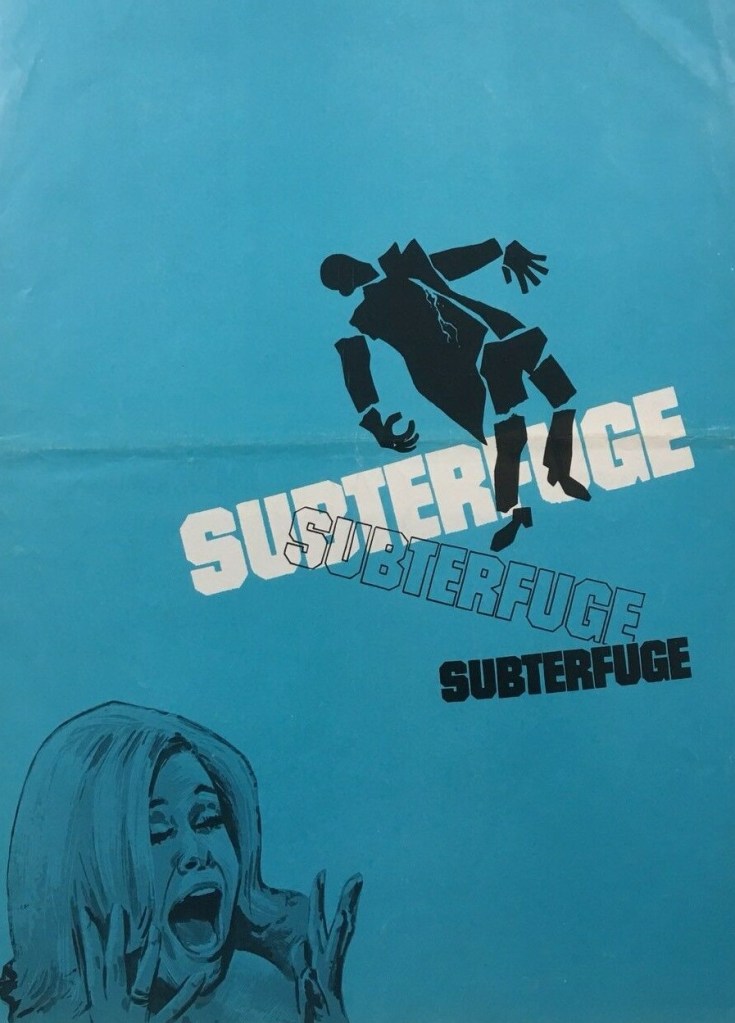
Joan Collins, in a career trough after her Twentieth Century Fox contract ended with Esther and the King (1960), has the principled role, determining that the price paid by families for those in active secret service is too high. No slouch in the spy department himself, essaying Charles Vine in three movies including Where the Bullets Fly (1966), Tom Adams plays with audience expectations in this role.

It’s a marvelous cast, one of those iconic congregations of talent, with former British superstar Richard Todd (The Dam Busters, 1955) and Michael Rennie, television’s The Third Man (1959-1965), Marius Goring (The Girl on a Motorcycle, 1968) and Suzanna Leigh (The Lost Continent, 1968) trading her usual damsel-in-distress persona for a turn as terrific damsel-causing-distress.

Shorn of sunny location to augment his backgrounds, director Peter Graham Scott (Bitter Harvest, 1963) turns his camera on scenic London to take in Trafalgar Square, the zoo, Royal Festival Hall, the Underground, Regent’s Park with the usual flotilla of pigeons and ducks.

Get slinky.
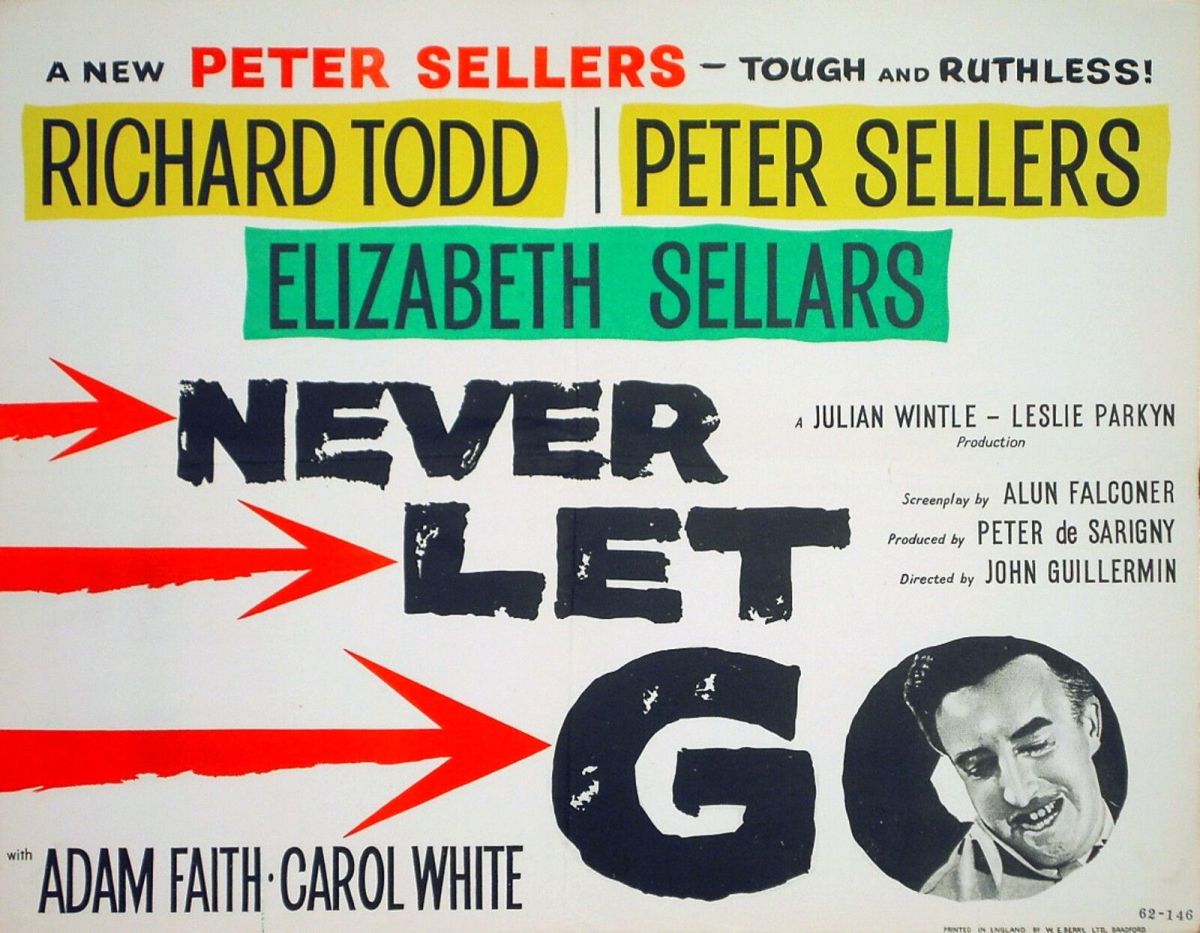
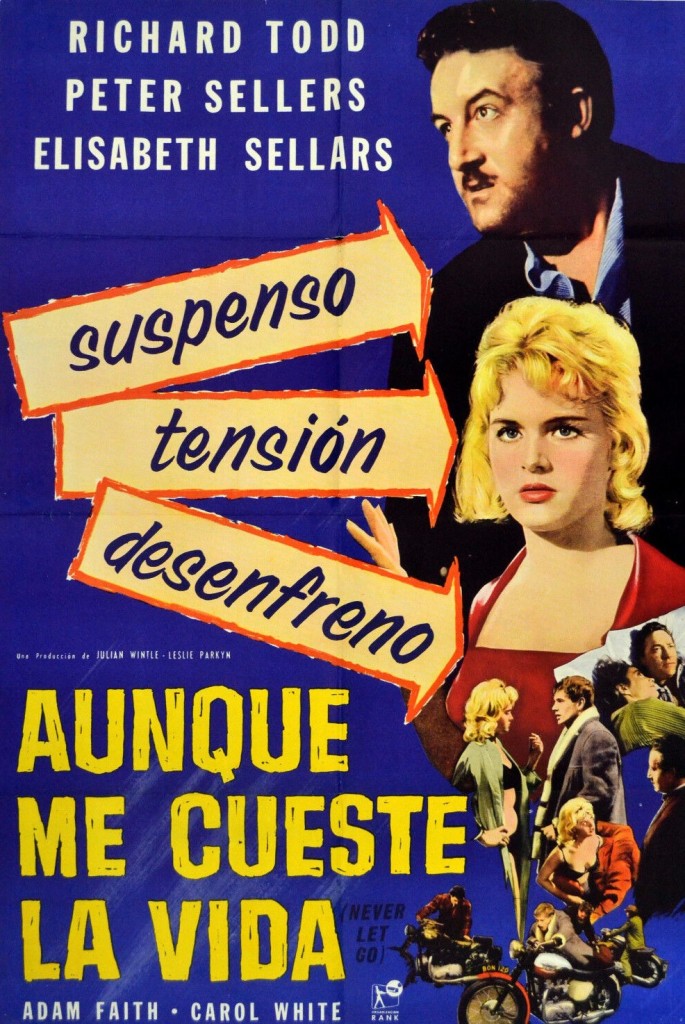
Never Let Go (1960) ****

Under-rated British film noir classic. All the principals playing against type. Comedian Peter Sellers (The Millionairess, 1960) as the villain, British hero Richard Todd (The Dam Busters, 1955) comes seriously unstuck, pop star Adam Faith (Beat Girl / Wild for Kicks, 1960) tosses away his cuddly image. One of the earliest scores by John (James Bond) Barry. First grown-up role for Carol White (Daddy’s Gone A-Hunting, 1969). As much savage violence as the censor would allow at the time.

Down-on-his-luck salesman John (Richard Todd) has his car stolen. It’s uninsured. Without it he can’t get to his appointments on time. The police aren’t interested. So he has to investigate. That leads first to dodgy Teddy Boy Tommy (Adam Faith) who steals cars to order for supposedly legitimate businessman Lionel (Peter Sellers) and makes a play for Lionel’s young mistress Jackie (Carol White).

The interest lies not so much in the investigation as how those involved deal with pressure. John, hardly able to support wife Anne (Elizabeth Sellars) and two kids, has a history of failure, squandering money on get-rich-quick schemes, and apt to blow his top at clients who complain when he fails to keep appointments.

Doesn’t take long for him to lose his job. But instead of knuckling down and finding another, he stubbornly refuses to abandon his investigation, upsetting Scotland Yard Inspector Thomas (Noel Willman) who has much bigger fish to fry.

Lionel is a cocky gangster not afraid to lash out. In fact, he seems to enjoy battering people with his fists, feet and broken bottle. He treats Jackie with contempt, reminding her she’d be a sex worker if it wasn’t for him. He’s got a nice little empire and has kept his nose clean. He pays off corrupt cops.

But the last thing he expects is to be pursued by a loser like John who’s not cut from the John Wick template. Not does he possess the very particular set of skills that appear to be the prerequisite of anyone embarking on a mission of revenge.

If director John Guillermin (El Condor, 1970) hadn’t been obliged to tag on a happy ending, this would have been a downbeat tour-de-force, with the good guy losing everything in order to win back his self-respect.

It just sizzles with tension. Lionel belongs to the generation that spawned the likes of Harold in The Long Good Friday (1980) or the Kray Twins, a simmering, stewing piece of work, all gloss on the outside, a tinderbox on the inside.  

There’s fabulous photography, eyes trapped in pools of light, overhead camera staking out victims, and seedy London picked out in detail. Newspaper vendor Alfie (Mervyn Johns), of pensionable age, the only witness to the crime, has his bedsit ransacked, the tiny terrapin he treasures crushed underfoot, when inadvertently he gives too much away.

Tearaway Tommy isn’t such a tough guy when Lionel comes battering on his door. Jackie is the only one who not so much stands up to Lionel as treats his idea of romance with disdain. Even when John fingers Lionel, Inspector Thomas bluntly tells him he’s too small fry and the cops aren’t interesting in chasing after his plebeian vehicle.

Lionel is the kind of gangster who is never going to realise he can’t always get away with it, that he might have to trim back his ambition until the coast is clearer. Instead, he batters on regardless, determined to terrify everyone into acquiescence.

As the movie progresses, the more you learn about John, the less you sympathise. His wife has stood by him through mostly thin, and will stick by him even if unemployed, but draws the line at antagonising a gangster who doesn’t know when to draw a line. John isn’t Gary Cooper in High Noon. He’s not a principled defender of the law. He’s almost as bad as the gangster, in that he doesn’t know when to stop, regardless of the danger this places his family.

Understandably, Peter Sellers attracted most of the critical plaudits, but this is the role of a lifetime for Richard Todd, who detonates his screen image, battered and bloodied almost beyond recognition, not hiding behind a stiff upper lip. Carol White, too, is superb as the mistress who just about recognises that this is not a good deal, and that she’s a chattel, not a loved one.

John Guillermin’s direction is superb. Coupled with the insistent, jazzy John Barry score, this is British film noir (admittedly, that’s not large pool to draw on) at its best.

https://amzn.to/3GoA77M

The Long and the Short and the Tall / Jungle Fighters (1961) ****

The Brits were onto something in wartime Malaysian jungles in 1942 – sonic warfare. Imagine the franchise possibilities for comic-book or spy villains (The Brides of Fu Manchu, 1966, or Some Girls Do, 1969, anyone?). Fortunately, this ignores such temptations and takes a long hard raw look at the reality of conflict, courage and cowardice, the desire and reality of killing.  

Beginning as a fairly stock examination of men in combat, the usual clash of personalities, bullying loudmouths, and it being British elements of class distinction. But it quickly moves on to something much deeper, initially tough guys worrying about what their wives are getting up in their absence back home, but on capturing a Japanese soldier what exactly to do with him once his usefulness is over. Treat him according to the Geneva Convention as a prisoner-of-war and escort him back to base or just get rid of him and save yourself the trouble.

Five main characters make up this squad. Sgt Mitchem (Richard Todd) is the ruthless leader under pressure. He was busted down to corporal for losing a previous patrol, has got his stripe back and wants to prove his worth. But he appears to be from a different generation to his troops, his stiff upper lip only too evident while the others just give lip.

Corporal Johnstone (Richard Harris) likes to remind him of his previous misdemeanor and question his judgement. Racist Private Bamforth (Laurence Harvey) riles everyone, especially picking on Lance Corporal Macleish (Ronald Fraser) who is as likely to reply with his fists. Radio operator Private Whitaker (David McCallum) is over-keen on the spoils of war, kitbag stuffed with enemy mementoes.

After apprehending Jap soldier Tojo (Kenji Takaki) Johnstone is inclined to bayonet him right away (a bullet would attract attention). Others, more squeamish than principled, balk at the deed. At first Bamforth makes fun of the captive, belittling him, but then views him as a human being caught up in a war not of his making, giving him cigarettes, trying to make him more comfortable. When Macleish starts slapping the prisoner around, Bamforth defends him, though it’s obvious Mitchem and Johnstone have no intention of taking him back.

Then the tide turns. They are surrounded by Japs and it’s battle for real with an enemy who can defend itself. Action determines character. Some are revealed as complete cowards, others will abandon colleagues to save their skin, others are instinctively courageous, others yet again with a bit more cunning.

But the firefight when it comes is nothing like any other battle you have seen where Allied forces invariably triumph. There’s none of the clever ruses more typical of the genre.

This is by far the rawest depiction of British soldiers on the battle. The characters and conversation hit home. Tough guys are nothing but vulnerable. Although it appears that way, none of the characters actually change, it’s more that their real personalities emerge.

This is Laurence Harvey’s (The Running Man, 1963) best performance. In other pictures, his clipped delivery hid an edge of malevolence, and especially to retain audience sympathy he restrained an inner nastiness, even when ruthless as in Room at the Top (1958), this aspect more important if the male lead in a romance or essaying a decent character. Here, the real Harvey is let loose in the sense that his delivery is more normal, as if he delights in taking pleasure in using language to gut his victims. Sure, it’s an ideal central role, the guy who starts off one way and ends another, but he really brings it to life.

Richard Harris (This Sporting Life, 1963) was a rising star at this point. And it shows. He’s always trying to steal scenes, an unnecessary gesture, a roll of the eyes, forceful delivery. He turns out to be nastier than everyone else. Richard Todd (Subterfuge, 1968) also plays against type, no longer the heroic figure of The Dam Busters (1955) but fighting not just the enemy and his fellow soldiers but his internal demons.

Ronald Fraser (Fathom, 1967), often condemned to humorous supporting parts, also has a meatier role as does David McCallum (The Spy in the Green Hat, 1967).

Apart from a heavy dose of rain and some stock shots of animals, it betrays its stage roots, based on a play by Willis Hall, but that hardly matters when the dialog is so sharp, the characters so well-drawn and the drama so intense.

Leslie Norman (Dunkirk, 1958) does an excellent job of focusing on character and making the action believable. Wolf Mankowitz (The Day the Earth Caught Fire, 1961) was credited with the screenplay.

High-quality stuff.

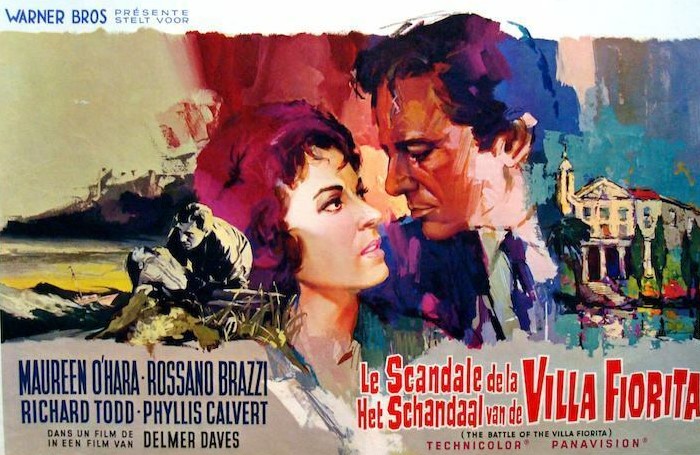
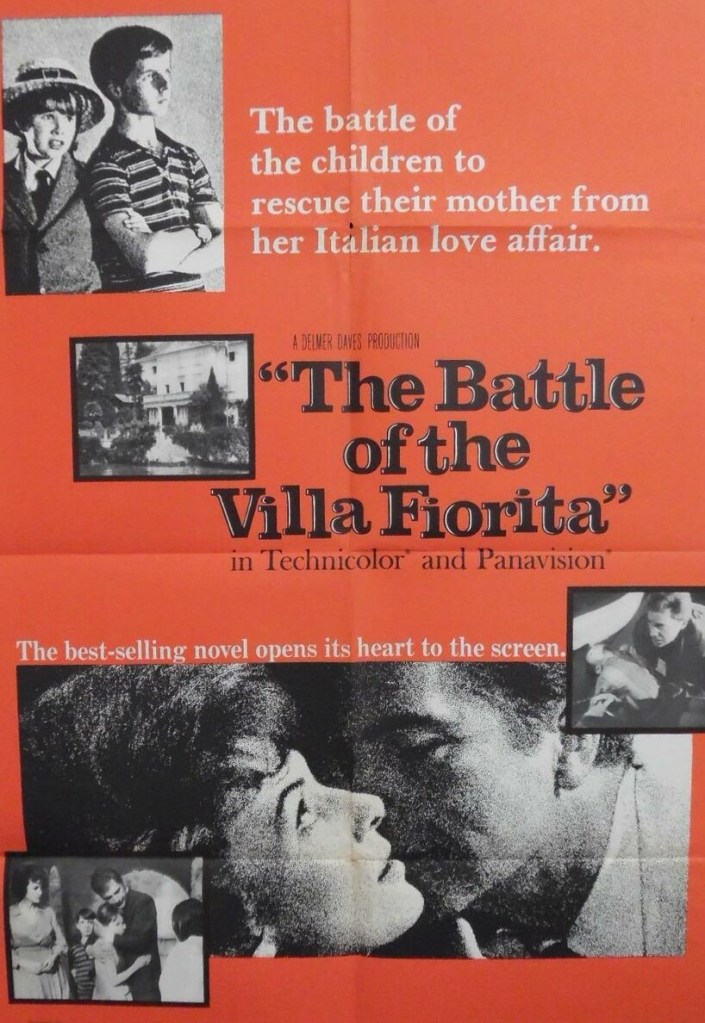
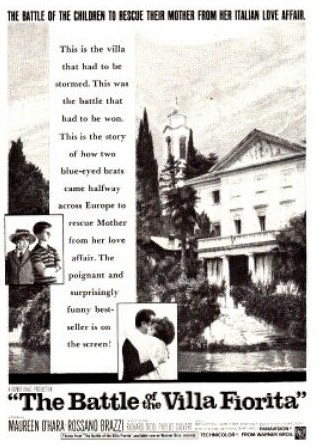
The Battle of the Villa Fiorita (1965) ****

One of the few romantic dramas of the 1960s to resonate today. Neglected wife Moira (Maureen O’Hara) abandons her two children to fly to the eponymous villa on Lake Garda in Italy to take up with composer Lorenzo (Rossano Brazzi).  While husband Darrell (Richard Todd) accepts the fait accompli, kids Michael (Martin Stephens) and Debby (Elizabeth Dear) set out to bring her back. Although Disney had created a hit on a similar theme with The Parent Trap (1961) – also starring O’Hara – The Battle of the Villa Fiorita failed to find an audience at the time primarily because it sailed too close to comfort regarding the reality of the effect of separation and impending divorce on children.

Nor are these kids Disney cute. While Debby occasionally calls upon her internal winsome to tug at heartstrings, both she and Michael are made of sterner stuff. Unwilling to use comedy as a means of bringing the errant adults to heel, the movie gets deeper and deeper into darker territory, as the kids embark on a war of attrition, disrupting the cushy love-nest and forcing their mother to accept her maternal responsibilities. And the ending is far from what you would term happy.

Moira injects some nascent feminism into her role, determining that she is entitled to happiness rather than merely fulfilling the part of a good mother, running a household,  looking after her offspring and enjoying the life of a well-to-do matron married by a husband too often away on business and the too-familiar company of boring respectable friends. A Disney picture would have seen the kids relying on the kindness of strangers or harmless subterfuge to make the trip from Britain by boat and train to Italy. Here, they fund the journey by selling Debby’s horse. The trek is not only dull but on their miserable budget they spend most of the time famished, unable to afford food on the train, resigned to watching adults in their compartment stuff their faces (Disney would have had the grown-ups share  out the tasty fare).

Arriving at the palatial villa, where Moira is waited on hand and foot, spoiled by presents and ardently wooed, the children are under no illusion about the uphill battle they face especially when Moira is not immediately stricken enough by conscience to give in to their entreaties. Lorenzo’s initial solution is to fly the children home. Adult fortitude begins to waver when the English pair join forces with Lorenzo’s estranged daughter Donna (Olivia Hussey) on a hunger strike. Lorenzo shows a sharper side to his temperament, Moira a weaker. The children’s solidarity is also, however, sorely tested by their own differences.

That there is no easy solution – the kids perhaps joining their mother full-time in Italy or some kind of child-sharing scheme – is what gives this movie its power. The classical idea of a repressed woman finding redemption in the arms of an Italian lover (as with Summertime, 1955, also starring Brazzi) is turned on its head as reality intervenes. It’s as well the kids don’t kill us with cuteness, but instead present a realistic example of what it’s like for adoring children to be abandoned. As the film progresses, and the children turn the screw, they soon face adult realization that, even if they win, the mother they will bring back will not be the mother they knew.

After turns with James Stewart (Mr Hobbs Takes a Vacation, 1962) and John Wayne (McLintock!, 1963), Maureen O’Hara had regained her marquee appeal, and although feisty enough in those outings, this was a different, and more courageous,  performance than her fans might have expected. Her conflict is mostly internalized and especially when her children fail to see her point of view, that feistiness vanishes from sight replaced by a more somber, thoughtful individual. Brazzi is excellent as the lover whose paternal responsibilities he takes lightly compromised by a woman forced to come to terms with motherhood. Martin Stephens (The Innocents, 1961), Elizabeth Dear (The Pumpkin Eater, 1964) and, making her debut, Olivia Hussey (Romeo and Juliet, 1968) make convincing, conniving, children still dealing with their own hormonal and emotional growth.   

Adapting the bestseller by Rumer Godden (Black Narcissus, 1947), this proved to be the final movie for veteran director Delmer Daves (3:10 to Yuma, 1957).

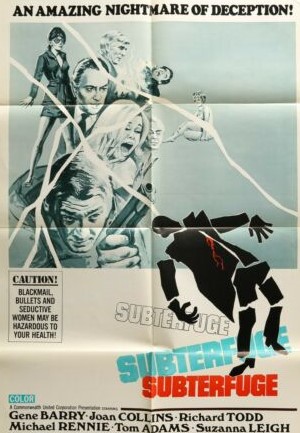
Subterfuge (1968) ***

Worth seeing just for super-slinky leather-clad uber-sadistic Donetta (Suzanna Leigh) who  delights in torturing the daylights out of any secret agent who crosses her path, in this case Michael Donovan (Gene Barry). She’s got a neat line in handbags, too, the poisonous kind. Two stories cross over in this London-set spy drama. American Donovan is under surveillance from both foreign powers and British intelligence. When his contact comes into unfortunate contact with a handbag, he finds himself on the sticky end of the attention of Shevik (Marius Goring) while at the same time employed by the British spy chief Goldsmith (Michael Rennie) to find the mole in their camp.

The three potential British suspects are top-ranking intelligence officer Col. Redmayne (Richard Todd), British spy Peter Langley (Tom Adams) and backroom underling Kitteridge (Colin Gordon). On top of this Langley’s wife Anne (Joan Collins) adds conscience to the proceedings, growing more and more concerned that the affairs of the secret state are taking too much precedence over her marriage.

The hunt-the-mole aspect is pretty well-staged. Kitteridge always looks shifty, keenly watching his boss twisting the dials on a huge office safe containing top secret secrets. Langley is introduced as a villain, turning up at Shevik’s with the drugs that are going to send the Donovan to sleep for eight hours before being transported abroad in a trunk. But he turns out to be just pretending and aids Donovan’s innovative escape. Charming but ruthless Redmayne is also under suspicion if only because he belongs to the upper-class strata of spies (Burgess, Philby and Maclean) who had already betrayed their country.

In investigating Langley, Donovan fixes on the wife, now, coincidentally, a potential romantic target since her husband is suing for divorce. She is particularly attracted to Donovan after he saves her son from a difficult situation on the water, although that appears manufactured for the very purpose of making her feel indebted. However, the couple are clearly attracted, although the top of a London bus would not generally be the chosen location, in such glamorous spy pictures, for said romance to develop.

As you will be aware, romance is a weak spot for any hard-bitten spy and Shevik’s gang take easy advantage, putting Anne, her son and Donovan in peril at the same time as the American follows all sorts of clues to pin down the traitor.

This is the final chapter in Gene Barry’s unofficial 1960s movie trilogy – following Maroc 7 (1967) and Istanbul Express (1968) – and London is a more dour and more apt climate for this more down-to-earth drama. Forget bikinis and gadgets, the best you can ask for is Joan Collins dolled up in trendy mini-skirt and furs. Barry, only too aware that London has nothing on Morocco or Istanbul in the weather department, dresses as if expecting thunderstorms, so he’s not quite the suave character of the previous two pictures. In this grittier role, he does not always come out on top. But that does not seem to dampen his ardor and the gentle romantic banter is well done.

Joan Collins, in career trough after her Twentieth Century Fox contract ended with Esther and the King (1960), has the principled role, determining that the price paid by families for those in active secret service is too high. No slouch in the spy department himself, essaying Charles Vine in three movies including Where the Bullets Fly (1966), Tom Adams plays with audience expectations in this role. It’s a marvelous cast, one of those iconic congregations of talent, with former British superstar Richard Todd (The Dam Busters, 1955), Michael Rennie, television’s The Third Man (1959-1965), Marius Goring (The Girl on a Motorcycle, 1968) and Suzanna Leigh (The Lost Continent, 1968) trading her usual damsel-in-distress persona for a turn as terrific damsel-causing-distress.

Shorn of sunny location to augment his backgrounds, director Peter Graham Scott (Bitter Harvest, 1963) turns his camera on scenic London to take in Trafalgar Square, the zoo, Royal Festival Hall, the Underground, Regent’s Park with the usual flotilla of pigeons and ducks to fill in any blanks in the canvas.

Catch-Up: Previously reviewed in the Blog are Gene Barry in Maroc 7 (1967) and Istanbul Express (1968), Joan Collins in Esther and the King (1960) and Suzanna Leigh in The Lost Continent (1968).

This is hard to find so your best bet is ebay although it is available on Youtube for free but the print quality is not great.

Discover WordPress

A daily selection of the best content published on WordPress, collected for you by humans who love to read.

The Atavist Magazine

by Brian Hannan

WordPress.com News

The latest news on WordPress.com and the WordPress community.