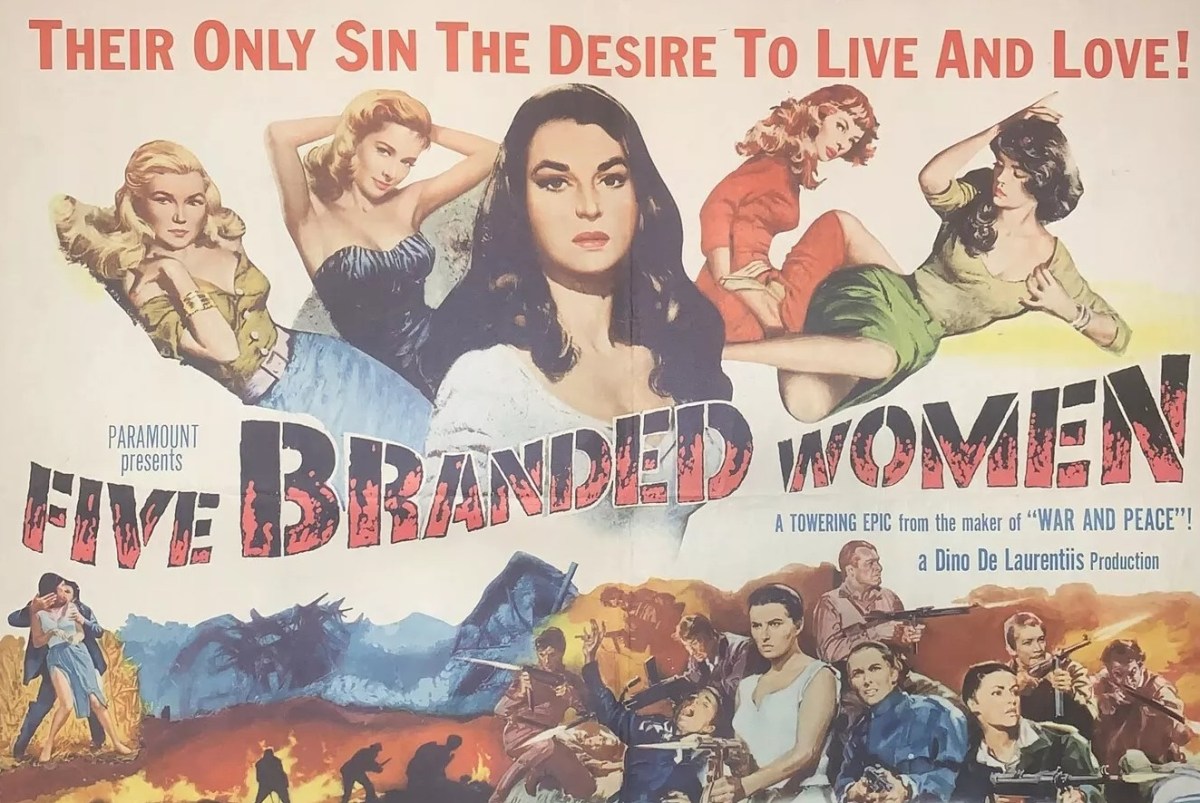
Five Branded Women (1960) ****

Should have qualified as that rare thing – an all-star female cast. Italian Silvana Mangano had led the arthouse revolution and kickstarted the importing of sexy Italians in international hit Bitter Rice (1949), Jeanne Moreau was a leading light in the French New Wave (and another sexy import to boot)  as star of Les Liaisons Dangereuses/Dangerous Liaisons (1959), Vera Miles was hot after Psycho (1960), rising star Barbara Bel Geddes (Vertigo, 1958) another Hitchcock protegee. Never mind that the story was a serious one, the redemption of female collaborators in Yugoslavia in World War Two, there was still time for what had become very much a western genre cliché, the inability of any woman not to strip off at the sight of a waterfall – here all five go skinny dipping.

The narrative should have been clearcut as redemption tales generally are: miscreant finds salvation. But this one is pretty muddled up and the moral confusion gets in the way. While some of the women such as Ljubo (Jeanne Moreau) have sex with the occupying Germans to prevent a brother being sent to a work camp, others such as Jovanka (Silvana Mangano) simply fall in love or like widow Marja (Barbara Bel Geddes) are desperate for a child. All five have been conquests of German lothario Sgt Keller (Steve Forrest) who is castrated by the partisans. The women are humiliated by the partisans who shave their heads and the Germans cast them out of the town, Daniza (Vera Miles) part of the quintet though she denies having sex with Keller.
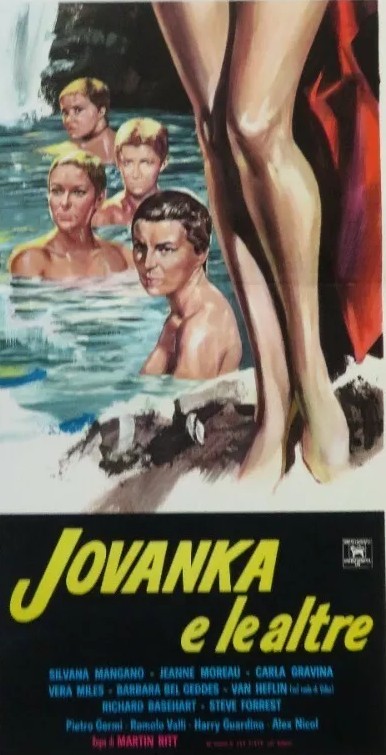
Like “Deadly Companions” the marketeers major on the promise of female nudity in a pool.

But it’s not just the Germans who are apt to have predatory notions about women. A pair of armed collaborators consider them fair game and attempt to rape Jovanka and Ljubo. Partisan Branko (Harry Guardino) – ostensibly in the category of good guy – attempts to rape Jovanka then seduces Daniza. The lovers are later executed by the partisans for breaking the rule not to have sex with each other. And this is where it gets mixed up. The pair were meant to be on guard when they started having sex. In consequence, three Germans sneaked into their camp and nearly caused disaster. Despite that, Jovanka, who believes she was unfairly treated in the first place in being denied love just because there was a war on, still insists that they shouldn’t be condemned for ordinary human desire.

The movie works best when it sticks to straightforward redemption or is character-driven. Given the chance Jovanka turns into an effective partisan, cutting down Germans with a machine gun, preventing rape of herself and Ljubo by shooting the attackers with a captured pistol. But she rejects an attempt at reconciliation by partisan leader Velko (Van Heflin), the one who had cut off her hair, blaming him for her unnecessary humiliation. He later tries to make amends, by trying to keep her out of brutal action.
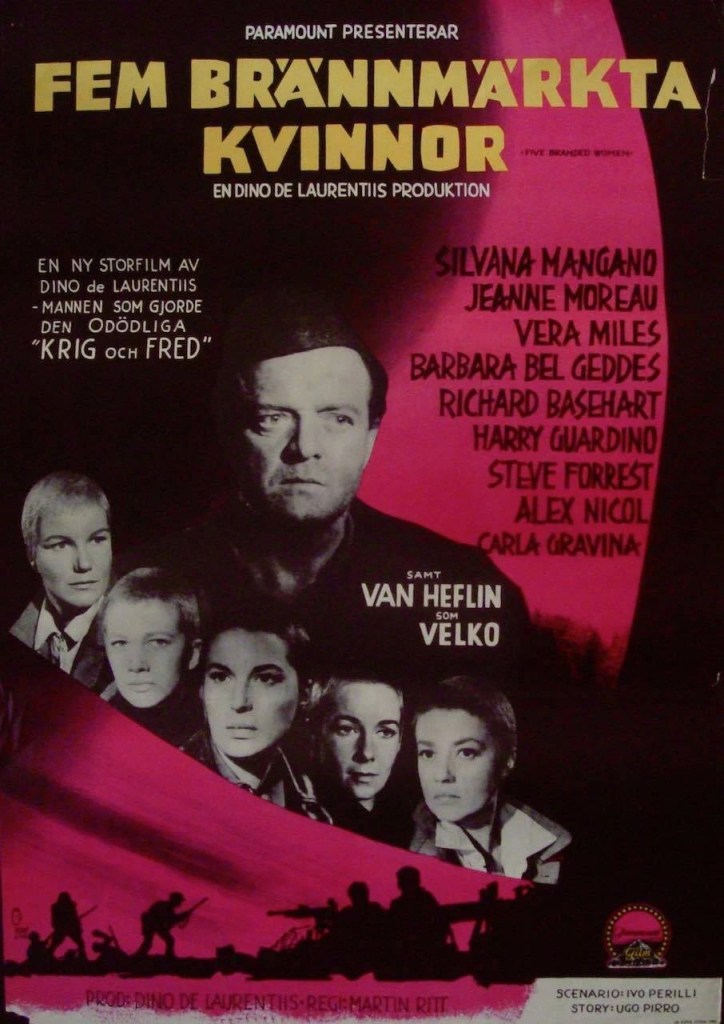
Despite taking up arms, the women remain vulnerable to smooth-talking men. Ljubo takes prisoner Capt Reinhardt (Richard Basehart), who might fall into the “good German” category since he isn’t like Keller, was a professor of philosophy and generates sympathy because his wife died in an air raid. Taking his word of honor, Ljubo unties him. She thinks he will be exchanged for a partisan prisoner. But he knows the truth – there are no partisan prisoners available for exchange because the Germans kill them. So he tries to escape, and she machine guns him in the back.

By this point Ljubo is far from a soft touch, not likely to prattle on about women being free to love the enemy or their compatriots, and is the one who shoots Daniza as part of a firing squad when it is left to her or Jovanka to do so.

What saves it is the brutal realism of war, this predates the vengeful citizens who at war’s end would take revenge on local women who slept with any occupying Germans (Malena, 2000, showed this repercussion in Italy and it was the same throughout France). There’s certainly an innocence about female desire and Jovanka defending her right to have sex, though, surely, there would have been shame involved in having sex with even a Yugoslavian before marriage in what would still have been a devout country. So a complex defiant woman, refusing to bow down to male-enforced rules. But there’s a male corelative. Branko equally refuses to obey any rules, and his actions cause harm.

In terms of acting, Silvana Mangano and Jeanne Moreau are streets ahead of their American counterparts, and complement each other, Mangano loud and outspoken, Moreau quiet and brooding. Harry Guardino (Madigan, 1968), Richard Basehart (The Satan Bug, 1965) and Van Heflin (Once a Thief, 1965) are the pick of the males.  

Martin Ritt (The Spy Who Came in from the Cold, 1965), who liked to back a cause, has chosen an odd one here, and after a slow start it picks up. Written by Ivo Perilli (Pontius Pilate, 1962) from the book by Ugo Pirro.

Easily leads the pack of the women-in-wartime subgenre and despite, or bcause of, the moral confusion still well worth a look.

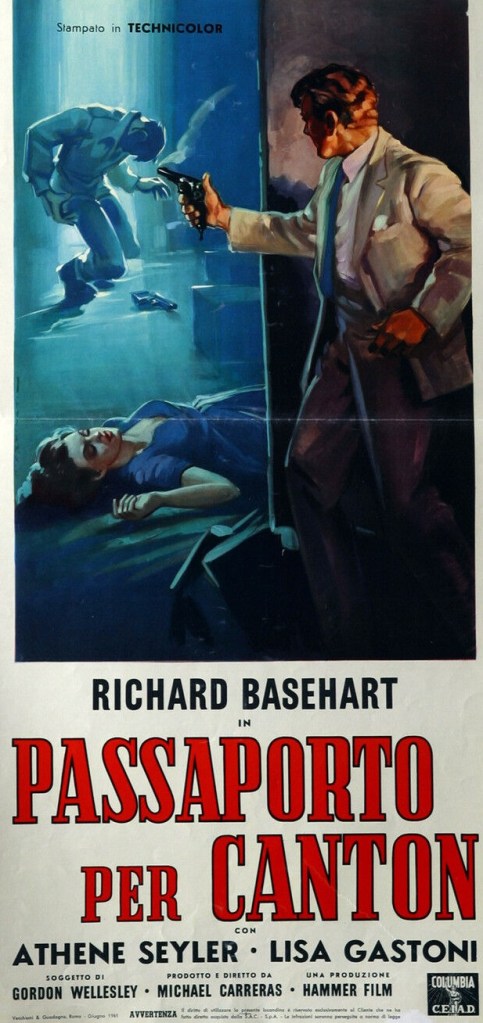
Passport to China / Visa to Canton (1961) **

Marked down for sheer laziness. Another Hammer “thriller,” this time with fading American star Richard Basehart and Italian glamor puss Lisa Gastoni. But mostly a hodge-podge travelog of stock footage with dialog taking the place of action, a tedious voice-over far removed from the snappy one-liners we are accustomed to getting from Chandleresque investigators. And let’s forget the red-eyed Chinese replete with drooping moustaches who pepper the picture.

A plane has gone down in Red China with an American courier carrying vital “scientific” information, Approached to help by US government personnel, snappily-dressed Hong Kong travel agent Benton (Richard Basehart) refuses. But when he discovers the pilot is Jimmy (Burt Kwouk), a member of a Chinese family he has befriended during World War Two, he mounts his own rescue mission. Which consists, by the way, of nothing more than floating a sampan up a river, avoiding a few bullets and whisking the lad away.

But he is blackmailed into rescuing the courier when Hong Kong police imprison Jimmy. So off he trots to Macao and then Canton aided along the way, in the opulent back room of a casino, by Chinese businessman Kong (Eric Pohlmann) who you might mistake for a James Bond villain such is his fondness for being surrounded by women – or such is his girth mistake him for a Robert Morley lookalike. Kong happens to be a Russian spy.

No sneaking into China by parachute or perhaps motor boat is required, Kong simply furnishes him with the visa of the title. Benton, vaguely assisted by a maker of fake porcelain, has clues –  Three Fishes, The Stream of the Willows.

In his hotel bedroom sits the courier, blonde Lola (Lisa Gastoni), held prisoner. But no sooner have they kissed, as you might expect of any self-respecting travel agent doubling as a spy, than they are interrupted by Kong. She disappears. Naturally, Benton finds her easily enough. She doesn’t have papers, instead a photographic memory.

But she’s not working for the Americans. She’s an espionage freelance, working for the highest bidder. She does it for the danger, perhaps like a certain James Bond, danger is the drug, heightens her senses.

But she’s also pretty damn clever. Knowing Kong is a double agent and can’t just snatch her out of China, she starts an auction for her information. Benton offers more. Therefore she is his property. To get over the tickly issue of Kong, in revenge, keeping her prisoner in China, he is conveniently accidentally shot.

So now they have to escape. But in the shoot-out at the docks (in a barn full of hay for some reason she gets shot) so the movie suddenly turns into one of those post-Bond thrillers where all that effort has been expended for no result.

But you might have thought a producer (Michael Carreras) would have introduced Lola much earlier in femme fatale fashion. But then this producer who, as it happens was also the director, seems to think that voice-over will solve all the tedious problems of actually creating a screenplay that works.

You shouldn’t have cared less about a snappy-suited character such as the one played by Gene Barry in his informal espionage trilogy – Maroc 7 (1967), Istanbul Express (1968) and Subterfuge (1968) – he’s about on a par as an actor as Basehart. But those movies at least had proper stories that made sense and were not just a series of jumps explained by voice-over, the hero neither having to undertake any shamus digging or go into harm’s way, or battle his way out of perilous situation.

It’s not even bad enough to eventually win over a cult audience. The problem is it’s well-made up to a point and the story is intriguing up to a point, but that mark is very low.

Richard Basehart (The Satan Bug, 1965) isn’t called upon to do much except act as the storyteller he’s okay and Lisa Gastoni (Maddalena, 1971) isn’t accorded sufficient screen time to really make a mark. Which is the biggest shame because an amoral spy like her would have made a brilliant femme fatale had she been introduced early on and then turned out to be the mercenary she was.

The rest of the cast are caricatures, though interesting to see Burt Kwouk in pre-Pink Panther persona but cringe-worthy to see Bernard Cribbins (You Must Be Joking, 1965)  mangle a foreign accent. Clearly Carreras learned a lesson from this implosion of talent and story because two pictures on he directed taut thriller Maniac (1963).  

Behind the Scenes – “The Satan Bug” (1965)

In 1963 John Sturges made a deal for his Kappa Productions outfit with United Artists.  The director was keenest on The Hallelujah Trail (1965) and what became Hour of the Gun (1967) but The Satan Bug was greenlit first because of the production difficulties inherent in developing westerns. To cut down on travel, Sturges decided to shoot in and around the desert area close to his home turf of Palm Springs and the Joshua Tree National Park. He called in James Clavell, responsible for the screenplay of The Great Escape (1963), and Edward Anhalt (Becket, 1964) to Americanize  and update the English-set Alistair Maclean thriller written before the Cold War escalation of the Cuban Crisis and the increasing fears of nuclear arsenals.

Hardly a director known for “message pictures” – more likely to emanate from the likes of Stanley Kramer – nonetheless he recognized the implicit threat of biological warfare for “its terror potential” and envisioned a powerful climax in the evacuation of Los Angeles. He swapped the married, lame and disfigured hero of the novel for a hip loner in the Steve McQueen mold.

Unable on a $6 million budget to afford a leading man of the McQueen calibre – a strange notion when Two for the Road’s $5 million budget included $1 million for Audrey Hepburn – he settled on rising star George Maharis (Quick Before It Melts, 1964) who had graduated from television’s Route 66 (1960-1963). “We were disappointed that we were not able to get a major star to play the leading role,” commented producer Walter Mirisch, whose company Mirisch Pictures bankrolled the picture. “The idea of using… George Maharis was suggested… John (Sturges) pressured us to cast him. I had felt the subject required a major action-adventure star. George Maharis wasn’ t that, nor did he ever become a major shooting star. ”

Richard Basehart was also plucked from television – the star of Voyage to the Bottom of the Sea (1964-1968) – as was Frank Sutton (Donald in the film) from comedy Gomer Pyle, USMC (1964-1969). Initially cast as the general’s daughter, Joan Hackett (The Group, 1966)   – in what would have been her movie debut – was replaced by Anne Francis. In fact, Hackett worked on the movie for two weeks. “John called,” explained Mirisch,” and told me he was very dissatisfied with Joan.” Sturges had worked with her replacement Anne Francis before on Bad Day at Black Rock (1955).

Sturges biggest problem was creating imposing research facility Station 3. Sticking it underground saved a chunk of cash on the budget, since interiors were minimalist. “The set cost us nothing,” said Sturges. But to add a sense of tension, the set was lit with an ominous amber glow.

However, it proved impossible to achieve the one effect Sturges had set his heart on – the panic-crazed evacuation of Los Angeles. City officials put a block on the gridlock called for in the script. Recalled Sturges, “The sons-of-bitches wouldn’t let me stop traffic…we didn’t get the panic on the streets, the motorists trapped on the freeways…the nightmare of the evacuation.” The director was forced to resort to “glass shots” and background noise to create the sense of pandemonium, the gridlock limited to the roadblock.

Also hampering production was a sense that the director’s mind was not fully on the job. Screenwriter John Gay (The Hallelujah Trail) was often on set conferring between shots with Sturges. The laughter they enjoyed dreaming up ideas for the comedy western seemed at odds with the mood of the pandemic thriller, leaving some actors annoyed.

Commented Mirisch, “It never developed any momentum on its (U.S.) release and wasn’t successful commercially.” According to the Mirisch internal records, the picture’s negative cost (excluding marketing and advertising) was $1.78 million. It only brought in $850,000 in rentals from the U.S. release though foreign business was better, $1.75 million, but the combined total was not enough, once the promotional costs were included, to turn a profit.

SOURCES: Glenn Lovell, Escape Artist: The Life and Films of John Sturges, University of Wisconsin Press, 2008,p243-248; Walter Mirich, I Thought We Were Making Movies, Not History, University of Wisconsin Press, 2008, p211-212; Mirisch Financial Records for 1965.

Discover WordPress

A daily selection of the best content published on WordPress, collected for you by humans who love to read.

The Atavist Magazine

by Brian Hannan

WordPress.com News

The latest news on WordPress.com and the WordPress community.