Counterpoint (1968) ****

Absorbing duel of minds between two autocrats obsessed with their own glory and needs and dealing with dissension in the ranks. That it takes place during the Battle of the Bulge turns out to be less of a dramatic hindrance though you maybe have to suspend disbelief in the notion that any resistance fighters might take time out from trying to sabotage Germans to help rescue a bunch of whining, pampered non-combatants with no strategic value whatsoever.

Once you accept that the U.S.O. would deem a classical orchestra the best way to entertain the troops rather than Betty Grable or Bob Hope then you’re halfway there.

Poster that misleadingly apes “The Great Escape” and “The Dirty Dozen”. Naturally, no woman would attempt such an escape without giving everyone a glimpse of cleavage.

Anyway, the Germans launching an offensive in December 1944 by accident capture the classical orchestra led by world-famous conductor Lionel Evans (Charlton Heston). The Germans are under orders to take no prisoners so as not to divert vital troops during this last-stage effort to extend the war, so under the direction of Colonel Arndt (Anton Diffring) the musicians face a firing squad until General Schiller (Maximilian Schell) happens to pop his head out of his window and recognize his hero, Evans.

Death is temporarily averted while Schiller purrs over his captive. But Evans, still high on principle and arrogance, refuses to comply with Schiller’s request to play a concert for him during a delay in the battle as, the Germans, hit by fuel shortage, are unable to continue their campaign and therefore have time on their hands. There ensues the aforesaid duel of minds plus various demonstrations of disloyalty and ruthlessness.

The joy here is the dialog because there’s not much else going on, beyond a half-hearted attempt to escape, and the tension doesn’t rachet up until Evans realizes Schiller is only keeping them alive until the concert, after which they will be turned over to the trigger-happy Arndt, who lacking any subtlety, has already begun to dig a mass grave in full view of the trapped self-proclaimed neutrals.
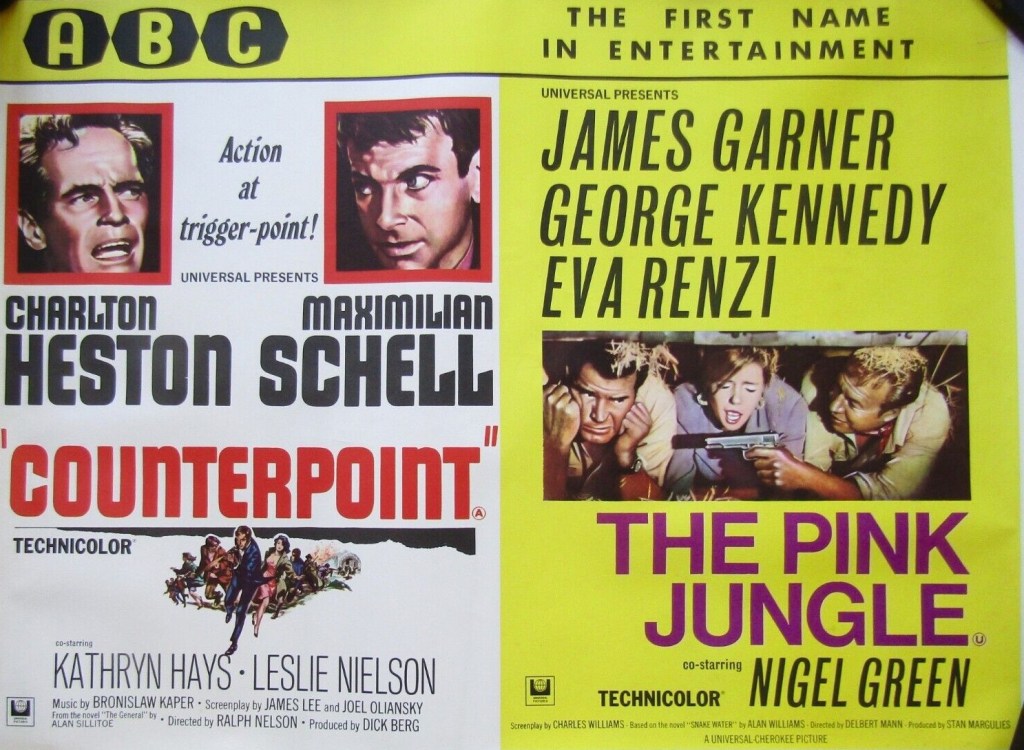
Teamed up in Britain with the long-lost “The Pink Jungle”, which, as it happens, I’m reviewing shortly.

It’s almost a parade of bon mots as each of the leaders tries to top the other’s sentences, and not in merely a clever manner, but with full-blown fascinating argument, in part about the different outlooks of each country, but also about their contradictions, and it’s a rare movie that can hold your attention just through dialog unless it’s set in a courtroom. But, here, Evans isn’t so much arguing for the suspension of a death penalty, for example, but in a remote high-mindedness complaining that, well, there’s no other word for it, that it’s just “unfair” as if the Geneva Convention has a special clause regarding classical musicians.

Maybe it does, given these are Americans, though not in uniform, which might be a point in their favor. But any commander would be correct in assuming they could, through courageous action, perform an act of sabotage or at the very least, as I mentioned, tie up vital resources.

Matters are complicated because Arndt, less self-indulgent than his superior, goes behind Schiller’s back to rat him out to HQ in Berlin while nameless persons within the orchestra are clearly in cahoots with the Germans. And you can’t blame them either. Arndt believes Schiller’s actions could compromise the attack, the orchestra traitors that Evans’ defiance will get them all killed. Evans is quite happy to sacrifice former lover Annabelle (Kathryn Hays) to keep the German commander, who has taken a fancy to her, happy.

Matters are complicated by the presence in the orchestra ranks of two U.S. soldiers in uniform, who feel duty bound to find a way out, so there’s a bit of the kind of action you’d get in a heist movie where an audience listens to classical music while above them a cat burglar is divesting them of their jewels. Here, the two soldiers are clambering up the innards of a church to the roof to scope out the territory and then attempt escape using a home-made rope made up of scarves and nylons etc.

As it becomes obvious that there is no point in Evans playing for time, the tension and turmoil does increase as that unfilled mass grave beckons. Doesn’t play out the way you’d expect, a couple of neat twists keeping cliché at bay.

But, as I said, the primary interest is the verbal battle between two refined minds convinced they are the most important people on the planet. The only standout scenes not involving Evans concern Schiller’s “seduction” of Annabelle and the playing of the American national anthem by one of the soldiers, planted in the orchestra, who Arndt suspects, from his age (too young to be in such august company unless a musical prodigy), doesn’t fit in.

Charlton Heston (Number One, 1969) and Maximilian Schell (Topkapi, 1964) are both superb as flawed characters. There’s a rare movie appearance for Kathryn Hays (Ride Beyond Vengeance, 1966) and another chance to see Leslie Nielsen (Beau Geste, 1966) before he became comedy catnip.

But it’s the script by James Lee (Banning, 1967) and Joel Oliansky (The Todd Killings, 1971), that really delivers, although I’m guessing that the best lines came directly from the source novel, The General by Alan Sillitoe (Saturday Night and Sunday Morning). Directed by Ralph Nelson (Once a Thief, 1965).

Rare to get a movie that relies so much on script and actors on such top form.

Underrated gem.

PREVIOUSLY REVIEWED IN THE BLOG: Charlton Heston in Diamond Head (1962), 55 Days at Peking (1963), Major Dundee (1965), The War Lord (1965), Khartoum (1966), Planet of the Apes (1968), Number One (1969); Maximilian Schell in Judgement at Nuremberg (1961), Topkapi (1964), Fate is the Hunter (1964), Father Goose (1964), Return from the Ashes (1965), The Deadly Affair (1967), Krakatoa -East of Java (1968); Ralph Nelson directed Soldier in the Rain (1963), Once a Thief (1965), Duel at Diablo (1966) and Soldier Blue (1970).
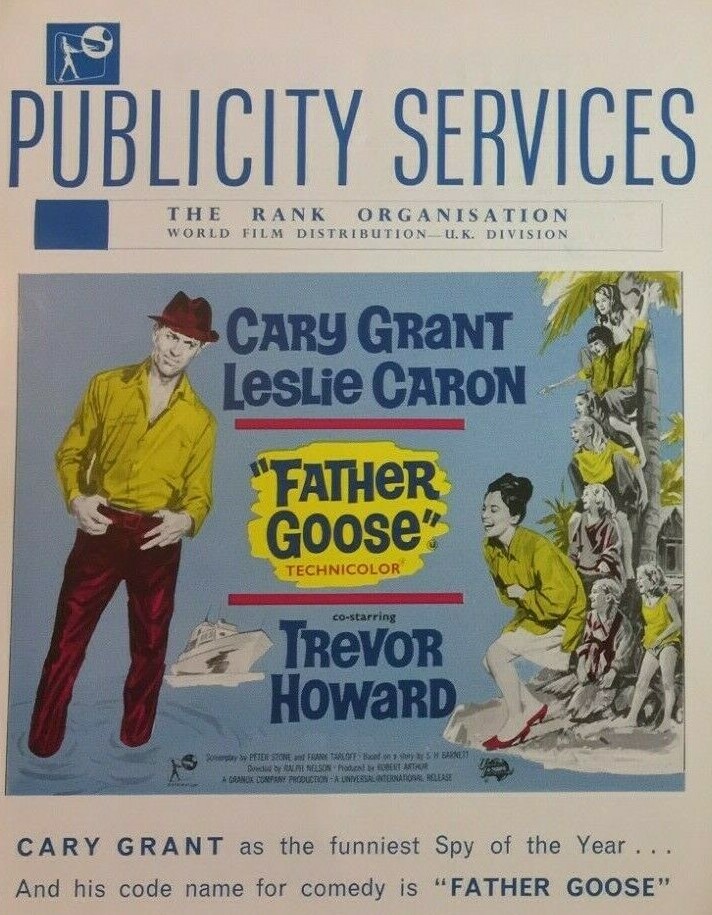
Father Goose (1964) ***

The African Queen with kids or 100 ways to see Cary Grant deflated. The penultimate movie in the screen giant’s career is a tame affair especially after the thrilling Charade (1963) and it may have prompted him to shy away from attempting to carry on a romance with a woman decades younger as occurs in his final offering Walk, Don’t Run (1966). When Trevor Howard (Von Ryan’s Express, 1965) effortlessly steals the picture with a performance that turns his screen persona on its head, you can be sure it’s not quite top notch.

In World War Two, Walter (Cary Grant), a hobo on water with a knack of stealing official supplies, is commandeered by British officer Houghton to operate a radio outpost on a Pacific island giving early warning on Japanese aircraft sorties. While there, he encounters Catherine (Leslie Caron), a French schoolmistress and consul’s daughter, in charge of a pack of female schoolkids.

Effectively, both relationships follow a pattern of verbal duels, initially with Walter losing them all as he is kept on a leash by Houghton and then is beaten by teacher and children. The kids steal his hut, his bedding, clothes (shredded and sewn to fit young girls), food, booze and sanity.

The straight-laced Catherine is happiest when straightening a picture. Walter only regains some of his standing when it transpires he has practical skills like catching fish, repairing a boat and encouraging to talk a girl who has been traumatized by war into temporary dumbness. Naturally enough, any time Leslie warms to him he does something off-putting. But gradually, of course, they get to know each other better, romance is in the air, and secrets are revealed, his hidden past laughable.

It’s a series of set pieces, designed to make the most of Cary Grant’s deftness with physical comedy, he can pull faces with best of them and long ago mastered the double take and the pratfall. So there’s little here you’ve not seen before. And the trope of man and woman trapped on a desert island – most recently probably best exemplified given its inherent twist in Heaven Knows, Mr Allison (1957) – has long been over-used and this addition to the sub-genre suffers from lack of originality.

The little blighters are less an innovation than a complication (or perhaps a multiplication) but they do have the advantage of reducing him to impotence, since he can hardly deal with their transgressions the way he might Catherine. And of them is smart enough to realize that he runs on booze and rations this out.

All in all it’s gentle stuff, nothing too demanding, redemption neither an issue nor an option. Cary Grant is an unusual species of top star in that, as with Rock Hudson and a few others, he didn’t mind being the butt of all the jokes, and in some respects sent up his screen persona. 

Keeping Cary Grant in check might well be a sub-genre of its own, so Leslie Caron (Guns of Darkness, 1962) is inevitably limited in the role, primarily a foil/feed for the Grant, the part not not quite of the caliber of the roles played by actresses in his thrillers such as like Grace Kelly (To Catch a Thief, 1965), Eva Marie Saint (North by Northwest, 1959) and Audrey Hepburn in Charade.

As I mentioned, Trevor Howard is the surprise turn, and steals the show. Ralph Nelson (Soldier Blue, 1970) directs from s script by Peter Stone (Charade), Frank Tarloff (The Double Man, 1967) and S.H Barnett, a television writer in his only movie. I’ve clearly under-rated the script because it collected the Oscar.

Perfectly harmless and enjoyable, if a tad obvious.

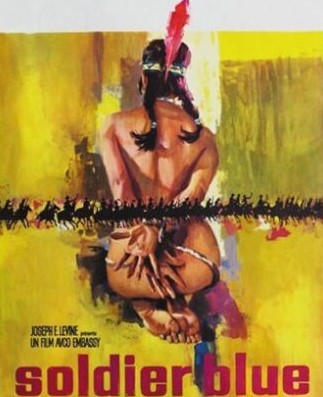
Soldier Blue (1970) ****

Except for the visceral violence and the gender reversal almost plays like a traditional western, mismatched pair, army private Honus (Peter Strauss) and white squaw Cresta (Candice Bergen), trekking through Indian Country until finally ending up where they started, he at the cavalry fort, she back with her Native American husband Spotted Wolf (Jorge Rivero). Initially viewed as an allegory of Vietnam, specifically the My Lai massacre of 1968, no less powerful for that element not resonating so much.

From the outset this U.S. cavalry troop has little in common with the polished units of the John Ford era, the alcoholic commander, sex-obsessed soldiers, while the Cheyenne are considerably smarter, knocking off the unit not to rescue Cresta but to steal the money being ferried to the fort in order to buy rifles. The soldiers are so raw they don’t even post “flankers” to warn of imminent danger, are taken by surprise and decimated within minutes.

Cresta, who has a better grasp of the terrain, is first to find safety, later joined by Honus. Usually, it’s the male who is dominant, the female weak, needing rescued, tended and escorted home across perilous territory. There’s nothing innocent about Cresta who shocks Honus with her cursing and the way she strips off underwear that will hold her back over their long journey. While he makes his bones, defeating a Kiowa chief in a knife fight and demonstrating his marksmanship by shooting a rabbit, largely it’s down to Cresta to plot their course, tutor the young man in the ways of the wild, and get them out of scrapes.

There’s not much to the plot except them growing closer, eventually huddling together for warmth, while she fills him in on the genocidal tendencies of the U.S. government and how life on a reservation will ruin the indigenous people. But the preachy stuff takes second place to their relationship, the virginal Honus surprised by his own feelings, made more difficult by the fact that his more worldly companion has a fiancé back in camp.  

There’s an interlude of sorts when they are captured by the itinerant Cumber (Donald Pleasance), uncovering and destroying his cache of rifles intended for the Native Americans, and pursued as a result.  

Although theoretically, the action takes place after Little Big Horn in 1876, the references are to the Sand Creek Massacre of 1864. We’re given no backstory as to how Cresta came to be welcomed in the Native American camp and was accepted as the wife of Spotted Wolf, and she is regarded almost as a traitor for succumbing. The narrative drives the audience towards Honus as the shocked observer on one side of the battle and Cresta as part of the Native American camp outnumbered by the massed Cavalry and massacred.

The film is more remembered for the violence than the performances which is a shame because Candice Bergen (The Magus, 1968) is particularly good as the far-from-typical Western woman, not just in her defence of the Native Americans, but in her gutsiness and know-how, and in a superb gender reversal becoming the protector of the male rather than the other way round. Peter Strauss (Hail, Hero, 1969) makes the transition from youth to maturity, from staunch  defender of American policy to outraged witness of its barbarity.

While you would need to track back in history to get the Vietnamese references, you will need little reminder of the atrocities armies can visit on the defenceless. The movie appeared at the same time as Dee Brown’s non-fiction book Bury My Heat at Wounded Knee, the first major work to take a different perspective on the Indian Wars. I’ve just finished reading The Earth Is Weeping by John Cozzens, published in 2016, who had greater access to historical data and presented the story in less black-and-white terms and which would have challenged a narrative that placed Cresta as a loved and loving wife in a Native American camp.

Whichever version you read, the outcome is still the same – unforgivable genocide.

The U.S. commander here, Col Iverson (John Anderson) is a pitiless creature. Once the main Native American force has been wiped out, he does nothing to prevent the subsequent raping and killing, some of the scenes filmed too strong for audiences weaned on the violence of the spaghetti westerns and The Wild Bunch (1969).  

Director Ralph Nelson (Duel at Diablo, 1966) almost employs the bait-and-switch approach, lulling us with minimal violence in a tale of the couple’s journey across the wilderness, before revealing the appalling unstoppable climax. John Gay (No Way to Treat a Lady, 1968) wrote the script based on the Theodore V. Olsen novel Arrow in the Sun.

Still retains its power half a century on.

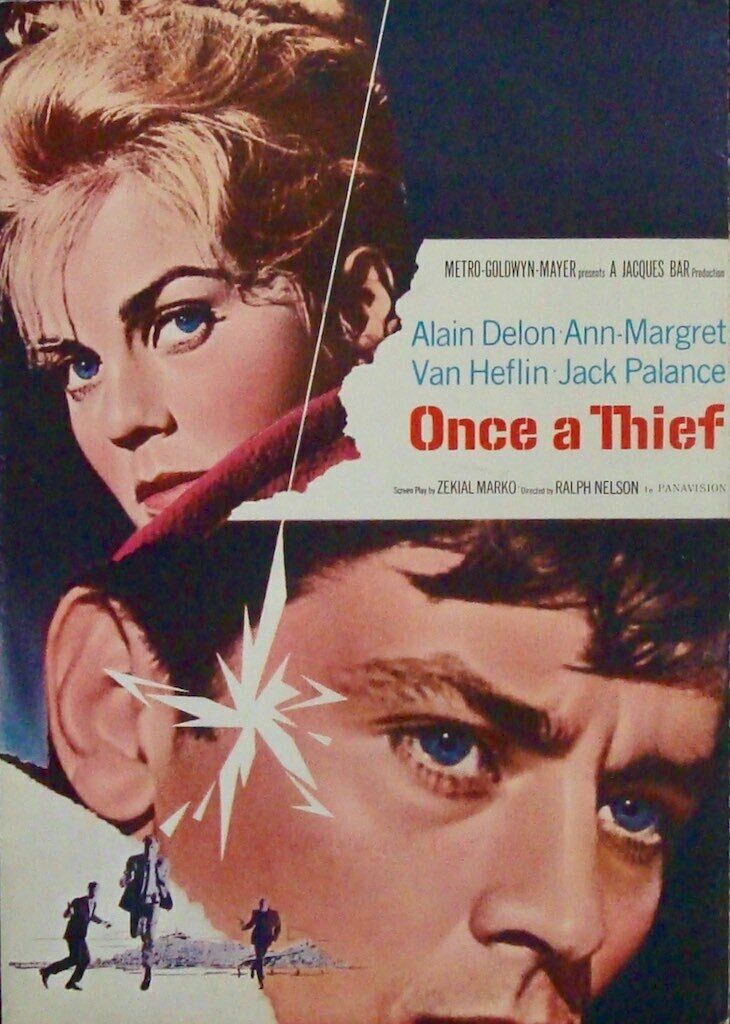
Once a Thief (1965) ****

Latter-day film noir gem with terrific cast filmed in black-and-white and often at night that crams into a taut storyline  different slants of the themes of the con-going-straight, the vendetta and the double-cross. While Hollywood at this point had imported platoons of foreign beauties in the Sophia Loren-Elke Sommer vein, there had been less interest in the male of the species with the exception of a small British contingent and possibly Omar Sharif, on whom the jury was still out. 

MGM was gambling on Frenchman Alain Delon (The Leopard, 1963) to alter industry perceptions at the same time as pushing new contract star Ann-Margret (The Pleasure Seekers, 1964) along more dramatic lines away from the glossy puffery that had made her name and which relied more upon her physical assets than acting potential. Had she continued in this vein, her career would certainly have taken a different turn. 

Eddie Pedak (Alain Delon), former minor hood turned San Francisco truck driver, is happily married to Kristine (Ann-Margret) with a young daughter they both adore. But tough cop Mike Vido (Van Heflin), with a reputation for brutality, is determined to pin a murder on him in revenge for purportedly being shot by him early in Eddie’s previous career. Eddie manages for a time to resist the overtures of brother Walter (Jack Palance) to participate in a million-dollar diamond. But when he loses his job, that changes.

While the robbery naturally takes center stage, that’s not actually the dramatic highlight. Instead, it is the Eddie-Kristine relationship. Instead of Eddie being the usual down-on-his-luck ex-con, he has clearly turned his life around, so much so he can afford a $500 down payment on a small boat. A loving father, he accepts without rancor when his daughter interrupts a night-time lovemaking session. And he’s stylish, too, wearing an iconic sheepskin jacket and driving a snazzy 1931 Ford Model A roadster. Kristine just wants a normal home life, desiring domesticity above all else, but swallowing her pride when she needs to go out to work in a night club to make ends meet, for a time rendering the unemployed Eddie a house husband.

But Eddie is not all he initially seems. His tough streak has not been smothered by the good life. In a brilliant Catch-22 situation he gets violent when an employment benefits clerk refuses to accept that Eddie was fired from his job, instead believing his employer’s claim that he resigned – the former triggering relief payment, the latter zilch. But that’s nothing to the beating he inflicts on Kristine when, pride injured that he is not the breadwinner, he discovers the skimpy costume she wears for her job.

Adding to the unusual mix are Vido and Walter, the former’s brooding presence somewhat undercut by the fact that in middle age he still lives with his mother, the latter while a big-time gangster letting nothing get in the way of strong fraternal feeling for Eddie. You won’t be surprised to learn that double cross is in the air, not when Walter employs a creepy sunglass-wearing henchman Sargantanas (John Davis Chandler) who appears to have more than a passing interest in little girls. The climax, which contains both emotional and dramatic twist, involves redemption and sacrifice.

Delon has played the cold-eyed ruthless but romantic character before, but here adds depth from his paternal commitment and as a man turned inside out by the system.

Ann-Margret is the revelation, truly believable as mother first, sexy wife second, and her anguish in the later parts of the picture showcase a different level of acting skill to anything she previously essayed. This role immediately preceded her man-eater in The Cincinnati Kid (1965) which attracted far more attention and considerably bigger box office and it would have been interesting to see how her career might have panned out had Once a Thief been the critical and commercial triumph. She probably did not attain such acting heights again until Carnal Knowledge (1971). And I did wonder, as with Daliah Lavi (The Demon, 1963) before her whether her acting skills were too often overshadowed in the Hollywood mindset by her physical attributes.  

Van Heflin (Cry of Battle, 1963) is excellent as the cop tormented by the idea that a villain is walking free, Jack Palance (The Professionals, 1966) is good as always and character actor Jeff Corey (The Cincinnati Kid) puts in an appearance as Vido’s whip-cracking boss. This marks the debut of Tony Musante (The Bird with the Crystal Plumage, 1970). Watch for a cameo by screenwriter Zekial Marko, who wrote the original book.

This represented another change of pace for director Ralph Nelson, Oscar-nominated for the Lilies of the Field (1963) and also known for box office comedy hit Father Goose (1964). His  use of an experimental extremely light-sensitive camera eliminated the bulky lighting commensurate with filming at night, bringing freshness and greater freedom to those scenes. His natural gift for drama ensured that the emotional was given as much prominence as the action. Racial awareness was demonstrated by the opening scene in a jazz club where African Americans were clearly welcome, hardly the norm at that time.

The picture was shot on location in San Francisco including Nob Hill, Chinatown and Fisherman’s Wharf. To add authenticity, Nelson employed as extras or in bit parts people famed for different reasons in the area. There was Armenian Al Nalbandian who owned the Cable Car flower store on Union Square. William ‘Tiny’ Baskin was a highly successful diamond cutter, owner of the city’s biggest diamond collection – because of his size he was ideal to play a night club bouncer. The North Beach night club provided cameos for Big Al and resident jazz drummer Russell Lee, who both play themselves. Local singer Toy Yat Mar plays the woman murdered at the start of the film. Also appearing were piano player Jimmy Diamond, bus driver Wed Trindle and belly dancer Shereef.

Mention again of a terrific score by Lalo Schifrin, especially the bold drum solo that played out over the credit sequence. Schifrin’s work on the film was showcased in a featurette aimed at schools and colleges. Russell Lee’s drumming so impressed Ralph Nelson that the opening credits were rewritten around his drum solo.

Catch-Up: Alain Delon has featured in the Blog in reviews for Lost Command (1966), Is Paris Burning? (1966), The Girl on a Motorcycle (1968) and Farewell, Friend (1968); check out also Ralph Nelson’s Duel at Diablo (1966) and Ann-Margret in The Cincinnati Kid (1965).

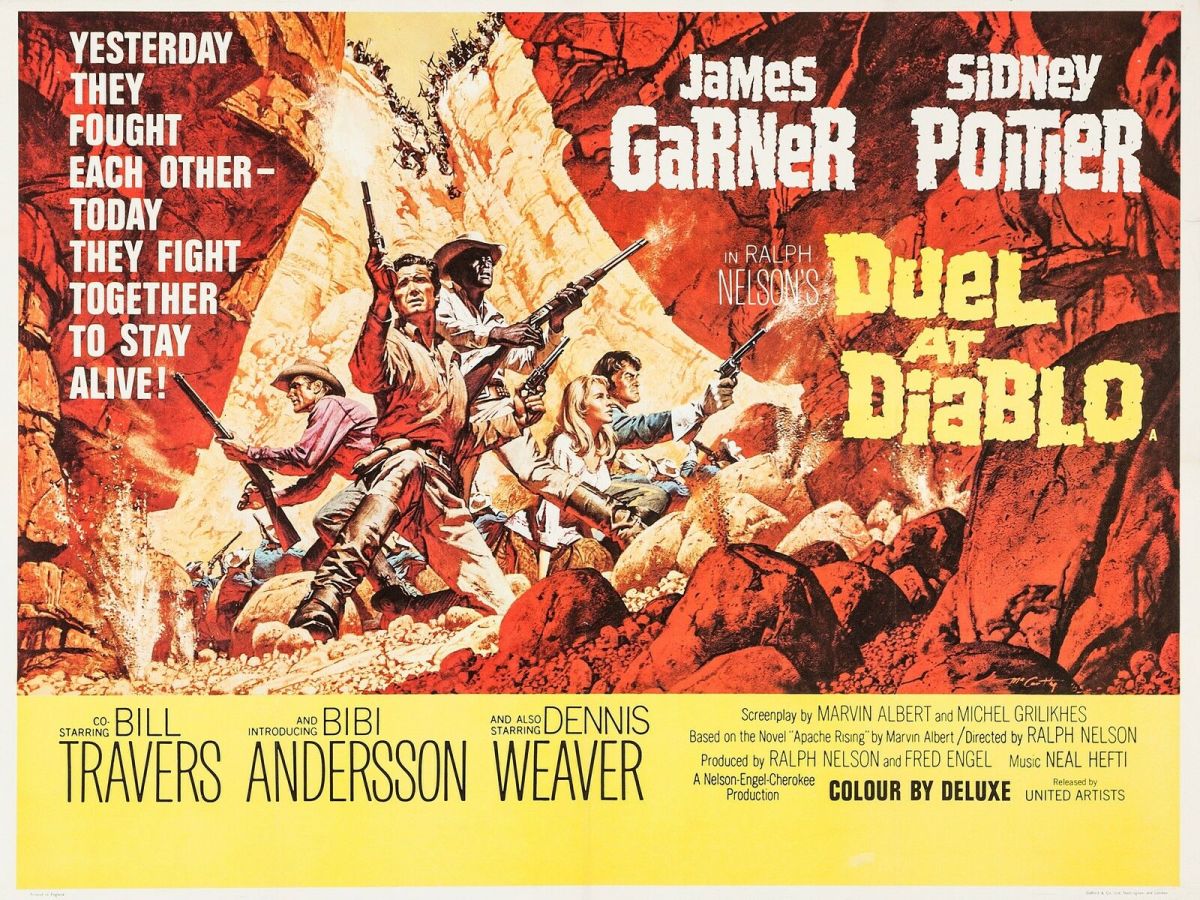
Duel at Diablo (1966) ****

Action-packed and plot-jammed revisionist western with fresh performances from James Garner and Sidney Poitier caught up in an Apache uprising. Tough-as-teak ex-cavalry scout Garner has dispensed with his glib smart-aleck persona in favor of world-weariness and Poitier is a revelation as a cocky cigar-smoking ex-cavalry sergeant horse-dealer. Racism here concerns hostility towards Indian squaw Bibi Andersson (Persona, 1966), Garner, who had married a Commanche (now dead) the only one to treat her with any decency.

Returned to “civilization,” Andersson wants nothing more than to escape, back to her baby it transpires. Her crime is staying alive after Apache capture when she should have done the “decent thing” and killed herself rather than living as a squaw. But prejudice is leavened by husband Dennis Weaver (minus trademark moustache) who retains tender feelings towards her and, eventually, her baby. Apache chief John Hoyt is equally redeemed by his care towards the baby.  

Director Ralph Nelson (Lilies of the Field, 1963) handles the action with aplomb but it is the Apaches who prove the masters of battlefield strategy, deftly maneuvering the cavalry into an ambush and cutting them to shreds. His biggest problem is delivering logical reasons for all the principals – Weaver is an arms dealer, Garner and Poitier no longer in the army – to join up with Bill Travers’ (Born Free, 1966) cavalry troop. However, rather than slowing the story down, the various complications add further tension.  

Nelson never reins in reality. The cavalry are raw recruits, hardly able to control their mounts. Garner and Poitier don’t buddy-up, there is no camaraderie, and Andersson is an outcast in both worlds. And the good guys are constantly out-smarted by the Apaches, Poitier’s mistake leading to initial ambush, the Apaches targeting water supplies to derail the enemy and resorting to bow-and-arrow in case a stray bullet ignites the ammunition wagons. But it is still a duel, Poitier, Garner and Travers each in turn coming up with brilliant ideas to retrieve what looks like a desperate position trapped in a box canyon.     

We might be more sympathetic towards the plight of the Apaches, shoved into a “hell-hole of a reservation,” had Nelson concentrated less on their brutality, the picture opening with the corpse of a mutilated man, the cavalry under siege at Diablo tortured by the screams in the night of a man being tortured, Andersson told that she will be buried alive. But when any Commanche woman can be killed and scalped just because she married a white man and Andersson viewed as fair game for rapists because she lived with Apaches, you can see how little regard the Native Americans have for their oppressors.

Garner and Poitier are superb and top marks for a rounded performance from John Hoyt, savage one minute, gentle the next. Scotsman Travers and Swede Andersson should have added to the authenticity since immigrants such as these provided the mass of settlers, but Travers seems quite out of place and Andersson never quite delivers the angst required of her situation.  William Redfield (One Flew over the Cuckoo’s Nest, 1975) can be spotted. Nelson has a cameo and if you look closely you will see a fleeting glimpse of Richard Farnsworth. Western specialist Marvin H. Albert (The Law and Jake Wade, 1958) co-wrote the screenplay from his novel.

You might be able to catch this for free on Sony Action Movies, but otherwise here’s a DVD link. You might get it on Amazon Prime but last time I posted a link for that, it didn’t work.

Discover WordPress

A daily selection of the best content published on WordPress, collected for you by humans who love to read.

The Atavist Magazine

by Brian Hannan

WordPress.com News

The latest news on WordPress.com and the WordPress community.