Behind the Scenes: Selling The Million-Dollar Marlon Brando – “The Fugitive Kind” (1960) Pressbook

Should have been a darned-easy sell. After all, Marlon Brando had made global headlines after becoming the first actor to be paid a million bucks for a movie, his fee for The Fugitive Kind outstripping by $250,000 the previous record jointly held by John Wayne and William Holden (see Note below) for The Horse Soldiers (1959). And there was no suggestion – as indeed there is not even now – that audiences held against the stars the wealth their talents accrued.

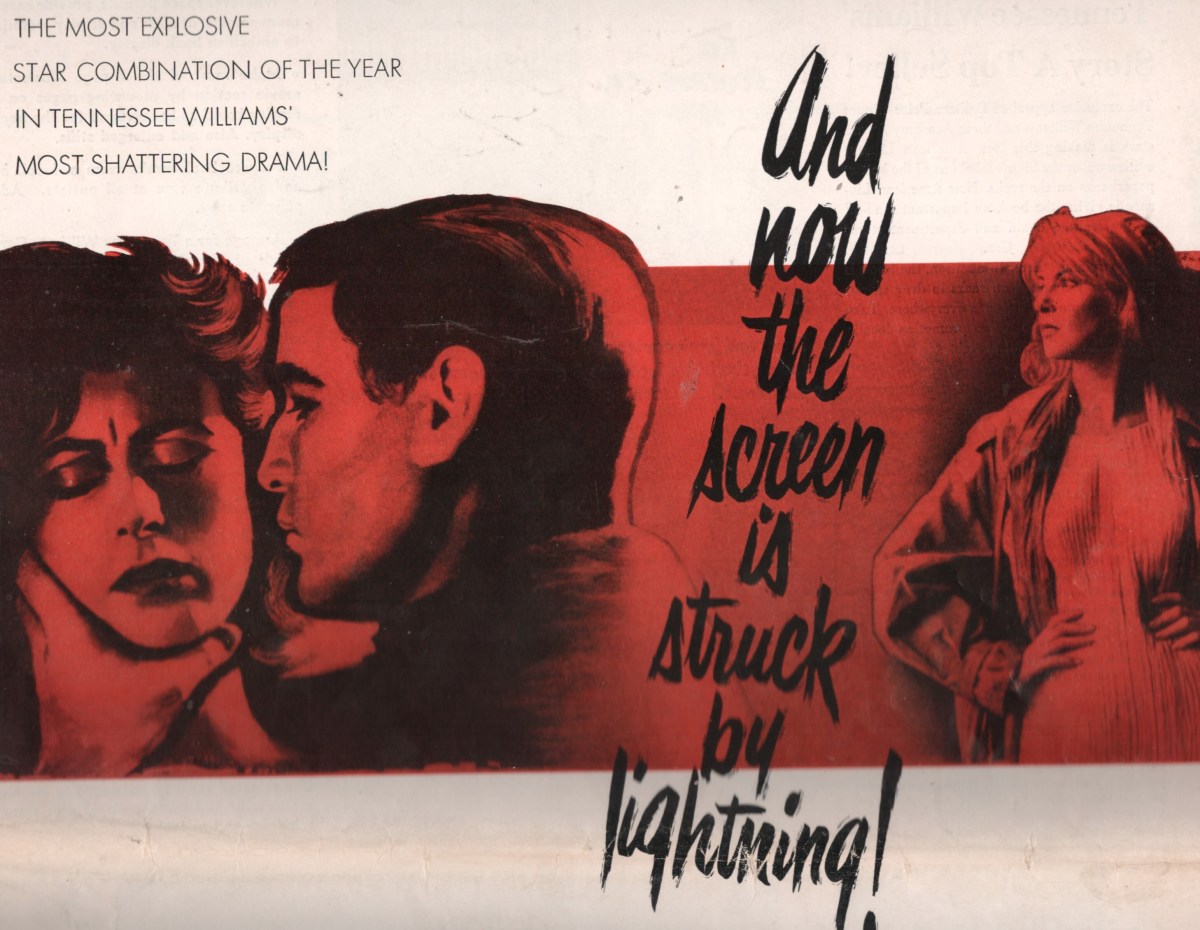
“The Most Explosive Star Combination of the Year” was how this was generally sold, on the back of the Oscars held by each of the principals, Brando, Italian Anna Magnani and Joanne Woodward and the Pulitzer Prize awarded to playwright Tennessee Williams, himself also a two-time Oscar nominee as well as his work providing Oscar wins and nominations by the bucket load for actors and directors.
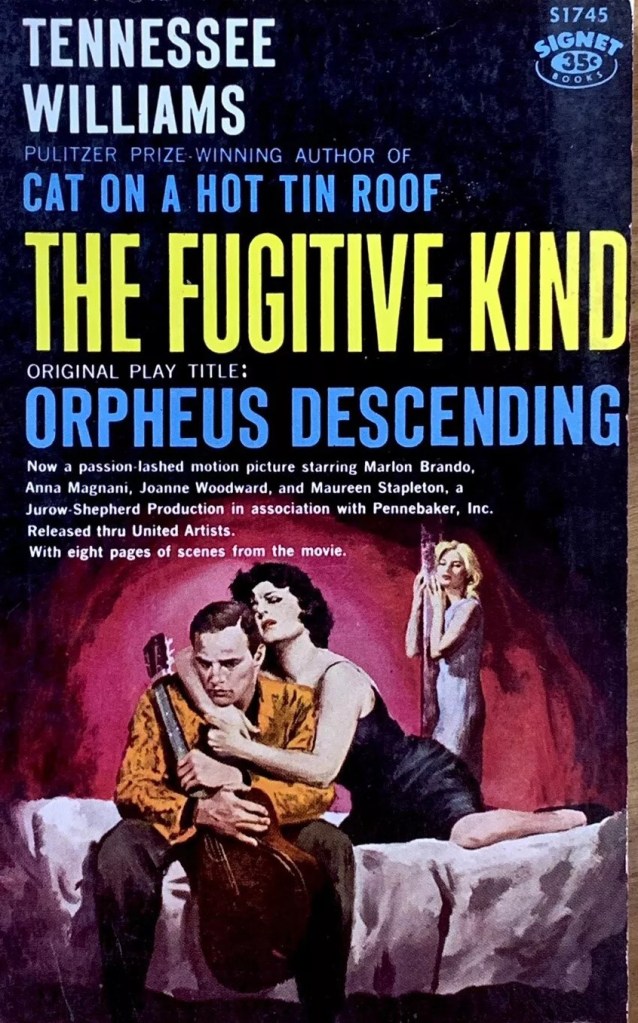
“Something about the way he looked at a woman, something about the way he handled a guitar” were other notable taglines and marketeers tried to convince the public “the screen is struck by lightning.” And if that was not enough – “their fire…their fever…their desire” was expected to do the trick.

Publicists encouraged exhibitors to make full use of Brando’s accoutrements from the movie, namely his snakeskin jacket, Rolex and Kay Guitar, which in one scene he actually played. Suggestions included auctioning a guitar for charity and running a talent contest. Brando was a reasonably accomplished player, specializing in perennials like “Shenandoah” and “Streets of Laredo.”

How to make a snakeskin jacket was another angle.  The Rolex watch his character wore presented opportunities for marketing tie-ups with jewellery stores. No marketing stone was left unturned to the extent of the Necchi sewing machine, seen in the movie, being offered as a prize in a national competition. Novo Greetings Cards were also seen in passing in Lady Torrance’s store and this company was backing the movie.
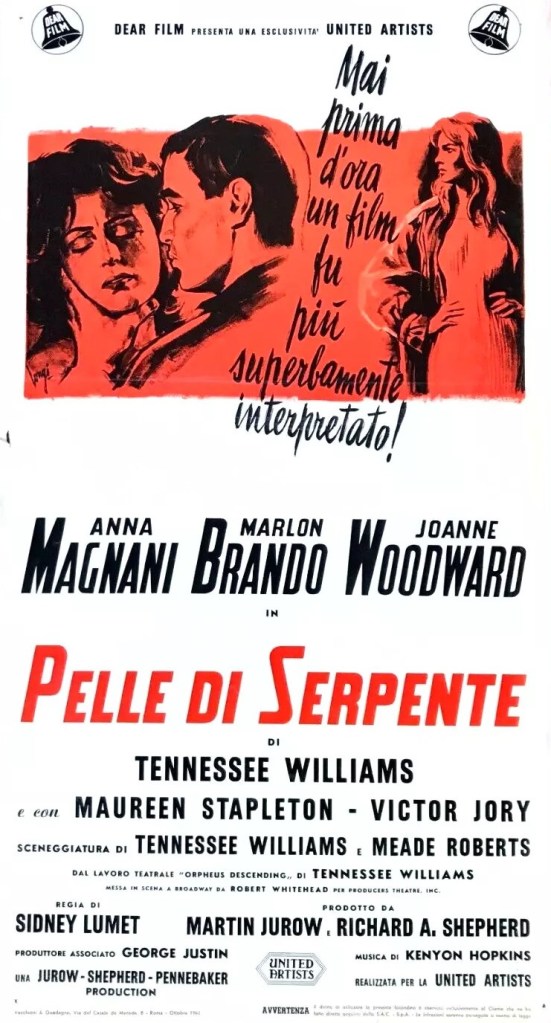
Unusually, Signet was using the movie tie-in approach to sell a play, the paperback comprising the source material Orpheus Descending, which included an eight-page spread of stills from the picture. Williams’ position as the most popular playwright of his generation – his only rival Arthur Miller had less success in Hollywood – brought potential access to libraries, book clubs and schools. Military bases around the world were targeted  through marketing material emphasizing Joanne Woodward.

It would certainly have helped if the movie had been able to set a new fashion trend for the wearing of snakeskin jackets. Or revive a trend that had last occurred in the 1930s, “quite a craze” for shoes, bags, hats and belts. “It wouldn’t surprise me,” said United Artists costume designer Frank Thompson, “if Brando wearing this jacket starts the whole thing again.”

Thompson had quite a task making two identical jackets – in case one was damaged during filming. First of all, he had to locate skins that were found in Mississippi. The choice came down to rattler or python. Opting for python, Thompson went through 200 skins before he found three that matched. “Looking for two snakeskins that match identically is like looking for two fingerprints that are exactly the same.”

The film was based on Battle of Angels, written by Williams in 1939, his first full-length work professionally staged (in Boston). He “never quit working on this one…it never went into the trunk, it always stayed on the work bench.” Rewriting about 75% of the play, it was reprised as Orpheus Descending on Broadway in 1957. Although Williams had Brando and Magnani (star of the film version of The Rose Tattoo, 1955) in mind for the stage play, it went ahead instead with Cliff Robertson and Maureen Stapleton. Williams had written The Rose Tattoo for Magnani but again it was Maureen Stapleton who won the role on stage.

Williams had outstanding success in writing roles that were in tune with Oscar sensibilities. A Streetcar Named Desire (1951) won Oscars for Vivien Leigh, Kim Stanley and Karl Malden with Brando nominated. Anna Magnani won for The Rose Tattoo and Marisa Pavan was nominated. Other nominations included Carroll Baker and Mildred Dunnock for Baby Doll (1956), Elizabeth Taylor and Paul Newman for Cat on a Hot Tin Roof (1958), and Katharine Hepburn and Taylor for Suddenly, Last Summer (1959).

Despite its Mississippi location and except for external establishing shots, The Fugitive Kind was shot in the Bronx. Director Sidney Lumet was a notably New York kinda guy, having filmed his first three movies – Twelve Angry Men (1957), Stage Struck (1958) and That Kind of Woman (1959) – in the city.

He argued, “Hollywood’s great attractions have been the technicians and the shooting facilities, With care, men of comparable talent can be found in New York. As for facilities, a sound stage is a sound stage wherever it is. I concede that in California they’re larger and more elaborate, but the same results can be produced elsewhere. And the fabulous back-lots, which counted so heavily in the past, seem to be outmoded today by the sophisticated eye of the audience. You can’t shoot on studio streets and pretend any more. It has to be real.”

NOTE – William Holden pocketed around $3 million in the end as his percentage share of the gross –not the more contentious net – of Bridge on the River Kwai (1957) so he was the decade’s biggest winner until Richard Burton made more on a similar deal from Where Eagles Dare (1968).

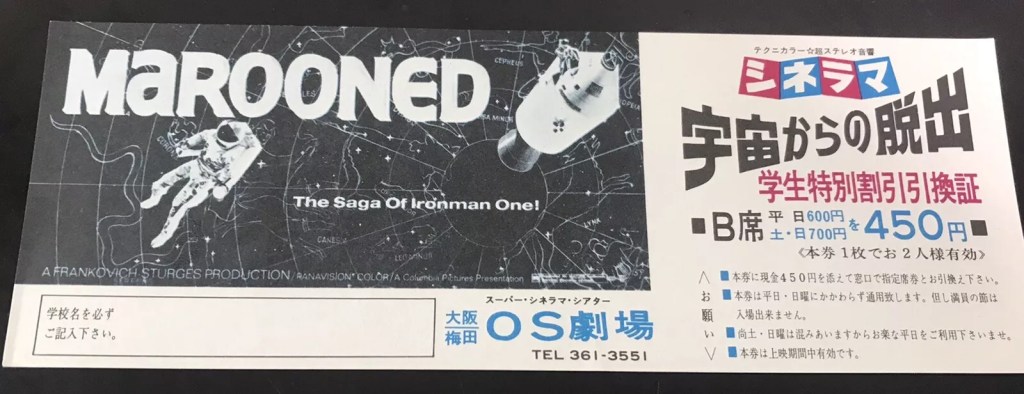
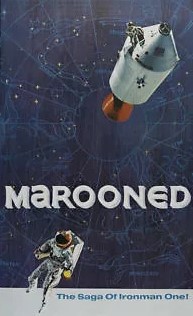
Behind the Scenes: Selling Jeopardy in Space – Pressbook for “Marooned” (1969)

You could come away from the Pressbook/Exhibitors Manual wondering if some of the actors were in the wrong profession, given the number of accomplished pilots on the roster.  James Franciscus held a commercial license for multi-engine planes and had logged three thousand flying hours in three years. Gene Hackman not only had a private flying license but was in the process of building his own biplane.

Producer Mike Frankovich had flown with the US Air Force during World War Two, clocking up 7,000 hours flying time and ending up a colonel. Technical expert George Smith had ejected at 6,000 feet from a plane flying at 800 mph.

Another less well-known fact, Natalie Wood (who was appearing in producer Mike Frankovich’s Bob and Carol and Ted and Alice, 1969) was fluent in Russian and was brought in to translate for a showing of the movie to visiting Russian spacemen. Nancy Kovack, by the way, was equally talented, speaking Persian and other languages.

As much as the main function of the Pressbook was to provide exhibitors with a range of adverts in every conceivable size that they could cut out and take along to their local newspaper, its secondary function was to provide cinema owners with promotional ideas and to provide snippets and articles that could be passed on to a local friendly reporter.  But pickings were slim for jouranlists. Not surprisingly, Gregory Peck didn’t have much say, since whatever he did have to say he’d said already as promotion work for the two other features preceding Marooned this year. And nobody’s spilling the beans on the special effects.

Due to the bulkiness of their space suits, the three actors playing astronauts couldn’t sit down between takes and instead the production employed “the slanted boards usually leaned against by elaborately-gowned female stars to protect their costumes.” (You learn something new about the business every day!). Never mind the bulkiness, the actors spent a chunk of their time in the air and the one day James Franciscus expected to meet acting hero Gregory Peck (they had no scenes together) it proved impossible as when the star visited the capsule set Franciscus was 60 ft in the air.

Richard Crenna got a better response from his young son, who had little concept of what an actor did. But after seeing his dad floating around in space high above him, he reckoned his father was actually a hero

For such a male-oriented picture, Columbia made a big play for the female audience. “The Ladies Love Marooned,” boasted one advert in the 16-page A2 Pressbook/Campaign Manual aimed at exhibitors. Pulling on quotes from critics nobody had really heard of, it managed to present the notion that the picture was as exciting, fascinating, “ingeniously-devised,” and suspenseful for women as much as men, at the same time as focusing on the feminine aspects of the movie – “Lee Grant is a knockout.”

The Pressbook itself allocated editorial space to the three female stars. For Lee Grant the slant was that her talent had been recognized by a host of awards – Emmy, Obie, Best Actress at Cannes plus an Oscar nomination (she would later win an Oscar for Shampoo, 1975). But you have to wonder how an actress would respond to be called, in print, “an egg-head with sex” as was the case with Nancy Kovack. In between turning out such pictures as Tarzan and the Valley of Gold (1966) and this, Kovack had been resident in Iran where she made Diamond 33 (1967) and Night of the Angels (1968). By comparison, Mariette Hartley got off lightly, thanks to her Shakespearian training.

A separate 4-page A2 insert promoted the three Oscar nominations for cinematography, sound and visual effects. “Nominated for 3 Academy Awards,” was the slug accompanying the ads. Never mind the reviews from female critics, much bigger space was devoted here to a rave review form Rex Reed, one of the most famous critics of the day (and star, if that’s the right word, of Myra Breckenridge, 1970), who claimed Marooned was “as exciting, spirited and suspenseful as any spy movie or any cops-and-robbers movie ever made.”

As you might expect, the bulk of the promotional ideas were science-based. Exhibitors were told to target the country’s 2,500 science clubs, the armed forces, the industries that supported the space program and, of course, schools and colleges. Tie-ins had been achieved with 4,500 A&P stores, Jane Parker Donuts, and Philco-Ford dealers.

From a contemporary marketing standpoint, the surprising tie-in was with Omega watches, tagged “the first watch on the moon,” the company’s Speedmaster brand not just worn by the astronauts who did land on the moon in July 1969 but seen in the picture on the wrists of Gregory Peck, Richard Crenna, David Janssen, Gene Hackman and James Franciscus. Over 4,000 dealers were backing the movie.

Model kit manufacturer Revell was offering space suits as prizes in a competition. It distributed more than 42,000 standees and posters and printed five million entry forms. Bantam books was promoting the original novel by Martin Caidin.  That exhibitors would be eager to equip a staff member with an astronaut’s garb and have him/her parade through the streets went without saying. Using lift-off sound effects in a cinema lobby was another idea or turning the entire lobby into a space set.

Rather disconcertingly, the marketing bigwigs thought it would be a clever idea to propose a discussion program on radio or local television on the subject of what would happen if spacemen were marooned, a rather tetchy subject when that became reality.

Unusually, but not surprisingly, the posters stuck with the one tag line: “Three marooned astronauts. And only 55 minutes left to rescue them. While the whole world watches and waits…” and buttressed by some thumbs-up quotes from the likes of reviewers from the New York Times, Redbook, Los Angeles Times and Los Angeles Herald Examiner. In fact, the advertising department took such a shine to Charles Champlin of the LA Times that they cut up his review and stuck snippets of it in three separate ads.

You’ll have seen from the variety of adverts I’ve used to support the review and the Behind the Scenes article earlier in the Blog, that there was a wider range, initially, of adverts, some showing the capsule stuck out in the middle of space. By the time it came to printing this Pressbook, the one for the picture’s general release, all of those were jettisoned in favor of the insipid “thumbs-up” poster with faces to the foreground and the launch in the background, attendant quotes and the “3 Academy award Nominations” slug.

Selling Boris Karloff, Or At Least Trying To: Pressbook for “The Sorcerers” (1967)

Exhibitors measured a movie’s commercial potential in large part by the size and shape of the Pressbook. There was a correlation between a studio’s marketing budget and box office expectation.

This was the era of the 16-page A3 (twice size of a sheet of A4 paper) Pressbook/Campaign Manual that would contain what a cinema manager required to make the most of the picture through newspaper exploitation. This included snippets that would be passed on as nuggets for the editor of the entertainment section – incidents that occurred on set, details of location, hitherto unknown facts about the stars, interesting quotes – and for the newspaper’s non-editorial section that came in the form of a series of  different advertisements, six or seven not unusual.

These adverts were core to what you might see in your local newspaper. The cinema manager simply cut out the preferred size of advert – they were offered a huge range of sizes that often took up to half the Pressbook – and handed that in to the newspaper which duly, with cinema name attached, used it to make up the printed ad.

The point of the A3 Pressbook was to accommodate ads that size (11.7 x 16.5 inches / 297 x 420mm) and encourage the cinema manager to consider paying for such a hefty space in a newspaper. Beginning with the giant size indicated studio confidence, which, it hoped, the cinema manager would match. Of course, should he or she not, then there was a wealth of smaller-sized ads – which might themselves start at roughly A4  (8.3 x 11.7 inches / 210 x 297mm) that the cinema manager might feel more appropriate to the picture house’s marketing budget.

The various ads accommodated a number of different taglines and images, so that a cinema manager could choose the best one for targeting their specific audience – most commonly, for example. an action picture might be sold on the love interest.

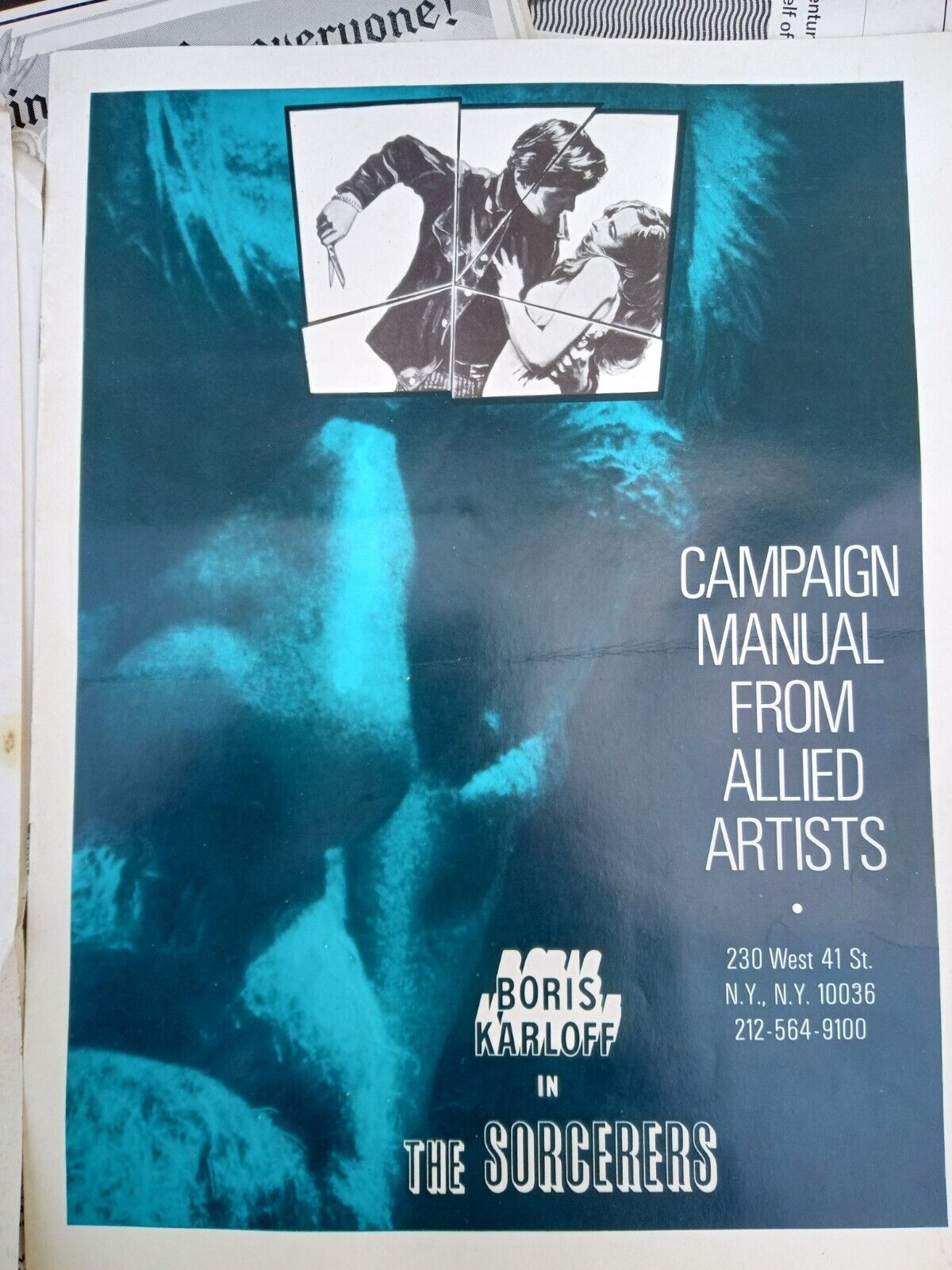
The Sorcerers was released in the U.S. by Allied Artists. Once a big name, producing Friendly Persuasion in 1956, it had now fallen on harder times and largely reverting to its Monogram origins except for a financial boost from the unexpected success of the French-made A Man and a Woman (1966). Whatever imapct that had on Allied’s coffers did not translate into expenditure on the Pressbook for The Sorcerers. Cinema mangers would not have been filled with any great confidence. In size and in the advertisement material it did not shout box office winner.

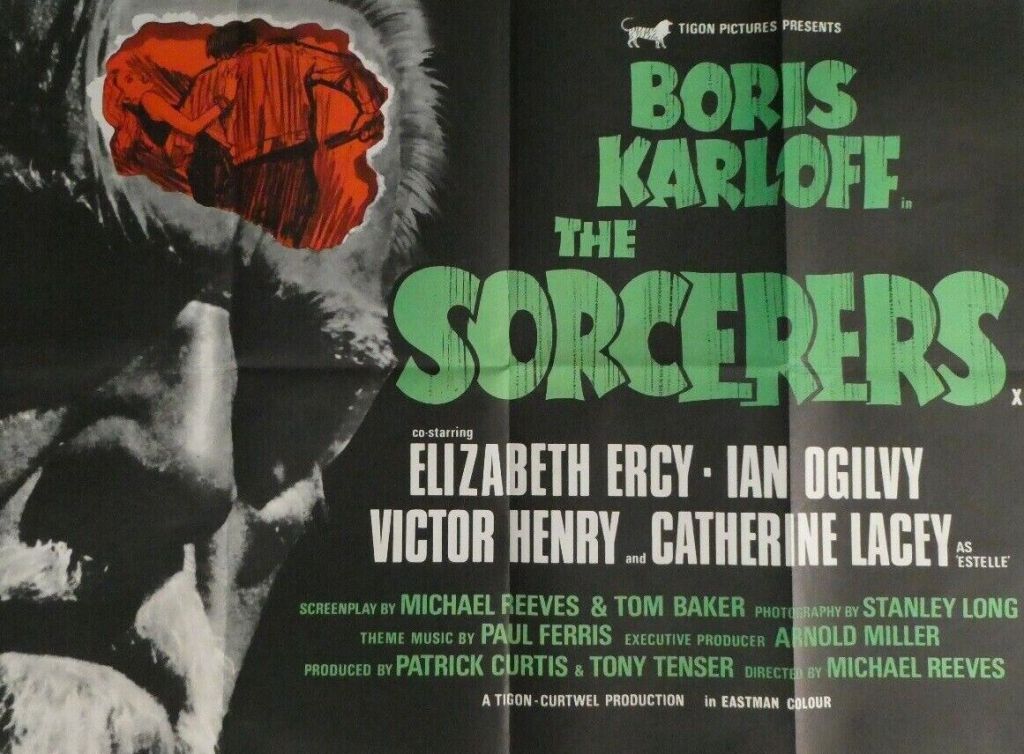
This is an ad from the British campaign which showed more originality than in the U.S.

The Pressbook was 8-pages A4, of which more than half was advertisements, one full-page A4. But there was only, effectively, one ad, though presented over five pages in twelve different sizes, from the aforementioned A4 down to what would be little more than a slug, one inch running the width of one newspaper column (about two inches).

Boris Karloff’s brooding features, intercut with a man knifing a woman, dominate the advert. There is a tagline: “He turns them on…he turns them off…to live…love…die or KILL!” At the foot of the ad is a montage of young things, dancing, kissing, a girl in backless dress the height of the titillation portrayed. The rest of the near-dozen adverts are all exactly the same, with, as the adverts grow smaller, bits of the main ad dropped out.

The problem with marketing any film starring Boris Karloff was the actor himself. Although a legendary name in movies thanks to Frankenstein, that career-making role had been three decades before and anyone who had seen it in the 1960s had done so on television where it was shorn of a lot of its power. Karloff had only intermittently popped up in horror movies during the 1960s, most recently in Die, Monster, Die (1965).

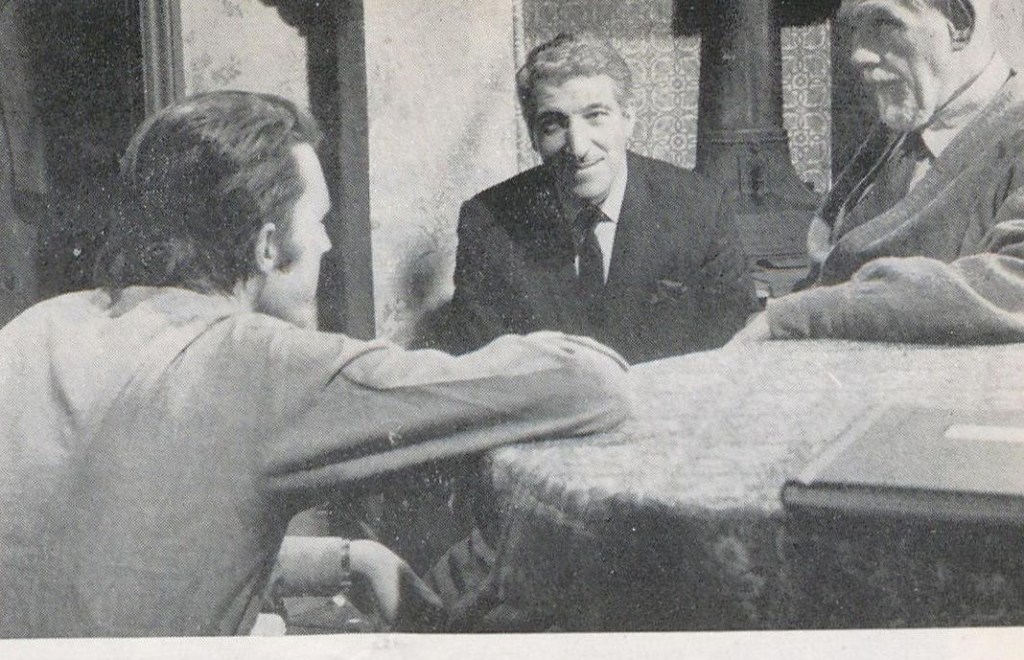
Director Michael reeves (left) with Tony Tenser of Tigon and Karloff.

Karloff was not, to put it mildly, a major marquee attraction. And part of the reason was his determination not to be typecast. So, in the 1940s and 1950s he was more likely to be seen on stage, in Arsenic and Old Lace or The Lark, for example, or on television. He only made eight movies during the 1950s.

There had been some kind of horror comeback in 1963 with The Raven, The Terror, Black Sabbath and The Comedy of Terrors, but since then movie appearances had been sparse. And, of course, for an actor of his age, there was nothing new to say, although perhaps just to remind people that he had been born William Henry Pratt in England.

None of the other performers were remotely well-known. Ian Ogilvy had supporting roles in She Beast (1966) and Stranger in the House / Cop-Out (1967). Elizabeth Ercy had small parts in Doctor in Clover / Carnaby M.D. (1966) and Fathom (1967). Each was given an one-eighth page biography. Despite directing She Beast, Michael Reeves wasn’t mentioned at all.

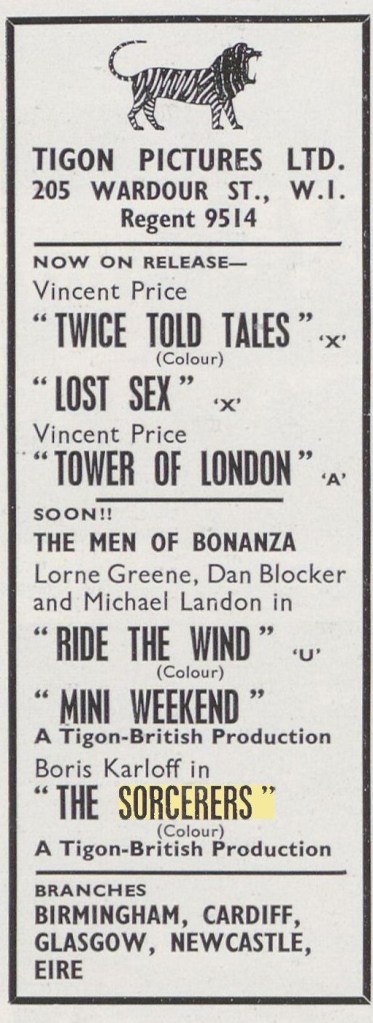
The company you keep. Tigon’s line-up for 1967.

So you get the distinct impression from the Pressbook that it’s Karloff or nothing and since the actor, as noted, was hardly a major player, nobody was going to much trouble to sell the picture.

The Pressbooks I’ve presented in previous features in the Blog have all had considerably more going for them, but this was the downside of the movie business. When there wasn’t much to sell, the distributor wasn’t going to waste his money trying to achieve the impossible.

The Pressbook, printed in 1967, did not appear to achieve any success. The movie did not win a single first run or showcase booking in any of the major cities whose box office was reported by Variety magazine. However, in July 1968, the film was awarded the Grand Prix at the Trieste Sci Fi Festival, with Elizabeth Ercy named Best Actress. That did not appear to brighten the movie’s prospects.

But in 1969, it turned up at the bottom of two horror triple bills. In Boston in first run at the Center it grossed $7,000 (Variety, February 19, 1969, p8) supporting Island of the Doomed (1967) and Castle of Evil (1966). In Los Angeles in a Karloff triple, it was topped in the billing by The Comedy of Terrors and The Raven, earning a decent $110,000 from 12 houses. (Variety, April 30, 1969, p8), it was top-billed in first run in Chicago taking in a “neat” $5,500 at the Monroe (Variety, October 15, 1969, p8).

But it’s possible these few bookings and doubtless others on the drive-in circuits and in smaller towns might still have helped turn a profit on the picture since it only cost $210,000 to make in the first place.

Selling the Obvious: Pressbook for “Kisses for My President” (1964)

Fred MacMurray doesn’t actually wear a woman’s hat in this picture, he just imagines himself wearing one. But that image was all it took for the marketeers to do it to death. Warner Brothers clearly believed the picture was going to be a winner and produced a whopping 32-page A3 Pressbook (double the normal size) in a bid to persuade exhibitors of its potential. That included a blockbusting two dozen adverts. Although in the 1960s as this series on Pressbooks has shown, movies were not sold just on the basis of one core image, but even so a limit was generally called when the number of options reached eight or nine.

On top of that, the Pressbook writers provided interesting copy for editors who might file a snipper or two around the movie’s launch. Arlene Dahl, for instance, contended that a large proportion of the most prominent women in history – Salome, Cleopatra, Elizabeth I – had, like her, red hair. Writing a syndicated beauty column, Dahl also offered advice on wearing perfume.

Eli Wallach put forward a convincing argument for remaining a supporting actor. “Get your name above the title,” he opined, “and if you make a hit you have to play the same thing over and over – the actor gets sick of the monotony and sooner or later so does the public.” Polly Bergen, who based her screen wardrobe on Jackie Kennedy, argued that ordinary women were well turned out in America whereas abroad that was the preserve of the wealthy. Starting out in Wisconsin Fred MacMurray scraped paint off cars for $20 a week.

To get exhibitors in the mood to sell a political comedy, the Pressbook offered eight “punchy and funny” spoof campaign posters, suggesting they be positioned in door panels or along one wall in a straight line and on a voting booth in the lobby. Expanding on the concept in their local area, exhibitors were encourage to recruit an important woman “holding some office” who could be corralled into acting as a “president” embarking on an imitation tour backed up by supporters carrying placards.

Silent screen star Carmel Myers, who manufactured a fragrance line for men, was enrolled by Warner Brothers for a nationwide tour in part talking about the subject that is key to the movie’s subplot – “can a beautiful and glamorous woman be a successful business executive?” A high-flying vamp of the silent era, Myers starred in Ben-Hur: A  Tale of the Christ (1925) and later had her own short-lived television series before entering the beauty business.

Except twice, each of the other myriad adverts stuck with a photo of MacMurray wearing a hat. The taglines, running on the theme of what happened to the female President’s male consort, varied only slightly. “When a woman becomes President, what happens when her poor husband becomes First Lady?” / “President arrives in New York today, leaves First Lady home with knitting”/ “Women rise, men revolt, everybody cheer”

Inevitably, advertising focused on politics. “Republicans and Democrats agree this is the funniest picture you’ll ever see” / “First male First Lady takes Washington by storm” / “Is America prepared for the first woman president and her First Lady?

Some taglines took a different approach. “This year a woman will be elected President of U.S….and a man will be elected to the Comedy Hall of Fame” /”Vote the sdtraight ticket (the movie ticket, we mean” / “When you cast your next vote for President, be sure to do it at (this) theatre” / My father is the hostess with the moistest.” 

Selling James Bond – Pressbook for “From Russia with Love” (1963)

United Artists had two concepts in mind when it came to marketing the second in the James Bond series From Russia with Love (1963). The first, and quite audacious notion, was to tell anyone who hadn’t seen Dr No (1962) much they had missed. Producers Cubby Broccoli and Harry Saltzman reckoned 69 million moviegoers across the world had seen Dr No, but America only accounted for a small fraction of that total. So their mission was to ensure that American audiences did not miss out again on the “throbbing world of hot-blooded excitement.”

To target that marketplace, the adverts were more like a relaunch, not a sequel, and the taglines began with “Meet James Bond, Secret Agent 007.” And then, “For those unlucky few who missed Dr No…You are unprepared for the sophisticated mayhem and polished lovemaking. The James Bond bug has not bitten you. But take heart! There is still time to jump on the Bond bandwagon with the second James Bond adventure From Russia with Love. See it and we guarantee – you will be hooked for good.” The final exhortation: “Don’t you think it’s time you met secret agent 007?”

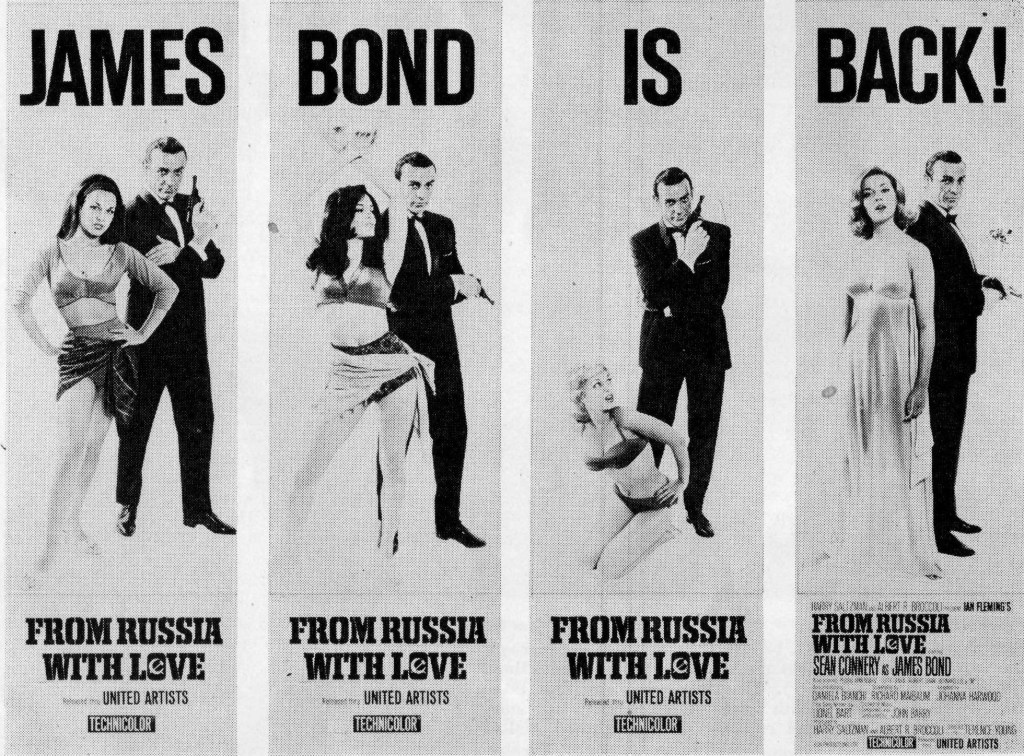
But of course James Bond already had some kind of fan club in the States. “James Bond Is Back!” screamed the alternative advertisements. For both, however, the emphasis was on the new. “His incredible new women! His new incredible enemies! His new incredible adventures!”

“Target: the unkillable James Bond 007. Blast him! Seduce him! Bomb him! Strangle him!” The tone of the adverts suggested something entirely new. While heroes in thrillers could expect to face danger at every turn, and while a romance might sweeten the pot, there would not be a selection of alluring scantily-attired women. “For those who saw Dr No, consider yourself fortunate. Now you are prepared for the further fantastic adventures of that master of intrigue and women, secret agent 007 James Bond, join him in his new thriller From Russia with Love.

To whet the appetite of local newspapermen there was a host of snippets. Oxford University had organized an 007 Society whose members included three lords and the heir to one of the the country’s largest department stores. While James Bond never uses a Windsor knot in his ties, Sean Connery does. Ian Fleming’s Bond novels had sold 30 million copies including six million of From Russia with Love. Four Istanbul mosques featured in the new film as well as an underground cistern a millennium old.

Door posters five feet high.

Beauty queens were always a good bet for coverage – Miss Universe runner-up Daniela Bianchi  won the role of James Bond’s girlfriend after a screen test and former Miss Israel Aliza Gur and former Miss Jamaica Martine Beswick played the fighting gypsy girls. Lotte Lenya was married to Kurt Weill who, with Berthold Brecht, wrote The Threepenny Opera. Sean Connery was fitted out by his own Savile Row tailor Anthony Sinclair and during filming got through ten customized shirts, eight suits, two top coats and a dress suit.

Highly sought-after these days in the memorabilia market are the door panels – measuring 20 inches x 60 inches – which exhibitors would stick to lobby doors but which could also be utilized as displays in stores. Signet brought out a movie tie-in paperback which came with its own promotional material. As there were already other books in the series, booksellers would be inclined to set up a Bond display. As well as the John Barry original soundtrack album, other artists recording material from the film included Matt Monro, Jackie Gleason, Kenny Ball, Al Caiola and Si Zetner, all creating promotional tools.

“Bondmanship” was the overall name given to lifestyle items worn by Bond or which he might wear so tie-ups with fashion stores and retailers were encouraged “no direct endorsement is necessary.” So, for example, restaurants were encouraged to offer “ a menu good enough for James Bond.” It didn’t matter that Bond did not wear a manufacturer’s shoes, ties or suits in the film, just that he might wear them if they were of sufficient quality.

The marketeers came up with a simple stunt: send a set of keys to a newspaper, turn up the next day with a dispatch box handcuffed to your wrist, open it and find inside various promotional items. Or the keys don’t open the case and you need to send for a locksmith. Either way it was important to have a photographer to hand.

Selling Oscar Winners – Pressbook for “The Slender Thread” (1965)

Just how do you sell a movie about a suicide to an audience for whom such a subject is still taboo? The answer is – you don’t. Instead, you fall back on your stars – and the fact that they are both Oscar winners.

We are pretty used these days to advertising campaigns, especially trailers, focusing on Academy Award recognition – The House of Gucci (2021), for example, boasting umpteen winners and nominees – but it was far rarer in the 1960s when exhibitors expected Pressbooks to provide them with sufficient marketing information to lure in the customers. Oscar success might have been mentioned in passing, forming part of a participant’s biography, but it would not be the entire focal point of the campaign.

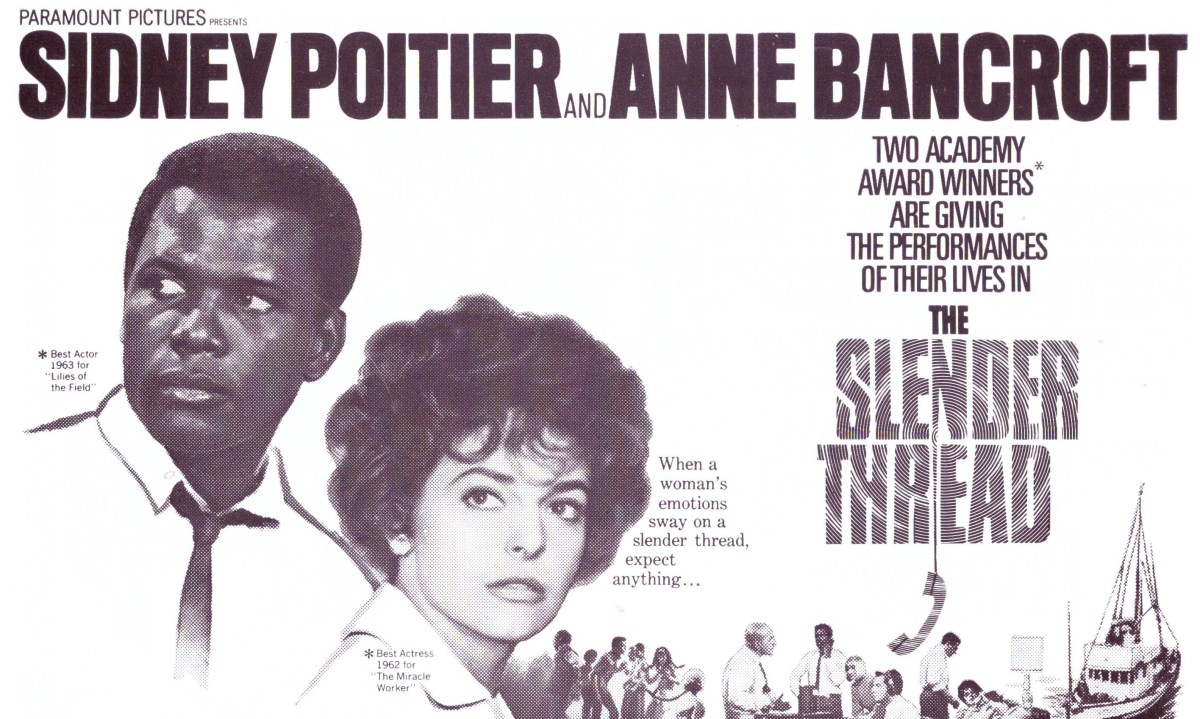
The 16-page A3 Pressbook for The Slender Thread does nothing but. There was, of course, a link between the two stars in that Anne Bancroft recipient of the Best Actress Oscar for The Miracle Worker in 1962 had the following year presented Sidney Poitier with his Best Actor gong for Lilies of the Field (1963).

“Two Academy Award winners giving the performances of their lives” is pretty much as far as the tagline writers went in providing exhibitors with something to sell. The subsidiary tagline “when a woman’s emotions sway on a slender thread expect anything” offer little in the way of explaining the film’s content. An image of a phone plays a prominent role in artwork but again without clarifying its purpose. In much smaller writing, at the end of another reference to the Oscars, is the mention of “a motion picture rarely, if ever, surpassed in suspense” but again minus clarification.

You might actually come away with the notion that the drama takes place on the high seas since a ship features in the advertising.

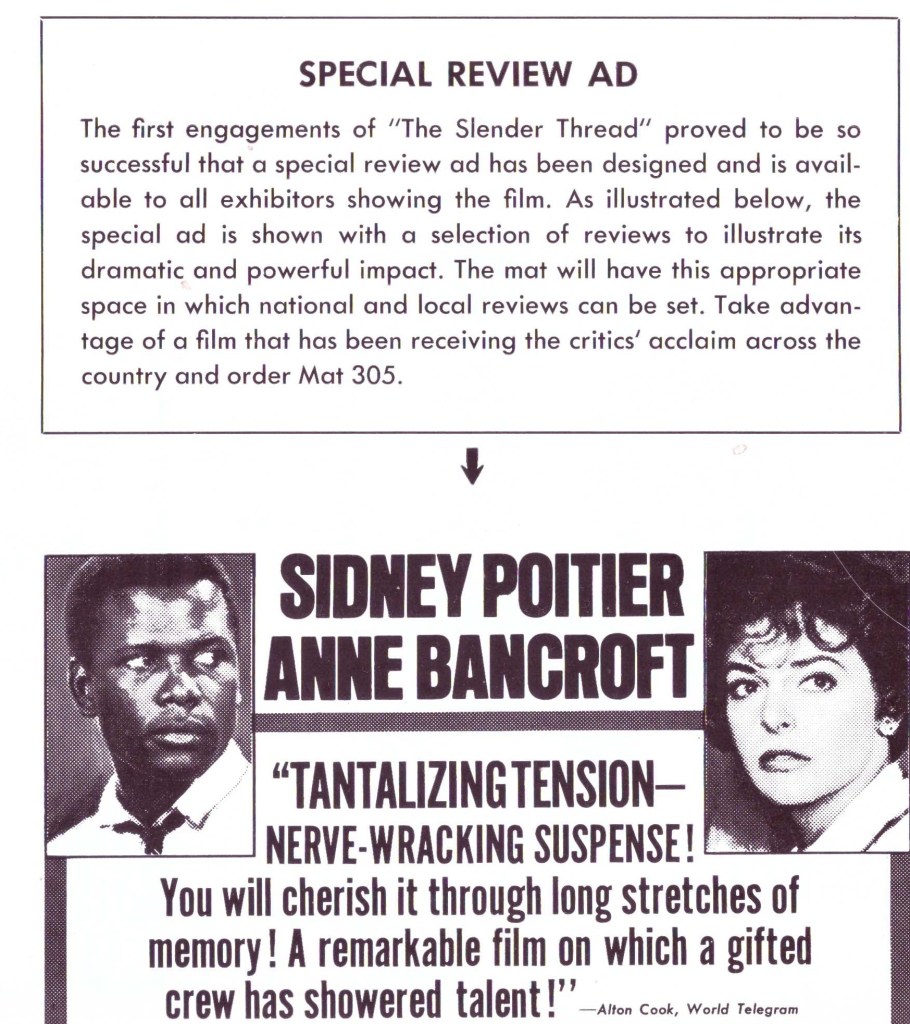
The only other assistance given exhibitors came in the form of reviews which make more mention of suspense. Cue magazine termed it “gripping, bristling tension and suspense all the way.” Kate Cameron in the Daily News concurred – “a high tension suspense film” as did Alton Cook of the World Telegram (“Tantalizing Tension! Nerve-Wracking Suspense!). Nobody mentioned what caused the tension and suspense.

The best bet for tie-ins came from record stores since record label Mercury has organised a “giant merchandising campaign” promoting the Quincy Jones soundtrack. The studio took the chance that exhibitors might take it into their own hands to organise some tie-ups with beauty salons, telephone companies and discotheques since these make an appearance in the picture.     

Quite how 16 pages of the same repeated artwork was meant to inspire exhibitors into, first all, booking the picture, and then, consequently, selling it to moviegoers is never explained.

Selling Sharif – The Pressbook for “Mayerling” (1969)

MGM didn’t know how to sell this. So they came up with three different campaigns. The first was the classical illustration of stars Omar Sharif and Catherine Deneuve about to kiss. This image was used for the film’s launch in the U.K. and at the Radio City Music Hall in New York. The artwork could be augmented if need be by various scenes from the film. You would categorize this as the straightforward romantic sell. Sharif after all was the most famous romantic idol of the decade following the monumental success of Doctor Zhivago (1965).

But this was the more liberalized 1969 rather the restrained mid-decade so MGM offered exhibitors the opportunity to promote the picture as a more salacious number, not overdone sexually since that would defeat the purpose of achieving a rating designed to attract the widest possible adult audience, but nonetheless touching on enough of the risqué to satisfy modern cinemagoing taste.

Of the two alternatives, one was considerably more spicy than the other. Using the tagline “No one woman could satisfy him…until he fell in love” this presented Sharif as wanton playboy, wine glass in hand, cavorting with cleavage-ridden woman.  The other approach, though technically more reserved, was as provocative since it highlighted Deneuve’s role as a high-class sex worker in Belle de Jour (1967), the sensational arthouse breakout. The connection would not be lost on the more sophisticated members of the audience.

Nor did the Pressbook avoid the more intimate elements of the drama and in fact the biggest article in the promotional material concerned the “emotional incest” between Sharif as the Crown Prince and his mother played by Ava Gardner – “the abnormally close relationship between the two was noted again and again in records of the era” – and in their first scene together “looked like lovers to the silver screen born.”

Historical films lent themselves to the kind of detail that journalists loved and the Pressbook for a movie set in a magnificent Vienna at the end of the nineteenth century capitalized on this.  As you might expect, waltzes played a key role in the social life of high society. The Pressbook introduced newspaper editors to the concept of “left-waltzing,” a particularly energetic form of the dance performed on state occasions. This waltz had a “strict etiquette” in that it is “forbidden to reverse no matter how dizzy one gets,” explained director Terence Young. Auditioning for extras to participate was made simpler by eliminating anyone who collided with another dancer.

The Pressbook, unusually, also casts light on directorial technique, again in reference to a waltz. This is the one where Omar Sharif scandalizes the court by opening a ball by dancing with his mistress Catherine Deneuve. Young wanted to create the effect of the whirling couple revolving into a world of their own.  To achieve this the stars had to “dance in a perfect circle, keeping a constant distance in the center of the ballroom floor from director of photography Henri Akedan and his revolving camera.”

Initially, Young resorted to “two elaborate and – as it proved – punishing devices since the dance had to be done over and over.” The first saw camera and stars balanced at opposite ends of a rotating “see-saw.” But this moved so fast Sharif lost his balance and Deneuve suffered from dizziness. Next, they were connected by a lasso but this metal contraption struck them so often in the hips it was abandoned. Finally, they reverted to the simplest of solutions, working round a circle chalked on the floor. 

To ensure authenticity, Young was able to film at the Hapsburg Palace, the Karlschirche and the Schonbrunn Palace. However, such was the urge to preserve these antiquities, the stars were not permitted to sit on any of the chairs or even get anywhere close to them, so it was standing room only for days at a time. However, the Vienna Opera House of 1888 was reconstructed on Parisian sound stages.

The marketers were able to take advantage of the current fashion for the vintage look as pioneered by the likes of The Beatles. Under the heading “Groovy Gear,” the promotional gurus encouraged exhibitors to target the university crowd and metropolitan areas with a preponderance of young people who would appreciate the “freaky clothes” and “up-town hippy clothing” like the military garb, long topcoats, high boots and fur hats worn in the film. Even so, the Pressbook originators were remarkably unimaginative when it came to dreaming up stunts and promotional gimmicks. Their best suggestions were a Catherine Deneuve look-alike contest and a competition to list all Omar Sharif’s roles. Rather more ambitious was the idea of inviting high school pupils to write an essay on aspects of the period.

Selling Crime – “King of the Roaring 20s” (1961)

Gambling dominates the 12-page A3-sized Pressbook with the legend of the sinister yet charming Arnold taking pride of place in the editorial section rather than, as would be usual, the actors. So we are given the inside story of the famous betting coup with Sidereal at a New York race track, but fleshing out the man shown on screen, exhibitors also learned that Rothstein was known as the “banker of the underworld,” how he won $600,000 in a poker game and a masterpiece painted by Sir Joshua Reynolds.

Not touched upon in the picture, but included here, was that he owned an art gallery, chartered ocean liners to transport liquor from Europe, ran protection rackets in the garment industry, and was instrumental in creating what became known as “The Syndicate.” In short, the Pressbook set out to built Rothstein up as even more fabulous figure than shown in the film.

As with Jessica, and as pointed out in my report on that Pressbook, the producers took the unusual step of sticking with the one dominant image in the poster of David Janssen (as Rothstein) leaning over a poker table with fistfuls of cash in his hand and Dianne Foster (Rothstein’s wife) at his back– although it’s possible in this instance the single-image approach was to reduce costs since this was in fact a glorified B-picture. The rest of the poster is an amalgamation of various scenes – racehorses, showgirls, people dancing the Charleston, a drive-by shooting. In the absence of one big star billed above the title, a total of 10 actors have their names below or their faces running down the side, almost giving the impression that it is an all-star ensemble picture.

After paying his dues in television with four years as Richard Diamond, Detective (1957-1960), David Janssen was a relative newcomer to a leading role although his performance in a second-billed role in war film Hell to Eternity (1960) had caused him to be touted as the new Clark Gable / Cary Grant. He was lucky that he had already been signed up for King of the Roaring 20s for his next picture after Here to Eternity was critical stinker and box office bomb Dondi (1961).

Other journalistic nuggets included that an Arab sheik once offered 100 camels for British star Diana Dors, Mickey Shaughnessey revealed as a Golden Gloves boxer, Dianne Foster previously taught modelling, and Keenan Wynn had a plate in his jaw. David Janssen’s sister Teri made her debut and their mother Berniece was an extra while Timmy Rooney, son of Mickey, was drafted in to play Johnny Burke as a youngster.

Not surprisingly several promotional ideas aimed at exhibitors revolved around gambling. One suggestion was to place a gambling wheel in the lobby with anyone landing on the numbers 7 or 11 winning a pair of guest tickets. Exhibitors were urged to get in touch with the local vice squad to see if they would donate confiscated gambling equipment for lobby display. Giving away cards that provided information on betting odds was another notion.

To get audiences into the mood of the era, cinema managers could run Charleston contests or a tie-in with a fashion store marketing clothes from the period or attire models as “flappers” to parade around town, especially in an open-top car from the era. More straightforward was a new movie tie-in paperback edition of The Big Bankroll, the book that inspired the picture, published by Cardinal.

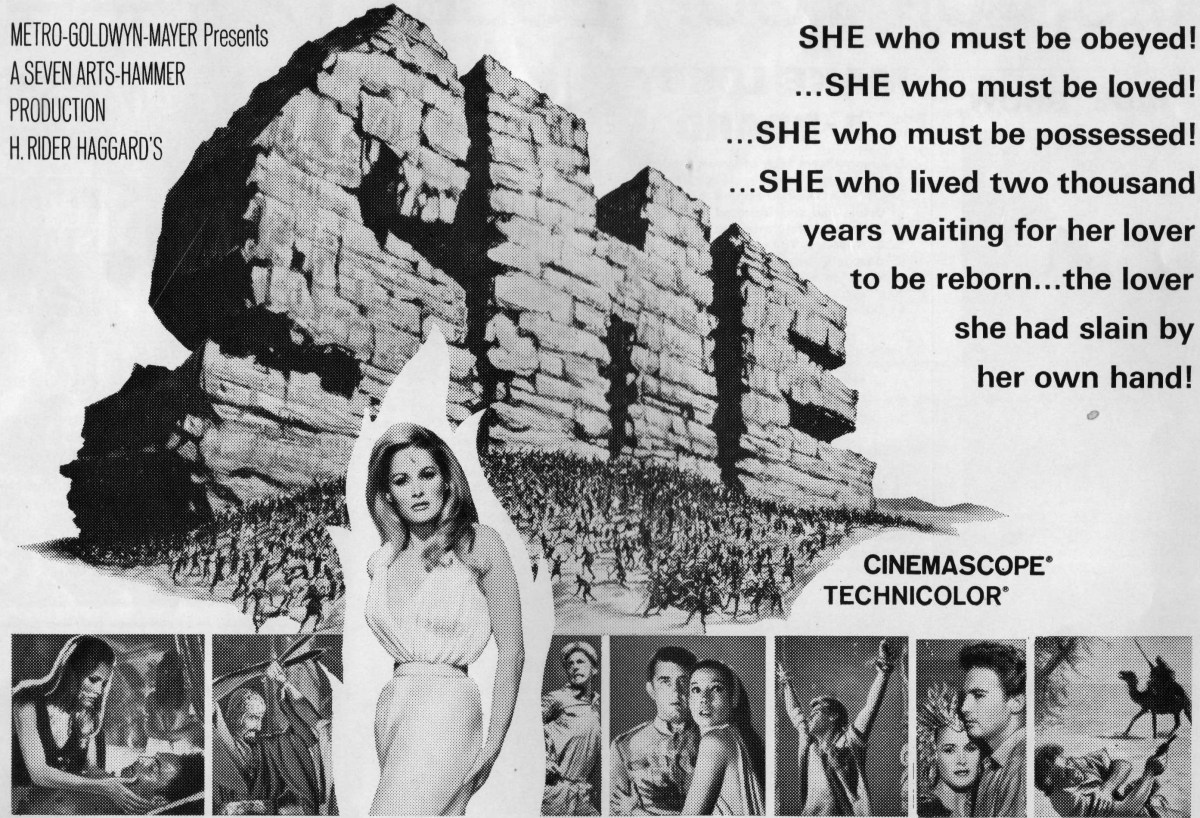
Selling Ursula Andress – The Pressbook for “She” (1965)

Dr No (1962) had only enjoyed moderate success in the United States so it was far from given that Ursula Andress meant much to American audiences. The first Bond outing had finished 43rd in the annual box office rankings and Andress had not exactly swept Elvis Presley off his feet in her only Hollywood offering so far, Fun in Acapulco. However, she was the immediate beneficiary of one of the most extraordinary pieces of luck to fall to a barely-known star.

The gargantuan success of Goldfinger (1964) had sent studio United Artists back to the vaults to resurrect the first two films in the Bond series and put them out in a double bill – the first of many such Bond pairings – in April 1965, a couple of months before She hit the big screen in the U.S. Dr No/From Russia with Love was a record-breaking sensation, attracting three times the numbers that had attended the first release of Dr No.  So outstanding a performer was the double bill that it hit number five on the annual box office chart.   So by the time She was launched Ursula Andress’s iconic bikini-clad entrance in Dr No was fresh in audience memories.

MGM, the U.S. distributor of the Hammer picture, had wisely not counted on the unexpected resurrection of Dr No and had a stack of other promotional wheezes up its sleeve. The 12-page A3 Pressbook kicked off with a “phone stunt” whereby exhibitors would set up a message on a telephone line purportedly from “She-Who-Must-Be-Obeyed.”  The statuesque figure of Ursula Andress in figure-clinging costume was a natural for a standee in a cinema lobby as was the setting up of an artificial flame.

There were any number of ideas for competitions held in conjunction with a radio station or local newspaper: famous women who had ended up as film titles – Cleopatra and so on; famous female rulers; or a list of “love goddesses” to whose ranks it was decreed Andress deserved a place – in posters MGM had no hesitation is calling the actress “the most beautiful woman in the world.”

Journalists were to be hooked into running editorial pieces by a variety of interesting facts that could be cobbled together for an interesting article. The luxurious furs used to decorate the queen’s inner sanctum had been insured for $300,000. Andress had worn a total of nine gowns, designed by Cal Tomms, but none weighed more than a few pounds, the gossamer-like material both free-flowing and clinging to her natural assets. The crown weighed 3lb, a heavy object to carry around on your head for a week, as Andress had. Her cloak contained 3,000 feathers. No doubles were used for the duel between John Richardson and Christopher Lee, both being accomplished swordsmen.

There were human interest items as well. Both Andress and Richardson had previously signed contracts with major studios without ever being given any roles. Andress, shy in real life, had learned to claim to be someone lese when approached by fans.  Filming Dr No, she was grateful it was shot in Jamaica: “I didn’t want anyone to see what a fool I might be making of myself,” she said.

However, she was certainly self-assured in general. Interviewed exclusively for the Pressbook, she said, “Beauty gets you everywhere. It is a gate opener. It takes a long time to discover a good mind, but a beautiful woman attracts attention right away. Only stupid people think that a woman who is attractive must be silly.”

She added: “I will give you a list of the qualities that are most important for a woman – emotional range, beauty, intelligence, education and talent. Emotions are the most important, the ability to feel and love. Beauty next, and intelligence after that. Education is less important than intelligence because if you have the latter you’ll acquire education.

“I have never made a study of acting,” she explained. “I just do it if and when I feel like it. I have no desire to work on the stage and what I do in front of the camera is instinctive and spontaneous. My best takes are the first. Repetition distracts from the quality of my performance. Ayesha in She was a difficult part because this mysterious queen is 2,000 years old  and I had to be very stylized.”

Andress was central to the advertising campaign and although there were a number of different adverts, the actress featured in all, the only difference being her position on the poster, left, right or central. “She had waited 2,000 years waiting for her lover to be reborn – the lover she had slain by her own hand.” To whet audience appetite, a variety of scenes were included at the foot of some posters. 

To grab the attention of the exhibitor, and ensure full cooperation in selling the picture, MGM was offering a treasure chest of rewards for the best local campaign – a total of $10,000 in prize money. To gain additional publicity there was a single record and, more important, a new tie-in edition of the famed novel by H. Rider Haggard, which had already sold 20 million copies in America.

Selling Sex – The Pressbook for “A House Is Not a Home” (1964)

Selling sin had never been difficult in Hollywood, dating back to the Cecil B. DeMille silent epics and more recently when a series of films challenged the Production Code, the studio’s self-governing censorship system. In most films, however, sex had been a by-product of passion, a couple in love, or a glimpse of nudity. Nobody had ever attempted to foist onto the American public a picture about transactional sex, one that examined the basest elements of male desire.

If anyone could be relied upon to sell the unusual it was producer Joseph E. Levine, the master marketeer, who had spent millions to make millions with Hercules (1958) and more recently The Carpetbaggers (1964).  Only Levine had the audacity to market the picture as a “typical American success story” and present the Polly Adler, the New York madam at the center of the movie as “not a stereotype of a procurer” but as confidante of politicians and artists.

That at least was the upfront story, the version presented in the various articles peppering the Pressbook whose sole purpose was to win over the exhibitor. When it came to the public, the approach was a mixture of the imminently direct and the subtle.

In the straightforward department were a whole string of teasers under the headlines “She’s One of Polly’s Girls” featuring glamorous women in sexy outfits to soften up the potential moviegoer in advance. The women featured in virtually every advertisement to follow as “luscious playmates,” either taking center stage or in the background.

A graphic with an illustrated sexy women in little more than bra and panties sitting atop a house also appeared in several adverts. There were several ads along these lines and several different taglines.

“The story of a House of Pleasure…The woman who ran it…The beautiful girls who lived in it…The famous and the infamous who knocked lovingly on its door” set the tone.  Taking a similar approach was the tagline: “A motion picture for those who think they’ve seen everything and those who know they haven’t”  / “the body-and-soul shocker” / “Take a tour of New York’s most famous house! Meet the madam who ran it…the beautiful dolls who lived in it…the Johnnies whose ‘jack’ built it.” (“Jack” in this case meaning “money” in case your imagination runs to more lascivious ideas.)

Going down a more playful route, certainly subtle in comparison to the rest of the advertising, was a series of small ads that focused on aspects of an ordinary home – “the welcome mat is always out” / “the door is always open” – simple illustrations without sight of a sexy inmate.

Often promotional writers struggled to find enough interesting information to fill out a Pressbook but this was littered with fascinating snippets. Shelley Winters lived up to her reputation as a colorful actress by having thrown off the set a noted columnist, a photographer, a magazine writer and the film’s press officer – all in the one afternoon. Cesar Romero who plays gangster Lucky Luciano was born close to the gangster’s birthplace and had been gifted the underworld kingpin’s watch. Polly Adler, whose story the film tells, started writing her bestseller A House Is Not A Home as a thesis as part of a degree at UCLA and later took up painting.

Meri Welles, who essays suicide Lorraine, was actually in the property business, renting homes to movie stars like Rex Harrison. Broderick Crawford had previously won an Oscar as a crooked politician, similar to his role here, in All the King’s Men. Over 1,600 young hopefuls were auditioned over 18 days for the bit parts of Polly’s girls.

Leading the tie-ins was a new edition of the bestseller which had sold over 3 million copies. Brook Benton, then a top-selling pop star, had recorded the title theme by Burt Bacharach and Hal David which managed to avoid any mention of the type of house involved and there was always sheet music to add “promotional punch.” However, based on the notion of an ordinary house, exhibitors were encouraged to get in touch with household suppliers in order to run adverts along the lines of “a house is not a home without refrigerators” linked to the name of a local company.

However, the marketing team struggled somewhat to deliver the usual roster of gimmicks that could be applied by exhibitors, falling back on contests to complete a crossword and devise a limerick. Quite who dreamed up the idea of dressing up a promotional model in cap’n’gown and have her hand out diplomas inviting people to “meet the girls at Polly-Tech” was anybody’s guess and exhibitors might find it difficult to hire someone to parade the streets as a “walking book.”

Discover WordPress

A daily selection of the best content published on WordPress, collected for you by humans who love to read.

The Atavist Magazine

by Brian Hannan

WordPress.com News

The latest news on WordPress.com and the WordPress community.