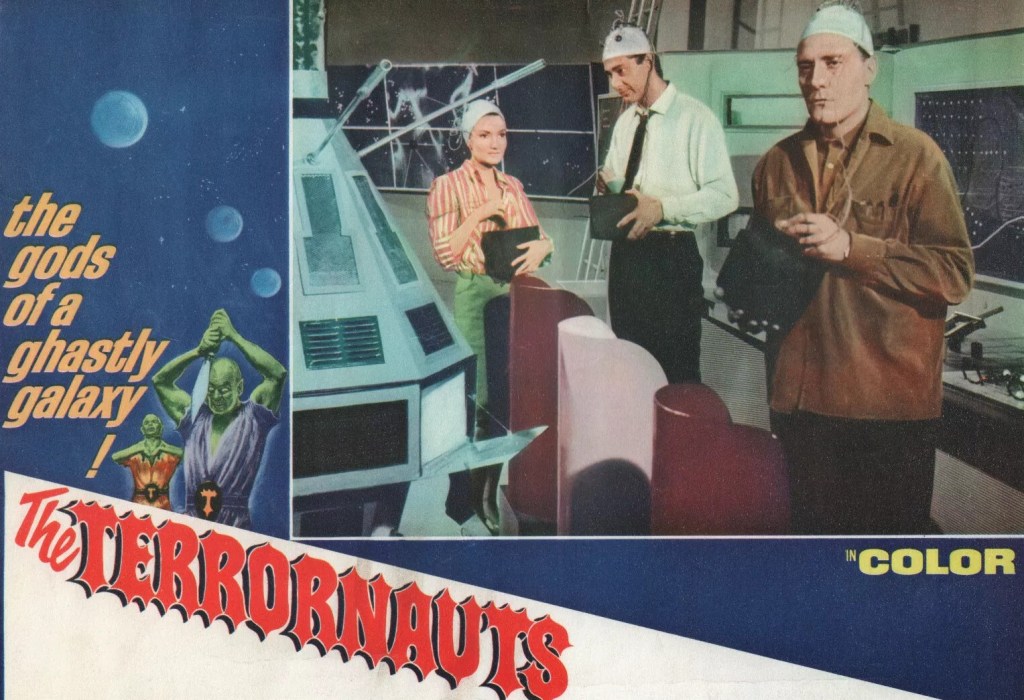
Behind the Scenes: “The Terrornauts” (1967)

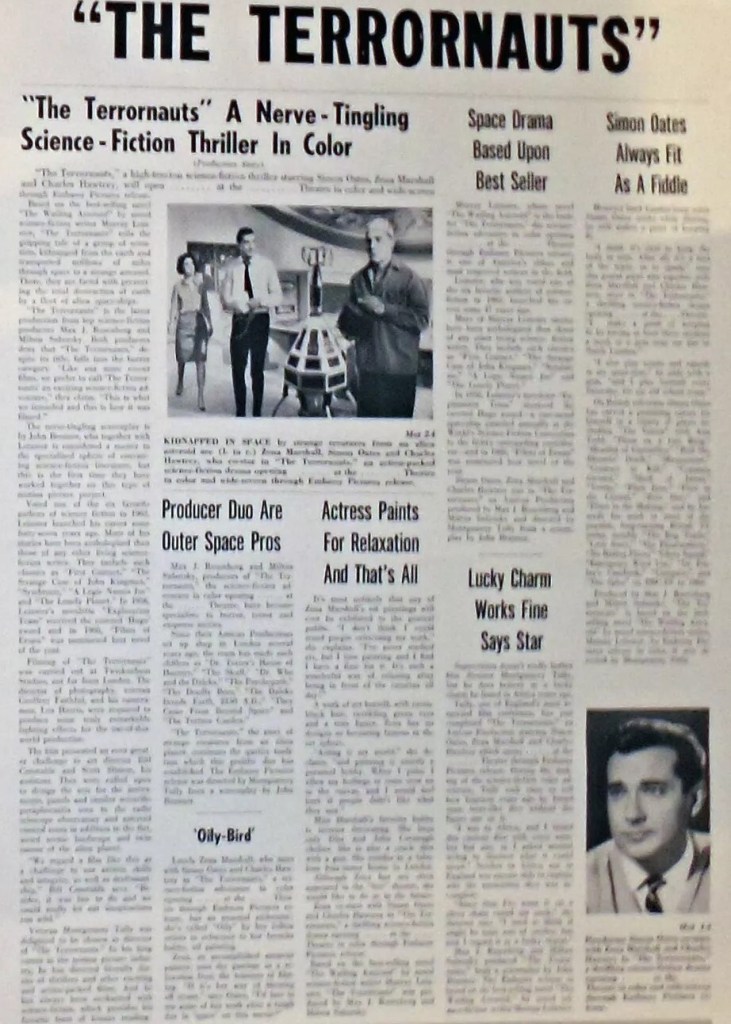
Unless you’re a sci-fi buff of a certain vintage, you probably haven’t heard of Murray Leinster who wrote The Wailing Asteroid on which The Terrornauts is based. Which is a shame because he was one of the giants of science fiction of the golden age. Time magazine called him The Dean of Science Fiction.

For a contemporary audience his name is of considerable significance because he invented the concept of the multiverse. In those days it was called a parallel universe or an alternate history but it amounted to the same thing. And he did so nearly a century ago – in 1934 in fact.

He was second only to H.G. Wells in originating science fiction concepts. He was the first, for example, to imagine meeting an alien culture that was as advanced as our own. He explored themes of mutual distrust, mutual assured destruction, and aliens as superior beings. He also invented the idea of the Internet and man-eating plants.

In The Wailing Asteroid, Leinster draws upon many of the ideas he was first to promulgate.

We have alien encounter. We have the fear that as a consequence terror might be brought back to Earth. We have a species that has evolved far beyond human experience.

We have the same kind of instant absorption of knowledge that occurs through the Internet. The little blocks that our hero finds might as well be called Miniature Googles.

You could also argue that what the space explorers discover is akin to The Sentinel that features in 2001: A Space Odyssey, released in 1968. And you could also view the asteroid as a life-affirming alternative to the hovering destructive Death Star of Star Wars filmed a decade later.

The Terrornauts is a rarity because only a handful of Leinster books were ever filmed. But he was very important to the movies in another way, at the forefront of an invention – front projection – that changed the way movies were made in the 1960s.

At this point, production entity Amicus was as well known for its sci fi output as its horror thanks to Dr Who and the Daleks (1965) and Daleks Invasion Earth 2015 A.D (1966).

So when Embassy Pictures knocked on the door and offered a flat fee of around half a million dollars for a science fiction double bill, Amicus was delighted. Hammer sold its horror pictures as double bills, a complete program more attractive to an exhibitor and more lucrative for a producer than  half a program.  

Amicus contracted to make The Terronauts and They Came from Beyond Space. They weren’t big enough to have stars under contract, nor the first port of call should a director or star have a pet project that required funding.

Their modus operandi was to trawl through the hundreds of novels published every year, either in pre-publication galley form, or when printed. Max Rosenberg claimed to read 500 books a year. “The basic job of a producer,” explained his partner Milton Subotsky, “is to find properties.”  That was how they came across The Wailing Asteroid.

It was occasionally part of the deal in Hollywood that when a studio bought a best-seller, the author was given the opportunity to write the screenplay. But that wasn’t the case here.

Instead, Amicus turned to another science fiction author. John Brunner was as prolific as Leinster. Brunner got the gig because he mixed in the same social circles as Subotsky. Mostly, he wrote conventional space opera and it was only after his experience on The Terrornauts that he acquired a bigger name in science fiction, after winning a Hugo Award in 1969.

The first casualty was the title. The Wailing Asteroid was not as catchy as The Terrornauts. And Brunner had no qualms about scrapping most of the original narrative. He telescoped the time frame. The action in the book takes place over several months, not a couple of days. The book involves multiple countries. Leinster’s novel was set in the United States, but Brunner made the characters British and added the comedy – no tea lady or accountant in the original.  And there’s no humor either. He changed the hero’s occupation from design engineer to scientist, and dumped the incipient hesitant romance between Joe and Sandy. But he brings in the notion of scientists hunting for intelligent life in space.

Nor does Leinster’s book involve little green men, robots or human sacrifice. That’s all Brunner’s doing. He turns what was really a concept novel, an exploration of ideas more akin to 2001: A space Odyssey and Planet of the Apes. Brunner shifts it from what if to alien abduction.

Budget shaped the picture. The first four reels are slow and full of dialog because dialog can be shot much quicker and more cheaply than action. Low budgets didn’t bother Amicus. “I defy any other picture making company,” proclaimed Rosenberg, “to turn out that sort of picture with the budget we are under.” He added, “We make pictures for a price and I think we’re better at it than anybody else.” 

Amicus had something of a stock company, Freddie Francis, for example, the in-house director, had helmed four pictures, the same number as Peter Cushing headlined. Christopher Lee starred in two, Robert Bloch contributed four scripts and Elizabeth Lutyens scored two pictures. But only Lutyens was retained here.

Amicus handed The Terrornauts to veterans, the majority involved were over 50 years of age. Cinematographer Geoffrey Faithful was 74, author Murray Leinster 71,  supporting actor Max Adrian 64, special effects guru Les Bowie 64, director Montgomery Tully 63, composer Elizabeth Lutyens 61.

It would prove the last hurrah for female lead Zena Marshall, Montgomery Tully would bow out later that year after Battle Beneath the Earth and Geoffrey Faithful would only make another two pictures.

The Terrornauts and They Came from Beyond Space were not filmed in October-December 1966 as has been widely reported. Instead, production took place earlier in the year. According to British trade magazine Kine Weekly’s Shooting Now section, The Terrornauts was first to go before the cameras at Twickenham Studios, on June 13 1966 and still featured on its production chart on August 3. Filming on They Came from Beyond Space in the second last week of September continued also at Twickenham until the week of November 3.  

Though to some observers the amount spent on The Terrornauts was very little, in fact the £87,000  budget was nearly double the amount spent on City of the Dead and slightly more than The Skull. Admittedly, there were special effects to consider but to offset that the stars came cheaper than the likes of Peter Cushing and Christopher Lee.

For a time it looked as if Embassy expected The Terrornauts to prove the more popular picture. It ran a one-page advertisement in trade newspaper Variety for The Terrornauts in April 1967 claiming it would be available to rent the following month. The image of Zena Marshall being held down by aliens was accompanied by the tagline – “the virgin sacrifice to the gods of a ghastly galaxy” They didn’t run any adverts for They Came from Beyond Space.

I’m sorry to have to tell you this is a condensed version of the audio commentary by me that accompanies the spanking new DVD released by Vinegar Syndrome – I’m sure you’ll forgive me another small plug – and it’s on special offer.

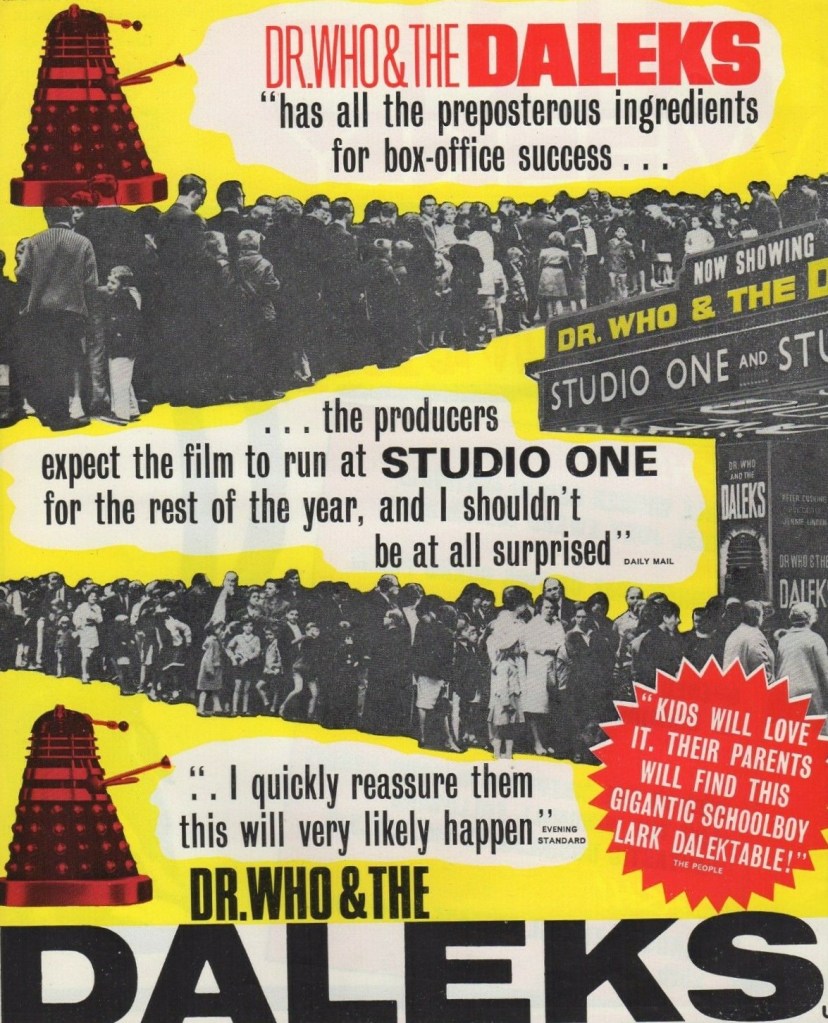
Dr Who and the Daleks (1965) ***

The maiden voyage of the time-travelling Tardis is triggered by some unexpected pratfall comedy. On board are the venerable doctor (Peter Cushing), his intrepid great-granddaughter Susan (Roberta Tovey) and a fearful pair, granddaughter Barbara (Jennie Linden) and accident-prone Ian (Roy Castle). They land on a petrified planet ruled by the robotic Daleks with menacing electronic voices.

The malfunctioning Tardis forces them to investigate an abandoned city but they are quickly imprisoned, the steel robots determined to discover why the earthlings should be immune to the radiation that has consumed this planet after nuclear war. Meanwhile, the planet’s remaining inhabitants, the Thals, are planning an uprising.

Budget restrictions ensure that menace is limited, even as the characters endure a heap of traditional obstacles such as swamp and rocky outcrop. Adults who did not grow up in the 1960s when the BBC television series took Britain by storm and apt to come at this without the benefit of nostalgia will certainly look askance at the sets and costumes. And it doesn’t possess the so-bad-it’s-good quality of some 1950s sci-fi pictures. But since it was primarily made for children, then perhaps it’s better to watch it with a younger person and gauge their response – of course, that may be equally harsh from someone brought up on the modern version of the series or already immersed in superheroes.

On the plus side, it does move along at a clip. Roberta Tovey (A High Wind in Jamaica, 1965) charms rather than annoys as the plucky grand-daughter even if her grandfather has mutated from the sterner figure of the television series into an eccentric inventor. Peter Cushing (The Skull, 1965) is only required to ground the production which he does adequately. The innate comic timing of comedian Roy Castle, in his leading man debut, brings a light touch to proceedings as the bumbling boyfriend and generates some decent laughs. Jennie Linden (Women in Love, 1969) has little to do except look scared.

Oddly enough, it was American Milton Subotsky who, in opportunistic fashion, brought the project to the big screen, although the BBC had a track record of providing product that might make such a leap, The Quatermass Experiment in the 1950s the leading example. He wrote the screenplay and acted as producer and had previously worked with Cushing on Dr Terror’s House of Horrors (1965) and was about to embark on horror masterpiece The Skull the same year. He has approached the material with some reverence and the fact that the budget allowed for hordes of Daleks rather than being seen one or two at a time as on the television probably made some child’s day.

Scottish director Gordon Flemyng (The Split, 1968) would make the leap to Hollywood on the back of this picture and its sequel the following year and you can see what made studios have faith in his ability – he deals with multiple characters, works quickly on a low budget and delivers an attractive picture that was a box office hit.

I suspect that audiences will divide into those who watch the film with nostalgia-colored spectacles, those who think it only as good as a bad episode of Star Trek and those who adore any low-budget sci-fi movie.

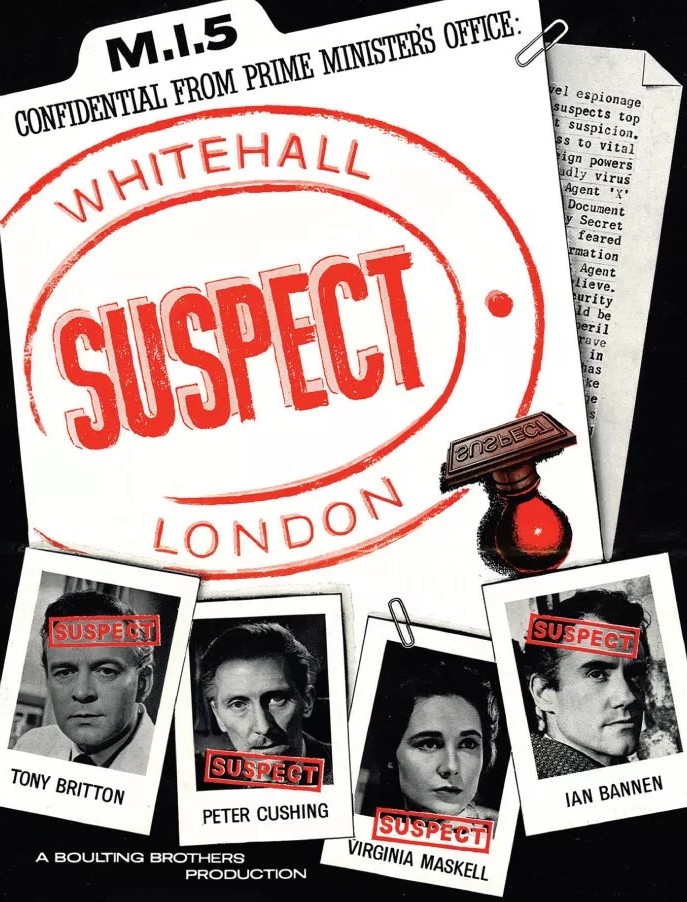
Suspect / The Risk (1960) ****

Marvellous long-forgotten character-driven espionage drama exploring the twin themes of guilt and duty. It would appear to be stolen by two supporting actors, Ian Bannen and Thorley Walters, but in fact both play roles that have significant bearing not only on the narrative but on our understanding of the most important characters. Not only do we have the main plot, but we also have two well-worked sub-plots, one concerning disability and the other of more sinister relevance – a 1984 Big Brother theme.

Basic tale concerns a laboratory that has discovered a bacteria that can cure plague. Hopes of  a celebratory drink all-round and academic kudos on publishing his paper for top boffin Professor Sewell (Peter Cushing) are dashed when the Government in the shape of the pompous Sir George Gatling (Raymond Huntly) steps in, steals the discovery and makes the staff sign the Official Secrets Act.

Romance No 1 – Virginia Maskell and Tony Britton in the lab.

While the revered professor takes it on the chin, colleague Bob Marriott (Tony Britton) is outraged so vocally in public that he attracts the attention of the shady Brown (Donald Pleasance) who suggests to the dupe that there is a way of getting the information out to the wider scientific community, especially to plague-ridden countries.

However, don’t let Sir George’s pomposity fool you. He doesn’t trust this bunch an inch and puts the Secret Service on their tail to assess “the risk” and we dip into the dark kind of web (not that kind of dark web) and the mundane business of deception and betrayal shortly to be explored by the likes of John Le Carre (The Spy Who Came in from the Cold, published in 1963) and Len Deighton (The Ipcress File, published a year earlier).

Rather than this outfit being headed by a version of the prim George Smiley, Mr Prince (Thorley Waters) has a lot more in common with the unkempt Jackson Lamb of the Slow Horses series. His incompetence is an act to make visitors to his shambles of an office under-estimate him.  But he’s got that Columbo knack of asking the most important question just when an interviewee thinks the interview is over.

Also in the background, coming more increasingly into the foreground, is an unusual love triangle between colleagues Bob and Lucy Byrne (Virginia Maskell), who kiss and hold hands in the cinema, and Lucy’s flatmate, the disabled war vet Alan Andrews (Ian Bannen). The fact that Lucy and Alan live together at a time when such a relationship was frowned upon and would be career death in certain circles and that they were once engaged to be married gives it an edge. That Alan has lost an arm and a hand so needs to be cared for – fed (as in food spooned into his mouth),  washed (you can guess that aspect), cigarette lit and removed between puffs, dressed – suggests significant intimacy for an adult.

Obviously, she’s the kind of lass who couldn’t abandon him to the welfare system, and he’s the kind of man who broke off their engagement so she wouldn’t feel tied to him for the rest of her life. But he also hates what he’s become, his desperate reliance on her, what he’s lost, and that’s turned him into not just a bitter individual but a particularly cunning one, who has developed the trick of torpedoing any nascent romance. “You can’t compete,” he gloats to Bob, “because you can’t make her feel good.”

Romance No 2 – Ian Bannen and Virginia Maskell.

But when that doesn’t work, he befriends Bob and surreptitiously eggs him on to betray his country and in so doing, hopefully, kill off the romance.

Mr Prince is a delight. Accorded the best lines, he makes great use of them. When his subordinate Slater (Sam Kydd) abrasively brings Dr Shole (Kenneth Griffith) in for questioning, he reprimands him with the rather coy, “Oh, you haven’t been rough again.” To Dr Shole (Kenneth Griffith), the most susceptible of the professor’s acolytes, he warns, “Tell him (Sewell) not to be a fool or you’ll smack him on the backside.”  Though Dr Shole has a superb retort, “We’re not exactly on those terms.”

Professor Sewell appears mostly on the back foot. While quietly seething at being denied his professional day in the sun, he accepts duty. Even so, he’s smart enough to outwit Prince when the traitor is caught.

The background of the wheels-within-wheels of Government, the silent overseeing of ordinary lives, the authorized level of spying, comes as something of a shock, since despite George Orwell’s best efforts Big Brother was seen as a clever fiction that could not occur in this most democratic and upright of countries where “fair play” was the rule. Visually, this is well done, we see eavesdroppers in mirrors in pubs and, as I said, Prince seems the least effective of operatives but with the kind of personality that you could easily have built a series around.

Disability from war was a constant of post-war British pictures, most often demonstrated by a character with a limp, as with general dogsbody Arthur (Spike Milligan) here. The Oscar-winning The Best Years of Our Lives (1946) was the most effective at dealing with the physical after-effects of the Second World War. But there, the worst-affected soldier, had prosthetic hands. Here, Alan does not, so the scenes of him being tended to by Lucy are emotionally more powerful.

She tends to his emotions, too, and will embrace him and kiss him on the mouth though he’s not dumb enough to read true romantic commitment into those demonstrations of affection. Clearly, there is emotional residue from their engagement, from which you guess she will ultimately be unable to entangle herself, unless he can find a more brutal way of helping her out of the dilemma.

The lab aspect is surprisingly well done. We don’t get any real information on the scientific breakthrough. Mostly, what we view is the grunt work, the laborious checking of thousands of samples for another experiment. At one point Bob thrusts his arm into a contraption packed with buzzing flies as if he was a competitor in I’m a Celebrity, Get Me Out of Here.

Ian Bannen (The Flight of the Phoenix, 1965) is the standout but character actor Thorley Waters (Sherlock Holmes and the Deadly Necklace, 1962) runs him close. Tony Britton (better known later for television comedy) has the least interesting role, but Virginia Maskell (Interlude, 1968) has too much to do without dialog to demonstrate her dilemma. Peter Cushing (The Skull, 1965) is solid as always and Spike Milligan provides light relief.

Joint direction by the Boulting Brothers (The Family Way, 1967), Roy and John. Screenplay by Nigel Balchin (Circle of Deception, 1960) based on his own novel.  

Exceptionally solid stuff. I was very much taken by the unusual approach, the themes and the acting.

Worth a look.

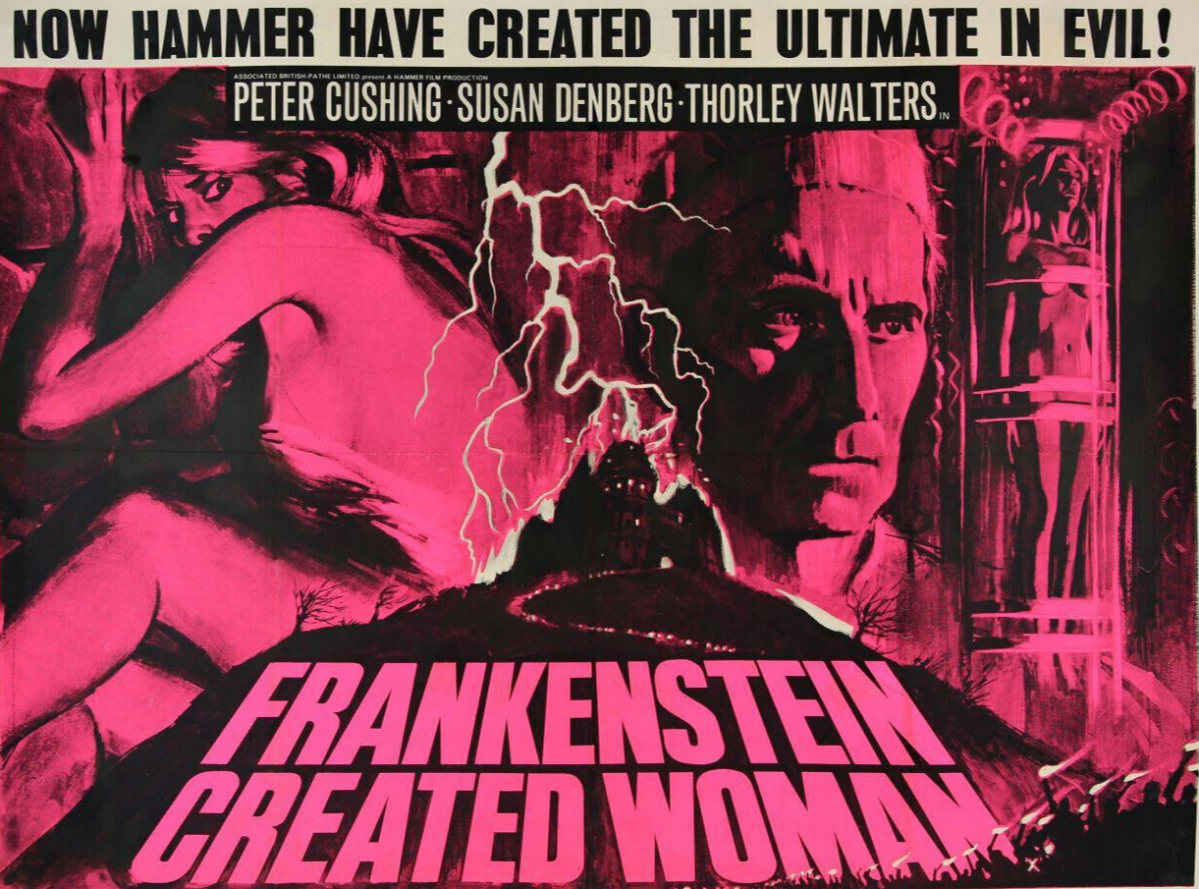
Frankenstein Created Woman (1967) ***

Custom-made for a contemporary audience. How can you fail with a tale about a male brain taking over a female body. Male soul if you want to be strictly correct and metaphysical about it or if you are Martin Scorsese for whom discussion about whether the soul leaves the body after death and exists on some other plane was of the greatest interest. But, yes, so although our hero/villain Baron Frankenstein (Peter Cushing) does create a female instead of a male, and not just with the misogynistic purpose of supplying a monster with a mate, unfortunately in the act of creation the poor woman is saddled with the soul/brain of a man, and, even worse, one with  bloody revenge on his mind.

These days for sure audiences would not have any trouble with female stars carving a swathe through any populace and nobody would require transplanting of  male hormones-soul-brain-whatever to take off on a rampage. But, back in the day, before Hammer went full-tilt-boogie down the lesbian vampire route, it was rare, outside of film noir and exploitationer pictures, for a woman to be so savage. So her actions are viewed with regret rather than roars of approval. But, for once, nobody is taking a torch or axe to the good old Baron.

That’s not all that takes the audience by surprise. The use of a guillotine, ideal for a post-task  dripping of blood, turns out to be widely used in central Europe in the 19th century, hardly surprising since it was a German invention. The movie opens with a young boy, Hans, witnessing his father’s execution on such a device, a point that seems arbitrary but proves pivotal.

The grown-up Hans (Robert Morris) assists Dr Hertz (Thorley Walters) assisting the Baron in some kind of resurrection experiment, the guinea pig being Frankenstein himself. Naturally, for purely metaphysical purposes you understand, the Baron would like to experiment on as barely-dead a cadaver as possible to prove his theories. That this takes a good while to materialize is largely because the narrative has to go all around the houses.

Hans’s lover, disfigured and lame innkeeper’s daughter Christina (Susan Denberg), is taunted by a trio of young swells that results in Hans attacking them. Later, for no particular good reason, the toffs kill the innkeeper, but Hans gets the blame and is sentenced to death. After he is  guillotined, Christina commits suicide by drowning. Both bodies turn up in Frankenstein’s lab at roughly the same time. Complication of course being that a guillotine doesn’t deliver a body intact. Quite how Frankenstein achieves his soul-body transplant is left up to your imagination – the scene promised in the poster is a marketing fiction.

And there’s a touch of Poor Things about the result as Christina wakes up minus scars and disfigurement but with no recollection of her past and needs to be taught who she is. Not that she requires much education in the feminine wiles department and is soon stalking the three young toffs, seducing them with hints of sexual promise before taking savage revenge.

There also a Curse of the Undead element when villagers discover her grave is empty. In fairness to the Baron, he soon realizes what fate had befallen her and tries to ensure that, once her revenge is complete, she can live a different life, although in the way of horror films a happy ending is rarely an option. And in fairness to the Baron the villagers aren’t queueing up to set him alight.

With various subplots to get through, this leaves the Baron out of the picture for considerable periods of time. From a contemporary perspective, there’s a freshness here that will appeal, especially the creation’s desire to discover her purpose in life, her not being bred to fulfil a romantic purpose, and the battle of the male-female will.

Peter Cushing (The Skull, 1965) is as usual splendid, Thorley Walters (Sherlock Holmes and the Deadly Necklace, 1962) presents as an inebriated and impecunious assistant while Austrian Susan Denberg (An American Dream, 1966) does well in the dual role.

Fourth outing in the Hammer series, directed with occasional verve by the reliable Terence Fisher (The Devil Rides Out, 1968) from a screenplay by Anthony Hinds (The Mummy’s Shroud, 1967).

Contemporary appeal and can never go wrong given that it is purportedly one of Martin Scorsese’s favorite films.

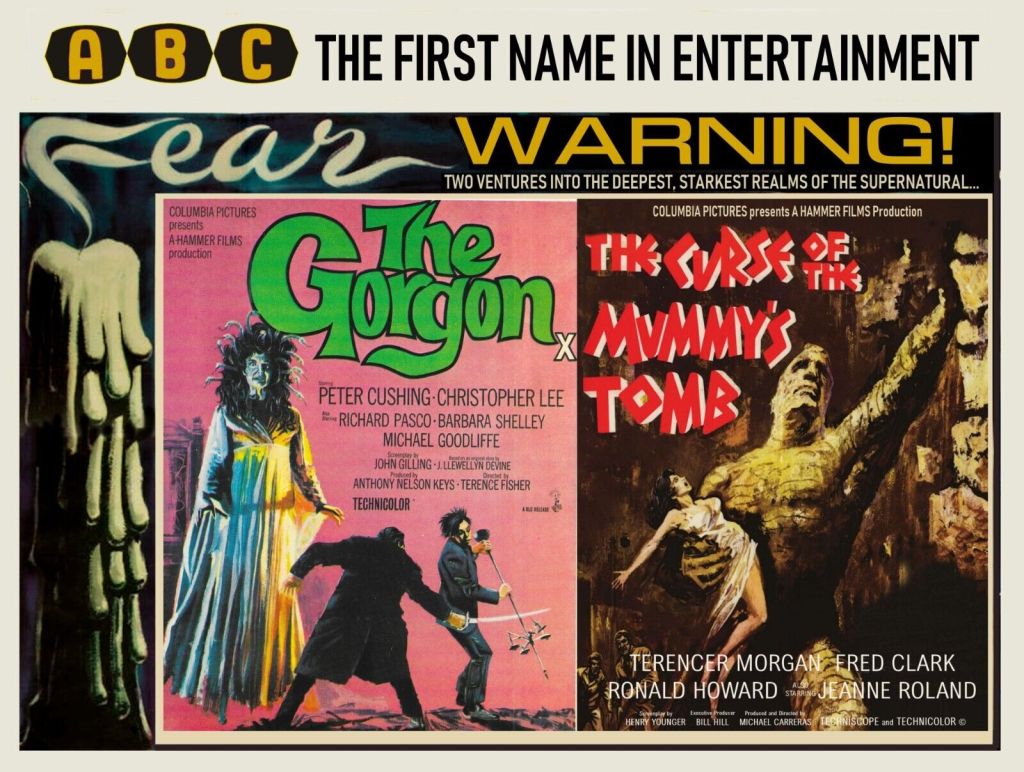
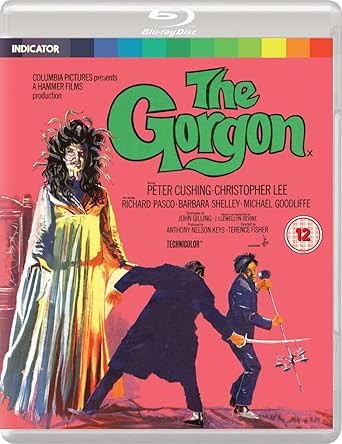
The Gorgon (1964) ***

This impressive Hammer conspiracy-of-silence slow-burner, more thriller than horror, features the triumvirate of Christopher Lee (The Devil Ship Pirates, 1964), Peter Cushing (The Sword of Sherwood Forest, 1960) and Barbara Steele (Dracula, Prince of Darkness, 1966) in untypical roles. Lee and Cushing, of course, had locked horns before, namely in Hammer’s reimagining of the classic Dracula, with the former the charismatic fiend and the latter his nemesis.

Dr Namaroff (Peter Cushing) is a  doctor in an unnamed European turn-of-the-twentieth-century police state who knows more than he is letting on about seven inexplicable deaths in five years and the possibility of a 2,000-year-old myth coming to life and taking on a human form. And with quite a human side, jealous when his assistant Carla (Barbara Shelley) falls for a younger man, Paul (Richard Pascoe). Professor Karl Meister (Christopher Lee) appears late in the day to investigate.

Director Terence Fisher, who had shepherded the studio’s Dracula, Frankenstein, the Mummy and Dr Jekyll franchises through the starting gate, builds up the atmosphere with full moons, haunting voices, fog, sudden sounds, drifting leaves and an abandoned castle forever in shadow. The camera is often a weapon of stealth. Shock is kept to a minimum, fleeting ghostly apparitions and a finger falling off a corpse. Given the limitations of special effects in this era, that was a smart move.

Far better to concentrate on fear of impending doom, a man knowing he is turning to stone, a woman living in terror of being taken over by the phantom. The title gives away the story somewhat – even if you didn’t know the Gorgon was a mythical monster with a headful of snakes and the ability to turn people to stone, that is soon explained. 

Death remains the trigger for action, the suicide of an artist after he has apparently murdered his pregnant girlfriend bringing his father onto the scene and then his brother accompanied by Lee. But all investigation hits a wall of silence after Inspector Kanof (Patrick Troughton) refuses to instigate detection.

The Hammer double bill was a common feature in British cinemas. It also meant Hammer didn’t need to share box office receipts with another company.

At the heart of all the relationships is betrayal. The artist leading his girlfriend on, Namaroff willing to endanger Carla, whom he professes to love, rather than revealing the truth. Even Carla spies on the brother, with whom she is falling in love, in order to gather information for Namaroff. 

Forgive the pun, but Shelley steals the picture. An amnesiac, a victim and finally the lure, she remains enigmatic, a whisper of a woman. It is a haunting portrayal far removed from Hammer’s traditional cleavage queens. This is a very human character who nonetheless must stand guard over herself. Shelleye, here a gentle beauty, initially introduced as merely the love interest, becomes central to the story but without sucking up all the available horror oxygen by over-acting.   

Cushing embroiders his character with little touches, smoking a cigarette in a holder, for example, but Shelley’s character, her distrust of herself, shows in every move she makes.

You would need a heart of stone to be unmoved.

https://amzn.to/41dZqD3

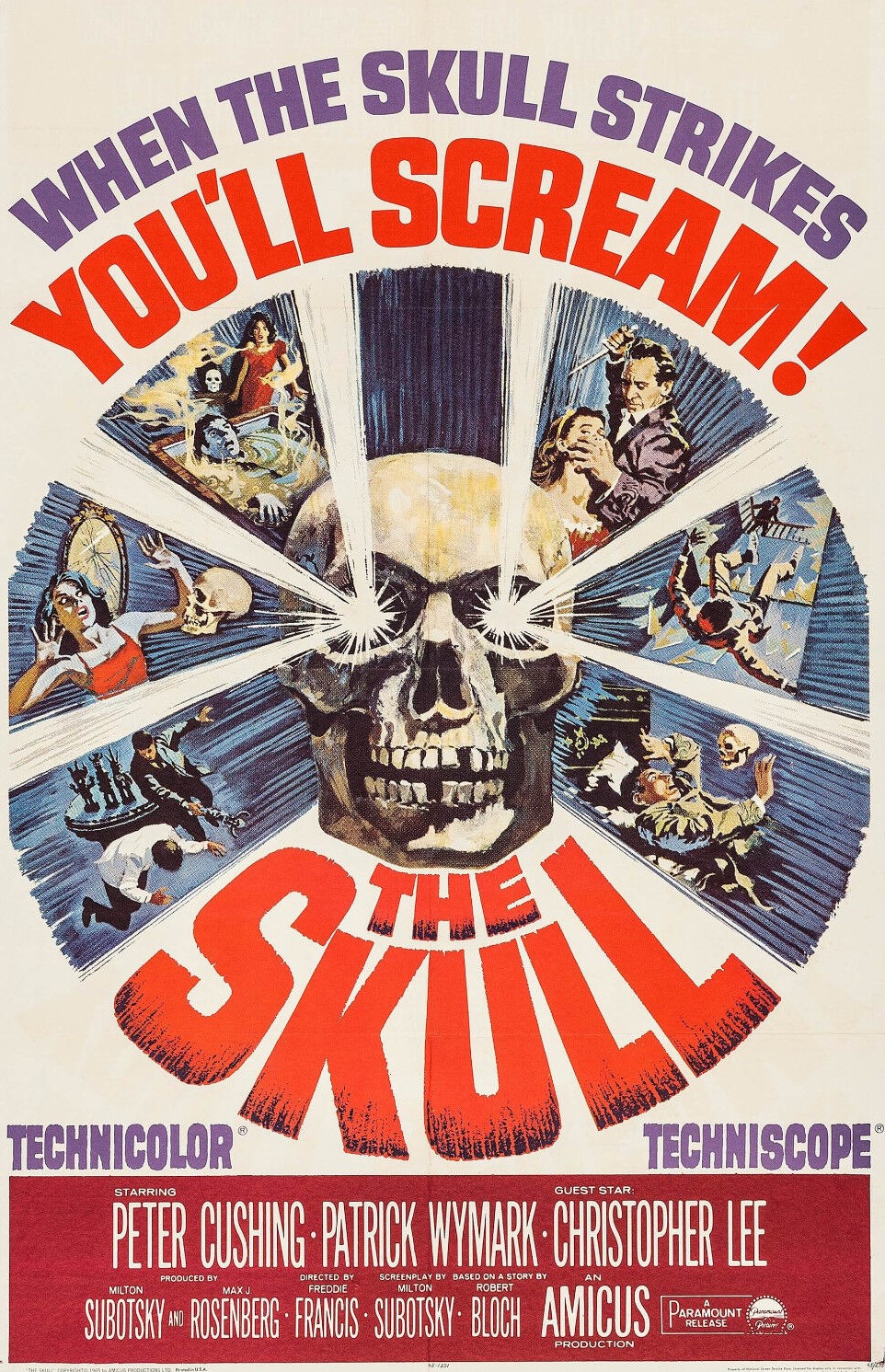
The Skull (1965) *****

I have no idea why this masterpiece has not been acclaimed. For virtually half the picture, there is no dialogue, the entire focus on camerawork and reaction. Even Stanley Kubrick in The Shining (1980) gave in to grand guignol and The Exorcist (1973) was filled with over-the-top scenes but here the psychological impact of possession remains confined.

Initially, it appears we are in familiar Hammer territory, a grave-robber detaching a skull from a corpse only to meet an untimely end. There is another flashback to the gothic where the presence of the skull drives an order man to murder. But this is an Amicus production and set in contemporary times where Christopher Lee and Peter Cushing are once again in opposition, but this time only in an auction house bidding for demonic artefacts.

Exposition is straightforward. Dealer Marco (Patrick Wymark) sells Maitland (Peter Cushing) a book about De Sade bound in human skin. Marco may be a con man. He claims to possess the skull of the Marquis de Sade but his attitude towards it, kissing its head, plucking its nose socket, and the fact that he willing to halve his asking price, suggest otherwise. Sir Matthew (Christopher Lee), who once owned the skull, warns Cushing against it.

The rest of the film covers Maitland’s possession of the skull and the skull’s possession of him. There is a notable Kafkaesque sequence where Maitland is arrested, taken before a judge and forced three times to play Russian roulette before ending up in the house of the dealer where he steals the skull. What is less often commented upon is that this nigh-on 15-minute sequence including a 90-second taxi ride is conducted in virtual silence, the camera mostly on Maitland’s face, that silence only broken by the feeding of bullets not the barrel of the gun and the barrel being rolled round. It is not long before Maitland commits his first murder.

There is a famous scene in the Last Tycoon (1976) in which Robert De Niro explains to a truculent word-obsessed British writer why dialogue is redundant in the movies. All you need is camera and reaction. That sets up The Skull’s greatest scene, a 17-minute dialogue-free climax, where Maitland is effectively preyed upon and consumed.

The skull itself appears to have a point-of-view, various shots of Maitland through the skull’s eyes. The actual special effects are limited to what is imminently achievable, the skulls glows, it moves through the air. The impact of its presence is shown on Maitland’s face and by his action. It is just hypnotic.

Various directors have been anointed for the way they move their camera – Antonioni’s 360-degree turn in The Passenger (1975) comes to mind, large chunks of 2001: A Space Odyssey (1968), the long wait for sunrise in Lawrence of Arabia (1962), the lengthy shots of James Stewart driving a car in Vertigo (1958). But I have never seen anything as innovative as the silent sequences in The Skull which would be a waste of innovation were the sequences not so effective, especially on the small screen. Freddie Francis (Nightmare, 1964) directed from a story by Robert Bloch (Psycho, 1960). Equally innovative is the jarring music by avant-garde composer Elizabeth Lutyens.

In the role of his career, Peter Cushing (Dr Who and the Daleks, 1965) turns on the style, his character virtually turning 360-degrees as he becomes enmeshed in diabolic terror.

A must-see.

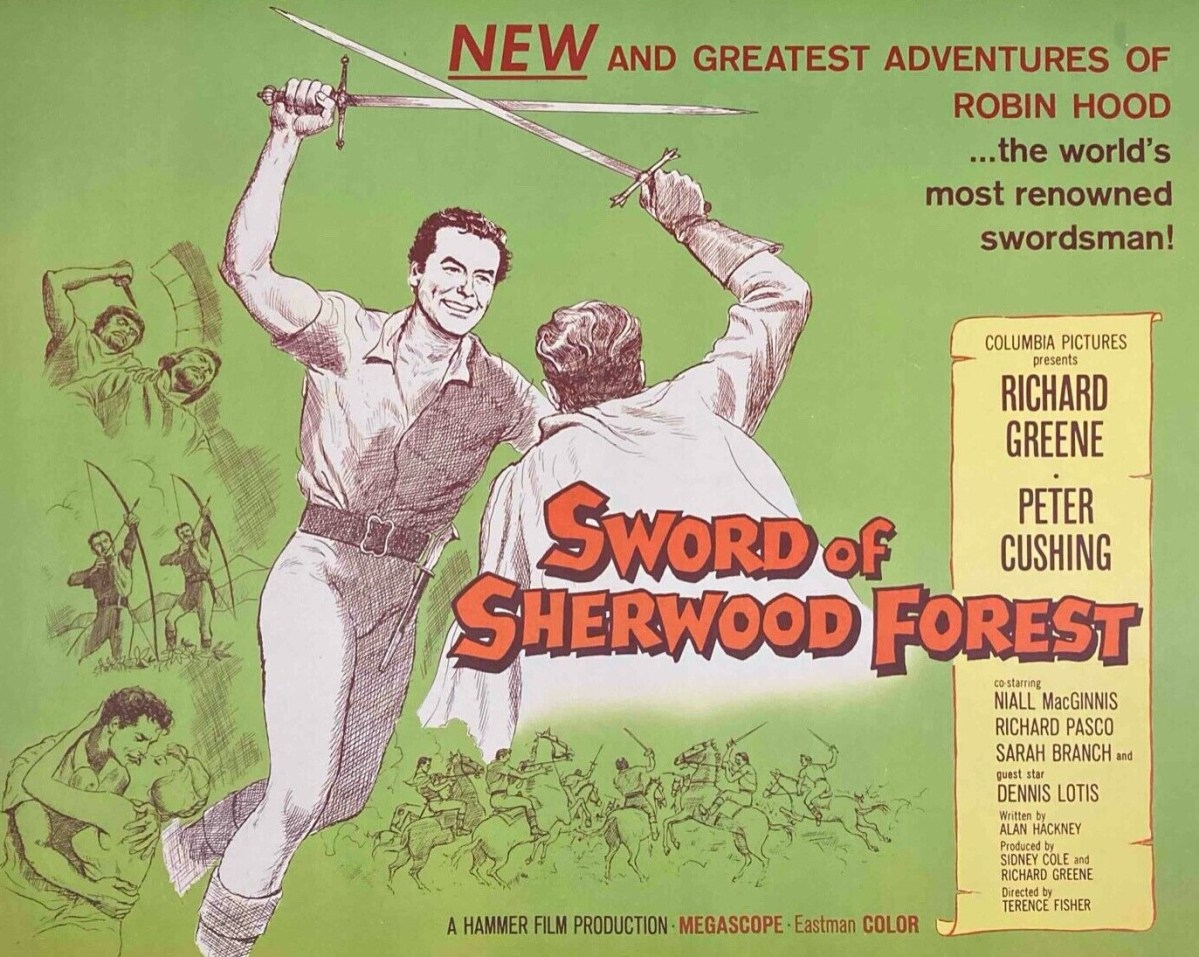
Robin Hood Double Bill: Sword for Sherwood Forest *** (1960) and A Challenge for Robin Hood ***(1967)

The last swashbuckler to cut a genuine dash was The Crimson Pirate (1952) with an athletic Burt Lancaster romancing Virginia Mayo in a big-budget Hollywood spectacular. The chance of Hollywood ponying up for further offerings of this caliber was remote once television began to cut the swashbuckler genre down to small-screen size. Britain’s ITV network churned out series based on Sir Lancelot, William Tell and The Count of Monte Cristo and 30-minute episodes (143 in all) of The Adventures of Robin Hood. So when Hammer decided to rework the series as Sword of Sherwood Forest their first port-of-call was series star Richard Greene.

And to encourage television viewers to follow the adventures of their hero on the big screen, Hammer sensibly dumped the small screen’s black-and-white photography in favour of widescreen color and then lit up the canvas at the outset with aerial tracking shots of the glorious bucolic greenery of the English countryside. Further temptation for staid television viewers came in the form of Maid Marian (Sarah Branch) bathing naked in a lake. Robin Hood is soon hooked. 

Two main plots run side-by-side. The first is obvious. The Sheriff of Nottingham (Peter Cushing) is quietly defrauding people through legal means. The second takes a while to come to fruition. Robin Hood is hired by for his archery skills by the Earl of Newark (Richard Pasco) – he shoots a pumpkin through a spinning wheel, a moving bell and a bullseye through a slit – before it becomes apparent he is being recruited as an assassin. Oliver Reed and Derren Nesbitt put in uncredited appearances and the usual suspects are played by Niall MacGinnis (as Friar Tuck) and Nigel Green (as Little John).

There is sufficient swordfighting to satisfy. Director Terence Fisher (The Gorgon, 1964), more at home with the Hammer horror portfolio, demonstrates a facility with action. Richard Greene (The Blood of Fu Manchu, 1968) makes a breezy hero and Peter Cushing (The Gorgon) resists the tmeptation to camp it up. Screenplay honors went to Alan Hackney (You Must Be Joking! 1965).

Six years on from Sword of Sherwood Forest, the challenge of reviving a moribund genre proved too much for A Challenge for Robin Hood but this second Hammer swashbuckler is a valiant and enjoyable attempt. More in the way of an origin story, this explains how a nobleman turned into an outlaw and how the merry band was formed. For in this tale Robin Hood (Barry Ingham) is a Norman nobleman framed for murder, Will Scarlet (Douglas Mitchell) and Little John (Leon Greene) are castle servants – also Normans – while Maid Marian (Gay Hamilton) is in disguise. Some liberties are taken with the traditional version – there is no fight with Little John, instead, as noted above, they are already acquainted.

There are a couple of excellent set pieces and although the swordfights are not in the athletic league of Errol Flynn they are more inventive than the previous Hammer outing and there is enough derring-do to keep the plot ticking along. Robin’s cousin Roger de Courtenay (Peter Blythe) is the prime villain this time round, the sheriff (John Arnatt), although involved up to the hilt at the end, content to offer acerbic comment from the sidelines.  

When Robin and Friar Tuck escape the castle by jumping into the moat, Will Scarlet is caught and later used as bait. Meanwhile Robin’s archery prowess and leadership skills have impressed the Saxon outlaws hiding in the forest and he takes over as their head. But there are clever ruses, jousting, Robin disguised as a masked monk, torture, and a pie fight.

Director C. M. Pennington-Richards had some swashbuckling form having helmed several episodes of The Buccaneers and Ivanhoe television series but his big screen experience was limited to routine films like Ladies Who Do (1963) with Peggy Mount. This was a departure for scriptwriter Peter Bryan, more used to churning out horror films like The Brides of Dracula (1960) and The Plague of the Zombies (1966), and he has invested the picture with more wittier lines and humorous situations than you might expect.

It’s certainly an escapist holiday treat and unless compared to the likes of the Pirates of the Caribbean or the classic Errol Flynn adventure it stands up very well on its own.

https://amzn.to/3MqhwLO

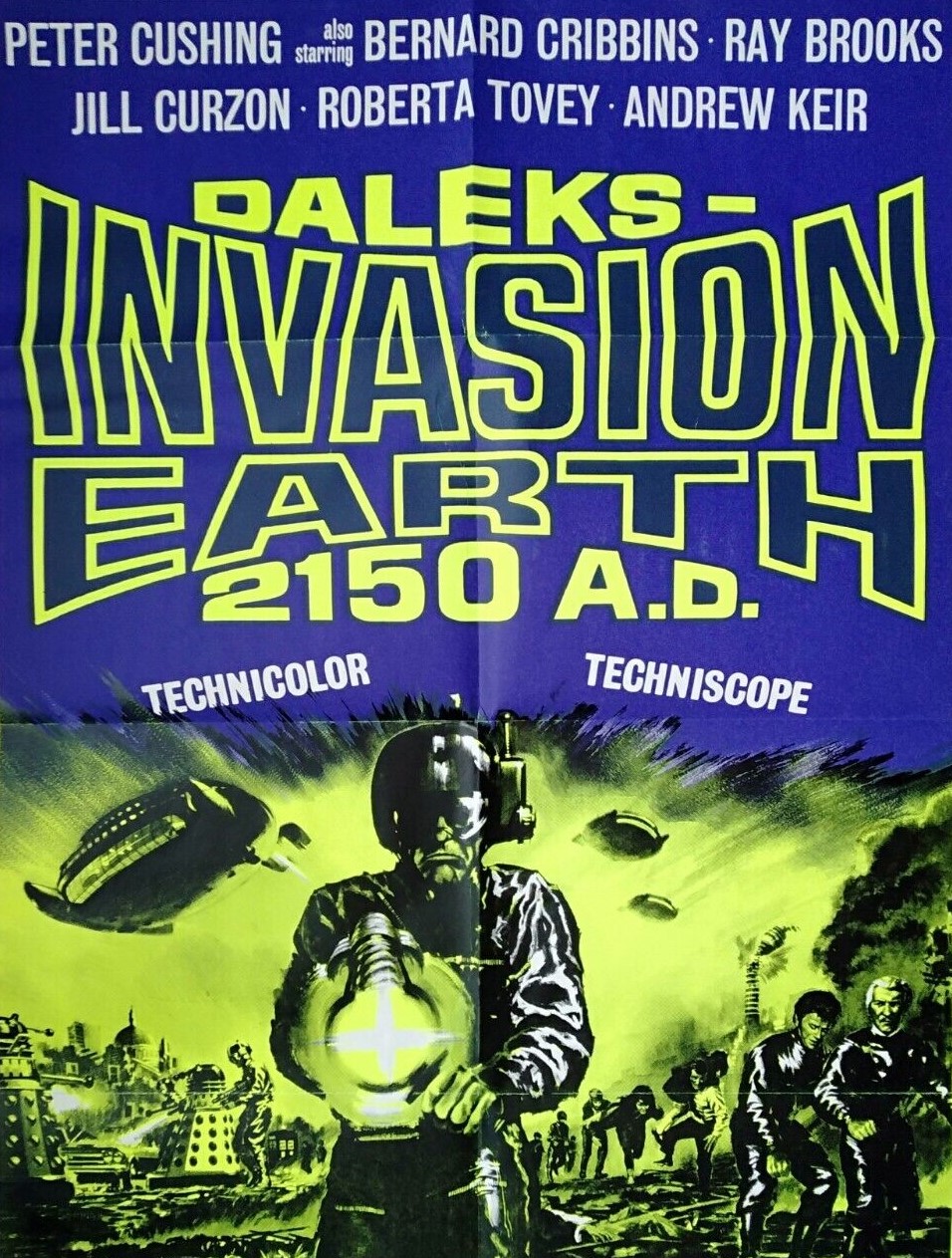
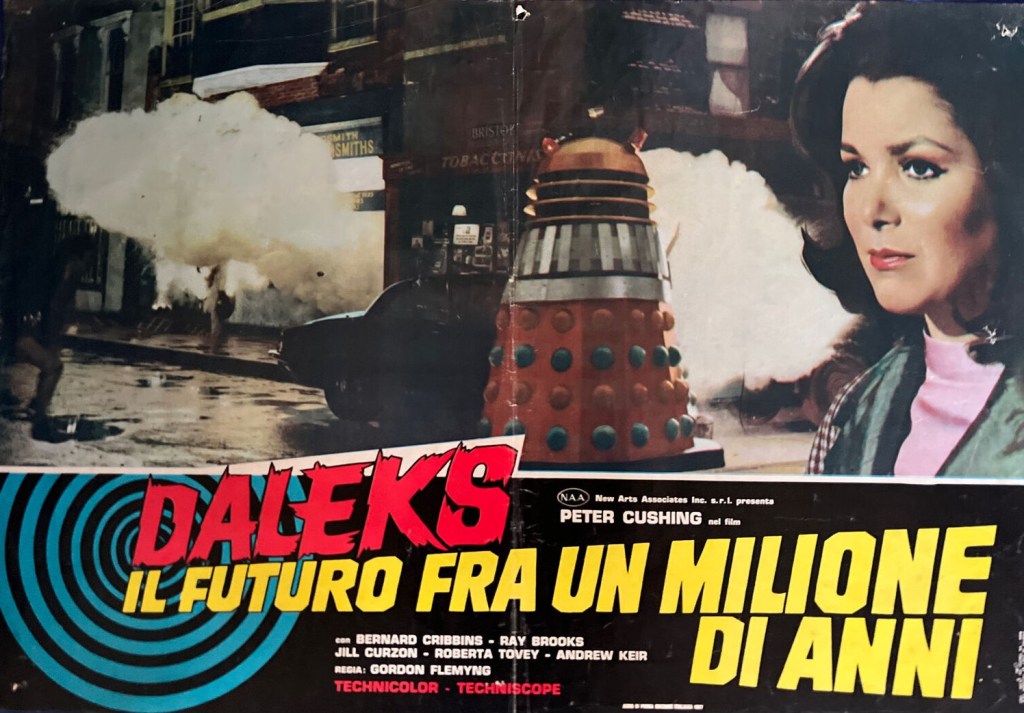
Daleks’ Invasion Earth 2150 A.D. (1966) ***

Sequels being all the rage – James Bond, Matt Helm, Derek Flint, The Pink Panther, The Magnificent Seven – in the 1960s it was no surprise that the success of Dr Who and the Daleks (20th top film at the British box office in 1965) suggested that a second go-round might be as profitable. As was standard, a recurring formula was the key.

In this case, Dr Who (Peter Cushing) and grand-daughter Susan (Roberta Tovey) repeated their previous roles though another grand-daughter Barbara (Jennie Linden) was replaced by a niece Louise (Jill Curzon) and hapless passenger Ian (comedian Roy Castle) was ousted in favour of  hapless London cop Tom (comedian Bernard Cribbins). But returning director Gordon Flemyng (The Split, 1968) upped the ante. Instead of waiting ages for the dreaded mechanical monsters with their electronic catchphrase (“Exterminate”) to appear, they turn up virtually in the first reel.

As if to emphasise the versatility of the Tardis, this time instead of space travel it’s time travel, Dr Who turning up in a blitzed London virtually two centuries ahead only to discover his nemesis rules the planet. It being set in a familiar locale, nobody is loaded down with information dumps, a tedious feature of the first picture, and it doesn’t take as long to get going, and our heroes, in various configurations, and while befriending the rebels – leader Wyler (Andrew Keir) and David (Ray Brooks) – endure a cycle of trap and escape while the good doctor tries to work out what brought the daleks to his home planet.

I’m giving this the benefit of the doubt and suggesting that the first appearance of the daleks is a homage to Dr No (1962) although one of the creatures emerging from the River Thames is hardly a patch in the sexy-entrance stakes as a bikini-clad Ursula Andress. Amidst all the mayhem, there are a couple of standout sequences, the best of which is a comedy skit involving Tom, disguised as a leather-clad member of the brainwashed automatons. This reminded me of Bob Hoskins in the first Super Mario Bros (1993 vintage) being trapped in an elevator with the Goombas. Tom is just too human to fit into this gang, constantly out of step with their actions.

Naturally, the Dr Who team are split up, allowing the action to move into two converging directions. The daleks plan to turn the planet into a giant spacecraft it can tow around, that storyline somehow involving a mining operation outside London while there’s some clever sci fi tomfoolery using the Earth’s magnetic poles to destroy the enemy.

Oops, I’ve given away the climax. Not that anybody cares that much, the main fun being the escaping formula – the daleks even use this as a plot twist, commending the intelligence of any human who can manage to escape – and watching the doctor outwit the enemy. Actually, the main fun is the dastardly daleks. Every time they appear you can imagine yourself back in a cinema crammed with thousands of kids yelling “Exteminate! Exterminate!”  

The plot keeps rolling along, no time to draw breath. And we’re not having to bother with any of the boring MCU claptrap intent on giving the super-villains a backstory or expiating their evil brains. The daleks represent alien domination, and they’re not here to give lectures on inhumanity or peace. In their determination to kill, they could almost be contemporary, given the number of serial killers and/or madmen clogging up cinema screens.

If not conspicuously inventive, Gordon Flemyng’s management of a large cast and a variety of action brought him to Hollywood attention. Given the storied career of Peter Cushing (The Skull, 1965) storied career, his performances as the doctor are generally overlooked, which is a pity, because he is certainly among the best to essay this character.  Carry On regular Bernard Cribbins livens up proceedings without needing to resort to slapstick in the Roy Castle mode. This must have seemed a bit of a come down for Ray Brooks after unexpected hit The Knack (1965) but he always seemed more at home on the small screen (although Flemyng hired him again for The Last Grenade, 1970).

The series ended here after the movie flopped on home territory. The original had bombed in the States, so the producers were heavily dependent on British box office. I guess just getting U.S. audiences aware there was such a thing in Britain as a “police box” would have been harder to grasp than the fact that it housed a time machine, and that the interplanetary craft was just there without a whole story about how it had come into being.

Made on a miserly budget by anybody’s standards, the sfx was never going to come up to scratch. But who cares.

“Exterminate! Exterminate!”

https://amzn.to/3FkXVJa

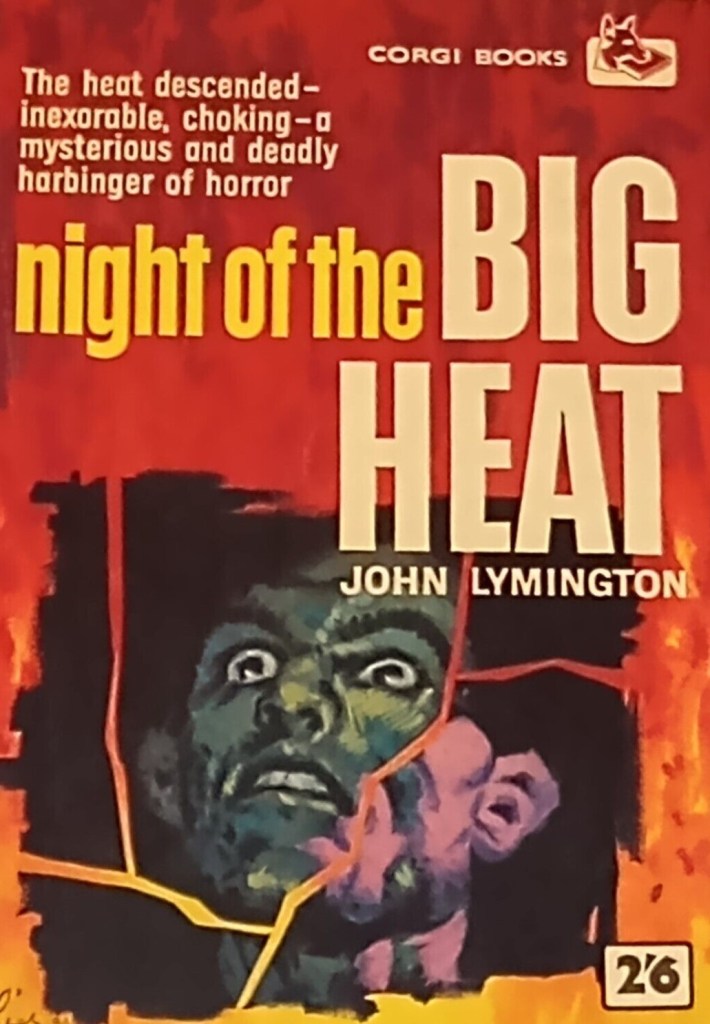
Night of the Big Heat/ Island of the Burning Damned (1967) ***

The Day the Earth Caught Fire (1961) meets War of the Worlds with a nod in the direction of Star Trek.  In the absence of a decent budget director Terence Fisher (Dracula Prince of Darkness, 1966) loads the movie with decent actors and relies of suspense rather than revelation. Ignoring the obvious opportunities for beefcake, partially embraces cheesecake.

While you might anticipate a horde of sweat-soaked men you will be taken by surprise by that most un-English of scenes – delight in a downpour. This is more sensibly located on a remote island rather than a big city and dials down on the preachy stuff, nothing to do with  atomic bombs, but still alien invasion.

Instead of The Old Dark House it’s a very hot English pub in winter – a time when the rest of the country is freezing – where all the characters congregate. We’ve got author Jeff (Patrick Allen), wife and pub landlady Frankie (Sarah Lawson),  local doctor Vernon (Peter Cushing), mysterious guest Godfrey (Christopher Lee), mechanic Tinker (Kenneth Cope) and newly-arrived secretary Angela (Jane Merrow) who has been having an affair with Jeff. 

It’s so hot Angela has to cool off with a lager and lime. The women appear to withstand the heat better than the men who are all in shirtsleeves and soaked through with sweat. Angela’s got the right idea, nipping down to the sea in her bikini, cooling her neck (and cleavage as it happens) with an ice cube.

As well as the unseasonable weather there’s a high-pitched eerie noise that especially afflicts automobile drivers, forcing them off the road. Various characters are despatched before disclosure. There’s a surprisingly vivid slice of sexual competition between the two women for Jeff’s attentions. In an excellent scene the wife works out what’s going by Jeff’s attitude towards Angela.

Naturally, Jeff has little idea how to retrieve the situation and maybe it’s just the acceptable misogyny of the period or maybe Frankie is just a bit dim, but I doubt if many women would be happy to hear husband describe lover as a “common slut” without wondering how often he attracted to such. Luckily, the crisis is much bigger than a marriage being potentially wrecked.

The sight of the eventually sweat-soaked Angela is too much for Tinker resulting in a brutal scene of attempted rape. While the males, except for being overcome by the noise, tended to remain cool, Angela turns hysterical, threatening suicide and murder in turn, but in the context of being shunned by Jeff and attacked by Tinker it’s hardly surprising she’s at the end of her tether.

Turns out the aliens have taken a leaf out of the Star Trek playbook and can beam themselves to Earth and dematerialize and that the endless human search for life among the universe has prodded an alternative life form into action. Seeing Earth as one giant platter of energy, they have landed and started sating their appetites.

It’s a fairly standard premise and exposition is left to Christopher Lee (The Devil Rides Out, 1968) rather than the more obvious choice of Peter Cushing (The Skull, 1965). Audiences expecting Lee and Cushing to be on opposite sides, with the former cast as villain, will be disappointed. Lee takes on the role of scientist that would normally fall to Cushing. He makes a good boffin, snappy, abrupt, remote and luckily without the slightest interest in any of the disporting damsels.

Patrick Allen (Puppet on a Chain, 1970) who spent most of the decade in television, the movies generally only interested in utilising his voice for narration duties (Carry On Up the Khyber, The File on the Golden Goose etc) takes the opportunity to grab the dramatic center, the character who has to work out what’s going on, while given a pair of conflicting love interests to increase the tension.

Jane Merrow (The System/The Girl Getters, 1964) is the surprise. Provided with the only genuine character arc in the picture, she goes from cool, confident, teasing chick to all-get-out-hysterical, but still with several ounces of sense, able to beat off her attacker, and willing to embrace the suicide option rather than being burned alive by invaders. The aliens, you won’t be surprised to learn, are not, despite the build-up, in the slightest bit scary.

But Fisher does a good job and the reason is a watchable low-budget sci-fi shocker.

Corruption (1968) ***

Admit it, you always wanted to discover what went on behind Peter Cushing’s chilly British reserve. The man who appeared to be constantly tormenting that nice Dracula or donning a deerstalker to outwit countless villains or battling otherworldly creatures like the Daleks or just a dependable character who in the unconventional Sixties knew right from wrong.

Of course, our Peter had occasionally come unstuck, the duped bank manager in Cash on Demand (1961) but even as Baron Frankenstein he never revealed a demonic side even as he  created monsters who had a tendency to run wild, always civil to the last, stiff upper lip never quavering.

So it’s something of a surprise to see him cast in the first place as the older man lusting after a younger woman. Sir John Rowan (Peter Cushing) is a highly esteemed surgeon who has fallen for model-cum-flighty-piece Lynn (Sue Lloyd) and although he sticks out like a sore thumb at a typical Swinging Sixties party full of gyrating lithe young women he is happy to put up with it for the sake of his girlfriend.

But Lynn has a strong independent streak, she’s not the submissive lass who might have been content to swoon at the feet of such a highly intelligent man, and objects to his attempts at control and can’t resist the chance to show her allure to all and sundry by giving in to the temptation to pose for louche photographer Mike (Anthony Booth), and, as it happens, the assembled throng.

Sir John isn’t going to stand for such brazenness, starting a fight with Mike that ends in a dreadful accident, destroying half Lynn’s face. Naturally, plastic surgery being the coming thing and Sir John capable of turning his hand to anything he’s able to fix up her face good and proper.

Except it’s a temporary measure, something to do with the pituitary gland, and it turns Sir John into a serial killer. There’s no mystery to it, no detective scouting around trying to put together clues, the question soon becomes can Sir John keep it up and what psychological damage is inflicted on Lynn as she comes to the realization that the beauty she had taken for granted, setting aside the predations of age which are still some way off, could vanish in an instant leaving her shrieking in a mirror.

Things get out of hand when they head for the country and fresh victims and find themselves trapped in a home invasion by a gang as gormless and vindictive as the pair from The Penthouse. It doesn’t end the way you’d expect because there’s a twist in the tail that you might accept as par for the course in the unconventional cinematic Sixties or you might just put the producers down for wanting to have their cake and eat it.

Still, it’s good while it lasts. Cushing certainly reveals a different side to his screen persona, and I can’t remember ever seeing him truly in love or indulging in a passionate screen kiss, and certainly to see his murderous side emerge is quite a treat, no scientific excuse to mask his behavior.

And it’s equally good to see Sue Lloyd (The Ipcress File, 1965) in another of those roles where she displayed considerable independence.  As an added bonus future Hammer Queen Kate O’Mara (The Horror of Frankenstein, 1970), here cleavage well hidden, turns up as Lynn’s sister.  You might also spot Vanessa Howard (Some Girls Do, 1969) and Marianne Morris (Vampyres, 1974). Anthony Booth (Girl with a Pistol, 1968) was trying to shake off the shackles of BBC comedy Till Death Us Do Part

Robert Hartford-Davis (The Black Torment, 1964) does pretty well unsheathing the beast within the context of a vulnerable older man. Derek Ford wrote the screenplay with his brother Donald before he decided the sex film was his way to British film legend. The version released abroad contains more gore and sex than when the British censor had its wicked way.

Discover WordPress

A daily selection of the best content published on WordPress, collected for you by humans who love to read.

The Atavist Magazine

by Brian Hannan

WordPress.com News

The latest news on WordPress.com and the WordPress community.