The Psychopath (1966) ****

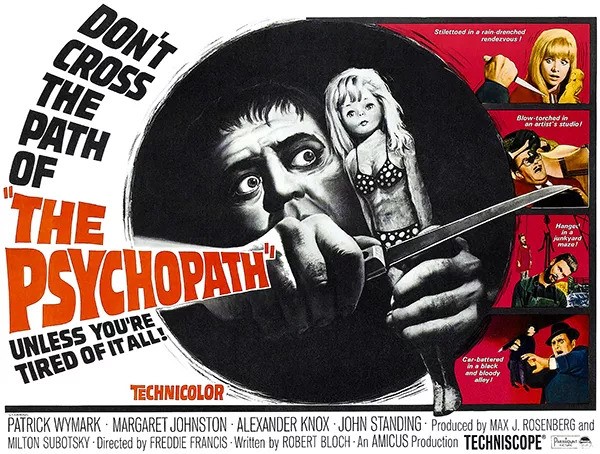
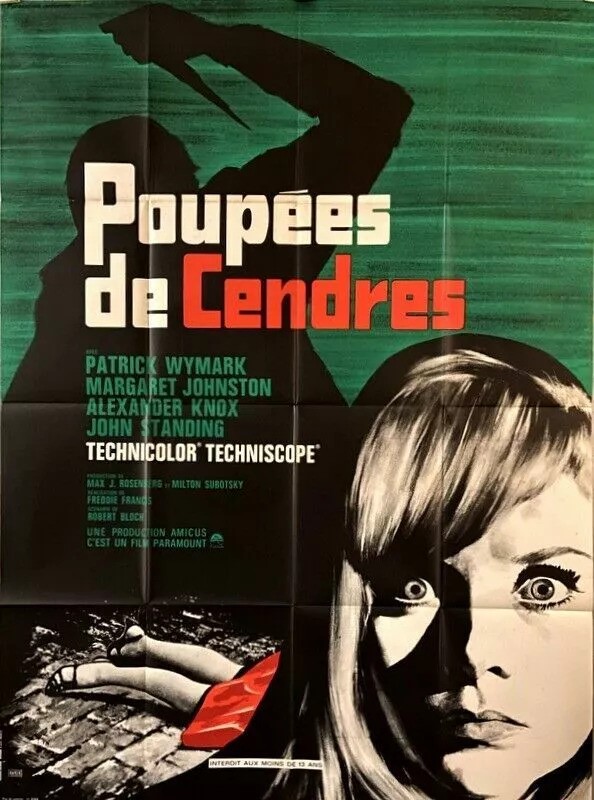
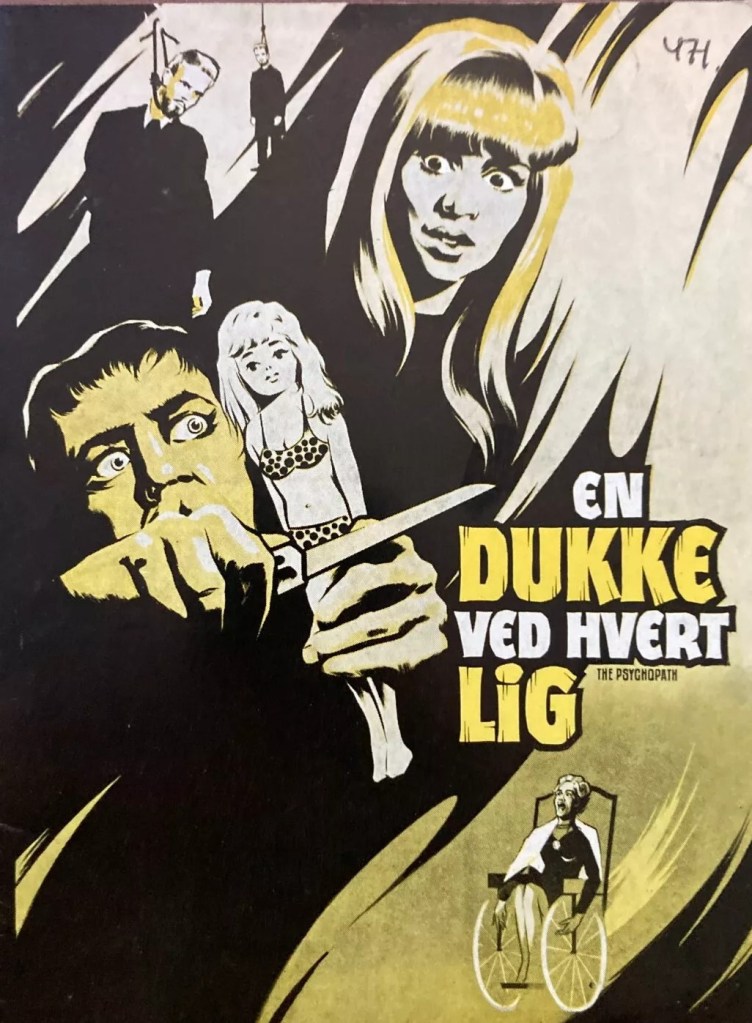
As evidenced by its popularity in Italy often considered a forerunner of the giallo subgenre. While the involvement of Robert Bloch brings hints – mother-fixation, knife-wielding killer –  of his masterpiece Psycho (1960), here some of those themes as reversed. And the stolid detective and younger buddy suggests the kind of pairing that would populate British television from The Sweeney (1975-1978) onwards. Surprising, then, with all these competing tones that it comes out as completely as the vision of director Freddie Francis (The Skull, 1965), especially his use of a rich color palette that would be the envy of Luchino Visconti (The Leopard, 1963).

Theoretically mixing two genres, crime and horror, the resonance figures mostly towards the latter. Considering the crime element just for a moment, this features a serial killer, in the opposite of what we know as normal multiple murder convention, who leaves a memento at the scene of the crime rather than taking one away such as a lock of hair or something more intimate. Also, the list of suspects rapidly diminishes as they all turn into victims, still leaving, cleverly enough, a couple of contenders.

What’s most striking is the direction. Francis finds other ways rather than gore to disturb the viewer. The first death, a hit-and-run, focuses on the violin case, dropped by the victim, being crushed again and again under the wheels of the car. There’s a marvelous scene where a potential victim tumbles down a series of lifeboats.

The camera concentrates more on the villain’s armory than their impact: noose, knife, oxy-acetylene torch, jar of poison, the lifeboats, the aforementioned car. There are intriguing jump-cuts. We go from the smashed violin to a very active one, part of a string quartet. From toy dolls in rocking chair to skeletal sculpture. From a string of metal loops choking a victim to a man forking up spaghetti.

We go from the very conventional to the jarring, serene string quartet and loving daughter to wheelchair bound widow talking to the dolls, so real to her she shuts some naughty ones away in a cupboard. We move from one cripple to another, from real toys to human toys, to a human who talks like a wind-up toy.

It soon occurs to our jaded jaundiced cop Inspector Holloway (Patrick Wymark) that the victims are connected, all members of the string quartet who were on a war crimes commission during the Second World War. At each murder the memento left, a doll with the face of the victim, leads the detective to investigate doll makers and then a doll collector, Mrs von Sturm (Margaret Johnson), widow of a man the commission condemned. Could it be the simplest motive of all – revenge? But why now?

The string quartet are an odd bunch, and on their own, you wouldn’t be surprised to find all of them capable of murder – sleazy sculptor Ledoux (Robert Crewdson) with naked women in his studio, the wealthy Dr Glyn (Colin Gordon) so weary of his patients he wished he’d become a plumber instead, the selfish over-protective father Saville (Alexander Knox) whose neediness prevents his daughter Louise (Judy Huxtable) marrying. Her American fiancé, Loftis  (Don Borisenko), a trainee doctor, is also in the frame.

Mrs von Sturm could be the killer, her wheelchair a front – apparently housebound she manages a visit to Saville, though still in her chair. Her nervy son Mark (John Standing) also appears an odd fish.

As I mentioned, Holloway scarcely has to disturb his grey cells, the deaths of virtually all the suspects eventually make his job pretty darned easy. But Francis’s compositions let no one escape. Long shot is prime. Staircases fulfil visual purpose. The creepiness of the doll scenes wouldn’t be matched until Blade Runner (1982). Stunning twists at the end, and the last shot takes some beating.

Margaret Johnson (Night of the Eagle, 1962) is easily the standout, but she underplays to great effect. Patrick Wymark (The Skull, 1965) steps up to top-billing to act as the movie’s baffled center, with more of the cop’s general disaffection than was common at the time. Alexander Knox (Fraulein Doktor, 1969) knows his character is sufficiently malignant to equally underplay. The false notes are struck by Judy Huxtable (The Touchables, 1969) and Don Borisenko (Genghis Khan, 1964), both resolutely wooden.

Freddie Francis is on top form. Not quite in the league of The Skull. Commendably short, scarcely topping the 80-minute mark.

Well worth a look.

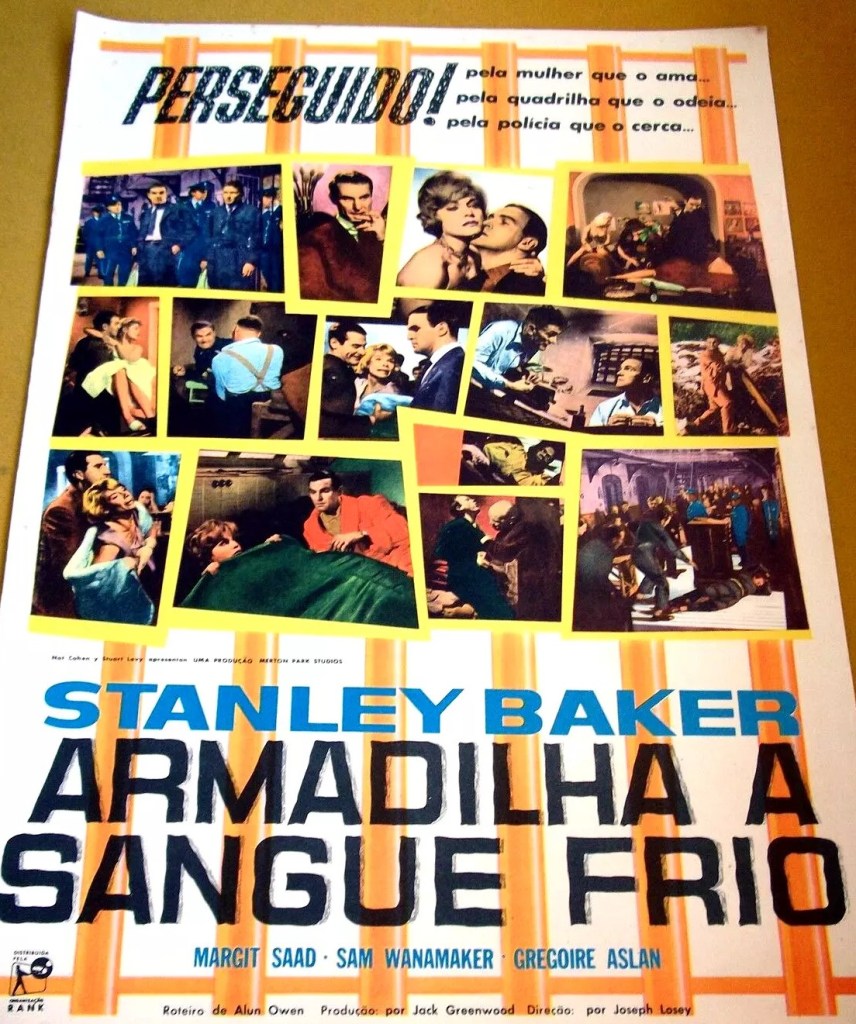
The Criminal / The Concrete Jungle (1960) ****

You’d be hard put to imagine from this hard-nosed gangster picture that both director Joseph Losey and star Stanley Baker would be capable of a more discreet arthouse offering like Accident (1966). Except for the director’s penchant for introducing a jazz score more often than suits the material – witness a brutal beating in a prison – this is an exceptionally gruelling blast through the British underworld, as though the domestic film industry had suddenly inhaled a narcotic comprised of Cagney and Bogart at their meanest.

With hardly a redemptive character in sight, it makes terrific demands of both director and star that anyone comes out achieving audience sympathy. Hollywood usually fell back on the trope of the innocent prisoner to instigate character empathy, but there’s no question from the outset that career criminal Bannion (Stanley Baker) is as tough as they come. In the opening section he arranges for rival Kelly (Kenneth Cope) to be viciously beaten with prison guard Barrows (Patrick Magee) turning a blind eye.

Out after a three-year stretch, Bannion plans a robbery of a race track with a partner, American Mike (Sam Wanamaker). But it turns out the track is owned by another gangster. After that, the double-crosses come thick and fast, nobody to be trusted, everyone out for themselves. He ends up back in prison, wanted by both sides of the law, the gangsters desperate to get their hands on the hidden loot.

Inside, he is protected by Italian mob boss Saffron (Gregoire Aslan), ruling his empire from prison, in return for a share of the loot. In due course, he instigates a riot, and double-crossing the other inmates, secures a shift to a low-security prison, and he is rescued from the transfer van. But there’s no escape. It’s a bleak ending all round. He dies on a beach, but without revealing where he has stowed the loot.

There are a couple of gals in the mix. The first, his ex-, Maggie (Jill Bennett) he treats in appalling fashion. The second, something of a present for his release, Suzanne (Margit Saad), sees the better side of him, although you have a sneaking feeling that she’s a plant.

But, really, nobody’s got a better side here. The prison scenes are grittier than had previously been the case in British movies, but the whole gangster set-up has a realistic “goodfellas” feel to it, boozing gangsters welcoming him home even as they are planning to stitch him up. And while Bannion may be unaware of ownership of the race track, clearly Mike isn’t, and Bannion is being set up to take the fall.

Joseph Losey (The Damned, 1962) takes an original approach to the material, cutting out the “big job” element entirely in favor of repercussion. He keeps up a brisk pace, which helps build tension, instead focussing on the relationships between the criminals and the prison hierarchy. Especially in the early prison scenes, more is made of vulnerability than toughness, many of Bannion’s confederates presented as weak and easily controlled rather than constantly challenging, prison guards complicit.

Stanley Baker (Where’s Jack, 1969) has such a malevolent appearance he was often as his best in the toughest arenas and perhaps Losey is making the point that even the toughest of tough guys can be duped by gangsters with more brains. There’s a terrific support cast: Sam Wanamaker (Warning Shot, 1966), Gregoire Aslan (Lost Command, 1966), Patrick Magee (Hard Contract, 1969), Jill Bennett (The Charge of the Light Brigade, 1968), Patrick Wymark (Where Eagles Dare, 1968) and  Laurence Naismith (Jason and the Argonauts, 1963). German star Margit Saad (The Magnificent Two, 1967) lends an air of mystery to her character.

This was the third – of four – teamings for Losey and Baker. The British censor took a mighty mild attitude to the unexpected levels of nudity and violence. Alan Owen (A Hard Day’s Night, 1964) and Jimmy Sangster (The Devil-Ship Pirates, 1964) are credited with the script.

Takes no prisoners.

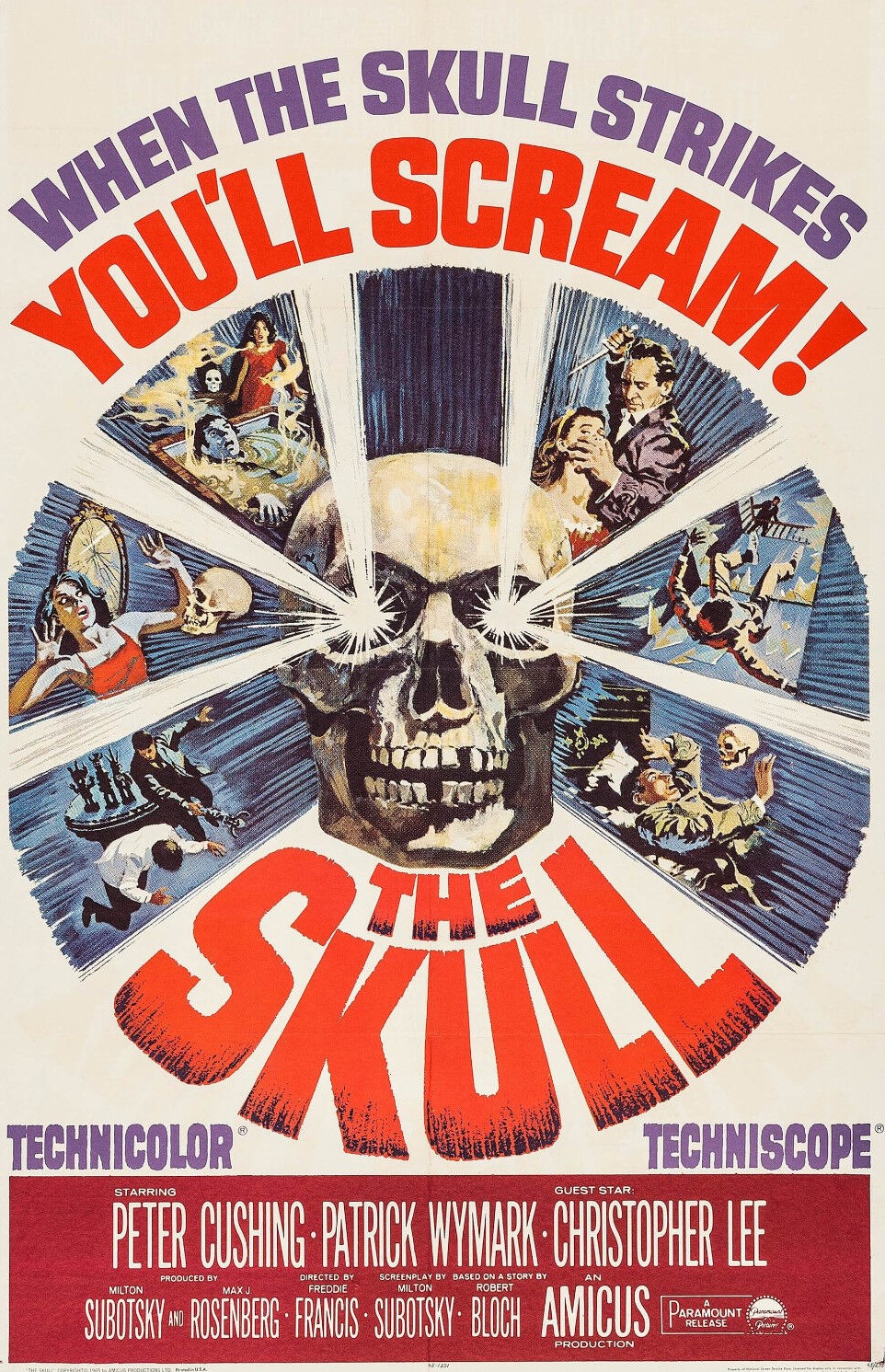
The Skull (1965) *****

I have no idea why this masterpiece has not been acclaimed. For virtually half the picture, there is no dialogue, the entire focus on camerawork and reaction. Even Stanley Kubrick in The Shining (1980) gave in to grand guignol and The Exorcist (1973) was filled with over-the-top scenes but here the psychological impact of possession remains confined.

Initially, it appears we are in familiar Hammer territory, a grave-robber detaching a skull from a corpse only to meet an untimely end. There is another flashback to the gothic where the presence of the skull drives an order man to murder. But this is an Amicus production and set in contemporary times where Christopher Lee and Peter Cushing are once again in opposition, but this time only in an auction house bidding for demonic artefacts.

Exposition is straightforward. Dealer Marco (Patrick Wymark) sells Maitland (Peter Cushing) a book about De Sade bound in human skin. Marco may be a con man. He claims to possess the skull of the Marquis de Sade but his attitude towards it, kissing its head, plucking its nose socket, and the fact that he willing to halve his asking price, suggest otherwise. Sir Matthew (Christopher Lee), who once owned the skull, warns Cushing against it.

The rest of the film covers Maitland’s possession of the skull and the skull’s possession of him. There is a notable Kafkaesque sequence where Maitland is arrested, taken before a judge and forced three times to play Russian roulette before ending up in the house of the dealer where he steals the skull. What is less often commented upon is that this nigh-on 15-minute sequence including a 90-second taxi ride is conducted in virtual silence, the camera mostly on Maitland’s face, that silence only broken by the feeding of bullets not the barrel of the gun and the barrel being rolled round. It is not long before Maitland commits his first murder.

There is a famous scene in the Last Tycoon (1976) in which Robert De Niro explains to a truculent word-obsessed British writer why dialogue is redundant in the movies. All you need is camera and reaction. That sets up The Skull’s greatest scene, a 17-minute dialogue-free climax, where Maitland is effectively preyed upon and consumed.

The skull itself appears to have a point-of-view, various shots of Maitland through the skull’s eyes. The actual special effects are limited to what is imminently achievable, the skulls glows, it moves through the air. The impact of its presence is shown on Maitland’s face and by his action. It is just hypnotic.

Various directors have been anointed for the way they move their camera – Antonioni’s 360-degree turn in The Passenger (1975) comes to mind, large chunks of 2001: A Space Odyssey (1968), the long wait for sunrise in Lawrence of Arabia (1962), the lengthy shots of James Stewart driving a car in Vertigo (1958). But I have never seen anything as innovative as the silent sequences in The Skull which would be a waste of innovation were the sequences not so effective, especially on the small screen. Freddie Francis (Nightmare, 1964) directed from a story by Robert Bloch (Psycho, 1960). Equally innovative is the jarring music by avant-garde composer Elizabeth Lutyens.

In the role of his career, Peter Cushing (Dr Who and the Daleks, 1965) turns on the style, his character virtually turning 360-degrees as he becomes enmeshed in diabolic terror.

A must-see.

Dr Syn, Alias The Scarecrow (1963) ****

The mysterious masked Scarecrow was the creepiest character thus far put on celluloid by Disney. A lot of the action takes place at dusk so it is soaked in crepuscular atmosphere. Filmed against the sky, every horse seems to thunder past. Gallows swing ominously. Coupled with a strong storyline and clever ruses by alter ago the mild-mannered clergyman Dr Syn (Patrick McGoohan), this is one for the Under-Rated Hall of Fame.  

While the character has antecedents in folk-hero Robin Hood, the Scarecrow is more rooted in the brutal reality of Britain in the mid-1700s when to fund a host of foreign wars King George taxed already-impoverished peasants to the hilt, making smuggling essential to survival. The Scarecrow is not just the underworld kingpin but has operational skills a spy would be proud of, coded messages, secret rendezvous et al.  

Ruthless General Pugh (Geoffrey Keen), sent to rid the countryside of this menace, makes no bones about putting the squeeze on the wives of villagers to force them into providing the information he requires. Outwitted from the off by Dr Syn, the infuriated general begins torching houses. Helped unwittingly by local squire and judge Thomas Banks (Michael Hordern), the general acquires an informer Joseph Ransley (Patrick Wymark).

This is not the bucolic England of Robin Hood or other historical yarns of Hollywood invention featuring glorious scenery and ample female cleavage. Here, a barmaid is likely to use a meat cleaver to defend herself. This was also the era of press gangs, where government-appointed hoodlums would raid a village and carry off young men as unwilling recruits for the Royal Navy. It was a time of imminent insurrection, the King’s subjects in the North American colonies on the point of sedition. And when money – or its lack – infected every area of society.       

Although like any super-hero the Scarecrow occasionally comes to the rescue, the movie is distinguished by the fact that is more often Dr Syn who subverts the General through cunning subterfuge. Victory through force of arms is impossible since violence visited on the king’s troops would result in a multiplication of their numbers. So it is more a battle of wits. In addition, the Scarecrow faces a dilemma – how to punish a traitor with such severity his authority is never questioned again while at the same time upholding the principles of Dr Syn. Just how these issues and others are resolved make for a very involving picture.

Minor subplots – a romance between the squire’s daughter and an officer, a deserter from the Navy and the presence of an American (Tony Britton) – serve the main story. So the narrative remains taut. And, interestingly, that hangs upon what characters have to lose rather than gain. It is not about greed but survival.

For a Disney picture there is considerable directorial vigor, not just the depiction of the smuggling and pounding hooves accompanying peril or escape, but two terrific trial scenes, a masterly escape conducted in the complete absence of on-screen music and, of course, the terrifying vision of the Scarecrow himself.

The acting has a sterling quality. While Michael Hordern was a stage star, the film primarily called upon actors who later achieved fame on British television programs. Patrick McGoohan headlined The Prisoner (1967-1968), George Cole was in Minder (1979-1994), Patrick Wymark and Alan Dobie in The Plane Makers (1963-1965) Geoffrey Keen in Mogul (1965-1972), and Tony Britton in Robin’s Nest (1977-1981). McGoohan had a previous television incarnation as Danger Man  (1960-1961) and Cole had been a con man in the St Trinian’s films. You can also spot in small roles Kay Walsh, a former British leading lady, and a young Richard O’Sullivan, later star of Man About the House (1973-1976).

Director James Neilson was a Disney favorite, having helmed Moon Pilot (1962), Bon Voyage! (1962) and Summer Magic (1963). But these were all lightweight features and it is to his credit he met the challenge of turning Dr Syn, Alias the Scarecrow into a dramatic actioner. British writer Robert Westerby (The Square Ring, 1953), who also created the source material for Kali-Yug, Goddess of Vengeance (1963),  fashioned the screenplay from the books of William Buchanan and Russell Thorndike

Although Disney had cannibalized the Davy Crockett television series in the 1950s, stitching together episodes for feature films, this was something of a reversal. As part of its The Magical Wonderful World of Disney U.S. television program the studio had shown The Scarecrow of Romney Marsh as a three-part mini-series while Dr Syn, Alias the Scarecrow was released as a movie in Britain.  

You will need to go onto ebay or other secondhand sources to find the movie. The television mini-series can be found below.

The Skull (1965) *****

I have no idea why this masterpiece has not been acclaimed. For virtually half the picture, there is no dialogue, the entire focus on camerawork and reaction. Even Stanley Kubrick in The Shining (1980) gave in to grand guignol and The Exorcist (1973) was filled with over-the-top scenes but here the psychological impact of possession remains confined.

Initially, it appears we are in familiar Hammer territory, a grave-robber detaching a skull from a corpse only to meet an untimely end. There is another flashback to the gothic where the presence of the skull drives an ordinary man to murder. But this is an Amicus production and set in contemporary times with Christopher Lee and Peter Cushing once again in opposition, but this time only in an auction house bidding for demonic artefacts. Exposition is straightforward. A dealer (Patrick Wymark) sells Cushing a book about De Sade bound in human skin. Wymark may be a con man. He claims to possess the skull of the Marquis de Sade but his attitude towards it, kissing its head, plucking its nose socket, and the fact that he willing to halve his asking price, suggest otherwise. Lee, who once owned the skull, warns Cushing against it.

The rest of the film covers Cushing’s possession of the skull and the skull’s possession of him. There is a notable Kafkaesque sequence where Cushing is arrested, taken before a judge and forced three times to play Russian roulette before ending up in the house of the dealer where he steals the skull. What is less often commented upon is that this nigh-on 15-minute sequence including a 90-second taxi ride conducted in virtual silence, the camera mostly on Cushing’s face, that silence only broken by the feeding of bullets into the barrel of the gun and the barrel being rolled round. It is not long before Cushing commits his first murder.

There is a famous scene in the Last Tycoon (1976) in which Robert De Niro explains to a truculent word-obsessed British writer why dialogue is redundant in the movies. All you need is camera and reaction. That sets up The Skull’s greatest scene, a 17-minute dialogue-free climax, where Cushing is effectively preyed upon and consumed. The skull itself appears to have a point-of-view, various shots of Cushing through the skull’s eyes. The actual special effects are limited to what is imminently achievable, the skulls glows, it moves through the air. The impact of its presence is shown on Cushing’s face and by his action. It is just hypnotic.

Various directors have been anointed for the way they move their camera – Antonioni’s 360-degree turn in The Passenger (1975) comes to mind, large chunks of 2001: A Space Odyssey (1968), the long wait for sunrise in Lawrence of Arabia (1962), the lengthy shots of James Stewart driving a car in Vertigo (1958). But I have never seen anything as innovative as the silent sequences in The Skull which would be a waste of innovation were the sequences not so effective, especially on the small screen. Freddie Francis directed from a story by Robert Bloch. Equally innovative is the jarring music by avant-garde composer Elizabeth Lutyens.

Many of the films from the 1960s are to be found free of charge on TCM and Sony Movies and the British Talking Pictures as well as mainstream television channels. But if this film is not available through these routes, then here is the link to the DVD and/or streaming service.

Discover WordPress

A daily selection of the best content published on WordPress, collected for you by humans who love to read.

The Atavist Magazine

by Brian Hannan

WordPress.com News

The latest news on WordPress.com and the WordPress community.