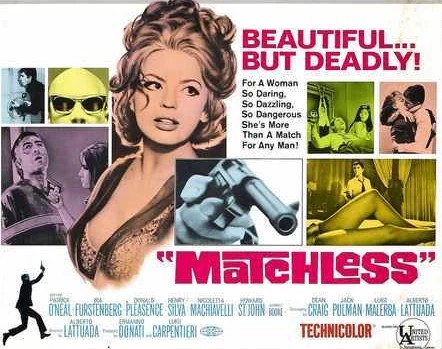
Alberto Lattuada is the big attraction for me here, being the director of World War One spy drama Fraulein Doktor (1968) starring Suzy Kendall and which has become a standout, in terms of views, on the Blog. Conversely, you might be swayed by the undoubted physical attributes of Ira von Furstenberg (The Vatican Affair), a real-life princess to boot, or perhaps by the under-rated Patrick O’Neal (Stiletto, 1969) enjoying a rare foray as the top-billed star.
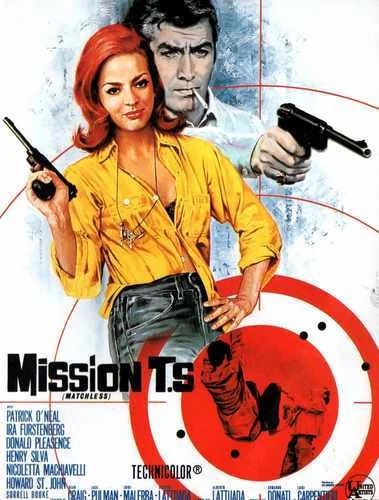
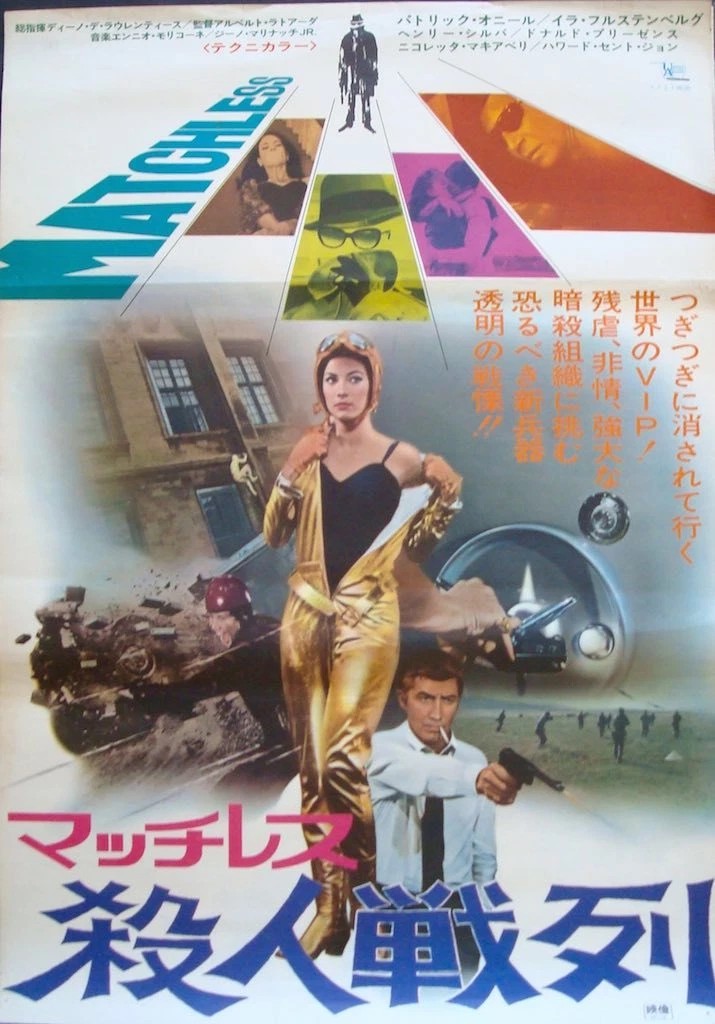
While the U.S. title is a tad opaque – our journalist hero Perry Liston (Patrick O’Neal) uses that by-line – the foreign title gives the game away. While imprisoned in China, Perry is handed a ring with magical powers by a Chinese prisoner in gratitude for helping him out. The ring permits a brief snatch of invisibility every ten hours, resulting in the screenwriters having to ration its appearance. As with any such charm, it provides opportunity for tension, humor and sexual frisson.
Another inmate Hank (Henry Silva) wants the ring for himself so spends a lot of the movie chasing, catching and losing Perry. The U.S. Government reckons a touch of invisibilkity will come in handy when dealing with arch-villain Georges Andreanu (Donald Pleasance) who has the usual arch-villain’s penchant for world domination. If it’s not enough that people are hunting him for the magic ring, Perry has others on his trail once he steals Andreanu’s secret serum. (Sensibly, the screenwriters shy away from what actually the serum does in the way of helping the arch-villain along in his quest for world domination – all that detail never did much to enhance the Bond/Flint/Helm stories.)
And like any decent spy of the era, Perry has women throwing themselves at him, some just for the hell of it but others who use sex to their advantage. O’Lan (Elisabeth Wu) falls into the first category, Tipsy (Nicolatta Machiavelli), a henchwoman of Andreanu, into the second, while artist Arabella (Ira von Furstenburg) has him guessing, Instead of a girl in every port, Perry has a girl in every country, China, Britain and Germany.
Perry isn’t a superhuman spy in the James Bond mold, and he’s not forced to keep it going with spoofery of the Derek Flint/Matt Helm variety, and he’s often at a disadvantage, caught naked, for example, when the invisibility spell wears off, and allowing Arabella to generally outwit him.
The central conceit works well in the context of the movie, helping and hindering Perry in equal measure. But there are also plenty other original touches: a car chase where the vehicles end up on top of a train, Hank watching a Man from Auntie series on television, tension racked up when villains come inadvertently close to the ring, hypnotism to fix boxing matches, torture by spinning, facial transformation, an amphibious car, a set-piece in a bank.
There’s more serious intent than you might expect, a satirical view of good guys and bad guys. Americans and Chinese apply the same kind of torture to Perry and employ the same plastic surgery method to send spies in undercover. While Perry is at his most powerful – i.e when invisible – he is also at his weakest by being naked.
Patrick O’Neal and Donald Pleasance (who appeared as Blofeld the same year in You Only Live Twice) have a ball though Ira von Furstenberg steals every scene she’s in. Henry Silva has the opportunity to try out his comedy acting chops.
Not in the same vein as Fraulein Doktor but generally consistently holding the interest.
Audiences weaned on glossy spies surrounded by pretty girls and generally their own country taking a straight moral path turned up their noses at this more realistic portrayal of the espionage business where dirty infighting was the stock in trade. The Spy Who Came in from the Cold (1965) was saintly by comparison.
Complaints about a complicated plot were led by critics who rarely had had to work their way through a tricky narrative, unless it was from the likes of Alfred Hitchcock who was apt to add twists to his stories. The fact that the bulk of the characters went by strange monikers – The Highwayman, Sweet Alice, The Warlock etc – also seemed to upset critics. (In the book by Noel Behn, the author points out that these spies were constantly adopting new identities, it made it easier for others to keep tabs on them if they were always referred to by nicknames which were constant.)
A contemporary audience, accustomed to things never being what they seem and all sorts of double-dealing, would be more at home here.
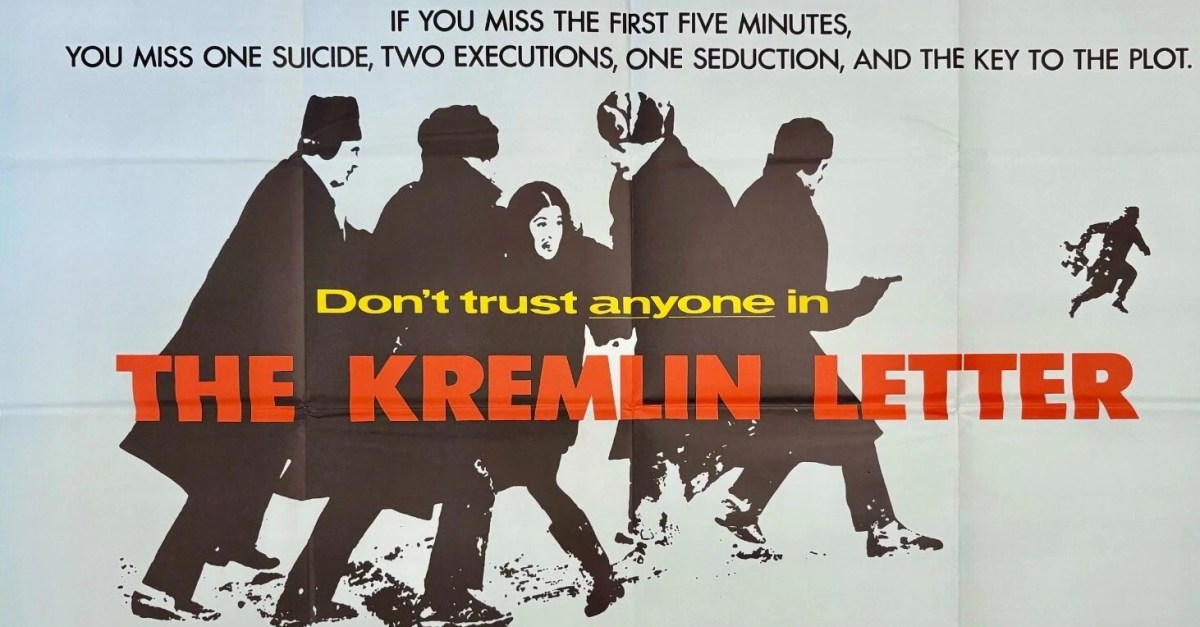
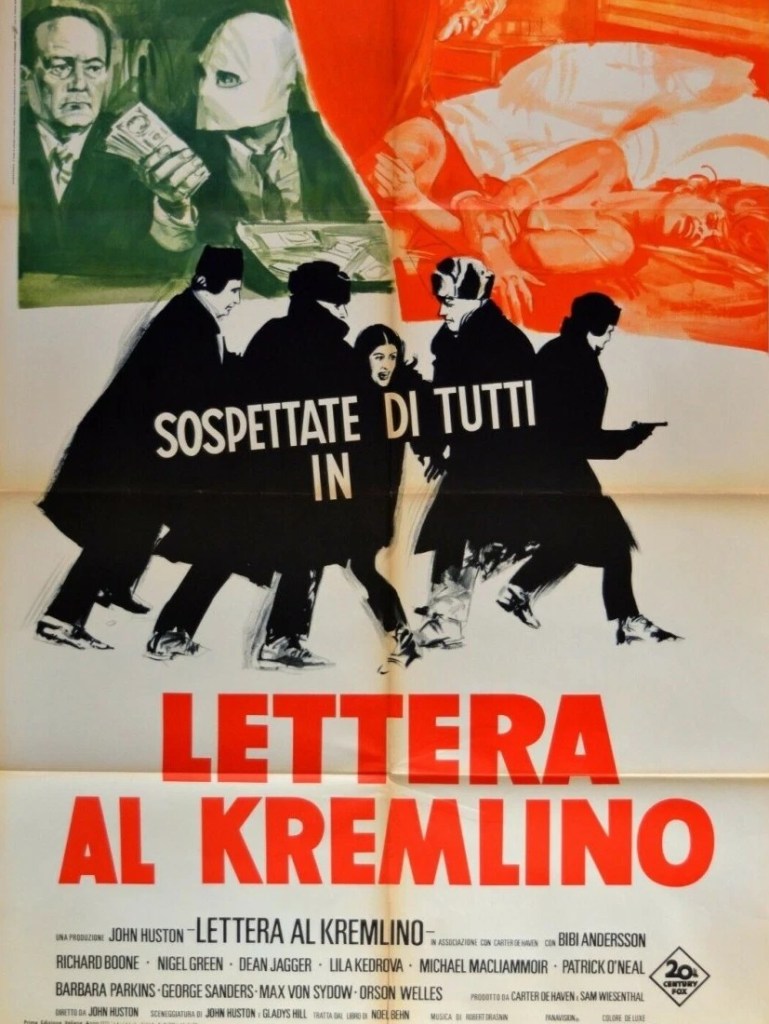
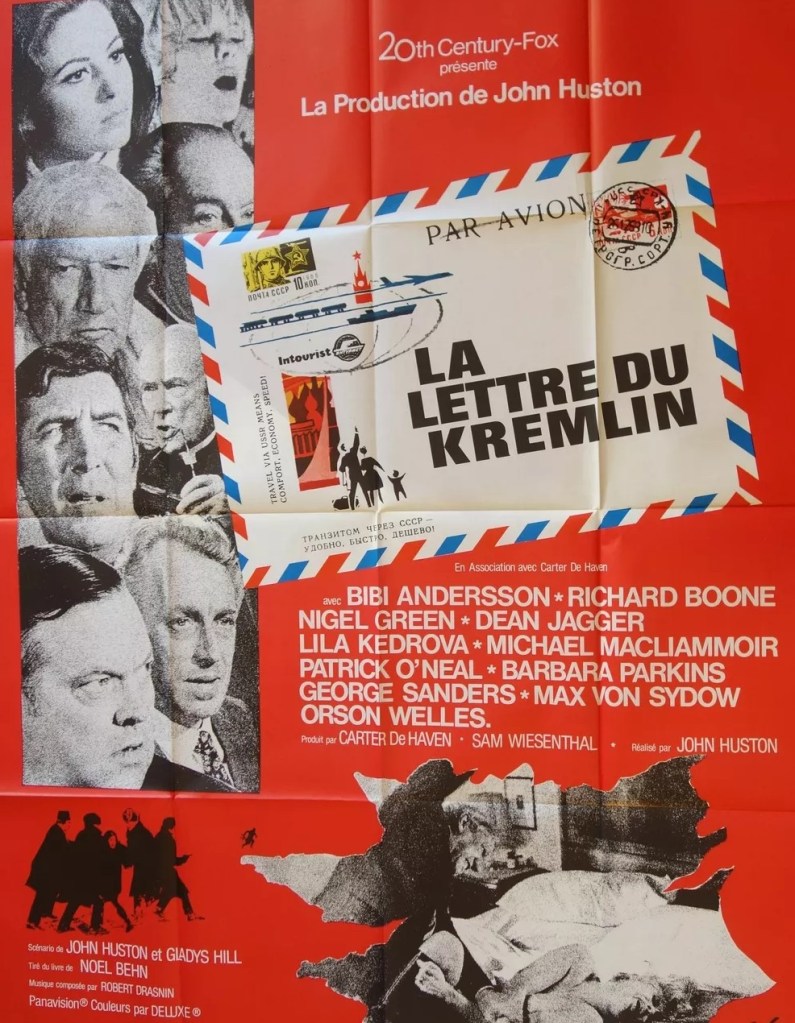
None of the characters, even the supposed good guys/gals, get off lightly. Personal unsavory sacrifice is unavoidable. Charles Rone (Patrick O’Neal) and B.A. (Barbara Parkins), who have fallen in love with each other, both have to prostitute themselves for the cause. And when the going gets too tough, suicide is the only way out. There’s hefty financial reward for those who survive the mission, but the substantial pot will be split between the survivors and not the dependents of those who don’t come home.
At the crux of the story is recovering a letter which promises that the USA and Russia will conspire against China and destroy its atomic weaponry. Espionage expert The Highwayman (Dean Jagger) recruits a team to infiltrate Moscow consisting of Rone, burglar and safe cracker B.A., drug dealer The Whore (Nigel Green), Ward (Richard Boone) and ageing homosexual The Warlock (George Sanders) who is a dab hand at knitting.
More than a few have a dodgy past, Ward an art dealer of ill repute, The Whore a pimp, even Col Kosnov (Max von Sydow), the target of the US operation, betraying his own countrymen. B.A. has to learn how to use sex to trap the enemy and, to get past the starting gate, loses her virginity to the obliging Rone.
The Whore sets up in the brothel business with Madame Sophie (Lila Kedrova), keeping the sex workers docile by filling them up with heroin, which he imports. As instructed, B.A. shares out her favors with the enemy while Rone seduces the wife, Erika (Bibi Andersson), of Col Kosnov.
You always go into a spy picture expecting double cross and this is no different. B.A., The Whore and The Warlock have their covers blown, the latter committing suicide, the girl failing to do so but paralyzed as a result. Ward kills Kosnov. But his motive seems odd – blaming the Russian for betraying his countrymen – and his action only becomes clear at the climactic double cross when Ward is revealed as a double agent in the pay of the enemy. For which, it has to be said, he doesn’t suffer. If anything, with B.A. in his hands, he has Rone over a barrel.
While this was never going to be a by-the-book espionage number, it’s elevated by exploring the emotional price that has to be paid, both in hiding some feelings and feigning others.
While possibly it made sense to present the stars in alphabetical order, suggesting nobody took precedence in the billing, most have the opportunity to play against type. Barbara Parkins (Valley of the Dolls, 1967) is excellent as the girl embarking on a career for which she has, emotionally, little aptitude. Bibi Andersson (Duel at Diablo, 1966), usually cast in repressed roles, has a ball as woman giving in to impulse. Tough guy Patrick O’Neal (Stiletto, 1969) must knowingly betray his true love. Richard Boone (The Night of the Following Day, 1969) is already playing a secret role and effortlessly dupes his colleagues.
There’s not much of the John Huston (Sinful Davey, 1969) visual magic but he makes up for that by allowing the actors to delve deeper into their characters. But he doesn’t attempt to spin a happy ending and the downbeat climax suggests that the USA lost this battle. The one memorable image is a ball of red wool rolling across the ground, indicating that The Warlock is dead. Written by Huston and Gladys Hill (The Man Who Would Be King, 1975) from the bestseller by Noel Behn (The Brink’s Job, 1978).
While the themes didn’t appeal then, they resound now.
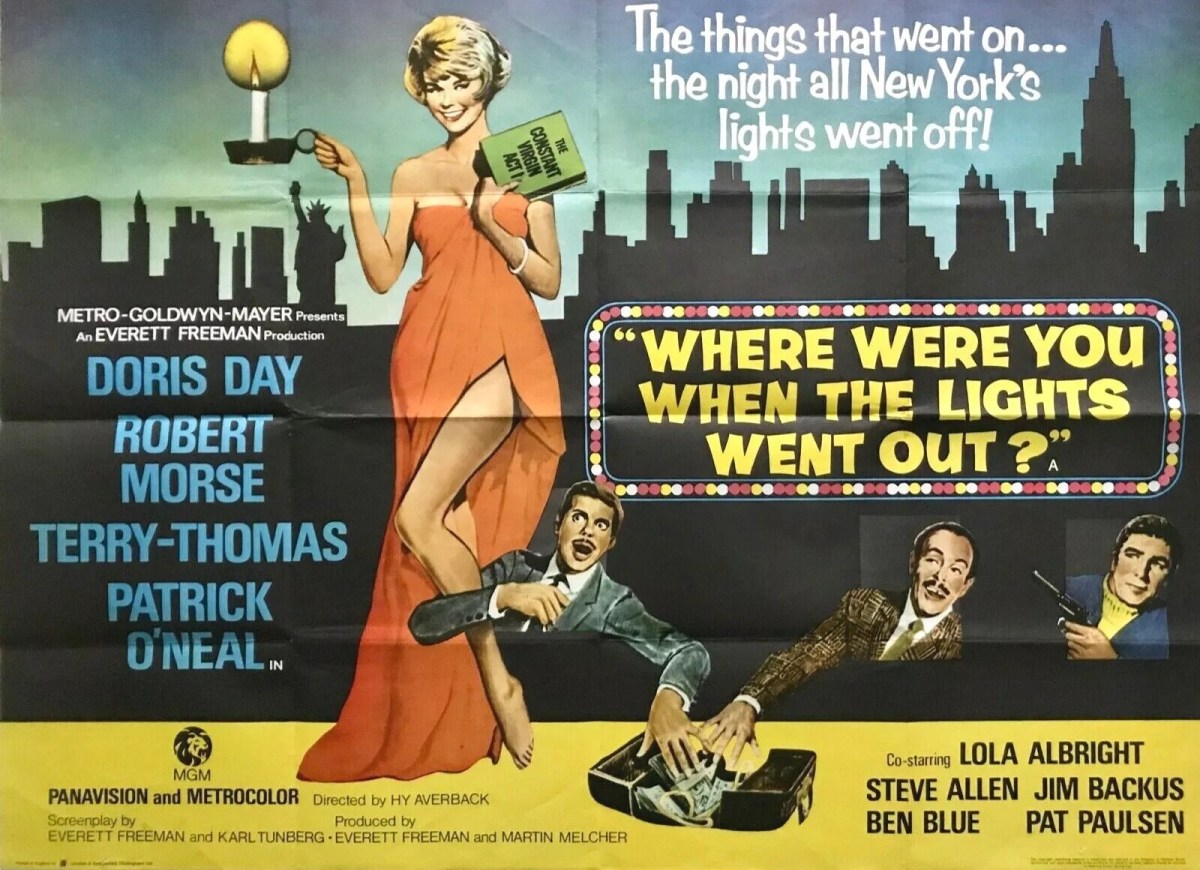
Of the 25 million stories you could have chosen when New York and the surrounding area was hit by an electricity blackout in the mid-1960s, you could have elected for something more interesting than this farce-style comedy that after the opening sections resembles nothing more than a stage play. But that’s because, somewhat surprisingly, it is based on a play and one concerning not the great fracas in the Big Apple but a similar occurrence in Paris almost a decade before. Once you know that, the farce element makes sense, but not much else does.
The three constituent parts that eventually coalesce into little more than a collage of double takes and startled expressions are: thwarted businessman Waldo (Robert Morse) making off with a couple of million bucks; Broadway star Margaret (Doris Day) finding architect husband Peter (Patrick O’Neal) in a clinch with journalist Roberta (Lola Albright); and impresario Ladislaus (Terry-Thomas), the most English-sounding Eastern European you ever came across, terrified Margaret is going to quit his play.
The lights going out malarkey is an ill-judged MacGuffin so that all except Roberta can end up in a classy Connecticut apartment and get into a quandary about who loves who and who’s cheating on who and career choices to be made. It’s pretty hard work all round to make all the pieces misalign and then fit. Waldo’s car has broken down so he has no real reason to be there nor to gulp down a beaker of alcohol that knocks him out without noticing that Margaret is fast asleep on the same couch after imbibing the same concoction.
Cue not much hilarity when guilty Peter turns up hoping to win back his wife, not expecting to find her unconscious from booze and once he discovers her bed partner convinces himself that she is as much of a cheat as himself. Meanwhile, Ladislaus tries to keep the jealousy pot boiling in the hope that she will divorce her husband and be forced to continue working.
I’m not sure I really cared whether it all worked out or not. Sure, comedies often pivot on bizarre instance, but this is just awful. More to the point, the structure doesn’t focus sufficiently on Margaret. The Waldo scenario seems wildly out of place and not enough is made of the chaos of the blackout. More to the point, with streets completely jammed and traffic signals not working, just how all four manage to get out of the city is beyond belief.
Sure, Doris Day grew up fast in the decade; at the start we worry about her losing her virginity; by the end it’s whether she’s going to embark on an affair. She’s always on the brink of the kind of sophistication that might tolerate an affair before drawing back in shock at such a notion.
The laffs are thin on the ground, even Doris Day drunk – one of her trademark touches – seems to lack punch. The best written scenes are those between Ladislaus and his cynical psychiatrist
Doris Day does her best but it’s far from the sparkling form of Pillow Talk (1959) that kicked off her very own rom-com subgenre. The quality of her male co-star had diminished over the years, from the peaks of Rock Hudson and Cary Grant to the acceptable Rod Taylor and James Garner but Patrick O’Neal (Stiletto, 1969) acts as if he is curling his lip and about to belt someone in the harder-edged dramas with which he made his name. Robert Morse (The Loved One, 1965) looks as though he’s still trying to work out what his character’s doing there. However, Terry-Thomas (Arabella, 1967) exudes such charm he’s always a joy to watch. Lola Albright (A Cold Wind in August, 1961) isn’t in it nearly enough.
The original French play by Claude Magnier was a sex farce, but casting Doris Day meant the sex angle was played down, inhibiting the movie. An unlikely vehicle for screenwriter Karl Tunberg – Ben-Hur (1959) and Harlow (1965) – who co-wrote with producer Everett Freeman (The Maltese Bippy, 1969). Director Hy Averback (The Great Bank Robbery, 1969) doesn’t come close to demonstrating the lightness of touch required to make such a ponderous effort work.
The bursting of the B-movie bubble dealt a death blow to the careers of the two stars here. In the past, rising talent who failed to make the marquee grade could find almost a lifetime of contentment in low-budget westerns, neo-noir thrillers and down’n’dirty exploitationers with the hope of an occasional supporting role in a bigger picture to ease their path. By the end of the decade, just about the only option were Roger Corman biker flicks or spaghetti westerns. Especially if they had gone down the tough guy route, B-pictures might have provided an exemplary move for both Alex Cord and Patrick O’Neal. As it was, this was their last shot at the big time. And it was lean pickings.
Retirement can be a tough call any time for a high-flying businessman. But when you’re at the top of your profession in the Mafia, loosening such ties can prove problematic. Count Cesare (Alex Cord) is a part-time assassin, spending the rest of his time as a fun-loving playboy with a string of women, fast cars and racehorses. Only problem is, he wants to retire from the Family – and not in normal fashion, weighted down by a block of cement. Unfortunately, his dilemma doesn’t solicit sympathy from boss Matteo (Joseph Wiseman).
Adding to his problems is tough cop Baker (Patrick O’Neal) on his tail who fastens onto illegal immigrant Illeana (Britt Ekland), Cesare’s girlfriend when he’s not pursuing Ann (Barbara McNair). A strictly by-the-numbers thriller it’s enlivened by two underrated tough screen hombres. Alex Cord (The Brotherhood, 1968) isn’t given enough of a character here to tug at audience heartstrings although elsewhere he had proved better-than-expected value. If anything, he’s an existential kind of hero.
Cord made a brief splash as an action hero in the monosyllabic Clint Eastwood/Charles Bronson mold after debuting in the John Wayne role of the Ringo Kid in the remake of Stagecoach (1966) and didn’t have more than half a dozen stabs at making his name on the big screen before disappearing into the television hinterlands. So he’s something of an acquired taste, maybe the small output enough to qualify him for cult status. Here, he’s a decent fit for the violence but saddled with a role that makes little sense.
Patrick O’Neal (El Condor, 1970) followed a similar career trajectory, swapping television with the occasional movie and even managing a screen persona as a snarky type of villain/supporting character. A few more tough-guy roles and he might well have built a stronger footing in the business.
This is another thankless role for Britt Ekland (Machine Gun McCain, 1969), there to add glamor, but, surprisingly, she manages to bring pathos to the part. Barbara McNair (If He Hollers Let Him Go, 1968), always worth watching and who had made an auspicious debut the year before, hardly gets any screen time.
Director Bernard L. Kowalski (Krakatoa, East of Java, 1968) proves better at the action than the characterization, though, luckily nobody needs to be anything other than tough. Three scenes, in particular, are well handled – the opening murder in a casino, a shoot-out a penthouse and the climax on a deserted island which has more than a hint of a spaghetti western. Joseph Wiseman (Dr No, 1962) rustles up another interesting performance and collectors of trivia might note Roy Scheider (Jaws, 1975) putting in an appearance.
This old-style tough-guy thriller would have been better off had the Cord vs. O’Neal set-up taken center stage, with the assassin on murderous overkill hunted down by the zealous cop. As it is, it’s a missed opportunity for Cord to develop an Eastwood/Bronson persona and enter the action star hall of fame.
Based on a thin Harold Robbins bestseller, the screenplay by W.R. Burnett (The Great Escape, 1963) and A.J. Russell (A Lovely Way to Die, 1968) doesn’t take any prisoners.
Doesn’t quite deliver what it says on the tin, but interesting to see Cord and O’Neal battle it out.
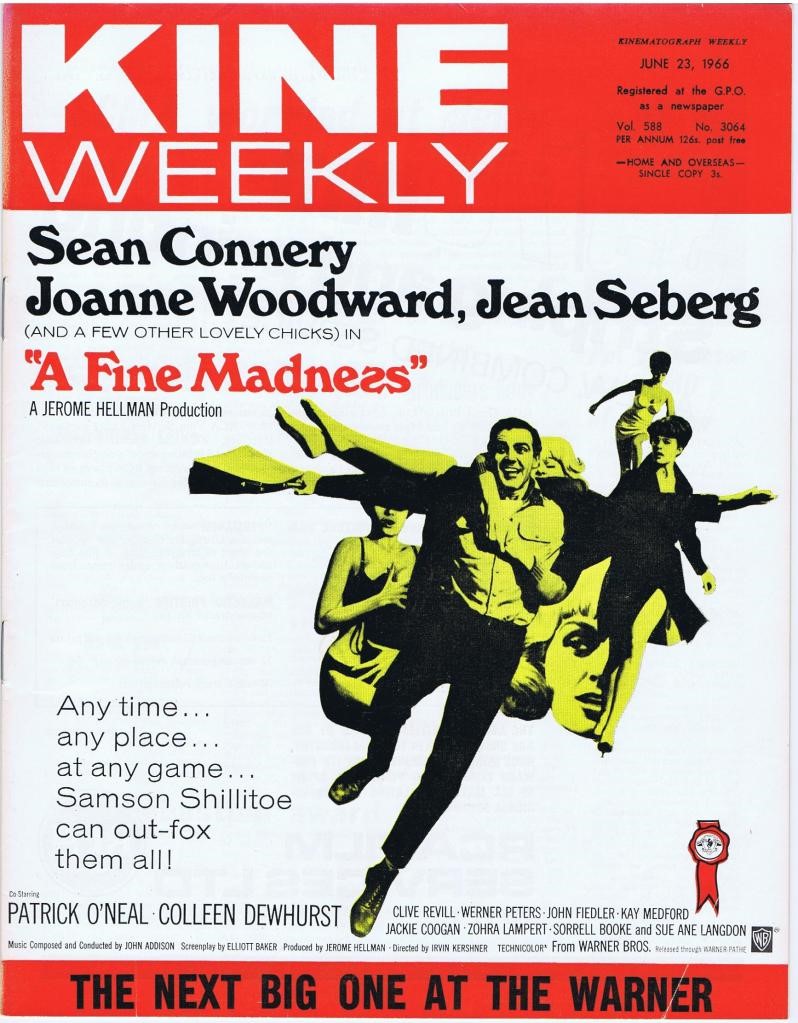
Let’s start with the Hollywood happy ending. Poet Samson (Sean Connery) slugs pregnant second wife (Joanne Woodward). He’d have punched her lights out before if only she hadn’t been so good at diving out of the way. As it is he manages to throw her down the stairs. The film kicks off with him ill-temperedly whacking her over the head with a pillow.
This is the kind of film where violence against women is treated as a running gag.
Let’s try to sell it as a wacky comedy.
Lydia (Jean Seberg), wife of psychiatrist Dr West (Patrick O’Neal) treating Samson for writer’s block, doesn’t have the courage to make it plain to his creepy colleague Dr Vorbeck (Werner Peters) that she doesn’t fancy him when he endlessly paws her and slaps her rear so he takes this as the green light to attempt to rape her. That’s another running gag.
Surly loud-mouthed bully Samson gets a free pass because he’s an artist, a poet with one poor-selling volume of poetry, and unable to find the time or space to complete his masterpiece. He would have more time if he didn’t spend so much of it chasing women.
At my count, he gets through at least four – Lydia, office secretary Miss Walnicki (Sue Ann Lngdon), a client (he cleans carpets for a living) Evelyn (Zohra Lampert), and Dr Kropotkin (Collen Dewhurst), another colleague of Dr West, not to mention the current wife he drives demented and the previous wife for whom he is being aggressively pursued for alimony.
You can see how director Irvin Kershner was a shoo-in for The Flim-Flam Man/One Born Every Minute (1967) because at every opportunity he tries to turn simple dramatic confrontation that enhance the story into needless chases that divert it and extract slapstick from material that in no way suggests it’s ripe for such an approach.
Trivia lovers note: The John “Redcap” Thaw in the supporting feature “Dead Man’s Chest” is the same John Thaw from “The Sweeney” and “Morse“.
There’s a story in here somewhere and a pretty barmy one at that if you set aside the poor poet’s endless battle against a world that fails to understand his genius and his dodging of the alimony. Rightfully diagnosed as some kind of sociopath by yet another of Dr West’s colleagues, the needle-happy Dr Menken (Clive Revill), he is admitted to a psychiatric hospital initially as a way of dodging his creditors and providing him with space and time to write.
Again, his most creative use of his time is to make out with Lydia and Krokoptin. But since he is spotted in a hydro-bath/ripple bath with naked Lydia, the vengeful husband gives the go-ahead to perform some kind of lobotomy on the poet, on the assumption it will dull his violent tendencies. (It doesn’t work.) The opportunity to satirise the psychiatric profession takes second place to another opportunity for a chase.
Anomalies abound. Samson’s character is clearly drawn on Welsh poet Dylan Thomas who exploited his fame and made his money on recital tours. Performing is against the broke Samson’s principles and he turns viciously on his audience of appreciative women. Despite demanding center stage, when offered it he turns it down. He lambasts middle-aged women but has little against those younger members of the species more susceptible to his charms. He only has to tell Miss Walnicki she has “pouty lips” and she falls into his arms.
All this has going for it are the performances. Sean Connery (Marnie, 1964), it has to be said, certainly exhibits screen charisma though this is not as far removed as he would like from the macho James Bond. Joanne Woodward (From the Terrace, 1960) – switching from her normal brunette to blonde – is excellent as the downtrodden waitress wife, but on the occasions when she is spiky enough to put him in his place soon regrets her temerity.
Jean Seberg (Pendulum, 1969) – switching from blonde to brunette and paid more ($125,000 to Woodward’s $100,000) – is good as the sexually frustrated rich housewife. And Patrick O’Neal (Stiletto, 1969) looks as if he is desperate to throw a punch. Elliott Baker (Luv, 1967) wrote the screenplay based on his own novel.
You do sometimes wonder at the knuckle-headedness of stars. Was this all that was offered to Connery at his James Bond peak? Or was it a pet project? I doubt if it would have been made with another big star – you couldn’t see even the macho Steve McQueen entering this territory and the likes of Paul Newman wouldn’t go near it.
Theoretically, studio head honcho Jack Warner gets the blame for this. He didn’t like Kershner’s cut and ordered it re-edited but I’d be hard put to see how his hand could be any less heavy than that of the director.
That’s two stinkers in a week. If you want proof of just how rampant sexism was in Hollywood check out a double bill of this and A Guide to a Married Man (1967).
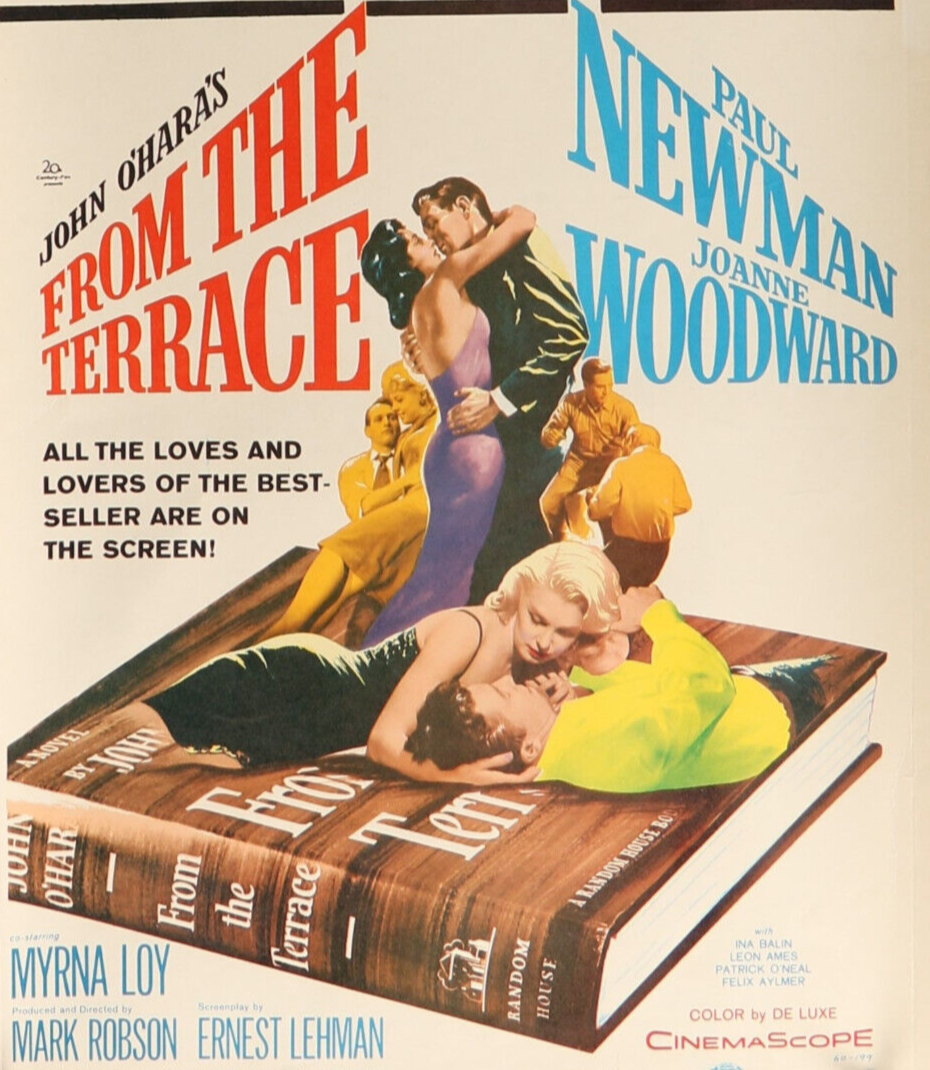
When your plot pivots on the hero diving into an icy pond to save the grandchild of a Wall St multi-millionaire – and reaping the career benefits – you are kind of in trouble. Not as much, though, as having a self-righteous hypocritical prig of a hero who lacks the self-awareness, a mark of the John O’Hara bestseller on which the film is based, to realize he is turning into a carbon copy of his father.
But it is handsomely-mounted and a decent enough melodrama with an excellent cast, though you would have to say, given the better material, Joanne Woodward (A Big Hand for the Little Lady, 1966) out-acts husband Paul Newman (The Prize, 1963), adding a rather contemporary element of a free-loving wife who manipulates the constraints of an era (post WW2) when divorce in high society was highly frowned-upon.
It’s a shame it drifts into predicable melodrama because the initial stages are niftily put together. A woman (Myrna Loy) is found dead drunk on a train, steel magnate husband Samuel (Leon Ames) ensuring he is not at home for her return, both actions meaning nobody is there to welcome only son David Alfred Eaton (known as Alfred at the start of the film and David at the end for odd reasons) when he returns from the war.
A few quick scenes establish that: the father holds a grudge against the living son because he has not got over his dead son; he has ignored his wife in favor of his career; he bullies his staff; the wife has embarked on an affair.
David Alfred’s character is quickly established: he refuses to be stiffed by a cab driver; is adored by the household staff; refuses to work in his father’s business; and beats up his mother’s lover.
After that, for all the emotional shifts through the gears, it slows down, not so laborious as devoting too much time to the inner workings of high society – O’Hara’s metier – rather than the new small-plane-building business into which David Alfred pours his energy. That is, if he has much energy left over after stealing Mary (Joanne Woodward) from fiancé Jim (Patrick O’Neal), a psychiatrist.
You are probably already aware that society operates in various strata. A mill owner is only on the verge of society and looked down upon by the likes of Mary’s wealthier parents who in turn are no match for the grand life enjoyed by the aforementioned Wall St broker MacHardie (Felix Aylmer). Snobbery is rife and money talks. And if you lack the dough you’ve got no say in anything as David Alfred discovers in an aeronautical business venture, his partner Lex (George Grizzard), who has put up all the money, excluding him from key decisions.
Luckily, while driving in the countryside there’s a drowning child to be rescued and a grateful grandfather willing to set you up in his business. But that means sacrifice. David Alfred is away from home so much his neglected wife instead of turning to alcohol merely turns to men. There’s a wonderful scene when after a telephone call with her husband promising not to see Jim again (at this point no impropriety apparently committed as far as David Alfred is concerned), Mary lies down on the bed and turns to an unseen figure and says, “You’re not to come up here any more.”
But there are too few scenes so slickly written. On a job in Pennsylvania David Alfred falls for industrialist’s daughter Natalie (Ina Balin), and as though this is key to their romance tells her to call him David rather than Alfred. As his stock rises in the company, he maintains a hypocritical front with his wife, who he knows is now engaged in various affairs, denying her suspicions that he is having a fling with Natalie. Mary is quite happy to maintain an open marriage since her status depends on her husband’s position and she still quite fancies him now and then.
You can see how this is going to end, but self-righteousness allows David Alfred to ignore that he is merely repeating the mistakes of his father. In sharp contrast to his wife who is all too conscious of her failings but contrives to make the best of the situation, and would happily continue in an unhappy marriage if only he would play ball. Although nothing is made of this, it’s obvious that David Alfred, despite his progress in the Wall St company, doesn’t have the business cojones of his father. He quit the plane business because Lex wanted to spend more time perfecting the prototype rather than rushing to the market in order to make money quickly. By following his own instinct, Lex is later proved correct, the business grown so big it attracts the attention of MacHardie.
There’s a sense here of Paul Newman pulling his shots. Though he is ruthless in making wife play second fiddle to career, and has no qualms really about playing away from home, nor about edging out MacHardie’s ineffectual son-in-law from the business, he lacks the killer instinct. The ruthlessness and amorality that made The Hustler (1961) and Hud (1962) so enjoyable is sadly missing. Handsome box office idols – the likes of William Holden apart – were reluctant to play the devious.
Mark Robson (Von Ryan’s Express, 1965) directs as if this is an upmarket Peyton Place and can’t resist at least one close-up of Newman’s baby blues. The script by Ernest Lehman (The Prize) only occasionally sparkles but I suspect there was a lot to trim from the O’Hara doorstopper. As I said, Joanne Woodward is the stand-out and you will be surprised to learn that Patrick O’Neal is also minus his later ruthless screen persona. Felix Aylmer (Masquerade, 1965) and Ina Balin (The Commancheros, 1961) are the pick of the supporting cast.
An interesting more than a riveting watch, mostly to see Newman before he reached screen maturity.
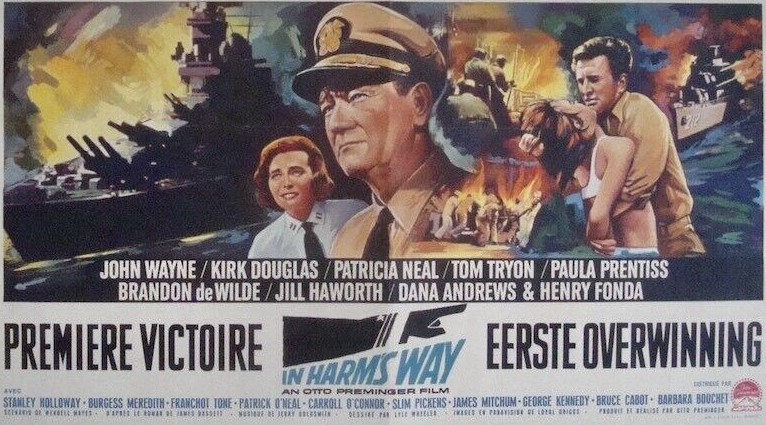
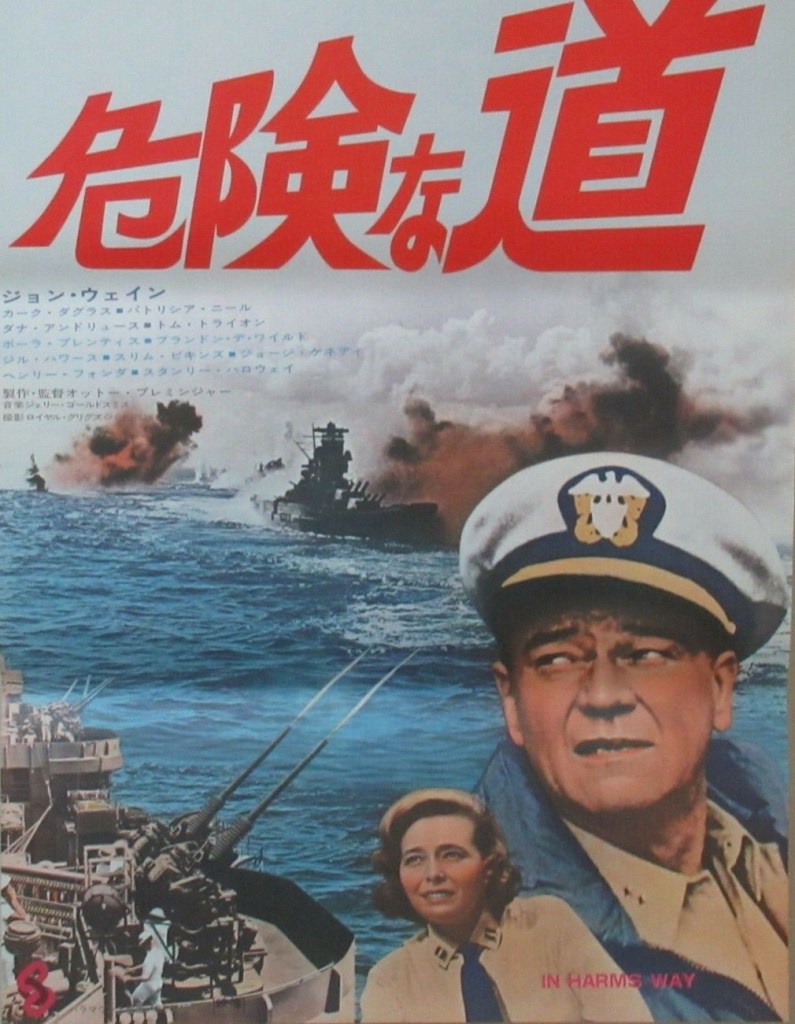
Preminger at a peak, the more I watch this picture, not just the more impressed I become but the more I want to watch it again – three times, as it happens, for this review. A tale of heroism populated by morally wounded heroes, the undertone of critique for the Naval establishment dealt with in brilliant narrative fashion, terrific pacing, one of John Wayne’s very best performances, Kirk Douglas not far behind, great action scenes, and one of the few movies to fulfil this director’s original intent.
You can, of course, argue that it’s the height of political PR. Just as the Americans managed with The Alamo and the British with Dunkirk, the aim was to turn defeat into victory, so this moves beyond the humiliation of Pearl Harbor to the victories beyond. But in some sense Pearl Harbor is just the prologue to a stiffer examination of men at war, rather than sailors taken to task over the complacency that left them so open to cataclysmic attack.
And while there’s a number of sub-plots, these are more expertly handled than I can recall in many another lengthy big-budget picture, no endless cutting between major and minor characters, but the minor characters only entering the frame when they have a dramatic part to play.
Captain “Rock” Rockwell (John Wayne) falls foul of his superiors for basically being in command of a ship sunk by a torpedo. On a technical point, he’s stripped of command, and reduced to a desk job, a casualty of the peace-time hierarchy determined to find someone to blame, only returning to active duty – and promoted to Admiral – when more war-oriented figures are put in charge.
The desk job gives him time to romance feisty nurse Lt. Maggie Haines (Patricia Haines) who has the cojones to take charge of the budding relationship. She happens to share an apartment with another nurse, the much younger Ensign Annalee Dorne (Jill Dorne) who is dating entitled Ensign Jeremiah Torrey (Brandon de Wilde), Rock’s estranged son.
Jeremiah works for slimy glory-hunter Commander Neal Owynn (Patrick O’Neal), a former U.S. Congressman using his political skills to worm his way into the office of by-the-book Vice Admiral Brodick (Dana Andrews). Rock shares his apartment with Commander Egan Powell (Burgess Meredith), a thrice-married playboy, high up in Navy intelligence.
Rock’s second-in-command is Commander – junior to a captain in case you don’t understand the U.S. Navy ranking system – Paul Eddington, a hothead whose mourning for dead wife Liz (Barbara Bouchet) results in him also being reduced to a desk job and exiled to the Pacific. On the fringes of the story are Lt. Commander “Mac” MacConnell (Tom Tryon) and pregnant wife Beverley (Paula Prentiss).
How all these characters enmesh is the consequence of a quite brilliant screenplay by Wendell Hayes (Advise and Consent, 1962). Rockwell and Eddington both seek redemption, the former to prove his Naval worth and regain the affection of his son, the latter to absolve himself for his terrible actions.
You can always tell the hero in war films because they are so rarely a physical casualty of war, all the others are killed and wounded but hardly ever the hero, so it takes something for the Hollywood Hero of the Century to play a character who is wounded not once but twice, and for the early part of the picture walks around with his arm in his sling (not quite an echo of the way he holds his arm in The Searchers, but evoking the same internal conflict).
The only supposed out-and-out hero is MacConnell, but his inaction at the beginning of the movie fails to prevent the death of Eddington’s wife. And his heroism largely takes place off-screen and it’s worth noting that Rock doesn’t raise a rifle or pistol in anger (or even get into a punch-up as was the actor’s wont in other films). Being in charge he’s removed from the core action even if suffering the consequences of battle. In a marvellous touch of irony, Rockwell is the most passive hero to hit the screen. It’s an incredibly bold and self-confident director who would even think of luring audiences into an action picture starring the Hero of the Century and then denying him a single moment of screen glory.
Much has been written about the cinematic arc John Ford took in the beginning and ending of The Searchers, the symbolic opening and closing of doors, but since Preminger is long out of critical favor nobody’s has bothered to notice how much of this film concerns cinematic echo.
To take the most obvious example, the first witnesses of the airborne Japanese attack on Pearl Harbor are illicit pair Liz Eddington and her paramour (Hugh O’Brian) and towards the end it’s her husband Paul, by this point guilty of horrendous behaviour, who leads the airborne fightback against the enemy.
A beach – where Liz and escort make love – is how the director initially pushes the audience towards sympathising with the drunken Eddington. A beach is where we later learn to despise him, as he brutally rapes Ensign Dorne. And it doesn’t take much to work out that his wife’s exuberant wildness explains Eddington’s initial attraction to her, not realising that psychologically it provides him with an excuse for his own darker wildness, initially restricted to self-destruction but when it truly emerges it’s to the detriment of an innocent.
And that’s before we get on to Rockwell as the messenger of death, delivering the bad news to wives, and then being on the receiving end after his son dies in battle. And finally, the political peace-time high-ups get their come-uppance in actual war.
It’s insulting – as some have suggested – that the performance of John Wayne (The Hellfighters, 1968) is the result of undiagnosed cancer when in fact this is a finely nuanced role of a high-ranking figure living out in his life in regret, at times quite shamefaced about abandoning his son at a very early age. Preminger cracked down on Wayne’s habit of splitting his lines in two, so those typical pauses we have come to expect are in large part gone, and it helps the movie’s pacing. For most of the movie the character is saddled with consequence. That passivity that the director saw as essential to the role is virtually present all the time.
Preminger wrings a different performance, too, from Kirk Douglas (A Lovely Way to Die, 1968), equally laden with regret, but not enough to prevent him lashing out and the actor is accorded two quite stunning scenes, the first as he broods in silence over his wife, but for the second, prior to raping Ensign Dorne, the stone-cold look on his face suggests a serial killer held at bay for too long and now about to explode.
Burgess Meredith (Hurry Sundown, 1967) is another brought to directorial heel, his more common scene-stealing and vowel-stretching also eliminated, but in exchange given a larger-than-life character on which to expend screen energy. The entire cast is good-to-excellent and it’s jam-packed: Patricia Neal (Hud, 1962), Tom Tryon (The Cardinal, 1964), Paula Prentiss (Man’s Favorite Sport, 1963), Brandon De Wilde (Shane, 1953), Jill Haworth (Exodus, 1960), Dana Andrews (The Satan Bug, 1965), Franchot Tone (Advise and Consent, 1962), Patrick O’Neal (Stiletto, 1969), George Kennedy (Cool Hand Luke, 1967), Henry Fonda (Battle of the Bulge, 1965), Barbara Bouchet (Danger Route, 1967) and Stanley Holloway (My Fair Lady, 1964) Many of the supporting cast were also playing against type – Prentiss as the young wife falling to pieces, Andrews and O’Neal as slippery political types, Holloway a guerrilla, and perhaps most interesting off Neal, not the typical woman left behind when the man goes off to war but, in her role as nurse, entering harm’s way herself.
And despite criticism of the miniatures used in sea scenes while that might have been obvious on the big screen you don’t notice it on the small screen. The action scenes are very well-done for the time, and quite unusual in that by and large it’s the Americans who appear shell-shocked not the enemy.
Cramming this much narrative into the overall arch of Pearl Harbor and retaliation against the Japanese, while bringing so many different characters to the fore with clear dramatic purpose is an amazing achievement, screenwriter Wendell Mayes (Advise and Consent) doing the heavy lifting in this department.
But Preminger the director is very much to the fore, in his composition and use of the camera for long tracking shots (a particular favorite of mine) such as at the beginning. A riveting watch full of splendid acting. Shooting it in black-and-white might have at one time appeared to date the picture but instead it has rendered it ageless. Five stars without a doubt.
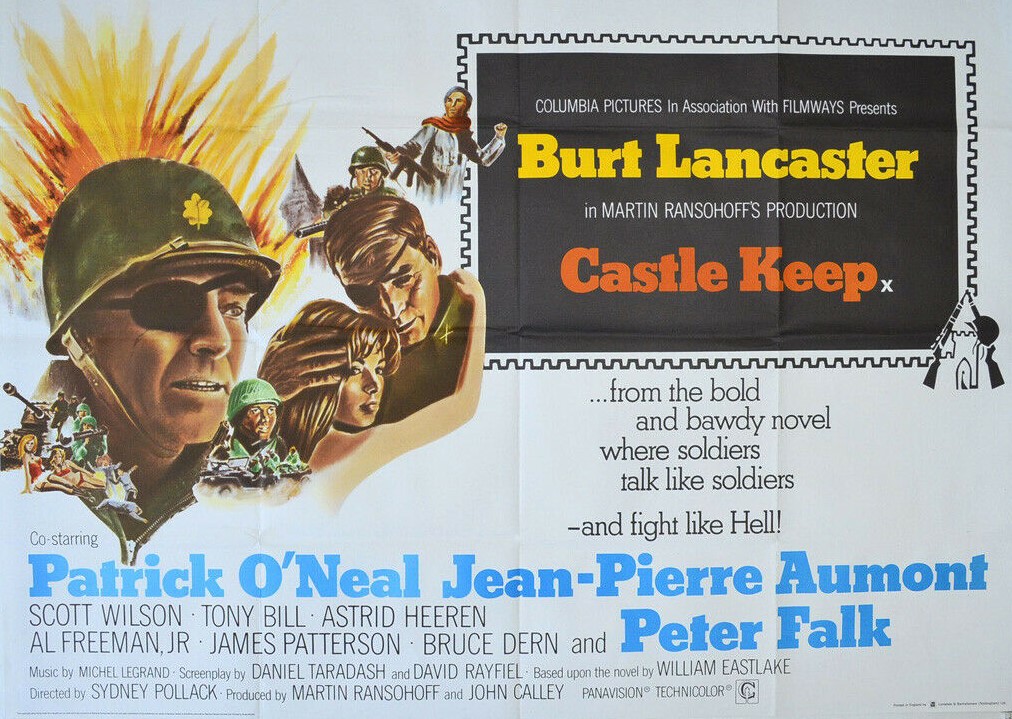
A bit more directorial bombast and this could have matched Apocalypse Now (1979) in the surrealist war stakes. Never mind the odd incidents surrounding a small unit of G.I.s taking over a magnificent Belgian castle towards the end of World War II prior to what turned out to be the Battle of the Bulge, this has on occasion such a dreamlike quality you wonder if it is all a figment of the imagination of one of the characters, wannabe writer Private Benjamin (Al Freeman Jr.). Throw in a stunning image, for the beleaguered soldiers at the start, of a horsewoman charging by in a yellow cloak, so out of place that it carries as much visual impact as the unicorn in Blade Runner (1982), and we are in definite cult territory.
One of the unusual elements is that, in this unexpected respite from battle, the soldiers are defined by character traits rather than dialogue or bravery as would be the norm. This ranges from baker Sergeant Rossi (Peter Falk) taking over the village boulangerie and bedding the baker’s wife (Olga Bisera), mechanic Corporal Clearboy (Scott Wilson) diving into a lake to rescue a Volkswagen he has adopted and the troops receiving a lecture on art history from Captain Beckman (Patrick O’Neal).
Commander Major Falconer (Burt Lancaster) is not only brilliant in the art of war, but calmly mentors Beckman through a firefight with an enemy airplane, teaches local sex workers how to make Molotov cocktails and, evoking ancient aristocratic tradition, enjoys conjugal relations with the conquered countess (Astrid Heeren), whose impotent husband (Jean-Pierre Aumont) encourages the relationship since the castle needs an heir.
There is wistful revelation, Beckman clearly hankering after his turn with the countess, a trainee minister who wishes he had the courage to join the boys in the brothel, the young soldiers there being treated as children rather than customers. And there are juvenile pranks – moustaches are painted on statues, wine bottles used for ten-pin bowling practice.
But the surreal moments keep mounting up. The Volkwagen, though riddled with bullets, refuses to sink in the lake, a hidden German reveals himself by playing the same tune on a flute as one of the enemy, the countess often appearing as an ethereal vision.
Through it all is rank realism. Falconer knows a German previously shared the countess’s bed. The count will do anything to safeguard his castle and maintain the family line, even to the extent of incest, since his wife is actually his niece. But above all, while his troops believe the war is at an end and enjoy the pleasures at hand, Major Falconer prepares for rearguard action by the Germans, filling the moat with gasoline, planning to pull up the drawbridge and control the high ground. The battle, when it comes, is vivid and brutal, the initial skirmish hand-to-hand in the village before the Germans advance to the castle.
Burt Lancaster (The Swimmer, 1968) is superb, far removed from his normal aggressive or athletic persona, slipping with pragmatic ease from the countess’s bed to battle stations. War films in the 1960s were full of great individual conflicts often won on a twist of ingenious strategy but seldom have we encountered a soldier like Falconer who knows every detail of war, from where and how the enemy will approach, to the details of the range of weaponry, and knows that shooting dead four soldiers from a German scouting mission still leaves one man unaccounted for.
Patrick O’Neal (Alvarez Kelly, 1966) also leaves behind his usual steely-eyed screen persona, here essaying a somewhat timid and thoughtful character. Peter Falk’s (Machine Gun McCain, 1969) baker is a beauty, a man who abandons war, if only temporarily, for a second “home,” baking bread, adopting a wife and child. In a rare major Hollywood outing French actor Jean-Pierre Aumont (Five Miles to Midnight, 1962) carries off a difficult role as a count willing to accept the humiliation of being cuckolded if it improves his chances of an heir. In one of only four screen appearances German actress Astrid Heeren (The Thomas Crown Affair, 1968) makes the transition from a woman going to bed with whoever offers the greatest chance of saving the beloved castle to one gently falling in love.
There is an excellent supporting cast. Bruce Dern (Support Your Local Sheriff, 1969) makes the most of a standout role as a conscientious objector. You will also find Scott Wilson (In Cold Blood, 1967), Al Freeman Jr. (The Detective, 1968), future director Tony Bill (Ice Station Zebra, 1968) and Michael Conrad (Sol Madrid / The Heroin Gang, 1968).
Two top-name writers converted William Eastlake’s novel into a screenplay – Oscar-winning Daniel Taradash (Hawaii, 1966) and newcomer David Rayfiel who would work with Lancaster again on Valdez Is Coming (1971) and with Pollack on Three Days of the Condor (1973) and Havana (1990)
Sydney Pollack (This Property Is Condemned, 1966), who had teamed up with Lancaster on western The Scalphunters, 1968), does a terrific job of marshalling the material, casting an hypnotic spell in pulling this tantalising picture together, giving characters space and producing some wonderful images, but more especially for having the courage to leave it all hanging between fantasy and reality.
Expressions like “we have been here before,” “once upon a time,” “the supernatural” and “a thousand years old” take solid root as the narrative develops and will likely keep spinning in your mind as you try to work out what it’s all about.
Many thanks to all who took the time to enter the first-ever competition run by the Blog. The idea was to guess which of the films reviewed in the April Blog received the highest number of views. How many did you get correct?
Here’s the Top Five in ascending order:
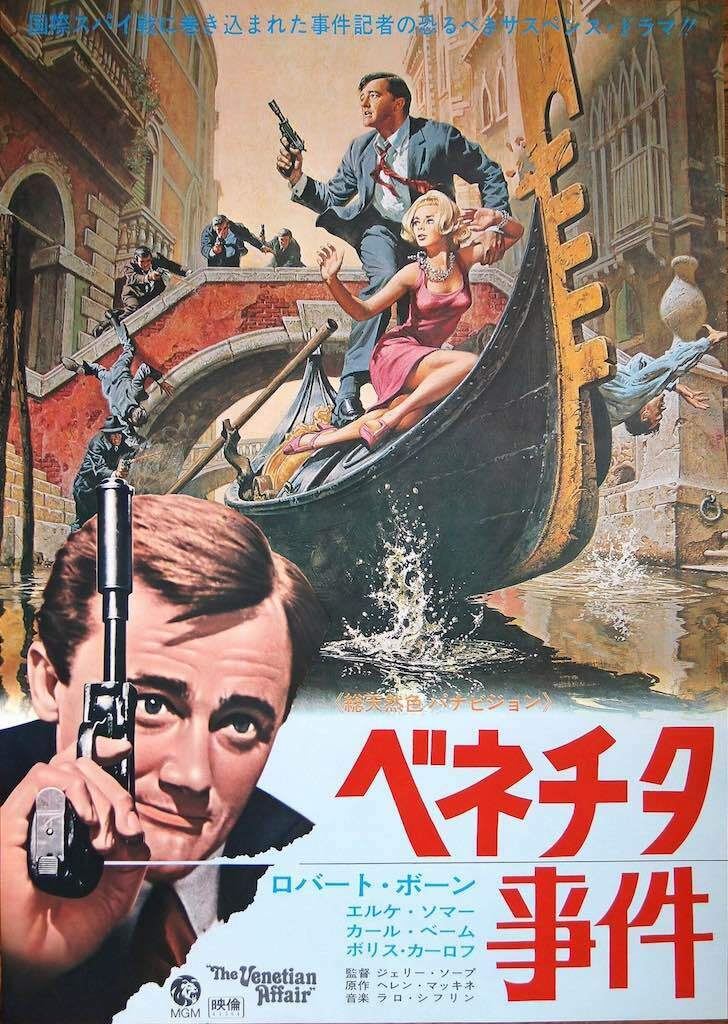
The Venetian Affair (1966)- Robert Vaughn, Elke Sommer and Boris Karloff in espionage drama, adapted from the Helen MacInnes bestseller.
The Secret Ways (1961) – Richard Widmark behind the Iron Curtain in Alistair Maclean thriller.
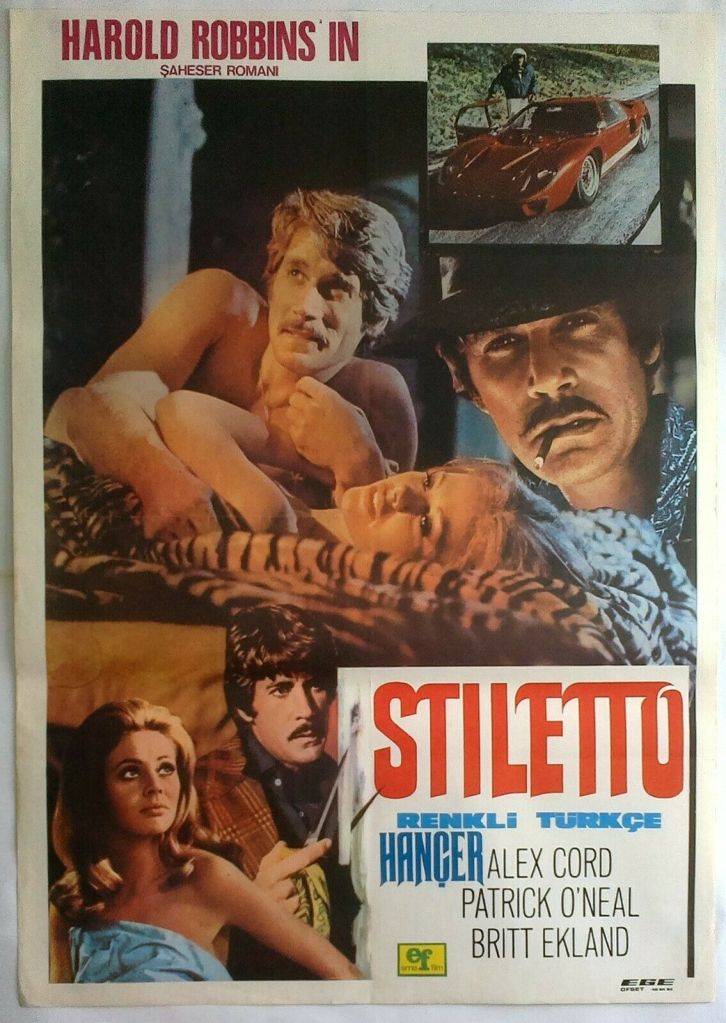
Stiletto (1969) – Mafia assassin Alex Cord hunted by cop Patrick O’Neal with Britt Ekland providing the glamor. From the Harold Robbins novel.
Duel at Diablo (1966) – action-packed western starring James Garner and Sidney Poitier, both playing against type.
The Secret Partner (1961) – Stewart Granger on the run in mystery thriller also starring Haya Harareet.
If I had not restricted the films in the competition to those that were just reviewed in the April edition of the Blog, I would have had to find room for another picture that was originally reviewed last year. Polish epic Pharaoh/Faraon (1966) would have taken fifth place if I had changed the criteria to just total views for the month.
I am delighted to see readers digging back into the Blog to ferret out great films.
The winner has requested that I respect his anonymity. He writes a movie blog under the pseudonym “Over-The-Shoulder” and has asked I don’t reveal his full name. But if you want to know what he writes about, check out his blog.
Tough talking Patrick O’Neal (Castle Keep, 1969) whose “hello” is usually accompanied with a fist enlivens this adaptation of a slim bestseller by Harold Robbins as cop George Baker on the trail of Mafia hitman Count Cesari Cardinali (Alex Cord ). Unusually, Cord was the go-to star for producers of Mafia pictures, his previous movie being The Brotherhood (1968). Equally unusual, Cardinali is a part-time assassin, spending the rest of his time as a fun-loving playboy with a string of women, fast cars and racehorses. Only problem is he wants to retire – and not in normal fashion, weighted down by a block of cement. Unfortunately, his dilemma is hardly one to solicit sympathy from an audience much less Mafia boss Emilio Matteo (Joseph Wiseman) and Cord isn’t enough of an actor in any case to tug at the heartstrings.
Cord made a brief splash as an action hero in the monosyllabic Clint Eastwood/Charles Bronson mold after debuting in the John Wayne role of the Ringo Kid in the remake of Stagecoach (1966) and Italian-made A Minute to Pray, A Second to Die (1967). But didn’t have more than half a dozen stabs at making his name on the big screen before disappearing into the television hinterlands. So he’s something of an acquired taste, maybe the small output enough to qualify him for cult status. Here, he’s a decent fit for the violence but saddled with a role that makes little sense and sure enough he soon discovers that Wiseman doesn’t consider him a candidate for a pension while O’Neal bullies witnesses into providing the legal ammunition to bring the gangster down.
One such person is illegal Polish immigrant Illeana (Britt Ekland), Cardinale’s girlfriend when he is not chasing Ahn Dessie (Barbara McNair). This is another thankless role for Ekland (Machine Gun McCain, 1969), there to add glamour, but, surprisingly, she manages to bring pathos to the part. McNair, who is always worth watching and had made an auspicious debut the year before in If He Hollers, Let Him Go, hardly gets any screen time. But it’s O’Neal (Alvarez Kelly, 1966) as the ruthless cop who holds it all together.
Director Bernard L. Kowalski (Krakatoa, East of Java, 1968) proves better at the action than the characterization, though, luckily nobody needs to be anything other than tough. Three scenes, in particular, are well handled – the opening murder in a casino, a shoot-out at a penthouse and the climax on a deserted island which has more than a hint of a spaghetti western. Wiseman (Dr No, 1962) rustles up another interesting performance and Roy Scheider (Jaws,1975) also appears.
This old-style tough-guy thriller would have been better off had the Cord vs. O’Neal set-up taken center stage, with the assassin on murderous overkill hunted down by the zealous cop. As it is, it’s a missed opportunity for Cord to develop an Eastwood/Bronson persona and enter the action star hall of fame. This was the seventh adaptation of the books of bestseller writer Harold Robbins after Never Love a Stranger (1958), A Stone for Danny Fisher (filmed as King Creole in 1958), The Carpetbaggers (1964) – which also resulted in Nevada Smith (1966) – and Where Love Has Gone (1966).
This isn’t easy to get hold of but you are more likely to find it will find it on Ebay (new) than Amazon.









 The Magnificent 60s