Three into Two Won’t Go (1969) ***

Unhappily married and childless salesman Steve (Rod Steiger) begins an affair with kooky promiscuous hitchhiker Ella (Judy Geeson). A free spirit in control of her life – no VD and on the Pill – and happy to drift from mundane job to mundane job, Ella ranks her many lovers on their sexual performance. Steve has just moved into a new house in a dreary new estate, perhaps in the hope of revitalizing his staid marriage to Frances (Claire Bloom).

While Steve is away on business, Ella turns up at his home where, revealing – without implicating Steve – that she is pregnant and convinces Frances to let her stay the night. Naturally, it is Steve’s baby but Ella plans an abortion. Steve wants the baby and so, too, still unaware of the father, does Frances, seeing adoption as the solution to their marital woes. And so a love triangle, or more correctly a baby triangle, plays out, with a few unexpected twists.

Like most of the marital dramas of the 1960s, especially in the wake of the no-holds-barred Who’s Afraid of Virginia Woolf (1966), this is riddled with outspoken protagonists who have no idea how to find real happiness. Based on the book by Andrea Newman and adapted by Edna O’Brien, who both have previously marked out this kind of territory, the picture shifts sympathy from one character to the next. While no one is entirely culpable, none are blameless either. Yet there is an innocence about Steve and Frances in the way they fling themselves at unlikely salvation. They are not the first couple to find themselves in a marital cul de sac, nor the first to do nothing about it, hoping that somehow through a new house or job promotion things will right themselves.

Audiences, accustomed to seeing Steiger (In the Heat of the Night, 1967) in morose roles, might have been shocked to see him happy and he manages to present a more rounded character than in some previous screen incarnations. In burying herself in domesticity, Claire Bloom (Charly, 1968) essays a far from fragile character, whose resilience and pragmatism will always find a way forward. Geeson is the surprise package, at once knowing and in charge, and at other times completely out of her depth, and to some extent enjoying the chaos she sparks. The exuberant screen personality she presents here is almost a grown-up more calculating version of the character she portrays in Hammerhead (1968).

Director Peter Hall (Work is a Four-Letter Word, 1968) ensures more universal appeal by not grounding the movie in the swinging sixties so that it would not quickly become  outdated. The snatching at last-minute fantasy to avert marital disharmony will still strike a note. The performances are all excellent, including a turn by Peggy Ashcroft (Secret Ceremony, 1968) and bit parts from British character actors Paul Rogers (Stolen Hours, 1963) and Elizabeth Spriggs in her second movie.

Make sure you catch the correct version of this picture if you hunt it down. Against the director’s wishes. Universal edited it then added new characters for the version shown on American television.
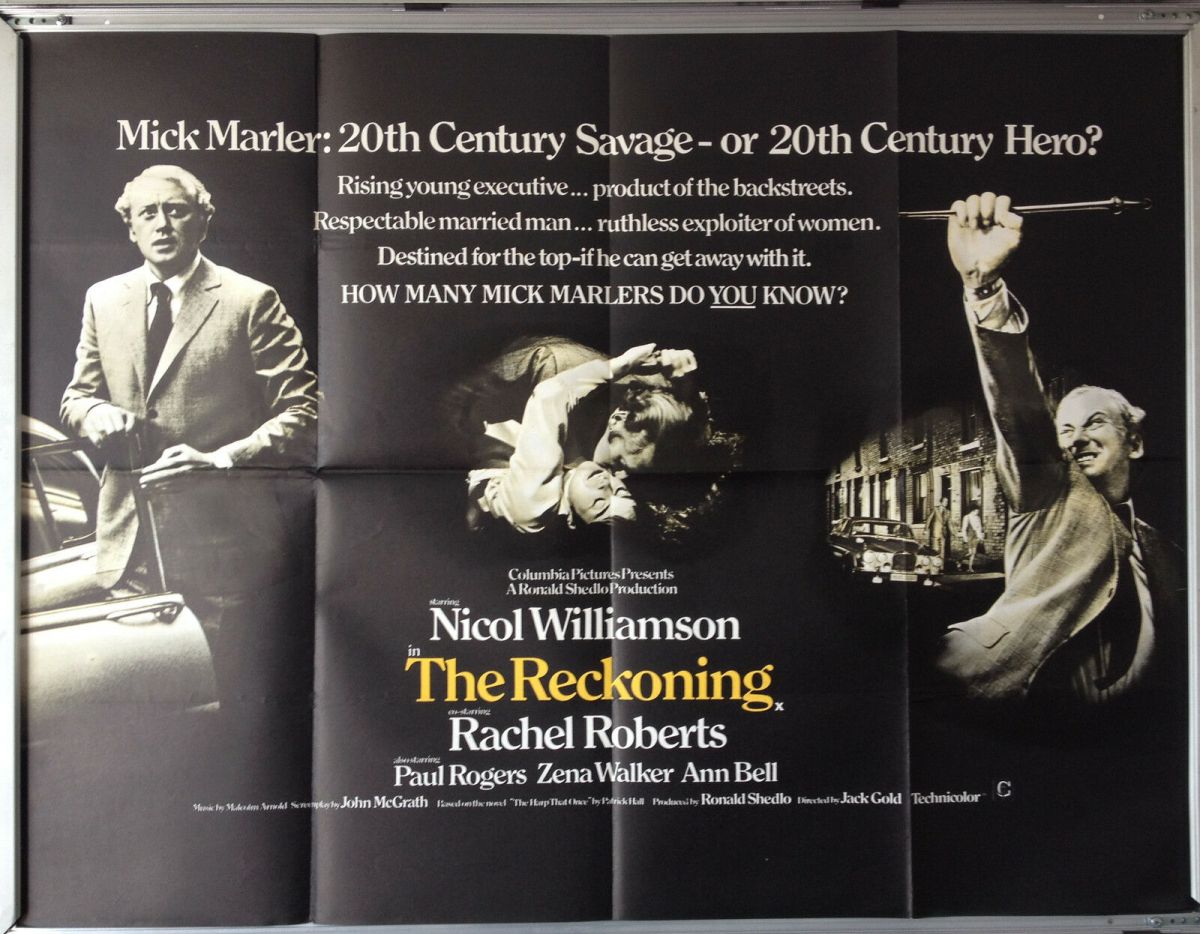
The Reckoning (1970) ****

Fans of Succession will love the boardroom battles and fans of Get Carter (1971) the gritty violence. Michael Marler (Nicol Williamson) is a thug whichever way you cut it. He’s a business hard-ass, at his nicest he’s obnoxious, at this worst brutal. He drives like a demon. Even in love, he’s fueled by hate, sex with wife Rosemary (Ann Bell) infernal. And all of this made acceptable, according to the left-wing tenets that underwrite the film, because he is a working-class man battling upper-class hypocrisy, never mind that his upper-class wife was hardly foisted upon him, nor that he was forced to live in luxury.

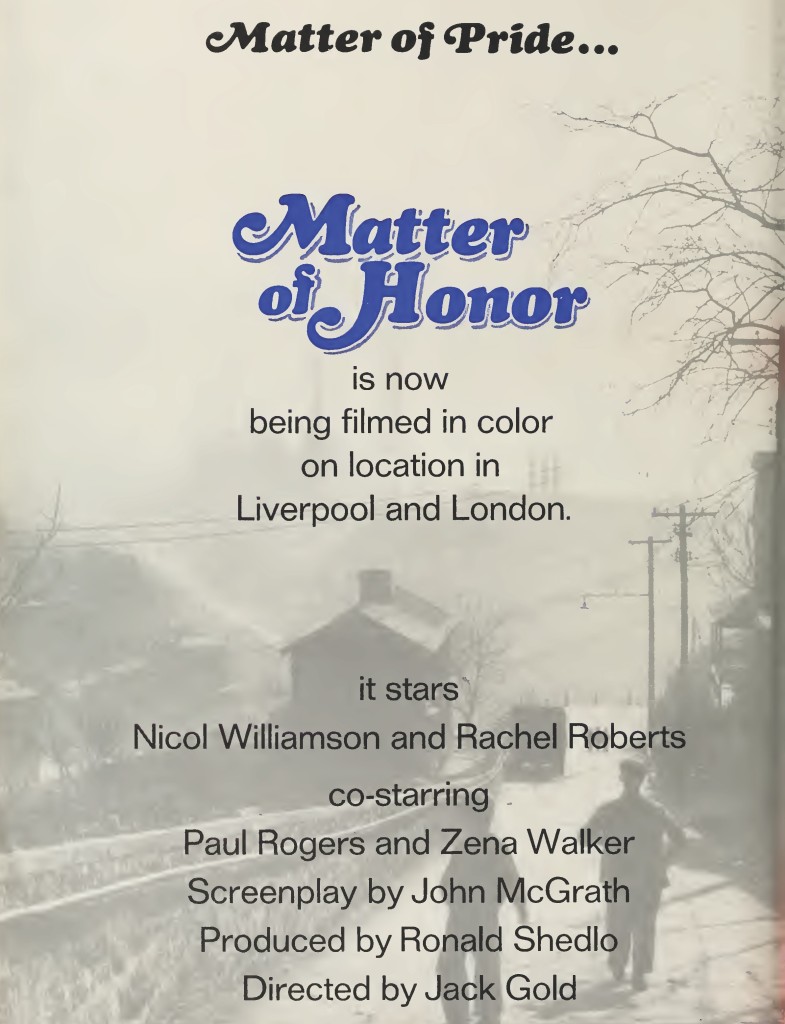
Unexpectedly, the film also explores other themes which have contemporary significance. Computers play a pivotal role and so does honor killing. The picture’s original title – A Matter of Honor – was ironic given that in the upper-class worlds in which Marler moved, courtesy of job and marriage, he is considered to have little in the way of chivalry. But in the working-class world he has escaped he must exact revenge according to a code of honor steeped in violence.   

This advert dates from October 1968, which gives an indication of how long the film’s release was delayed, not appearing until January 1970. Interestingly, the advert appeared in the U.S. trade magazine Box Office (October 28, 1968), suggesting Columbia had high hopes for the British production. The title here suggest a different approach to the movie.

The sudden death of his father sends Marler back to Liverpool where he discovers the old man was killed in a pub brawl. But the local doctor and the police, uninterested in complicating what must be a regular occurrence, view his death as accidental. So Marler takes it upon himself to uncover the culprits and wreak revenge, any kind of revenge on any kind of culprit, regardless of the fact that from the outset it is clear they will hardly be gangsters.  While contemplating violence, he strikes up a sexual relationship with the married Joyce (Rachel Roberts).

The story jumps between the back-stabbing corporate world to a scarcely less violent working class environment. The combination of charm and brute energy holds a certain appeal for Rosemary (Ann Bell) and helps keep him in the good books of his boss, but he is otherwise a bully, targeting the weak spots of anyone who stands in his way on his climb to the top, and while heading up the sales division of a company in trouble blaming everyone else for his own failings. And while scorning his wife’s upper-class friends is quite happy to enjoy the benefits of her lifestyle, the flashy car might be the result of his endeavors but not the huge posh house. Marler stitches up another associate with the assistance of another lover, secretary Hilda (Zena Walker), and his long-suffering wife finally takes umbrage at his venomous manner.

Marler hides his hypocrisy behind the façade of a left-wing class-struggle. John McGrath’s screenplay clearly intends Marler’s working-class background to provide him with a get-out-of-jail-free card as well as to launch an attack on upper classes seen as namby-pamby except when it comes to putting the poor in their place. The anti-class polemic has somewhat eroded over time but in its place can be found an accurate portrait of the social mores of ordinary people for whom, alcohol, the drug du jour, plays a massive part.  The going-home element is populated by endless terraced houses without a single parked car, vast caverns of pubs which host wrestling matches and are a tinder spark away from erupting in a brawl. This is in stark contrast to the high-living life Marler enjoys in London.

He has no desire to go back home, hasn’t visited in five years, escaping from there deemed a sign of success, and mostly returns metaphorically to draw on memories with which to scourge the upper-class and excuse his own behavior. 

Nicol Williamson (Inadmissable Evidence, 1968) delivers a tour de force, his screen presence never so vibrant, exhibiting the same raw appeal as Caine in Get Carter. At this point in his career, with a critically-acclaimed Hamlet on stage, he was perceived as the natural successor to Laurence Olivier and Columbia held up the release of The Reckoning to allow the Tony Richardson film of that stage production to pick up critical momentum. Oddly enough Rachel Roberts had not capitalized on her Oscar-nominated role in This Sporting Life (1963), this only her second movie in seven years. Initially coming across as brassy caricature, she soon softens into a surprisingly wistful character. Both Ann Bell and Zena Walker bring greater dimension to their characters rather than as adoring doormats. You can catch Paul Rogers (Three Into Two Won’t Go, 1969) and Tom Kempinski in supporting roles.

Director Jack Gold, who had worked with both Williamson and McGrath on his movie debut The Bofors Gun (based on the writer’s play), does a great job of capturing a particular period of British social history as well as allowing Williamson to stomp around in his pomp.

The Arrangement (1969) ***

It might have been better if director Elia Kazan had handed over the screenwriting chores for this adaptation of his bestseller about the midlife crisis of advertising man Eddie Anderson (Kirk Douglas). Anderson’s attempts to juggle wife Florence (Deborah Kerr) and mistress Gwen (Faye Dunaway) coupled with growing disgust at selling a new brand of cigarettes, Zephyr (“The Clean One”), in a way that pointedly avoids their cancer potential, leads to a suicide attempt.  

During convalescence he determines to quit the advertising world and go back to his first love, writing, but in fact he ends up sabotaging his career. Florence represents impossible seduction and conscience. Slinky, in dark glasses, hot-tempered rather than submissive or demure, she accuses him of self-deception in his job. The picture flits back and forth between his various choices – different job, return to wife, settle down with mistress, or what seems his ideal world, cossetted by both Gwen and Florence.

Gwen is an excellent study of the modern woman (of that fast-changing period, I hasten to add), who needs a man for sex but not necessarily love, and can use the opposite gender as ruthlessly as any man. What she actually requires in her real life is quite different to what she seeks in the fantasy love she enjoyed with Anderson, sex on the beach, the buzz of controlling a high-powered man. Florence could be seen as an old-fashioned portrait of the adoring wife except for capturing so well the bewilderment of betrayal.

Kazan conjures up some wonderful images: the tension before the suicide attempt as Anderson plays chicken between two trucks, Gwen emerging wet from the pool to eat dangling grapes or with her legs up on Anderson’s desk, Anderson’s mother lighting votive candles in her house before using the same match for her cigarette, Kerr’s futile attempts to win back her fallen husband, Anderson flying solo.

In parts well-observed and directorially savvy, quick cuts between the present and the past, however it sinks beneath its own self-indulgence. My guess is that author Kazan could not bear to kill off a single one of the characters he had created for his acclaimed novel and the upshot is a vastly over-populated picture, few of whom cast any real light on Anderson’s predicament. So we are not only introduced to mother, dying father, brother, sister-in-law and  analyst but priest and a bucket of clients and guys from the office. And there are some plot oddities – Anderson gets time off apparently to write journalistic pieces – and what is clearly intended as hard-hitting satire of the advertising world does not come off.

Dunaway (Bonnie and Clyde, 1967) is the standout as Gwen, living life according to her own rules, and with an unexpected vision of domesticity but Deborah Kerr (Prudence and the Pill, 1968) does pain like nobody else and is extremely convincing. Strangely enough, I didn’t go much for Douglas (Seven Days in May, 1964). He could have been leading a cavalry charge for all the range of emotions he exhibited. Douglas is no Montgomery Clift (Wild River, 1960), James Dean (East of Eden, 1955) or Marlon Brando (On the Waterfront, 1954) who was Kazan’s first choice. Kazan had not made a picture in six years and it had been eight years since his last hit Splendor in the Grass (1961). Not quite out-of-touch in concept and delivery, nonetheless it was shunned by the Oscar fraternity.

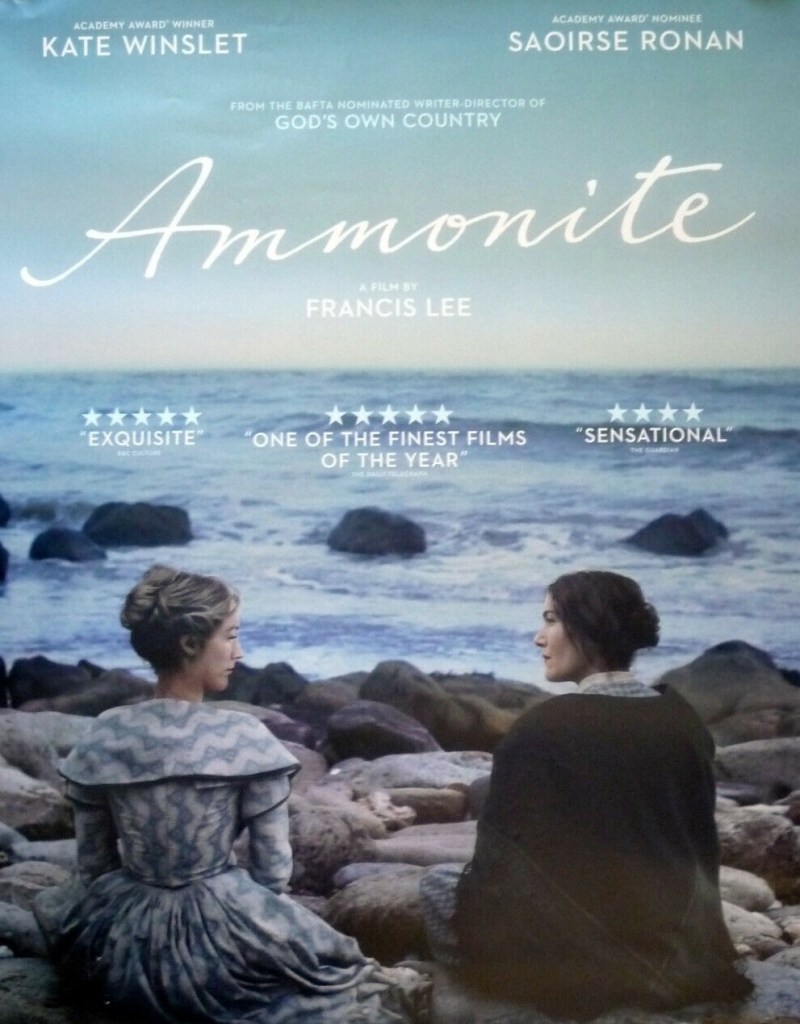
Ammonite (2020) ****

I came at this picture with some trepidation and in truth only watched it at the cinema because I had seen everything else worth a look in the few weeks since the picture houses have reopened. Although initially attracting Oscar buzz, that failed to materialize when it mattered and it was left out of the Oscar loop. While kate Winslet was a proven commercial box office draw, this appeared to have arthouse sensibilities and the few reviews I had read promised a turgid evening.

The reality was something different and as a result of what I can only describe as the magic of the big screen. Watching a film in a cinema is automatically more involving than on the small screen: there are fewer distractions, the dominating size of the screen is unavoidable and it is dark. Had I watched it at home I could well have switched it off after fifteen minutes in reaction to the slow pace. But in a cinema, slowness did not matter, and until it widened out in the final few scenes it was like an absorbing chamber piece, featuring a handful of characters.  In approach it was closest to a film about an artist, Pollock (2000) and Mr Turner (2014) come to mind, where obsession is the driving force, narrative and plot merely subservient. We are exposed to considerable detail about the character’s archaeological work, which is often filthy and undertaken outside in all sorts of weather, requiring the constitution of a miner or farmer rather than a painter, as well as the patience of a saint to brush, wash or poke clean her discoveries.

Mary Anning (Kate Winslet) was not an attractive personality, downright truculent and rude for the most part, given that she depended for her living on selling the archaeological items she had found in the Lyme Regis area to tourists and collectors. That her major archaeological discoveries resided in the British Museum brought no personal satisfaction because thanks to the male archaeological hierarchy they were presented there under the names of the purchasers rather than the finder. What she earned for major pieces could keep herself and her ageing and infirm mother (Gemma Jones) for a year. By and large, they lived in poverty, existing on soup mostly, the mother at least as obsessive as the daughter with her collection of knick-knacks, one for each of her eight children who had died prematurely, which she washed and polished every day. Mary spurned any male overtures and indeed appeared to resent any friendship, the hint of some kind of betrayal in brief scenes with Elizabeth Philpot (Fiona Shaw), a local worthy.

Mary is hired by wannabe archaeologist Roderick Murchison (James McArdle) to look after his insipid, annoying, depressed wife Charlotte (Saoirse Ronan). Gradually a friendship forms, leading to desire. Nothing is more illustrative of the Victorian attitude to sex than that the idea of a lesbian relationship ran counter to all imagination. Perhaps one of the more refreshing aspects of the picture is that while Victorian women clearly resented having sex with their husbands that was largely down to the fact the men had no idea how to satisfy a woman. That is not the case here and though the sex scenes have been criticised in places as “too strong” I thought it was essential just to be sure that the women did know what they were doing and clearly derived enormous satisfaction from the sexual act if properly performed. A chaste kiss and cuddle would hardly do justice to the passion suddenly erupted.

While Mary experiences jealousy when Charlotte is entranced by Elizabeth, romance does not produce complete fulfilment and when Charlotte, as if she were a man, appoints herself Mary’s protector that independence for which the archaeologist had fought so hard is imperilled. Love miraculously changes Charlotte’s outward demeanour, the same is not true of Mary.

This isn’t the picture-postcard version of a Victorian seaside town, rather its harsher cousin. Writer-director Francis Lee (God’s Own Country, 2017) refuses to soften the rude edges of life and the best a true romanticist can expect is that the storms occasionally abate and the surf does not pound so heavily.

Powerful roles have been in short supply of late for Kate Winslet (Blackbird, 2019) and she is superb as the stoic woman in a male-dominated world, unable to express passion except in whittling away at pieces of ammonite. Saoirse Ronan (Little Woman, 2019) moves from bitter and confused child-woman to finding joy and from then to taking charge. Veteran British character actors Gemma Jones (Rocketman, 2019) and Fiona Shaw (My Left Foot, 1989) are impressive while James McArdle (Mary, Queen of Scots, 2018) and Alec Secareanu  (Amulet, 2020) offer different interpretations of the entitled male.

To be sure there is no conclusive proof that Mary Anning was this way sexually inclined but in these days of Hollywood reinvention or reimagining for little more than comic-book glory it would be hard not to allow the director some leeway in providing his love story with an interesting backdrop and a fascinating character. At times it is a painful watch, but a rewarding one.

The Crimson Cult/ Curse of the Crimson Altar (1968) ***

Horror is a small world and at any moment you are likely to bump into stars of the caliber of Christopher Lee, Boris Karloff and Barbara Steele – or in this picture all three. Investigating his missing brother Peter sends antiques dealer Robert Manning (Mark Eden) to a remote country mansion where he encounters owner Morley (Christopher Lee), his seductive niece Eve (Virginia Weatherall), the wheelchair-bound authority on witchcraft Professor Marsh (Boris Karloff), deaf mute Elder (Michael Gough) and a centuries-old mystery.

Morley can legitimately deny that Peter has ever set foot on the premises since it was common for the brother to adopt an alias when seeking out significant antiques. By the time Robert amasses sufficient clues to challenge Morley on this particular issue, it appears that further ideas of more sinister goings-on may be illusory. On his first night Robert observes an annual celebration of the Black Witch but although an effigy is burned this festival appears to have more to do with the innocent consumption of alcohol and heady bouts of sex than satanism.

Thanks to career reinvigoration after Peter Bogdanovich’s “Targets” (1967)
Boris Karloff gained top billing in the British release.

And after a while, Robert indulges in carnal delight with Eve. However, he is plagued by a nightmare that involves a grotesque trial by a jury wearing animal heads. Gradually, he learns that Morley, meanwhile, is such a congenial host, and his niece delightful and sybaritic company, that the finger of suspicion points at Elder, who does take a pot shot at Robert, and the professor who has a collection of instruments of torture.

Were it not for veteran director Vernon Sewell (Urge to Kill, 1960) beginning proceedings with some kind of black mass complete with floggings and female sacrificial victim, the audience might have been kept in greater suspense. As it is, the non-violent annual celebration throws us off the scent as does the seduction of Eve and the prospect that Robert’s nightmare is little more than psychedelic hallucination. The denouement is something of a surprise. The ritualistic aspects of the picture are well done and given this is a Tigon film rather than Hammer you can expect harsher treatment of the S&M element, flagellation delivered by women, especially for the period.  

In the U.S. – where it was shown both as “The Crimson Cult” and “The Crimson Altar” – Christopher Lee was accorded prime billing status.

The eerie atmosphere and well-staged witchcraft scenes are a plus, but, despite the involvement of a handful of horror gods, the movie’s reliance on lesser players to drive the narrative is a minus. Lee, Karloff and Steele (though in a more minor role) are all excellent as is the demented Michael Gough but Mark Eden (Attack on the Iron Coast, 1968) is too lightweight to carry the picture although Virginia Wetherall in her first big part suggests more promise.  More of Lee, Karloff and Steele would have definitely added to the picture but since this type of film often requires the young and the innocent to take center stage that was not to be.

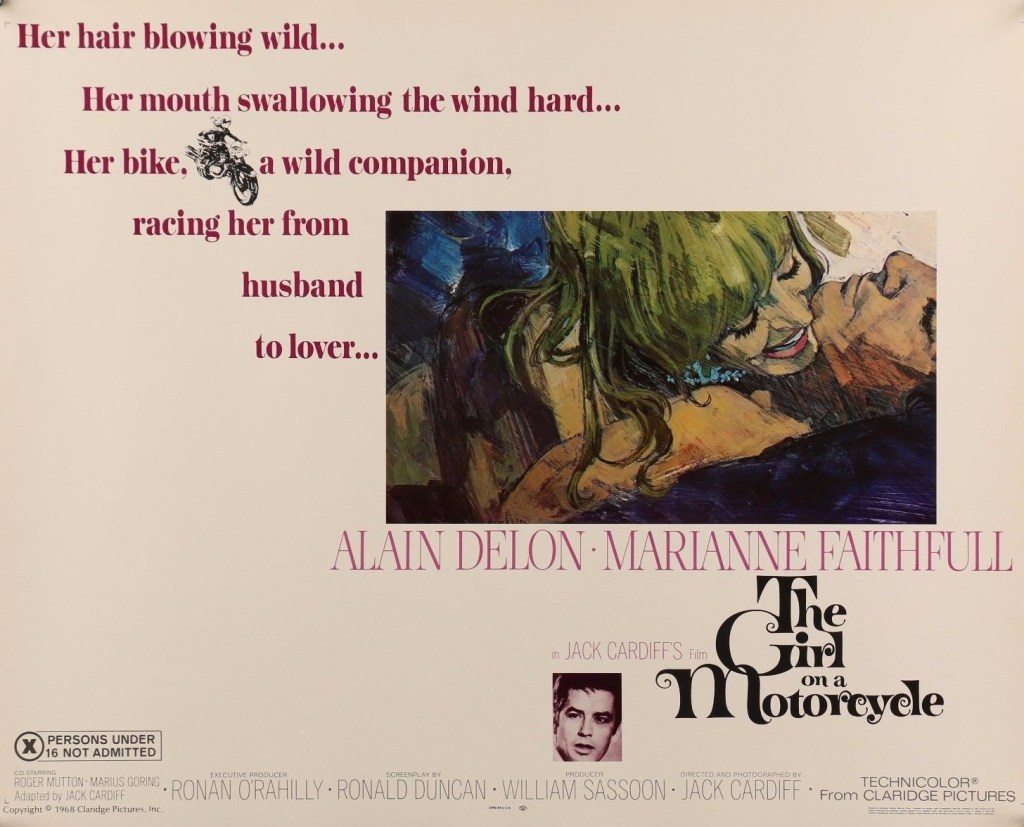
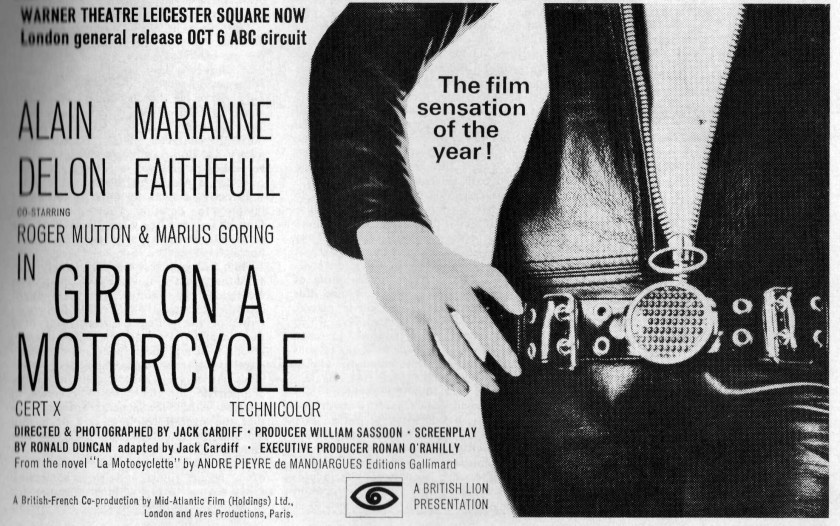
The Girl on a Motorcycle / Naked under Leather (1968) ***

An erotic charge deftly switched this picture from the Hell’s Angels default of violent biker pictures spun out cheaply by American International.  Where Easy Rider (1969) was powered by drugs, this gets its highs from sex. Rebecca (Marianne Faithful), gifted a Harley Davidson Electra Glide motorbike by lover Daniel (Alain Delon) two months before marriage to staid teacher Raymond (Roger Mutton), takes to the highways to find herself.

This ode to speed (of the mechanical kind) allows her to shake off her preconceptions and fully express her personality, beginning with the one-piece black leather outfit, whose zip, in one famous scene, Daniel pulls down with his teeth. The bike is masculine. “There he is,” she intones and there is a none-too-subtle succession of images where she clearly treats it as a male appendage.

She is both self-aware and lost. In some respects Raymond is an ideal partner since he respects her wild nature and gives her space, and she views marriage to him as a method of avoiding “becoming a tart.” In other words he represents respectability, just like her father (Marius Goring) who owns the bookshop where she works. But he is just too reasonable for her and, in reality, as she would inevitably discover that is just a cover for his weakness. The only scene in which she does not appear is given over to Raymond being tormented by young pupils who have him chasing round the class hunting for a transistor radio.

But Daniel is not quite up to scratch either. He believes in “free love”, i.e. sex without commitment and he is not inclined to romantic gestures and she knows she could just become another in a long line of discarded conquests should they continue. Raymond is a “protection against” Daniel and her ending up as an adulteress teenage bride and potential nymphomaniac. She seeks abandon not reality.

As well as sexy interludes with Daniel, her head is filled with sexual images, not to mention dabbling with masochism, in a dream her leather outfit being stripped off piece by piece by a whip-wielding Daniel, in a bar imagining taking off her clothes in front of the aged drinkers.

Jack Cardiff’s film is certainly an interesting meditation on freedom and sexual liberation at a time when such notions were beginning to take hold, but it suffers from over-reliance on internal monologue and Marianne Faithful’s lack of acting experience. Cardiff went straight into this from violent actioner Dark of the Sun (1968) and audiences remembering him from The Liquidator (1965) and The Long Ships (1964) would need reminded that he braced romance before in the touching and Oscar-nominated Sons and Lovers (1960). In that film he elicited an Oscar-nominated performance from Mary Ure, something that was unlikely here.

Pipe-smoking was generally the preserve of the old, or detectives, unless you were a young intellectual as Delon is here, but it does seem an odd conceit to force the actor into such a contrivance. Delon is accustomed to playing amoral characters, so this part is no great stretch, but, minus the pipe, he is, of course, one of the great male stars of the era and his charisma sees him through.

It was also interesting to compare Cardiff’s soundtrack to that of Easy Rider. Here, the music by Les Reed – making his movie debut but better known as a songwriter of classic singles like “Delilah” sung by Tom Jones – is strictly in the romantic vein rather than an energetic paeon to freedom such as “Born to Be Wild.” 

Cardiff’s skill as an acclaimed cinematographer (Oscar-winner for Black Narcissus, 1947) helps the picture along and clever use of the psychedelic helped some of the sexual scenes escape the British censor’s wrath, though not so in the U.S. where it was deemed an “X”. 

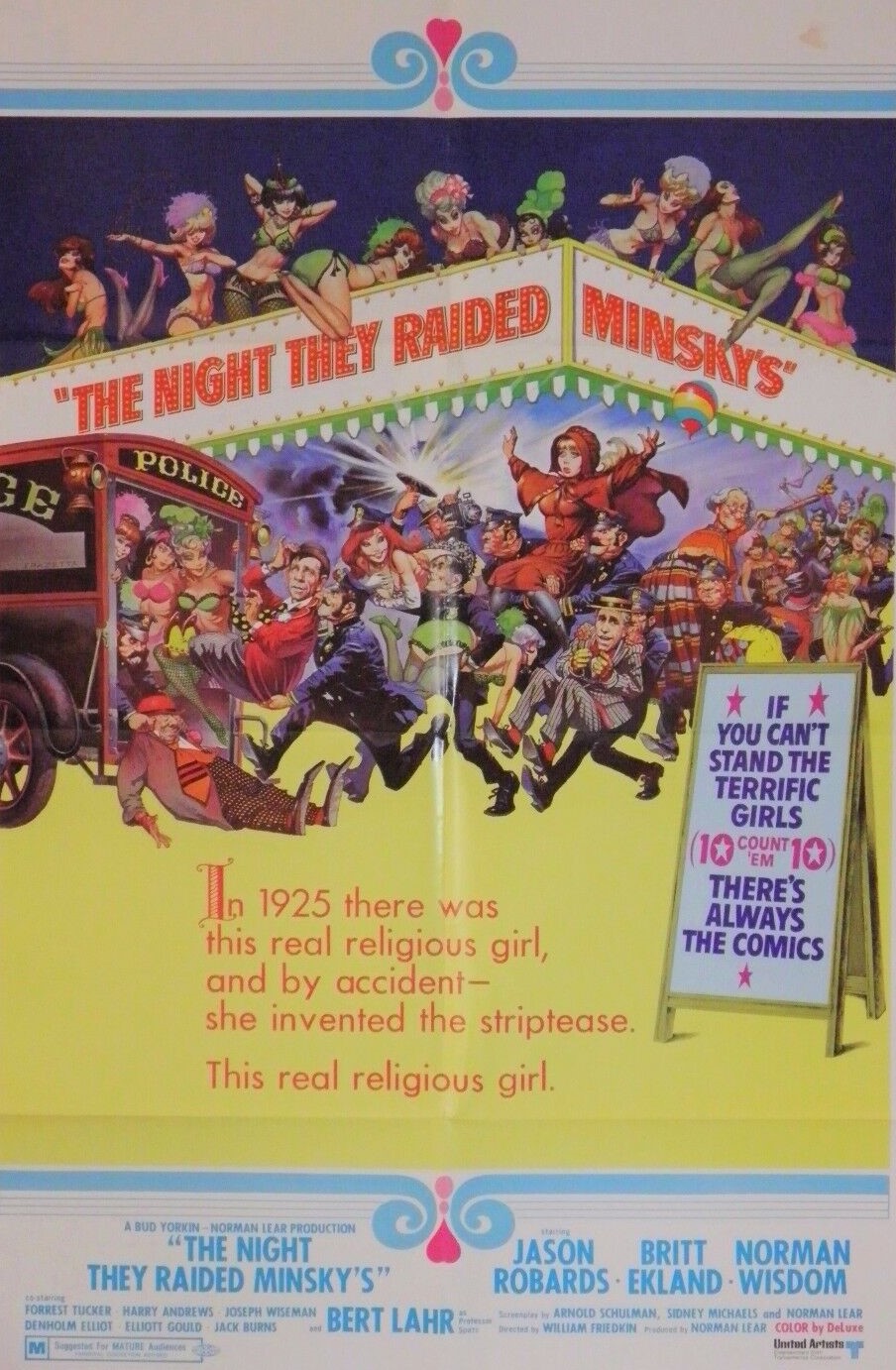
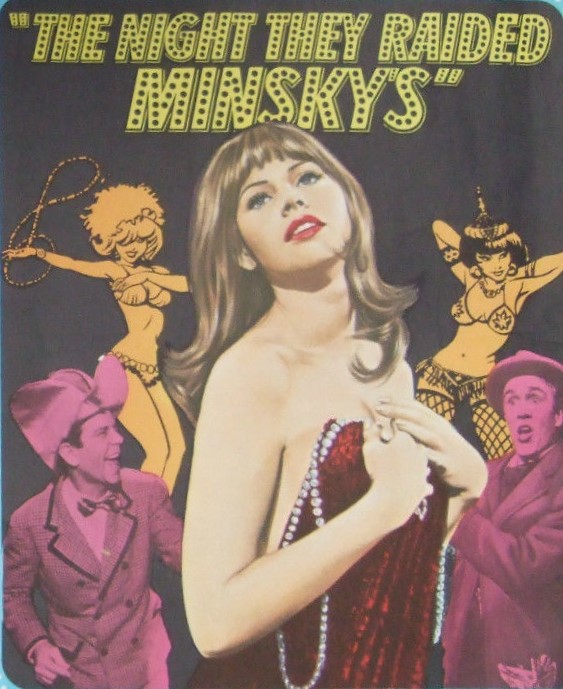
The Night They Raided Minsky’s (1968) **

This affectionate homage to 1920s vaudeville goes awfully astray under the heavy-handed direction of William Friedkin. Never mind the sexist approach, there’s an epidemic of over-acting apart from a delightful turn from Britt Ekland as the innocent star-struck Amish who accidentally invents striptease and former British music hall star Norman Wisdom who knows what he’s doing on the stage. The plot is minimal – burlesque theater manager (Elliott Gould) needs to save theater from going bust in a few days’ time. That’s it – honest!

The rest of the story looks tacked on – the overbearing leering other half (Jason Robards) of the Norman Wisdom double act tries to bed anything that moves, Amish father (Harry Andrews) in pursuit of his daughter, vice squad official (Denholm Elliott) determined to shut the theater down.

The saving grace of this debacle is Ekland’s performance which carries off a difficult part. Could anyone really be so dumb? She is endearing in a murky world but still capable of interpreting the Bible to her own ends (there is dance in the Good Book, for example) and she has confidence that the Lord will give her the go-ahead to have sex. Her innocence appears to transcend reality and since she doesn’t know a showbiz shark when she sees one she carries on as if life is just wonderful. Somehow this should never work but Ekland is so convincing that it does.

What might have been another saving grace is the documentary feel of much of the background, black-and-white pictures of the epoch transmuting into color, but too often the movie simply cuts to that without any real purpose. Equally, the various song-and-dance acts, chorus lines and comic turns provide an insight into burlesque reality but, again, all too often, that goes nowhere. There are plenty of people trying to be funny without much in the way of decent laughs. There’s altogether too much of everything else and not enough of the ingredients you might have considered essential.

This scarcely sounds like William Friedkin material given that although this preceded The French Connection and The Exorcist, by this point he had already made his mark with an adaptation of Harold Pinter play The Birthday Party (1968). In fact, his original cut was re-edited once he had departed the picture. Might it have worked better with Tony Curtis in the Jason Robards role as originally planned – he certainly had more charm than the jaundiced Robards. Regardless of who was cast what it needed most was a better story and less in the way of stock characters. And since in American theater folklore Minsky’s is synonymous with the invention of the striptease it meant that quite a few of the audience were there just to see how much skin would be revealed – which is not really the basis for a good mainstream picture.

The Pawnbroker (1964) *****

Director Sidney Lumet (Fail Safe, 1964) could have made an excellent film just about the customers of a pawn shop, the haunted individuals haggling for more bucks than they will ever be paid, the sad sacks, junkies, lost souls and general losers whose stories are told in the items they pawn or redeem – candlesticks, lamps, radios, musical instruments, occasionally themselves. You don’t need to be a pawnbroker to know that three hoodlums turning up with a pricey lawnmower are dealing in stolen property. And it comes as something of a surprise to learn that the pawnbroker is involved in some kind of money-laundering scam for a local gangster. Clearly shot on location on a bustling low-rent area, north of 116th St in East Harlem, New York, there’s enough going on in the streets – the markets, the tenements, poolrooms, the bustle, the eternal noise – to keep you hooked.

But you might think twice about positing as your hero an “absolute bastard” as Lumet himself described shop owner Sol Nazerman (Rod Steiger). He is more haunted than any of his clientele, a Holocaust survivor, plagued by flashbacks to the concentration camp where he witnessed his son die and his wife raped. He is devoid of life, completely shutdown to any emotion, rejecting overtures of friendship, and his life is played out in tiny elliptical shreds. He does not even derive any enjoyment out of his affair with a widow and although he claims to worship money – according to him the only “absolute” outside of the speed of light – that brings no fulfillment either. It is surprising he has lasted so long without imploding. After his war experience, you would have to wonder at a man who spends his life behind the bars of the grille in his shop and just in case he considers escaping from his predicament designer Richard Sylbert (Chinatown, 1973) incorporates other visual aspects of imprisonment into the production.

This startling image taken from the Pressbook encapsulates one of the striking moment of the film. As seen on the advert at the top of the blog, although not technically a roadshow in the normal sense (i.e. in the grandeur of 70mm) it played separate performances. This was a technique to drive up demand by limiting access. Originally, to take advantage of a British tax break known as the Eady Levy, the film was due to be made in London. Lumet pulled out when MGM insisted on a London shoot and only returned after that idea was abandoned and second-choice director Arthur Hiller bowed out.

Steiger gives a very restrained performance, especially for an actor known for his volubility and over-acting. He seems to sink into the role. He is accused of being among “the walking dead.” Around him are a set of very lively characters, his ambitious assistant (Jaime Sanchez, The Wild Bunch, 1969) trying to go straight and his girlfriend (Thelma Oliver), a very smooth and wealthy and gay gangster (Brock Peters), and a trio of small-time hoods with whom the assistant is friendly. But also the deranged and the lonely. A widowed social worker (Geraldine Fitzgerald) who suffers from the “malady of loneliness” offers him friendship but is rejected.

There is little plot to speak but it is just enough to teeter him on the brink of self-destruction. So it is primarily a character study. Unusually, Lumet observes without any sentimentality those around Steiger. “Sol has buried himself in this area,” Lumet wrote (“Keep them on the hook,” Films and Filming, October 1964, p17-20) “because he needs to be with people that he can despise….This is a man who is in such agony that he must feel nothing or he will go to pieces.” There is no redemption and he lacks the courage to commit suicide. It’s a stunning, bold picture, as raw as you can get without turning into a bloodsucker.

Fans of “The Godfather” might recognise this image – of a puppet on the strings -used to symbolise the power of the Mafia don. Eight years before Coppola’s gangster saga, this rarely seen but similar image in the Pressbook for “The Pawnbroker” evoked the opposite – a broken man.

The film had a few firsts. It was the only mainstream American picture to deal with the Holocaust from the perspective of a survivor (although films like Judgement at Nuremberg, 1961, has shown camp victims). It broke mainstream conventions on nudity, bare breasts being seen for the first time. Lumet experimented with incredibly short cuts – just one-frame and two-frames in places (a technique he had first used in television)- when the standard assumption was that audiences required three frames to register an image. Brock Peters played not just the first openly gay person in a mainstream picture, but the first gay African-American (although The Long Ships the same year had a bit of comedy about a eunuch chasing Vikings).

Quincy Jones made his debut as a movie composer. If you listen closely you might detect a piece of music later made famous by the Austin Powers pictures and if you look closely you might spot a debut sighting of Morgan Freeman. And if want another anomaly, try and work out why Rod Steiger lost out to that year in the Best Actor Oscar stakes to Lee Marvin in Cat Ballou (1965).

Many of the films from the 1960s are to be found free of charge on TCM and Sony Movies and the British Talking Pictures as well as mainstream television channels. But if this film is not available through these routes, then here is the link to the DVD and/or streaming service.

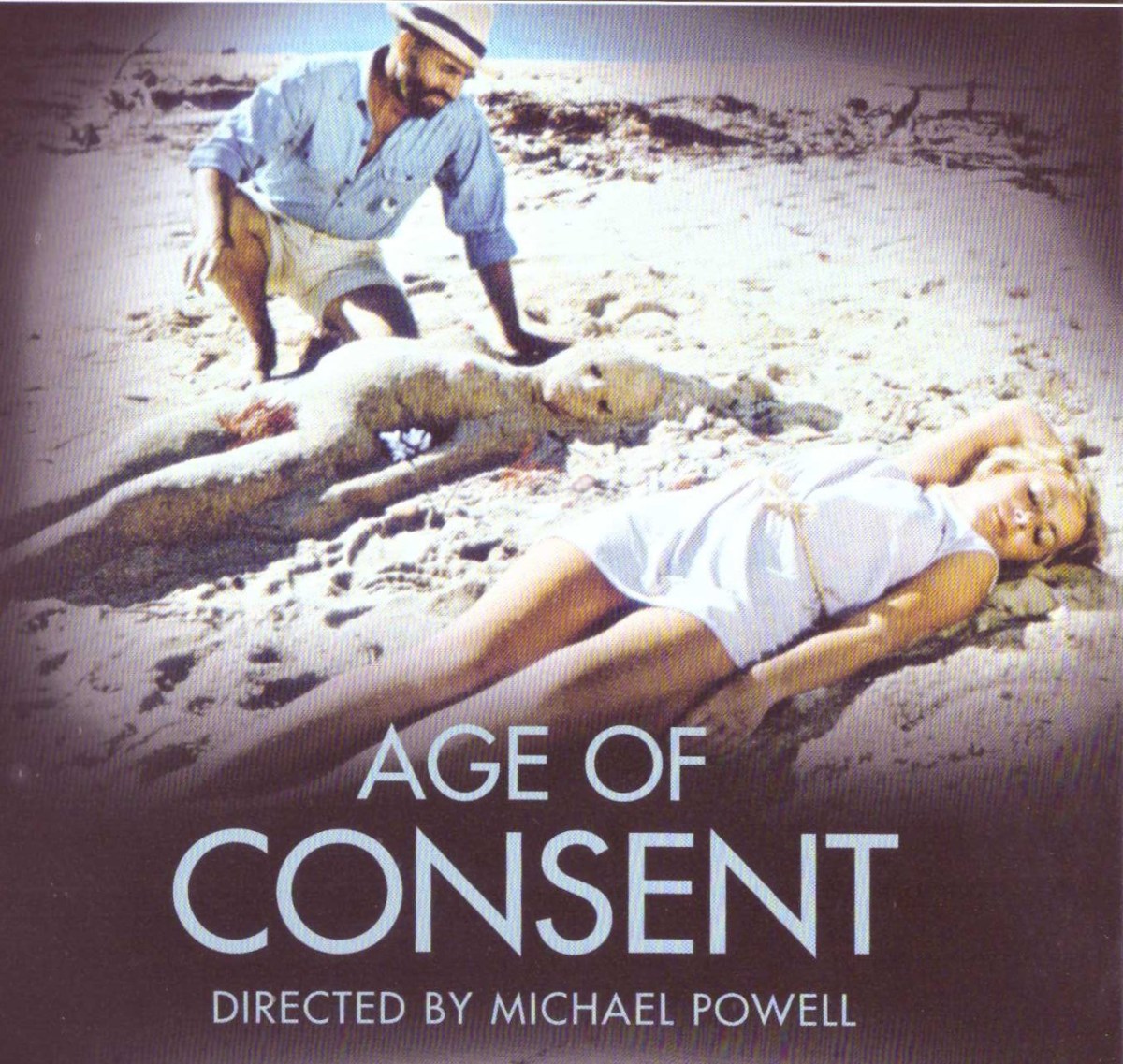
Age of Consent (1969) ***

Reputations were made and broken on this tale of a jaded artist returning to his homeland to rediscover his mojo. Director Michael Powell had, in tandem with partner Emeric Pressburger, created some of the most acclaimed films of the 1940s – A Matter of Life and Death (1946), Black Narcissus (1947) just remade by the BBC and The Red Shoes (1948) – but the partnership had ended the next decade. Powell’s solo effort Peeping Tom (1960) was greeted with a revulsion from which his career never recovered. Age of Consent was his penultimate picture but the extensive nudity and the age gap between the principals left critics shaking their heads.

For Helen Mirren, on the other hand, it was a triumphant start to a career that has now spanned half a century, one Oscar and three Oscar nominations. She was a burgeoning theatrical talent at the Royal Shakespeare Company when she made her movie debut as the muse of the artist played by James Mason. It should also be pointed out that when it came to scene-stealing she had a rival in the pooch Godfrey.

You would rightly be concerned that there could be some grooming going on. Although 24 at the time of the film’s release, Mirren played an under-age nymph who spent a great deal of time sporting naked in the sea off the Great Barrier Reef in Australia. But there are a couple of provisos. In the first place, Mirren’s character was not swimming for pleasure, she was diving for seafood to augment her impoverished lifestyle. In the second place, she was so poor she would hardly have afforded a swimsuit and was the kind of free spirit anyway who might have shucked one off. Thirdly, and more importantly, Mason wasn’t interested. He wasn’t the kind of artist who needed to perve on young girls. An early scene showed him in bed with a girlfriend and it was clear that he was an object of lust elsewhere. Mason was an artist, fit and tanned, as obsessed any other artist about his talent, and was in this remote stretch not to hunt for young naked girls but to find inspiration. As well as eventually painting Mirren, he also transforms the shack he rents into something of beauty.

Mason is as vital to Mirren’s self-development. The money he pays her for modelling goes towards her escape fund. Her mother being a useless thieving alcoholic, she has little in the way of role model. And the world of seafood supply was competitive. She is lost in paradise and the scene of her buying a tacky handbag demonstrates the extent of her initial ambition. Although her physical attributes attract male attention, it is only on forming a relationship with the painter that Mirren begins to believe in herself. There’s not much more to the central story than the artist rediscovering his creative spark and helping Mirren’s personal development along the way.

And if Powell had wanted to make an erotically-charged movie, he need look no further than his own Black Narcissus, in which two nuns are brought to the brink of lustful temptation in a convent in the Himalayas. Powell, himself, had form in the erotic department, having previously been the illicit lover of the film’s star Deborah Kerr and at the time of making the movie had switched, in similar illicit fashion, to her co-star Kathleen Byron. There is no question that the young Mirren in a beauty, but it is not lust that guides Mason.

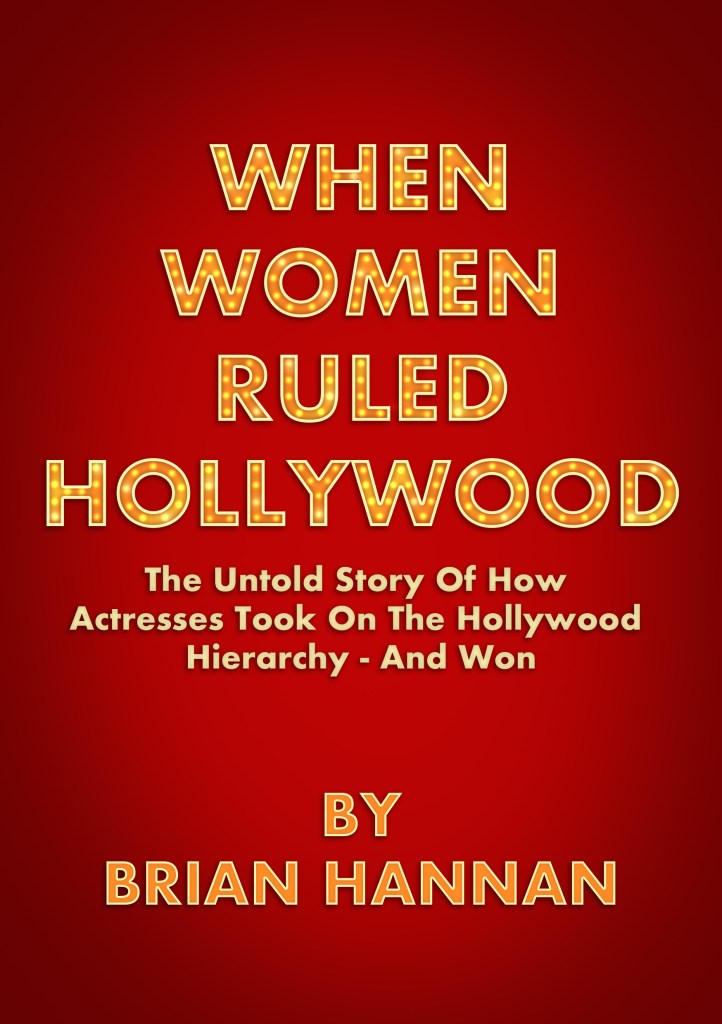
Female career longevity has always been an issue in Hollywood, the assumption being that women had shorter careers than men. But when I was writing “When Women Ruled Hollywood,” I discovered this was not true. Until Sophia Loren’s late foray this year, Jane Fonda had led the roll of honor – male or female – with a career lasting 58 years. Next came Shirley Maclaine with 56 years, then Clint Eastwood (54), Katharine Hepburn (52) and Helen Mirren (51) and Robert Redford (51). Loren’s latest – The Life Ahead – gave her a career as a recognised star turn of 66 years.

Mason is a believable character. He is not an impoverished artist. Far from being self-deluded, he is a questing individual, turning his back on easy money and the temptations of big city life in order to reinvent himself. He isn’t going to starve and he has no problems with women. And he is perfectly capable of looking after himself.  A more rounded artist would be hard to find. Precisely because there is no sexual relationship with Mirren, the movie, as a film about character development, is ideally balanced.

The movie is gorgeously filmed, with many aerial shots of the reef and underwater photography by Ron and Valerie Taylor.  

What does let the show down is a proliferation of cliched characters who over-act. Jack McGowran as a sponging friend, ruthless seducer and thief heads that list closely followed by Neva Carr-Glynn as Mirren’s grandmother who looks like a reject from a Dickens novel. There’s also a dumb and dumber cop and a neighbor so bent on sex that she falls for McGowran. It’s not the first time comedy has got in the way of art, but it’s a shame it had to interrupt so often what is otherwise a touching film.

At its heart is a portrait of the artist as an older man and his sensitive relationship with a young girl. In later years, Powell married film editor Thelma Schoonmaker and after his death she oversaw the restoration of Age of Consent, with eight minutes added and the Stanley Myers score replaced by the original by Peter Sculthorpe.

Discover WordPress

A daily selection of the best content published on WordPress, collected for you by humans who love to read.

The Atavist Magazine

by Brian Hannan

WordPress.com News

The latest news on WordPress.com and the WordPress community.