C.C. and Company (1970) *

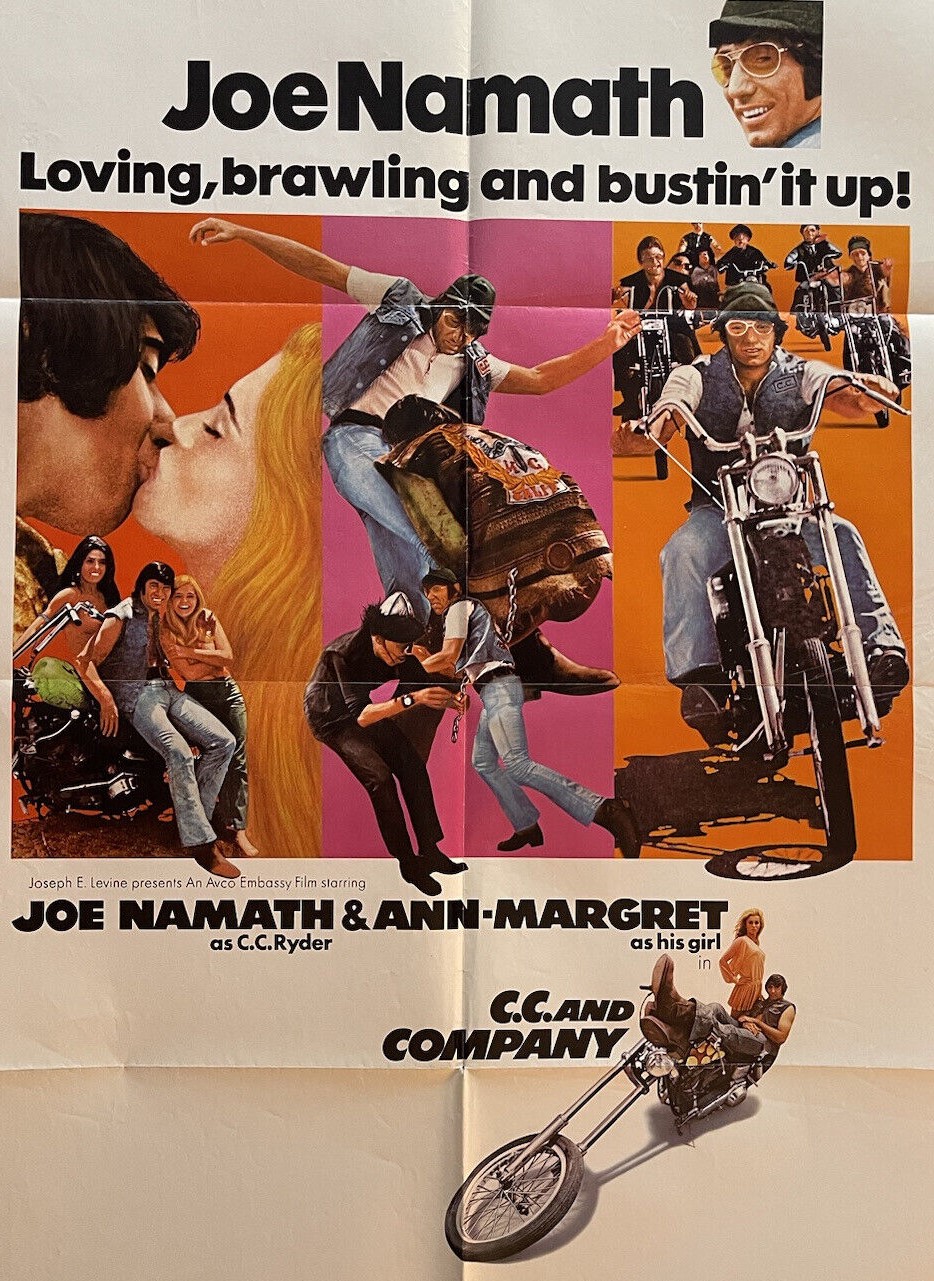
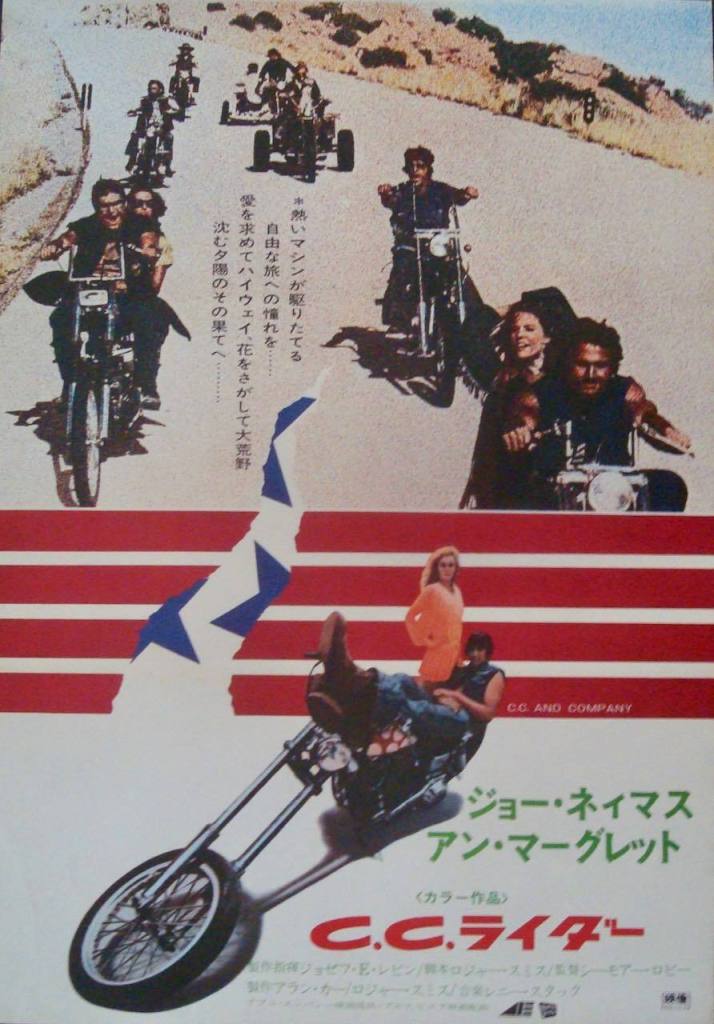
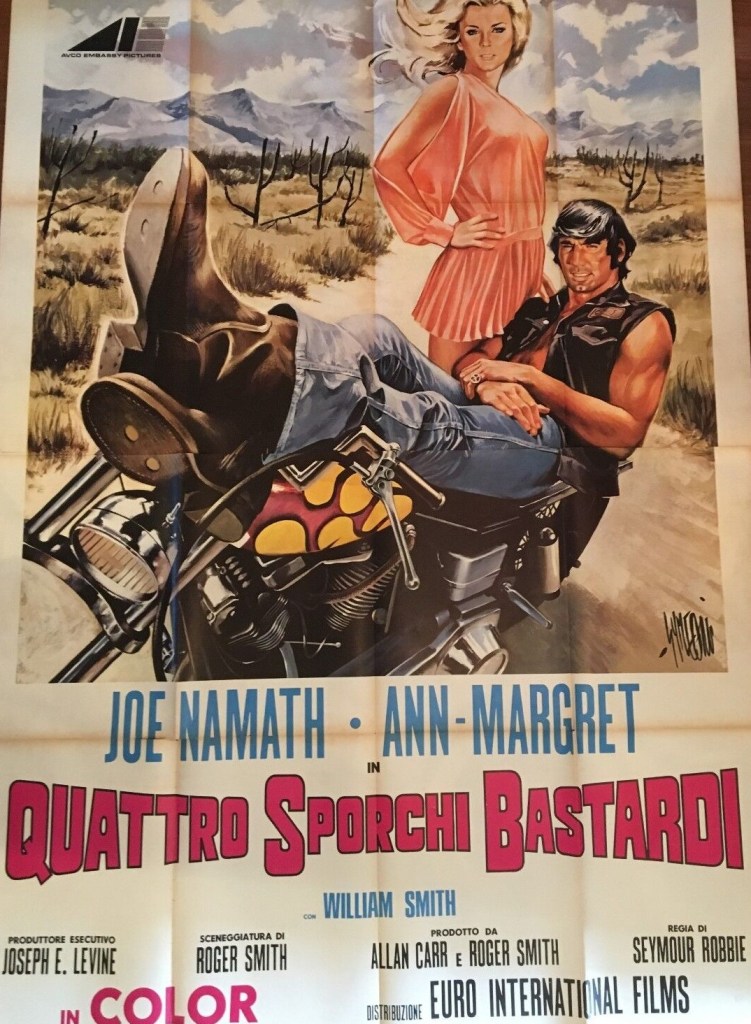
Just terrible. Not even the presence of Ann-Margret (The Swinger, 1966) can save this. Scarcely a single redeeming feature and nothing that might lend itself to shift it into the So Bad It’s Good category. In fact, you would probably put it in a lower class, the So Bad It’s Worse Than You Can Possibly Imagine strata. Little seen for over half a century, and small wonder.

And, boy, did Ann-Margret need a hit after a three-year self-imposed exile in Italy, where she earned big bucks for pictures that hardly got a sniff on the U.S. release circuit, putting an almighty dent in her marquee value. In theory, she should have returned home with a bang, as female lead in a Stanley Kramer production, R.P.M. (1970), the most prestigious picture she had ever been associated with, and easily the best director. But that, riding the counter-culture wave, was a big flop.

This was her second attempt at counter-culture. Motorbike sagas were bankable after the success of Easy Rider (1969) and even as B-pictures had attracted decent audiences for the likes of The Wild Angels (1967) and Run, Angel, Run (1969).

But this was saddled with a terrible star in Joe Namath, and a terrible script by Roger Smith (The First Time, 1969), Ann-Margret’s husband-manager, that puts the wild boys of the highways in a motocross competition, swapping their high-powered bikes for the much smaller Kawasaki engines used in that sport.

If you were American, Joe Namath was a god. If you were foreign, he was a nobody. One of the country’s greatest American football (not soccer!) players, he had made his movie debut in another flop, Norwood (1969). My guess is Ann-Margret was there to help out her husband, also the producer, and beef up the marquee.

But C.C. Ryder (Joe Namath) looks more like an overgrown schoolboy, hulking though he is, than a Hell’s Angel. For the lack of believability he invests in the role you would have done as well with pop star Fabian (Ten Little Indians, 1965).

Anyway, on with the barmy story. So, fashion director Ann (Ann-Margret) has the bright idea, as fashion directors did in those days, of setting up a shoot against the backdrop of a motocross event, kind of like Zabriskie Point (1970) but with bikes. On the way, her car breaks down. The two passing bikers who come to her rescue have something else in mind and she is only saved from rape by the intervention of Ryder.

He belongs to a biking troupe headed by Moon (William Smith), the misogynist’s misogynist, who slaps his women around and sends them out to prostitute themselves on the highways because unlike the enterprising chaps from Easy Rider he’s not got the brains to set up a drugs operation. Then he gets the inspired notion of picking up easy money by sending his guys to compete in the motocross competition because, surely, them being serious motorbike freaks they can beat the hell out of any professional motocross rider who does this for a living.

No doubt audiences will be rooting for the amateurs the way they do for the young kids in other movies that need to put on their own show to save an orphanage or the like.

Naturally, Ryder falls for Ann. Equally naturally, Moon doesn’t like that one bit. And so kidnaps Ann, ensuring Ryder comes to the rescue. Cue a showdown. No doubt we’ll see an almighty battle with chains and wrenches and surely there will be a flashing blade or two as this pair roll around in the dust.

Nope! Let’s just find a handy football stadium and race round the athletic dirt track. That’s bound to be more exciting. You would get more excitement watching goldfish in a bowl.

Theoretically, the combination of Namath and Ann-Margret should have reached the incendiary levels of football star Jim Brown’s sexual tussle with Raquel Welch in 100 Rifles (1969). Nope. Namath has all the screen charisma of a beetle and there’s nothing Ann-Margret can do to help that. You couldn’t have wasted her first nude scene on someone less deserving.

As you might expect, Ann-Margret does get to dance, but for some reason the camera is more focused on Namath who is lacking in the shake-your-booty department.

There is one decent scene and one interesting shot. Unfortunately, the only good scene is the opener, giving a false sense that this might be an interesting picture. It involves Namath “grazing” his way round a supermarket, making up a sandwich from easily available ingredients, even stealing a tissue from a box to wipe his lips. What a rascal, no wonder everyone would be terrified of such a biker. And in the climactic race one of the bikers hits a fence that collapses concertina style.

But that’s it, a 94-minute vanity project that killed off Namath’s movie career and nearly put the kibosh on Ann-Margret’s. You can’t really blame television director Seymour Robbie (Marco, 1973) for failing to improve the material or the stars.  

Sometimes being a completist (in this case following Ann-Marget’s career) has its down side.  

PREVIOUSLY REVIEWED IN THE BLOG: Ann-Margret in State Fair (1962), Viva Las Vegas (1964), Kitten with a Whip (1964), The Pleasure Seekers (1964), Bus Riley’s Back in Town (1965), Once a Thief (1965), The Cincinnati Kid (1965), Made in Paris (1966), The Swinger (1966), Stagecoach (1966), Appointment in Beirut/Rebus (1968), Criminal Affair/Criminal Symphony (1968).

A Lovely Way To Go / A Lovely Way To Die (1968) ****

Woefully neglected detective thriller with a sparkling script and sexy leading stars exuding screen charisma. Like the celebrated William Goldman-scripted opening to Paul Newman private eye picture Harper (1966), the credit sequence here is at least as innovative in that it appears to be little short of a trailer, a highlights reel showing the audience what lies in store.

Schuyler (Kirk Douglas) is a womanizing cop too handy with his fists, half his arrests making an unexpected detour to hospital. Rena (Sylva Koscina) is the bored young wife of an older millionaire whose idea of fun is to chuck an expensive scarf out of a speeding car forcing her husband to pull up and go back and fetch. When her husband is shot, suspicion falls on Rena, inclined  to dress in revealing outfits for the media, and her playboy boyfriend.

At the behest of attorney Fredericks (Eli Wallach) sporting a rich Southern accent and a with knack for speaking in parables, Schuyler, having resigned from the force one step ahead of being fired, is sent in to provide security and find out whether her alibi stacks up. He soon finds out it doesn’t but by this time he has fallen under her spell. Witnesses disappear, intruders are dealt with, attempts are made on the detective’s life, and the twists come thick and fast. Rena is the arch femme fatale who is a past master in the twisting department – twisting every male within a 50-mile radius round her little finger.

Harper was a throwback to The Maltese Falcon/The Big Sleep but A Lovely Way To Die knocks that shamus tradition on the head. For a start, Schuyler is a high-living high-rolling  character who doesn’t take prisoners. The second time we meet him he has dumped the girl he took to the races for someone he has met when picking up his winnings.  Seducing gorgeous women and dumping them is second nature. This is Douglas as a glorious charmer, a part of his screen persona lost after a glut of more serious pictures like Seven Days in May (1964) and Cast a Giant Shadow (1966). Yugoslavian actress Koscina, often little more than eye candy for most of the decade, had vaulted into the higher echelons after a turn as Paul Newman’s squeeze in The Secret War of Harry Frigg (1968).

An inherent part of the attraction of this picture is how deftly Rena keeps Schuyler at bay. Scriptwriter A. J. Russell (Stiletto, 1969) and director David Lowell Rich (Madame X, 1966) deliver the goods in maintaining the tension in their relationship. There is a wonderful scene where the expectant Schuyler follows her up the stairs of her fabulous mansion and three times he ignores the import of her unmistakable “Goodnight,” his uber-confidence taking him to her door – which she shuts in his face.  

Sure, in some ways it is slick, but it is also taut and realistic, Schuyler does not win all his fights and he eats with the rest of the help at the mansion. And he does some terrific detection so it doesn’t fall short in that department. He is definitely helped by some choice lines – “police methods are sometimes difficult for an amateur to understand” he tells Rena after he brutally deals with an intruder.

Koscina is in her element as the sexy, wealthy suspect, and especially in her banter with Douglas – her main aim to disarm his cockiness. Eli Wallach (The Moon-Spinners, 1964) is also superb, given just enough ham to hang himself, but matching Douglas in arrogance and outgunning the D.A. with his courtroom gymnastics. A couple of the subsidiary characters are well-drawn, a housekeeper who plays the markets.      

For some reason this sank like a stone on its initial outing, audiences perhaps being more attuned to the Bogart-style sleuth, but I found it highly enjoyable and this could be seen as a  taster for anyone familiar with the antics of the star’s son Michael Douglas who found himself in similar territory in Basic Instinct (1992).

Complex tale high on intrigue and sex, well worth a watch.

REVIEWED PREVIOUSLY IN THE BLOG: Kirk Douglas in Strangers When We Meet (1960), Lonely Are the Brave (1962), Two Weeks in Another Town (1962), For Love or Money (1963), Seven Days in May (1964), In Harm’s Way (1965), The Heroes of Telemark (1965), Cast a Giant Shadow (1966), Is Paris Burning? (1966), The Way West (1967), The Brotherhood (1968), The Arrangement (1969); Sylva Koscina in Jessica (1962), Hot Enough for June (1963), Deadlier than the Male (1967), The Secret War of Harry Frigg (1968); Eli Wallach in Seven Thieves (1960), The Misfits (1961), Act One (1963), The Moon-spinners (1964), Kisses for My President (1965), Lord Jim (1965), Genghis Khan (1965), How to Steal a Million (1966).

The Corrupt Ones / The Peking Medallion (1967) ****

Non-stop action as spy Cliff Wilder (Robert Stack) battles a variety of crooks in Macao on the Chinese border as they seek to recover the legendary Peking medallion. Wilder hails from the James Bond school of espionage, duty bound to kiss every girl he meets. He might wonder at their compliance until he realizes they are only after his knowledge of the missing medallion.

The violence is criminally brutal – punch-ups, gunfights, samurai swordfights, murder and torture by blowtorch and acid and being dragged behind a motorboat. The string of sexy women is matched by handsome men, Brandon (Christian Marquand) and Danny (Maurizio Arena) in addition to Stack. The thriller pitches helter-skelter through nightclubs, casinos, caves, temples and palatial mansions, the pace only slowing down for, naturally, a scene in a stately rickshaw.

As well as Wilder who briefly – and unknowingly – has the medallion in his hands, others in the hunt include Lilly Mancini (Elke Sommer), wife of Danny who had passed it to Wilder before being killed. Mancini is on the wrong side of the femme fatale equation. Once Wilder  is wise to her seductive charm,s he quips, “Maybe you’re telling the truth but I can’t trust you.”

Also in hot pursuit are gangster Brandon and a Chinese mob headed by Tina (Nancy Kwan) That’s on top of a corrupt cop (“I have never feared death, only poverty” is his mantra) who doesn’t care who wins the prize as long as he gets his share. Double cross is the order of the day, alliances forged then broken. The action never stops long enough for one of those tension-building scenes of which Alfred Hitchcock or imitators like Stanley Donen (Charade, 1963, and Arabesque, 1966) were so fond.

Wilder faces danger with a quip, a kiss or gritted teeth, an old-fashioned tough guy without the James Bond self-awareness. He carries out his manly duties until his brain kicks in and he realizes this isn’t a spy picture after all but a genuine treasure hunt with clues that have to be deciphered. After that, the pictures sidetracks down another route. For a moment, the movie seems to have lost the plot. But then all hell breaks loose and we are back on the safe ground of fistfights, double-crossing and shooting.

Fans of improbable storylines, exotic settings, action, interesting bad guys and twists and turns will love this. How can you fail to love a movie with a samurai vs camera tripod swordfight?

An exemplary cast for this kind of malarkey, a French-Italian-German co-production with English as the mother tongue. Scarcely creditable that Robert Stack, in his biggest picture since The Untouchables tv series (1959-1963), was once Oscar-nominated given subtlety is never required. Nancy Kwan (The World of Suzie Wong, 1960) steals the show as the villainess but she’s run close by Elke Sommer (The Prize, 1963). In supporting roles are Werner Peters (Istanbul Express, 1968) and Christian Marquand (The Flight of the Phoenix, 1965).  

Might seem a considerable change of pace for director James Hill after Born Free (1966) but that’s only if you ignore his work on the equally complicated A Study in Terror (1965).  Screenplay punched out by Englishman Brian Clemens (And Soon the Darkness, 1970), Hungarian Ladislas Fodor (best know for the Dr Mabuse series) and Harald Bloom, his only known credit.

Great fun.

PREVIOUSLY REVIEWED IN THE BLOG: Robert Stack in Is Paris Burning? (1966); Elke Sommer in The Prize (1963), The Art of Love (1965), The Money Trap (1965), The Oscar (1966), The Venetian Affair (1966), Deadlier than the Male (1967), They Came to Rob Las Vegas (1968) and The Swiss Conspiracy (1976); and James Hill’s A Study in Terror (1965); Nancy Kwan in Tamahine (963), Fate Is the Hunter (1964), The Wild Affair (1965).

Anyone But You (2023) **** – Seen at the Cinema

Hey, I’m going back to Anyone but You because I went back to see it again. Blame Oppenheimer, or its lack thereof –  the reissue had been scheduled for showing on Monday but was pulled presumably because it was already on streamer and not enough customers showed up over the weekend – so I took a chance on this substitute. If you recall, I’ve already reviewed it and gave it three stars. But on re-view, I’m upping that to four stars. As is often the case on first viewing, you get snagged down by the narrative, but for second viewing, once you know which way it’s headed you can sit back and enjoy the other ingredients.

I’m not alone in thinking this has been under-rated – in the U.S., box office has gone up by over 11 per cent rather than down in the third weekend of release – and, in fact, the take has increased every weekend – indicating strong word-of-mouth.  

The rom-com has kind of faded away from the glory days of Tom Hanks-Meg Ryan / Richard Gere-Julia Roberts / Hugh Grant-A.N. Other  and if you find it at all these days it’s likely to be wrapped in an adventure or thriller. In truth it’s been on a sticky wicket for over five decades when studios preferred straight-out romance or straight-out comedy rather than a hybrid, but more importantly because, for it to work, you need stars of equal importance who can generate that extremely rare onscreen chemistry.

And not either male or female stars so big that nobody cares who plays the leading man or leading female opposite them. While movie pairings ain’t so unusual – think Tracy-Hepburn, Rock Hudson-Doris Day, Burton-Taylor, Bogart-Bacall, Clark Gable-Lana Turner – it’s worth remembering that it’s only the first two of these teamings that fitted the rom-com mold, the rest being more high octane dramas or thrillers.

Most comedies that have hit the contemporary button have been raunchy boozed-up affairs whose characters have been waylaid by self-destructive tendences, insecurity and body shaming. This one is a throwback to Hollywood gloss. Nobody’s out of work, even temporarily, nobody’s poor, nobody’s moaning about their bodies, nobody’s out of their mind on drink or drugs. The male members may have a predilection for displaying torso, ass and, er, members, and the gals are equally fit, prancing about as likely as not in bikinis or even just the bottom half.

It’s woke enough, it’s a gay wedding they’re attending, they all do yoga and are fit enough to undertake a hike into the wilderness, you can take a break (a la Friends) from a relationship and hook up with someone else, and the worst that can be said is that the older guys like an occasional joint while someone takes peppermint tea with sugar and the male lead, despite being buffed-up-to-hell, is scared of flying and swimming. But it’s a very nifty script, with a bucket of little character-defining cameo moments, the brides-to-be compete to place plates in the correct position on a table, one boyfriend too keen on booze, helicopter parents.

And you could say it is as contemporary as they come, pivoting on effectively tittle-tattle, what otherwise might be an indiscreet comment on social media that turns the world upside down is here just overheard. And it’s a pretty intelligent picture that puts the ability to have a decent fight in a marriage above peace and harmony, reality in other words over romantic fiction gibberish.

The basis of any rom-com is of course meet-cute followed by any number of reasons to keep the couple apart. Most of those ideas have been used up already, so the chances of digging up anything original is rare. What they come up with here is pretty fair, and plays on the necessity of a warring couple required to cosy up in order not to cause chaos at the wedding.

But a rom-com ain’t going to work unless the audience takes to the central couple. And my first question after seeing Glen Powell (Top Gun; Maverick, 2022) and  Sydney Sweeney (The Voyeurs, 2021) is when are they going to team up again? They’re far from cloying or schmaltzy, but believable human beings. Individually, they are stars in the making. Together, they are dynamite..

I’m not sure you’d go for the other Sydney (the one in Australia) as your ideal wedding venue unless Australia was helping you foot the movie production bill, and although interesting use is made of the harbor I’d not be keen on a river so shallow that boats can’t turn around in it (a plot point) but if you’re going to stage a Titanic homage (not the sinking I hasten to add but the King of the World malarkey) probably this is as good a place as any.

Anyway, the story focuses on the disgruntled participants of a one-night stand forced to pair up at a wedding where they encounter an abundance of exes and various interfering family members. While skipping the raw rudeness of its immediate predecessors, there are still a couple of slapstick moments centering on the discarding of items of clothing, but mostly the narrative follows the dictat of the will-they-won’t-they scenario, cleverly finding ways to  keep them apart just when they look set.

Apart from Powell and Sweeney, worth looking out for Hadley Robinson (The Boys in the Boat, 2023), Alexandra Shipp (Barbie, 2023), MTA Charlee Fraser in her movie debut, and old-timers Dermot Mulroney (My Best Friend’s Wedding, 1997), Rachel Griffiths (Muriel’s Wedding, 1994) and Bryan Brown (Cocktail, 1988). Directed by Will Gluck (Friends with Benefits, 2011) from a script by himself and Ilona Wolpert (High School Musical: The Musical, 2021-2023) but pretty much drawn from Shakespeare’s Much Ado about Nothing.

Has charm in abundance, and the script has plenty of bite especially when the couple are trading bitter remarks.

An updated version of the old-fashioned enjoyable rom-com.

Villain (1971) *****

Get Carter, out the same year, tends to get the critical nod over Villain, but I beg to differ. Not only do we have the most realistic robbery yet depicted on screen, but Richard Burton (Becket, 1964), delivering one of his greatest performances, is nearly matched by Ian McShane, flexing acting muscles that would come to fruition in Deadwood (2004-2006) and John Wick: Chapter 4 (2023), and Nigel Davenport’s cop, as cool under pressure as Frank Bullitt.

Where Michael Caine in Get Carter is primarily the avenging angel, Burton’s Vic Dakin is every bit as complex as Michael Corleone. Way ahead of its time in portraying Dakin as a gay gangster in sympathetic fashion, he also has a moral code akin to that of Don Corleone. While the Mafia chieftain drew the line at selling drugs, Dakin despises MP Draycott (Donald Sinden) for his corruption and views with contempt sometime boyfriend Wolfe (Ian McShane) for small-time drugs and girl peddling.

He reveres (as did Don Corleone) family values, bringing his aging mother tea in bed, kissing her affectionately on the forehead, treating her to a day out at the Brighton. But he also rejoices in violence as much as any of Scorsese’s gallery of thugs.

Complexity is the order of the day. Every dominant character, whether operating on the legal or illegal side of the street, receives a come-uppance verging on humiliation. Dakin himself is arrested in full view of his mother. The bisexual Wolfe, who otherwise dances unscathed through the mire, is beaten up by Dakin and humiliated when his male lover shows his female lover, the upmarket Venetia (Fiona Lewis), the door. Top gangster Frank (T.P. McKenna), who attempts to lord it over Dakin, ends up whimpering in agony in the back seat of a car.

Maverick cop Mathews (Nigel Davenport) is brought to heel by internal politics and frustrated at home when his wife is indifferent to the late night shenanigans of his son. Even cocky thug Duncan (Tony Selby), with a quip to terrify victims, is reduced to a quivering wreck under the relentless stare of Dakin.

Unlike The Godfather, mothers excepted, wives and girlfriends are complicit. Little chance of a shred of feminism here. Women are chattels, Venetia is traded out as a “favor” to Draycott, terrified gangster’s moll Patti (Elizabeth Knight) also used in that capacity by Wolfe. Draycott professes little interest in whether the women, procured in this fashion, enjoy sex with him.

So, to the story. Tempted by a tasty payroll robbery, Dakin steps out of his usual line of work, a protection racket, and joins up with two other leading hoods, Frank (T.P. McKenna) and his brother-in-law, the belching Edgar (Joss Ackland). But the robbery goes wrong. The tail is spotted by the payroll car and the victims almost evade capture. But stopping the payroll car renders the getaway vehicle virtually useless, a flat tyre soon flies off and they drive for miles on a wheel rim.

The payroll is well-guarded and several of the villains emerge badly scathed. Worse, the cases containing the cash have anti-theft devices, equipped with legs that spring out and red clouds of smoke. And there are ample witnesses. Edgar is quickly apprehended, and the movie enters a vicious endgame.

Contemporary audiences were put off by the obvious references to the Kray Twins and the Profumo Affair and American audiences had long shown an aversion to Cockneys (though that is not so apparent here) and critics gave it a mauling, the general feeling being that after Performance (1970) and Get Carter, the British public was entitled to the more genial criminal as exemplified by The Italian Job (1969), incidentally another U.S. flop.

There are many superb moments: Dakin’s affectionate stroke of Wolfe’s shoulder, Dakin and his sidekick’s nonchalant stroll over a footbridge as they make their escape, Dakin pushing Draycott into a urinal, Wolfe abandoning Venetia at a country house party so that Draycott can avail himself of the “favor,” Dakin’s love for his mother. Throwaways point to deeper issues, a country stricken by strikes and political corruption.

Dakin, unaware he has made a target for his own back by the unnecessary brutal treatment of an associate, comes up against a cool implacable cop, as confident as Dakin without the arrogance or recourse to brutality, easy with the quip.

A modern audience might appreciate the violence more than the acting, given that a la Scorsese we are supposed to revel in criminal behavior, but it’s the performances that lift the film. Burton had entered a career trough, sacked from Laughter in the Dark (1969), involved in a quartet of financial and critical turkeys – Boom! (1968), Candy (1968), Staircase (1969) and Raid on Rommel (1971) – with only another Oscar nomination for Anne of the Thousand Days (1970) to alleviate the gathering gloom that would see him strike out in his next nine pictures before another nomination for Equus (1977) restored some stability.

So this is a superb character, suited and booted he might be, doting on his mother, but underneath stung by insecurity and unable to rein in his sadistic streak. A marvellous addition to the canon of great gangster portrayals.

Ian McShane, too, provides a performance of great depth, in his element when skirting around the small-time world, out of his depth with the big time, the charm that can hook a vulnerable upper-class lass like Venetia as likely to attract a malevolent mobster, the former under his thumb, the latter controlling. To see him go from cheeky chappie with a winning grin to penitent lover forced to dismiss Venetia is quite an achievement.

Nigel Davenport (Sands of the Kalahari, 1965) is on top form and the supporting cast could hardly have been better – T.P. McKenna (Young Cassidy, 1965), plummy-voiced Donald Sinden (Father, Dear Father TV series, 1969-1972) playing against type, Joss Ackland (Rasputin: The Mad Monk, 1966). Throw in a bit of over-acting from Colin Welland (Kes, 1969) plus Fiona Lewis (Where’s Jack?, 1969) at her most accomplished.

Michael Tuchner (Fear Is the Key, 1972) directs with some style from a screenplay by Dick Clement and Ian La Fresnais (Hannibal Brooks, 1969) working from the novel by al Lettieri.

Ripe for reassessment.

https://amzn.to/3GQS6Uo

All-Time Top 40

Not my pick of the flicks, but yours, the films viewed most often since the Blog began in June 2020. Given that the number of hits for the blog has tripled over the last year, you might expect to see an entirely new Top 40. But that’s not been the case. Worth noting that the top five pictures star women. And some films have shown remarkable staying power with some stars – big round of applause for Ann-Margret, Angie Dickinson, Alex Cord, George Peppard, Gene Barry, Jean Seberg, Roger Moore, Alain Delon, Frank Sinatra, Kirk Douglas et al – featuring more than once.

The figures in brackets represent the previous year’s position.

  1. (4) The Swinger (1966). All hail Ann-Margret. Bouncy sex comedy that manages a sprinkling of innocence. 
  2. (40) Stagecoach (1966). No prizes for guessing that it’s the presence of Ann-Margret (again) rather than Alex Cord that has hit a chord in this decent remake of John Ford’s famous western.
  3. (1) Jessica (1962). Angie Dickinson as a young widow incurring the wrath of wives in a small Italian town.
  4. (5) Fraulein Doktor (1969). Under-rated World War One espionage tale with Suzy Kendall out-foxing Kenneth More, grisly realistic battle scenes and a superb score from Ennio Morricone.
  5. (New Entry) The Sins of Rachel Cade. Angie Dickinson as African missionary falling foul of the natives and commissioner Peter Finch. Roger Moore in an early role.
  6. (3) Once Upon a Time in the West (1969). Sergio Leone masterpiece featuring the stunning cast of Claudia Cardinale, Henry Fonda and Charles Bronson and that fabulous Morricone score.
  7. (New Entry) Fireball XL5. The famous British television series from Gerry and Sylvia Anderson, now colorized. “My heart will be a fireball…”
  8. (3) The Secret Ways (1961). The first of the Alistair MacLean adaptations to hit the big screen features Richard Widmark trapped in Hungary during the Cold War. 
  9. (10) Moment to Moment (1966). Nod to Hitchcock in twisty Jean Seberg thriller set in the South of France. Also starring Honor Blackman.
  10. (New Entry) Vendetta for the Saint . Who cares if it’s two television episodes combined? Roger Moore tackles the Mafia.
  11.  (32)  Baby Love (1969). Controversy was the initial selling point but now it’s morphed into a morality tale as orphaned Linda Hayden tries to fit into an upper-class London household.
  12. (15) The Sisters (1969). Nathalie Delon and Susan Strasberg in complicated love triangle of love and betrayal.
  13. (7) Pharoah (1966). Polish epic set in Egypt sees the country’s ruler at odds with the religious hierarchy.
  14. (9) Can Heironymus Merkin Ever Forget Mercy Humpe and Find True Happiness? Self-indulgence reaches new heights as singer Anthony Newley invokes his inner Fellini that somehow involves bedding lots of women. Then-current wife Joan Collins co-stars.
  15. (New Entry) The Best House in London (1969). That’s a euphemism for a brothel, let’s get that right from the outset. David Hemmings tries to do right by the sex workers.
  16. (New Entry) Pendulum (1968). The George Peppard (or perhaps Jean Seberg) reappraisal continues. Here he is the cop accused of murdering unfaithful wife Seberg.
  17. (6) Oceans 11.  Frank Sinatra heads the Rat Pack line-up, inspiring a couple of remakes and with Tarantino ripping off one scene.
  18. (36) Lady in Cement (1969). Sinatra again as private eye Tony Rome who takes on Raquel Welch (and that’s a stretch?) as a client.
  19. (8) The Golden Claws of the Cat Girl (1968). French cult film with Daniele Gaubert as a sexy cat burglar.
  20. (New Entry) Go Naked in the World (1961). Gina Lollobrigida finds that her profession (the oldest) and true love (with rich Anthony Franciosa) don’t mix. Great turn from Ernest Borgnine as a doting father.
  21. (17) Pressure Point (1962). No escape for racist patient Bobby Darin when psychiatrist Sidney Poitier is around.
  22. (New Entry) A Dandy in Aspic (1968). Cold War thriller with Laurence Harvey as a double agent who wants out. Mia Farrow co-stars.   
  23. (22) Deadlier than the Male (1967). Espionage with a sting in the tale as venomous female villains including Elke Sommer and Sylva Koscina target Bulldog Drummond.
  24. (New Entry) Once a Thief (1965). Change of pace for Ann-Margret as working mother whose ex-jailbird thief Alain Delon is forced into another job.
  25. (12) Subterfuge (1968). Gene Barry-Joan Collins spy thriller set primarily in a dreary London.  
  26. (14) Fade In (1968). Not at all as bad as rising star Burt Reynolds believed he disowned it. Romance set on a movie location.
  27. (New Entry) The Girl on a Motorcycle / Naked under Leather (1968). Heavily-censored in the U.S., erotic drama with singer Marianne Faithfull as the titular fantasizing heroine. Alain Delon co-stars.
  28. (New Entry) Some Girls Do (1969). Bulldog Drummond returns and a bevy of villainous women including Daliah Lavi and Beba Loncar await.
  29. (New Entry) She Died with Her Boots On / Whirlpool (1969). Sleazy British film from cult Spanish director Jose Ramon Larraz sees kinky photographer Karl Lanchbury seduce real-life MTA Vivien Neves.   
  30. (New Entry) The Misfits (1960). Last hurrah for Clark Gable, fabulous turns from Montgomery Clift and Marilyn Monroe in John Huston tale of losers.  
  31. (New Entry) Rage (1966). Glenn Ford and Stella Stevens combat pandemic in Mexican town.
  32. (23) A House Is Not a Home (1964). Not when it’s a brothel. Shelley Winters is the madam. Raquel Welch has an uncredited role.
  33. (New Entry) In Harm’s Way (1965). John Wayne and Kirk Douglas in Otto Preminger WW2 epic set in Pearl Harbor and after.
  34. (New Entry) Istanbul Express (1968). Gene Barry faces Senta Berger in espionage thriller. Shown on television in the U.S., but gained a cinematic release elsewhere.
  35. (24) P.J. / New Face in Hell (1967). George Peppard’s private eye finds client Raymond Burr too tough to handle. Gayle Hunnicutt is the femme fatale.  
  36. (New Entry) Beat Girl / Wild for Kicks (1960). Another sleazy British drama. Gillian Hills is the youngster tempted into the striptease game. Christopher Lee puts in an appearance.  
  37. (27) The Brotherhood (1968). Brothers at war Mafia-style with Kirk Douglas and Alex Cord.  
  38. (New Entry) The Invitation (2022). Gothic conspiracy starring Nathalie Emmanuel from Game of Thrones.
  39. (New Entry) The First Deadly Sin (1980). Frank Sinatra’s last starring role as cop tracking serial killer. Faye Dunaway plays his dying wife.
  40. (New Entry) The Family Way (1966). Hayley Mills sheds the child-star image with a vengeance, shedding his clothes in British family drama. Co-starring father John Mills and Hywel Bennett.

The Trip (1967) ***

Give any neophyte (word of the week!) independent film director a camera and a small budget ($100,000 in this case) and they might well have come up with something like this. Has the feel of being an advert for promoters of LSD who felt they had to play fair and show the potential downside. Meanwhile, they can jam in an absolute phantasmagoria of imagery and sit back and wait for Stanley Kubrick to rip off some of their ideas and give the whole head-spinning malarkey some credence for the conclusion of 2001: A Space Odyssey.

If there’s a story, it’s as thin as they come. Commercials director Paul (Peter Fonda), trying to understand himself better, and why, for example, wife Sally (Susan Strasberg) has left him for another man, enlists the help of self-help guru John (Bruce) to guide him through an LSD trip. The notion that there are drug guides comes as a surprise to me, and this feels like the kind of the warning you get on the side of cigarette packets, although quite what guidance anyone can expect while under the influence is anybody’s guess. If you’re high as a kite, it’s unlikely you’re on an even enough keel to do what you’re told.

Anyway, off we go. And lo and behold, before you can utter the words “groovy” or even “psychedelic,” suddenly the screen is invaded with all sorts of images, coming so quick and fast that even the ones that might makes sense – i.e. indicating paranoia – get little time to settle before the next appear. Some of the images look like they’re offcuts from an AIP horror picture, haunted houses, medieval backdrops, torture, people being mummified or hanged or drowned or all three (maybe all at once).

And from there it’s an easy step into being dazzled by headlights or climbing a cliff or running through a desert or being chased by masked men on horseback and hearing high-pitched giggling. Some of the images, while dreamlike, remain realistic, such as topless body-painted go-go dancers. And the oddest image of a woman in curlers eating a chicken leg in a laundromat feels easily like something out of a bizarre dream when in fact it isn’t.

Some stuff you might expect. Items like an orange are experienced with more intensity. And Paul is disembodied when he observes people making love. Sometimes you’re looking through a kaleidoscope, other times it’s with grim clarity. Strobe lights, hallucination, add to the dreamy expressionistic quality. Not sure the movie had much to say except drugs can be fun – or not. But, inevitably, the imagery, instead of assisting with characterization, gets in its way.

Looks strange to see so many hippies with short hair. Peter Fonda, Dennis Hopper and Jack Nicholson (here only in his capacity as the screenwriter) would come together with greater effect in Easy Rider (1969). This resembles nothing more than an audition for the later film but directed by someone (Hopper) with a bit more sense, adding a proper narrative and cutting the tripping down to the minimum.

Roger Corman (The Secret Invasion, 1964) directed but Susan Strasberg (The Sisters, 1969), Bruce Dern (Castle Keep, 1969)  and Dennis Hopper have such small parts they are almost only there to add marquee value. Not quite the ode to counter culture envisaged.

Shows how difficult it is to film the unfilmable.

https://amzn.to/3Rz1mCW

El Condor (1970) ****

Highly under-rated western, directed with some style by a Britisher, bolsters Jim Brown’s marquee credentials and twists and turns every inch of the way. The basic story couldn’t be more cliché: outlaw Luke (Jim Brown), after escaping from a chain-gang, hooks up with gunslinger Jaroo (Lee Van Clef) and his gang of Apaches to steal the gold bullion hidden inside a Mexican fortress.

It just doesn’t work out that way. Any time a cliché rears its ugly head, director John Guillermin (The Blue Max, 1966) treats it as narrative obstacle and finds a neat way round it. Luke’s attitude doesn’t help either. Looking at a woman the wrong way, not showing Apaches sufficient respect, failing to rein in his larcenous partner, all lead to trouble. But at the right time and the right place, the pair show – almost show off – their respective skills, permitting escape when necessary and finding a way into the citadel.

Lee Van Cleef takes top billing in the Italian poster which adopts a more thematic approach than the normal action-oriented marketing.

Did I mention there was a bullfight with fort commander Chavez (Patrick O’Neal), wielding a saber, dancing around the animal on horseback, or that at one point Luke becomes the bull substitute. Or that, in the picture’s most notorious scene, shades of Raquel Welch taking an impromptu shower in 100 Rifles (1969), the invaders are helped by Chavez’s disgruntled mistress Claudine (Marianna Hill) distracting the defending soldiers by disrobing.

And, though minus such distractions, this is probably where the white walkers in Game of Thrones learned to scale a mighty wall. Even so, it’d be a pretty big ask to infiltrate a fortress almost medieval in its construct with an outer and an inner wall, so Luke evens the odds by subjecting the inmates to involuntary thirst, having destroyed their water tower and poisoned all nearby wells.

Given the heist involves gold, it’s no surprise that the weaselly Jaroo is overcome by greed, taking any opportunity to help himself to more than his fair share, encouraged of course by the even wilier Chavez who has the measure of the potential thief. Luke might have been cautioned about entering into a partnership with such a character after witnessing a couple of Jaroo’s schemes backfire. In one of them, in just about the cleverest and most audacious cut you will ever see, we go from Jaroo in a store stuffing illicit goods under his coat to the pair emerging tarred and feathered from a pond.

And this ain’t The Dirty Dozen, nobody appears to understand a command structure, or even stick to orders, Apache chief Santana (Iron Eyes Cody), left to his own devices, liable to attack a wagon train despite that giving due warning of their presence in the vicinity. But then Luke doesn’t show due respect either, resulting in the pair being staked to the ground in the boiling sun, and finding it impossible to dislodge an Apache clinging to his back.

As you might expect, it’s a bloody affair, but without dwelling on gore, none of the visceral exploding body parts of The Wild Bunch (1969). And there is a surprisingly touching moment when, shades of Charles Bronson in The Magnificent Seven (1960), the hard-nosed Jaroo bonds with a young boy on the grounds that they are both illegitimate and parts with one of his two precious gold nuggets to give the child a start in life.

Harsh reality intrudes. Unspoken racism on the part of Chavez sets him against Luke. And that women are prizes of war provides an uneasy undercurrent. Claudine is Chavez’s lover because he offers safe haven, a security not afforded other Mexican woman, forcibly parted from husbands to provide soldiers with sexual playthings.

Jim Brown (100 Rifles) and Lee Van Cleef (The Good, the Bad and the Ugly, 1967) are an inspired teaming, both playing against type, incurring more laughs than you might expect, and less inclined to play their previous stock characters, the former just a tough guy, the latter a ruthless professional. Patrick O’Neal (Stiletto, 1969) is a formidable opponent, perfectly capable of outwitting the more easily-duped Jaroo.

Despite, perhaps unfairly being remembered more for her nudity than her acting, Marianna Hill (Medium Cool, 1969) exhibits vulnerability as well as a tough core. Iron Eyes Cody (Nevada Smith, 1966) has a very refreshing take on an Apache war chief.  And you might spot British starlet Imogen Hassall (The Long Duel, 1967) and veteran Elisha Cook Jr (Welcome to Hard Times, 1967).

But this movie really belongs to director John Guillermin who takes a fairly routine western and turns it on its head, extracting reversals at every opportunity, and clearly delighting in the several twists in the tail. Larry Cohen (Daddy’s Gone A-Hunting, 1969) and in his movie debut Steven Carabatsos (The Revengers, 1972) wrote the screenplay and the presence in the producer’s chair of Andre de Toth (Play Dirty, 1968) might account for some of the movie’s subversiveness.

There’s a historical footnote to El Condor. In a revision of the certificates issued by the censor, the British Broad of Film Classification in 1970 introduced the “AA” certificate, permitting people aged over 14 to view material that would previously have been restricted to the X-certificate. Admission to that category was raised to 18. So for a whole generation of teenage boys, hormones going wild, the first glimpse they had of a naked woman was in El Condor. (In the US it was an “R”.)

Not only well worth seeing but free to view on YouTube.

And when that source dries up you can find it on the Warner Archive.

https://amzn.to/46FBZn8

Behind the Scenes: “Flareup” (1969)

Says everything about Raquel Welch’s position in the global box office firmament that she was chosen to head up the launch of a new production company formed by J. Ronald Getty, son of the billionaire oil tycoon. Given she was a lot more affordable than the likes of John Wayne, Paul Newman and Doris Day, nonetheless in terms of audience recognition and fanboy delight, Welch was, thanks to endless magazine spreads, just about the best-known star on the planet, with a popularity among editors that came close to emulating Elizabeth Taylor at her Cleopatra-controversy height. While still the most popular cover star of the popular magazine, she also featured in a 10-page spread in Vogue.

Welch was at a box office peak. The success of One Million Years B.C. (1966) and Fantastic Voyage (1966) had catapulted her into the marquee stratosphere. Bandolero (1968), Lady in Cement (1969) and 100 Rifles (1969) consolidated her position and her involvement guaranteed her films opening in countries that weren’t so keen on private eye capers or even Frank Sinatra for that matter.

Not more artistic license! Suffice to say, Welch doesn’t don this outfit.

She was high on the wanted list for major studios – 20th Century Fox had signed her up for Myra Breckenridge (1970) and Columbia for Dubious Patriots (renamed You Can’t Win ‘Em All, 1970, but minus her presence). Italian producer Franco Cristaldi had her in mind for An Average Man (not made either after she dropped out) with Karl Malden and Peter Falk.

Commonwealth United, another major start-up, had joined forces with her husband Patrick Curtis to make Tilda, based on the novel by Elizabeth Kate (Patch of Blue, 1965). And Curtwel, the Welch-Curtis production arm, had also set her to star in Laurie Lee in Movies, “a vicious Hollywood love story” to be directed by actor Robert Culp (Bob and Carol and Ted and Alice, 1969).

It didn’t seem odd at the time for someone more familiar with the oil business to be jumping into the Hollywood nest of vipers. The takeover splurge of the 1960s had seen traditional conglomerates such as Gulf & Western enter the movie business.  In fact, Getty was viewed as representative of “one of the most significant developments in the current trend of investment by leading industrial and financial figures.”

Getty (aged 34) teamed up with accountant Richard McDonald and veteran producer Leon Fromkess (57) to form GMF. Best known for Edgar Ulmer film noir Detour (1945), from an industry perspective Fromkess, a former production executive for Eagle Lion and Samuel Goldwyn, was admired for turning out low-budget numbers like Ramar of the Jungle (1952). Getty was determined not to plough a huge chunk of money into risky ventures.

“We intend to become a dominant factor in the industry,” he proclaimed. And like many outsiders considered Hollywood too bloated for its own good. “Sound business practices are equally applicable everywhere. Small hard-hitting outfits with a short chain of command can run rings round (the) major complex studio structures.”

Fromkess averred, “We are convinced that there is always a marketplace for films which are made independently, economically and in tune with today’s entertainment requirements.”

Welch and GMF turned out to be well-suited. The actress wanted to move away from the cheesecake roles on which her fame was based. And while the majors would have rejected the idea of Welch not spending an entire film in skimpy costume, or rolling around in bed with a co-star, or otherwise exuding sex by the inch, a newcomer would be more likely to allow concessions.

A budget of just $1.3 million, a substantial chunk of which ended up in her pocket, did not extend to providing her with a name co-star, so she was happy to be reunited with James Stacy, leading actor in her debut picture A Swingin’ Summer (1965), whose laid-back persona made a change from the testosterone heavy Jim Brown and Burt Reynolds and Hollywood veterans like  James Stewart and Frank Sinatra.

In this film she would not be viewed as an adornment, and in fact was able to exert her authority, demanding that the company change the ending so that she drives away on her own rather than end up as prospective wife. A woman who had just dispatched the villain by dousing him in petrol and setting him alight was hardly going to settle for hearth and home. (The cliché ending, it has to be said, was what made it into the final picture. But the finale chosen by the producers, rather than the one Welch assumed had been agreed, was an expression of male dominance. Originally, the boyfriend had agreed to accompany her to Mexico but when he got cold feet she drove off. And I have to agree that seemed an apposite end. Except, for no reason at all, she turns back.)

The film was shot on location in Las Vegas and Palm Springs with interiors at the Goldwyn Studios. The zoo, focus of a womanhunt, was the original Los Angeles Zoo which had closed in 1966. Although the soundtrack suggested some animals had been left behind, that was a construct. The Los Angeles go-go club featured had been a favorite talent-scouting spot for soft porn king Russ Meyer.

GMF aimed to be self-funding, turning to the majors only for their distribution know-how. It says everything about Raquel Welch’s box office prowess that MGM ponied up for global distribution rights just four months after Flareup began shooting, the studio, at that time, not known for pick-ups. With the tiny budget, that probably spelled immediate profit.

Despite its poor box office in the United States – only one week on the Showcase circuit in New York, with Elvis vehicle The Trouble with Girls (1969) in support – her face on the poster guaranteed the movie opened globally. MGM wasted no time sticking it out on the reissue circuit as a support and it was heavily promoted in the 1972 television feature film season.

While it may have not achieved its aims at the box office, her performance was noted more favorably by critics than ever before. Box Office opined it “proved her dramatic ability,” Kine Weekly maintained that “Raquel Welch who normally is not asked to rely on anything but her looks adds some acting to her performance” and even Variety agreed she did “a good job.”

GMF soon had five more movies set to go –  cop drama Brutes in Brass (later retitled Not Yet a Widow), comedy drama Charlie Olive, World War One adventures Zeppelin and Lion of Africa, and Sheila to star Brenda Sykes. In keeping with its lean operation, budgets remained  modest. Just $1.2 million was set aside for Charlie Olive, $1.25 million for Sheila. Recreating World War One was perceived as more tricky financially, Zeppelin budgeted at $1.7 million but topping out at  $2 million and Lion of Africa with $2.5 million. Warner Brothers had come on board as distributor.

While only two pictures – Zeppelin (1971) and Honky (1971, the former Sheila) of the initial five announced by GMF – went into production, Getty remained in the movie business, the company slimmed down to Getty & Fromkess for George C. Scott vehicle Rage (1972) and just to Getty Pictures for Jack Cardiff horror picture The Mutations (1974).

https://amzn.to/3QCcmiw

Flareup (1969) ***

I thought I’d be taking one for the team in tracking down this much-maligned Raquel Welch number. Instead, I was pleasantly surprised. Oh, the movie’s nothing to write home about, desultory home invasion thriller that fails to come close to Kitten with a Whip (1964), Wait until Dark (1967) or The Penthouse (1967). But La Welch is something of a revelation.

Forget the Las Vegas go-go dancer come-on, this is more of a gentle romance. While attractive, Welch dispenses with the bra-busting outfits and overt sexiness, settling for a girl-next-door persona. In fact, you could have dumped the entire murder plot and had a more interesting picture, along the lines of Fade In (1969) where the normal hot-to-trot Burt Reynolds plays a gentler character.

Artistic license taken to an extreme. Raquel Welch is a brunette not a redhead.

Since, (spoiler alert) in her sole dance number Welch keeps her attributes well-hidden, the producers felt obliged to stick in some topless dancers (quite how Welch is permitted to keep her clothes on in a topless go-go bar is never explained) which gives the picture a sleazy feel that runs counter to the tone of the romance.

So, Michele (Raquel Welch) is on the run from nutjob killer Alan (Luke Askew) who has bumped off his ex- Nikki (Sandra Giles) and her friend Iris (Pat Delaney). But why Michele is in the killer’s sights is never satisfactorily explained, except that she purportedly turned Nikki against him. Michele swaps Las Vegas for Los Angeles, finding work in another go-go bar and romance with Joe (James Stacy) whose interest in bull-fighting might have scared her off. But that’s tempered by his enthusiasm for flying model airplanes (an important plot point it transpires).

Cops are on the killer’s trail but not before he bumps off a guy who gave him a lift. Michele’s not hard to find, a drug addict employee of the Las Vegas operation points him in the right direction. There’s some desultory car chase footage and for no reason at all a chase on foot through an old zoo (presumably a genuine old zoo).

I had half-expected there might have been a lion or snake left behind to ramp up the thrill-quotient, but no such luck. What we do get, however, is a rarity in the chase department – exhaustion. Most people being chased on foot manage to drum up an insane amount of energy. Michele, on the other hand, is on the point of collapse.

But she’s not dumb. She might be rootless, not the questing soul of Easy Rider, but driven away by parental issues and, in gaining independence not keen on surrendering it to any passing male. And come the climax, she’s got a nasty weapon up her sleeve.

Essentially, she’s a sweet gal. Not the kind of character you’d expect La Welch to be playing, and perhaps that’s what attracted her to the script. It gives the actress the opportunity to escape from her sexy persona, and, while the tale is hardly weighty, the chance to prove she can do more than hide behind her particulars. Innocence isn’t something you’d associate with Raquel Welch, but here she exudes more of that than earthiness or sex appeal.

James Stacy (star of Welch’s debut picture A Swingin’ Summer, 1965) is a likeable boyfriend, not the kind trying to hustle her into bed. Luke Askew (The Devil’s Brigade, 1968) doesn’t do much except play mean.

James Neilson (The Moon-Spinners, 1964), while not able to jazz up a rancid plot, allows, as he did with Hayley Mills (an odd comparison indeed), Welch the chance to grow up on screen, defusing her sexuality but allowing her space to create a character so far removed from anything previously seen. But the tempo sags with over-reliance on dancing sequences, the Las Vegas backdrop and too much chasing that goes nowhere. Mark Rodgers (Let’s Kill Uncle, 1966) dreamt this up.

One perhaps for completionists. Lack of sexy scenes might be off-putting but, equally, you might want to see what Welch can do when playing against type.

https://amzn.to/3s0UpRi

Discover WordPress

A daily selection of the best content published on WordPress, collected for you by humans who love to read.

The Atavist Magazine

by Brian Hannan

WordPress.com News

The latest news on WordPress.com and the WordPress community.