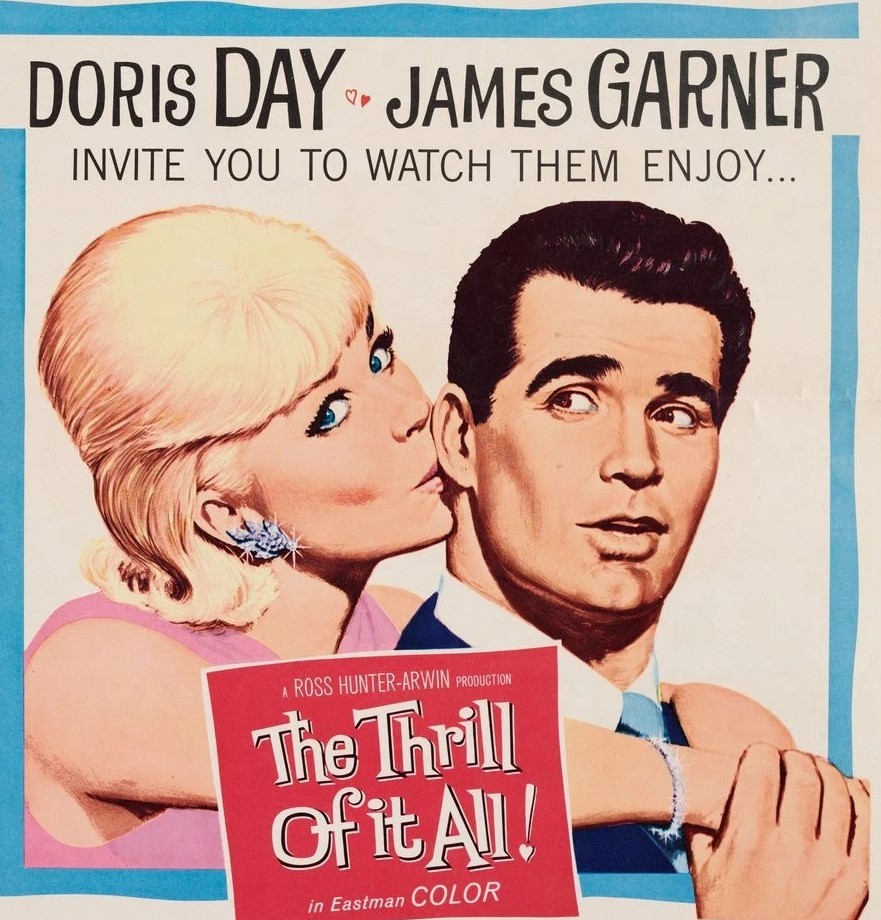
Has three unusual distinctions for a Doris Day comedy. First of all, it’s feminist. Secondly, it’s prophetic. Third, and perhaps most interesting of all, is that it plays exactly into expectations – for completely different reasons – for audiences sixty years apart. Only the ending would split the audiences.
And this is a somewhat mature Doris Day. Having shucked off Rock Hudson and Cary Grant, she was no longer stuck in a relatively mindless, however charming, love story following the usual formula of girl-meets-boy girl-loses-boy girl-gets-boy. Here she’s contented housewife Beverly Boyer married to successful obstetrician Dr Gerald Boyer (James Garner) with two kids apt to cause disruption but whose main purpose, equally unusually, is to make caustic comment about grown-up behavior. There is one magnificent outlandish set-piece involving soap powder but the slapstick is toned down and there’s a gentle satire of the television industry and advertising.
There’s only one downside to the marriage, her husband is being called out at all hours to deliver babies and that’s such a worthy calling what decent wife could complain about such absences even if it means spoiled dinners and missing events.
However, everything is turned upside down when by pure chance Beverly takes on the role of becoming the onscreen spokesperson for a brand of soap called Happy Soap. This being in the days of live television – so this is set strictly in the 1950s hence the more pronounced tone of a woman’s place being in the home – she has to do the advertisement live on air and her fumbling and inexperience touch a chord with audiences who respond with such vigor that she is offered a contract that puts her in the position of earning substantially more than her husband. How dare she?
Naturally, the demands placed upon her by the advertising company turns the domestic tables. She’s the one coming home late and he’s the one seen as her adjunct. The soap powder boss is so determined to keep her he fulfills every whim – even when such wishes are not made with any seriousness. So she wakes up one morning with a swimming pool in the back yard which virtually demands that a car drive straight into it.
The battle of the sexes comes down a battle of women’s rights (yes, they are mentioned) against men’s rights, in other words freedom vs toeing the line. Rather than delighted at her extra dough, he’s infuriated that she’s infringing on his perceived role as being the sole provider for the family.
Eventually, he decides the only way to bring her to her senses is to arouse her jealousy by being seen in the company of other women. But that only works up to a point. And she only gives in when she is made to realize – by the only narrative misstep as far as the contemporary audience is concerned – that his job is much more important than hers.
While this is the first of two pairings – the other being Move Over, Darling the same year – between Doris Day and James Garner (Hour of the Gun, 1967) is lacks the purer screen chemistry she found with Cary Grant and Rock Hudson and you feel the plot has been written to accommodate this deficit. There’s little requirement for intimacy or proper wooing, much less for the misunderstandings that fueled the previous pairings.
Doris Day’s haplessness is put to a different use, as it is initially the reason why she proves so appealing to television audiences.
Whether women in the 1960s had to keep to themselves their rooting for the career women in Beverly being given a chance to shine, or whether – the beginnings of the modern feminist movement dating from the publication of The Feminine Mystique by Betty Friedan published in 1963 – she was seen as a poster girl for the movement I’m not qualified to judge.
These days, however, Beverly would be viewed as an early champion of women’s rights and that, regardless of how important it was that a man tasked with delivering babies had a woman at home to make his dinner and mop his brow, his demands should not take priority.
While there aren’t as many outright laffs as in previous Doris Day comedies, the feminist angle provides the picture with an unusual worthiness, not something you’d go looking for in Day’s portfolio.
Directed by Norman Jewison (The Thomas Crown Affair, 1968) and written by Carl Reiner (The Art of Love, 1965).
Passage of time has made this more important than the material might suggest. Gets extra marks for serious intent.
Richard Burton was first choice. Sean Connery second. Jack Lemmon a distinct possibility. A suave Frenchman such as Jean-Paul Belmondo (Breathless, 1960) was briefly entertained. Brigitte Bardot a certainty for the female lead. Thoughts of entertaining Steve McQueen for the male lead were so far beyond left field as to have entered the outer limits. He played down’n’dirty working characters clad in nothing more sophisticated than denim. Faye Dunaway’s screen persona – violent slutty bitch – was the opposite of the character depicted.
Producer Walter Mirisch was well versed than most about McQueen, having hired him for The Magnificent Seven (1960) and The Great Escape (1963). But when Burton rejected the part, “we determined to try to interest Sean Connery in the role.” The Scottish actor was receptive to any movies that would instantly take him away from the typecasting of the James Bond series. Lunch at the Regency Hotel was followed by further conversation “for most of a Saturday afternoon.”
But to no avail. “We were crestfallen when we failed to convince Sean Connery,” who was, after all, the biggest star in the world, and looked immaculate in a suit.
Even Steve McQueen acknowledged he was an odd choice. He told a film school class in January 1967 that he was a “limited actor, I mean my range isn’t very great.” But after the possibility of crowning his acting career with Oscar glory for The Sand Pebbles (1966) had faded and with motor racing epic Day of the Champion in cold storage but with a six-picture with Warner brothers promising a hefty $700,000 per, he had the pick of projects.
Maybe too many came his way, over 100 in a few months. He took a meeting with Twentieth Century Fox over a proposal to star with Audrey Hepburn in Two for the Road (1967). He was mooted, along with Paul Newman, for In Cold Blood (1967) and was wooed by John Huston for The Kremlin Letter (not made till 1970).
Eventually, director Norman Jewison, who had worked with McQueen on The Cincinnati Kid (1965), another change to the actor’s screen persona, after much badgering, agreed to let him see the script. “Norman and I both felt that Steve was completely wrong to play Thomas Crown,” commented Mirisch, especially over the demand that “he should to wear a necktie on the screen.”
Although Jewison and McQueen shared the same agency, William Morris, the notion of the actor being tapped up for the role didn’t come from there. McQueen heard about it from a friend Steve Ferry who had seen the screenplay. Jewison came straight to the point when he took a telephone call from McQueen: “If it’s Thomas Crown, forget it. You’re not right. I love you and respect you as an actor. But I’ll never tell you lies. You can’t have the part.”
Jewison went further, listing the actor’s shortcomings, explaining McQueen was prone to “looking down at the ground or squinting up into the sun…What’s going to happen when you have to look people in the eye?” Only after three hours on the director’s back lawn did Jewison’s obstinacy relent. “The more he talked, the more I saw him as Thomas Crown. Now we had the problem of turning him physically into Thomas Crown.”
“He’s a rebel like me,” surmised McQueen, “Sure, a high society rebel, but my kinda cat.” Jewison kept telling him he “wasn’t right for it.” It was “unlike anything Steve had ever done” and casting him still seemed a risk. McQueen was aware of the damage miscasting could do to this career. “I don’t have any illusions on that score…If people laugh at me, my ass is gone.”
McQueen explained his enthusiasm for the role. “I had thought of changing my screen image for more than a year. I felt it was time to get past those tough upright types. When Norman showed me the Crown part I grabbed it.”
It was an odd movie from the beginning, not churned out by a seasoned professional. An experienced Hollywood type would never have considered writing a heist picture where the mastermind was a slick millionaire with a string of successful businesses behind him, who, rather than being a professional criminal, was drawn to crime from sheer boredom.
Alan R. Trustman was a legal eagle, partner at the law firm of Nutter, McClennen and Fish. “I had never written a line, except for law briefs. One Sunday afternoon I got bored watching TV and suddenly, for no apparent reason, I thought it would be fun to write a screen story…in two months The Crown Caper was done.” But it was nothing like the polished movie that ended up on screen. “It had a lot of dialogue, a lot of description and a lot of prose,” recalled Mirisch, and at thirty pages long was more of a treatment than a script. “But it had a great germ of an idea.”
Mirisch was an early advocate of Faye Dunaway, having seen her on stage in a play, Hogan’s Goat (1965), recognized her potential and “always had in mind that, one day, a role would come along.”
Mirisch had McQueen on some sort of a financial string. Their multiple-picture deal with him dated back to The Magnificent Seven (1960), at a time when he was a rising rather than established star. In the way of such pacts, initial remuneration was pretty low, rising with each successive picture, and relying on the actor having become, somehow, a success.
“His agent and manager made a big fuss about the nominal salary provided for in our second option. To settle the argument,” stated Mirisch, “I agreed to pay him the salary called for in the third option as well as to cancel that last option. I recognized that we really should be paying him more than the price stipulated in the option. Also I felt that trying to enforce the third option would be difficult if not impossible.”
If Walter Mirisch thought he was getting a bargain, it wasn’t much of one. McQueen still pulled in $650,000 plus $1,000 a week living expenses and a ton of perks – including it later transpired the dune buggy (worth about $50,000 at today’s prices), all the tailor-made suits, and the shoes and a swag-bag of props. The actor called on his Beverley Hills tailor Ron Postal to deck him out in $400 suits (over $3,500 now), had his hair transformed by celebrity stylist Jay Sebring (later murdered along with his girlfriend Sharon Tate by the Manson gang) and learned to play polo “until his hands literally bled.”
Dunaway, by contrast, with Bonnie and Clyde (1967) in the bank and wanted by every studio in town, was paid a larger salary (though McQueen made up for it by his profit share). Out of the $4.3 million budget around a third was spent on the salaries of the two principals.
Dunaway proved terrific casting for another reason. She was as tough, single-minded and independent as the character she played. She had an inner strength McQueen’s previous leading ladies and contemporary amours lacked. In person “she threw him off-balance” and she “did the same thing on camera” which provided the anchor of their relationship. She was far from the typical Hollywood “love interest.”
Mirisch’s pact with Jewison had proved wildly successful, among the best financial deals the company had ever achieved, the hot box office of The Russians Are Coming, The Russians Are Coming (1966) exceeded by In the Heat of the Night (1967). Jewison rehired many of the crew from his previous picture, including two budding directors, cinematographer Haskell Wexler (Medium Cool, 1969) and editor Hal Ashby (Shampoo, 1975).
Aside from the sensational screen charisma of the leading actors, the screenplay’s originality was enhanced by a huge step forward in the use of technology, the innovative split-screen process, executed by visual designer Pablo Ferro, who had devised the credit sequence for The Russians Are Coming, The Russians Are Coming.
Multiple image was used in three principal area – to introduce six characters and establish their relationship during the initial robbery, for the polo game, and in the final caper. The polo game employed “not only out-of-focus and soft effect panels but also at some point involved over fifty separate panels on the screen simultaneously,” said Jewison. For the second robbery “the amount of film used in relationship to the amount of screen time was probably in the ratio of four-to-one.”
In other words, not only was it incredibly stylish, but it vastly compressed screen time, reducing the running length by fifteen or twenty minutes, ensuring that the audiences concentrated on the evolving relationship between McQueen and Dunaway.
McQueen could ride, of course, what Hollywood star, with westerns in high demand, could not. “But he hated horses and he hated polo, but he wasn’t about to give up.” Thanks to his dedication, he proved a worthy competitor. Jewison only believed in McQueen once he witnessed him in action playing polo. “That’s when I realized how much he was giving for the film. Polo was symbolic of all the reasons why he wanted to play Thomas Crown.” The snobs at the club might sneer but they could not ignore “his sensational back hand.”
McQueen had never used the English saddle, a prerequisite for polo. He trained at the Myopia hunt club from morning till night until he mastered the art of riding using his knees not his arms (essential to be kept as free as possible to swing the mallet) as well as becoming such a “proficient player” he received a standing ovation from the members.
The F.B.I. refused to cooperate. Rejecting a request to film in its Boston office, the crime buster operation complained about what it perceived as “an outrageous portrayal of the Bureau” especially as the film ended with Thomas Crown outwitting the organization.
McQueen turned up for shooting as if he had swallowed the Method. “Call me Tommy,” he told the crew. But there was limited time to knock the character into shape, the actor having only signed up for a week of pre-production.
The twelve-week shoot was marred for McQueen by “some letters of a threatening nature that he had received.” That meant posting a security guard on his rented house to ensure the safety of his children. “It preyed on his mind a great deal during the shooting,” said Mirisch.
According to Jewison, McQueen’s security concerns evolved into paranoia, itself driven by his drug-taking. As well as a 24-hour security detail and surveillance on the front of his house, he demanded the same facility for the back of his house which between him and the Atlantic Ocean consisted only of a private beach. “Who the hell did he think was going to get in from there?” mused the director. Off-screen McQueen never exhibited his on-screen confidence. Jewison observed, “He was tortured.”
Filming was, as Jewison put it, best described as “bittersweet.” Producer Robert Relyea recalled “refereeing” a few incidents between actor and director. McQueen’s unease or the eternal power battle between director and actor resulted in one opportunity missed. For the dune buggy scene, said Jewison, “we had everything lined up for a scene on the beach at Magic Hour just as the sun was going down. Beautiful… conditions were perfect, everyone was ready except Thomas Crown Esq who was out in the surf in his dune buggy not answering his radio.”
Oddly enough, McQueen objected to the director speaking to him snippily when the actor returned and after that their relationship wasn’t the same, McQueen nibbling away at the director’s confidence, objecting to scenes or lines, until Jewison at one point ended up in tears. McQueen became a consummate actor, expressing emotion with the slightest lift of an eyebrow, or tightening a facial muscle, because “he couldn’t get his tongue around a lot of words.”
The producer was delighted to return to Boston, the movie’s main location, because he had attended college there a quarter of a century previously. Locations used included Old Copp’s Hill Cemetery, the Boston commons, the Little Italy outdoor markets, Anthony’s Pier 4 restaurant, and the sand dunes near Crane’s Beach and Provincetown. The St James Ballroom of the Jordan Marsh mansion provided the setting for the ballroom while the chess game was shot at the Goldwyn Studio. The initial bank robbery was filmed using hidden cameras at the National Shawmut Bank.
For the chess game “ we were hoping to get inspired moments that could give us more than dialog could.” Inspiration didn’t stop there, the fashionable outfits adorning Dunaway helped enormously and, of course, the movie hit pay dirt with the Oscar-winning theme song, “The Windmills of Your Mind” composed by Michel Legrand with lyrics by Marilyn and Alan Bergman, a huge success in the global singles charts.
The original title of The Crown Caper was changed for a time to Thomas Crown and Company before setting finally on The Thomas Crown Affair.
Although initially criticized as being primary style over substance, and now recognized as a work of inspired genius, one of the few times when everything falls into place on a movie, according to Mirisch, it was more “an exhibition of style…we hoped to dazzle the audience with the multiple panels and the chess game, the photography and the music.”
It proved a smash at the box office, rentals of $6.25 million in the U.S, nearly matched by $5 million abroad.
SOURCES: Walter Mirisch, I Thought We Were Making Movies, Not History (The University of Wisconsin Press, 2008) p265-270; Penina Spiegel, Steve McQueen, The Untold Story of the Bad Boy of Hollywood (Collins, 1968) p201-209; Christopher Sandford, McQueen, The Biography (HarperCollins Entertainment, 2002) p196-198, 202-206.
Employs Hitchcock’s trick of having you rooting for the bad guy. The caper picture remade. Steve McQueen (Nevada Smith, 1966) reinvented. Faye Dunaway (The Extraordinary Seaman, 1969) making the most stunning entrance this side of Ursula Andress in Dr No (1962). The technological dream of the split screen. Film noir filmed in bright sunshine with a femme fatale on the right side, only just, of the law.
Takes the insurance agent of Psycho (1960) and switches the gender. Nabs the Hitchcock crown (Notorious, 1942) for the longest screen kiss. Steals from Ingmar Bergman (The Seventh Seal, 1957) the title of best chess scene.
Female sleuth at a time when I don’t think the idea of a female detective crossed anyone’s minds in Hollywood. And one so sexy, stylish and uber-confident that she attracts not one sexist remark. Not dumb enough either like Lila in Psycho to walk into a trap.
And, incredibly, given wealth has been a movie trope since day one, luxuriates in a lifestyle – gliders, dune buggies, polo – never seen before. Not just a mesmerising song (“The Windmills of Your Mind”) but an absolutely outstanding score from Michel Legrand (Play Dirty, 1968). Almost works as a visual greatest hits collection, one memorable scene after another, a cat-and-mouse scenario, twists aplenty and smart, smart dialog.
Ignores back story and dark hidden secrets. Dispenses with the usual robbery cliches of planning the heist and the robbers irritating the hell out of each other. Theft here is carried out with mathematical precision, the crew members never meeting, mastermind Thomas Crown (Steve McQueen) hidden from view at initial interview behind a bank of blinding lights. But the investigation is clever, too, donkey work – tracking everyone who flew to Geneva (where the stolen cash is banked) – coupled with instinct, insurance agent Vicki (Faye Dunaway) choosing Crown as the most likely criminal from his photograph, and a piece of inspiration, offering a huge reward for anyone noticing their spouse had been in Boston on the day of the robbery and been behaving oddly.
Crown is a fabulous invention, savvy businessman, bursting with competitive instinct, unable to prevent himself crowing, his opening line – “you overpaid” – puncturing the triumph of businessmen who believed they bettered him in a deal. But he’s bored, riches and all the toys that brings including sexy girlfriend Gwen (Astrid Heeren) not enough, and he seeks to test himself against the law.
But he’s always testing himself, regardless of how high or how low the stakes. He’s the kind of guy who just bets for the thrill. The only reversal in the whole movie is a golf match where he employs the old sucker punch, double-or-quits routine, to be able to repeat an unexpectedly successful shot. When he loses spouts another brilliant line, “What else can we do on Sunday?”
But he’s up against as steely a competitor. Has any character ever delivered such an immortal line with such panache – “I’m immoral” – as Vicki who has no qualms about invading Crown’s house on a flimsy pretext or kidnapping the son of one of the gang. “You won that round,” she tells Crown after bringing gang member Erwin (Jack Weston) in for questioning and stationing him in the same room as Crown, hoping to elicit recognition.
You’d hardly be surprised to discover she’s more than capable of using her body as a weapon, but you’d be hard put to work out who is seducing who. For both, part of the attraction must be danger, being up close (and very personal) with your rival. It wouldn’t take much to imagine this is a reversal, that Vicki is being hunted, that in the throes of romance she will give away too much. Or that the arrogant Crown believes he can have his cake and eat it. He doesn’t need the money, he can give it back, avoid arrest and sail off into the sunset with a woman his match in style and intellect.
If there’s one flaw in the spellbinding narrative, it’s here. We all know insurance exists outside the law. Retrieving money for clients is the sole aim, justice not on the agenda. No bank chief executive wants to suffer the embarrassment of being hauled into a courtroom to explain just how fallible their security systems are. Hand back the money, bury the publicity and all’s well. I’m not entirely sure why Vicki had to seek the approval of detective Eddy (Paul Burke), leading the police side of the investigation, when she could as easily have bypassed him and picked up her ten per cent of the money as reward and sailed off into the sunset.
Unless, of course, it’s not a flaw. And that for Vicki, as resolute a competitor as Crown, she requires official recognition of victory and to prove her superiority over the criminal by allowing him to be set free, giving her if you like the upper hand in the relationship.
Director Norman Jewison was on a box office roll after turning conspiracy upside down with The Russians Are Coming, The Russians Are Coming (1966), and exploring racism with In the Heat of the Night (1967). Where most critics prefer directors who reveal thematic consistency, Jewison seemed to be headed every which way – although in the cat-and-mouse stakes you could look at The Cincinnati Kid (1965) – with elan his ace in the hole.
And if you ever sat in a movie theater and thought you could do better than the drivel you were watching, then screenwriter Alan R. Trustman would be your patron saint. A lawyer by profession, he wrote The Thomas Crown Affair in a couple of weeks and, hardly surprising, given its audacity, it found its way to an agent. He went on to write Bullitt (1969), Lady Ice (1973) – almost a remake of Thomas Crown – and The Next Man (1974) for Sean Connery.
The best fun crime movie since Hitchcock paired Cary Grant and Grace Kelly in To Catch a Thief (1955) and never bettered since.
Priceless. Effortless comedy from the same director, Norman Jewison, as Send Me No Flowers (1964) but minus the box office powerhouses of Doris Day and Rock Hudson and perhaps it’s their absence that makes this work so much better. Or perhaps you get more comedic leeway in Paris. Although the scripts were written by different people, I sense a directorial insistence that the supporting characters are believable, not just there to oil the plot.
The story here is fraud, penniless artist Paul (Dick Van Dyke) faking his own death to give his paintings the necessary burst of publicity to make them hot items. Except he doesn’t fake his death. He dives into the Seine to save a drowning girl Nikki (Elke Sommer) and his buddy Casey (James Garner), a wannabe writer for whom Paul is a meal ticket, and who you would have to say was instrumental in suggesting such a scam, assumes he has committed suicide.
Paul goes along with the scheme for as long as it takes art dealer Zorgus (Roger C. Carmel) to make a killing (no pun intended) from his paintings. Nikki ends up a housemaid at a risqué nightclub (though it being Paris what other kind is there) run by Madame Coco (Ethel Merman) where, coincidentally, heavily disguised, Paul hides out. Meanwhile, in the final piece of the complication jigsaw, Paul’s fiancée Laurie (Angie Dickinson), turns up. A bit like the lecherous friend in Send Me no Flowers, Casey knows how to make the most of the opportunity to give a potential widow a shoulder to cry on. “How can you make a play for this girl?” he asks his reflection, but she’s too gorgeous for qualms.
You can pretty much guess where it will go from here.
It works so well because none of the principals is permitted to milk their roles (though Van Dyke can’t resist making a meal out of a sneeze) and the supporting cast drive it along with selfish action. Dick Van Dyke (Divorce American Style, 1967) has none of his usual zaniness or limbs that refuse to obey orders. James Garner, though in part cloning his character from The Americanization of Emily (1964), plays it as drama. Elke Sommer (The Venetian Affair, 1966) is the best I’ve seen her, no longer the pouting sexpot but a girl-next-door from the suburbs fallen on hard times. Angie Dickinson (Jessica, 1962), further down the billing than I’d expect, has to play it for drama, almost the foil for Casey’s seductive tendencies.
There are some superb running gags. Paul is furious to find a red-headed woman in the bed of flat-mate Casey. But, sight gag number one, it belongs to a mannequin. The wig, sight gag number two, is used to disguise Paul. Casey gets ride of the mannequin by stuffing it into a furnace only it doesn’t fit so he has to saw off its legs and is discovered from above by a waiter, sight gag number three, who naturally thinks he is sawing a woman in half. (I always think the beauty of a good comedy is that you can see the gag coming and you still laugh.) That gag has even more miles to run.
The supporting cast, as I said, are all given just delicious lines. Paul and Nikki, soaking wet, are saved by a passing barge. Paul hangs out her clothes to dry. When the naked woman in the wheelhouse calls for her clothes, the barge skipper, enjoying the prurient scene, implores, “Don’t give her her clothes back.” And when, after a row, that allows her to leave the barge, the skipper whines, “I told you not to give her her clothes back.”
. “I don’t want you to think I came for the rent you owe,” says Casey’s landlord. “What did you come for,” asks Casey. “The rent you owe, but I didn’t want you to think it.” The landlord’s wife comforts the grieving Casey (at this point he thinks Paul is actually dead) with some chicken soup. Casey admits the suicide was his idea. The woman snatches back her soup.
Having put Nikki on a bus, Paul, handing over few coins, asks the driver to keep an eye on her. Comes the reply, “I would whether you pay me or not.”
Sure, Ethel Merman (There’s No Business Like Show Business, 1954) gets to sing. Audiences expected that. But that’s understandable. What a voice. When you wonder why Ann-Margret wasn’t given more opportunity to sing in proper musicals, this is the answer. She lacks the voice of an Ethel Merman, Julie Andrews or Barbra Streisand.
The sly screenplay was concocted by Richard Alan Simmons (Della, 1965), William Sackheim (First Blood, 1982) and Carl Reiner, who had written for both Dick Van Dyke (his eponymous television show) and James Garner (The Thrill of It All, 1963).
The stars play proper roles, not just one-note characters driven by plot. Doesn’t take much to work out where it’s going all right but that doesn’t lessen the enjoyment of the journey.
I always wondered why, after making his name in comedy, Norman Jewison was selected for more serious works like The Cincinnati Kid (1965) or In the Heat of the Night (1967), but when you see the care he takes with each character, far more than standard directors in the fun genre, how he carefully builds the narrative, you do tend to agree he’s wasted in comedy.
Doris Day (With Six You Get Eggroll, 1968) is such a whiz at physical comedy you wonder why it is ever rationed, as it appears to be here, limited to a fabulous sequence where her coat is caught in the door while collecting supplies from the milkman and a shorter one where she loses control of her golf cart. And until the relevant misunderstandings kick in, this slightly limps along on the tale of hypochondriac George (Rock Hudson) believing he has only a few weeks to live and determining to make provision for his wife Judy (Doris Day) once he is dead.
Unfortunately, he confesses to his neighbor Arnold (Tony Randall) who is overcome with grief, even writing an eulogy along the lines of “when they wanted a good sport in Heaven they called on George Kimble.” Into the misunderstanding mix are innocent Dr Morrissey (Edward Andrews), Bert (Clint Walker), Judy’s college sweetheart, and lecherous bachelor Winston (Hal March) who preys on women with marital issues.
The fun only really starts when Judy, on discovering George kissing a woman in a cloakroom, believes he is having an affair and discovers that he is being more of a hypochondriac than usual in assuming early mortality. And that’s when we come to Doris Day’s other priceless (rather under-rated ) asset – her range of expressions, not just the expected outrage at deception, but the look in her eye that tells you she is planning revenge.
Most of the supporting characters are well-drawn. Dr Morissey, endlessly envious of colleagues making a killing in one speciality or another, is the kind of man who has a ring of white atop his tanned face indicating where he has kept his hat on when out fishing in hot weather. The predatory Winston demonstrates his talents for picking up vulnerable women. The undertaker is ridiculously jolly. And Bert acts as if Judy made a big mistake in throwing him over. For that matter, Judy seems unable to resist his romantic arm around her shoulder.
It’s not until the complications mount up in that Rock Hudson (Seconds, 1966) comes into his own – an excellent scene sharing Tony Randall’s bed when kicked out by Judy during which his neighbor revises the eulogy downwards, and a cracker of a sequence where, taking his neighbor’s advice, he has to invent a lover in order to confess an affair to his wife in the hope of speedy forgiveness.
It’s all effortless fluff but you do wonder how well it would have worked in other hands. You often don’t appreciate the skill of actors at this kind of light-hearted comedy, creating highly believable characters and at the same time leaving themselves open to be ridiculed by the script. The narrative skips through three arcs. First we focus on the hypochondriac, then the “good sport” trying to ensure that his wife is so well looked after following his death that he buys his own burial plot and attempts to find her a second husband, and it’s only in the third act that the engineered complications kick in.
I was surprised to find Norman Jewison’s hand on this particular wheel, having associated him with more serious pictures like The Cincinnati Kid (1965) and In the Heat of the Night (1967) while even The Russians Are Coming, The Russians Are Coming (1966) fits more the category of satire. But comedy was very much his forte in his initial foray in Hollywood.
Of course, you could argue that the Rock Hudson-Doris Day cavalcade needed little steering, the two principals pretty capable of making the whole enterprise run smoothly, so I’m assuming the attention he paid to the supporting cast was where his effort was most noticeable. And, also, given this was based on a short-lived Broadway play, he does an excellent job of widening it out, so that it rarely feels stage-bound. Although maybe that credit should go to screenwriter Julius J. Epstein (Return from the Ashes, 1965) who adapted the play by Norman Barasch and Carroll Moore.
Nothing to exert you here, just sit back and enjoy the fun.
Although Billy Wilder had written a script based on The Life of Sherlock Holmes, he was not considered as its director. Mirisch was looking at a budget in the region of $2 million, which would rule out any big star. However, there were issues with the Conan Doyle Estate which was in the process of firing up other movies based on Sherlock Holmes, A Study in Terror (1965) being the most recent. That had been the brainchild of Henry Lester and perhaps to general astonishment these days Mirisch had agreed Lester would be allowed to make more Sherlock Holmes pictures as long as they remained very low-budget, on the assumption, presumably, that the marketplace would treat them as programmers rather than genuine competition.
However, Mirisch and UA retained the upper hand as regards the Conan Doyle Estate and “could cut him (Lester) off at such time as we have made definite plans to proceed.”
There was another proviso to the deal. The Estate would agree to forbid any further television productions unless Mirisch decided it wished to go down the small screen route itself. It was odd that Mirisch had eased Billy Wilder out of the frame given the mini-major had enjoyed considerable success with the director on Some Like it Hot (1959) and The Apartment (1960), a commercial partnership that would extend to The Fortune Cookie (1966).
Instead, Mirisch lined up British director Bryan Forbes who would be contracted to write a screenplay based on the Wilder idea. The sum offered – $10,000 – was considered too low, but it was intended as enticement, to bring Forbes into the frame as director. If Forbes refused to bite, “the only other name suggested and agreed upon was that of John Schlesinger.” Although David Lean was mooted, UA were not in favour. Mirisch didn’t want to risk paying for a screenplay before there was a director in position.
The offer of the Sherlock Holmes picture was seen as a sop to Forbes. At this meeting, Mirisch had canned The Egyptologists, a project which Forbes believed had been greenlit. And why would he not when he was being paid $100,000 for the screenplay. In bringing the project to an untimely close Mirisch hoped to limit its financial exposure to two-thirds of that fee. Should Forbes balk at Sherlock Holmes, he was to be offered The Mutiny of Madame Yes, whose initial budget was set at $1.5 million, plus half a million for star Shirley Maclaine. Another Eady Plan project, this was aimed to go before the cameras the following year. If Forbes declined, then Mirisch would try Norman Jewison with Clive Donner and Guy Hamilton counted as “additional possibilities.”
As for Billy Wilder he had much bigger fish to fry. He was seeking a budget of $7.5 million to adapt into a film the Franz Lehar play The Count of Luxembourg to pair Walter Matthau and Brigitte Bardot. Should Matthau pass, Wilder would try for Cary Grant (whose retirement had not yet been announced) or Rex Harrison. Both sides played negotiation hardball. UA currently in the hole for $21 million for The Greatest Story Ever Told (1965) and Mirisch, having pumped $13 million into the yet-to-be-release Hawaii (1966), didn’t want to commit to another unwieldy expensive project. So Mirisch insisted the project advance on a “step basis” allowing UA to reject the project after seeing the screenplay. Wilder countered by insisting that if it went into turnaround he, rather than the studio, would have the right to hawk it elsewhere (generally, studios tried to recover their costs if a movie was picked up by another studio). But Wilder was also in placatory mood and even if UA rejected this idea he was willing to work with the studio on a Julie Andrews project called My Sister and I.
However, UA and Mirisch were all show. “After Billy left the meeting,” read the minutes, “it was agreed we would not proceed with The Count of Luxembourg since we did not want to give Billy the right to take it elsewhere if United Artists did not agree to proceed.” Harold Mirisch was detailed to give Billy the bad news, but use a different excuse.
Mirisch was also on the brink of severing links with Blake Edwards. Negotiations for a new multiple-picture deal were to be terminated, which would mean the director would only earn his previous fee of $225,000 for What Did You Do in the War Daddy? It was also sayonara for Hollywood agent Irving Swifty Lazar, whose current deal was not working out to the studio’s satisfaction.
Other long-term deals with directors were under discussion. While its previous John Sturges movie, The Hallelujah Trail (1965), had flopped, UA was still keen on the Mirisches pursuing a long-term deal with the director, feeling that he was a “good picture-maker with the right project.” To that end, it was suggested Mirisch reactivate Tombstone’s Epitaph, but emphasising Stuges had to bring the cost down.
At this point nobody knew Norman Jewison was embarking on all almighty box office roll – The Russians Are Coming, The Russians Are Coming set to hit the screens, In the Heat of the Night at screenplay stage, so Mirisch was prescient in trying to put together a long-term deal with the director. Wind on Fire and Garden of Cucumbers were seen as tentpoles for a multi-picture deal. Mirisch had already agreed a $50,000 producer’s fee for Wind of Fire, payment of one-third of which was triggered for supervising the screenplay.
The meeting also gave the greenlight to Death, Where Is Thy Sting-A-Ling, a project that would be later mired in controversy with shooting ultimately abandoned. The go-ahead was given with the proviso the Mirisches secured the services of Gregory Peck or an actor of his stature. Budget, excepting Peck’s fee, was just over $3 million and it was another one hoping to take advantage of the Eady Plan.
This kind of production meeting was probably more typical than you would imagine, studios trying to keep talent sweet while not committing themselves to dodgy product. It’s perhaps salutary to note that of the projects under discussion, only a handful found their way onto cinema screens. Garden of Cucumbers (as Fitzwilly), How To Succeed in Business, having met budget restraints, and Tombstone’s Epitaph (as Hour of the Gun) with James Garner all surfaced in 1967 and Inspector Clouseau the following year. Neither of the Steve McQueen projects survived nor the pair proposed by Billy Wilder. High Citadel, Saddle and Ride, The Narrow Sea, The Great Japanese Train Robbery, and The Cruel Eagle failed to materialize. Billy Wilder eventually made The Private Life of Sherlock Holmes under the Mirisch auspices but not until 1970.
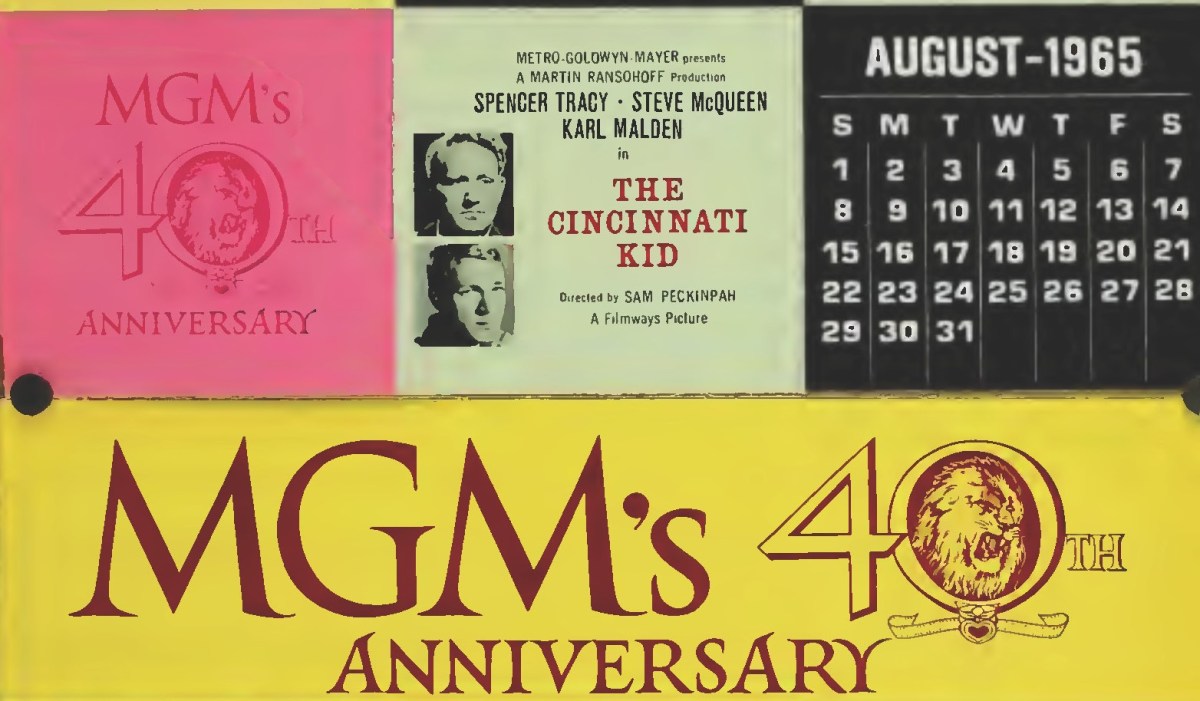
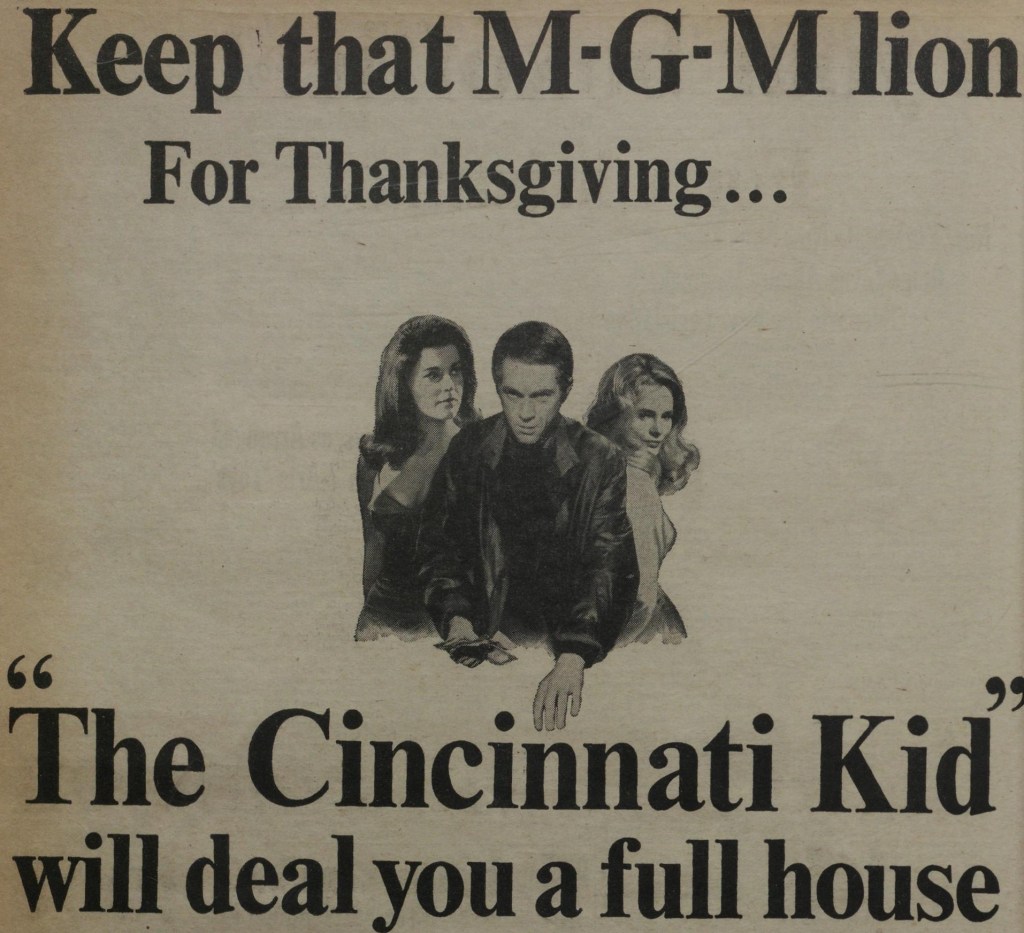
As you can see from the advertisement above, this was originally intended to be quite a different film, directed by Sam Peckinpah and starring Spencer Tracy in the role of ageing poker champ Lancey. The director had just come off one troubled shoot, Major Dundee (1965), and was seeking Hollywood redemption. Two-time Oscar winner Tracy was also hoping to revive his career. Except for what amounted to little more than a extended cameo on It’s A Mad, Mad,, Mad, Mad World (1963) he had not worked since Judgement at Nuremberg (1961). Also initially on board in a small role was Sharon Tate (Valley of the Dolls, 1967)
This was also a big gamble for industry outsider Martin Ransohoff who had moved to the forefront of independent production after The Americanization of Emily (1964) with Julie Andrews and James Garner and The Sandpiper (1965) starring current top-billed royalty Elizabeth Taylor and Richard Burton. He had wheeled and dealed with top studios – MGM, Columbia and United Artists – desperate for quality product. He was planning the biggest movie of his career having purchased the rights to the Alistair MacLean bestseller Ice Station Zebra. Ransohoff was a marketing innovator and long before Robert Evans pumped tens of thousands of Paramount dollars into advertising the book of Love Story (1970) to ensure it rode high on the bestseller charts and thus increased public awareness, Ransohoff had pulled off the same trick for Richard Jessup’s novel The Cincinnati Kid.
Tracy was first to quit, infuriated that he was denied script approval. Essentially, he wanted his role beefed up. But Ransohoff “would not expand his role in any way” and angered at the prospect of playing second fiddle to McQueen the actor walked out, to be replaced by a star with considerably less marquee appeal, Edward G. Robinson.
At least Tracy was able to depart with head held high. Peckinpah was ignominiously fired after shooting had begun. The intemperate director had already locked horns with the producer over a story which had now taken the efforts of four screenwriters – Oscar-winner Paddy Chayefsky (The Americanization of Emily), Oscar-winner Ring Lardner Jr. (Woman of the Year, 1943), Oscar nominee Terry Southern (Dr Strangelove, 1964) and newcomer Charles Eastman (Little Fauss and Big Halsy, 1970) – to knock the book into a workable screenplay without the extra bother of Peckinpah adding his own scenes.
Trade newspaper Variety reported: “Peckinpah’s problems stemmed from his filming of a nude scene that wasn’t in the script but which the director wrote on his own. Last Friday (November 4, 1964) he reportedly excused the featured cast and began to lense the nudie scene using an extra from the cast.” Whether this was indeed Sharon Tate, of whom Peckinpah was reported to have filmed in a flimsy shirt without a bra so that her nipples were showing, is unclear. And although there is an undertone of sex in the actual picture, as delivered by Ann-Margret, it was considerably more discreet.
Strangely enough, Ransohoff was no stranger to the benefits of nudity in his pictures and had fought a losing battle with the all-powerful MPAA, the industry ruling body in matters of censorship, to have nude scenes included in The Americanization of Emily. The nude statue of Elizabeth Taylor in The Sandpiper was permitted, however, and Ransohoff sent hundreds of miniature statues out to influencers as a gift.
Peckinpah did not have final cut so Ransohoff could easily have excised any nude scenes from the finished movie. What was considerably more alarming was that Peckinpah was shooting in black-and-white. Later, Ransohoff would contend that he was outraged by this notion but he surely must have signed off on it at the outset. Whatever the reasons, and some believed fisticuffs were involved, Peckinpah was sacked, leaving a $750,000 hole in the budget.
Production closed for over a month while Ransohoff scrambled for a new director. McQueen was pay-or-play, so if the film was cancelled, the actor was due his entire fee. McQueen had signed on for a fee of $200,000 – or $350,000 depending on who you believe – and $30,000 a week in overtime plus 25 per cent of the profit and a host of extras. McQueen had been initially lined up for a Ranoshoff remake of Boys Town to co-star James Garner, but that proved little more than a publicity flyer.
Replacement Norman Jewison had no reputation for hard-line drama – more at home with light comedy such as Send Me No Flowers (1964) – but was available and more likely to toe the Ransohoff line. However, initially he demurred. It was against the rules of the Directors Guild to step in in such a manner and Jewison required reassurance that Peckinpah was indeed out of the picture, and the film had been shut down, before accepting the job. Theoretically, Jewison received more control of the final cut than Peckinpah. His contract called for him to be in sole charge of the completed picture until after the third public preview. If it wasn’t working by that point, Ransohoff had the right to take over. Jewison exerted control in other ways, denying actors a chance to look at the rushes
Theoretically, McQueen had conceded top billing to Spencer Tracy, but that was not reflected in the artwork MGM put out – the illustration at the top of the Blog appeared in the trade press prior to production. To keep McQueen sweet during the layoff, Ransohoff handed him $25,000 to play the tables in Vegas. Edward G. Robinson had the same worries as Spencer Tracy, fearing his part would be cut to build up the star. In reality, McQueen welcomed going head-to-head with an older star, a situation he had not experienced since The Magnificent Seven (1960) with Yul Brynner.
But if the male stars, under the confident direction of Jewison, gave no trouble, that was not the case with the female contingent. Tuesday Weld came with a heap of personal issues related to becoming, as a child model, the family breadwinner at an early age – nervous breakdown at nine, alcoholic at ten, suicide attempt at twelve. She had never quite achieved stardom, in part as a result of turning down roles like Lolita (1962)
Ann-Margret was the opposite. She could earn nearly as much as McQueen – her fee at some studios was $250,000. However, Twentieth Century Fox was holding her to an earlier four-picture deal which paid a miserly $25,000 per movie, forcing her to lose out on a $150,000 payday in Europe for The 10th Victim (1965) with Marcello Mastroianni – known at the time as The Seventh Victim, Ursula Andress her replacement – in order to take up a contracted role in the remake of Stagecoach (1966). Her over-sexed screen persona had caused playwright William Inge to remove his name from Bus Riley’s Back in Town (1965).
One of the hottest young stars in the business, she intended to stay that way, and her portrayal of Melba in The Cincinnati Kid pretty much fitted in with audience expectation. She was in such demand that she was under contract to make a total of 17 pictures for five separate studios plus Frank Sinatra’s independent production company. Her deals were with Universal (six pictures), Fox (four), MGM (three), Columbia (three) and United Artists (one). But after dropping out of Marriage on the Rocks (1965) with Sinatra her output for the rest of the decade comprised one movie apiece for Paramount, MGM, Fox and Columbia and four independent pictures in Italy.
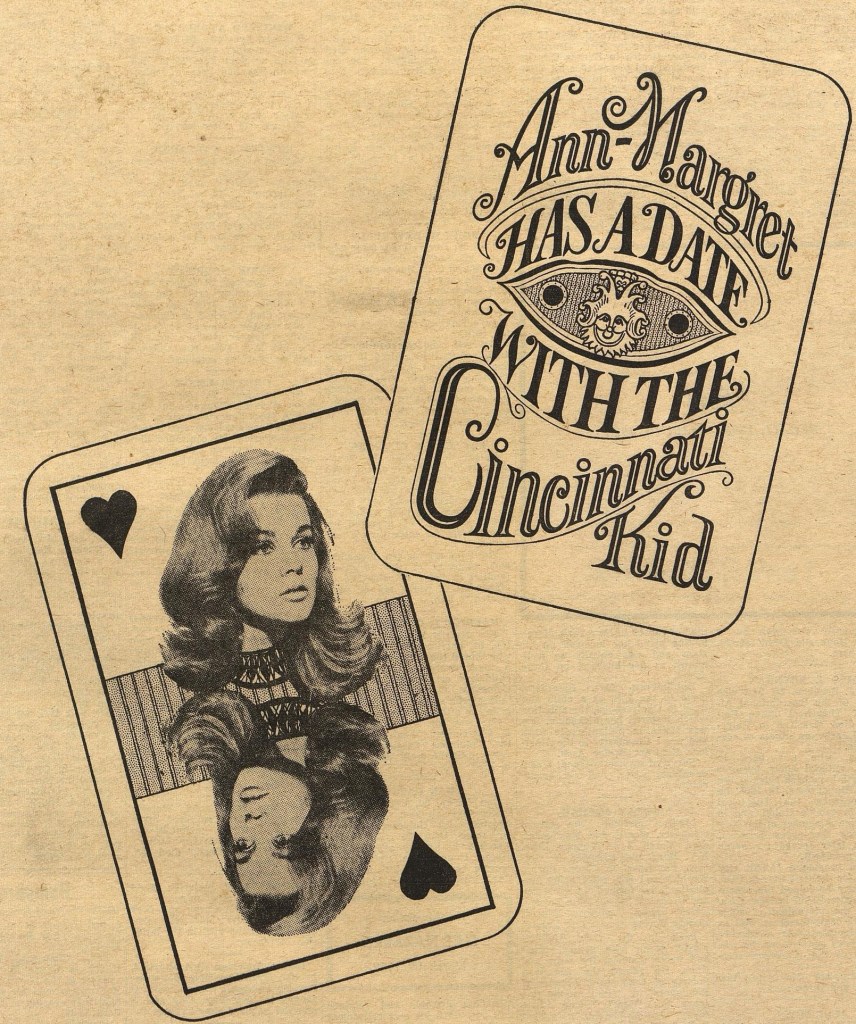
MGM spent big bucks promoting the picture and, in particular, the Ann-Margret connection. The studio had put a marker down on Thanksgiving 1965 for the launch date, but was marketing the movie more than six months ahead, the kind of exposure that was normally only allotted to roadshow features.
SOURCES: Christopher Sandford, McQueen: The Biography, Harper Collins paperback (2002) pages 165, 170-176; Penina Spiegel, Steve McQueen: The Untold Story of a Bad Boy in Hollywood, Collins, 1986, p162, 169-173; “Ransohoff To Start Five Films in 6-Month Period,” Box Office, June 17, 1963, p27; “Marty Ransohoff To Seek Code Changes,” Box Office, November 25, 1963, p6; “Ann-Margret Into The Cash Splash,” Variety, July 22, 1964, p5; advert, Box Office, October 9, 1964, p9; “More Cincinnati Kid Books,” Box Office, October 24, 1964, pW-5; “Refuse Spencer Tracy Xincy Kid Script Okay So Actor Takes Powder,” Variety, November 11, 1964, p24; “Jewison Replacement for Sam Peckinpah,” Variety, December 9, 1964, p24; Advert, Variety, March 10, 1965, p80; “Fear Ann-Margret Going Wrongo In Her Screen Image,” Variety, March 24, 1965, p5; “Fox Holds Ann-Margret To Stagecoach, Denying Her For Mastroianni,” Variety, April 14, 1965, 4; Advert, Variety, May 19, 1965, p20.
Steve McQueen had little trouble identifying with this role. He was the Hollywood contender, trying to knock current kingpin Paul Newman off his perch, and in Norman Jewison’s tense, often heart-stopping, drama he has the ideal vehicle. For the most part this is a winner-take-all face-off, as much a showdown as any western shootout, in darkened rooms under the harsh light of a New Orleans poker table between a rising star always referred to as The Kid (Steve McQueen) and the unofficial world champion, the urbane cigar-smoking Lancey Howard (Edward G. Robinson).
Broadened out in the initial stages to include scenic diversions – the Mississippi at dawn, a cockfight, some jazz – plus romance and intrigue, this is essentially pure sport, a game of stares, where bluff holds the ace and women exist on the perimeter only to fill in the time before the next hyped-up encounter. There’s no trophy to be won, not even glory, just the right to call yourself “The Man.” The Kid feels the pressure of punching above his weight, Lancey of getting old.
Farmer’s daughter and arty-wannabe Christian (Tuesday Weld) is the Kid’s main squeeze until she gets between him and his game. When she takes off, he makes do with Melba (Ann-Margret), girlfriend of dealer Shooter (Karl Malden) who was somewhat preoccupied with giving the Kid more than a helping hand to satisfy the vengeful Slade (Rip Torn), a rich businessman.
Although it finally comes down to a confrontation between the Kid and Lancey, subordinate characters like sweating poker player Pig (Jack Weston) and stand-in dealer Ladyfingers (Joan Blondell) help dissipate the tension. But in fact anything that occurs only seems to increase the tension as it comes down to the one big final hand.
This is McQueen (The Magnificent Seven, 1960) in transition, from the loner in The Great Escape (1963) to an actor exuding charisma and on top of his acting game. While on the face of it little more than a sporting lug, the Kid is an appealing character, engaging with a little shoeshine boy, winning over Christian’s truculent parents with what appears a card trick but is actually a demonstration of the phenomenal memory necessary to excel in his chosen field. There’s a winsome child in there among the macho persona. The poker face that McQueen developed would become one of his acting traits over the years.
Edward G. Robinson (Seven Thieves, 1960) gives a rounded performance as the reigning poker champ accepting emotional loss as the price for all his financial gains. Tuesday Weld is an appealing waif. Karl Malden (Pollyanna, 1960) essays another tormented soul and Rip Torn (Judas in King of Kings, 1961) a sleazy one. Also look out for a host of great character actors including Jack Weston (Mirage, 1965), Oscar nominee Joan Blondell (Advance to the Rear, 1964) and Jeff Corey (Once a Thief, 1965) plus composer and bandleader Cab Calloway.
Ann-Margret, all eye-shadow and cleavage, is in her best man-eater form. But, thankfully, there is more to her character than that. It is unclear whether she simply latches on to a potential winner or is pimped out by Shooter, but just hooking up with that older man (i.e. Shooter) makes her interesting, since looks are far from his attraction. Her ruthlessness is spelled out in simple fashion. She is determined to win, cheating at solitaire and she slams the wrong pieces into a jigsaw just for the satisfaction of making it look complete. You can sense a depth in this character which the film does not have time to fully explore.
Although often compared to The Hustler (1962), and in many eyes considered both its inferior and a crude rip-off, this is in some respects a greater achievement. At least in The Hustler, there actually was action, players moving around a pool table, clacking balls racing across the surface. Poker is all about stillness. Any gesture could give away your thoughts. Unlike any other sport, poker requires silence. There is no roaring crowd, just people dotted round the room, some with vested interest if only through a wager, some wanting to say they were there when a champion was toppled.
So the ability to maintain audience interest with two guys just staring at each other, interspersed with minimal dialog, takes some skill. Building that to a crescendo of sheer tension is incredible.
The first four pictures of Canadian director Norman Jewison (Send Me No Flowers, 1964) did not hint at the dramatic chops, confidence, composure and understanding of pacing required, especially as he was a last-minute replacement for Sam Peckinpah, to pull this off. That he does so with style demonstrated a keen and versatile talent that would come to the boil in his next three films: The Russians Are Coming, The Russians Are Coming (1966), In the Heat of the Night (1967) and The Thomas Crown Affair (1968).
The former blacklisted Ring Lardner Jr. (Tracy-Hepburn comedy Woman of the Year, 1942) was credited with his first screenplay since The Forbidden Street in 1949 and he shared the chore with another iconic figure, Terry Southern (Dr Strangelove, 1964), basing their work on the original novel by Richard Jessup. Not sure who contributed the classic line: “Read ’em and weep.” Mention should be made of a terrific score by Lao Schifrin.




 The Magnificent 60s