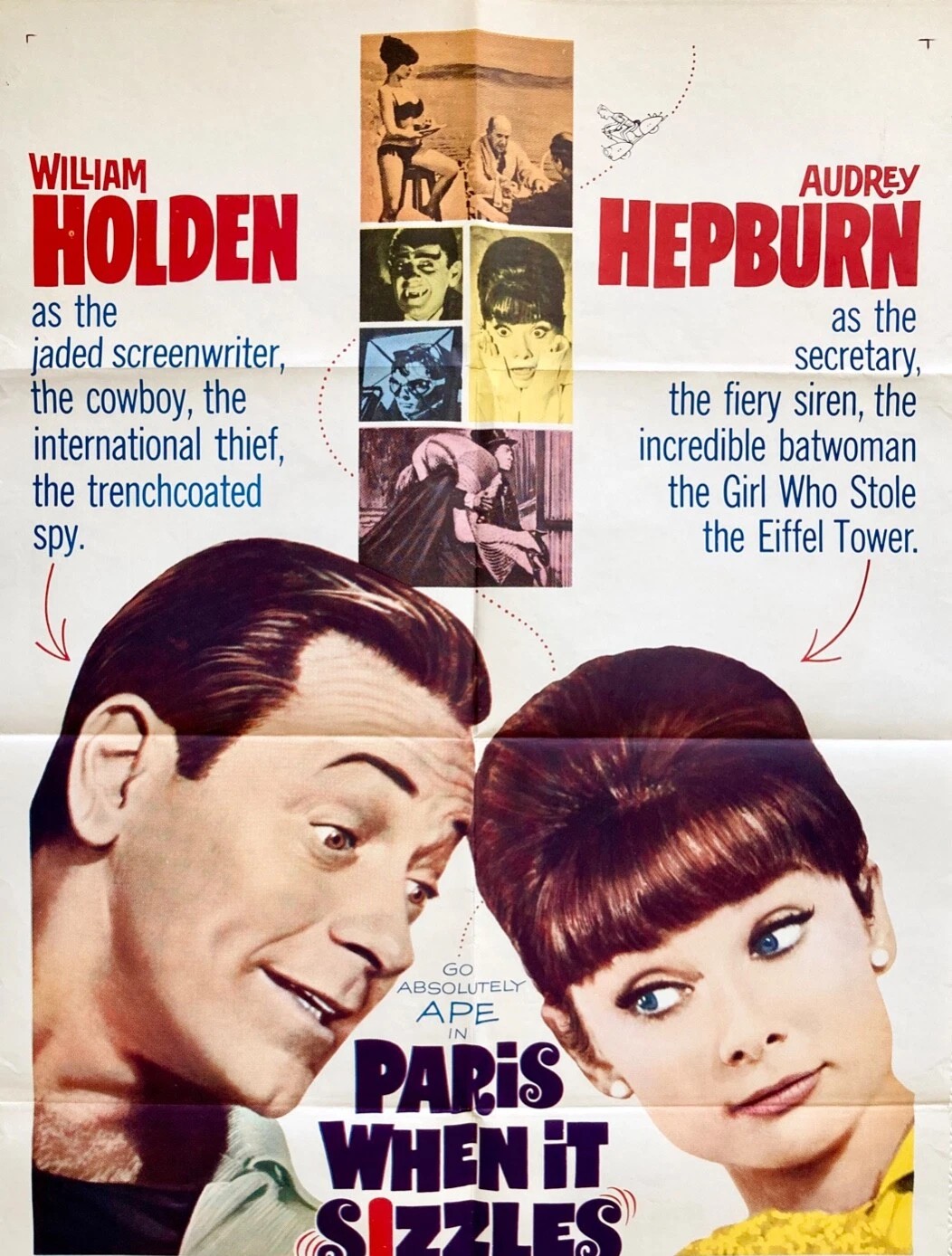
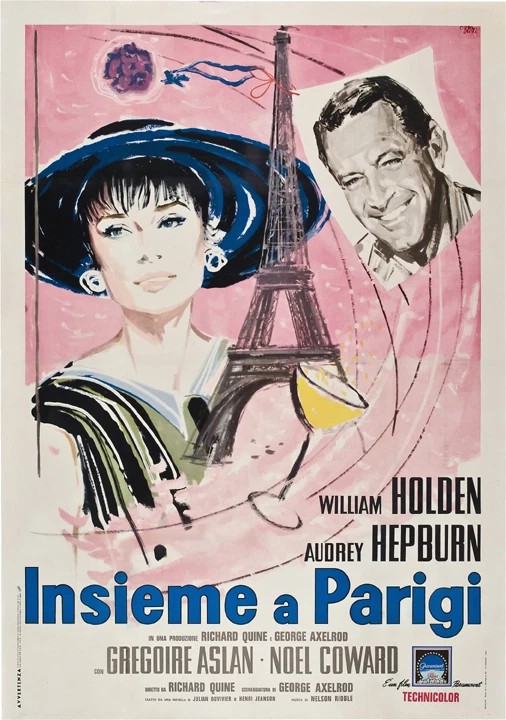
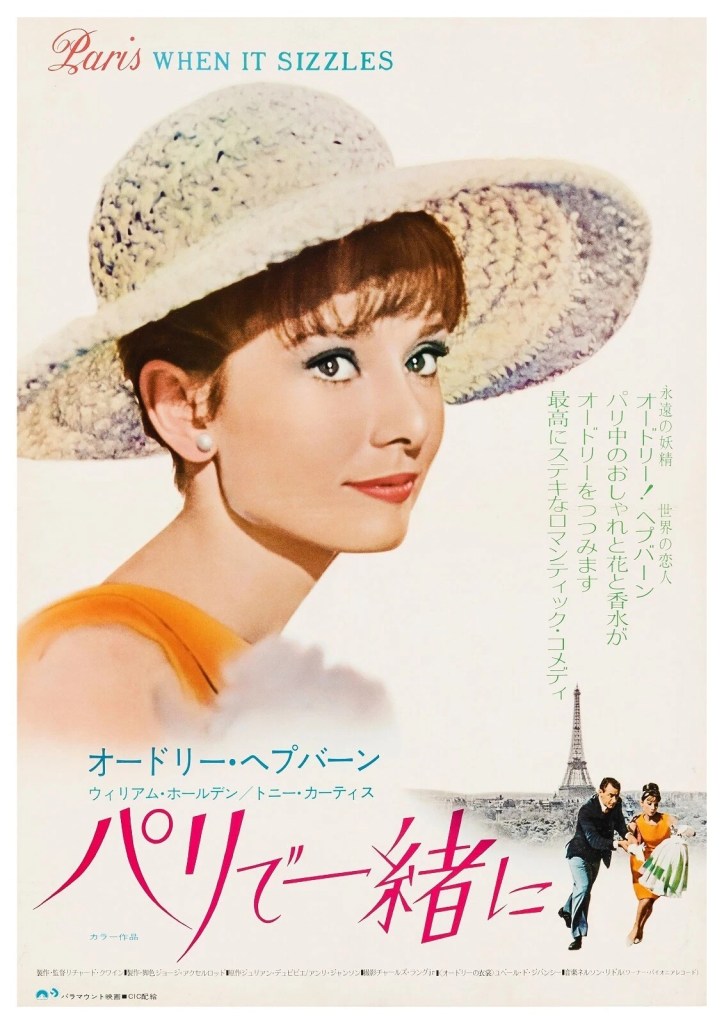
Screen charisma can only get you so far. The pairing of William Holden and Audrey Hepburn must have seemed certain to create a box office tsunami given they had worked together before on the hit Sabrina (1954) and were coming off hits, the former in The World of Suzie Wong (1960) and the latter having reinvented herself as a ditzy fashion icon in Breakfast at Tiffanys (1961). But clearly studio Paramount knew something about the outcome of this production that it was keeping to itself, otherwise how to explain that a movie completed in 1962 languished on the shelves for nearly 18 months.
By the time it appeared Hepburn was still a big box office noise after Hitchcockian thriller Charade (1963) but Holden’s flame was dying out following three successive flops, The Devil Never Sleeps, The Counterfeit Traitor and The Lion all released in 1962. Had the studio played an even longer waiting game and held off release until the end of 1964 when Hepburn was enjoying sensational success with My Fair Lady, audiences might have been more likely to be suckered in to this romantic comedy. Although whether they’d be any more appreciative is doubtful.
Problem is, the narrative hardly exists. And what remains is too clever by half. It might have appealed as an insight into how Hollywood works, but it lacks backbone and is more of a series of spoofs as we wait inevitably for the two stars to fall in love.
Alcoholic Richard Benson (William Holden) has writer’s block and having frittered away his time drinking, traveling and romancing, now has two days to deliver a screenplay for producer Meyerheim (Noel Coward) – who incidentally seems to spend his time in the sunshine drinking and surrounded by beautiful women. Benson hires typist Gabrielle (Audrey Hepburn) both to speed up the process and have someone to bounce ideas off.
Primarily a two-hander and virtually contained on a single set, his swanky apartment in Paris, it only ventures out to assist his imagination by playing out various concepts in which the pair act out various scenes in what turns into a relatively ham-fisted satire of the movie business. The only really interesting Hollywood expose is when Benson explains the tricks of the screenwriting trade, the various reversals (they were called “switches” in those days) and conflicts to keep the audience on their toes and prevent the potential lovers getting to the actual loving stage too quickly.
So we watch Gabrielle initially fending off his moves before becoming entranced and ridding herself of a carapace of dustiness before transforming into a flighty fun lass. But when the dialog often centers on arguments over the meanings of words there’s not a great deal for the audience to get its teeth into.
The concept, such as it is, allows Richard and Gabrielle to act out various scenarios, rattling through the genres – spies, musical, the jungle, horror, whodunit and western – while they manage to find a way to turn his title The Girl Who Stole the Eiffel Tower into a movie.
Even though the last thing this needs is further levity – any more froth and it would disintegrate – Tony Curtis (The Boston Strangler, 1968) has a recurrent role in a variety of cameos and you can spot an uncredited Marlene Dietrich (Judgement at Nuremberg, 1961) and Mel Ferrer (Brannigan, 1975). Perhaps the most unusual angle was that it was a remake of the French La Fete a Henriette (1952) directed by Julien Duvivier. Or that it was the first screen credit for Givenchy, who devised Hepburn’s clothes.
While both Holden and Hepburn are very easy on the eye, the actor often topless, and Hepburn going through the fashions, it only works if you want to see screen chemistry at work and are not remotely interested in narrative or if you are so unaware – and of course genuinely interested – in the screenwriter’s craft that you are find out how words on paper are translated into images on the screen. It might well be an audience’s first encounter with such gems as “Exterior:Day.”
Oddly, both Holden and Hepburn are good and it’s solidly directed by Richard Quine (The World of Suzie Wong) from a script by George Axelrod (Breakfast at Tiffany’s) adapting the previous film.
A harmless trifle, you might say, but just too bad that with the talents involved it doesn’t even rise to a soufflé.
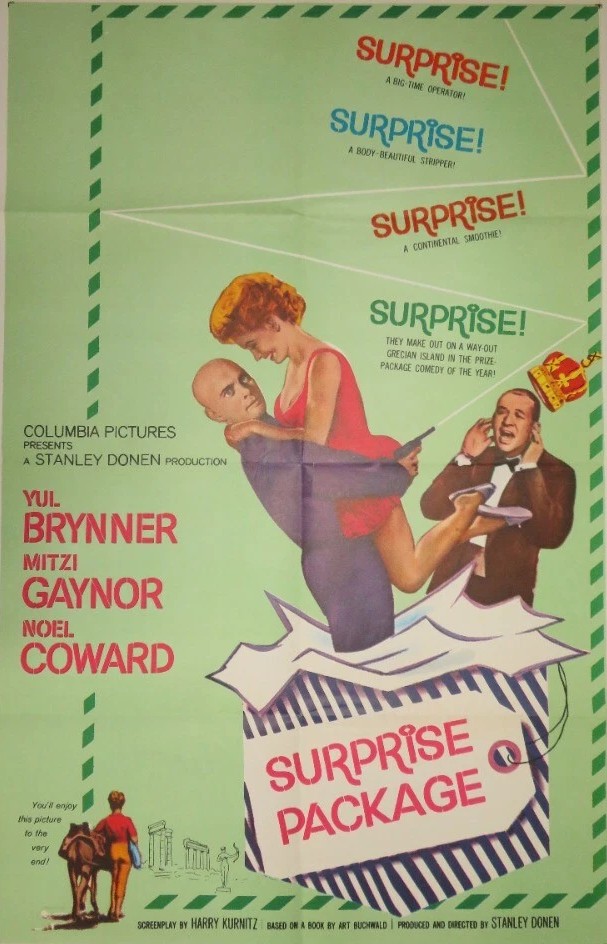
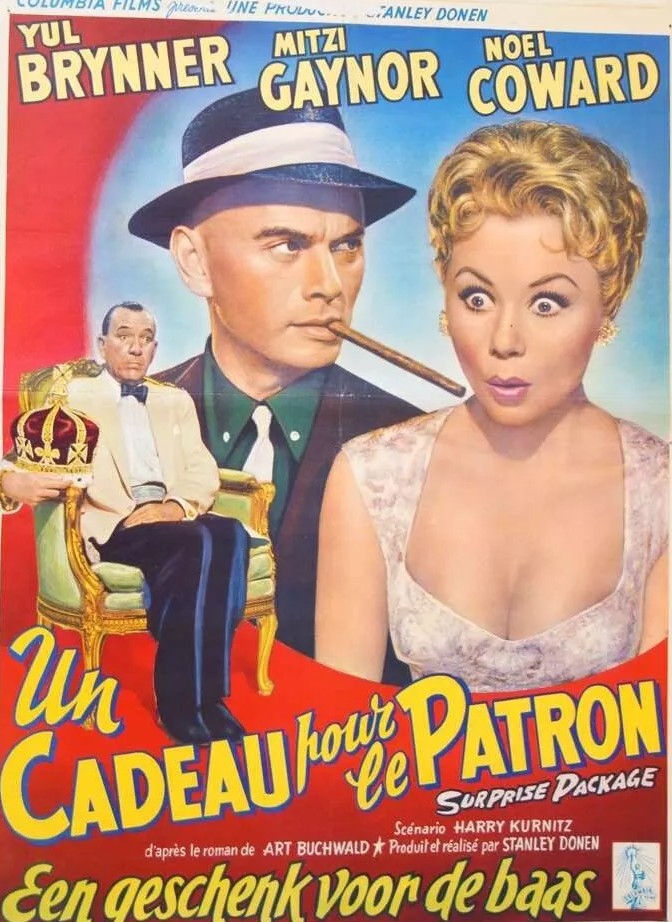
Poses two questions. Is this every bit as bad as Once More with Feeling, Stanley Donen’s previous picture? Yep, sorry, it’s every bit as wretched. The second question is: how on earth did Donen go from this mess to sublime romantic thriller Charade three years later? Well, the answer might simply be in the casting. Yul Brynner is no Cary Grant. And in this movie he’s not even Yul Brynner.
My guess is he’s meant to be a humorous twist on the Brynner screen persona. But playing a gangster with a thick Noo Yoik accent was always the preserve of the dumb supporting actor not the star. And since Yul Brynner isn’t any more convincing in this than in Once More with Feeling the project is in trouble from the start.
We’re given too much of this faux gangster drivel at the start when mob kingpin Nico (Yul Brynner) is collecting tributes from his underlings. Then, for no particular reason, he is deported, sent back into exile to his homeland of Greece. There he encounters the only smart guy in the picture, the corrupt chief of police Stefan (Eric Pohlmann) who’s so astute in the bribery department that all Nico receives in return for his thousand dollar bribe is to be told he won’t be arrested for bribery.
Stefan sets up Nico to meet another exile, deposed King Pavel II (Noel Coward), whose accent makes no sense either unless he was exclusively raised in high class British society, schooled at Eton, a member of upper class clubs etc etc, otherwise how to explain the plummy tones unless this is also meant to be as over-the-top gag as Nico’s Noo Yoik accent. Nico plans to buy the king’s crown for a million bucks. But the boys back home stiff him and instead of the cash send him instead his girlfriend – the surprise package of the title – mob moll Gabby (Mitzi Gaynor), and the ongoing gag here is that, what with Nico trying to elevate himself in society, Gabby’s table manners and speech let him down.
So with no cash forthcoming, what’s a gangster to do to pad out his exile? So Nico decides to steal the crown. And if there had been either a hint of the classic heist a la Grand Slam (1960) or Topkapi (1964) or its alternative, the totally inept thief, then we might have been onto something. But instead we’ve got much what we might expect from such a poor piece – not much. And in any case, the laffs are meant to come from another party, representing the king’s citizens, and led by Dr Panzer (George Coulouris) who wants the crown restored to its proper home. Two crooks chasing the same prize? What a crazy idea. But this works as well as the rest of the picture.
Thanks to Gabby’s principles, the crown goes in neither’s pockets. To make a buck, Nico and the king transform the latter’s villa into a casino with Gabby, now Mrs Nico, employed as the hat check girl.
Stanely Donen made three pictures in 1960 and then not another man for three years, which suggested he was a) working on too many projects at once and b) that break sure refreshed his cinematic skills. Just like Once More with Feeling he gets wrong virtually most of the directorial decisions, beginning with the accents and ending up with the storyline and characters you don’t care a button for, which wouldn’t have mattered if they could generate a laugh.
Yul Brynner followed this up with his iconic performance in The Magnificent Seven (1960) so perhaps he can be excused. This pretty much killed off the career of Mitzi Gaynor (South Pacific, 1958) – it was another three years till she appeared on screen again, and that was her final picture. It took Noel Coward (Bunny Lake Is Missing, 1965) four years to get another screen role.
Written by Harry Kurnitz (Once More with Feeling) from the Art Buchwald novel so I am assuming this was greenlit before the results of the previous Donen-Brynner teaming were known.
A genuine all-star cast goes off-piste in what used to be called – and maybe still is – a comedy of manners. A chance encounters at the stately home owned by Victor (Cary Grant), an Earl who makes ends meet by opening up his home to tourists, sees his wife Lady Hilary (Deborah Kerr), who helps make ends meet by selling home-grown mushrooms, fall in love with American oil millionaire Charles (Robert Mitchum).
Victor is far too English and posh to go off in the deep end and after considering allowing her to indulge in an affair until she gets bored, comes up with a strategy to ensure it’s her lover who is shooed away. Hilary’s best friend, the glamorous and often barmy Hattie (Jean Simmons), all Dior outfits and full-on make-up, meanwhile, steps in to attempt to rekindle her romance with former lover Charles.
Needless to say, this scene does not exist in the film.
While it’s peppered with epigrams and clever lines and several twists, what’s most memorable is the acting, the initial scene between Charles and Hilary a masterpiece of nuance, what’s shown in the face opposite to what they say. And there’s another peach of a scene where the most important element is what’s conveyed by a sigh. And by Robert Mitchum of all people, an actor not known for nuance.
But it’s let down by the staginess – it was based on a hit play – the very dated by now notion of showing the comic differences between British and Americans and the pacing. The theatrical element, thankfully, doesn’t resort to farce but with a whole bunch of entrances at unexpected moments you occasionally feel it’s heading in that direction. There are minor attempts to open up the play, a scene in the river, some location work in London and upmarket tourist haunts, but mostly it’s a picture that takes place on a couple of sets.
The British vs American trope just becomes tiresome after a while except that essentially the two men trade cultures, Victor exhibiting the kind of ruthlessness you might expect (in the old cliched fashion) from an American while Charles displays the kind of subtlety you would more likely find in an Englishman.
The pacing’s the biggest problem. The actors deliver lines at such speed that no time is allowed for the audience to laugh. The three British characters are almost manic in their urgency, while the Yank so laid-back he might belong to a different century.
Late on, a couple of subplots brighten up proceedings, a joke played on Hilary by Victor over the contents of a suitcase that she has devised an elaborate cover story to explain, and a betrayal of Hilary by her friend. Devilishly clever though it is, the duel scene almost belongs to a different picture. There’s also an amusing butler Sellers (Moray Watson), a wannabe writer, who believes, as is obvious, he is being under-employed, and pops up when the movie requires straightforward comic relief.
It starts off, via the Maurice Binder (Goldfinger, 1964) credits with babies, occasionally in the buff, unspooling film and indulging in other humorous activities. The only characters established before the plot kicks in are the Earl and the butler, Victor shown as tight-fisted, literally counting the pennies (although, literally, these are actually half-crowns, the price of admission to the stately home), the efficient Sellers revealed as otherwise baffled by life. The joke of a wealthy couple forced to rely on the income from visitors was not even much of a joke by then.
Perhaps what’s most interesting is that this movie essentially about immorality failed to click with U.S. audiences while an equally immoral picture The Apartment (1960) did superb business, the difference less relating to star quality than directorial ability, Billy Wilder’s work always having a greater edge than the confections of Stanley Donen.
It’s the supporting cast – if stars can be so termed – who steal the show. Robert Mitchum (Man in the Middle/The Winston Affair, 1964) is just marvelous, one of his best acting jobs, relying far more on expression to carry a scene. He delivers a masterclass in how little an actor needs to do. Jean Simmons (Rough Night in Jericho, 1967) is also excellent for the opposite reason, an over-the-top mad-as-a-hatter conniving ex-lover with an eye on the main chance. That’s not to say Cary Grant (Walk, Don’t Run, 1966) and Deborah Kerr (The Arrangement, 1969) are not good, just overshadowed, and Kerr’s first scene with Mitchum, where she, too, realizes she is falling instantly in love is remarkably underplayed.
Stanley Donen (Arabesque, 1966) should have done more, pre-filming, to tighten up the script and expand the production. Hugh Williams and Margaret Vyner adapted their own play. It’s entertaining enough but I was more taken by the acting than the picture.
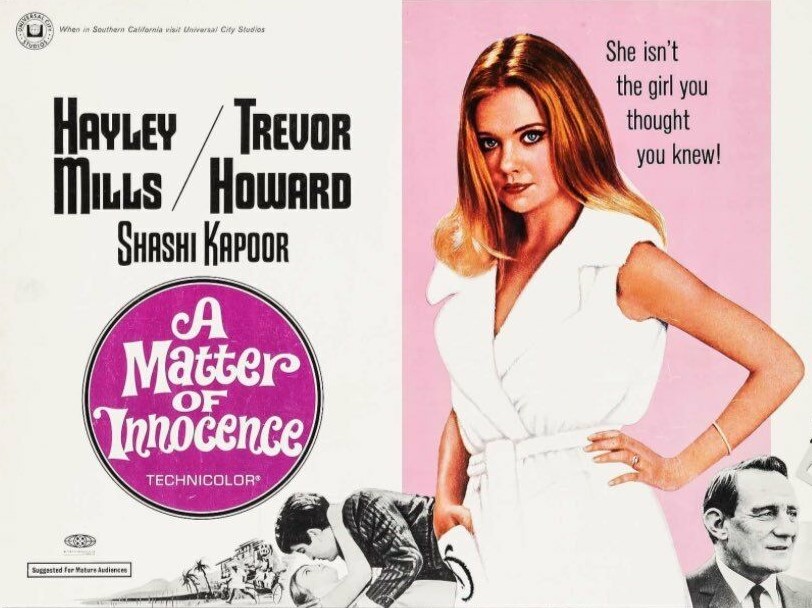
Dramatically undernourished coming-of-age tale over-reliant on “authentic” travelogue and continuing the transformation of Hayley Mills from child to adult star, although that change had been clearly wrought by her previous outing in The Family Way (1966) which had contained her first nude scene. While there’s definitely way more sex here it’s all off-screen.
In Singapore, family black sheep Robert (Trevor Howard) tries to stifle romance blossoming between his ugly duckling niece Polly (Hayley Mill) and local king of the fixers Amaz (Shashi Kapoor), to quote from list of the clichés the screenplay happily summons up. Polly is the bespectacled, dowdy, shy travelling companion to snippy aunt (Brenda de Banzie) – Robert’s sister not wife – who resides in a magnificent suite in Raffles Hotel, consigning her niece to a hovel of a room. When said aunt drops dead in the swimming pool, Polly, wasting no time on mourning, is free to turn butterfly, channeling her inner Brigitte Bardot with bouffant hairstyle and tight red dress.
The genial Amaz is on hand as a guide, in sexual matters as well as tourist, until huffing-and-puffing plantation manager Robert threatens to intervene and smarmy American Critch (Peter Bayliss) attempts to sweep her off her feet. And that’s about it, plot-wise. The meandering story provides insights into different aspects of local culture – Whicker’s World was the only globe-trotting television series available at the time so all this would probably have entranced moviegoers rather than, as now, bored them to death.
Perhaps what’s most interesting is what’s left unsaid or never dwelt upon, of the posh English girl having sex with a native of Singapore. In previous movies – Bhowani Junction et al – miscegenation would have been the sole plot point with Brits up in arms at the suggestion of it. Here, the only objection to Amaz is that he’s a bit of a Casanova, practised seducer in the main of older women. While Amaz falls in love, Polly is considerably more objective, viewing their relationship in terms of rite-of-passage, rather an un-British approach, more in keeping with the attitudes those bold females exhibited in pictures like The Group (1966).
Polly is a pretty cool-headed kid, with a good head for booze, not staggering in gutters or throwing up after imbibing too much, alert to the intentions of Critch and more than capable of putting her uncle in his place. Despite her delight at enjoying sex Polly is more independent than you might imagine and the film’s actually a character study of a woman refusing to be defined – or trapped – by love and its obvious consequence marriage and viewing this new freedom as merely the starting point of her life.
For Hayley Mills fans, of course, her career divides sharply into Disney and post-Disney. Few child stars ever manage to take the first steps to an adult career never mind sustain one, but the actress made a good stab at throwing off her previous precocious screen persona by taking on challenging roles that perhaps upset her core followers. But the film would have benefitted from a better storyline and minus the distracting tourist elements been a lot tighter.
The career of Trevor Howard, long-time second male lead, was on a bit of an upswing after sterling roles in Von Ryan’s Express (1965) and The Long Duel (1967) and although he remained the scowler supreme he brings more vulnerability to this role. Bollywood heartthrob Shashi Kapoor had come to prominence as far as the English-speaking countries were concerned through arthouse director James Ivory’s The Householder (1963) and Shakespeare-Wallah (1966) but this was his mainstream debut. He certainly has a screen presence and enjoys the best character arc, going from the cynicism of sex to the innocence of love. I’m sure the title is intended to refer to Polly but she is innocent, in screen shorthand terms, for about two seconds. Pretty Polly, the title of the short story on which the film is based, was not usable in certain countries because the name was the trademark of a popular brand of hosiery.
This was the final film of Brenda de Banzie (The Man Who Knew Too Much, 1956) and the second for British television stalwart Patricia Routledge (Keeping Up Appearances, 1990-1995), while for Chinese star Kalen Liu (Welcome to Hard Times, 1967) it was both her second and last picture.
This was perhaps an odd choice for director Guy Green (A Patch of Blue, 1965) but he was mired in the on-again off-again saga of proposed MGM roadshow epic Forty Days of Musa Dagh and compared to those travails this may have been welcome light relief. Keith Waterhouse and Willis Hall (Lock Up Your Daughters, 1969) developed the screenplay from Noel Coward’s short story.
Unusually for an Otto Preminger project, this took an unconscionably long time to get off the ground, given he had purchased rights to the bestseller by Evelyn Piper which had been published in 1957. The first problem was that no one could lick the screenplay. Getting first bite was Ira Levin (Rosemary’s Baby, 1967), followed by “wholesale doctoring” by Dalton Trumbo (Exodus, 1960) who delivered a “polished script.” But that failed to satisfy the director either and triggered further attempts by Charles Eastman (Little Fauss and Big Halsy, 1970) and Arthur Kopit (Oh Dad, Poor Dad, Mummy’s Hung You in the Closet and I’m Feeling So Sad, 1967). But nobody seemed able to come up with a satisfactory job. The book had been set in New York as had the various subsequent screenplays. The solution appeared to be to shift the location some 3,000 miles to London. Penelope Mortimer (The Pumpkin Eater, 1964) wrote a draft but ended up having a fight with Preminger and withdrew and the project was completed by her husband John Mortimer (John and Mary, 1969).
The Levin screenplay was dismissed as being too faithful to the book, the kidnapper in this instance turning out to be a former teacher who was childless and afflicted with “menopausal psychosis,” a character Preminger found weak and uninteresting. Trumbo changed the villain into a wealthy woman, not just childless but judged unfit to adopt, an approach the director deemed “very theatrical and wrong.” The Kopit and Eastman versions offered no better solution. “I almost gave up Bunny Lake,” admitted Preminger, “because while working in the script I realized that women would not like the film…because they are afraid of all situations in which a child is in danger.” After considering transplanting the story to Paris, Preminger finally settled on London, and hired the Mortimers whose villain brought the picture a 2new dimension.”
Until now, and in keeping with the original novel, Newhouse, while assisting in the investigation, had been a psychiatrist. In the hands of the Mortimers he now morphed into a police inspector. Wilson who had been Newhouse’s quite respectable friend turned into a drunken reprobate. At this point the heroine’s name remained Blanche as in the book. There was one other significant element that changed between the initial Mortimer script and the final shooting script: at the start of the film the Ann and Steven were shown reacting as if the child was there, whereas when the movie went before camera the question of the child’s existence remained in doubt. Penelope Mortimer dropped out when, summoned with her husband to Honolulu where Preminger was filming In Harm’s Way, she was roundly ignored.
Filming was originally scheduled to slip in between Anatomy of a Murder (1959) and Exodus (1960) with a budget set at $2 million. But something always seemed to get in the way. Occasionally it was a bigger project. After Columbia announced filming was scheduled for 1961, Bunny Lake was pushed back to spring 1962 to permit the filming of Advise and Consent (1961). Then The Cardinal (1962) took precedence but only to the extent of shifting the Bunny project till later that year. Then it was set to be completed by fall 1963. Further cause of delay was the decision to accommodate the pregnancy of that Lee Remick who had signed for the leading female role. But when she was ready to go, Preminger was not and she fell out of the equation.
At one point, fearful of his schedule becoming too crowded – filled with expensive projects like The Cardinal and In Harm’s Way (1965) – Preminger had tried to wriggle out of the directorial commitment, planning to limit his involvement to producing only, but studio Columbia would not accept this. Preminger was in considerable demand, like a major movie star contracted to deals with rival studios, in 1961 for three pictures with United Artists and four for Columbia and by 1965 adding into the mix a seven-picture deal with Paramount, and most of these big pictures, leaving little time for a relatively low-budget – by his standards – picture.
A good example of the British distribution system. The film opened at the Odeon Leicester Square and quickly went into general release, first in cinemas in North London and a week later the prints shifted to South London. In the West End, it ran solo, in the suburbs as a double bill.
Finally, Bunny Lake received the green light with filming beginning in London on April 9, 1965. Unusually, the movie was shot entirely on location, the director expressing a “yen for realistic on the spot” filming in a dozen places including a pub, the Cunard office and Scotland Yard. A school in Hampstead doubled for the nursery, the mews flat was found just behind Trafalgar Square. He was quick to point this was not a matter of economy. “What you save in studio (time) you spend in other ways. But I think it leads to more urgent film-making.” Somewhat surprisingly, he aimed to shoot in black-and-white, colour now being predominant except for low-budget movies and those wishing to take advantage of black-and-white world War Two newsreel footage as was the case with his previous picture In Harm’s Way.
Carolyn Lynley (The Pleasure Seekers, 1964) was given the lead with Keir Dullea (David and Lisa, 1962) in the pivotal role of her brother. Neither could be considered a big star although Lynley had the second female lead in The Cardinal and moved up the credit rankings to female lead in the low-budget Shock Treatment (1964). But she was such a hot prospect Preminger in 1965 signed her to a four-picture deal although this was not exclusive as she also had contracts with Twentieth Century Fox and Columbia. Dullea was potentially a better prospect, picking up some acting kudos for David and Lisa, the designated star of that picture and The Thin Red Line (1964) but only second lead for Mail Order Bride (1963) and the Italian-made The Naked Hours (1963).
Although some decades away from his Hollywood box office prime, the casting of Oscar-winner and five-time nominee Laurence Olivier (Spartacus, 1960) was something of a coup, although he was only hired because another actor proved too expensive. Other parts were filled by actors experienced in the Preminger school of film-making, Martita Hunt from The Fan (1949)- and Bonjour Tristesse (1958), Victor Maddern (Saint Joan, 1958) and David Oxley (Saint Joan and Bonjour Tristesse).
The first day’s shooting was in a television studio to capture the newsreader and pop group The Zombies which the content of the show shown in the pub on television. Contrary to depictions of Preminger as a martinet on set, he was keen in rehearsals to “put everyone at ease” although he emphasised the need for “slow, thoughtful diction.” The famous Preminger wrath came down heavily on personnel failing to carry out their job correctly. But he accepted Olivier’s decision to omit a particular phrase. He was specific about the look he wished to achieve, required high contrast black-and-white cinematography while nothing was to be done “to enhance Carol Lynley’s beauty: instead…to deepen her features, bring out her emotions.”
And he was determined to get what he wanted, 18 takes required to complete a lengthy tracking shot that flows Inspector Newhouse (Laurence Olivier) and Miss Smollett (Anna Massey) as they negotiate a passage through a group of noisy children in a classroom and then across a hall. Accepting Lynley’s difficulty in expressing the pain of losing a child, he instructed her to forget about subtext and play the moment. However, 14 takes of a scene between Lynley and Olivier was too much for the actress but she was comforted when Preminger told her the famous actor was the problem not her. But on another occasion, Preminger ended up giving her an almost line for line reading of how he wanted the scene played. The only way he got what he wanted was to reduce her to “sobbing uncontrollably” and then start the camera rolling.
Without question, Keir Dullea came off first. “He would humiliate you, he would scream at you…his dripping sarcasm was the worst of it,” recalled Dullea. “I was always very prepared in terms of knowing my lines…but the stress, there was some action where I was supposed to put a glass down or pick up a glass” that Dullea kept getting wrong. In face of what he deemed incompetence, Preminger accused him of being “an actor who can’t even remember a line and if heremembers a line he can’t remember an action…what, you can’t do these two things at the same time.” In the end Dullea faked a nervous breakdown and after than “he never screamed at me again.”
Olivier would occasionally coming to rescue, persuading the director to ease off and “stop screaming at the children.” Olivier found Preminger such a bully that it “almost put me off his Carmen Jones, which I found an inspired piece of work…It’s a miracle it came from such a heavy-handed egotist.” On the other hand Noel coward, who played the landlord Wilson, believed Preminger an excellent director.
Preminger spun his marketing on a similar gimmick to that utilised by Alfred Hitchcock for Psycho (1960) in preventing the public from entering once the movie had started. To make this more dramatic, he had clocks installed in the lobbies of theaters that counted down the length of the performance and a sign that stated “nobody admitted while the clock is ticking.” Preminger was credited with coming up with a longer tagline for the advertisements: “Not even Alfred Hitchcock will be admitted after the film has started.”
The only problem was Return from the Ashes, released at the same time, had adopted a similar marketing ruse, nobody admitted “after Fabi enters the bath.” Despite this, Preminger went hell-for-leather for this marketing trick, to the extent of adding a rider to exhibitor standard contracts to that effect, not a problem in more sophisticated cities where by now patrons had become accustomed to turning up for a picture’s announced start time but a problem in smaller towns and cities where the whole point of continuous programme (i.e. no break between one film and another) was that moviegoers could walk in whenever they liked.
The whole tone of the marketing did not meet the approval of two important segments of the greater movie community. The National Association of Theater Owners opined that the marketing campaign was weak and were astonished to learn that there was nothing Columbia could so about it – Preminger had advertising-publicity approval. Allowing that some of the advertising images for Preminger pictures, courtesy of designer Saul Bass – The Man with the Golden Arm (1953), Anatomy of a Murder, Exodus etc – were among the most famous in Hollywood history, it would appear Preminger knew what he was doing. But, in fact, although the Saul Bass credit sequence showing pieces of newspaper being torn away made sense in the framework of the picture, the idea was not so effective taken out of that context.
Not intentionally, perhaps, Preminger also riled the critics, deciding that to “preserve the secrecy of the surprise ending,” the movie would open without the normal advance screenings for reviewers. Such action was more likely to set alarm bells ringing, it being a standard assumption among critics that the only films that went down this route were stinkers. From a practical point-of-view it also ensured that marketing was undercut since the lack of timed reviews denied the picture an essential promotional tool.
Finally, the movie ended up in a war with the censors. Many states in the U.S. had their own censors. Columbia objected to having to wait on the say-so of a local censor – in this case Kansas – before being able to release a movie. And for any release to be delayed if there was any nit-picking by the censor, especially as this movie had an undercurrent of incest. So Columbia refused to conform and failed to submit Bunny Lake Is Missing to the Kansas censors. After being promptly banned for such arrogance, Columbia objected again and the case went to the Kansas State Supreme Court which judged that the censor was unconstitutional. That resulted in the censors losing their jobs when the board was abandoned and the movie entering release a good while after its initial opening dates.
Although it made no impact at the Oscars, Village Voice critic Andrew Sarris picked it as one the year’s ten best and it was nominated for cinematography and art direction at the Baftas. The film was a flop, failing to return even $1 million in rentals at the U.S. box office. In fact it probably made more when it was sold to ABC TV for around $800,000.
SOURCES: Chris Fujiwara, The World and Its Double, The Life and Work of Otto Preminger, p330-342; (Faber and Faber, 2008) “Trends,” Variety, January 14, 1959, p30; “Ira Levin Pacted by Preminger for Bunny,” Variety, September 2, 1959, p2; “Col Primed To Start ½ Dozen Prods,” Variety, April 5, 1961, p3; “Otto Preminger Views Film Festivals As Important Marketplaces,” Box Office, May 1, 1961, p11; “Trumbo May Script for UA,” Variety, May 31, 1961, p5; “Bunny Lake Delayed,” Variety, June 7, 1961, p18; “Preminger Postpones One,” Box Office, June 12, 1961, p13; “Otto Preminger to Film Cardinal for Col,” Box Office, August 7, 1961, -10; “Otto Preminger Is Guest of Soviet Film Makers,” Box Office , May 14, 1962, pE-4; “Two Writers Signed,” Box Office, August 6, 1962, pSW-3; “Preminger,” Variety, September 12, 1962, p15; “Preminger’s New Rap at Costly U.S. Distribution,” Variety, October 10, 1962, p7; “Preminger Gets Rights to Hurry Sundown,” Box Office, November 23, 1964, p9; “Prem’s Next in London,” Variety, January 13, 1965, p18; “Preminger Signs Actress for Four More Pictures,” Box Office, February 8, 1965, pW-3; “Advertisement,” Variety, April 7, 1965, p1; “Preminger-Paramount Pact Calls for 7 Films,” Box Office, April 26, 1965, p7; “100% Location for Bunny,” Variety, May 5, 1965, p29; “Not Even Hitch,” Variety, September 1, 1965, p4; “Preminger’s Nix on Pre-Opening Critics,” Variety, September 22, 1965, p16; “2 Pix Enforce Entrance Time on Ticket Buyers,” Variety, September 29, 1965, p5; “Time Rules Are Set for Bunny Shows,” Box Office, October 4, 1965, p13; “Preminger’s Promotional Prerogative,” Variety, October 27, 1965, p13; “Clock for Bunny Lake,” Box Office, November 8, 1965, p2; “Village Voice Vocal on Bests,” Variety, January 26, 1966, p4; “Col Kayos Kansas Censoring,” Variety, August 3, 1966, p5.




 The Magnificent 60s