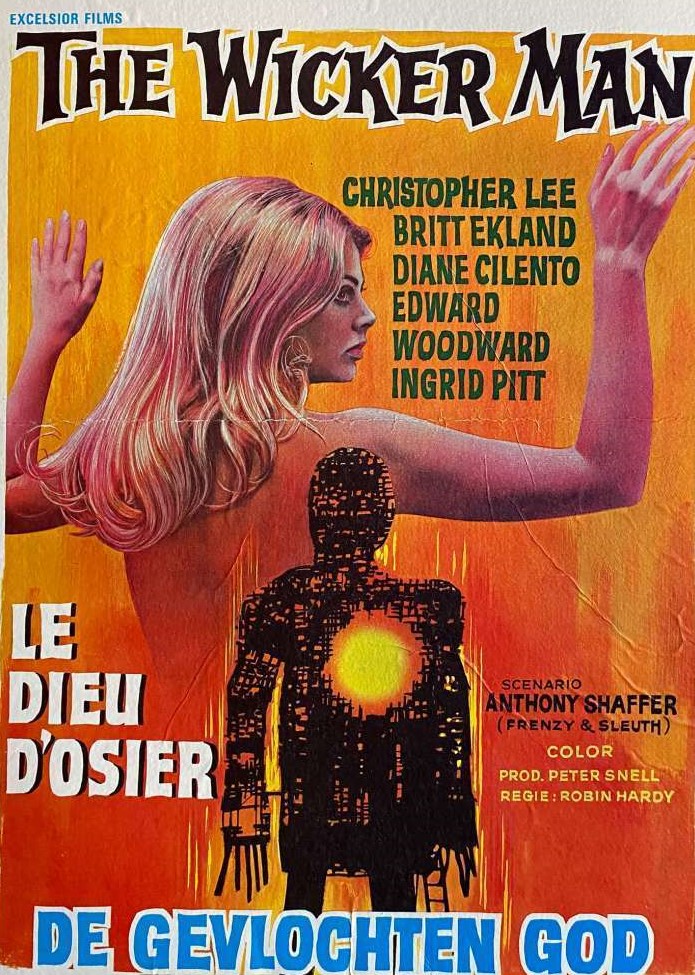
Behind the Scenes: “The Wicker Man” (1973) at the Box Office

Cult films don’t come any bigger than The Wicker Man (1973). Regarded as a box office flop in Britain at the time of initial release, it struggled to gain any traction in the U.S., only managing a truncated release there towards the end of the decade. However, closer examination of the box office reveals a different story and suggests both that distributor British Lion was rather harsh in declaring it a box office disaster and that more careful handling on the delayed U.S. release could have produced better results.

In the U.K., it was denied a stand-alone release and went out as the second feature to the critically acclaimed and commercially successful Don’t Look Now (1973) directed with some style by Nicolas Roeg and starring Donald Sutherland and Julie Christie, and which has, assuredly, stood the test of time. Several weeks after Don’t Look Now launched as a solo feature on October 1973 at the prestigious Odeon Leicester Square in London’s West End it shifted in December to the less prestigious Metropole where it was coupled with The Wicker Man.
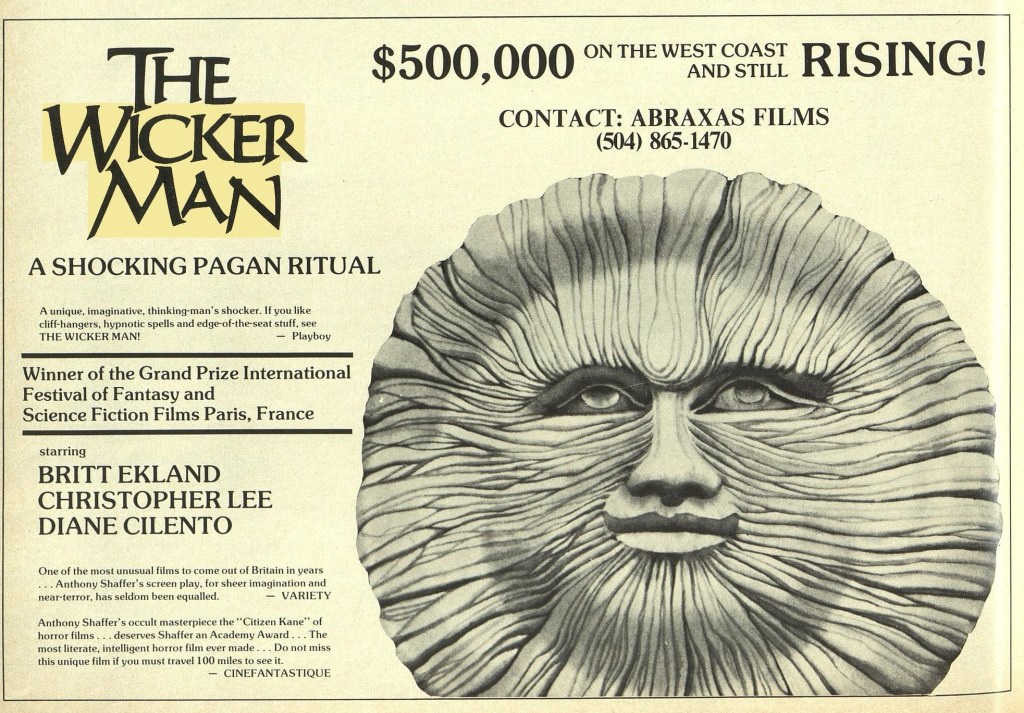
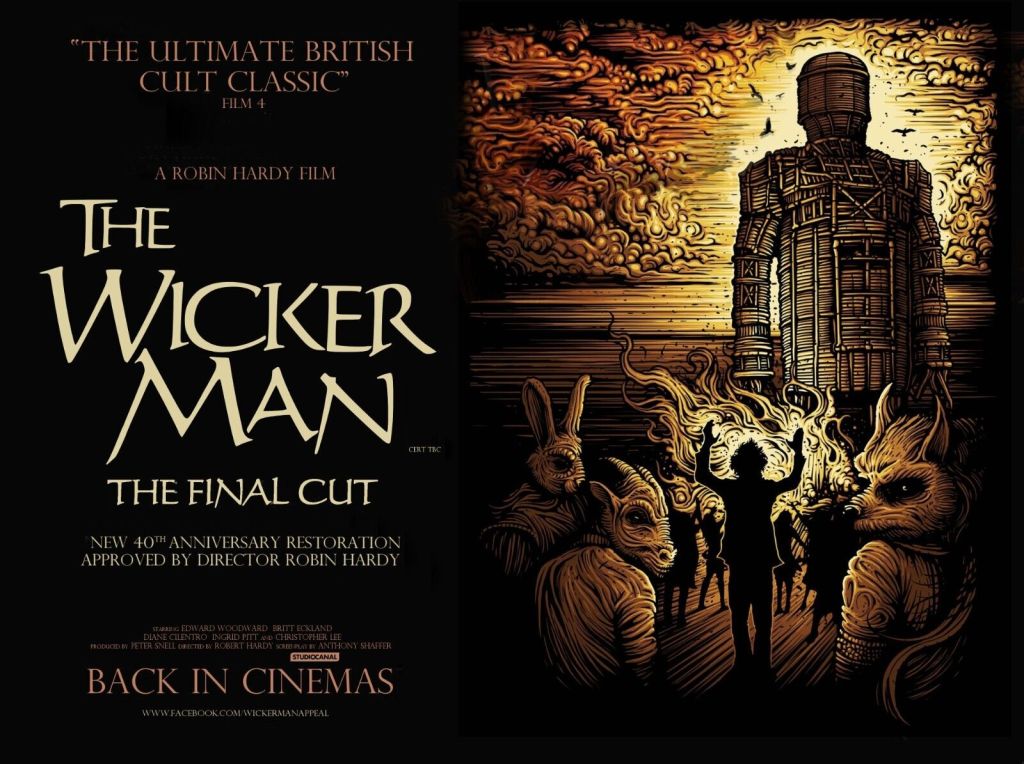
It’s my considered opinion that the reason the double bill managed such a long run – around five months – in the West End, moving between various cinemas, was, in substantial part, due to The Wicker Man. It had been released with virtually no fanfare and relied on word-of-mouth to attract an audience and I think it was the beginnings of that cult recognition that resulted in the double bill playing as long.

Given Don’t Look Now was a verified box office hit as a solo feature, it made little sense to couple it with an unfavored second feature since at this point the double bill was losing ground at cinemas. A single bill meant more performances, especially on the vital weekends, and therefore the potential for greater box office.

One of the elements that backed the notion that The Wicker Man was more important to the double bill than the distributors cared to acknowledge was that the fall-off week-by-week was minimal. The double bill played on in London’s West End long after it had completed a circuit run on the Odeon chain, suggesting that its attraction was perhaps due to the unexpected pulling power of The Wicker Man.

In its accounts, British Lion wrote off a $470,000 loss against The Wicker Man. But that seems like an accounting trick. The distributor had a choice in how it allocated the box office. A supporting feature could expect to receive little more than a flat fee as its share of the box office if it was deemed a B-feature. A genuine double bill – and bear in mind that horror maestro Christopher Lee was a box office attraction in Britain – would split the proceeds. That British Lion opted to treat it as a second feature, allowing it to maneuver the box office against the picture. Otherwise, given its low budget, it would certainly have turned a profit. The loss seems even more baffling when you take into account that it was sold to 17 countries.

In any case, since nobody else has tracked The Wicker Man’s actual performance in the UK and the U.S., I thought it might be interesting to do so.
UK (LONDON WEST END) BOX OFFICE 1973-1974

Don’t Look Now/The Wicker Man

Metropole (1,394 seats)

December 19 1973: – $5,300 (Variety deemed this “anaemic”)

December 26 1973: – $4,700

January 2 1974: – $4,900

January 9 1974: – $13,200

January 16 1974: – $9,700 (“very good”)

January 23 1974: – $8,700 (“fine”)

January 30 1974: – $7,700

Odeon Kensington (1,883 seats)

January 16 1974: – $16,800 (“boff”)

January 23 1974: – $13,700 (“robust”)

January 30 1974: – $10,900 (“fancy”)

February 6 1974: – $10,800

February 13 1974: – $9,300 (“stylish”)

February 20 1974: – $6,100

Odeon Haymarket (600 seats)

February 20 1974: – $6,000

February 27 1974: – $8,300

March 6 1974: – $7,700

March 13 1974: – $6,800

March 20 1974: – $7,400

March 27 1974: – $7,100

April 3 1974: – $6,900

April 10, 1974: – $5,700

Cincenta 3 (150 seats)

April 24 1974: – $2,600 (“nice”)

Cinecenta 2 (150 seats)

May 1 1974: – $2,700

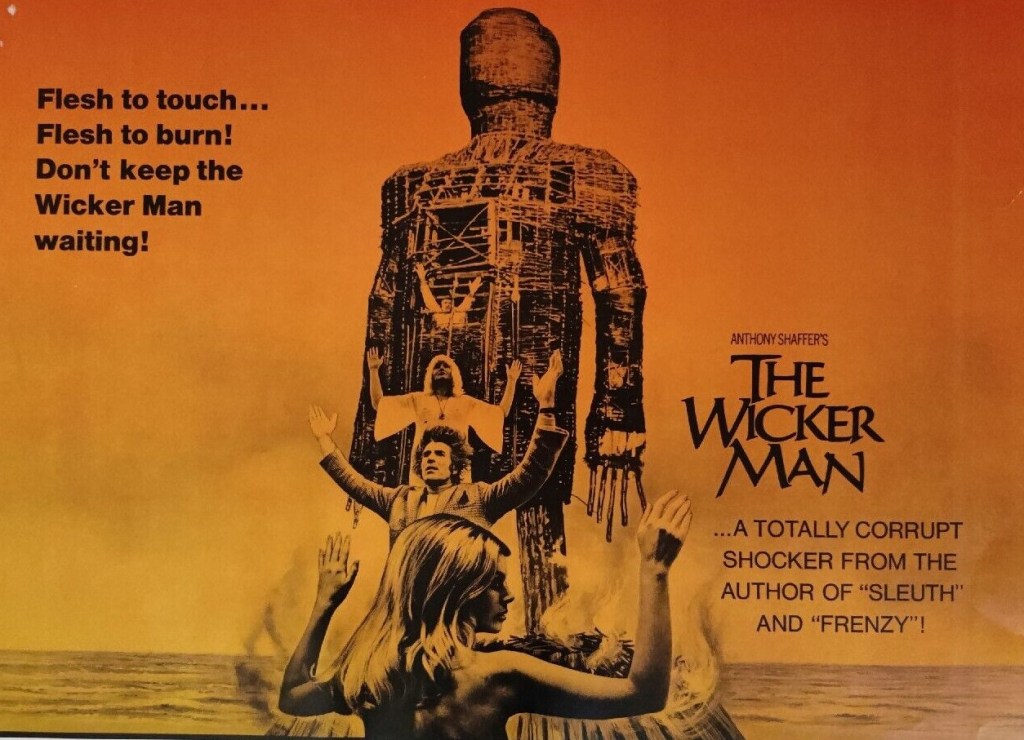
It was pretty much unheard of in London’s West for a programme to move around five cinemas, and, with the exception of Cinecenta, running for so long at each venue with a low drop-off week-by-week (steeper falls would have seen runs more speedily terminated). And when it came to the U.S. release, half a decade later, as you can see, much to everyone’s surprise, The Wicker Man on its own delivered both some notable opening figures and lengthy runs.
US BOX OFFICE 1977-1981

The Wicker Man only

Although being rated “R” by the U.S. censor in April 1974 and being reviewed by Variety in May 15 1974, The Wicker Man failed to gain any release in the U.S. even though one-time partner Don’t Look Now was widely distributed. The Wicker Man received a promotional fillip after winning top prize at the Fantastic Festival in 1974 but it wasn’t enough to boost its Stateside distribution prospects. Both National General and New World had considered taking it on but ultimately passed. It ended up at Warner Brothers which stuck it in the vault after a disastrous test at drive-ins in Atlanta and San Diego.

Box Office magazine gave it a favourable review in 1978, calling it a “lost horror classic” and noting that director Robin Hardy had made “an impressive debut.” The version its reviewer saw was cut from the original 102 minutes to 87 minutes. But the version seen by The Hollywood Reporter in 1979 was the restored version and its reviewer reckoned that the “dark intagibles” of its mangled release made it ideal fodder for a “cult audience.” By now PR had kicked in and it received the accolade of a front-page story in The Hollywood Reporter, calling it “reborn” and making play of the problems encountered along the way.

But apart from the Minneapolis misadventure in 1977, it wasn’t until 1979 that it made any release headway. Most of the bookings were in arthouse cinemas. But what is noticeable is length of runs and comparatively small week-by-week drop-offs.

Minneapolis: World (461 seats)

October 5 1977: – $2,000 (“poor”)

San Francisco: Lumiere (300 seats)

January 24, 1979: – $19,000 “boffo”

January 31, 1979: – $15,500

February 7 1979: – $13,000

February 14 1979: – $11,000

February 21 1979: – $10,600

February 28 1979: – $7,000

March 7 1979: – $5,700

March 14 1979: – Not known

March 21 1979:  – $5,900

Los Angeles: Los Feliz Westland 1 (763 seats)

March 21 1979: – $19,500

March 28 1979: – $13,500

April 4 1979: – $11,000 (“not bad”)

April 11 1979: – $9,500 (“tidy”)

April 18 1979: – $4,000

April 25 1979: – $4,000

May 2 1979: – $3,100

Los Angeles: showcase release in four other theaters

March 21 1979: – $26,000

March 28 1979: – $18,000 (“pretty”)

Seattle: Crest (700 seats)

April 4 1979: – $7,100

April 11 1979: – $6,700

April 18 1979: – $6,300

April 25 1979: – $4,700

May 2 1979: – $3,300

New York: Paramount (533 seats)

April 2 1980: – $21,000

April 9 1980: – $9,000 (transit strike ruined second and subsequent weeks)

April 16 1980: – $4,400

April 23 1980: – $4,000

Boston: Orson Welles II ( 200 seats)

April 23 1980: – $15,000 (“house record”)

April 30 1980: – $14,000 (“lusty”)

May 7 1980: – $8,800

May 14 1980: – $8,700

May 21 1980: – $7,600

May 28 1980: – $6,200

June 4 1980: – $4,200

June 11 1980: –  $5,200

June 18 1980: – $3,200

June 25 1980: – $3,300

Washington: Cerberus II (150 seats)

December 3 1980: – $7,500

December 10 1980: – $5,500

Kansas City: Fine Arts (560 seats)

January 21 1981:– $3,200

Kansas City:  Watts Mill (250 seats)

February 11 198l: – $2,500

Miami: showcase release in four cinemas

April 1 1981: – $3,700 (“remote”)

Cleveland:

April 1981: shown as part of the Cleveland International Film Festival

Pittsburgh: Arcade (775 seats)

May 20 1981: – $5,000 (“stout”)

According to an advert in Box Office magazine placed by distributor Abraxas in October 1979, The Wicker Man had already grossed $500,000 on the U.S. west coast. counting it the 1980 and 1981 releases, more than likley it passed the $1 million gross. Whether any of these receipts found their way to British Lion is questionable, so the U.S. box office would have done little to remove the idea it was a flop, but, in fact, counting all the results together, it must have done enough overall to turn a healthy profit.

I should point out that the dates above refer simply to the dates when the box office was reported in “Variety” magazine and not to the actual date when the film was shown. Typically, “Variety” would report box office in the week after a film was shown but this could still be up to 14-17 days after. The actual week 1 / week 2 / week 3 stuff is completley accurate even if the dates might appear misleading.

NOTE/PLEA/WHATEVER: Collecting these figures took a huge amount of work so if you want to pass on this information to others, please acknowledge the source.

SOURCESVariety, dates as shown; “Coming Releases,” Box Office, September 30, 1974, pA6; Review, Box Office, January 9, 1978, pA9; “Wicker Man Reborn Thanks to Persistent Young Distribs,” The Hollywood Reporter, February 15, 1979, p3; Review, The Hollywood Reporter, February 20, 1979, p3; Advert, Box Office, October 1979, 1979, p16; “Wicker Man Gets Proper Release After 6 Years,” The Hollywood Reporter, April 3, 1980, p1; “Strike Dents N.Y. Box Office,” Box Office, April 14, 1980, p7.

https://amzn.to/406reJa

Behind the Scenes: Greta Garbo 1960s Revival Queen

More than two decades after Greta Garbo abandoned acting she was the Queen of London’s West End in one of the most astonishing comebacks in Hollywood history.

Although her Hollywood career was relatively short-lived, lasting only 15 years and ending voluntarily in 1941,  and at one point the highest-paid actor (male or female) in Hollywood, the London experience made her a big star all over again in the 1960s  – and later in the 1970s – when reissues of her most famous films filled holes in a global release system starved of product.

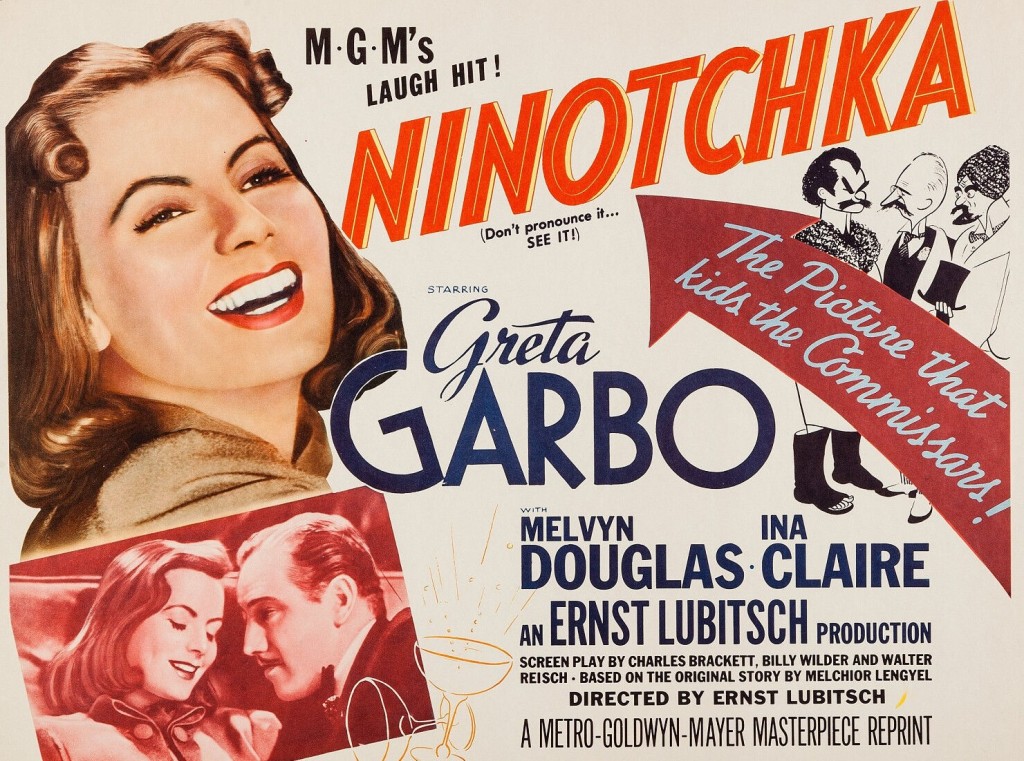
“Masterpiece Reprint” was cleaver ad-speak for getting round exhibitor phobia
regarding the words “reissue” or “revival.”
And it also suggested a new print since reissues were infamous for re-using long over-used old prints.

She’d first made an impact in the revival business in the U.S. reissue boom of 1948 in a double bill of San Francisco (1936) and Ninotchka (1939), a program so successful that shortly afterwards both were reissued again separately. The box office draw of pictures like these was such that some cinemas, for example, the State in Lubbock, Texas, re-launched themselves as “first run reissue” houses, the beginnings of the boom in repertory theaters.

But it wasn’t all gravy. Distribution didn’t just rely on old prints. Ninotchka, for example, not only had new prints but a new advertising campaign, campaign manual and accessories. However, apart from the first flush of revival, Ninotchka stumbled at the box office, too ambitious a level of release, quickly withdrawn after costing the studio $150,000.  

The impetus for the 1960s Garbo Revival came from abroad. In the U.S., Garbo films had by this point been viewed as arthouse fare, running, as in the 1950s, on a repertory basis, rented out for a flat fee, cinemas cramming in as many as a dozen films over one week. While they were available to anyone who wanted them, they came without attendant publicity. Given, they had all been screened on U.S. television they were considered a poor bet for a more commercial revival campaign.

But British television companies, of which there were only two – BBC and ITV – were more niggardly in buying Hollywood pictures so the major studios simply refuse to sell pictures, such as those starring Garbo, at what they saw as, compared to U.S. networks, cut-price rates.  

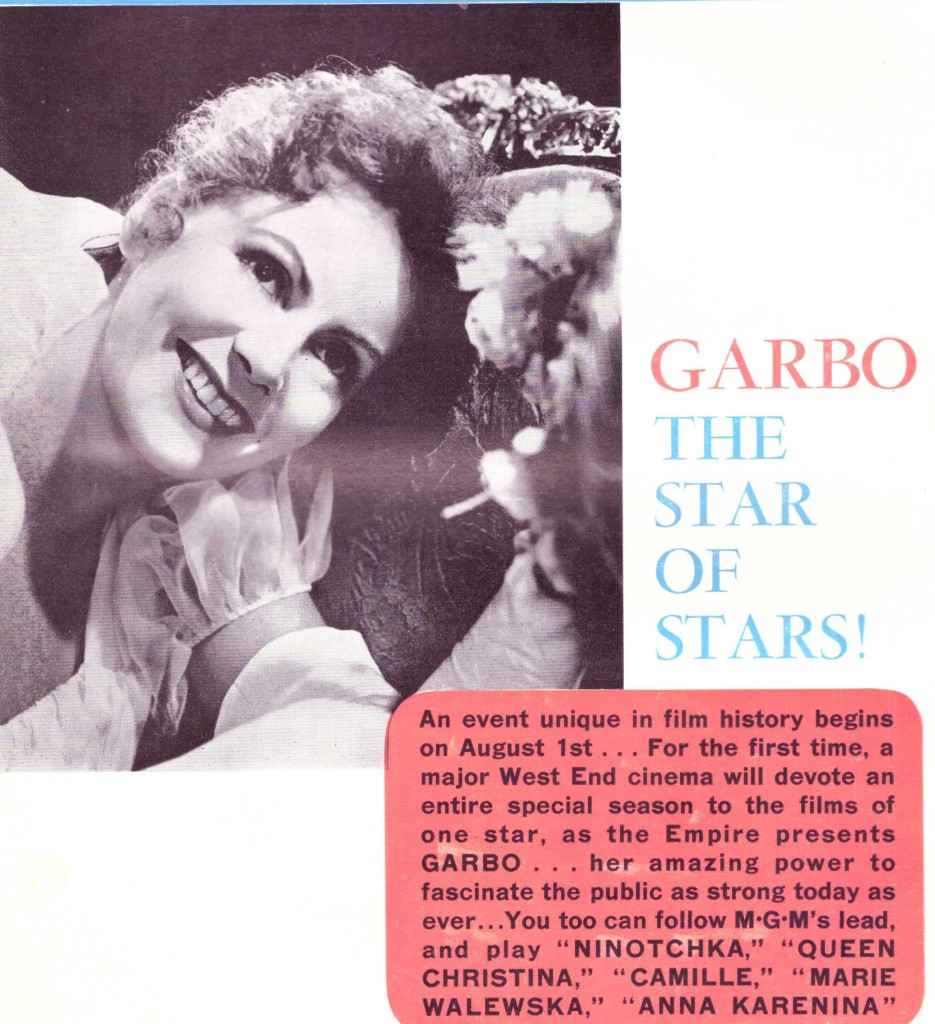
Even so, it was an act of incredible boldness for the Empire cinema in London’s West End, one of the top two theaters (the other being the Odeon Leicester Square) in Britain for movie launches, outside of roadshows,  to decide to take a gamble on reviving her movies following audience response to a brief showing at the Royalty. It was the first time a major commercial house in such a heavily-competitive environment  had devoted any time to what was in effect a retrospective, setting aside two months for a succession of Garbo pictures.

Two-Faced Woman (1941) – Garbo’s last picture – shored up $14,000 – equivalent to $140,000 now – in its first week. Queen Christina (1937) made a debut of $9,000 and Camille (1936) $11,000. In all, over this opening stint and a further season later on, the Empire screened eleven pictures – the others being Grand Hotel (1932), Anna Christie (1930), Mata Hari (1931), Ninotchka, Anna Karenina (1935), Marie Walewska (aka Conquest, 1937), As You Desire Me (1932) and The Painted Veil (1934)

And there was more to come. The Empire was the release showcase for the entire ABC circuit, so anything screening there would be rolled out in the country’s biggest chain.  Since ABC was decidedly not in the arthouse business, sending the movies out into the general mainstream seemed an even bigger risk. But such fears proved unfounded.

Garbo pictures were distributed throughout the country, and not just on the ABC circuit. In Glasgow, for example, the La Scala (owned by Caledonian Associated Cinemas) first-run house – rather than the city’s denoted arthouse the Cosmo – launched a three-week season comprising Ninochka, Queen Christina and Camille, two of the three going out as single bills.

Meanwhile, in the U.S. Garbo movies were being unfurled via the MGM Perpetual Product Plan, whereby classics (rented on a percentage basis) were screened for one day a week for a period of eight-to-ten weeks with audiences able to book a discounted ticket for the entire season. Abroad, there was more opportunity. Like Britain, countries like France revered the star and the movies were continually revived in Europe during the 1960s at commercial venues.

But by the end of the decade, the book should have been closed on Garbo. Because, in 1969, MGM, with the exception of perennials like Gone with the Wind (1939) and Doctor Zhivago (1965), pulled out of the reissue business. The studio withdrew from release its core library of around 100 vintage pictures because the operation was now losing money. Flat fee rentals of $100 (as opposed to the earlier percentage deals) for a three-day engagement failed to cover the costs of prints, distribution and advertising. The novelty of the one-day-a-week scheme had worn off.

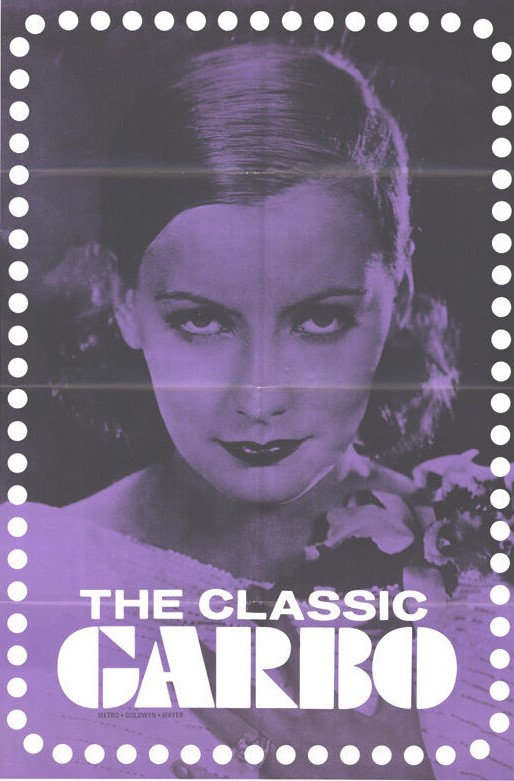
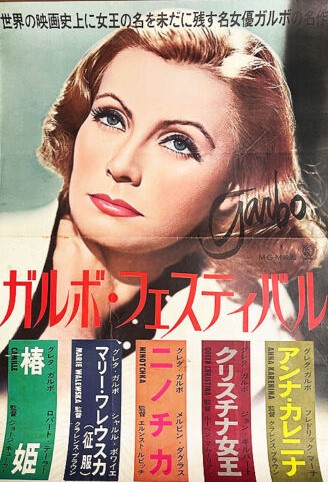
MGM intended to try out the old “creating demand” tactic by keeping its oldies out of circulation for at least four years.  But the studio was in severe financial straits at the start of the new decade and not in a position to resist an offer in 1970 from Erwin Lesser of Entertainment Events who proposed taking out a two-year lease on 65 pictures that had “made film buffs out of two generations.” Lesser drew up a package of 26 “Movie Incomparables.” Garbo was the main attraction. Included in the list were As You Desire Me, not seen for 30 years. Lesser returned to rentals based on percentages rather than a flat fee.

While Lesser made the movies available as single features and double bills and as support to new features, the main thrust of his marketing campaign was the “Garbo Festival,” an idea stolen from television which had taken to rewrapping old pictures as week-long events as a means of enticing viewers.

Although the Museum of Modern Arts in New York agreed to run a Garbo retrospective, that hardly produced the kind of box office juice that was required to kickstart a major revival.  So Lesser bided his time, and in the end accepted a nine-day “filler engagement” in March 1971 for the 565-seat Murray Hill arthouse in New York. A “rousing” first week delivered $15,000 – $113,000 in today’s money – while the remaining two days hit a colossal $7,800.

Garbo was back – and in some style. Two months later the Garbo package returned to Murray Hill for a socko one-week $11,000 followed by a move-over to the 533-seat Paramount. And then it was game on.

One of the major elements of the Festival was its flexibility. It became an umbrella term. Exhibitors could decide whether to create a program out of single showings or double bills that could run for consecutive weeks or for an on-off event of single weeks interspersed over a longer period with other features.

In Chicago the double bill of Grand Hotel / Anna Christie romped home at the 505-seat Cinema with $8,500 in the first week and $7,500 – an amazingly low drop-off at the box office considering 40%-50% tumbles in the second week are the norm today – followed by Mata Hari / Ninotchka also on $7,500. In the same city Camille / Anna Karenina racked up $4,800 at the 598-seat Carnegie.

In Philadelphia a four-film package hoisted $19,000 running simultaneously at the 500-seat World and the 855-seat Bryn Mawr. The second week take dropped by just $1,500. Two more packages running each for a week brought in a total of $15,000. In Pittsburgh and Detroit the seasons also ran for three weeks.

But showings were not restricted to arthouses. In Cleveland the package played the 1,500-seat Beachcliff, in Dayton the 1,000-seat  Cinema East and in Kansas City the 1,291-seat Midland.

Garbo’s name was kept alive all through the 1970s as revivals, either in one-week festivals, or shorter bookings, continued to bring in revenue across the USA and around the world, proving the continued box office potency of one of the industry’s greatest stars.  

We’re still a few years away from the centenary of her Hollywood debut in MGM’s Torrent in 1926 so expect major reassessment then. Whether she breaks out of the arthouse confines and fuels new demand in the multiplexes might not be such a long shot. Release patterns for revivals have markedly changed, many now being promoted as “one-day-only” events (miss out at your own peril) rather than running over a week or longer. A major publicity campaign and the assistance of social media could change public perception of a star whose films embraced both the silent era and Hollywood’s Golden Age and who was never short of publicity.

In my opinion it’s always worth watching a Garbo film for one technical reason – the difference between male and female close-ups. Watch a Garbo picture and a close-up  could last for minutes, the end of Queen Christina for example, as her eyes move through a variety of emotions. Male close-ups by comparison are over in a flash. With few exceptions the soul of a male actor is rarely revealed in close-up and even rarer is for expression to so dramatically change.

SOURCES: Brian Hannan, Coming Back to a Theater Near You, A History of Hollywood Reissues 1914-2014 (McFarland, 2016) pp 33, 55, 56, 58, 75, 128, 130, 133, 212, 223-225, 232 “Test Garbo Retrospective at Royalty in London,” Variety, June 23, 1963, p11; “Garbo Pic Sets London Record,” Variety, August 15, 1963, p2; “Click of Metro’s Garbo Pix in London’s Empire Cues More Runs,” Variety, August 21, 1963, p19; “British Provinces May Get Metro Garbo Films,” Variety, August 28, 1963, p23; “Metro Classic (Garbo, Marx Bros, Tuners) Withdrawn from Market,” Variety, August 27, 1969, p3; “MGM Leases 65 Pictures for Re-Releasing,” Variety, August 10, 1970, p3; “Picture Grosses,” Variety 1971 – March 31, April 7, May 11, May 25, June 9, June 23, June 30, August 18, November 22, December 8.

New York Showcase: 1969 Box Office Race

In the days before computerised box office figures and the internet permitting easy access, fans of the sport had to make do with the weekly tallies in the “New York Showcase” section run every week in Variety. The “Showcase” was an early version of the wide release but instead of the 3,000-4,000 cinemas involved today in an opening week launch, movies would hit the Big Apple in 23-60 theaters. No matter the low theater count, it was still considered the most accurate prediction of how a movie would fare nationwide.

Some films opened straight into the showcase format, others ran day-and-date with a glossy opening on Broadway or a prestigious arthouse, and for a few this was the first step in general release after a roadshow run.

The same rules applied as today. A movie was retained for a further week only if the picture hit the target. Long runs were rare, two weeks the standard. As we shall see, some were movies making their 1969 debut while others were going wide after opening the previous year, the delay accounted for by holdover success in first run or Oscar recognition.

Just over 200 theaters took part in the showcase splurge, divided into five main strands generally through circuit or distributor affiliation plus one that brought together suburban arthouses. Not all the streams were in full-time operation, some weeks saw four new releases others six. Movies could count on losing theaters after the first week.

And, as with now, while overall receipts were the main factor, the per-theater gross could also offer up some indication of future performance.

The best single week’s take in 1969 was achieved by Dustin Hoffman comedy The Graduate which took $760,000 from 43 houses (per-theater average: $17, 674) followed very closely by Ali McGraw debut Goodbye, Columbus  with $757,000 from 44 ($17, 204 per theatre). Steve McQueen thrill-ride Bullitt nabbed $684,000 from 45 ($15,200). In fact all three pictures placed twice in the single-week top ten.

Others flying high, at least for one week, were: Whatever Happened to Aunt Alice ($540,000 from 48), True Grit ($531,000 from 49), Joanne Woodward in Rachel, Rachel ($522,000 from 42), psychedelic outing The Trip ($520,000 from 49), sexploitationer Fanny Hill ($506,000  from 42), The Boston Strangler ($481,000 from 38) and I Am Curious Yellow ($480,000 from 40).

By contrast, at the other end of the heap, Marlon Brando in Night of the Following Day could only manage $125,000 from 31, The Assassination Bureau scraped up $82,000 from 22, Elliott Gould in Ingmar Bergman’s The Touch hit $48,000 from 26 while Michael Caine performed abysmally, Play Dirty knocking up just $91,000 from 24, The Magus $80,000 from 20, The Battle of Britain tumbling stratospherically from $366,000 from 32 one week to $101,000 from 27 the next.

But the showcase system also breathed life into arthouse hits attempting to break out into a wider marketplace. John Cassavettes’ Faces rocked up $469,000 in three weeks, Luis Bunuel’s Belle de Jour $329,000 over the same period, Brian De Palma’s Greetings $263,000 in a fortnight while one week of Robert Downer Snr.’s Putney Swope registered $205,000.

Reissues were also prime fodder to stoke up a distribution system creaking at the seams due to lack of new product. Gone with the Wind (1939) was the plum, $658,000 in three weeks. Disney’s Swiss Family Robinson (1960) chopped down  $418,000 in two and Clint Eastwood pair A Fistful of Dollars/For a Few Dollars More – both released Stateside in 1967 – $279,000 in a fortnight. More usually, reissues lasted just a week, filling a gap in the annual program.

Even so, they could pull in some decent numbers: Peter Pan (1953) grossing $300,000, Sidney Poitier double bill Guess Who’s Coming to Dinner (1967)/To Sir, With Love (1967) $272,000, perennial favorite The Sound of Music $230,000, Rosemary’s Baby (1968)/The Odd Couple (1968) $215,000, James Bond dualer Goldfinger (1964)/Dr No (1962) $162,000, another Eastwood pair The Good, The Bad and the Ugly (1967)/Hang ‘Em High (1968) $155,000 and a lengthy coupling of Planet of the Apes (1968)/ Those Magnificent Men in their Flying Machines (1965) $115,000.

The overall winner in the annual New York Showcase stakes was The Graduate which over a five-week run grossed $2.24 million. Bullitt was the runner-up with $1.99 million over six weeks, though the last sally was in a double bill with Bonnie and Clyde. Goodbye, Columbus came third with $1.95 million over four weeks. Romeo and Juliet lasted a record eight weeks to pocket  $1.69 million. Fifth was Swedish sensation I Am Curious Yellow on $1.28 million after five weeks.

After playing first run for the best part of six months Rachel, Rachel hit the showcases following an Oscar nomination for Joanne Woodward, bringing in $1.08 million over three weeks. Another anomaly was I Love You, Alice B. Toklas, such a flop the previous year it was ranked 78th in the annual box office race, but now emerging as a showcase front-runner with $1.03 million over five weeks.

Eighth spot went to The Boston Strangler ($932,000 in three weeks) followed by Charly – Oscar win for Cliff Robertson – on $910,000 for six weeks. Butch Cassidy and the Sundance Kid was tenth with $900,000 in two weeks – the western had launched at the tail end of the year and did so well it ran for another five weeks in 1970 to capture an extra $1.5 million.

Filling out the top twenty were, in order, Easy Rider, Ice Station Zebra, The Night They Raided Minsky’s, The Wild Bunch, Popi, On Her Majesty’s Secret Service, True Grit, Oliver!, Whatever Happened to Aunt Alice and Fanny Hill.

In general terms, New Yorkers response to showcase releases was mirrored throughout the country.  The majority of the high-flying films mentioned ending up in the annual box office top 20. But there were some anomalies. Rachel, Rachel had finished the previous year in 37th place in the annual chart, hardly suggesting it was prime candidate for an exceptional showcase run. The Night They Raided Minsky’s came only 32nd in the 1969 chart. Whatever Happened to Aunt Alice did not earn enough around the country to qualify for inclusion on the annual chart. And, frankly, I’m mystified as to why I Love You, Alice B. Toklas did so well.

By contrast Paul Newman racing picture Winning performed so indifferently in the New York showcase that for the final two weeks of its three-week run it was bolstered by John Wayne oil adventure The Hellfighters, yet it ran out 16th for the year. Three in the Attic (18th in 1969) and Support Your Local Sheriff (20th) failed to match expectations in New York.

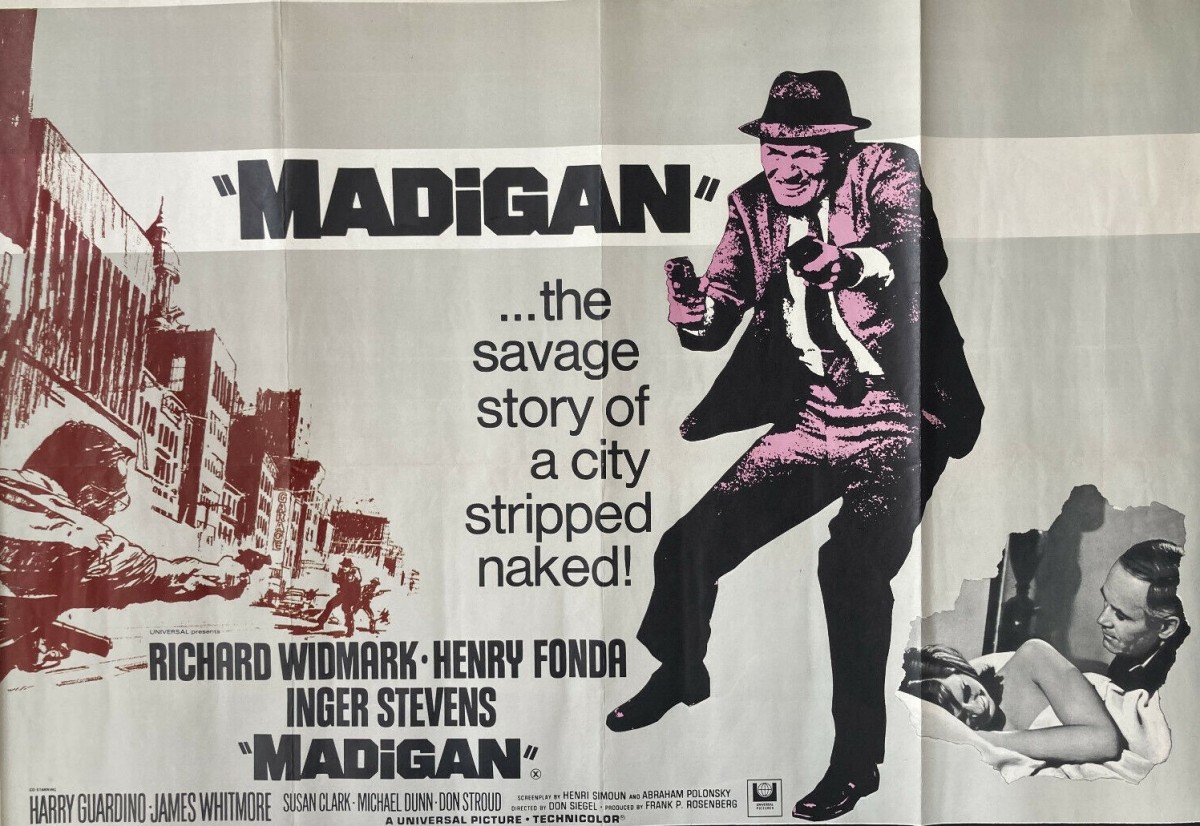
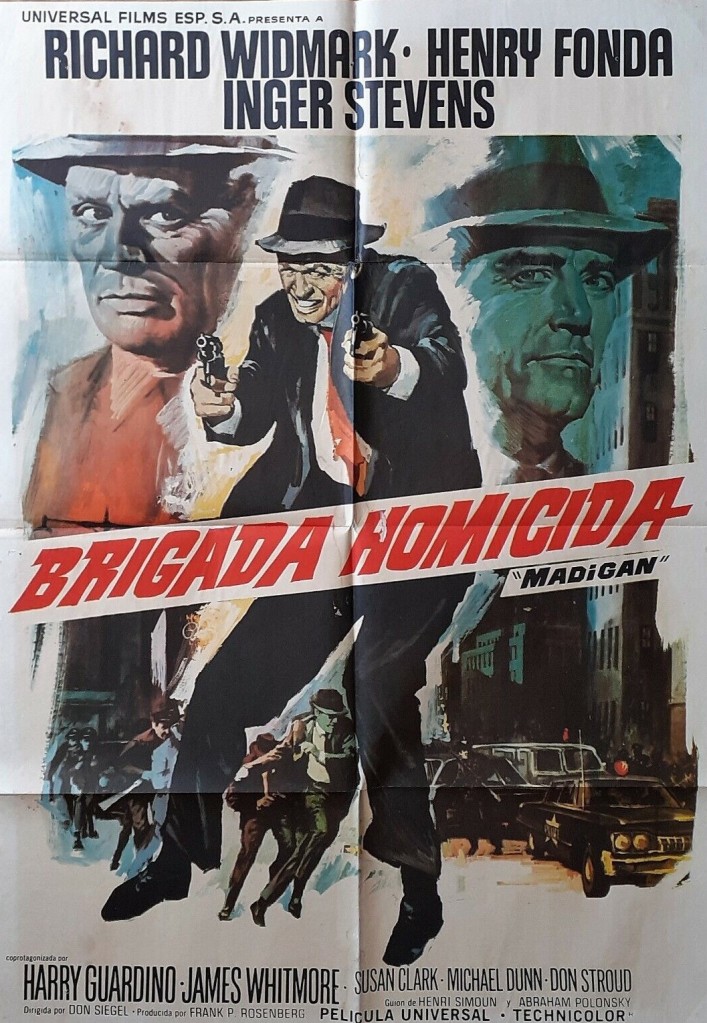
Madigan (1968) ****

Reignited the careers of director Don Siegel (no Hollywood traction since Hell Is For Heroes in 1962), Richard Widmark (reduced to supporting roles) and Henry Fonda (no longer first name on the team sheet for the biggest pictures) and reinvented the cop thriller as a gritty urban affair. The plot – chasing down a suspect – is a MacGuffin to explore tough police methods, corruption, and the harm the job does to the domestic lives of the police.

Detective Dan Madigan (Richard Widmark) and partner Rocco Bonero (Harry Guardino) come woefully and embarrassingly unstuck when hood Benesch (Steve Ihnat) evades capture and steals their guns. They have 72 hours to bring him back or be suspended. So, basically, they spend most of the time following a bunch of leads, intimidating anyone who gets in their way, including a helpless secretary. And while Bonero is happily domesticated, Madigan’s lonely wife Julia (Inger Stevens) is fed up with late nights and broken promises to the extent of considering a one-night stand when hubby stands her up once too often.  

Commissioner Russell (Henry Fonda) has his hands full dealing with the errant detectives  without the ramifications of corruption involving his best friend, long-time cop Chief Inspector Kane (James Whitmore). The widowed Russell would be a poster-boy for the principled cop except he’s having an affair with married woman Tricia (Susan Clark).

While Madigan is kicking and snarling his way through the underworld, Russell is trying to work out how to save his friendship and his affair. And while they might appear opposites, the classy top officer and the street cop, the uptight Russell envies Madigan’s way with people. Madigan is comped drinks and even a suite at the Sherry-Netherland hotel not merely because he’s a cop but because his charm goes a long way.

And while Russell dithers over helping out a friend, Madigan has no qualms about being taking for a ride by an old pal down on his luck and in need of an excuse to be bought a drink. When it comes down to it, Madigan is the better advert for humanity.

The soap opera elements don’t intrude too much on the thriller. Madigan and Bonero go in with fists blazing and work their way through a menagerie of skunks including Castiglione (Michael Dunn) and stool pigeon Hughie (Don Stroud). Benesch is a piece of work, not just clever enough to use his lover’s nudity to distract the attention of cops, but sufficiently hard-boiled to shoot a cop dead in the street and have little hesitation in opening fire on anyone who comes too close.

There’s some fascinating internal cop politics as Kane locks horns with Chief of Detectives Lynch (Bert Freed) over the latter’s insistence on suspending Madigan. And Russell has to finagle his way through the problems a well-heeled son is causing a rich doctor (Raymond Jacques).

Every time the pace slackens, the movie falls back on the old Chandler routine, have someone come through the door with a gun (a fist would suffice). Madigan is a driven cop, struggling to hold onto his marriage, Julia too often the sacrificial lamb. And for all his outward bravado, there’s a superb scene when unexpectedly encountering Russell he turns into a stammering ball of nerves, like a schoolkid anticipating a roasting from a headmaster.

Richard Widmark (The Bedford Incident, 1964) has a hell of a part, tough guy, check, but with a side helping of kindness, and pretty assured on the loving front, investing what could have been a fairly cliched character with a good deal of complexity. Henry Fonda (Firecreek, 1968) does a lot of pacing as his self-esteem implodes; how can he be a good guy if he’s running around with another man’s wife and how can he stick to his principles if he’s going to let a pal away with corruption?

Inger Stevens (Firecreek, 1968) is impressive as the disappointed wife trying to keep disappointment at bay. Harry Guardino (Hell Is For Heroes) always makes a good sidekick, but James Whitmore (The Split, 1968) digs into a sack of guilt as he attempts to avoid the oncoming storm. Don Stroud was almost auditioning for Don Siegel – he would turn up again in Coogan’s Bluff (1968) and Joe Kidd (1973); Susan Clark, too, Eastwood’s squeeze in Coogan’s Bluff. In smaller parts are Sheree North (Lawman, 1971) and Raymond St Jacques (Uptight, 1968).

But the show belongs to Don Seigel. There can be few directors so out-of-favor that they are able on their return to kick start a new cop cycle that culminated in Dirty Harry (1971). While this pulls no punches on the action front, it’s the quieter behind-the-scenes domesticity that almost as much catches the eye, the way he gives the characters time to breathe, opens them up to reveal more intricate inner workings.

It also spelled rebirth for blacklisted screenwriter Abraham Polonsky (Tell Them Willie Boy Is Here, 1969) in his first credit under his own name for 17 years. He didn’t do it all himself, though, Howard Rodman (Coogan’s Bluff) sharing the chores, the pair working from the novel The Commissioner by Richard Dougherty.

When Caine Was King

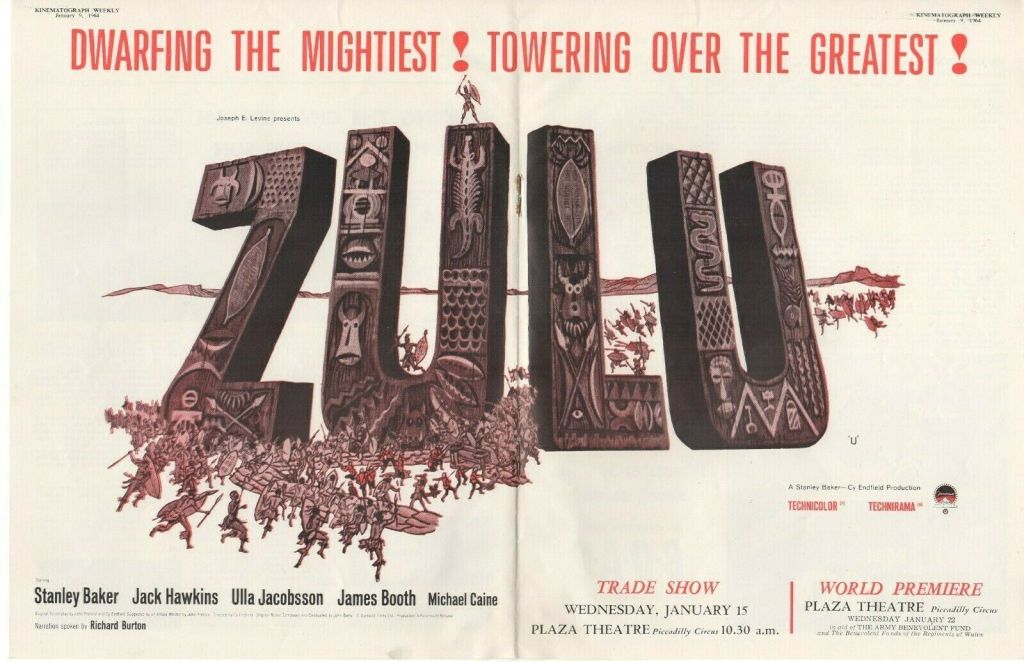
Producer Joseph E. Levine was so carried away by the sensational performance of Zulu (1964) in Britain that he earmarked a million-dollar marketing budget for its U.S. launch. Levine was already doing the rounds of U.S. exhibitors in January 1964 and it was reviewed that same month in Variety – which predicted it would be a “sturdy box office prospect” – leading observers to believe its launch was imminent. That it was held back till the summer suggested interest from the trade, not as fascinated by an obscure war in Africa as the British, was not as high as the producer would have liked. Even then Box Office magazine reckoned it “should be a box office smash” to emulate the $589,000 it had taken in nine weeks in the first run Plaza in London’s West End coupled with two weeks in 29 houses on the British ABC circuit.

But somewhere along the line Levine had lost heart and promoted it as if was Hercules all over again, 500 simultaneous bookings in a month, little time to build on the decent box office it attracted in New York in two weeks at the first run Palace. The drubbing Zulu (1964) received at the American box office – it did not even attract the $1 million in rentals needed to place it in the Variety annual box office chart – made trade journalists, while recognizing Michael Caine’s initial promise, reserve judgement on his future, observing that he “still has some ground to cover before he becomes as familiar to filmgoers as Sean Connery.”

Michael Caine is way down the cast list.

Despite Zulu’s failure, Variety predicted that Caine’s performance had “won this blond young man a swift passport to potential stardom” and even while The Ipcress File (1965) divided critics, the trade paper reported “there’s no disputing Caine’s personal impact…the sky’s the limit.”

To justify his deal with Harry Saltzman, Caine was committed to appearing in ten films in five years, although the producer was not only happy to loan him out to other studios but share the spoils. That was an unusual trait, given that stars as varied as Sandra Dee, Carroll Baker and Rock Hudson bristled at what they saw as exploitation, when their paymaster  retained the entire amount gained from loaning their services to other studios, often pocketing a hefty profit in the process. Caine, on the other hand, “kept the major share of any loan-out loot.”

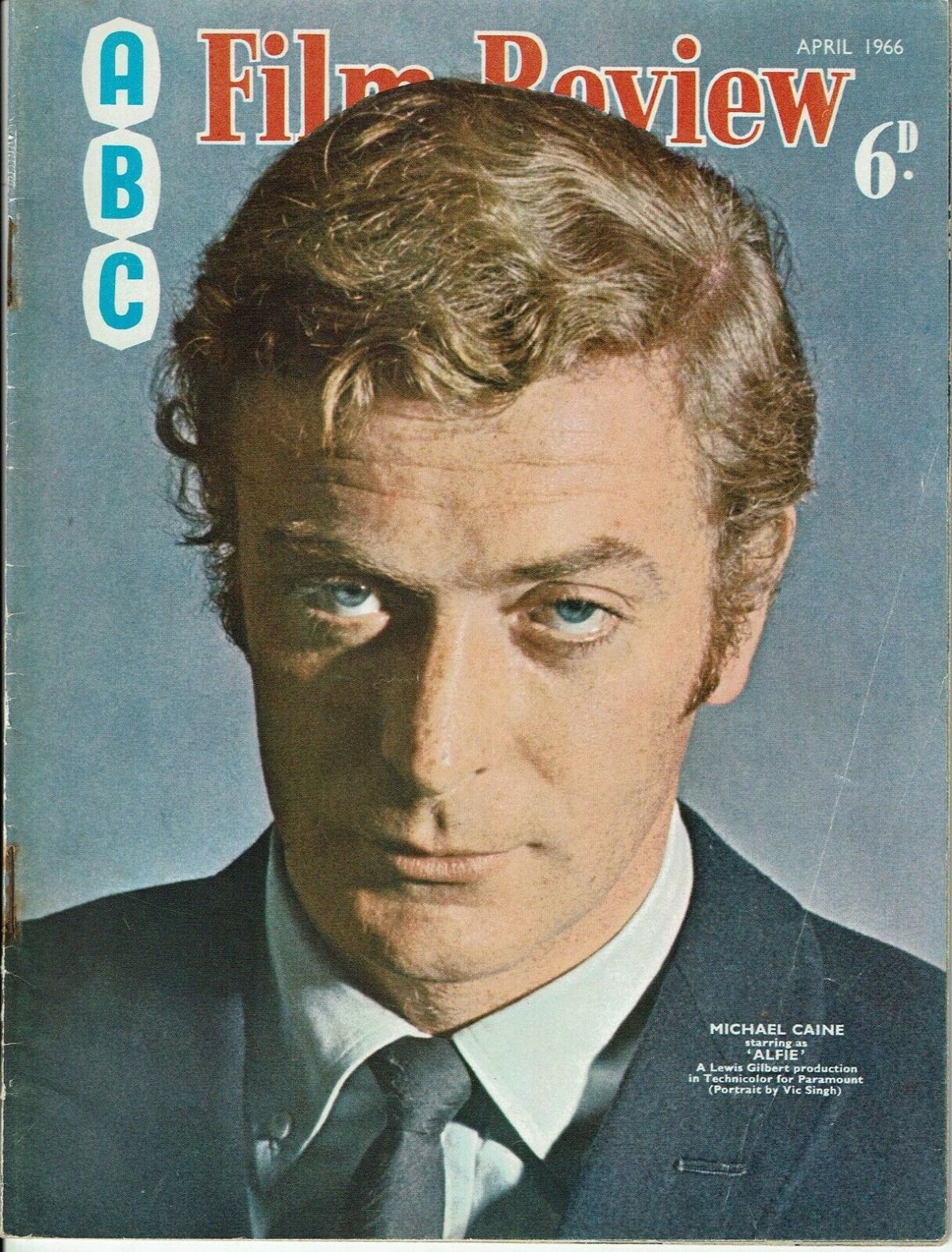
After The Ipcress File, Caine would have five films released in the U.S. in the space of eight months from July 1966 to February 1967, an output that could make or break him. In order of U.S. launch these were: black comedy The Wrong Box (1966), ribald sex drama Alfie (1966), caper movie Gambit (1966), a second outing for Harry Palmer in Funeral in Berlin (1966) and big-budget steamy Otto Preminger drama Hurry Sundown (1967) not to mention a reissue in 1967 of Zulu to capitalize on his growing fame.

The breadth of acting skills Caine brought to these diverse movies caught the attention, by and large, of the critics as well as the industry. The National Association of Theater Owners, proclaimed him their Future Star of the Year in September 1966 with the ringing endorsement of “never has a newcomer to films so fully and immediately captured the imagination of the world audience.”

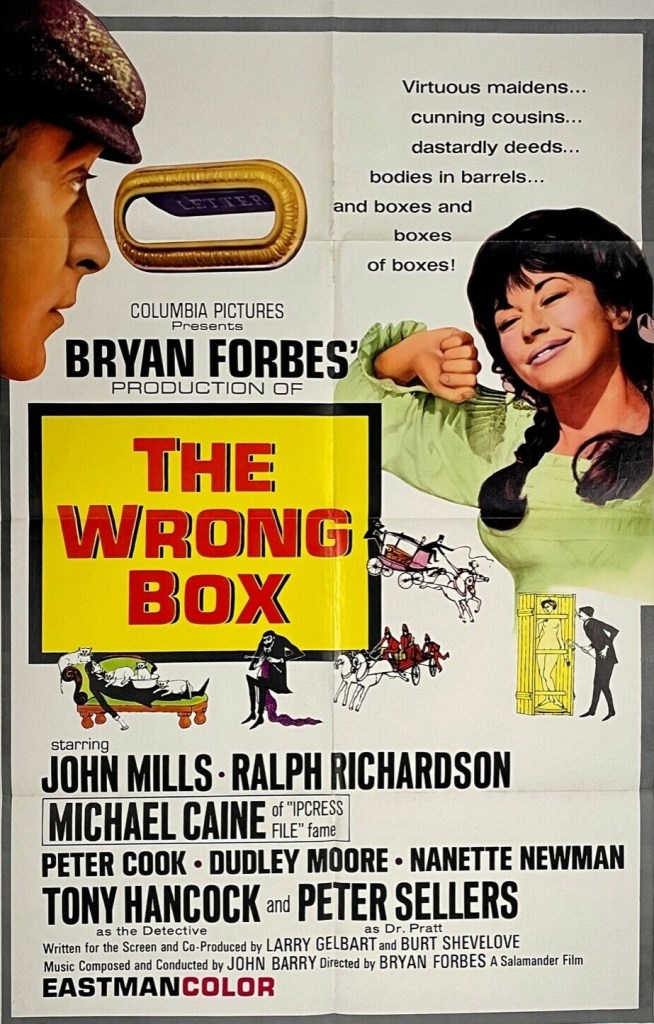
Oddly enough, there was no better follow-up as far as America was concerned to The Ipcress File than The Wrong Box in which he was a last-minute replacement for American actor George Hamilton.  The Wrong Box (1966) presented Caine as the timid romantic opposite of the lothario of Alfie and the accomplished seducer of The Ipcress File (1965) but it was the kind of role to make critics sit up and wonder what else he had in his acting box of tricks. 

But the release strategies employed by the various distributors, Columbia for The Wrong Box, Universal for Gambit and Paramount for the other three, ensured that the movies did not go down the Levine saturation-release route that had done for Zulu. Limited openings in prestigious arthouse-style cinemas allowed for slow build. In fact, it was almost tantamount to creating ‘sleepers’ out of every film. A film that remained for months at a time in one or two cinemas in a major city was the best way of driving up word of mouth. And during this hectic period whenever Caine was promoting one film, he was also being asked about all the rest.

It was almost inevitable that when a new picture opened, all the others were still playing. As a measure of how well this unplanned strategy worked, at Xmas 1966 his films were playing in six first run cinemas in New York, far more than any other star, and far more than any other star in the history of Hollywood. Each new opening boosted the box office of all the rest and when Oscar consideration or Year-End Best Awards entered the equation they served notice that, through his other films, this was an actor with a wide range of skills.

What had become quickly apparent to studios was that they had no idea how to assess Caine’s box office appeal.  Such reticence proved invaluable. The limitations imposed on his film launches ensured that audience demand would dictate the release pattern. Only after Universal had opened The Ipcress File to sensational business at the Coronet in New York at the start of August 1965 did it consider widening the movie out. Audience response gave the studio the confidence to book it towards the end of the following month into Grauman’s Chinese in Los Angeles for an “unprecedented booking.” The two cinemas could not have been more opposite – the New York house seating just 590, the Los Angeles venue nearly three times as much with 1,517 seats.  The studio was “evidently convinced to go commercial with the picture nationwide as booking into Grauman’s indicates.”

Columbia almost copied that campaign to the letter. The Wrong Box opened in early July   1966 to an “amazing” $35,000 at the 700-seat Cinema One. What was just as astonishing was that it was pulling in $28,500 in its seventh week by which time it had begun first run engagements across the country – a “socko” $25,000 in Chicago, “wham” $25,000 in Philadelphia, “boffola” $20,000 in Boston, “boffo” $18,000 in Washington D.C.

Although distributed by a different studio, Alfie followed a similar pattern, opening in New York again at the Coronet and also at the 500-seat New Embassy, breaking all-time records at both cinemas. Alfie, however,was less of a risk. On the financial front, it had already recouped its $750,000 costs solely from its London run. On the critical front, the film had won the Special Jury Prize at Cannes.

Just as important was Paramount’s marketing backing. A 16-page A3 Pressbook began by detailing both the critical acclaim enjoyed by the picture on its New York opening and its subsequent commercial success. Every advertisement was garnished with critical quotes: “Alfie bubbles with impudent humor and ripe modern wit” (Bosley Crowther, New York Times), “delightful comedy” (Judith Crist, NBC Today Show), “you are going to enjoy Alfie very much” (Life). “There’s no question about it,” crowed the Pressbook, “Alfie has completely conquered New York…(and) is the new champ of the press.” The New York Times had run four separate articles on the film, major magazines lined up to profile the star, on publicity duties Caine had come across as charming and personable, and the movie’s theme song topped the charts.

Three pages of the Pressbook were devoted to Michael Caine, calling him “multi-talented” and setting out the proposition, “Will Alfie’s Michael Caine Become the Newest Teenage Idol?” Caine predicted, “I believe it takes at least five movies to make a star of anyone,” counting Zulu as his first, plus The Wrong Box and Alfie. Given Funeral in Berlin and Gambit were still to come, he was already well on the way to proving himself correct.   

Alfie launched in New York a few weeks after The Wrong Box had already whetted appetites. The Coronet delivered a $43,000 opener and the New Embassy $33,400, both all-time non-holiday records. Second weeks were equally potent, $40,000 at the Coronet, $33,000 at the New Embassy.

So Paramount “nursed” the sleeper. It didn’t properly expand until Thanksgiving and even then was limited to 56 theaters which had to commit to 14-week runs that would see it safely past Xmas and New Year so as to be “in active exhibition” during Oscar season. Before the first Oscar nomination was in, Paramount had pulled in $3m million in U.S. rentals (the studio’s share of the box office gross) and about the same again overseas (including Britain). Winning five Oscar nominations – including Best Picture and Best Actor – boosted takings.

The Xmas 1966 unofficial “Michael Caine Season” saw a three-cinema New York opening for Funeral in Berlin (budgeted at $2.6 million) and one house for Gambit while Alfie was still playing in two houses. The Harry Palmer sequel rocked up with a “wow” $40,000 – equivalent to $356,000 today – opening week at the 813-seat Forum, an “amazing” $21,000 ($187,000 equivalent) at the 450-seat Guild (extra shows to cope with the demand) and $37,000 ($330,000 equivalent) at the 568-seat Tower East. Gambit knocked up a “smash” $20,000 at the 561-seat Sutton with Alfie bringing in a “wham” £21,000 in its 18th week at the  New Embassy plus $14,000 in its first week at the 430-seat Baronet. The capacities of all these cinemas showed that, in reality, they were glorified arthouses rather than the bigger 1,000-plus-seaters where the big-budget pictures resided.

In Britain, a top box office draw, in America king of the arthouses.  

How well his movies did outside that limitation depended on popularity and accessibility. Pairings with top female stars like Shirley MacLaine (Gambit) and Jane Fonda (Hurry Sundown) ensured that the actor’s transition into the Hollywood elite was painless. His career has had many ups and downs, and many fans know him only from his appearance in Christopher Nolan films, but in celebrating a career that encompasses nearly 70 years as a star, no one should forget the eight months that turned him into one.

SOURCES: “Levine Heads Zulu showmanship Meets,” Box Office, January 13, 1964, p8;  “Big Zulu Whoop,” Variety, January 15, 1964, p3;  Review of Zulu, Variety, January 29, 1964, p6; “Levine Sells His Theatres,” Box Office, February 10, 1964, pNE2; Advert for Zulu, Variety, April 29, p26-27; “Britain Bubbles with Talent,” Variety, April 29, 1964, p58; Review of Zulu, Box Office, June 22, 1964, pA11; Review of The Other Man, Variety, September 16, 1964, p41; Review of The Ipcress File, Variety, March 1965, p6; “Newcomer Talent in British Pix,” Variety, May 12, 1965, p57; Advertisement for Zulu, Box Office, Jun 15, 1964, p3; “Ipcress File Pre-Release in NY Aug 2,” Box Office, July 26, 1965, pE4; “Michael Caine No Bottled-In Bond,” Variety, September 15, 1965, p30; “Grauman’s Sets Extended Run of Ipcress File,” Box Office, September 20, 1965, pNC1; “Preminger Signs Caine,” Box Office, April 11, 1966, pE1; “Funeral in Berlin Budget $2,600,000,” Variety, April 27, 1966, p29; “Caine Is Able at B.O. with Five Star Roles in 33 Months since Zulu,” Variety, August 31, 1966, p2; “Michael Caine Named NATO Future Star,” Box Office, September 19, 1966, p3; “Par Nurses Its Alfie with Limited Playoff Through Holidays,” Variety, October 12, 1966, p21; “Michael Caine On Tour for Funeral in Berlin,” Box Office, November 21, 1966, pE2; “Embassy Reissues Three Caine, Belmondo Films,” Box Office, January 9, 1967, p10; “Alfie Could Be Par’s Tom Jones,” Variety, February 1, 1967, p3. Box office figures taken from the “Picture Grosses” section of Variety: July 20, 1966-September 24, 1966 and December 28, 1966.

Behind the Scenes: “The Wicker Man” (1973) – Revised Version

The movie Cinderella story to end all movie Cinderella stories. Quite how The Wicker Man came to earn its cult status given that for more than a decade it was hardly screened is quite a remarkable tale. An occult picture that as authoritative a producer as Michael Deeley (Blade Runner, 1982) deemed one of the ten worst films of all time – and without even the compensation of falling into the “so bad it’s good” category.

Most people who saw it during its original British release did so by default. They had gone to see Nicolas Roeg’s Don’t Look Now (1973) with top stars Donald Sutherland and Julie Christie and tagged onto that box office hit – and critical smash – was this other movie critics had dismissed. That it surfaced at all was because British Lion put it out on the lower part of a double bill in order to legitimately defray its costs by snipping off some of the revenue accrued by Don’t Look Now.

It certainly wasn’t that the Nicolas Roeg picture needed a helping hand on the box office front. Prior to opening, Don’t Look Now had already covered its $1.2 million budget by selling off foreign rights with Paramount taking it for the United States. Despite having the same budget of $1.2 million, The Wicker Man, did not attract the same foreign interest, or indeed any foreign interest. and for the time being was put on the shelve. British Lion had been sold to EMI who put Deeley in charge and his assessment of The Wicker Man‘s worth put paid to any prospect of a high-end launch.

Don’t Look Now opened, minus The Wicker Man, in October 1973 at the London West End’s most prestigious cinema, the Odeon Leicester Square and in phenomenal fashion. An opening week $32,000 (equivalent to $126,000 these days) was bettered by a second week of  $44,000 ($174,000 equivalent). A further two weeks brought in $41,000 and $35,000 respectively (or about close on to a total of $600,000 in today’s money).

Advertisement that ran in the “Variety” trade paper on November 16, 1977.

Then it switched, still minus The Wicker Man, virtually next door to the equally prestigious 1,402-seater Leicester Square Theater. An opening salvo of $29,000 dropped just $1,000 in the second week. A six-week run garnered $138,000 ($546,000 equivalent). Four weeks into that run it also opened at the 1,394-seat Metropole, this time as a double bill with The Wicker Man. It wasn’t a genuine double bill. A proper double bill consisted of two films of roughly equal standing that might both have premiered in the West End, top billing given to the movie that had performed best at the box office.

The Wicker Man had been on quite a different trajectory to Don’t Look Now. Despite it being promoted in “a savvy publicity ploy” at the Cannes Film Festival in May 1973 with a 30ft high “wicker man” set on fire on the Croisette, once Michael Deeley took control, replacing Peter Snell, also producer of The Wicker Man, he had no intention of giving a solo launch. By piggybacking on a hit movie, it was guaranteed to bring in some income.

However, initially, it seemed a disastrous idea. The Metropole double bill opened in mid-December 1973 to a miserly $5,300, second week no better, just $4,900.

But then something extraordinary happened. The third week was through the roof, a whopping $13,700. Over seven weeks it snapped up $57,000 (equivalent to $225,000 today). It wasn’t that surprising, however, since in the first two weeks it was still showing at the Leicester Square Theatre, but once the Metropole was the only option, the figures jumped up. Assuming revenue would taper off, in the fifth week of the Metropole  run it began playing simultaneously at the 1,883-seat Odeon Kensington – probably to coincide with the general release – where the first week raked in $16,800. It continued at this cinema for six weeks, bringing in another $57,000.

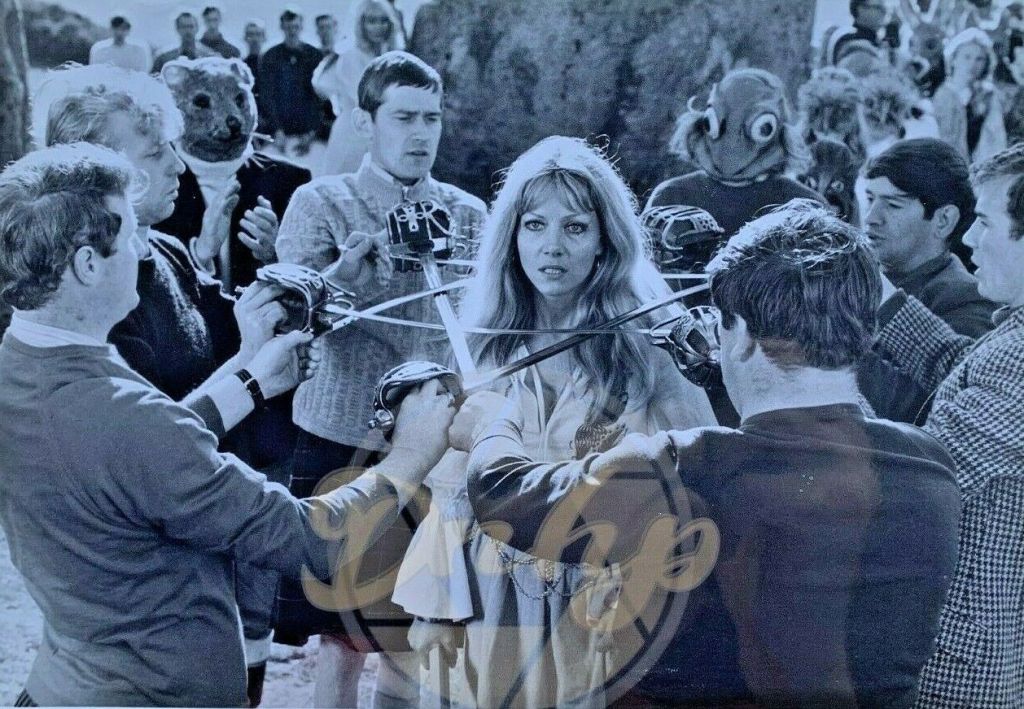
Let the fun begin: Ingrid Pitt does a blade runner.

And even then it wasn’t done. Towards the end of February the double bill switched to the 600-seat Odeon Haymarket, also in the West End. and opened with $6,000. A decent enough tally for a movie that had been on the market for over four months, but it turned out that except for its eighth and final week, that amount was the lowest it grossed. It ran out with a similar sum to the other two cinemas, $56,200. And then it moved again to the 150-seat Cinecenta 3, just off Leicester Square in London’s West end for a final flourish of $5,300 in two weeks, the second week improving on the first. All told, the double bill grossed $175,100 in the West End (just under $700,000 at today’s figures). The double bill also went out on general release on the Odeon circuit in Britain at the start of February 1974 – and not in December 1973 as has been argued (the London West End screenings were what would be termed “pre-release” activity).

How much of the double bill’s success could be attributed to The Wicker Man is not that difficult to calculate. As we have seen, Don’t Look Now was already an enormous success before it took on a perhaps-unwanted partner. Not every Odeon general release required a supporting feature, often a short would do. Without another film on the program, Don’t Look Now would have received more daily showings which could boost receipts and at the very least been more profitable for not having to share the box office.

Whereas Don’t Look Now sailed into New York on a tide of box office and critical glory at the 549-seat Sutton with a first week tallying $30,000 and had massed $110,000 in five weeks, The Wicker Man was deemed a massive flop. British Lion wrote it off to the tune of $470,000, a substantial amount.

There was no chance of British Lion fobbing off the more astute Americans with the notion of The Wicker Man running as the stablemate of Don’t Look Now. Major  U.S. distributors bought pictures that had been hits on release in their home country. Perhaps not surprisingly, the main contender for the rights was Roger Corman, a horror specialist, and he thought he could make it work if the film was editing from the original 102-minutes to 86-minutes, a timing that make it more appealing in a double bill. But Corman could not meet EMI’s terms.

However, it was bought in 1974 for American release by the Beechwood Properties – which Variety mispelled as “Beachhead Corp” but only initially as as a tax shelter. However, Beechwood succeeded in drumming up a distributor, National General Corporation which distributed John Wayne movies Rio Lobo (1970) and Big Jake (1971) as well as Little Big Man (1971) and Le Mans (1971), The Getaway (1972) and The Life and Times of Judge Roy Bean (1972). NGC was taken enough by the movie to pay EMI $300,000 for the rights.

But then NGC hit a financial brick wall and pulled out and the project passed on to Warner Brothers after it picked up the top prize at the International Festival of Fantasy and Science Fiction. As a prelude to a release, Warner Brothers submitted it to the American censor where it earned an “R” (restricted) rating in keeping with its British X-certificate. Warner Brothers test-marketed the shortened version as a solo feature with 24 prints playing the San Diego and Atlanta regions. But when the movie failed to attract an audience it was deemed a flop and shelved.

And in summer 1974 it was officially shelved.  

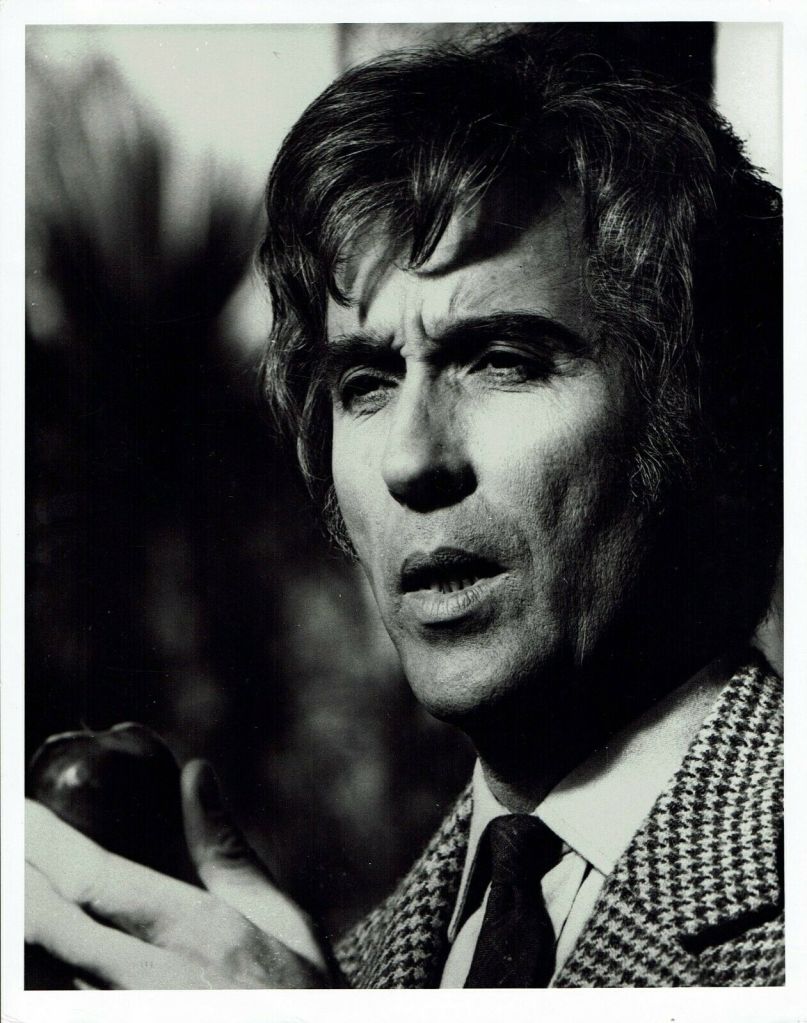
Christopher Lee with flowing locks.

So it sat in limbo for another three years before in 1977 Cinefantastique magazine dubbed it “The Citizen Kane of Horror Pictures” and devoted a 32-page spread to it in its Vol 6 No 10 issue, so determined it had uncovered a work of genius that it took out a substantial advertisement in U.S. trade paper Variety. That appeared to elicit some distributor interest and it was purchased in 1977 from Beechwood by New Orleans company Abraxas, headed by Stirling Smith, John Alan Simon, and Ron and Micheline Weinberg. Abraxas got the rights for a song – just $20,000.

But then the Weinberg’s split from Abraxas and set up a company (I am presuming) called International Films. It looked like they were licensed to show The Wicker Man, which they did in a kind of hit-and-run strategy, racing all over the country with the movie in the back of the car, and renting it out to around 30 arthouses, presumably assuming the “Citizen Kane” tag might attract an audience.

Distributed under the banner Summerisle Films, some of these showings were indeed propitious. In January 1979 at the 300-seat Lumiere in San Francisco with tickets priced at $4 it knocked up a “boffo” $19,000 (equivalent to a meaty $75,000 now). There was none of the steep fall-off either that you might expect. The second week hauled in an excellent $15,500 ($59,000 today) and the nine-week run brought in total of $93,000 (a very good $368,000 in today’s terms). It was deemed so successful that it achieved in exhibitor  parlance a “move-over,” transferring to the 300-seat Cento Cedar.

Results were similar in Los Angeles. At the 763-seat Los Feliz Westland 1, also primarily an arthouse, it racked up opening week figures of $19,000 and after six weeks had powered to $61,900 plus another $37,000 from a two-week run at four suburban houses. There was a decent performance in Seattle, close on $40,000 in a five-week run at the 700-seat Crest. Enough to counter a poor showing in Minneapolis at the 461-seat World where it opened to a “slow” $2,000. And excepting that result, the prospects must have looked rosy.

That is, until the wheels came off.

International Films turned out to be beset by financial problems. Weinberg had been due to pay Abraxas a total of $150, 000 by December 1978, paid off in three tranches, an initial amount of $30,000 by December 1977, another $50,000 by June 1978 and the the remaining sum by December of the same year. When the debt was not settled, Abraxas took Weinberg in court in July 1979 and the outcome was that the rights reverted back to Abraxas, now headed by Smith and Simon. And that was timely from a publicity perspective for the movie had just been named Best Horror Picture and Best Screenplay by the Academy of Fantasy and Horror Films. 

So Abraxas started all over again, sticking to the precedent of opening it in arthouses. But it looked like they sold off regional rights for the movie appeared under different distributors, Horror Films as well as Abraxas and the original Summer Isle banner   April 1980 saw The Wicker Man set a new house record at the 200-seat Orson Welles III in Boston with a $15,000 opening and over the next eight weeks it locked up a hefty $73,500 ($256,000 equivalent). The same month it hit New York, but an excellent opener of $21,000 at the 533-seat Paramount dropped to just $9,000 in the second week, then $4,400 in the third and $4,000 in the last. In December it scored $7,500 at the 150-seat Cerberus II in Washington D.C, finishing with $16,000 for three weeks.

In January 1981 it was the last movie shown in a 12-week season of revivals at the 560-seater Fine Arts in Kansas City and, despite registering only a “mild”  $3,500, it moved over the Watts Mill 2 for a $3,200 opener and an $8,400 total over four weeks. But a four-screen “showcase” in Miami produced a “remote” $3,700. There was some publicity derived for being selected, eight years after initial launch in Britain, at the Cleveland International film Festival.

But success in the independent field required momentum and despite excellent results in a handful of cinemas, The Wicker Man never really took off.

Salvation came via another route – video. Without VHS and then DVD it is doubtful if the movie would ever have achieved its current cult status. It’s not the first film to hit the ground running in the video format after a less than stellar performance in the cinema. I doubt that anyone, years after it was first shown, believed The Wicker Man had a hidden pot of gold. But my guess is the video rights cost little and in the burgeoning market where taste was not stifled by choices made at a cinema chain head office it was a film that finally found an audience.

SOURCES: “Michael Deeley Replaces Snell at Brit Lion,” Variety, April 11, 1973, p4; “Doing The Cannes-Cannes,” Variety, May 23, 1973, p26; “Form Beachhead Corp To Handle Wicker Man,” Variety, Jan 2, 1974, p4; “This Week’s Code Tags,” Variety, April 24, 1974, p4; “Wicker Man Wins Top Prize at Fantasy Fest,” Variety, May 1, 1974, p7; “British Lion 6 Months Slips to 890G,” Variety, January 29, 1975, p39; Advert, Variety, November 16, 1977, p38; Stuart Byron, “Something Wicker This Way Comes,” Film Comment, November-Dcember 1977; “Abraxas Corp Sues Ronald Weinberg,” Variety, April 18, 1979, p5; “Enjoin Weinberg Re Wicker Man,” Variety, Jul 4, 1979, p35; “Cleveland: 45 Titles: 3 Situations,” Variety, April 1, 1981, p24; “Metropolis Strikes Deal with Magnum,” August 10, 1988, p34. Box office figures all from the following issues of weekly Variety: Oct 24, 1973-April 24, 1974; October 5, 1977; March 21, 1979, April 11, 1979; April 18, 1979; April 25, 1979; May 7, 1979; April 23, 1980; December 3, 1980; February 4, 1981; April 1, 1981; May 20 1981.

“Penelope” (1966) ***

Comedic twist on the heist movie with Natalie Wood (This Property Is Condemned, 1966) as a kleptomaniac. Given its origins in a tight little thriller by E.V. Cunningham, pseudonym of Howard Fast (Mirage, 1965), it’s an awful loose construction that seems to run around with little idea of where it wants to go. Wood, of course, is a delightfully kooky heroine who takes revenge on anyone who has ignored or slighted her by stealing their possessions.

The picture begins with her boldest coup. Cleverly disguised as an old woman, she robs the newest Park Avenue bank owned by overbearing husband James (Ian Bannen). This prompts the best comedy in the movie, a man with a violin case (Lewis Charles) being apprehended by police, the doors automatically locking after a clerk falls on the alarm button, James trapped in the revolving doors losing his trousers in the process.

In flashback, we learn that she turned to thievery after a rape attempt by Professor Klobb (Jonathan Winter), her college tutor, and while half-naked managed to make off with his watch fob. She stole a set of earrings from Mildred (Norma Crane) after suspecting she is having an affair with James. “Stealing makes me cheerful,” she tells her psychiatrist, Dr Mannix (Dick Shawn) and while admitting to dishonesty denies being a compulsive thief. After the bank robbery she even manages to relieve investigating officer Lt Bixby (Peter Falk) of his wallet.

Nobody suspects her, certainly not her husband who could not conceive of his wife having the brains to carry out such an audacious plan. Bixby is a bit more on the ball, but not much. Clues that would have snared her in seconds if seen by any half-decent cop are missed by this bunch. And generally that is the problem, the outcome is so weighted in Penelope’s favor. The plot then goes all around the houses to include as many oddballs as possible – boutique owners Sadaba (Lila Kedrova) and Ducky (Lou Jacobi), Major Higgins (Arthur Malet) and suspect Honeysuckle Rose (Arlene Golonka). Naturally, when she does confess – to save the innocent Honeysuckle – nobody believes her in part because everyone has fallen in love with her. Bixby, just as smitten, nonetheless makes a decent stab at the investigation.

Howard Fast under the pseudonym of E.V. Cunningham wrote a series of thrillers with a woman’s name as the title. He was on a roll in the 1960s providing the source material for Spartacus (1960), The Man in the Middle (1964), Cheyenne Autumn (1964), Sylvia (1965), Mirage (1965) and Jigsaw (1968).

Taken as pure confection it has its attractions. It’s certainly frothy at the edges and there are a number of funny lines especially with her psychiatrist and the slapstick approach does hit the target every now and then. The icing on the cake is top class while the cake itself has little of substance. It strikes a satirical note on occasion especially with the Greenwich Village cellar sequence. It doesn’t go anywhere near what might be driving this woman towards such potential calamity – that she gets away with it is only down to her charm. There has probably never been such a pair of rose-tinted spectacles as worn by Penelope, even though her every action is driven by revenge.

Without Natalie Wood it would have sunk without trace but her vivacious screen persona is imminently watchable and the constant wardrobe changes (courtesy of Edith Head) and glossy treatment gets it over the finishing line. It’s one of those star-driven vehicles at which Golden Age Hollywood was once so adept but which fails to translate so well to a later era. Ian Bannen (Station Six Sahara, 1963) is in his element as a grumpy husband, though you would wonder what initially she saw in him, and Peter Falk (Robin and the 7 Hoods, 1965) delivers another memorable performance.  Dick Shawn (A Very Special Favor, 1965) is the pick of the supporting cast though screen personalities like Lila Kedrova (Torn Curtain, 1966), Jonathan Winters (The Loved One, 1965) and Lou Jacobi (Irma la Douce, 1963) are not easily ignored.  Johnny Williams a.k.a John Williams wrote the score.

Arthur Hiller (Tobruk, 1967) delivers as much of the goods as are possible within the zany framework. Veteran Oscar-winner George Wells (Three Bites of the Apple, 1967) wrote the screenplay and it’s a far cry from the far more interesting source material and I would have to wonder what kind of sensibility – even at that time – could invent a comedy rape (not in the book, I hasten to add).

Follow That Nurse – What a Carry On

British critics hated the “Carry On” films until late in the decade Carry On Up the Khyber (1968) hit a satirical note. Critics felt the movies pandered to the lowest common denominator and were a poor substitute for the Ealing comedies which had given Britain an unexpected appreciation among American comedy fans.

It was a well-known fact the comedies did not always travel. Apart from Jacques Tati, the more vulgar French comedies featuring the likes of Fernandel were seen as arthouse fare. Unless they featured a sex angle or the promise of nudity, coarse Italians comedies struggled to find an international audience. The “Carry On” films were bawdy by inclination without being visually offensive

Carry On Sergeant (1958), the first in the series, had been a massive success in Britain. Distributors Anglo-Amalgamated was so convinced it would find a similar response in the U.S. that it was opened in New York at a first run arthouse. Although the comedies were hardly standard arthouse fare, this was generally the route for low-budget British films.  The picture lasted only three weeks and other exhibitors taking that as proof of its dismal prospects ignored it. 

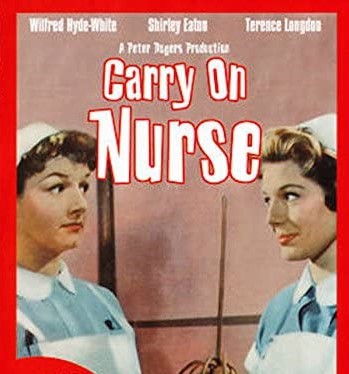
The follow-up Carry On Nurse (1959) took an entirely different route when launched in America in 1960. This time New York would be virtually the last leg of its exhibition tour.  Instead it opened on March 10 at the 750-seat Crest in Los Angeles. Away from the New York spotlight, the little movie attracted not just good notices but decent audiences.

Instead of being whipped off screens after a few weeks, it developed legs. In Chicago it ran for 16 weeks in first run before transferring to a further 50 theaters. Within a few months of opening it had been released in 48 cities. In Minneapolis it was booked as a “filler” at the World arthouse, expected to run a week and no more. Instead, it remained for six weeks and when it shifted out to the nabes out-grossed Billy Wilder’s big-budget comedy The Apartment (1960) with a stellar cast of Jack Lemmon and Shirley Maclaine.

In its fourth month at the 600-seat Fox Esquire in Denver where it opened in May, it set a new long-run record for a non-roadshow picture. It had been taking in a steady $4,000 a week since opening.

SOURCES: “How To Nurse a Foreign Pic That’s Neither Art nor Nudie: Skip N.Y.,” Variety, Aug 24, 1960, 3; “British Carry On Nurse A Sleeper in Mpls With Long Loop Run, Nabe Biz,” Variety, Aug 24, 1960, 18;

Discover WordPress

A daily selection of the best content published on WordPress, collected for you by humans who love to read.

The Atavist Magazine

by Brian Hannan

WordPress.com News

The latest news on WordPress.com and the WordPress community.