In Harm’s Way (1965) *****

Preminger at a peak, the more I watch this picture, not just the more impressed I become but the more I want to watch it again – three times, as it happens, for this review. A tale of heroism populated by morally wounded heroes, the undertone of critique for the Naval establishment dealt with in brilliant narrative fashion, terrific pacing, one of John Wayne’s very best performances, Kirk Douglas not far behind, great action scenes, and one of the few movies to fulfil this director’s original intent.

You can, of course, argue that it’s the height of political PR. Just as the Americans managed with The Alamo and the British with Dunkirk, the aim was to turn defeat into victory, so this moves beyond the humiliation of Pearl Harbor to the victories beyond. But in some sense Pearl Harbor is just the prologue to a stiffer examination of men at war, rather than sailors taken to task over the complacency that left them so open to cataclysmic attack.

And while there’s a number of sub-plots, these are more expertly handled than I can recall in many another lengthy big-budget picture, no endless cutting between major and minor characters, but the minor characters only entering the frame when they have a dramatic part to play.

Captain “Rock” Rockwell (John Wayne) falls foul of his superiors for basically being in command of a ship sunk by a torpedo. On a technical point, he’s stripped of command, and reduced to a desk job, a casualty of the peace-time hierarchy determined to find someone to blame, only returning to active duty – and promoted to Admiral – when more war-oriented figures are put in charge.

The desk job gives him time to romance feisty nurse Lt. Maggie Haines (Patricia Haines) who has the cojones to take charge of the budding relationship. She happens to share an apartment with another nurse, the much younger Ensign Annalee Dorne (Jill Dorne) who is dating entitled Ensign Jeremiah Torrey (Brandon de Wilde), Rock’s estranged son.

Jeremiah works for slimy glory-hunter Commander Neal Owynn (Patrick O’Neal), a former U.S. Congressman using his political skills to worm his way into the office of by-the-book Vice Admiral Brodick (Dana Andrews). Rock shares his apartment with Commander Egan Powell (Burgess Meredith), a thrice-married playboy, high up in Navy intelligence.

Rock’s second-in-command is Commander – junior to a captain in case you don’t understand the U.S. Navy ranking system – Paul Eddington, a hothead whose mourning for dead wife Liz (Barbara Bouchet) results in him also being reduced to a desk job and exiled to the Pacific. On the fringes of the story are Lt. Commander “Mac” MacConnell (Tom Tryon) and pregnant wife Beverley (Paula Prentiss).

How all these characters enmesh is the consequence of a quite brilliant screenplay by Wendell Hayes (Advise and Consent, 1962). Rockwell and Eddington both seek redemption, the former to prove his Naval worth and regain the affection of his son, the latter to absolve himself for his terrible actions.

You can always tell the hero in war films because they are so rarely a physical casualty of war, all the others are killed and wounded but hardly ever the hero, so it takes something for the Hollywood Hero of the Century to play a character who is wounded not once but twice, and for the early part of the picture walks around with his arm in his sling (not quite an echo of the way he holds his arm in The Searchers, but evoking the same internal conflict).

The only supposed out-and-out hero is MacConnell, but his inaction at the beginning of the movie fails to prevent the death of Eddington’s wife. And his heroism largely takes place off-screen and it’s worth noting that Rock doesn’t raise a rifle or pistol in anger (or even get into a punch-up as was the actor’s wont in other films). Being in charge he’s removed from the core action even if suffering the consequences of battle. In a marvellous touch of irony, Rockwell is the most passive hero to hit the screen. It’s an incredibly bold and self-confident director who would even think of luring audiences into an action picture starring the Hero of the Century and then denying him a single moment of screen glory.

Much has been written about the cinematic arc John Ford took in the beginning and ending of The Searchers, the symbolic opening and closing of doors, but since Preminger is long out of critical favor nobody’s has bothered to notice how much of this film concerns cinematic echo.

To take the most obvious example, the first witnesses of the airborne Japanese attack on Pearl Harbor are illicit pair Liz Eddington and her paramour (Hugh O’Brian) and towards the end it’s her husband Paul, by this point guilty of horrendous behaviour, who leads the airborne fightback against the enemy.

A beach – where Liz and escort make love – is how the director initially pushes the audience towards sympathising with the drunken Eddington. A beach is where we later learn to despise him, as he brutally rapes Ensign Dorne. And it doesn’t take much to work out that his wife’s exuberant wildness explains Eddington’s initial attraction to her, not realising that psychologically it provides him with an excuse for his own darker wildness, initially restricted to self-destruction but when it truly emerges it’s to the detriment of an innocent.

And that’s before we get on to Rockwell as the messenger of death, delivering the bad news to wives, and then being on the receiving end after his son dies in battle. And finally, the political peace-time high-ups get their come-uppance in actual war.

It’s insulting – as some have suggested – that the performance of John Wayne (The Hellfighters, 1968) is the result of undiagnosed cancer when in fact this is a finely nuanced role of a high-ranking figure living out in his life in regret, at times quite shamefaced about abandoning his son at a very early age. Preminger cracked down on Wayne’s habit of splitting his lines in two, so those typical pauses we have come to expect are in large part gone, and it helps the movie’s pacing. For most of the movie the character is saddled with consequence. That passivity that the director saw as essential to the role is virtually present all the time.

Preminger wrings a different performance, too, from Kirk Douglas (A Lovely Way to Die, 1968), equally laden with regret, but not enough to prevent him lashing out and the actor is accorded two quite stunning scenes, the first as he broods in silence over his wife, but for the second, prior to raping Ensign Dorne, the stone-cold look on his face suggests a serial killer held at bay for too long and now about to explode.

Burgess Meredith (Hurry Sundown, 1967) is another brought to directorial heel, his more common scene-stealing and vowel-stretching also eliminated, but in exchange given a larger-than-life character on which to expend screen energy. The entire cast is good-to-excellent and it’s jam-packed: Patricia Neal (Hud, 1962), Tom Tryon (The Cardinal, 1964), Paula Prentiss (Man’s Favorite Sport, 1963), Brandon De Wilde (Shane, 1953), Jill Haworth (Exodus, 1960), Dana Andrews (The Satan Bug, 1965), Franchot Tone (Advise and Consent, 1962), Patrick O’Neal (Stiletto, 1969), George Kennedy (Cool Hand Luke, 1967), Henry Fonda (Battle of the Bulge, 1965), Barbara Bouchet (Danger Route, 1967) and Stanley Holloway (My Fair Lady, 1964) Many of the supporting cast were also playing against type – Prentiss as the young wife falling to pieces, Andrews and O’Neal as slippery political types, Holloway  a guerrilla, and perhaps most interesting off Neal, not the typical woman left behind when the man goes off to war but, in her role as nurse, entering harm’s way herself.

And despite criticism of the miniatures used in sea scenes while that might have been obvious on the big screen you don’t notice it on the small screen. The action  scenes are very well-done for the time, and quite unusual in that by and large it’s the Americans who appear shell-shocked not the enemy.

Cramming this much narrative into the overall arch of Pearl Harbor and retaliation against the Japanese, while bringing so many different characters to the fore with clear dramatic purpose is an amazing achievement, screenwriter Wendell Mayes (Advise and Consent) doing the heavy lifting in this department.

But Preminger the director is very much to the fore, in his composition and use of the camera for long tracking shots (a particular favorite of mine) such as at the beginning. A riveting watch full of splendid acting. Shooting it in black-and-white might have at one time appeared to date the picture but instead it has rendered it ageless. Five stars without a doubt.

Deadfall (1968) **

“The Big Reveal” comes too late to save this heist-cum-melodrama. It can’t make up its mind whether it wants to join the canon of superlative 1960s caper pictures – in which case it needed to make a greater effort on the cat burglary front – or whether it’s an odd addition to the menage a trois category, in which case it needed characters you could actually believe. Worst of all, it contains one of the great artistic follies, a robbery carried out in time with an  orchestra playing one of the great John Barry compositions, “Romance for a Guitar and Orchestra.”

The only problem, there’s no dramatic reason for this. Since the concert is miles away from the robbery, it’s not as if the music drowns out the shenanigans. Director Bryan Forbes (King Rat, 1965) shoots himself in the foot. It’s too clever a device by half, even if the music is intended as a counterpoint to the  robbery’s more dramatic themes or the silence which had become a trope.

Cat burglar Henry (Michael Caine) forms a business partnership with elderly safecracker Moreau (Eric Portman) and falls for his wife Fe (Giovanna Ralli). The husband-wife relationship is off to begin with, he preferring males, and the wife admitting she doesn’t always find men attractive, though quite what she is hinting at is never made clear. The target is millionaire Salinas (David Buck), whom Henry is investigating to the point of pretending to be an alcoholic so he can get to know Salinas in a sanatorium.

Any other movie would get straight to the point – draw up plans and get on with it. But here, for no real reason except delay, Moreau wants them to do a trial run,  a safecracking job on the mansion of the kind of couple who drive off in a posh car to attend a concert. The effort put into the planning isn’t really up to scratch, not when compared to the likes of Topkapi (1964) – to which every heist film of the era was measured – or Gambit (1966) or even the less well-known The Happy Thieves (1960) or Seven Thieves (1960).

Apart from some cat burglary skills the whole episode is perfunctory, guard dogs knocked out by drugs. The background music, the aforementioned John Barry opus, just about kills off any prospect of tension. It only sparks into life when Moreau admits the safe is beyond him and Henry has to prise it out of the wall and cart it to the waiting car.

The second heist would have been far more interesting had we known from the start that Salinas welcomes burglary attempts, seeing it as some kind of duel of wits with malfeasants.

In between the two robberies there is time enough – too much time in fact – for Henry and Fe to get it together, for Fe to run off and then return only to learn in The Big Reveal the kind of despicable man her husband is. The movie can’t even deal with the incestuous sub-plot and just lets it hang there. But by that stage you couldn’t care less. Fe isn’t the type of femme fatale to bother crossing the road for, the romance seems too prescribed and the downbeat ending makes no sense.

I’m only giving this any points at all really because it stars Michael Caine (Hurry Sundown, 1967) and features a lengthy slice of John Barry music. Caine has been in enough duds for sure, but this doesn’t have the ring of one of his doing-it-for-the-money numbers or a stab at the Hollywood big-budget scene. Caine is good enough and Eric Portman (The Bedford Incident, 1965) is an interesting study. But it just doesn’t gel, not just let down by Giovanna Ralli (The Caper of the Golden Bulls, 1967) but by the pretentious direction and dramatic miscalculation of Bryan Forbes.

Forbes’ wife Nanette Newman (The Wrong Box, 1966) makes a puzzling appearance in a small role with no dramatic credibility. Leonard Rossiter (Deadlier than the Male, 1967) provides another cameo. For many the high spot will be to see John Barry in the flesh, conducting the orchestra playing his composition.

A Fistful of Dollars (1964) ****

Breezy western debut that created five legends: announced the arrival of a new directorial force in Sergio Leone; bestowed screen stardom on Clint Eastwood; instantly created a new mini-genre in the Spaghetti western; provided a platform for the distinctive music of Ennio Morricone; and best of all from the producers’ perspective made a mountain at the box office. You could add in a cavalier attitude to corpses and adding a notch to the development of that 1960s standby, the anti-hero. From now on the good guy could be a bad guy or so morally ambiguous as not to make a difference.

Look no further than the opening scene to note the alternative Leone approach to the western. An anonymous stranger (Clint Eastwood) arriving in town, observes, while drinking water from a well, a gang torment a small boy by firing bullets at his feet. Indifference to the taboo subject of violence to children became a Leone trademark, most evident when children are slaughtered in Once Upon a Time in the West (1969). Most astonishing of all here, the stranger, ostensibly our hero, does not intervene despite, as we shall soon discover, being a ferocious shot.

Who the heck is this Bob Robertson? A pseudonym for Sergio Leone, as if Robertson was particularly any better known than the debut director. Daniel Martin, oddly enough, is correct, but John Wells, Carol Brown and Benny Reeves are all made up.

Instead he learns that the child is being kept from his imprisoned mother Marisol (Marianne Koch), who has been taken from her husband Julio (Daniel Martin) by Ramon Rojo (Gian Maria Volonte). Rather than directly intervene a a good hero should, the stranger decides to profit from the situation. Realizing there are two opposition factions in town, the Rojos and the Baxters, he decides to play them off against each other, taking money in turn from each, demonstrating his credentials by shooting four men. That the Baxter clan includes the town sheriff (Wolfgang Lukschy) shows how powerful the Rojos have become.   

In fact the stranger doesn’t orchestrate a straightforward shoot-em-up as you might expect but cleverly gets them to kill each other first of all by arranging for both families to confront each other in a makeshift cemetery where the stranger has deposited the bodies of two men, the supposed survivors of a massacre of Mexican soldiers escorting a gold shipment. The Rojos win this round.

After appearing as nothing but a ruthless opportunist, the stranger now turns into a hero, freeing Marisol, reuniting her with husband and son, and giving them money to go away. This kind act does not go unnoticed, the stranger captured and tortured, the Baxters massacred on the assumption he was acting on their behalf. The stranger escapes in a coffin, fashions himself some chest armour in a tin mine, and confronts the remaining Rojos in an old-fashioned, though with a typical Leone twist, gunfight.

Setting aside the body count, which enraged traditionalists, including the vast majority of critics who would later endorse the even more violent blood-letting of The Wild Bunch (1969), the trio of Leone, Eastwood and Morricone put their innovative stamp on the western.

Stylistically, it was in a class of its own (until, at last, Leone outdid himself with the further adventures of The Man with No Name and Once Upon a Time in the West). The operatic elements which feature so strongly in his later work, are here confined to the plethora of close-ups, more like portraits and extremely well-lit, the circular camera movement for the climax (again, more evident in Once Upon a Time in the West), and the stillness before the shoot-out, the way tension builds through nothing happening for a considerable amount of time, not through characters shifting to more advantageous position, but simply while the camera sits and broods.

Leone cut out exposition, generally a large part of the beginning of any western, the stranger having no emotional involvement in the situation. A normal western would focus on the forcibly estranged husband attempting to free the imprisoned wife, perhaps as in The Magnificent Seven (1960) hiring someone to do it for him. The stranger, in effect, sets out to profit from misery.

And he doesn’t say much. A character this monosyllabic would be a supporting actor in a traditional western, perhaps fulfilling a comic role or given some elaborate emotional back story for why words were so precious he wouldn’t spend them.

And he’s definitely iconic. In a later scene, Leone has Eastwood materializing out of the swirling dust in a scene that would easily have fitted the traditional western. But for the most part, he relies on audience reaction to a character who dresses in far from traditional fashion, most notably with his poncho and cigars. The western hero didn’t squint either. He walked not situations with his eyes open, indicative of his boldness and ability to face any situation.

Leone avoids classic western confrontation, the one-on-one scenes that usually occur close to the start where the hero either exhibits prowess or is humiliated. In what might be called “the Chicago Way” not only does nobody come to a gunfight with a knife, the bad guys come mob-handed.

Sure, that means the hero is shown to be even more deadly with a pistol, but it also permits Leone to extend the action by focusing not just on two opposing characters but a number of different faces. There are some other motifs at play in Leone’s debut – women are not all as submissive as Marisol, Consuelo, the Baxter matriarch, on hiring the stranger, says “I’m rich enough to appreciate the men my money can buy,” her power and wealth finding later echo in Once Upon a Time in the West.

Last but not least, is the Morricone sound. There had been great western themes before, plaintive as in High Noon (1952) and The Alamo (1960) or stirring like The Big Country (1958) and The Magnificent Seven (1960), but this appeared to arrive from a different orchestral planet.

If ever a movie could claim ownership of the title “a star is born” it’s this one. Perhaps it has remained so special because the triumvirate of Leone, Eastwood and Morricone had such illustrious careers, this merely a starting point rather than, as if often the case when Hollywood anoints a new star, the highlight.

Tunes of Glory (1960) ****

Fans of Succession will appreciate this power struggle in a Scottish army regiment set in 1948. In a reverse of The Godfather (1972) where the Corleones complain about needing a “wartime consigliore,” here the powers-that-be have decided this unnamed distinctly Highlander company requires a commanding officer with skills more appropriate to peace time.

Major Jock Sinclair (Alec Guinness) has been in charge of the battalion since the North Africa campaign in World War Two when the original commander was killed. But he has never been promoted to full Lt. Col. Naturally, having been in charge for six years, he feels the job should be his. At a time when the currency of command was wartime experience he’s less than pleased when he loses out to Col. Barrow (John Mills) who spent most of the war as a Japanese POW.

It doesn’t help that they are complete opposites. Sinclair is a tough, hard-drinking, attention-seeking Scotsman who enlisted as an ordinary soldier and rose through the ranks winning two medals for courage during the conflict. Barrow is Oxford-educated English upper-class, a lecturer at Sandhurst Military Academy, and recalls his war experience with terror rather than the braggadocio of Sinclair. Worse, he doesn’t drink.

It doesn’t take long for the pair to clash. Sinclair, who has ruled as much by preying on weakness as force of personality, is quick to start to look for flaws in his opponent’s make-up. Barrow feels discipline has been slipping and enforces tougher measures. That might make him unpopular but an army is built on discipline so soldiers can hardly complain.

But Barrow slips up by misreading the men. He chooses the worst of all issues to make a stand. For the first post-war official barracks party, Barrow insists the soldiers embark on traditional Highland dancing in regulation fashion rather than in their normal exuberant, not to say rowdy, manner. The soldiers are infuriated when Barrow insists they take lessons.

He has just lit the fuse. Naturally, nothing goes according to plan. Barrow is humiliated, Sinclair triumphant. But victory does not turn out the way Sinclair expected.

Somewhat cynical rebranding of the film in Italy as “Whisky and Glory,” possibly trying to cash in on the success of “Whisky Galore” and also misleading in suggesting actual conflict with the fighting in the background.

The main thrust of the narrative, as you might expect, is the stand-off between Sinclair and Barrow and the tensions felt all round, as would be the case in any business (Succession, now, of course the classic example) when a new boss takes control. While everyone might expect, and perhaps fear, change, in the military (as in the navy) there is always the danger, should the new broom try to sweep too clean, of mutiny.

This might not amount to a raising of arms. But there are other effective methods of mounting opposition – laxity, questioning or outright refusal to obey orders – or giving the new chief the cold shoulder. Here, in the background, are other simmering tensions. Not everyone is comfortable with Sinclair’s very laddish approach to command, the back-stabbing and double-dealing Major Charles Scott (Dennis Price) ready to pounce at any opportunity.

Sinclair is also having to deal with his daughter Morag (Susannah York) asserting her independence, having the temerity not just to take a boyfriend, Corporal Fraser (John Fraser), but one from the ranks rather than the officer class. And he feels the harsh tongue of his own paramour Mary (Kay Walsh).

Emotional isolation is rarely commented upon in matters of the armed forces and yet it is so much a driving force. If not adequately compensated by camaraderie, a man at the top can be very lonely indeed, and prone to the most vicious self-torment.

Director Ronald Neame (The Prime of Miss Jean Brodie, 1969) superbly invokes an army atmosphere away from the more usual battleground backdrop. The picture is anchored by brilliant performances all round and a roll-call of strong supporting characters. An unflinching look at power, especially leadership and the personal toll it takes. And it was astonishing that the movie could hit the target so well without relying on the usual round of sex, violence or that old stand-by the comic subordinate. It also probes the issues of what happens – in any industry – when the wrong person is put in charge. No less an authority than Alfred Hitchcock called it “one of the best films ever made.”

The sparring between Oscar-winning Alec Guinness (The Quiller Memorandum, 1966) and John Mills (The Family Way, 1966), who won the Best Actor Award at the Venice Film Festival for this role, is of the highest quality. Dennis Price (The Comedy Man, 1964) is the pick of the support while Susannah York (Sands of the Kalahari, 1965) makes an auspicious debut.

Few films could boast a better supporting cast: former British leading lady Kay Walsh (A Study in Terror, 1965), Gordon Jackson (The Ipcress File, 1965), Duncan Macrae (Best of Enemies, 1961), John Fraser (Tamahine, 1963), Gerard Harper (Adam Adamant Lives!, 1966-1967, TV series) and Peter McEnery (The Moon-Spinners, 1964).

James Kennaway (The Shoes of the Fisherman, 1968) wrote the screenplay based on his own novel.

Orphan First Kill (2022) *** – Seen at the Cinema

Evil meets its match” would have been a good tagline for this neat B-picture, a slow burn that starts off as horror before swerving into a more straightforward thriller. A prequel to surprise hit Orphan (2009) and a perverse take on the origin theme so beloved of the MCU/DC movies, this begins in Estonia where Leena (Isabelle Fuhrman) is an inmate at a psychiatric institute.

At first it looks like the tale is heading in the direction of Leena’s relationship with new art therapist Anna (Gwendolyn Collins). But that is quickly stymied when Leena, having orchestrated an escape through her manipulative and seductive powers, knocks off Anna as well, pausing only long enough to harness the woman’s computer to find a lookalike missing girl, the American Esther Albright, she could pretend to be. The wealthy Albrights, mum Tricia (Julia Stiles), devastated artist husband Allen (Rossif Sutherland) and spoiled brat son Gunnar (Matthew Finlan) live in a huge mansion in Connecticut.

And at first again, we go down another rabbit hole, this time the question of whether Esther can maintain her disguise, coming up shy at times in the old memory department. A psychiatrist is initially a bit suspicious and there’s a cop, Inspector Donnan (Hiro Kanagawa) lingering in the background. But Esther bonds with Allen over their shared interest in painting and the husband believes he has unearthed a new shining talent.

We also go down a rat-hole, so to speak, when Esther befriends a rat (an unlikely inhabitant in such a deluxe property, but there you go) whose only purpose you guess right away is to die, poisoned in one way or another. You imagine the poisoner is going to be Esther just wanting to maintain her killing skills.

Not so. The poor old rat is killed by mistake by Tricia who is, it turns out, trying to rid herself of this imposter, a lass she knows only too well cannot be her missing daughter for one very unsavoury reason which I won’t divulge but certainly took me by surprise.

So then the film switches onto a completely different tack, and one that is far more satisfying than just a deranged maniac, as in most horror pictures, going round slaughtering everyone in sight.  Donnan has re-entered the frame by this point, continuing his investigations to the point of sneakily snatching Esther’s fingerprints so he can try and do a match.

So now it’s game on and Esther is out- numbered, up against a pretty dangerous mother-and-son combo, with only the dim husband as ally. And no matter what clever stunts Esther dreams up to rid herself of this infernal duo and live happily ever after with the doting father, the equally tough Julia is quietly setting her own snares.

We were already expecting trouble the moment we set eyes on Esther, who, with her baby-faced features and size, that was a given, if ever there was a monster-in-disguise it was her. But beautiful socialite Tricia is a different story and so if there’s a “secret” this time round it’s to do with Tricia’s family, the pair involved maintaining an ongoing masquerade with the unwitting father.

Esther’s survival depends not so much on killing her way out of here but on winning over the father sufficiently should that, inevitably, if her plans work out, bereft of wife and son he will turn to her for consolation.

Isabelle Fuhrman (Orphan) is even better than she was before. Then she was a young actress playing a young maniac. Now she’s over a decade older and having to act more than a decade younger and that certainly takes some doing. But Julia Stiles (Hustlers, 2019) is the revelation, the cold-as-ice beauty, barely holding her family together after the previous tragedy, on the one hand welcoming Esther because it revitalizes her almost-dormant husband, on the other needing to exert considerable control otherwise their carefully constructed lives are going to explode. Although the surname is not new to me, the actor is, and Rossif Sutherland (The Middle Man, 2021) gives a touching performance as the grieving, brooding father finding himself, especially good in his scenes in his studio with Esther. In only his second picture Mathew Finlan (My Fake Boyfriend, 2022) isn’t given much scope as a spoilt brat son nor is Hiro Kanagawa, best known for the Star Trek: Discovery TV series.

Director William Brent Bell (The Boy, 2016) does a decent job, especially given he has to stradde the twin genres or horror and thriller with a nod in the direction of film noir. The scenes between Esther and Julia, where they realise they are adversaries, are especially well done. There are enough twists to keep the plot spiralling along and clever use of doubles to make you believe Fuhrman is a little girl.

Far from a great picture, but enough to be getting along with in the absence of a blockbuster. The hardier of the moviegoer species, people like me who pop along to their local cinema every week regardless and find something to watch, will be less picky about this kind of fare than those who get in for nothing or are sent a streamer due to their status as critics. Exhibitors have complained for over a century now that the best movies are never spread out over the year, but clustered into various time zones. Their livelihood, after all, depends on a constant string of winners. It’s a different story for cinemagoers. We just want to sit in the dark and see a film and as long as it’s reasonable enough we’re not going to complain.

In what should have been an indifferent week for moviegoing – given I had already seen Bullet Train, Nope, Top Gun: Maverick etc – I managed quite a nice triple bill on my weekly outing. This was the sandwich between the charmingly tolerable Fishermen’s Friends: One for All and documentary Girls Can’t Surf.    

Hellfighters (1969) ****

I’m sticking my neck out on this one – under-rated would be an understatement – and primarily because it’s the Duke’s most intriguing film of the decade and possibly ever. For a start we have John Wayne The Quitter (the hell you say!). Then he ducks out of the picture for a full quarter of an hour (he does what?). Fast forward a couple of years and this would have led the disaster cycle pack – a little tinkering with the structure and you would have all four principals fighting fires in South America in the middle of a revolution (beat that, The Towering Inferno.) But most enthralling of all this is a family drama masquerading as an action picture.

And it led me to thinking if True Grit (1969) had not landed on Wayne’s doorstep whether he would have continued down the dramatic rather than the action road for the tail end of his career. He had just collected his first million-dollar fee so in box office terms he was untouchable. And just for the record, the action scenes, especially given the absence of CGI, are terrific. Sure, the oil’s a little bit too thin to pass for real oil, but it does gets sloshed over all concerned, including the Duke, by the bucketload.

And it might be a shade on the episodic side, Chance Buckman (John Wayne) and compadres racing from one hellish event to another, but it’s wrapped around a tight dramatic core, Chance vs independent daughter Tish (Katharine Ross), Chance vs one-time sidekick and now Tish’s husband Greg (Jim Hutton), Chance vs. Tish’s mother Madelyn (Vera Miles) and Chance vs. all the dimwits on the board of the company he quit his own operation to join.

Chance is based on the real-life Red Adair, an oilman who had invented the extremely scientific but extremely dangerous method of putting out oil-well fires. When a gazillion gallons of oil spurting unchecked out of the ground catch fire you’ve got a helluva problem on your hands. A gazillion gallons of water ain’t going to cut it. The only solution is to cut off the oxygen supply long enough to cap the well. Red Adair’s technique: blast the oxygen out of the way. He’d attach drums filled with massive amounts of nitro-glycerine, roll them into the blaze on the end of cranes, hide behind nothing more resilient than hazard suits and shields made of corrugated iron, and detonate them. The resulting explosion did the trick.

The picture opens with this stunt, although after being accidentally injured, Chance is hospitalized, bringing estranged daughter and ex-wife into the dramatic frame. After a pretty frosty meet-cute,  Tish and Greg hit it off and get married, forcing Tish to confront the fear that drove Chance and Madelyn apart, that, like the wife of a Formula One driver, she never knows if her husband will come back. This bothers the feisty Tish a lot less than the weary Madelyn. And she even ignores all protocol and rushes to her husband’s side, regardless of the danger.

Meanwhile, Chance decides not only has he had enough of dicing with danger but he can leave his company in the safe hands of Greg. His life now on a more mundane keel, Madelyn is attracted back. But of course it wouldn’t do for Chance to live out retirement with nothing more testy than board meetings so he comes back into the fray during a rebellion in Venezula and both women have to confront their true feelings.

The action, considering the lack of CGI, or the kind of budget available to The Towering Inferno, is first-class. This is the ideal movie reversal. Instead of running away from a fire, these characters race towards it. There are some hair-raising moments. At one blowout, gas is leaking from the ground, poisoning everyone in sight, Greg is trapped underwater. And should complacency sneak in, fire, being on the unpredictable side, is prone to sudden explosion.

John Wayne (The Undefeated, 1969) has always excelled at restrained emotion and here he gets both barrels. Having got rid of the over-protective wife he’s now saddled with a daughter he’s desperate to protect from the hell he put his wife through. He’s faultless here, given considerably more acting scope than normal and not, as in McLintock (1963), just able to tan a woman’s backside, presenting a more contemporary male, perhaps as puzzled by female behavior as any of his cowboys, but taking a more modern approach to resolving his feelings.

Katharine Ross (Tell Them Willie Boy Is Here, 1969) has her best role, not a mere appendage as in her other films of this period, but driving forward the action through her independence. Jim Hutton (Walk, Don’t Run, 1966) is growing on me. I’ve reversed my view of him as a lightweight. Vera Miles (The Man Who Shot Liberty Valance, 1962) does a pretty good job of playing older – she was not yet 40 – and essays a complicated character, more rounded than was often the case with the female lead in Wayne pictures. Veterans Jay C. Flippen (Firecreek, 1968) and Bruce Cabot (The Undefeated) head the support.

The perennially underrated Andrew V McLaglen (The Undefeated) does a pretty good job with the action, as you might expect, but is also savvy enough to let the dramatic scenes flow. Clair Huffaker (Rio Conchos, 1964) penned the screenplay.

Guilty pleasure personified, you might say, but I’d retort that this is a damn fine picture erroneously ignored – rating only two paragraphs in Scott Eyman’s  650-page biography of John Wayne for example – possibly because it appeared in between the critically-reviled The Green Berets (1968) and the critically-acclaimed True Grit.

The Misfits (1961) *****

A knockout. Stone cold five-star gold label classic. It’s rare for a non-western to turn into one of the greatest westerns of all time. Forget The Wild Bunch (1969) and Once Upon a time in the West (1969) and every other paean to the dying of the Old West. This is all you need. A true insight into just what is left for the cowboy once civilization and modernization have run their course.

What’s perhaps most astonishing is that three major Hollywood stars plus a top director and  one of the three greatest American playwrights of all time combined to make an indie. There’s no high drama of the kind Hollywood usually requires, no love dashed, no death or murder, nothing dramatic enough to be called narratively gripping. Made today, it would be the kind of picture that would traipse from film festival to film festival, hoping for a break at Sundance. The cast would be no-namers unless a star, fed-up with actioners, wanted to gain some artistic credibility.

This is as misleading a tag line as you could get. Admittedly, selling the movie’s core sadness
in the early 1960s would have been tough.

By some freak of Hollywood magic this was greenlit. There’s plenty good dialog but nothing that’s going to make it into the Classic Line Hall of Fame and there’s only a handful of finely wrought scenes. So beyond the astonishing mustang sequence, what reverberated was the acting, with each big star producing a scene of the highest quality, for pure emotional impact possibly unsurpassed in their entire careers.

The story itself is pretty slim. Roslyn (Marilyn Monroe) in Reno to get a divorce hooks up with washed-up cowboy Gay (Clark Gable) and grieving car mechanic Guido (Eli Wallach). They repair to Guido’s cabin in the country, unfinished after his pregnant wife died because he didn’t have a spare tire. They are joined by hard-drinking man-hungry Isabelle (Thelma Ritter). Roslyn shacks up here with Gay, brightening up the place with decorative ideas and planting vegetables.

At the rodeo they stake drunken Perce (Montgomery Clift), a tough guy with mother issues, self-destructing one rodeo at a time. At various times the trio nurse and console each other, but mostly they get drunk. The three men take Roslyn along to show off their cowboy skills, catching wild mustangs. This is less old-fashioned than you might imagine. It’s more like tracking down the great white shark in Jaws (1975), a primeval battle between man and beast. Man has the advantage of being able to use Guido’s biplane to drive the horses down to Gay and Guido waiting with lassoes.

And tires.

What are the tires for you might well ask? Well, they fulfil the same function as the barrels in Jaws, to weight down the animals so they are easier to track, perhaps exhausting them so much they might just topple over and die. So the odds are not exactly even.

The guys are further disadvantaged by Roslyn’s presence. When she learns of the horses’ fate – not as you might expect to become working horses on a ranch like current television series Yellowstone – she is horrified. The critters will end up as pet food. So much for the Wild West.

This is an absolutely fantastic sequence and I’m surprised it doesn’t turn up on critical lists at all as one of the great western segments of all time. It says more about the end of the West than all the violence of The Wild Bunch or operatic fervour of Once Upon a Time in the West. And it’s a companion piece to The Old Man and the Sea, man, for all his endeavors, ending up with virtually nothing.

There’s a few twists and turns to this sequence so I won’t spoil it for you except to say it is one of the very few sections in movies where character plays out in action.

And this isn’t even Gable’s greatest scene. The moment when, drunken out of his skull already, he bleats in the street about his kids carries awesome power. What he’s saying doesn’t even make a great deal of sense, which is the beauty of it, because what drunk ever makes sense, most of the time he’s effectively addressing the demons inside.

Clift has a horrifically comic scene. His brain is as washed away as his body. He wakes out of a drunken stupor and can’t remember why he has a huge bandage round his head and proceeds to unravel it, again with a monologue that reveals his inner catatonic state.

Monroe is mute in her best scene. She just stares in horror at the mustang incident unfolding. And she has another terrific scene, probably the most ordinary thing she ever did in her screen career, battering a ping-pong.

The title is actually a rodeo term apparently for, unsurprisingly, a horse that was too small or weak to work. I would have preferred something less obvious because it’s quite clear from the outset all the characters are misfits.

This is probably the closest Monroe got to playing a character who reflected her inner turmoil. Roslyn’s beauty brightens up lives but mostly she is depressed, thinking that even when you win you lose, too fragile to cope with reality, and inclined to need consoled as much as she is willing to nurse the others. Gay is a superb creation, who despises men who earn “wages,” that is have a regular job and lose their freedom. Even if freedom means no female companionship and being reduced to catching horses for the few bucks they will bring in from pet food manufacturers, he would rather do that. Perce is just so battered by life he hasn’t a clue what he’s doing. The self-serving Guido whines.

Put all these characters together and they still live in world of their own, and although they occasionally cross the border into another’s existence by and large it is without understanding.

Without John Huston’s empathetic direction it would be unbearably sad, but with virtually nothing in the way of real plot he draws us inexorably in to their small lives. Given its budget and the box office potential of the stars, it was a flop on release. Now it’s a masterpiece.    

However tragic or premature, few Hollywood stars could have gone out at the top with a picture of this quality as did Gable and Monroe. Possibly as a result of his exertions on the film, Gable died a few days after shooting completed, Monroe eighteen months later, but what a final legacy.

Fathom (1967) ***

If audiences rallied to the sight of Raquel Welch wearing nothing more than a fur bikini for the entirety of One Million Years B.C. (1966) and a skin-tight suit in Fantastic Voyage (1966)  Twentieth Century Fox must have reasoned they would surely return in droves were the star to spend most of Fathom in a succession of brightly-colored bikinis.

Given such a premise who would care that a sky-diving expert was named after a nautical measurement? Or that Fathom (Raquel Welch) came nowhere near the height indicated by her name? Or that  the character as described in the source material (a novel by Scottish screenwriter Larry Forester) had a distinctly harder edge; murder, sex and drugs among her proclivities.

With Our Man Flint (1966), the studio had successfully gatecrashed the burgeoning spy genre and spotted a gap in the market for a female of the species, hoping to turn Modesty Blaise (1966) starring Monica Vitti and Fathom into money-spinning series. The Fathom project was handed to Batman, The Movie (1966) co-conspirators, director Leslie H. Martinson and screenwriter Lorenzo Semple Jr. (Flash Gordon, 1980).

Female independence was hard-won in the 1960s and there were few jobs where a woman was automatically at the top of the tree. Burglary was one option for the independent entrepreneur (see The Golden Claws of the Cat Girl) and sport was another.

Welch plays an innocent bystander recruited for her top-notch sky-diving skills (her aptitude demonstrated in the opening sequences) to help Colonel Campbell (Ronald Fraser) of British intelligence recover the “Fire Dragon,” a trigger that could explode a nuclear bomb. Her sky-diving skills are required to land in the courtyard of playboy Peter Merriwether (Anthony Franciosa).

That turns out to be baloney, of course, a MacGuffin to point her in the direction of a valuable Chinese heirloom. And then it’s case of double-cross, triple-cross and whatever cross comes next.   

There’s an intriguing mystery at the heart of this picture and a couple of top-class hair-raising moments. In one she is trapped in a bull ring and stunt double Donna Garrett had a few very definite close calls trying to avoid the maddened beast. In another she is stalked at sea by a circling motor boat while being peppered with harpoons. There is also an airplane duel and a ton of great aerial work. A couple of comic sequences are well wrung – Campbell pins his business card to one of the prongs of a pitchfork being brandished with menace by Fathom  while Peter delivers a classic line: “The only game I ever lost was spin the bottle and that was on purpose.”

You could probably determine something about national character from the color of costume different countries chose to show Raquel Welch in.

The biggest problem is that the film veers too far away from the source material which posited the heroine as a much tougher character, one who can despatch bad guys with aplomb. Instead, Fathom is presented almost as an innocent, bundled from one situation to another, never taking charge until the very end. Minus karate kicks or a decent left hook, she is left to evade her predators by less dramatic means. She has a decent line in repartee and by no means lets the show down. However, the idea, no matter how satisfactory to fans of the actress, that Fathom has to swap bikinis every few minutes or failing that don some other curve-clinging item, gets in the way of the story – and her character. Into the eccentric mix also come a millionaire (Clive Revill) and a bartender (Tom Adams).

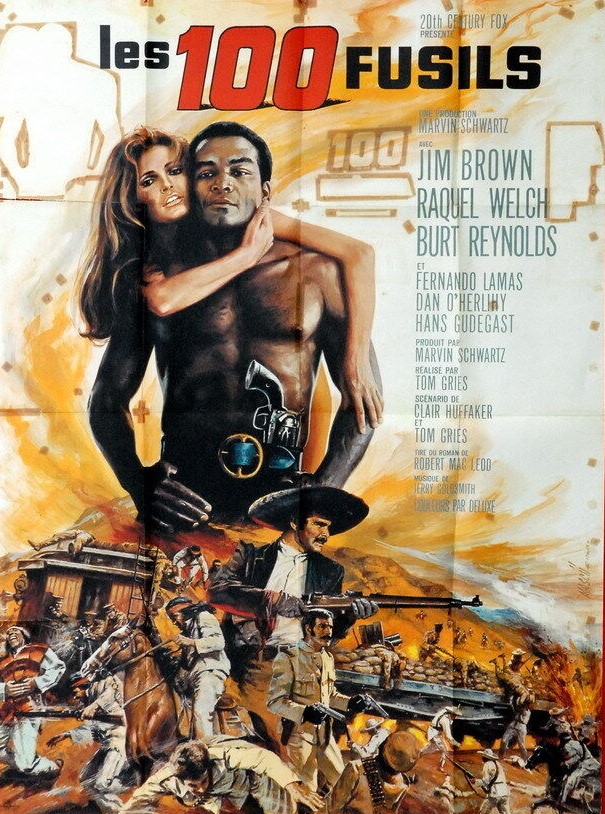
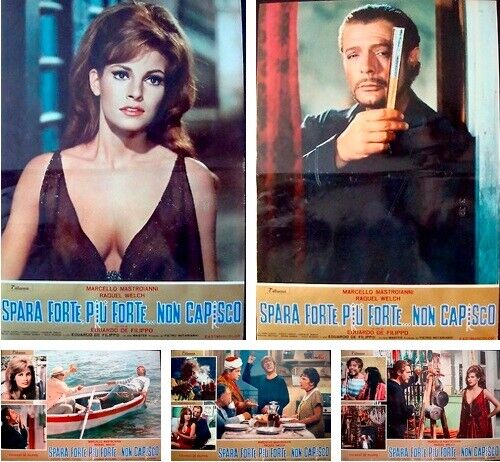
There’s no doubt Welch had single-handedly revived the relatively harmless pin-up business (not for her overt nudity of the Playboy/Penthouse variety) and had a massive following in Europe where she often plied her trade (the Italian-made Shoot Loud, Louder…I Don’t Understand in 1966 and the British Bedazzled in 1967) but she was clearly desperate for more meaty roles. Those finally came her way with Bandolero (1968) and 100 Rifles (1969) and Fathom feels like a lost opportunity to provide her with that harder edge. 

She’s not helped by the odd tone. As I mentioned she gets into plenty of scrapes and proves her mettle with her diving skills. In the hands of a better director and with a few tweaks here and there it could have been a whole lot better and perhaps launched a spy series instead of languishing at the foot of the studio’s box office charts for that year.  

Anthony Franciosa (Rio Conchos, 1964) , still a rising star after a decade in the business, who receives top billing, doesn’t appear for the first twenty minutes. And then he behaves like a walking advert for dentistry, as though his teeth can challenge Welch’s curves. And some of the supporting cast look like they’ve signed up for a completely different movie. Richard Briers (A Home of Your Own, 1965) – Ronald Fraser’s intelligence sidekick – looks like a goggle-eyed fan next to Ms Welch while Clive Revill (The Double Man, 1967) thinks it’s a joke to play a Russian as a joke. Ronald Fraser (Sebastian, 1968) provides decent support.

But it is certainly entertaining enough and you are unlikely to get bored.

Book into Film: A Girl Called Fathom by Larry Forrester (1967)

The blurb gives the game away. The British paperback published by Pan went: “She was blonde. She was beautiful, she was six foot tall. She’d killed the man who had dragged her to the lowest depths of addiction and lust.” The American Fawcett Gold Medal paperback was more succinct: “lady by birth, tramp by occupation and murderess by design.”

If any of that rings a bell, it was not from the film Fathom (1967) starring Raquel Welch which chose to ignore her background and her venomous skillset. The novel opens with the heroine killing a man in cold blood. He had promised her a film career but turned her into a call girl and heroin addict. Her father, now dead, was in the British secret service.  Once she has committed her first murder, she is immediately kidnapped by a secret organization (C.E.L.T.S. – Counter Espionage Long-Term Security) and trained to become an even more ruthless government-sanctioned killing machine.

Larry Forrester was a Scottish television scriptwriter who had worked on a stack of British series such as Whirligig (1953), Ivanhoe (1958) and No Hiding Place (1960-1964) before publishing his first novel A Girl Called Fathom. His sole screenplay was Tora! Tora! Tora! (1970) after which he concentrated on U.S. television including episodes of Fantasy Island (1980-1983) and Hart to Hart (1983-1984).   

A Girl Called Fathom is split into two. Comprising roughly two-fifths of the book, the first section concentrates on her brutal training and on getting her off drugs. There’s a fair amount of sexual intrigue not to mention sex. But also a lover’s betrayal.  For the final part of her training she is abandoned in the middle of nowhere in scorching heat and barely makes it home. “She had passed over a great divide. She was empty, hard – dehumanized. Alone. She would always be alone.” And then she is forced to kill again.

As was common with this kind of book in the 1960s, it was fast-moving and globe-trotting with plenty of realistic detail to offset the preposterous plot. For the remainder of the book, which shifts location to Europe, Fathom is up against an organization called W.A.R. (World of Asian Revolution) which aims to destabilize the existing world order. Her arch enemy is an American-born Soviet agent (and whip and knife expert) Jo Soon (who turns up in the film Fathom in slightly different form as Jo-May). Fathom’s team must protect French elder statesman Paul-Auguste Valmier whose playboy son Damon (who fantasizes about burning people alive), a friend from her past, is her main contact.

The book is peopled by interesting and occasionally outrageous characters – for example Tin (shades of Iron Man), who has hardly a human bone left in his body; the far-from-harmless Aunt Elspeth; and a sadistic colleague who loves her but dare not let his emotions out lest he loose on her his love of pain. The central plot is driven by a mass of twists and turns, heroine endangerment, fights with knife and gun and fist, traitors (naturally) and the clever idea of killing off the leaders of the free world with a bomb hidden in the coffin of a man worthy of a state funeral being held in Paris.

At the end she is counting the human cost of victory and sees herself as one of the walking wounded, a reject, driven from the herd. The film was apparently based on an unpublished sequel so it’s conceivable that the plot concerning the Chinese heirloom was pulled from that in its entirety. But even so the film’s heroine was neutered, not a patch on the ruthless killer with a sordid past outlined in A Girl Called Fathom.

On the Fiddle / Operation Snafu (1961) ***

Unassuming but undeniably charming British World War Two comedy denied U.S. release until four years later when a savvy distributor jumped on the James Bond bandwagon. Primarily of interest these days for the opportunity to see a pre-Bond Sean Connery (Dr No, 1962) in action its merit chiefly lies in ploughing the same furrow, though with a great deal less pomposity and self-consciousness, as the later The Americanization of Emily (1964), of the coward backing into heroism.

Horace Pope (Alfred Lynch) is a scam merchant who only dodges prison by enlisting. Assigned to the RAF he teams up with Pedlar Pascoe (Sean Connery) and they embark on a series of schemes designed to keep them as far away from the front line as possible. It’s hardly an equal partnership, Pope dreams up the fiddles while Pascoe just falls in with them. It’s not dumb and dumber but a collaboration that goes no further back in the annals of movies than brain and brawn.

Needless to say, the movie lacks the the damsels in bikinis which were a prerequisite of the Bond pictures. Sean Connery takes top billing Stateside where he was originally behind Lynch.

It’s certainly a cynical number, reflecting the boredom experienced by many of the Armed Forces backroom staff, the administrators whose inefficiency turns them into easy dupes, and the determination of soldiers to take advantage of every opportunity to bend the rules. It takes the unusual position of presenting the ordinary soldier as smart and every officer as a numbskull, an approach that would only have been possible 15 years after the war ended and in marked contrast to the determined heroism of other British war films – such intrepid stiff-upper-lip behavior a hallmark of the British version of the genre.

First stop is to run an operation issuing leave passes – for a price – and the sheer effrontery exhibited by Pope is a joy to behold. Next up is selling stolen meat on the black market.

While Pedlar is the wide-eyed camp follower, and more likely to forever sit on the sidelines, cheerful but shy, and only a few pratfalls away from being a bumbling idiot, they do make a good team. Being sent to France is more of a heaven-sent opportunity to increase their bankrolls than a hazardous wartime mission as Pope sells rations to the French. Eventually, of course, their various scams are rumbled and they are forced into battle.

The only thing better than one pre-Bond Connery picture is two.

The movie switches a bit more deftly into serious mode than the aforementioned The Americanization of Emily mostly because these are actual soldiers trained to be soldiers rather than an officer who landed a cushy number and whose main effort is to avoid combat. War is presented as horrific rather than comedy and it must have been the same experience for an ordinary soldier at the time, after months of inactivity suddenly thrust into the cauldron.

The picture moves at a brisk pace and is continually amusing if not particularly laugh-out-loud. You’ve probably seen most of the set-ups before but they are reinvented with an appealing freshness and briskness  As a bonus there’s reams of British character actors and comedians – plus token American Alan King (who would appear in Connery starrer The Anderson Tapes, 1971) – along the way. The term “snafu” in case you’re interested, has a similar meaning to the “fubar” of Saving Private Ryan (1998).

Alfred Lynch (The Hill, 1965) doesn’t milk the Cockney patter overmuch and he’s got a greater international screen appeal than the likes of the more English Sid James (Carry On films) or Norman Wisdom. Think a shiftier Sgt Bilko, if the Phil Silvers creation could be any more untrustworthy.

Connery’s performance is well worth a watch as a prelude to what was to come once his roles were tailor-made. He is an effortless scene-stealer, gifted in expressing emotion through his eyes, and although verbally Lynch dominates it’s difficult to take your eyes off Connery.

The roll-call of character actors includes Cecil Parker (A Study in Terror, 1965), Stanley Holloway (My Fair Lady, 1964), John Le Mesurier (The Moon-Spinners, 1964), Graham Stark (The Wrong Box, 1966) and Victor Maddern (The Lost Continent, 1968).

Cyril Frankel (The Trygon Factor, 1966) comfortably cobbles this together from a screenplay by Harold Buchman (The Lawyer, 1970, and who had ironically enough penned the picture Snafu in 1945) based on the novel Stop at a Winner by R.F. Delderfield.

When the box office supremacy of the Bond pictures was underscored by the reissue of the Dr No/From Russia with Love double bill in 1965, distributors, as had been their wont, racked the vaults for anything featuring Connery that could be re-sold to a willing public.    

While there is a readily available DVD, this turns up on a regular basis, in Britain at least, on television.

She Died With Her Boots On / Whirlpool / Perversion Flash (1969) ***

Sexual adventuress takes trip to the country with disastrous results. Best described as an early British venture in the giallo mold it lacks some of the style of that genre but is notable for the debut of Spanish cult director Jose Ramon Larraz (Vampyres, 1974). Perhaps as interesting is that it details a nascent killer warming to his task and climaxes in a nihilistic ending. Scoring so high on the sex/nudity quotient in the U.S., it was considered an out-and-out exploitationer.

Wealthy older woman Sarah (Pia Andersson) brings home model Tulia (Vivian Neves) for her protégé Theo (Karl Lanchbury), a budding photographer.  Sarah’s proclivities are apparent from the start, preferring young women though young men will also suffice, a switch in the normal power play of the era (and now for that matter) of rich old men chasing younger women.

Tulia is no innocent, lured or straying into the big dark house, and she’s game for anything, happily participating in a game of strip poker that ends in sex with Theo. However (and striking a contemporary note), he is unable to perform – for reasons that might be similar linked to young people today who suffer from the same condition due to over-exposure to porn – and in Theo’s case because he prefers watching.

Quite how far he is willing to go to achieve his kicks is shown in a scene where he drives Tulia to the woods where she is almost raped by his friend Tom so that Theo can photograph the act. Quite how far Tulia is willing to go is indicated by the fact that, while upset at this incident, she doesn’t run a mile and instead continues to enjoy games of seduction, this time with Sarah, with Theo at first limiting his participating to recording the action but later taking part in a menage a trois.

Meanwhile, a Scotland Yard Detective Inspector (Barry Craine) interrogates businessman Mr. Field (Edwin Brown), sugar daddy to missing Irishwoman Rhonda (Johanna Heger), and Field takes it upon himself to pay Theo a visit. Quite how he knows of Theo’s involvement with Rhonda is unclear but he doesn’t accept the explanation that the girl has gone home and hangs around to do a bit of spying. Not such a good idea, because he pays the penalty.

Although it’s a pleasant detached cottage and far from an old dark house, Tulia takes it upon herself to take a look at Theo’s studio where she finds various items of female clothing and photos of an unsavoury nature. A flashback reveals the death of Rhonda, seduced by Tom, then, following the arrival of Theo and his trusty camera, raped by a tramp. But it’s not Theo who kills her. It’s Tom, and largely by accident.

So what’s being set up really is how far beyond his normal games Theo will go, with Tulia providing the test case.

A chunk of the tension comes from having no idea what’s going on beyond Sarah indulging Theo. She appears ignorant of the depth of his perversion. And with Tulia being so complicit initially in the sex it appears to be going down a different route to the slasher pictures like Scream and more in keeping with the giallo which had yet to get into its stride. Tulia is a modern girl for the times, certainly not sexually repressed, which was refreshing, and being a model comfortable with her body. But she would not have been expecting something like this.

Karl Lanchbury (What’s Good for the Goose, 1969) looked like he was perfecting the creepy persona that would carry him through a few more Larraz pictures. Vivian Neves was a model, famous two years later for featuring in the first nude advertisement in The Times, but also a glamour model with pictorials in Penthouse and The Sun, and known as “The Body” a quarter of a century before that title was appropriated by Elle Macpherson, and later set up her own modelling agency. Pia Andersson only made this one picture.

Given he was dealing with so much inexperience and was himself a debutant, Larraz does a pretty good job. He would go on to make another 25 films mostly in the exploitation vein.  

I came across this on YouTube while looking for the Otto Preminger film noir Whirlpool (1950). The version I saw is taken from a very ropey VHS with time codes but there’s a better print on the channel under the title of Perversion Flash.

Discover WordPress

A daily selection of the best content published on WordPress, collected for you by humans who love to read.

The Atavist Magazine

by Brian Hannan

WordPress.com News

The latest news on WordPress.com and the WordPress community.