The Naked Edge (1961) ***

What a potential cinematic coup. Upstanding Gary Cooper (High Noon, 1952) a villain? That’s the entire premise and a bold one at that.

Businessman George (Gary Cooper) is the key witness in the trial of alcoholic colleague Donald Heath (Ray McAnally) on charges of murder and theft of £60,000. But after Heath is convicted, George’s wife Martha (Deborah Kerr) begins to suspect the wrong man has been found guilty. Her husband has suddenly come into a large sum of money from, he claims, playing the stock market and at the trial’s conclusion is accosted by a stranger, Jeremy Clay (Eric Portman).

The “red danger warning flashing light.”

Several years a later blackmail letter comes to light, increasing Martha’s doubts. After all this time, George can’t quite lay his hands on the documents regarding his stock market claims. He is spotted in London when he should be abroad. 

Martha is so convinced something is wrong that she writes a cheque to Heath’s wife (Diane Cilento) not realizing how shady this would look if the case was revisited. Alarming incidents mount up – her husband’s razor, an invitation to walk along a clifftop. Much of the pressure is self-generated. She has put so much faith in her husband that she would be destroyed if he was guilty, so he must be innocent. Except she can’t quite get rid of the nagging voice.

For his part, George behaves so oddly, being caught out in lies about his whereabouts, and except, conversely, on his insistence that for the sake of their love she must trust him, he does little to shake the doubts especially when Clay pops up again reasserting his misgivings. Since there is no sign of a police investigation, Martha is solely responsible for creating the tension. And, with her out of the way, life might be a lot easier all-round.

The much-vaunted “final 13 minutes” – as promoted in the poster – certainly justifies the tension but outside of whatever’s going on in Martha’s head much of that has been created by bursts of melodramatic music, sudden close-ups and continued emphasis on her point-of-view.

This was Gary Cooper’s final film and it wasn’t the kind of triumphant send-off achieved by Clark Gable (The Misfits, 1961) or Spencer Tracy (Guess Who’s Coming to Dinner, 1967). It might even have been a surprise choice, audiences more accustomed to find him in westerns – add Vera Cruz (1954) and Friendly Persuasion (1957) to his star turns in that genre. But although he had made nine westerns in the previous decade, he also starred in six non-westerns, including a politician-businessman in Ten North Frederick (1958), and wasn’t averse to playing less than straitlaced characters.

That grim determination that become a hallmark when upholding law and order easily transitioned into just grim determination against whatever threatened his well-being. Of course, the whole enterprise relies on sleight-of-hand but that’s par for the course.

Deborah Kerr had ended the 1950s as a strong-minded female but now seemed to be hell-bent on exploring her fragility and this role seems a direct line to characters played in The Innocents (1961), The Chalk Garden (1964) and The Night of the Iguana (1965).

Audiences were used, by now, to being told when they could enter a theatre. Remember, this was in the glory days of the continuous performance when customers could take their seats at any time during a screening not, as now, before the picture started. You might think it odd that people were barred from entry during the final 13 minutes, as if anyone would consider this a good time to enter, but it was very common for people to take their seats at any odd time. Just in case people didn’t have watches to hand, cinemas were instructed to install a red light and have it flashing in the lobby to prevent interlopers entering. Alfred Hitchcock, of course, invented this clever marketing ploy of annoying the customers for Psycho (1960) but it was still going on as late as Return from the Ashes (1965).

Not Cooper’s greatest film but a decent two-hander that might have worked better if there had been more of a sense of gaslighting Kerr. That it works at all is down to the actors, not a bad achievement when you consider the director was asking the audience to go completely against type in accepting Cooper as a potential killer.

British director Michael Anderson (The Quiller Memorandum, 1966) had the sense to ignore the attractions of tourist London and concentrate on suspense. Joseph Stefano (Psycho) based the screenplay on a novel by Max Ehrlich.

Mickey One (1965) ***

Smorgasbord of paranoia, Kafka and the surreal, set in an American netherworld. Cue trampolines, a mime, what these days we’d call installations, a comic without a decent joke, a wrecker’s yard, organic food, catering kitchens. You could call Arthur Penn (Bonnie and Clyde, 1967) a visionary director just for including some of these aspects. Or you could go for another contemporary word: “random.”

We are pretty used to people being on the run be they innocent of the crime of which they are accused or small-time hoods trying to evade punishment. The notion here is of small-time hood Mickey One (Warren Beatty) fleeing Detroit for Chicago but with no idea for what crime, though the list could include gambling debts and stealing a bigger gangster’s moll.   

A misleading tagline if ever.

His situation is spelled out often enough in case you’ve not got the picture. “Hiding from you don’t know who for a crime you don’t know you committed,”  remarks girlfriend Jenny (Alexandra Hay). In a particularly Kafkaesque moment, Mickey espouses: “The only thing I know is I’m guilty – of not being innocent.”

Smart with the words but not so smart with the actions. Even though he can just about get by  as a kitchen wash-up, he gets sucked back into his former profession of stand-up comedian, hardly the most anonymous of jobs. So he is all angst-on-fire when success in some low dive, keeping clients entertained between strippers, attracts interest from a classier joint which naturally sees marketing the new prospect as part of the deal.

Some of this paranoia might just be in his head were it not for being stalked by car-crunching cranes in the wrecker’s yard, spotlights on stage (though you could point out that’s an occupational hazard) and a silent rag-and-bone man.

It says something for the acting of Warren Beatty (Kaleidoscope, 1966) that this is in any way believable. The fast-living lothario of the opening sequence, with gals and booze aplenty, segues into a bum without missing a beat. His paranoia is consistent and he makes some attempt to find out what the heck he has done to end up this way, though it has to be said there’s no actual evidence of pursuit, just the fear of it, and the notion that he owes somebody maybe twenty grand or that the lass tempted into stripping for him was stepping out of line.

Pretty good plug from a top critic and an arthouse opening – what else could you ask for?

His breadline living is realistic, too, hitching a ride on a train, bumming food from a mission, sleeping among bags of rubbish, a world where down-and-outs steal the clothes from the back of other vagrants and his job is scraping leftover food from plates in a cafeteria. And there’s always someone at the scam, his landlady dumping another tenant (Jenny) in his tiny apartment.

Maybe less realistic that club owners are lining up to hire him when there’s nary a laugh in his schtick. The biggest joke is in the casting, some kind of infernal joke on audiences to put the likes of the uber-handsome Beatty through mental and physical torture, albeit that he’s perceived as man of abundant talent and collects with ease women willing to put up with the depressive side of his nature.  

The movie doesn’t quite fit the Kafka mold because being on stage represents freedom and nobody in Franz’s world ever had a sniff of that. And you wouldn’t call it a thriller either. And if it’s a homage to the French New Wave you’d have to watch a stack of French pictures from this decade to work out what it’s mimicking.

And it’s not like Penn’s work is always on this kind of edge, he’s not the David Lynch of his generation. Every top director is permitted at least one turkey, and this would have been Penn’s except critics in the 1990s started to give it the old reassessment treatment, Penn being a big enough name from his other works to have a stab at how this fits into his repertoire/oeuvre.

So, far from being an intolerable mess. Doesn’t quite ask the big questions Penn hopes it does. More of a curate’s egg of a picture, some interesting ideas, and an excellent performance from Beatty. Alexandra Hay (Only When I Larf, 1968) was part of the French connection, a Canadian model who had hit it big in Paris, with roles in French pictures and an affair with director Louis Malle. But actually she’s good, not the kind of submissive woman Mickey has perhaps been used to, but thoughtful and capable of challenging his illusions.

Screenwriter Alan Surgal was not prolific, this being his only movie.

Charade (1963) *****

Arguably the slickest thriller ever made. Two stars at the top of their game, three rising stars giving notice of their talent, more twists than you could shake a Hitchcock at, the chance to frighten the life out of the most fashionable actress of her generation, and standout scene after standout scene.

Three characters are presented upfront as bad guys, but whole enterprise is so laden with suspicion you are not all surprised when the finger points at Peter (Cary Grant) and Reggie (Audrey Hepburn), not least because Peter keeps changing his name, but also because audiences with lingering memories of film noir could easily imagine Reggie as a femme fatale especially when she comes on to a man whose got three decades on her.

Basic story: Reggie returns from a ski holiday where she met divorced Peter to find her husband dead and Parisian apartment empty. She is menaced by three men – Tex (James Coburn), Herman (George Kennedy) and Leopold (Ned Glass) – convinced she knows the whereabouts of $250,000 they lay claim to. Bartholomew (Walter Matthau) of the C.I.A. also stakes a claim. Tex has a nasty habit of throwing lighted matches at her, Herman threatening her with his steel hand. And there are doubts about Peter, initially perceived as a savior.

It is a film of such constant twists, you never know quite where you are, and forced to follow the lead of a befuddled and confused Reggie you question everything, so it’s an unsettling watch. Given the permutations, you could easily come up with a number of different endings.

And although this is virtually thrill-a-minute stuff it has the most endearing light romance, full of beautifully-scripted sparkling cross-purpose banter, and managing to work in marvellous scraps of Parisian atmosphere, some tourist-hinged (a market, boat ride on the Seine), others (a subway chase) less exhilarating. At times, Reggie turns spy and comes up with clever ruses to evade pursuit.

You can have this amount of conflict – baffling clues, perplexed French Inspector Grandpierre (Jacques Marin) kidnap, rooftop fight – without corpses soon mounting up. Alleviating the tension are a myriad of little jokes: a small boy with a water pistol, time out in a night club to play the rather frisky orange game, Peter showering with his clothes on. The romance might have helped except every time Reggie trusts Peter he gives her good reason to distrust him. And, of course, she could as easily have squirreled the money away herself.

The whole ensemble is delivered with such style and attention to detail (a bored man at a funeral clips his nails, cigarettes are expensive in France, voices echo when a boat passes under a bridge, phone booths are both refuges and traps) that it’s as if every single second was storyboarded to achieve the greatest effect.

It’s not just the entrance of the bad guys, door slamming in an empty church, that signals a director alert to every nuance, but the fact they all proceed, in different ways, to check Reggie’s husband is actually dead. A man has drowned in his bed. “I sprained my pride,” explains Peter after coming off worse in a fight. Apart from the core tale of suspicion, betrayals, theft and murder, everything else in the thriller genre is completely revitalized, in dialog and visuals this is nothing you have ever seen before.

The principals invest it with a rare freshness. Cary Grant (Walk, Don’t Walk, 1966) and Audrey Hepburn (Two for the Road, 1967) are such natural screen partners you wonder why (expense apart) the exercise was never repeated. And in typical John Wayne fashion, to minimise the May-December romance element, it’s Hepburn who makes all the running in that department, and you get the impression that she had been married to an older man anyway. Grant’s character is surprisingly adept at the old fisticuffs while Hepburn is more feisty than helpless, and devious, too, not above using the old screaming routine as a device to bring Grant running for romantic reasons.

James Coburn has his best role since The Magnificent Seven (1960), Walter Matthau (Lonely Are the Brave, 1962), at this point not considered comedian material, brings very human touches to his role, and George Kennedy (Mirage, 1965) presents a memorable villain.

And that’s not forgetting an absolutely outstanding score by Henry Mancini (Hatari!, 1962), jaunty one minute, romantic the next, and for the most thrilling sequences creating the type of effect David Shire achieved in All the President’s Men (1976) of steadily mounting tension rather than instruments shrieking terror. And the Saul Bass-style title credits were actually conceived by Maurice Binder of James Bond fame.

Outside of his musicals, this is the peak of Stanley Donen’s (Two for the Road) career. The gripping screenplay was the work of Peter Stone (Mirage), based on a story by Marc Boehm (Help!, 1965).

One of the few twist-heavy thrillers that rises effortlessly above the material.

100 Rifles (1969) ****

Highly under-rated but effective western that cemented Raquel Welch’s position as the queen of the genre, established Jim Brown as the first African American action star, scored points for its parallels with Vietnam, and provided the only image of the actress to rival that iconic fur bikini.

Arizona lawman Lyedecker (Brown) arrives in Sonora, Mexico, in 1912 on the trail of half- breed bank robber Yaqui Joe (Burt Reynolds). He finds the Mexican army callously executing Yaqui Indian rebels. To prevent further killing, Joe creates a diversion, which, while failing, permits the captured Sarita (Raquel Welch) to escape. The $6,000 Joe stole buys the titular 100 rifles to help the rebel cause.

Most posters played up the action but here the emphasis is on La Welch.

Helped by Lyedecker, Joe escapes, picking up Sarita on the way. Both Lyedecker and the Mexicans are in pursuit, and the Mexicans soon recapture Joe and Lyedecker, who is now viewed as a rebel. Sarita again escapes. Lyedecker and Joe are returned to the garrison where the Mexicans have taken possession of the rifles. Just as the pair are put in front of a firing squad, Sarita, leading a group of rebels, frees them and steals the weapons.

In retaliation, the Mexicans attack a village, slaughtering the inhabitants and taking the children as hostages. At night, Lyedecker, Sarita, Joe and some rebels capture the garrison before the soldiers return, freeing the children. Lyedecker has been injured in the battle; after Sarita binds the wound, they make love.

When they take the rifles to the rebel stronghold, they discover the rebel leader is dead. For no particular reason, the rebels elect Lyedecker their new “generale.” Seizing a Mexican troop train is pitifully easy once Sarita creates a diversion by taking a shower under a water tower. The empty train is sent cannoning into the town and in the ensuing battle Sarita is killed. Yaqui Joe takes over leadership of the rebels while Lyedecker rides home.

While the capture- escape-chase-capture formula is overdone, the movie’s biggest structural problem is Yaqui Joe, clearly turned into a drunk to avoid becoming a romantic encumbrance for Sarita, leaving the way clear for Lyedecker. His other contributions are to brawl with Lyedecker and try to get the American to give up his quest and stay and help the rebels. There are other unnecessary characters and touches. We know it is a modern western because  a motor car is involved as there would be in The Wild Bunch. The sole purpose of a German military adviser Von Klemme (Eric Braeden) is to act as a sounding board for Gen. Verdugo (Fernando Lamas), whose actions in any case speak louder than words. Railroad magnate Grimes (Dan O’Herlihy) represents equally callous big business. When Americans get drunk in westerns, that usually leads to fisticuffs, but when Indians knock back the liquor in 100 Rifles they act like clichéd drunken Indians, tearing up the town, looting and destroying anything in sight.

These reservations apart, the film has a great deal to recommend it. On the whole, it is well directed, although without much of an eye for landscape. Sarita, wearing a red headscarf, thus  continuously color-coded, is accorded the greatest emotional depth, haunted by guilt for sacrificing her father in the name of freedom: “I helped him to die.” But she has another weapon at her disposal: her body. When captured, she distracts a soldier with sight of her breasts before stabbing him, the shock in her eyes suggests this is the first time she has killed a man.

Although the narrative advocates her as feisty leader from the start, this scene, and in particular her reaction, suggests otherwise. More than capable of taking care of herself, it is she, and not the two stronger men, who effects an escape. When she organizes the rescue of the two men, she’s more interested in the guns than them. But when it comes to children, they take precedence.

The genocide theme, pertinent both to American treatment of its own indigenous Native Americans and to the current war in Vietnam, is raised. It is more trouble than it’s worth for Gen. Verdugo to clear the Indians from their lands and ship them elsewhere, as the Americans had done when putting Indians onto reservations. Verdugo has few compunctions. Unlike in The Wild Bunch and Butch Cassidy and the Sundance Kid, here the railroad is a tool of control. Trains loaded with troops and guns (including Gatling guns, also seminal to The Wild Bunch) and artillery can travel with ease across alien territory to keep the inhabitants in check. As exemplified by Grimes, railroads also represent the intrusion of big business into politics and ordinary lives, and the railroad man, while concerned that Lyedecker’s possible execution could jeopardize U.S.- Mexican relationships and, by extension, possible halt the American railroad’s expansion, is ultimately more apprehensive about damage to running stock than the cost in human lives of his partnership with the Mexicans.

There’s a nod to seminal Sidney Poitier picture The Defiant Ones (1958) with Lyedecker and Joe chained together, and the American, initially disinterested in rebellion, only takes up the cause after a child he has befriended is slaughtered.

100 Rifles shares with The Stalking Moon, The Wild Bunch, Mackenna’s Gold, and Butch Cassidy and the Sundance Kid the theme of relentless pursuit, of an implacable enemy, often with justice or morality or power on their side, who will never give up, and, in a twist on this, in True Grit Rooster Cogburn is the one in fearless pursuit.

At the time, in male-dominated society, the sexual centerpiece was Raquel Welch in various states of undress, forgetting that women, too, were apt to be partial to the sight of an unclothed muscular male. It is Jim Brown who is first seen shirtless. And it is Sarita who takes control of the scene, kissing him as a reward “for all the bad things I said to you.” (Another gender twist, for usually it is the man making reparation.) A more tender scene between Lyedecker and Sarita, ostensibly of the more traditional kind, feisty female   transformed into docile housewife by cooking her man a steak invited another reading, more in keeping with her character, not, you may notice, clinging to him, desperate for his love, but happy to enjoy the moment and abandon him when it suits (as Katharine Ross will in Butch Cassidy and the Sundance Kid, departing before the outlaws die).

For many, of course, the highlight is Sarita, the leader in all but name, using her body as weapon. As the train approaches the water tower, the soldiers see Sarita standing underneath dressed in only a man’s shirt, taking a shower. The train shudders to a halt for this voyeuristic delight; the camera too, for the audience’s sake, lingering on Sarita’s curves.

Although 100 Rifles is ponderous and improbable in places, with too much emphasis on escape- and-rescue, it certainly achieves its immediate aims, setting up Brown as an action man, giving Welch a role that’s hardly subordinate, ensuring the combination is as sexy as all get-out, while at the same time supplying enough shoot- outs and battle scenes to keep traditionalists happy. As important, director Tom Gries (Will Penny, 1968) is not afraid of using the film to make points, if sometimes a little heavy- handed, about Vietnam and genocide. Clair Huffaker (The Hellfighters, 1968) wrote the screenplay along with Gries based on a Robert MacLeod novel.

All in all, a movie that deserves a good bit more respect.

This review is an edited version of an article that appeared in The Gunslingers of ’69: Western Movies’ Greatest Year (McFarland, 2019) by Brian Hannan (that’s me).

Shoot Loud…Louder, I Don’t Understand (1966) ***

The Raquel Welch picture nobody’s seen. Which is a shame because she demonstrates considerable comedic flair. And there’s a freshness and naturalness – almost a youthful gaucheness – about her that’s lacking in other movies where she was developing her more iconic acting style.

Tania (Raquel Welch) literally bumps into sculptor Alberto (Marcello Mastroianni) when his latest acquisition, an iron gate (locked naturally), blocks a footpath. Intrigued, she enters his Aladdin’s cave of artefacts and is frightened by his mad uncle who communicates via fireworks. With a start like that, you’re either headed for gentle romance between sensible young woman and less sensible artist, the usual on-off on-off scenario, or, this being quirky Italy and the director the even quirkier Eduardo Di Filippo (better known as a playwright – Saturday, Sunday, Monday) it’s going to follow a different route.

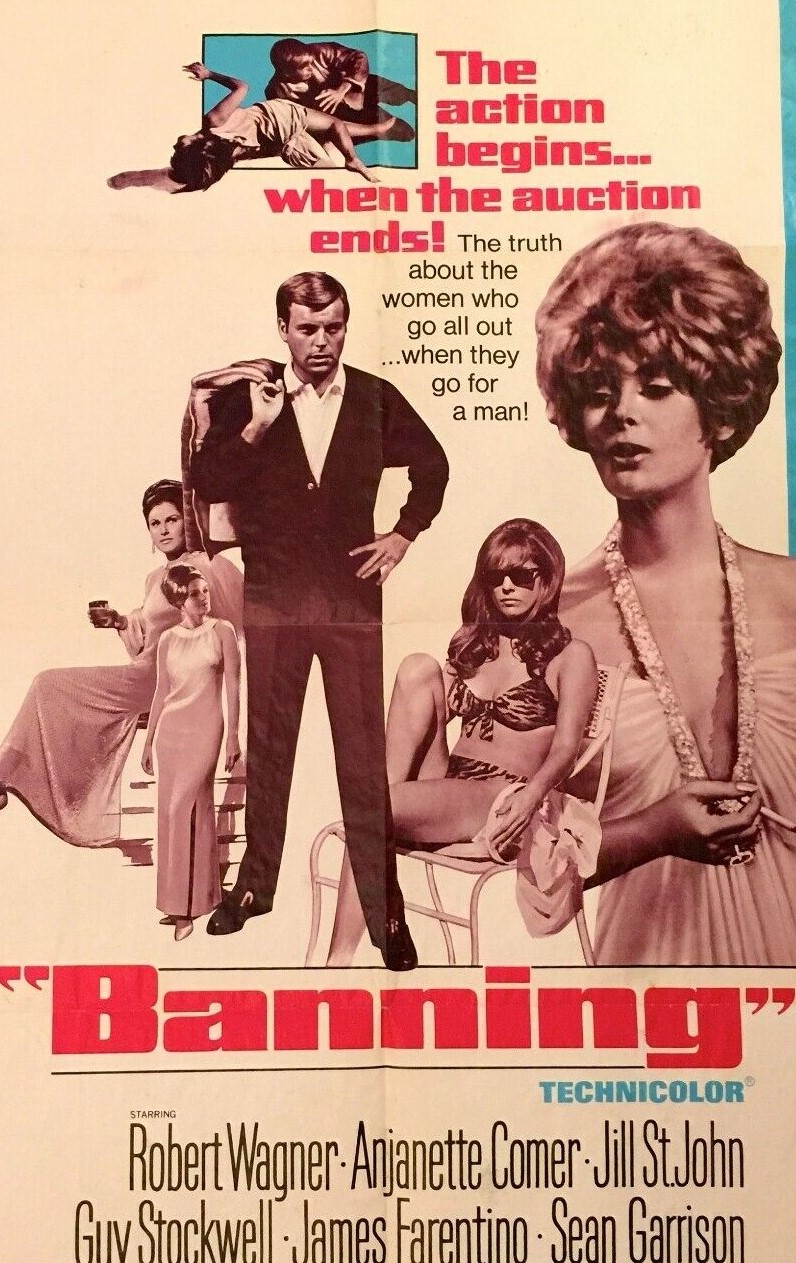
While Raquel Welch is for the most part costumed in alluring dresses she does not wear a bikini as in the poster at the top.

And so it does. Alberto thinks he has witnessed the murder of neighbor Amitrano (Paolo Ricci) – blood-soaked glove one clue – but when he confesses it might have been a delusion, something to which he is prone, he is arrested because the dead man was a gangster.  That sets a surreal tone – chairs raining from the sky, anyone?, a coffin full of potatoes, fortune tellers – and for some reason Alberto (who has received a bang on the head) begins to think Tania is also a figment of his imagination.

You can see where that idea came from, the delectable Tania in cleavage-resplendant form wearing dresses with clasps that appear unwilling to do their job. But on the other hand, he is handsome enough, with an artistic beard, and I doubt it would be the first time he had attracted a beautiful woman.

Tania is certainly a character, driving around in a sports car (with pink drapes) that appears to float rather than drive, containing another receptacle for a blood-soaked glove and with hot food in the glove compartment. In fact, she carries around a goodly supply of this local delicacy in case she might feel hungry in a police station or what have you.

Raquel Welch wasn’t girl of the year when this was made but by the time it was released in the USA in 1968 she had made a name for herself, in particular being named Star of the Year by one of the industry’s exhibiting organisations.

There’s certainly a bunch of dream-like sequences. After he finds a bloody knife and bloodied clothes Alberto gets punched on the head by a turbaned man, only to wake momentarily and fan his face with a fan, the kind of imagery Fellini could have dreamed up in his sleep. But this is set against a realistic backdrop, neighbors screaming at each other in the traditional Italian manner.  

So, what we are left with is a perfectly acceptable comedy where Alberto is accused of a crime he didn’t commit but the film might be too Italian for most tastes. This was made before La Welch achieved screen notoriety through the donning of a fur bikini and critics tended to look on Mastroianni (A Place for Lovers, 1968) as a serious actor rather than someone mixed up in this kind of gentle tomfoolery. I thought he was excellent in the role. But that was par for the course here, everyone dismissed.

De Filippo (Ghosts – Italian Style, 1967) didn’t have the kind of critical following ascribed to the likes Fellini and Antonioni so if this fitted into his normal style nobody was aware of it. But I’ve a feeling that this quirkiness was one of his hallmarks.

If you accept it on face value without looking to insert some kind of meaning then it makes perfect sense. As I mentioned, although her voice is dubbed, Raquel Welch (Bandolero, 1968) comes across very well, especially as, despite the enticing attire, she is not required to be all sexed-up or carry the dramatic weight of the tale, unlike the westerns where she is generally an object of lust and continually attempting to assert independence.

Having said that, this is particularly hard to track down, so you might not think it’s worth the bother. But, of course, if you are a Welch completist, nothing will be too much trouble. However, you’ll need to scour the second-hand markets to find a DVD.

Wild in the Streets (1968) ***

Far more prophetic than you would have ever thought possible in acknowledging the growing power of the young, the pandering of politicians to them, and the unexpected ability of youth to see through politicians and set their own agenda. Plus, Christopher Jones gives the kind of performance that had David Lean rushing to sign him up for Ryan’s Daughter  (1970).

It was prescient, too, of its time, not just the notion that the young could lead the way in opposition to political forces.   

And what top pop star has not believed they could harness their global following for the greater good – Live Aid the classic example – and once you’ve bedded your way through the known female universe and sampled every drug known to man there has to be something else that’s going to grab your attention. And, for once, a movie star makes a very credible pop star.

Max Frost (Christopher Jones), channelling his inner Jim Morrison, is on top of the world, a phenomenon, the biggest thing since Elvis and The Beatles. His rebellious streak emerges at an early age. And where other nutcases would torture animals or pull the legs off spiders or play with matches, he blows up the family car. But he’s something of a statistician and reacts to the notion that there are more young people than old people – 52 per cent of the population is under 25 – by writing a song about it, a song that turns into a protest that segues into a movement.

Aspiring politician Fergus (Hal Holbrook) thinks he can harness what he perceives as a dumb youngster with fans so dumb they will ape his every command. His vote-winning idea is to campaign on a platform of lowering the voting age from 21 to 18, not that revolutionary an idea since ever since American men were shipped off the Vietnam there had been similar calls along the lines of too young to vote but not too young to die.

Max pretends to back him but instead demands the voting age be reduced to 14. This being politics, there’s negotiation, and the compromise is reducing the age to 15. The ever-read Max has songs covering whatever age is agreed.

Bandmember Sally LeRoy (Diane Varsi) is elected and gets a law passed to lower the voting age. Fearing youth and somehow assuming Max will curb their worst excesses, older politicians support his bid for the Presidency (as you may know, anyone in the U.S. can become President even if they lack political experience) but once he gains power he turns on them and forces through a law making retirement compulsory at 30. And goes about, Heaven help us all, doing good, albeit with a dictatorial agenda.

But the fairly straightforward satire, puffed out with endless scenes of public demonstration, works very well, and not just because the power of youth is demonstrated everywhere today, not least among Hollywood mavens who seem unable to make anything that doesn’t appeal to that age group, but because the brain behind the scheme are actually pretty smart. The group is presented as  clever all round, their excessive income down to the business acumen of Billy (Kevin Coughlin) so the band have no chance of ending up penniless, ripped off by everyone in sight. Sally is a former child star so she’s been taken advantage of already and ain’t going to let it happen again.  There’s a clever sting in the tale that takes the campaign to its logical conclusion.

It’s great fun seeing grizzled politicians being outsmarted by Max and his cohorts and for the older population to, unwittingly, get a taste (no pun intended) of what it’s like to be young. Audiences went for this in a big way since it presented an alternative universe, part sci-fi but also with some imminently achievable aims, some of which came to fruition. Hollywood was brought to heel the following year after Easy Rider, only in retrospect anyone realizing that the rescue from box office oblivion of 2001: A Space Odyssey (1968) by spaced-out hippies was a turning point not a one-off.  The voting age was lowered a couple of years later.  These days, of course, nobody needs elected or has to pass a law for changes to be made, and far quicker than if they had to go through the political process. Developments nobody voted for have been forced through by the court of public opinion, though sometimes by the very minorities that were once outside the existing power base.

Christopher Jones (Three in the Attic, 1968) delivers his best performance in what turned out to be a very short career. Shelley Winters (A House Is Not a Home, 1964) gives another scene-stealing turn and on back-up are Hal Holbrook (All the President’s Men, 1976) , in only his second movie, Diane Varsi in her biggest role to date, Millie Perkins (The Diary of Anne Frank, 1959) and an early showing from Richard Pryor.

Barry Shear (The Karate Killers, 1967) directed from a screenplay by Robert Thom (Death Race 2000, 1975).

You could probably go through this ticking off what predictions have come true and it’s more powerful now than it was at the time.

Titanic (1997) ***** – Seen at the Cinema in 3D Imax

You might have thought it the height of Hollywood hubris for James Cameron to assume Titanic could steal the Valentine’s Day crown from Humphrey Bogart-Ingrid Bergman World War Two lovelorn Casablanca (1942). But bear in mind Casablanca had replaced Doctor Zhivago (1965) as the movie’s greatest love story and that, in turn, had superseded Gone with the Wind (1939).

Each followed a similar recipe – cataclysmic event, except Casablanca epic in scope, except Gone with the Wind memorable song,  except Clark Gable introducing relative newcomers, perhaps most of all fabulous screen charisma between the male and female leads. Titanic, of course, has a late twentieth century vibe, more action than drama as the lovers, often pursued, hurtle from one potential disaster to another, and are within a lifejacket and a large enough piece of flotsam of a happy ending.

But where Rhett Butler (Clark Gable) and Rick Blaine (Humphrey Bogart) exhibited world-weary cynicism and Zhivago (Omar Sharif), though his occupation, achieved maturity, Rose (Kate Winslet) and Jack (Leonardo DiCaprio) are little more than blossoms blown on the wind, as innocent as a fresh coat of paint. Jack grows up fast, fast enough to hold his own among the upper class, strong enough to whisk Rose away from a life of servitude to a male ideal.

In some respects, to use the modern idiom, she is the ultimate Final Girl. On several occasions, she rescues him, plunging through the rising torrent to find him and cleave his handcuffs with an axe. She risks far more than he. Vengeful fiancé Cal (Billy Zane) and his ruthless henchman (David Warner) would easily chuck Jack overboard given the chance.

In essence, the story is light. Spoiled brat saved from a half-hearted suicide attempt, Jack embraced by Cal as a means of humiliating him, various attempts to smear Jack, Rose finding a freedom below stairs she never expected, shown a world of opportunity beyond her ken, taking the lead in sexual matters, lightly mocking Jack for blushing at her nudity even as she shamelessly and confidently strips.

And told against the backdrop of a ruthless caste system, where only the “better” people can survive and millionaires see “winning” as the embodiment of entitlement. Cameron holds up a mirror to the supposedly classless America and a world of enterprise where lifeboats are viewed as an obstacle to beautiful design. The two outsiders, Rose’s mother (Frances Fisher) and Molly Brown (Kathy Bates) are opposites, the latter, by dint of inheritance pushing her way brusquely into society, the former meekly trading her daughter for a life of privilege.

And the romance is given a twist when cold-blooded Cal proves to be as obsessed by Rose as Jack, the several times offered safe passage turning it down to pursue her, and not in the end as an object to be collected but as the subject of his restrained passion.

But you would need extraordinary acting to keep you glued to the screen when there were so many other astonishing visuals and even at the distance of a quarter of a century the power of DiCaprio and Winslet just blows you away. Sure, there is a bit of will she-won’t she, but once we’re past that it’s romance as a breath of fresh air, DiCaprio mixes devil-may-care with adoration, Winslet bristles, succumbs and then takes the lead, the sheer exhilaration of it all the bulwark against the drama of the slowly sinking ship.

It’s a fabulous scenario, Cameron careful to allow other elements to float into place, the officers assuming sacrificial stance, the hunt for the mythical jewel that kicks off the tale and provides meaningful coda.

I’m sure it helped that DiCaprio and Winslet were mere rising stars, otherwise I doubt if someone with more box office clout would have stood for the endless hours/days/weeks in freezing cold water (I don’t think you could heat it up even in a studio setting) and without their genuine travails it would not have worked so well.

It’s worth noting that DiCaprio went on to become – along with Brad Pitt – the last of the genuine stars and that he forsook the easy route of romantic lead for more interesting and complex characters and embraced an association with Martin Scorsese that took him to darker places than the likes of Paul Newman or Harrison Ford ever dreamed. Winslet, too, has enjoyed a memorable career, perhaps entranced too often by the arthouse, but you can hardly argue with one Oscar and six nominations.

On a personal note, I realised I had passing acquaintance with two of the actors. When I worked backstage at the Citizens Theatre in Glasgow, I would often come across Jonathan Hyde (the arrogant Ismay). One role he played quite astonished me. Not so much the role (and I can’t remember what it was) but, if you like, the preamble. When audiences entered the theatre they were faced with the sight of Hyde sitting on stage in full costume and in character, as if this was Method Acting taken to an extreme, waiting for the play to begin.

I was at university with Ron Donachie (the master at arms). We both studied Drama at Glasgow University. This course was never intended to produce actors, and mostly it set students on a path to theatre management and the like, including a friend Anne Bonnar who went on to head up Creative Scotland. But, of course, it was always a route into acting if that was your ambition. Ron Donachie and another friend Duncan Bell (British television series Heartbeat) took the opportunity. Needless to say, my stint at the Edinburgh Festival Fringe was enough to convince me that acting was not my forte.  

Sgt Ryker (1968) ***

Universal pulled a fast one with this tidy courtroom drama. The studio resurrected a two-part television piece originally made as the The Case Against Paul Ryker five years before under the Kraft Suspense Theatre brand to capitalize on the unexpected box office success of Lee Marvin, the decade’s most unlikely new star after a straight run of hits from the Oscar-winning Cat Ballou (1965) through western The Professionals (1966) to The Dirty Dozen (1967).

Re-titled and hoping audiences would not notice the sleight of hand, this was thrown out into first run. By normal standards it would be deemed a flop for a star of Marvin’s newfound magnitude but the $1 million notched up in rentals Stateside and more overseas prove a handy cache of found money for the studio. Audiences might have smelled a rat when the star’s name came at the bottom of the opening credits with an “And” billing, which generally denoted guest – rather than main – star.

Still, despite being promoted as an actioner, posters show Ryker with machine gun in hand in the midst of a battle scene – there is such a scene but Marvin plays no part in it – it’s actually a decent drama, especially given the unusual background. Set in 1951 during the Korean War there’s nothing gung-ho about it. The Americans are retreating, evacuating Seoul, when army attorney Capt Young (Bradford Dillman) feels Ryker was short-changed during a trial that condemned him to death as a traitor.

Young and Ryker’s estranged wife Ann (Vera Miles) embark on a deadline-dogged mission – he’s due to be hanged in a couple of days’ time – to clear his name. Strafed by enemy planes during a trip from Tokyo to Seoul, there’s a hint of nascent romance. And when they are later caught together in a clinch, this adds to the murky atmosphere, Young facing court martial accused of the deadly sin of having an affair with a colleague’s wife and deemed a pariah by colleagues. He has another strike against his name – he dug up a grave.

The situation is exacerbated by high command caught between troops needing the morale-booster of seeing a traitor hanged and fearing scandal if they are found after the event to have sent an innocent man to the gallows. And there is the irony that Young, in his capacity as prosecutor, was the man who found Ryker guilty in the first place. He only ends up on the opposite side as punishment for exposing technical irregularities in the defence’s handling of the case.

Ryker doesn’t help himself by initially proving to be an unreliable witness, remembering in erroneous detail minor matters but not the one thing that could clear his name, whether his commanding officer, now deceased, had left a note clearing Ryker. The sergeant, caught behind enemy lines, had claimed he was acting under orders during a counter-intelligence mission.

So the odds are heavily stacked against Ryker, at the re-trial the sheer malevolence of his boss Major Whittaker (Peter Graves), and sex-obsessed pal Capt Appleton (Murray Hamilton) and what seems like ranks of generals barely concealed. The investigation focuses on finding missing items – watch, pen, notebook – of the dead officer, none of which it transpires helps the case.

The courtroom has plenty of the usual twists including a surprise witness proving Ryker fraternised before the war with a Korean general. So, with army politics and a downbeat take on war thrown into the mix it’s a generally absorbing drama.

Bradford Dillman (A Rage to Live, 1965), usually relegated to leading man or supporting star in the credits, one or two places below the star in the billing, gets the chance to shine, essaying both a man standing up for his principles against heavy opposition and a lover guilty of attempting to steal another man’s wife. Appearing in virtually every scene, he gives a better account of his acting skills than in most of his movies, far more than the often one-note performances to which he was consigned. One-time Hitchcock protegee Vera Miles (Hellfighters, 1968) doesn’t bring quite enough of the internal conflict to her role but she’s a reasonable sidekick.

Had any big studio been paying attention, Lee Marvin gave pretty good notice of his potential for star status especially the menace he could impart with just a glance rather than the showy over-acting to which he was inclined in previous villainous outings such as The Man Who Shot Liberty Valance (1962). He’s careful to allow the shiftier and gloomier elements of his character to come into play rather than playing the role as heroic innocent. There’s good back-up from Peter Graves and allowed, a little leeway from their normal movie personas, Murray Hamilton md Norman Fell (both from The Graduate, 1967).

Buzz Kulik (Villa Rides, 1968) directed from a screenplay by Seeleg Lester (Change of Mind, 1969) and William D. Gordon (Cotter, 1973).

At a crisp 85 minutes it doesn’t outstay its welcome as long as you’re not taken in by the still-misleading poster. A good example of the species with excellent performances.

Plus, you can catch if for free on YouTube.

In Cold Blood (1967) *****

Unfairly overlooked in favor of the Coppola/Scorsese grandiose perspective on gangsters, this changed the shape of the crime picture as much as the best-selling book altered the way readers regarded murderers. Neither whodunit, whydunit nor film noir, nonetheless it invites us into the world of the senseless crime, providing an extremely human portrayal of two men if not natural born killers then their pitiful lives always going to lead them in the wrong direction.

Although Perry Smith (Robert Blake) is a fantasist, dreaming of becoming a singing star in Las Vegas, determined to find the lost treasure of Cortez, and convinced a giant bird protected him from vicious nuns in an orphanage, his life did already verge on the fantastical. His mother, a Cherokee, was a star rodeo performer, his father a gold prospector in Alaska, but the mother, an alcoholic, choked to death on her own vomit and the father (Charles McGraw), a hobo in all but name, is astonished that the child he brought up, so he believes, to recognise right from wrong, would stoop to crime. As a child Perry and siblings watched his mother have sex with clients and his father viciously beat her with a belt. Perry is addicted to aspirin to minimize pain from a leg injury, and you can’t help but feel sorry for this otherwise fit young man massaging the massive disfiguring scar, the result of a motorbike accident.

Dick Hickock (Scott Wilson) is a very charming cocky personable con man, leaving a trail of bad checks behind him as he masquerades as a best man who has come out without enough cash to buy a wedding outfit for his buddy and, with his convincing patter, hoodwinking store clerks not just into accepting a check for the goods, later to be sold, but also cashing a personal check. His father, too, is stunned to hear his son had criminal tendencies.

Fatherhood is represented as a holy grail. Hickock enjoyed being a parent until he was caught with another girl and had to do “the decent thing” i.e. abandon existing wife and child. The parents of both boys have wonderful, emotion-filled, memories of loving and being loved by their children.

From another prisoner, Hickock has been told of the “perfect score,” a rich farmer called Clutter in Kansas with $10,000 in his safe. The plan, to which Smith has only momentary objection, is to leave no witnesses. Even muttered in grandiose manner, this phrase surely, in anybody’s mind, conjures up slaughter, Smith’s only saving grace that he prevents Hickock raping the daughter Nancy (Benda C. Currin). Their haul amounting to $43 and a radio, you could imagine the thieves wiping out the family in a fit of fury. But that’s not the case, it’s just cold-blooded thinking, an element of leaving no trace behind.

And that’s just what they do, committing an almost perfect crime, no fingerprints, just the mark of the sole of a shoe imprinted in blood. There’s a red herring – old man Clutter had just signed off on an insurance policy worth $80,000. But detective Alvin Dewey (John Forsythe) has to solve the crime the old-fashioned way, with inter-state cooperation and months (years in reality) of footslogging. Dewey could have been straight out of film noir with his nippy one-liners and epigrams.

Other than Alfred Hitchcock, it was unusual for a reissue double bill to comprise
two films by the same director.

Unlike the novel which concentrated as much on the aftermath among the shocked townspeople, the film focuses on the manhunt and Dewey’s deft way with newspapermen and colleagues. The four murders occur off-camera, but by that point we already know the outcome. There’s a virtue-signalling coda that shows the inhumane conditions in which murders were kept on Death Row, but that is countered by a marvellous speech by Dewey on the inequities of being a cop: hounded by media and public for letting someone get away with heinous crime, generally getting a tough time over police methods, lambasted after catching them for not doing it quickly enough, and then having to stand by while media and public launch an outcry to prevent the killers being executed.

All shade, the documentary style achieves the contradiction of appearing sparingly told yet with a wealth of character detail (location and time are ignored) and none of the grandeur and faux community spirit invested in gangsterdom by the likes of Coppola and Scorsese. Smith and Hickock would never pass the entry test for the Mafia given that at least required discipline and the ability to follow orders. Minus the killing spree, these characters might have survived a little longer in the underclass before ending up inside again.

All three principals are brilliant in the understated manner demanded. Robert Blake (Tell Them Willie Boy Is Here, 1969) is the pick, tormented by future dreams and past nightmares, but Scott Wilson (In the Heat of the Night, 1967) has the stand-out scene, gulling store salesmen with his finely worked con, and there is a sense of the big brother in the way he looks after his friend. This might well be the best work by John Forsythe (Topaz, 1969).

And it certainly is one of the finest movies made by writer-director Richard Brooks (The Professionals, 1966) who handles a very difficult subject with at times such delicacy it is almost a complete departure in style.

The Cape Town Affair (1967) **

It was too much to hope that a remake of Sam Fuller’s Pickup on South Street (1953) could match the original. Universal had made a decent job of a second bash at Beau Geste (1966) and Madame X (1966) and Twentieth Century Fox should be applauded for having the cojones to even attempt a reimagining of the John Ford classic when it tackled Stagecoach (1966). Generally speaking, remakes were seen as opportunities to feature up-and-coming talent rather than established marquee names.

So it was no surprise that Fox opted for rising stars in James Brolin (The Boston Strangler, 1968) and Jacqueline Bisset (The Detective, 1968), graduates of its talent school, though perhaps more of a stretch to relocate the Fuller classic to South Africa’s  Cape Town. Interestingly, the key role of the informer went to Claire Trevor, star of the original Stagecoach (1939). But while she is a decent replacement for six-time Oscar nominee Thelma Ritter (Move Over, Darling), Brolin was no match for the snarling Richard Widmark (The Bedford Incident, 1964) and Bisset pales when set against Jean Peters (Viva Zapata, 1952).

It’s really the acting that lets it down because it’s virtually the same plot as Pickup on South Street. On a bus in Cape Town pickpocket Skip McCoy (James Brolin) steals a wallet from the purse of Candy (Jacqueline Bisset). Unknown to him, she’s a courier, the wallet containing microfilm of a state secret. Unknown to her, she’s working for the Communists. Unknown to either of them she’s being tailed.

Sometime tie salesman, sometime hooker, sometime police informant Sam (Claire Trevor) identifies Skip as the most likely suspect. Secret service agents investigating his beach shack find nothing. Candy has better luck, Skip a sucker for a pretty face – and a sucker punch. She’s a bit quick in falling in love, he’s a bit too ready to ask for money, but eventually they work together to sniff out the Commies, not that that takes much. The fights are somewhat desultory and the only decent twist comes at the end when, by now loved-up, he is treating her to a romantic dinner, but still up to his pickpocketing tricks purloins the cash to pay from her handbag.

Brolin doesn’t do much but shout and come over like a male model while Bisset turns on the waterworks at the drop of a hat. If it wasn’t for the title, you wouldn’t even know this was set in Cape Town, no focus on city landmarks. There doesn’t look as if there was any budget to speak of.

Robert D. Webb (Pirates of Tortuga, 1961) directed without a hint of the comedy he injected into the swashbuckler. You can’t really blame Harold Medford (Fate Is the Hunter, 1964) for the actors messing up his screenplay.

Worth seeing if you want an example of how a rising star can surmount a debacle. Bisset went straight from this into The Sweet Ride (1968), The Detective (1968) and Bullitt (1968). But Brolin had no such luck. After a supporting role in The Boston Strangler he wouldn’t make another picture for four years and not win another starring role until Gable and Lombard (1976).

I had come at it, as is the undoing of many a movie fan, with the idea of finding a hidden gem, the long lost film of stars at the outset of the careers. Beyond the fact that Bissett looked classy and had a steal of a voice, and Brolin had at least looks, there was little worth finding. But, hey, you might be a completist and think this worth the effort.

Discover WordPress

A daily selection of the best content published on WordPress, collected for you by humans who love to read.

The Atavist Magazine

by Brian Hannan

WordPress.com News

The latest news on WordPress.com and the WordPress community.