Corruption (1968) ***

Admit it, you always wanted to discover what went on behind Peter Cushing’s chilly British reserve. The man who appeared to be constantly tormenting that nice Dracula or donning a deerstalker to outwit countless villains or battling otherworldly creatures like the Daleks or just a dependable character who in the unconventional Sixties knew right from wrong.

Of course, our Peter had occasionally come unstuck, the duped bank manager in Cash on Demand (1961) but even as Baron Frankenstein he never revealed a demonic side even as he  created monsters who had a tendency to run wild, always civil to the last, stiff upper lip never quavering.
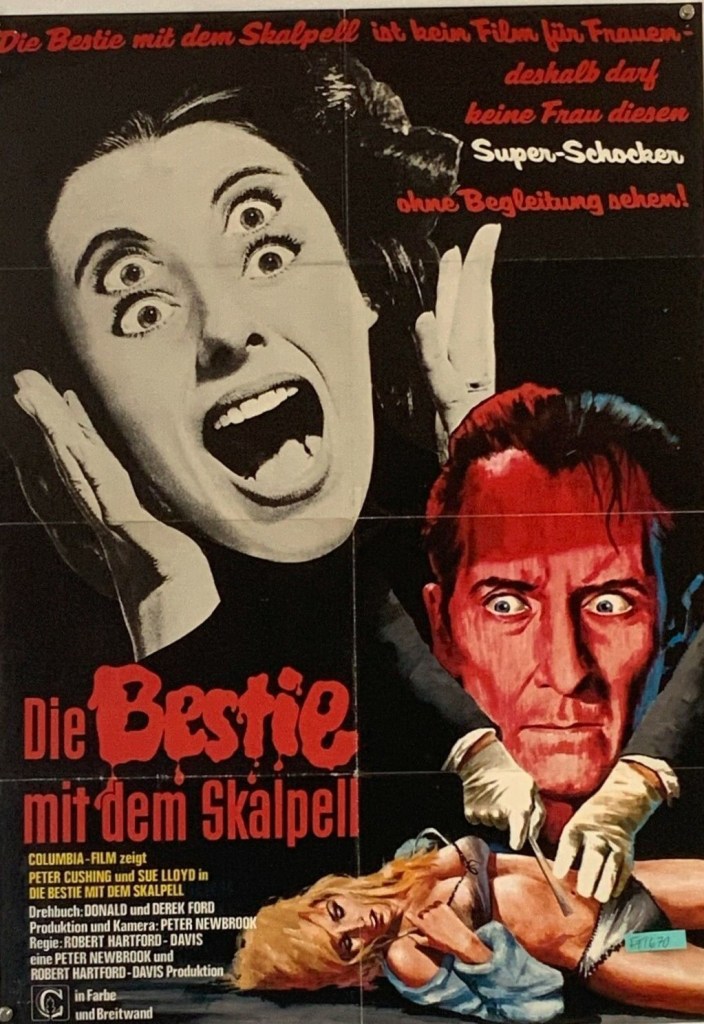
So it’s something of a surprise to see him cast in the first place as the older man lusting after a younger woman. Sir John Rowan (Peter Cushing) is a highly esteemed surgeon who has fallen for model-cum-flighty-piece Lynn (Sue Lloyd) and although he sticks out like a sore thumb at a typical Swinging Sixties party full of gyrating lithe young women he is happy to put up with it for the sake of his girlfriend.

But Lynn has a strong independent streak, she’s not the submissive lass who might have been content to swoon at the feet of such a highly intelligent man, and objects to his attempts at control and can’t resist the chance to show her allure to all and sundry by giving in to the temptation to pose for louche photographer Mike (Anthony Booth), and, as it happens, the assembled throng.

Sir John isn’t going to stand for such brazenness, starting a fight with Mike that ends in a dreadful accident, destroying half Lynn’s face. Naturally, plastic surgery being the coming thing and Sir John capable of turning his hand to anything he’s able to fix up her face good and proper.

Except it’s a temporary measure, something to do with the pituitary gland, and it turns Sir John into a serial killer. There’s no mystery to it, no detective scouting around trying to put together clues, the question soon becomes can Sir John keep it up and what psychological damage is inflicted on Lynn as she comes to the realization that the beauty she had taken for granted, setting aside the predations of age which are still some way off, could vanish in an instant leaving her shrieking in a mirror.

Things get out of hand when they head for the country and fresh victims and find themselves trapped in a home invasion by a gang as gormless and vindictive as the pair from The Penthouse. It doesn’t end the way you’d expect because there’s a twist in the tail that you might accept as par for the course in the unconventional cinematic Sixties or you might just put the producers down for wanting to have their cake and eat it.

Still, it’s good while it lasts. Cushing certainly reveals a different side to his screen persona, and I can’t remember ever seeing him truly in love or indulging in a passionate screen kiss, and certainly to see his murderous side emerge is quite a treat, no scientific excuse to mask his behavior.

And it’s equally good to see Sue Lloyd (The Ipcress File, 1965) in another of those roles where she displayed considerable independence.  As an added bonus future Hammer Queen Kate O’Mara (The Horror of Frankenstein, 1970), here cleavage well hidden, turns up as Lynn’s sister.  You might also spot Vanessa Howard (Some Girls Do, 1969) and Marianne Morris (Vampyres, 1974). Anthony Booth (Girl with a Pistol, 1968) was trying to shake off the shackles of BBC comedy Till Death Us Do Part

Robert Hartford-Davis (The Black Torment, 1964) does pretty well unsheathing the beast within the context of a vulnerable older man. Derek Ford wrote the screenplay with his brother Donald before he decided the sex film was his way to British film legend. The version released abroad contains more gore and sex than when the British censor had its wicked way.

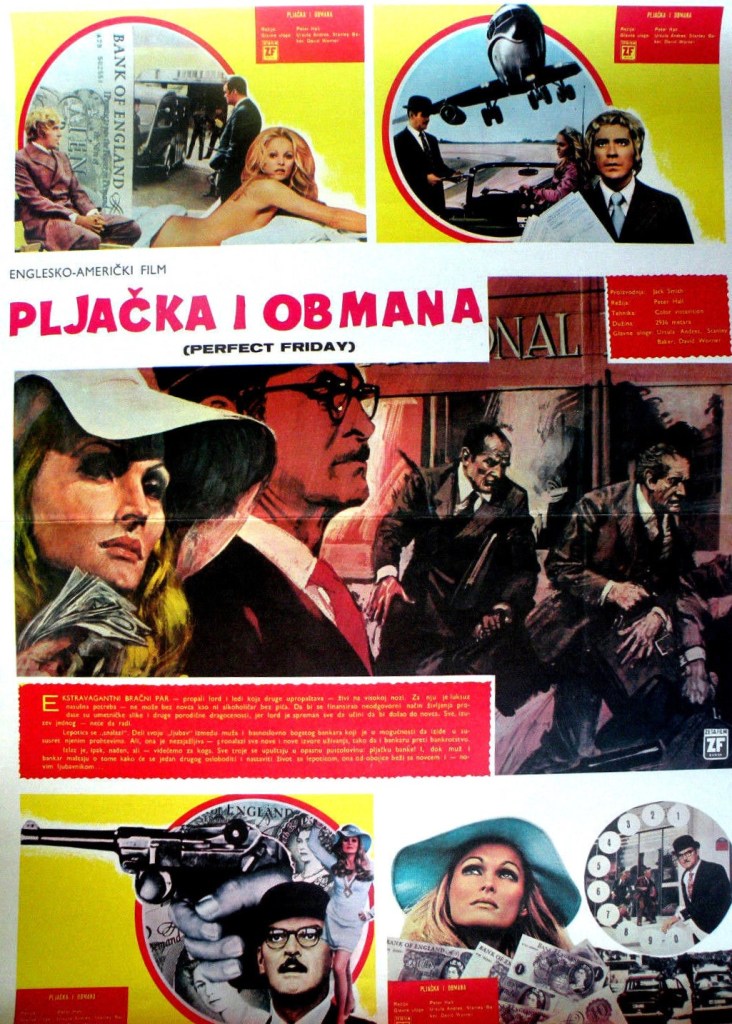
Perfect Friday (1970) ****

Delicious caper movie. Under-rated and largely dismissed because a) it is very British, b) audiences preferred Stanley Baker in an action film like Zulu (1964) and c) it appeared a year after the action-driven heist picture The Italian Job. So many black marks you might think it was an automatic candidate for relegation.

But, in fact, it is a delight, a gem that never outstays its welcome and, furthermore, elicits tremendously enjoyable performances from the three principals, with the added bonus, I guess, of the costume budget being much reduced by Ursula Andress prancing around so much in the nude.

Mr Graham (Stanley Baker) is an uptight, bowler-hatted, spectacled, unmarried, straitlaced banking executive. That’s too fancy a title for his job. He’s not the manager, he’s not even the deputy, he’s the deputy to the deputy (here called an “under-manager”) and his sole joy in life appears to be granting or refusing overdrafts, an action that might, to one of life’s smidgeons, be construed as an exercise in power.

One of his clients is uber-sexy Lady Britt Dorset (Ursula Andress) who, while living in penury, manages to swan around in the most divine outfits and a swanky sports car, mostly as the result of his overdrafts. Although he believes he is tough and worldly it never occurs to him to wonder how his client has the wherewithal to repay the overdrafts.

She is married, but to the equally poverty-stricken Lord Nicholas Dorset (David Warner) whose sole income derives from a daily payment from sitting in the House of Lords and schemes such as attaching his name to a restaurant chain.

It doesn’t strike Mr Graham as particularly odd that Britt takes a fancy to him, infidelity appearing to be written into her marriage vows. And it’s not long before the deputy deputy manager starts to wonder how he might turn this relationship into something more permanent. So he comes up with a clever caper, a three-man job, or more correctly a two-man one-woman job. He’s going to steal £300,000, split three ways, from his bank. Nicholas will pose as a bank inspector, Britt will be the one who physically removes the cash and Mr Graham, naturally, will take on the role of criminal mastermind, finding a way to get hold of the necessary duplicate keys and over-riding the usual security concerns.

For a good while most of the plan consists of keeping the husband out of the way, sent on various “missions” across the country and abroad, to give Mr Graham time to enjoy making love to the wife. There’s an occasional hiccup to the plan, but mostly it appears to be running smoothly.

Except, as you might imagine, double cross is afoot. Mr Graham would like to purloin the husband’s share, all the more to set up cosy home somewhere abroad with the wife. And, as you might expect, there’s a sting in the tale.

But this is all so effortlessly done, tremendous tension as the robbery is carried out in complete silence (as was by now par for the course), jaunty music intervening at other times, the combination of the three opposites making for a delightful scenario, the stuffy manager at odds with the lazy, louche husband, and an unlikely companion for the sexy, apparently docile, wife.

Some clever directorial touches from Peter Hall (Three into Two Won’t Go, 1967) provide unexpected zest, but primarily this is a comedy of manners shifted onto the heist plane. And the best thing about it is the performances.

Ursula Andress (The Blue Max, 1966), here taking top billing, delivers her best-ever performance, the sexy front concealing a clever brain, easily manipulating lover and husband, deceit embedded in her genes, the hard-coiled core hidden from view, as she indulges both herself and her paramour.

Stanley Baker is superb, almost in Accident (1966) stiff upper lip mode, but without, until sex triggers criminality, that character’s free-wheeling attitude and immorality. He lives his entire life in a glass booth, observing and being observed, working within an arcane code of practices, not believing that he, of all people, could actually break the rules.

But David Warner (Titanic, 1997) steals the show as a bored upper-class lord who wants nothing more than a quiet life paid for by someone else and who almost throws a hissy fit when, as part of his role, he is forced to wear clothes he finds demeaning. If it wasn’t for the prize, this whole enterprise would be so much beneath him, and he doesn’t even have the satisfaction of being able to put this underling in his place.

Sheer enjoyment.

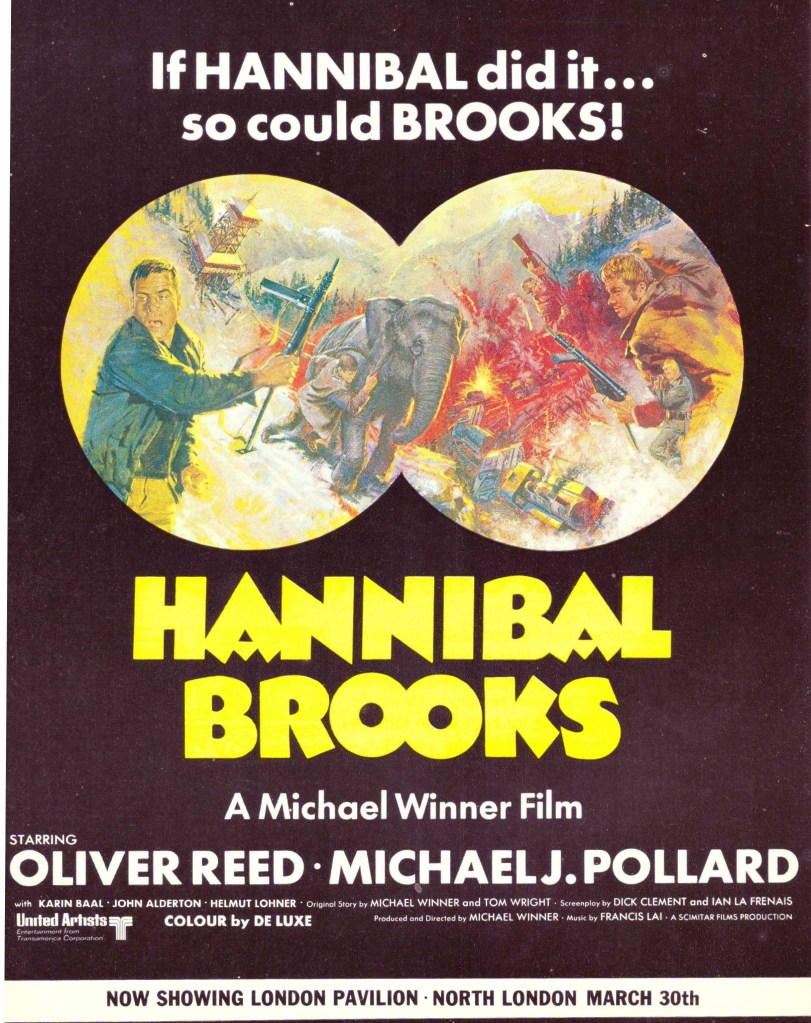
Hannibal Brooks (1969) ***

Gruff British star Oliver Reed shows his tender side in this entertaining offbeat POW escape picture. With local German men called up for war, Berlin Zoo relies on local prisoners-of-war to help look after the animals. Stephen Brooks (Oliver Reed) is detailed to look after an elephant (considerably more discreet in his toilette than those employed on Babylon). When Berlin is bombed, Brooks takes the elephant to Innsbruck in Austria.

His nickname is a bit of a misnomer. You would think he was going to emulate his famous predecessor and take the elephant over the Alps and into Italy, which would be possibly a safe destination because at this stage of the war the Americans have invaded and are marching north. But, instead, sadly, he only plans to make it as far as neutral Switzerland, where he would be equally safe.

Naturally he is pursued – and captured, and pursued and captured. But there always seems to be a convenient pile of logs that, a la Swiss Family Robinson, can be weaponised. And should you need any obstacle pulled down, well, an elephant comes in pretty handy on that score too.

Ineffectual American escapee Packy (Michael J. Pollard) turns up from time to time, usually in some piece of action that goes wrong, once to interrupt a romantic dalliance with Brooks’ occasional companion Anna (Maria Brockefhoff). And this being the Tyrol, it seems a shame not to halt proceedings every once in a while to take in a marching band or a traditional wedding or fair and for every damsel to have her cleavage on display.

Heading up the pursuit is Colonel von Haller (Wolfgang Preiss) although you might imagine he had more important things on his mind at this stage of the war than chase an elephant. Various troopers are so easily duped by Brooks they might have gone under the collective expression of “dolts.”

Where the elephant has to take the long way – he could as easily have been called “Slowly” – the Germans can travel by road, rail and cable car. It’s pretty episodic stuff, enlivened here and there by explosions and gunfights and the like and the question of whose side Anna is really on.

In some respects it’s a buddy picture. When the buddy is the elephant it works pretty well. Brooks is surprisingly tender and caring. But when Packy enters the equation and it’s the old question of three into two won’t go it becomes a bit lopsided. You get the impression it’s one of these picture that, to accommodate the budget, required an American star and Michael J. Pollard, with his already-established schtick, was nearest to hand.

It’s just as well Reed has toned down his scene-stealing growls and sideways glances because nobody can steal a scene like Pollard. If the elephant was ever in the slightest genuine danger, then you might have had a better picture, but nobody in those days was going to slaughter such a magnificent beast just to give a movie a harder edge.

Elephant is surplus to requirements in this action-based poster.

So the harder edge never comes, and it skips along uneasily between gentle comedy and action, with a potential screen partnership of unlikely personalities never quite gelling. If director Michael Winner had stuck with Reed and the elephant it would probably have worked much better. Or if the escapees had to blow up some vital factory or carry out another mission deep inside enemy territory it might have carried more narrative thrust.

It’s like two separate pictures, Reed and the elephant and Pollard and his bunch of generally hapless escapees. Harmless enough stuff and interesting mostly for seeing Oliver Reed upending his usual screen persona.

At this point in his career, Michael Winner (You Must Be Joking, 1965) was better known for comedy so perhaps this was his passport to suggesting to Hollywood he could handle action. Certainly, it suggested he could merit a bigger budget, for his next movie was The Games (1970) before stepping into the more comfortable territory of Lawman (1971).

I’d suggest this was equally a stepping stone for Reed (The Assassination Bureau, 1969). This film is largely ignored in assessments of the changes to his acting style that he made to accommodate the critically-acclaimed Women in Love (1969). And you can certainly draw a development line between the Michael J. Pollard of Bonnie and Clyde (1967) and his character in Little Fauss and Big Halsy (1970) where he successfully buddied up with Robert Redford. Dick Clement (The Jokers, 1967) devised the screenplay from a story by the director and Tom Wright, on whose own story of being a POW zookeeper this is based.

Most movies perceived as stepping stones are made of stronger material, and although this is more lightweight, it’s entertaining enough and certainly helped director and both stars switch career tracks.

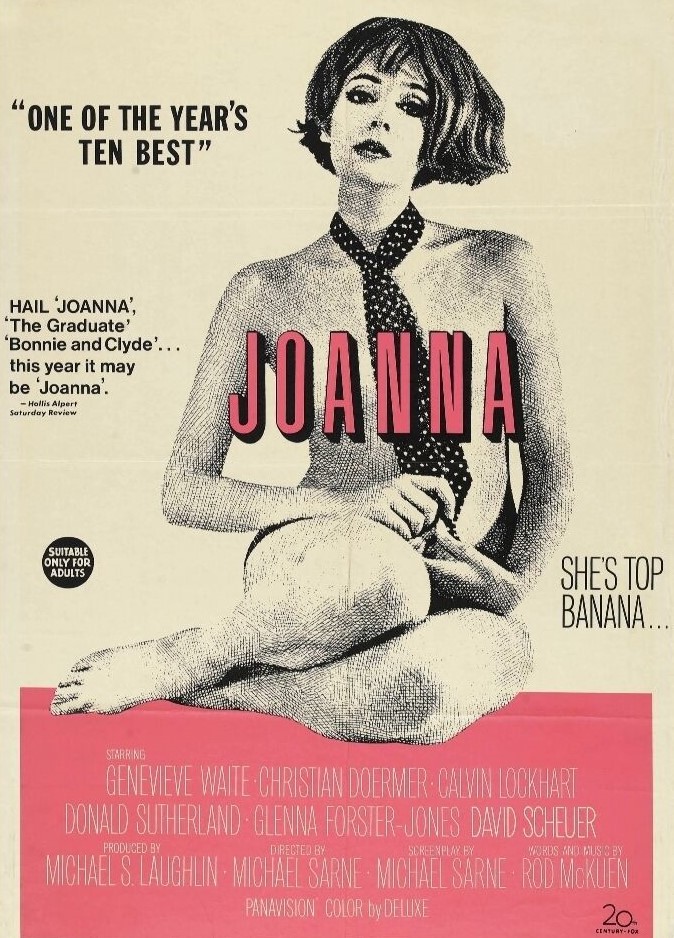
Joanna (1968) **

Mike Sarne (Myra Breckenridge, 1970) was one of those talents who ran away with himself, artistic notions indulged by the industry, until he was exposed as having little to say. Joanna is pretty empty of everything except style. And that wouldn’t be so bad if it was consistently stylish or showed a genuine flair for the visual image beyond a woman bathing in a lily pond or chasing an ambulance through a park.

And, of course, it’s never a good idea to park your inexperienced girlfriend upfront and center of your debut feature. Genevieve Waite, a model in the Twiggy fashion, had a thin, whiny baby voice, and lacked the skill to suggest any depth to the titular heroine.

The film stands up today as a shrine to misogyny, for the way in which, in the name of emancipation, women were exploited by men. Sexual freedom, bouncing along from one man to another, is the theme. “All women gained from emancipation is the privilege of being laid,” points out one (male) character. Freedom is expressed as lack of commitment. It’s kind of odd to hear young trendy men going on about commitment and expressing reservations about a flighty lifestyle, but it’s just as if the male authority figure had simply skipped a generation and was determined to keep women in their place.

Joanna, arriving from the countryside laden down with pots of home-made jam, flits through the Swinging London scene, exploring her artistic side through attending an art studio, occasionally working as a model, but more likely living off men, who are as likely to be married, and even then with another woman on the side.

She flits between artist Hendrik (Christian Dormer), nightclub owner Gordon (Calvin Lockhart) and wealthy dying toff Lord Peter Sanderson (Donald Sutherland) with a yacht in Morocco who surrounds himself with talented people because he lacks any talent himself. We don’t learn much about Joanna except her father, whom she fantasizes about cutting his throat, is a powerful enough magistrate that he can intervene when coppers are causing her boyfriend grief.

The other theme explored is racism. Gordon, a Sierra Leone native but a tax-paying British resident for eight years, is subjected to some racial abuse and later given a beating. That’s given more prominence than the miscegenation that would the following year (in 100 Rifles) attract so much controversy.

Lacking a strong narrative – mostly it’s people sitting around talking or getting into bed with each other – the film mostly hangs on a series of fantasies. Any time a new character appears, Joanna has the habit of spiriting them into a fantasy. Gordon’s sister is transformed into a maid in an English country house, Gordon becomes a Regency hero, the minute someone says sex can get you anything you desired even an elephant, lo and behold there’s Joanna sitting atop an elephant.

There’s a self-consciousness that this film can’t quite shake, the idea that somehow Sarne is holding a pillar up to society when in reality it is more a reflection of his own fantasies. The best scene comes at the end when the entire cast sings the theme song along a railway platform. The song, with no sense of irony, rhymes “top banana” with “Joanna.” And, of course, would you believe, this was all a film, director and cameras appearing at the end.

Whimsy is piled upon whimsy and that’s not enough to sustain the film. Waite offers very little except bounce, Donald Sutherland (The Split, 1968) – now coming up on 200 screen and television roles – is sorely miscast. Calvin Lockhart (The High Commissioner, 1968) brings more to the table, a polished performance that avoids the temptation to go too American. Sarne wrote the screenplay.

It’s not as bad as most films that get two stars from me but for the life of me I can’t see how it honestly earns three stars. You can sample it for free – or watch it all the way through – on Youtube.

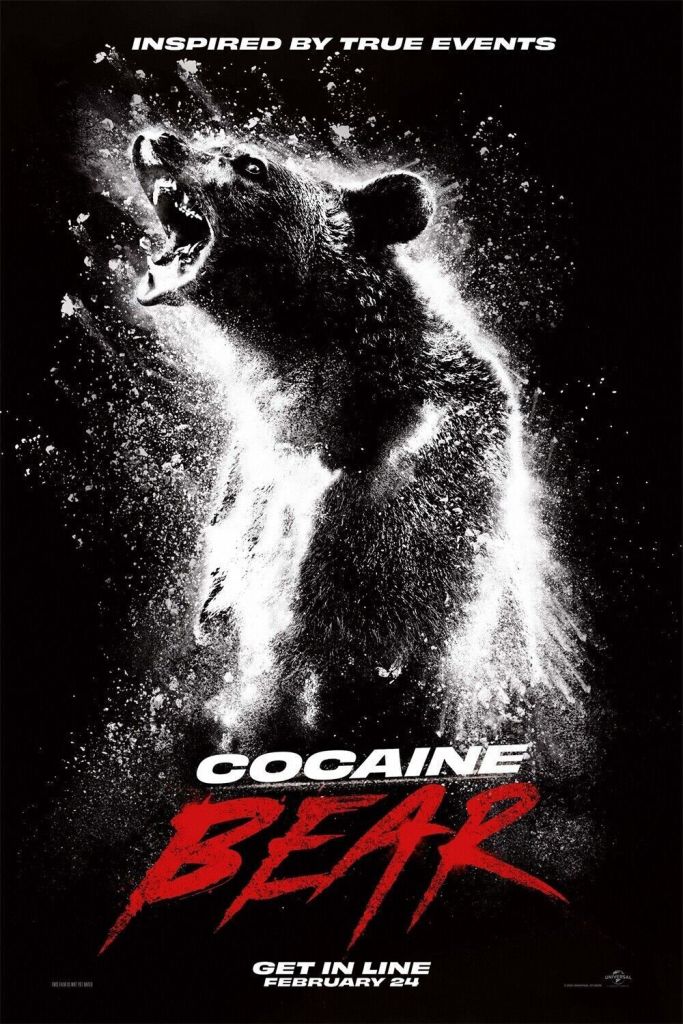
Cocaine Bear (2023) **** – Seen at the Cinema

You probably know by now that this (unnamed) bear has been on a successful box office rampage.  You’ll know, too, that the special effects (you thought it was real bear, duh!) are particularly effective. And you better believe this as hilarious as it is bloody.

What you’ll be less well informed about is the cleverness of the set up. Yes, essentially, it falls into the slasher genre (slabs of claws instead of knives) but has a different approach to the potential victims. Generally, in this kind of horror picture you’ve a good  chance of being slaughtered if you’re sinful, indulging in sex generally the marker but you might enter the killing zone for being a bully or a bitch. While it’s pretty much up to speed with the contemporary trope of the killer being a woman (yep, said bear, it turns out in one hilarious scene, lacks male equipment), but the victims don’t conform to type.

Although it may come in different shapes and sizes, this advert needs only one image.

For the most part they are dumb,  and that includes dumb innocence, but the driving force is  the misguided. Parental focus is misplaced. Sari (Keri Russell) is so desperate for male companionship she ignores the needs of daughter Dee Dee (Brooklynn Prince). Drug runner Syd (Ray Liotta) ignores son Eddie (Alden Ehrenreich), so steeped in sorrow he abandons his son. And then there’s detective Bob (Isaiah Whitlock Jr) who has commitment issues with a new dog.

Hankering after a male leads park ranger Liz (Margo Martindale) to douse herself in perfume in a bid to inflame desire from tepid activist Peter (Jesse Tyler Ferguson). Three dumb teenagers attempt to rob the hulking fashion-conscious Daveed (O’Shea Jackson Jr), less concerned about being attacked than the damage blood can do to tee-shirt and sneakers.

Parallel storylines send Sari hunting her kids, the drug-runners and cops hunting bags of cocaine – missing after being dropped from a plane – into the path of the bear who has taken a liking to the drug. At least, without any education in drug lore, the bear knows to sniff or ingest the stuff rather than try to eat it like Dee Dee and her pal Henry (Christian Convery).

There’s a good reason this picture was set in 1985 – the date of the original “true” story – because these days nobody would believe any pre-teen kid wouldn’t know how to absorb coke, and be desperate to try it. And also because “woke” wasn’t invented so nobody needs to get preachy.

Turns out if you want lessons in maternal instinct, you’d better go find yourself a female bear.

This is keenly directed too, by Elizabeth Banks (putting her career on the line, apparently, after her last two pictures, Call Jane, 2022 and Charlie’s Angels, 2019, stiffed). It would be pretty easy to get lost in this smorgasbord of characters, but Banks has a nifty way of leaving you wondering what happened to character X only to find him/her turning up in a situation that advances the story.

I should point out it’s hilarious. Not just the classic line, “Bears don’t climb trees,” but some wonderful deadpan dialog between Daveed and Eddie and then between Eddie and one of the delinquents, gun-happy Liz’s chat-up lines in between being seven-points-to-Sunday barmy, and a pair of loved-up Icelandic tourists falling out over which band will play at their wedding. The question of how to determine a bear’s sex has entered movie comedy heaven.

Banks equally astutely switches the action between gore and comedy, but keeps sufficient focus on the characters to ensure you don’t just look on them as victims, waiting with some glee for them to be chomped up. There’s not that sense of working out who might be Final Girl. Sensibly, she avoids trying to emulate Jaws in the stoking up of tension, nor does she take the mickey out of the audience by using the kids to tug on their heartstrings.

Just like the out-of-left-field Me3an this has sequel stamped all over it. There’s still plenty cocaine left in that wood and, you never know, the bear might enter rehab or it could go down the crossover route and form chapter five of the John Wick saga. Wait, I’m forgetting the obvious. Cocaine Cubs R Us.

Whatever, this is a riot. Best title of the year by far delivers. The actors, even Liotta, prone to overacting, make it believable. Screenwriter Jimmy Warden (The Babysitter, Killer Queen, 2022) comes up with the goods and Banks and the sfx team do the rest.

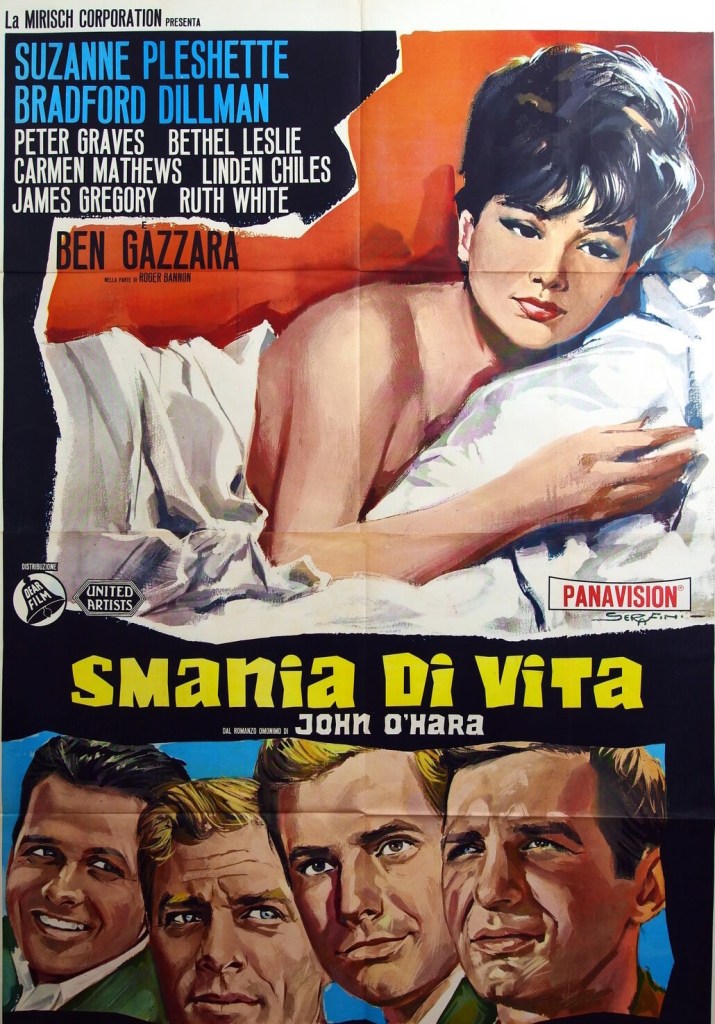
A Rage To Live (1965) ***

There was one in every town: a woman, rich (Sanctuary, 1961) or poor (Claudelle Inglish, 1961) or in between (Butterfield 8, 1960), with a predilection for sex. There were several men in every town, queuing up to take advantage. The woman was inevitably a shameful creature, the men the envy of their peers. You don’t have to look further than Frank Sinatra’s tom-catting in Come Blow Your Horn (1963) or Omar Sharif as the romantic star of the decade with two women in tow in Doctor Zhivago (1965) for an idea of the double standards in play. Welcome to hypocritical Hollywood.

Grace (Suzanne Pleshette), father dead and stuck with a domineering mother, finds escape and fulfilment in sex, and just to give hypocrisy a final tug discovers that while boyfriends are keen to help her explore such physical needs, they take the hump when they discover they might not be the first – or the only. Parents, naturally, are appalled, and discovery of Grace’s antics – and she’s not particularly particular, a passing waiter will do – leads her mother to collapse.

Having confessed to potential husband Sidney (Bradford Dillman) that he will not be marrying a virgin and almost bursting with gratitude that he is willing to overlook her behavior, Grace becomes a farmer’s wife and then a happy mother, until construction owner Roger (Ben Gazzara) comes on strong. She might well have been able to have her cake and eat it but Roger, having fallen in love,  reacts badly to being dumped and it’s only a matter of time before her world implodes.

Made a couple of years later, when the independent woman was being exalted, this would have been a different kettle of fish. Here, the boot on the other foot, the woman who picks and chooses her lovers seemed a step too far for that generation.

Before the big trouble begins, the movie does explore, though somewhat discreetly, the almost taboo notion that a woman might just enjoy sex for the sake of it. Sure, Grace likes being wanted and likes being held, but if she was around today, nobody would bat an eyelid if she just came out and expressed her preference.

Less discreetly, the subject of consensual sex comes up, but not as a question of debate, more as a matter of fact, that when Grace says no she actually means yes. There’s a very uncomfortable moment at the beginning when in a Straw Dogs-scene, though nothing like as violent, Grace appears to welcome a rape. Whether this is as bad as it sounds, or is just Hollywood hiding the blush that a woman would not seek out sex but could only discover its pleasures when forced upon her, is hard to say.

Nor is Grace a walking sex machine. She knows enough about men that she only has to put out feelers and any susceptible male will take the bait. And given the restrained times, she’s got no female pal with whom she can discuss her unseemly desires.

Of course, if this was a man, nobody would be batting an eyelid. Sure, once caught, he’d come up with all sorts of excuses, denials, begging for forgiveness, but an audience would give him a free pass. It’s only because this is a woman that it causes ructions. The movie just about gets close to what does make Grace happy and why she needs the thrill of extra marital sex but by that point the melodrama has taken over and there’s little time left for discussion, what with Roger intent on revenge and another lovelorn wife, mistakenly imagining her husband has fallen victim to Grace’s charms, also on the warpath.

Small town constraints play their part, too. Washing your dirty linen in public the worst of all offences. Author John O’Hara, on whose bestseller this is based – and whose other works Butterfield 8, Ten North Frederick (1958) and From the Terrace (1960) explored similar worlds  – knows only too well that while wealth brings freedom and privilege it comes with chains attached.

And there’s some interesting role reversal, an illicit lover falling in love with a married person normally a starting point for a movie to explore happiness and its opposite rather than being the one act Grace will not tolerate in a lover, she wants strings-free sex, not anything with encumbrance. While Grace would like to act like a man, and has the wealth to shield herself from the worst of the fall-out, as a mother she is extremely vulnerable, and in this particular era could risk losing her child if seen as maternally unfit.

While lacking the sexual combustibility of Elizabeth Taylor or Lana Turner or other Hollywood heartbreakers, Suzanne Pleshette (Nevada Smith, 1966) gives a decent enough performance especially when it comes to her straightforward attitude to sex, aware she might be causing upheaval, but finding it impossible to ignore desire, or imagine a life in which that does not play an impulsive part.

Bradford Dillman (Sanctuary) has less room for character maneuver and is mostly called upon to suck it up. He comes into his own in the movie’s latter stages when bewilderment at betrayal and public humiliation clashes with continued love for his wife. Ben Gazzara (The Bridge at Remagen, 1969), trademark leer and smug face kept in check, has a showier role especially when the violent aspects of his character explode.

Director Walter Grauman, while better known for war picture 633 Squadron (1963), had just come off another picture dealing with female trauma (Lady in a Cage, 1964) and does quite a decent job here, the camera intensely focusing on the leading actress and then as the tragic outcome unfolds drawing away from her. There’s one great piece of composition. He had used tree branches and the countryside to frame Grace and Sidney at the height of their love. And he does the same again when Grace is abandoned.

Asks some difficult questions without quite getting to grip with the real subject of female sexuality. There was a sense that Hollywood was just on the cusp of accepting the independence of women, but didn’t want to go the whole hog just yet, because, apart from anything else, where would it leave the guys?

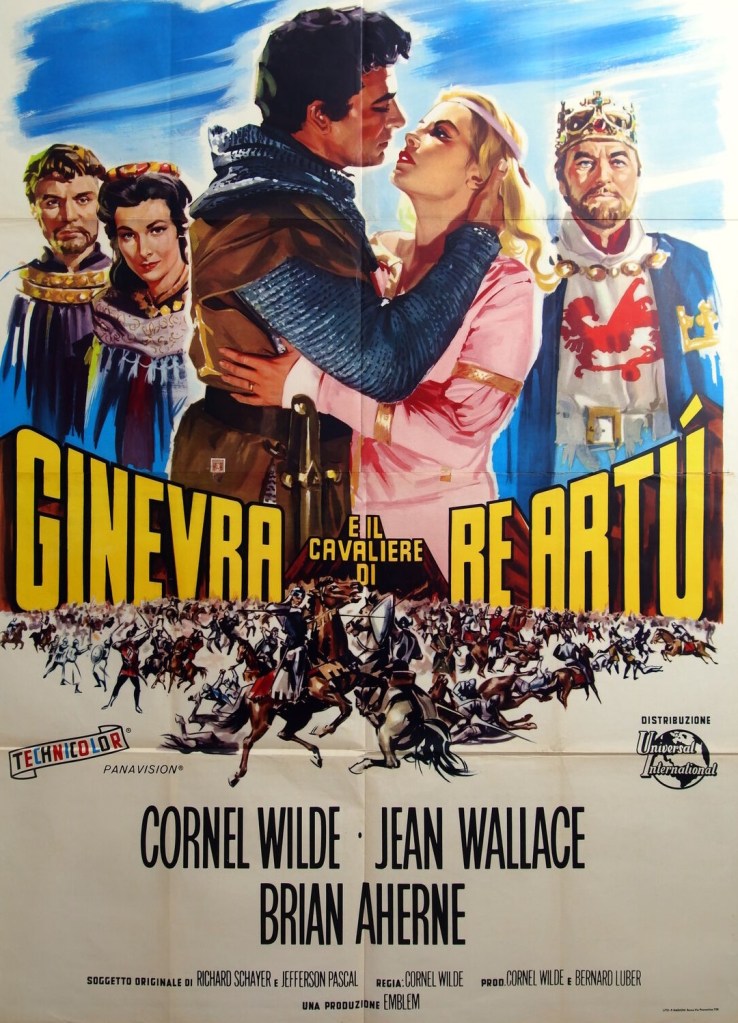
Sword of Lancelot / Lancelot and Guinevere (1963) ***

The legend is knotty. On the one hand it’s the most chivalric period in history. Excalibur, The Holy Grail, the feudal-tyranny-busting power-sharing democracy of The Round Table, and before Harry Potter came into view the most celebrated wizard of all time in the shape of Merlin. On the other hand, love was a pawn. Women were traded to cement relationships between rival kingdoms. And humans were all too fallible.

For a start, you had a king, Arthur, who couldn’t keep it in his pants and had already sired a bastard son Mordred who had his own ideas about inheritance. Then you had the king’s champion, Lancelot, who had a similar problem, except in his case he couldn’t keep his hands off the king’s new wife, Guinevere.

To pull off this love story, and keep the audience onside, you needed actors of a high caliber otherwise it sinks to a tawdry tale of adultery and betrayal. Unfortunately, there’s no Robert Taylor-Elizabeth Taylor (Knights of the Round Table, 1951) to hand and the combination of Cornel Wilde and his wife Jean Wallace doesn’t have the same ring or impact.

So, wisely, Cornel Wilde who doubles – make that quadruples – as director, co-writer and co-producer as well as star, concentrates on action, far more than in other swashbucklers of the decade such as Pirates of Tortuga (1961) and King’s Pirate (1967). Wilde has genre credentials, outside of Errol Flynn and Tyrone Power, with At Sword’s Point (1952) to his credit.

And you can’t help taking a liking to a swashbuckler which begins with a joke about soap, and then carries the same riff through to the obligatory bathing scene, where the act of physical washing, rather than merely splashing about in the nude for audience titillation purposes, sparks the relationship between the doomed couple.

This version of the story begins with the French king reneging on the deal to marry his daughter to King Arthur and demanding the matter be settled in the traditional manner, one-to-one combat. Lancelot is elected the English champion. By the time he returns home, complication lies in his wake. It’s not long before suspicions are aroused, Guinevere unable to keep emotions in check when she imagines Lancelot wounded in battle. Indiscretion gets the better of them and when Lancelot is discovered leaving her bedchamber, it’s all lovelorn systems go. Condemned to death for adultery, she needs rescued from a burning pyre.

Guilt ruins exile. Lancelot is now a reluctant rebel. And sex is off the agenda. Matters are only settled in the most drastic fashion, one that ensures an ending to rival Casablanca (1942). Action compensates for acting – Wilde runs the gamut of emotions from grimace to grin while Wallace over-acts – with a number of well-managed battle scenes.

The pick is Lancelot leading an army against raping pillaging Vikings. Apparently impregnable behind a lake that prevents attack on three sides, the Vikings don’t expect the English to block off their escape by setting the forest on fire, forcing them to charge through the water to Lancelot’s waiting troops. Another pitched battle is equally well-handled with thundering horses, each side trading volleys of arrows, and a clever flanking movement.

Although a relative novice behind the camera, Wilde is not afraid to experiment. Tracking cameras are extensively used as is limited point-of-view (opponent viewed through a vizor) although he does resort on occasion to older tricks like speeding up film so foot soldiers resemble Olympic sprinters.

And there is a sprinkling of other jokes and observations. A courtier mangles a visitor’s name in Court Jester fashion. Church bells ring because someone is battering the hell out of the iron casing. A rhymer is on hand to mock. A trumpeter is killed before he can sound the retreat. An old crone chomping on an apple settles in to watch a burning at the stake.

Obviously, in my search for a 1960s swashbuckler, I take the blame for bringing this to your attention. While lacking the charisma of Doug McClure and Jill St John in King’s Pirate  and the acting not rising much above the levels of Pirates of Tortuga, this outshines both in the action department.

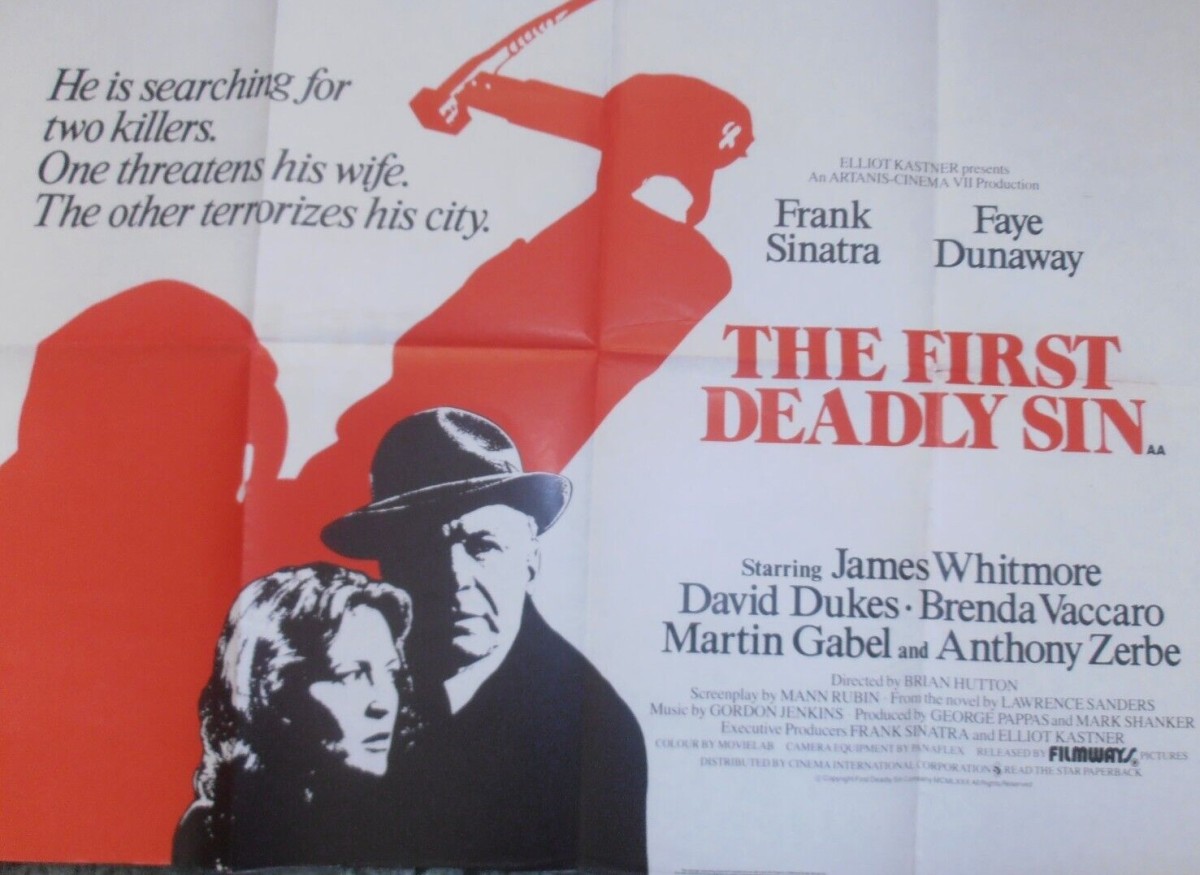
The First Deadly Sin (1980) ****

Highly under-rated. Mostly because star Frank Sinatra has the audacity at the age of 65 to play an older cop as an older guy, with none of the wisecracking or physical zap of his previous crime movies like Tony Rome (1967) and The Detective (1968). Deliberately downbeat and surprisingly compassionate with a gallery of unusual and realistic supporting characters.

Sure, we start off with a cliché, cop Delaney (Frank Sinatra) about to retire sniffs out a serial killer operating across New York. But that’s about as far as the cliches go. His boss (Anthony Zerbe) is highly territorial and doesn’t want Delaney doing work that might benefit any precinct other than his own. On top of that an operation on artist wife Barbara (Faye Dunaway) has gone seriously wrong and now she’s hooked up to all sorts of machines in hospital, Delaney sitting by her bedside reading from a book.

Unable to use the department’s facilities, Delaney is forced back on improvisation and enlists a museum curator Langley (Martin Gabel), an expert on weaponry, to find the specific type of tool the assailant is using to crack open heads. Langley is old, too, lacking in either wisecracks or physical zap, likely to doze off at inopportune moments.

Delaney isn’t above taking the law into his own hands, gaining admittance by devious means to the apartment of suspect Daniel (David Dukes) only to be told in no uncertain terms that not only has he no just cause to arrest Daniel, a high-flying executive with legal connections, but that any judge would immediately throw out the case thanks to the cop’s law-breaking.

So the movie settles into two parallel stories, both, if you like about observation. Delaney follows the suspect and he watches his wife die, in both instances unable to intervene, not able to prevent the murderer killing again unless he should happen to catch him in the act and as far as the hospital is concerned having to listen to a doctor (George Coe) tell him that doctors aren’t infallible and often get it wrong. Even his only ally, forensic expert Dr Ferguson (James Whitmore), is warning him off.

And where you might expect in another film a bit of romance between Delaney and witness Monica (Brenda Vaccaro) that doesn’t go anywhere either because he is a faithful husband and doesn’t need any distractions from a dying wife and she’s not the kind of woman that often turns up in crime pictures to form an adulterous relationship. If anything, she turns her attention to mothering Langley.

So this isn’t a fast action tough-talking crime picture of the kind audiences had been familiar with from the late 1960s/early 1970s, there’s no car chase to add entertainment heft. In fact, Delaney is an old-fashioned cop, I don’t think you even see him in a vehicle, he’s mostly pounding a beat of one kind or another.

And it’s oddly compassionate. There’s a lot of cross-cutting between the two narrative strands, and it soon becomes pretty clear that this is a different kind of killer, not one carefully planning his next murder, or taking sexual delight from the agony he inflicts, and he isn’t into abduction either, nobody corralled away in a basement or attic, night-time providing murky cover for his activities.   

What we’re actually witnessing, it turns out, is a killer’s meltdown, as he hunkers naked in a bath or hides under bedclothes in a closet. And Delaney recognizes that insanity and that this is someone who needs treatment rather than being locked up in a prison.  Daniel justifies his acts as a kind of purity. His victims are “all living inside me, I love them and they love me.”

The idea of sacrifice is embedded in the initial image of a neon-lit cross hanging above a street, the crucifix cross-referenced in several other scenes, and Xmas wet and miserable rather than Hollywoodized snow and ho-ho-ho.

So get your downbeat boots on and join the trudge and don’t start complaining this is lazy acting from Sinatra when actually he is delivering one of his finest performances. Nobody complained that Tom Hanks was lazy when he acted old in A Man Called Otto, where sorrow is similarly repressed, or that Hanks had a shade too much zest for a man his age. Faye Dunaway (Three Days of the Condor, 1975) has made an equally bold decision to play a woman who never gets out of bed and she makes no attempt, as an actress, to invoke your sympathy, there’s none of the cuteness you might expect from doomed romance. Critics, in general, have been put off by the fact that she plays a dying woman as if she is actually dying rather than about to spring into a song-and-dance.

You might be surprised to learn that director Brian G. Hutton (Where Eagles Dare, 1968) came out of a self-imposed seven-year retirement to make this picture, in some respects a companion piece to the equally down beat Night Watch (1973). And he makes a terrific virtue out of keeping characters realistic. Add Martin Gabel to the principals for playing old and slow when age dictates he’s old and slow. Screenplay by Mann Rubin (The Warning Shot, 1967) from the Lawrence Sanders bestseller.

Thoughtful, brooding picture, fitting finale to Sinatra’s career. This is the last hurrah without any forced Hollywoodized hurrah.

“It won’t be the same without you,” says the reception desk cop as Delaney hands in is papers. “It’s always the same,” retorts the world-weary cop.

But please go into it with your eyes open and not in expectation of the more typical 1970s crime movies.

Incidentally, I had thought this one of the lost movies, out of circulation due to legal shenanigans, so was pleasantly surprised when it popped up on YouTube.

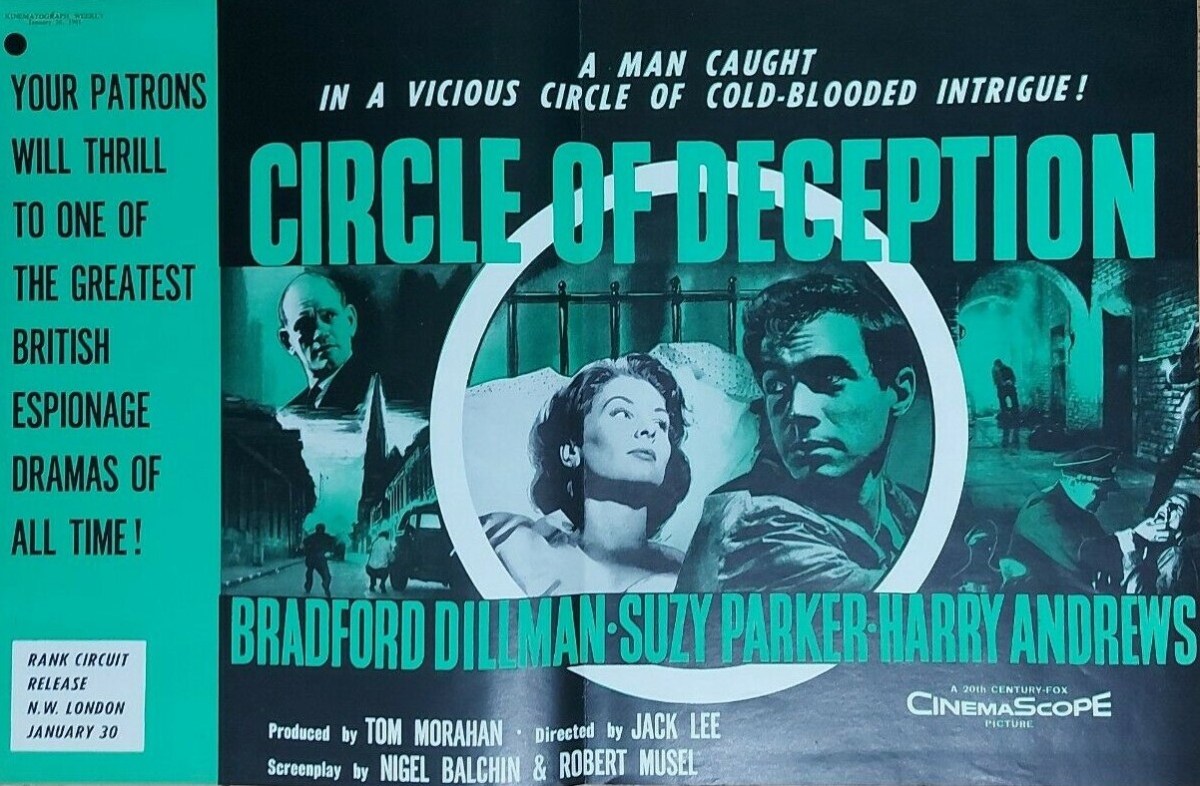
Circle of Deception (1960) ***

What the enemy do to an Allied spy is nothing compared to his friends. Blood brother to The Spy Who Came in from the Cold (1965) and The Quiller Memorandum (1966) where agents are mere pawns in a bigger game, this is set on the eve of D-Day. The old trope of sending a spy in with misleading information is turned upside down in that this isn’t a corpse as in The Man Who Never Was/Operation Mincemeat, but live bait.

Except the agent doesn’t know he’s being used and has been chosen because he is deemed to have sufficient courage to stand up to initial torture but not hold out forever so that when he inevitably breaks the secrets he spills are believable.

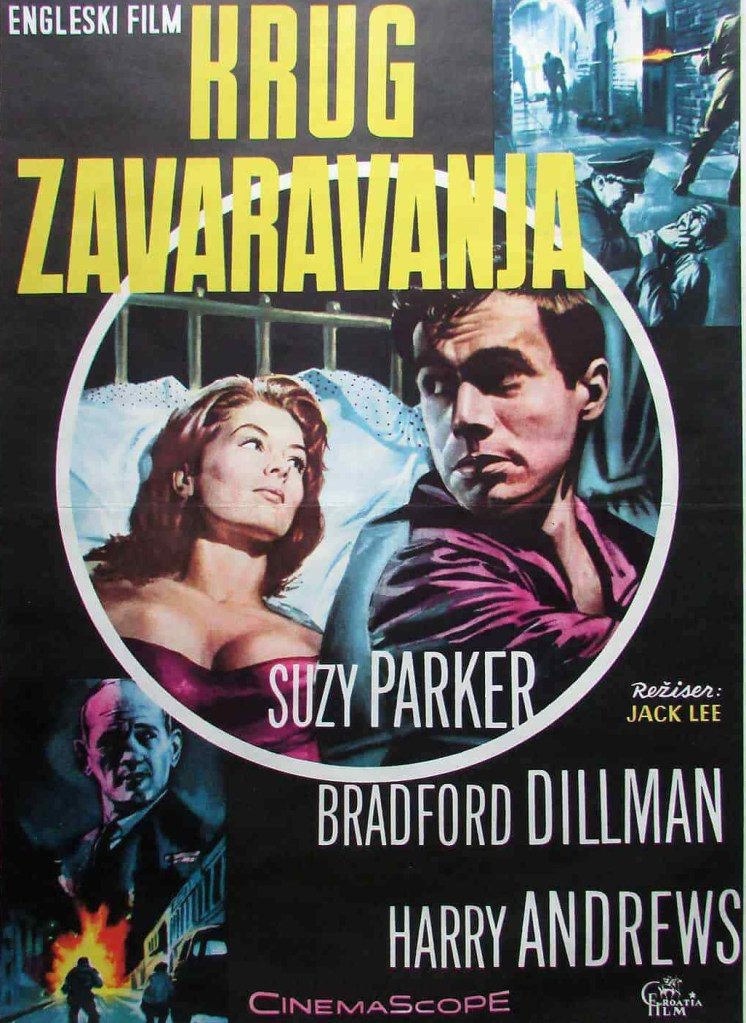
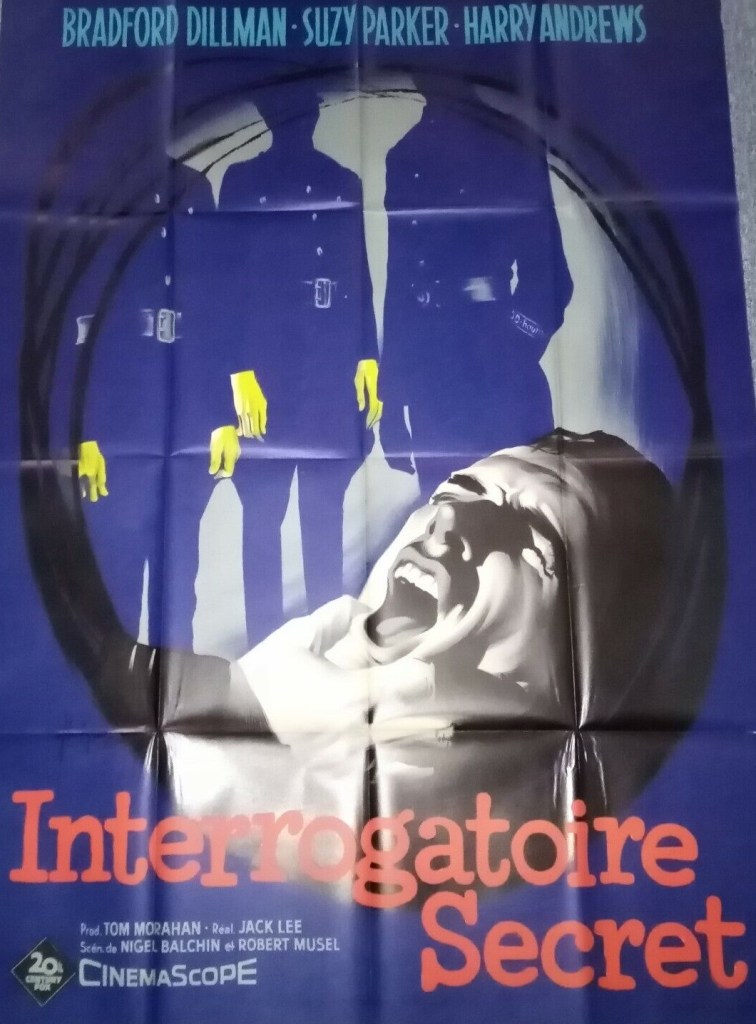
As you might expect, being accustomed now to misleading posters, Suzy Parker, given top-billing here, is nothing like as wanton, nor for that matter as bosomy.

Ruthless Capt Rawson (Harry Andrews) who devises the cunning plan employs psychiatric assessment and the romantic wiles of his secretary Lucy (Suzy Parker) to select the correct victim, Paul Raine (Bradford Dillman). “A perfectly good man is exactly what we don’t want,” expounds Rawson.

War is gender-neutral. Although from the off, Rawson is unscrupulous, with only a modicum of conscience, Lucy is more human, and when she is drawn into the deception, initially just to report on Raine’s qualities, she proves as ruthless, though afflicted more by conscience, a factor her boss dismisses as making women “singularly unsuited” for war, despite the fact that she is making greater sacrifice, having fallen in love with Raine.

Orphaned, Raine covers up the emotional instability detected by psychiatrists with derring-do, battling through terror out of fear that he will be consumed by fear. A Canadian who speaks French he is the right “wrong man” for the job. 

Considerable effort goes into ensuring he won’t be caught out by detail. His French-bought watch has an English strap, for example. And although, once on enemy territory, his innate skills mean he evades capture for longer than intended. He slips off a train, passes himself off as a woodcutter’s temporary assistant.

Unaware of the plot against him, when captured and brought before “good” German Capt Stein (Robert Stephens), who respects a gentleman officer, he refuses to give up his secrets, undergoing a whipping, electrocution and a primitive though equally effective form of water-boarding. At the very last, courage long gone, he aims to deprive his captors of victory by biting on a cyanide pill hidden in his tooth only to discover this is missing.

After that, all that is left is irony. He is treated as a hero, officially accorded a medal, but post-war hiding behind a bottle in Tangiers because he can’t face the truth. Lucy, scarred by her experience, knowing she is as guilty as her superior in destroying a man, tries to retrieve an irretrievable situation.

After only really knowing Bradford Dillman as often a one-note supporting actor, I’ve been surprised to discover he has a greater range of acting skills to offer. A Rage To Live (1965) provided one insight and Sgt Ryker (1968) another but this is on a different plane, mean-budgeted B-picture though it is.  It’s a difficult part to pull off, afraid that his bold exterior hides a cowardly personality, and that in the final analysis his soul will be laid bare. There’s not much help in the script. He doesn’t get to explore his fears with Lucy except in the most basic fashion. He has to rely on facial expression, rather than screaming his head off, to get across the rest of it. And he is pretty exemplary on that score. And since he’s Canadian that can hardly be put down to having learned the British stiff-upper-lip.

Suzy Parker (The Interns, 1962) , formerly the world’s highest-paid model (and soon to be Mrs Dillman), has mastered her stiff-upper-lip as well as a passable British accent. She’s not permitted much in the way of anguish script-wise, and lacks Dillman’s acting skills in presenting interior feelings. But, equally, her character is a subordinate and a well brought-up English lass, as she would need to be to qualify for such a post, would not make her feelings known too forcefully to her commanding officer.

A Richard Burton or a Peter O’Toole might have injected more into the part, but Dillman does more than enough. It’s a shame Hollywood failed to recognize his talent. In his final picture Jack Lee (A Town Like Alice, 1957) directs admirably, though I could have done without the flashback structure, it might have added more tension to not know the outcome, and the rescue sequence seemed an anomaly.

Otherwise, crisply told and a precursor to the cold-blooded spy stories to come. 

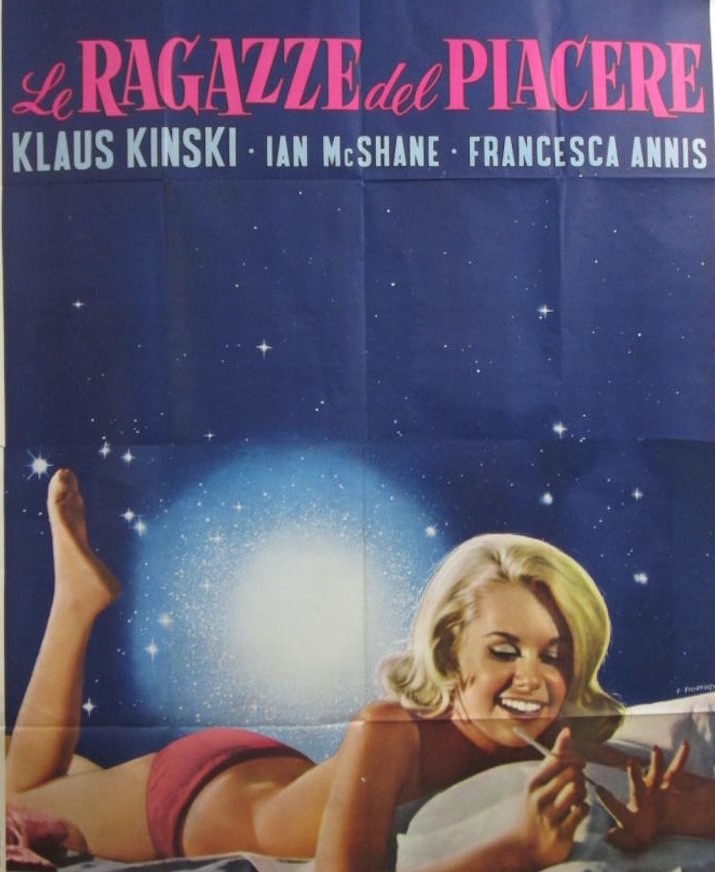
The Pleasure Girls (1965) ***

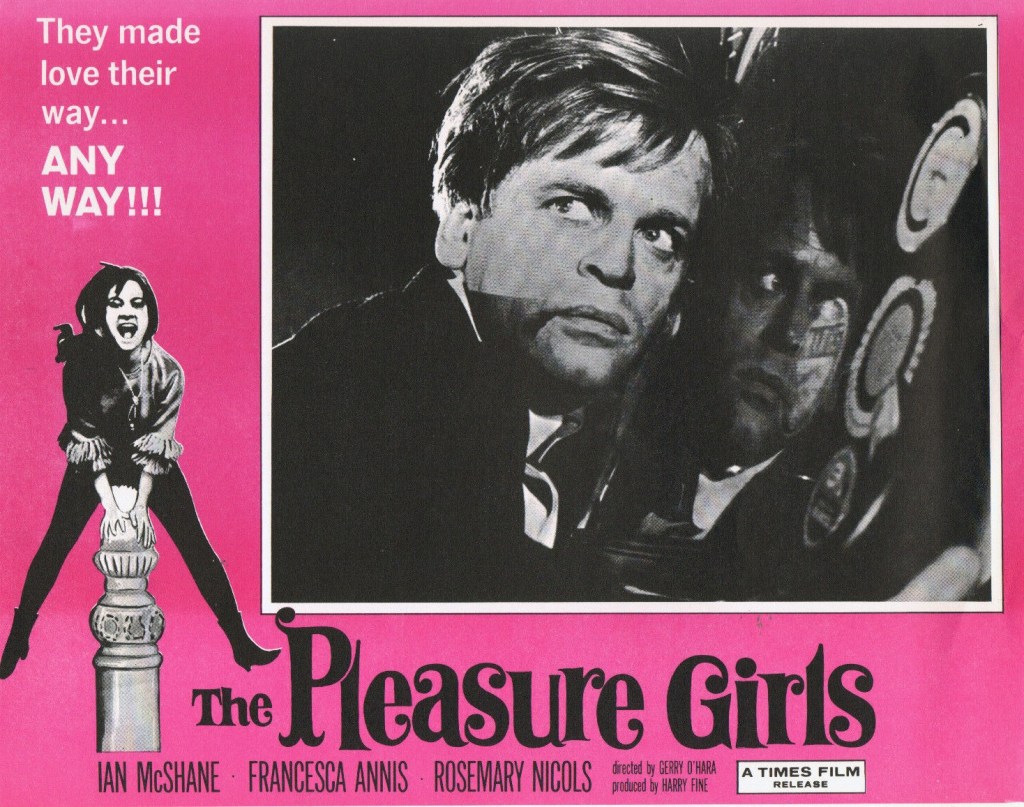
Klaus Kinski and The Pleasure Girls. What depraved mind dreamed up that concoction?

In reality, given this is early onset Kinski, before he was a fully-developed beast, and because it just precedes the British censor throwing off his shackles to accommodate the likes of Blow Up (1966) and The Fox (1967) it’s pretty tame stuff.

Klaus Kinski – what more did any B-picture of the decade need?

The girls might parade in night attire, and, should they happen to sleep in the nude, flash a bit of less rude skin, but that’s as far as it goes although at least couples are permitted to share a bed unlike the U.S. where that was outlawed by the Production Code (hence, in case you didn’t work it out, why there was so much frolicking via censor loopholes such as the outdoors or in the surf a la From Here to Eternity).

And you might find it hard to believe that John Wick’s Ian McShane has been a star for nearly half a century. Though here on the shifty side here and a shade fresh-faced his trademark cynical eyebrow is perpetually raised. He’s one of the suitors of a posse of girls sharing a house in London. A year later and a photographer like him would have had girls throwing themselves at him rather than primly trying to hold onto their virginity.

A weekend of drama awaits model wannabe and suburban lass Sally (Francesca Annis) on her arrival at the house, a whirlwind of parties beckoning, though drugs and booze in little evidence. Among her flatmates glamorous Dee (Suzanna Leigh) is mistress of slum landlord Nikko (Klaus Kinski) and while happy to be wined and dined and presented with jewellery,  fur coats and cash, draws the line at being put up in an apartment. Compliant Angela (Anneke Wills) is enmeshed with unscrupulous gambler Priddy (Mark Eden).

While there are plenty good-time girls to hand in casinos and there is some discreet nudity at a party it’s not exactly high-end stuff what with scenes set in launderettes and street markets and girls cutting themselves shaving their legs. And while proclaiming himself sex-mad, Keith (Ian McShane) is rather more romantic than he would like, prepared to wait for Sally, even while spouting self-conscious lines like “surely every girl wants you to want to even if she doesn’t want to,” the kind of hypocritical male double standard of the day.

The Sally-Keith relationship doesn’t get much beyond will she-won’t she so the real drama takes place in the lives of Dee-Nikko and Angela-Priddy and Dee’s very outgoing brother Paddy (Tony Tanner). Nikko collects debts with the help of thugs and an Alsatian, while Priddy sells his girlfriend’s precious brooch.

There’s more violence than sex. One man beaten up and tied to the hood of a car to be whipped with a belt. Another is tied to a chair and hung out a window. And, for the time, one man’s homosexuality is unusually tenderly expressed while the prospect of a career being more attractive than marriage is given a fair airing.

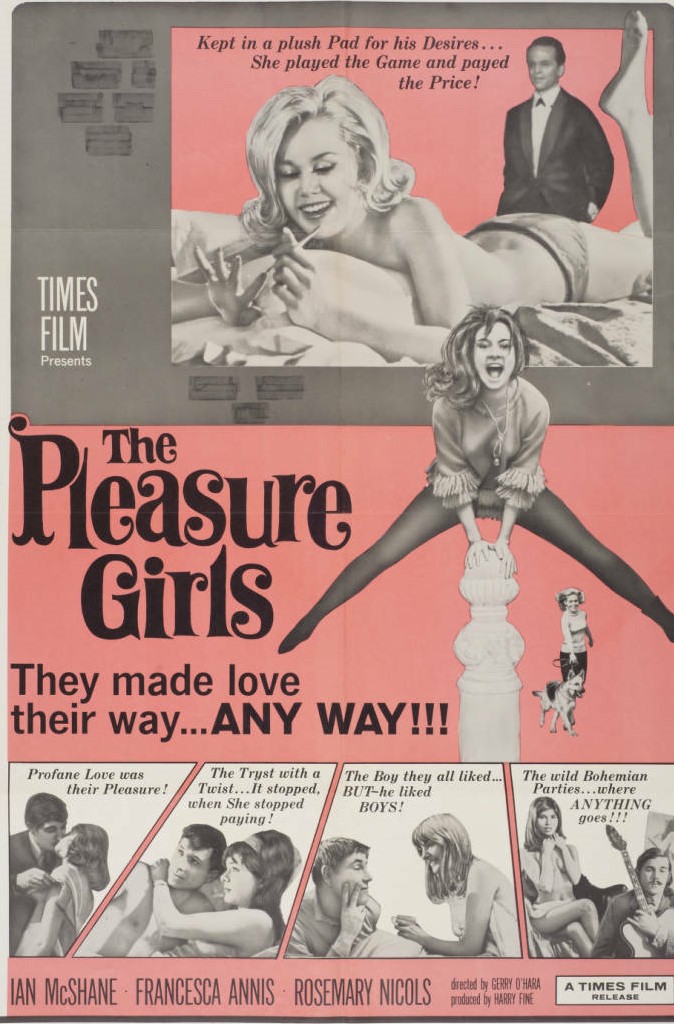
It’s surprisingly well acted, all the characters believable with enough development twists to keep you interested, and of course it’s not the degrading or unseemly world the posters would have you believe although in a pre-Pill world the dangers of unprotected sex are only too obvious.

Producers Tony Tenser (later founder of Tigon) and Michael Klinger (Get Carter, 1971) had made their reputations on exploitation pictures like the previously-reviewed London in the Raw (1964) and this attempts, at least for marketing purposes, to go down a similar seedy route, but is confounded by a storyline that is more Peyton Place than Bad Girls Have Sex.

It’s more an opportunity for rising stars to be put though their paces rather than characters put in their place. Ian McShane’s (Sky West and Crooked/Gypsy Girl, 1966) twinkle is never far from view and he demonstrates the charm that will keep him in demand for the next near-50 years. Klaus Kinski (Five Golden Dragons, 1967) is remarkably restrained given his later work, proving he doesn’t have to over-act to make his mark.

Of the others in the talent shop window, Suzanna Leigh (Deadlier than the Male, 1967) makes the biggest impact. It didn’t make a star out of Francesca Annis though Mark Eden (Curse of the Crimson Altar/The Crimson Cult, 1968) had marginally better luck.

Gerry O’Hara (Maroc 7, 1967) directed from his own script.

Discover WordPress

A daily selection of the best content published on WordPress, collected for you by humans who love to read.

The Atavist Magazine

by Brian Hannan

WordPress.com News

The latest news on WordPress.com and the WordPress community.