Pit of Darkness (1961) ****

Occasionally I get to wondering when one of these British crime B-pictures is exceptionally well-plotted, refreshing and above all logical, whether it might have benefitted from grander treatment Hollywood-style. You could easily see Cary Grant or Gregory Peck wriggling around in this one and with a Grant or Peck involved they’d be accompanied by a glamor puss of the Sophia Loren, Deborah Kerr vintage. And that would put the whole movie in an entirely different light and ensure it wasn’t lost for decades, as was the fate of this one.

What struck me most about the opening section here, an attitude maintained for about half the picture, was that the actress wife Julie (Moira Redmond) of amnesiac Richard (William Franklyn) didn’t believe for a minute his story that he couldn’t remember where he’d been for the last three weeks. There wasn’t an ounce of sympathy. That struck me as an entirely believable reaction. Rather than going all soppy at his return, she reckoned he’d run off with another woman and only came back because the affair had gone sour.  

And it doesn’t help his case that he was found unconscious on a piece of London waste ground where four days before the private detective she had hired to find him was discovered murdered. Then there are the suspicious phone calls, leaving him to deny the existence of anyone called Mavis.

But just when we start to believe him, suddenly we don’t. He seems to be too familiar with the Mavis who calls him and agrees to meet her at a remote cottage. And then we’re back on his side, as he just avoids being blown up in the cottage. But he leaves his hat behind.

And he doesn’t own up to Mavis about being nearly killed and gives a spurious reason for buying a new hat and not keeping the old one. So we’re on her side, something is going on for sure. And then back on his, when someone tries to sideline him in a hit-and-run accident.

In turn, he’s suspicious of everyone, including his wife, and his colleagues at work, especially Ted (Anthony Booth) who seems an unlikely candidate to have won the heart of his delectable secretary Mary (Nanette Newman).

He works for a firm that makes safes and whatever’s going on appears to be linked to a burglary that occurred in his absence involving one of the safes the company made. Eventually, Julie comes round to his way of thinking. Clues lead him to a nightclub, whose mysterious owner Conrad (Leonard Sachs) somehow seems familiar. He encounters Mavis, a dance hostess, and she agrees to help him but when he goes round to her apartment finds a corpse. There’s something distinctly odd going on in the building across the street from his office. On further investigation, he uncovers an assassin. Luckily, our man is armed with the office pistol and the villain is chucked from the roof.

But, still, nothing makes much sense, even though bit by bit memory is returning. He realizes he shouldn’t have been found unconscious on the waste ground, but dead, murder only interrupted by the sudden arrival of a gang of boys.

But in retracing his steps in order to unlock the lost memories he finds himself undergoing a perilous process a second time. He works out that he was kidnapped and locked in a cellar in the club. When he confronts Conrad, that instigates a repeat.

Conrad locked him away and when bribery and the seductive wiles of Mavis didn’t work, Conrad convinced Richard that his wife was in danger if he didn’t go along with the burglary. And Conrad isn’t one to let a good opportunity go to waste, so second time around, using the same threat that worked the last time, he forces Richard to commit another burglary. But this time there’s a catch and one that Richard’s secretary hasn’t known about to pass on to Ted.

So the bad guys are caught, and in the way of the obligatory happy ending the audience is left to assume that the police will ignore his part in the robbery and the death of the man on the roof.

Not just exceptionally well-plotted, but the addition of the marital strife, the suspicious wife, adds not just to the tension but makes it all the more believable and turns the amnesia trope on its head.

Having wished for a Cary Grant or a Gregory Peck, I have to confess I was more than satisfied with William Franklyn (The Big Day, 1960) who managed to look innocent and guilty at the same time. Certainly Deborah Kerr would have managed more in the acerbic look department than Moira Redmond (The Limbo Line, 1968) but I have no complaints.

Interesting support cast at the start of their careers, so Anthony Booth (Corruption, 1968) displays just a hint of his later trademark sarcastic snarl and there’s no chance for Nigel Green (The Ipcress File, 1965)  to put his steely stare into action or effect his drawl. Nanette Newman (Deadfall, 1968) has little to do except look fetching. Leonard Sachs was taking time off from presenting TV variety show The Good Old Days (1953-1983).

More kudos for the script than the direction this time for Lance Comfort (Blind Corner, 1964).

Given it’s from the Renown stable. I would normally have expected to come upon this picture on Talking Pictures TV, so I was surprised to find it as one of the latest additions to Amazon Prime.

First class.

Die, My Love (2025) * and Dragonfly (2025) * – Seen at the Cinema and A Stinker of a Double Bill

I can’t be the only one knocked sideways – if we were still awake – by a bizarre climax that pays homage to Daenerys Targaren of Game of Thrones, the dragon queen who could walk naked through fire. Given our heroine here, Grace (Jennifer Lawrence), has plenty other examples of easier ways to die – her uncle committed suicide by sticking a shotgun up his ass, she kills a really annoying dog with a shotgun and her mum or it could be her mother-in-law (it’s one of these pictures where relationships are vague) Pam (Sissy Spacek) is given to carrying a shotgun while out on midnight perambulations, it’s an odd choice. Especially as she’s the one that sets the woods on fire. Quite why she needs to tramp naked into the flames is anybody’s guess unless, as I mentioned, it’s a homage.

Used to be that Oscar buzz was the icing on the cake, the chance, once awards season kicked in, for worthy vehicles to pick some more box office dough. Now it seems to be the entire cake and the promise of seeing a potentially Oscar-winning performance has become the main marketing plank of way too many pictures. Performance used to be linked to narrative with the latter taking precedence. Now narrative is way down the line of considerations.

It’s entirely possible that Jennifer Lawrence and Robert Pattinson ended up here because they were short of offers having fallen from the box office heights. Lawrence has been in one flop after another – Passengers (2016), Mother! (2017), Red Sparrow (2018), Don’t Look Up (2012), No Hard Feelings (2023) – since The Hunger Games quartet and Joy (2015). So we’re talking a solid decade of box office turkeys. Apart from The Batman (2022), Robert Pattinson hasn’t done much better. So you’d think both would be aiming to consolidate their fading box office attraction rather than taking time out for this self-indulgent nonsense.

Grace and Jackson (Robert Pattinson) are a hot-for-each-other couple who take up residence in a house you are led to believe is remote but turns out to be a pram’s walk from shops. In a very vague sort of way you are led to believe that they’re here because Grace wants solitude to write the Great American novel. He’s got a job, but that’s vague too, except he’s on the road a lot and it’s hinted that he’s having one-night stands and also hinted that she’s had an affair with a neighbor.

All that’s pretty much by-the-by as the main tale appears to be a study of post-natal depression. But that hardly rings true. There’s clearly been a lot wrong long before the baby arrives and it’s not as if she doesn’t bond with the baby – if anything it’s Jackson who doesn’t bond and clearly feels so left out of the equation that he buys a particularly noisy attention-seeking dog. The house isn’t a mess the way it might be for a manic depressive.

But every now and then Grace goes bananas, smashing up the bathroom, charging though a solid pane of glass and her sharp tongue awaits anyone who attempts a friendly overture. So, we’re just waiting? For what? Some explanation of her madness? Some narrative thread?

Too bad, there’s nothing here except Jennifer Lawrence doing what she thinks might garner an Oscar. Robert Pattinson overacts and director Lynne Ramsay (We Need To Talk About Kevin, 2011) does nothing to stop either.

**

Dragonfly

A glorified television film. Not even that, a blown-up out of all proportion episode of a soap. You can see where this is going from the outset. The director aims to take swipes at all sorts who don’t deserve it in the hope of striking up some sympathy for a murderous Colleen (Andrea Riseborough) who does a kindly turn for elderly widowed neighbor Elsie (Brenda Blethyn). Both are lonely, though Colleen has a brute of a dog for company. They become friends and except for Colleen’s murderous instincts this would have ended badly anyway once the younger woman starts stealing.  

That it goes another way is blamed on middle-class meddling. Elsie’s son John (Jason Watkins), who doesn’t visit nearly often enough, doesn’t trust the friendly neighbor and realizing that the brute of a dog is actually a dangerous outlawed dog informs the cops who destroy it. In revenge, Colleen murders John and then slits her wrists in Elsie’s kitchen.

Whaat? Yes, whaaaat? Who greenlit this? As much about loneliness as Die, My Love is about post-natal depression. Essentially, it’s a gentle two-hander that, if it had only been about a gentle friendship developing between two lonely souls, wouldn’t have been greenlit at all. Writer-director Paul Andrew Williams (Song for Marion, 2012) has a point to make, although for the life of me I can’t work out what that is except give people on benefits a cushy number and they’re liable to slaughter someone. 

Brannigan (1975) ***

File under guilty pleasure. And bear in mind in the early 1970s there was no such thing as the police procedural, certainly not as we know it today, when cops have the benefits of DNA, increased forensics and computer technology. Hollywood in this era didn’t waste time with endless knocking on doors or collecting massive amounts of minutiae in the hope of uncovering a clue.

Generally speaking, cops of this period had two things in common. They were mavericks and they constantly fought authority usually represented by some dumb superior. Normally the narrative consisted of the character taking on the  persona of a bull in a china shop and thundering towards a main objective, the more set pieces to demonstrate said bullish tendencies the better, and if in the course of apprehending a criminal he can deliver a catchphrase such as “make my day” or, as here, “knock, knock,” so much the better.

John Wayne had made eight westerns in a row and having turned down Dirty Harry (1971) ventured into the cop genre with McQ (1974) and came straight back for seconds here.

Brannigan (John Wayne) has been shipped over to London to bring back under the extradition treaty Mob gangster Larkin (John Vernon) which would be pretty straightforward except the Brits don’t keep such prisoners in custody – Larkin swans around in a white Rolls Royce – and in any case he’s in custody of another kind, having been kidnapped by some British hoods.

In terms of authority Brannigan battles the sappy Brits who won’t allow him to carry a gun and do things the Chicago way. Luckily, for the picture, top cop Commander Swann (Richard Attenborough) is not the standard stiff-upper-lip buffoon but as likely to pitch in when the fisticuffs begin. There are a couple of excellent car chases and one stunt of French Connection (1971) quality when two cars go sailing over the gap in a raised Tower Bridge. This is a London mixing glory and grit, posh residences and ancient buildings share screen time with rundown docklands. And the movie has the sense not to go all May-December on us and while a certain affection builds up between the U.S. cop and his driver Jennifer (Judy Gesson), it doesn’t teeter into unlikely romance.

The plot’s clever. While in a sauna having a massage Larkin is knocked out cold and bundled into a sweatbox by two apparent delivery guys and then smooth attorney Fields (Mel Ferrer) acts as the go-between, delivering Mob ransom money to the kidnappers, the price increasing with every failed rescue attempt, until the kidnappers are sitting on a cool million. Naturally, there’s some double-crossing and the cops have one tiny magic bullet to use to their advantage.

So mainly the fun is watching Brannigan charge around in a British china shop, mostly bypassing British rules. There’s a subplot involving a hitman hunting Brannigan and even when in a normal cop movie you might think, fair’s fair, the policeman should be able to defend himself with a weapon, that doesn’t equate with the British rules, so you have our hero able to point out that if he wasn’t armed to the teeth Jennifer would be dead, while Swann does his best to insist that it would be better for the young lass to end up on a mortuary slab than British cops go rampaging around with guns.

There’s some gentle fun in poking at British tradition – the obligatory wearing a tie in certain upmarket establishments – and in Swann having to translate to a waitperson Brannigan’s breakfast order.

Except when standing up for rules, Swann is great value, a good match for the American, both in tempering his ruthlessness, and matching him punch-for-punch in a brawl.

Apart from the action sequences, John Wayne is permitted to grow old gracefully, his dialog rarely filled with barbed retorts or salty words and there’s quite nice acting on the Duke’s part when he’s called upon to demonstrate his special skill, which is “reacting”.

Richard Attenborough (Only When I Larf, 1968) has a ball, and not before time, able to let some of the usual repressed intensity burst out. Judy Geeson (The Executioner, 1970) must have been delighted to find a part that didn’t involve her taking off her clothes and she’s afforded some of the best lines. John Vernon (Topaz, 1969) is his usual hardass but Mel Ferrer (The Fall of the Roman Empire, 1964) has a good stab at a bad guy.

Not in the same league as director Douglas Hickox’s Sitting Target (1972). Written by Christopher Trumbo (The Don Is Dead, 1973), William McGivern (The Wrecking Crew, 1968), Michael Butler (The Gauntlet, 1977) and William Norton (The Scalphunters, 1968).  

Erroneously tabbed as a box office disappointment, this was made on a budget of $2.6 million but cleared $7 million in rentals (the studio share of the box office) plus another $1.5 million from television.

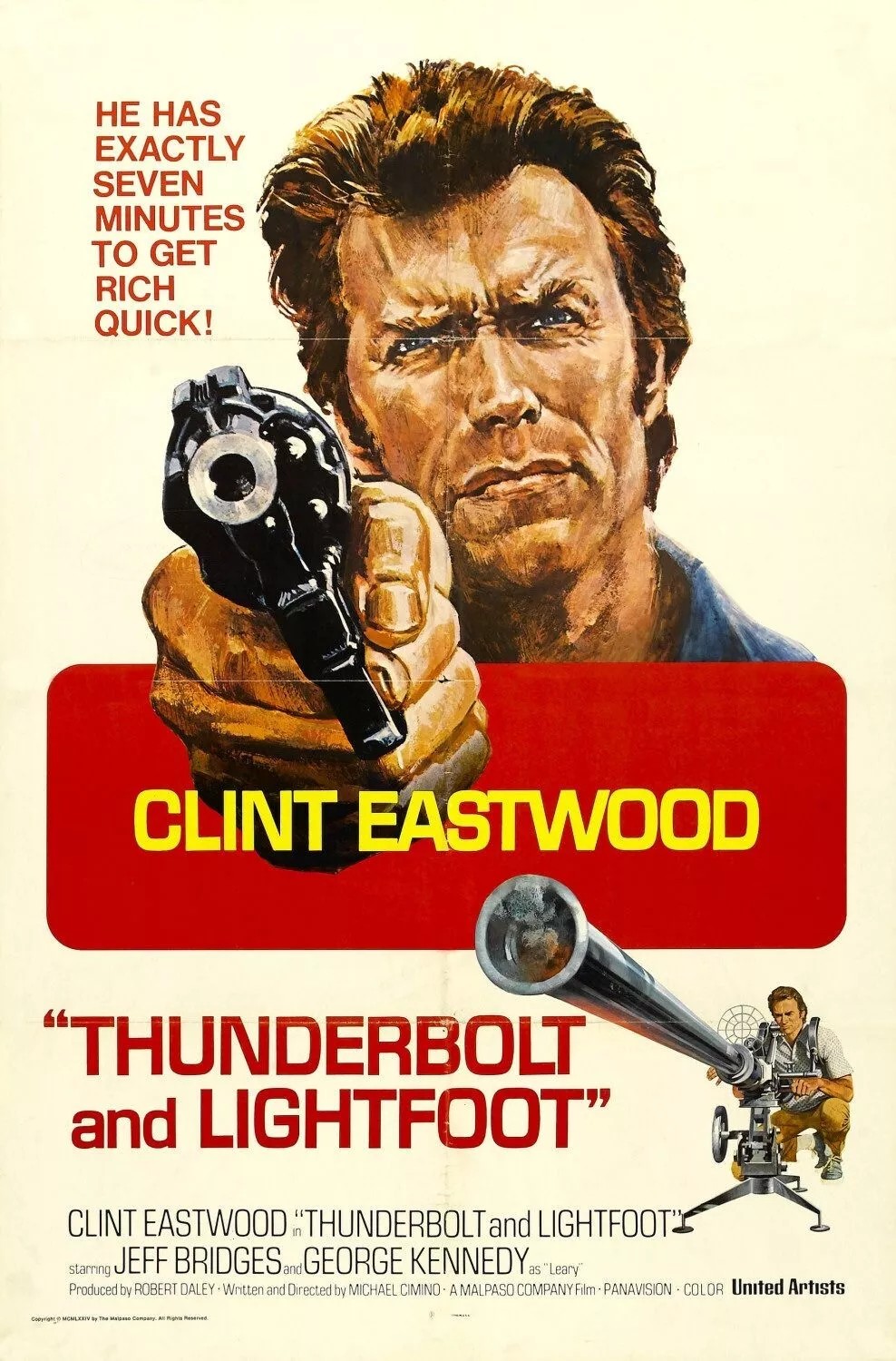
Obviously, if you’re in the Clint Eastwood camp this falls short, but otherwise it’s enjoyable stuff.

Predator Badlands (2025) **** – Seen at the Cinema

In possibly the most audacious pivot in sci fi here’s a movie minus any human characters. The leading character Dek (Dimitrius Schuster-Koloamatangi) is a monster straight out of the Alien back catalog and he is accompanied on his journey through the titular badlands by an android Thia (Elle Fanning), though one programmed with feelings though only for scientific purposes, and a mini-monster Bud (Rohinal Naharan) who when he’s not being fierce is quite cute.

The tale, however, has recognizably human dimensions. Dek is the runt of the litter and since weakness is despised in his clan he is scheduled to be terminated by his big brother, who can’t bring himself to do it so it’s left to his ruthless father to kill the protective brother. Meanwhile, Dek escapes to a distant planet, Genna, where everything is lethal including the grass. He hopes to prove his worth by killing the biggest monster in the universe, Kalisk. He teams up with a legless android Thia who has formed an affection of a sibling nature for a fellow synthetic Tessa (Elle Fanning).

The monsters encountered are pretty impressive and the landscape, whose rock formations suggest ragged versions of the spaceship that houses the aliens in the Alien series, is a visual treat. Though originally regarding Thia as nothing more than a “tool”, and happy to abandon whenever her usefulness ends, Dek ends up reacting in quite human fashion to her.

So if you’ve come expecting an extension of the Predator franchise where the monster merely exists to hunt down anyone in its path and you don’t get a glimpse of its character beyond the slicing and dicing this isn’t for you. But if you are open to a refreshing take on the monster universe, there’s plenty to enjoy.

And given the drought of audience-friendly pictures this last couple of months, an action picture with some emotional notes is more than welcome and thank goodness it hasn’t come with critics touting it for Oscar glory.

Turning the previous concept on its head, young Dek is the hunted not the hunter. He doesn’t have to go far to encounter venom, everything that moves or grows is dangerous. He’s got the moves and a scimitar that seems to owe something to a weapon from a different universe – the light saber. Even so, it’s often only by luck that he survives.

His teaming with Thia falls into a more conventional trope, the buddies who start out as enemies and/or the brain vs brawn combo. Thia speaks every language on the planet which helps when he is linguistically confounded. And Bud plays the unwelcome recruit which dates back to The Magnificent Seven (1960) and way before, though he turns out to play a significant part. There’s even time for some humor as when Thia’s disembodied legs stride down the street and go into vexatious action.

Given we’re dealing with non-humans, there’s a surprising emotional upside and a pay-off that provides a neat twist and suggests a sequel.

It would be non-stop action except for the interplay between hero and his “tool” and the emotional elements that spurt up every now and then. On the action alone it would be well worth your bucks, but the other elements take it a level above.

While Elle Fanning’s (A Complete Unknown, 2024) double turn isn’t as in-depth as that of Michael B Jordan in Sinners (2025) it’s still pretty good and had this been another kind of picture her misplaced affection for her scientifically-generated sibling  might have received greater emphasis.

The stripped down and pedal-to-the-metal narrative is driven by director Dan Trachtenberg (10 Cloverfield Lane, 2016) who would be one of the few directors to genuinely deserve the “visionary” tag so carelessly thrown around. He had a hand in the screenplay along with Patrick Aison (Prey, 2022) based on the Predator characters invented by Jim and John Thomas.

Hot stuff.

Battle of Midway (1976) ****

Even-handed documentary-style tale recounting of the most famous U.S. naval battle of all time, a turning point in the struggle for control of the Pacific in 1942. Both sides make mistakes, luck and judgement play an equal part.

I’d always assumed Midway was some abstract geographical position without any idea of its strategic importance – did the name mean it was halfway between the U.S. (or Hawaii) and Japan? But here I learned it was an actual island that the Japs planned to invade and the Americans intended to stop them. In some senses, it was bait, a way to draw the U.S. Navy out of Pearl Harbor. But the bait ran both ways. If the Yanks could coax the enemy out into the Pacific, they had a chance of gaining an advantage, even though the Americans were inferior in shipping tonnage.

The Japs have been stung into action by the audacious American bombing of Tokyo. Admiral Yamamoto (Toshiro Mifune) uses the perceived threat of further attacks to gain official approval for his plan to invade Midway.

This is strictly a male show. However, in a bid to lower the testosterone levels a romantic subplot is inserted. The aviator son, Lt Thomas Garth (Eddie Albert), of top aide and former pilot Captain Matthew Garth (Charlton Heston) has an American-born lover Haruko (Christina Kobuko) of Japanese descent who’s being investigated for espionage and subsequently interned. On intervening, the father digs up a hodgepodge of racism – from both sides, Haruko’s parents against her forming a relationship with a non-Japanese. But the plan backfires causing a breakdown between father and son.

But that’s very much on the fringes and although it raises interesting cultural aspects, the movie concentrates mostly on the nuts-and-bolts of heading into a major engagement.

American intelligence, headed by Commander Joe Rochefort (Hal Holbrook), gets wind of the planned attack. But the clues are scant – the old trope of increased radio traffic not enough to convince – and while the audience knows the Japs are on the move with a mighty naval force including four top-class airplane carriers, the Americans remain ignorant almost until it’s too late.

Luckily, Admiral Nimitz (Henry Fonda), heading up the American naval contingent, is keen to inflict a blow on the enemy, even though he’s limited to two carriers and another just out of the repair yard. Each side relies on spotter planes to detect the enemy. But the Japanese, by imposing radio silence, shoot themselves in the foot, unable to switch tactics until too late. The hunch plays an important part.

There’s rarely much opportunity for individual heroics on a ship under fire, beyond rescuing someone. The fighter pilots are a better bet, especially since some of their forays are nearly suicidal given the firepower they attract. Matt Garth, who for most of the picture is an upscale backroom boy, is called into action with unexpected results.  

Most battle films tend to concentrate on the heroics often at the expense of understanding in any detail what’s going on. Thankfully, this is different. We are kept informed of every change in the conflict. And whereas you might think that dull, in fact I wouldargue that it adds substantially to the tension, and the fact that the only one of the commanders who looks as if he could throw a punch (Robert Mitchum) in the manner of John Wayne is confined to his bed thus forcing the movie to concentrate as much on brain as brawn.

Audiences at the time welcomed all the talking and this was a substantial hit. Snippets of old war footage were carefully sewn into the lining of the action, bringing the kind of authenticity that moviemakers reckoned moviegoers craved. For me, there was more than enough going on already.

Nimitz’s decision to go for broke rather than dive for cover results in victory but he’s no gung-ho commander, rather presented as a thoughtful but determined individual. The lack of backstage effort especially in the communications department was partly to blame for the humiliation of Pearl Harbor but here these guys share the glory.

Boasting the kind of all-star cast that used to be the hallmark of the 1960s roadshow, this has a bunch of top-notch actors, albeit most just flit in and out of the picture. Charlton Heston (Planet of the Apes, 1968) effortlessly shoulders the main burden with Henry Fonda (Once Upon a Time in the West, 1969) the fulcrum of all decision-making. Robert Mitchum (The Way West, 1967) , James Coburn (Our Man Flint, 1966), Glenn Ford (Rage, 1966), Cliff Robertson (The Devil’s Brigade, 1968) and Toshiro Mifune (Red Sun, 1971) all feature.

Jack Smight (Harper / The Moving Target, 1966) directs from a script by Donald S Sanford (Mosquito Squadron, 1969).

Thoroughly engrossing.

  • I’m doing a Behind the Scenes tomorrow.

Out of Time (2003) *****

The most tension-filled thriller this side of The Day of the Jackal (1973). Stone-cold classic in my book. Admittedly not a big box office success in its day nor critically acclaimed, but this nod to film noir with cop taking a stroll for his own convenience down the wrong mean streets and an old-fashioned femme-fatale male-dupe scenario coupled with witty dialog and terrific set pieces suggests to me this is long overdue for reappraisal.

This was really the start of Denzel Washington as action hero – Crimson Tide (1995) was more a straightforward drama albeit with characters facing the ultimate consequence – and it probably helps that I’m looking back at this through the prism of more than two decades of the actor whizzing along in the derring-do department especially in his turn as The Equalizer (2014) – and sequels – where he demolishes opponents in seconds. Apart from the occasional side hustle as a bad guy, he’s generally been a good guy, the sort of dependable hunk that Tom Hanks would aspire to if he wanted to add brawn to his guy-next-door persona.

Matt Whitlock is the top law enforcement officer in a Florida slumber town (pop 1300) but he’s not as clean-cut as he looks given his affair with married Ann Harrison (Sanaa Latham) who bursts his romantic bubble by announcing she has just six months to live thanks to a cancer so advanced that only some new-fangled treatment could save her. I smelled a rat, I have to confess, the minute she decided she was going to make him the beneficiary of her million-dollar insurance policy.

So what’s a decent guy to do but steal the $500,000 drugs money he’s holding in his police safe, that’s liable to sit untouched for years to come, in order to fund her treatment on the assumption that the insurance policy acts as his insurance. How dumb can you be?

So when Ann and husband Chris (Dean Cain) die in a horrific fire, his world unravels, especially as detective soon-to-be-ex-wife Alex (Eva Mendes) is in charge of the murder investigation and the Feds arrive out of the blue looking for the drugs cash. So basically he’s an old-fashioned “running man”, diving from one hole to the next, barely keeping ahead of the cops and the FBI, fingered twice by witnesses, discovering that the specialist who diagnosed the cancer is an imposter, and not just being made to look the biggest fool who ever fell in love with the wrong woman but liable to pay for his error with a lengthy jail sentence.

Alex begins to suspect he knows more than he’s letting on, he’s desperate to trace the bogus doctor, all the while, in a nod to No Way Out (1987), desperately trying to stop a tsunami of telephone evidence – arriving via fax and computer – that links him to the supposed dead woman.

There are verbal confrontations galore and a couple of physical ones, a chase through a hotel culminating in a brawl on a balcony, and possibly a second murder charge.

It’s not just a terrific tale, mostly consisting of twists and narrow escapes, I counted half a dozen twists in the last ten minutes alone, but offers some terrific dialog. In a diner, the relationship between Matt and Chris is spelled out in style: Matt recommends the crab, Chris points out he’s allergic to crab. “I know,” retorts Matt. The movie opens with some decidedly salty goings-on between Matt and his lover and the verbal duel between Matt and Alex has the underlying Tracy-Hepburn classic squabbling.

For all that Matt is smart enough to chase down the missing cash and hold the Feds at arm’s length long enough, he’s still, when you come down to it, only going from dumb to dumber and the shock when he realizes just how well he’s been duped is a cracker.

So, obviously, the key is that the audience wants him, guilty though he is of theft and stupidity, to get away with it or at least be thrown a get-out-of-jail-free card and that’s part of the hook, and that element is brilliantly done. I had no idea how he was going to get off with it, as one avenue of escape after another was rigorously shut down, until the very end.

There’s a whole stew of those reversals that screenwriters throw at audiences who think they are one step ahead of the game.

It’s a great cast. Denzel Washington is superb, Eva Mendes (Training Day, 2001) is an excellent sparring partner, Sanaa Latham (AVP: Alien vs Predator, 2004) as slinky as femme fatale as you’ll find. Look out for television’s Superman Dean Cain and especially character actor John Billingsley.

Director Carl Franklin (Devil in a Blue Dress, 1995) piles on the tension and kudos to screenwriter Dave Collard (Annapolis, 2006) for creating the blueprint.   

I caught this on Amazon Prime but be quick about it because it’s in the section that the streamer calls “leaving in 30 days.”

An absolute classic.

Frankenstein (2025) **** – Seen at the Cinema

I came at this with a bucketload of reservations. First was the length. I grew up with versions of this tale that were around a good hour shorter. Ninety minutes seemed to be the ideal length not a stonking 150 minutes. Secondly, I’m not a huge fan of director Guillermo del Toro and excepting Pacific Rim (2013) – an outrider in his portfolio – and The Shape of Water (2017) felt his reach was not matched by his grasp. He was the kind of director whose work I was supposed to like and invariably responded less well than I had expected. And third of course was, even with the trend for reimaginations and remakes and in the hands of a “visionary director” (a vastly over-used term), I had seen this story so often before I wondered what else he could bring to it.

So I was very pleasantly surprised to find an emotionally satisfying thoroughly enjoyable work that did not outstay its welcome. Moreover, it doesn’t rely on the tropes of outraged villagers carrying torches and as far as I can gather without me going back to the sacred text whatever changes have been made to the original appear logical and true. Both the creator and the monster at various points will touch your heart.

One of the aspects I most enjoyed was the creation. The detail involved was in keeping with heist movies where robbers work out their plan in minute detail or war films where the audience is filled in on the strategy and tactics involved in battles as though they were adults who could understand the importance of long scenes of dialog rather than treating them as children who preferred to go straight into the action regardless of whether they understood what was going on or not.

Here, we begin in the Arctic where an exploration vessel trapped in ice comes upon a very ill Victor Frankenstein (Oscar Isaac) who is being pursued by the monster (Jacob Elordi) of his creation.

Then we’re in flashback mode. Victor is son of a famous but tyrannical surgeon (Charles Dance) whose adored mother dies in childbirth giving birth to a more favored brother William (Felix Kammerer).

Then we shift to a medical disciplinary court where Victor is on trial for his experiments in reanimating corpses, for playing God in a society where the Supreme Being was still considered in charge of everything on Earth. But no matter how clever the corpse appears, capable of apparently playing catch, the case goes against him and his dreams, and career, would be in tatters except for the intervention of wealthy arms dealer Harlander (Christoph Waltz), uncle of Elizabeth (Mia Goth) the fiancée of William.

She’s intellectually advanced for a woman of the era, studying insects, and more than a match for Victor and for a while it looks like we’re in for an awkward love triangle. Meanwhile, Victor is harvesting bits and pieces of fresh corpses from battlefields and stitching them together in a way that maintains the body’s unique nervous system while Harlander happily stumps up the enormous cost.

The experiment, which takes place in a remote castle and costs the life of Harlander, is a success but given the monster’s size (Jacob Elordi) Victor keeps him in chains in the castle’s vast cellar. But he soon becomes exasperated by the creature’s lack of intellect, speech limited to repeating his creator’s name (and his own as it turns out).

When Elizabeth discovers the creature, she falls in love with it and turns against the scientist and keeps the gift of a leaf the creature has given her pressed inside the pages of a book. Since the creature is fit for no more than a circus exhibit rather than acclaimed as an experiment, and needing someone to blame for Harlander’s death, Victor fits up the monster, blaming him for setting fire to the castle.

Victor escapes, takes refuge in a cottage where he is educated by a blind man, and discovers his own emotions. Hounded out of there, he sets out to find Victor who is attending his brother’s wedding. The monster’s plea for a female companion is derided by Victor and in a melodramatic moment he accidentally shoots Elizabeth. The monster carries the dying woman out of the wedding pieta style.

So the hunt is on. Victor flees to the frozen north and eventually when the monster engineers a confrontation, he is able to attempt reconciliation with his creator.

The question asked – who is the monster? The creator or the result of his tampering with nature?

The acting is top notch, Jacob Elordi (Saltburn, 2023) should have walked off with the acting plaudits except that Oscar Isaac (Dune, Part One, 2021) elicits our sympathy and then our horror and Mia Goth (Maxxine, 2024) excels in a role where she is not called upon, as so often before, to overact. As far as Christoph Waltz (No Time to Die, 2021) and Charles Dance (The First Omen, 2024) are concerned their roles are minor variations of characters both have played before.

Praise is very much due to writer-director Del Toro for not losing my interest for a minute.

Since this is a Netflix production I could have saved myself a few bucks and waited till it appeared on the small screen. But unlike other big budget works by “visionary” directors, this will work very well on the smaller screen because, despite some arresting visuals, it’s essentially a chamber piece involving a handful of characters.

The highest praise I can give any director of an epic is the ability to not lose my interest for a single minute. So all praise Del Toro.

Sweet Bird of Youth (1962) ***

Tennessee Williams wrote better parts for women than he did for men. You can start with Vivien Leigh, Oscar-winner for A Streetcar Named Desire (1951) – Marlon Brando only nominated – and Anna Magnani Oscar-winner for The Rose Tattoo (1955) with Maria Pavan nominated and star Burt Lancaster left out of gong consideration. Carroll Baker and Mildred Dunnock were nominated for Baby Doll (1956) with star Karl Malden ignored. Paul Newman did receive an Oscar nomination for Cat on a Hot Tin Roof (1958) as did Elizabeth Taylor.

Montgomery Clift was frozen out of Oscar consideration for Suddenly, Last Summer (1959) while both Elizabeth Taylor and Katharine Hepburn scored nominations.  Marlon Brando received no Oscar recognition for The Fugitive Kind (1960). Ditto Laurence Harvey for Summer and Smoke (1961) though Geraldine Page and Una Merkel received nominations. Lotte Lenya was recognised with a nomination for The Roman Spring of Mrs Stone (1961).

So the omens were not particularly good for Paul Newman when he repeated the role he had essayed on Broadway of Chance Wayne in Sweet Bird of Youth. In the stage version, while he received respectable notices, it was Geraldine Page who picked up the glory, winning the New York Drama Critics Award and nominated for a Tony.

So it was going to be a long shot that Newman could outshine her in the film version, even though he received considerably more screen time – Page and Shirley Knight were nominated, Newman was not.

The flaws in the tale are more obvious in the screen version. On stage, sheer force of personality can win over an audience, on screen that’s more difficult. And in truth Chance was another of Williams’ male losers. The main difference between Williams’ male and female characters is that not only are the women more reflective and aware of their shortcomings while the men simply bulldoze ahead but they are more able to express their feelings without dialog.

Chance is a failed actor turned gigolo taking advantage of alcoholic over-the-hill movie actress Alexandra Del Lago (Geraldine Page), running away from what she believes will be her final and calamitous movie, who half the time doesn’t know where she is or who he is. Chance has dreams of using her to hustle his way into the movie business, blackmailing Del Lago over her drugs abuse to front a new picture, and begins knocking on doors, but long-distance, since he’s returned to his home town in the hope of winning back his childhood sweetheart Heavenly Finley (Shirley Knight), planning to set her up as a movie star.

Expectations that there might be a welcome for a young man made good are dashed when everybody continues to treat him as the waitperson he once was or wants to run him out of town. To protect his daughter from such an unworthy suitor, the town’s most prominent citizen and political heavyweight Tom Finley (Ed Begley) had previously managed to pay Chance to leave town. His son Tom Jr (Rip Torn)  shares his father’s aspirations.

Despite the odds Chance determines to woo Heavenly but his Hollywood dream is scuppered when Del Lago realizes that her last picture looks like becoming an unexpected success and she can once again write her own ticket rather than rely on a con man like Chance.

It doesn’t end well though, for reasons best known to him, writer-director Richard Brooks tacked on a happy ending – the play had an unhappy ending – that doesn’t ring true.

There’s nothing wrong with Paul Newman’s acting even if it didn’t attract the attention of the Oscar voters, but there’s not enough meat on the character. On the other hand, Geraldine Page and Shirley Knight (The Group, 1966) in part excel because their characters are better written. Rip Torn (Beach Red, 1967) develops his screen menace. Ed Begley’s (Warning Shot, 1966) over-the-top performance snagged him an Oscar.

The story’s just too thin and the hard edges of the play have been trimmed back so it was less appealing to an audience.

Lacks the usual Tennessee Williams bite but the female performances are well worth a watch.

I’m doing a Behind the Scenes article tomorrow so look out for that.

Wait Until Dark (1967) ****

You wouldn’t have figured Audrey Hepburn – she of the model looks (Breakfast at Tiffany’s, 1961)  and upmarket twang and belonging to the highest echelons of the movie business – for a Scream Queen. But there were precedents – Doris Day had at times been screaming fit to burst in Midnight Lace (1960) and Lee Remick, though not in either’s marquee league, had been terrified to bits in Experiment in Terror / The Grip of Fear (1962). By this point in pictures, the screen was awash with Scream Queens, courtesy of lower-budgeted efforts from Hammer, AIP and Amicus, so asking a top star to exercise her lungs in similar fashion might have been career suicide.

As it was, which would have come as a surprise to her legion of fans, this turned out to be pretty much the star’s swansong. She wouldn’t make another movie in nearly a decade and only another three after that. But here she certainly hits a dramatic peak.

The story’s a bit muddled and initially requires unraveling. Drug mule Lisa (Samantha Jones) passes a doll packed with heroin to fellow passenger Sam (Efrem Zimbalist Jr.) on a plane. She had been planning to steal the dope and set up on her own with Mike (Richard Crenna) and former cop Carlino (Jack Weston). There’s a bit missing from the tale but you have to assume that somehow Lisa got talking to Sam and he gave her his address and that she has turned up at his apartment looking for the doll, which wasn’t there.

Mike and Carlino turn up and have no luck searching the apartment. They don’t look hard enough because if they’d looked in the closet they’d have found the corpse of Lisa, killed by her employer Roat (Alan Arkin) who arrives to confront the pair and then hire them to help him find the heroin and dispose of the body.

So with all that out of the way we come to the meat of the story. And it follows the same premise as Man in the Dark / Blind Corner (1964) –  though, luckily, so few people saw that it wouldn’t be at the forefront of the audience mind at the time – of not so much a blind person being terrorized in their home but being largely played for a fool. The audience knows more than the blind person does and much of the story is not their vulnerability but just how long it will take for them to twig what’s going on.

In the case of Susy (Audrey Hepburn), as with the composer in Man in the Dark, her ears are her radar. She is on the alert after hearing the same pair of squeaky shoes on different people and wondering why people are opening and closing her blinds so often. Mike and Carlino masquerade as good guys, cops investigating the murder of Lisa for which her husband Sam is a suspect. She helps them tear apart the apartment looking for the doll.

She trusts Mike implicitly, less so Carlino, and when she starts to put two and two together she has an ally, teenager Gloria (Julie Herrod) who lives upstairs – they communicate like jailbirds by banging on the pipes. Although her eyes are denied sight, they still express her emotions – trust, relief, gratitude, fear.

But there’s not just one game of cat-and-mouse. There’s three. You know damn well that Mike and Carlino plan to squeeze Roat out of the equation just as you know damn well that he is planning to play them for patsies, apt to take revenge when double-crossed.   

Gradually, her suspicions ramp up. She’s pretty smart working out the various clues. And then we hit two dramatic peaks. Firstly, when she discovers Mike is a bad guy. Secondly, when Roat kills Mike and turns on her, splashing petrol about the place, exploiting her terror of fire. She’s still got a couple of moves to turn the tables, at least temporarily but when absolute darkness does descend – she’s smashed all the lights out – and theoretically they are both in the same boat, and advantage her because of her keener hearing, it doesn’t quite work out the way she’s expected because he knows how to exploit sound.

I won’t tell you where the doll is hidden because that’s a very clever twist in itself, but apart from the few plotholes at the outset (how did Lisa manage to break into Susy’s apartment for a start and leave no trace, for example) once the narrative takes hold it exerts a very strong bite.

Audrey Hepburn is on top form. Alan Arkin (The Russians Are Coming, The Russians Are Coming, 1966) and Jack Weston (Mirage, 1965) are a bit too obvious for me, but the smoother Richard Crenna (Marooned, 1969) is excellent.

Directed with both an eye to character and tension by Terence Young (Dr No, 1962) and adapted by Robert and Jane-Howard Carrington (Kaleidoscope, 1966) from the Broadway play by Frederick Knott (Dial M for Murder, 1954).

Top notch.

The St Valentine’s Day Massacre (1967) ***

I didn’t realise that the Prohibition gangsters who invented the drive-by shooting were perfectionists. Just to be make sure of completing the job, I found out here, they might send a dozen cars one after the other rolling past the chosen restaurant/cafe, machine guns spouting hundreds of bullets. Nobody could survive that, you would think. But there was a flaw to the idea. If someone just lay down on the floor, the bullets would pass over their head. Strangely enough, we never got a potted history of the drive-by shooting in this docu-drama because otherwise we found out just about everything we needed to know about the infamous massacre.

But I did wish that the narrator would shut up once in a while. I kept on thinking we were going to be examined afterwards. Every dumb schmuck that made even a brief appearance on screen got the full bio treatment, including when – and how (not always by violence) – they died. That annoying feature aside, it was certainly a forensic examination of the whys and wherefores of the infamous gangland slaying. Rival Chicago mobsters Al Capone (Jason Robards) and Bugs Moran (Ralph Meeker), both concluding that the other was not open to negotiation, decided instead to rub him out and the movie basically follows how each develops their murderous plan.

All the big gangster names are here – it’s like a hit man’s greatest hits – Frank Nitti (Harold J. Stone), massacre mastermind Jack McGurn (Clint Ritchie) and Capone enforcer Peter Gusenberg (George Segal) – and the movie reprises some of the classic genre tropes like mashing food (sandwich this time rather than grapefruit) in a woman’s face and Capone taking a baseball bat to a traitorous underling. And there’s the usual lopsided notion of “rules,” Capone incandescent that a ganster was murdered in his own home.

Capone’s plan is the cleverest, involving recruiting people with little or no criminal record including the likes of Johnny May (Bruce Dern in a part originally assigned to Jack Nicholson), renting a garage as the massacre venue, and dressing his hoods up as cops. The film occasionally tracks back to set the scene. And the ever-vigilant narrator makes sure to identify every passing gangster but come the climax seems to run out of things to say, a good many sentences beginning with “on the last morning of the last day of his life.”

Since there’s so much money washing around, it makes sense for the ladies to try and get their share. Gusenberg’s girlfriend (Jean Hale) casually, without seeking permission, swaps one fur for another four times as expensive. A sex worker as casually steals from her client’s wallet before demanding payment for services rendered.

The only problem with bringing in so many bit characters – either those doing the murdering or being murdered – into play is that it cuts down the time remaining to cover Capone and Moran, so, apart from the voice-over, we learn little of significance, most of the drama amounting to outbursts of one kind or another. But it’s certainly very entertaining and follows the Raymond Chandler maxim of when in doubt with your story introduce a man with a gun, or in this case machine gun. The violence is episodic throughout.

Despite the authenticity, punches are pulled when it comes to the physical depiction of Capone. The man universally known as “Scarface” shows no signs of such affliction as played by Jason Robards (Hour of the Gun, 1967). Certainly, Robards shows none of the brooding intensity with which we associate Godfather and son Michael in the Coppola epic, rather he has more in common with Sonny. He delivers a one-key performance of no subtlety but since the film has no subtlety either then it’s a good fit. Ralph Meeker (The Dirty Dozen, 1967) has the better role, since being the junior gangster in terms of power he has more to fear. I felt sorry for Oscar-nominated George Segal (No Way To Treat a Lady, 1968) since although his character is there for obvious reasons there is no obvious reason why he should be allocated more screen time. And given more screen time, nobody seems to know what to do with it.

There’s a superb supporting cast including Jean Hale (In Like Flint 1967), Bruce Dern (They Shoot Horses, Don’t They, 1969), Frank Silvera (Uptight, 1969), Joseph Campanella (Murder Inc., 1960) Alex Rocco (The Godfather, 1972), future director Gus Trikonis and future superstar Jack Nicholson.  

After over a decade of low-budget sci-fi, horror and biker pictures, this was director Roger Corman’s biggest movie to date – his first for a major studio – and, excepting the voice-over, he does an efficient job with the script by Howard Browne (Portrait of a Mobster, 1961) who was presumably responsible for the intrusive narration.

CATCH-UP: This isn’t really a good place to start with the acting of George Segal and you will get a better idea of his talent if you check out the following films covered so far in the Blog: Act One (1963), The New Interns (1964), Invitation to a Gunfighter (1964), King Rat (1965), Lost Command (1966), The Quiller Memorandum (1966), No Way to Treat a Lady (1968), The Bridge at Remagen (1969) and The Southern Star (1969).

Discover WordPress

A daily selection of the best content published on WordPress, collected for you by humans who love to read.

The Atavist Magazine

by Brian Hannan

WordPress.com News

The latest news on WordPress.com and the WordPress community.