Love Lies Bleeding (2024) *** – Seen at the Cinema

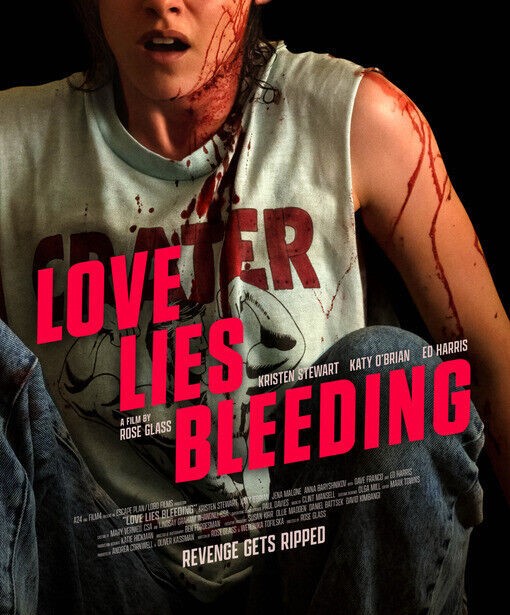
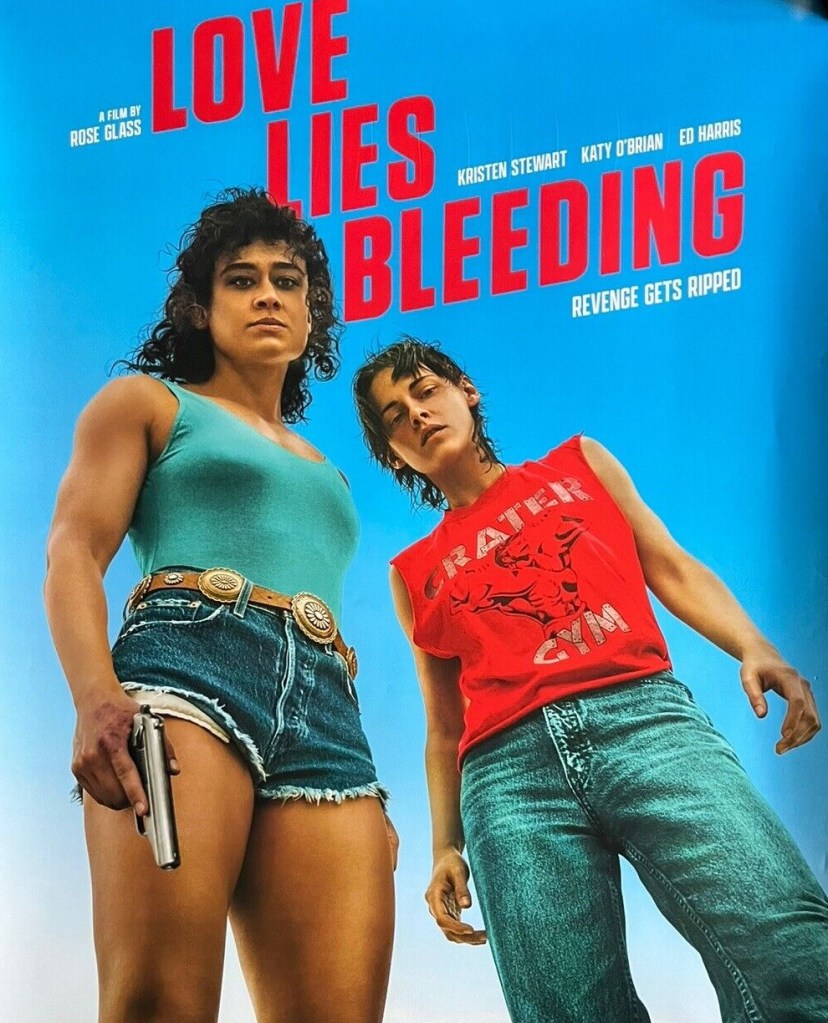
This year’s Saltburn. An ethereal mix of noir, exploitation, wife beating, body building, carpetbagging, blackmail, steroids, bug snacking, daddy issues, such a long string of coincidence it could run a marathon, topped off with a healthy dose of surrealism. I guess going with the flow brings reward. Not sure it made much of being set in 1989, no signs of movie theater marquees promoting Batman or Indiana Jones and the Last Crusade though the principals might have got a buzz out of Lethal Weapon.

You do have to wonder though at choice. Was this all that Kirsten Stewart was offered or has she aligned herself as the kind of arthouse darling whose attachment makes such an unwieldy project feasible? But an actress who can switch from Seberg (2019) to Charlie’s Angels (2019) and back again to Crimes of the Future (2022) demonstrates the kind of versatility that can sit easily on both sides of the Hollywood fence. But it’s a step too far for martial artist Katy O’Brian (Ant Man and the Wasp: Quantumania, 2023).
Coincidence can only get you so far though generally you can rely on a screenwriter to attempt to magnify relationships by ensuring that nobody gets through a movie without having some difficult relationship. That guy on the corner, let’s make him an uncle. The kid who appears once, let’s make him a drug addict who’s addicted to heroin because he blames himself for his mum dying in childbirth. Coincidence overload has found a true champion here.

So hitchhiker Jackie (Katy O’Brian) has sex in the car of JJ (Dave Franco) on the understanding that he’ll find her a job on a shooting range owned by Lou (Ed Harris) who happens to be the father and shares the same name as Lou (Kirsten Stewart) a gym manager who falls for Jackie’s swelling pecs and who happens also to be JJ’s brother-in-law. Lady Lou happens to have a sometime girlfriend Daisy (Anna Baryshnikov) who happens upon Jackie driving Lady Lou’s car after Jackie’s s murdered JJ. And Lady Lou’s only happened upon the murder because – you can see where this going.
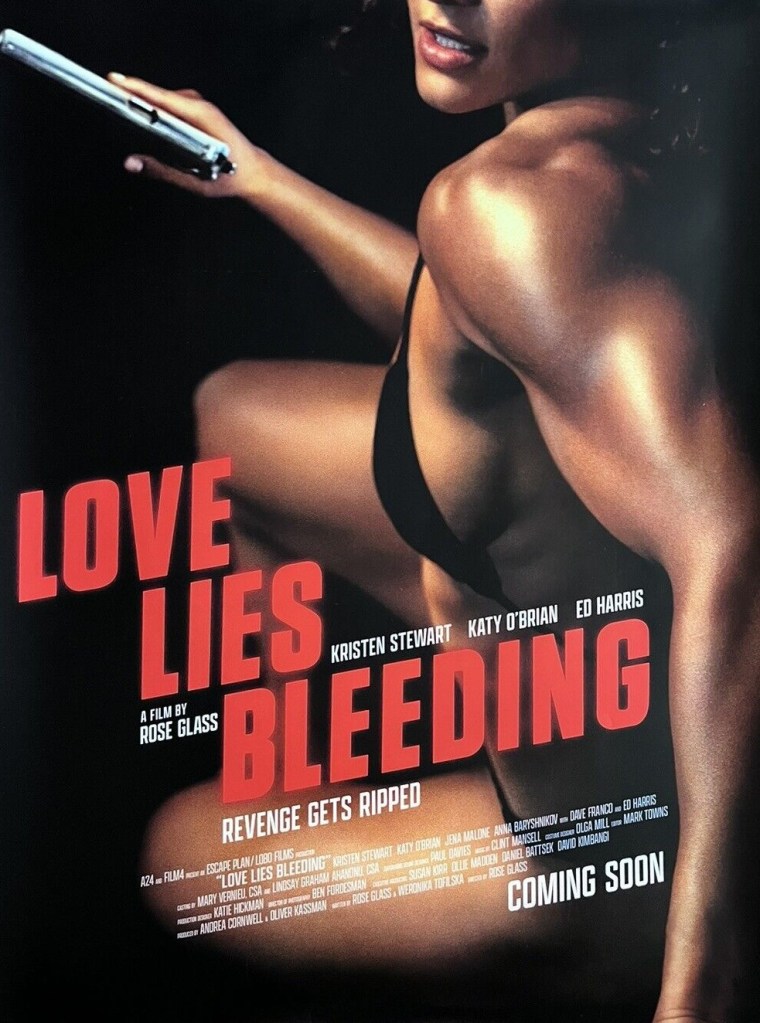
Luckily Lady Lou is experienced in getting rid of a corpse – and luckily there are plenty of good-sized rugs to spare because she has to lug out a total of three dead bodies. Her dad’s a gun-runner and corrupter of cops so he’s immune to pretty much everything unless his daughter decides to rat him out, which might be a complication for her, given that earlier she was running in his slipstream.

There’s plenty lowlife mixed in with high end angst, Lady Lou falling out with Jackie once she cottons on to the fact that she quite enjoys bisexuality and has no objection to swapping sex for a job, not even with an odious wife-beating brother-in-law. And then Lou has to come to terms with the fact that after committing murder Jackie’s only concern is in high-tailing it down to Vegas for a body building competition.

So really way too much narrative and subplot for this thin gruel. But in passing there are some memorable moments. For a start, this is the first time I can remember seeing anyone at a shooting range who isn’t a cop of the Dirty Harry persuasion or a spy. To see ordinary folks happily popping off at targets and enjoying a beer afterwards goes a long way to explain the country’s obsession with ownership of weaponry.

And the face of the victim of the wife-beating was truly shocking as was what was left of JJ’s jaw once Jackie had smashed it into a table. Then we have the surreality – a full-grown Lady Lou pops out of JJ’s mouth covered in birth residue, Jackie’s muscles audibly crack almost every time she takes a breath and when she goes into full-blown Incredible Hulk mode her tee-shirt splits in half, plus she turns into a giant to pin down Daddy Lou.

By the time you get to the end, there’s been so many changes of tempo and mood that you’re grateful that after all this is really a romantic comedy complete with making up on a tennis court and a corpse coming to life in the back of a car. It’s a good few tunes short of a decent picnic, but once you realize this is more of a cartoon than a genuine noir thriller and go with the flow it has rewarding moments. There’s a decent amount of nihilism and almost anytime anyone makes a declaration of love you can be sure they’re going to blow the loved one’s brains out or do something to totally contradict their statement.

As directed by Rose Glass (Saint Maud, 2019), it might have been better if the surrealism had infused the entire movie rather than being reseved, as if the icing on the cake, for the final segments.

As I said, this year’s Saltburn.

Eight for Silver / The Cursed (2021) ****

Restraint in a horror picture? Nary a scream? Scarcely a close up? More bloodletting in surgery than in the woods? Use of candlelight evocative of Stanley Kubrick? The classical composition of John Ford, long shot beloved of Henry Hathaway, in camera (minus the juddering cuts) treatment favored by Christopher Nolan? Where has this little gem been hiding?

Set in rural France in the nineteenth century, positing a Biblical reimagining of the werewolf legend, every scene so carefully measured by British director Sean Ellis (Anthropoid, 2016) that you would think this is a master sprung to life. Even more tantalizing, given the genre, is the ensemble acting. This isn’t one of those horror efforts where you’re trying to work out (or hope) who’s going to be bumped off next.

Marketing team do this picture a disservice with this poster which more or less gives the game away, even though this forms a tiny fraction of a classy film.

And you think – although the participants remain baffled – that you know what’s going on, so you let down your guard, until the feet are swept out beneath you by the late twist, that, too, with Biblical connotation. The first Biblical allusion seems far-fetched, I have to admit, linking Judas Iscariot’s 30 pieces of silver to the silver bullet traditionally used to kill werewolves, vampires and the like. But then it twists into left field, both thematically and intellectually, covering such wider ground as betrayal and confession. The second Biblical reference we are all familiar with – reaping what you sow.

Technically, the narrative revolves around a gypsy curse. Nothing unusual in that you might think. Gypsies – and teenagers for that matter – are known for handing out curses for any minor breach or discrepancy. In this case, you wonder how the curse was set, given every single gypsy within the vicinity has been slaughtered, buried alive or, hands and feet chopped off, turned into a human scarecrow.

But the gypsies, suspecting imminent malevolence, have fashioned from their horde of silver coins (maybe thirty, we are not told), a pair of silver false teeth, which are buried, but then found by the local children, directed to them by dream/nightmare. These aren’t of the distinct vampiric molar kind, but seemingly more akin to those employed by wolves for savaging purposes. It’s the children who are turned into werewolves or, as here, that rarer mythical entity shamans (though not in the strict understanding of the word).

Stuck for another poster – which shows how little of an initial release “Eight for Silver / The Cursed” received – I’ve taken the easy way and added the movie with which Kelly Reilly first attracted attention.

Victims appear chosen at random, and not for illicit sexual behaviour as was once the norm, and  gradually a more apparent truth emerges. Eventually pathologist McBride (Boyd Holbrook) takes center stage, but that’s a slow time coming, and mostly what we have is nobody taking center stage, or focus shifting around a variety of characters, landowner Seamus (a traditional French name, don’t you know) Laurent (Alistair Petrie), submissive wife Isabelle (Kelly Reilly), their daughter Charlotte (Amelia Church) and a variety of young teenagers including Timmy (Tommy Rodger) and servants.

But, as I said, restraint is the watchword, and there are three just outstanding scenes. The movie opens – didn’t I mention this – in World War One, a field surgeon extracting bullets from a wounded soldier. The bullets don’t even, as would be the usual cliché, clang when tossed into a metal bowl. The surgeon finds two. The third is unusual. It’s much bigger for a start than your normal machine gun ammunition. And it’s silver.

And here’s the genius. Nobody exclaims, oh my goodness, a silver bullet, whatever can that mean, it just sits there dripping with blood from the operation, and the image filters down into the audience brain. Then we’re into flashback and gypsies making such a nuisance of themselves claiming ancient ownership of land that good old Seamus decides to call in the mercenaries. And that entire scene, of terrible slaughter, people shot and skewered and burned alive, is shown in extreme long shot, the camera never moving.

Third terrific scene. The Laurent’s son Edward is missing. Father, mother and daughter sit at the kind of long table you get in mansions, mother at one end father at the other. Mother is weeping scopiously, father is silently eating his dinner. Long shot again, no cuts, just the measured camera.

Virtually the only color in most scenes is a candle or a torch, and you would have to say a less showy and more effective treatment of light than in Kubrick’s Barry Lyndon (1975).  And in audio terms it’s the same, scarcely a raised voice. And when McBride’s family tragedy is revealed, it’s done so visually and discreetly, though for the dumber audience member the ground is covered with dialog later on.

No showboating required from the actors so in that sense it’s the very best type of acting, as if everyone had learned from Anthony Hopkins how little you had to do to be effective. So top marks to Boyd Holbrook (Indiana Jones and the Dial of Destiny, 2023), Kelly Reilly (Yellowstone, 2018-2022) and Alistair Petrie (Rogue One, 2016). Sean Ellis didn’t just write and direct this but he handled the cinematography too. Had this been an arthouse number, Ellis would be praised to the skies.

If you require jump-out-of-your-seat moments and copious gore, then this isn’t one for you, but if you want to appreciate a story superbly told by a director in command of his craft, then seek this out. Strangest of all it’s turned up on Netflix, not known for harvesting little gems, and probably scarcely aware of what it has uncovered.

A marvellous surprise.

The Great Race (1964) **** – Seen at the Cinema

And not just any old cinema, but the 87-year-old Fine Arts in Los Angeles, I guess the second oldest movie house still standing there, with admission a princely 50 cents and the whole place done out in a gaudy red. I was taking time out from a research mission to the Academy of Motion Pictures Arts and Sciences’ (the Oscar people) equally famous Margaret Herrick Library, where I was digging up stuff for my next book about the films of Alistair MacLean.

And where I discovered to my unimaginable delight they they had my books on their shelves. I’ll never win an Oscar and bestsellerdom will continue to evade me, but for a writer of books on movies, there can be no greater honor than to have your works on the shelves of Hollywood’s most important library. Since data protection will prevent me from discovering who has checked out my books, I can safely imagine that it was bound to be Harrison Ford, Greta Gerwig, Christopher Nolan and/or Steven Spielberg.

Anyway, enough of that self-congratulatory nonsense and on with the show. If you’ve any memory of this picture – jaunty jalopies battling it out at the start of the 20th century when suffragettes were raising hell – it’ll be for the slapstick. The upfront feminism most likely  passed you by. A savvier female you would be hard put to find, especially one that susses out exactly that when a male falls in with her views it’s just to get her into bed. So, from the contemporary perspective, this is a far harder-nosed picture than the fluffy narrative suggests.

Setting aside the famous pie-throwing homage to silent film pie-throwing (and every circus clown act since Doomsday) and a couple of sequences that outlive their welcome and the odd decision to find a plotline that can accommodate Jack Lemmon going down the (almost) identical twin route, this is pretty much sheer delight.

Characters could not be more black-and-white – in visual terms as well – than rival mechanical whizzes The Great Leslie (Tony Curtis) and Professor Fate (Jack Lemmon) except for the much more rounded (in character terms) interloper Maggie Dubois (Natalie Wood) as a reporter. Not content with being a legend in his own lunctime, the mad professor follows the Gore Vidal tack of being upset by any rival’s successes. However, he’s such an incompetent saboteur he doesn’t realize he’s merely the feed for a number of superb visual gags.

The Great Leslie, smile resounding with the Colgate audible zing, doesn’t have much to do except expound the principles of fair play and occasionally demonstrate his fencing skills when the plot turns sideways. Maggie is the ace inveigler, and when that doesn’t work resorts to handcuffs to ensure she will not be moved or someone else will be stuck fast. Standard bearer for female equality, she manages to put all the arguments without sounding dull, especially as, verbally, she is dealing with a keen dueller. And when she’s not switching sides, she’s rooting for the good guy.

The plot could have come out of a dishwasher but roughly equates to a round-the-world road race with most countries conveniently missed out, ending up in Paris with a stop-off somewhere in Germany. The deliberately cartoonish feel shouldn’t work at all, especially for a contemporary audience, but then we all laughed at Dumb and Dumber and plenty comedies with even less of a one-note touch. Thankfully, there was no such thing as deconstructed comedy in those days so everyone enters the spirit of the thing. And it’s quite refreshing to watch stuff being blown up and falling apart not for overblown thriller or comicbook reasons.  

I wasn’t taken with the overlong sequence in the saloon – extended singing and brawl (heck, what else are saloons for) – and wasn’t so hot on the legendary pie section either and certainly the notion that Professor Fate could be such a doppelganger for a dumb German prince that the powers behind the throne plan to substitute one for the other seems to belong in the furthest reaches of the Far Fetched Highway.

But there are so many gags and the characters, no matter how cartoonish at times, seem true to themselves, and with Maggie on hand to constantly upset the misogynistic applecart it seems a tad picky to be so picky. I was astonished that the audience I watched it with, primarily much younger than I, were so tickled.

Tony Curtis (The Boston Strangler, 1968) and Jack Lemmon (How to Murder Your Wife, 1965) repeat the magic of Some Like it Hot (1959) thanks to the strong directorial hand of Blake Edwards (The Pink Panther, 1963). Natalie Wood (Bob and Carol and Ted and Alice, 1969) shines. Rare comedy role from Peter Falk (Penelope, 1966). Excellent support from Keenan Wynn (Warning Shot, 1966). Edwards co-wrote the script with Arthur A. Ross (Brubaker, 1980).

Certainly more than stands the test of time.

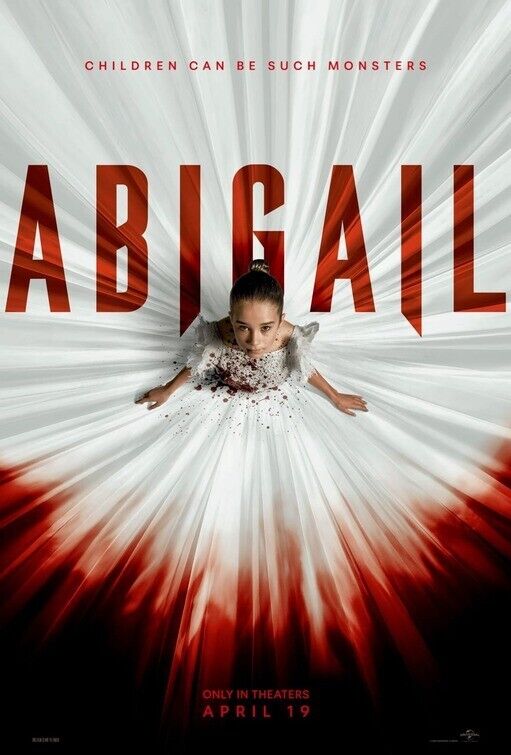
Abigail (2024) ** – Seen at the Cinema

Someone hasn’t pointed out to the directors (there’s two of them) – or they’ve decidedly to pointedly ignore – the crazy notion that you need someone to root for in a horror film, even if it’s someone you start out disliking. Nor has anyone seemingly touched upon the grating error of the premise. You’re planning a $50 million kidnap, so you hire a team of top professionals, who turn out not to be able to control their liquor, get drunk or stoned within an hour of a 24-hour shift, and can’t even keep to their own basic rules which include not mentioning each other by name or revealing their faces to the victim.

The twist – that somehow they’re the ones trapped – would have a chance of succeeding if the principals were capable of extracting an ounce of sympathy from the audience. We’ve got an ex-junkie single mom too keen on playing the victim, an ex-cop, a muscle man from the Dumb and Dumber Selection Box, a sociopath, a rich girl looking for kicks and a guy who may be more mainstram but acts dodgy.

The other twists – that the kidnapped girl is actually a vampire and that her dad is some feared villain – don’t count for much unless it’s the girl we’re supposed to be rooting for because (twist number 22) vampires aren’t born that way but need to be bitten and guess who did that indoctrination, yep, the bad dad, so, technically, this counts as child abuse. So, technically, little Abigail would get my sympathy vote except she’s caught up in one awful movie.

What with exploding bodies, decapitated corpses, a lake of dead people, mirrors with miracualous properties and the usual stakes, garlic and crosses failing to work it’s a blood-drenched hotch potch that wears out its welcome very quickly. Not even worth it to see posh Downton Abbey alumni Dan Stevens and Matthew Goode sharpening their fangs.

Saw this on a double-bill with Challengers. This kind of counter-programming has worked in the past. But not here, sadly.

Challengers (2024) ** – Seen at the Cinema

Am getting a bit fed up with critical wishful thinking where reviewers pump up the latest effort from a “visionary” director, the movie they wish they had seen rather than the dreadful evidence of overblown miscalculation in front of their eyes. Hammy television-sized performances, fidgety faces, actors who don’t know what to do in a close-up, and a director who doesn’t know how to tell even as simplistic a tale as this without indulging in slow-mo, bizarre camera angles and sex in a storm.

Luca Guadagnino (Bones and All, 2022), in making easily the worst sports movie of all time, is an early contender for this year’s Razzies. And I’m hoping not too many people are going to fall for the marketing line that this is sizzling with sexuality when it is one of the most tepid you will ever see, beyond the kind of dialog that would have shamed Porky’s (1981).

And if you’re going to go down the Christopher Nolan flashback route, try and do it without just the title of “earlier” – if it had gotten any earlier we would have been back in the twentieth century. Any insights into tennis are restricted to the jaw-dropping revelation that there are winners and losers and not everyone’s teenage dreams can come true, and that the prom queen isn’t going to pick the sexiest lad but the one with the most financial promise.

If you’re interested, the plot goes something like this. Best pals and tennis prodigies Art (Mike Faist) and Patrick (Josh O’Connor) both fancy the same woman, Tashi (Zendaya), a cut above them in the prodigy stakes, and she thinks they actually fancy each other and engineers a scene where the two boys kiss each other. Having initially chosen the charismatic Patrick as her love mate, she changes her mind and opts for Art. A dozen or so years later – the chronology is less than exact – the rivals meet up again in a low-level tennis tournament, Art, supposedly a U.S. Open champ, Patrick a long-time loser who hasn’t made the grade.

None of the principals look as if they know one end of a tennis racquet from the other, but that doesn’t matter because the director is so busy with the dizzying visuals (including a tennis ball POV) he could have turned performing dogs into champs. Luckily for us, the moment there’s some kind of emotional climax (or attempt at one) the director hits us with some heavy music.

Josh O’Connor (Lee, 2023) has the saving grace of some screen charm but Zendaya (Dune: Part Two, 2024) blows her screen credibility with a gurning performance.

Awful.

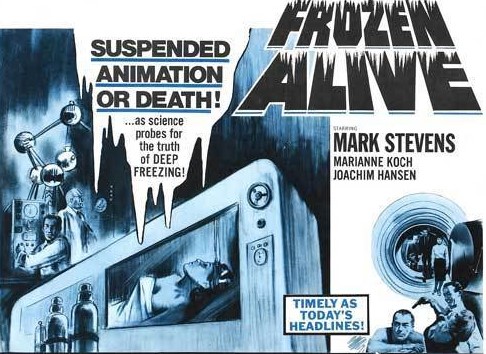
Frozen Alive (1964) ***

Sometimes the stars fail to align, initial promise fizzling out. Mark Stevens, rising post-war star, top-billed in film noir The Street Has No Name (1948) and Between Midnight and Dawn (1950), paired with Olivia de Havilland in The Snake Pit (1949), seemed all set for major stardom. No go. By the end of the 1950s he was mostly seen in low-budget westerns, and too few of them. September Storm (1960) was his first picture in two years. He had tried his hand at direction, but landed in B-movie hell with titles like Escape from Hell Island (1963) and after a bit part in Fate Is the Hunter (1964) hightailed it to Germany for this.

Not quite the sc-fi or noir number it says on the tin, more an exploration of personal and professional jealousies in the scientific community. You probably didn’t know the World Health Organization ran a Low Temperature Unit engaged in cryogenics experiments. Maybe they did, this being promoted as a timely movie.

Dr Overton (Mark Stevens) along with lab partner Dr Wieland (Marianne Koch) are on the verge of a breakthrough in their cryogenic experiments with monkeys. Although she has a lover Tony (Joachim Hansen), his unfaithful alcoholic journalist wife Joan (Delphi Lawrence) is jealous of his success and of Wieland and dreads leaving the fast lane for life in  the country and potential motherhood.

Professional jealousy results in the successful scientific team being split up, so before that can be actioned, Overton decides to embark on a human experiment with himself as the guinea pig.

All the tension of watching an inert frozen human being relies on wondering whether he’s going to wake up and will he have all his working parts, brain especially. So, just to heighten that tension, Overton could face a murder charge when he does emerge. And Wieland, in love with him, has to decide whether it’s better to let him die than go to prison.

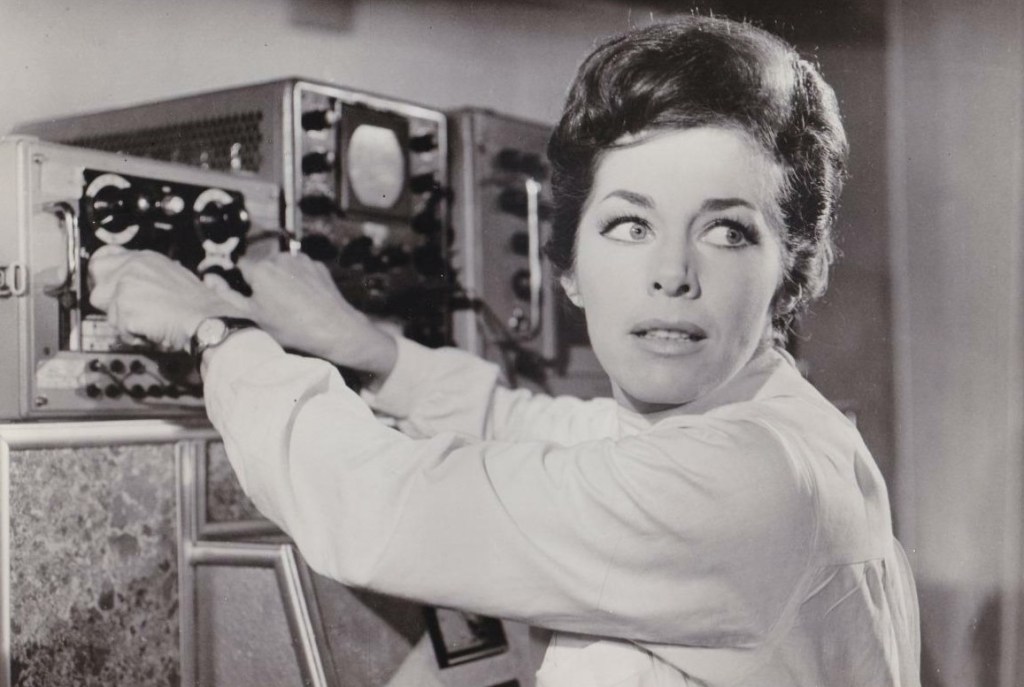
Marianne Koch at the controls. Will she let the suspected murderer live – or die?

The crime aspect is something of an oddity. The time element puts Overton potentially in the frame. And there’s a definite Hitchcockian element to the death, that in one sense robs it of tension, but in the other jacks it up to eleven. Because what we know but Wieland doesn’t is that Joan died by accident, playing with the gun of her lover.

So not only could an innocent man go to jail in the first place, stacked up against him his potential anger at potentially discovering his wife has a lover, but Wieland could let him die only to find out afterwards that he’s innocent all along.

It’s a good job Joan did die because she was stealing the picture. But even being soused in booze doesn’t dampen her zest for life, the kind of woman whose life mostly exists in cocktail bars and smart parties, dressed to the nines, showing enough cleavage to annoy her husband but tease potential suitors, and with enough toughness to dump any lover that gets too close. She’s sassy fun and married the wrong dull guy.

And she’s smart enough with her “intelligent anticipation” to figure out that husband is soon going to cosy up to lab buddy. Overton’s boss notices the signs when he’s not too busy covering his own back. “You sit on the fence and if someone makes a fuss later I take the rap.”

The Mind Benders the previous year covered similar territory but concentrated on the post-experiment after-effects, so this is almost a prologue to that, and interestingly, setting Joan aside, delivered with almost a British stiff upper lip, secret passion kept under wraps, lust revealed in lingering looks, while the cut-throat elements of ambition are played out under the guise of a civil service mentality.

Not quite what you’d expect from the title, but then it’s kind of a cul de sac in sci fi terms, as it’s generally the awakening that produces the problems and this doesn’t go there. But still a decent watch. British actress Delphi Lawrence (Farewell Performance, 1962) steals the show but the simmering turn from Marianne Koch (A Fistful of Dollars, 1964) comes close. Mark Stevens doesn’t have as much to play with and he’s pretty much kept his emotions tamped down up to this point so hardly going to let rip now.  Wolf Rilla (The Secret Ways, 1961) has a small part.

Bernard Knowles (Hell Is Empty, 1967) directed television writer Evelyn Frazer’s only screenplay. You might dwell on the irony that Delphi Lawrence’s star turn here led to nothing as much as Mark Steven’s career dwindled.

Something of a cult possibly because it’s hard to find.

Watchable.

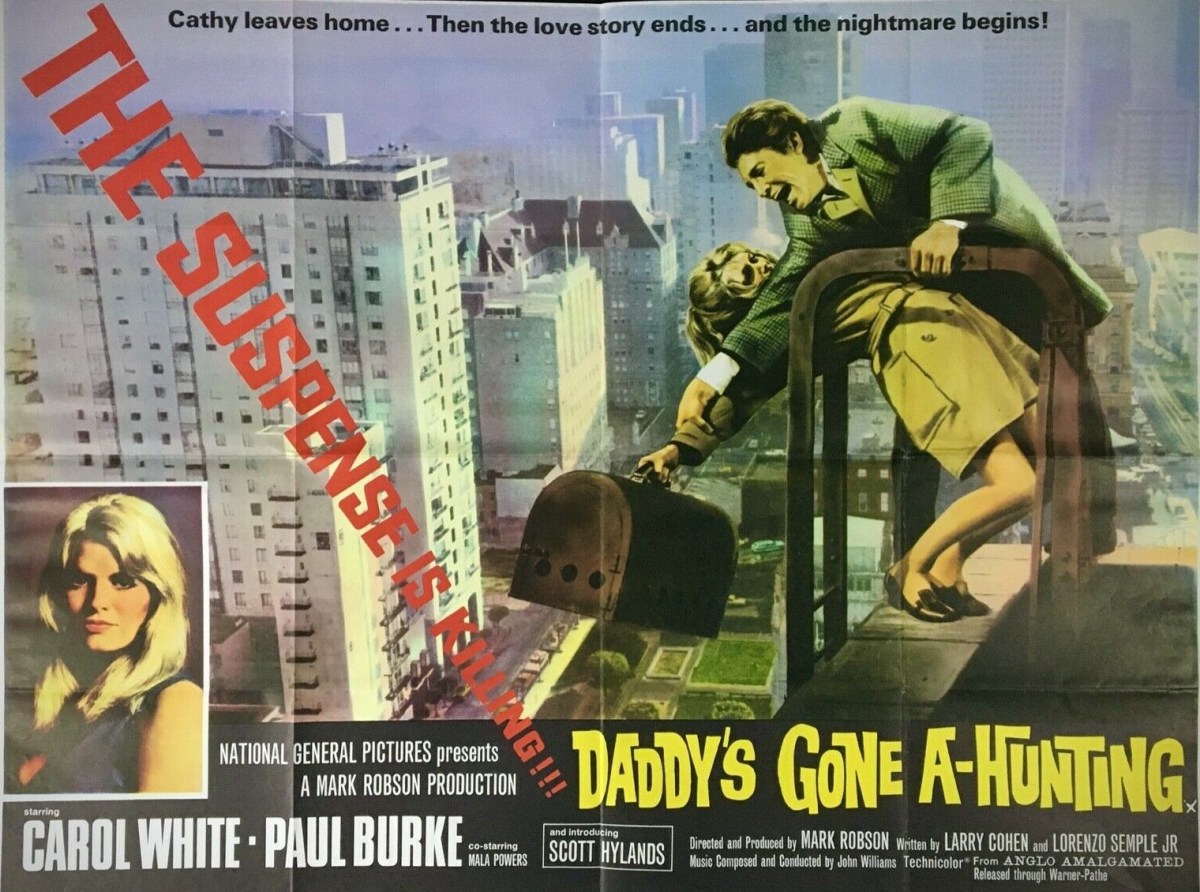
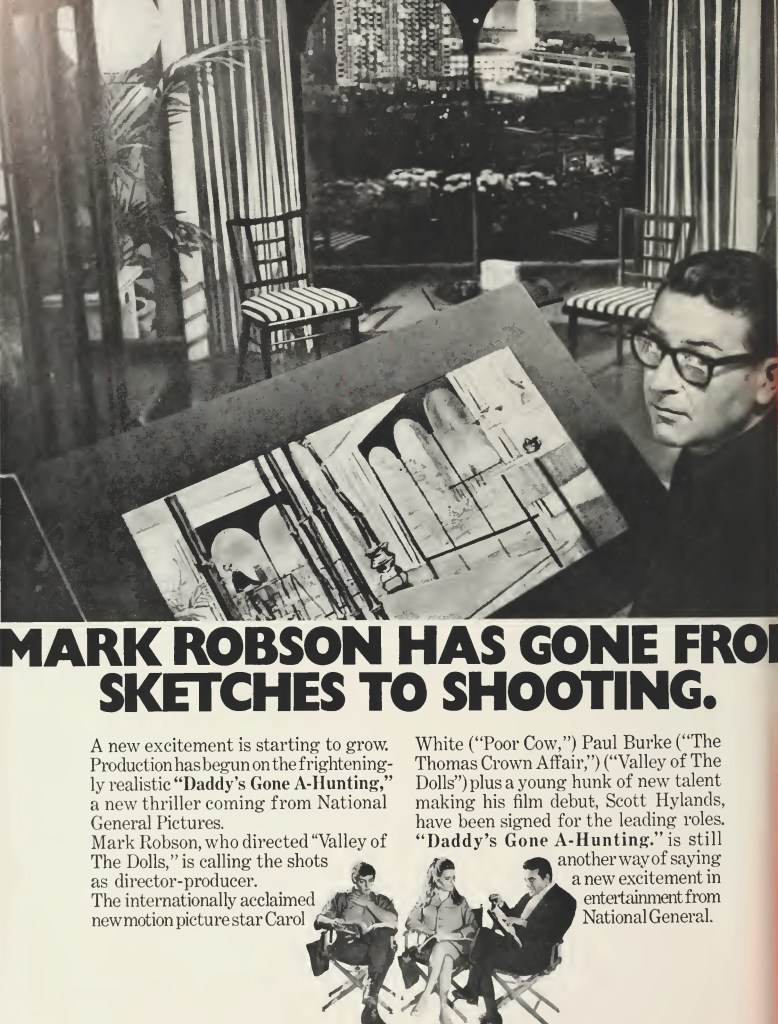
Daddy’s Gone A-Hunting (1969) ***

Everyone wants to be a star-maker. Director Mark Robson thought he had some form in this area after Valley of the Dolls (1968) showcased Barbara Parkins and Sharon Tate. There’s no doubt British actress Carol White reveling in critical kudos for Poor Cow (1967) had promise. But not necessarily good professional advice otherwise how to account for a supporting role in Prehistoric Women/Slave Girls (1967) her first picture after success in three BBC television productions. The female lead in Michael Winner’s I’ll Never Forget Whatisname (1967) was followed by a small role in the more prestigious John Frankenheimer drama The Fixer (1968). But none of these films did anything at the box office. Enter Mark Robson.

This thriller might have made her a star had it not been so darned complicated. It veers from paranoia to stalkersville to Vertigo via Gaslight without stopping for breath and some elements are so obviously signposted at the start you are just waiting for them to turn up. Plus, if ever a film has dated, it’s this one, going back to the days when abortion carried automatic stigma and fathers could get away with lines like “you murdered my baby.”

So, one of the few times in history San Francisco got snow (it averages zero inches annually according to Google) the meet-cute is sketch artist Cathy (Carol White) being hit by a snowball thrown by wannabe Kenneth (Scott Hylands, making his debut). But when she realizes how much he enjoys watching cats stalking canaries decides she doesn’t want his baby and aborts it. 

A few years later she marries congressional candidate Jack (Paul Burke from Valley of the Dolls) and when pregnant crosses paths with Kenneth who manages to insinuate himself into her family via her husband. Twist follows twist until we are on the Top of the Mark (a famous city landmark) for a gripping climax.

White does well as she shifts through the emotional gears but she is barely given respite from being overwrought so at times her acting appears one-dimensional rather than varied. In fairness to her, the movie’s plot gives her no chance to deliver a settled performance. Hyland looks as if he’s auditioning for a role as a serial killer, but the depth of his cunning and his twisted perceptions kept this viewer on edge – what it would take for Cathy to make amends will chill you to the bone.

Robson has some nice directorial touches, a scene reflected in the eye of a cat, a clever jump-cut from marriage proposal to marriage ceremony and some flies in milk.  Mala Powers makes a welcome big screen appearance after nearly a decade in television. That this whole concoction emanated from the fertile imaginations of screenwriters Larry Cohen (It’s Alive, 1974) and Lorenzo Semple Jr. (Fathom, 1967) might give you an idea of what to expect.

That Man in Istanbul / Istanbul 65 (1965) ****

Action-packed superior James Bond rip-off belonging to the Eurospy subgenre and elevated by memorable lines, wit and visual imagination. So if you recall any movie where ricochets play havoc in a room, this is where it originated. Flying through a window on a rope and then crashing through a series of rooms and not stopping, ditto. That famous line uttered by Johnny Depp in Pirates of the Carribean (2003) about “the marchandise,” yep, you’ve guessed it. Although it did steal a nice touch from Robin and the 7 Hoods (1964), the one where an illegal drinking den (illegal casino here) is remarkably transformed.

And all the promise star Horst Buchholz showed in The Magnificent Seven (1960) and kept stowed away all these years, that’s back in spades. Chases, fistfights, shootouts, saloon (well, casino, actually) brawl, competing ruffians, safe-cracking, hitmen, infiltration of secret hideout, a pair of femme fatales and the inevitable atomic scientist.

Some clever thugs including Schenk (Klaus Kinski) dupe the U.S. government out of a million bucks by only pretending to hand over a missing scientist, instead pocketing the cash and blowing up a plane with him on board. With for the time suprising use of forensics, the CIA determines the man killed in the plane wasn’t the missing scientist and work out that he might well be getting sold on to China.

Camera footage taken of the plane crash scene points to mysterious underworld figure Tony (Horst Buccholz). Against her superior’s wishes, agent Kelly (Sylva Koscina) heads off to the titular city in pursuit, tracks down Tony with no great difficulty to his illegal gambling den just in time to witness the electronic miracle of the roulette wheels disappearing into the floor when the cops turn up. The electronic scam would have worked except for a drunken customer who demands his chips be cashed and the only way to silence him being for Tony to slug him and trigger a brawl.

Under the cover of which, Kelly sneaks into Tony’s office whereupon finding no evidence of either a million bucks or a missing scientist, she asks for a job. “Strip!” he demands. But that’s not for licentious reasons it transpires, but to examine the labels on her clothing, from which he and his henchmen deduce (I won’t bore you with the details but they do match up) she’s a plant.

However, she is the one, accidentally, to trip over the Chinese conspiracy, in, of all places, a cemetery. Eventually, she persuades Tony to help her out, although that’s for financial rather than patriotic reasons. She’s got a few tricks of her own up her sleeve, and under the guise of kissing him, steals his keys.

Kelly kind of fades in and out of the picture – which is a shame because she’s good value in a feisty seductive clever way – while all the chasing of opposing sets of criminals is down to Tony. First target being the man with the steel hand (though not the steel claw that in the old British comic The Valiant allowed him to become invisible).

The non-Chinese criminals are as likely to kill their own men to stop them coughing up. But mostly, Tony and his gang are stalking the two sets of criminals, Kelly mostly waiting in a car or popping up to ask questions, with Tony being driven off a mountainside, thrown off a tower, duelling underwater and avoiding a scalding in a sauna. But we’re talking the Houdini of spies and none better than when escape involves commandeering a bulldozer and ramping up over a bunch of vehicles (that idea’s got to have appeared in a later film, too).

Kelly’s the good kind of femme fatale, the spy who has to use her wiles to snare the bad (or badd-ish) guy. But she’s a rookie compared to Elizabeth  (Perette Pradier) who leads Tony a merry dance by first of all pretending to be a victim.

But there’s style by the bucket load, clever reversals by the ton. There’s a marvellous scene where Tony knocks out a guy and then with nowhere to hide him props him up at a piano only to be undone when the fella slides over and hits the piano keys. Ever seen someone use the rolling coin distracting device. Or when the rope between two stanchions snaps mid-air casually sliding down the broken end. Or sex indicated by one person hanging their bathrobe over a door after the other person has done the same. Or the hero doing up a bikini top instead of undoing it. And a leading man who spends more time in a state of undress than any of the females. And, for good measure, a couple of times, and this very much  in the contemproary idiom, breaking the fourth wall.

Once we get going it’s the kind of non-stop action we later equated with Taken (2008) or John Wick (2014). Horst Buchholz was never better, a brilliant light touch with the lines and good deal tougher with the fists. Sylva Koscina (A Lovely Way To Die, 1968) has less to do than you’d like once the rival femme fatale appears but she shows just how capable an actress she is in displaying in non-verbal fashion and in a three-shot of all things her jealousy.

If you’re familiar with Spanish director Antonio  Isasi-Isasmendi from They Came to Rob Las Vegas (1968) stick that to one side because this is way better. Screenplay by Giovanni Simonelli (Django Shoots First, 1966), Nat Wachsberger (Starcrash, 1978) and Luis Josep Comeron (They Came to Rob Las Vegas).

Great treat.

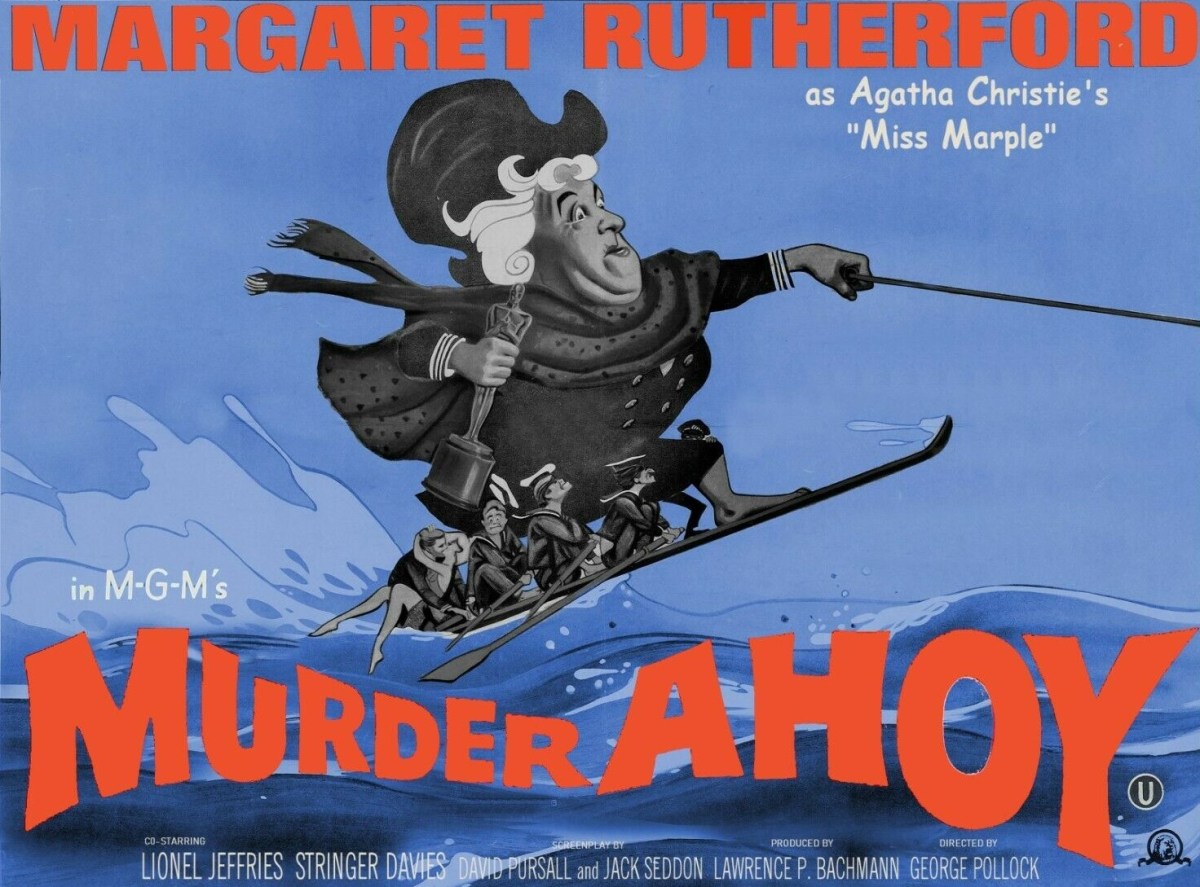
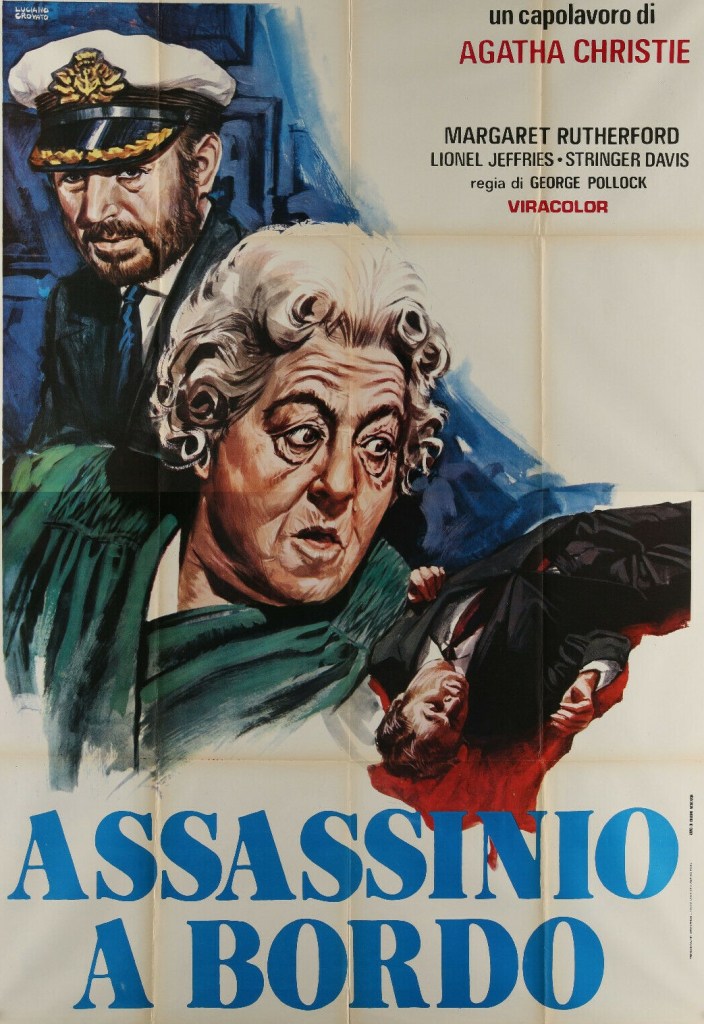
Murder Ahoy! (1964) ***

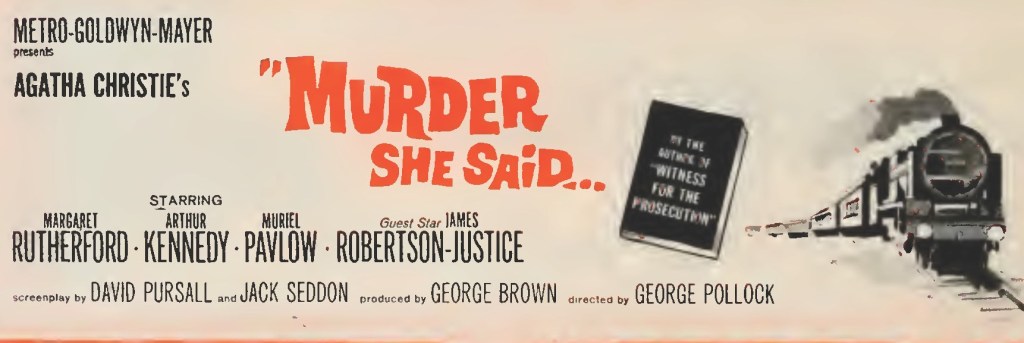
Agatha Christie tales were in a mostly B-movie limbo in the 1960s, despite Billy Wilder’s Witness for the Prosecution (1957) and would have to wait another decade before glorious all-star resurrection in Sidney Lumet’s Murder on the Orient Express (1974). In the meantime, audiences made do with Margaret Rutherford’s Miss Marple in an MGM quartet – all directed by George Pollock – that ended with Murder Ahoy!

Rutherford did not enjoy the national treasure status of the likes of Maggie Smith and Judi Dench these days, but she had been elevated to late-career fame by winning the Best Supporting Actress Oscar for The VIPs (1963). But she never quite made the cinematic impact anticipated after Blithe Spirit (1945) and was mostly seen in roles that called for eccentricity or determination, characteristics associated cinematically with Christie’s second most famous sleuth (although, in reality, the author was furious with her impersonation). And this had nothing to do with any published Christie work, just borrowed the character.

The title had led me to expect a picture set on a liner or a cruise ship. Instead, this being a cheaply-made British black-and-white feature, we are limited to sojourn on a sail training ship which remains moored at all times. Nonetheless, Miss Marple (Margaret Rutherford) is resplendent in naval attire and disports herself as if she were the captain.

Her excuse to get on board is the sudden death of a member of the committee overseeing said ship just before he makes an announcement. Miss Marple relies on a good deal more than Hercule Poirot’s little grey cells and through laboratory experiment determines the man died from strychnine poisoning. Among her other hidden talents are signaling mastery and dexterity with a sword and she drops popcorn on corridor floors to warn of imminent arrivals when she invades cabins.

The suspects include Capt Rhumstone (Lionel Jeffries), Sub-Lt Eric Humbert (Derek Nimmo), Lt. Compton (Francis Mathews) and Commander Breeze-Connington (William Mervyn) while Dr Crump (Nicholas Parsons) is described in double entendre fashion as “brisk.”  

Naturally, there is more murder, and the subplots include burglary, secret romance involving Matron Fanbraid (Joan Benham) and thwarted romance with Shirley (Norma Foster). However, nothing can deter Miss Marple and she soon puts the world to rights.

The first in the series.

It’s an engrossing enough little film, the resolution a surprise, and Rutherford has skill and charm enough to almost trademark the role. At one time in the 1960s in the USA the Marple pictures were revived as double bills but generally in Britain treated with less regard.

Although you could argue that MGM could have bolstered the standards of production, much of the merit derives from the quaintness and the quintessential English lives portrayed. Of course, Margaret Rutherford steals the show but he is ably supported by Lionel Jeffries (First Men in the Moon, 1964), Derek Nimmo, strangulated mannerisms from later BBC’s Oh, Brother not in evidence, William Mervyn (Hammerhead, 1968)  and Nicholas Parsons (ITV game show Sale of the Century.)

As a bonus there are moments of well-observed comedy and a very inventive score from Ron Goodwin (633 Squadron appeared the same year).   Directed by George Pollock (Kill or Cure, 1962) from a screenplay by the team of David Pursall and Jack Seddon (The Secret Partner, 1961).

Taken in the spirit it was intended and acknowledging the low budget, not bad.

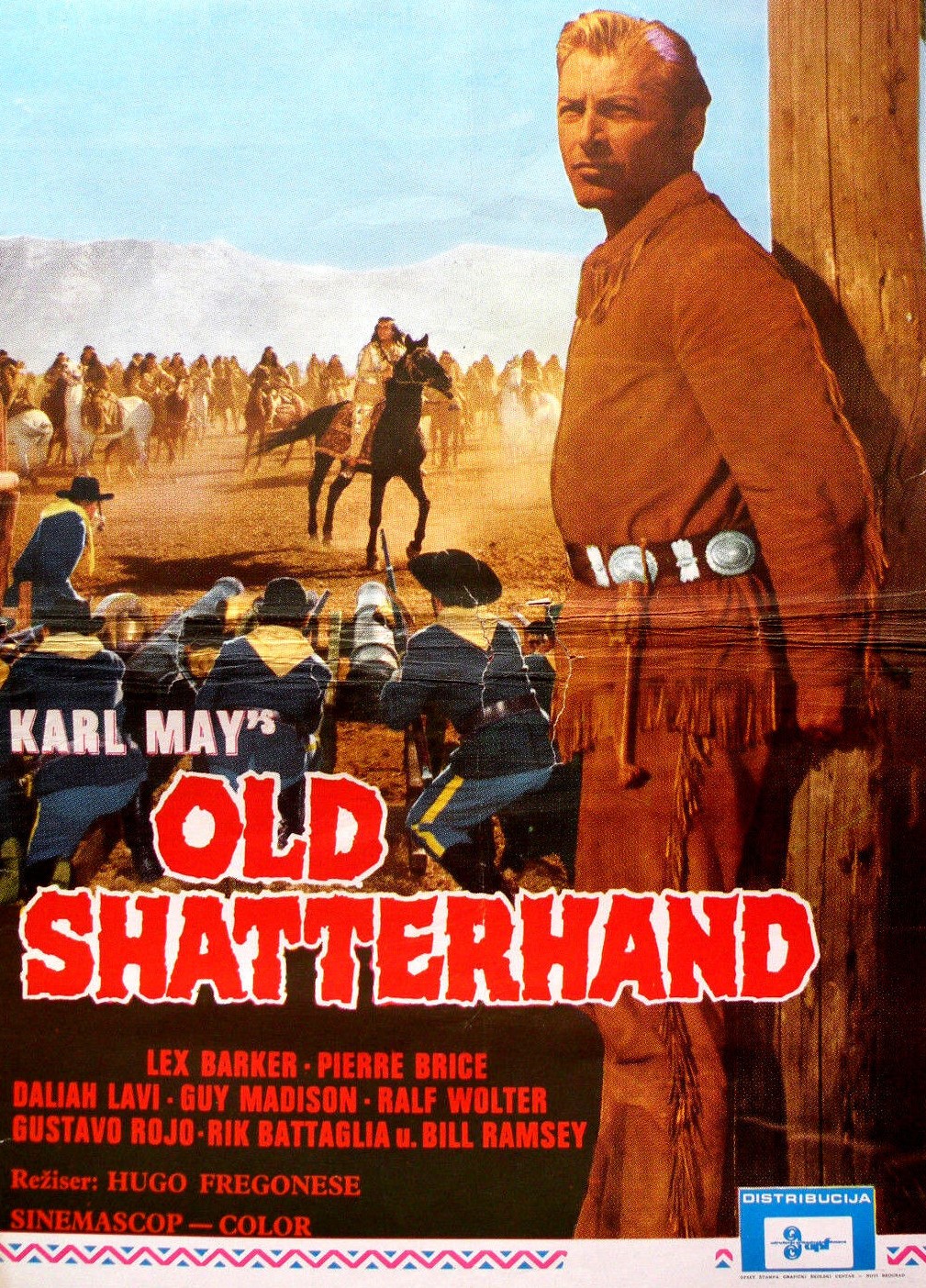
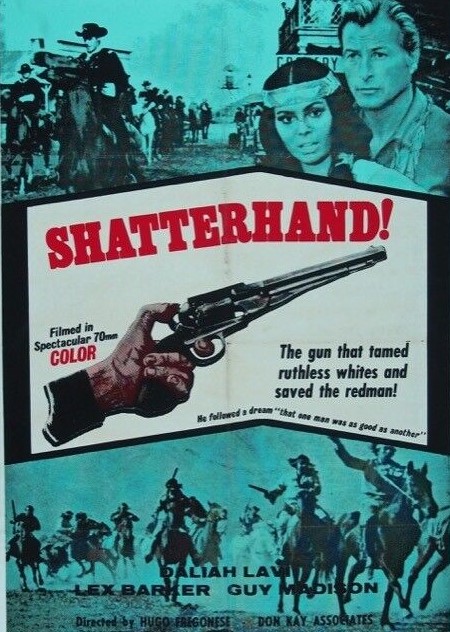
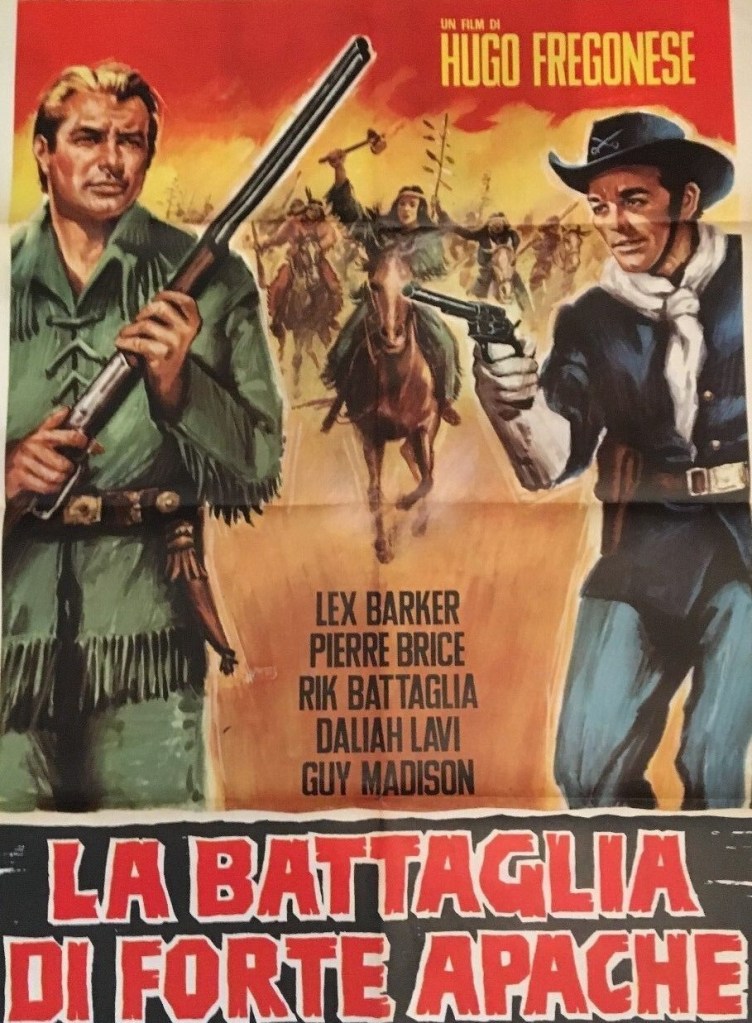
Old Shatterhand (1963) ***

Blame Lex Barker (Pirates of the Coast, 1963) and Daliah Lavi (The Demon, 1963) for my interest in this German-made western. In the aftermath of the spaghetti western and the messianic writings of Christopher Frayling I’d been aware of the Karl May western boom in the early 1960s and a series revolving around cowboy Old Shatterhand and his buddy Apache chief Winnetou, based on the novels of May who died in 1912. Quite why it took the 50th anniversary of his death to make the Germans wake up to his potential is anybody’s guess.

Theoretically, he was the German equivalent of Zane Grey, but unlike the American author whose novels were filmed over 100 times before the 1960s, only six movies were made from May westerns up to that point compared to over 20 and umpteen small-screen features and series since. Treasure of the Silver Lake (1962), the number one film at the German box office that year, was credited with starting the boom.

Story here is quite simple but the cinematography, filmed in 70mm, is breath-taking, even if it’s primarily of Yugoslavia. And there’s an iconic score. Hugo Fregonese (Marco Polo, 1962) isn’t in the Sergio Leone league – he doesn’t come close – but the picture is held together by Lex Barker (Pirates of the Coast, 1963) as Shatterhand and Frenchman Pierre Brice (Samson and the Slave Queen, 1963) as Winnetou with Daliah Lavi popping up as half-breed Paloma, not, interestingly enough, romancing either of the principals, and actually exploring her maternal instinct, looking after the orphaned Tom (Leonardo Putzgruber), more central to the narrative.

Guy Madison (Tobruk, 1967) used his matinee idol looks in kind of a role reversal, the idea of a handsome villain being anathema to audiences of the period, more accustomed to bad guys in the Jack Palance-Lee Marvin vein.

U.S. Cavalry Capt. Bradley (Guy Madison) teams up with the Commanche to frame Winnetou for the murder of settlers in order to disrupt peace negotiations between the Native Americans and the Government. Tom, the only survivor of a massacre, is later brutally murdered by the soldiers. Not quite lingering on the baby blues of ruthless killer Henry Fonda in Once Upon a Time in the West (1969) but still breaking a big taboo.

As you might expect there’s an attempted lynching but you’d be surprised to see this amount of nudity for the time, though, of course, a nice peaceful river always proves too much of a temptation for skinny dipping. There’s some pretty decent action, and the Native Americans get to show off their marksmanship with a bow-and-arrow, and there’s an axe duel instead of the usual fisticuffs. Shatterhand doesn’t always come to the rescue, for the finale he’s tied up. But there’s some interesting authentic detail, a male saloon keeper, for example, hanging out towels to dry, and when Native Americans ambush a wagon train with boulders it is logically achieved – and the boulders look dangerous enough. There’s a pretty big reversal when you’re cheering on a Native American attack on a fort.

Although the American western was about to enter a revisionist period, there was no equivalent to the ongoing friendship between Shatterhand and Winnetou or the idea that the Native American was a regular guy. 

There’s not enough story to support a two-hour movie but the scenery is stunning and you can see why Lex Barker was invited back to the well several times. Daliah Lavi’s talent was often overlooked in favor of her beauty but here, at least, she has a part with some meat.

Interesting.

Discover WordPress

A daily selection of the best content published on WordPress, collected for you by humans who love to read.

The Atavist Magazine

by Brian Hannan

WordPress.com News

The latest news on WordPress.com and the WordPress community.