Behind the Scenes: “Toys in the Attic” (1963)

Producer Harold Mirisch purchased the rights to the 1960 Broadway hit play by Lilliam Hellman as a way of hooking William Wyler. He had originally signed up the director in the mid-1950s when his Paramount contract came to an end. This was before the Mirisch Brothers was an independent production entity and later responsible for films like The Apartment (1960), The Magnificent Seven (1960), West Side Story (1961) and The Great Escape (1963). At that point Mirisch worked for Allied, the upmarket offshoot of B-picture outfit Monogram. Allied backed Wyler’s Oscar-nominated western Friendly Persuasion (1956).

In 1960 Wyler was the most celebrated Hollywood director of the era, not just with three Oscars and ten nominations, but riding as high as anyone ever had after the monumental critical and commercial success of Ben-Hur (1959). He had his pick of the projects and had shown “great eagerness” to do Toys in the Attic. He was friends with the playwright Lillian Hellman and had filmed These Three (1936) from her stage play The Children’s Hour and The Little Foxes (1941) from her original screenplay.

But Wyler decided instead to opt for a remake of The Children’s Hour (1961), assuming that changes in public perceptions would permit him to bring to the fore the lesbian elements kept hidden in his previous adaptation, but, critically, it was a Mirisch production.

In his absence, the Mirisch Bros decided to stick with Toys in the Attic, possibly to bolster their attempt to be seen as a purveyor of serious pictures and hence a contender for Oscars, which would solidify their reputation, as would soon be the case. After consultations with distribution and funding partner, United Artists, “it was decided that…since we had considerable investment in (Toys in the Attic)… we should try and put together a film,” explained Walter Mirisch.

Next in line for directorial consideration was Richard Brooks who had acquired a reputation for adapting literary properties after The Brothers Karamazov (1958), Cat on a Hot Tin Roof (1958) and Elmer Gantry (1960). Initially, Brooks “had been so insistent and enthusiastic” about becoming involved. However, he, too, rejected the opportunity. He, too, after Oscar and commercial success, was riding high. “It was not because he did not wish to work with the Mirisches because he would be delighted to make a picture for them…but he felt it would be wrong for his career to do a film so similar in mood and background as the one he was working on, Sweet Bird of Youth (1962).”

In fact, it was probably more to do with his financial demands. He wanted $400,000 a picture, which was extremely high at the time, plus “a drawing account of $2,000 a week” (i.e. payment in advance of an actual production). While Cat on a Hot Tin Roof and Elmer Gantry had been box office hits, they were nothing like Ben-Hur. And Brooks already had other pictures in mind. He had purchased a book called Goodbye My Son – never filmed – and was already revving up for Lord Jim (1965) funded by Columbia.

Walter Mirisch eventually settled on television director George Roy Hill (Thoroughly Modern Millie, 1967). This would have been his debut except preparations for the movie dragged on and in between Hill helmed Period of Adjustment (1962), an adaptation of another play, this time by Tennessee Williams. He would later direct Hawaii (1966) for Mirisch.

The play had been a significant hit, running for just over a year on Broadway at the Hudson Theater, and making $129,000 profit on a $125,000 investment, though it incurred a loss of $48,000 on a subsequent tour. Hellman did pretty well out of it too. She received ten per cent of the gross and twenty per cent of the profit – a total of around $36,000 – exceptionally good going for a playwright, especially when other monies would be forthcoming from movie rights and foreign and amateur runs. Director Arthur Penn’s share of gross and profit came to over $10,000 in addition to a $5,000 fee.

Turning a play or musical into a movie came with one inbuilt problem. It was inevitably subject to delay. No movie could go into production until the play had exhausted its theatrical (as in stage-play) possibilities. In this case, that meant 58 weeks in the original run and then another 20 weeks once it hit the road. Any contract with a significant movie player would have to include the possibility that in the meantime star or director would have lined up other projects while awaiting the green light on this one, and that in itself could cause further hold-ups.

Hill was in greater demand than Mirisch anticipated, juggling four separate projects – Period of Adjustment, The Rise and Fall of the Third Reich for MGM (never made), and the $2.5 million A Bullet for Charlemagne starring Sidney Poitier (not made) as well as Toys in the Attic.

Jason Robards, star of the play, was the obvious contender for the movie role. But he lacked box office cachet, so he was bypassed in favor of Dean Martin, “an attractive motion-picture figure.” However, in the time it took the movie version of the play to reach the public, Robards was potentially a screen star. He had bought himself out his stage contract after 37 weeks – paying $3,950 for the privilege – having been offered second billing on By Love Possessed (1961) opposite Lana Turner, and in Twentieth Century Fox’s ambitious mounting of Tender Is the Night (1962) opposite Jennifer Jones. While Robards would never become as big a star as Dean Martin, he was the superior actor, later adding two Oscars and one nomination to his name.

In addition to being much better known to cinema audiences than Robards, “we felt he (Martin) would bring humor to it” – Martin having originally made a splash as part of the Martin-Lewis comedy team of the 1950s – “as well as an audience that might expand the normal constituency of that type of film.” Trade magazine Box Office agreed with the decision, viewing Martin as a “good choice for the haunted show-off.”

The play’s other stars – Oscar nominee (and later winner) Maureen Stapleton (The Fugitive Kind, 1960) – and Irene Worth (Seven Seas to Calais, 1962) – were ignored in favor of Geraldine Page, who incidentally scored an Oscar nomination in Summer and Smoke, and  Wendy Hiller (Sons and Lovers, 1960), who already had an Oscar. Shooting began on September 16, 1962. Hill tried to “inject more suspense, more action, more melodrama into the movie version,” without cheapening the material. He was convinced the hiring of Martin was inspired, and would prove a personal  turning point, as he gives “the best dramatic job of his career.”

Titles didn’t matter so much on Broadway, plays sold on the name of the writer or the star. Mirisch feared Toys in the Attic would either mean nothing to a general audience ignorant of the picture’s origins or be considered so obscure as to serve to confuse them. So, they planned to rename it Fever Street or “some sensational substitute.”  Hill was furious, pointing out the “violence of his feelings” to this title. He complained that “others will assume that it is an exploitation title…a cheap gimmick to get people into the theater (cinema) … automatically puts the picture in a low budget quickie picture category that might be appropriate for 42nd St all-night houses or a second feature at Loews 86 St.”

Hill felt changing the title would demonstrate that Mirisch was “ashamed to have bought the play Toys in the Attic, have no faith in the picture, are resorting to panic tactics to get some money out.” And that Fever Street would have the opposite effect, and “keep people away in droves.” His impassioned plea worked, and the original title remained.

While backing down on the title, Mirisch veered towards the exploitative in the main poster which showed Dean Martin slugging Yvette Mimieux.

However, United Artists remained in two minds about the release policy. Despite the  prestige of being chosen for the San Sebastian Festival, United Artists opted to open it in New York as part of a “showcase” run. That was a relativelynew distribution notion, a version of regional wide release. It would eventually be refined to allow several weeks in prestigious first run venues first, but inclusion in this release pattern meant first run was simultaneous with an opening in – in this case – another 20 New York neighbourhood cinemas.  Had UA had more faith in the project, it might have benefitted from an opening just in first run. The $55,000 first week from two first run houses on Broadway was judged a “wow” result by Variety. First run in other major cities suggested a prestige title – “very stout” $15,000 in Boston, a “sock” $14,000 in Washington D.C., “neat” $14,000 in Buffalo, while it was “bright” in Kansas City ($8,000), Los Angeles ($10,000) and Chicago ($18,000).

Hill’s concerns about United Artists’ ability to sell the picture were mirrored in the result. “It did not turn out well,” concluded Walter Mirich, “It’s a grim story. It was not well reviewed and was not financially successful.” Part of the reason for its failure, he argued, was that it “probably appeared at the end of a cycle” of American Broadway adaptations of heavy Tennessee Williams dramas.

While the movie came in $70,000 below the $2.1 million budget, the savings were put down to the fact that it was filmed in black-and-white rather than color, as had been originally envisioned. The box office followed a common, but disturbing, trajectory, a big hit in the big cities, mostly ignored elsewhere. But it was not as bad as all that. Mirisch tallied the domestic box office as $1.7 million with another $900,000 from the overseas box office. By its estimation, once marketing costs were considered, it was facing a loss of $183,000. But that was before television revenue entered the equation and that should have at the very least, made up the difference. There were various pickings later on, too, picked up by CPI under the “Best of Broadway” label in 1981.

SOURCES: Walter Mirisch, I Thought we Were Making Movies, Not History (University of Wisconsin press, 2008) p157-159. Leon Goldberg, “Office Rushgram: Final Cost on Toys in the Attic, May 13, 1964, United Artists Files, Wisconsin Center for Film and Theater Research;  “Mirisch Pictures Box Office Figures,” UA Files; Letter,” George Roy Hill to Walter Mirisch, March 15, 1963, UA Files; “Lillian Hellman Could Mop Up if Toys Clicks,” Variety, February 4, 1960, p103; “Toys Exit,” Variety, January 18, 1961, p72; “George Roy Hill To Direct Toys for Mirisch Co,” Box Office, January 22, 1962, pE8; “Hollywood Report,” Box Office, February 22, 1962, p16; “George Roy Hill Announces First Film on UA Deal,” Box Office, March 19, 1962, p16; “Bloomgarden Had Varied Fortune,” Variety, August 29, 1962, p49; “Toys in Attic Chosen for San Sebastian Festival,” Box Office, June 10, 1963, pE8; “Premiere Showcase,” Variety, July 31, 1963, p22. Box office figures from Variety issues dated August 7, August 14, August 21, September 4, September 11 and October 23.

Toys in the Attic (1963) ***

Dean Martin is at his best when he’s not playing the character you expect. Coming over as big and brash came to define his screen persona, and that just wasn’t, unless a comedy job where he was being set up to be taken down a peg or two, as interesting as his quieter, slow-burn performances in Rough Night in Jericho (1967) or Five Card Stud (1967). To some extent Geraldine Page was known for over-the-top performances, generally quivering on the edge of some emotional disaster. Even in Dear Heart (1964), which I adored, despite her lively exterior, that was her character.

So you match that pair with relatively raw director George Roy Hill (Butch Cassidy and the Sundance Kid, 1969) and you can see the problems he has reining them in, especially as the movie is based on a topline Broadway drama written by the highly-venerated Lillian Hellman (The Chase, 1966). Screenwriter James Poe (Riot, 1969) accommodates some scenes outside the smothering atmosphere of the home of sisters Carrie (Geraldine Page) and Anna (Wendy Hiller).

Given it’s set in sweaty muggy New Orleans, the shadow of Tennessee Williams hangs heavily over the picture, though the Deep South twangs are not fully in evidence. Throw in that their brother Julian (Dean Martin) has brought home a child bride Lily (Yvette Mimieux), suspicious not just of her newfound environment but of her possibly already-straying husband, plus that he returns a wealthy man, when normally his entrepreneurship has usually dealt a losing hand, and you have the making of a rather predictable tale of home truths, overheated emotions and a hint of incestuous longing.

This is the kind of tale, reverberating with unhappiness and frustration, that requires an unlikely trigger to get going. It’s not as dumb as the murderer in the recently-reviewed “five-star” so-bad-it’s-good Doctors Wives (1971) who funds an escape from police custody by blackmailing his wife’s extensive band of lovers and getting a colleague to momentarily pretend to take on his identity.

This time it’s an overheard phone call and the conniving Carrie who suggests to the new bride that Julian has taken up with old lover Charlotte (Nan Martin), the source of his newfound wealth by helping him buy up cheaply land that her husband Cyrus (Larry Gates) needs for his business. This not only puts the marriage in danger but, when Cyrus realizes he has been duped by his wife, Julian’s life is threatened.

This is one of those films where the plot threatens to run away with the story which is essentially that the two sisters have come to expect that their wastrel brother is dependent on them and cannot accept it when he is not. Whereas dealing with a depressed loser maintains the family status quo, coming to terms with a winner takes some doing and jeopardizes existing relationships.

The sisters are equally jealous of each other, so there’s constant niggling. Escape is in the offing for too many of the characters. Julian, from his down-at-heel existence, the sisters from their poverty, Charlotte from her clearly over-dominant husband and Lily from what seems like an ill-chosen husband. That, in several instances, escape pivots on revenge makes the situation sweeter.

The sisters have the best scenes, but that’s a limitation. While audiences watching a stage play might remain in rapt awe at actresses dealing with their frustrations, within the confines of a movie, it weighs the picture down, two old maids quarrelling is hardly a concept that would have movie fans signing up.

Stage plays often suffered from translation to screen, if the characters were not sufficiently louder than life. It’s significant that none of the works of Arthur Miller, not even his masterpiece Death of a Salesman, managed this. Tennessee Williams was more successful because of leading characters with explosive temperaments. The Glass Menagerie (1950), A Streetcar Named Desire (1951), The Rose Tattoo (1955), Cat on a Hot Tin Roof  (1958) and Suddenly, Last Summer (1959) were showered with Oscar wins and nominations and generally hit the box office mother lode.

Lillian Hellman was largely in the Arthur Miller category when translating her stage plays to the screen. While The Dark Angel (1935) and These Three (1936) had enjoyed some success, The Children’s Hour (1961) had stumbled at the box office.

Fans of Dean Martin didn’t enjoy him going all hi-hat and in truth he comes up short compared to Wendy Hiller (Sons and Lovers, 1960) and Geraldine Page, both nominated for Golden Globes. Yvette Mimieux (Diamond Head, 1962) continues to show promise and Gene Tierney (The Pleasure Seekers, 1964) puts in an appearance.

For fans of Broadway adaptations.

The Psychopath (1966) ****

As evidenced by its popularity in Italy often considered a forerunner of the giallo subgenre. While the involvement of Robert Bloch brings hints – mother-fixation, knife-wielding killer –  of his masterpiece Psycho (1960), here some of those themes as reversed. And the stolid detective and younger buddy suggests the kind of pairing that would populate British television from The Sweeney (1975-1978) onwards. Surprising, then, with all these competing tones that it comes out as completely as the vision of director Freddie Francis (The Skull, 1965), especially his use of a rich color palette that would be the envy of Luchino Visconti (The Leopard, 1963).

Theoretically mixing two genres, crime and horror, the resonance figures mostly towards the latter. Considering the crime element just for a moment, this features a serial killer, in the opposite of what we know as normal multiple murder convention, who leaves a memento at the scene of the crime rather than taking one away such as a lock of hair or something more intimate. Also, the list of suspects rapidly diminishes as they all turn into victims, still leaving, cleverly enough, a couple of contenders.

What’s most striking is the direction. Francis finds other ways rather than gore to disturb the viewer. The first death, a hit-and-run, focuses on the violin case, dropped by the victim, being crushed again and again under the wheels of the car. There’s a marvelous scene where a potential victim tumbles down a series of lifeboats.

The camera concentrates more on the villain’s armory than their impact: noose, knife, oxy-acetylene torch, jar of poison, the lifeboats, the aforementioned car. There are intriguing jump-cuts. We go from the smashed violin to a very active one, part of a string quartet. From toy dolls in rocking chair to skeletal sculpture. From a string of metal loops choking a victim to a man forking up spaghetti.

We go from the very conventional to the jarring, serene string quartet and loving daughter to wheelchair bound widow talking to the dolls, so real to her she shuts some naughty ones away in a cupboard. We move from one cripple to another, from real toys to human toys, to a human who talks like a wind-up toy.

It soon occurs to our jaded jaundiced cop Inspector Holloway (Patrick Wymark) that the victims are connected, all members of the string quartet who were on a war crimes commission during the Second World War. At each murder the memento left, a doll with the face of the victim, leads the detective to investigate doll makers and then a doll collector, Mrs von Sturm (Margaret Johnson), widow of a man the commission condemned. Could it be the simplest motive of all – revenge? But why now?

The string quartet are an odd bunch, and on their own, you wouldn’t be surprised to find all of them capable of murder – sleazy sculptor Ledoux (Robert Crewdson) with naked women in his studio, the wealthy Dr Glyn (Colin Gordon) so weary of his patients he wished he’d become a plumber instead, the selfish over-protective father Saville (Alexander Knox) whose neediness prevents his daughter Louise (Judy Huxtable) marrying. Her American fiancé, Loftis  (Don Borisenko), a trainee doctor, is also in the frame.

Mrs von Sturm could be the killer, her wheelchair a front – apparently housebound she manages a visit to Saville, though still in her chair. Her nervy son Mark (John Standing) also appears an odd fish.

As I mentioned, Holloway scarcely has to disturb his grey cells, the deaths of virtually all the suspects eventually make his job pretty darned easy. But Francis’s compositions let no one escape. Long shot is prime. Staircases fulfil visual purpose. The creepiness of the doll scenes wouldn’t be matched until Blade Runner (1982). Stunning twists at the end, and the last shot takes some beating.

Margaret Johnson (Night of the Eagle, 1962) is easily the standout, but she underplays to great effect. Patrick Wymark (The Skull, 1965) steps up to top-billing to act as the movie’s baffled center, with more of the cop’s general disaffection than was common at the time. Alexander Knox (Fraulein Doktor, 1969) knows his character is sufficiently malignant to equally underplay. The false notes are struck by Judy Huxtable (The Touchables, 1969) and Don Borisenko (Genghis Khan, 1964), both resolutely wooden.

Freddie Francis is on top form. Not quite in the league of The Skull. Commendably short, scarcely topping the 80-minute mark.

Well worth a look.

Jason and the Argonauts (1963) *****

An absolute delight, great storytelling married to groundbreaking special effects produces an adventure picture of the highest order. Though mostly known for its Ray Harryhausen stop-motion animation, its success also relied heavily on the direction of Don Chaffey (The Viking Queen, 1967) and a great script. It’s one of the few films to benefit from not being viewed in its original size, the small screen minimizing the flaws of the special effects. In essence it’s a combination of three genres – the Italian peplum, the men-on-a-mission picture and the classic detective story. 

Plus there are interesting stabs at philosophy – if man refuses to believe in the gods, do they cease to exist? And if the golden fleece brings peace and prosperity to a nation what will happen to that country when it is stolen?  And if various people call on their own gods for help will that not create conflict in heaven as much as on earth? And the ultimately question – what can man achieve without celestial interference?

While the episodic structure derives from the clues meted out piecemeal to hero Jason (Todd Armstrong) during his long voyage to find the golden fleece these often come minus vital pieces of information ensuring that surprise remains a key element.

Without doubt special effects are the triumph, although some work better than others. The highlights for me were the towering bronze statue of Talos and the skeleton warriors. I can’t be the only one who thinks that some of the visuals in Game of Thrones were inspired by the sight of Talos astride two land masses separated by the sea. Talos is not so much a man-mountain as an actual mountain, first viewed coming round the corner of a cliff top, his head topping it. But where, except for cunning Jason, the crewmen are viewed primarily in miniature in relation to the giant Talos, the skeletons are the same size as the adventurers and the fight scene all the more impressive as the ensuing battle appears completely real.

Scale allows Harryhausen to wriggle out of the problems of contact. If the creatures are out of reach anyway, there’s little need to attempt to bring them into close proximity. The way the Harpies are utilized, close enough to strip clothes from a blind man but otherwise hovering just out of reach, is a classic example of clever direction. The multi-headed Hydra, on the other hand, is the least convincing monster simply because it is impossible for Jason to get close to the beast. Scale is also one of the film’s best weapons. The scenes where a miniaturized Jason is transported to Mount Olympus to face the gods are well done as are the occasions when the gods peer down on tiny man.

Outside of the special effects and the varying degrees of excitement aroused, in the background there is constant intrigue. Jason is the son of the King of Thessaly slain by the usurper Pelias (Douglas Wilmer) and his crew includes Acastus (Gary Raymond), son of Pelias, whose task is to cause trouble and if Jason succeeds in his endeavor to kill him. On top of that, there is a heavenly battle over Jason’s fate. Jason, having defied Zeus (Niall MacGinnis) by first of all refusing to believe he exists and that his life is determined by fate, becomes enmeshed in a battle between the king of the gods and his wife Hera (Honor Blackman) who grants Jason a get-out-jail-free card, the ability to call on her help, but only five times.

Jason determines to recruit his own team and in the manner of The Guns of Navarone (1961) and The Professionals (1966) they are all experts in their fields but unlike that film and The Dirty Dozen (1967) are willing conscripts. The team also includes Hercules (Nigel Green) and Hylas (John Cairney) and in the first of the film’s many surprises and reversals, the weedy latter is able to beat the muscular former in a contest of strength.

There is enough incident to keep the story ticking along but Don Chaffey fills in the blanks with montage, the various essentials of a ship – sails, oarsmen, sides, stern, figurehead, pace set by drumbeat  – and a full color palette from the bright blue sky, to dawn and dusk and sunset and night, a wonderful image of rowers at sunset on the sea the pick. He also makes great use of the sea – pounding surf, storms, the sea turned tempest by the clashing rocks, a shipwreck. And we have dancing girls, colorful costumes, ancient backdrops and the sense that the budget has been well spent

Some scenes call for immense skills in coupling special effects with real characters. For the clashing rocks sequence five elements are simultaneously in play: the crew in danger, a tempest, rocks crashing into the water, the ship itself and Neptune.

And the romance is well handled dramatically: if Jason rescues Medea (Nancy Kovack) then she too rescues him. Love produces conflict. To love Jason, Medea must betray her country. There is hardly a moment when Jason, confronted either by monsters or kings, does not face death.  

In addition, there is a stunning score by Bernard Herrmann (Psycho, 1960).

Any top-notch acting would have been over-shadowed by the special effects. Which is just as well because the entire cast is drawn from the lower strata of the stardom ladder. Todd Armstrong, from the Manhunt tv series (1961), needs only not to mess up, which he manages adequately. Nancy Kovack (Diary of a Madman, 1963) does well to make an impact given she does not appear until the final third. This did not turn out to be much of a star-making vehicle for either. Honor Blackman drops the slinky persona with which she had made her name in The Avengers tv series (1962-1964) and instead plays a confident goddess willing to out-maneuver husband Zeus.

The rest of the cast comprises a regiment of future movie supporting actors – Nigel Green (Tobruk, 1967), Niall MacGinnis (The Viking Queen, 1967) and Douglas Wilmer (The Brides of Fu Manchu, 1966). Future television stars range from Patrick Troughton (the second Dr Who) and Scottish actor John Cairney (This Man Craig, 1966-1967) to Laurence Naismith (The Persuaders, 1971), Gary Raymond (The Rat Patrol, 1966-1968), Mike Gwynn (Poison Island, 1965) and Andrew Faulds (The Protectors, 1964).

The screenplay was written by Jan Read (First Men on the Moon, 1964) and Beverley Cross (The Long Ships, 1964), husband of Maggie Smith. Cross returned to ancient worlds again for producer Charles H. Schneer for Sinbad and the Eye of the Tiger (1977) and Clash of the Titans (1981)

Although the ending appeared to leave the door open for a sequel, none was made. A huge box office hit in Britain, it did not repeat its success elsewhere.

I first saw this film as a boy and was so enthralled I wouldn’t have noticed if there was anything awry with the special effects. I have not seen it since. Coming at with some degree of skepticism I found that attitude misplaced. I was equally enthralled.

Seven Seas to Calais (1962) ***

In between hi-hat Hollywood endeavors The Time Machine (1960) and The Birds (1963) Rod Taylor made a couple of pit stops in Italy. Here, he tries his hand at a swashbuckler and does a pretty good job of it, depicting famed English naval hero Sir Francis Drake, in a story that covers about a dozen years from him circumnavigating the globe to masterminding the defeat of the Spanish Armada in 1588.

Not content with glorifying tales of his derring-do as he robs the Spanish of their gold, the producers also mine a rich seam of political intrigue as Spanish King Philip II (Emberto Raho) seeks to nullify the English threat first by a treaty and then by conspiracy before full-blown invasion seems the better option.

Queen Elizabeth (Irene Worth) proves a political maestro, telling the Spanish what they want to believe and condemning Drake’s activities in public while in fact privately financing his expedition and waiting for his pirate gold to underpin her navy. 

After putting down a potential mutiny, most of Drake’s time is spent plundering Spanish galleons or gold mines. When not pillaging, Drake takes time out from his adventures to discover potato and tobacco and for a romantic dalliance with what appear to be Native Americans (judging from the feathers they wear) including a young woman called Potato (Rossella D’Aquino). It is left to his number two Malcolm Marsh (Keith Michell) to carry the main subplot which has French beauty Arabella (Edy Vessel) in his absence taking up with Babington (Terence Hill), a traitor with an eye to freeing the imprisoned Mary, Queen of Scots (Esmeralda Ruspoli).

There are more than enough swordfights for purists and Drake employs a certain amount of cunning and bravado in his various piratical enterprises. Clever filming renders the ships  realistic enough though in long shot they do resemble toys. In making it look as though Drake has returned from his voyage in the nick of time to save Elizabeth from the Spanish aggressors, the producers neatly kaleidoscope the actual time frame. Elizabeth takes no prisoners and there are spicy exchanges between the queen and the pirate.

Rod Taylor presents a more muscular and athletic screen person than in any of his previous pictures and exudes authority but he also has a lightness of tone that would become a trademark. However, American stage actress Irene Worth – in her sole movie role of the decade –  just about plays him off the screen, her regal bearing hiding an agile mind.  Keith Michell (The Hellfire Club, 1961) makes a strong impression as does future spaghetti western star Terence Hill, (They Call Me Trinity, 1970) credited here as Mario Girott. Edy Vesssel (The Thief of Baghdad, 1961) only made two more films, although one was Fellini’s (1963). This was the second film outing after Antonioni’s L’Avventura (1960) for Esmeralda Ruspoli

Strangely enough, given the part Drake played in English history, he has been dealt a poor hand in the movies. A British television series Sir Francis Drake (1961-1962) starring Terence Morgan was unlikely to have instigated this picture, so it is odd to rely on Italy for the only movie, regardless of its veracity.

In the portfolio of veteran director Rudolph Mate (When Worlds Collide, 1951), this immediately followed on from The 300 Spartans (1962) but lacks that film’s rigor and vigor.. The script was dreamt up by Filippo Sanjust (also Morgan the Pirate).

Deliverance (1972) ****

Packs a considerable punch even at the remove of half a century. In fact, the reversal of the ultimate male-domination trope – rape – will reverberate even more in a contemporary society more attuned to abuse. A quartet of macho posturing guys – except for one more at home overseeing a barbecue pit – not only get their come-uppance but have to sit on a very thin fence when the morality clause comes into play.

Much of the patronising attitudes towards the poor and bereft will not have evaporated with time. The better-educated, the very ones who should know better, still make fun of the less well-off and their accents – such scoffing by the privileged recently made headlines in the UK. The hillbillies represented here are not making fashion statements with their clothing or attribute their scrawny physiques to weight-loss therapy. This is poverty in the raw – and yet our quartet treat the wilds as a playground.

You want swagger?

Presumably expecting campfire singalongs Drew (Ronny Cox) has brought his guitar, forgetting it might not be so easily transported through the rapids, but he thinks he’s made contact with the inhabitants when he duets with a banjo player (Billy Redden). Macho Lewis (Burt Reynolds), easily identified as the toughest of the quartet by his visible chest hair and archery set, is at one with nature, assuming that the beasts he presumably intends to kill are okay with that. He believes he’s got one-up on the natives when he beats a local down to $40 for moving their cars to the finish-point, not considering for a moment that the fellow would probably have done it for half.

Ed (Jon Voigt) is the calm one, the peacemaker, keeping the volatile Lewis and the nervous Bobby (Ned Beatty), inclined to poke fun, in check. Turns out the locals don’t take kindly to this kind of invasion and two ambush Ned and Bobby, rape the former, but before they can work their way round to the latter, are interrupted by Lewis who puts an arrow through one of the mountain men. The toothless one escapes.

This is where it gets tricky. Lewis, inner Clint Eastwood to the fore, justifies his slaying. Chances are, if he’d fired a warning shot, the rapists would have scarpered. The chances, too, of Bobby reporting the crime are a big fat zero because the humiliation would be unendurable, even if the local cops accepted a crime like male rape even existed, and given the general lack of police interest in female rape no guarantee it would even be investigated.

Course, you kill one of “them” and you’re setting yourself up as a target for revenge. Our quartet would skedaddle but the only way out is downriver. Drew, in complete shock, topples overboard and drowns, the canoes crash into each other, Lewis breaks his leg, leaving Ed to lead them to safety.

He climbs a cliff, armed with the archery kit, in case they are being stalked by the other hillbilly.  When he spots him, he fires, killing the hillbilly. So Ed has to get the injured Lewis and the useless Bobby to safety and hope nobody finds the bodies, one buried in the ground, the other dumped into the river. The cops do come calling, but the trio brave it out.

And the audience is left with a moral quandary – an even more resonant one these days. Are the killers morally justified? In, they presume, a lawless patch, where men are as likely to rape their own gender as women, are they permitted to take the law into their own hands? Stand up for themselves? Be a man? Rather than waiting for someone else to clean up their mess.

Or are they obnoxious over-entitled tourists who can pillage their way through the countryside? They had assumed that the hillbillies would not call in the law in case the cops were hunting for illicit stills. As if the mountain men didn’t have families who would hold them dear, no matter their crimes.

Sure, they get away with it, but don’t the rich always get off scot-free, one rule for the wealthy, another for the poor? Back in the day, I’m sure Americans feared these kinds of hinterlands, where mountain men ran wild, and the idea of ecology was a whistle in the wind. Our guys aren’t campaigning against the loss of the wilderness, but enjoying one last trip before the scenery is flooded.

Some standout moments – the duelling banjos (a hit single), “squeal like a pig,” the white water canoeing, Ed ramming his fingers in the corpse’s mouth to check for give-away missing teeth, the nightmare at the end that set a trend for what today would be termed a post-credit sequence.

Director John Boorman (Point Blank, 1972) easily sits astride his own fence. If all you’re looking for is action in an unusual setting and the Western trope of pacific man roused to anger, then you can go home happy. If you’re sniffing around for something deeper, for the ease with which the morally upright defend the indefensible, then you’ll have plenty to talk about. Poet James Dickey, author of the original unexpected bestseller, turned in the screenplay.

Tough thriller that asks tough questions.

The Scorpio Letters (1967) ***

Desultory spy thriller with over-complicated story that’s worth a look mostly for the performance of Alex Cord (Stiletto, 1969). I can’t say I was a big fan of Cord and I certainly didn’t shower him with praise for his role as a disillusioned Mafia hitman in that movie. But now I’m wondering if I have been guilty of under-rating him.

Normally, critics line up to acclaim actors if they deliver widely differing performances – Daniel Day-Lewis considered the touchstone in this department after Room with a View and My Beautiful Launderette opened in New York on the same day in 1985. But usually screen persona rarely changes, a heightened or amalgamated version of the actor’s character or features. Once Charles Bronson, for example, started wearing his drooping mustache, for example, he was never seen without.  Actors may grow old, but never bald.

The macho mustachioed Cord of Stiletto is nowhere in sight. In fact, in The Scorpio Letters minus moustache and resisting attempts to reveal his musculature, he is almost unrecognizable. In this picture Joe Christopher (Alex Cord) is flip, resentful, thoughtful, occasionally pedantic, more natural than many of the current crop of Hollywood new stars, and for once in a movie that has transplanted an American in London rather scornful of British traditions.

There’s a realistic flourish here, too, he is so poorly paid – and on a temporary contract – that he has to take the bus. And although he is an ex-cop fired for brutality, that level of violence ain’t on show here. Virtually the opposite of the character Cord created for Stiletto, I’m sure you’ll agree. So full marks for versatility and talent.

Unfortunately, the rest of the movie is not up to much, at the very bottom of the three-star review, almost toppling into two-star territory. Christopher is investigating the death of a British agent who was the subject of a blackmail attempt. By coincidence – or perhaps not – another part of British Intelligence is investigating the same death, and this brings Christopher into contact with Phoebe Stewart (Shirley Eaton) and eventually they work together to unravel a list of codenames and uncover the conspiracy with a bit of risk to life and limb.

But the pay-off doesn’t work despite all the exposition attempting to build it up and you’re left with a kind of drawing-room drama rather than exciting spy adventure. It’s determinedly London-centric with red buses, red postboxes, Big Ben, Horse Guards Parade all putting in an appearance. The scene shifts to Paris and Nice without much increase in tension. There’s also an irate German chef.  Despite a couple of neat scenes – a chase held up behind a wedding party, an interrogation in a wine cellar – it’s much too formulaic.

Cord apart, Shirley Eaton (Goldfinger, 1964) adds some glamour, but her rounded portrait depicts a character with warmth rather than oozing sex. This is the kind of film that should be awash with character actors and up-and-comers, but I recognized few names except for Danielle De Metz (The Karate Killers, 1967), Oscar Beregi (Morituri, 1965) and Laurence Naismith (The Persuaders tv series, 1971).

One-time top MGM megger Richard Thorpe (The Truth about Spring, 1965) was coming to the end of a distinguished career which had included Ivanhoe (1952) and Knights of the Round Table (1953). This was his penultimate film. The appropriately named Adrian Spies (Dark of the Sun, 1968) wrote the screenplay based on the Victor Canning thriller. Making his movie debut was composer Dave Grusin (Divorce American Style, 1967)

Albeit with a limited budget of $900,000, MGM intended the picture for theatrical release but with a short cinema window to make it available for a speedy showing on ABC TV. It was originally scheduled for a May 1967 theatrical release but MGM decided to cut out the American release and so it made its debut in the “Sunday Night at the Movies” slot on February 19, 1967, and was shown in cinemas abroad. Nor was it shown first on U.S. television because the studio believed it a disaster. Variety (February 22, 1967, page 42) called it “very hip.”

The Red One (2024) ***

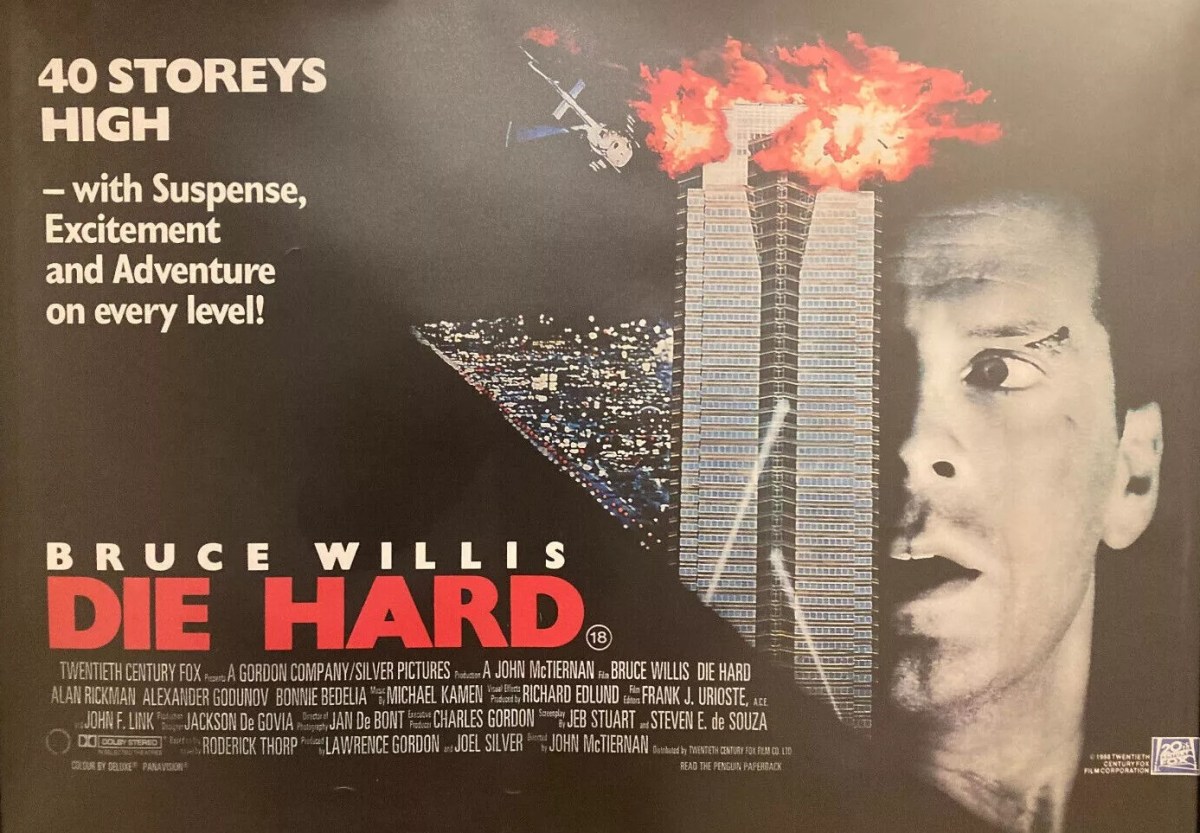
Santa Claus meets Die Hard might have worked well enough if it hadn’t been padded out with all sorts of other festive characters from the dark side of Xmas and a sludge of sentiment about an absent father reconnecting with his son. Can’t quite decide if it’s family-friendly or aiming for a queasier relationship with a Beetlejuice, Beetlejuice audience. And I suspect if Amazon had the courage of its theatrical convictions, it would made this a Xmas cinema release rather than chucking it into picture houses now and lining it up for a small-screen Xmas special.

Attempts to merge James Bond-style big budget thriller with underworld shenanigans conjuring up the kind of misfits who’d have been slung out of a Star Wars cantina while at the same time as making up the rules as it goes along. There’s a mix-and-match feel to the characters – we get Gryla, a mythical Icelandic monster, Krampus, a hairy devil of Germanic extraction who has his fun the night before Xmas, but is repurposed here as a Santa’s big bad brother, as well as a bunch of gargoyles who are way too easily distracted by a hen who they, mysteriously, can’t manage to catch, and then like a throwback to Transformers we get tiny Lego style figures who turn gigantic when let loose. You can stop snowmen in their tracks by whipping off their carrot noses.

Face-slapping is reinvented, shapeshifting is the game, and as if nobody had watched  how badly Ghostbusters: Frozen Empire failed we’re back to a villain with icy superpowers. The giant polar bear featured – cousin to the armored bear in The Golden Compass (2007) – in the poster is underused. Not to mention that Xmas staple, the kids threatened with losing out on presents if they are naughty. None of this should work at all, but it does fairly well.

On the eve of said Mr Claus’s big night, he gets kidnapped. Bodyguard Callum (Dwayne Johnson), who turns out to be more than 500 years old, is on the trail and tracks down hacker Jack (Chris Evans) who’s sold Santa’s secret location to villain Gryla (Kieman Shipka), the ex- of Krampus’s (Kristofer Hivju),  who wants to trap every night child in the world inside the kind of glass snow globe that was a traditional Xmas present. She’s manufactured these in the gazillions.

Callum and Jack team up though the latter’s not much use, his contribution to the double act consisting mainly of double takes and it’s only when he doesn’t take the opportunity to escape Krampus’s lair that he becomes one of the team. Mostly, it’s one bizarre situation after another and although at just over two hours it’s already outstaying its welcome it could have done with spending some more time on outlining the background and developing the fiendish characters. It’s a world that seems surprisingly undercooked given the mega budget. On the plus side – or perhaps the minus depending on your perspective – there’s a cuteness bypass. There’s a little too much time spent on – unsuccessfully – showing how Santa manages to get himself down every single chimney in the world in the space of a night including time to gobble down some treats. Would have done better to stick to the Santa hijack than include a technologically-improved Xmas.

Xmas spirit missing in this previous red one.

This didn’t need the presence of Dwayne Johnson (Black Adam, 2022) and certainly Chris Evans (The Gray Man, 2022) is wasted but with the MCU world closing its doors on both actors, perhaps this is an attempt to set up a new series. As Mr Claus, J.K. Simmons (Juror #2, 2024) isn’t in it long enough. Jake Kasdan (Jumanji, The Next Level, 2019) directed from a script by Chris Morgan (Shazam! Fury of the Gods, 2023) and Hiram Garcia (Jumaji, The Next Level).

Not as bad as I expected.

Anora (2024) *

This poses two questions. Am I so out of touch with modern film-making that I consider this a terrible film? Or are the jurors at the Cannes Film Festival and a whole raft of critics so out of touch with modern film-making that they think it’s a great film.

One of the problems for proper critics – that is the people who see every single film that comes out as part of their job and are hired to offer their opinions in eminent media as opposed to the self-styled critics who have podcasts and blogs but pick and choose what they watch   – is the sheer volume of product.

From speaking over the years (over the decades) I know that one of the perennial problems facing the critic is boredom. They see so much dreck and are equally turned off by earnest movies or by seeing the same old same old that they tend to get extremely excited when they come upon something that’s new, refreshing, different. Added to that they want to champion new invigorating film-makers rather than poke holes in the latest Hollywood disaster.

So there’s a tendency to over-champion and to patronise, pumping up films which critics feel audiences should see. And over the years there’s been no shortage of forgettable movies that enjoyed a moment in the sun, picked out by a critic as the next best thing in a very dull week, and over-praised, or by a critic who simply wanted to get behind home-grown product or a particular favored director or star.

There’s a sense that critics feel they are needed more than ever in order to steer audiences in the right direction, forgetting that moviegoers are perfectly capable of making up their own minds. The Cannes Film Festival hasn’t usually had an iffy reputation. Sure, for every game changer like Easy Rider (1969), Sex, Lies and Videotape (1989) or Pulp Fiction (1994) and solid successes like The Piano (1993) or The White Ribbon (2009) or Blue Is the Warmest Colour (2013) there are king-sized stumbles. Let’s not hear it for the likes of Elephant (2003) or Tree of Life (2011) – efforts to buff up fading reputations – and Triangle of Sadness (2022) which took a long time going nowhere. But poor choices are a relatively minor phenomenon.

This is worse than any of them. The worst of the worst. It’s not even redeemable like yesterday’s Doctors Wives (1971) which is one of the best so-bad-it’s-good pictures you’ll come across. Some clever dick tagged this as a contemporary Pretty Woman (1990) but it bears as much resemblance to that picture as Donald Trump to Joe Biden.

If you’re aiming for a Cinderella story involving a sex worker you’re going to need the oodles of narrative charm and screen charisma that proved Pretty Woman’s major selling point or you disguise the commercial instincts of the female lead beneath a sheen of “presents” as in Butterfield 8 (1960) and Breakfast at Tiffany’s (1961).

Even better, you just learn how to tell a story. And that doesn’t mean repeating the same scene with minor variations for nearly half an hour. Stripper Ani (Mikey Madison) is hired for a week of sex by juvenile Russian playboy Vanya (Mark Eidelstein). When they’re not having sex in every possible position and she’s subtly trying to make him last longer, he’s off his head with drink and drugs and playing computer games. That’s basically it for a full hour. Initial lap dances, off to his amazing mansion, then sex, drugs, computer game, sex, drugs, computer game, sex, drugs, computer game. Am I boring you yet?

Yes, there is some mild backstage bickering at the strip club and partying with his friends but that’s just minor interruption to sex, drugs, computer games, sex, drugs, computer games, sex, drugs, computer games. Vanya is so out of it he asks Ani to marry him, which she does, in Vegas, possibly with the ulterior motive of him getting a green card. But he doesn’t seem to have a single thought in his head beyond sex, drugs, computer games, and that kind of conniving would require a more competent brain.

Anyway, of course, mom and pop back in Russia get wind of their son marrying a sex worker and send Toros, a Russian Orthodox priest, to sort out the mess. Best scene in the film is Toros, carrying out a baptism in a crowded church, taking a text message in the middle of the ceremony and dumping the unbaptized baby in the arms of the astonished parents and rushing off. If the rest of the film were up to the originality of that scene, we might be onto something.

Maybe there were great scenes to come. I couldn’t tell you. And maybe I shouldn’t be reviewing this at all because I walked out just after the baptism.

Nobody comes out of this well, least of writer-director Sean Baker whose last effort Red Rocket (2021) was similarly concerned with sexual low-lifes. Mikey Madison (Scream, 2022) and Mark Eidelstein get their kits off to no avail.

A mess.

Conclave (2024) ****

No great surprise that the political thriller has made a return – all subgenres resurface after a while. The surprise here is the context. The Catholic Church hardly seems a fitting setting, given it’s been wracked for decades by accusations of child molestation, Oscar-winning Spotlight (2015) taking it down over historic malfeasance in Boston, though that was more in the line of another subgenre, the fearless journalistic expose.

Nor would you expect the drama of the election by all the Cardinals of a new Pope to turn into a riveting thriller, with a stunner of a twist at the end which carries considerable contemporary heft. The last time the goings-on in the Catholic Church attracted the attention of Hollywood was in Otto Preminger’s The Cardinal (1963) and The Shoes of the Fisherman (1968), which were cut from a more traditional cloth. Except for some interesting procedural background and some argument about the future direction of the Church, the bulk of this picture concerns the horse-trading and corruption that threatens to envelop the election.

Our guide through the shenanigans is Lawrence (Ralph Fiennes), the dead Pope’s righthand man, who, although filled with his own doubts, is in charge of managing the actual election. He’s so self-effacing that it comes as something of a shock to him to discover that he’s one of the candidates. It’s a blind-voting system and continues until one person has secured 72 votes. As you might expect there’s wheeling-and-dealing with the liberal elements set against the more entrenched right-wing groups.

The main contenders are: Bellini (Stanley Tucci), favored by Lawrence, Tremblay (John Lithgow), Adeyemi (Lucian Msamati), a black African who would be a popular winner except for his stringent views on homosexuality, Tedesco (Sergio Castellito) who wants to cancel all the liberal developments of the Church in the last half century, and surprise packet Benitez (Carlos Diehz) from Afghanistan who represents the downtrodden that the rest of the high-living Cardinals appear to have forgotten.

You’re going to remember the twists more than any moral message. But it does allow time for debate of the major moral questions, mostly handled with subtlety. The Cardinals are all sequestered away from the outside world for the duration of the election. Turns out the deceased Pope was trying to rig the election to suit his own ends, conspiring against those Cardinals he felt were too ambitious, self-obsessed or had unsightly, but secret, stains on their characters.

For a holy fellow the dead Pope set some remarkable traps which leave Lawrence reeling. And as the election proceeds, Lawrence is revealed, on the one hand, to be quite a tough egg, like a good journalist determined to uncover the truth, but on the other hand given to bouts of crying as the weight of duty and expectation and, I guess, shock at the findings get to him.

This is quite an adult movie. Not in the sense that we’re dealing with a particularly controversial subject matter, but it’s a kind of courtroom drama in all but name, and except for the sprinkling of revelations, and the inherent tension of an election, apt to be slow moving, allowing characters time to breathe and to put various points across. The structure makes no concessions to the MCU generation. Nor to the traditional Hollywood approach which would have allocated a certain amount of time to tourist Rome. A couple of cheats – hidden documents, access to a computer when access to anything was denied – don’t get in the way.

I’m always worried when trailers concentrate on the number of Oscar winners or nominees involved because generally that suggests to me a weak narrative. But, in fact, two-time nominees Ralph Fiennes (No Time to Die, 2021) and John Lithgow (Interstellar, 2014), and one-time nominee Stanley Tucci (The Hunger Games, 2012) deliver terrific, largely understated performances, while director, also a nominee, Gerard Berger (All Quiet on the Western Front (2022) brings it together with a stately majesty.

He’s allowed himself a certain amount of self-indulgence. The overhead shot of the lines of Cardinals moving through the rain and carrying white umbrellas bears no narrative weight but is visually splendid. As if escaping from a more offbeat movie, turtles appear from time to time. The rigmarole of ritual is compelling.

Some scenes are conducted in Latin, with subtitles of course. Thank goodness, I know now what “in secula seculorum” now means. But you didn;t need to know back in the day. That was the point. It was like joining a secret society. The Catholic Church once had an unique ID that it threw away – the fact that all Masses were spoken in Latin, and therefore universally appreciated, and you could go to a Church in any country and understand what was going on, whereas now you’d need Google translate.

Screenwriter Peter Straughan (Tinker, Tailor, Soldier, Spy, 2011) is on something of a roll at the moment, his teleplay for Wolf Hall: The Mirror and the Light just out. Robert Harris, who’s not had much luck at the box office with the various movie interpretations of his bestsellers Enigma (2001), The Ghost Writer (2010), and An Officer and a Spy (2019) – banned pretty much everywhere because of Roman Polanski’s involvement –  gets his just reward here for laying down such a superb template. The music by Volker Bertelmann was particularly striking. Oddly enough his Oscar win for All Quiet on the Western Front didn’t warrant a mention in the trailer.

Thoroughly absorbing.

Discover WordPress

A daily selection of the best content published on WordPress, collected for you by humans who love to read.

The Atavist Magazine

by Brian Hannan

WordPress.com News

The latest news on WordPress.com and the WordPress community.