Behind the Scenes: “Toys in the Attic” (1963)

Producer Harold Mirisch purchased the rights to the 1960 Broadway hit play by Lilliam Hellman as a way of hooking William Wyler. He had originally signed up the director in the mid-1950s when his Paramount contract came to an end. This was before the Mirisch Brothers was an independent production entity and later responsible for films like The Apartment (1960), The Magnificent Seven (1960), West Side Story (1961) and The Great Escape (1963). At that point Mirisch worked for Allied, the upmarket offshoot of B-picture outfit Monogram. Allied backed Wyler’s Oscar-nominated western Friendly Persuasion (1956).

In 1960 Wyler was the most celebrated Hollywood director of the era, not just with three Oscars and ten nominations, but riding as high as anyone ever had after the monumental critical and commercial success of Ben-Hur (1959). He had his pick of the projects and had shown “great eagerness” to do Toys in the Attic. He was friends with the playwright Lillian Hellman and had filmed These Three (1936) from her stage play The Children’s Hour and The Little Foxes (1941) from her original screenplay.
But Wyler decided instead to opt for a remake of The Children’s Hour (1961), assuming that changes in public perceptions would permit him to bring to the fore the lesbian elements kept hidden in his previous adaptation, but, critically, it was a Mirisch production.

In his absence, the Mirisch Bros decided to stick with Toys in the Attic, possibly to bolster their attempt to be seen as a purveyor of serious pictures and hence a contender for Oscars, which would solidify their reputation, as would soon be the case. After consultations with distribution and funding partner, United Artists, “it was decided that…since we had considerable investment in (Toys in the Attic)… we should try and put together a film,” explained Walter Mirisch.

Next in line for directorial consideration was Richard Brooks who had acquired a reputation for adapting literary properties after The Brothers Karamazov (1958), Cat on a Hot Tin Roof (1958) and Elmer Gantry (1960). Initially, Brooks “had been so insistent and enthusiastic” about becoming involved. However, he, too, rejected the opportunity. He, too, after Oscar and commercial success, was riding high. “It was not because he did not wish to work with the Mirisches because he would be delighted to make a picture for them…but he felt it would be wrong for his career to do a film so similar in mood and background as the one he was working on, Sweet Bird of Youth (1962).”

In fact, it was probably more to do with his financial demands. He wanted $400,000 a picture, which was extremely high at the time, plus “a drawing account of $2,000 a week” (i.e. payment in advance of an actual production). While Cat on a Hot Tin Roof and Elmer Gantry had been box office hits, they were nothing like Ben-Hur. And Brooks already had other pictures in mind. He had purchased a book called Goodbye My Son – never filmed – and was already revving up for Lord Jim (1965) funded by Columbia.
Walter Mirisch eventually settled on television director George Roy Hill (Thoroughly Modern Millie, 1967). This would have been his debut except preparations for the movie dragged on and in between Hill helmed Period of Adjustment (1962), an adaptation of another play, this time by Tennessee Williams. He would later direct Hawaii (1966) for Mirisch.

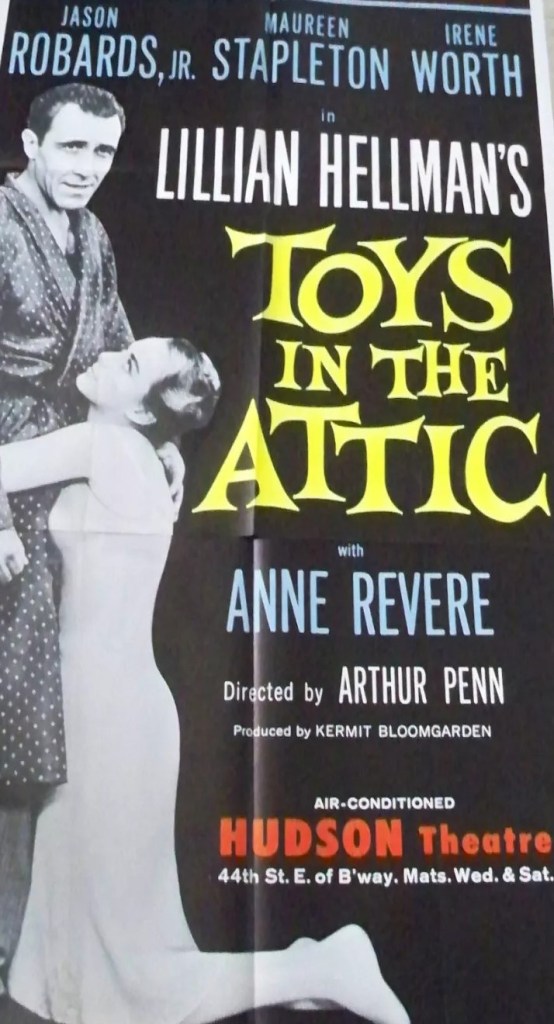
The play had been a significant hit, running for just over a year on Broadway at the Hudson Theater, and making $129,000 profit on a $125,000 investment, though it incurred a loss of $48,000 on a subsequent tour. Hellman did pretty well out of it too. She received ten per cent of the gross and twenty per cent of the profit – a total of around $36,000 – exceptionally good going for a playwright, especially when other monies would be forthcoming from movie rights and foreign and amateur runs. Director Arthur Penn’s share of gross and profit came to over $10,000 in addition to a $5,000 fee.

Turning a play or musical into a movie came with one inbuilt problem. It was inevitably subject to delay. No movie could go into production until the play had exhausted its theatrical (as in stage-play) possibilities. In this case, that meant 58 weeks in the original run and then another 20 weeks once it hit the road. Any contract with a significant movie player would have to include the possibility that in the meantime star or director would have lined up other projects while awaiting the green light on this one, and that in itself could cause further hold-ups.

Hill was in greater demand than Mirisch anticipated, juggling four separate projects – Period of Adjustment, The Rise and Fall of the Third Reich for MGM (never made), and the $2.5 million A Bullet for Charlemagne starring Sidney Poitier (not made) as well as Toys in the Attic.

Jason Robards, star of the play, was the obvious contender for the movie role. But he lacked box office cachet, so he was bypassed in favor of Dean Martin, “an attractive motion-picture figure.” However, in the time it took the movie version of the play to reach the public, Robards was potentially a screen star. He had bought himself out his stage contract after 37 weeks – paying $3,950 for the privilege – having been offered second billing on By Love Possessed (1961) opposite Lana Turner, and in Twentieth Century Fox’s ambitious mounting of Tender Is the Night (1962) opposite Jennifer Jones. While Robards would never become as big a star as Dean Martin, he was the superior actor, later adding two Oscars and one nomination to his name.

In addition to being much better known to cinema audiences than Robards, “we felt he (Martin) would bring humor to it” – Martin having originally made a splash as part of the Martin-Lewis comedy team of the 1950s – “as well as an audience that might expand the normal constituency of that type of film.” Trade magazine Box Office agreed with the decision, viewing Martin as a “good choice for the haunted show-off.”

The play’s other stars – Oscar nominee (and later winner) Maureen Stapleton (The Fugitive Kind, 1960) – and Irene Worth (Seven Seas to Calais, 1962) – were ignored in favor of Geraldine Page, who incidentally scored an Oscar nomination in Summer and Smoke, and  Wendy Hiller (Sons and Lovers, 1960), who already had an Oscar. Shooting began on September 16, 1962. Hill tried to “inject more suspense, more action, more melodrama into the movie version,” without cheapening the material. He was convinced the hiring of Martin was inspired, and would prove a personal  turning point, as he gives “the best dramatic job of his career.”

Titles didn’t matter so much on Broadway, plays sold on the name of the writer or the star. Mirisch feared Toys in the Attic would either mean nothing to a general audience ignorant of the picture’s origins or be considered so obscure as to serve to confuse them. So, they planned to rename it Fever Street or “some sensational substitute.”  Hill was furious, pointing out the “violence of his feelings” to this title. He complained that “others will assume that it is an exploitation title…a cheap gimmick to get people into the theater (cinema) … automatically puts the picture in a low budget quickie picture category that might be appropriate for 42nd St all-night houses or a second feature at Loews 86 St.”

Hill felt changing the title would demonstrate that Mirisch was “ashamed to have bought the play Toys in the Attic, have no faith in the picture, are resorting to panic tactics to get some money out.” And that Fever Street would have the opposite effect, and “keep people away in droves.” His impassioned plea worked, and the original title remained.

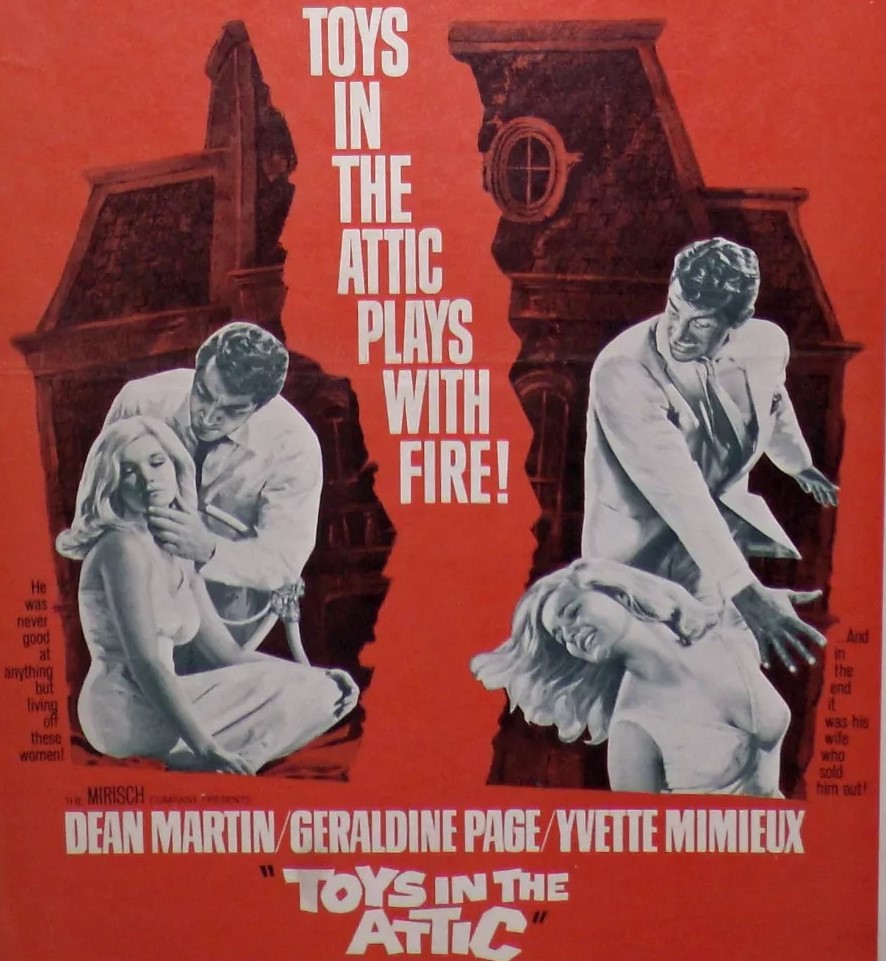
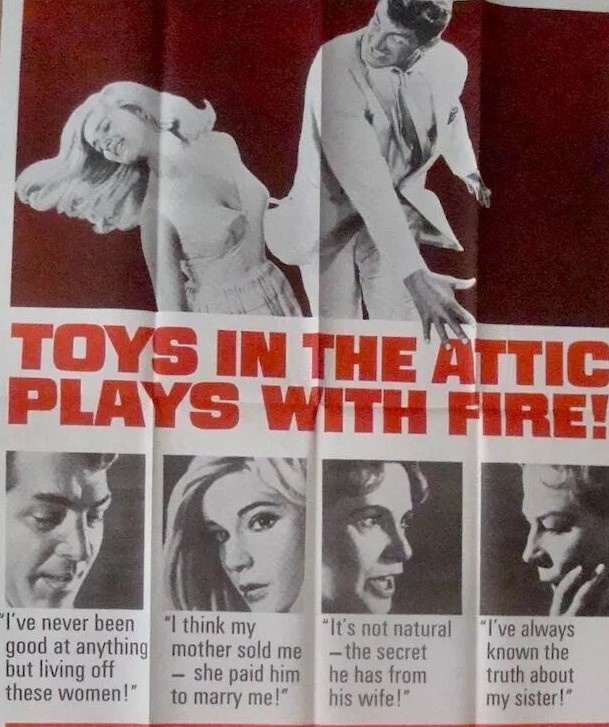
While backing down on the title, Mirisch veered towards the exploitative in the main poster which showed Dean Martin slugging Yvette Mimieux.

However, United Artists remained in two minds about the release policy. Despite the  prestige of being chosen for the San Sebastian Festival, United Artists opted to open it in New York as part of a “showcase” run. That was a relativelynew distribution notion, a version of regional wide release. It would eventually be refined to allow several weeks in prestigious first run venues first, but inclusion in this release pattern meant first run was simultaneous with an opening in – in this case – another 20 New York neighbourhood cinemas.  Had UA had more faith in the project, it might have benefitted from an opening just in first run. The $55,000 first week from two first run houses on Broadway was judged a “wow” result by Variety. First run in other major cities suggested a prestige title – “very stout” $15,000 in Boston, a “sock” $14,000 in Washington D.C., “neat” $14,000 in Buffalo, while it was “bright” in Kansas City ($8,000), Los Angeles ($10,000) and Chicago ($18,000).

Hill’s concerns about United Artists’ ability to sell the picture were mirrored in the result. “It did not turn out well,” concluded Walter Mirich, “It’s a grim story. It was not well reviewed and was not financially successful.” Part of the reason for its failure, he argued, was that it “probably appeared at the end of a cycle” of American Broadway adaptations of heavy Tennessee Williams dramas.

While the movie came in $70,000 below the $2.1 million budget, the savings were put down to the fact that it was filmed in black-and-white rather than color, as had been originally envisioned. The box office followed a common, but disturbing, trajectory, a big hit in the big cities, mostly ignored elsewhere. But it was not as bad as all that. Mirisch tallied the domestic box office as $1.7 million with another $900,000 from the overseas box office. By its estimation, once marketing costs were considered, it was facing a loss of $183,000. But that was before television revenue entered the equation and that should have at the very least, made up the difference. There were various pickings later on, too, picked up by CPI under the “Best of Broadway” label in 1981.

SOURCES: Walter Mirisch, I Thought we Were Making Movies, Not History (University of Wisconsin press, 2008) p157-159. Leon Goldberg, “Office Rushgram: Final Cost on Toys in the Attic, May 13, 1964, United Artists Files, Wisconsin Center for Film and Theater Research;  “Mirisch Pictures Box Office Figures,” UA Files; Letter,” George Roy Hill to Walter Mirisch, March 15, 1963, UA Files; “Lillian Hellman Could Mop Up if Toys Clicks,” Variety, February 4, 1960, p103; “Toys Exit,” Variety, January 18, 1961, p72; “George Roy Hill To Direct Toys for Mirisch Co,” Box Office, January 22, 1962, pE8; “Hollywood Report,” Box Office, February 22, 1962, p16; “George Roy Hill Announces First Film on UA Deal,” Box Office, March 19, 1962, p16; “Bloomgarden Had Varied Fortune,” Variety, August 29, 1962, p49; “Toys in Attic Chosen for San Sebastian Festival,” Box Office, June 10, 1963, pE8; “Premiere Showcase,” Variety, July 31, 1963, p22. Box office figures from Variety issues dated August 7, August 14, August 21, September 4, September 11 and October 23.

Behind the Scenes: Sherlock Holmes and Other Stories, Thumbs Up or Thumbs Down, United Artists 1966 – Part Two

Although Billy Wilder had written a script based on The Life of Sherlock Holmes, he was not considered as its director. Mirisch was looking at a budget in the region of $2 million, which would rule out any big star. However, there were issues with the Conan Doyle Estate which was in the process of firing up other movies based on Sherlock Holmes, A Study in Terror (1965) being the most recent. That had been the brainchild of Henry Lester and perhaps to general astonishment these days Mirisch had  agreed Lester would be allowed to make more Sherlock Holmes pictures as long as they remained very low-budget, on the assumption, presumably, that the marketplace would treat them as programmers rather than genuine competition.

However, Mirisch and UA retained the upper hand as regards the Conan Doyle Estate and “could cut him (Lester) off at such time as we have made definite plans to proceed.”

There was another proviso to the deal. The Estate would agree to forbid any further television productions unless Mirisch decided it wished to go down the small screen route itself. It was odd that Mirisch had eased Billy Wilder out of the frame given the mini-major had enjoyed considerable success with the director on Some Like it Hot (1959) and The Apartment (1960), a commercial partnership that would extend to The Fortune Cookie (1966).

Instead, Mirisch lined up British director Bryan Forbes who would be contracted to write a screenplay based on the Wilder idea. The sum offered – $10,000 – was considered too low, but it was intended as enticement, to bring Forbes into the frame as director. If Forbes refused to bite, “the only other name suggested and agreed upon was that of John Schlesinger.”  Although David Lean was mooted, UA were not in favour. Mirisch didn’t want to risk paying for a screenplay before there was a director in position.

The offer of the Sherlock Holmes picture was seen as a sop to Forbes. At this meeting, Mirisch had canned The Egyptologists, a project which Forbes believed had been greenlit. And why would he not when he was being paid $100,000 for the screenplay. In bringing the project to an untimely close Mirisch hoped to limit its financial exposure to two-thirds of that  fee. Should Forbes balk at Sherlock Holmes, he was to be offered The Mutiny of Madame Yes, whose initial budget was set at $1.5 million, plus half a million for star Shirley Maclaine. Another Eady Plan project, this was aimed to go before the cameras the following year. If Forbes declined, then Mirisch would try Norman Jewison with Clive Donner and Guy Hamilton counted as “additional possibilities.”

As for Billy Wilder he had much bigger fish to fry. He was seeking a budget of $7.5 million to adapt into a film the Franz Lehar play The Count of Luxembourg to pair Walter Matthau and Brigitte Bardot. Should Matthau pass, Wilder would try for Cary Grant (whose retirement had not yet been announced) or Rex Harrison. Both sides played negotiation hardball. UA currently in the hole for $21 million for The Greatest Story Ever Told (1965) and Mirisch, having pumped $13 million into the yet-to-be-release Hawaii (1966), didn’t want to commit to another unwieldy expensive project. So Mirisch insisted the project advance on a “step basis” allowing UA to reject the project after seeing the screenplay. Wilder countered by insisting that if it went into turnaround he, rather than the studio, would have the right to hawk it elsewhere (generally, studios tried to recover their costs if a movie was picked up by another studio). But Wilder was also in placatory mood and even if UA rejected this idea he was willing to work with the studio on a Julie Andrews project called My Sister and I.

However, UA and Mirisch were all show. “After Billy left the meeting,” read the minutes, “it was agreed we would not proceed with The Count of Luxembourg since we did not want to give Billy the right to take it elsewhere if United Artists did not agree to proceed.” Harold Mirisch was detailed to give Billy the bad news, but use a different excuse.

Mirisch was also on the brink of severing links with Blake Edwards. Negotiations for a new multiple-picture deal were to be terminated, which would mean the director would only earn his previous fee of $225,000 for What Did You Do in the War Daddy? It was also sayonara for Hollywood agent Irving Swifty Lazar, whose current deal was not working out to the studio’s satisfaction.

Other long-term deals with directors were under discussion. While its previous John Sturges movie, The Hallelujah Trail (1965), had flopped, UA was still keen on the Mirisches pursuing a long-term deal with the director, feeling that he was a “good picture-maker with the right project.” To that end, it was suggested Mirisch reactivate Tombstone’s Epitaph, but emphasising Stuges had to bring the cost down.

At this point nobody knew Norman Jewison was embarking on all almighty box office roll – The Russians Are Coming, The Russians Are Coming set to hit the screens, In the Heat of the Night at screenplay stage, so Mirisch was prescient in trying to put together a long-term deal with the director. Wind on Fire and Garden of Cucumbers were seen as tentpoles for a multi-picture deal. Mirisch had already agreed a $50,000 producer’s fee for Wind of Fire, payment of one-third of which was triggered for supervising the screenplay.

The meeting also gave the greenlight to Death, Where Is Thy Sting-A-Ling, a project that would be later mired in controversy with shooting ultimately abandoned. The go-ahead was given with the proviso the Mirisches secured the services of Gregory Peck or an actor of his stature.  Budget, excepting Peck’s fee, was just over $3 million and it was another one hoping to take advantage of the Eady Plan.

This kind of production meeting was probably more typical than you would imagine, studios trying to keep talent sweet while not committing themselves to dodgy product. It’s perhaps salutary to note that of the projects under discussion, only a handful found their way onto cinema screens. Garden of Cucumbers (as Fitzwilly), How To Succeed in Business, having met budget restraints, and Tombstone’s Epitaph (as Hour of the Gun) with James Garner all surfaced in 1967 and Inspector Clouseau the following year. Neither of the Steve McQueen projects survived nor the pair proposed by Billy Wilder. High Citadel, Saddle and Ride, The Narrow Sea, The Great Japanese Train Robbery, and The Cruel Eagle failed to materialize. Billy Wilder eventually made The Private Life of Sherlock Holmes under the Mirisch auspices but not until 1970. 

Behind the Scenes: Thumbs Up or Thumbs Down, United Artists 1966 – Part One

Most observers don’t have a clue why some films are made in preference to others, or even of which movies have sat in turnaround hell for years. When I was researching my book The Making of The Magnificent Seven I came across some priceless material that gave some clues regarding the process. An “Inter-Office Memorandum” dated February 3, 1966, provided an insight into how independent producers Mirisch, then allied to studio United Artists, set about giving the thumbs up or thumbs down.

The memo referred to a meeting held at the Beverley Hills Hotel on January 29-30, 1966, attended by the three Mirisch Brothers – Harold, Marvin and the recently-deceased Walter – as well as UA head honcho Arthur Krim, Herb Jaffe and David Picker. On the agenda: Inspector Clouseau, Sherlock Holmes, The Mutiny of Madame Yes, The Egyptologists, Garden of Cucumbers, Wind on Fire, High Citadel, Saddle and Ride, The Narrow Sea, The Great Japanese Train Robbery, Lydia, In the Heat of the Night, The Cruel Eagle, How To Succeed in Business, and Death, Where Is Thy Sting-a-Ling.

Separately, the group examined commitments to various talents including John Sturges, Norman Jewison, Bryan Forbes and Billy Wilder.

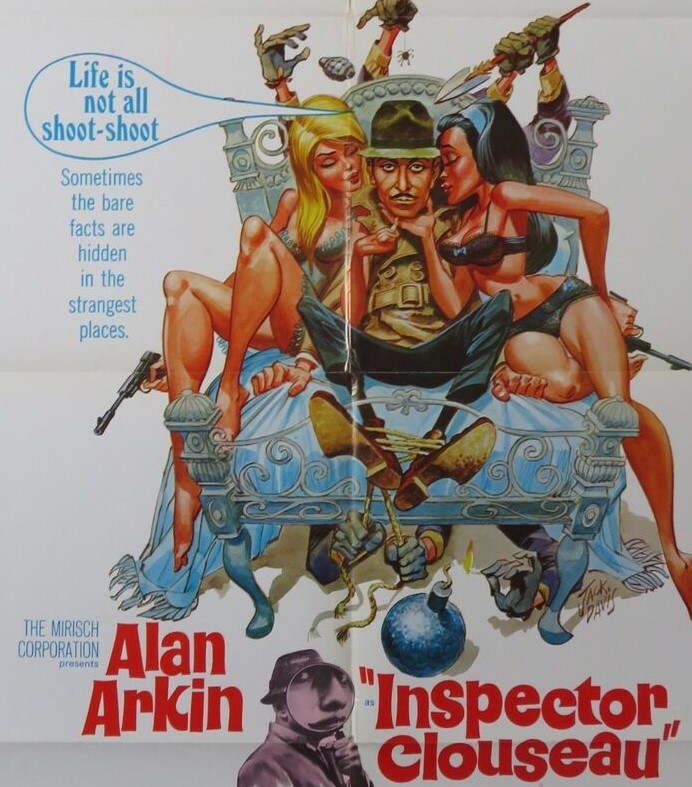
Top of the agenda was Inspector Clouseau, a sequel to the successful Pink Panther series, from which Peter Sellers had withdrawn. The budget was set at $3 million including $466,000 for director and star. Alan Arkin was not yet a lock, UA reserving its opinion on Arkin’s marquee’s credentials until it saw how The Russians Are Coming, The Russians Are Coming (1966), in which he was the star, performed at the box office. Should it bomb, second choice was Zero Mostel. Jonathan Winters, viewed as a “questionable choice,” was also in the running. Clive Donner was the preferred director. If he passed, next up was Guy Hamilton. (In the end both rejected the offer and it was released in 1968 with Bud Yorkin at the helm.)

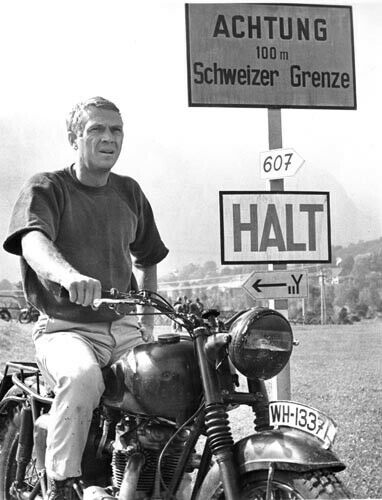
Two projects on the table were mooted as vehicles for Steve McQueen. The first, Wind of Fire, was intended as “immediately following Sturges’ racing picture.”(This was Day of the Champion but a legal battle with MGM would derail this and McQueen was five years away from releasing Le Mans). Wind of Fire, to be directed by Norman Jewison, suffered from an incomplete script which restricted discussion. John Wayne had shown an interest but UA “was not really interested in Wayne,” possibly as a result of the fall-out from The Alamo (1960). The second McQueen project was the thriller Lydia based on the book by E.V Cunningham (the pseudonym of Howard Fast of Spartacus fame). Here, the script was complete and in the actor’s hands. Doris Day had been touted for female lead but Mirisch had nixed her involvement. When dealing with any major star, greenlighting a picture depended on schedules not clashing. (In the end neither project saw the light of day.)

Mirisch was also juggling two properties to star Dick Van Dyke.  The Great Japanese Train Robbery was due to commence filming in June 1966, although that meant cooperation from Columbia and Disney who had first call at that point on the actor; Disney had excused him, Columbia had not. Virna Lisi, the intended female lead, was dunped for demanding too much money, $300,000 her current asking price. In her place were suggested Claudine Auger, Catherine Deneuve, Stefania Sandrelli or Luciana Paluzzi. Although the budget was approved at around £3.3 million, the movie never went ahead.

Garden of Cucumbers with Van Dyke, though minus a female lead, was already scheduled to start shooting in August-September 1966. Proposed director, in order of preference, was Norman Jewison, Arthur Hiller or Elliott Silverstein. This project did make it over the line though the title, changed to Fitzwilly, was helmed by Delbert Mann and co-starred Barbara Feldon in her biggest role to date.

A budget of $1.89 million had been set for High Citadel, based on the Desmond Bagley thriller. UA was locked into a pay-or-play deal, which meant star James Garner would receive his salary whether or not the picture was made. However, there was a get-out clause. The studio could use Garner for another picture as long as it slotted into the same timeframe. The other options were Saddle and Ride and The Narrow Sea. Of these Mirisch preferred the former, UA the latter. But there was a directorial issue with The Narrow Sea. Mirisch had a moral commitment though not a legal contract with producer Robert Relyea to make this his directorial debut and UA didn’t want him. (In the event neither film was made.)

There were budget issues on How To Succeed in Business. UA had given the go-ahead on the basis that it would cost no more than $3.25 million but the budget had since soared by over half a million. To meet the May 1 start date, the budget had to be trimmed back to the original amout. (This was presumably done, since the movie appeared the following year). In the Heat of the Night was in the early stages of development, the production company still to see the Stirling Silliphant script, but at this stage no objections were raised. Fred Zinnemann was being considered as the director of The Cruel Eagle by Frederick E. Smith, author of 633 Squadron. (It was never greenlit).

Making movies in Britain – in order to take advantage of the tax advantages of the Eady Plan – was central to the Mirisch strategy. While Inspector Clouseau, Death, Where Is Thy Sting-a-Ling,  and The Mutiny of Madame Yes– budgets totalling around the $10 million mark – were already committed to the Eady Scheme, Mirisch was also seeking backing to set up a low-budget unit in Britain to maximize the government’s largesse. Budgets per picture would be limited to $1 million or less. In the memo they were described as “disciplined” or “service” pictures to be “produced in color.” In essence that meant basic programmers that could be sold to drive-ins and cinemas with a high movie turnover, on a rental basis if they topped the bill, for a flat fee if they were supports. This would have the added benefit, for those houses whose customers demanded a double bill, of being able to offer a program where all the revenue would end up in the Mirisch pocket.

Book Review – Dreams of Flight: “The Great Escape” in American Film and Culture

In the history of rousing action cinema few movies are as revered or have produced such a collective cinematic response as John Sturges’ World War 2 POW picture The Great Escape (1963) starring Steve McQueen, James Garner and Richard Attenborough and a host of upcoming stars including The Magnificent Seven alumni James Coburn and Charles Bronson,  

Dana Polan’s rich assessment of the film’s making coupled with a superb analysis of the film itself, script, style, themes and directorial bravura is filled with informative nuggets. Eschewing the standard star bio approach, Polan goes much deeper to detail how earlier adaptations for American television and Australian radio (made by novelist Morris West’s company and with Rod Taylor as a German guard) affected the film, how it fitted into the British POW tradition (The Colditz Story etc) and the influence of an American offshoot like Stalag 17.

You might already be familiar with the work of Dana Polan since he has written books on Pulp Fiction, The Sopranos and Jane Campion and another half-dozen books besides. This is an excellent addition to his impressive portfolio.

Paul Brickhill, author of The Great Escape (and other war classics The Dam Busters and Reach for the Sky) had been an inmate at Stalag Luft III so drew on personal experience – including that of tunnel digger – and sketches made at the time of the tunnels to turn out, as co-writer, a precursor Escape to Danger. It was either interviews relating to this or a magazine article or condensation that alerted neophyte director Sturges in 1945/1946 to a potential film. The book, published in 1950, sold a million copies in paperback in the UK alone and was a huge global success. And for independent producers Mirisch, for whom Sturges later made The Magnificent Seven, buying the rights was integral to the director’s pact with that company in 1957 and indeed The Great Escape was mooted as his debut picture for them. When finally greenlit, it was intended to be shot in the U.S. with only 10 per cent taking place in Europe. That it went the other way was due to an unusual set of circumstances.

In his analysis of the picture, Polan makes other interesting connections, first of all to the caper picture where each character has a specific task to contribute to the overall effort. Unusually for a heroic film, he points out that courage is continually undercut, each uplifting moment leading to defeat, the film itself having an essentially downbeat ending, the only true victory found in defiance. And in some respects The Great Escape created a bridge between the gung-ho war films of the 1950s and the more cynical approach to war envisioned in The Deer Hunter and Apocalypse Now.

Being British, it had never occurred to me how important the baseball glove was to American culture, the glove representing for many a “certain brand of American problem-solving in the face of adversity” although far more universally accepted would be the premise of the motorcycle escape representing the triumph of the spirit even as it results in a more down to earth resolution.

Tracing Sturges’ stylistic development back to post-WW2 B-movies made for Columbia explains the importance of the trademark parabolic shot in driving action forward. Yet for all his stylistic bravura, Sturges was very grounded when it came to the work required to make pictures, for example here adopting coloured index cards to shuffle around pieces of action to best effect.

The script went through various hands – William Roberts and Walter Newman, both integral to The Magnificent Seven, but was finally credited to crime writer W.R. Burnett (who had worked with Sturges on Sergeants 3, 1962) and James Clavell (who adapted The Satan Bug, 1965), himself a POW in a Japanese camp with British writer Ivan Moffat (Giant, 1956) coming in at the last minute as script doctor. A breakdown of the various scripts attributes the Hilts’ cooler baseball bouncing to Moffat who also wrote the scene that changed Hilts from loner to participant.

In a terrific appendix you can discover exactly the problems facing the real escapees and who came up with the book title (clue – not the author) four years after the idea originally surfaced. There’s a fascinating coda about the film’s impact on Hollywood and general culture and Polan takes time out to reflect on the experience of various fans on their virgin encounter with the picture. The movie was a big hit and so well received that when critic Bosley Crowther wrote a negative review the “New York Times” postbag was filled with complaints. Written with tremendous authority and great style, this is one book you would want to find in your Xmas stocking.

Dreams of Flight: The Great Escape in American Film and Culture by Dana Polan is published by University of California Press at $24.95 / £20 in both paperback & ebook.  ISBN 9780520379305. It is available on Amazon and Kindle.

https://www.ucpress.edu/book/9780520379305/dreams-of-flight

Discover WordPress

A daily selection of the best content published on WordPress, collected for you by humans who love to read.

The Atavist Magazine

by Brian Hannan

WordPress.com News

The latest news on WordPress.com and the WordPress community.