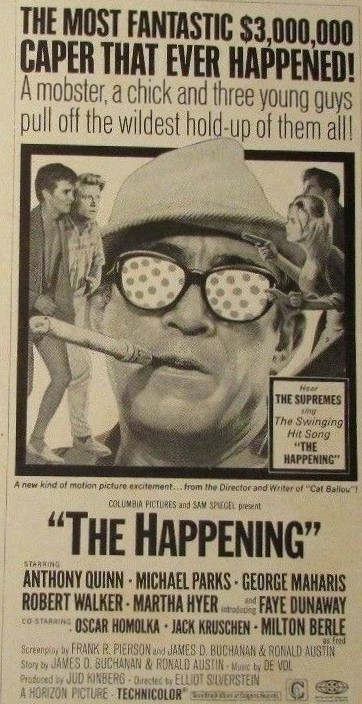
Lepke (1975) ***

Gangsters are just the same as you and I. They want to be loved, they want a family, they want the kind of respect that isn’t achieved by just pointing a gun at someone. The Godfather (1972) led the way in subtly reminding us that gangsters were human beings even if it was more seductive in making us believe we should excuse their criminal tendencies. Lepke spends as long on romance and trying to win the approval of the bride’s father as it does on the character’s perfidy. The idea that marriage cannot so much absolve you of your sins but provide an oasis of calm inside a murderous world is one only a true romantic would consider pursuing. As is the notion that a wife would forgive you your sins because her love would outweigh your actions, in the same way as the wife-beaten wife (as shown in Love Lies Bleeding) still loves her husband no matter how brutal the treatment meted out.

Lepke has got reason to be sore with the world. He was left out of the gangster chronicles. An important part of the Murder Inc operation, he was ignored when Hollywood passed judgement on such criminal enterprises. And you get the sneaky feeling his life story was only revived because after the Coppola epic his was one of the few tales untold in the gangster chronicles.
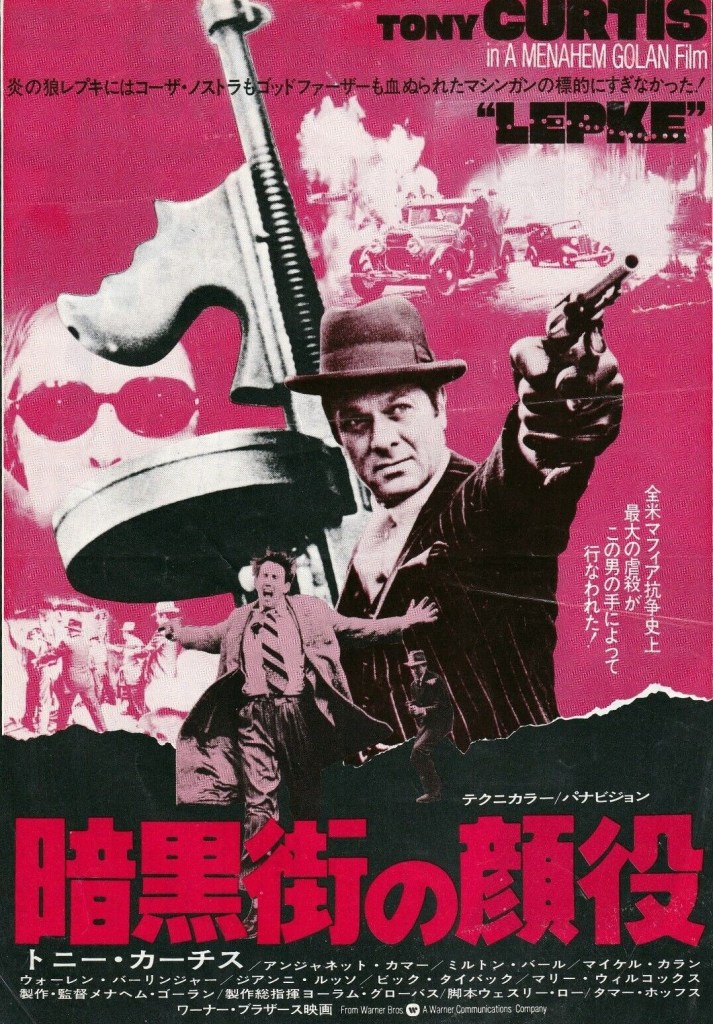
“If there’s any good in him, that’s the part I’ve got,” says wife Berenice (Anjanette Comer), “If I was a whore I could leave him.” And you can see the part she adores, not only respectful to the point of being obsequious to her upstanding father Mr Meyer (Milton Berle), but charming and romantic with her and he’s clearly able to separate business from romance, turning into an exemplary family man (but then so, too, did Don Corleone).

Which is just as well because Lepke (Tony Curtis) is a dreaded Mafia enforcer, forming a murder syndicate with Dutch Schulz (John Durren)  and Lucky Luciano (Vic Tayback) that takes responsibility for knocking off anyone who steps out of line away from the big bosses. There’s some standard gangster stuff, machine guns in violin cases, bombs in the spaghetti, but also some interesting touches, a shoot-out on a carousel, and of course the last person a gangster can trust is the one he places his truth with. Double-dealing is the order of the day.

Like all the top gangsters, Lepke is an entrepreneur, expanding out of the killing racket into dope, extortion and trade unions. New York D.A. Thomas E. Dewey is on the Murder Inc case and his assassination is only prevented by the intercession of Lepke. But he’s tackled as much by Robert Kane (Michael Callan), friend to Berenice who works in narcotics along with Dewey.
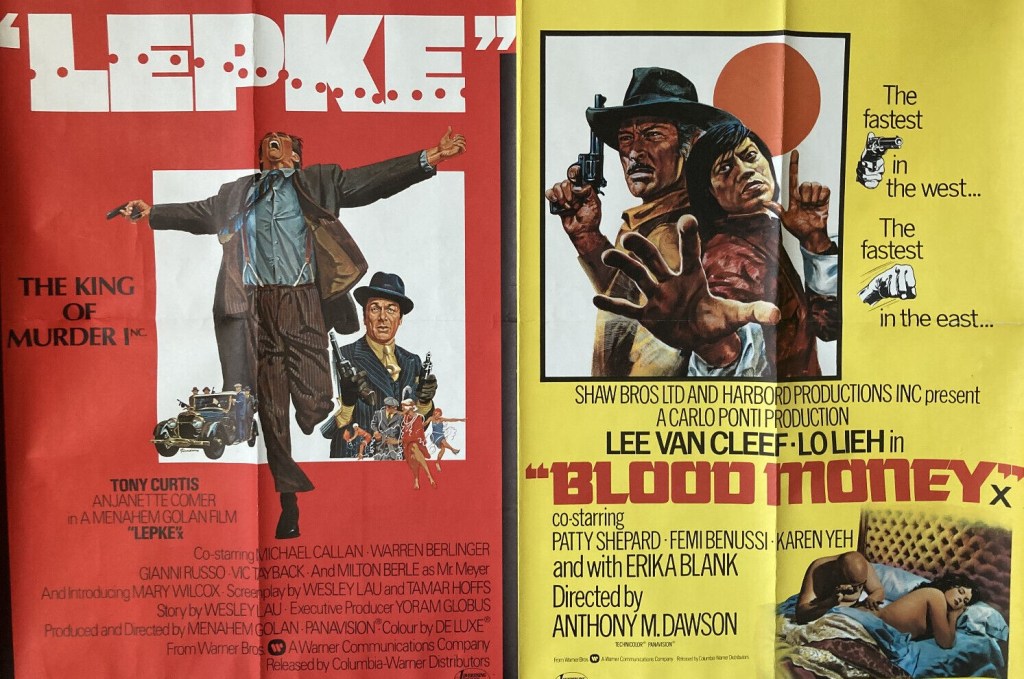
Dewey’s not the only real-life character making an entrance. Legendary journalist Walter Winchell (Vaughn Meader) plays a significant role. Most of the picture involves Lepke  being nefarious by day and loving at night and the gang are only tripped up when witnesses need to be eliminated and as the cops work a similar kind of dodge to the one that snared Al Capone. Instead of tax evasion it’s anti-trust issues.  

Covering the period from 1923, Lepke’s emergence as a ruthless street rat, and his development of the narcotics business by sourcing product direct for the Far East,  to his execution in 1944, it pays only cursory attention to the period. Most of the time, Lepke is fighting for his life one way or other, suspicious of colleagues, walking a knife-edge between actions that could inavertently lead to his demise, and trying to remain the best part of himself that remains appealing to his wife.

That any of this works other than being a standard depiction of the rise and fall of a gangster is down to Tony Curtis (The Boston Strangler, 1968) who delivers one of his best later performances while maintaining a difficult balancing act, clearly believing that he can separate the two sides of his personality, and that the murderous part is really just a performance. The documentary-style rendition helps as this can be complicated stuff, especially with so many disparate traitors.

Anjanette Comer (Guns for San Sebastian, 1968) is always watchable.  Menahem Golan, of Golan-Globus and Cannon fame, perhaps taking a cue from The Godfather, takes considerable care with the family elements and is rewarded with a better picture than the elements might suggest.

This pretty much rounds out my Hollywood History of the Gangster.

The Oscar (1966) ****

Don’t you just love a really good bad movie? Where redemptive character is outlawed. When over-acting is the key. In which everyone gets the chance to spout off about someone else, generally to their face, and then is permitted, in the cause of balance, a quiet moment of bitter self-reflection. And even the most minor character gets a zinger of a line. Welcome to Hollywood.

Tale of an actor’s rise and not exactly fall because we leave Frank Fane (Stephen Boyd) at a pinnacle of his career, though, don’t you know, he’s empty inside and deserted by all his faithful companions. Lucky Frank has some kind of charisma or that he just fastens onto losers who see in him what they need because from the outset he is one mean hombre, living off stripper girlfriend Laurel (Jill St John), so dumb she switched to him from his so dependable best pal Hymie (Tony Bennett – yes, that Tony Bennett, the singer).

He hooks up with Kay (Elke Sommer), a designer who happens as a sideline to make costumes for off-Broadway productions. When King of Lowlife Punks Frank shows a pusillanimous stage actor what you do in a knife fight he strikes a chord with theater producer Sophie (Eleanor Parker), who happens to have a sideline as a talent scout for the movies.

She fixes him up with an agent Kappy (Milton Berle – yes that Milton Berle, the loudmouth comedian) and together they sell him to studio boss Regan (Joseph Cotten). The only good deed Frank does in the entire movie is to stand witness – not for marriage, but for divorce – for an ordinary couple, private detective Barney (Ernest Borgnine) and Trina (Edie Adams), he meets at a bullfight, huge fans, and thank goodness that action comes back to bite him.

The picture goes haywire in the third act. Fane’s career is crumbling in the face of audience indifference, exhibitor displeasure and, don’t you know it, a chance for revenge for Regan, who was stiffed in a previous contract. But instead of taking the traditional tumble into the forgotten category, his career is revived by an Oscar nomination.

From top to bottom – a fully-clothed Stephen Boyd, then in various states of undress, Elke Sommer, Jill St John and Eleanor Parker. That’s how to sell a picture apparently.

But that’s not enough for the ruthless Fane. Earlier in his life a corrupt sheriff had stuck him with charges of pimping. Using Barney, who seems to have the ear of the media, he plants a story about himself, hoping that Hollywood being the cesspool it is, everyone will assume one of his rivals did the dirty. “I can’t rig the votes,” rationalizes our poor hero,”  but I can rig the emotions of the voters.”

What a scam. I was chortling all the way through this section and almost laughing out loud when it transpires Frank had misjudged how deep the cesspool is, because Barney then blackmails him. This gives everyone he has treated heinously over the years the chance to stick it to him. Nobody will lend him the dough to get this grinning monkey off his back. Salvation comes in the oldest of Hollywood maneuvers. Trina, who has always wanted to get into pictures, and is the kind of person who embodies A Grievance Too Far, supplies the information that will sink her ex-husband, in exchange for Frank using his influence to get her a small role.

There’s a brilliant climax. I should have said spoilers abound but I can’t resist telling you the ending it’s such a cracker. So there is Frank at the Oscars with Bob Hope (yes, that Bob Hope) as master of ceremonies and the audience studded with real stars like Frank Sinatra (yes, that…). Like an evil chorus – you can almost hear them hissing under their breath and they all fix him with baleful looks – are all those he treated badly.

The winner is announced. “Frank…” Assuming victory, Fane gets to his feet. “Sinatra.” The only way he can rescue his embarrassment is to make it look as he is giving the winner a standing ovation. But when the rest of the audience follows suit, he slumps to his chair, and in the only true cinematic moment in all the sturm and drang the camera pulls back from him sitting bitter, twisted and defeated in his seat.

Stephen Boyd (Shalako, 1969) is terrific because even when he was top-billed he tended to over-act and when he became a co-star or supporting player he was an inveterate scene-stealer, of the sharp intake of breath / vicious tongued variety. Here he shows both his charming and venomous side. If he was playing a gangster he couldn’t be more menacing – or charismatic. It’s a peach of a role – he can dish it out, dump women at will, and still embrace victimhood as “170lb of meat.”

Luckily, most of the rest of the cast take the subtle route. Although all disporting in various negligible outfits at one time or another, Jill St John (The Liquidator, 1965), Elke Sommer (The Prize, 1963) and Eleanor Parker (Eye of the Cat, 1969) and giving Frank his comeuppance wherever possible – St John slings him out – the performances are generally nuanced, Parker in particular evoking sympathy.

Tony Bennett is miscast, especially as he has to do double duty as an unwelcome voice-over, filling in bits of the narrative that, thankfully, has been skipped. But Milton Berle is pretty good as  a quiet-spoken agent.

In the over-the-top stakes, Boyd has his work cut out to hold his own in scenes with Ernest Borgnine (The Wild Bunch, 1969) who revels in his scam, and Edie Adams (The Honey Pot, 1967) who is anything but a dumb blonde and delivers the most stinging of zingers.

Doesn’t tell us anything we didn’t know about Hollywood except in one delicious scene where, early in his career, Frank has to squire around a female star who relishes putting him in his place.

It’s not badly made just pell-mell and over-the-top. Russell Rouse (The Caper of the Golden Bulls, 1967) directs from a screenplay by himself and Harlan Ellison (yes that Harlan Ellison, the sci fi author) from the bestseller by Robert Sale.

An absolute hoot.   

Let’s Make Love (1960) ***

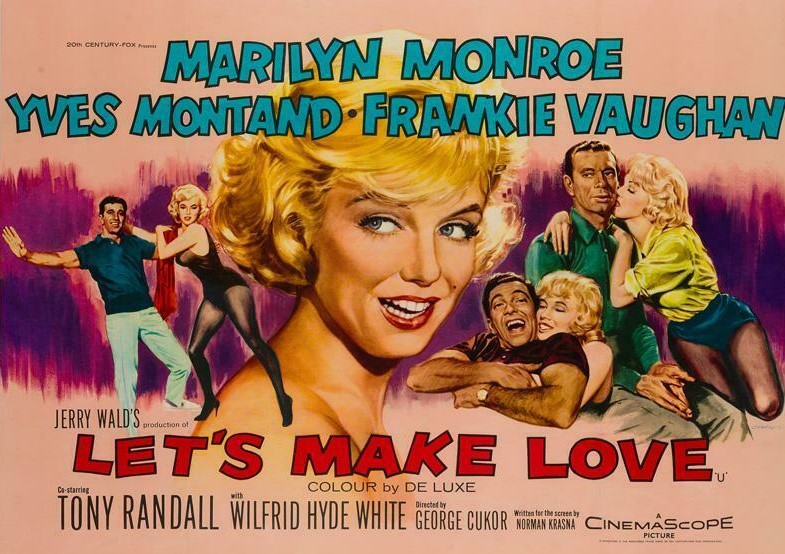
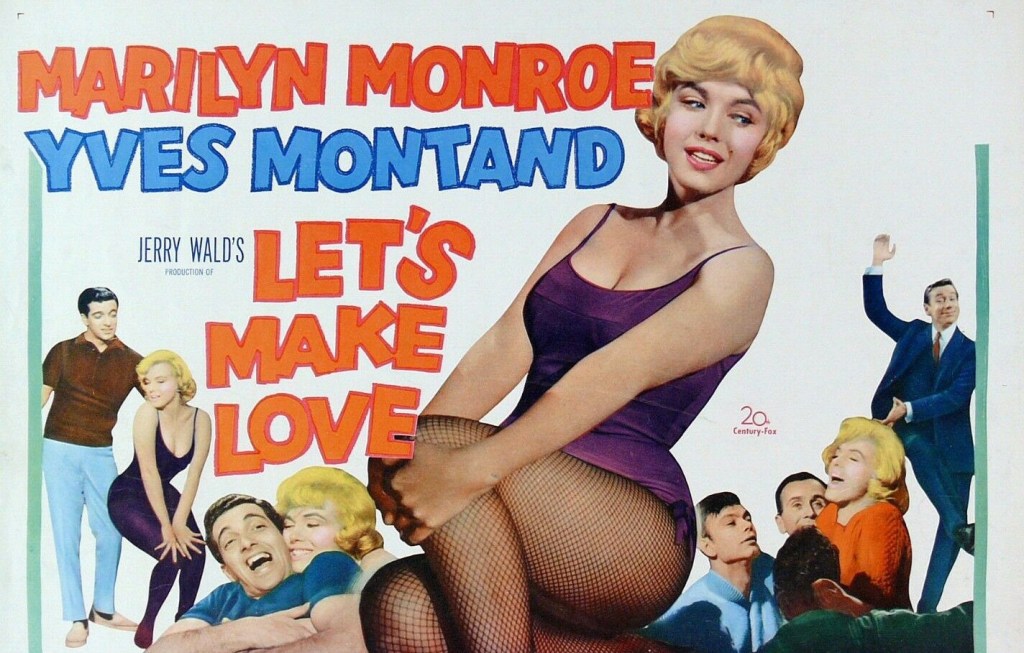
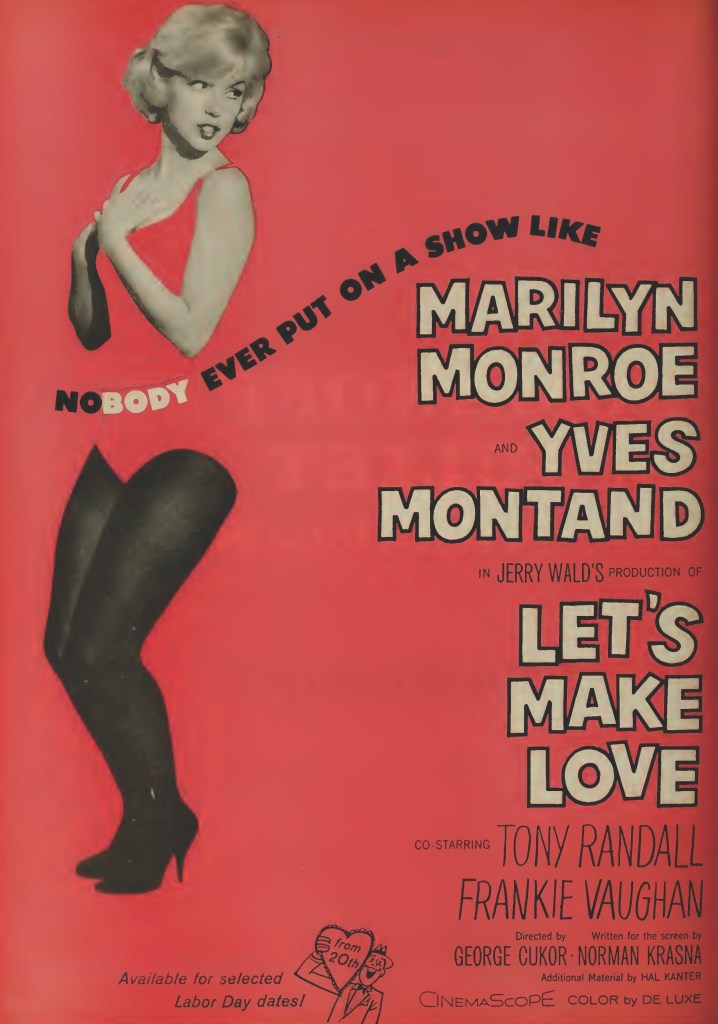
Despite a luminous performance by Marilyn Monroe (Some Like it Hot, 1959) , in revealing outfits half the time, this backstage musical drama barely staggers over the line. Whatever relationship the actress enjoyed off-screen with co-star Frenchman Yves Montand (Grand Prix, 1966) fails to register here. In this fish-out-of-water tale of the Broadway intrigue involved in putting a musical together, watching klutz billionaire Jean-Marc Clement (Montand) getting his act together as neophyte actor-cum-singer fails to fly.

It’s always difficult observing a good actor trying to be bad. If he’s a really good actor, it’s going to be an awful watch. And unless he’s got the comedic chops to trigger a bucketload of laughs it’s painful to observe. Gregory Peck reportedly quit this role in favour of The Guns of Navarone (1961) because there was too much Marilyn Monroe in it, and possibly an awkward Peck would have been more fun to watch though comedy was scarcely his forte, but without Monroe the movie would have been virtually unwatchable.

The story’s familiar, a twist on Cinderella with Clement being the ugly duckling in terms of talent. The billionaire businessman, notorious for his love life, attends a rehearsal of a show intending to register outrage at its veiled portrayal of him. Instead, he is mistaken for an auditioning actor and offered a role. He falls for Amanda (Monroe) but she shows little interest, either obsessed with her knitting or trying to improve her education at night class, and appears far more interested in her stage co-star Tony (Frankie Vaughan).

In order to sharpen up his act, Clement hires a bunch of well-known thespians: Milton Berle, Bing Crosby and Gene Kelly.

This is where the show could be get interesting. Genuinely learning the secrets of a great comedian, singer and dancer should at the very least provide a fascinating insight into their skills. Of these, Crosby is the pick, demonstrating the importance of raising or dropping your voice at various points in order to maximize the emotion in a song, in other words a singing masterclass. Berle has too much screen time and does little to justify it.

Whatever, regardless of what the script says, Clement seems to take on board little of what he is taught. Montand was a gifted crooner in any case, having begun his career as Edith Piaf’s protégé, and it just seems like he switched instantly from being a bad singer to a good one. In contrast, when Amanda has to take direction, she immediately shows how simple it is to improve a number by adding some actions.

Luckily, Monroe is such a mesmeric screen quality that she can rescue any indifferent movie.  This would work better with a more charismatic leading man – and the prospect of Peck teaming with Monroe was intriguing – but regardless of who she acts opposite Monroe will always blow them away. This is a different kind of role for her because in a sense she is neither the girl adored nor the victim of romance gone wrong. For the most part she’s just a career girl focusing all her attention on getting on. She’s almost just the foil in the dramatic sequences for Montand. But once she has the stage or screen or to herself she dazzles.

Can Heironymus Merkin Ever Forget Mercy Humppe and Find True Happiness (1969) **

One of the biggest-ever movie follies, an overblown vanity project with Fellini-esque overtones – written, directed, produced and starring British crooner Anthony Newley (Doctor Dolittle, 1967) – that turned into the first X-rated musical. Bob Fosse mined a similar, almost as seedy, sex-obsessed autobiographical vein in All That Jazz (1979) to critical acclaim whereas the Newley effort met with critical coruscation.

Although primary known as a Broadway star (Stop the World, I Want to Get Off), he had a small but reasonable movie portfolio, star of The Small World of Sammy Lee (1963) and male lead to Sandy Dennis in Sweet November (1968), so in a sense he was ready for the leap into movie stardom, though perhaps not in such grandiose fashion. Had the movie shown the slightest touch of irony, that might have been its saving grace, but the main theme is that women queue up to bed a star who is fed up with bedding women yet appears to revel in his own moral decadence.

The story is so slim it defies belief or arrogance. Hieronymous Merkin (Newley) is preparing to make a film about his own life though he feels he has been controlled from the outset, his child view is that of a marionette with someone else pulling the strings. Once Goodtime Eddie Filth (Milton Berle) sets him on a stage career beauties flock to his side. Although married to Polly Poontang (Joan Collins) he longs to be reunited with earlier lover Mercy Humpe (Connie Kreski). Basically, he keeps asking the universal question besetting all men – if I can have all the sex in the world, why am I not happy?

On the plus side it is certainly audacious, surreal, pretentious, unconventional and gives a good idea of what would happen if a director turned up on a beach in Malta with $1.25 million to spend on whoever happened to be available plus assorted nudes and rolled the camera to see what would happen and then argued with his crew or critics about what was taking place. One big minus is the songs. Newley was a talented lyricist (Goldfinger) and composer as well as performer. But the material here is poor and Newley, despite his Broadway experience, has no idea how to stage a musical.

Cameos abound. You can spot famed comedian George Jessel, singer Stubby Kaye, British entertainer Bruce Forsyth, Tom Stern (The Devil’s Brigade, 1968), and British character actors Patricia Hayes, Victor Spinetti and Judy Cornwell. You may be surprised to learn that the script written in tandem with Herman Raucher (Sweet November) was named Best British Original Screenplay by the Writers Guild of Great Britain.

Theoretically, this is now regarded as a cult classic but I’ve yet to come across a review that treats it as anything other than a self-indulgent curiosity rather than a must-see.

Studio Universal was so embarrassed by the final outcome that it released it in the U.S. under its Regional Film unit “which handles product Universal doesn’t care to go out under its own banner.” The picture was not quite the box office disaster many anticipated after poor runs in New York and Los Angeles. Helped along by a 10-page spread in Playboy it scored substantial business in cities as diverse as Detroit, Louisville and Minneapolis, though not enough, ultimately, to break even.

Given Newley did not make another picture for six years, you might have imagined Hieronymous Merkin spelled the death-knell for his career. But that was not so. After the film opened, he signed a $1 million four-year deal at Caesar’s Palace in Las Vegas, was lining up a Broadway musical about Napoleon and Josephine with Barbra Streisand and was in talks to star in a movie adaptation of his hit musical The Roar of the Crowd.

Afraid you’ll have to dig around on Ebay to find this.

SOURCES: “Newley Making Vegas Bow Aug 7 at Caesar’s Palace,” Variety, June 11, 1969, p76; “Newley-Streisand for B’way Tuner on Nappy-Josie,” Variety, July 2, 1969, p1; “Merkin Dates Overcome Jinx,” Variety, July 9, 1969, p3; “Jack Haley Jr. Setup To Produce, Direct,” Variety, December 24, 1969, p6.

The Happening (1967) ***

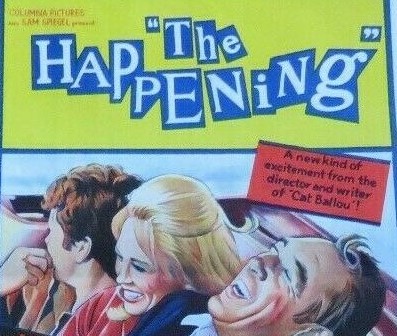
Poor casting blows a hole in this picture’s great premise and only an excellent turn by Anthony Quinn as an indignant kidnappee prevents it achieving “so-bad-it’s-good” infamy. In fact for the first third of the movie you could pretty much guarantee it’s going to be a stinker, so dire are the performances of the quartet of hippy kidnappers. Only when the camera cuts  Quinn a bit more slack and the script skids into a clever reversal does the movie takes flight although still hovering dangerously close to the waterline.

Faye Dunaway (Sandy), all blonde hair and pouting lips, looks for the most part as though she has entered an Ann-Margret Look-A-Like Competition. Michael Parks (Sureshot) resembles a fluffy-haired James Dean. George Maharis is condemned to over-acting in the role as ringleader Taurus while Robert Walker Jr. as Herby does little more than mooch around. None shows the slightest spark and behave virtually all the time as if they are in on the joke.

For no special reason, beyond boredom, they kidnap hotel tycoon Roc (Quinn) hoping to make an easy score with the ransom. Unfortunately for Roc, none of those he is counting on to cough up the dough – wife Monica (Martha Hyers), current business partner Fred (Milton Berle), former business partner Sam (Oscar Homolka) and offscreen mother – will play ball. In fact, Monica and Sam, enjoying an affair, would be delighted if failure to produce a ransom ended in his death.

Eventually, while the movie is almost in the death throes itself, Roc fights back, using blackmail to extort far more than the kidnappers require from his business associates and taking revenge on his wife by setting her up as his murderer. It turns out Roc is a former gangster and well-schooled in the nefarious. So then we are into the intricacies of making the scam work, which turns a movie heading in too many directions for its own good into a well-honed crime picture.

Quinn is the lynchpin, and just as well since the others help not a jot. From a kidnappee only too willing to play the victim in case he endangers wife and son, he achieves a complete turnaround into a mobster with brains to outwit all his enemies. But in between he has to make a transition from a man in control to one realizing he has been duped by all he trusted.

Director Elliott Silverstein, who got away with a lot of diversionary tactics in Cat Ballou (1965) – such as musical interludes featuring Stubby Kaye and Nat King Cole – essays a different kind of interlude here, fast cars speeding across the screen at crazy angles. But that does not work at all. Probably having realized pretty quickly that he can’t trust any of the young actors, he mostly shoots them in a group.  

Some scenes are completely out of place – a multiple car crash straight out of It’s A Mad, Mad, Mad, Mad World, for example. But occasionally he hits the mark in ways that will resonate with today’s audience. Sureshot, confronted by a policeman, refuses to lower his hands in case he is shot for resisting arrest. Although drug use is implied rather than shown, Sureshot is so stoned he can’t remember if he has actually made love to Sandy. And like any modern Tinderite, neither knows the other’s name after spending a night together.  

The strange thing about the youngsters was that they were not first-timers. Dunaway had made her debut in Hurry Sundown (1967). George Maharis had the lead in The Satan Bug (1965) and A Covenant with Death (1967), Michael Parks the male lead in The Idol (1966) and played Adam in The Bible (1966) and although it marked the debut of Robert Walker Jr. he had several years in television. Oh, and you’ll probably remember a snappy tune, the music more than the lyrics, that became a single by The Supremes.

I’ve got an old DVD copy but I don’t think this is readily available but you can catch it for free on YouTube, although it’s not a good print. Via Google you should be able to see The Supremes performing the title song.

Discover WordPress

A daily selection of the best content published on WordPress, collected for you by humans who love to read.

The Atavist Magazine

by Brian Hannan

WordPress.com News

The latest news on WordPress.com and the WordPress community.