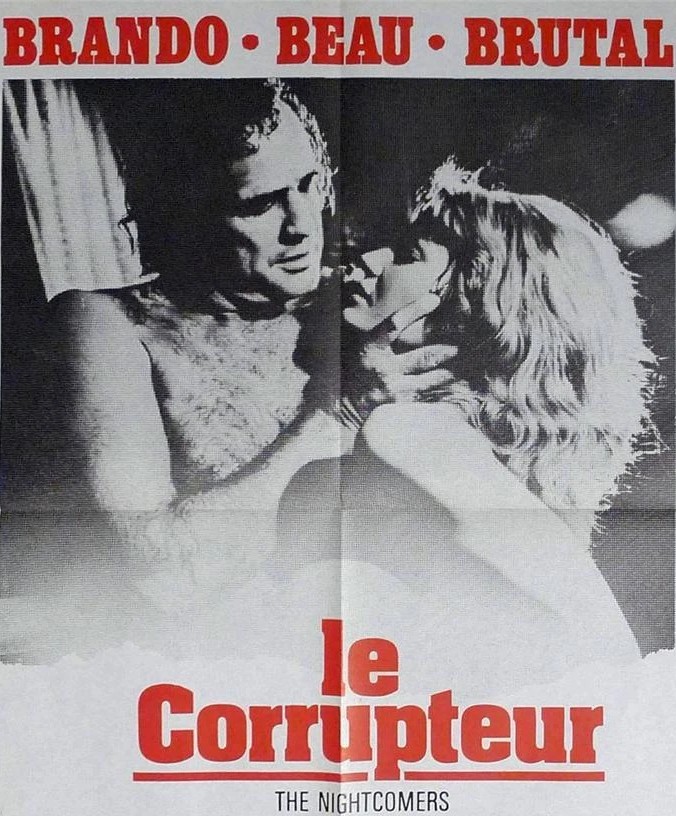
Behind the Scenes: “The Nightcomers” (1972)

Marlon Brando’s box office cachet had crashed. He hadn’t made a picture in two years following the flop of Queimada/Burn (1969) which had followed his debilitating box office trend of most of the decade. While his stock remained high enough to headline such big budget numbers as The Chase (1966) and Reflections in a Golden Eye (1967), thereafter confidence in his marquee value tumbled. Apart from Queimada, he had only been signed up for Night of the Following Day (1968), another loser.

But that last picture had brought him into the orbit of independent producer Elliott Kastner (Where Eagles Dare, 1968) who had been a friend of director Hubert Cornfield (Pressure Point, 1962) when they had both worked as agents at MCA. “Although he was crazy,” recalled Kastner, “I loved his writing and his drive.” Kastner was a fan of Cornfield’s earlier movies especially as they had been delivered on short time schedules. “I wanted to do something with Marlon Brando and he wrote Night of the Following Day.” 

Brando still had clout in Hollywood. His three-picture deal with Universal obliged the studio to pony up for any (financially viable) projects he put to them. Kastner was delighted to hop over from his base in London to the French location and although the movie continued the actor’s poor reception at the box office, the producer enjoyed the experience.

Brando wasn’t averse to the “resting” that most actors endure, stints of unemployment between gigs. So when the actor approached Kastner to work with him again, it took the producer by surprise. “Marlon wanted to do a film,” said Kastner, “which was unusual for Marlon because he hides from work. He wanted to do a film in Europe and he loved staying at my house in the country. I talked to (Brando’s agent) Jay Kanter (who later became Kastner’s business partner) about it and we gave him a screenplay called The Nightcomers…that Michael Winner wanted to direct.”

Kastner had liked Winner’s output and was equally attracted to the fact that he also worked fast. Winner was contemptuous of directors who shot too much footage, especially “coverage”, filming a scene from too many different angles. But he was also a very fast editor. He took an editing caravan with him on location, and after the day’s filming ended at 6pm he spent the next two hours watching rushes and another two hours after that editing. His editor Freddie Wilson said,” His speed of decision in the cutting room saves a great deal of time and money.”

Winner had been sitting on the screenplay by Michael Hastings for some time. “No one was rushing to finance it,” remembered Winner, until Brando showed an interest. Winner arranged to meet the actor at his “modest Japanese-style house” in Los Angeles. However, insurance proved a sticking point following payouts for Quiemada.

“On a personal level,” recollected Kastner, “I thought he (Winner) was a bully with waiters. He was really nasty to people beneath him. I didn’t have much (personal) respect for him but he was very amusing.”

Due to scheduling conflict Vanessa Redgrave (Blow-Up, 1966) turned down the role of Miss Jessel. Winner also offered the part to Britt Ekland (The Double Man, 1967) provided she could bring some financing to the project. In the end, remembered Kastner, “Michael wanted to cast this girl with this big bust who was a halfway decent actor.” Neither Redgrave nor Ekland could compare in the bust measurement department to Stephanie Beacham, so clearly chest size was not a priority.

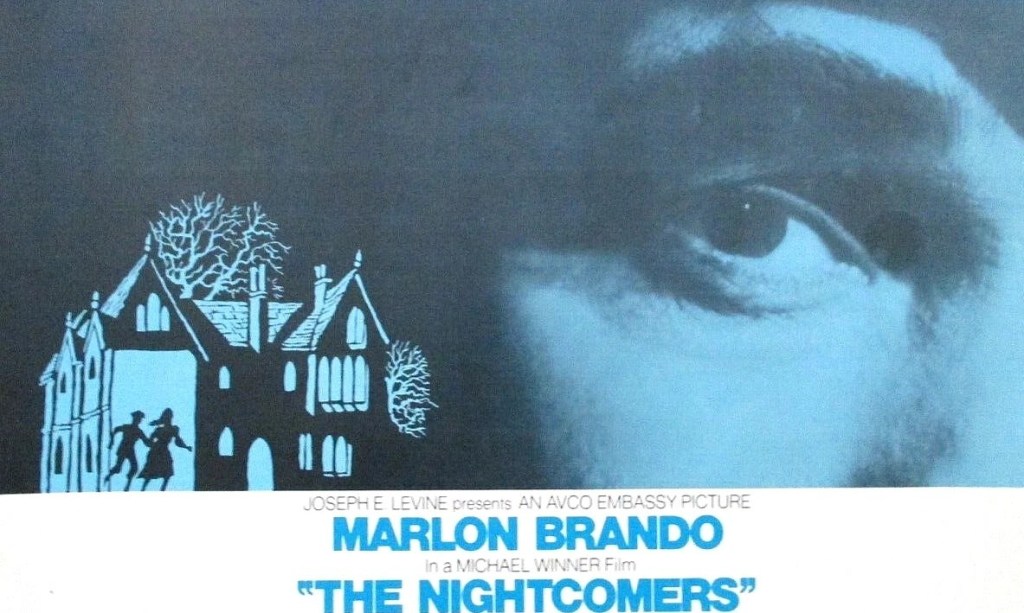
Kastner reckoned Brando “would bring plenty of poetry” to the project. It was remarkably cheap even for a star of Brando’s fading attraction. The budget was $686,000, of which Kastner received $50,000 as a producer’s fee plus 30% of the profits. Winner deferred his fee, only paid if the movie made money. At that point, Kastner was leading the way in finding funding outside the studio system. Funding for When Eight Bells Toll (1970), for example, was entirely sourced from an American businessman. For The Nightcomers, Kastner located investment of $100,000 from a company called Film & General Investments. Universal was involved through its contract with Brando – paying him his $300,000 salary for this picture to count as the final one on his contract, but declined to distribute the picture. For another producer, this might have been enough to kill off the project, but not for Kastner, who, following his current practice, intending to sell the completed film to a distributor.

As far as Kastner was concerned the movie went into immediate profit. Joe Levine of mini major Avco Embassy, still riding high after the success of The Graduate (1967) and The Lion in Winter (1968), ponied up $1 million for the worldwide rights plus a share of the profits. But Avco also limited its exposure, selling a 40% share to businessman Sigmond Summer for $1 million. (Judging from later legal documents, Universal retained some financial interest in the picture).

Brando had decided Quint was Irish. To learn the dialect, Brando and Winner got together with a group of Irishmen in the back room of a pub, one whom became the actor’s dialog coach on location.

The six-week shoot, on locations in Cambridgeshire, Britain, with Sawston Hall doubling as the mansion, began in January 1971. There was another reason for the speed of the shoot. Winner had contracted with United Artists to make Chato’s Land (1972) and there was no time to spare between the movies. Over 100 actresses auditioned for the role of the female orphan. Winner, seeking “someone over 18 who looked 11,” selected Verna Harvey (she also won a role in Chato’s Land).

Although Winner had gone to some expense to set up a private dining room for the star at Sawston Hall, Brando preferred to eat with the crew. According to Winner, despite Brando’s fearsome reputation, he knew all his lines, immensely patient with his young inexperienced co-stars, concerned about the crew, and, as importantly, arrived on time and even watched rushes, a rarity among the profession. Brando used earplugs to prevent distraction from extraneous noise. During the shoot Francis Ford Coppola flew over to spend time discussing the script of The Godfather with Brando.

Brando initially refused to have stills taken of him during the sex scene and only gave in after considerable persuasion, though he kept his wellington boots on. He wanted to leave the drunk soliloquy to the end of shooting. Though he was actually drunk after consuming a lot of Scotch, “he remembered his lines immaculately…(and) also matched his hand movements and body movements, which is very important in movies,” explained Winner, “because if you have to cut different bits of film together if the body or hands or arms are in a different position you’re in trouble.” 

Jerry Fielding didn’t record his score until July during a three-day session with an orchestra of 80 at Cine Tele Sounds Studio. Despite his editing prowess, Winner realized his final version didn’t work. “The first cut was too fast. For a moody period film I’d just messed up. I put back seven minutes (of footage) and spent another three weeks getting it right.”

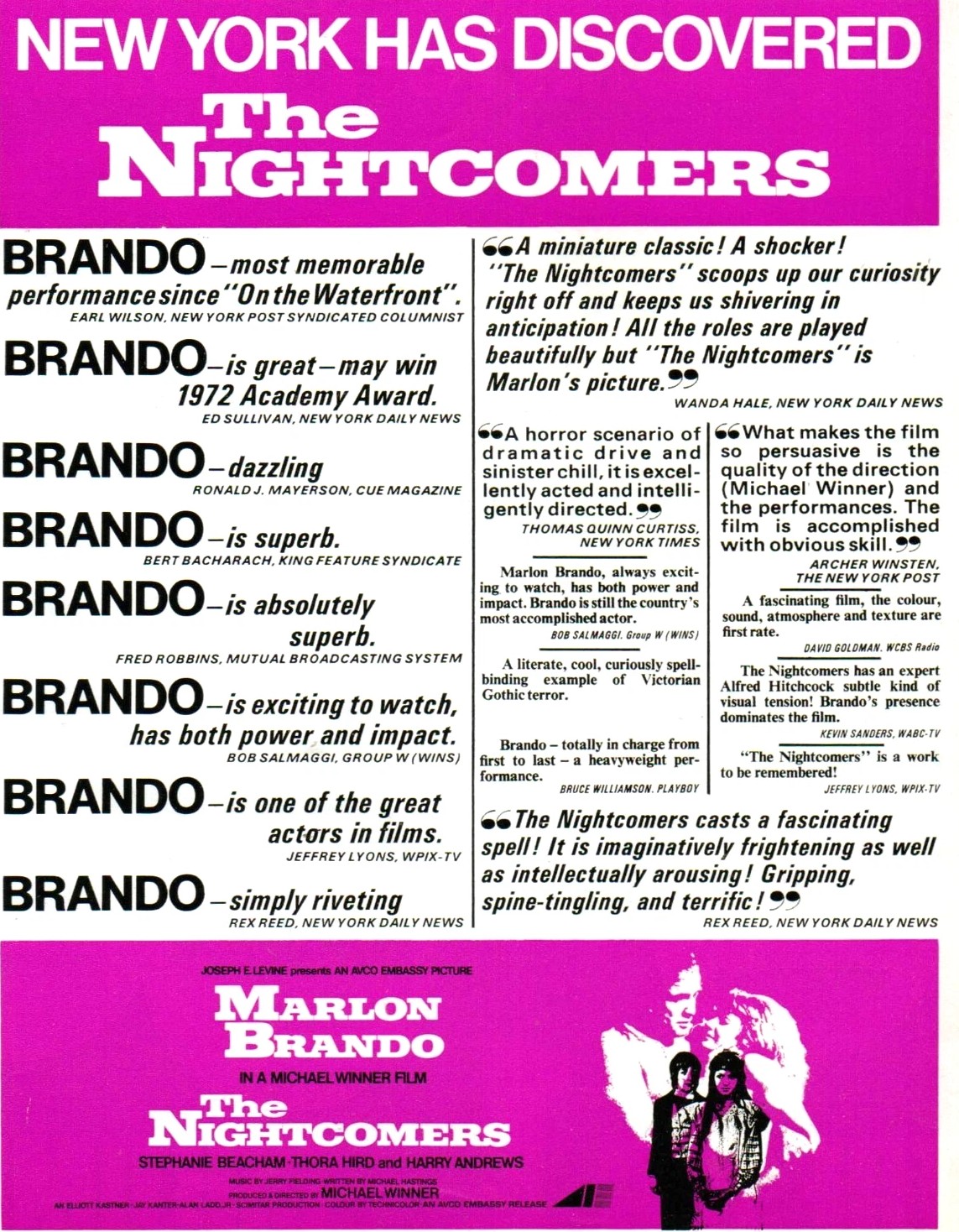
Thanks to its world premiere at the Venice Film Festival alongside the likes of Sunday, Bloody, Sunday (1971), it was touted, perhaps unwisely, as an arthouse picture, rather than majoring on the sex and violence. While Variety tabbed it a “grippingly atmospheric thriller,” only two out of the five most influential New York critics gave it the thumbs-up.

A distribution deal was not struck till the end of 1971. Rather than potentially riding along in the slipstream of The Godfather (1972), which was already attracting huge hype, Avco decided that it was better to come out before the Mafia picture than risk being swamped in its wake. But there was confidence in the project. “Joe Levine thought the film was so brilliant we didn’t have to wait for The Godfather,” related Winner.

It launched first in America, opening in February 1972 – beating The Godfather to the punch by a month – at the 430-seat Baronet arthouse in New York. The opening week of $20,700 was rated “nice” and held well for the second week before plummeting to $11,000 in the third week. It was yanked after six weeks.

By the time it spread out into the rest of the country, The Godfather rollercoaster was well into it stride, but the early release had not particularly gathered any pace and in the aftermath of the Coppola movie it was certainly buried. It opened to $6,500 in Boston compared to The Godfather’s second week of $140,000. There was a “scant” $39,000 from 13 houses in Los Angeles, a “modest” $4,000 in Louisville though $5,000 in San Francisco was rated “brisk” and the same amount in Washington “snappy.

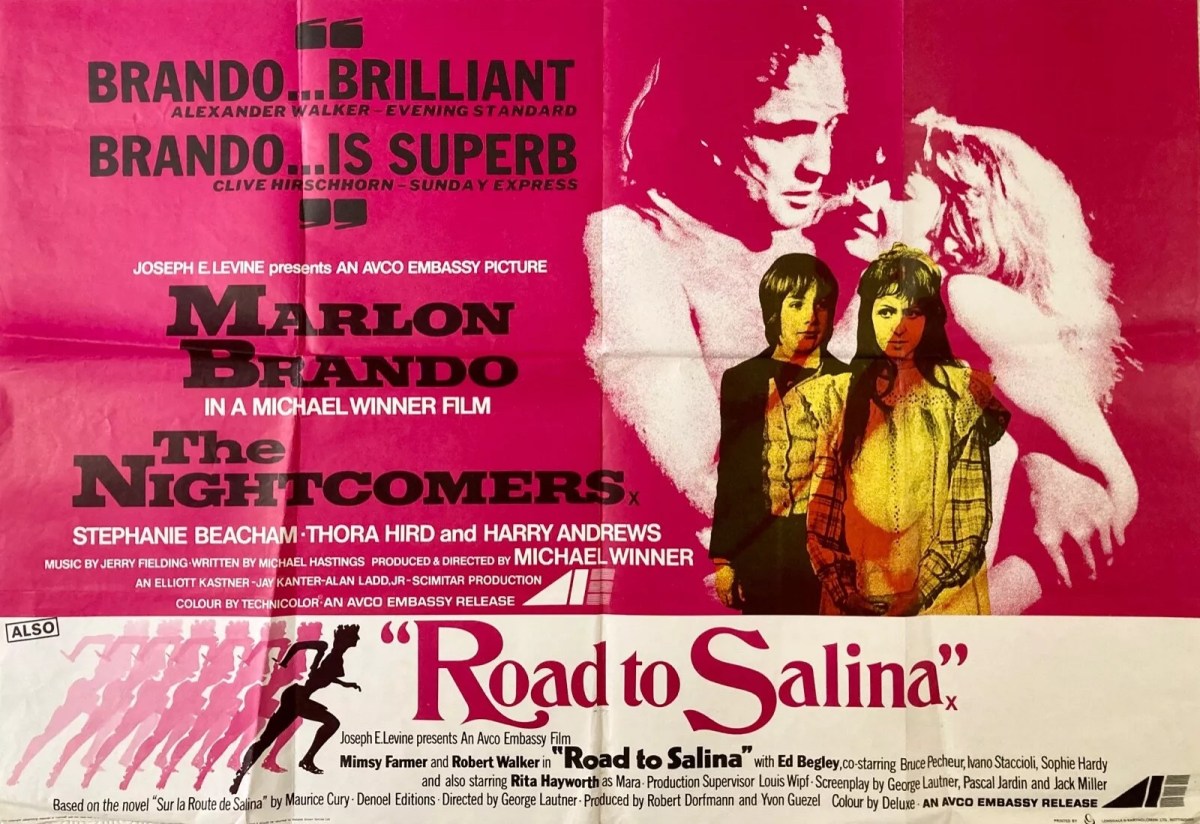
Initially, at least, Britain appeared more propitious. It opened in key West End venue the 1,400-seat Leicester Square Theatre to a “loud” $24,700 and though it dropped $10,100 in the second week, the third and fourth weeks improved on the second. Eight weeks into its West End run, when it was still pulling down $13,300, The Godfather put it to the sword with a record-breaking $191,000 from five West End houses. After that pummelling, The Nightcomers managed only three further weeks.

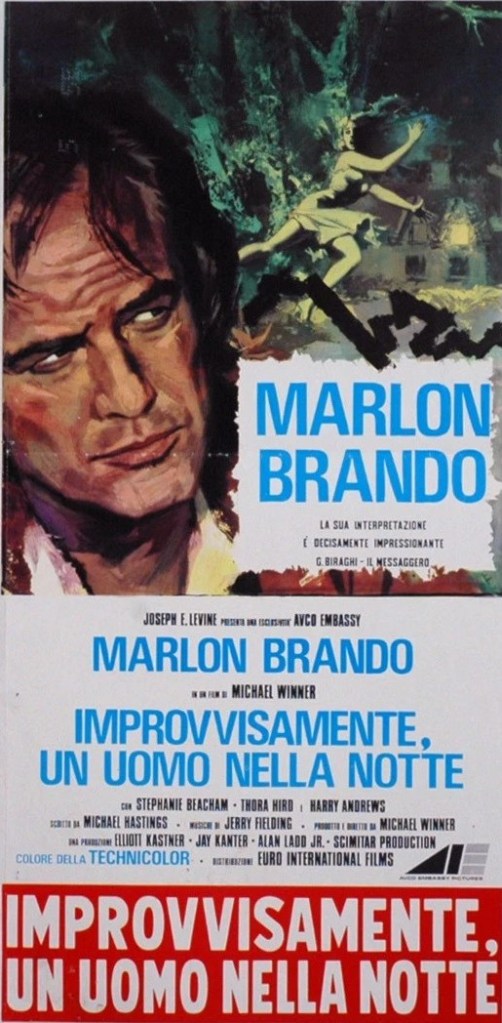
In fact, the movie did surprisingly well, especially overseas. Total rentals came to $1.69 million, a clear million-dollar profit on the negative cost. While less than half a million came from the U.S., and only $160,000 from Britain, the overseas market kicked in the bulk of revenue – $986,000 – possibly because it was released after The Godfather (1972) rather than, as in the UK and the US, before. In the run-up to and in the wake of The Missouri Breaks (1976), it was included in Brando perspectives at the Museum of Fine Arts, where it was presented as a “novel film…lost in the shadow of The Godfather,”  and Carnegie Hall. But an attempt at commercial  reissue proved disastrous – a “weak” $1200 in Pittsburgh.

Except from a financial perspective, Kastner wasn’t especially impressed, calling it “grim, boring, contemptuous of story, oblique.” Viewers, including me, beg to disagree.

SOURCES: Elliott Kastner’s Unpublished Memoirs, courtesy of Dillon Kastner; Elliott Kastner Archive, courtesy of Dillon Kastner; Michael Winner, Winner Takes All, (Robson Books, 2004); “Production Review,” Kine Weekly, January 23, 1971, p10; “Not So Young,” Kine Weekly, May 22, 1971, p16;“Jerry Fielding,” Kine Weekly, July 17, 1971, p10; “Michael Winner,” Kine Weekly, August 13, 1971, p10; “Nightcomers to Avemb,” Variety, January, 19,1972, p5;  “New York Critics,” Variety, February 23, 1972, p35; “Picture Grosses”, Variety, 1972: February 23-April 26, June 7-14; July 19- Sep 27; “Broadway,” Box Office, February 9, 1976, pE2; “Museum of Fine Arts,” Box Office, October 18.

The Nightcomers (1972) ****

Originally dismissed as meretricious trash, contemporary re-evaluation reveals it as uncommonly prophetic. You can start with the feral children, abandoned by their guardian, lack of parenting allowing space for pernicious ideas to foment. Or with the pornography correlative, the young, posited as unruly voyeurs, conditioned by the internet into believing that violent sex is the norm. Or with the influencer seeding notions that demolish the accepted Establishment views. Or impressionable children creating a distorted world view based on their interpretation of adult behavior.

Audiences and critics back in the day were taken in by the most cunning Maguffin of all, that this was some kind of more realistic Downton Abbey/Upstairs, Downstairs power struggle  played out among the servants against the background of a sadistic/masochistic affair. Lives can be ruined on a whim. A letter to the absent landlord can destroy a career. Remember from Downton Abbey the importance in the servant hierarchy of the role of the owner’s valet. To be summarily demoted from that lofty position to gardener, forced to tug your forelock in gratitude at not being cast out, and you can see where power lies.

Instead, consider this a slow-burn, deliberately understated drama where, against the style of the usual horror picture, the score (by Jerry Fielding) offers no clues, a virtually anonymous piece to lull you into thinking this is a pastoral setting where genuine evil, as opposed to acts of mean inconsideration, can flourish.

Watching it entirely from the perspective of the children, ignoring the appeal of the top-billed Marlon Brando engaging in licentious and disturbing sex with the governess Miss Jessel (Stephanie Beacham) he has groomed, and a completely different movie emerges. It reveals more than any other study of children unexpectedly grown violent how vulnerable young minds are to suggestion and that in the absence of adult intervention how easy it is for them to devise a fantasy whose fabric is drawn from their misinterpretation of the real world.

My guess is that back in the day the attempts by teenage Miles (Christopher Ellis) and younger sister Flora (Verna Harvey) to copy the bondage scenes and violent sex witnessed by the voyeuristic boy would have had the audience in stitches rather than reeling in shock. There would have been very little in the audience experience beyond teenage gangs to suggest that young children could be guilty of such depravity – this is long before the murder of Jamie Bulger in England or the mass shootings by teenagers in America. So laughter would be the natural response.

But times are different now. We know that children existing outwith genuine adult supervision are prone to suggestion and acting on impulse. Miles and Flora have been taught by gardener Quint (Marlon Brando) to ignore traditional views of Heaven and Hell, to imagine that torture of small creatures is acceptable, and that love is hate, and that only in death can true lovers be united. Miles has been taught to shoot with a bow-and-arrow by Quint and there’s more than a touch of irony in how quickly the young fellow masters this skill that leads to a grisly climax.

While the adults largely ignore the children, the children are not ignoring the adults. They are in thrall to what they see and hear and make up their own minds about how to put the world to rights. Had the children been adults driven by loneliness and abandonment to such acts, they would viewed simply as evil monsters. But here they are demonstrably not evil, just misguided, and by the very people who should be guiding them. Quint takes inherent joy in corrupting the young, it’s the simplest type of revenge he can enact against his master, filling the heads of the next generation of overseers with information that runs counter to the accepted.

The British censor left largely untouched the rape scenes in The Straw Dogs and A Clockwork Orange out the same year. He was much tougher on this, excising the bondage sequences, as if such prurience would diminish the impact. Certainly, that did the trick at the box office for audiences, denied shock content, ignored it.

If all this isn’t enough to trigger reconsideration of the picture, then the grooming of the governess (Stephanie Beacham), her submission to male control, will strike a contemporary chord. Despite the respectability of her position, she is revealed as eminently vulnerable, born out of wedlock, witnessing how tough life was at home without a protective male figure, not just prone to accepting Quint’s brutality but conditioned herself to wait in a more romantic setting for the gentler lover of her imagination who never arrives. While the housekeeper (Thora Hird) comes over as any powerless functionary exerting what little power she has.

Marlon Brando (The Chase, 1966) is especially good and the scene where he blackens his teeth to amuse the children might have been a dress rehearsal for the sequence in The Godfather where, unintentionally, he frightens the child. Except for Dracula A.D. 1972 (1972) in Italian crime tale Mafia Junction (1973), rising star Stephanie Beacham’s star failed to significantly rise, and she never again enjoyed such an important, and difficult, screen role, especially in those scenes where she attempts to exert control.

Written by Michael Hastings (The Adventurers, 1970).  

It might be a contradiction in terms to suggest that much-maligned British director Michael Winner (Hannibal Brooks, 1969) ever came close to producing what you might term a masterpiece, but within his own portfolio this is surely the chief contender.  

You can catch in on Talking Pictures for free.

Well worth a look.

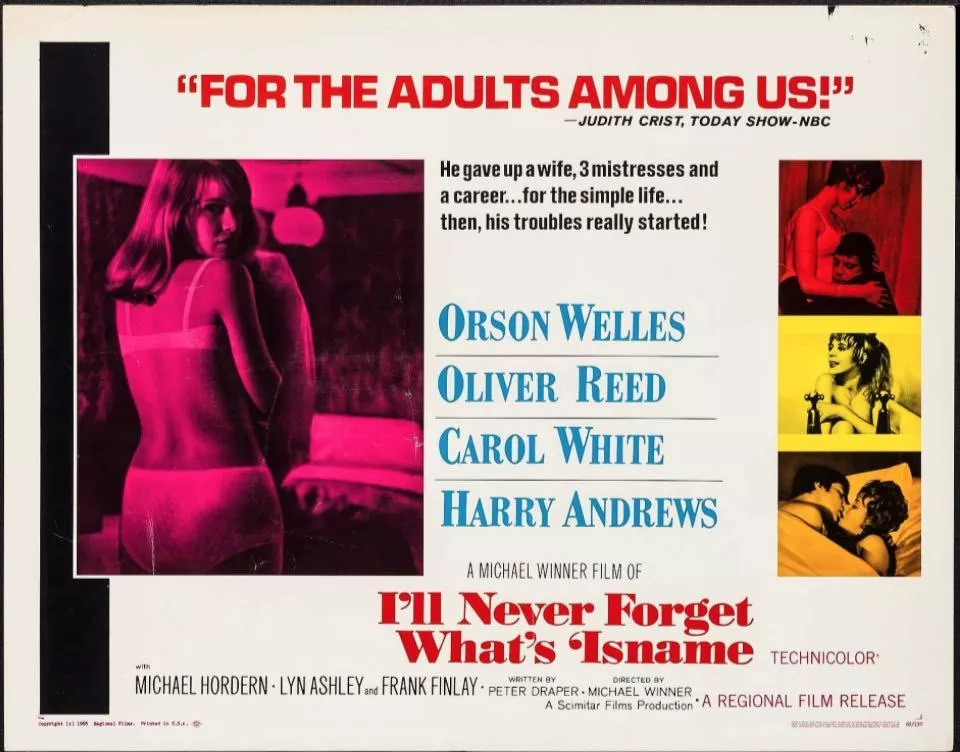
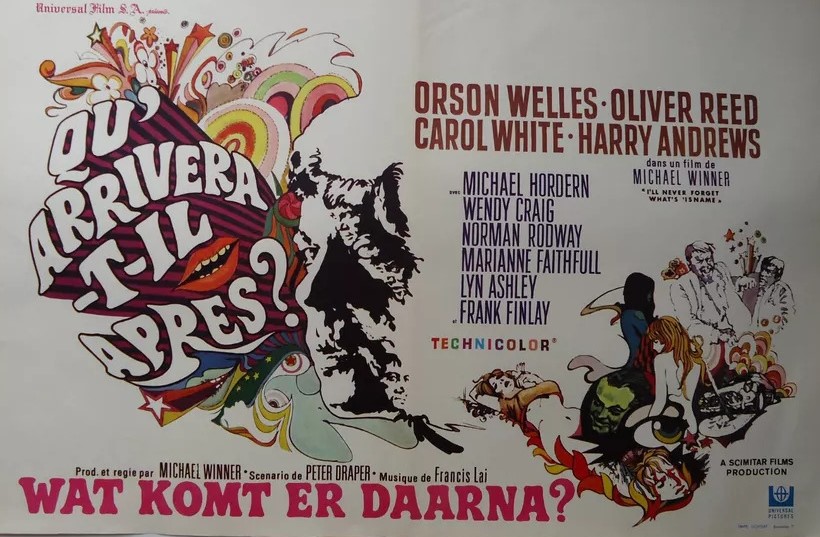
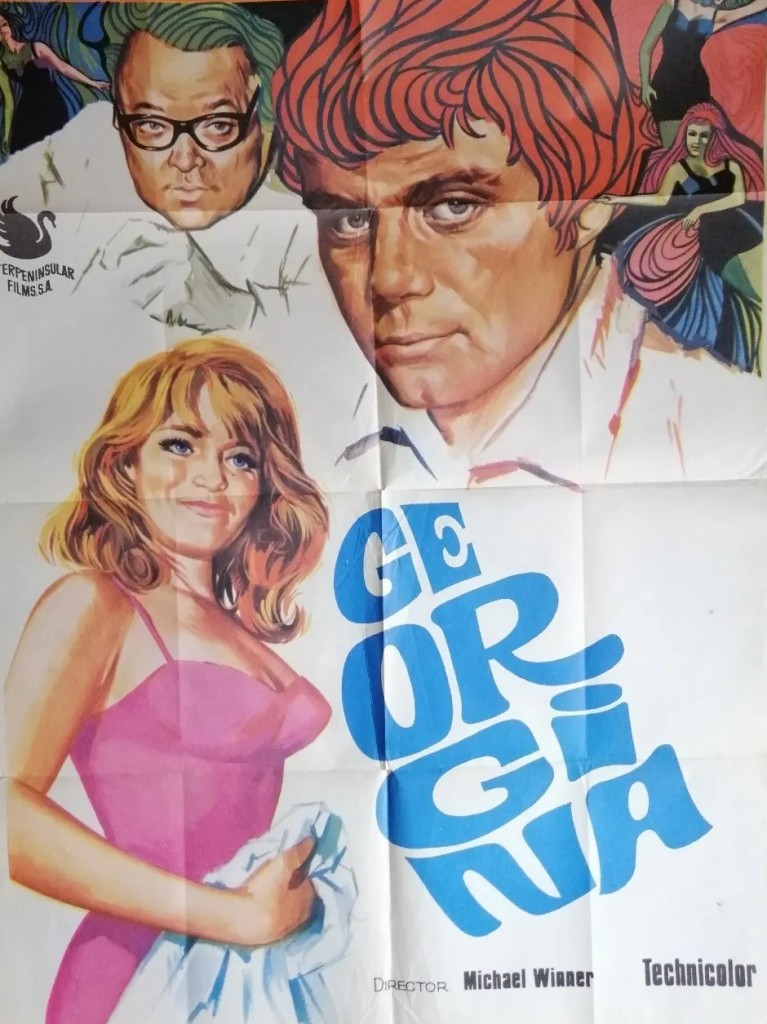
I’ll Never Forget Whatsisname (1967) ****

Director Michael Winner’s proudest moment – from a critical perspective. Rave reviews all round and hailed as a rising star of British cinema. Such adulation didn’t last long, of course, Hannibal Brooks (1968) and The Games (1970) elicited little critical reposnse and whatever kudos he achieved from a couple of westerns was soon blown away once he went down the Death Wish (1974) brutal revenge route. So this fits into the anomaly department in his canon and, although pretentious in spots, it does show a fine intelligence at work and a singular prophetic quality that should have contemporary reverberation.

For a start, he highlights the creativity of the advertising world that became the training ground for such British directorial talents as Ridley Scott (Alien, 1979), his brother Tony (Top Gun, 1986), Alan Parker (Midnight Express, 1978) and Adrian Lyne (Fatal Attraction, 1987) as well as producers in the vein of David Puttnam (Chariots of Fire, 1981). Perhaps more interesting are the ecological aspects, predicting the importance of waste both as an issue and a financial opportunity.

And although If… (1969) was viewed as the pre-eminent depiction of public school immorality, this provided a much shorter introduction to the prevalence of public school attitudes in society. You might also suggest, should you be so bold, that Winner envisioned the boom in reality televison, when the camera is not used to create illusion but to pick at the scabs of society. And we might also fast forward to Jaws (1975) whose meanest character shares the same surname as our hero here, whose personality defects are what drives the picture.

Within all this there’s a fair chunk of satire. And it’s rare for this director to so obviously poke fun at his heroes.

The narrative follows disillusioned advertising ace Quint (Oliver Reed) as he tries to extricate himself from various romantic entanglements in order to concentrate on first playing a more meaningful role via literary creativity and then, when that option is pulled out from under him, exposing the hypocrisy from which he has made his fortune.

The movie opens with a stunning image. Quint wielding an axe. Despite this being in the  middle of London, he scarcely receives a second glance – as if this might be construed as typical English eccentricity – as he marches towards his posh headquarters, proceeds to smash his office and hand in his notice to boss Lute (Orson Welles). He finds work in a literary magazine with old school chum Nicholas (Norman Rodway) where, unfortunately given he already has a wife and several mistresses, he falls for virgin secretary Georgina (Carol White).

But despite his success he is tormented by his schooldays, which instead of toughening him up made him more vulnerable to abuse from a teacher and to bullying from fellow pupils led by entitled thug Maccabee (Harvey Hall). The nightmarish glimpses of school are sharply brought into focus when he encounters Maccabee again and witnesses the savage hounding of another innocent man.

Meanwhile, Lute keeps popping up, either to try and seduce Quint back to his job or to sabotage his existing one. When a fight breaks out at one of Lute’s parties he wants it stopped before another of his precious artworks is broken rather than before a participant ends up in hospital. Lute takes English eccentricity to the extreme, enjoying a massage while playing Scalextrix, the epitome of avuncular decency except that he’s twisting the rules.

Even with his diabolical childhood, it’s hard to sympathize with Quint. He’s little more than a charming lout, but I suspect his is a more universal condition, those who have so much easy wealth inclined to poke at the foundations of success, and seek a more worthwhile profession. The ending is contrived, but, then, the fun has to stop somewhere.

That said, Oliver Reed (The Assassination Bureau, 1969) presents a more rounded character than in many of his later films. From the confidence of his delivery you get the impression that Orson Welles (House of Cards, 1968)  – top-billed ahead of Reed – improvised many of his lines. He’s certainly having some fun with his role, but then that is the seductive part of his character. Carol White (Daddy’s Gone A-Hunting, 1969) is the big surprise, bringing a genuine freshness to her role, before she conformed to the Hollywood dictat. And you won’t forget the malicious Harvey Hall (The Games, 1970).

The quite amazing cast includes Edward Fox (Day of the Jackal, 1973),  Michael Hordern (Where Eagles Dare, 1968) as a demented headmaster, Marianne Faithfull  (The Girl on a Motorcycle, 1968), Harry Andrews (The Long Duel, 1967) as a writer with a creepy hobby, Wendy Craig (TV series Not in Front of the Children, 1967-1973), Ann Lynn (Baby Love, 1969) and Frank Finlay (The Shoes of the Fisherman, 1968).

It’s entirely possible that it was pure coincidence that Winner covered so many topics relevant to today but I’m giving him the beenfit of the doubt. Written by Peter Draper (The System / The Girl-Getters, 1964).

Great – and meaningful – fun.

Behind the Scenes: The Box Office Bump Part Two – Foreign Saves the Day

In previous decades, box office outside of the U.S., while a growing part of the ancillary equation, only in very rare circumstances outscored domestic. The general expectation, in part due to tougher competition for screens and extra distribution costs, was on average studios could expect to earn about half of domestic revenues.

There was one obvious exemption to this rule. James Bond overseas blew all the competition out of the water. And so it proved in the early 1970s from an examination of United Artists books for the period. Live and Let Die (1973) was the standout performer, knocking up $27 million in rentals (the studio share of the overall box office gross) from foreign cinemas compared to $16.4 million at home. Diamonds Are Forever (1971) did equally well – $22 million abroad, $20 million domestic.

James Bond was such a cash cow that surprised no one. Last Tango in Paris (1973) was considered an anomaly, controversy stoked by UA four-walling the picture when it couldn’t find enough screens. It came in third in the foreign market league, adding $16 million to domestic $21 million.

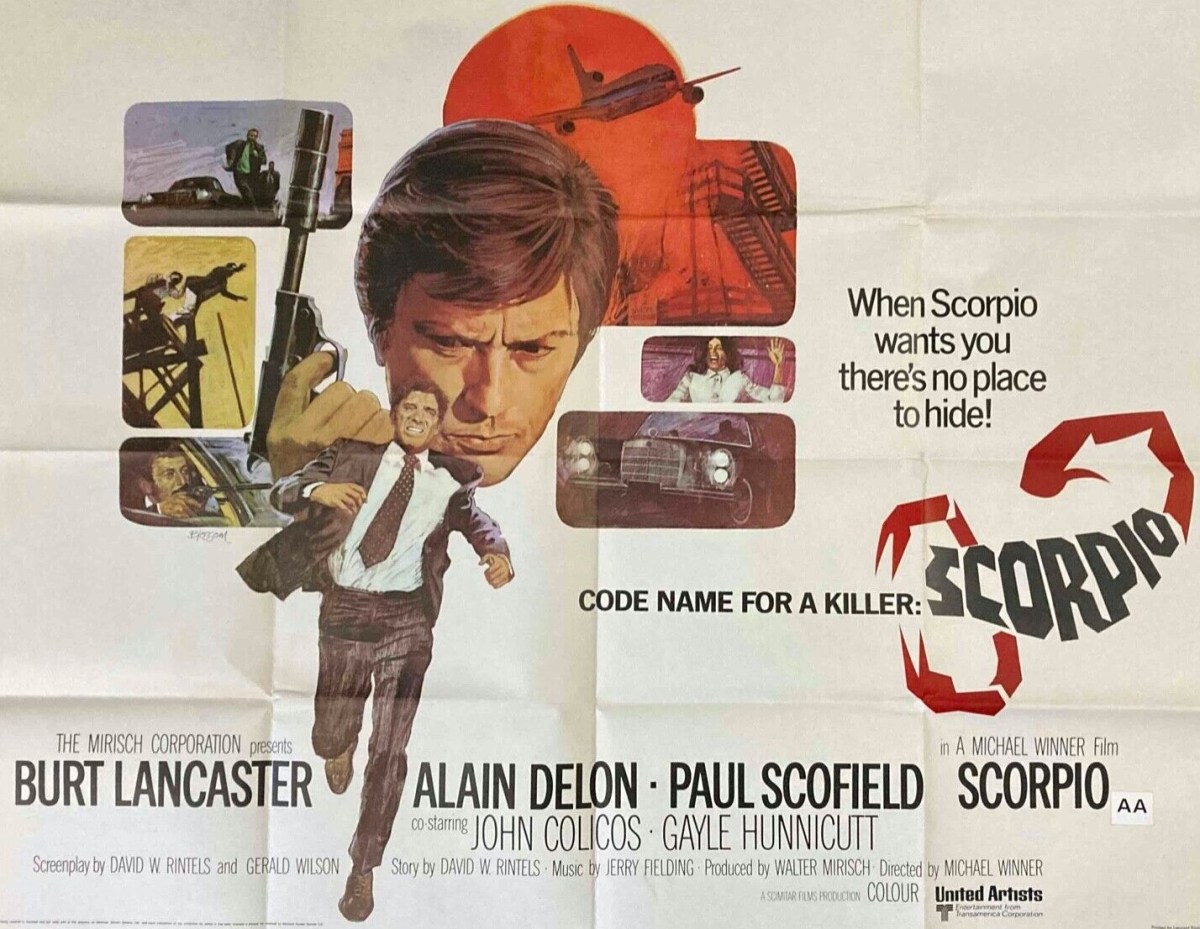
What did take Hollywood’s breath away was how often under-performers – flops even – at the U.S. ticket wickets did gangbusters elsewhere. The biggest winner was the aptly-named Michael Winner, director of westerns Lawman (1971) and Chato’s Land (1972), hitman thriller The Mechanic (1972) and spy drama Scorpio (1973). Total American rentals a shade over $7 million, total foreign rentals three times as much a colossal $21.8 million.

There was hardly a greater example of the disparity between American audience tastes and the rest of the world. And it made Hollywood studios more adventurous when it came to choosing subject matter, and in backing stars, aware that they could make their investment back – and more – from foreign markets.

It was probably astonishing to any studio executive that Burt Lancaster – for over two decades a high-flying marquee name from action-oriented fare like The Crimson Pirate (1952) and controversial drama From Here to Eternity (1953) to his Oscar-winning turn as Elmer Gantry (1960) and hardnosed western The Professionals (1966) – had lost his domestic audience especially after he had fronted up disaster movie smash Airport (1970).

But Lancaster could only scrape up $1.35 million at home for Scorpio, $2.1 million for Lawman and $2.8 million for another western Valdez Is Coming. Scorpio was the biggest hit abroad, with a massive $7 million, over five times domestic, while Lawman shot up $3.2 million (50 per cent above domestic) and Valdez Is Coming $2.65 million.

Charles Bronson was another beneficiary of foreign largesse. The Mechanic, too, targeted $7 million abroad, nearly three times the domestic tally of $2.6 million. Chato’s Land (1972) only delivered $1.27 million in the U.S. but $4.6 million abroad.

Westerns were a mixed bag. Oliver Reed-Candice Bergen-Gene Hackman number The Hunting Party (1971) was an almighty flop at home, just $800,000 in the kitty, but rallied somewhat abroad, not enough to turn profit but at least add a sheen of respectability, with $2.4 million elsewhere, three times domestic. The Magnificent Seven Ride! (1972), proof the sequels had outstayed their welcome, brought in just $750,000 domestically but again did triple the business abroad with $2.15 million and given the paltry budget enough to sit in the black.

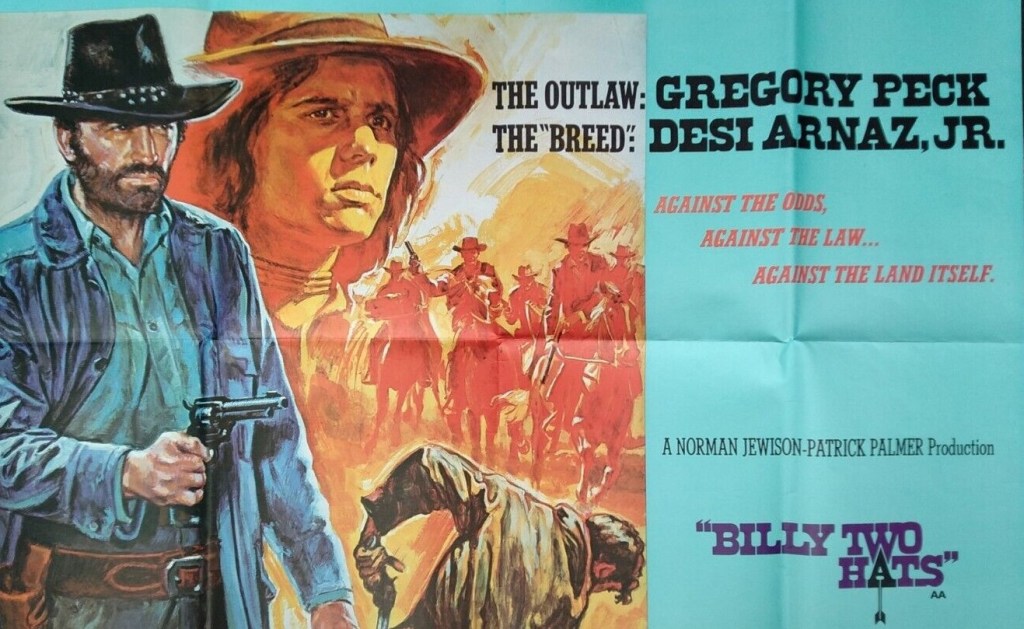
Revisionist effort Billy Two Hats (1974) starring Gregory Peck added $900,000 abroad to a miserable $440,000 at home – foreign revenues not enough to save it from flop. But foreign couldn’t save the second remake of the Gunfight at the OK Corral legend, Doc (1971) with Stacy Keach and Faye Dunaway which moseyed along to $1.35 million abroad to add to $1.8 million domestic. And another western sequel Support Your Local Gunfighter (1971) notched up just $970,000 abroad compared to $2.1 million. Modern western The Honkers (1972) with James Coburn managed just $550,000 abroad and $1 million at home.

It didn’t really matter that Michael Caine comedy thriller Pulp (1972) did better abroad, figures everywhere nothing to write home about, $600,000 in total, five-sixths of that abroad. Fiddler on the Roof (1970), for other reasons, underwhelmed but nobody was going to complain too much when foreign audiences stuck $10 million in till, about a quarter of domestic.

There were some conundrums in the foreign-domestic share-out. Typically, American comedies didn’t travel. But Billy Wilder’s Avanti! (1972) starring Jack Lemmon, perhaps because of the Italian setting, did better abroad – $2.5 million to $1.6 million. Glenda Jackson British-made menage a trois Sunday, Bloody Sunday (1970) not surprisingly did better abroad, but only just, $1.8 million to $1.77 million.

Sidney Poitier in second sequel The Organization (1971) tapped into $2.9 million abroad and $2.45 million at home but generally too-specifically-American features struggled overseas, The Hospital (1971) snaring only $1.9 million compared to $9 million, White Lightning (1973) snagging $1.8 million compared to $6.9 million, Fuzz (1972) holstering $1.7 million against $3.1 million.

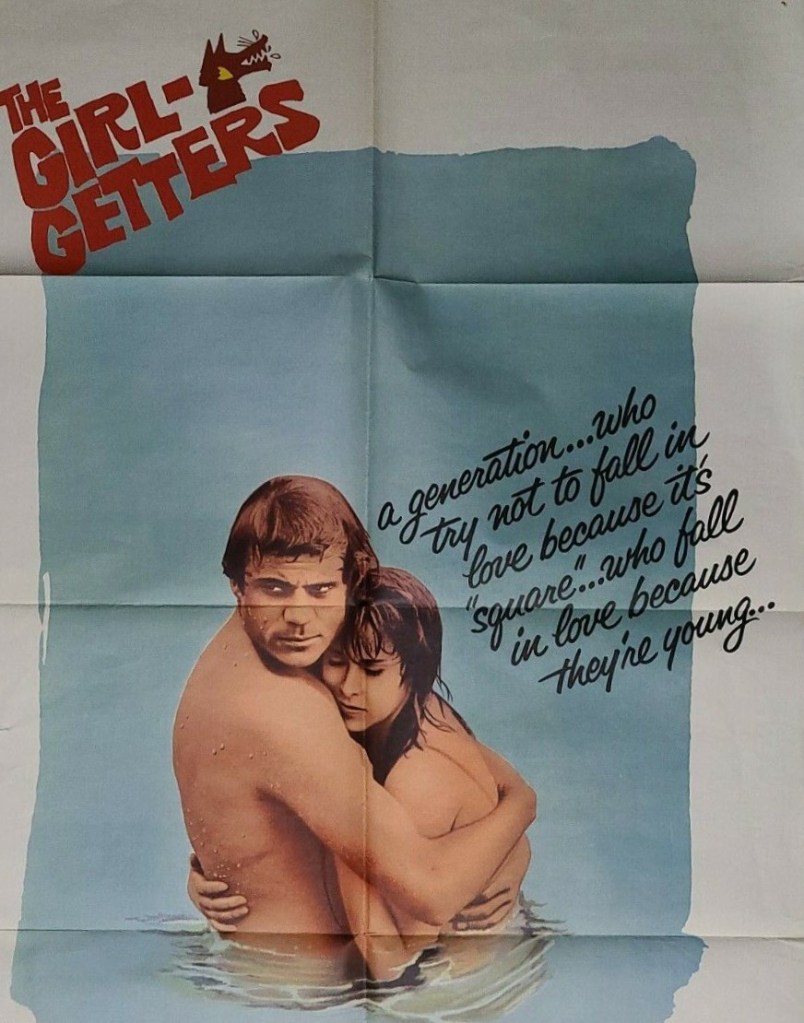
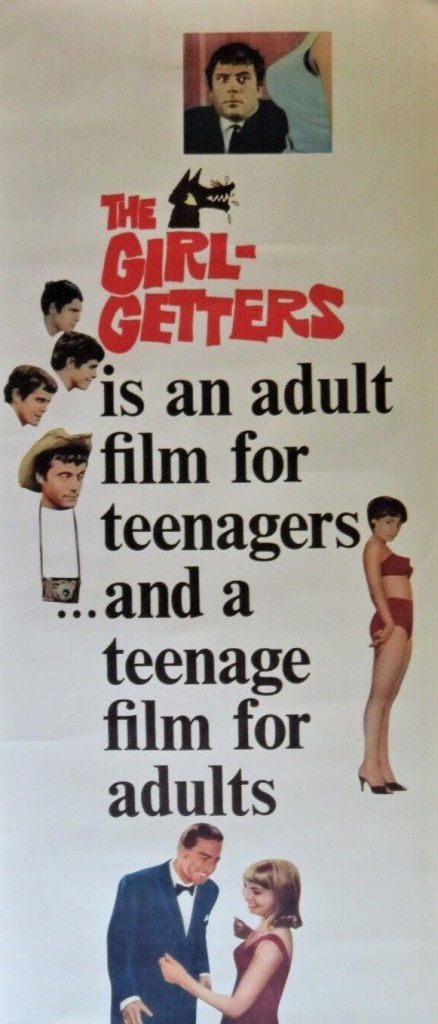
The System / The Girl-Getters (1964) ***

Surprisingly subtle performance from Oliver Reed (Hannibal Brooks, 1968), eschewing the trademark quick inhalation of breath and steely glare, as leader of a gang seducing impressionable young girls during the summer season in an English seaside town.  Surprisingly artistic touches – swipes, montage, a meet-cute involved blowing bubbles – from the more usually heavy-handed director Michael Winner (Hannibal Brooks). Surprising amount of rising talent including cinematographer Nicolas Roeg (Don’t Look Now, 1971).

And unlike the previous The Damned / Those Are the Damned (1963), the impromptu gang headed by Tinker (Oliver Reed) is not hell-bent on violence and destruction, and the various seducers, thankfully, could hardly be described as sexual predators. Young girls away on their own for the first time, disappointed not to find the love of their lives,  are still happy to settle for a holiday affair.

The American title is more appropriate and only an overbearing parent would dream of marketing it – effectively from the male perspective – as girls entering perilous territory rather than with the lightness of tourist romance a la The Pleasure Seekers out the same year. The “system,” a misnomer if ever there was one, involves the guys finding various ways of getting tourists’ addresses – Tinker as a beach photographer has the advantage here – in order to seduce them.

Sometimes the plan goes wrong and a girl gets pregnant leaving Nidge (John Alderton) not only abandoning the frolics but doing the decent thing by proposing. Oddly, there’s no sense of the guys competing with each other for the biggest tally of notches on a bed-post; in fact they’re a democratic bunch, dividing up the potential prospects equally.  Equally oddly, I guess, none of the women come across as virgins, no first-timer angst.

Tinker, who spends most of his time avoiding telling compliant girls what they are desperate to hear, i.e that he is in love with them and that the holiday affair might turn into something more permanent, falls for posh model Nicola (Jane Merrow).

There is some, for the time, risqué material, a view in very long shot of a nude woman, a girl in bra and panties (getting dressed after sex, so perhaps where Roeg got the idea from for the famed montage in Don’t Look Now), a brutal fight between rival photographers, camera smashing on the stairs. But there’s also Tinker’s humiliation by the jet set as he tries to fit in, thumped at tennis, and dumped by the married lover he ignores during the season. There’s surprising inventiveness, a demonic parade where effigies of bride and groom are burned on a pyre, a soulful scene of a bubble salesman blowing bubbles on a deserted beach at night.

The twist is of course that some girls come to the seaside town to find boys from whom they want no commitment, instead just the enjoyment of a casual fling. Should a man like Tinker happy to fall in love, more fool he.

Naturally, with a film aimed at the young crowd, there are snatches of pop performers – the Rockin’ Berries the most prominent – and a rock arrangement of Khachaturyan’s Sabre Dance that would four years later become, for someone else, a hit single.

Oliver Reed proves very engaging, especially when in playful mode, benefitting from lengthy screen time rather than being forced into a supporting actor’s scene-stealing. Jane Merrow (The Lion in Winter, 1968), excellent as the self-aware boy-getter, heads a raft of rising talent that includes David Hemmings (Blow-Up, 1966), almost unrecognisable with a side parting rather than the trademark mop of hair, and really a bystander here. John Alderton (Hannibal Brooks) is also permitted more artistic leeway, and takes it, rather than the comedic gurning of later years.

Look out for Julia Foster (Half a Sixpence, 1967), Barbara Ferris (Interlude, 1968), and Ann Lynn (Baby Love, 1969). Even Harry Andrews (The Hill, 1965) tones down his usual screen persona.

Considerably more thoughtful and visually interesting – and occasionally playful, for goodness sake – than anything else Winner produced during the decade. A good script by Peter Draper on his screen debut makes its points without either being too clever or too forceful.   

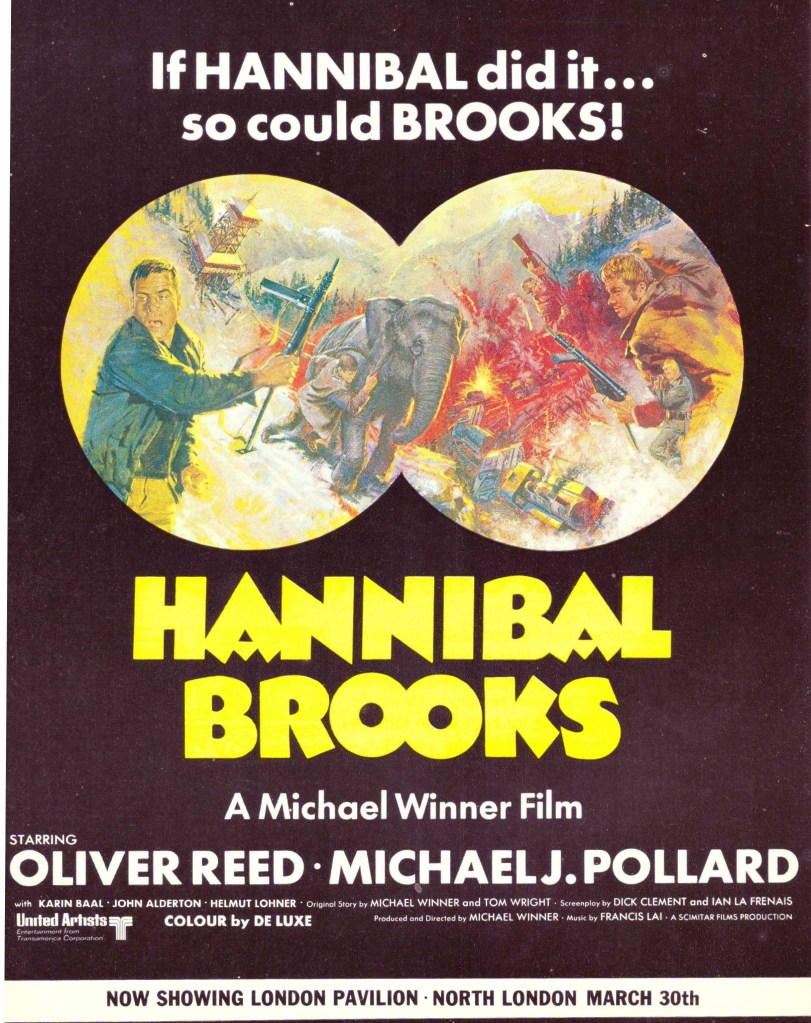
Hannibal Brooks (1969) ***

Gruff British star Oliver Reed shows his tender side in this entertaining offbeat POW escape picture. With local German men called up for war, Berlin Zoo relies on local prisoners-of-war to help look after the animals. Stephen Brooks (Oliver Reed) is detailed to look after an elephant (considerably more discreet in his toilette than those employed on Babylon). When Berlin is bombed, Brooks takes the elephant to Innsbruck in Austria.

His nickname is a bit of a misnomer. You would think he was going to emulate his famous predecessor and take the elephant over the Alps and into Italy, which would be possibly a safe destination because at this stage of the war the Americans have invaded and are marching north. But, instead, sadly, he only plans to make it as far as neutral Switzerland, where he would be equally safe.

Naturally he is pursued – and captured, and pursued and captured. But there always seems to be a convenient pile of logs that, a la Swiss Family Robinson, can be weaponised. And should you need any obstacle pulled down, well, an elephant comes in pretty handy on that score too.

Ineffectual American escapee Packy (Michael J. Pollard) turns up from time to time, usually in some piece of action that goes wrong, once to interrupt a romantic dalliance with Brooks’ occasional companion Anna (Maria Brockefhoff). And this being the Tyrol, it seems a shame not to halt proceedings every once in a while to take in a marching band or a traditional wedding or fair and for every damsel to have her cleavage on display.

Heading up the pursuit is Colonel von Haller (Wolfgang Preiss) although you might imagine he had more important things on his mind at this stage of the war than chase an elephant. Various troopers are so easily duped by Brooks they might have gone under the collective expression of “dolts.”

Where the elephant has to take the long way – he could as easily have been called “Slowly” – the Germans can travel by road, rail and cable car. It’s pretty episodic stuff, enlivened here and there by explosions and gunfights and the like and the question of whose side Anna is really on.

In some respects it’s a buddy picture. When the buddy is the elephant it works pretty well. Brooks is surprisingly tender and caring. But when Packy enters the equation and it’s the old question of three into two won’t go it becomes a bit lopsided. You get the impression it’s one of these picture that, to accommodate the budget, required an American star and Michael J. Pollard, with his already-established schtick, was nearest to hand.

It’s just as well Reed has toned down his scene-stealing growls and sideways glances because nobody can steal a scene like Pollard. If the elephant was ever in the slightest genuine danger, then you might have had a better picture, but nobody in those days was going to slaughter such a magnificent beast just to give a movie a harder edge.

Elephant is surplus to requirements in this action-based poster.

So the harder edge never comes, and it skips along uneasily between gentle comedy and action, with a potential screen partnership of unlikely personalities never quite gelling. If director Michael Winner had stuck with Reed and the elephant it would probably have worked much better. Or if the escapees had to blow up some vital factory or carry out another mission deep inside enemy territory it might have carried more narrative thrust.

It’s like two separate pictures, Reed and the elephant and Pollard and his bunch of generally hapless escapees. Harmless enough stuff and interesting mostly for seeing Oliver Reed upending his usual screen persona.

At this point in his career, Michael Winner (You Must Be Joking, 1965) was better known for comedy so perhaps this was his passport to suggesting to Hollywood he could handle action. Certainly, it suggested he could merit a bigger budget, for his next movie was The Games (1970) before stepping into the more comfortable territory of Lawman (1971).

I’d suggest this was equally a stepping stone for Reed (The Assassination Bureau, 1969). This film is largely ignored in assessments of the changes to his acting style that he made to accommodate the critically-acclaimed Women in Love (1969). And you can certainly draw a development line between the Michael J. Pollard of Bonnie and Clyde (1967) and his character in Little Fauss and Big Halsy (1970) where he successfully buddied up with Robert Redford. Dick Clement (The Jokers, 1967) devised the screenplay from a story by the director and Tom Wright, on whose own story of being a POW zookeeper this is based.

Most movies perceived as stepping stones are made of stronger material, and although this is more lightweight, it’s entertaining enough and certainly helped director and both stars switch career tracks.

Behind the Scenes with a Behind the Scenes Operator: Reel Life

From attending to director Michael Winner’s parking meter and falling foul of the British film censor to interviewing David Lean at the National Film Theatre in London, Tony Sloman’s autobiography casts a fascinating light on the British film industry.  A marvellous string of anecdotes relating to Othello (1965), One Million Years B.C. (1966), Chitty, Chitty, Bang, Bang (1968), Wonderwall (1968), De Sade (1969) and cult television series The Prisoner (1968) are augmented by insights into the less well-known aspects of how movies are made. 

Most commonly associated with the sound and editing departments, he also directed two British sex films Sweet and Sexy (1971) and Not Tonight, Darling (1971). In addition, he is also a walking encyclopaedia on film – he later lectured on the subject – and a riveting part of the book involves how he fell in love with the movies. I’ve read countless biographies of actors and directors who made it big in pictures and rarely, if ever, do their stories focus on their love of the medium, of the films they saw when growing up and the experiences that entailed. So the first part of this book plays off to the soundtrack of inveterate filmgoing in the 1950s at his local cinema in London and then up to the West End, one expedition to view a revival of Gone with the Wind ending up instead with the saucier Femmes de Paris (1953).

Getting into the business was very difficult for a tailor’s son from Streatham and, having determined to become a film editor, even attending evening film classes failed to open any doors until he responded to a newspaper advert and became a dispatch boy and soon after an editor for a small suite of cutting rooms in Soho in the same building as Private Eye magazine, thus beginning a long apprenticeship in this particular discipline, working in all the  British studios from biggies like Shepperton, Elstree and Pinewood to smaller outfits such as Merton Park.

Except for this book I would be unaware of the how menial are some of the tasks essential for a film to be made. One of his earliest jobs was to attend the screening of rushes and “tick the selected takes in the rushes notebook…and then after numbering them break them out in script order for the editor to assemble the next day in the cutting copy.” He learned not to count frames or measure length when dictating a particular cut but to put himself in the position of the character and the audience, how much of what they see needs to be shown to register.  

One of the refreshing elements of this biography is that the author is happy to own up to professional and personal mistakes. As he didn’t drive he was unable to synchronise car engine sounds in the correct manner. He got into trouble for labelling cans containing film in pen and not stencil. As a result of personal mishap, he learned the hard way never to film anything without a continuity person present.

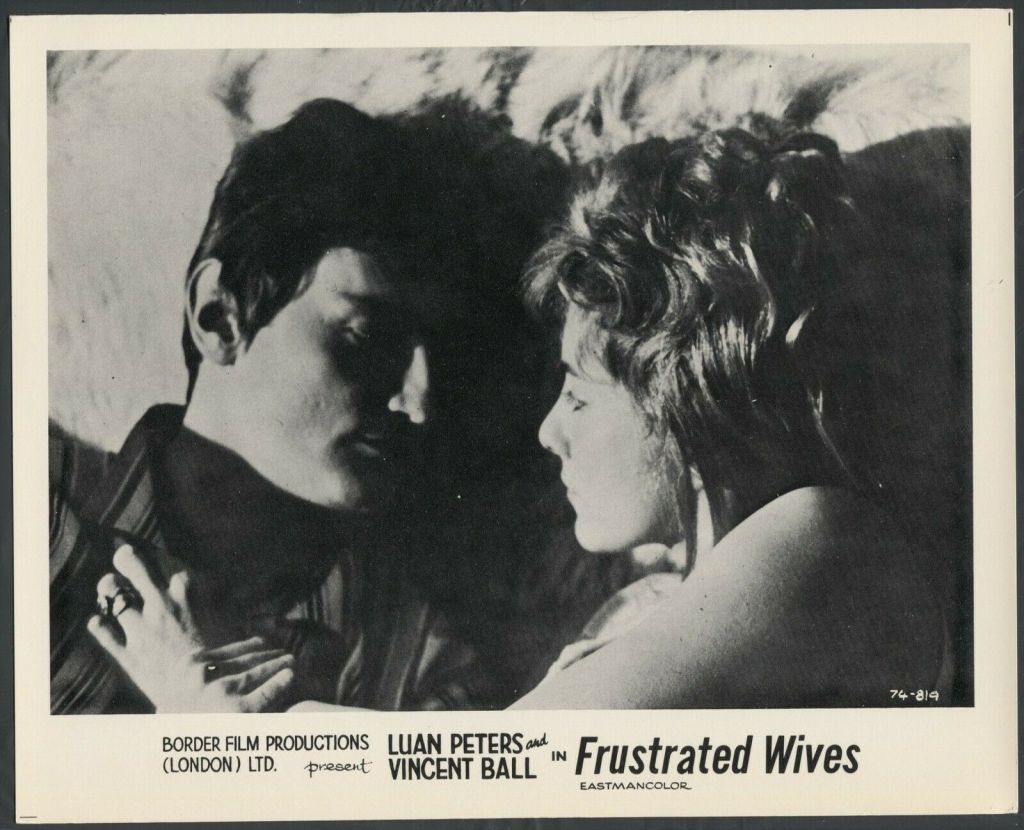
His second directorial effort “Not Tonight Darling” was renamed “Frustrated Wives.”

And he has a fan’s delight at meeting stars in the flesh, walking down the street with a David Niven determined to be swamped by fans, recounting that Maximilian Schell is shorter than expected, James Mason taller. He reveals that Dana Andrews’ favorite of his own films is not a Hollywood classic like Laura (1944) or The Best Years of Our Lives (1946) but the lesser known Three Hours to Kill (1954) because when the producer ran out of cash he paid the actor in Mexican artefacts that came to be worth a quarter of a million dollars. Former silent film star Bessie Love tried to convert him to Christian Science when the author would have rather she reminisced about her days in early Hollywood. Eating in a restaurant in Cannes he watched at another table Federico Fellini and Luchino Visconti share a bowl of bouillabaisse and later bumped (literally) into Graham Greene and encountered in the hills working as barman a former camera operator for Jean Renoir.

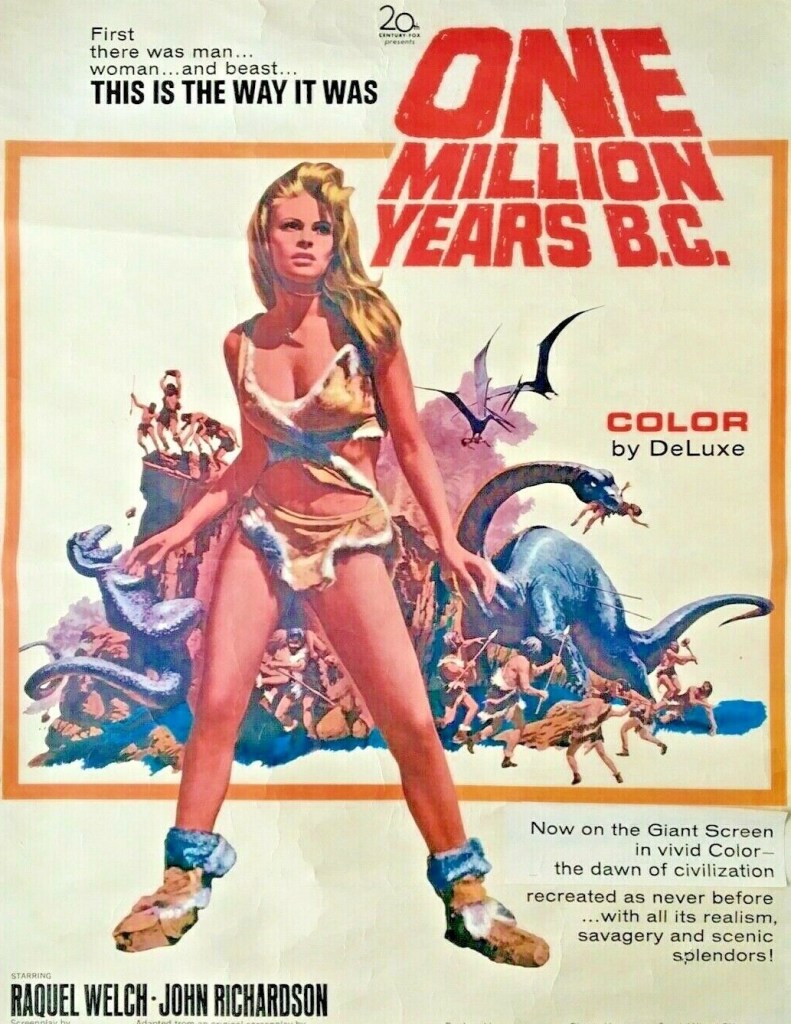
He met the entire Dirty Dozen at lunch in the studio canteen, heard Maggie Smith swear and enjoyed an up-close-and-personal encounter with Raquel Welch over the moviola “pressing closer to me in that tiniest of bikinis.” Working with  Ray Harryhausen on One Million Years B.C. (1966) “my main function with him was to be his own personal soundstage at Elstree with the moviola…to see where his newly-shot material would go into the sequence as cut…Ray needed to see them over and over and do frame counts before shooting his effects.” On the same film he was responsible for writing “dialogue” – in other words” a series of grunts and sounds that would match up with the actor’s mouth movement.”

There are other fascinating nuggets. He played an unsung part in the success of The Prisoner, coming up with the ideal piece for the beginning of the Arrival episode – the “Radetzky March.” He had an unusual job title, too, “Film Librarian,” which consisted of getting all the back projections which had already been filmed ready for the actual set. Supplying library material as and when, shooting inserts, and matching new film to location work.  “The secret of finding music for mute material was not merely finding music that was appropriate but to find music that would positively enhance the image to which it would be matched.”

There are other fascinating nuggets. Donald Sutherland was revoiced in his role in Oedipus the King (1968) but after the success of Mash (1970) his original voice was put back in. The first screening of Wonderwall (1968) was for the Beatles because George Harrison had expressed an interest in writing the score. In the course of this when his Indian-style slippers were ruined  by rain someone on the set whipped up for him a “customized pair of cardboard shoes made from Technicolor delivery boxes.” Composer John Barry was set to co-finance a film called The Jam but the screenplay was shown to Jean-Luc Godard who promptly went out an made Weekend (1967).

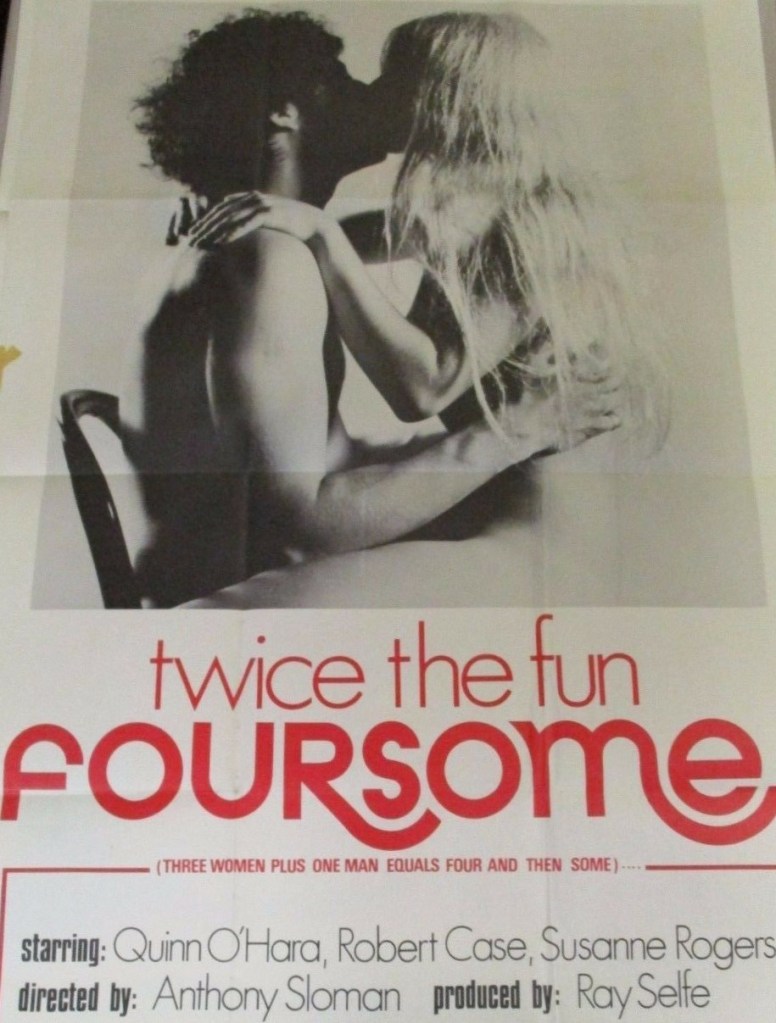
Sweet and Sexy” was renamed “Foursome” for the U.S. market, even though no such activity takes place. At one point Scottish actress Quinn O’Hara had been engaged to U.S. pop star Fabian.

He shared a flat with Michael Billington (Alfred the Great, 1968) – who holds the record for most auditions for the role of James Bond. Billington was a lover of Liza Minelli, Barbara Broccoli and Quinn O’Hara and was slated to direct Sloman’s first film but when he was offered a starring role in the UFO series (1970-1971), Sloman took over the directorial reins and recruited as leading man Billington’s UFO stand-in Robert Case. Quinn O’Hara (Cry of the Banshee, 1970), Billington’s girlfriend, had the female lead. It began life with the relatively harmless title of City Suite.

But when it was funded by Miracle Films, the title changed to City, Sweet and Sexy and finally plain old Sweet and Sexy (though it goes by the name of Foursome on imdb). What the Americans called “sexploitation.” The initial budget only ran to £15,000 but was increased to  £20,000. But when submitted to the British Board of Films Censors in October 1970, it was refused a certificate unless 40 minutes were cut. After nearly 18 months of wrangling it was finally granted an X-certificate – minus 21 offensive minutes – and the 69-minute picture finally opened at the Cameo Royal in London in March 1972.

Sloman had better luck with his second feature, Not Tonight Darling (1971) – also known as Frustrated Wives. Luan Peters (Lust for a Vampire, 1971) came on board as star and Sloman had the good luck to snare pop band Thunderclap Newman, who had enjoyed a big hit with “Something in the Air”, for the score. There were also appearances by Jason Twelvetrees, who had also been in Sweet and Sexy, Fiona Richmond (Let’s Get Laid, 1978) and James Hayter  (A Challenge for Robin Hood, 1967).

The book ends in the early 1970s and I can only hope Tony Sloman is hard at work on a second volume as his memoirs are a welcome antidote to the raft of books about big stars which are often far less entertaining. An excellent read, especially if you are interested in the behind-the-scenes aspects of movie making.

EXTRA: This is not in the book but I did a bit of digging on my own account to see if any of his movies were ever screened in the U.S. I found out, as noted in the article above, that “Sweet and Sexy” was released in the U.S. as “Foursome”. Despite the concerns of the British film censor, it was not that out of line otherwise it would not have received an “R” rating when it could easily have been rated “X.” I couldn’t find any sign of a review, either in “Variety” or “Box Office,” the two main trade magazines. But I did find some evidence that it had been screened in some big cities.

It was distributed by AIP in the U.S, and C-P in Canada. “Variety” and “Box Office” had different methods of measuring revenue. The former simply listed the gross. But the latter employed a different approach. It related the receipts for each film according to the average weekly take of a particular cinema. This was in some senses a better idea. Strong figures might not necessarily mean a good result if that cinema was used to movies knocking up big numbers.

In January 1972 “Foursome”, playing solo, had a “sexy” opening week, according to “Variety,” at the 1,200-seat Midtown in Philadelphia (tickets priced at $1.50-$3.00) with $14,000 (equivalent to $96,000 today) followed by s second week of $9,500. The same month, supported by “Freedom to Love” (1969), a documentary about sexual behavior, “Foursome” ran for three weeks at the 609-seat World (tickets $1.25) in Chicago. The first and third weeks both accounted for $3,800 but the second week was tops with $4,000. In April there was a “lusty” (presumably intended ironically) $3,100 at the 2,809-seat Loews Downtown (tickets $2.00-$2.50) in Dayton where it played solo.

In August at the 676-seat Suburban World (tickets $2.25) in Minneapolis it scored a “fair” $4,000, again the only film on the program. In December it turned up at the 250-seat Playhouse (tickets $2.50) in Washington, as the supporting feature this time to “Together” (1971) starring Marilyn Chambers and directed by Sean S. Cunningham, later responsible for the first “Friday the 13th ” (1980). The outcome was a “sharp” $4,500. By comparing seating capacity and ticket prices you can get a better idea of the film performed.

Box Office magazine marked performance on a percentage basis against a basic mark of 100, which represented an average week. According to this magazine, the movie was also to be found in Hartford where it scored 175 (i.e. almost double the average week’s takings), New Haven (175), Boston (150) and Buffalo (100). The takings in Minneapolis were no great shakes according to this method of analyzing results, reaching only 100 on the magazine’s measuring system.

Box Office also noted a couple of outings in Canada, where it played as the supporting feature to “Love Me Like I Do” (1970) starring Dyanne Thorne, later immortalised as “Ilsa”. However, Canada appeared not to subscribe to the percentage system. Instead, in Winnipeg at the Downtown in March 1972 it was judged “very good” while in Toronto at the Coronet in November 1972 it was judged “fair.”

SOURCES: “Variety” – January 12, 1972, p8; January 26, 1972, p10; April 5, 1972, p14; August 30, 1970, p14; December 6, 1972; p14. “Box Office” – September 11, 1972, pB4; “Box Office Barometer,” September 18, 1972 pB4; November 6, 1972, p16; November 13, 1972, pK2; March 5, 1973, pK3.

Bronson Unwanted

That Farewell, Friend / Adieu L’Ami (1968) was a smash hit in France did nothing for Charles Bronson’s Hollywood career. Hollywood had form in disregarding U.S.-born stars that Europe had taken to its box office bosom. Example number one of course was Clint Eastwood, ignored by the big American studios until four years after his movies had cut a commercial swathe through foreign territories. Charles Bronson took about the same length of time for his box office grosses abroad to make an impact back home.

While we tend to look upon The Dirty Dozen (1967) as a career-making vehicle for many of the supporting stars, that wasn’t actually the case. Jim Brown was quickest out of the blocks, a full-blown top-billed star a year later in The Split (1968). Otherwise, John Cassavetes had the biggest crack at stardom after landing the male lead in box office smash Rosemary’s Baby (1968). But the rest of the gang – Telly Savalas, Donald Sutherland, Charles Bronson, Richard Jaeckal et al – remained at least for the time being strictly supporting players.

For Charles Bronson, the year of The Dirty Dozen produced nothing more than television guest spots in Dundee and the Culhane, The Fugitive and The Virginian. Beyond that he had a berth in two flop westerns Villa Rides (1968) and Guns for San Sebstian (1968) and no guarantee his career was moving in an upward direction. But the latter picture was primarily a French-Mexican co-production, the Gallic end set up by top French producer Jacques Bar under the aegis of Cipra which had previously been responsible for Alain Delon vehicles Any Number Can Win (1963), Joy House (1964) and Once a Thief (1965).

There was another, as vital, French connection. Henri Verneuil directed both Any Number Can Win and Guns for San Sebastian so could attest to Bronson’s screen presence. And another legendary French producer, the Polish-born Serge Silberman, best known for Luis Bunuel’s Diary of a Chambermaid (1964), had taken note of Bronson, whose screen persona was similar to that of French stars Lino Ventura and Jean Gabin. Silberman’s Greenwich Films production shingle was in the process of setting up Farewell Friend / Adieu L’Ami.

Like The Girl on a Motorcycle (1968), Farewell Friend was part of a new trend to make French productions in English as well as French, in this case the English version viewed as “the working one.” But that ploy failed to convince U.S. distributors to take a chance and the film sat on the shelf for five years. And little that Bronson did in the meantime increased his chances of a serious stab at the Hollywood big time.
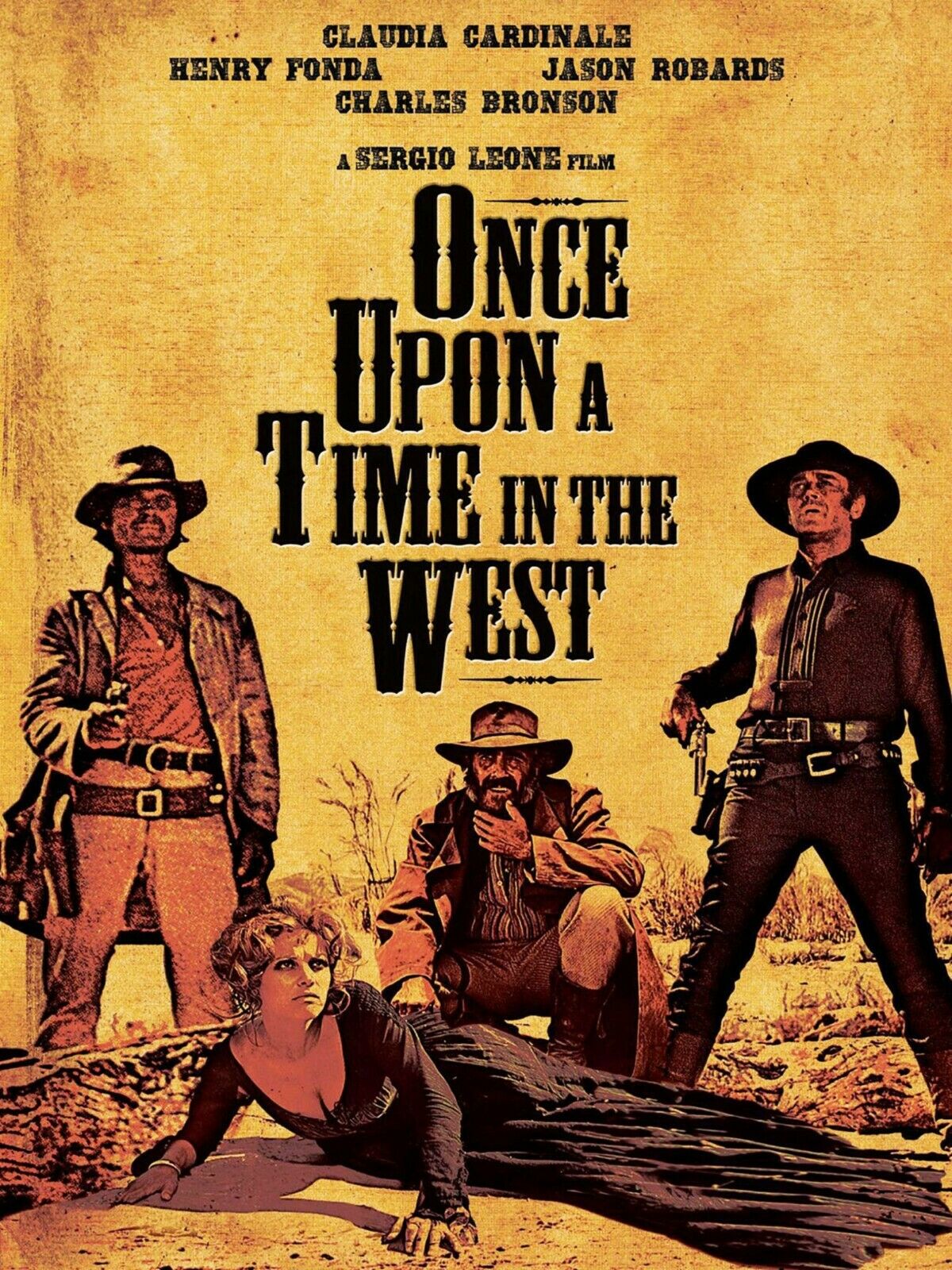
Although Paramount had piled cash into the Italian-made Once upon a Time in the West (1968) it was counting on Henry Fonda – undergoing a career renaissance after Madigan (1968), The Boston Strangler (1968) and Yours, Mine and Ours (1968) – to provide the box office momentum. Bronson was billed fourth after Claudia Cardinale, Fonda and Jason Robards, so still in Hollywood’s eyes a supporting player.

And while the Sergio Leone picture flopped Stateside, the success of Farewell, Friend in France turned Bronson into a star and was instrumental in the western breaking box office records in Paris (where it ran for a year) and throughout the country.

Fortunately for Bronson, European producers recognized his potential. His next picture should have been an Italian-French-German co-production of Michael Strogoff, for which he was announced as the top billed star (Advert, Variety, May 8, 1968, p136-137).  When that fell through, Italian company Euro International, bidding to become the top foreign studio outside Hollywood, gave him top-billing in Richard Donner drama Twinky (aka Lola, aka London Affair, 1970) and Serge Silberman tapped him for Rene Clement thriller Rider on the Rain (1970), another French hit.

British director Peter Collinson (The Italian Job, 1969) was responsible for recruiting him for You Can’t Win ‘Em All (aka The Dubious Patriots, 1970), but with Tony Curtis taking top billing. Again, though funded by an American studio, this time Columbia, it was another big flop, mostly because the studio did not know how to market the picture, Curtis in a box office slump and Bronson considered to have little appeal.

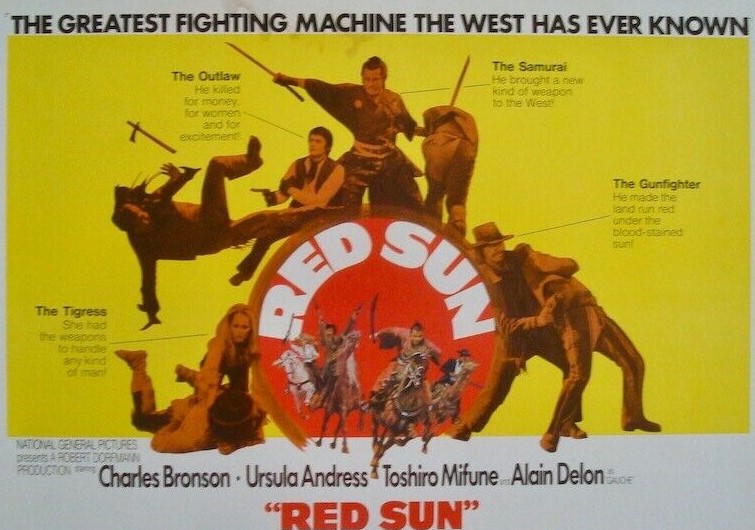
But still the Europeans kept the faith. Another French-Italian co-production Sergio Sollima’s Violent City (1970) gave him top billing over exiles Telly Savalas and Jill Ireland, Bronson’s wife. That was also the case with Cold Sweat (1970), helmed by British director Terence Young (Dr No, 1962).  He had another French-made hit with Someone Behind the Door (1971) and Terence Young hired him again, along with Farewell, Friend co-star Alain Delon, Japanese star Toshiro Mifune (Seven Samurai, 1954) and Dr No alumni Ursula Andress for international co-production Red Sun. While this western sent box office tills whirring all over the world, it only made a fair impression in the U.S., ranking 53rd in the annual box office chase.
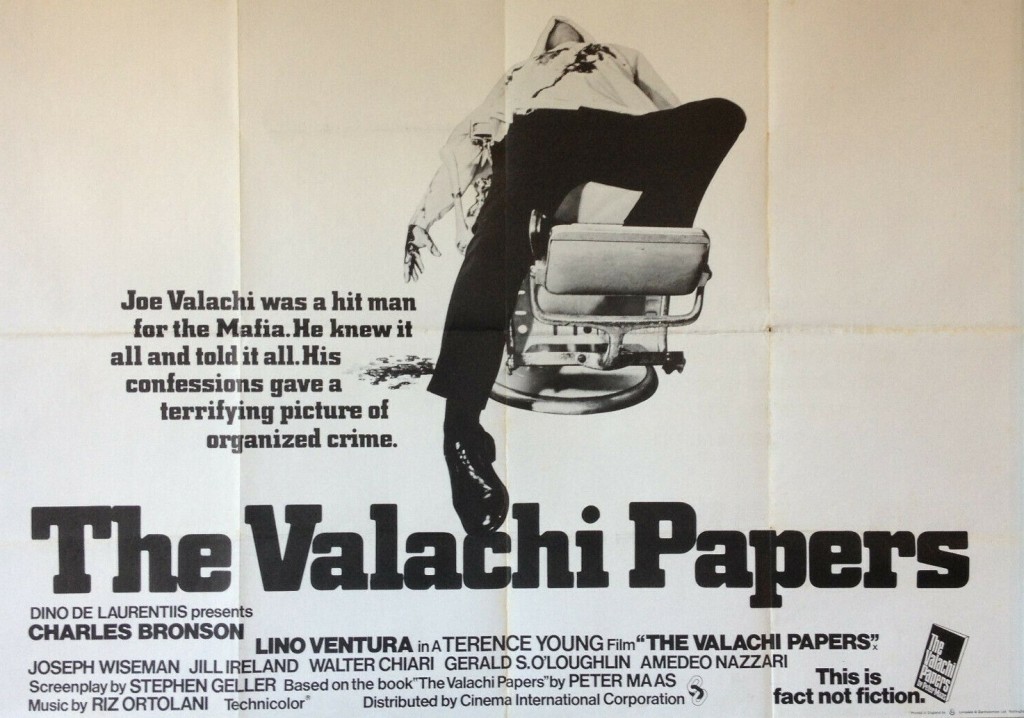
Riding on the back of The Godfather phenomenon, Italian producer Dino De Laurentiis chose Bronson for Mafia thriller The Valachi Papers (1972), again directed by Terence Young, which produced something of a box office breakthrough in the U.S., ending the year just outside the Top 20. But it took another British director, Michael Winner, to help solidify the Bronson screen persona and boost his global appeal. Four – and all of the hits – out of the star’s next six pictures were directed by Winner.  These were the western Chato’s Land (1972), The Mechanic (1972), The Stone Killer (1973) and Death Wish (1975). The Mechanic was such a big hit Stateside it did better in its second year of release than the first and Columbia redeemed itself by giving prison escape thriller Breakout (1975) the widest release – up to that point – of all time.

That America had little interest in developing Bronson as a breakout star could be judged by the distribution treatment of his pictures. As mentioned above, Farewell, Friend had to wait until 1973 for its U.S. debut and then renamed Honor among Thieves. Twinky was denied a cinema release in the U.S. and went straight to television in 1972. Violent City had to wait until 1973 for a distribution deal, Cold Sweat until 1974 and even Red Sun took nine months before it hit American shores.  Until The Valachi Papers did the business, Bronson was not considered the kind of star who could open a picture in the U.S.

By then, of course, Bronson had reversed the normal box office rules. Usually, for films starring American actors, foreign revenues were the icing on the cake. For Bronson it was the other way round. Along with Clint Eastwood he was the first of the global superstars, whose name resonated around the world, and whose pictures made huge amounts of money regardless of American acceptance or interest. But had it been left to Hollywood, Bronson would never have made the grade.

Discover WordPress

A daily selection of the best content published on WordPress, collected for you by humans who love to read.

The Atavist Magazine

by Brian Hannan

WordPress.com News

The latest news on WordPress.com and the WordPress community.