Behind the Scenes: Selling “Zulu” (1964) – The Pressbook

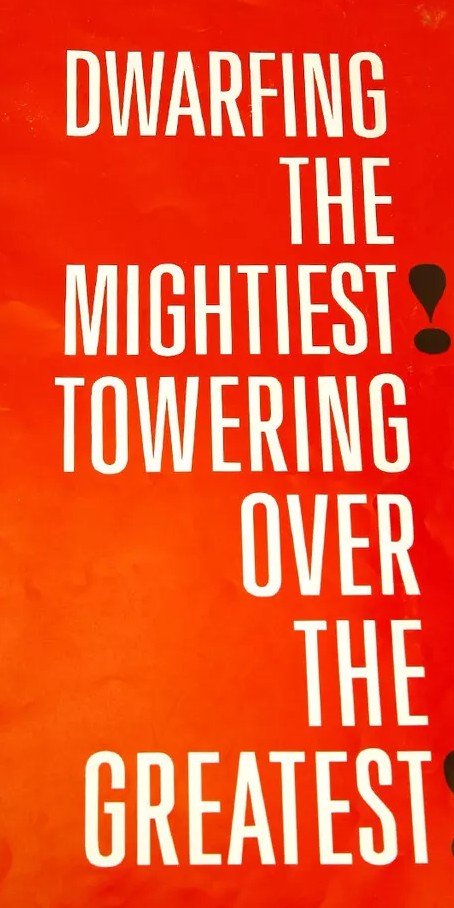
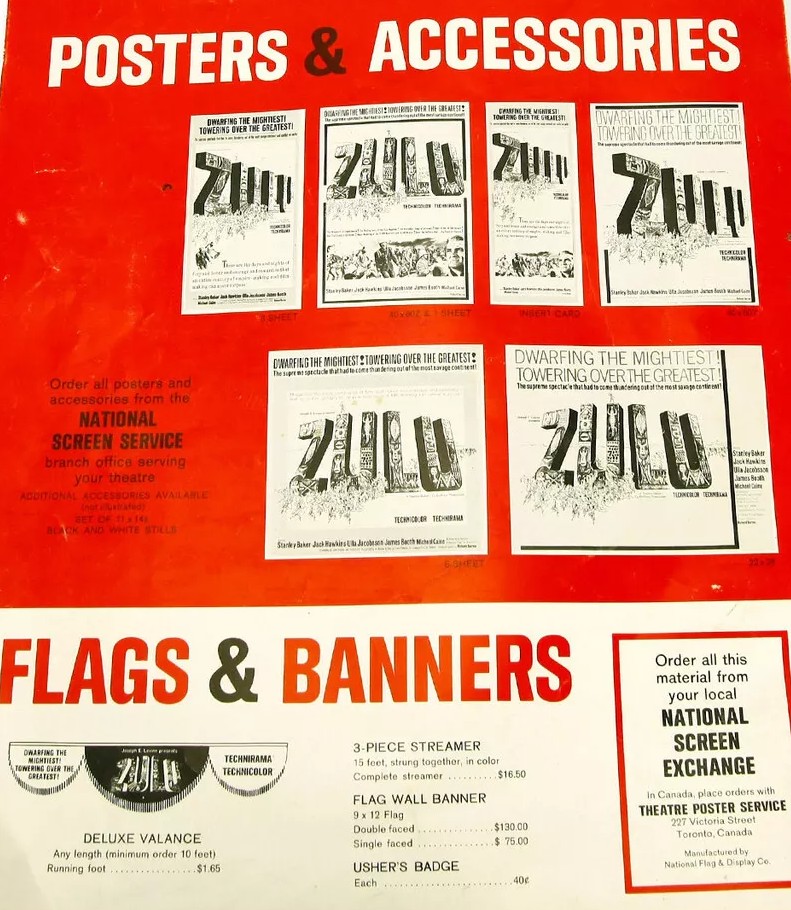
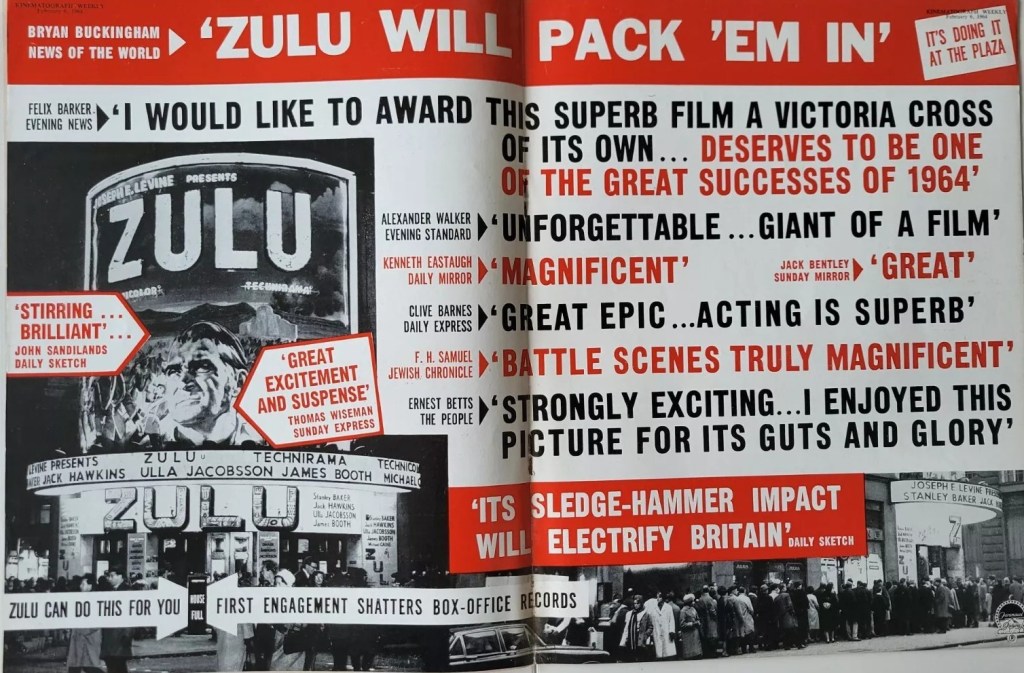
“Dwarfing the Mightiest! Towering over the Greatest!” wasn’t just the movie’s tagline. It could have easily been used to describe the Pressbook. This folded out into a colossal 40 inches wide  by 20 inches high, one of the biggest pressbooks ever produced.

The marketing team produced an impressive list of ideas. Cinema managers were urged to get war correspondents and war heroes involved and to blow up photos of the Victoria Cross. Hanging on the name of the star was a “Baker’s Dozen” competition, inviting people to list the thirteen movies featuring Stanley Baker. Quite how they thought a promotion involving banks would go down is anybody’s guess. Especially as this was the notion: “Zulus are allowed as many wives as they want, provided they can afford to pay for them. The price ranges between six and twenty head of cattle per wife. For an interesting tie-in, get local banks to display money and other barter materials. Give them a montage of still from the picture to display.” Culturally tone-deaf doesn’t cut it.

To attract children there was a coloring-in competition and a school study guide. The movie was available in 70mm Super Technirama so there was a special advertisement linked in to that for cinema going down that route.

Other taglines included: “The supreme spectacle that had to come thundering out of the most thrilling continent!” and “These are the days and nights of fury and honor and courage and cowardice that an entire century of empire-making and film-making can never surpass!”

And in case hyperbole wasn’t enough, one of the ads spelled out the exciting details. “The Massacre of Isandlwana! The Mating Song of the Zulu Maidens! The Incredible Siege of Ishiwane! Night of the 40,000 Spears! Days That Saved a Continent! Mass Wedding of 2,000 Warriors and 2,000 Virgins! Amid the Battle’s Heat…the Flash of Passion!”

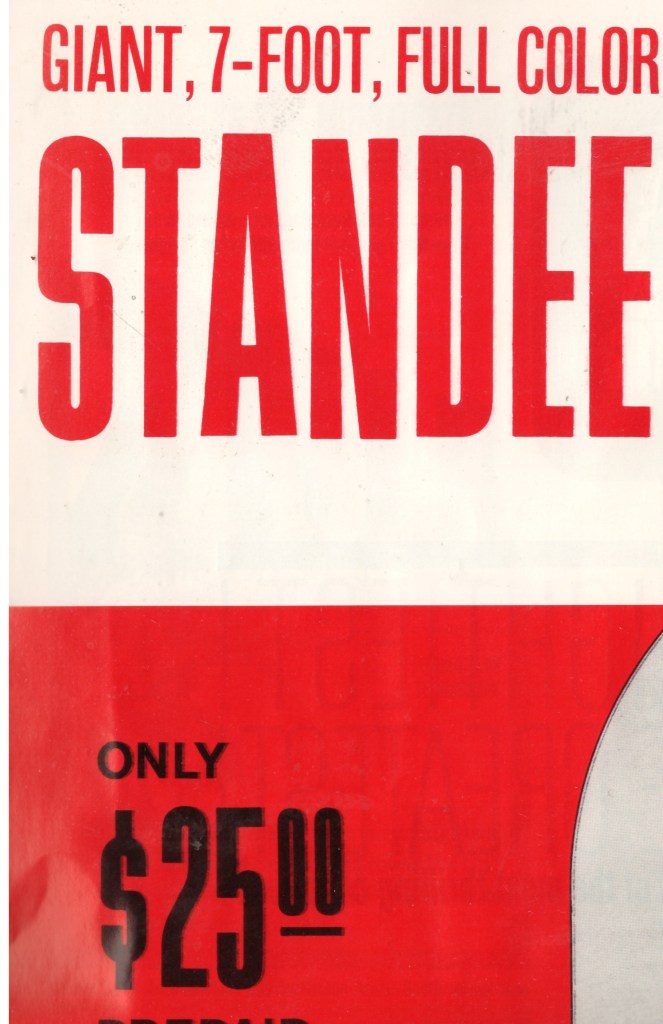
There was a seven-foot high standee and a three-foot 3D illuminated standee.

To help sell the picture to local journalists, little articles were planted that could hook an editor’s interest. For example, when director Cy Endfield glimpsed some soldiers firing their rifles left-handed, he stopped filming, because British soldiers were required to shoot right-handed. The film was shot in the shadows of the Darkensberg Mountains. The river which flowed past Rorke’s Drift was slower than it had been at the time of the battle so the course was altered and dammed to increase the flow. Out of sight of the cameras but essential to filming were the modern villages constructed to house cast and crew, stores, catering and compounds for horses and oxen.

The cast were on set at 6.30am for make-up. The Zulus spent more time in make-up than the British soldiers, as the costume department ensured every aspect of their outfits was historically correct. A total of 100lb of small colored beads was crafted by made by local women for the maidens to wear. A primitive method of making necklaces, strung together with animal sinew and rolled by hand, was employed incorporating a further 100lb of wild syringa seeds which were dyed.

The warrior loincloths of softened animal skins were made the traditional way using stones aqnd animal fat. Shields were also made from animal skin. The teeth of tigers and baboons formed their necklaces. They kept snuff in a small gourd worn round the waist. The purpose of a porcupine quill tucked into their hair was to extract thorns after a long march.

Three cameras were utilized to shoot the blaze that burned down the hospital. “Undress rehearsal” was the name given to the marriage ritual scenes of bare-breasted women.

Though Michael Caine was being touted for stardom, as far as the Pressbook was concerned he was relegated to section below Jack Hawkins, James Booth and Ulla Jacobsen who had smaller parts. The movie was a notable change for Jack Hawkins, who saw action in World War Two. Instead of playing his usual hero, he was a weakling and drunk. It was the second English-language film for Swede Jacobsen after Love Is a Ball / All This and Money Too (1963).

Zulu (1964) *****

The technical excellence is substantially under-rated. Not just the aural qualities – the approaching enemy sounding like a train – and the reverse camera and uplifted faces registering awe that later became synonymous with Steven Spielberg, but the greatest use of the tracking camera in the history of the cinema. So what could otherwise be a rather static movie given it revolves around a siege is provided with almost continuous fluidity.

It’s perhaps worth pointing out, in relation to accusations of jingoism, that the British had relatively few battles to celebrate – Agincourt in the Middle Ages, Waterloo in 1815, El Alamein in 1942. But the Crimean War, in which Britain was on the winning side, was remembered for the disastrous Charge of the Light Brigade. Dunkirk in 1940 was a defeat and in cinematic terms D-Day was seen as heavily favoring of the Americans. Although there had been a corps of British World War Two pictures, these generally focused on individual missions (The Dam Busters, 1955) or characters (Reach for the Sky, 1956). And in fact the defense of Rorke’s Drift was preceded by a resounding defeat at the hands of the Zulus at Isandlwana.

Tactically, too, the Zulus are smarter. Their leader is only too happy to sacrifice dozens of his troops in order to gauge the British firepower, their snipers probe for weaknesses in the British defences, their troops feint to attract fire and waste bullets.  The Zulus are too clever to attack where the British want.

This is not even your normal British army. Rorke’s Drift is a supply station and hospital. Its upper class commander Lt Bromhead (Michael Chard) idles his time away going big game hunting. The more down-to-earth Lt Chard (Stanley Baker) is there in his capacity as an engineer, erecting a pontoon bridge over the river. Neither has been in battle.

It’s surprisingly realistic in its depiction of the common soldier as having other interests beyond fighting. Private Owen (Ivor Emmanuel) is more concerned about the company choir, Byrne (Kerry Jordan) more focused on his cooking than bearing arms, and farmer Private Thomas (Neil McCarthy) spends his time cuddling a calf. Hook (James Booth) is a troublemaker and slacker and surgeon Reynolds (Patrick Magee) inclined to mouth off to his superior officers. The Rev Witt (Jack Hawkins) turns out to be a drunken hypocrite. His pious daughter (Ulla Jacobsen) is shocked when the men try to steal a kiss

Beyond a fleeting glimpse of victorious forces at Isandlwana, the Zulus are introduced in a sequence of harmony, a tribal ritual preceding a marriage ceremony, lusty singing and dancing scarcely setting up what is to come. It’s more like the by-now traditional section where the main characters in a movie set in an exotic land are introduced to aspects of local culture. Various characters attest to their military exploits.

But after that, tension cleverly builds. Witt raises the alarm, a bunch of cavalry irregulars refuse  to stay and fight, the sound of the pounding “train” of the approaching army (an idea imitated for the oncoming unseen German tanks in Battle of the Bulge, 1965) and then the awesome shot of the thousands of Zulus adorning a hilltop make it unlikely the garrison can survive, especially given the inexperience of Chard and Bromhead, the latter of the civil “old boy” old school, and their inherent rivalry. Nor are the commanders typical. Chard may be gruff but he’s not arrogant and the soft-spoken Bromhead is the antithesis of every British officer you’ve ever seen on screen.

As the camera continues its insistent prowl, many sequences stand out – the battle of the battle hymns (“Men of Harlech” from the Brits); the bandage unravelling from the leg of wounded Swiss; the blackened wisps of canvas on the burning wagons at Isandlwana; the trembling voice of Color Sgt Bourne (Nigel Green) in the post-battle roll call; “he’s a dead paperhanger now”; the frantic bayonets digging holes in the walls of the hospital to escape; the final “salute” by the defeated Zulus; the torrential firepower the defenders inflict when three units fire in turn.

There’s a scene you’ll remember from The Godfather (1972) when Michael Corleone and the baker’s son stand guard outside the hospital and the baker’s hand shakes when he tries to light a cigarette whereas Michael notes that his own is perfectly steady. That has its precedent here. Chard’s hand shakes loading bullets into his pistol but later, battle-hardened, it does not.

There’s no glory in war as the surgeon constantly reminds the leaders and Bromhead, expecting to exult in triumph, instead feels “sick and ashamed.”

Terrific performances all round, mighty score by John Barry, written by director Cy Endfield (Sands of the Kalahari, 1965) and Scottish historian John Prebble (Culloden, 1964). The high point of Endfield’s career. Despite his character’s prominence Michael Caine was low down the billing, and despite the movie’s success stardom did not immediately beckon and he had to wait until The Ipcress File (1965) and Alfie (1966) for that.

I hadn’t see this in a long while and expected to come at it in more picky fashion. Instead, I thought it was just terrific.

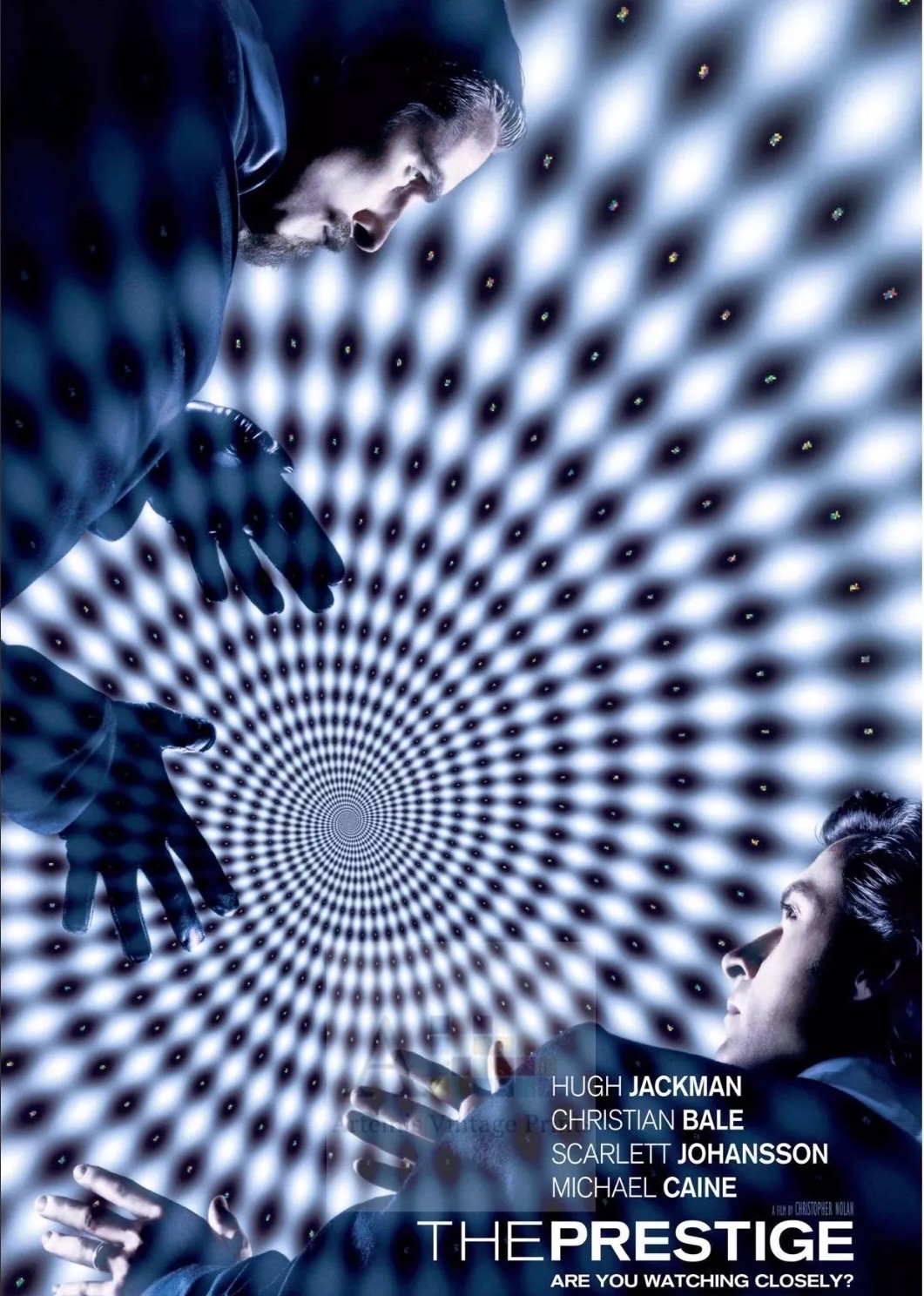
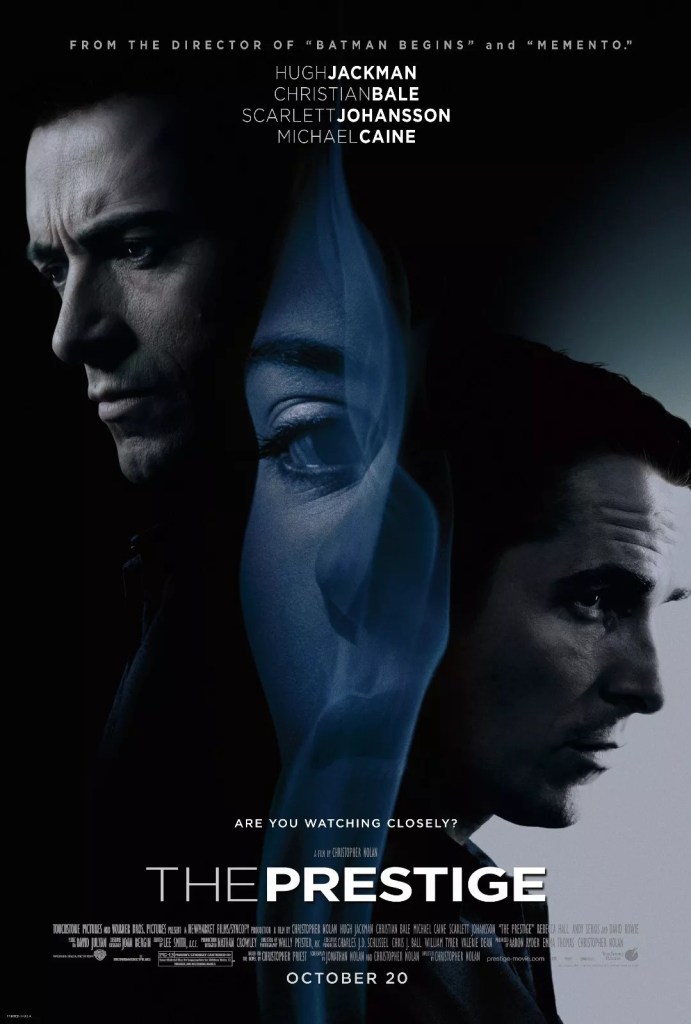
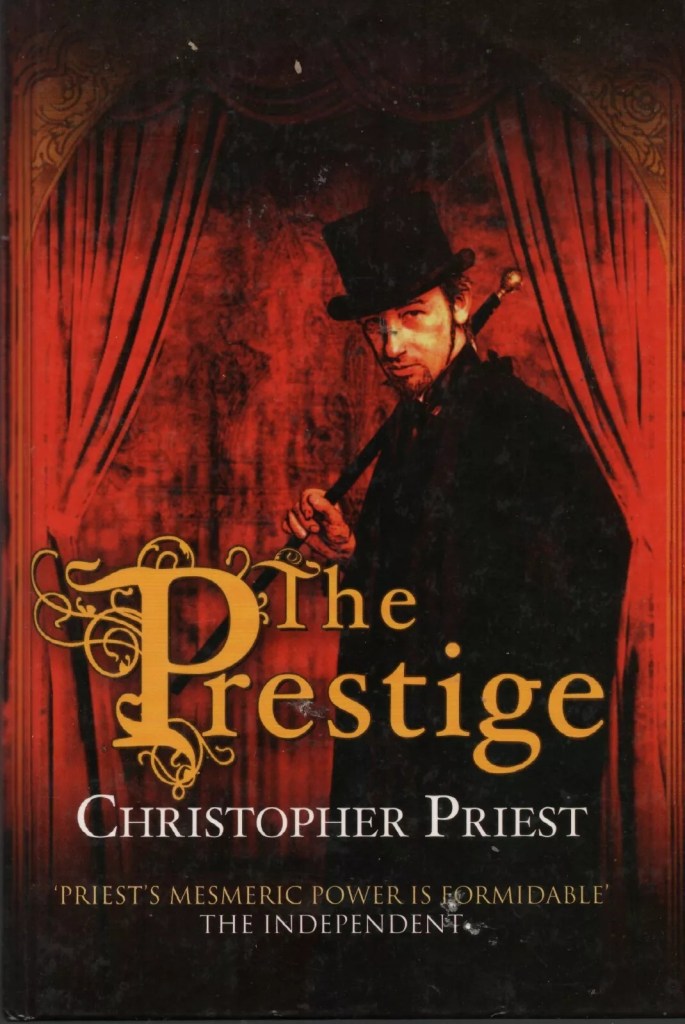
The Prestige (2006) ****

Christopher Nolan (Oppenheimer, 2023) revels in sleight-of-hand, if only by mixing up time frames, but even he isn’t intellectually smart enough to overcome the deficiency that ensured this picture failed to emulate the commercial success of all his other movies. And it revolves not around what you do to dupe an audience. An audience wants to be duped and isn’t so concerned if how the duping is achieved is never revealed, which is, of course, core to the business of the stage magician. Part of the success of this picture is that Nolan gives away stage secrets, even, if you were playing close enough attention, giving away the main reveal of one of the two dueling stage magicians.

But one of these revelations cuts so close to the bone the audience loses its sympathy for both the main characters, Alfred Borden (Christian Bale) and Robert Angier (Hugh Jackman). By the time we understand just how ruthless this pair are to the extent of risking marriage/romantic attachment for the sake of either getting one over on the opponent or maintaining the central deceit of their act, we have already become too squeamish to care overmuch. And the twists which come with increasing regularity which are supposed to take our breath away are defused by the ticking time bomb.

And the miscalculation pivots on who you can kill in a movie. Henry Fonda cold-bloodedly slaughtering an innocent child in Once Upon a Time in the West (1969) set a new high/low for onscreen barbarity, but that was excused because it demonstrated just what a villain this character was. Since then a virtual industry has grown up over inventing more creative ways in which people can be killed.

One of the standard ploys of the stage magician is to make a canary in a cage disappear in front of your very eyes only for said canary, minus cage, to reappear moments later to thunderous applause. Turns out the cage is collapsible and it vanishes into a space hidden in a table. The canary? It is squashed to death in the cage. It’s a different canary that magically reappears.

So all through the picture canaries are squashed, sometimes we see the cages being emptied of dead canaries, and workrooms filled with canaries waiting to be squashed.

What happens after this somehow pales into insignificance. Here we have a business that requires murdering God knows how many canaries every night of the year. It doesn’t take much intelligence among the easily duped moviegoer to work out how many canaries both magicians have ruthlessly despatched.

So when they get around to killing each other’s loved ones, or shooting off each other’s fingers or ruining each other’s acts, your stomach has already been turned and although the darkest of dark narratives has long been a theme of the movies, this, and not fitting into the exploitation B-picture genre where it would more comfortable reside, sucks the sympathy out from under the director’s feet and all his later sleight-of-hand, as ingenious as it is, counts for very little.

There’s certainly tragedy here and of the kind that only Shakespeare could conjure. In order to safeguard the integrity of his act – the secrecy paramount to its success – loving husband Borden is forced to pretend to his loving wife Sarah (Rebecca Hall) that he has a mistress, resulting in distraught wife killing herself. Though discreetly done, scarcely glimpsed in the final sequence, Angier has embarked on the murderous spree essential to concealing the mechanics of his famous trick, The Transported Man.

That it works at all, and splendidly to a large extent, is down to Nolan’s traditional time-shift sleight-of-hand and installing in the middle of this brouhaha the wise Cutter (Michael Caine) whose tempered diction brings the movie unexpected gravitas. When he speaks you tend to believe. The minute the other pair open their mouths you are suspect.

Just for his calmness Michael Caine (Interstellar, 2014) steals the picture from Christian Bale (Ford v Ferrari / Le Mans ’66, 2019) and Hugh Jackman (Deadpool and Wolverine, 2024). Rebecca Hall (Godzilla v Kong: The New Empire, 2024)and Scarlett Johansson (Fly Me to the Moon, 2024) are at opposite ends of the feminine divide, the former unable to cope with deceit, the latter manipulating it to her own ends. The director and brother Jonathan adapted the Christopher Priest award-winning novel.

Setting aside the canaries and the difficulties of presenting all-consuming obsession, this remains an intriguing work, possibly the darkest area into which the director ever ventured.  

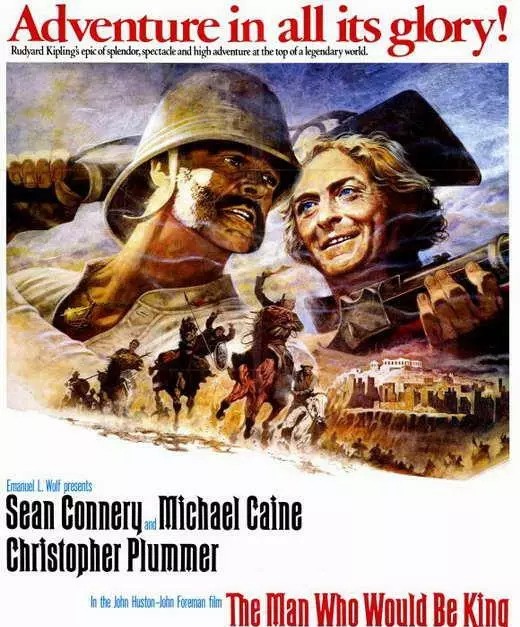
The Man Who Would Be King (1975) ****

Variation on the director’s earlier The Treasure of the Sierra Madre as a pair of British ex-military cheekie chappies whose reach exceeds their grasp come unstuck when confronted by powerful religious elements. Enticingly presents a marvellously ironic puzzle – you can have everything your heart desires except anything that would make you human. And elevated less by John Huston’s cinematic achievement than by terrific performances by the two stalwarts of the British film industry at the time, Sean Connery and Michael Caine, the former taking the acting kudos by a nose as the less intelligent of the duo. Given Connery’s standing at the time, this was somewhat playing against type. Yes, he exudes screen charisma and is a macho as ever, but nonetheless not quite as quick on the uptake as the more calculating Caine.

Story is told in flashback after a maimed Peachy Carnehan (Michael Caine) turns up as the offices of journalist Rudyard Kipling (Christopher Plummer). They originally met when Peachy had stolen the writer’s watch, returning it on realizing they were fellow freemasons. With buddy Daniel Dravot (Sean Connery), they attempt to enlist Kipling in a blackmail scheme and in due course the soldiers set off to make their fortunes in the forbidding land of Kafiristan, at the top of the Indian sub-continent, where no white man has set foot since Alexander the Great.

Their scheme is simple – to hire themselves out as mercenaries to various tribes, bringing modern warfare skills and weaponry to primitive society and ascending the ranks of power. When Daniel appears unhurt after plucking an arrow out of his chest, the natives confer on him the status of god, and so he is elevated to kingshippery and all the gold he could want. But in this Garden of Eden there is a humdinger of a Catch 22, the apple he must not touch.

He can’t take a wife.

You can see the logic. As a god you should be above base earthly desires. A god could not possibly wish such intimacy with a human. Otherwise he would lose his otherworldly sensibilities, not to mention that the chosen woman would expect to physically explode. While the more sensible Peachy has been all the time calculating just how he’s going make a getaway with as much gold as he can carry, Daniel becomes trapped in the notion that he can have his cake and eat it.

The religious hierarchy says otherwise and it doesn’t end well.

Audiences may well have been disappointed at the lack of action. There’s only one battle and it’s over in a minute, albeit that there’s a timeout to make the point about the power of religion. And although our boys endure a momentous trek it’s fairly standard stuff and Huston lacks the vision of a David Lean to turn the journey into anything more dramatically or visually memorable. A whole bunch of indigenous background material – including the ancient version of polo where the ball is a human head – doesn’t make up.

What does transform this relatively slight tale is the playing. Connery and Caine are a delight, the kind of top-of-the-range double act on a par with the cinemagical pairing of Paul Newman and Robert Redford in Butch Cassidy and the Sundance Kid (1969) and The Sting (1973). They spark each other off just a treat. Caine, surprisingly, is the one in charge, Connery adrift in  matters of arithmetic, strategy and, when it comes down to it, common sense even though when called up to judge on civil matters proves himself relatively astute and fair.

The writing, too, seems to understand implicitly how to get the best out of the characters. When they fall out, it is so subtle you would hardly notice. Caine scarcely bristles when Connery explains that Caine really should be falling in line with the rest of his subjects and bowing his head, but if you are astute reader of an acting face you can see the chasm that has opened up in their relationship.

To employ a Scottish phrase, Connery gives it “laldy” – acts with gusto – when playing the part of a madman, whirling around like a demented dervish, but mostly reins it in.

The intricacies of freemasonry would wait a few decades before called to the cinematic altar in The Da Vinci Code (2006) but here the mumbo-jumbo proves less important than, as with the Dan Brown epic, a symbol, and, again with the lightest of narrative strokes, we are left considering its mystic origins.

John Huston (Sinful Davey, 1969) back on top form but he’s more than helped by exceptional acting by Sean Connery (The Hill, 1965) and Michael Caine (Play Dirty, 1968) with Christopher Plummer (Nobody Runs Forever / The High Commissioner, 1968) in unusually subtle form as well. Gladys Hill (Reflections in a Golden Eye, 1967) and Huston were Oscar-nominated for the  the screenplay based on the Kipling short story.

Impressed by this performance I should warn you I feel a Sean Connery binge coming on.

Behind the Scenes: The Box Office Bump Part Two – Foreign Saves the Day

In previous decades, box office outside of the U.S., while a growing part of the ancillary equation, only in very rare circumstances outscored domestic. The general expectation, in part due to tougher competition for screens and extra distribution costs, was on average studios could expect to earn about half of domestic revenues.

There was one obvious exemption to this rule. James Bond overseas blew all the competition out of the water. And so it proved in the early 1970s from an examination of United Artists books for the period. Live and Let Die (1973) was the standout performer, knocking up $27 million in rentals (the studio share of the overall box office gross) from foreign cinemas compared to $16.4 million at home. Diamonds Are Forever (1971) did equally well – $22 million abroad, $20 million domestic.

James Bond was such a cash cow that surprised no one. Last Tango in Paris (1973) was considered an anomaly, controversy stoked by UA four-walling the picture when it couldn’t find enough screens. It came in third in the foreign market league, adding $16 million to domestic $21 million.

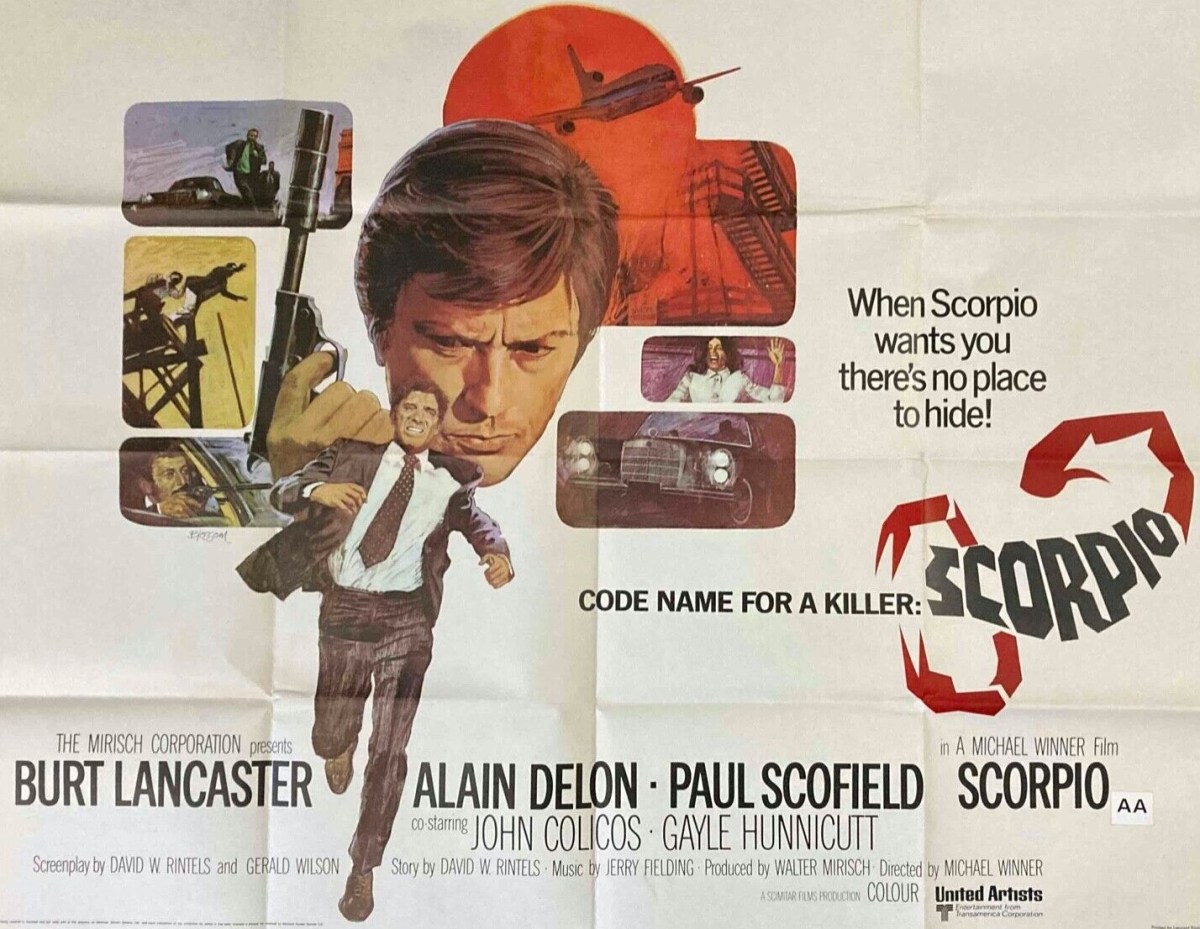
What did take Hollywood’s breath away was how often under-performers – flops even – at the U.S. ticket wickets did gangbusters elsewhere. The biggest winner was the aptly-named Michael Winner, director of westerns Lawman (1971) and Chato’s Land (1972), hitman thriller The Mechanic (1972) and spy drama Scorpio (1973). Total American rentals a shade over $7 million, total foreign rentals three times as much a colossal $21.8 million.

There was hardly a greater example of the disparity between American audience tastes and the rest of the world. And it made Hollywood studios more adventurous when it came to choosing subject matter, and in backing stars, aware that they could make their investment back – and more – from foreign markets.

It was probably astonishing to any studio executive that Burt Lancaster – for over two decades a high-flying marquee name from action-oriented fare like The Crimson Pirate (1952) and controversial drama From Here to Eternity (1953) to his Oscar-winning turn as Elmer Gantry (1960) and hardnosed western The Professionals (1966) – had lost his domestic audience especially after he had fronted up disaster movie smash Airport (1970).

But Lancaster could only scrape up $1.35 million at home for Scorpio, $2.1 million for Lawman and $2.8 million for another western Valdez Is Coming. Scorpio was the biggest hit abroad, with a massive $7 million, over five times domestic, while Lawman shot up $3.2 million (50 per cent above domestic) and Valdez Is Coming $2.65 million.

Charles Bronson was another beneficiary of foreign largesse. The Mechanic, too, targeted $7 million abroad, nearly three times the domestic tally of $2.6 million. Chato’s Land (1972) only delivered $1.27 million in the U.S. but $4.6 million abroad.

Westerns were a mixed bag. Oliver Reed-Candice Bergen-Gene Hackman number The Hunting Party (1971) was an almighty flop at home, just $800,000 in the kitty, but rallied somewhat abroad, not enough to turn profit but at least add a sheen of respectability, with $2.4 million elsewhere, three times domestic. The Magnificent Seven Ride! (1972), proof the sequels had outstayed their welcome, brought in just $750,000 domestically but again did triple the business abroad with $2.15 million and given the paltry budget enough to sit in the black.

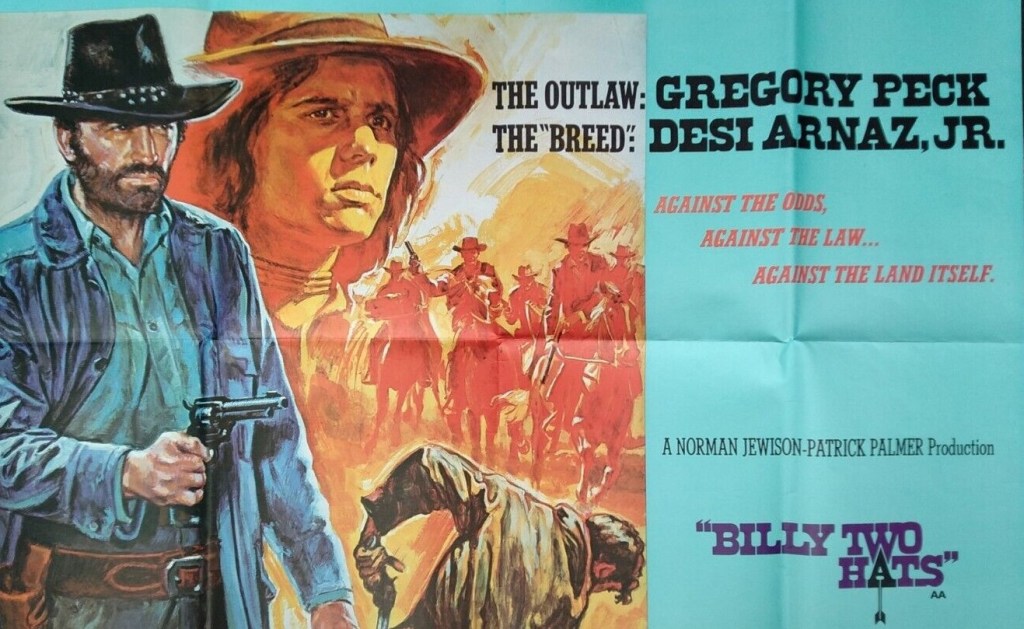
Revisionist effort Billy Two Hats (1974) starring Gregory Peck added $900,000 abroad to a miserable $440,000 at home – foreign revenues not enough to save it from flop. But foreign couldn’t save the second remake of the Gunfight at the OK Corral legend, Doc (1971) with Stacy Keach and Faye Dunaway which moseyed along to $1.35 million abroad to add to $1.8 million domestic. And another western sequel Support Your Local Gunfighter (1971) notched up just $970,000 abroad compared to $2.1 million. Modern western The Honkers (1972) with James Coburn managed just $550,000 abroad and $1 million at home.

It didn’t really matter that Michael Caine comedy thriller Pulp (1972) did better abroad, figures everywhere nothing to write home about, $600,000 in total, five-sixths of that abroad. Fiddler on the Roof (1970), for other reasons, underwhelmed but nobody was going to complain too much when foreign audiences stuck $10 million in till, about a quarter of domestic.

There were some conundrums in the foreign-domestic share-out. Typically, American comedies didn’t travel. But Billy Wilder’s Avanti! (1972) starring Jack Lemmon, perhaps because of the Italian setting, did better abroad – $2.5 million to $1.6 million. Glenda Jackson British-made menage a trois Sunday, Bloody Sunday (1970) not surprisingly did better abroad, but only just, $1.8 million to $1.77 million.

Sidney Poitier in second sequel The Organization (1971) tapped into $2.9 million abroad and $2.45 million at home but generally too-specifically-American features struggled overseas, The Hospital (1971) snaring only $1.9 million compared to $9 million, White Lightning (1973) snagging $1.8 million compared to $6.9 million, Fuzz (1972) holstering $1.7 million against $3.1 million.

Behind the Scenes: “The Man Who Haunted Himself” (1970) – The British Are Coming, Part One

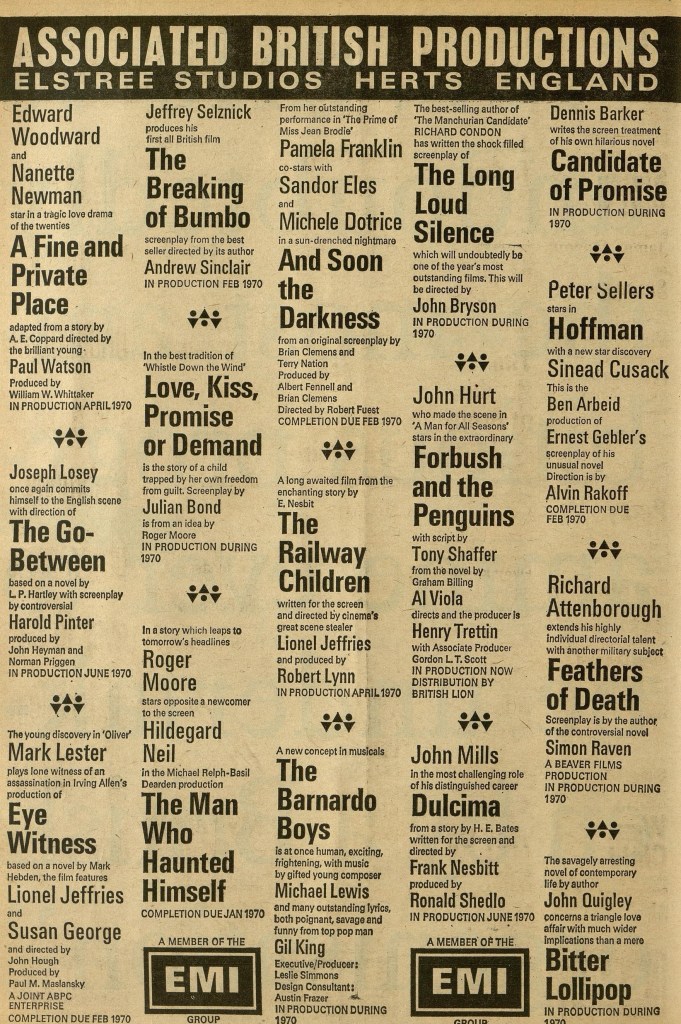
The Man Who Haunted Himself (1970) appeared as part of new British production strategy. In fact, the British had been trying to dominate the global film industry since the silent era when  the population of its Commonwealth exceeded that of the United States. At various points, the British had launched various distribution attacks on Hollywood – aligning with U.S. cinema chains, organizing their own distribution system (Gaumont-British in the 1930s for example) and even taking over major Broadway houses as a launch platform for new releases. Come the end of the 1960s , Britain had lost its production grip on the world stage. Though movies were still being made in Britain they were often funded by Hollywood, or were B-movies or genre-specific such as Hammer horror.

In 1969, Associated British Picture Corporation, following a takeover by EMI, relaunched as a major production entity, aiming to provide increased programming for its own 270-strong ABC cinema chain as well as hitting the export market. Bernard Delfont, chairman of ABPC, set up two production strategies that he intended to run in parallel. He brought in director Bryan Forbes (King Rat, 1965) as production chief of ABPC while Nat Cohen, head of ABPC subsidiary Anglo-Amalgamated, would augment that effort.

Full page ads (above and below) were taken in “Variety” to promote the MGM-EMI slate.
Of the 26 features planned, only 15 were made.

Forbes took on the role after initially signing a three-picture deal with Delfont which developed into “something wider…at a time of real crisis.” Forbes explained his motivation: “I think if you’ve been a critic as I have over the years…you’ve got to put up or shut up. And if the job is offered to you, you can’t turn it down and then go on criticising.”

The initial slate was being made with no guarantee of foreign distribution. Even getting a foothold in Britain was difficult. “We are very dependent…on getting West End outlets. There’s a long queue and we don’t have any particular pull.”

(In Britain at this point, roadshow – which to a large extent was no longer the favoured release device for big budget pictures in the U.S. – still dominated the West End and the type of picture being envisaged was more targeted towards the circuit. But a West End run was always seen as a mark of quality. The downside of the West End release was that it delayed movies reaching the provinces and by the time they did all the initial media interest was long forgotten.)

Budgets were being assessed to meet the prospect that a very successful film could recover its negative costs on a British release alone, with anything else pure profit. Trying to appeal to the international and/or U.S. market at the outset was too complicated and expensive a proposition. And there was always the prospect that with the production well running dry in American, that a distributor, with a hole to fill, would come calling.

ABPC allocated a total budget of £36 million to make 28 pictures, with Forbes’ outfit taking the lion share, leaving Nat Cohen only $7 million to make 13 movies. According to Delfont, it was the “most ambitious” program ever scheduled by a British company. While certainly an overstatement given the investment by Rank, ABPC and Gaumont-British in the past, it nonetheless captured media attention.

The Forbes project didn’t go according to plan. Hoffman (1970) with Peter Sellers, thriller And Soon the Darkness (1970), The Man Who Haunted Himself (1970) starring Roger Moore, The Breaking of Bumbo (1970) and Mr Forbrush and the Penguins (1971) headlining John Hurt and Hayley Mills all flopped, despite costing a lot less than originally expected. The Railway Children (1971) was the only undeniable hit while The Tales of Beatrix Potter (1971) made a profit. Raging Moon / Long Ago, Tomorrow (1971), with Forbes directing Malcolm McDowell and Nanette Newman, and Dulcima (1971) with John Mills and Carol White also ended up in the red. 

Forbes fared much better heading up MGM-EMI, a co-production unit set up in 1970, which produced hits The Go-Between (1971) and Get Carter (1971). Forbes resigned in 1971.

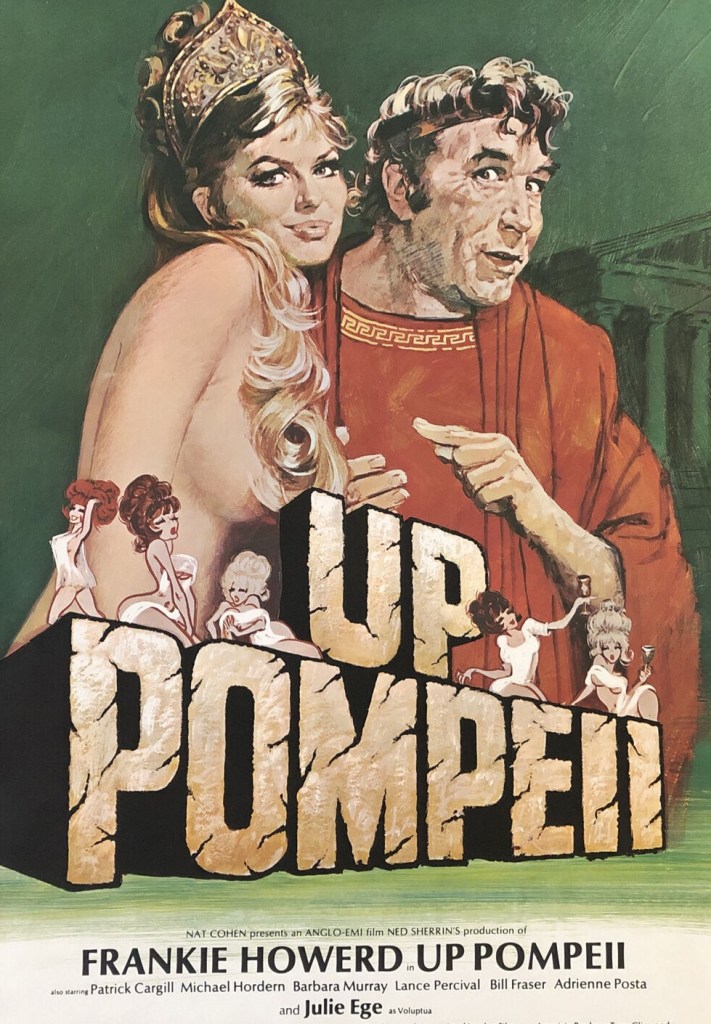
Nat Cohen, while pandering to a lower common denominator, enjoyed more straightforward success with sex-change comedy Percy (1971), and big screen versions of On the Buses (1971), Up Pompeii (1971) and Steptoe and Son (1972) – and their various sequels –  Richard Burton as Villain (1971), Fear Is the Key (1972), and Stardust (1974) while Murder on the Orient Express (1974) with an all-star cast was a huge global hit.

In 1976 Michael Deeley and Barry Spikings became joint managing directors of EMI and aiming for an international audience fronted part of the finance for The Deer Hunter (1978), Sam Peckinpah’s Convoy (1978) and Walter Hill’s The Driver (1978) and had significant investment in Columbia pictures like Close Encounters of the Third Kind (1977) and The Deep (1977).

But the British invasion amounted to very little in the end, as Hollywood, led by gargantuan hits of The Godfather (1972), Jaws (1975) and Star Wars (1977) swept all before them and made it impossible for British-made films to compete either on a commercial or artistic basis.

The experiment was a massive flop. EMI failed to break into the American market and, in fact, the box office achieved was on the dismal side. Best performers were Get Carter and The Go-Between both estimated to achieve rentals of just under $2 million. Tales of Beatrix Potter didn’t reach $1 million and Villain not $750,000. The Railway Children couldn’t manage $500,000 nor Percy $250,000 and none of the others even crossed the $100,000 mark. It was considered such a footnote in British movie history that it didn’t merit a mention in Sarah Street’s Transatlantic Crossing, British Feature Films in the USA (Continuum, 2002).

SOURCES: Alexander Walker, Hollywood England, (Orion paperback, 2005) p426-440; Advert, Variety, January 21, 1970, p12-13; Derek Todd, “The Emperor of Elstree’s First 300 Days,” Kine Weekly, March 7, 1970, p6-8, 19; “MGM-EMI In Joint Deal On British Filmmaking,” Box Office, April 27, 1970, p7; “MGM Setting EMI CoProds,” Variety, June 10, 1970, p3; “MGM-EMI To Produce 12 Films Annually,” Box Office, July 6, 1970, p6; “From $10-Mil and Up, Rentals, to $100,000 and Less,” Variety, November 12, 1972, p5.

The Wrong Box (1966) ***

Somewhere between SBIG (So Bad It’s Good) and WAL (Worth a Look), The Wrong Box is a black comedy in the wrong directorial hands. Better known for thriller Seance on a Wet Afternoon (1964) and POW drama King Rat (1965) Bryan Forbes struggles to bring enough comedy into the proceedings or to wring sufficient laughs out of what he has.

Neither the wit nor the slapstick is sharp enough. But it does exhibit a certain charm. Essentially an inheritance story, it pivots on the notion that the two potential inheritors are on their last legs and putting one, Joseph Finsbury (Ralph Richardson), out of action will benefit dastardly nephews Morris Finsbury (Peter Cook) and John Finsbury (Dudley Moore) of the sole survivor Masterman Finsbury (John Mills).

It turns out Joseph Finsbury is not dead. That does not cue as much hilarity as it should., as the nephews plot to send him to his grave. Given the idea was dreamed by none other than Robert Louis Stevenson of Dr Jekyll and Mr Hyde fame, you can imagine it was written less with comedy in mind.

With so much dependent on set-pieces, it’s rather a hit-and-miss affair, with the conspirators’ failures not matching the humor of watching potential victims escape their proposed doom. Only occasionally does it sparkle.

Surprisingly, the film relies on affecting performances from the shy, retiring Michael Finsbury (Michael Caine), a gentle soul, who enjoys a very innocent romance with Julia Finsbury (Nanette Newman), a young woman terrified of being murdered, which condition provides ample opportunity for her to be rescued/consoled. who enjoy a very innocent romance.

Ralph Richardson steals the movie as a dotty pedant, weighted down with erudition and a knack, equally, for boring the pants off anyone within earshot and for escaping from the jaws of death including a massive train pile-up and several murderous attempts.

Michael Caine, in a follow-up to The Ipcress File (1965) and Alfie (1966) convincingly plays against type. John Mills (The Family Way, 1966) also plays against type as a villain rather than Hitherto, I had been rather sniffy about Nanette Newman (Deadfall, 1968),wife of the director, but here she is delightful.

Peter Cook (A Dandy in Aspic, 19680 and Dudley Moore, in his movie debut, let the show down by being so obviously the personalities from their comedy series Not Only…But Also (1964-1970), a partnership that works so well on television just frittered away here from what looks like characterization with nowhere else to go. But there is a nice cameo from Peter Sellers (The Millionairess, 1960) as an inebriated doctor.

Hard to say whether the blame lies with Larry Gelbart (The Thrill of It All, 1963) for his screenplay or Bryan Forbes for his direction.

Michael Caine got it spot-on when pointing out in his autobiography that it was a “gentle success in most places except Britain” precisely because to foreigners it represented an acceptably stereotypical view of a country full of eccentrics while to Brits it was all too stereotypical. So if you’re from America or other points global you might like it and if you are British you might not. On the other hand, the score by John Barry is one of his best with a wonderful theme tune.

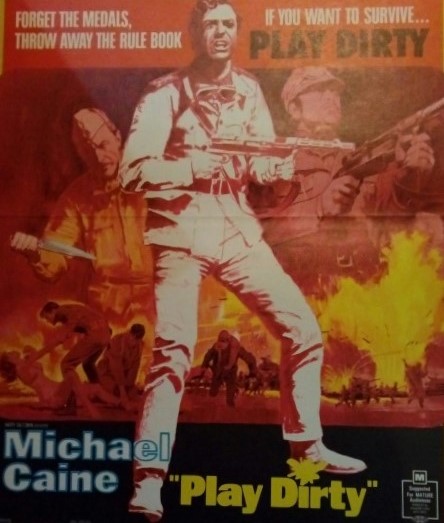
Behind the Scenes – “Play Dirty” (1969)

Hungarian Andre de Toth’s somewhat cavalier career had become ultra-cavalier during the 1960s. Best known for westerns such as Ramrod (1947) with Joel McCrea, Springfield Rifle (1952) starring Gary Cooper and The Indian Fighter (1955) headlined by Kirk Douglas plus House of Wax (1953), he was not, you might have imagined, riding high in the critical stakes. Hollywood considered him a journeyman. Esteemed French magazine Cahiers du Cinema, which had championed Hitchcock in the face of mainstream indifference, believed otherwise and interviewed him for a 1967 issue.

He might have been the name of everyone’s lips for more hard-won commercial reasons had attempts in the late 1950s come to fruition of filming the Ian Fleming portfolio beginning with Dr No. Instead, he was deemed a spent force and during the ensuing decade limited to only four films:  Man on a String (1960) and the Italian-funded Morgan The Pirate (1960), The Mongols (1961) and Gold for the Caesars (1963).

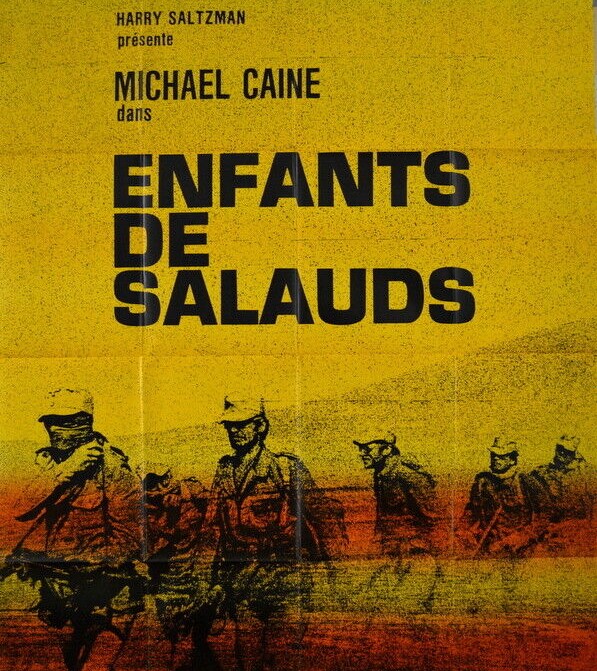
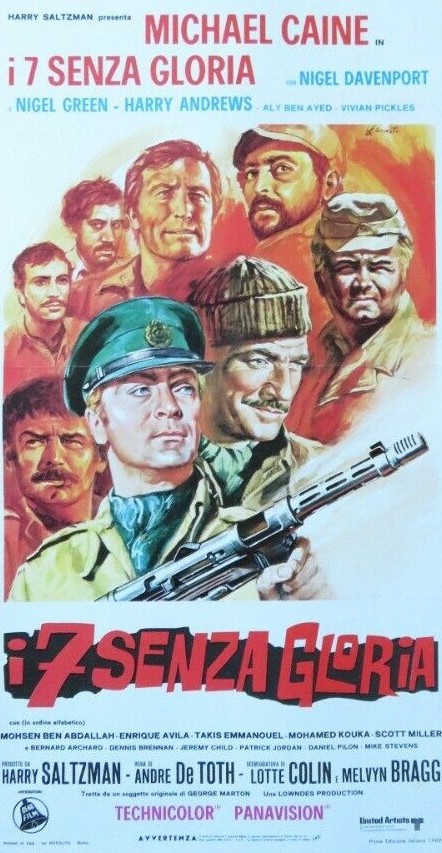
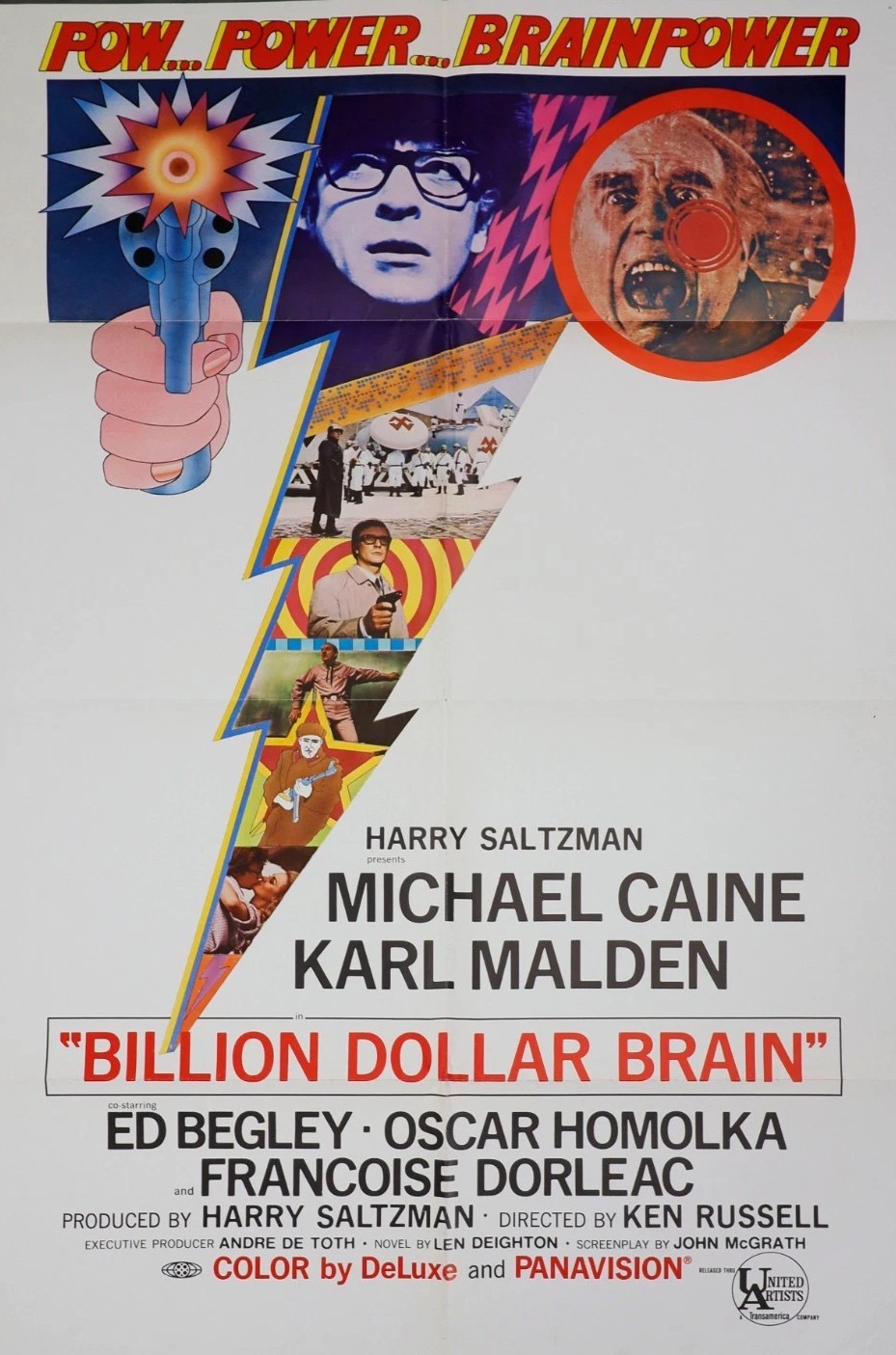
The Fleming enterprise had put him into the orbit of Harry Saltzman which led to a producing gig on Billion Dollar Brain (1966). Saltzman was also involved in The Deadly Patrol – the basis of Play Dirty – with French director Rene Clement (Rider on the Rain, 1970). According to de Toth, Saltzman wanted to elevate himself in movie circles. He “looked down on the Bond pictures” and wanted to make more serious movies.

And the pair clashed on style. “Genteel Rene wanted to make ‘a poetry of war.’ Harry wanted blazing guns and roaring tanks.” Saltzman feared Clement’s version  “was going to be some kind of art movie.”

Play Dirty was originally set to be shot in Israel – even though insurance was impossible – as a favor to Arthur Krim, head honcho at United Artists which was providing the finance. In the end filming was switched to Spain, even though neither Saltzman nor Clement was familiar with the terrain of Almeria, and the reality fell far short of the Lawrence of Arabia landscape both envisaged.

De Toth, by now part of the Saltzman entourage, was again assigned production duties with a new script to be written by de Toth, John McGrath (Billion Dollar Brain) and Melvyn Bragg (Isadora, 1968) as long as the credits made room for Lotte Colin, Saltzman’s mother-in-law. Shuttling pages to Saltzman, de Toth had little conviction the revised screenplay was being passed on to the Frenchman.

Michael Caine, already contractually committed, was keen to make a movie “good, bad or indifferent” with Clement. Richard Harris, on a salary of £150,000, pulled out of the role of Capt Leach after script rewrites eliminated four of his major scenes. “I wasn’t going to play second fiddle to Caine,” raged Harris. (Nigel Davenport, originally in a supporting role, was upgraded to take his place). Caine didn’t like the script. But it was either go ahead or Saltzman lose out on all the money already spent. Sets were built with still no guarantee from Clement that he would actually turn up.  

The inducement of receiving the final chunk of his salary, payable on completion of the picture, did the trick. At first Clement appeared fully committed, altering the script, and “observant and meticulous about details.” But soon mere tinkering escalated into demanding to “revamp the set, find new locations maybe in North Africa; in short, shoot another film.” When de Toth turned up on set, Clement vanished. Then the director went sick but refused to admit a doctor to his hotel room. A three-day enforced hiatus ended after De Toth was subjected to a barrage of abuse down the telephone by Saltzman and then instructed to get on the set and start shooting.

“It was a strange way to get the directorial assignment,” noted de Toth. “I would have been a hypocrite to deny I wasn’t happy. I had wanted to do a story like Play Dirty since I had wallowed in the blood of futility in Poland.” But that combat experience came in handy. “I had learned in Poland how to crawl under barbed wire with fishhooks dangling on it and if you were caught and the tin cans rattled you had no chance to start your last prayer.” De Toth’s acquaintance with the realities of war inform the film. Location manager Andrew Birkin, brother of actress Jane Birkin, described de Toth as “more of a sergeant-major and he made the picture that way which was probably the right way to do it.”

“Michael Caine was probably more disappointed than I and I understood him and his resentment of the film. He felt uncomfortable, insecure, in the film without Clement, which made his portrayal in Play Dirty so remarkable, considered by many one of his very best…My respect for his professionalism grew as we drilled.”

Unexpectedly in the desert, rain came to the aid of the already hard-pressed production. The downpour turned the sand into a flower garden. Shooting was postponed for two weeks allowing the cast and crew to bond and iron out the script.

Since the beginning of the decade Almeria, decidedly smaller than it usually appeared, was a an in-demand location, favored by King of Kings (1961), El Cid (1962), Lawrence of Arabia (1962), Cleopatra (1963) and, following the success of A Fistful of Dollars (1964) hugely popular for westerns. The local authorities had regulations in place regarding usage, limiting employing of the sand dunes made famous by Lawrence of Arabia. “You got them for two weeks because another picture was coming in.” Even so, competing movies often got in each other’s way.

Michael Caine recalled  that one scene requiring German tanks to advance over the desert sands were “confronted round one of the dunes by a horde of American Indians in full battle cry in pursuit of a nineteenth-century stagecoach” for the western Shalako (1968). The noise of the tanks made the horses rear up, throwing off their riders, and the war picture production was delayed while all evidence of the western, including, of course, mounds of horseshit, were cleared away.

Caine remembered the experience more for the opportunity to meet Brigitte Bardot, the female lead on Shalako. One afternoon his peace was disturbed by the arrival of Bardot who uttered the immortal words, “I have been looking for you everywhere.” Caine leapt to his feet, knocking over a table of drinks.” Caine’s assumption that the French sex goddess had her eyes on him was wide of the mark. Instead, it was Bardot’s assistant, Gloria who was keen to make Caine’s acquaintance, the actor falling far short of Bardot’s taste in men, extremely young and very dark.

Despite disgruntlement about not working with Clement and over the picture in general, there was a happy ending for Caine. For his 35th birthday present, Saltzman presented him with an envlope containing his contract torn up into small pieces.” From being beholden to Saltzman, albeit his salary on a seven-year contract signed in 1965 was incrementally increased on an annual basis – the fee for The Ipcress File was just £6,000), Caine was now a free man.

Lotte Colin hated the end result and tried convincing Saltzman to shelve it – unlikely given the millions involved and the commitment to a distributor and not least because Caine’s name attached guaranteed audience interest . But she did succeed in removing elements of the Michel Legrand score. And she did replace de Toth on the screenplay credits.

Play Dirty disappointed at the U.S, box office bringing in a miserly $650,000 in rentals (the amount returned to studios once cinemas have taken their cut of the gorss). It did better overseas with $2 million in rentals. but since it cost $3 million it incurred a loss.

“Play Dirty” managed to offset some of its losses by being a regular on the reissue scene – though it would probably have been hired for a fixed fee rather than a percentage. It later showed up as the support to “Beach of the War Gods” (1973).

This proved to be de Toth’s last directorial assignment. But it might not have been. The bosses of new production shingle National General were ardent pacifists and wooed de Toth. Offered the choice of producing or directing western El Condor (1970) he chose the latter.

Nowadays de Toth is best described as a director’s director, an “unsung hero,” by the likes of Martin Scorsese who confesses to being “fascinated” by the “underlying anger and determination” that often makes the director’s movies “very disturbing.” 

“Take Play Dirty for instance,” he observes. “The characters have no redeeming social value; they don’t think, they just act. They have a job to do and they’re going to do it. The nihilism, the pragmatism – it’s at least unsettling. Disguise becomes a way to survive that brings doom at the end.”

SOURCES: Andre de Toth, Fragments: Portraits from the Inside (Faber and Faber, 1996) p390-391, 399, 416,433-447; Michael Caine, What’s It All About? (Century, 1992) p247, 256; Michael Caine, From Elephant to Hollywood, The Autobiography ( Hodder and Stoughton, 2010) p142-144; Robert Sellers, When Harry Met Cubby, The Story of the James Bond Producers (The History Press, 2019) p182-184; De Toth on de Toth (Faber and Faber, 1997) p151, 158; “United Artists Corporation and Subsidiaries, Motion Picture Negative Costs for Pictures Released in the Year Ended January 3, 1970” (University of Wisconsin).  

Play Dirty (1969) ***

Heroism is a handicap in this grimly realistic, brutally cynical, ode to the futility of war. David Lean would have struggled to turn this stone-ridden desert into anything as romantic as his Lawrence of Arabia (1962) though he might have recognized the self-serving glory-hunting superior officers.

There’s a murkiness at the outset that is never quite clarified. You could easily assume that the long-range bunch of saboteurs led by Captain Leach (Nigel Davenport), with the peculiar habit of losing new officers, was involved in something more nefarious rather than doing its utmost to disrupt Rommel’s supply lines in North Africa during World War Two.

Brigadier Blore (Harry Andrews) appoints raw officer Captain Douglas (Michael Caine) to take charge of the next mission – a 400-mile trek to blow up a fuel dump.  Col Masters (Nigel Green), in overall charge of the commandos, bribes Leach to ensure Douglas comes back alive. Blore is using this small unit as a decoy before deploying a bigger outfit to complete the mission with the singular aim of snaffling the glory for himself.

Leach proves insolently disobedient, forcing Douglas at one point to draw his weapon on his crew. But when it comes down to a question of heroism vs survival, Leach takes control at knifepoint, preventing Douglas going to the aid of the larger outfit when ambushed by Germans.

It’s mostly a long trek, somewhat bogged down by mechanics of desert travel. You’ll be familiar with the process of rescuing jeeps buried in sand dunes and of personnel sheltering from sandstorms, so nothing much original there. What is innovative is the terrain. Stones aren’t conveniently grouped together, edges softened by time, as on a beach. They’re jagged- edged and less than a foot or so apart so as to more easily shred tires. So there’s a fair bit of waiting while tires are replaced.

Some decent tension is achieved through sequences dealing with mines – threat removed in different fashion from Tobruk (1967) or, for that matter, The English Patient (1996) – and in crawling under barbed wire.  But that’s undercut by the sheer brutality of the supposed British heroes slaughtering an Arab encampment and viewing a captured German nurse as an opportunity for rape.  

A couple of twists towards the end raise the excitement levels but it’s less an action picture than a study of the ordinary soldier at war. Captain Douglas, the only character worth rooting for, soon loses audience sympathy by foolish action and behavior as criminal as his charges.

A few inconsistencies detract. For a start, there’s no particular reason to assign Douglas to this patrol. Primarily a backroom boy, he’s put in charge because he was previously an oil executive. But it hardly takes specialist knowledge to lob bags of explosives at oil drums. And the ending seems particularly dumb. I can’t believe Douglas and especially the canny Leach, both dressed in German uniforms, would consider walking towards the arriving British forces waving a white flag rather than stripping off their uniforms and shouting in English to make themselves known to the trigger-happy British soldiers.

And a good chunk of tension is excised by the bribery. Why not leave the audience thinking that at any moment the bloody-minded Leach would dispatch an interfering officer rather than offering him a huge bounty (£75,000 at today’s prices) to prevent it?

It suffers from the same affliction as The Victors (1964) in that it sets out to make a point and sacrifices story and character to do so. That individuals will be pawns in pursuit of the greater good or glory is scarcely a novel notion.

Having said that, I thought Michael Caine (Gambit, 1966) was excellent in transitioning from law-abiding officer to someone happier to skirt any code of conduct. There’s no cheery Cockney here, more the kind of ruthlessness that would emerge more fully grown in Get Carter (1971). Nigel Davenport (Life at the Top, 1965) adds to his portfolio of sneaky, untrustworthy characters.  Equally, Harry Andrews (The Charge of the Light Brigade, 1968) has been here before, the kind of upper-class leader who behaves like a chess grandmaster.

In his first picture in half-a-decade Andre de Toth (The Mongols, 1961) produces a better result than you might expect from the material – screenplay courtesy of Melvyn Bragg (Isadora, 1968) and in her only known work Lotte Colin, mother-in-law of producer Harry Saltzman – and creates some exceptionally tense scenes and the occasional stunning image.

Anti-war campaigners line up here.

Gambit (1966) ****

The heist movie – as epitomised by The Asphalt Jungle (1950), The Killing (1958) and Jules Dassin’s Rififi (1955) and Topkapi (1954) – had tended to be a relatively low-budget affair. Top-ranking stars steered clear because complicated plot often got in the way of character development  In the highly polished and entertaining Gambit British director Ronald Neame’s riff on the genre involved a narrative shift worthy of Christopher Nolan, Quentin Tarantino and, of course, Akira Kurosawa who had with Rashomon (1950) single-handedly invented the complex point-of-view.

Neame brought another couple of other aces out of the deck. First of all, there was the fun of watching over-confident thief Michael Caine’s apparently foolproof plans come unstuck. Secondly, in a romantic dynamic in the vein of It Happened One Night (1934) the less accomplished female (Shirley MacLaine) proves more accomplished than the male.

Gambit was also a clear demonstration of the power of the female star not just in the plot complications but from the fact that Caine owed his big Hollywood break to MacLaine, the actress having the power of veto over the male lead and, equally, the contractual right to choose her co-star.

The movie had gone through an interesting development phase. The original script by director Bryan Forbes (King Rat, 1965) had Cary Grant in the central (i.e MacLaine) role. Rewritten by Jack Davies (Those Magnificent Men in Their Flying Machines, 1965) and in his movie debut Alvin Sargent (The Stalking Moon, 1968) the main character underwent a gender shift.

After Psycho (1960) audiences had become used to being messed around. Stars could be killed off halfway through or not appear (Operation Crossbow a classic example) until well into the movie. Neame was not quite so bold but what audiences made of the usually garrulous MacLaine being rendered mute during the early part of the picture was anybody’s guess, perhaps the dumb show was a joke in itself.

But lack of dialogue did not prevent MacLaine from stealing the show and proving what an adept comedienne she was, a barrage of submissive looks enough to send an audience into hysterics.

In essence, Caine plays two characters. In the opening segment he is the brash, cocky  English gentleman-thief at the top of his game, bossing MacLaine around, gulling his mark (Herbert Lom) with an audacious plan to steal an expensive sculpture. In his version of events his plan goes off without a hitch. But when we switch to the MacLaine perspective, in which nothing goes according to plan, his cool demeanour is sorely tested and he turns into a frustrated idiot.

Watching the movie now, you can almost imagine that the MacLaine character, with a host of useless facts at her fingertips, was making fun of Caine’s well-known love of trivia, but that predated the actor’s acknowledgement of this aspect of his real-life character.

What makes the movie so much fun is that both parts of the film work and for the same reasons: believable characters; exciting heists and plenty of twists. The initial premise is that Caine recruits Hong Kong dancer MacLaine due to her startling resemblance to the late wife of Arab billionaire Herbert Lom as part of a ploy to relieve him of a priceless artefact.

While Lom is falling for MacLaine, Caine moves in for the kill with an ingenious heist. Mission accomplished he pays her off. But in the real version of the story, as seen through her eyes, Lom does not fall for the ridiculous scam, Caine’s plan fails to work until MacLaine comes to the rescue. Meanwhile, MacLaine has fallen for Caine, but does not want to be in love with a criminal. Although Caine initially resists his own emotions, he, too, takes the romantic plunge except that to win her he may have to lose what he prizes more.

As I mentioned it is awash with twists and the heists themselves are exceptionally well done but the screen chemistry between the two leads is terrific. Caine, who had otherwise been in control in his previous starring roles as the upper-class officer in Zulu (1963), spy Harry Palmer in The Ipcress File (1965) and the womanising Alfie (1966) – The Wrong Box (1966) was an ensemble item – was taking a chance in playing a character who would effectively play second fiddle to the star and in terms of the thief often appears out-of-control. MacLaine was more obviously in her safety zone. Hollywood spent a lot of time investing in screen partnerships, mostly failing, but this pairing certainly succeeded.

Discover WordPress

A daily selection of the best content published on WordPress, collected for you by humans who love to read.

The Atavist Magazine

by Brian Hannan

WordPress.com News

The latest news on WordPress.com and the WordPress community.