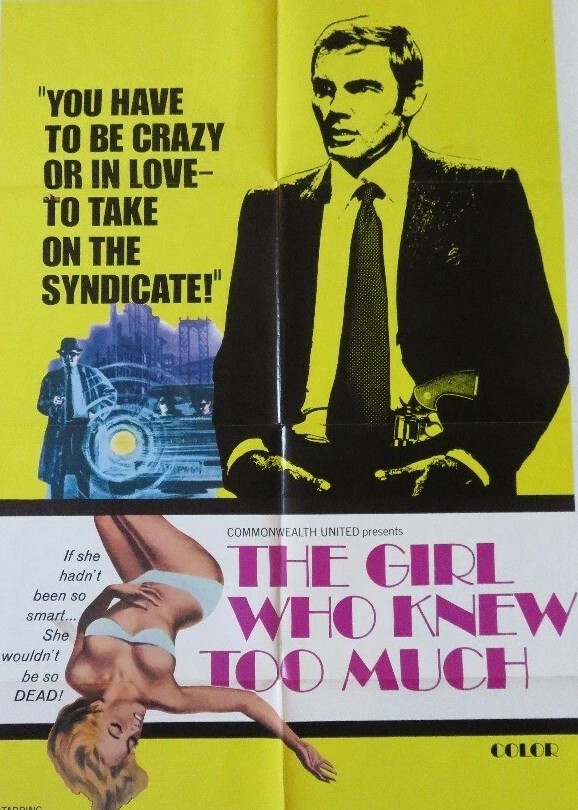
The Girl Who Knew Too Much (1969) ***

Prophetic plot is the best reason to watch this more considered feature from newcomers Commonwealth United. Another movie featuring a former star on the wane in Nancy Kwan. Again, one of those neo noir films which might have made a bigger splash with an actor other than Adam West, coming off the Batman television series and 1966 film, in the lead. A fair bit of philosophizing from the supporting cast.

The Mafia trying to go legit had been tackled in Point Blank (1967) and The Brotherhood (1968) and would be key to Michael Corleone’s machinations in The Godfather Part Two (1974), but here it goes into far deeper and more dangerous territory. At this point, organized crime was still run by the Mafia, but what if that and the legitimate big businesses and financial institutions they operated were prey to foreign interests.

Most movies  that involve Russian, Eastern European, Albanian or South American gangs taking over American criminal networks, usually by force, concentrate on the illegal activities rather than the legitimate and powerful businesses suborned through money laundering. Although here the plot is somewhat convoluted involving the CIA and priceless artefacts, the core asks the question – what would happen in the U.S. should the Mafia come under Far East control.

This occurs for the dumbest of reasons. One of the Mafia top hoods, part of the management committee, wants to be in sole control so he’s enlisted the help of Far Eastern bodies, not realizing that the foreigners intend it to go the other way, and that he is in their grasp.

A convoluted tale is an invitation to plot holes. Hard to imagine restaurateur Johnny Cain (Adam West) as a former top assassin when in three out of four tussles with gangsters he comes off worst. He’s tossed in the drink, chucked through a window and thrown out of a door.

And he’s only turned detective under duress. The Mafia force him to track down the killer of old-school gangster Tony Grinaldi (Steve Peck) otherwise they will take out a contract on him. His first port of call in Grinaldi’s girlfriend Revel Drue (Nancy Kwan), who had enjoyed a brief liaison with Johnny until her lover promised her a termination. Then old buddy Lt Miles Crawford (Nehemian Persoff), philosophizing cop, lends a hand. The CIA turn up the heat since someone is killing the great spies of Bermuda. The missing artefact, a solid gold statue of a Tibetan god, enters the mix. Grinaldi’s wife, drunken actress Tricia (Patricia Smith) is the secret lover of one of the top Mafia guys, Kenneth Allardice (Robert Alda).

Little chance of it being confused with the Hitchcock classic.

When one set of thugs aren’t trying to do away with Johnny, another bunch have Revel in their sights. But it turns out that the foreigners are backing Allardice, knocking off the other four members of his committee leaving him in sole control.

All the way through except clinging to Johnny and looking scared, Revel (“a small town girl who wanted a big city man”)  hasn’t had much to do, so I was expecting at the very least, once she turned the romantic screws on Johnny, that she would turn out to be a femme fatale in the pay of the foreigners. Turns out the femme fatale comes from a different source. Tricia has infiltrated the organization, either on her own account or on behalf of the government (it isn’t clear which). Marrying Grinaldi then launching into an affair with Allardice who, having conveniently got rid of his rivals, leaves her in pole position to head the group.

There are some neat touches. Johnny lives on a big yacht not the usual down-at-heel houseboat occupied by a down-on-his-luck private eye, a naked leg part of a naked body warming Johnny’s bed kicks over the phone when it interrupts her bed warming activities, the Mafia headquarters are atop a snazzy department store, the academic Johnny seeks out for information on the artefact is a part-time stripper.

But we’ve also got to suffer two whole songs from cabaret artists Lucky (Buddy Greco) which slows the tempo right down.

Nancy Kwan made an instant splash as the romantic lead opposite William Holden in The World of Suzie Wong (1960), a box office smash, for which she won two Golden Globes. Her star potential was quickly recognized, either top-billed or leading lady in her next seven films. But after Lt. Robin Crusoe, U.S.N. (1966) her marquee slipped and after making up the numbers in The Wrecking Crew (1968) her career never recovered. For sure, she held onto her place in the sun for far longer than Tippi Hedren (Tiger by the Tail, 1968) who was at one point the bigger star, but Hollywood burned through stars at a heck of a pace or dropped them altogether or sent them into the exploitation/B-picture hinterland – Kwan was the star after all of Wonder Women (1974) and Fortress in the Sun (1975).

Adam West barely found a place in the sun, five films, and supporting roles/bit parts at that, over the next decade represented a poor return.

Final film of director Francis D. Lyons (Destination Inner Space, 1966), an Oscar-winning editor, from a screenplay by Charles A. Wallace (Tiger by the Tail, 1968). Became something of a cult item on television.

Interesting concept but you need patience.
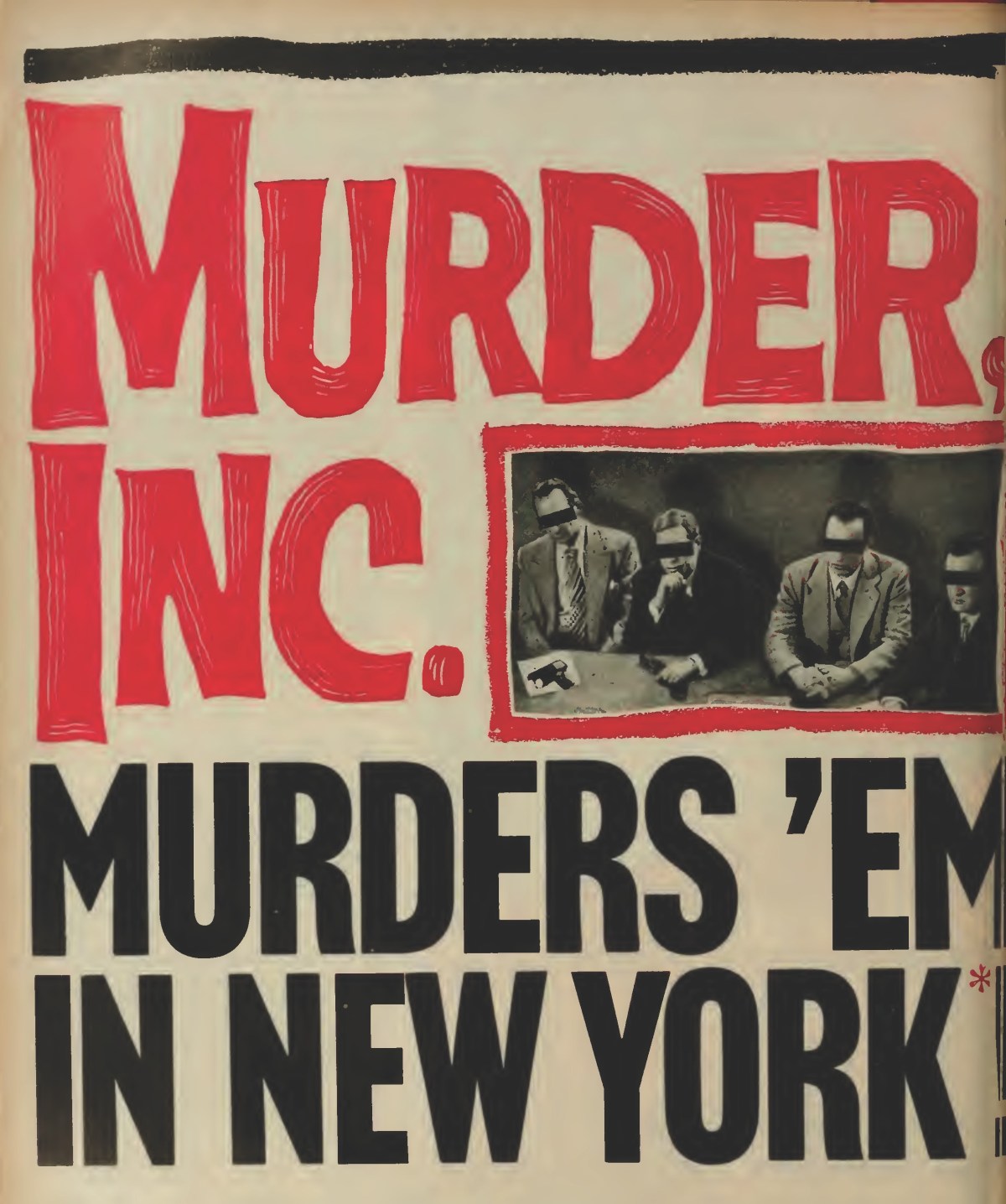
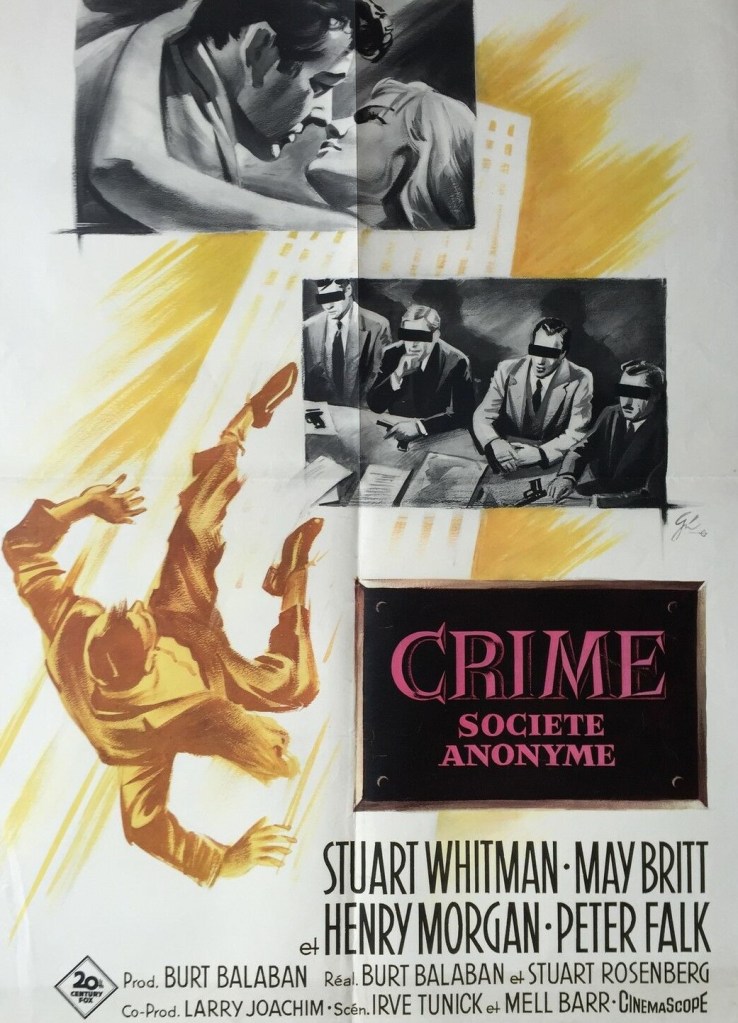
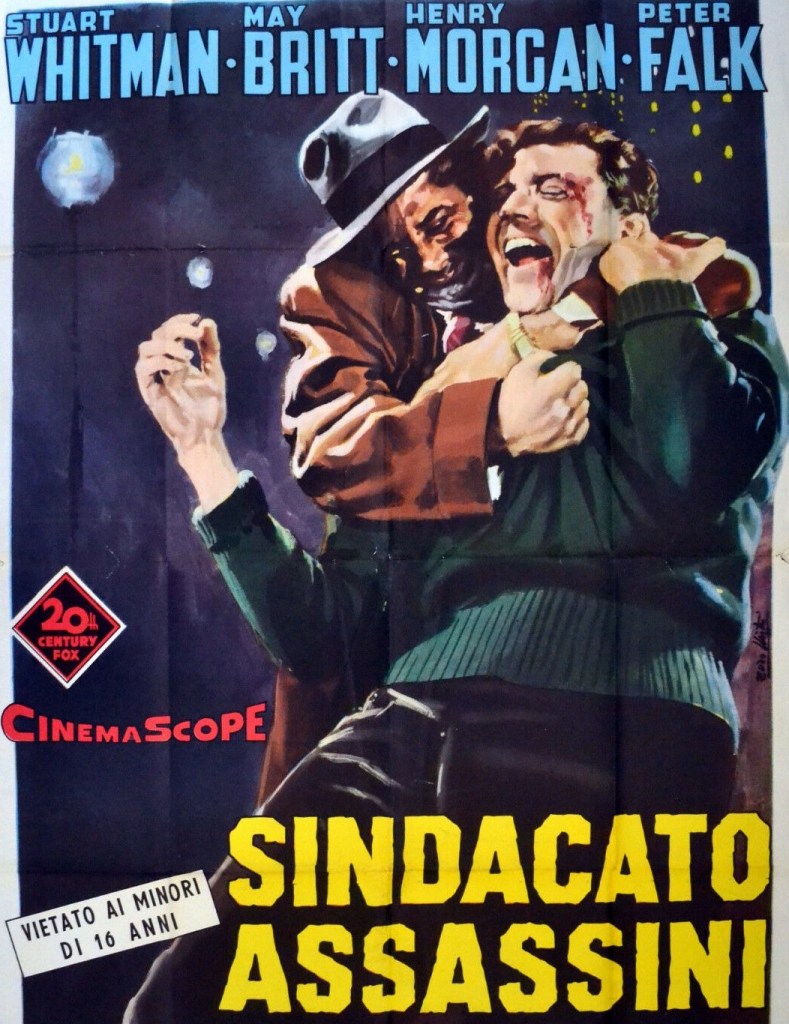
Murder Inc (1960) ***

A gangster trend hit the mean streets of Hollywood at the start of the 1960s. But in the absence of big box office hitters like James Cagney, Humphrey Bogart and Edward G. Robinson, these were all B films with unknowns or low-ranked stars in the leading roles. Whereas Little Caesar (1931), Public Enemy (1931), The Roaring Twenties (1939) and White Heat (1949) were fictionalized accounts of hoodlums, the gun-toting movie spree kicked off by Machine Gun Kelly (1958) and Al Capone (1959) was based on the real-life gangsters who had terrorized America’s big cities in the 1920s and 1930s.

By the end of 1960, moviegoers had been served up an informal history of the country’s best-known mobsters from Ma Barker’s Killer Band (1960), Pretty Boy Floyd (1960), The Rise and Fall of Legs Diamond (1960) and Murder Inc (1960). The infamy of the criminals was so comparatively recent that moviemakers assumed audiences had a wider knowledge of their exploits and the context of their crimes.

Murder Inc tells how underworld kingpin Lepke Buchalter – Tony Curtis played him in the more straightforward biopic Lepke (1975) – set up a system of killing dissenters in the ranks for the entire American Cosa Nostra (aka The Syndicate) in a way that prevented those ordering the murders being connected to those committing them, the same kind of protective cell operation used by terrorists. He created a separate organization of hitmen.

This quasi-documentary, with occasional voice-over narrative, focuses on three characters – the quiet-spoken Lepke (David J. Stewart), hitman Abe Reles (Peter Falk) and singer Joey Collins (Stuart Whitman) who becomes involved to pay off a gambling debt. Later on, the focus switches to Brooklyn assistant district attorney Burton Turkus (Henry Morgan), against a backdrop of massive police corruption, investigating the murder epidemic this deadly enterprise created. The films jumps around too much to be totally engrossing but it is certainly an interesting watch.

The two main villains could not be more different, Lepke representing the new school, a businessman, ordering killings but never participating, and for such a tough character tormented by a delicate stomach. Reles is old school, relishing opportunities to murder, and raping Collins’ honest wife Eadie (May Britt) in part because she treats him as scum. It’s hard to muster much sympathy for Joey especially as his wife takes the brunt of the violence.

In an Oscar-nominated performance Peter Falk (Castle Keep, 1969) steals the show as the chilling, venomous killer, the kind of nonentity who rises to prominence only through his penchant for homicide. Swedish star May Britt (The Blue Angel, 1959) isn’t far behind with a portrayal of a strong woman saddled with a weak husband. David J. Stewart (The Young Savages, 1961) only made three movies in the 1960s and his milk-drinking hood was as scary in his pitilessness as his more overtly violent underling.

Stuart Whitman (The Commancheros, 1961) is almost acting against type for he was later known for rugged roles. Henry Morgan (It Happened to Jane, 1959) gave his portrayal of Turkus similar characteristics to Lepke, appearing as a quiet individual, concerned with details,  except that he was incorruptible.

Simon Oakland (Bullitt, 1968) is an honest cop, Vincent Gardenia (Mad Dog Coll, 1961) is a lawyer, comedian Morey Amsterdam (The Dick Van Dyke Show, 1961-1964) plays a hotel manager, Sylvia Miles (Oscar-nominated for Midnight Cowboy, 1969) has a bit part and singer Sarah Vaughan is a singer.

For some reason, this movie starred a number of actors in leading roles who made few screen appearances. This was the only movie of the decade for May Britt, David J. Stewart made only three movies during the same period, and Henry Morgan only made three pictures in his entire career, this being the last.

The movie boasted two directors. Stuart Rosenberg (Cool Hand Luke, 1967) was replaced  by Burt Balaban (Mad Dog Coll, 1961) when the threat of strike action by actors and writers in 1960 forced the 18-day shoot to be cut by 10 days so it’s hard to say who was responsible for which scenes, although the film does boast some unusual aerial shots. Written by Irve Tunick (High Hell, 1958) and Mel Goldberg (Hang ‘Em High, 1968) from the book by Burton Turkus and Sid Field.

Killers are loose – and how!

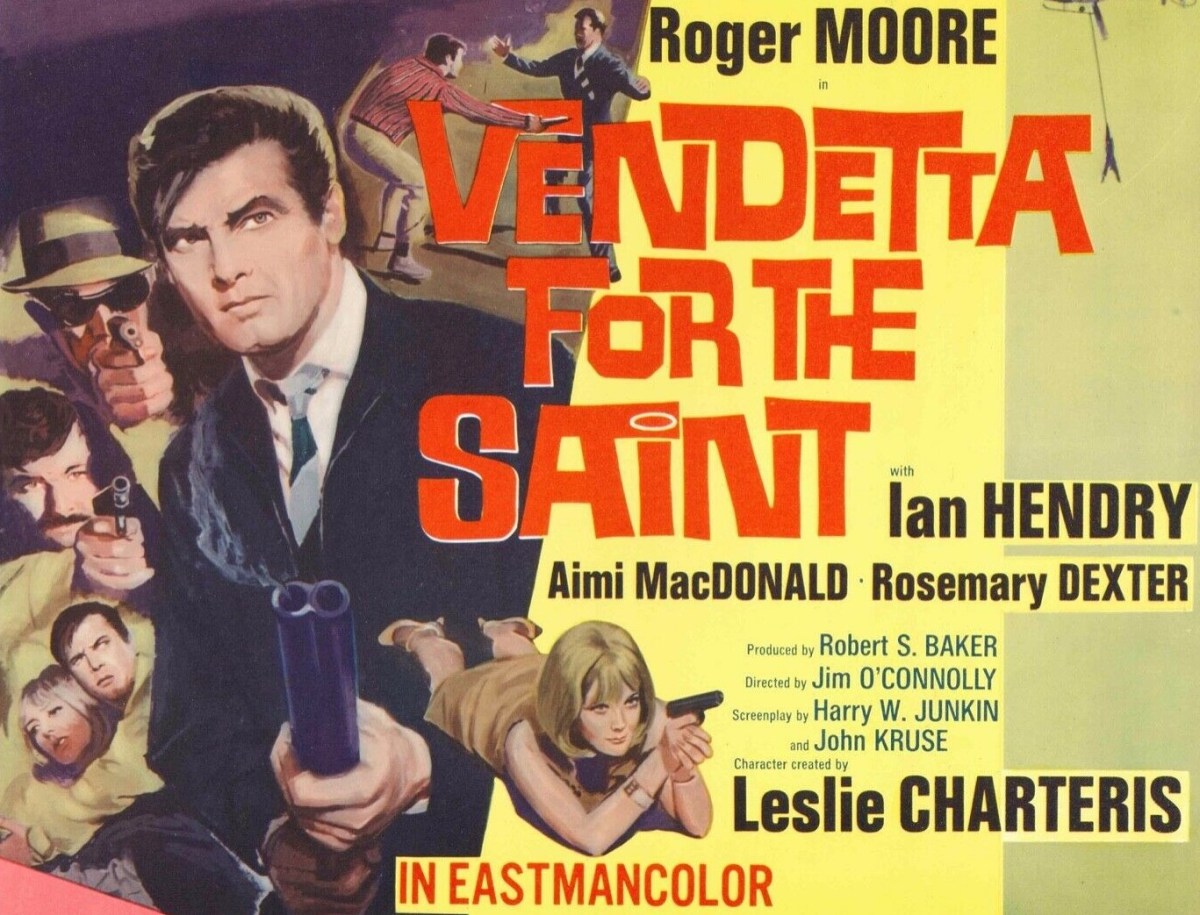
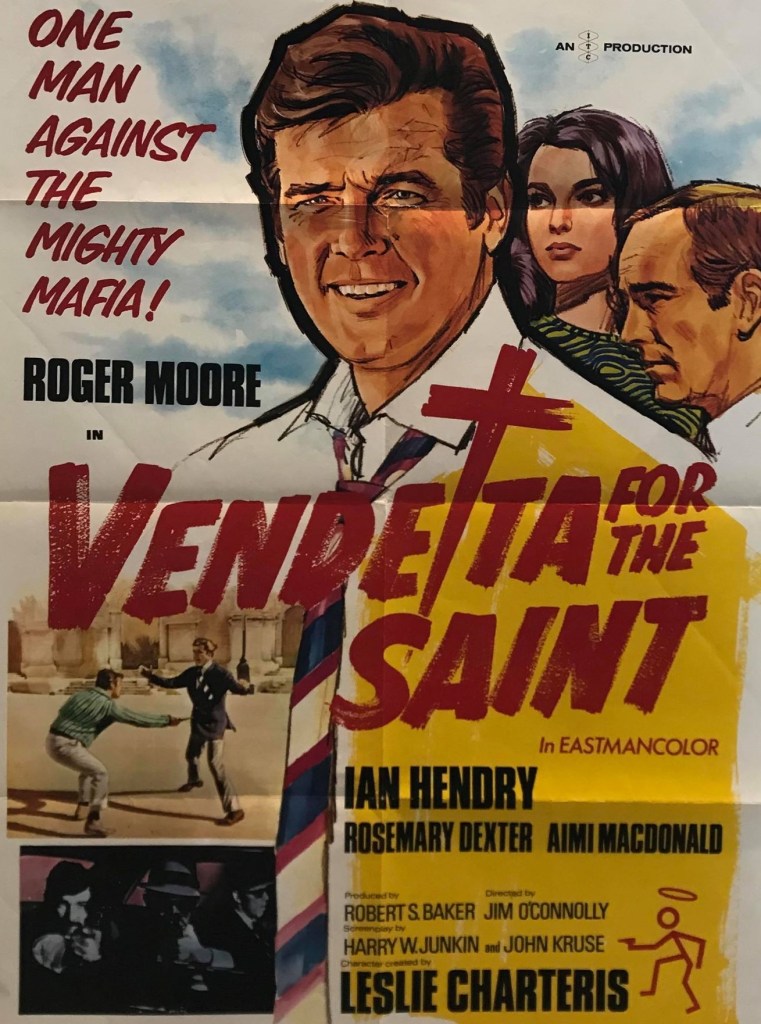
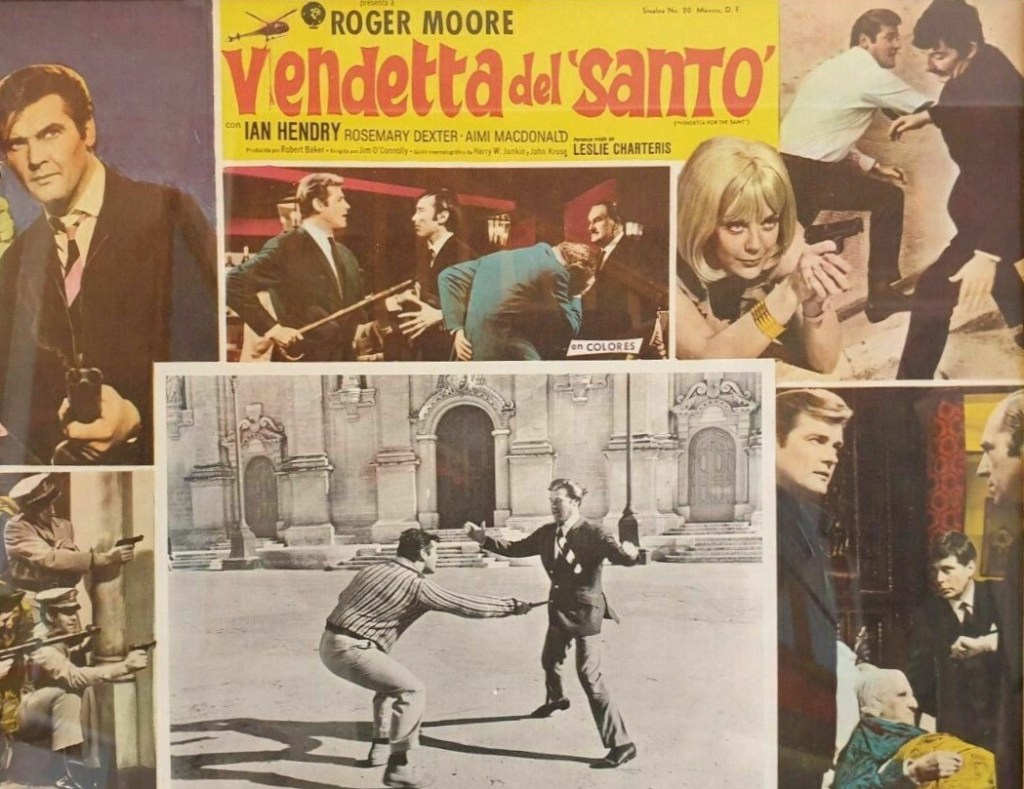
Vendetta for the Saint (1969) ***

This big-screen version of a small-screen hero is as pleasant a diversion as you can get. Nostalgia pretty much gives it a free pass and in any case the action, which punctuates the drama at regular intervals, was always going to be budget-restricted. Despite being in almost constant danger the insouciance of gentleman thief Simon Templar dictates that the pace is no more than languid.

As the title suggests, we’re in Mafia country, Templar (Roger Moore) drawn into a Cosa Nostra succession scenario as the result of a casual encounter with  former bank clerk Houston (Fulton Mackay), later found dead. Houston has cast doubts on the real identity of  Mafia Don Destiamo (Ian Hendry), one of several contenders to become the next Mafia overlord. Templar sneaks into Destiamo’s world by pursuing his niece Gina (Rosemary Dexter). Although outwardly respectable, Destiamo a bit too fond of using his cigar as a weapon of disfigurement, threatening his blonde English moll Lily (Aimi MacDonald) in this fashion.

Part of Templar’s attraction is that, although he has a nefarious side, he is happy to walk those mean streets and has a strict moral code. And he moves in such elevated circles that he has a nodding acquaintance with dying Mafia chieftain Don Pasquale (Finlay Currie) who has yet to pick his successor.

The other part of his attraction is that he’s played with such suaveness by Roger Moore. For a good chunk of the time someone is trying to knife him, shoot him, blow him up, capture him, jab him with a truth serum, and generally trying to stop him. In fending off such attacks, or out-smarting the villains, there’s rarely a hair out of place. It’s not so much devil-may-care as devil-is-wasting-his-time with such an imperturbable fellow.

Although the action is pretty straightforward, Templar is not above a clever ruse – jamming a bus in a gateway preventing his pursuers continuing the chase – nor an old one such as tying sheets together to climb out of a window. While Malta stands in for Italy, the locations still look authentic enough, ancient stone buildings, the occasional horse pulling a cart. When the action/drama eases up, there’s always pleasant scenery.

Following MGM’s success in stitching together into a movie two episodes of The Man From U.N.C/L.E. television series (which of course had pinched the idea from Walt Disney’s cinematic re-presentation of Davy Crockett episodes) it was no surprise that ATV, then under the control of future movie mogul Sir Lew Grade (Raise the Titanic, 1980), decided to adopt the same idea. Although The Saint had been showing on British television since 1962, by the end of its run in 1969 it had stepped up to bigger budgets, 35mm and colour. Given each episode lasted around 50 minutes, it was relatively simple to devise a two-part programme shown over consecutive weeks on ITV in Britain and then release it throughout the rest of the world as a feature film. The first such project was The Fiction Makers (1968) followed by Vendetta for the Saint.

Roger Moore’s movie career had been in limbo since Romulus and the Sabines (1961) and there’s no doubt that his performance as Simon Templar and later in another glossier British television series The Persuaders (1971-1972) made him a candidate for James Bond. While his interpretation of Templar, especially the wry delivery, does bear some similarities to his incarnation as 007, that only holds true as long as you set aside the year’s supply of Brylcreem dumped on his hair, the shoulder-padded shoulders and the fact that he had not yet perfected his trademark move, the raising of the single eyebrow.

While no match for the quips prevalent in James Bond, Canadian screenwriter Harry W. Junkin – best known for his television work, his only other movies being a similar melding of television episodes of The Persuaders – and John Kruse (Hell Drivers, 1957) – had some neat one-liners. Despite the obvious limitations, director Jim O’Connelly (Berserk, 1967) does a decent enough job.

But Moore carries the show. Ian Hendry makes a passable villain but not a passable Italian. In general, not surprisingly since most characters were played by British actors, the accents are all over the place though Moore, courtesy of squiring Luisa Mattioli (later his wife) manages to deliver his Italian lines in an acceptable accent. Otherwise, the only one who comes close is Rosemary Dexter (The Shoes of the Fisherman, 1968) and that’s because she was Italian. Worth checking out in the supporting cast are Finlay Currie (Ben Hur, 1959) and Fulton Mackay (BBC series Porridge, 1974-1977).

You can find a lot wrong with this without looking very hard but if you switch off your over-critical faculties you will be pleasantly surprised.

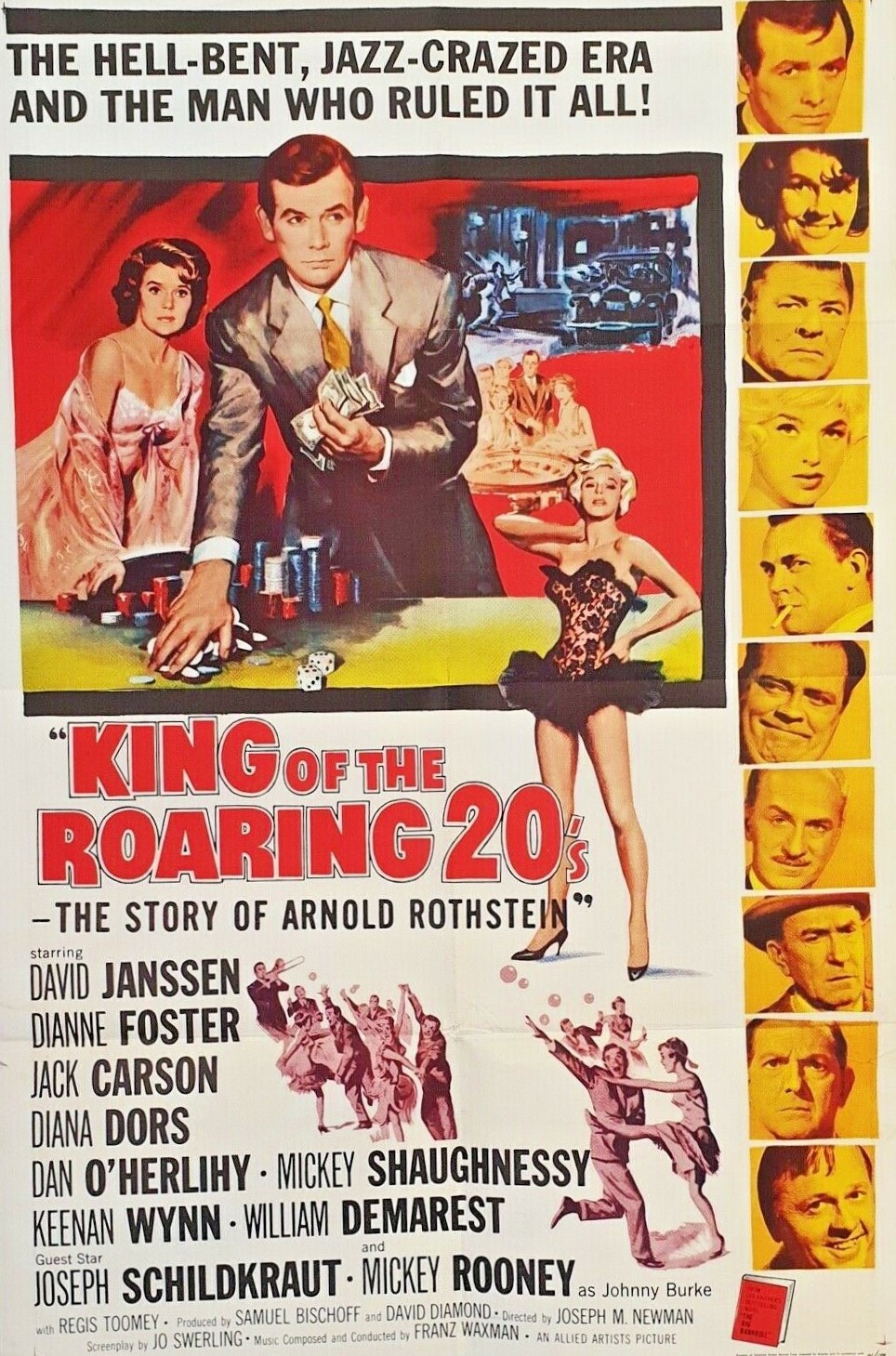
King of the Roaring 20s (1961) ***

Occasionally stylish B-picture purporting to tell the story of American Prohibition-era gangster Arnold Rothstein. It’s more of drama with various nefarious figures trying to outwit each other rather than a shoot ‘em up in the style of Al Capone (1959). David Janssen (Warning Shot, 1967) is ideal casting as the thoughtful, cold, calculating and possibly gambling genius Rothstein, the opposite of an intemperate crook like Capone.

The story is told essentially in two parts, Rothstein’s rise to power in partnership with childhood pal Johnny Burke (Mickey Rooney), initially running dice games in the street and  pulling the odd con before graduating to fly-by-night horse racing operations. When the opportunity arises to move into mainstream illegal gambling, he dumps Burke. Corrupt cop Phil Butler (Dan O’Herlihy) is a constant thorn in his side and showgirl fiancée Carolyn Green (Dianne Foster) views marriage as risky – “he’s the gambler but I’m the one that’s going to be doing the gambling.”

For whatever reason, the movie dodges what was believed to be Rothstein’s biggest coup, the fixing of the baseball World Series, but one long section is devoted to how he pulls off a massive horse racing win where he ends up placing a $100,000 bet through insider information and strategic betting. Inevitably, his gambling puts the kibosh on his marriage but by far the most interesting part of the picture is the chicanery as he shakes off one partner, battles another, and without compunction sets up Burke as patsy to settle his score with Butler.

In some respects Rothstein is a template for Vito Corleone (The Godfather, 1972) in terms of his business brain and ability to out-think and out-fox opponents and certainly his facial expressions and innate coldness bear comparison with what Al Pacino brought to his characterization of Michael Corleone. Except that he didn’t trust banks, and carried round wads of cash (hence the title of the biography on which this is based – The Big Bankroll), it’s hard to get a sense of the wealth the gangster generated or, given the minimal violence,  the world of imminent peril he inhabited. 

Period detail is cursory, limited to dancing the Charleston and pouring champagne into teacups. A better idea of the flavor of the times is the wholesale corruption endemic in police departments, untrustworthy lawyers and hypocrisy run wild.  It’s not really Janssen’s fault that it’s hard to warm to such a cold-blooded character, although you could point to The Godfather and The Brotherhood (1968) for that matter as examples of Mafia hoods who do elicit audience empathy.

With occasional bravura moments involving long tracking shots and overhead shots, and a terrific image of champagne bubbles seen through a pair of binoculars, director Joseph M. Newman (This Island Earth, 1955) shows stylistic flourishes that eschew his B-movie roots. Given Janssen is called upon to show as little emotion as possible, he does very well. Dianne Foster (The Last Hurrah, 1958), though initially demure, provides the fireworks. Jack Carson (The Bramble Bush, 1960) as kingpin Tim O’Brien matches Janssen in the cool stakes and proves a worthy adversary. Rooney overacts but Dan O’Herlihy (The Night Fighters, 1960) relishes his dirty cop role.

In a rare Hollywood outing British sexpot Diana Dors (Hammerhead, 1968) puts in an unexpected and brief appearance as Carolyn’s cynical flatmate. The tremendous supporting cast includes Keenan Wynn (Point Blank, 1967), Mickey Shaughnessey (North to Alaska, 1960), Regis Toomey (The Last Sunset, 1961), Oscar-winner Joseph Schildkraut (The Diary of Anne Frank, 1959) and veteran character actor William Demerest.

Jo Swerling (It’s a Wonderful Life) delivers a pointed screenplay focusing on gangster conflict with some excellent observation of the deterioration of the Rothstein marriage and the nervousness of the usually ice-cold Rothstein when confronted by his father. This is one of those pictures that you think deserves a Netflix series, a dozen or so episodes to explore the myriad characters involved and especially to examine Rothstein in forensic detail. The movie spells out that potential and on a tight budget does it well.

Stiletto (1969) ***

The bursting of the B-movie bubble dealt a death blow to the careers of the two stars here. In the past, rising talent who failed to make the marquee grade could find almost a lifetime of contentment in low-budget westerns, neo-noir thrillers and down’n’dirty exploitationers with the hope of an occasional supporting role in a bigger picture to ease their path. By the end of the decade, just about the only option were Roger Corman biker flicks or spaghetti westerns. Especially if they had gone down the tough guy route, B-pictures might have provided an exemplary move for both Alex Cord and Patrick O’Neal. As it was, this was their last shot at the big time. And it was lean pickings.  

Retirement can be a tough call any time for a high-flying businessman. But when you’re at the top of your profession in the Mafia, loosening such ties can prove problematic. Count Cesare (Alex Cord) is a part-time assassin, spending the rest of his time as a fun-loving playboy with a string of women, fast cars and racehorses. Only problem is, he wants to retire from the Family – and not in normal fashion, weighted down by a block of cement. Unfortunately, his dilemma doesn’t solicit sympathy from boss Matteo (Joseph Wiseman).

Adding to his problems is tough cop Baker (Patrick O’Neal) on his tail who fastens onto illegal immigrant Illeana (Britt Ekland), Cesare’s girlfriend when he’s not pursuing Ann (Barbara McNair). A strictly by-the-numbers thriller it’s enlivened by two underrated tough screen hombres. Alex Cord (The Brotherhood, 1968) isn’t given enough of a character here to  tug at audience heartstrings although elsewhere he had proved better-than-expected value. If anything, he’s an existential kind of hero.

Cord made a brief splash as an action hero in the monosyllabic Clint Eastwood/Charles Bronson mold after debuting in the John Wayne role of the Ringo Kid in the remake of Stagecoach (1966) and didn’t have more than half a dozen stabs at making his name on the big screen before disappearing into the television hinterlands. So he’s something of an acquired taste, maybe the small output enough to qualify him for cult status. Here, he’s a decent fit for the violence but saddled with a role that makes little sense.

Patrick O’Neal (El Condor, 1970) followed a similar career trajectory, swapping television with the occasional movie and even managing a screen persona as a snarky type of villain/supporting character. A few more tough-guy roles and he might well have built a stronger footing in the business.

This is another thankless role for Britt Ekland (Machine Gun McCain, 1969), there to add glamor, but, surprisingly, she manages to bring pathos to the part. Barbara McNair (If He Hollers Let Him Go, 1968), always worth watching and who had made an auspicious debut the year before, hardly gets any screen time. 

Director Bernard L. Kowalski (Krakatoa, East of Java, 1968) proves better at the action than the characterization, though, luckily nobody needs to be anything other than tough. Three scenes, in particular, are well handled – the opening murder in a casino, a shoot-out a penthouse and the climax on a deserted island which has more than a hint of a spaghetti western. Joseph Wiseman (Dr No, 1962) rustles up another interesting performance and collectors of trivia might note Roy Scheider (Jaws, 1975) putting in an appearance.

This old-style tough-guy thriller would have been better off had the Cord vs. O’Neal set-up taken center stage, with the assassin on murderous overkill hunted down by the zealous cop. As it is, it’s a missed opportunity for Cord to develop an Eastwood/Bronson persona and enter the action star hall of fame.

Based on a thin Harold Robbins bestseller, the screenplay by W.R. Burnett (The Great Escape, 1963) and A.J. Russell (A Lovely Way to Die, 1968) doesn’t take any prisoners.

Doesn’t quite deliver what it says on the tin, but interesting to see Cord and O’Neal battle it out.

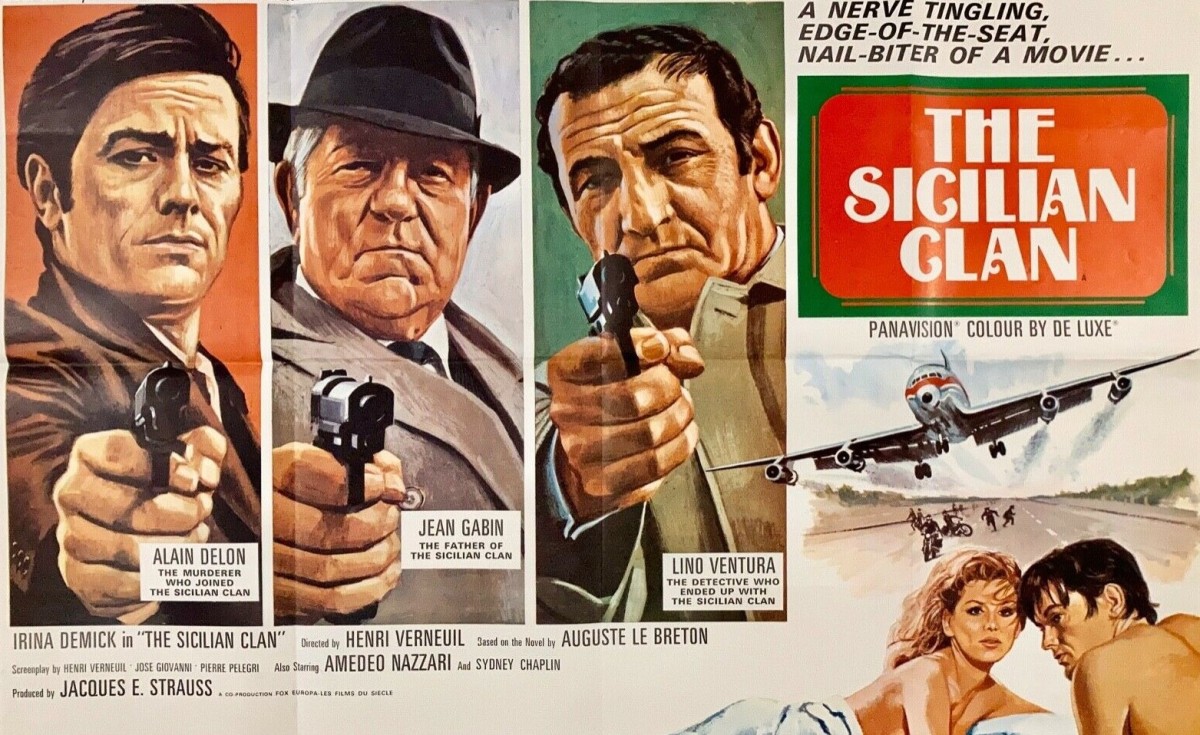
The Sicilian Clan / Le Clan des Siciliens (1969) *****

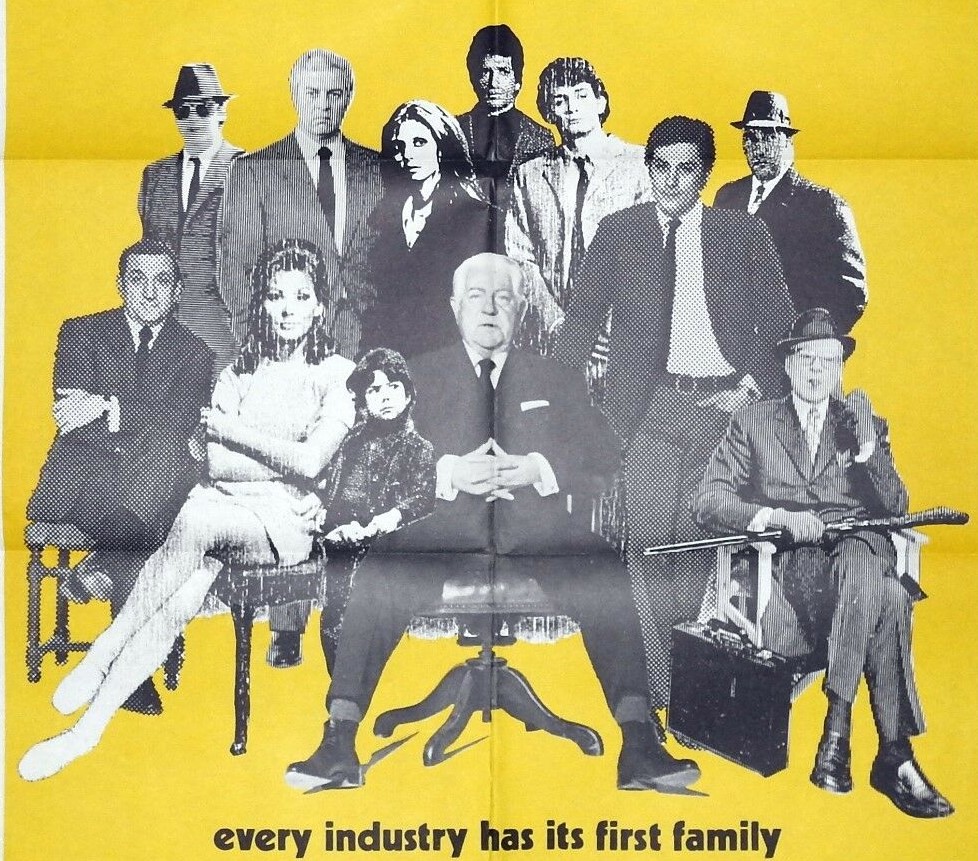
Absolutely cracking, brilliantly structured, gangster thriller featuring two fabulous heists and three legendary French stars in Jean Gabin, Alain Delon and Lino Ventura. Roger Sartet (Delon) is a trigger-happy robber whose terrific prison escape is organized for a hefty fee by French-based Mafia chieftain Vittorio Manalese (Gabin). Le Goff (Ventura) is the rugged cop hunting down the escapee which brings him into the orbit of Manalese, about whose existence he is completely unaware, the gangster having kept an extremely low profile, never engaging in violence, hiding behind the legitimate front of a pinball machine business.  Veteran French director Henri Verneuil (Guns for San Sebastian, 1968) dukes between the twin storylines with ease.

Sartet brings Manalese the opportunity to pull off the most audacious jewel robbery in history, even though the older man despises Sartet’s penchant for violence and sex. We often see Manalese at family gatherings, head of the dinner table, the family watching television together, frowning on one son’s liking for alcohol, playing with his grandson. He is not just a calm and clever businessman, but very quick-thinking, his sharp mind in a couple of instances preventing disaster. Sartet, on the other hand, will happily endanger his life and freedom by consorting with prostitutes and breaking an unspoken code of honor in an affair with Manalese’s son’s wife (Irina Demick).

The result combines dogged detective work by Le Goff and the inspired planning and execution of the jewel robbery until the two worlds collide. The investigation alone would have made this an outstanding picture. Le Goff, always seen with an unlit cigarette in his mouth although he is trying to give up smoking, concentrating initially on Sartet, sets up surveillance on the thief’s innocent sister and begins an involved – and engrossing – process of tracking down every potential lead and when at last he has Sartet in his sights it brings him up close to Manalese.

Le Goff’s professionalism is matched by that of Manalese and the picture develops into an absorbing battle of wits and the latter’s family values and moral compass puts him at odds with loner Sartet. There is some brilliant invention, the sacrificial watch, for example, and the unexpected appearance of a faithful British wife, although you do guess just how long Le Goff will go before lighting his ever-tempting cigarette. 

The ultra-cool Alain Delon (Once a Thief, 1965) excels in this kind of amoral part, but Jean Gabin (Any Number Can Win, 1963) and Lino Ventura (Army of Shadows, 1969) as old-style gangster and cop, respectively, steal the show. Irina Demick (Prudence and the Pill, 1968) thrives as the bored wife of a dull gangster who is attracted by the violent Delon, at one point deliberately putting herself in the line of his potential fire for the thrill. Actually, it’s the jewel heist that steals the show. Unlike other heist pictures where you have fair idea in advance of the details of the theft, here the audience is kept completely in the dark. Just as important in any heist is that the thieves get away with their plunder and the plan in this instance is breath-taking.

As proved by The Burglars (1971) director Henri Verneuil has the nose for a heist, but this tops that for sheer audacity and elan. Verneuil, Delon and Gabin had worked together on Any Number Can Play. Written by Verneuil and Jose Giovanni (Rififi in Tokyo, 1963) from the novel by Auguste Le Breton (Rififi, 1965).

Preceding The Godfather (1972) in its exploration of family and Mafia code of conduct, it offers plenty in the humanity department while dazzling with ingenuity in the criminality stakes.

Unmissable.

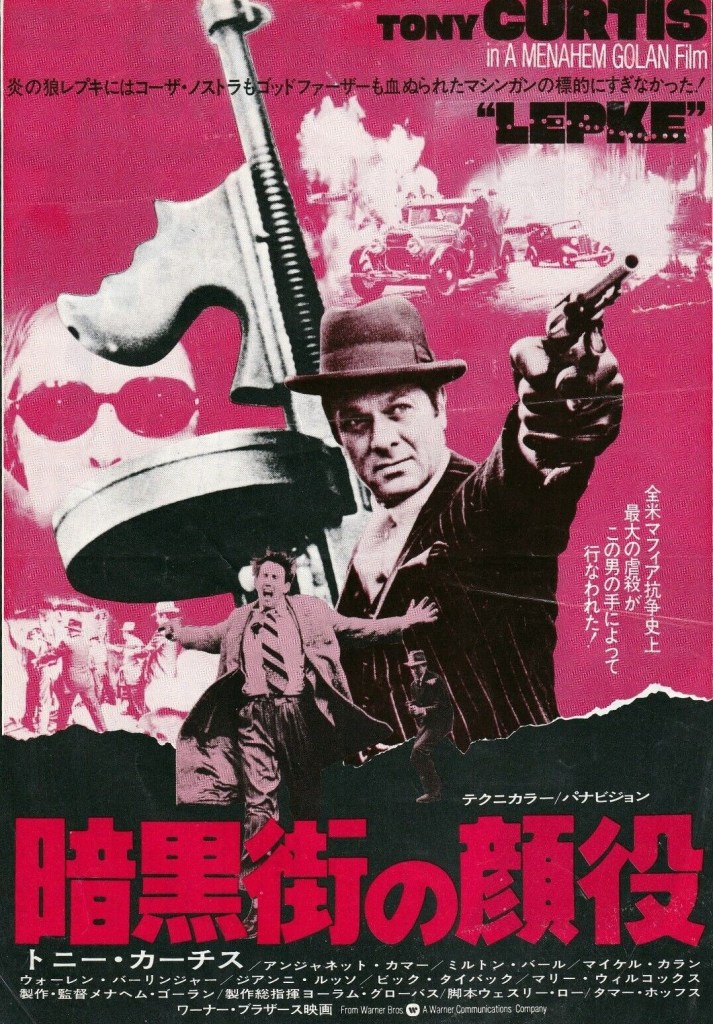
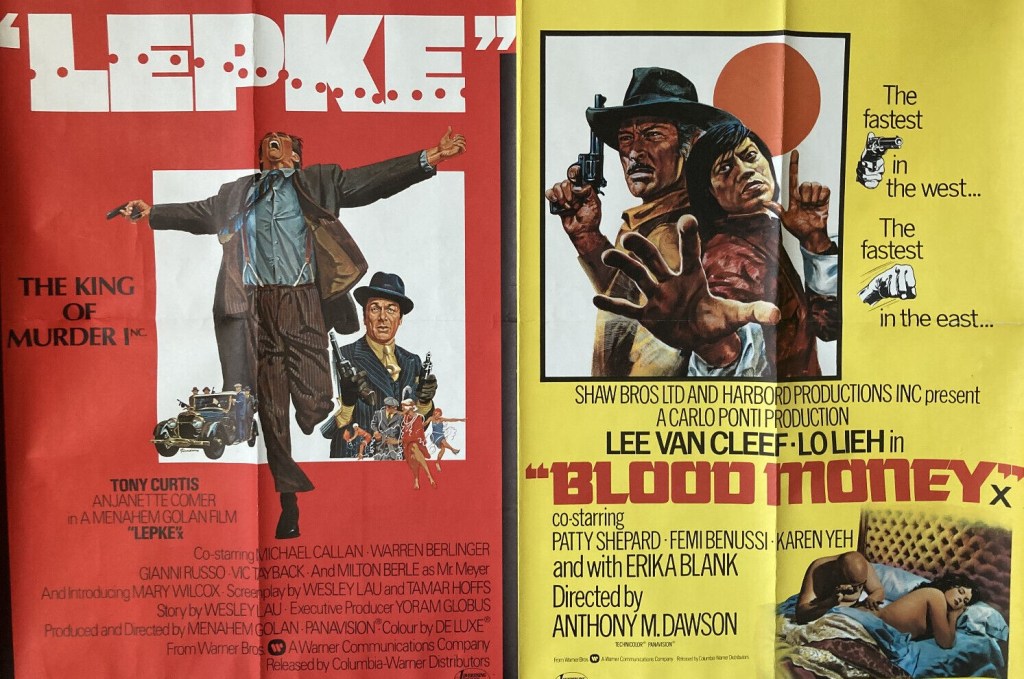
Lepke (1975) ***

Gangsters are just the same as you and I. They want to be loved, they want a family, they want the kind of respect that isn’t achieved by just pointing a gun at someone. The Godfather (1972) led the way in subtly reminding us that gangsters were human beings even if it was more seductive in making us believe we should excuse their criminal tendencies. Lepke spends as long on romance and trying to win the approval of the bride’s father as it does on the character’s perfidy. The idea that marriage cannot so much absolve you of your sins but provide an oasis of calm inside a murderous world is one only a true romantic would consider pursuing. As is the notion that a wife would forgive you your sins because her love would outweigh your actions, in the same way as the wife-beaten wife (as shown in Love Lies Bleeding) still loves her husband no matter how brutal the treatment meted out.

Lepke has got reason to be sore with the world. He was left out of the gangster chronicles. An important part of the Murder Inc operation, he was ignored when Hollywood passed judgement on such criminal enterprises. And you get the sneaky feeling his life story was only revived because after the Coppola epic his was one of the few tales untold in the gangster chronicles.

“If there’s any good in him, that’s the part I’ve got,” says wife Berenice (Anjanette Comer), “If I was a whore I could leave him.” And you can see the part she adores, not only respectful to the point of being obsequious to her upstanding father Mr Meyer (Milton Berle), but charming and romantic with her and he’s clearly able to separate business from romance, turning into an exemplary family man (but then so, too, did Don Corleone).

Which is just as well because Lepke (Tony Curtis) is a dreaded Mafia enforcer, forming a murder syndicate with Dutch Schulz (John Durren)  and Lucky Luciano (Vic Tayback) that takes responsibility for knocking off anyone who steps out of line away from the big bosses. There’s some standard gangster stuff, machine guns in violin cases, bombs in the spaghetti, but also some interesting touches, a shoot-out on a carousel, and of course the last person a gangster can trust is the one he places his truth with. Double-dealing is the order of the day.

Like all the top gangsters, Lepke is an entrepreneur, expanding out of the killing racket into dope, extortion and trade unions. New York D.A. Thomas E. Dewey is on the Murder Inc case and his assassination is only prevented by the intercession of Lepke. But he’s tackled as much by Robert Kane (Michael Callan), friend to Berenice who works in narcotics along with Dewey.

Dewey’s not the only real-life character making an entrance. Legendary journalist Walter Winchell (Vaughn Meader) plays a significant role. Most of the picture involves Lepke  being nefarious by day and loving at night and the gang are only tripped up when witnesses need to be eliminated and as the cops work a similar kind of dodge to the one that snared Al Capone. Instead of tax evasion it’s anti-trust issues.  

Covering the period from 1923, Lepke’s emergence as a ruthless street rat, and his development of the narcotics business by sourcing product direct for the Far East,  to his execution in 1944, it pays only cursory attention to the period. Most of the time, Lepke is fighting for his life one way or other, suspicious of colleagues, walking a knife-edge between actions that could inavertently lead to his demise, and trying to remain the best part of himself that remains appealing to his wife.

That any of this works other than being a standard depiction of the rise and fall of a gangster is down to Tony Curtis (The Boston Strangler, 1968) who delivers one of his best later performances while maintaining a difficult balancing act, clearly believing that he can separate the two sides of his personality, and that the murderous part is really just a performance. The documentary-style rendition helps as this can be complicated stuff, especially with so many disparate traitors.

Anjanette Comer (Guns for San Sebastian, 1968) is always watchable.  Menahem Golan, of Golan-Globus and Cannon fame, perhaps taking a cue from The Godfather, takes considerable care with the family elements and is rewarded with a better picture than the elements might suggest.

This pretty much rounds out my Hollywood History of the Gangster.

Machine Gun McCain (1969) ***

Armed robbers lack the finesse of a jewel thief or burglar when it comes to pulling off a major heist. Rather than resorting to the weaponry of the title, they are more inclined, as John Cassavetes does here, to plant bombs, both as a diversionary tactic and within the target building, in this case a Las Vegas casino.

Although boasting Hollywood leads in Cassavetes and Peter Falk and rising Swedish leading lady Britt Ekland (The Double Man, 1967) and wife of star Peter Sellers, this was an Italian-made gangster thriller with the usual abundance of location work. Without the romantic complications of A Fine Pair (1968) it concentrates on the machinations of the central characters.

And it is a pretty lean machine. The robbery takes place against the background of warring Mafia chieftains, West coast boss Charlie Adamo (Peter Falk) trying to muscle in on a Vegas casino without being aware it is controlled by the New York hierarchy. Hank McCain (John Cassavetes) does not realize the robbery has been set up by his naïve son Jack (Pierluigi Apra) on behalf of Adamo. Irene Tucker (Britt Ekland) is on board as a kind of mostly mute magician’s assistant, helping out Hank.

Little dialogue comes Cassavetes’ way, either, which plays to his strength, that glowering intense unpredictable weasel-face, whose reactions are less likely to be emotional than violent. Falk gets the dialog and little help it does him, his goose is cooked when he has the temerity to shout at the New York kingpin. 

Yet this slimmed-down documentary-style hard-nosed picture in the vein of Point Blank (1967) manages several touching moments, even more effective for completely lacking sentimentality. When Hank’s son is knifed in the back, the gangster finishes him off with a burst from the titular machine gun rather than see him suffer. His old flame Rosemary (Gene Rowlands), making too brief an appearance, has a wall covered in newspaper headlines of herself with Hank celebrating her life as his moll and she accepts without enmity the new woman in his life and she proves the toughest moll of all when confronted with Mafia gunslingers.. 

The planning of the heist is well done, no explanatory dialog, just action on screen; there’s a car chase; and the gangster dragnet is unexpectedly powerful. Gabriele Ferzetti (the railroad baron in Once Upon a Time in the West, 1968) is excellent as the calm authoritative New York boss, Falk a bit too excitable, and Florinda Balkan (The Last Valley, 1971), in her third screen role, has a small part as a traitorous moll. Ekland is surprisingly good with not much to play with, a couple of lines here and there but still emoting with her face.

Cassavetes, who always claimed he was only acting to fill in the time between directing  (Faces, 1968), and as a means of financing them, was at a career peak, Oscar-nominated for The Dirty Dozen (1967) and male lead in Rosemary’s Baby (1968). He had just appeared in another Italian gangster movie Bandits in Rome (1968). Cassavetes and Falk would go on to have a fruitful partnership over another five films. Falk and Ekland had played opposite each other in Too Many Thieves (1967). Falk also had an Oscar nod behind him for Murder Inc. (1961) but his career was about to go in a different direction after the TV movie Presciption: Murder (1968) that introduced Columbo.

Trivia trackers might also note a score by Ennio Morricone. Though not one of his best, a few years later he would deliver one of his most memorable themes for Sacco and Vanzetti (1971) for the same director Giuliano Montaldo.

Violent City /Family (1970) ****

Of all the lazy, incompetent streamers this has to take the biscuit. Not content with branding as new films made over half a century ago, now we have films being screened which clearly nobody has bothered to watch even once. Otherwise, how to explain a picture where the language lapses into Italian at critical moments without the benefit of sub-titles.

Which is a big shame because, confusing through the movie is, it takes an unique approach to the femme fatale angle and serves up a noted screen tough guy as one whose heart is genuinely broken – suck that up, pale imitators going by the name of Stallone, Schwarzenner, Willis et al.

Post-Bullitt (1968) but pre-The French Connection (1971) we open with a dazzling car chase where the pursued race up stairs rather than down as is the current trope and batter their way through closely-packed streets in the Virgin Islands. That’s before wannabe retired assassin Jeff (Charles Bronson) is gunned down, although he’s still capable of diving under a burning car to escape immediate detection.

Jeff is on the lam with lover Vanessa (Jill Ireland). Dumped in jail with time to repent (no, strike that), mull over his circumstances, in the meantime dodging a tarantula (a real one!) crawling over his body, and coming to the conclusion that the moll has set him up and has returned to her previous lover, ace racing driver Coogan (no idea who plays him, imdb doesn’t know either). Despite having abandoned his profession, Jeff, not getting the hang of the broken-hearted moping malarkey, decides he’ll come out of retirement for the usual one last job, this time laying waste to Coogan.

But someone spots him and he’s blackmailed by Mafia chief Weber (Telly Savalas) into continuing his murderous ways. But here’s a sting in the tail – a wonderful twist to end all twists: Weber is Vanessa’s husband. She’s not a femme fatale at all just a sexual butterfly who dances from one lover to the next with Weber’s tacit approval.

But, in fact, in another twist, she is, after all, the femme fatale to end all femme fatales, setting up Jeff to bump off Weber so that she and attorney lover (what, another one) Steve (Umberto Orsini), Jeff’s best buddy, can take over her husband’s organization now that it has gone legit. And in the final twist to end all twists this ends with Jeff’s broken heart turning him suicidal (beat that Schwarzenneger, Stallone, Willis et al).

This is a very down’n’dirty Italian thriller, dashing from deadbeat locale to Southern Belle balls, from rusting riverboats to swampland, from factories to fashion shoots, the confusion factor infused further by the sudden incursions into Italian, often in mid-scene, as if this was some kind of artistic coup, determined to leave the viewer baffled.

Despite going the whole nine yards in the broken-heareted department, Jeff isn’t quite the full-blown romantic, an attempted rape of Vanessa in New Orleans only interrupted by (wait for it) three thugs beating another character to death. Naturally, Jeff isn’t the kind of good bad guy who intervenes, and these characters, even more naturally, have nothing to do with the plot (except as Jeff points out it’s a violent city after all). But what the hell, it’s that kind of film.

I’ve cutting Amazon Prime a big break here with my rating, because despite the language problems, it’s a cut above your normal thriller, and Charles Bronson (Red Sun, 1971) before being typecast by Death Wish (1974) gives a very good account of himself, certainly a lot more to do than just grimace, and, heck, you even feel sorry for him twisted inside out by emotion. Telly Savalas (A Town Called Hell, 1971) is a bit more polished and emotionally aware than his usual villain.

You might be tempted to call Jill Ireland (Rider on the Rain, 1970) the stand-out. She still can’t act for toffee, but she is well suited to playing this kind of jinxed minx, whose beauty snags dupes well below her league. And (spoiler alert) she does let it all hang out, indulging in copious nudity.

Directed with some flair by Sergio Sollima (The Big Gundown, 1967) and extra marks for coaxing unusual performances from the three principals. Six screenwriters (can’t you tell) put this together including Lina Wertmuller (The Belle Starr Story, 1968). Great score by Ennio Morricone.

Given I couldn’t understand half of what was going on thanks to streamer disinterest in sub-titles, I was still very impressed. Worth a watch.

NOTE: Amazon Prime has this under the title Family but once the credits roll it switches to original title Violent City.

Youtube has the trailer.

Behind the Scenes: Dear Mr Scorsese…or Mr Nolan

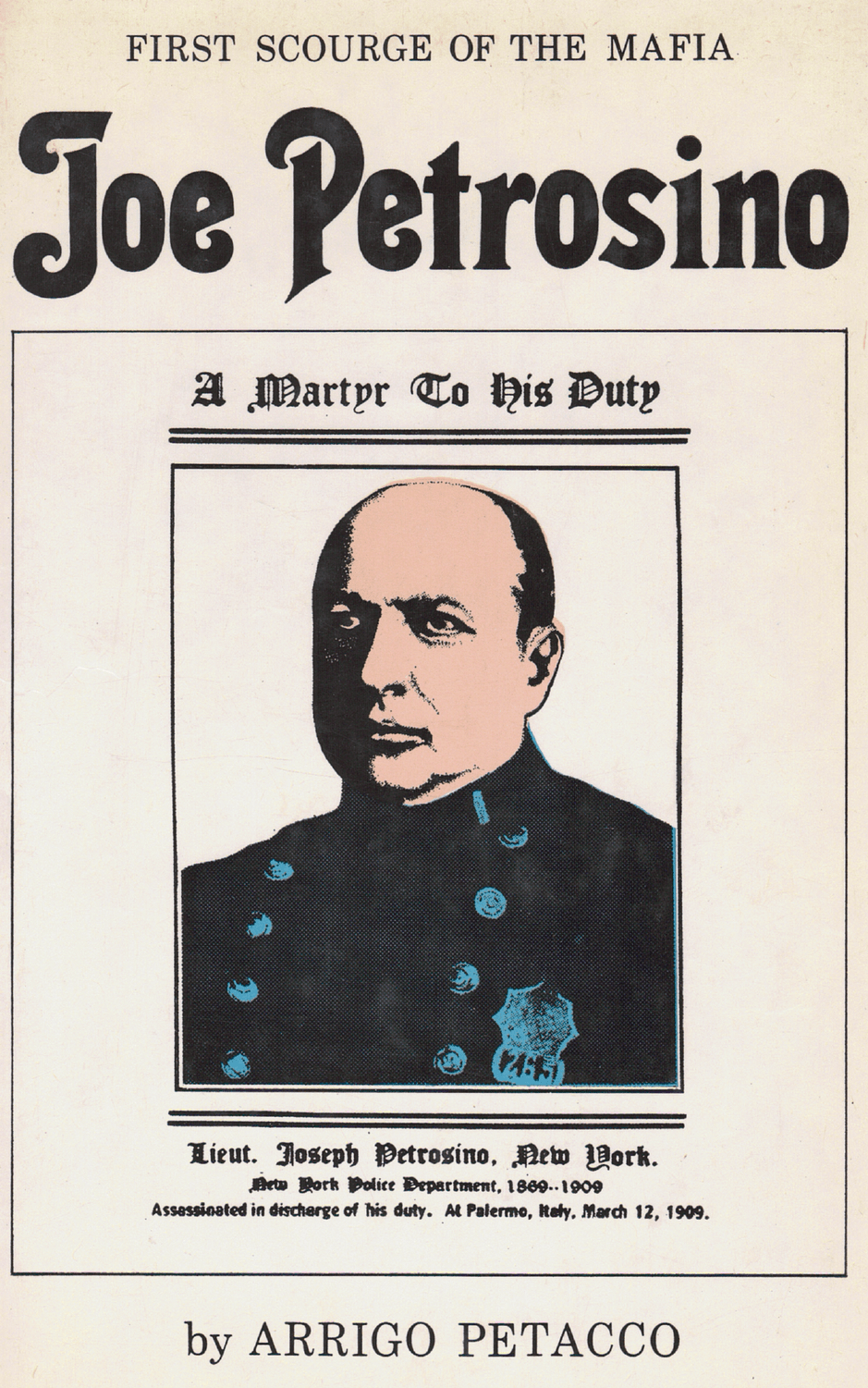
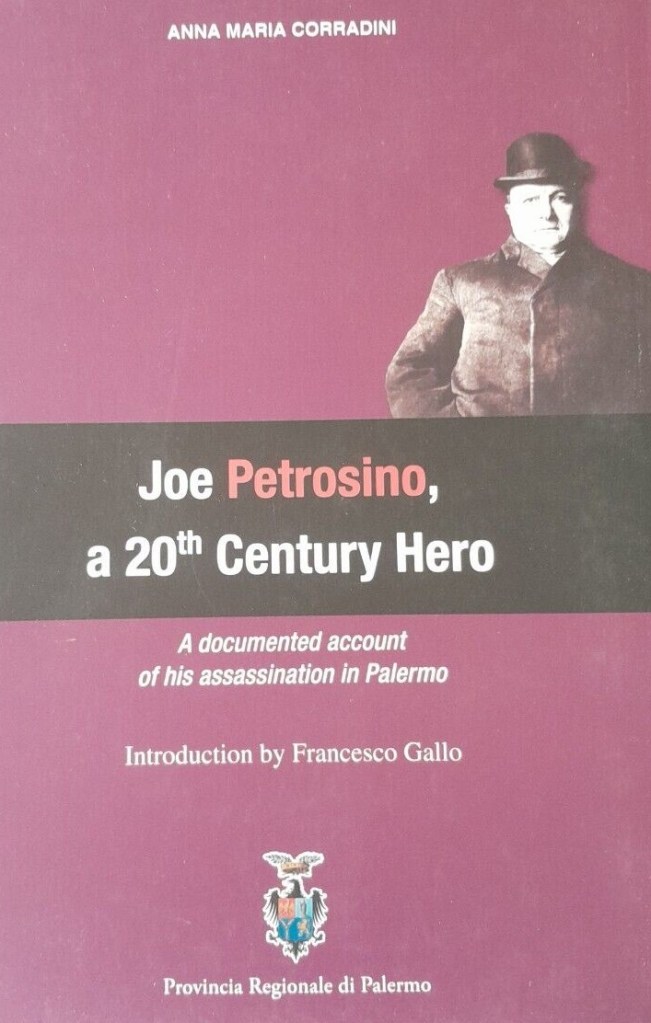
Should you be in the mood for atonement after a lifetime of deifying gangsters, Mr Scorses, you might wish to consider a biopic of the greatest cop, outside of Elliott Ness and Serpico, in American history. I’m sure Leonardo DiCaprio, who was at one time attached to a filmization of the bestseller The Black Hand (2017) by Stephen Talty, has brought the subject matter to your attention. Although Pay or Die (1960) covered similar territory, its budget and restrictions of length denied it the opportunity to properly explore the historical depth and social comment, for which in Killers of the Flower Moon (2023) you now seem more at home.

After the success of Oppenheimer (2023) audiences might be receptive to a true story about a cop who took on the Mafia a.k.a. the Syndicate a.k.a. the Cosa Nostra before it was known by any of those names and there is, to boot, a heart-rending romance that the Ernest Borgnine picture barely touched upon.

I’ve even dreamed up an opening.

A horse pulls a wagon laden with oranges and apples through a congested New York street circa 1883. As the driver pauses to make a delivery, a child, Claudia, watches from the window of her father’s shop – F. Fellini Jeweller. The horse collapses. The fruit scatters. Malnourished kids race to scoop up the merchandise. Claudia races out and strokes the horse’s mane.

We cut to a man in brown overalls striding towards the camera armed with a cleaver. The crowd parts. The child clings to her father in terror. The man raises the cleaver high over his head and slams it into the horse’s haunch. The child screams. The jeweller remonstrates with the man. The man removes his cleaver and says, “Not dead enough.”

As the credits roll, we see Claudia chasing away the flies that gather over the corpse, being pushed away by a man chiselling out the horse’s hoof, another sawing off its tail. Some days later as she is trying to pick off wriggling maggots, the man returns, this time driving a wagon. She hides behind her father.

His cleaver flashes in the sun as he hacks away at the horse. By now decomposition is so bad that the legs easily part from the body and the man is able to drag the horse bit-by-bit onto the back of his cart. Claudia watches as he leaves with the steaming carcass. We follow the wagon through the streets down to the river. A boat is waiting. The man heaves the meat onto the boat. The boat sets sail. Far out in the channels, the man begins chucking the meat overboard.

Back on dry land, the man cleans his cleaver and removes his brown overalls. Underneath he is wearing the uniform of a cop.

This is Joe Petrosino.

In those days cops also ran the Sanitary Dept in New York. Removing dead horses – they were too heavy to lift manually so you had to wait till the meat rotted sufficiently to fall from the bones – was a job for new recruits.

When Petrosino reaches the police precinct you’ll notice two things about him. He is short, well below the standard police requirement, and all the accents except his are Irish. In fact, he’s the only Italian cop on the force and only recruited because he can speak Italian and get information from all those immigrants who still can’t speak a word of English.

But he’s also very unusual especially to a contemporary audience because we’ve all been acclimatized to thinking that all Italians of this and successive generations accepted the Mafia rather than as Petrosino hating them and all they stood for. So this is effectively the tale of a silent majority who came from the same locale as the Mafia, understood their position in society in the home country, but loathed the fact that they had been allowed to infiltrate American society in part at least because they spoke a secret language (Italian) that few Americans understood or made an effort to understand with all the underlying racism that suggested.

But Petrosino’s not like a contemporary cop, forced to work within the tight constraints of the law and he’s not even like the cops of the 1930s-1960s who might have lawyers breathing down their necks and in the later decades accused by the media of breaching civil liberties. Petrosino was a good old-fashioned two-fisted cop, think James Cagney or Lee Marvin or Clint Eastwood but on the side of law and order. He thought nothing of beating up hoods, humiliating them in public as a way of showing that society was not going to stand by and let them terrorize the public.

Eventually, Petrosino was able to set up a specialist Italian-speaking squad to tackle The Black Hand/Mafia.

But he was also a superb detective. The Black Hand’s main line of business was kidnapping – little Claudia would come back into the story as a victim. Don’t pay the ransom and your business or your house would be blown up, the kidnappee killed. You may remember from old kidnapping movies that the kidnappers always cut out words from newspapers to write their demands.

Well, the only reason they ended up doing that was because of Petrosino. Prior to that, they just wrote out their demands in pen and ink. But he started to round up suspects by the hundreds and find an excuse to get samples of their handwriting. And then using the samples on file, whenever a new demand appeared he would scout the files to match the samples and go an arrest an astonished hood. So the gangsters wised up and started using newspapers.

He was also the guy who worked out that immigrants didn’t suddenly take up crime on arriving in America but they may well have criminal records back home and therefore could be extradited.

On top of that was the heart-rending love story. Petrosino had fallen for the daughter, Adelina, of a restaurant owner. Every night he dined in the restaurant. But she had been married before. She was a widow. Her husband had died young and she couldn’t contemplate marrying again to someone who was in such constant peril. So it took years of wooing, nightly meals, before she agreed to marry. The marriage lasted a year, ended by his death. He was assassinated while going into the lion’s den, the Mafia strongholds of Italy.

And all this is before you deal with the social issues of immigrant integration, of racism, of finding the new world as guilty of betrayal of trust as the old, of those complicit in murderous actions of the Mafia by turning a blind eye.

I’m suggesting Martin Scorsese because he’s covered this ground before but on second thoughts this might appeal more to the likes of Christopher Nolan who is comfortable with complexity and constantly seeks a wider perspective and who, whether through the Batman chronicles or Oppenheimer, is happy for his principal character to be in the main an upholder of justice.

Discover WordPress

A daily selection of the best content published on WordPress, collected for you by humans who love to read.

The Atavist Magazine

by Brian Hannan

WordPress.com News

The latest news on WordPress.com and the WordPress community.