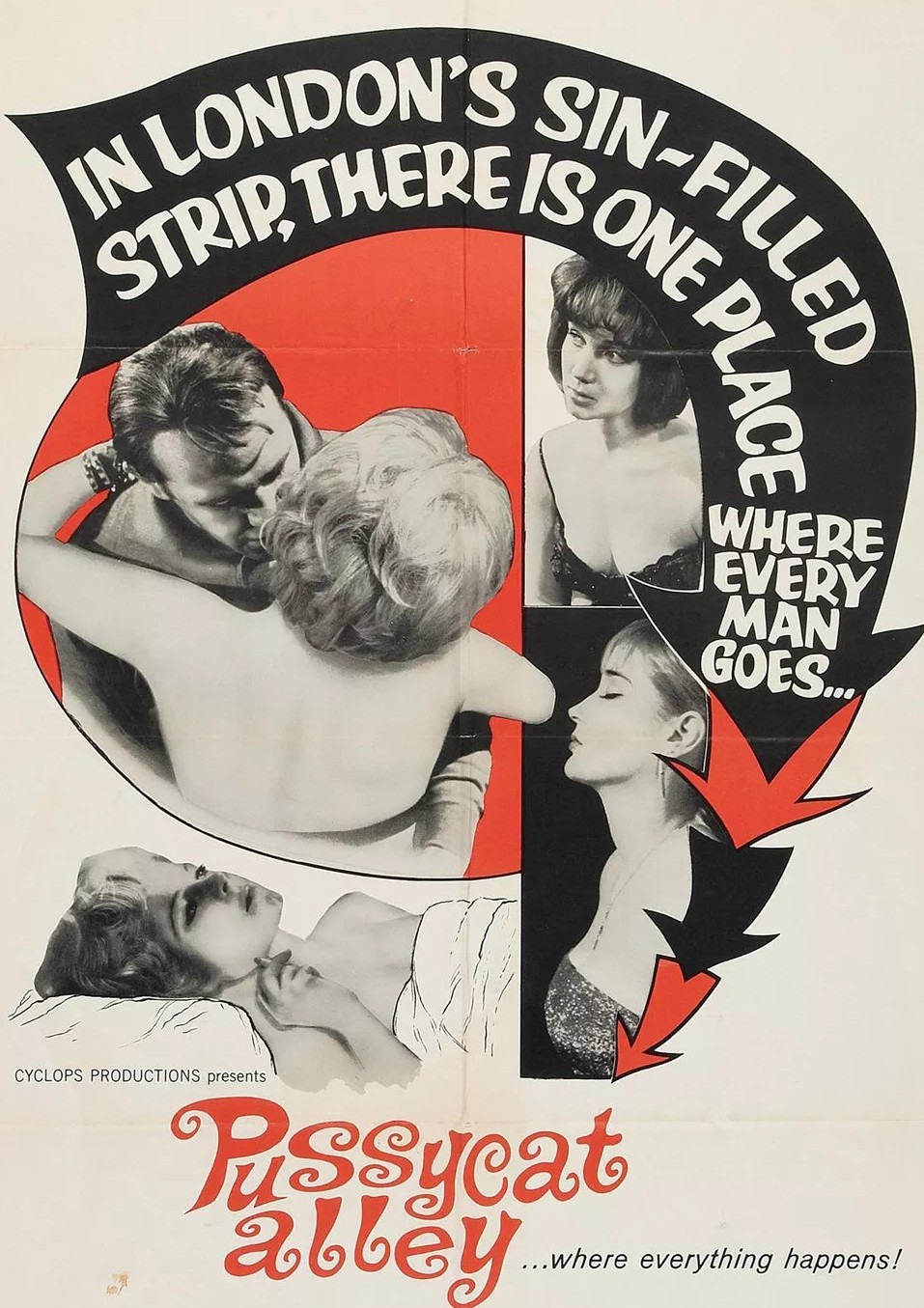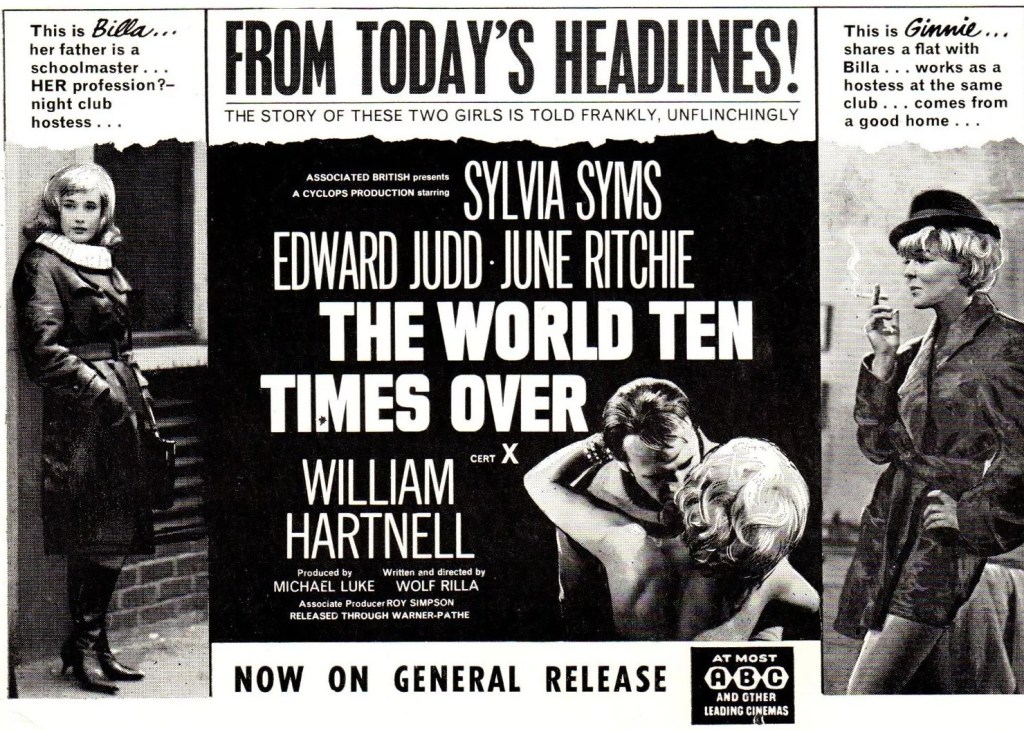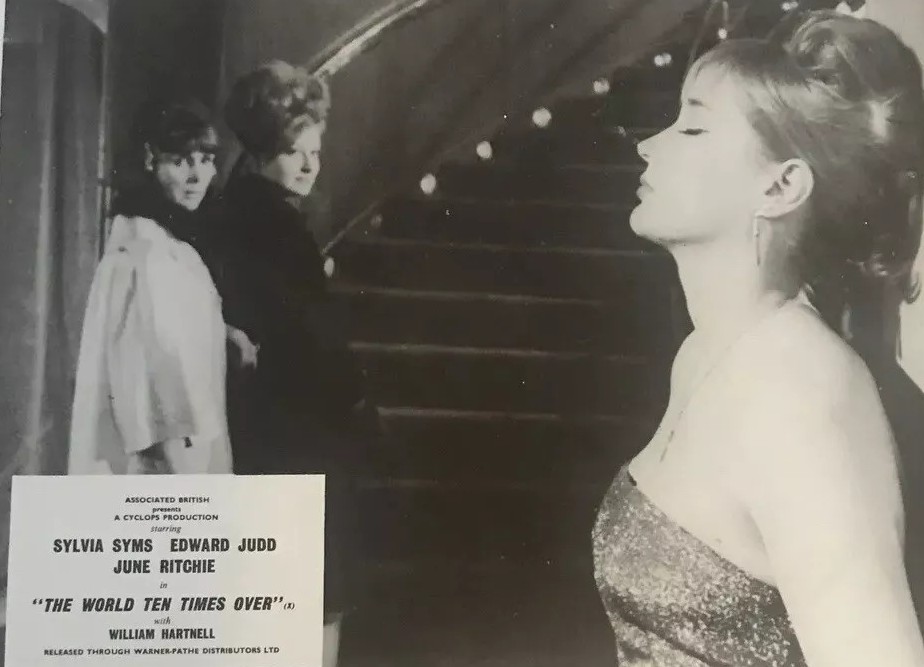
Pussycat Alley / The World Ten Times Over (1963) ***

Sold as sexploitation fare, this is more of a chamber piece as flatmates Billa (Sylvia Syms) and Ginnie (June Ritchie) face up to crises in their lives. For two-thirds of the picture we steer clear of their place of occupation, a Soho nighclub, and only go there for a scene of unsurpassed male humiliation. Unusually, since the expectation would be that the two girls, supplementing their official income with some part-time sex working (implicit rather than explicit), would be treated as victims of wealthy males, in reality they serve up several plates of juicy revenge, but in accordance with their characters rather than as noir femme fatales.

In a very drab London, shorn of tourist hallmarks and red buses and royal insignia, Ginnie sets the tone, furious at lover Bob (Edward Judd), pampered son of a wealthy industrialist, for bringing mention of “love” into what she views as either (or both) an expression of pure pleasure or financial transaction. Bob is the old cliche, the client fallen in love with the girl. Attracted as she is by the pampering and the fact that she can twist him round her little finger, she values her independence too much to commit to such a weak man. In addition, she is so used to getting her way and so wilful that she delights in running rings around him, humiliating him in front of his entire office. 

A contemporary picture like Anora (2024) would find space to excuse or explain her choice of employment, but here, beyond the fact that she left school aged 15 and has no qualifications, we are given nothing to work on, except that her predilection for doing exactly what she wants to do most of the time means she she might find steady employment a drain on her spritely personality.

Billa’s problem is she’s pregnant with no idea who the father might be and becomes infuriated by her widowed teacher  father  (William Hartnell) who can’t let go of his childlike notions of his beloved daughter. Thankfully, no  notions of abuse, but just a dad not coming to terms with a grown-up daughter, shocked that she can knock back the whisky, and whose idea of a treat is taking her to one of the most difficult of the Shakespeare plays. Eventually, suspicions aroused, he tracks her down to the nightclub where she takes great delight in behaving disgracefully, refusing to leave at his presence, parental authority cut stone dead, the staff treating the father like any other punter, even setting him up with a girl (though on the house and he doesn’t take them up on the offer). 

Meanwhile, the over-entitled Bob, failing to get his father to offer Ginnie a job except as an escort for the company’s clients, decides to leave his wife, books plane tickets for an exotic holiday only to be spurned. Ginnie recognizes more easily than him what a disaster marriage would be. She enjoys the fancy restaurants and fast cars but draws the line at commitment. She’s at her best when prancing around, indulging her whims, and yet there is a price to pay for her lifestyle as we discover in more sober fashion at the end.

Billa is sober pretty much all the way through, thoughtful, withdrawn, unable to connect with her father, her biggest emotional support being Ginnie. Despite her failure to go along with her father’s vision of her as an innocent child, her apartment is bedecked with childish paraphernalia, teddy bears, dolls etc. 

Not quite a harder-nosed version of Of Human Bondage, and not far off as far as the males are concerned, but more of a character study of the two women.

Although she has the less showy part, Sylvia Syms is the peach here, and if you consider her portfolio from The World of Suzie Wong (1960) through to East of Sudan (1964) this shows the actress at the peak of her ability. June Ritchie (A Kind of Loving, 1962) is excellent as the flighty piece and Edward Judd (The Day the Earth Caught Fire, 1961) steps away from his normal more heroic screen persona. This was William Hartnell’s last movie before embarking on his time travels for Doctor Who and it’s a moving portrait of an old man whose illusions are shattered.

Directed by Wolf Rilla (Village of the Damned, 1960) from his own screenplay.

Low-life never looked so glam and so shoddy at the same time.

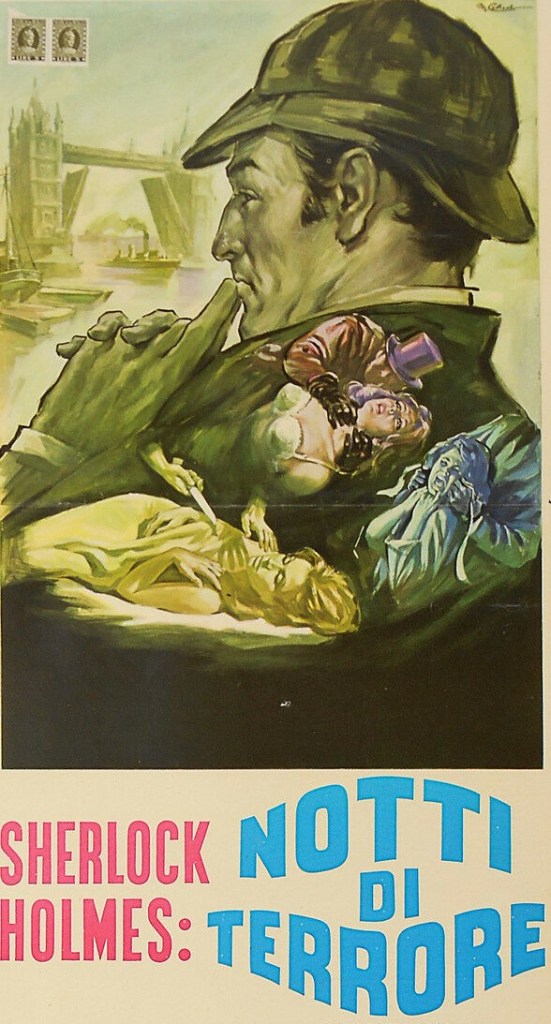
A Study in Terror (1965) ****

Excepting Sherlock Holmes and the Deadly Necklace (1962), the world’s most famous fictional detective had been absent from the big screen for over two decades so it seemed an inspired decision to set him on the trail of the world’s most infamous serial killer. The result is high-class comfort food, classic deduction coupled with barbaric murders in a fog-bound London replete with cobbled streets, Dickensian urchins and sex workers apop with cleavage and corset. Throw in sensitivity towards the abject poverty of the period, female exploitation and a nod towards an upper-class cover-up and you have a movie with a surprisingly contemporary outlook.

This is a tougher Holmes, handy with his fists, sporting a spring-loaded blade in his walking stick. The investigation draws in the Prime Minister (Cecil Parker) and the Home Secretary (Dudley Foster) as well as Sherlock’s pompous brother Myron (Robert Morley) and the ubiquitous Inspector LeStrade (Frank Finlay).

Pretty quickly it is Suspects Assemble. Due to a scalpel being the murderer’s instrument of choice, doctors are immediately implicated, the most likely candidate the philanthropic Dr Murray (Anthony Quayle) who operates s soup kitchen. Publican Max Steiner (Peter Carsten), with a sideline in blackmail, is another possibility. And there is the mysterious disinherited son of a lord, Michael Osborne, who has married sex worker Angela (Adrienne Corri).

As ever, the plot is complicated by red herrings and sleights of cinematic hand. But the highlight of a Holmes picture is the sleuth’s mastery of deduction based on clues missed by the ordinary mortal and every now and then the story grinds to a halt to allow time for the detective to demonstrate genius. Occasionally he dons a disguise. And thoroughly enjoyable these scenes are before he gets down to the main business of uncovering the killer.

A Study in Terror introduces social depth to the Holmes saga. When the crimes focus the media spotlight on Whitechapel Dr Murray draws attention to the constant “murder by poverty” ignored by the state. Female exploitation is of course the norm in the sex worker business and small wonder that such women are easy targets for the Ripper and although that is an overdone trope in this case a different angle comes into play. 

Shakespearian actor John Neville (Oscar Wilde, 1960) handles the main character with considerable aplomb with Donald Houston (The Blue Lagoon,1949) as his often baffled sidekick Watson. Robert Morley (Genghis Khan, 1965) is a splendid Mycroft although Anthony Quayle (East of Sudan, 1964) fails to nail down his Scottish accent.

The considerable supporting cast includes Judi Dench making her second film appearance, Barbara Windsor of Carry On fame, John Fraser (Operation Crossbow, 1965), John Cairney (Jason and the Argonauts, 1963), Peter Carsten (Dark of the Sun, 1968),  singer Georgia Brown (Nancy in the original stage production of Oliver!), Edina Ronay (The Black Torment, 1964), Corin Redgrave (The Girl with the Pistol, 1968), former British leading lady Kay Walsh (Oliver Twist, 1948) and future television comedy writer Jeremy Lloyd (Are You Being Served?, 1972-1985).

The picture was unusual in that it was not drawn from the existing Holmes stories but as an original devised by Derek and Donald Ford (The Black Torment), the former going onto a more extensive career as a director of British sexploitation pictures such as Suburban Wives (1972). Production company Sir Nigel Films had been set up to exploit the Holmes legacy.

Director James Hill (The Kitchen, 1961) had won an Oscar for the short Giuseppina (1960) and was a year away from his breakthrough Born Free. Given the low-budget this is a highly watchable picture.

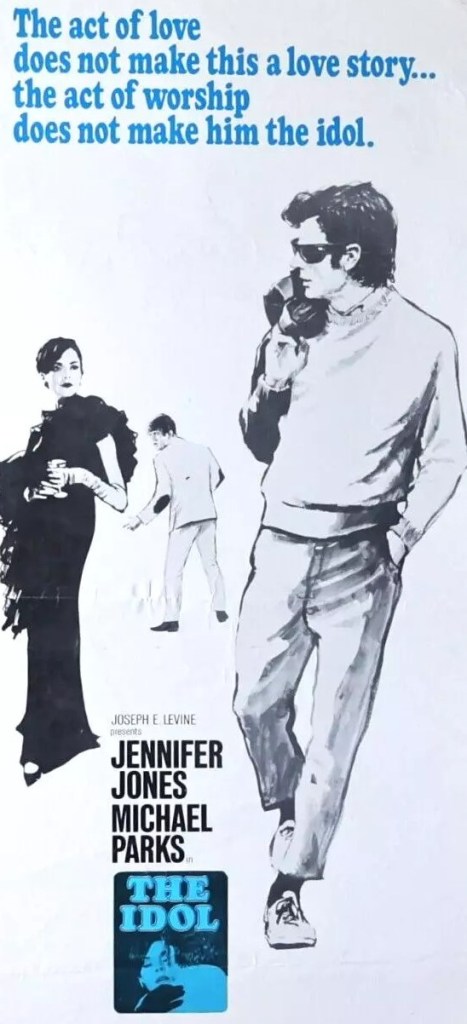
The Idol (1966) ***

By this point in the 1960s the use of black-and-white photography was a statement of artistic intent. So no bright red London buses or other colorful tourist features here. Instead, there’s an overall drabness, lack of bite and energy and a curious tale headlined by a purportedly rising star and a faded Hollywood marquee name. We’re back in rebel territory without much to distinguish it, a poor American studying art on a scholarship who gets in with a wealthier crowd, an under-explored Oedipal theme. On the other hand, the gender-reversed May-December episode is treated with more realism. There’s one superb scene of spite.

The impoverished Marco (Michael Parks), friendly with medical student Timothy (John Leyton), quickly appropriates his girlfriend Sarah (Jennifer Hilary), the cuckolded one too spineless to object, too needy of the arrogant buddy’s attention. They move into an apartment together. Timothy’s over-protective widowed mother Carol (Jennifer Jones), seeing the dangerous influence Marco wields, tries to separate them. She’s worried about how her son will react to her plan to marry confident businessman Martin (Guy Doleman).

Marco is theoretically at least the kind of pushy character who’s had to pull himself up by the bootstrings and despises his friends who merely inherited their good luck. He’s less of an Alfie (1965) than a self-destructive version of the rough-hewn Albert Finney character in Saturday Night and Sunday Morning (1960) but minus any genuine redemptive working class credentials. We never learn much about him.

When he makes an ill-advised play for Carol she dismisses his “schoolboy attempts at flirtation” and humiliates him. When she catches him in a bedroom in her house with Sarah. she wipes the lipstick from his mouth with a linen handkerchief and tosses said item out of the window. This scene taking place in front of a bunch of partygoers being given a tour of her grand house. He is thrown out.

Later, he wins back her favor after saving Timothy from being beaten up in a fight. What begins as a demonstration of maternal instinct soon leads to bed. But in the morning, in a reversal of the scene at the party, his draws lipstick on her lips, then wipes it off with a linen handkerchief and tosses the item out of the window. He was just using her. One of the best revenge scenes you’re likely to come across and carrying contemporary reverberation, not so much of the older woman falling for the younger man (an ongoing trope these days) but of the foolish woman trusting a man who has little interest in being faithful and treats her either as a sex object or an extension of his domination over the opposite sex.

Doting mother, spineless son.

It doesn’t end well, once Tomothy gets wind of his act, but the climax, especially the minor twist, feels tacked on. Marco’s the kind of character who romances them and leaves them, no love involved (except for himself), relatively little consequence, only tripped up by happenstance, and without engendering any empathy or sympathy from the audience.

In part this is because Michael Parks was an inexperienced movie actor, a rising talent after landing the male lead in Bus Riley’s Back in Town (1965) opposite Ann-Margret, which had a much better script, was in color (natch) and any time the plot slackened the camera could turn to the actress to save the day.

And in part it fails because Jennifer Jones was attempting one comeback too many, her first picture in four years, and only in her second in a decade, the marquee appeal that won her an Oscar for Song of Bernadette (1943) and a quartet of nominations besides long gone. Like contemporary Olivia de Havilland in Light in the Piazza (1962) she’s on relatively solid ground as a mother, but it’s quite a stretch for her to fall, even in a moment of weakness – unlike de Havilland who resists blandishments – for the churlish Marco.

It’s not helped by the weakness of the rest of the acting. John Leyton (The Great Escape, 1963) never managed the leap from pop star to movie star and Jennifer Hilary (The Heroes of Telemark, 1965) was merely another ingenue.

Daniel Petrie (Stolen Hours, 1963) is out of his depth with material that doesn’t quite fit together and doesn’t get a tune out of his male lead. Script by Millard Lampell (Escape from East Berlin, 1962).

The lipstick-wiping scenes stand out, and Jones is always watchable, but this is hardly memorable.

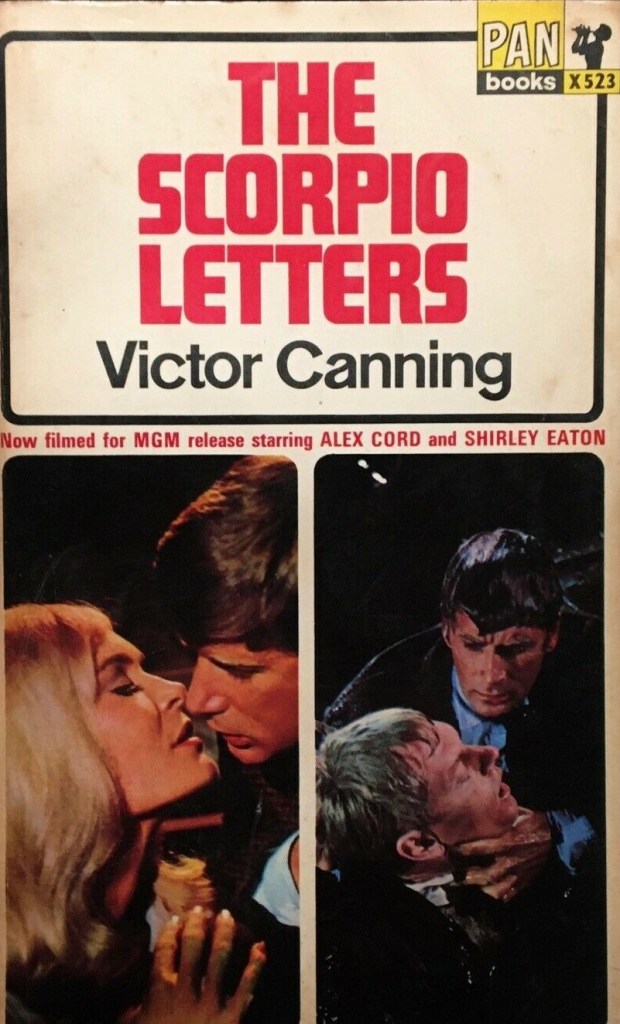
The Scorpio Letters (1967) ***

Desultory spy thriller with over-complicated story that’s worth a look mostly for the performance of Alex Cord (Stiletto, 1969). I can’t say I was a big fan of Cord and I certainly didn’t shower him with praise for his role as a disillusioned Mafia hitman in that movie. But now I’m wondering if I have been guilty of under-rating him.

Normally, critics line up to acclaim actors if they deliver widely differing performances – Daniel Day-Lewis considered the touchstone in this department after Room with a View and My Beautiful Launderette opened in New York on the same day in 1985. But usually screen persona rarely changes, a heightened or amalgamated version of the actor’s character or features. Once Charles Bronson, for example, started wearing his drooping mustache, for example, he was never seen without.  Actors may grow old, but never bald.

The macho mustachioed Cord of Stiletto is nowhere in sight. In fact, in The Scorpio Letters minus moustache and resisting attempts to reveal his musculature, he is almost unrecognizable. In this picture Joe Christopher (Alex Cord) is flip, resentful, thoughtful, occasionally pedantic, more natural than many of the current crop of Hollywood new stars, and for once in a movie that has transplanted an American in London rather scornful of British traditions.

There’s a realistic flourish here, too, he is so poorly paid – and on a temporary contract – that he has to take the bus. And although he is an ex-cop fired for brutality, that level of violence ain’t on show here. Virtually the opposite of the character Cord created for Stiletto, I’m sure you’ll agree. So full marks for versatility and talent.

Unfortunately, the rest of the movie is not up to much, at the very bottom of the three-star review, almost toppling into two-star territory. Christopher is investigating the death of a British agent who was the subject of a blackmail attempt. By coincidence – or perhaps not – another part of British Intelligence is investigating the same death, and this brings Christopher into contact with Phoebe Stewart (Shirley Eaton) and eventually they work together to unravel a list of codenames and uncover the conspiracy with a bit of risk to life and limb.

But the pay-off doesn’t work despite all the exposition attempting to build it up and you’re left with a kind of drawing-room drama rather than exciting spy adventure. It’s determinedly London-centric with red buses, red postboxes, Big Ben, Horse Guards Parade all putting in an appearance. The scene shifts to Paris and Nice without much increase in tension. There’s also an irate German chef.  Despite a couple of neat scenes – a chase held up behind a wedding party, an interrogation in a wine cellar – it’s much too formulaic.

Cord apart, Shirley Eaton (Goldfinger, 1964) adds some glamour, but her rounded portrait depicts a character with warmth rather than oozing sex. This is the kind of film that should be awash with character actors and up-and-comers, but I recognized few names except for Danielle De Metz (The Karate Killers, 1967), Oscar Beregi (Morituri, 1965) and Laurence Naismith (The Persuaders tv series, 1971).

One-time top MGM megger Richard Thorpe (The Truth about Spring, 1965) was coming to the end of a distinguished career which had included Ivanhoe (1952) and Knights of the Round Table (1953). This was his penultimate film. The appropriately named Adrian Spies (Dark of the Sun, 1968) wrote the screenplay based on the Victor Canning thriller. Making his movie debut was composer Dave Grusin (Divorce American Style, 1967)

Albeit with a limited budget of $900,000, MGM intended the picture for theatrical release but with a short cinema window to make it available for a speedy showing on ABC TV. It was originally scheduled for a May 1967 theatrical release but MGM decided to cut out the American release and so it made its debut in the “Sunday Night at the Movies” slot on February 19, 1967, and was shown in cinemas abroad. Nor was it shown first on U.S. television because the studio believed it a disaster. Variety (February 22, 1967, page 42) called it “very hip.”

Darling (1965) ****

Amorality tale. Compulsive opening but contradictory ending. Nobody comes out of this well as male and female alike use each other with little compunction shown. British film making that at one point appeared to be disappearing down the kitchen sink explodes into life with an exploration of just how far the Swinging Sixties can swing. Julie Christie picked up the Oscar for her portrayal of the impulsive, wilful, yet vulnerable model sleeping her way to the top, an unpopular theme in today’s climate.

The credits open with a striking image. A poster for global hunger relief being pasted over by one advertising model Diana (Julie Christie), the face of the decade. There are various other potshots at the hypocritical rich, fawned over for deigning to distribute some of their wealth to the poor, but it doesn’t quite complete the circle, because it’s exactly this kind of virtue-signalling philanthropic society to which Diana, with no sense of judgement, aspires.

It would be more convenient to view Diana as exploited, but, in fact, once she loses her puppy innocence, she is as good at the exploitation game as anyone else. First port of call is dull BBC arts journalist Robert (Dirk Bogarde) who provides her with an opening into the fashionable London set. Both, I should mention, are married, but ditch partners (and children in Robert’s case) and set up home together, she in demand as a hostess at charity events.

Trading sexual favors with advertising executive Miles (Laurence Harvey), she wins a role in a B-picture and his backing to make her the face of a campaign advertising chocolates, that commercial filmed in a palazzo in Italy owned by uber-wealthy but older Cesare (Jose Luis de Vilallonga), a prince, from whom she eventually accepts a marriage proposal, only to find she’s just as bored in Italy as elsewhere. There’s a speedy return to London and Robert’s bed, but he dumps her. Theoretically, she’s so powerless and vulnerable, poor lamb, that she submits to his plan to send her back to Italy, rather than, by now considerably more powerful, starting all over again with someone else.

Possibly the morality of the time or in keeping with some movie dictat required an unhappy ending (of sorts). But this seems to contradict her personality. Bear in mind she had already shown how readily she traded men, and you could already see her running off with a wealthy playboy in Italy and dumping  the prince.

At the remove of over half a century, the wild goings-on would be viewed as tame by contemporary standards, and the flashiness of the style, which attracted criticism, would be ignored in favor of the stunning performance by Julie Christie and her empowered female. Sure, she’s emotionally immature, shallow and all the rest of it, and as likely to become a member of the hypocritically rich, but she’s managed to finesse a life as a model into a high-flying princess with the world at her feet and sure as heck she would soon learn how to manipulate that world as easily as Swinging London.

The only dated aspect is the sexuality, much of which was sneaked in under the censor’s nose (though I would imagine would be considerably cut for U.S. audiences) but that acts as a time capsule for a period when homosexuality was still in Britain punishable by law. Nonetheless, there are fleeting references to cross dressing, an orgy, a threesome and oral sex. (Although a cynic might observe how effective courting controversy was for publicity purposes). In some senses, the obsession of director John Schlesinger with thumbing his nose at the censor gets in the way of the central section which is meant to show how far, in terms of decadence, Diana has fallen when in reality she seems to enjoy exploring the wilder and more sensual parts of her personality.

There’s a clever role-reversal. Usually, it’s the man who plays away from home but expects to still be accepted back by a resigned partner. Here it’s Diana. If the men in her life are to be blamed at all it’s for being dumb, not recognizing her ambition and demanding nature. A lover who continues to tap away at his typewriter while Diana exhibits signs of restlessness is as dumb as they come. Miles and Cesare are more her type, the sexually voracious former switching partners at the drop of a hat, while the older man probably already has a mistress stashed away and expects his trophy wife to pick up a discreet lover in the way of aristocracy the world over.

So, at the remove of several decades, a different Diana emerges, one very much in control of her own destiny, picking up men as it suits her purpose, yes still some emotional growing-up to do, but you could easily see her turning into one of the dowager duchesses who run these fundraising balls with young bucks like Miles lionising her and leaving a few other husbands and/or lovers in her wake, possibly still unhappy, but the rich rather than the poor version.

Not sure if she’d qualify as a feminist icon, but she certainly navigated the world of the male gaze and used it to her advantage.

Turned director John Schlesinger (Midnight Cowboy, 1969) into a brand name. Nominated for five Oscars including Best Picture and winning for three, Julie Christie as Best Actress, Frederic Raphael (Two for the Road, 1967) for the script and Julie Harris for costume design. Bogarde, as well as Christie, reigned supreme at the Baftas. Commercially, one of the most successful British films ever, on a budget of around $1 million earning over $4 million in U.S. rentals alone.

Ending doesn’t ring true, but the rest does.

Victim (1961) ****

Blackmail remains an odious and, unfortunately, booming area of criminal activity, especially targeting youngsters for perceived sexually inappropriate behavior. Politicians still fall into honey traps and I’m sure there are  Hollywood stars who dare not risk coming out for fear of jeopardising their careers. Too often, people pay up or commit suicide rather than endure what they view as a shameful transgression. Seventy years ago, it was a crime in Britain to be a homosexual so anyone with that particular inclination was open to blackmail.

This picture tied the British censor in knots just for daring to use the word “homosexual” never mind “queer” (in the old slang). The Americans were less sympathetic, refusing to allow it to be shown.

It remains surprisingly powerful, not just for the dealing with a subject that had ruined as brilliant career as that of Oscar Wilde over half a century before and had the power to continue to do so. While the wealthy might be able to hush up such criminal acts, the less well-off endured spells in prison.

It’s structured as a triple-edged thriller. Top London barrister Farr (Dirk Bogarde), a fast rising star, determines to root out a vicious blackmailer, while keeping from wife Laura (Sylvia Syms) his own submerged inclinations,  and all the time paying the price in emotional terms for denying his true feelings.

The police are surprisingly sympathetic so this isn’t full of tough cops beating up poor gay men but a community turned inside out trying to retain its sanity. The movie makes various open pleas to the British government to change its mind, but such agitation for change takes place within the context of an enthralling narrative.

It opens like a conventional thriller. A man on the run, Barratt (Peter McEnery), one step ahead of the law, seeking help from a variety of acquaintances, one of whom is Farr. We don’t know what this chap has done except he lugs around a precious suitcase. Not filled, it transpires, with compromising photos, as you might expect, but with a scrapbook.

Eventually, we find out Barratt has embezzled a large stash of cash in order to pay off blackmailers. When caught, he refuses to fess up, instead taking the suicidal way out. Farr, feeling guilty, decides to hunt down the blackmailers. This takes him through a gay underground, populated by characters who are being similarly fleeced: upmarket hairdresser Henry (Charles Lloyd-Pack), upmarket car salesman Phip (Nigel Stock), West End actor Calloway (Dennis Price). Some victims are not only complicit but implicate others (exactly as happened recently in Britain when a Tory MP was blackmailed). Eventually, the trailer leads to the vicious Sandy (Derren Nesbitt) and vile accomplice Madge (Mavis Villiers).

That it avoids falling into the exploitation sector is thanks to a story that focuses on human torment rather than pointing the finger. Prior to his marriage, Farr himself has owned up to a previous indiscretion and promised never to go astray. He can allow himself to fall in love, as with Barratt, but take it no further than giving the young man a lift home. Laura, meanwhile, refuses to just be his alibi, his “lifebelt,” her belief that she is in a proper marriage torn asunder by her husband’s admission that his career is under threat.

Inadvertently, Farr has wrecked other lives, small, dumpy bookseller Doe (Norman Bird) rejected by Barratt for unrequited love with the handsome lawyer. Laura’s brother cuts ties with her over the stain such a scandal would cast over the family. Friendship with Farr throws  suspicion onto married friend Eddy (Donald Churchill). Not everyone can hide their sexuality, Henry having endured four prison sentences for being caught.

And as with your normal thriller, there are red herrings, a newcomer to a pub possibly being in league with the blackmailer, and audience suspicion is directed to the camp pair whispering in the pub. As with the best red herrings, these are transformed into different narrative pegs.

Farr is far from your usual detective, what with his upper class lifestyle, and the danger – physical, marital and emotional – he puts himself in, but he is dogged and principled and in the end gets his man, knowing full well that he will pay a price. Eliminating stereotypes helps. Nobody minces around and there’s no vicious gossip or sarcastic observer on the sidelines.

I’d already been very impressed by the work of the underrated Basil Dearden whose portfolio includes lean thrillers The Secret Partner (1961) and The Man Who Haunted Himself (1970), grander affairs such as Khartoum (1966) and The Assassination Bureau (1964), and fistfuls of sub-Hitchcockian twisted complication in The Mind Benders (1963), Woman of Straw (1964), Masquerade (1965) and Only When I Larf (1968). This sits high on his list. But he is very much aided by a superb screenplay by Janet Green (The Clouded Yellow, 1950) and John McCormick (Seven Women, 1965).

Excellent performance by Dirk Bogarde (Our Mother’s House, 1967) and a very rounded one by Sylvia Sims (East of Sudan, 1964). A shout out for Derren Nesbitt (The Blue Max, 1966) as the creepy smug villain and John Cairney (Jason and the Argonauts, 1963), who recently died, and was a relation of my mother.

Recommended. Blackmail has an ominous contemporary ring.  

Two Weeks in September (1967) ***

Soubriquets were not common currency in Hollywood. Names might be shortened to a Christian name or a surname, as in Marilyn or Garbo, and occasionally a reporter might suggest an unlikely familiarity by referring to a star as “Coop” and for sure Bogie must have been desperate for people to call him anything other than Humphrey, hardly a name that spun off the tongue for a supposedly hardbitten hero eschewing his middle-class origins. But the world swung on its axis when simple use of the star’s initials were enough to guarantee universal acceptance.

BB was born on a wave of controversy. After And God Created Woman (1956) broke box office records all over the world, a star was born. But one who seemed to live as much on the pages of newspapers as on the screen. She could forever be guaranteed to provide a revealing photograph to spice up the more puritan newspapers.

But BB’s global fame didn’t translate into worldwide box office in part because her movies were mostly X-certificate in the U.K. and, being made generally by foreign companies, slipping past the Production Code in the U.S. and therefore into arthouses or shady emporiums in both countries rather than mainstream houses.

This isn’t the best introduction to her canon, but in many senses it’s pretty typical. The camera adores BB and shuns anyone else in her presence. There’s not much story here – bored wife dashes off to a model assignment in London and has an affair and can’t decide whether he’s ready for divorce.

To fill in the time we get plenty Carnaby St fashion shoots, certainly put into the shade by the likes of Blow-Up (1966), but of the kind that used to be so common, beautiful women in outlandish clothes against backdrops like zoo animals or suits of armor and all the while flirting with photographers and being chatted up in night clubs by all and sundry. As you might expec, red buses and mini cars are common, though the chances of a cop on horseback at night seems to stretch it a bit.

Cecile (Brigitte Bardot) seems too lively for staid husband Philippe (Jean Rochefort) and burdens him with ensuring her happiness. But he seems, I guess unusually for the time for such a wealthy character, to be happy for her to continue in her profession. She’s never been unfaithful unlike model buddy Patricia (Georgina Ward). But all this cavorting brings out the lech in photographer Dickinson (Mike Sarne) and while she flirts with him she fancies for no apparent reason the doe-eyed Vincent (Laurent Terzieff) although his doe-eyed dog is livelier.

Anyway, off they go to Scotland for a romantic idyll since every filmmaker in the world has been duped by Scottish Tourist Board fantasies of sunshine, tartan, heather and miles of unspoiled beaches (unaware they are empty because the natives have more sense than to go diving into icy water in freezing temperatures). Mostly, what they get is damp streets and grey skies, though if you have BB romping  in the water then nobody’s really going to notice the awful weather. And, naturally, the highways and byways are filled with tartan-clad gents so Brigadoon rides again.

Not quite sure how “To Their Heart’s Content” – clumsy in translation as it is –
is turned into the dull “Two Weeks in September.” Though she hardly seems happy in the poster.

In any case, by the time September comes round, the sun has already packed up for the winter in Scotland, so there’s your get-out-of-jail-card in the title. Not much happens in Scotland either, mostly soulful camera work, soulful BB and dull-as-ditchwater Vincent. There’s a contrived ending.

What impresses most is how little BB you need to make a picture work, even one as patchy as this. It is almost the same template as an Elvis picture minus the songs. Just like BB, Elvis scarcely required a working script, just any excuse to get him on screen. Some stars possess screen charisman that it’s impossible to shift. Shame it was left to Serge Bourguignon (The Picasso Summer, 1969) to get more out of the faint storyline because he  was never that bothered with narrative and inclined just to get by on close-ups and scenery. With BB she was as much scenery as audiences ever seemed to require.

Hardly falls into the recommended bracket but nonetheless an interesting example of how Bardot could get away with the mildest of trifles.

Girl with a Pistol (1968) ****

Off-beat Oscar-nominated comedy-drama that is both a marvelous piece of whimsy and a slice of social realism set in the kind of Britain the tourist boards forget, all drizzle and grime. It zips from Edinburgh to Sheffield to Bath to London to Brighton to Jersey as if the characters had been dumped from an If It’s Tuesday It Must Be Belgium sketch. If your idea of Italy was Fellini’s glorious decadence or Hollywood romance amid historic ruins and fabulous beaches, then the upbringing of Assunta (Monica Vitti) is the repressive opposite.

All women in her small town wear black. Men are not allowed to dance with women and must make do with each other. A man like Vincenzo (Carlo Giuffre) desiring sex must kidnap a woman, in this case Assunta, to which she will consent as long as he marries her. When instead he runs off to Scotland, she is dishonored and must kill him, armed with the titular pistol.

Pursuit first takes her to Edinburgh and a job as a maid, has a hilarious encounter with a Scottish drunk, and various other cross-cultural misinterpretations – in a bar she cools herself down with an ice-cube then puts it back in the bucket. Then it’s off   to Sheffield where she falls in with car mechanic Anthony Booth (television’s Till Death Do Us Part) because he is wearing Italian shoes.

She can’t imagine he can watch sport for two hours. “You’re a man, I’m a woman, nobody in the house and you look at the television.” Although tormented by images of being attacked back home by a screaming mob of black-robed women, she begins to shed her inhibitions, wearing trendier clothes, although an umbrella is essential in rain-drenched Britain and given the Italian preference for shooting exteriors.  

In between sightings of Vincenzo there are episodes with a suicidal gay man (Corin Redgrave) and a doctor (Stanley Baker). She becomes a nurse, then a part-time model, sings Italian songs in an Italian restaurant, drives a white mini, wears a red curly wig and more extravagant fashions. It turns out she can’t shoot straight. Gradually, the mad chorus of home gives way to feminist self-assertion as she becomes less dependent on men and a world run by chauvinists. It’s a startling mixture of laugh-out-loud humor and social observation. And while the narrative that at times verges on the bizarre, Assunta’s actions all appear logical given her frame of mind.

Vitti was Italian director Michelangelo Antonioni’s muse (and companion) through  L’Avventura (1960), La Notte (1961) and L’Eclisse (1962) to Red Desert (1964). She had a brief fling with the more commercial, though still somewhat arty, movie world in Joseph Losey’s Modesty Blaise (1966) and the nothing-artistic-about-it comedy On the Way to the Crusades (aka The Chastity Belt, 1968) with Tony Curtis. Director Mario Monicello had two Oscar nominations for writing but was best-known for Big Deal on Madonna Street (1958) and Casanova ’70 (1965). Girl with a Pistol was nominated in the Best Foreign Language film category at the Oscars.

Eagles over London (1969) ***

Presumably intended to capitalize on/rip-off the same year’s big-budget roadshow The Battle of Britain manages to cram in a pack of action beginning with a tank ambush in Normandy, the Dunkirk evacuation, the Battle of Britain, rooftop shoot-outs, ending up with an audacious attack of RAF High Command by a team of German saboteurs. As notable for technical achievement, split screen – sometimes split diagonally or quartered – in the manner of The Boston Strangler (1968) and The Thomas Crown Affair (1968), shots through various tiny holes, scenes filmed overhead, and a dazzling swirling camera sequence that would normally presage intimacy but here means death.

Somehow manages to squeeze a surprising number of dramatic moments focusing on relationships, a brief nod to homosexuality, and emulating Fraulein Doktor (1969) in giving the Germans credit for astute and effective espionage. Obvious use of stock footage for the air fight sequences, but you wonder what else has been cobbled out of the vaults given the preponderance of scenes requiring massive numbers of extras. Throw in Hollywood veteran Van Johnson (Divorce American Style, 1967)  and a particularly good Cockney sergeant (Renzo Palmer) and it hardly lets up.

So, Captain Stevens (Frederick Stafford) heads up a unit delaying the German blitzkrieg in France in 1940. The Germans, led by Donovan (Francisco Rabal), meanwhile, are in disguise, assuming the identities of dead British soldiers with the intention of infiltrating Britain and destroying its radar installations. Inadvertently, Stevens saves Donovan’s life, thus giving the German accepted entry into British high command. Equally inadvertently Stevens allows the German access to his girlfriend Meg (Evelyn Stewart) who needs a shoulder to cry on. Donovan has his own girlfriend, Sheila (Teresa Gimpera) on tap, an undercover agent working as a barmaid, well-trained at collecting loose talk and seduction.

Elements of giallo keep popping up as the Germans need to embark on a murderous rampage to continue to acquire new identities to keep ahead of the pursuing investigation, one strangulation taking place in a gay sauna. Every now and then we pop into RAF High Command where Air Vice Marshal Taylor (Van Johnson) is helping thwart the German aerial attacks and in the end, since more bodies are required, elects to go into battle himself.

The small screen allows laughable moments – model airplanes crashing into the sea, cardboard radar installations toppling – to pass almost unnoticed since most of the rest of the action is well rendered, the rooftop scene especially, and the other various shoot-outs where – shock to the system – the British are constantly outwitted and outgunned.

Mostly, you’ll note how stylish a concoction this is given the low budget. Excellent sex scene against the background of exploding bombs, the duping of our hero by the enemy, and one terrific scene where Sheila is deemed surplus to requirements, calmly accepting her fate on condition that it’s her lover who pulls the trigger.

This would have been solid support material in English-speaking countries but most likely a main feature in its Italian homeland. Might have even done better if distributors waited until Afred Hitchcock’s Topaz (1969) appeared since he recruited Frederick Stafford as his leading man. Stafford was always under-rated but he keeps this afloat, though the Germans have the more interesting roles, especially Francisco Rabal and Teresa Gimpel. Evelyn Stewart (The Whip and the Body, 1964) has a smaller part.

Not content with introducing far more style and, shall we say, flamboyance, than the material might suggest director Enzo G. Castellari (Any Gun Can Play, 1967) has the audacity to end by using Winston Churchill’s “the few” speech to halt the traffic so the British lovers can catch up with each other.

A classic example of what an interesting director can do with what in other hands would be more mundane material. Not quite sure why it took five screenwriters.

Surprisingly fun watch overloaded with style.

REVIEWED PREVIOUSLY IN THE BLOG: Frederick Stafford in Topaz (1969), Evelyn Stewart in The Whip and the Body (1964), Van Johnson in Divorce American Style (1967).

The Alphabet Murders (1965) ***

Just about the barmiest idea ever. Just about works. Tony Randall (Bang! Bang! You’re Dead / Our Man in Marrakesh, 1966), a cross between David Niven’s younger brother and a distant relation of Inspector Clouseau, would be nobody’s notion of a perfect Hercule Poirot. But back in the day, Agatha Christie’s famed detective was not a hallowed concept.  

In fact, in movie terms he was pretty much a nobody, not a single big screen appearance in three decades, the forgotten man of cinema sleuths, not a patch on Sherlock Holmes or Maigret who had enjoyed umpteen iterations. So that character, if you like, was there for the taking, up for grabs, not one so sacrosanct it was imprinted on audience minds.

You could do what you liked as long as he had a moustache, spoke with an exaggerated foreign accent and every now and then pointed to his head and mumbled something about little grey cells.

MGM had had some fun and box office success with Christie’s other famous criminal creation Miss Marple in a quartet of low-budget pictures in the light comedy vein starring Margaret Rutherford beginning with Murder, She Said (1961) and clearly believed the same recipe would work wonders with a character generally considered too stiff to work at all.

This is a chucklesome broth, some astute detective work mixed up with all sorts of sight gags. Frank Tashlin (The Glass Bottom Boat, 1966) is at the helm and the writing team of Jack Seddon and David Pursall who reimagined Miss Marple adapt the mystery.

It kicks off with the very contemporary trope of talking to the camera as real-life actor Tony Randall walks off an MGM set and transforms himself into Poirot. Hastings (Robert Morley), who in the novels is more an amiable companion, a kind of Dr Watson, is here portrayed as somebody high up in the British Secret Service trying to whisk Poirot out of the country. Mostly, he acts as a comedy foil.

After being attacked by a beautiful masseuse, Poirot finds himself on the trail of a serial killer who conveniently leaves an ABC London Guide at the scene of the crime and kills in alphabetical order (with a bent for alliteration) which would make the attempt on the detective’s life a bit of an aberration (that even Poirot doesn’t apparently notice). Anyway, the first victim is an Aquabatic, the second Betty Barnard (Grazine Frame). Poirot is on the case by the time the third likely victim Sir Carmichael Clarke (Cyril Luckham) hoves into view.

As luck would have it, a fourth contender Duncan Doncaster (Guy Rolfe) is both psychiatrist to chief suspect Amanda Beatrice Cross (Anita Ekberg) and lover of Clarke’s wife Diane (Sheila Allen). Inspector Japp (Maurice Denham) of Scotland Yard and Poirot are invariably at cross purposes.

The detective has a special set of skills, including cooking to restaurant standard, being able to vanish in a trice, horse-riding, and knocking down two sets of ten-pin bowling pins at the same time.  

That the comedy works is mostly thanks to the likes of Airplane (1980) which has accustomed contemporary audiences to barmy, almost literal sight, gags, faces elongated via shaving mirrors, while a cop elucidates a clever plan we are only shown the back of the map he’s pointing to, a conversation takes place over the sleeping body of a snoring wife, a business card tossed nonchalantly onto a desk ends up in a coffee cup, Hastings is trapped in the trunk of a car with a comely wench

You still get your London tourist features – the docks, bus stops, military parade, horse riding in Hyde Park – but these are invariably set-ups for sight gags. A naked Hastings invades the parade, fog shrouds the docks, Poirot’s horse leaps over (wait for it!) a park bench.

This version of Poirot might be heresy to some, and too jaunty by half, but there’s too much serious detection – and some classic Poirot intuition – to dismiss it as entirely a spoof, and I spent too much time chortling to dismiss it as a waste, so it lands in an odd halfway house, but I suspect that’s very much where Tashlin intended it to land.  

Worth a look if only to suspend your disbelief.

PREVIOUSLY REVIEWED IN THE BLOG: Frank Tashlin’s The Glass Bottom Boat (1966); Tony Randall in Let’s Make Love (1960), Lover Come Back (1961), Send Me No Flowers (1964), Bang! Bang! You’re Dead (1966); Anita Ekberg in 4 for Texas (1963); Robert Morley in Oscar Wilde (1960), Nine Hours to Rama (1963), Hot Enough for June (1964), Of Human Bondage (1964), Topkapi (1964), Genghis Khan (1965), The Loved One (1965), A Study in Terror (1965), Some Girls Do (1969).

Discover WordPress

A daily selection of the best content published on WordPress, collected for you by humans who love to read.

The Atavist Magazine

by Brian Hannan

WordPress.com News

The latest news on WordPress.com and the WordPress community.