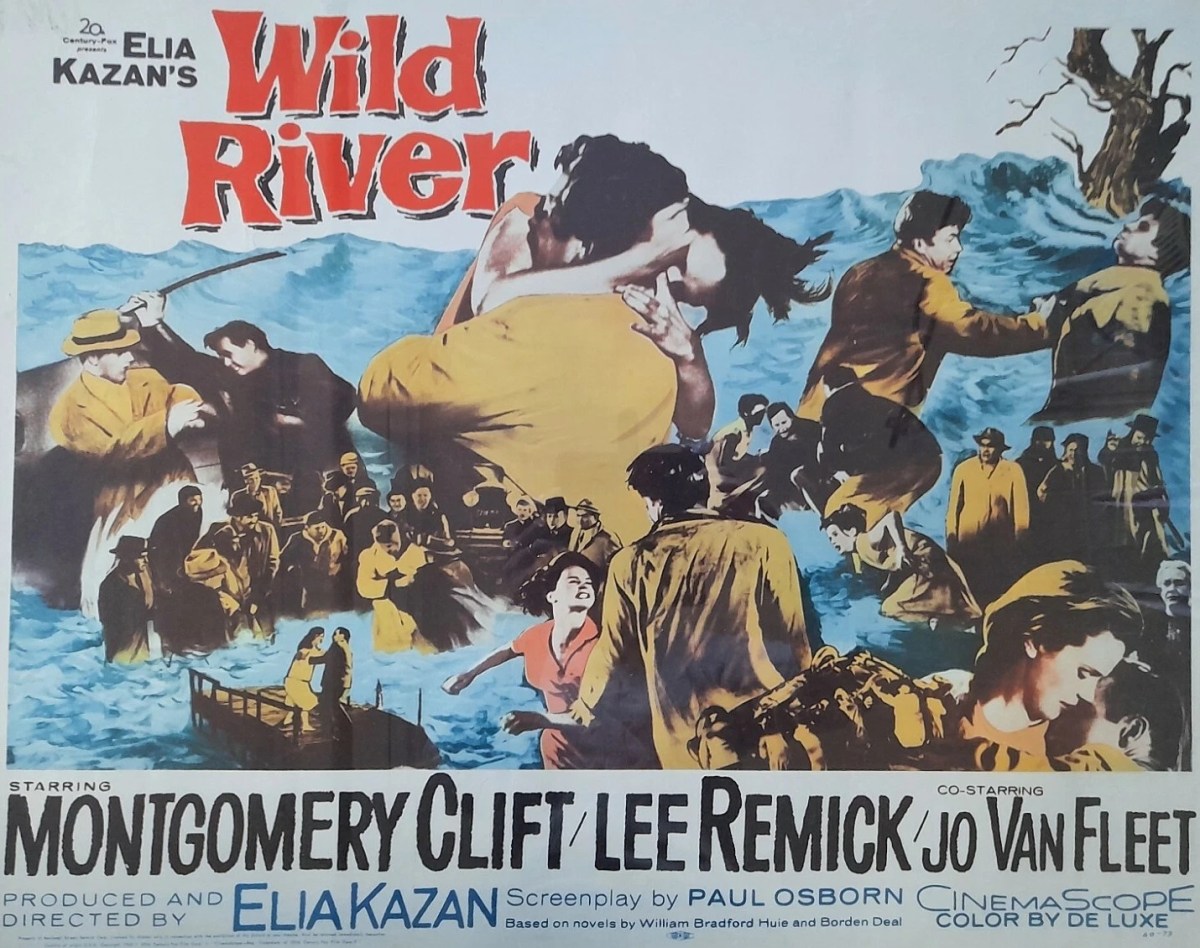
Wild River (1960) ****

Funny how you remember the circumstances of seeing a film for the first time. This was  important for me because it was the start of me digging into the vast heritage of the movies rather than watching just what was showing at my local cinema. I can’t pin down the exact date, but I have a feeling I was still at school, though in the advanced stage of that academia. I saw this on a 16mm print in a terraced house sitting on the hard kind of seats you used to get in assembly halls.

The location was the Scottish Film Council, the predecessor of the Glasgow Film Theatre, which was located in the city’s West End. The occasion was the final film in an eight-movie retrospective of Elia Kazan pictures. Either before or after I attended a similar Fellini retrospective. Certain more controversial films were omitted, so no Gentleman’s Agreement (1947), Pinky (1948) or Baby Doll (1956) and although this was the early 1970s no room for Splendor in the Grass (1961), America, America (1963) or The Arrangement (1969). Afterwards, there was a cup of tea and a biscuit and a discussion hosted by John Brown, who in my memory smoked small cigars, later a television and screen writer.
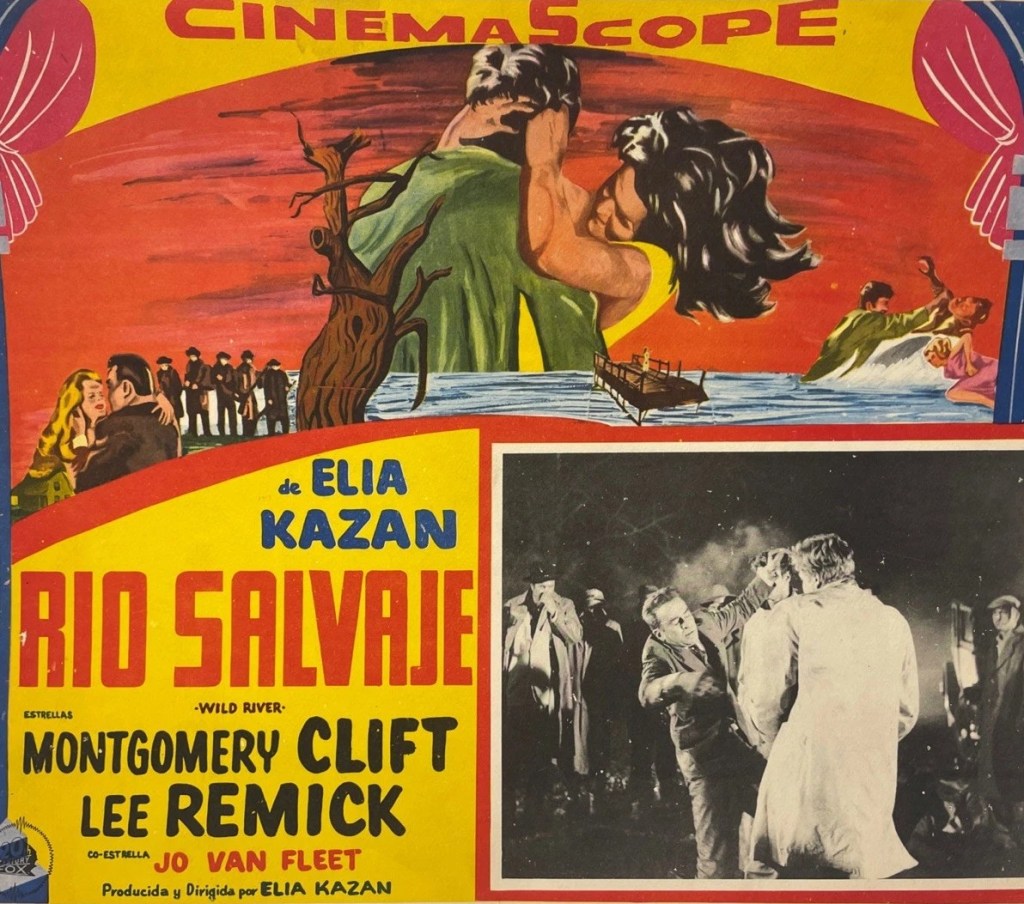
It was an introduction for me to the power of the retrospective, to view a huge number of a director’s films back-to-back (the screenings were weekly) and to understand the thematic symmetry of their work. Kazan predated the New Hollywood of the late 1960s and 1970s, so, although his movies usually challenged existing norms, these days they are often viewed as more stolid than of the first rank, his cause not helped by revelations that he named names at the anti-Communist hearings of the 1950s.

Wild River is one of those films that plays completely differently now thanks to the intervening decades. A contemporary audience is unlikely to sympathize with hero Chuck Glover (Montgomery Clift) whose job is to persuade farmers in the early 1930s to clear out of the way of  land that is going to be swamped with water to supply a new dam that would serve to both control the catastrophic flooding in the Tennessee Valley and bring electricity to an impoverished area.

These days ageing landowner Ella Garth (Jo Van Fleet) would attract massive publicity in her fight to avoid being shifted from land that had been in her family for generations, especially as she claims that dams go “against nature.”. And no matter how sympathetic a character like Chuck might be to her circumstances he would be viewed as a more well-meaning-than-most government apparatchik.
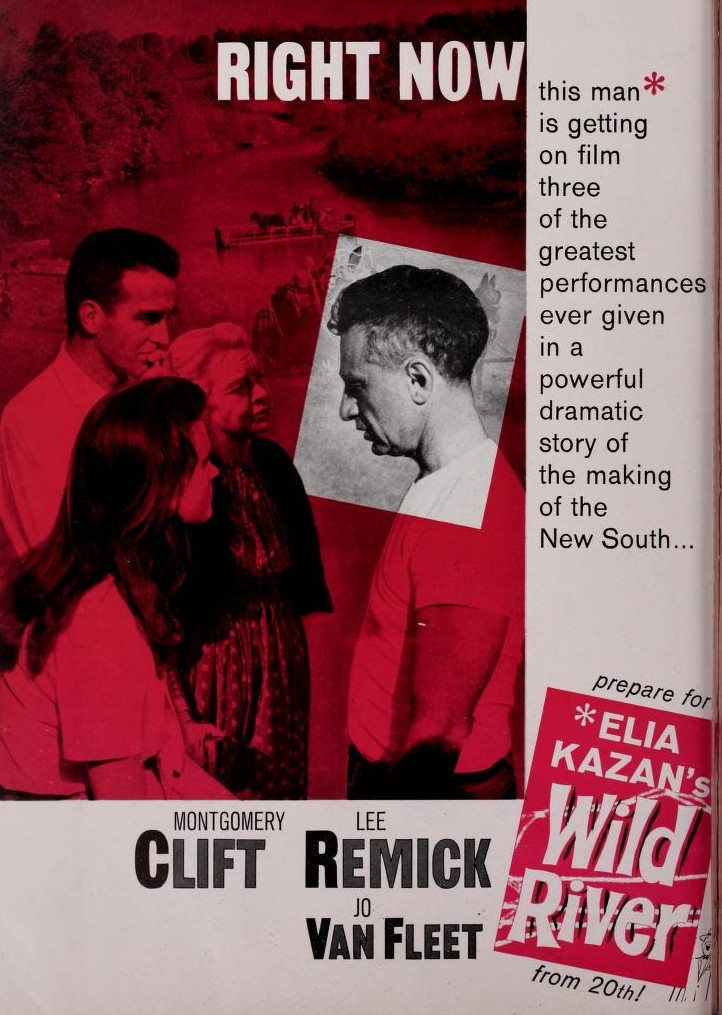
And in some respects, this plays much better as one of the few movies exploring the plight of the African American at the hands of the racist authorities. Chuck incites local hostility when he recruits Blacks to work alongside Whites, in the end conceding that they should work in separate crews. But he comes unstuck when he sticks to the principle that they should be paid the same, more than double the going daily rate for Blacks.

In consequence he is beaten up and, worse, a gang of thugs attack the house inhabited by his lover Carol (Lee Remick) and her two young children and the cops, when they arrive, are apt to condone the violence.

Ella takes a maternal attitude to her Black workforce and while certainly nobody received abusive treatment at her hands she has a patronizing manner, though in the end she encourages them to leave.

Despite his democratic and anti-racist views, Chuck comes over as a clever dick, thinking his smooth eastern charm can convince the reluctant woman to move and for the racists to abandon their inherent racism.

I’m not sure about the widowed Carol either, she almost seems to be throwing herself at the first decent man who comes her way. While she is already being courted by a local fellow, who is more decent than the rest, that is clearly going to be a marriage of convenience, but what exactly makes Chuck so much more an attractive proposition is never made entirely clear except that, for narrative purposes, it creates a romantic deadline – is she just a fling, thrown over when he heads home – and a whiff of tension.

However, marriage to the other man would have made her just a passive housewife, whereas she realizes that in many ways she is smarter than Chuck, more grounded, and she would have more freedom in this kind of match.

Oddly enough, there’s a Hitchcock vibe here. At several points the camera tracks Glover in longshot as he appears to be heading for trouble.  

The racist elements give this its bite rather than any ecological issues. The acting is certainly of  high quality, Montgomery Clift (The Misfits, 1961), less mannered than in some of his work, in one of his last great roles. It’s an interesting part. At one point he wishes he could once in a while win a physical fight, and it’s Carol who is more likely to show the venom required in battle.

Lee Remick (No Way To Treat A Lady, 1968) continued to build on her exceptional promise. Jo Van Fleet (Cool Hand Luke, 1967) gets her teeth into the kind of role most actors dream of. You can spot Bruce Dern (Once Upon a Time in Hollywood, 2019) in his first role.

An unusual approach to the screenplay, too, by Paul Osborn (The World of Suzie Wong, 1960). Like The Towering Inferno (1974) a decade later, this derived from two novels –  Dunbar’s Cove by Borden Deal and Mud on the Stars by William Bradford Huie (The Americanization of Emily, 1964).

Despite my ecological reservations, still stands up..

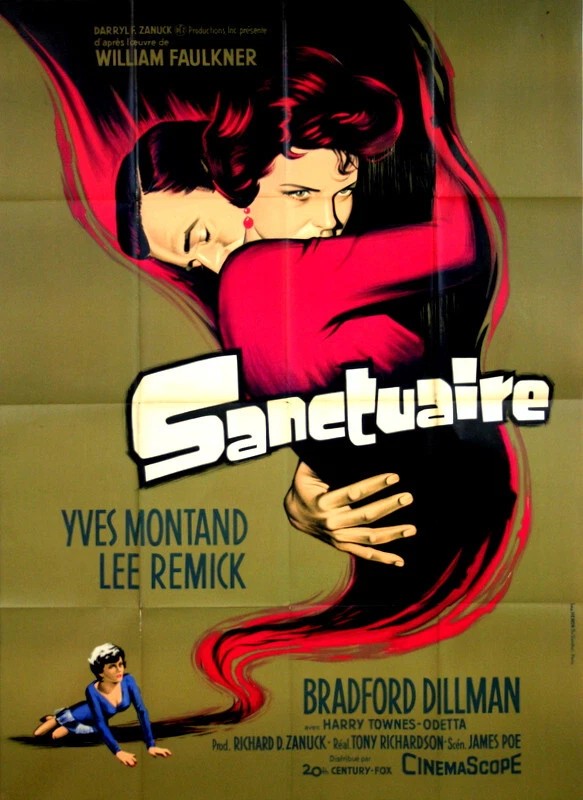
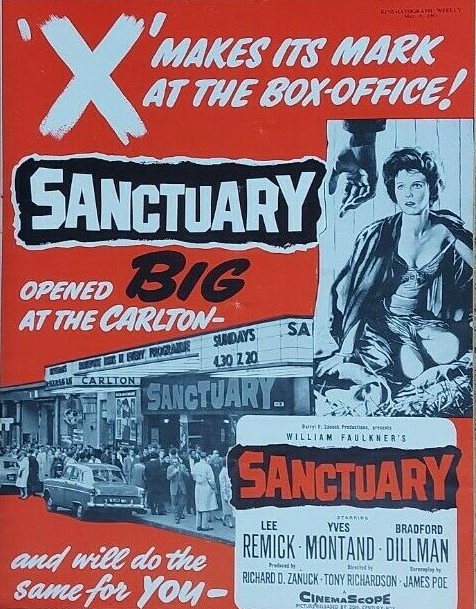
Sanctuary (1960) ***

This overheated melodrama stands as a classic example of Hollywood’s offensive attitudes to women. Nobel prize-winning author William Faulkner could hardly blame the movies for sensationalizing his misogynistic source material since if anything the movie took a softer line.  Told primarily in flashback as headstrong southern belle Temple Drake (Lee Remick) attempts to mitigate the death sentence passed on her maid Nancy (Odetta). Given that such appeals are directed at Drake’s Governor father (Howard St John), and that the maid has been condemned for murdering Drake’s infant child, that’s a whole lot of story to swallow.

Worse is to follow. Drake takes up with Prohibition bootlegger Candy Man (Yves Montand) after being raped by him and thereafter appears happy to live with him in a New Orleans brothel – the “sanctuary,” no irony intended, of the title – despite him slapping her around. The film steers clear of turning her into the prostitute of the original book, but pretty much sets up the notion that high class women will fall for a low-class tough guy whose virility is demonstrated by his brutality. In other words a “real man” rather than the dilettantes she has previously rejected.

After the Candy Man dies, Drake returns home and marries wealthy suitor Gowan Stevens (Bradford Dillman) who blames himself, rightly, for Drake falling into the clutches of the gangster in the first place. But a past threatening to engulf her precipitates the infanticide.

Faulkner was a Hollywood insider, adapting Sanctuary for The Story of Temple Drake (1933) and earning high praise for  his work on Bogart vehicles To Have and Have Not (1944) and The Big Sleep (1946). The success of The Tarnished Angels (1957) starring Rock Hudson, The Long, Hot Summer (1958) with Paul Newman and The Sound and the Fury (1959) headlined by Yul Brynner had sent his cachet rocketing. But all three were directed by Americans – Douglas Sirk and Martin Ritt – who had a distinctive visual style and an ear for what made melodrama work.

Sanctuary had been handed to British director Tony Richardson (Look Back in Anger, 1959) and he didn’t quite understand how to make the best of the difficult project. So while Lee Remick manages to suggest both strength and fragility, and makes her character’s wanton despair believable, Yves Montand is miscast and Bradford Dillman fails to convince even though portraying a weak character. Too many of the smaller roles appear as cliches. And it’s hard to believe the maid’s motivation in turning murderer.

What was acceptable steamy melodrama in the 1930s fails to click three decades on. Faulkner’s thesis that high-falutin’ women want a man to master them and furthermore will fall in love with their rapist seems to lack any understanding of the female mind and will not appeal to the modern sensibility than it did on release. Lee Remick is what holds the picture together, in part because she plays so well the role of a woman embracing degradation, and refusing – no matter how insane the idea appears – to let go of the man she believes is the love of her life. It’s not Fifty Shades of Grey, but it’s not that far off that kind of fantasy figure, and given the success of that book, it’s entirely possible there is a market for what Faulkner has to peddle.

Hard Contract (1969) ***

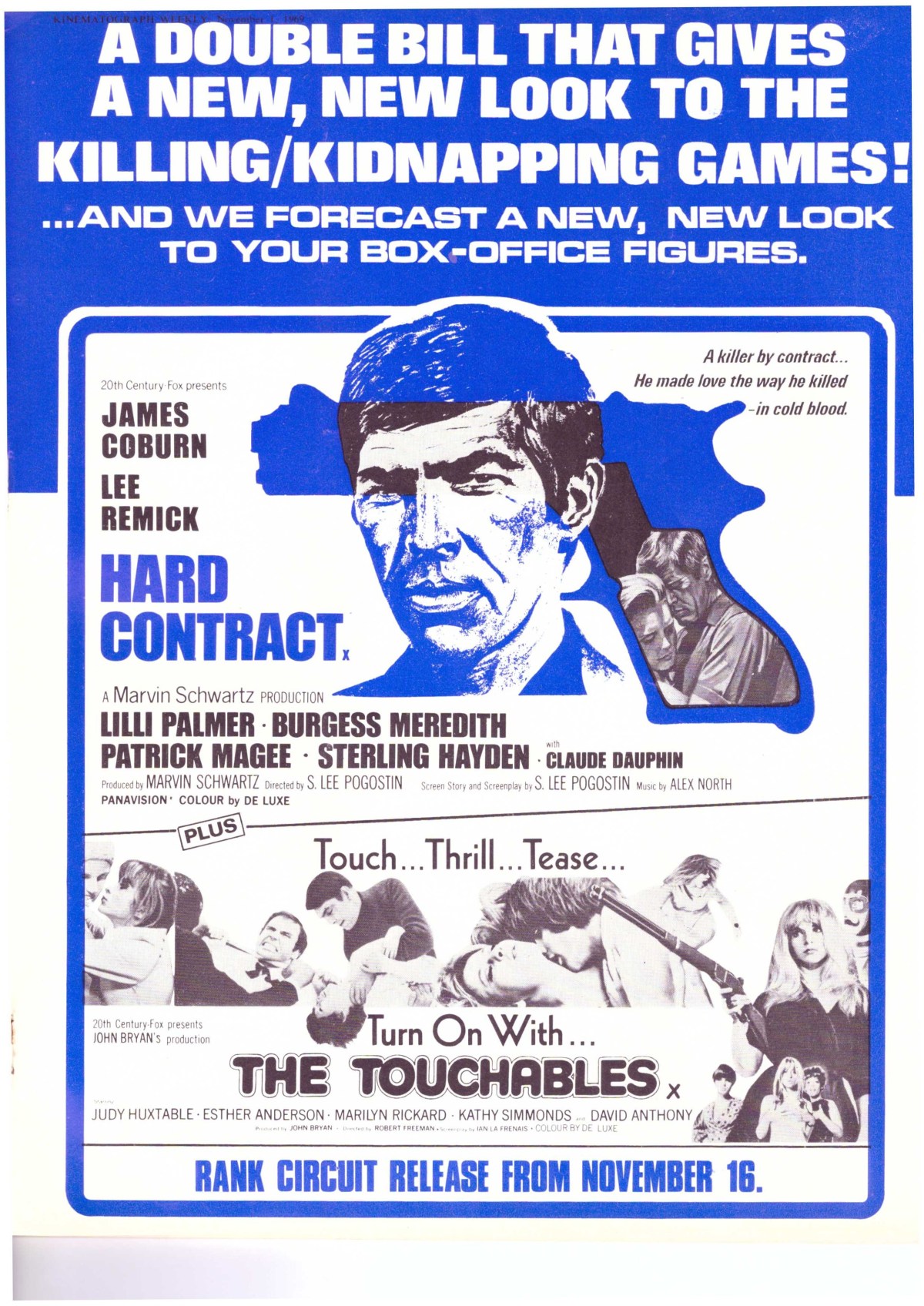
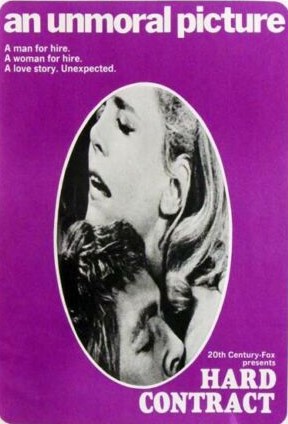
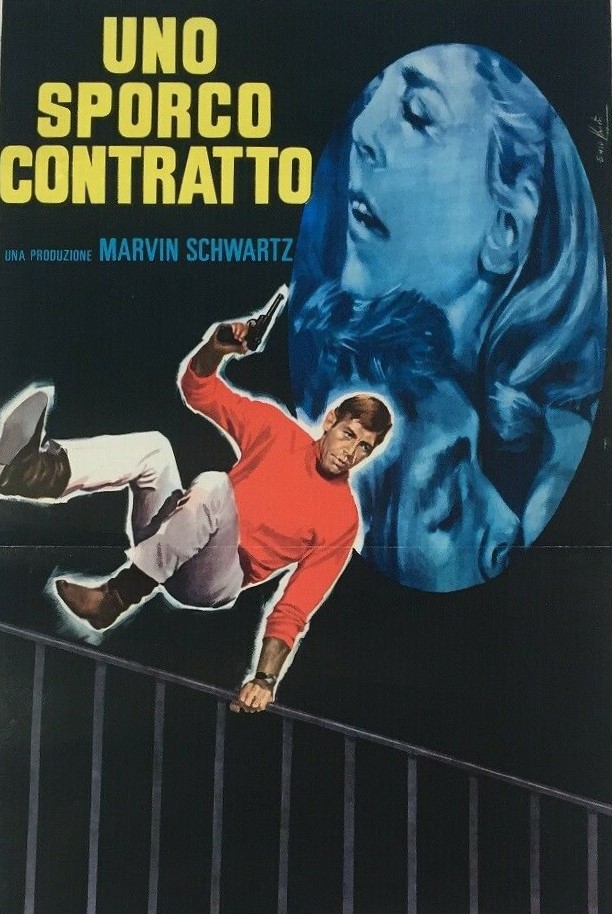
A hitman movie that verges on the existential is always going to be intriguing. Stone cold killer John Cunningham (James Coburn) manages to keep the world at a distance until he runs into the vibrant Sheila (Lee Remick) in Spain. The film is a curiosity of an admittedly small genre dominated by such disparate offerings as The Killers (1946 and 1964), Yojimbo (1961), Le Samourai (1967) and Stiletto (1969) in that although Cunningham does bump people off you never see the violence. We’ve come to expect hitmen to be introspective, but there’s never been anyone as closed-off as Cunningham. No romance in his life, only hookers, no apparent depth, in fact we learn very little about him.

He only runs into Sheila because for a laugh she pretends to be a sex worker. In reality she’s a wealthy divorced socialite running with a fast set that include Adrianne (Lili Palmer) and ex-Nazi Alexi (Patrick Magee) whom she loves to taunt but whose contacts allow Cunningham to be effectively stalked. And as unsavoury that might be from today’s perspective, it sheds light both on her power and whimsicality.

There’s an unusual background. Amid the extensive jet-setting in Torremolinos, Madrid and Tangiers, there are reality counterpoints, reflecting the issues of the decade – violent demonstrations with police using water cannon to control the crowds, the American elections and discussions about God, world hunger, terrorism and population growth.

No doubt the script is wordy, but there’s hardly a word that doesn’t challenge convention. It’s steeped in amorality – a touchstone of the decade – good only occurs “when evil takes a rest” and the world is “immune to murder.” And you certainly get the impression that the rich can confront anything because, not having to live in the ordinary world, they can get away with it. Conversely, this is also one of those films where you wonder who did the wardrobe (Gladys de Segonzac, since you ask, who ran fashion house Schiaparelli in the 1950s) because not only does Sheila sport clothes that would have delighted Audrey Hepburn but Cunningham gets away with wearing a white jacket.

And if Korean vet Cunningham is enigmatic, the insomniac Sheila is cut from a similar cloth, and while a potential source for redemption is as likely to have sex with a casual pickup in a filthy alley. The story does not go quite the way you would expect – Cunningham’s growing dissatisfaction with his profession revealed when he can’t perform in a Brussels brothel. And his mindset allows him to consider mass murder as a solution to an emotional problem he cannot solve.

At core, of course, is whether once Cunningham’s emotional defenses are breached he can continue as a hitman, and whether Sheila can accept his profession. The stakes rise when it transpires that (like Stiletto made the same year) retirement is not an option.

And for all the seriousness on show, there are some imaginative moments of hilarity – Cunningham’s idea of a love song is “To the Shores of Tripoli” and Adrianne proves determinedly indiscreet. In keeping with the paranoia cycle that was about to explode, you never find out why people are being murdered, or even who they are, far less the group which his boss Ramsay (Burgess Meredith) is fronting.

Far removed from the Derek Flint persona that had turned him into a star, James Coburn delved deeper into the amoral territory he had previously explored in Waterhole 3 (1967). Lee Remick (The Detective, 1968) is sheer madcap delight even when espousing her odd takes on philosophy. Lili Palmer (The Counterfeit Traitor, 1962), who by this point in her career was usually the wife or girlfriend, creates a very original character. Veteran Sterling Hayden had only made one film (Dr Strangelove, 1964) during the decade and is excellent as a contemplative retired hitman. Patrick Magee (The Skull, 1965) gives another of his tight-lipped performances. Karen Black (Easy Rider, 1969) has a small role as does Sabine Sun (The Sicilian Clan, 1969).

This marked both the debut and the demise of the directorial career of S. Lee Pogostin, best known at this point as the screenwriter of Pressure Point (1962) and Synanon (1965). In terms of argument over issues it stands comparison with Pressure Point but without that film’s intensity.

I remember being baffled by the picture when it came out and I was a teenager because the action I believed I had been promised never materialized but otherwise I could remember little about it so now it appears as an interesting antidote to the mindless action pictures.  

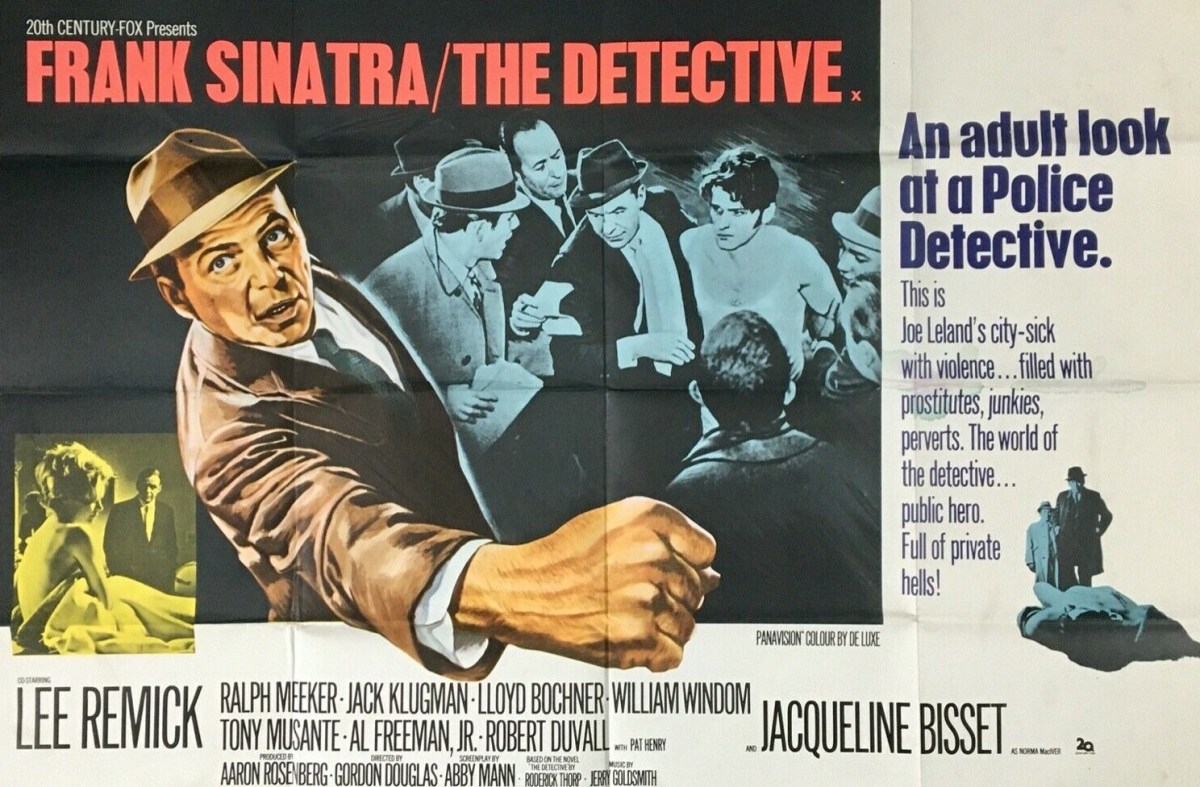
The Detective (1968) ****

Perhaps the boldest aspect of this raw look at the seamier side of life as a New York cop is that perennial screen loverboy Frank Sinatra plays a cuckold. Prior to what is always considered the more hard-hitting cop pictures of the 1970s – Dirty Harry (1971), The French Connection (1971), Serpico (1973) – this touched upon just about every element of society’s underbelly. Despite an old-school treatment, more a police procedural than anything else, homosexuality, nymphomania, corruption, police brutality, and a system that ensured poverty remained endemic all fell into its maw. And, for the times, several of these issues were dealt with in often sympathetic fashion.

Joe Leland (Frank Sinatra), an ambitious but principled detective gunning for promotion, investigates the murder of a prominent homosexual while dealing with the disintegration of marriage to Karen (Lee Remick) and colleagues on the take. When other cops want to beat confessions out of suspects or strip them naked to humiliate them, Leland intervenes to prevent further brutality. He is not just highly moral, but takes a soft approach to criminals, not just playing the “good cop” part of a good cop/bad cop double-act but genuinely showing sympathy. Not only does Leland leap to the defense of those he feels unfairly treated, but he trades punches with those meting out unfair treatment. In addition, he clearly feels guilt over sending to the electric chair a man he believes should be treated in a mental institution.

Although at first glance this appears a homophobic picture, it is anything but, Leland showing tremendous sympathy towards homosexual suspect Felix (Tony Musante) – whom his colleagues clearly despise – to the extent of holding his hand and gently cajoling him through an interview. Later, rather than condemn a bisexual the film shows empathy for his torment. Certainly, some of the attitudes will appear dated, especially the idea of sexual expression as a brand of deviancy, but the film takes a genuinely even-handed approach.  Through the medium of Leland’s perspective, it is clearly demonstrated that it is other police officers who have the warped notions.  

Having solved the first murder, Leland takes up the case of an apparent suicide at the behest of widow Norma McIver (Jacqueline Bisset), only for this to lead not only to civic corruption on a large scale but back to the original investigation. Leland also has a wider social perspective than most cops and there is a terrific scene where he berates civic authorities for creating a system that perpetuates poverty. The ending, too, casts new light on Leland’s character.

By this point, most screen cops were defined by their alcoholism and ruined domestic lives, but this is altogether a more tender portrait of an honest cop. Leland’s relationship with Karen is exceptionally well done. Normally, of course, it is the man who strays. This reversal in the infidelity stakes adds a new element. Karen has more in common with an independent woman like the Faye Dunaway character in The Arrangement (1969).

While playing the good cop would come relatively easy to an actor like Sinatra, carrying off the role of the hurt husband is a much tougher ask. Coupled with his sensitive approach to criminals, this is acting of some distinction.  This is the last great Hollywood role by Lee Remick (No Way to Treat a Lady, 1968) and she brilliantly portrays a woman trapped by her self-destructive desires.

Jacqueline Bisset leads an excellent supporting cast that includes Jack Klugman (The Split, 1968), Ralph Meeker (The Dirty Dozen, 1967), Robert Duvall (The Godfather, 1972), Lloyd Bochner (Point Blank, 1967) and Al Freeman Jr. (Dutchman, 1966).

While Gordon Douglas (Claudelle Inglish, 1961) was viewed very much as a journeyman director, he brings an inventive approach and some surprising subtleties to the picture. He opens with a very audacious shot. It looks like you are seeing skyscrapers upside down, as if a Christopher Nolan sensibility had entered a time warp, until you realize it is the city reflected off a car roof. There are some bold compositions, often with Sinatra appearing below Remick’s sightline, rather than the normal notion that the star must be taller or at least the same height as everyone else.

Oscar-winning Abby Mann (The Judgement at Nuremberg, 1961) adapted the bestseller by Roderick Thorp who achieved greater fame much later for writing the source novel for Die Hard (1988). Nothing Lasts Forever was a sequel to The Detective. For the Bruce Willis film Joe Leland became John McClane. Sinatra, although 73 at the time, was offered that role first as part of his original contract for The Detective.

Sinatra’s wife Mia Farrow was initially contracted to play the part of Norma McIver but pulled out when Rosemary’s Baby (1968) overshot its schedule. Partly in revenge, Sinatra sued her for divorce.

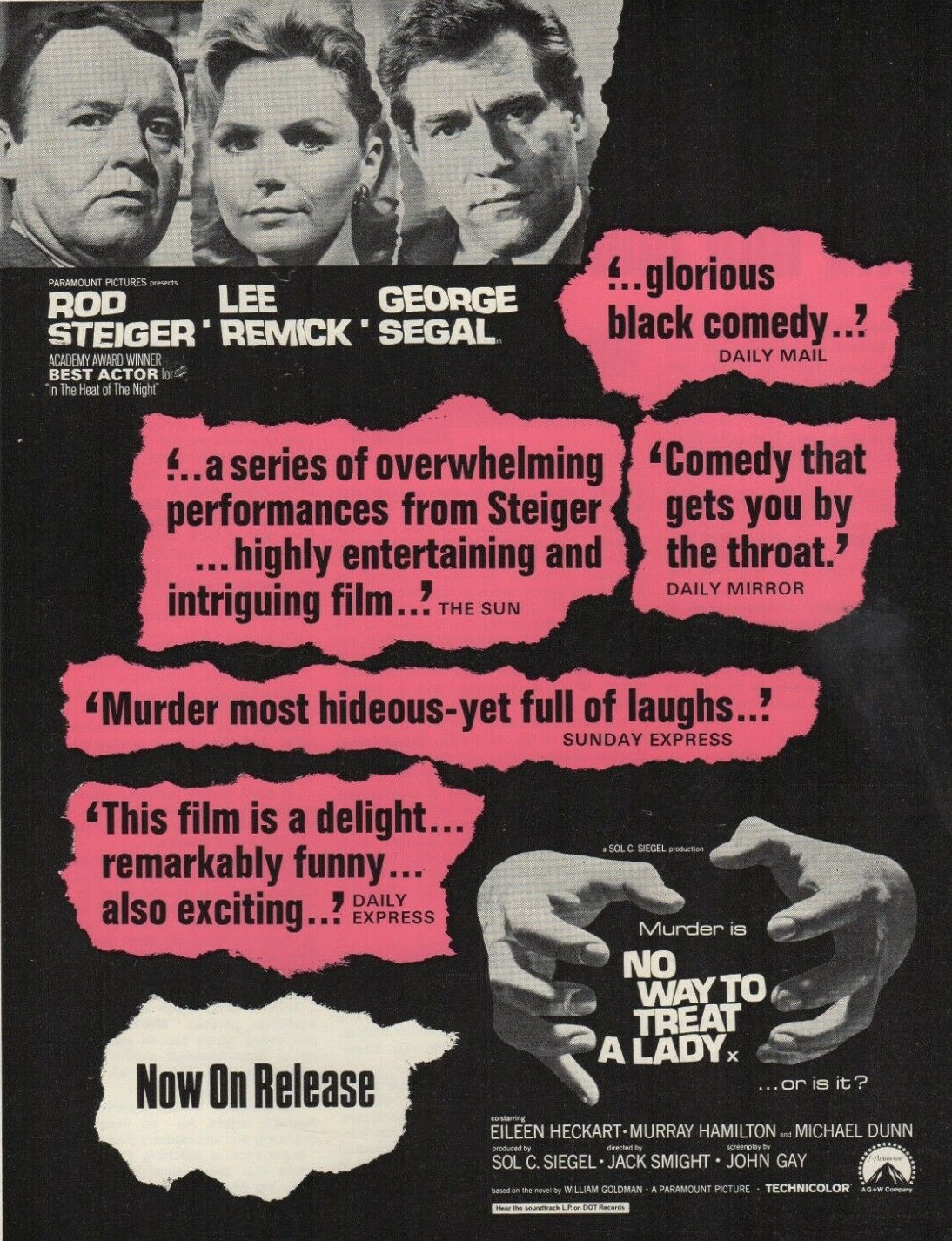
No Way to Treat a Lady (1968) ****

Sly, cunning highly original drama hugely enjoyable for a number of reasons, top among which would be Rod Steiger’s serial killer. As the wealthy and cultured Christopher Gill, the actor employs disguise to enter the homes of the unsuspecting. These range from Irish priest,  German maintenance man, camp wig salesman, a woman and even a policeman knocking on doors to advise people not to admit strangers.

Clearly Steiger has a ball with these cameos, but, more importantly, his character pre-empts the celebrity status accorded the modern-day mass murderer. This is a killer who wants everyone to know just how good he is at his self-appointed task, who desperately wants to be on the front pages, who revels in a cat-and-mouse taunting of the police. To be sure, an element of this is played as comedy, but from our perspective, half a century on, it is a terrific characterization of the narcissistic personality, and far more interesting than the psychological impulse that causes him to kill in the first place.

The hapless detective (George Segal) on the receiving end of Gill’s brilliance is named Morris Brummel which means that he is met with laughter anytime he introduces himself since he that is invariably shortened to Mo Brummel, too close to Beau Brummel, the famous dandy, from whom the cop could not be further removed. And Brummel is not your standard cop, stewed in alcohol with marital problems, feuding with his bosses and close to burn-out. Brummel would love marital problems if only to get out from under his nagging mother (Eileen Eckhart) , with whom he lives.

He is dogged, but respects authority and takes his demotion like a man. Not coincidentally, killer and cop are linked by mother issues. Although Gill is angry when ignored he does not taunt Brummel the way his mother does. She is ashamed he is a cop and not wealthy like his brother.

Even less standard is the meet-cute. Kate Palmer (Lee Remick) is a useless witness. She can’t remember anything about the priest she passed on the stairs. When the cop arrives, she is hungover and just wants to get back to sleep, and without being aware that Brummel is in fact Jewish praises his nose. Gill is a bit ham-fisted in the seduction department and it is Palmer who makes the running. But although appearing glamorous when first we see her, in reality she is a mundane tour guide. Their romance is conducted on buses and a police river launch, hardly the classic love story.

Although the trio of principals boasted one Oscar and two nominations between them, their careers were at a tricky stage. Winning the Oscar for In the Heat of the Night (1967) did not trigger huge demand for Steiger’s services and he had to skip over to Italy for his next big role. Both Remick and Segal, in freefall after a series of flops, had been working in television. Whether this picture quite rejuvenated their careers is a moot point for the picture was reviled in certain quarters for bringing levity to a serious subject and it was certainly overshadowed in critical terms by The Boston Strangler (1968) a few months later. But all three give excellent performances, especially Steiger and Segal who subjugated screen mannerisms to create more human characters.

While Jack Smight had directed Paul Newman in private eye yarn Harper (1966) the bulk of his movies, regardless of genre, were tinged with comedy. While he allows Steiger full vent for his impersonations, he keeps the actor buttoned-down for most of the time, allowing a more nuanced performance. Violence, too, is almost non-existent, no threshing of limbs of terrified victims. John Gay wrote the screenplay from a novel by William Goldman (who had written the screenplay for Harper) so short it almost constituted a movie treatment.  

In reality, the comedy is slight and if you overlook a sequence poking fun at the vertically-challenged, what remains is an examination of propulsion towards fulfilment through notoriety and the irony that the murders elevate the mundane life of the investigating officer.   

The Running Man (1963) ****

Twisty Carol Reed thriller pivoting on emotional entanglement that keeps you guessing right up to the end. In revenge for losing his business after an insurance company failed to cough up for his crashed plane, entrepreneur Rex (Laurence Harvey) fakes his own death and flees to Malaga in Spain.

But when girlfriend Stella (Lee Remick) joins him she discovers he has assumed the identity of an Australian millionaire whose passport he has purloined and completed the transformation by changing his black hair to blond. Rex has a mind to repeat the experiment by killing off himself (under the new identity) and claiming the insurance. Stella, complicit in the original scam, not only balks at this idea but finds disconcerting his change of personality and clear attraction to the opposite sex.

Tensions mount when mild-mannered insurance investigator Stephen (Alan Bates) appears on the scene. Anyone watching the film now has to accept that in the days before social media every face was not instantly tracked and accept that Stephen is unaware of what Rex looks like.

The couple cannot run because they are awaiting a bank draft. Stephen immediately sets the tone for suspicion when he pronounces that their vehicle  “looks like a getaway car.”  Forced to follow “The Godfather” dictum of keeping your enemies closer, the pair befriend Stephen  with the intention of finding out what he knows and what are his intentions. Rex and Stella  have to pretend they have only just met, separate bedrooms et al, leaving the door open for Stephen to gently woo Stella, an action endorsed by Harvey. They are caught out in small lies. Rex’s Australian accent falters. Stephen keeps on making notations in a notebook. Rex  foils his pursuer’s attempts to photograph him.

The ensuing game of cat-and-mouse is complicated by Stephen’s romantic inclinations towards Stella. Is this as genuine as it appears? Or is he trying to get her on her own to admit complicity? Both Rex and Stella are, effectively, forced to adopt the new identities they have forged to dupe Stephen, with unforeseen results. There are red herrings aplenty, a race along mountainous roads, and some marvelous twists as the couple find the tale they have woven is turning too tight for comfort until murder appears the only solution.  

As with his international breakthrough The Third Man (1949), Carol Reed grounds the whole Hitchcockian enterprise in local culture – this being unspoiled Malaga prior to the tourist deluge – Spanish churches, a wedding, fiesta, the running of the bulls, with an occasional ironic twist – “gypsy” musicians watching ballroom dancing on television. Reed resists taking the material down a darker route – Hitchcock would undoubtedly have twisted the scenario in another direction until Stella came under threat from Rex – but instead allows it to play out as a menage a trois underwritten by menace.

The acting is sublime. Laurence Harvey (A Dandy in Aspic, 1968) wallows in his part, Remick (Days of Wine and Roses, 1962) quietly anxious scarcely coming to belief that she had played a part in the original crime, Alan Bates (The Fixer, 1969), his deceptively pleasant inquisitive demeanor the ideal foil to Harvey. Unusually, they all undergo change, Harvey uncovers a more ruthless side to his character, Remick responds to the gentler nature of Bates, while Bates shrugs off his schoolmasterly aspects to become an attractive companion.

A couple of footnotes – special mention to Maurice Binder for the opening credits and this was the final score of British composer William Alwyn (The Fallen Idol, 1948). John Mortimer (Bunny Lake Is Missing, 1965) wrote the screenplay based on the Shelley Smith novel.

Full throttle film noir.

https://amzn.to/45ZFynU

Baby, The Rain Must Fall (1965) ***

Nothing to live on but dreams and, in those days, no social media to bail them out. Spare sad lives in Small Town U.S.A. told with an occasional grand guignol touch. Look elsewhere for the laconic loner of Steve McQueen legend, to, for example, The Cincinnati Kid, out the same year.

This has the feel of a vanity project, the actor’s Solar outfit taking a production credit, as if the star felt he wouldn’t properly be recognized as an actor unless he had a ton of lines to chew through. And he might be right to feel aggrieved, wildly contrasting roles from Daniel Day-Lewis in movies that opened the same day in New York two decades later had critics reaching for the superlatives. 

By my reckoning, this was the last year, save for occasional outliers like In Cold Blood  (1967), when studios accepted the hi-falutin’ notion that filming in black-and-white added artistic luster regardless of the damage it might do to a picture’s commercial prospects. The mono approach is taken to extremes from time to time, the contrast so sharp it might have emanated from the Ingmar Bergman school of cinematography. And given the desultory lives picked over, this might have fared better with subtitles, the kind of foreign picture that arthouse audiences fawned over.

Prison parolee Henry (Steve McQueen), entitlement hormone running amok, has got it into his head that if only he had the funds to reach Hollywood or Nashville (either would do) his singing and song-writing talent would be recognised. This puts wife Georgette (Lee Remick), newly arrived with small daughter, in the position of going out to work to keep the family, altering her domestic situation from independent single mother to wife in thrall to waster husband.

She’s supposedly no dupe either, rejecting the kindness of strangers, as if aware it usually comes with strings attached. It’s a given that any time a child enters a romantic equation you can be sure the narrative will turn on parenthood and responsibility. And that’s pretty much all the story there is.

You can guess from the outset that while Henry’s singing might set a few female hearts zinging, it’s not likely to win him a contract. So the question is, really, whether Henry can settle down and not be so swift to resort to his knife when confronted with a messy situation.

It’s marred by a couple of truly terrible scenes, a poorly-choreographed fight and a really odd sequence that has Henry declaiming with his back to a tableau of motley characters with the contrast at its sharpest. And in what looks like nothing more than an old haunted house.

It’s well-meaning enough and for the most part McQueen dispenses with the tough-guy attitude, but he doesn’t really offer enough in its place. It’s the kind of role that could easily have been delivered as effectively by any number of actors with nothing approaching his star quality. And that’s a shame because he really is trying – though it’s the trying that gets in the way, you keep on waiting for the real Steve McQueen to turn up.

If director Robert Mulligan (Up the Down Staircase, 1967) hadn’t been so determined to paint it in downbeat arthouse tones, the actor might have felt free enough to come up with a genuinely original turn. Though I accept it’s a bit unfair to complain about McQueen attempting something different, there’s no real excuse for him creating the worst singer ever to hit the screen.  

You might also note, by the way that whereas McQueen takes pole position on the poster, in the screen credits Lee Remick (Days of Wine and Roses, 1962) is top-billed. Remick is better than McQueen because she has a deeper well of emotions and wider range of characterizations to choose from. You never feel she is acting to save her career or hope that Oscar voters might nod in her direction.  

The movie makes more sense once you understand it really belongs to the 1950s –  the Horton Foote (To Kill a Mockingbird, 1962) Broadway play on which it is based was staged in 1954. The movie fatally switches focus from Georgette to Henry before working out which actor was likely to best convey the happiness drought on which the work depends. There’s more than enough sadness to go round but it just seems solidified from the outset. No great harm – that may well be the truth of it – but it prevents the movie taking off, stuck as it is in recycling Henry’s weary past. Don Murray (The Viking Queen, 1967) makes a good fist of a widowed sheriff.

Worth a look to see McQueen tackling something different. You decide whether he succeeds or fails.

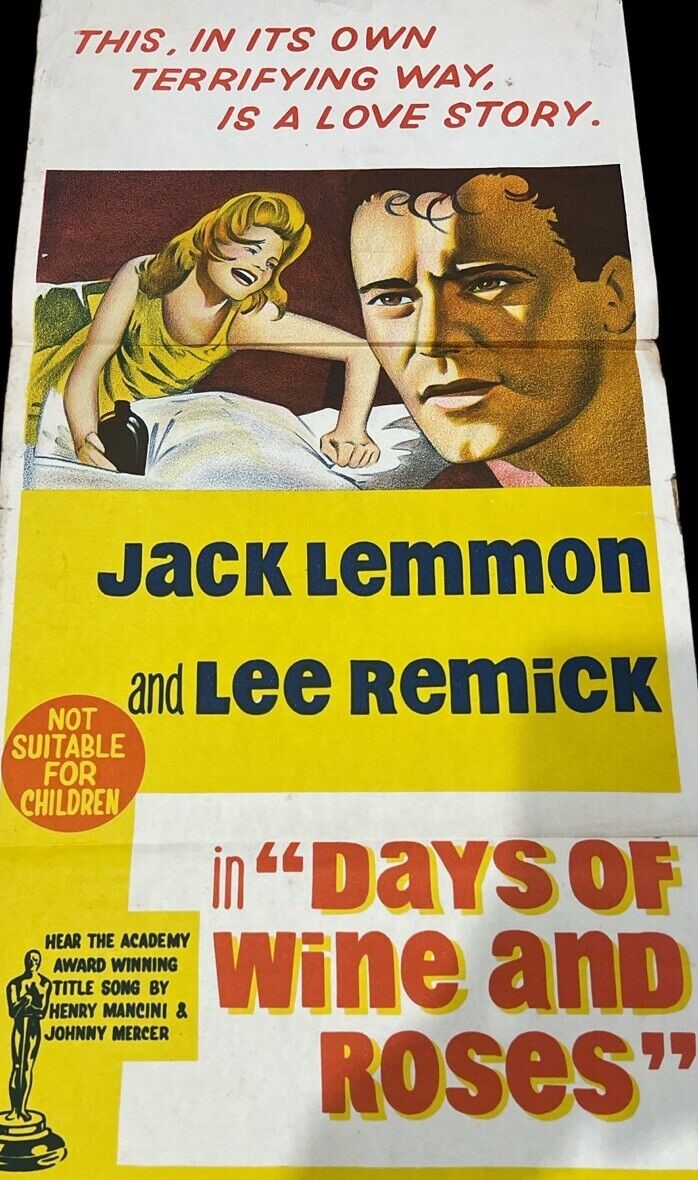
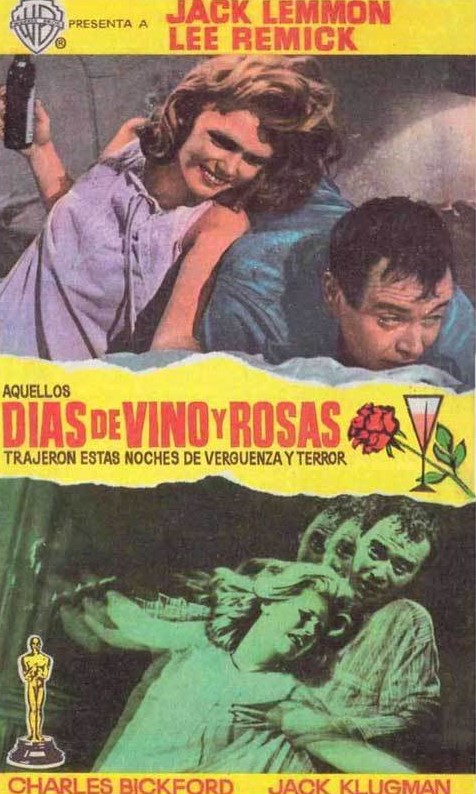
Days of Wine and Roses (1962) *****

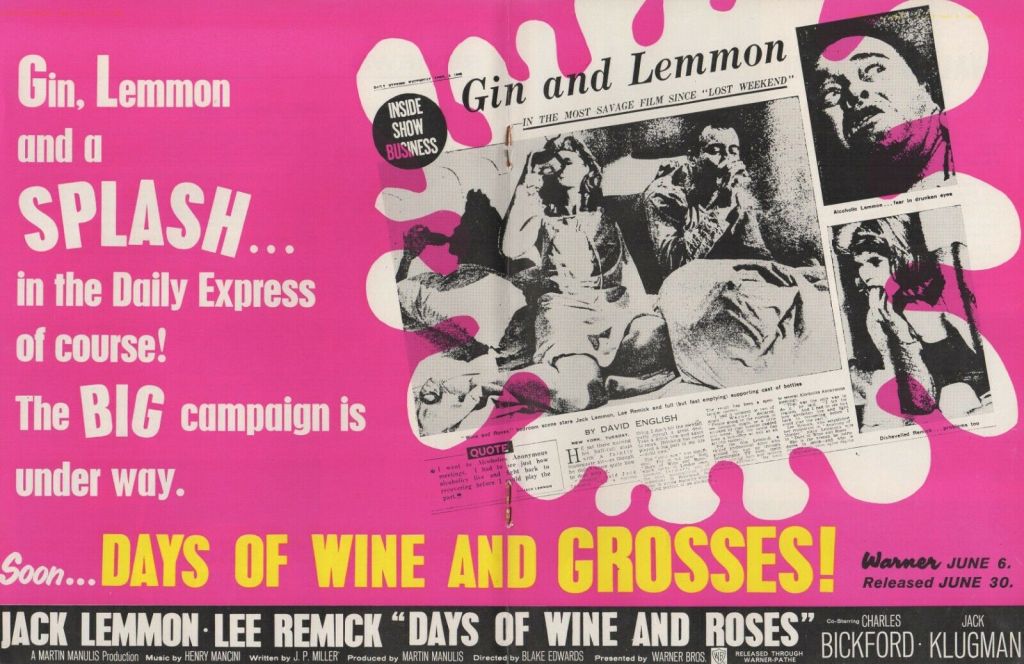
A touch of Mad Men satire adds a contemporary bite to tale of the destructive power of alcohol. Not since Billy Wilder let loose on The Lost Weekend (1945) did Hollywood finance a no-holds-barred examination of alcohol addiction.  

But let’s start with the amoral world of advertising or, in this case, public relations. When we are introduced to executive Joe (Jack Lemmon) he’s little more than a pimp for his client, rounding up a plethora of blondes who can be salivated over by wealthy men on a big yacht. When we first meet Kirsten (Lee Remick) she is initially mistaken by Joe as a blonde worth salivating over only to learn that actually she is the prim, though pretty, secretary of his client to whom the idea of a potential pawing on a big yacht has no appeal, regardless of how wealthy the pawing hands might be.

Romance should never have got off the ground as they insult each other in turn, but in the way of such tales, one of his barbed comments strikes home and she consents to be taken to dinner. Astonished to discover she doesn’t drink, he alights upon her weakness for chocolate as a way of getting her to sample Brandy Alexander (as stiff with chocolate as alcohol). That’s all it takes. While she begins to lose her inhibitions, he, ironically, adopts a principled stance towards the aforesaid pimping and is moved to another account.

After they marry, she stays off the sauce once a baby arrives, he, petulant at taking second place to the baby, gets deeper into the stuff. Eventually, he wears her down, and they have a whale of a time getting drunk and ignoring the child. Meanwhile, he is sliding lower down the company pyramid thanks to his drinking. Matters come to a head when she sets the apartment on fire.

Eventually, jobless, Joe throws himself on the mercy of Kirsten’s stern father Ellis (Charles Bickford) and they manage a good few months on the wagon until in a drunken spree he manages to destroy a greenhouse at his father-in-law’s landscaping business.  Joe ends up with the DTs, committed to a sanatorium and determines to mend his ways. But that means admitting his addiction and joining Alcoholics Anonymous. Kirsten, meanwhile, is not such a softie, refusing the believe she is an alcoholic.

Their bright future darkens by the minute as squalidness and selfishness take over. In some senses, this is a case study of the alcoholic, the one who can fight the demons and the one who can’t be bothered to fight anything since the bottle is the easiest cure.

Made at a time when Hollywood was not predisposed to this kind of sharp shock of reality, not even with attractive stars to make the tale more palatable, this is easily the highlight of director Blake Edwards’ career, the comedies and even the romanticised Breakfast at Tiffany’s (1961) seeming like so much fluff in comparison. He manages to avoid being either sentimental or sanctimonious and possibly the only time he holds back is when the fire takes place off-screen. Otherwise, it’s light years ahead of The Lost Weekend, whose protagonist seems more easily than humanly possibly to beat the addiction.

If you think Jack Lemmon (How To Murder Your Wife, 1965) is usually a hyperactive character anyway on screen, wait till you see what’s he’s like with a drink in him, just as if he doesn’t know when to stop, consequence never entering his consciousness, as like any drunken maniac he’s living in a fantasy world. But because she starts out on a different dramatic plane, and her slide into incoherence is more sobering, Lee Remick  (No Way to Treat a Lady, 1968) beats him to the critical kudos. Terrific performances from both and from those tasked with keeping them in line, Charles Bickford (The Unforgiven, 1960) and Jack Klugman (Goodbye, Columbus, 1969) as the recovering alcoholic trying to get Joe to face up to his condition.

In all the literature devoted to twentieth century humanitarians, you’ll find few busting a gut to highlight the work of Bill Wilson (better known as Bill W), the founding father of Alcoholics Anonymous. But this self-funded organisation that created a community for the addicted probably did more in the last century to cure a terrible disease than any scientist inventing a drug. Incidentally, James Garner played Bill in a television biopic My Name Is Bill W (1989).

Sometimes I think actors take on roles aiming to enhance their reputation by playing difficult unsympathetic characters. But I imagine Lemmon and especially Remick got the shock of their lives on seeing the completed movie because their character disintegration is so total it would have required teams of public relations executives to put a good spin on a picture that shows human beings in such a depressing light, almost disempowered by their addictions. First appearing as teleplay in 1958, writer JP Miller (The Young Savages, 1961), while adding more gloss for the movie adaptation, nevertheless does not shrink of the unpalatable truths.

Superb all-round effort.

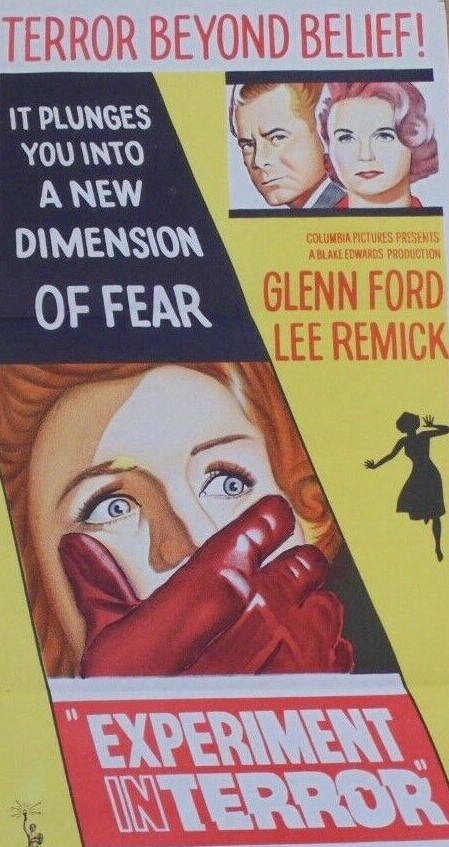
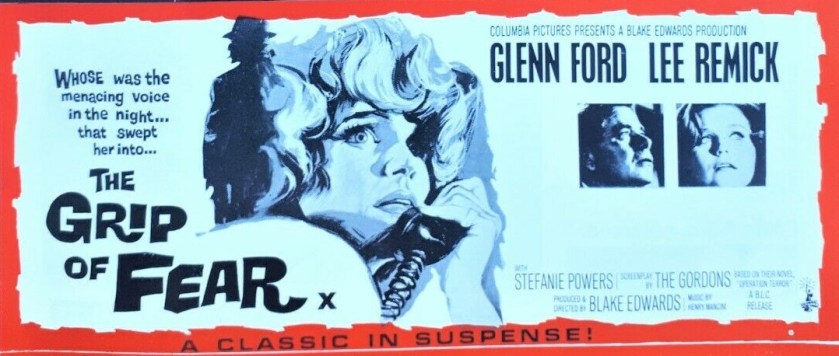
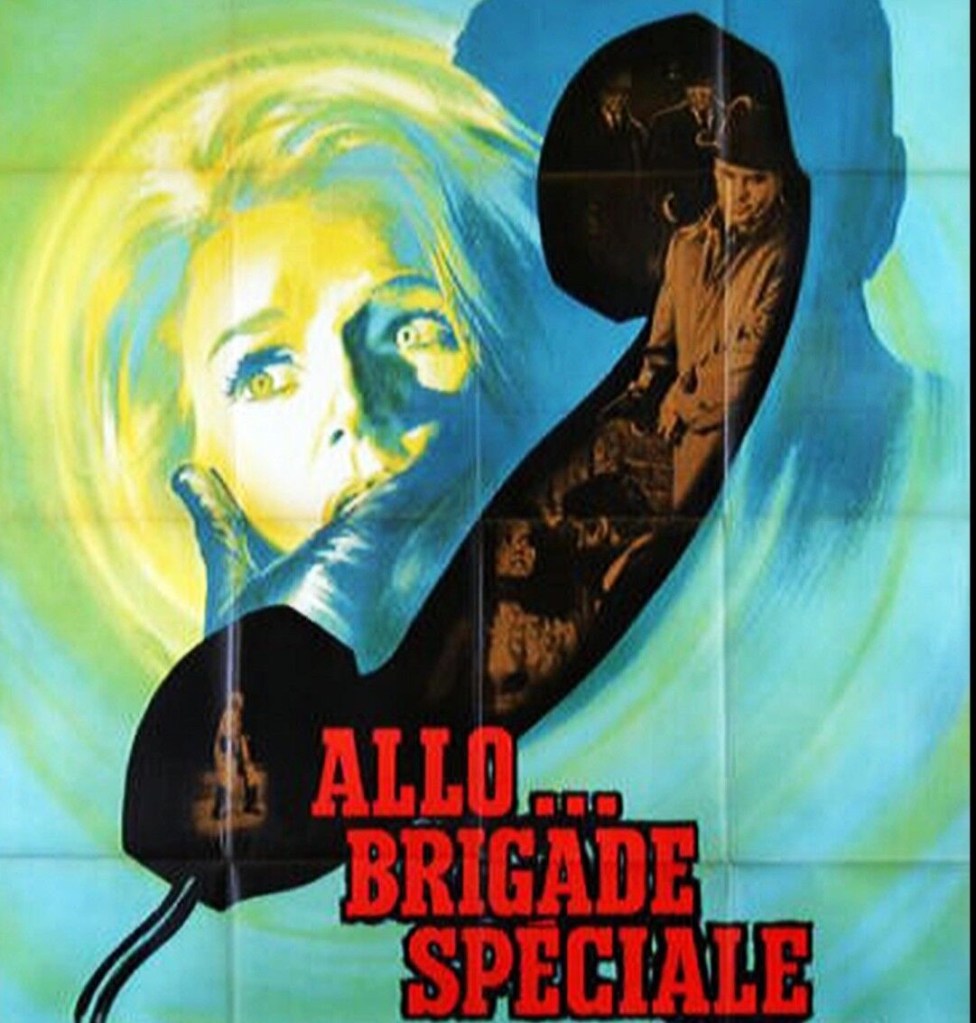
Experiment in Terror / The Grip of Fear (1962) ****

For a modern audience any film that contains mention of “Twin Peaks” and “Tarantino” either shows amazing prescience and/or an indication of what is to come. This classy thriller does not disappoint. Part police procedural, part portrait of a killer, part clever heist and part women in peril, it has you wondering why director Blake Edwards did not stick to the genre. Set in San Francisco in an era when the F.B.I. was generally considered a good thing rather than the paranoia-inducing entity it would become a decade later.

Bank teller Kelly Sherwood (Lee Remick)  is terrorized by an unknown assailant into helping him carry out a audacious $100,000 heist. F.B.I. agent Ripley (Glenn Ford), aware of the prospective theft, is drawn into the diabolical web as is Sherwood’s younger sister Toby (Stefanie Powers). The only clue to the thief is his asthmatic voice. Levels of forensic detection set a new bar with the F.B.I. employing telephone, personal and even aerial surveillance, commandeering of television cameras to scan a crowd, and analyzing a telephone conversation to identify the criminal.

Released in Britain as “The Grip of Fear,” exhibitors tried to pull a fast one on the public by using as the support “Operation Mad Ball,” a Jack Lemmon number from 1957, in a bid to convince moviegoers that this program would repeat the successful pairing of Remick and Lemmon in “Days of Wine and Roses.”

There are red herrings aplenty. Tension is racked up so adroitly that any character entering the frame automatically arouses suspicion. Edwards takes a leaf out of the Hitchcock suspense book by finding constant ways to remind Kelly – and the audience – just what is at stake, Ripley promising her a “reign of terror” and not, as you might expect, lying to her about the threat she faces.

As Ripley digs further into the robber’s past, he uncovers not only a catalogue of crime including rape and three murders, but also an unusual personality. Yes, as you might expect, a control freak, but also a guy capable of affection and of lavishing thousands of dollars on those worse off than himself. And, of course, he is exceptionally good at planning crime, outwitting the F.B.I., and picking the kind of vulnerable victim susceptible to intimidation. Every time, the F.B.I. thinks it is closing in, he remains one step ahead. Eventually, the F.B.I. has amassed so many clues, including his identity, a photograph and previous lovers, that you think it’s impossible for him to escape – until he does.

Kelly is so on edge, in following instructions, that she picks up the wrong man in a bar, the police so antsy they mistake a drunk for the assailant. Drenched in atmosphere and rich in subsidiary characters, there’s scarcely a dull moment, from a mannequin repairer (Nancy Ashton) with a roomful of dangling inert bodies, a karate class with (ironically) a woman well able to defend herself, to a small boy desperate to see a G-man’s weapon, an informant (Ned Glass) with a penchant (as did director Edwards) for silent comedies, and a bank manager who promises Kelly a promotion even if she has to steal the money.

On top of this there are some genuine creepy moments that up-end our expectations. What Ripley doesn’t tell Kelly is that she’s also bait and clearly has little concern that she might end up collateral damage – anticipating at the very least she will have a nervous breakdown when it’s over, if, in fact, she survives – in his bid to snare the criminal. A terrified  kidnapped Toby strips down to underwear in front a man we know is a rapist. And the movie touches on the woman-who-loves-a-killer motif, a theme very much in the contemporary vein.

Blake Edwards (Breakfast at Tiffany’s, 1961) delivers a directorial tour de force. The criminal is hidden for most the picture, drip-fed to the audience in glimpses, his mouth here, his back there, other times in disguise. Edwards establishes the F.B.I. as such a “very efficient organization” using the most up-to-date methods and involving a vast number of staff plus police that it seems impossible to fail – until it does. And there is an absolutely brilliant six-minute sequence at the outset, milking the best of film noir lighting, when the criminal surprises Kelly in her garage and spells out in detail her vulnerability and the basics of his plan. By keeping the criminal in the shade, and what little available light there is covering her face, Edwards makes the most of Lee Remick’s eyes – every bit as iconic as Audrey Hepburn’s outfits in Breakfast at Tiffany’s – and her acting skill.

Remick (Sanctuary, 1961) is superb, trapped by emotion as much as terror, placing her trust in an F.B.I. that lets her down time and again. This is an edgier role for Glenn Ford (Fate Is the Hunter, 1964) as he steps up from the trustworthy guy-next-door to reveal a more ruthless streak. Stefanie Powers (The Warning Shot, 1967) does well in a small role and there is sterling support from Ross Martin (The Ceremony, 1963), Patricia Huston (Synanon, 1965) and Clifton James (Live and Let Die, 1973). Gordon and Mildred Gordon wrote the screenplay based on their novel Operation Terror.

“Twin Peaks” in case you are wondering is the district in which Kelly lives. There’s a sign towards the end for Tarantino’s World-Famous Cocktails.

Sanctuary (1961) ***

This overheated melodrama stands as a classic example of Hollywood’s offensive attitudes to women. Nobel prize-winning author William Faulkner could hardly blame the movies for sensationalising his misogynistic source material since if anything the movie took a softer line.  Told primarily in flashback as headstrong southern belle Temple Drake (Lee Remick) attempts to mitigate the death sentence passed on her maid Nancy (Odetta). Given that such appeals are directed at Drake’s Governor father (Howard St John), and that the maid has been condemned for murdering Drake’s infant child, that’s a whole lot of story to swallow.

Worse is to follow. Drake takes up with Prohibition bootlegger Candy Man (Yves Montand) after being raped by him and thereafter appears happy to live with him in a New Orleans brothel – the “sanctuary,” no irony intended, of the title – despite him slapping her around. The film steers clear of turning her into the prostitute of the original book, but pretty much sets up the notion that high class women will fall for a low-class tough guy whose virility is demonstrated by his brutality. In other words a “real man” rather than the dilettantes she has previously rejected.

After the Candy Man dies, Drake returns home and marries wealthy suitor Gowan Stevens (Bradford Dillman) who blames himself, rightly, for Drake falling into the clutches of the gangster in the first place. But a past threatening to engulf her precipitates the infanticide.

Faulkner was a Hollywood insider, adapting Sanctuary for The Story of Temple Drake (1933) and earning high praise for  his work on Bogart vehicles To Have and Have Not (1944) and The Big Sleep (1946). The success of The Tarnished Angels (1957) starring Rock Hudson, The Long, Hot Summer (1958) with Paul Newman and The Sound and the Fury (1959) headlined by Yul Brynner had sent his cachet rocketing. But all three were directed by Americans – Douglas Sirk and Martin Ritt – who had a distinctive visual style and an ear for what made melodrama work.

Sanctuary had been handed to British director Tony Richardson (Look Back in Anger, 1959) and he didn’t quite understand how to make the best of the difficult project. So while Lee Remick manages to suggest both strength and fragility, and makes her character’s wanton despair believable, Yves Montand is miscast and Bradford Dillman fails to convince even though portraying a weak character. Too many of the smaller roles appear as cliches. And it’s hard to believe the maid’s motivation in turning murderer. Watch out for Strother Martin (Cool Hand Luke, 1967).

What was acceptable steamy melodrama in the 1930s fails to click three decades on. Faulkner’s thesis that high-falutin’ women want a man to master them and furthermore will fall in love with their rapist seems to lack any understanding of the female mind and will not appeal any more to the modern sensibility than it did on release. Lee Remick is what holds the picture together, in part because she plays so well the role of a woman embracing degradation, and refusing – no matter how insane the idea appears – to let go of the man she believes is the love of her life. It’s not Fifty Shades of Grey, but it’s not that far off that kind of fantasy figure, and given the success of that book, it’s entirely possible there is a market for what Faulkner has to peddle.

Not easy to find. This is actually on YouTube if you go onto that channel and search. Strangely enough, if I post a link, it says it is no longer playing there – but just as strangely if you go looking you will find it.

Discover WordPress

A daily selection of the best content published on WordPress, collected for you by humans who love to read.

The Atavist Magazine

by Brian Hannan

WordPress.com News

The latest news on WordPress.com and the WordPress community.