Is Paris Burning? (1966) ****

Paris endured a four-year “lockdown” during the Second World War, under a brutal Nazi regime, and this is the story of the battle to lift it.

Politics didn’t usually play a part in war films in the 1960s but it’s an essential ingredient of Rene Clement’s underrated documentary-style picture. Paris had no strategic importance and after the Normandy landings the Allies intended to bypass the French capital and head  straight for Berlin. Meanwhile, Hitler, in particular vengeful mood after the attempt on his life, ordered the city destroyed.

Resistance groups were splintered, outnumbered and lacking the weaponry to achieve an uprising. Followers of General De Gaulle, the French leader in exile, wanted to wait until the Allies sent in the troops, the Communists planned to seize control before British and American soldiers could arrive.  When the Communists begin the fight, seizing public buildings, the Germans plant explosives on the Eiffel Tower, the Louvre, other famous buildings and the bridges across the River Seine. 

The German commandant Von Choltitz (Gert Frobe), no stranger to slaughter having overseen the destruction of Rotterdam, holds off obeying his orders because he believes Hitler is insane and the war already lost. The Gaullists despatch a messenger to persuade General Omar Bradley to change his mind and send troops to relieve the city. Sorry for the plot-spoiler but as everyone knows the Germans did not destroy the city and the liberation of Paris provided famous newsreel and photographic footage.

Line-drawings from the extended poster – the all-star cast included Orson Welles, Glenn Ford, George Chakiris, Yves Montand, Leslie Caron, Kirk Douglas, Robert Stack, Jean-Paul Belmondo and Alain Delon. At $6 million, it was the most expensive French film ever made. It had a six-month shooting schedule and was shot on the streets of the city including famous locations like Etoile, Madeleine and the Louvre. It was a big hit in France but flopped in the United States, its box office so poor that Paramount refused to disclose it.

Director Clement was also aware he could not extract much tension from the question of whether von Clowitz will press the destruct button, so he takes another route and documents in meticulous detail the political in-fighting and the actual street battles that ensued, German tanks and artillery against Molotov cocktails and mostly old-fashioned weaponry. The wide Parisian boulevards provide a fabulous backdrop for the fighting. Shooting much of the action from above allows Clement to capture the action in vivid cinematic strokes.

Like The Longest Day (1962), the film does not follow one individual but is in essence a vast tapestry. Scenes of the utmost brutality – resistance fighters thrown out of a lorry to be machine-gunned, the public strafed when they venture out to welcome the Americans – contrast with moments of such gentleness they could almost be parody: a shepherd taking a herd through the fighting, an old lady covered in falling plaster watching as soldiers drop home-made bombs on tanks.

This is not a film about heroism but the sheer raw energy required to carry out dangerous duty and many times a character we just saw winning one sally against the enemy is shot the next. The French have to fight street-by-street, enemy-emplacement-by-enemy-emplacement, tank-by-tank. And Clement allows as much time for humanity. Francophile Anthony Perkins, as an American grunt, spends all his time in the middle of the battle trying to determine the location of the sights he longs to see – before he is abruptly killed.  Bar owner Simone Signoret helps soldiers phone their loved ones. Gore Vidal and Francis Coppola fashioned the screenplay with a little help from French writers whom the Writers Guild excluded from the credits.

Like The Longest Day and In Harm’s Way (1965), the film was shot in black-and-white, but not, as with those movies for the simple reason of incorporating newsreel footage, but because De Gaulle, now the French president, objected to the sight of a red swastika. Even so, it permitted the inclusion of newsreel footage, which on the small screen (where most people these days will watch it) appears seamless. By Hollywood standards this was not an all-star cast, Glenn Ford (as Bradley), Kirk Douglas (General Patton) and Robert Stack (General Sibert) making fleeting glimpses. But by French standards it was the all-star cast to beat all-star casts – Jean-Paul Belmondo (Breathless, 1960), Alain Delon (Lost Command, 1966), Yves Montand (Grand Prix, 1966), Charles Boyer (Gaslight, 1944), Leslie Caron (Gigi, 1958), Michel Piccoli (Masquerade, 1965) , Simone Signoret (Room at the Top, 1959) and Jean-Louis Trintignant (A Man and a Woman, 1966).  Orson Welles, in subdued form, appears as the Swedish ambassador. Director Rene Clement was best known for Purple Noon (1960), an adaptation of Patricia Highsmith’s The Talented Mr Ripley starring Alain Delon.

The score by Maurice Jarre is one of his best. The overture at the start is dominated by a martial beat, but snuck in there is the glorious traditional theme that is given greater and greater emphasis the closer the Parisians come to victory.
In the News – August 1960

CLEOPATRA VERSION ONE

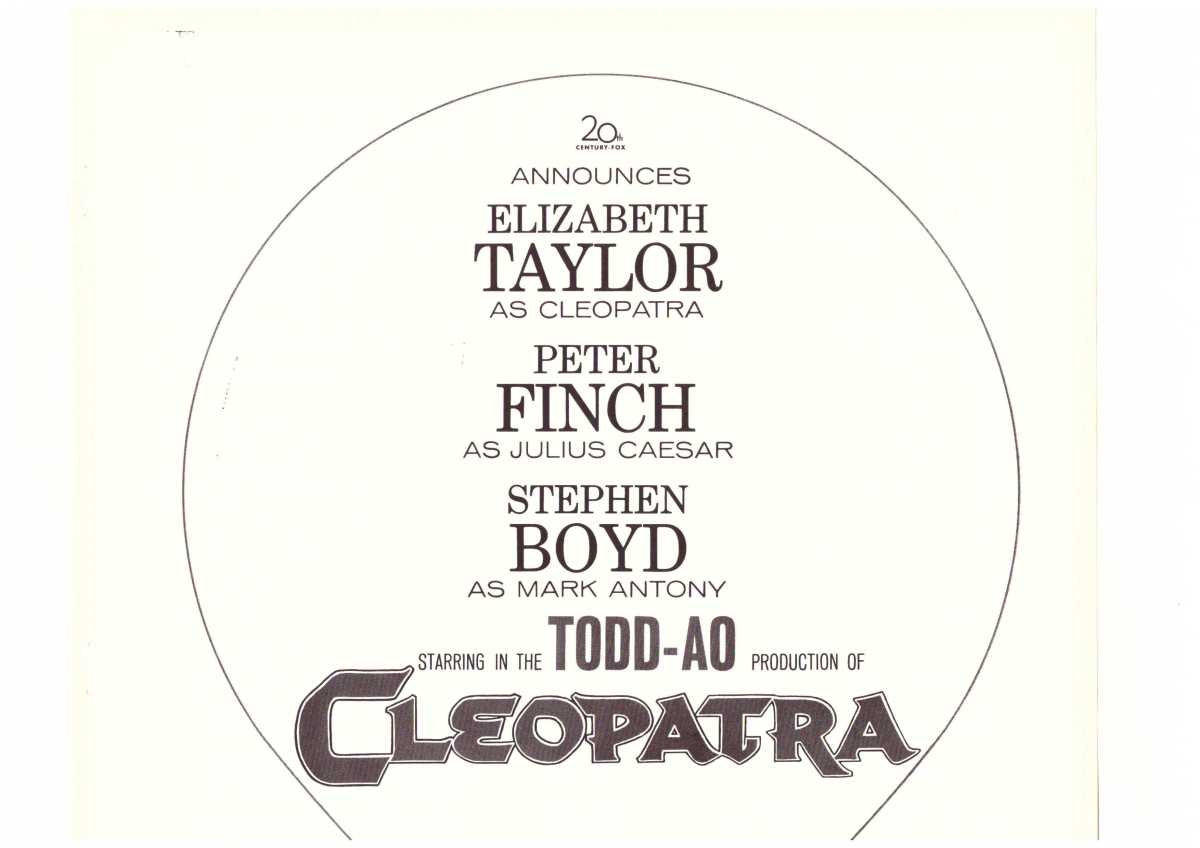
Producer Walter Wanger headed for Britain to oversee the start of production for Twentieth Century Fox’s Cleopatra. Before the movie was bogged down in illness and budget scandals, Elizabeth Taylor’s co-stars in this initial version were Stephen Boyd, fresh from Ben-Hur, and Peter Finch.  Wanger was mulling over taking the production to Egypt where he also intended to film the adaptation of Lawrence Durrell’s Justine. Rouben Mamoulian was the director of Cleopatra. Durrell had written the screenplay for this version. Fox was promising the movie would be on screens in June 1961. Joseph L. Mankiewicz, at this point down as writer of Justine, would later end up in charge of Cleopatra version two with Richard Burton and Rex Harrison replacing Boyd and Finch.

HITCHCOCK FESTIVAL

Although Alfred Hitchcock Festivals would become one of the major reissue talking points of the 1980s and while Rebecca (1940) had been successfully revived in the 1950s, the director’s first major commercial – as opposed to arthouse – retrospective was in the planning stage courtesy of David O. Selznick. He had in mind a rotating double bill based around three features to which he owned the rights – Spellbound (1945) with Ingrid Bergman and Gregory Peck, Notorious (1946) with Bergman and Cary Grant and The Paradine Case (1947) with Peck and Ann Todd. The project would be marketed as an “Alfred Hitchcock Festival.” Interest in the director was at all-time high after the double whammy of the previous year’s North by Northwest and current box office sensation Psycho. The fact that all three movies had already been shown on television was not seen as a deterrent. Selznick aimed to use as a promotional tool that moviegoers could see the pictures without irritating commercial breaks and on a much larger screen than television would afford.

IN THE PIPELINE

Montezuma was scheduled as Kirk Douglas’s follow-up to Spartacus with a budget in excess of the $12 million spent on the slave revolt epic. John Huston would pen the script and director. Douglas would play Cortez with Marlon Brando being wooed for the title role… Darryl F. Zanuck was setting up The Day Christ Died based on the Jim bishop bestseller in competition to George Stevens’ planned The Greatest Story Ever Told… Steve McQueen was planning to make The Captain under his own production company with Henry Fonda and Ernest Borgnine playing major parts… In fact, only The Day Christ Died ever saw light of day and  then only as a television film in 1980.  

IN OTHER NEWS

Critic Bosley Crowther declared war on subtitles, an unusual move for a writer long considered a purist where foreign movies were concerned…Pope John XXIII ordered a permanent projection room with air conditioning to be installed in the Vatican on the third floor of the Apostolic Palace because he liked movies more than his predecessor…La Dolce Vita was the top grossing film of the 1959-1960 Italian season with $1.125 million, well ahead of the closest runner-up Some Like it Hot with $725,000…Universal ordered a record fifty 70mm prints for SpartacusCharlton Heston was announced as El Cid for the forthcoming Samuel Bronston production…John Wayne held a sneak preview of The Alamo at the 900-seat Aladdin theater in Denver on August 5 with Can-Can kicked off the screen for the night…U.S. movie receipts were up for the first time in five years with the week of July 30 1960  the best since August 4 1956…In Britain, Hercules broke records in 36 of the 39 cinemas in its initial playoff.

SOURCES: “Wanger to Britain as Cleopatra and Justine Both May Shoot in Egypt,” Variety, Aug 3, 1960, p3; “Selznick Plotting Hitchcock Festival,” Variety, Aug 10, 1960, 7; “Kirk Douglas Outlines Plans for Mexican Biopic on Montezuma’s Life,” Variety, Aug 3, 1960, 4; “Zanuck Signs Gallico to Write The Day Christ Died,” Variety, Aug 10, 1960, 10; “Reisner-McQueen- Elkins Co-produce Captain,” Variety, Aug 17, 1960, 4; “Crowther’s Subtitles Must Go Stirs Trades, Uh-Huh but on the Other hand,” Variety, Aug 17, 1960, 4; “Vatican Getting Its Own Projection Room,” Variety, Aug 13, 1960, 13; “Italo Film in sharp Upbeat at ’59-’60 B.O.,” Variety, Aug 24, 1960, 11; “UI’s Big 70M Print Order for Spartacus,” Variety, Aug 24, 1960, 13; advertisement, El Cid, Variety, Aug 3, 1960, 16; “Wayne Sneaks Alamo,” Variety, Aug 10, 1960, 5; “Pictures $82,831,000 Take for Week Jul 30 Best Since Aug 4 1956,” Variety, Aug 10, 1960, 3; “Hercules Sets 36 New House Records out of 39 Spots in England,” Variety, Aug 10, 1960, 10.

Discover WordPress

A daily selection of the best content published on WordPress, collected for you by humans who love to read.

The Atavist Magazine

by Brian Hannan

WordPress.com News

The latest news on WordPress.com and the WordPress community.