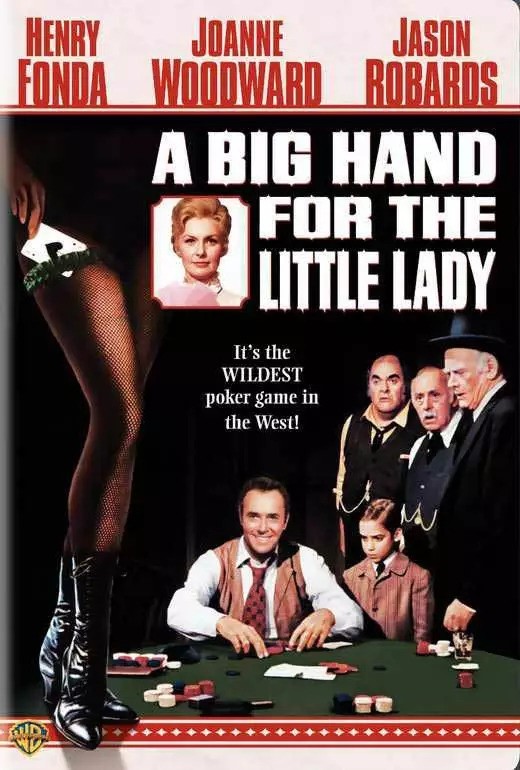
A Big Hand for the Little Lady / Big Deal at Dodge City (1966) ****

An absolute delight. Thrilling too. Knocked sideways in the box office battle of the poker pictures by the purportedly classier The Cincinnati Kid (1965) with Steve McQueen in one of his most iconic roles facing off against Edward G. Robinson and underrated ever since. But this more than holds its own against the Norman Jewison number. In part because of terrific untypical performances from Once Upon a Time in the West alumni Henry Fonda and Jason Robards.

I get my daily movie fix late at night when the rest of the house is abed and disinclined to share my interest in old movies but when at a critical point my DVD gave out instead of, as would be more sensible, giving up and going to bed, I spent ten minutes frantically scouring YouTube for a copy, even glancing hopefully at one in a foreign language, and expended the same time again tearing apart my DVD collection, which at one point had been sensibly arranged alphabetically until too many additions made nonsense of that arrangement, until I found another copy. Finally, I settled down, even later at night, to watch an enthralling finale.
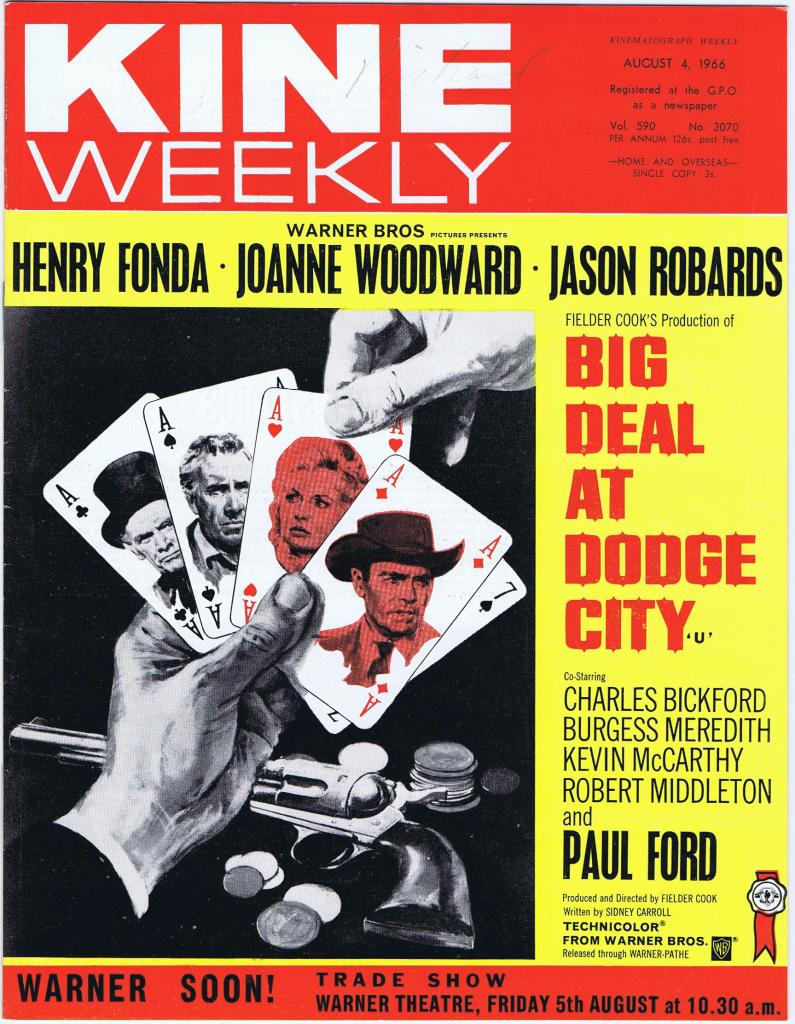
A more blatant example of artistic license you couldn’t find. The movie is set in Laredo, not Dodge.

Fielder Cook (Prudence and the Pill, 1968), with only a handful of movies to his name and generally considered no great shakes as a director, plays this hand brilliantly. It reeks of mystery, as a poker table should. We begin with an undertaker’s coach racing from town to town and  house to house collecting with urgency a disparate collection of people delivered to the backroom of a hotel in Laredo, Texas, where, nonetheless, the townspeople are excited beyond belief. It’s the long-awaited poker game between the five richest men in the territory.

As he stuffs more cash in the safe and pulls out bigger and bigger batches of poker chips, the hotel owner (James Berwick) is constantly badgered by his exuberant customers as to who is winning. He remains mute on that score until Doc Scully (Burgess Meredith), heading out to deliver a baby and a foal, asks the same question. Such is the medic’s local standing, the owner gives a reply. This means something to the onlookers but not to us because we have very little concept of the players.
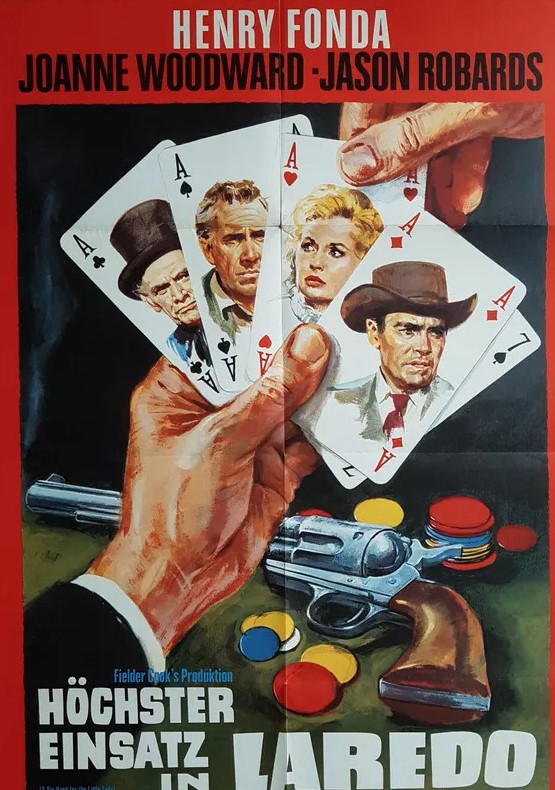
And that remains largely the case beyond some good-humored and occasionally tense banter when we learn that Drummond (Jason Robards) abandoned his daughter’s wedding to get here and that lawyer Habershaw did likewise in court leaving his client to defend himself. And the game itself is boisterous, devoid of the cathedral-like atmosphere of The Cincinnati Kid.

But when a relatively impoverished newcomer Meredith (Henry Fonda) enters the fray the situation turns ugly as he is besieged by insult and verbal abuse as his paltry stake gets smaller and smaller. When he takes his last $3,000 – the whole sum intended to provide a new future for his wife and son on a farm near San Antonio (“San Antone” he quickly learns is the correct pronunciation) – he discovers that he is undone as his fellow gamblers raise the bidding beyond his amount.

At which point he collapses, potential heart attack. Doc Scully hauls him off on a makeshift stretcher. The money will be defaulted unless upstanding wife Mary (Joanne Woodward) of the anti-gambling fraternity can be called upon to play out his hand in a game of which she is completely ignorant and, more to the point, raise the cash to be allowed to continue.

The players sneer at what she has to offer. The richest men in the territory have no need, even at a cut-price offer, of a gold watch and a new team of horses and wagon. For a moment you think Mary, seeing her family fortunes going downriver, is going to offer herself as collateral, but instead, she decides to try and get a loan, based on the hand she holds, from the bank. You might as well try to get blood out of a stone from bank owner Ballinger (Paul Ford). Maybe she has something worth more to him as collateral than watch and wagon.

I won’t spoil it for you by revealing the ending but it’s well worth the wait and the mystery.

I was knocked out by Henry Fonda’s acting. Usually, he is gritty, upstanding, sometimes the last man standing, and his smile is often more of a grimace. Here, he is nervous, jumpy, anxious, and desperate, the reformed gambler unable to resist temptation, persuading himself that this one last game would be worth all the broken promises given his wife. His smile is so ingratiating you wouldn’t want anything to do with it. As regards the temptation facing addicts it’s on a par with the heroin victim of The Man with the Golden Arm (1955) and the alcoholics of Days of Wine and Roses (1962).

With him removed from the equation, the acting lot falls to Joanne Woodward (A Fine Madness, 1966). She’s the prim opposite and doesn’t overplay her hand, restraining as best possible her confusion and fear. And this is a very fine turn from Jason Robards, most commonly accused of over-acting or under-acting, and here he gets the balance just right, volubility matched by arrogance, and a determination not just to win but to demolish an opponent.

A raw truth is expored here. Winners don’t just like winning – the medal, the lap of honor, the pile of cash, all that jazz – but they enjoy more seeing the defeat of their opponent, savoring that disgrace. This ain’t the kind of game that ends in a handshake or embraces sportsmanship. This is real in a way that The Cincinnati Kid is not.

There are a couple of familiar faces, John Qualen (The Sons of Katie Elder, 1965), and Charles Bickford (Days of Wine and Roses) in his final movie. The rest of the cast is largely anonymous, there to add febrile excitement, with hollering and racing around, desperate to keep up with the action.

Screenwriter Sidney Carroll had been here before, the big stakes, no-hoper taking on the world in The Hustler (1961) but he and Cook had managed a small-screen rehearsal of this picture a few years before on U.S. television in the DuPont Show of the Week series.

Every now and then, as I’ve maybe mentioned before, one of the joys of this little odyssey into the world of the 1960s movie is that you come across a little gem.

This one sparkles.
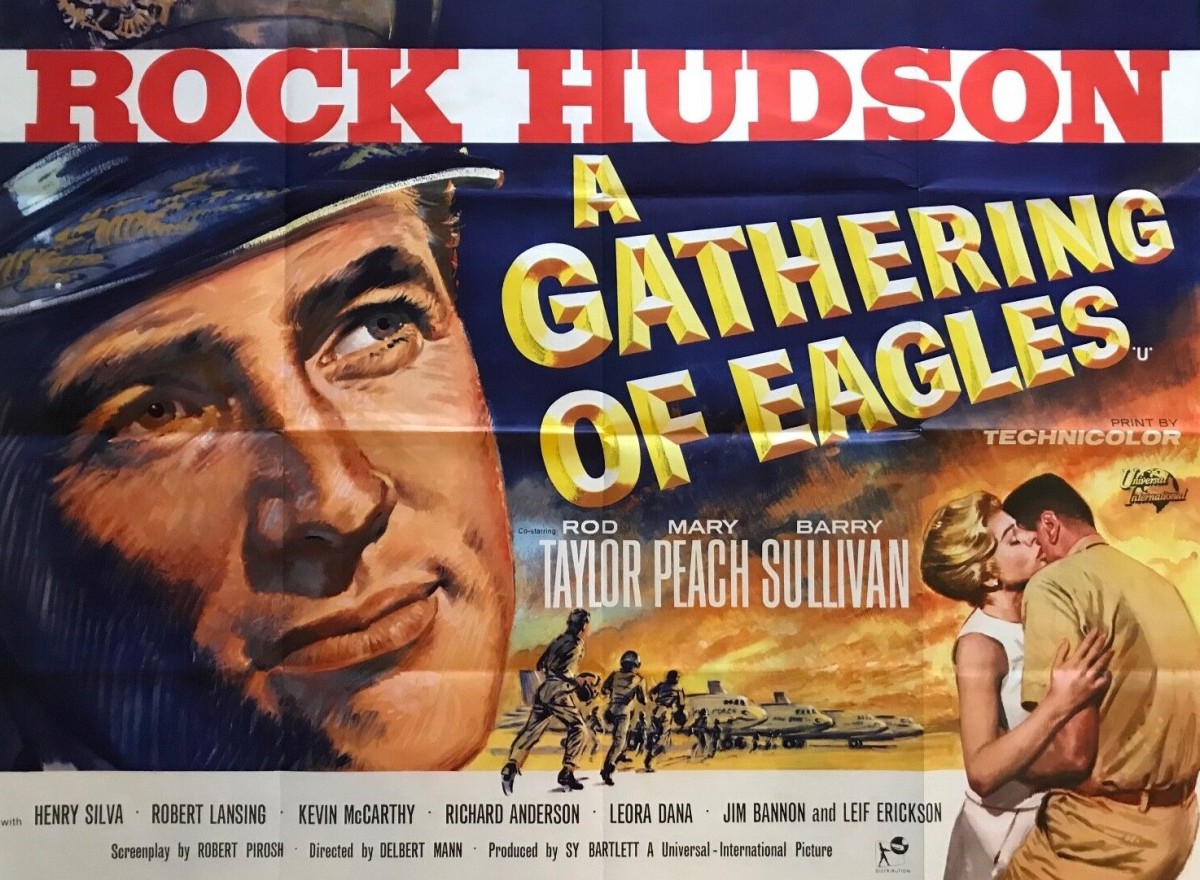
A Gathering of Eagles (1963) ***

Machines get in the way of this tale of men under pressure. Often viewed as a PR exercise for the Strategic Air Command to counter complaints about competence, and signally out of tune with a Hollywood faction that was beginning to view investment in nuclear weapons as a serious mistake, as epitomized by Fail Safe (1964), Dr Strangelove (1964) and The Bedford Incident (1965).

Not helped by action being under the auspices of simulation and not genuine war, filmmakers lacking the later bravura that just invented a side event, Top Gun, 1986, for example, to give audiences something to root for. Nor by a warehouse of info dumps.

That said, once it comes to the usual turf wars besetting any element of the military, the tension ponies up and there’s a real film underneath. There’s a surprising contemporary element to the narrative, two actually, firstly the arguments over leadership, and, secondly, the impact of PTSD, the endless deadline-based simulations as tough as being at war.

Hard-line efficiency expert Col Caldwell (Rock Hudson) is parachuted into a front-line B-52 Cold War command to toughen up sloppy procedure, bringing him into conflict with second-in-command Col Farr (Rod Taylor), a Korean War buddy. Caldwell rules by the book, Farr allows his men greater leeway. It comes down to the question of whether morale should be an issue or if men are expected to do their utmost even if they hate their leader. This debate about leadership style is prevalent today.

Caldwell is so tough he will sacrifice his buddy to get the job done better. And if people can’t handle the pressure they are better off out of the firing line. But since asking for a transfer to a less arduous berth would be viewed as a shameful admission of weakness, the only option for those who can’t cope is suicide. But since attempted suicide would not, as today, be viewed as a cry for help, anyone such attempt reduces the airman,, such as Col Fowler (Barry Sullivan) to a hospital bed where pity rains down on him.

The pressure comes in the shape of not just keeping on top of everything should the Russians suddenly decide to launch a missile attack, but dealing with intense simulations which appear out of the blue and require everyone to spring into battle stations. And in another prescient element, everyone is analysed to within an inch of their lives, marked down for the tiniest deviation from protocol, or not reaching the correct flight level or going too fast or too slow.

Caldwell is further hampered by English wife Victoria (Mary Peach) who fails to understand the pressure under which her husband, and all men in the base, operate, the kind of ground crew whose first question, on recovering from an operation, will not concern wife and kids but an airplane or a mission.

To add emotional heft, she is meant to have potentially fallen for Farr, and although rumors reach Caldwell’s superiors there’s no evidence of that. In the original script, the affair is spelled out, and such material was filmed, but it disappeared in the editing room. Perhaps because it proved that emotion was the Achilles heel of even the most efficient operation. In the actual movie, Victoria denies an affair and we believe her, but if an audience was shown her – and Farr – to be lying that casts a different complexion and at some level suggests betrayal.

In the air, despite assistance from the Strategic Air Command, the hardware is now out-dated, so of historical interest only, and while the movie fails to capture the tenor of the times, the situation of men under pressure has not changed.

Rock Hudson (Tobruk, 1967) is intensity on fire, Rod Taylor (Chuka, 1967) more laidback than in later films. Mary Peach (No Love For Johnnie, 1961) doesn’t have much of a filter between adoration and fury. Look out for Henry Silva (The Manchurian Candidate, 1962), Barry Sullivan (Harlow, 1965) and Kevin McCarthy (Hotel, 1967).

As you might expect, director Delbert Mann (Buddwing / Mister Buddwing, 1966) is more at home on the ground than in the air. Responsible for the screenplay were Sy Bartlett (Che!, 1969), also the producer, who had covered similar ground in Twelve O’Clock High (1949), and Robert Pirosh (Hell Is for Heroes, 1962)

The Top Gun of its day, bettered remembered now for the debate on leadership.

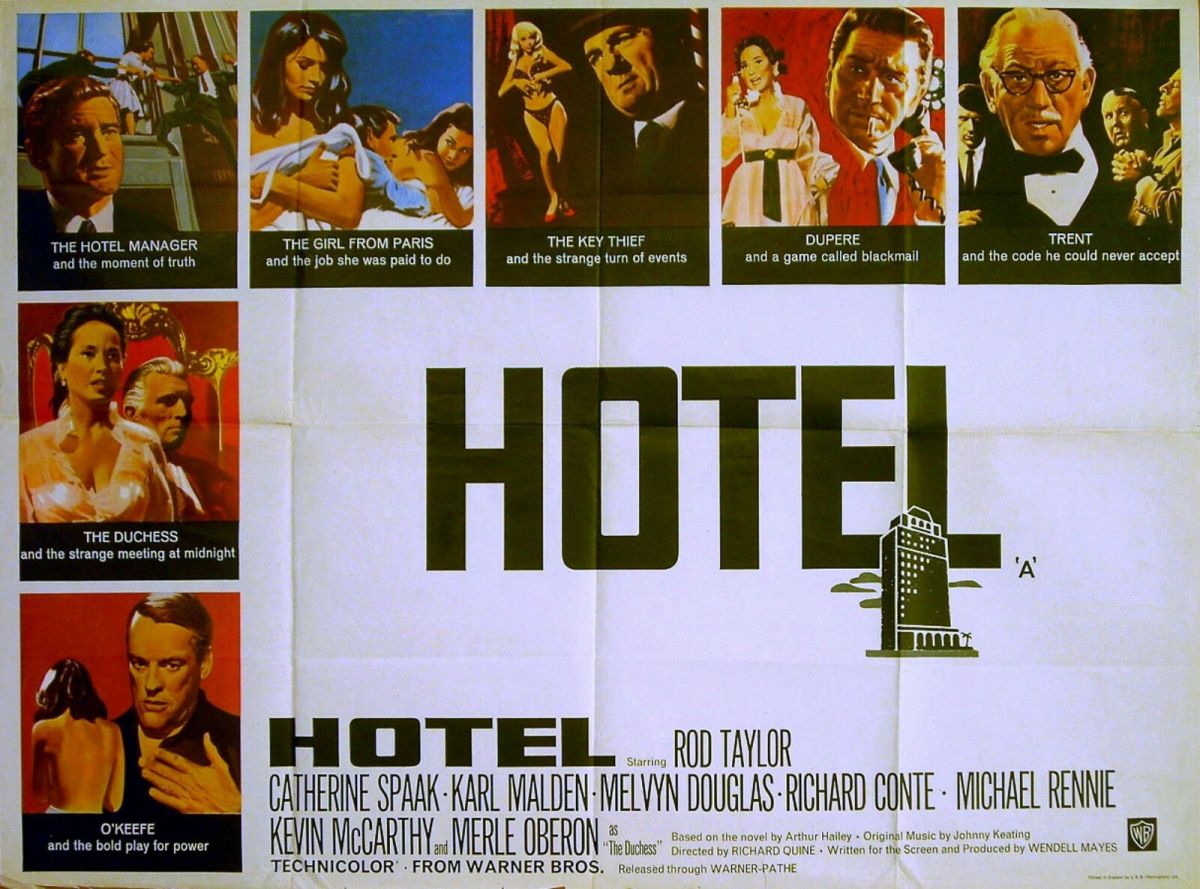
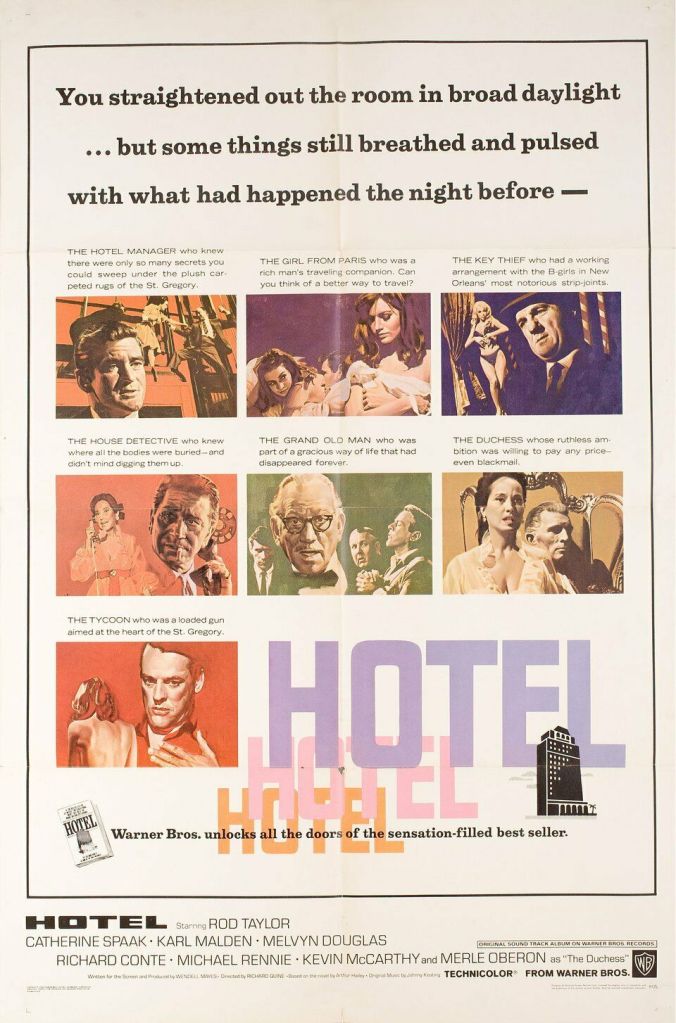
Hotel (1967) ***

The cardinal rule of the grand hotel picture was that it featured major stars. That is not so much the case here although the portmanteau of stories is up to scratch. Traditional hotel manager Peter McDermott (Rod Taylor) and boss Warren Trent (Melvyn Douglas) battle ruthless financiers, aristocrats Geoffrey (Michael Rennie) and Caroline (Merle Oberon) are involved in a fatal car accident, hypocritical God-fearing businessman Curtis O’Keefe (Kevin McCarthy) has a mistress Jeanne Rochefot (Catherine Spaak) on the side. Added into the mix are hotel thief Keycase Milne (Karl Malden) and hotel detective Dupere (Richard Conte). Not forgetting a dodgy elevator (you know where that’s headed!).

None of the stars mentioned comes up to the marquee standard set by the original in the subgenre – Grand Hotel (1932) boasted Jean Harlow, Greta Garbo, Joan Crawford and Wallace Beery – while an offshoot of the same idea The VIPs (1963) had Elizabeth Taylor, Richard Burton Orson Welles and the later Airport (1970) would rustle up top attractions Burt Lancaster, Dean Martin and Jean Seberg.

Top British film critic Alexander Walker espoused the movie.

It’s a fair bet that Warner Brothers felt audiences would be satisfied that the storylines were augmented by the behind-the-scenes insider information promised by the Arthur Hailey bestseller on which the film was based, such as how B-girls stole hotel keys, the tricks employed by a hotel thief and the various corrupt opportunities open to hotel staff. But it’s a major miscalculation to assume an audience cares that much who owns a particular hotel. And in the year in which In the Heat of the Night and Guess Who’s Coming to Dinner dealt with racism head-on, it was odd to see desegregation parlayed as a device to lower the asking price for the business or introduced out of economic necessity rather than high-minded principle.

Such gripes aside, this is movie comfort food, a picture that moves at a leisurely pace among its interwoven tales. Kevin McCarthy’s ruthless arrogant businessman steals the show, closely followed by Merle Oberon’s scheming duchess. To use a soccer analogy Rod Taylor is more like an old-fashioned center half rather than a midfield maestro, holding the picture together rather than setting it alight and his romance with McCarthy’s mistress (half his age) is an unlikely diversion, although the soft-spoken French actress, confronted by conscience, is particularly good. Melvyn Douglas as the aging owner mixes curmudgeon with affection and it’s hard not to feel sorry for Conte, outwitted by an older woman, and especially for Malden as the thief finding out how much the credit card has cut into the larceny business.

This was the last big-budget production for director Richard Quine whose career had been on the slide since box office highs The World of Suzie Wong (1960) and Sex and the Single Girl (1964). But he may have been somewhat restrained by having screenwriter Wendell Mayes (Von Ryan’s Express, 1965) as his producer. While well-crafted affair and glossy it lacks the inherent tension of an Airport.

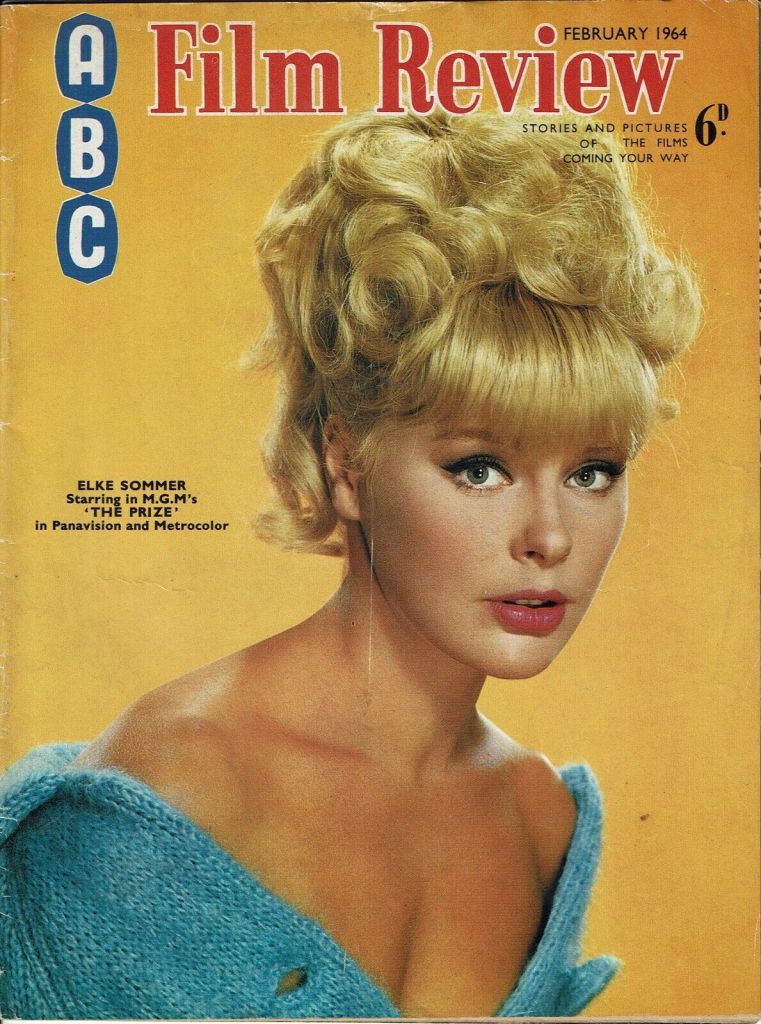
The Prize (1963) ****

Thoroughly involving potboiler with alcoholic novelist Paul Newman turning unlikely detective to uncover murky double-dealings at the annual Nobel Prize ceremony. Based on the Irving Wallace bestseller set in Stockholm, director Mark Robson (Von Ryan’s Express,1965) strings together a number of different stories that coalesce in a gripping climax. Screenwriter Ernest Lehman (North by Northwest,1959) brings alive what could have been a very soggy adaptation of a beefy bestseller with witty and literate dialog and a plot that hovers just the right side of hokum.

Elke Sommer, delegated to look after Newman, starts out as stuffed shirt not sexpot, allowing Newman’s attention to drift towards Emily Stratman (Diane Baker) – daughter of another winner Dr. Max Stratman (Edward G. Robinson) – while he is also dragged into romantic entanglement with neglected wife Dr Denise Marceau (Micheline Presle). Mostly, Newman just wants his next drink and his almost continual inebriation sparks some good comedy and he is gifted good lines to extricate himself from embarrassment. Simmering in the  background are warring winners – the Marceau husband-and-wife team and Dr John Garrett (Kevin McCarthy) convinced that Dr Carlo Farelli (Gerard Oury), with whom he is sharing a prize, has stolen his research.  

 There are sufficient character clashes and plots to be getting along with if you were just intent on taking a Valley of the Dolls approach to the material, that is, cutting between various dramatic story arcs, but, without invalidating the other subsidiary tales, the movie takes quite a different turn, providing the potboiler with considerable edge.  

Turns out that Newman is so impoverished that he has been writing detective novels under a pseudonym and suspecting that Dr Stratman is an imposter he starts investigating. So in some respects it’s a private eye procedural played out against the glamorous backdrop of the awards. But the clues are inventive enough and there is a femme fatale and once Sommer comes along for the ride and with Newman a target the picture picks up an invigorating pace. Echoing the humorous auction scene in North by Northwest is a sequence set in a nudist colony where Newman seeks refuge to avoid villains while another terrific scene plays out in the docks.

Newman looks as if he is having a ball. In most of his pictures he was saddled with seriousness as if every part was chosen with an eye on the Oscars. Here, he lets rip with a lighter persona, and even if he mugs to the camera once too often, the result is a screen departure that lifts the picture. Inebriation has clearly never been so enjoyable. Sommer is a delight, showing great dramatic promise. Edward G. Robinson (Seven Thieves,1960), more renowned for his gangster roles, convinces as a scientist. Diane Baker (The 300 Spartans, 1962), Kevin McCarthy (Invasion of the Body Snatchers,1956) and Leo G. Carroll (North by Northwest) provide sterling support.

Robson directs with dexterity, mostly with an eye on pace, but it is Lehman’s script with occasional nods to Hitchcock that steals the show.

Catch-Up: Previously reviewed in the Blog – Paul Newman in Torn Curtain and Cool Hand Luke; Diane Baker in Marnie and The 300 Spartans; Elke Sommer in The Corrupt Ones and Mark Robson picture The Lost Command.  


Discover WordPress

A daily selection of the best content published on WordPress, collected for you by humans who love to read.

The Atavist Magazine

by Brian Hannan

WordPress.com News

The latest news on WordPress.com and the WordPress community.