Fraulein Doktor (1969) ****

Surprisingly good World War One spy yarn full to bursting with clever ruses and pieces of deception and ending with a stunning depiction of carnage on the Western Front.  Loosely based on the life of Elsbeth Schragmuller, it fell foul on release to British and American hostility to the Germans actually winning anything.

The film breaks down into three sections: the unnamed Doktor (Suzy Kendall) landing at British naval base in Scapa Flow in Orkney to plan the death of Lord Kitchener; a flashback to France where she steals a new kind of poison gas; and finally on the Western Front where, disguised as a Red Cross nurse, she masterminds an attempt to steal vital war plans. She is hampered by her emotions, romance never helpful for an espionage agent, and her addiction to morphine.
Duelling spymasters the British Colonel Foreman (Kenneth More) and the German Colonel Mathesius (Nigel Green) both display callousness in exploiting human life. The films is so full of twists and turns and, as I mention, brilliant pieces of duplicity that I hesitate to tell you any more for fear of introducing plot spoilers, suffice to say that both men excel at the outwitting game.

I will limit myself to a couple of examples just to get you in the mood. Foreman has apprehended two German spies who have landed by submarine on Scapa Flow. They know another one has escaped. The imprisoned Meyer (James Booth) watches his colleague shot by a firing squad. Foreman, convinced Meyer’s courage will fail at the last minute, instructs the riflemen to load up blanks. Before a shot is fired, Meyer gives up and spills the beans on the Doktor only to discover that Foreman faked the death of his colleague.

And there is a terrific scene where the Fraulein, choosing the four men who will accompany her on her final mission, asks those willing to die to step forward. She chooses the ones not willing to die. When asking one of these soldiers why he stayed back he replied that she wouldn’t want to know if he could speak Flemish if he was so expendable.
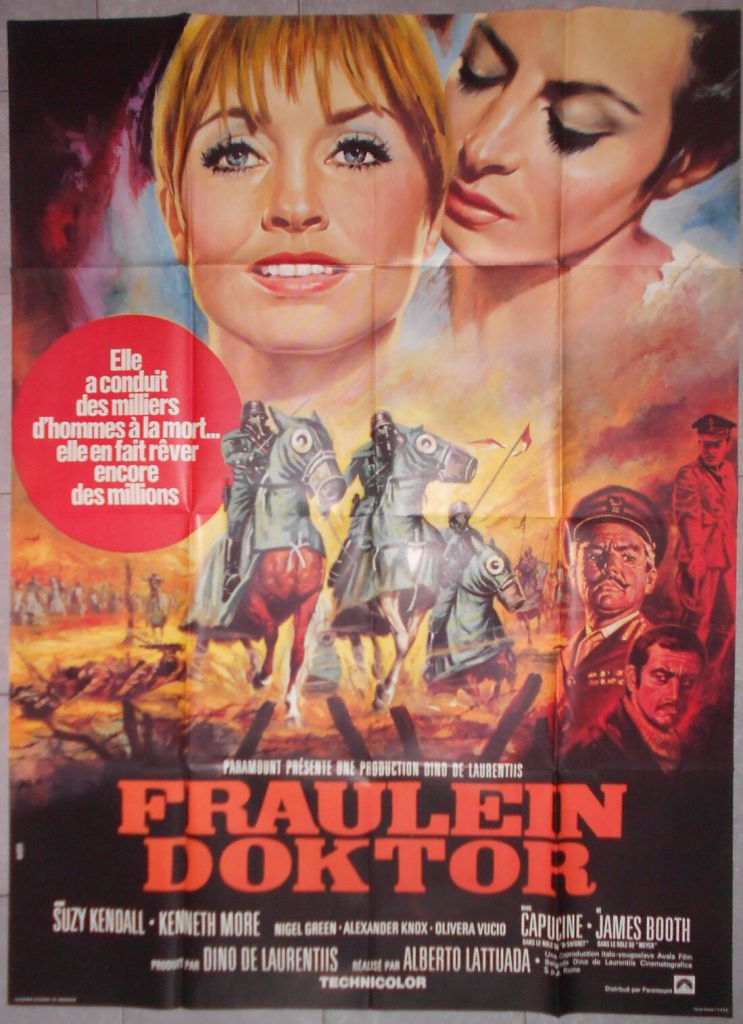
But the Fraulein is always one step ahead of her pursuers, changing clothes and hair color to make redundant any description of her, and knowing a double bluff when she sees one. In France, disguised as a maid, she turns seductress to win the trust of scientist Dr Saforet (Capucine) and in the final section takes command of the entire operation. It’s unclear whether this is her motivation to turn spy or whether at this point she is already an accomplished agent.

What distinguishes this from the run-of-the-mill spy adventure is, for a start, not just the female spy, how easily she dupes her male counterparts, and that the British are apt just to be as expedient than the Germans, but the savage reality of the war played out against a British and German upper class sensibility. When a train full of Red Cross nurses arrives at the front, the wounded men have to be beaten back; Foreman thinks it unsporting to use a firing squad; a German general refuses to award the Fraulein a medal because Kitchener was a friend of his; and the Doktor’s masquerade as a Red Cross nurse goes unchallenged because she adopts the persona of a countess.

Far from being an evil genius, the Doktor is depicted as a woman alarmed at the prospect of thousands of her countrymen being killed and Germany losing the war. In order to cram in all the episodes, her later romance is somewhat condensed but the emotional response it triggers is given full vent. And there is tenderness in her affair with Dr Saforet, hair combing a prelude to exploring feelings for each other.

Apart from The Blue Max (1966), depictions of the First World War were rare in the 1960s, and the full-scale battle at the film’s climax is exceptionally well done with long tracking shots of poison gas, against which masks prove little deterrent, as it infiltrates the British lines. The horror of war becomes true horror as faces blister and, in one chilling shot, skin separates from bone and sticks to the barrel of a rifle.

If I have any quibbles, it’s a sense that there was a brilliant film to be made here had only the budget been bigger and veteran director Alberto Lattuada (Matchless, 1967) had made more of the suspense. Suzy Kendall (The Penthouse, 1967) easily carries the film, adapting a variety of disguises, accents and characters, yet still showing enough of her own true feelings. Kenneth More (Dark of the Sun, 1968) in more ruthless mode than previous screen incarnations, is excellent as is counterpart Nigel Green (Deadlier than the Male, 1967) but James Booth (Zulu, 1963) has little to do than look shifty. Capucine (The 7th Dawn, 1964)  has an interesting cameo.

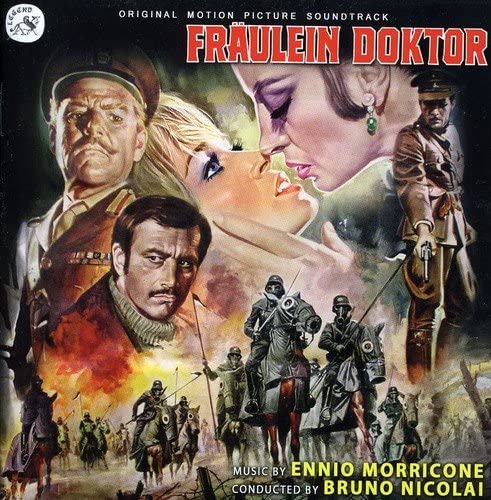
Ennio Morricone (Once upon a Time in the West, 1969) has created a masterly score, a superb romantic theme at odds with the discordant sounds he creates for the battles scenes.

Collectors of trivia might like to know that Dita Parlo had starred in a more romantic British version of the story Under Secret Orders (1937) with a German version, using the same actress, filmed at the same time by G.W. Pabst as Street of Shadows (1937).

This is far from your normal spy drama. Each of the main sequences turned out differently to what I expected and with the German point-of-view taking precedence makes for an unusual war picture. I enjoyed it far more than I expected.

Some People (1962) ***

Bet you didn’t know the Duke of Edinburgh (yep, that one, the recently deceased husband of the recently-deceased Queen Elizabeth II) was involved in the movies. Or that a film set up with the express purpose of promoting his Duke of Edinburgh Award Scheme could actually be any good.

A slice-of-life British picture that steers clear of the “kitchen sink,” so lives not blighted by alcohol, sex, abuse, unemployment which means no single mothers, no out-of-their head drunks, no railing at the government, no bloody violence. Instead, you’ve got kids in dead end jobs, refusing to conform, and then finding responsibility isn’t such a trial after all.

Not sure this notion qualifies as a promo for the Duke’s Scheme, but the movie’s probably best known for showing young women how to shrink their jeans skin-tight and, surprisingly, passing on the notion that your father would happily tolerate such behavior.

Three tearaways involved in an accident with their motorbikes lose their licences and at a loose end stumble across a benevolent choir master Smith (Kenneth More) who lets them use his church hall to rehearse their band. This is pre-Beatles so no mop-tops and screaming, but music with shades of Helen Shapiro and The Shadows, and the fancy footwork that was all the rage at the time.

The line-up is Johnnie (Ray Brooks) on piano and third guitar, Bert (David Hemmings) and bespectacled Tim (Timothy Nightingale) – a replacement for the disgruntled Bill (David Andrews). And they are joined by drummer Jimmy (Frankie Dymon) and singer Terry (Angela Douglas). The Award Scheme – a way of giving young people something to do and encouraging them to try an activity outside their usual sphere – malarkey is eased cleverly into the script, eventually becoming a challenge, though it’s somewhat gender-defined, Terry taking up knitting, while Bert helps make a canoe and plans the kind of outbound expedition with which the scheme was most associated.

There’s a punch-up and (gosh!) tables and tablecloths and crockery are destroyed, but mostly it’s just teenagers getting rid of their angst in ways that don’t define their lives (i.e. pregnant girlfriend or spell in jail.) The bulk of the aggravation comes from Bill, who refuses to join in, gets cross at being called a “teddy boy” and that his girlfriend Terry is making a play for Johnnie.

However, Johnnie is sweet on Smith’s daughter Anne (Anneka Wills), so there’s some sexual tension. Though the sexual element, despite the jeans scene, is conspicuously underplayed. Johnnie doesn’t even get to what was misogynistically referred to as “first base” in those days, restricted to kissing and a gentle hug. His romance is inevitably doomed because Anne wants to go away to college, but, by this time, despite an initial angry response, he’s grown-up enough to accept it and realize how much he’s benefitted from the relationship.

Although the actual music is supplied by The Eagles (no, not those ones), it helps that the actors look as if they know their way around music, although what they play is hardly sophisticated by the later standards of the decade.     

Critics might have preferred the more violent motorbikers of The Damned (1962) or The Leather Boys (1964) and the working class milieu of Saturday Night and Sunday Morning (1960), but this depiction of suburban life (it’s set in Bristol) is more in line with director Clive Donner’s later Here We Go Round the Mulberry Bush (1968).

You could have a high old time arguing which film is the more realistic, the ones over-teeming with violence, disillusionment  and sex, or ones where real ordinary life rarely touches such dramatic heights and relies more on people working their way through real or imagined difficulties. The slice-of-life elements involve a cigarette factory, fish-and-chips, blaring television, a father (Harry H. Corbett) out of touch with this son (one of the best scenes), roller skating, youngsters drinking Coca Cola and not booze (Johnnie has to be introduced, against his wishes, to alcohol by his father), hire purchase and a deluge of advertising promising a better life.

And it’s anchored by Kenneth More (The Comedy Man, 1964), who did this film for nothing with the unexpected bonus of meeting his third wife, Angela Douglas. On the basis of this performance, you wouldn’t be expecting David Hemmings (Blow-Up, 1966) to become the break-out star – he’s billed sixth – rather than young male lead Ray Brooks (The Knack, 1965). Angela Douglas popped up in Maroc 7 (1967) but was better known as a Carry On semi-regular. Anneke Wilks was one of The Pleasure Girls (1965) but more at home in television.

On a side note, I realized that the council-run buses in every big city had their own primary colors. Red, obviously, for London, but Bristol chose a virulent green while I remember the vehicles in my home town of Glasgow being yellow-and-green and I wondered if there was some official body that assigned color in this fashion. An idle thought.

Much better than you might expect from a movie whose main aim was to promote a scheme set up to help teenagers find their feet.  

Behind the Scenes: “The Loss of Innocence / The Greengage Summer” (1961)

Director Lewis Gilbert’s career was at an impasse. He had made his name primarily in a string of typically British stiff upper lip World War Two pictures including Reach for the Sky (1956) and Sink the Bismarck! (1960). It will come as a surprise to many British people to learn that virtually no British movie, not even the WW2 films that were big hits domestically, made any impact at the U.S. box office, Sink the Bismarck! a rare exception.

Ferry to Hong Kong (1959) starring Orson Welles had flopped  and WW2 comedy Skywatch/ Light Up the Sky (1960) had died the death.

British director Victor Saville, who had made a name for himself in Hollywood with Greer Garson sequel The Miniver Story (1950) and Kim (1950) starring Errol Flynn, had turned producer, purchasing the rights to the bestseller by Rumer Godden (Black Narcissus, 1947).

Saville had entered into a partnership with veteran independent producer Edward Small (Solomon and Sheba, 1959) who had a deal with United Artists. The duo had three films on their slate, the others being movie version of The Mousetrap (delayed due to the length of a stage run that still prevents it being turned into a movie) and Legacy of a Spy (never made). Cary Grant was initially touted as the lead for Loss of  Innocence.

When that deal foundered, it shifted from UA to Columbia after the intervention of British producer John Woolf (The African Queen, 1951),  a relation of Saville, who had an ongoing relationship with Columbia. The script found its way to Kenneth More (Sink the Bismarck!) still a highly-rated draw at the British box office. He had to lose weight for the role. Later, Gilbert intimated he was not right for the part and would have preferred Dirk Bogarde.

More’s wife Mabel was friends with Gilbert’s wife Hylda  and it was at the former’s suggestion that Lewis was roped in. Gilbert was initially wary of working with Saville who, although highly respected as a director, had a reputation of being difficult to work with. A director turned producer was all too likely to have ideas about the direction rather than sticking to the production side. As it turned out, Savile “didn’t interfere at all.”

Hayley Mills (The Family Way, 1966) was first choice for the female lead. Her Disney contract was not exclusive and at 15 she might have been ideal casting. But such a role would almost certainly impact on her future with Disney.

Mrs Gilbert was instrumental in the casting of Susannah York (aged 21) having called her husband down the stairs to see the young actress in a television production of Arthur Miller’s The Crucible. As it happened, Saville was on the same page, also having witnessed that performance, calling the director the following day to suggest York. Coincidentally, the Gilberts had been invited to dinner with Sylvia Syms, female lead in Ferry to Hong Kong, only to find York was a guest. Auditioned for the role of Jos, the oldest of the four sisters stranded at a chateau in France after their mother is taken ill, York won the part.

“The hard part to cast,” according to Gilbert, was Hester, Jos’s younger sister, wise beyond her 14 years “who can see trouble where Jos couldn’t.” Contrary to received wisdom, the bulk of children who attended stage schools were working class. “Their parents needed the income. Middle-class parents, preferring their children to be properly educated, discouraged them from going to stage schools.”

In consequence, the bulk of the girls turning up for auditions spoke Cockney whereas the part called for a “nicely-spoken girl.” Just as Gilbert was about to give up on the process, he received a phone call from an agent, promising a new discovery. “Her name was Jane Asher…a pretty 14-year-old with long red hair.”

Other casting gambles didn’t work out so well. Seeking a young man to play a French gardener, Gilbert hit on the notion of hiring a real Frenchman, having found a young lad with curly hair who appeared just right for the part. The only problem was – he couldn’t speak English. But it didn’t seem so insurmountable since he was cast three months before shooting began. But when the cameras rolled “he was unintelligible.”

Gilbert surmised that “someone so chaotic as that curly-haired Frenchman would never amount to anything.” He was wrong. The man was Claude Berri, later the highly successful screenwriter and producer of Jean de Florette (1986).  

The movie’s original title –  The Greengage Summer – caused a massive problem. Naturally, it was expected that greengages (plums) would feature prominently in the background. But there were no greengages thanks to a blight that had ruined the harvest all across France. As a consequence, British greengages were used, removed from their sacks by the thousands and sewn onto trees by the art department.

Susannah York created another problem when, in her naivety, she decided that the most authentic way to play drunk was to be drunk. Gilbert tried to dissuade her, explaining that the scene would go on all day not just last five minutes and in order to play a drunk you needed your wits about you. York ignored the advice and a day’s filming was ruined. Filming, split between England and France, began in August 1960.

Although it received “extraordinarily good notices” in both Britain and America it failed to light a spark with audiences in either country. Gilbert’s retrospective assessment, citing previous movies like Billy Wilder’s  Love in the Afternoon (1957) with Gary Cooper and Audrey Hepburn and Sabrina (1954) with Bogart and Hepburn, was that “very few films where you get a young girl in love with an older man have ever been successful.”

SOURCES: Lewis Gilbert, All My Flashbacks (Reynolds and Hearn, 2010) p207-210; Kenneth More, More or Less, (Hodder and Stoughton, 1978);  Roy Fowler, “Interview with Lewis Gilbert,” British Entertainment History Project; Philip K. Scheuer, “Saville to Resume Producing Career; Godden Novel First of Three,” Los Angeles Times, November 3, 1958, pC13; Richard Nason, “Small and Saville Planning Dear Spy,” New York Times, October 7, 1957, p47; Stephen Vagg, “Movie Star Cold Streaks, Hayley Mills”, Filmink, March 19, 2022.

Loss of Innocence / The Greengage Summer (1961) ***

The alternative title assumed nobody in America knew what a greengage was – it’s a type of plum – but the new title was actually pretty apposite. Until then director Lewis Gilbert had been known mostly for Second World War pictures like Reach for the Sky (1954) and Carve Her Name with Pride (1955) so this was a considerable change of pace, and filmed on location in France.

Joss (Susannah York) takes center stage as a girl on the brink of womanhood who experiences powerful emotions for the first time – love and its perpetual bedfellow jealousy – as well as rite-of-passage experiences like getting hammered on champagne. She is the oldest of four siblings stranded in a French chateau when their mother takes ill.

Left to her own devices, she promptly falls for the suave and much older Eliot (Kenneth More) who has interceded on their behalf when the hotel owner is against putting up with a bunch of motherless children. Matters are complicated because Eliot is having an affair with chateau owner Zizi (Danielle Darrieux) and by Joss attracting the attention of Paul (David Saire), a hotel worker closer to her own age. In short time, the situation is brimming over with suppressed emotion.

Hester (Jane Asher), suddenly aware of the romantic havoc being wreaked by her older sister, is going through her own transformation, jealous that the unrequited love of Paul is not directed towards her, her emotions flying off the handle when she triggers a violent altercation with a local lad.

Despite the distributor’s best efforts – the tagline promises “A Summer of Evil” – by modern standards this is a gentle tale, but not without a harsh undercurrent. York is superb as she undergoes a transformation from uncertain schoolgirl to a woman realizing the power her beauty can exert. She flares from child to adult and back again in seconds.

The main U.S. poster and this one seem determined to add seediness to the tale.

Susannah York (They Shoot Horses, Don’t They, 1969) had won her big break after a sparkling performance in a small role in Tunes of Glory (1960) and she floats effortlessly between chalet school pranks and more serious misdemeanors including drunkenness.

Sometime child actor Jane Asher (still better known as Paul McCartney’s girlfriend or for her cakes rather than stunning turns like Deep End, 1970) also achieves a career breakthrough and you could argue that she edges out York in a role that calls for more balance.

Kenneth More (Sink the Bismarck!, 1960) was at his charming best in the kind of affable role he had generally moved away from, but his character has a darker side. More importantly, as an older adult infatuated with a young girl, he manages to steer well clear of any inherent  creepiness. There is no sense of him exploiting the situation, rather trying to guide the young woman in the art of love.

The dialogue is surprisingly good and Danielle Darrieux (better known as one of Darryl F. Zanuck’s girlfriends rather than for the likes of Romain Gary’s The Birds Go To Die in Peru, 1968) is convincing as an aging beauty willing to do anything to hold onto her man.  There is an interesting under-developed subplot too dangerous to explore at this point in the decade of the hotel manager Madame Corbet (Claude Nollier) clearly being in love with Zizi.

The young Elizabeth Dear (The Battle of the Villa Florita, 1965), making her debut, also enhances her career and British character actor Maurice Denham (Danger Route, 1967) has a small role. 

Lewis Gilbert’s subtle direction set his career on a new course that would ultimately deliver an Oscar nomination for Alfie (1966).  The Howard Koch (The Fox, 1967) screenplay draws heavily on the source novel by Rumer Godden, an expert in the suppressed complexities of female life, best displayed in Black Narcissus (1947) and The Battle of the Villa Florita

The scenery is a bonus as are the snatches of provincial French life. All in all, an engaging piece of work, with Susannah York delivering a star-is-born kind of turn.      

No Highway in the Sky / No Highway (1951) ****

Having just read the Nevil Shute novel on which this movie is based, I was keen to see how it transferred to the screen. It got off to a great start with the casting. James Stewart was several classes above the author’s  description of the main character, but Marlene Dietrich more than fitted the bill of the Hollywood star as a passenger in the early days of Transatlantic air travel.

Widowed aeronautics research engineer Dr Honey (James Stewart), accent explained by him being a Rhodes Scholar who stayed on in Britain, is so absent-minded that he tries to enter a neighbor’s house and when he gets angry in a discussion with a visitor to his own house puts on his hat and coat and decides to leave. He has discovered a potential flaw in a new range of British airplanes and is despatched by boss Dennis Scott (Jack Hawkins) to Canada to examine the remains of a crashed prototype, the accident previously ascribed to pilot error.

It was called “No Highway” in Britain as that was the title of the novel.

However, once on board, he discovers the plane is perilously close to the danger level of flying time his research indicated. In between frightening the life out of stewardess Marjorie (Glynis Johns) and star Monica (Marlene Dietrich) with his predictions of doom and instructing them where best to hide in the plane in the event of crash-landing in the ocean, he tries to get the pilot to turn back. When that fails, he inadvertently charms the life out of stewardess and star.

When the plane lands, even closer to the danger zone in terms of flying hours, and still no one listening to his concerns, he manages to render the plane unflyable. The aeroplane company refuses to fly him home, leaving him stranded. That provides enough time for Monica and then Marjorie to turn up unannounced at his home in England to help look after his young daughter Elspeth (Janette Scott). When Honey finally returns, he faces an inquiry, and looks set to lose his job, virtually unemployable thanks to his antics in Canada. At the last minute, he is reprieved, fresh evidence from the crashed plane proving his research correct.

Meanwhile, Monica, forced to return to Hollywood, loses out in the battle for Honey’s affections. Marjorie, a former nurse and imminently more practical, is in any case better placed to help look after a growing girl, and eventually Honey sees sense and asks her to marry him.

Really well done with terrific performances all around, but vastly helped by the screenwriters who dumped three sub-plots in order to stick to the knitting of the tale. Honey, far removed from the man in the street persona that saw James Stewart through his Frank Capra movies, attracted female interest through his principled stand. Most importantly, the writers removed the section where Elspeth is seriously ill in her father’s absence. Secondly, in the book Scott was sent to Canada to find the crashed plane, involving a trek through perilous terrain, but that’s been excised, the search completed off-screen by others, the vital information relayed by letter. Thirdly, the remains of the tail, which had previously not been found, were located in the book by supernatural means, Elspeth being called upon to use a planchette to help find it.

In removing all this material, the movie is re-shaped partly as a Capra movie, with the downtrodden Honey achieving success through persistence, but, more importantly, allowing the movie to focus on the potential love interest. Needless to say that is determinedly old-fashioned, both women having forged successful careers now viewing work that was initially exciting rapidly pall. The book sets Monica thinking how much better life would have been if as a humble office girl she had married the kind but not handsome man who had caught her eye instead of now being thrice-divorced. Marjorie is even more old-fashioned, seeing a genius who needs looked after as much as his daughter requires a mother.

So there’s no point going anywhere near this if you’re not willing to accept a past where a woman’s role was primarily seen as a home-maker. But don’t jump to pointing the finger at the author as being equally old-fashioned because a later book, A Town Like Alice, not only turns the main character into a war hero but depicts her as a successful entrepreneur.

James Stewart (The Rare Breed, 1965) takes a considerable chance on playing the absent-minded professor but his endless well of screen charm allows him to pull it off brilliantly. Marlene Dietrich, top-billed when teamed with Stewart for Destry Rides Again (1939), has an excellent role as a rueful prima donna. Glynis Johns (Lock Up your Daughters!, 1969) is equally at home with a part that calls for her not to just fall at Honey’s feet. She was one of handful of British rising stars. Jack Hawkins (Masquerade, 1965) was on the cusp of being named Britain’s biggest box office attraction while Kenneth More (The Comedy Man, 1964) was a few years away from receiving that honor. Janette Scott (Day of the Triffids, 1963) gave notice of her talent.

As much as James Stewart’s career was linked to Frank Capra and Alfred Hitchcock, Henry Koster (Mr Hobbs Takes a Vacation, 1962) made five pictures with the actor, all excepting this comedies, including Harvey (1950). He does a fine job of keeping Stewart from spinning away too much in the direction of the geek professor and keeping the story pinned down.

Nevil Shute was an engineer to trade – he had worked in the British airship industry – so his books tend to be peppered with the scientific. That’s easy to digest when reading, but harder to absorb when watching a movie. R.C. Sheriff (The Dam Busters, 1955) and Oscar Millard (Angel Face, 1952) do an excellent job of condensing the novel, finding cinematic ways of getting across important material.

I had come at this, as I said, mainly to see how the author’s work was translated to the screen, but came away totally absorbed in a fine picture. What was left out helped the picture while the author’s later A Town Like Alice (1956) lost half its power by ending halfway through the original story which later saw the courageous heroine go onto to become a serial entrepreneur in a male-dominated society in Australia.

Obviously, I’ve deviated from my chosen field of 1960s pictures, but this is well worth a watch.

You can catch it on YouTube in a number of versions – the original, a colorized version, one with English subtitles and one where a musician has made his own edit and dubbed his own modern score on the picture.

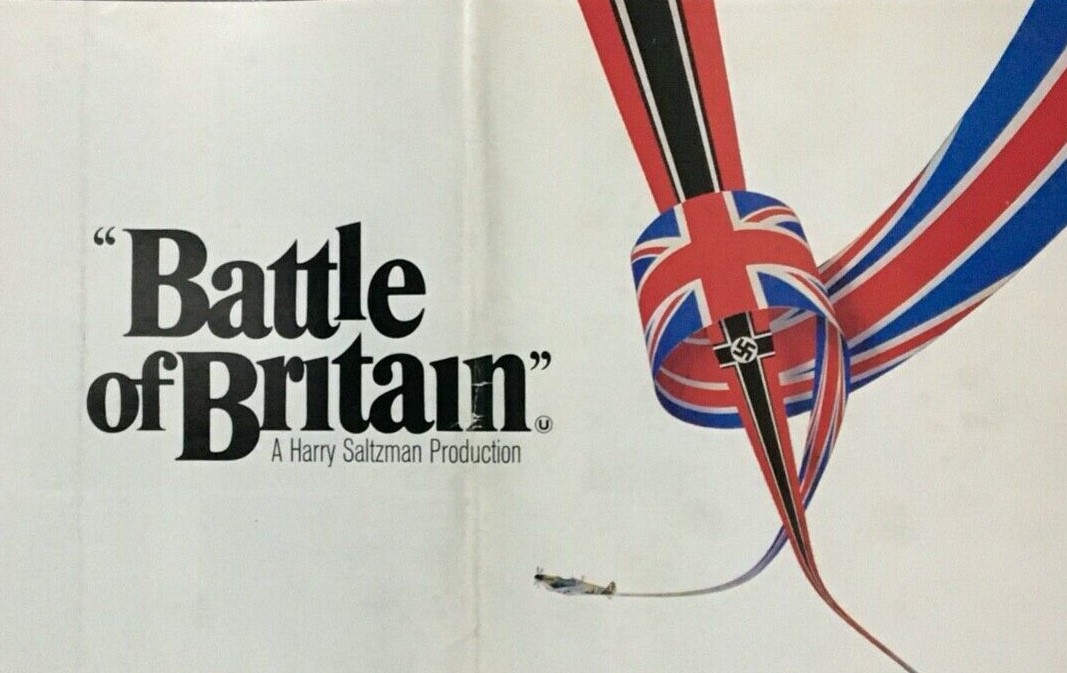
The Battle of Britain (1969) *****

Fabulous aerial sequences countered by grim reality. Like The Longest Day (1962) and Battle of the Bulge (1965) even-handedly doesn’t treat the Germans as the evil enemy, but unlike those films victory is somewhat obscure, no rattling of spears as in Zulu (1964) to announce opposition departure, just clear skies indicating an absence of foe. Anyone going into this – persuaded by Dunkirk (2017) that this retreat was a triumph – and with little knowledge that after Hitler had overrun Europe invasion was imminent might be surprised to discover that this was a campaign lasting over three months rather than one conclusive battle.

That’s to the benefit of the movie, allowing it space to breathe, for characters to develop, rather than everything crammed in pell-mell. Given the situation changed from day-to-day, the one constant, which we’re scarcely allowed to forget, is that the British are heavily outnumbered in the sky. It’s a war of attrition. The Germans can lose hundreds of planes, the British nary a one.

But it’s far from gung-ho, the British coming in for criticism for their unpreparedness, surprised when the Germans bomb airfields, even more astonished when the opponent starts dropping bombs on London. Perhaps, given the relatively short running time for an epic – 46 minutes shorter than The Longest Day, 35 minutes down on Battle of the Bulge – it might have been better to avoid slipping in a section on the impact of the Blitz on Londoners, though that is counteracted by panic in Berlin when that city is also bombed.

But, by and large, it’s an engrossing tale. And bold, too, in the version I saw no subtitles for German dialog, leaving audience reliant on facial and body expressions. To slow down the action, I guess, and add some class, several scenes involve people walking down long corridors.

All the salient points are covered, pilots thrown into battle with barely a few hours experience of flying a Spitfire, the lack of pilots, in-fighting at the top, checkers moved across the board at mission control indicating German aerial advance, the inability of getting aircraft up quick enough or repaired quick enough. Above all, the reality of death is shown in astonishing detail; once the pilot was shot or the airplane destabilized, there was almost no escape, fire enveloped anyone inside, hatches failed to open, planes burst into flame or crashed into the sea. And it was the same death, regardless of nationality. And there were no scenes of  callous Germans shooting down a British pilot parachuting to safety.

The aerial sequences are quite astonishing. I’ve seen this on big screen and small, but even on a small screen, the camerawork is quite extraordinary, even getting this number of workable planes in the air must have been some feat, then flying in formation and peeling off in attack. It is kind of hard from time to time to work out who is shooting at who since the planes are all the same grey color and only distinguished when the camera is close enough to identify  them by RAF roundel or Nazi swastika. But the overall effect is a sense of sorrow rather than triumphalism, young lives of any nationality brought to a brutal close. There is no scene, as in Battle of the Bulge, of the over-zealous Nazi, the singing that made them appear such an implacable foe. Here, there’s no need to play up implacable. Unless they abandon the fight, the Germans, courtesy of superior numbers, will inevitably win. All the British can do is stave off defeat for as long as possible.

The all-star cast is only an all-star cast if you’re British. Without a Hollywood star in the vein of John Wayne, Robert Mitchum and Henry Fonda, and in the absence of British superstars like Sean Connery and Peter O’Toole, it’s an all-star cast by default. The biggest name, Michael Caine (Deadfall, 1968), has one of the smallest parts. But the equality of the cast works in its favor, there’s none of the rubbernecking that got in the way of The Longest Day.

Christopher Plummer (The High Commissioner/Nobody Runs Forever, 1968) has the biggest role as a squadron leader determined to force his wife out of the front line working on the airfields and into a safer position. But the best acting comes from Laurence Olivier as the dry Air Chief Marshal Sir Hugh Dowding who has no truck with interfering politicians. Accused of inflating figures of German casualties he replies that if he is wrong the Germans will be in London in a week.

But it’s a close-run thing between him and Susannah York (They Shoot Horses, Don’t They, 1969) as the aforesaid wife with a growing streak of independence and Ian McShane (The Pleasure Girls, 1965) as a lowly pilot called upon to express grief more than most. There’s certainly a sense of solidarity among the cast, no show-boating from the usual scene-stealing culprits like Trevor Howard (Von Ryan’s Express, 1965) and Robert Shaw (Battle of the Bulge) whose normal determination to bristle at the slightest opportunity is dropped for the good of the cause.

The great and the good appeared to be happy with the slightest role just to take part. The roll-call includes Ralph Richardson (Khartoum, 1966), Michael Redgrave (The Hill, 1965), Kenneth More (Dark of the Sun/The Mercenaries, 1968) and a hatful more.

Guy Hamilton (Goldfinger, 1964) directs with some distinction, his biggest achievement to concentrate on fact rather than flag-waving, no better demonstrated than by my realization that the stirring theme tune that I remembered so well by Ron Goodwin (Where Eagles Dare, 1968) does not make an appearance until the very end. The screenplay by James Kennaway (Tunes of Glory, 1960), Wilfred Greatorex (The High Commissioner) and, in his only movie work,  Derek Dempster, displays more finesse than you might expect.

Almost documentary in tone, a classic.

Behind the Scenes: “Sink The Bismarck!” (1960)

The unexpected U.S. box office success should have propelled star Kenneth More into the Hollywood firmament. The British box office champ of the previous decade, after comedies like Genevieve (1953) and Doctor in the House (1956), war movie Reach for the Sky (1956) and drama A Night to Remember (1958), he had been rewarded by a tie-up between British studio Rank and Twentieth Century Fox. That allowed him bigger budgets and bigger co-stars, pairing him with Jayne Mansfield in comedy western The Sheriff of Fractured Jaw (1958), and Lauren Bacall for historical adventure North West Frontier (1959).

While hits in Britain, they failed to raise his profile in America. That changed with Sink the Bismarck!, his performance highly praised, the movie a genuine and very profitable hit. It should have been the stepping-stone he needed to break into the Hollywood big time. And for a short time it looked as if he would.

He was scheduled to co-star with Gregory Peck in the big budget high adventure war picture The Guns of Navarone (1961), in the part that finally went to David Niven. He lost the role  through petulance.

At a public event, he verbally tore into his boss, John Davis, head of Rank, to whom he was contracted and on whose goodwill he relied to loan him out to Columbia for this movie which would become the number one hit in the annual U.S. box office race. In revenge, Davis blocked the loan-out and in effect stymied his career. Few companies were going to invest in a star whose movies would automatically be blocked from being booked on the Odeon chain, owned by Rank, and one of the two biggest circuits in Britain. As a result of his intemperate, drunken, action, More’s career plummeted.

Oddly enough, Sink the Bismarck! also killed off the career of the German-born Dana Wynter, a rising Hollywood star, leading lady to Rock Hudson in Something of Value (1957) Robert Wagner in In Love and War (1958) and James Cagney in Shake Hands with the Devil (1959) and denoted star of Henry Koster’s Fraulein (1958). After Sink the Bismarck!, and On the Double (1961), she lost out on big roles until the low-budget If He Hollers, Let Him Go (1968).

It seemed almost a contradiction in terms that such a big hit as Sink the Bismarck! could produce no outright winners in the career stakes. And although director Lewis Gilbert had a stab at the Hollywood big budget picture with The 7th Dawn (1964) starring William Holden, he relied on later British pictures Alfie (1965) and You Only Live Twice (1967) to give his career the fillip it surely deserved.

Lewis Gilbert was virtually a veteran by the time Sink the Bismarck! appeared, 16 previous pictures including Reach for the Sky, another More-starrer Paradise Lagoon (1957) and  Carve Her Name with Pride (1958).

Kenneth More explaining details to Dana Wynter. In the movie they would have the most buttoned-down romance you could imagine, feelings not pronounced until the end.

Gilbert described Sink the Bismarck! as a “detective story set at sea,” and that’s the picture  he determined to make, focusing on the hunt more than the normal World War Two heroics, the usual battleground endeavours taking second place to backroom tactics that resembled a “psychological chess game” between British and Germans. It was a change of pace for star Kenneth More, his screen persona the opposite of “someone so stiff and buttoned up.” A star of More’s caliber was all the movie needed to be funded.

The bigger problem was the hardware. “If we were to film on real ships, explode old ones even,” recalled Gilbert, “we would need the cooperation of the Admiralty.” Luckily, the wife of producer John Brabourne (Romeo and Juliet, 1968) was the daughter of Earl Mountbatten, the former Governor of India, who happened to be First Sea Lord (head of the Admiralty) who could put in a good word.

“Blowing up ships, or bits of ships, turned out to be not so hard,” explained Gilbert.  Portsmouth’s naval shipyards contained many vessels whose active days were over and who were considered nothing more than scrap metal. So, prior to the commencement of shooting, Gilbert took a crew into the shipyard and began the blowing up. Because these were not models, the use of real ships “gave the film extra conviction.”

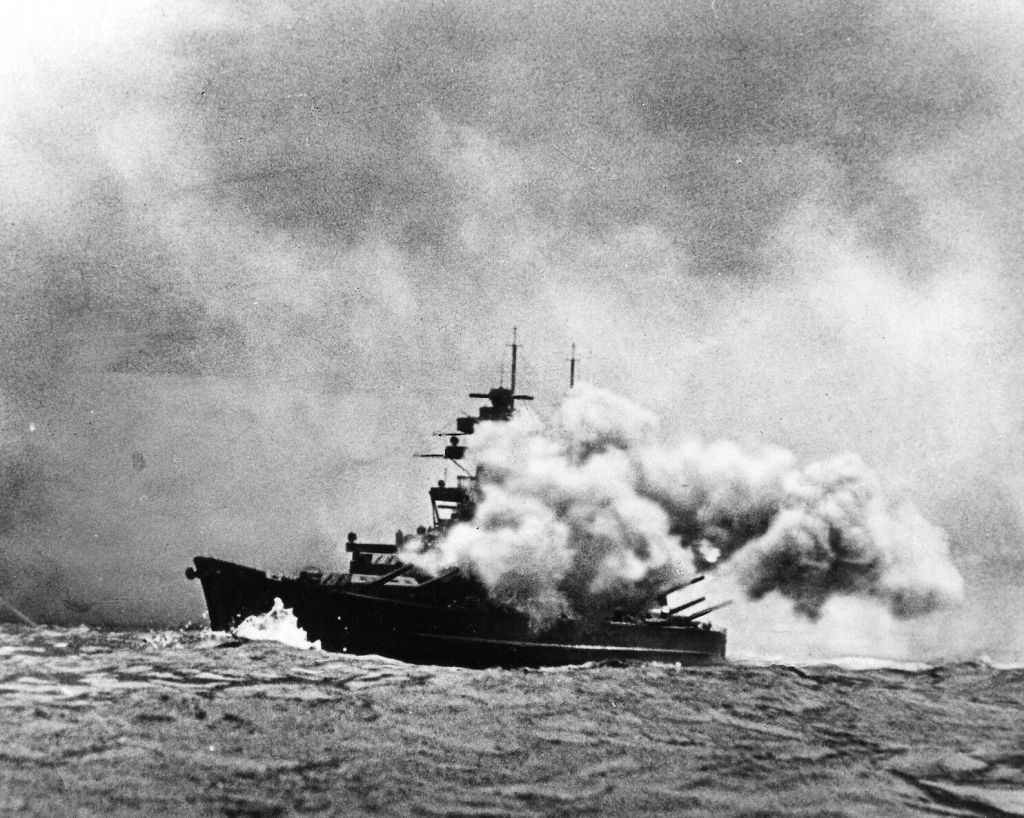
Gilbert also received permission to film on HMS Vanguard, the last British battleship of the era still on active duty although it too was due to be scrapped. That permitted filming the ship’s 15-inch guns in action. It doubled for scenes set aboard HMS Hood, Prince of Wales, King George V and the Bismarck, creating greater authenticity.  HMS Belfast stood in for the pursuing cruisers including HMS Norfolk, Suffolk, Dorsetshire and Sheffield. A Dido-class cruiser provided the set for Bismarck’s destruction.

Aircraft carrier HMS Victorious played herself as well as HMS Ark Royal but any actual flying took place aboard HMS Centaur. The destroyers participating in the night-time attacks were HMS Cavalier and HMS Hogue. The bridge of the Prince of Wales was “reproduced down to the last detail.” One of the officers wounded in that attack was Esmond Knight, an actor on the film, who had virtually lost his sight, but from memory was still able to determine that the bridge was “a perfect replica.”

Three Fairey Swordfish biplanes with torpedoes were used.  Three RAF jet pilots volunteered to the fly the biplanes in the movie for the experience of understanding the risks involved in diving at less than the top speed of 138 mph in a machine which was little more than wood and canvas to drop torpedoes on a highly-armed ship, but Gilbert had already hired specialist crews.

Top Hollywood model maker Howard Lydecker (The Underwater City, 1962) was recruited to build the 20ft model of the Bismarck, which, unfortunately, sank on launch. Raising it was not a problem. Long shots were filmed on the massive Pinewood water tank.  It helped the production that during the battle the weather had been foul, so ships could be seen emerging from fog, or rendered invisible because of it.

Gilbert used his own wartime experience to render the battle realistic. He remembered sailing past the Scharnhorst, one of Germany’s three most powerful battleships, being unable to see it because of fog but aware of its presence from the sound of its guns. “We knew it from what we heard and felt, not from what we saw.”

Post-war the sinking of the Bismarck became a cause celebre. The British were accused of a war crime for nor picking up survivors. However, the British claimed that the presence of U-boats in the area rendered this too hazardous.

SOURCES: Lewis Gilbert, All My Flashbacks (Reynolds & Hearn, 2010) p 197-203; Brian Hannan, The Making of The Guns of Navarone (Baroliant Press, 2013) p67.

Sink The Bismarck! (1960) ****

Hard to believe but outside of the Hollywood big-budget Bridge on the River Kwai (1957), this was the biggest British film at the U.S. box office in the previous decade. In fact, the British war films that did so well in the home territory, The Cruel Sea (1953) and Reach for the Sky (1956), sank like a stone when exported to in America while earnings for Ealing comedies,  limited to arthouses, hardly made a dent in the box office.

What makes this so appealing is the very lack of Britishness and the intrusion of a Yank, famed reporter Edward  R Morrow (playing himself), interrupting the action at various points to keep audiences up to speed. The fact that the sinking of the Bismarck, the biggest battleship ever built, was one of the few British actions at the start of the Second World War to be counted a success probably helped. Watching the Brits being lionized for defeat was not an attractive notion for global audiences.

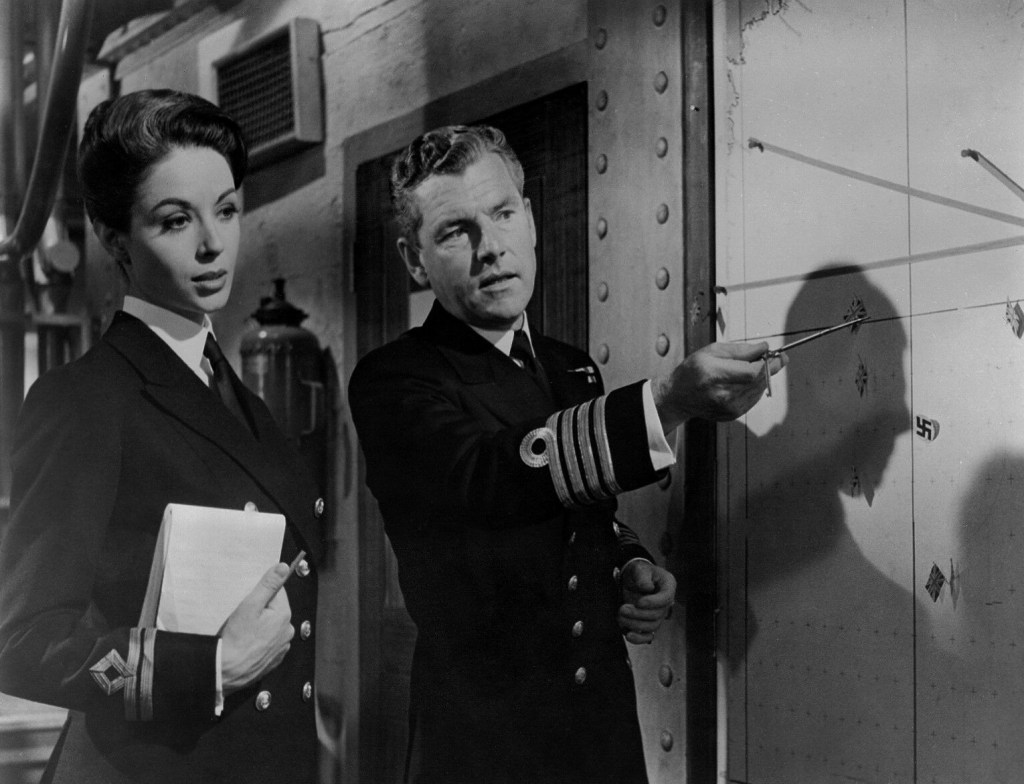
But in the main it is a thrilling docu-drama, very much a departure for the genre, with every nuance of potential consequence spelled out. Dialog and models being moved across maps announce the risks inherent in the British attack: the superiority of the newly-built German battleship, the multiple options the Germans had in 1941 to escape, the difficulties in pinpointing the German vessel in the fog-bound waters of the North Sea, and the devastation the battleship could inflict on the beleaguered convoys on which Britain depended to stay afloat. In addition, even when targeted the Germans could flee to occupied France or potentially summon U-boats or air support.

So in the manner or Operation Crossbow (1965) or Day of the Jackal (1973) the audience is primed for a minute-by-minute enterprise, the battleship deemed so dangerous that the Admiralty is willing to risk its own scarce supplies of battleships, destroyers, cruisers and aircraft carriers in a bid sink the enemy. It is so much a documentary that the beyond the thrill of the hunt there is little room left for drama and certainly little of the stirring kind that had become such a byword for the British version of the genre – and such a turn-off for foreign audiences who could hardly make out what the actors were saying never mind work out why such-and-such a mission they had never heard of was so important.

In any case emotion is forbidden in the subterranean claustrophobic Admiralty War Office where new operational commander Capt Shepherd (Kenneth More) holds sway. A martinet, “cold as a witch’s heart,” on arrival he rids staff of what he sees as the rank indiscipline of addressing colleagues by forename rather than surname, eating sandwiches at a desk to which the workforce have been chained for hours  and various minor offences against the strict code of a uniform.

It was inherent in this type of picture that the land-based unit suffer the casualties of war, husbands dead or missing in action, wives and children killed by German bombs. But the tightening of the stiff-upper-lip ensures that when such revelations become known, they appeared like emotional depth-charges on this otherwise staid ocean. And Capt Shepherd, through his choices, as would be true of many high-ranking officers, might be sending his own son to is death.

This is also one of the first instances in war pictures where the Germans are not treated as stock villains, but intelligent people, like Admiral Lutyens (Karel Stepanek) with his own vanity and a hunger for redemption, and Capt Lindemann (Carl Mohner), as valiant an opponent in the cat-and-mouse duel where outwitting the British enemy could wreak untold carnage and hasten – unusually from the German point-of-view rather than from the Allies – the end of the war.

A few months after launch the Bismarck is spotted leaving its home port, destination North Atlantic to feast on convoys travelling from America with invaluable supplies. There are four possible routes open to get round the top of Britain. To prevent the Germans reaching any of them British ships must be sacrificed, including HMS Hood – three survivors out of a crew of 1400.

It’s David vs Goliath except David is a terrier capable of inflicting tiny wounds that drain the battleship of some of its power, loss of fuel and rudder problems limiting movement. It’s a different kind of war picture, as well as the big guns blasting at each other over huge distances, the British employ biplanes loaded with torpedoes, a weapon also used in some instances by its ships.

To keep audiences more heavily involved, there are snippets of dialog involving characters on board the various ships, some in distinctly un-stiff-upper-lip mode, and montages of the various vessels getting ready for action, as well as shots of devastation should a shell find its target.

But basically it’s  brilliantly-told tactic-heavy war picture that shows the shifting battleground, how the various ships are deployed, with no shortage of telling the audience how crucial success is and how crushing defeat. There’s no reliance on individual heroism, no snappy soldier defying authority, no hunch being played out, none of the usual cliches of the genre, instead, as with The Longest Day (1962) a clear explanation of what’s going on with superb battle scenes for the action-inclined.

It’s fair to say that even on the small screen, the models look a bit iffy, but this is more than compensated by other scenes on real warships, the use of newsreel footage, and fast cutting.  That action never takes place under a clear blue sky but always in murky waters also adds to the realism.

In a role that would have been custom-made for Kenneth More (The Comedy Man, 1964), king of the stiff-upper-lip, rather than simply spouting his lines, he adds considerable emotional depth. Dana Wynter (Something of Value, 1957) is excellent as his equally buttoned-up assistant.

There’s a full crew of supporting British character actors including Michael Hordern (Khartoum, 1966), Laurence Naismith (Jason and the Argonauts, 1963), Geoffrey Keen (Dr Syn, Alias The Scarecrow, 1963) and Maurice Denham (Some Girls Do, 1969) while the Czech-born Karel Stepanek (Operation Crossbow, 1965) and Carl Mohner (Assignment K, 1968) inject humanity into the Germans.

Lewis Gilbert (The 7th Dawn, 1964) does a brilliant job of bringing this all together, adding touches of emotion and humour to what could have been a too-dry concoction, drawing on a screenplay by Edmund H. North (HMS Defiant/Damn the Defiant, 1962) which was based on the book by C.S. Forester of Hornblower fame.

Behind the Scenes: “The Collector” (1965)

Director William Wyler was “saved,” to use the term preferred by his biographer Jan Herman, from what turned out to be the biggest picture of all time (up till then) The Sound of Music (1965) by a piece of door-stepping by two determined young producers who presented him with a pre-publication copy of John Fowles’ novel The Collector.

Wyler had been well down the pre-production route for The Sound of Music. It was he who hired Julie Andrews, having seen her performance on Broadway in My Fair Lady, and been granted access to the rushes of Mary Poppins (1964). While he was an odd choice to direct, being more of an opera buff and hard of hearing, he would later nurse Funny Girl (1967) to box office and critical acclaim.

While instinct told the German-born director that The Sound of Music “would be a success” he was troubled that it was set in Austria at a time just before World War Two when the country was mostly whole-heartedly welcoming the Nazis. “I can’t bear to make a picture about all those nice Nazis,” he said.

So when novice producers Jud Kinberg and John Kohn, television writers who had set up Blazer Films, brought him what would turn out to be a sensational bestseller, actor Terence Stamp already under contract and a deal in place with Columbia, turned up on Wyler’s doorstep with a completed screenplay they gave him a reason to pull out of The Sound of Music. He ignored the screenplay in favor of devouring the book.

“I couldn’t put the book down and I’m a man who can put down books very easily,” he said. While not so enamoured of the screenplay by Stanley Mann, he signed up, and although since the 1950s he had either officially or unofficially acted as producer on his own movies, he agreed to allow Kinberg and Kohn to do the job this time, as long as they did not interfere with direction and that he, of course, had final say.

Despite critical acclaim for Billy Budd (1962), a part he won ahead of the likes of Warren Beatty, Terence Stamp had not made a film since, and begun to doubt whether he was cut out for stardom. He wasn’t short of media attention – the various women he squired seemingly all the time made sure of that – but he was distinctly lacking in movie offers.

He took on the role of the deranged Freddie – even though he loathed the character – primarily because he had no other choice. “I hadn’t gotten any new work in roughly a year,” he explained. “I knew the camera loved me, so I had confidence in that. But I just thought this Freddie character was beyond me.” And once Wyler was signed, Stamp felt he would not come up to the director’s high standards. Told that Wyler had no objections to his casting, the still dubious actor asked to take part in the screen tests the director was holding for actresses hoping to win the role of Miranda, the female lead, partly to feel his way into the part and partly to give Wyler an opportunity to fire him if he wasn’t up to the mark.

Without the director being present, he tested with Sarah Miles, whom he had played opposite in Term of Trial (1962) and Samantha Eggar (Doctor in Distress, 1963). Once Wyler saw the footage, with Stamp clad in his own notion of the character’s clothing he expressed his confidence in the actor and told him, “I’m not going to make the book. I’m going to make a modern love story.”

Samantha Eggar was fired three weeks into rehearsals, undermined by just how good Stamp was, unable in her inexperience to cope with his “nasty attitude,” a deliberate decision by the actor, remaining in character during shooting, in part because they had attended drama school together where he had a crush on her and could not allow himself to feel inferior to her. Although his character worshipped her in one sense, his level of entitlement made him feel superior to her in another.

It turned out Stamp was following Wyler’s instructions. The director didn’t want Stamp and Eggar mixing off-set. The actor was to be as cold to her in real life as the character was in the film.

There had been enormous press coverage over Eggar being chosen, one of those Gone with the Wind-style star hunts of which Hollywood was so fond, so the press would leap at the news that she had departed the picture without shooting a scene. Wyler, in the meantime, pursued Natalie Wood (Splendor in the Grass, 1961), a far more accomplished actress and certainly not going to be dominated on screen, or in real life for that matter, by the likes of Stamp. Columbia production head honcho Mike Frankovich intervened on Eggar’s behalf, a script read-through was arranged, and Eggar was back in, on condition she agreed to an acting coach, Kathleen Freeman, of Wyler’s choosing.

But it wasn’t just the humiliation of working with a coach – although Marilyn Monroe famously employed a coach, she was scorned for relying on one – that Eggar had to put up with. Eggar wasn’t permitted to leave the set during the day, or eat with the rest of the cast, forcing her to remain in the daunting isolation of her character.  

“He wanted her in a constant state of terror and that’s really very difficult to act,” revealed  Stamp, who agreed to conspire with the director to drag out of her the performance of her life. It felt to Stamp that they were torturing the young actress even if that extended to no more on his part than giving her the cold shoulder.

Wyler went further. He wanted her to feel defenceless. During the rain sequence, she had a bucket of water thrown in her face so she was absolutely drenched. And while her travails were not much compared to what, for example, Kate Winslet endured on Titanic, it has been viewed as yet another example of a director bullying a young actress.

I’m not so sure about that, to be honest. The scene called for Eggar to be soaked to the skin and whatever way that occurred she would need to be absolutely drenched. Whether she believed a gentle shower of rain from a sprinkler would achieve the same effect is unknown and you might consider whether Wyler took the bucket approach because he believed her incapable of registering the required look of shock.

It transpired that Eggar hadn’t a clue, beyond checking his credits, who Wyler was. She hadn’t been allowed to visit the cinema until she was 18. And “had no knowledge…of the history of film.” Directors scarcely made the gossip pages and the flurry of biographies and critical appreciations were a few decades away. And minus VHS or DVD there was no way to easily lay your hands on a director’s back catalogue. “I was very ignorant,” she admitted, “of the position that he held as a Hollywood icon.” It’s entirely possible she never even saw Ben-Hur, for she has never mentioned doing so.    

During the love scene, she was kept nude while Stamp had his clothes on. “I kept wondering why I had to stand there with no clothes on when they were only shooting me from the waist up.” (And in keeping with the Production Code rules, no nudity was shown on screen). Eggar wondered if perhaps Wyler, who had a reputation as a ladies man and enjoying dalliances during shooting with some of his actresses, had taken a fancy to her. But he showed no signs of making any moves or even making the kind of remark that suggested he was in love with her, or ogling her body. It was just another device to keep her in character. (Thought it might have been better all round if she had been given some say in this approach.)  

On the other hand, Wyler clearly went out of his way to help her. He reversed his own decision to use her. To help her remain in character and develop her role, ridding her gradually of the confidence she exuded in her earlier scenes, Wyler shot the film in sequence, as unusual a method in Hollywood as the other techniques mentioned here. And when a photographer hid in the gantry to get a shot of Eggar in the nude, Wyler raced to her defence, ripping the camera from the intruder’s hand, destroying the film and throwing the man out.

A later decision in the editing room enhanced her performance without the actress having to express single emotion, speak an extra line or give another look. The script called for her character to remember her lover, using his image to see her through her ordeal. But Wyler completely cut out actor Kenneth More playing the lover, leaving in just one shot of the back of his head, so that instead of appearing to rely on that memory and those feelings to  combat the situation, she was presented instead as woman of great resilience. “It’s love keeping her alive,” Eggar would later say.

And there’s certainly no sense that Wyler was dissatisfied with her performance. However, like Stamp, she doubted her own skill. “At first I just felt I couldn’t do it. It took me five weeks to get on Wyler’s wavelength. When it’s over you realise you have done the best you could do. It’s very satisfying for an actress.”

Stamp saw a different side to Wyler. He recalls a director who didn’t even call “action.” He would “simply roll his hand” in order not to disturb an actor’s concentration. Unless, of course, an actor was not up to the mark: Maurice Dallimore, who played the nosy neighbor, felt the rough edge of the director’s tongue when he could not manage the necessary English accent.  

Originally, Wyler intended to shoot the film in black-and-white. But when the cinematographer did a black-and-white test of Eggar he also did a color one that captured the magnificence of her red hair and skin. Wyler had feared that color would act as a distraction and “could be phony, exaagerated.” Except for some establishing shots in Britain, the picture was shot in Hollywood. The scene with the bathwater running down the stairs was not in the book and of course Wyler took quite a different approach to the novelist. Even so, John Fowles appeared pleased with the result.

Stamp changed his views of Wyler. Initially, he told Roger Ebert, “I don’t go much for Wyler.” But, contacted by Jan Herman for the Wyler biography, he claimed Wyler and Fellini were the two best directors he had ever worked with. “It was one of the great experiences of my life. He was just wonderful in a way I’ve never come across before,” he told Brian Raven Ehrenpreis.

SOURCES: Jan Herman, William Wyler, A Talent for Trouble (Da Capo Press, 1997) p418-428; Roger Ebert,  “Interview with Terence Stamp,” New York Times, June 12, 1968; Brian Raven Ehrenpreis, “Get Your Sword!”, www.thequietus.com , August 25, 2018; “Collecting Life, An iIterview with Samantha Eggar, www.terrortrap.com ; Kathleen Carroll, “Redhead Mad for Pink,” New York Daily News, June 20, 1965.

Fraulein Doktor (1969) ****

Surprisingly good World War One spy yarn full to bursting with clever ruses and pieces of deception and ending with a stunning depiction of carnage on the Western Front.  Loosely based on the life of Elsbeth Schragmuller, it fell foul on release to British and American hostility over the Germans actually winning anything.

The film breaks down into three sections: the unnamed Doktor landing at the British naval base in Scapa Flow in Orkney to plan the death of Lord Kitchener; a flashback to France where she steals a new kind of poison gas; and finally on the Western Front where, disguised as a Red Cross nurse, she masterminds an attempt to steal vital war plans. She is hampered by her emotions, romance never helpful for an espionage agent, and her addiction to morphine.

Duelling spymasters the British Colonel Foreman (Kenneth More) and the German Colonel Mathesius (Nigel Green) both display callousness in exploiting human life. The films is so full of twists and turns and, as I mention, brilliant pieces of duplicity that I hesitate to tell you any more for fear of introducing plot spoilers, suffice to say that both men excel at the outwitting game.

I will limit myself to a couple of examples just to get you in the mood. Foreman has apprehended two German spies who have landed by submarine on Scapa Flow. He knows another one has escaped. The imprisoned Meyer (James Booth) watches his colleague shot by a firing squad. Foreman, convinced Meyer’s courage will fail at the last minute, instructs the riflemen to load up blanks. Before a shot is fired, Meyer gives up and spills the beans on the Doktor only to discover that Foreman faked the death of his colleague.

And there is a terrific scene where the Fraulein, choosing the four men who will accompany her on her final mission, asks those willing to die to step forward. She chooses the ones not willing to die. When asking one of these soldiers why he stayed back he replied that she wouldn’t want to know if he could speak Flemish if he was so expendable.

The Fraulein is always one step ahead of her pursuers, changing clothes and hair color to make redundant any description of her, and knowing a double bluff when she sees one. In France as a maid she turns seductress to win the trust of scientist Dr Saforet (Capucine) who has developed a new, deadlier, strain of poison gas. It’s unclear whether, appalled at the potential loss of life to her fellow Germans, this is her motivation to turn spy or whether at this point she is already an accomplished agent. In the final section she takes command of the entire operation.

What distinguishes this from the run-of-the-mill spy adventure is, for a start, not just the female spy, how easily she dupes her male counterparts, and that the British are apt just to be as expedient as the Germans, but the savage reality of the war played out against a British and German upper class sensibility. When a train full of Red Cross nurses arrives at the front, the wounded men have to be beaten back; Foreman thinks it unsporting to use a firing squad; a German general refuses to award the Fraulein a medal because Kitchener was a friend of his; and the Doktor’s masquerade as a Red Cross nurse goes unchallenged because she adopts the persona of a countess.

Far from being an evil genius, the Doktor is depicted as a woman alarmed at the prospect of thousands of her countrymen being killed and Germany losing the war. In order to cram in all the episodes, her later romance is somewhat condensed but the emotional response it triggers is given full vent. And there is tenderness in her affair with Dr Saforet, hair combing a prelude to exploring feelings for each other.

Apart from King and Country (1964), The Blue Max (1966) and Oh, What a Lovely War (1969), depictions of the First World War were rare in the 1960s, and the full-scale battle at the film’s climax is exceptionally well done with long tracking shots of poison gas, against which masks prove little deterrent, as it infiltrates the British lines. The horror of war becomes true horror as faces blister and, in one chilling shot, skin separates from bone and sticks to the barrel of a rifle.

If I have any quibbles, it’s a sense that there was a brilliant film to be made here had only the budget been bigger and veteran director Alberto Lattuada (Matchless, 1967) had made more of the suspense. Suzy Kendall (The Penthouse, 1967) easily carries the film, adopting a variety of disguises, accents and characters, yet still showing enough of her own true feelings. Kenneth More (Dark of the Sun, 1968), in more ruthless mode than previous screen incarnations, is excellent as is counterpart Nigel Green (Deadlier than the Male, 1967) but James Booth (Zulu, 1963) has little to do other than look shifty. Capucine (North to Alaska, 1960) has an interesting cameo.

Ennio Morricone (Once upon a Time in the West, 1969) has created a masterly score, a superb romantic theme at odds with the discordant sounds he composes for the battles scenes. Collectors of trivia might like to know that Dita Parlo had starred in a more romantic British version of the story Under Secret Orders (1937) with a German version, using the same actress, filmed at the same time by G.W. Pabst as Street of Shadows (1937), both revolving around this infamous secret agent.

This is far from your normal spy drama. Each of the main sequences turned out differently to what I expected and with the German point-of-view taking precedence makes for an unusual war picture. I enjoyed it far more than I anticipated.

Another freebie on YouTube. I could not find a DVD so you might need to check out secondhand dealers on Ebay.

Discover WordPress

A daily selection of the best content published on WordPress, collected for you by humans who love to read.

The Atavist Magazine

by Brian Hannan

WordPress.com News

The latest news on WordPress.com and the WordPress community.