The Cincinnati Kid (1965) *****

Steve McQueen had little trouble identifying with this role. He was the Hollywood contender, trying to knock current kingpin Paul Newman off his perch, and in Norman Jewison’s tense, often heart-stopping, drama he has the ideal vehicle. For the most part this is a winner-take-all face-off, as much a showdown as any western shootout, in darkened rooms under the harsh light of a New Orleans poker table between a rising star always referred to as The Kid (Steve McQueen) and the unofficial world champion, the urbane cigar-smoking Lancey Howard (Edward G. Robinson).

Broadened out in the initial stages to include scenic diversions – the Mississippi at dawn, a cockfight, some jazz – plus romance and intrigue, this is essentially pure sport, a game of stares, where bluff holds the ace and women exist on the perimeter only to fill in the time before the next hyped-up encounter. There’s no trophy to be won, not even glory, just the right to call yourself “The Man.” The Kid feels the pressure of punching above his weight, Lancey of getting old.

Farmer’s daughter and arty-wannabe Christian (Tuesday Weld) is the Kid’s main squeeze until she gets between him and his game. When she takes off, he makes do with Melba (Ann-Margret), girlfriend of dealer Shooter (Karl Malden) who was somewhat preoccupied with giving the Kid more than a helping hand to satisfy the vengeful Slade (Rip Torn), a rich businessman.

Although it finally comes down to a confrontation between the Kid and Lancey, subordinate characters like sweating poker player Pig (Jack Weston) and stand-in dealer Ladyfingers (Joan Blondell) help dissipate the tension. But in fact anything that occurs only seems to increase the tension as it comes down to the one big final hand. 

This is McQueen (The Magnificent Seven, 1960) in transition, from the loner in The Great Escape (1963) to an actor exuding charisma and on top of his acting game. While on the face of it little more than a sporting lug, the Kid is an appealing character, engaging with a little shoeshine boy, winning over Christian’s truculent parents with what appears a card trick but is actually a demonstration of the phenomenal memory necessary to excel in his chosen field. There’s a winsome child in there among the macho persona. The poker face that McQueen developed would become one of his acting traits over the years.

Edward G. Robinson (Seven Thieves, 1960) gives a rounded performance as the reigning poker champ accepting emotional loss as the price for all his financial gains. Tuesday Weld is an appealing waif. Karl Malden (Pollyanna, 1960) essays another tormented soul and Rip Torn (Judas in King of Kings, 1961) a sleazy one. Also look out for a host of great character actors including Jack Weston (Mirage, 1965), Oscar nominee Joan Blondell (Advance to the Rear, 1964) and Jeff Corey (Once a Thief, 1965) plus composer and bandleader Cab Calloway.

Ann-Margret, all eye-shadow and cleavage, is in her best man-eater form. But, thankfully, there is more to her character than that. It is unclear whether she simply latches on to a potential winner or is pimped out by Shooter, but just hooking up with that older man (i.e. Shooter) makes her interesting, since looks are far from his attraction. Her ruthlessness is spelled out in simple fashion. She is determined to win, cheating at solitaire and she slams the wrong pieces into a jigsaw just for the satisfaction of making it look complete. You can sense a depth in this character which the film does not have time to fully explore.

Although often compared to The Hustler (1962), and in many eyes considered both its inferior and a crude rip-off, this is in some respects a greater achievement. At least in The Hustler, there actually was action, players moving around a pool table, clacking balls racing across the surface.  Poker is all about stillness. Any gesture could give away your thoughts. Unlike any other sport, poker requires silence. There is no roaring crowd, just people dotted round the room, some with vested interest if only through a wager, some wanting to say they were there when a champion was toppled.

So the ability to maintain audience interest with two guys just staring at each other, interspersed with minimal dialog, takes some skill. Building that to a crescendo of sheer tension is incredible.

The first four pictures of Canadian director Norman Jewison (Send Me No Flowers, 1964) did not hint at the dramatic chops, confidence, composure and understanding of pacing required, especially as he was a last-minute replacement for Sam Peckinpah, to pull this off. That he does so with style demonstrated a keen and versatile talent that would come to the boil in his next three films: The Russians Are Coming, The Russians Are Coming (1966), In the Heat of the Night (1967) and The Thomas Crown Affair (1968).  

The former blacklisted Ring Lardner Jr. (Tracy-Hepburn comedy Woman of the Year, 1942) was credited with his first screenplay since The Forbidden Street in 1949 and he shared the chore with another iconic figure, Terry Southern (Dr Strangelove, 1964), basing their work on the original novel by Richard Jessup. Not sure who contributed the classic line: “Read ’em and weep.” Mention should be made of a terrific score by Lao Schifrin.

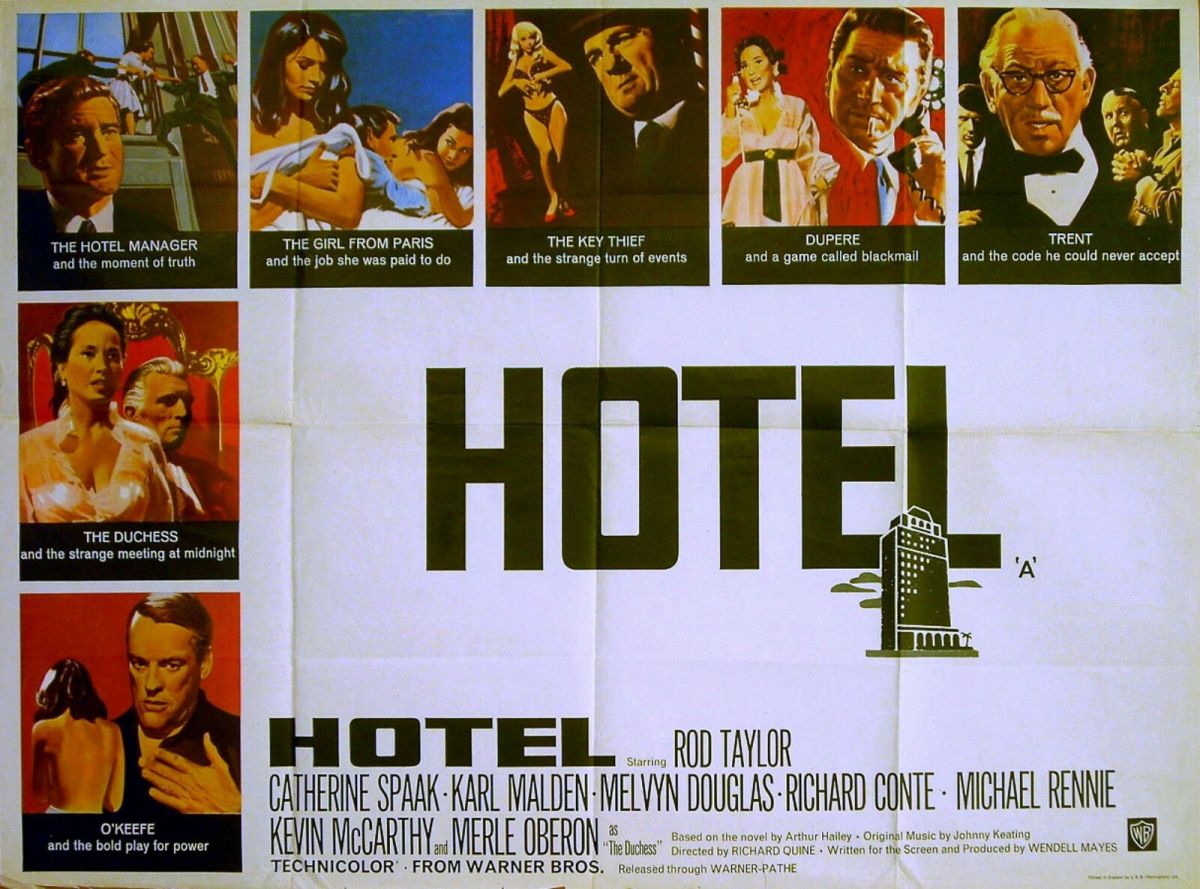
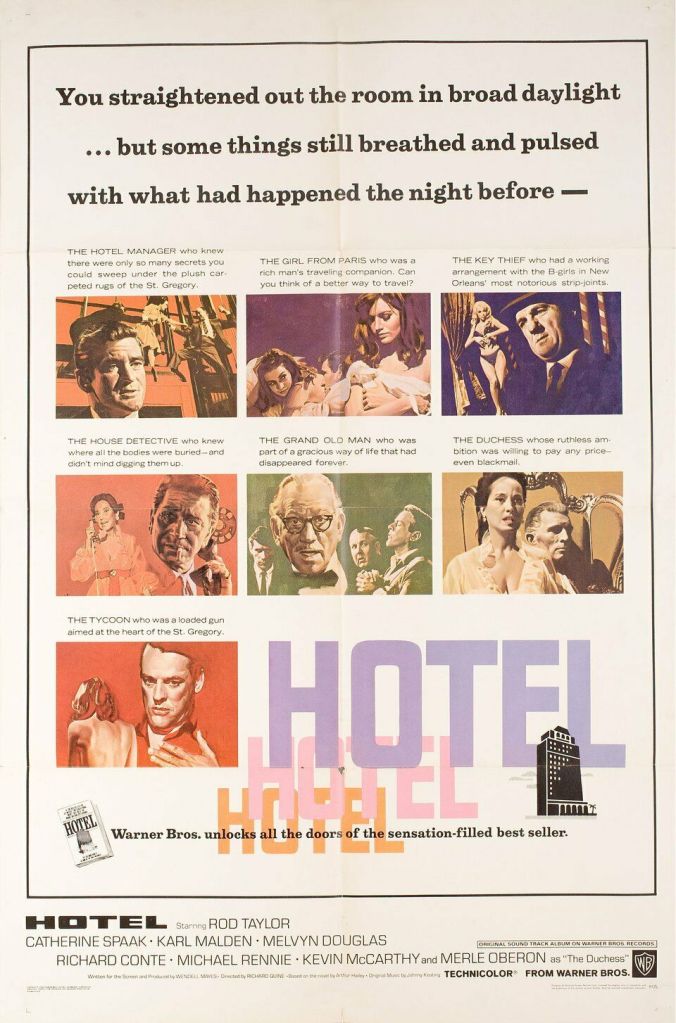
Hotel (1967) ***

The cardinal rule of the grand hotel picture was that it featured major stars. That is not so much the case here although the portmanteau of stories is up to scratch. Traditional hotel manager Peter McDermott (Rod Taylor) and boss Warren Trent (Melvyn Douglas) battle ruthless financiers, aristocrats Geoffrey (Michael Rennie) and Caroline (Merle Oberon) are involved in a fatal car accident, hypocritical God-fearing businessman Curtis O’Keefe (Kevin McCarthy) has a mistress Jeanne Rochefot (Catherine Spaak) on the side. Added into the mix are hotel thief Keycase Milne (Karl Malden) and hotel detective Dupere (Richard Conte). Not forgetting a dodgy elevator (you know where that’s headed!).

None of the stars mentioned comes up to the marquee standard set by the original in the subgenre – Grand Hotel (1932) boasted Jean Harlow, Greta Garbo, Joan Crawford and Wallace Beery – while an offshoot of the same idea The VIPs (1963) had Elizabeth Taylor, Richard Burton Orson Welles and the later Airport (1970) would rustle up top attractions Burt Lancaster, Dean Martin and Jean Seberg.

Top British film critic Alexander Walker espoused the movie.

It’s a fair bet that Warner Brothers felt audiences would be satisfied that the storylines were augmented by the behind-the-scenes insider information promised by the Arthur Hailey bestseller on which the film was based, such as how B-girls stole hotel keys, the tricks employed by a hotel thief and the various corrupt opportunities open to hotel staff. But it’s a major miscalculation to assume an audience cares that much who owns a particular hotel. And in the year in which In the Heat of the Night and Guess Who’s Coming to Dinner dealt with racism head-on, it was odd to see desegregation parlayed as a device to lower the asking price for the business or introduced out of economic necessity rather than high-minded principle.

Such gripes aside, this is movie comfort food, a picture that moves at a leisurely pace among its interwoven tales. Kevin McCarthy’s ruthless arrogant businessman steals the show, closely followed by Merle Oberon’s scheming duchess. To use a soccer analogy Rod Taylor is more like an old-fashioned center half rather than a midfield maestro, holding the picture together rather than setting it alight and his romance with McCarthy’s mistress (half his age) is an unlikely diversion, although the soft-spoken French actress, confronted by conscience, is particularly good. Melvyn Douglas as the aging owner mixes curmudgeon with affection and it’s hard not to feel sorry for Conte, outwitted by an older woman, and especially for Malden as the thief finding out how much the credit card has cut into the larceny business.

This was the last big-budget production for director Richard Quine whose career had been on the slide since box office highs The World of Suzie Wong (1960) and Sex and the Single Girl (1964). But he may have been somewhat restrained by having screenwriter Wendell Mayes (Von Ryan’s Express, 1965) as his producer. While well-crafted affair and glossy it lacks the inherent tension of an Airport.

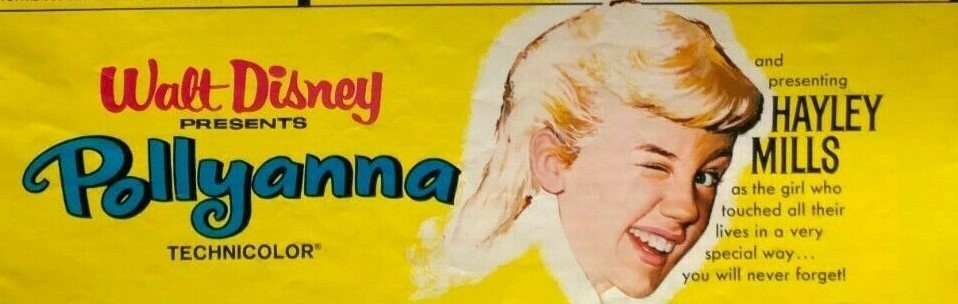
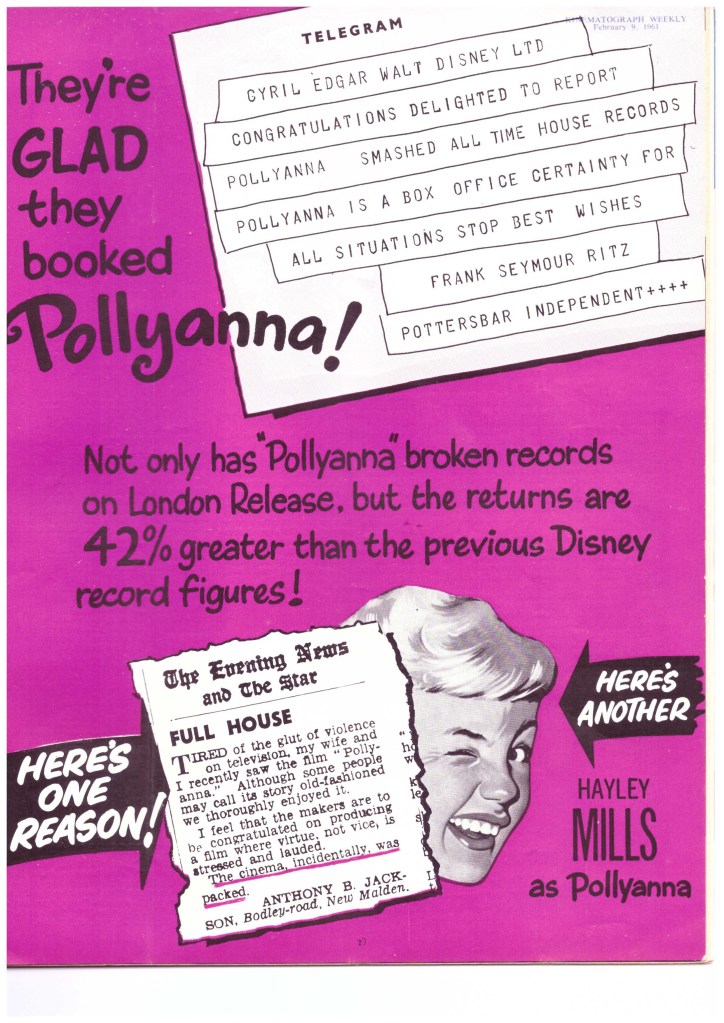
Pollyanna (1960) ***

This Walt Disney version discarded much of Eleanor H. Porter’s original best seller not to mention a great deal of the tear-jerking section that played to superstar Mary Pickford’s strengths in the silent 1920 adaptation. Pickford was in her late 20s at the time and a movie mogul to boot (having launched United Artists) so had a depth of emotion Hayley Mills (aged 13 during filming) could not hope to match.

The screenplay is a good lesson in how to retain the essential element of a story – a positive-thinking orphan alleviates the gloom in an embittered town – while providing more for adult audiences. Disney assembled an awesome cast with three Oscar-winners – Jane Wyman (Best Actress, Johnny Belinda, 1948),  Karl Malden (Best Supporting Actor, A Streetcar Named Desire, 1952) and Donald Crisp (Best Supporting Actor, How Green Was My Valley, 1942) – plus four-time nominee Agnes Moorehead and Adolph Menjou.

Despite no Oscar recognition Nancy Olsen had been leading lady to the likes of Bing Crosby, John Wayne and William Holden. In effect, parents would be very familiar with the stellar supporting cast. Unusually for a kid’s picture, Wyman, Malden and Crisp each are given a reflective moment to prove they are doing more than taking an easy salary cheque. 

At least in Hollywood terms (Mills made her debut the year before in the British Tiger Bay, 1959) Pollyanna falls into the a-star-is-born category. The actress acquits herself well, with her expressive face, while hearing the emotion she packs into the word “gorgeous” is word admission alone. With a healthy subplot about a town in thrall to matriarch Wyman, the weight of the movie does not fall on Mills’ shoulders alone and fire-and-brimstone preacher Malden and faded spinster Wyman are particularly good; Malden especially allocated more screen time than would be normal in a movie aimed at kids.

I have never read the book nor (to my shame) seen the Pickford version, so I came to the movie with low expectations, anticipating a lazy, maudlin effort. So I was quite surprised to discover how much I enjoyed it and was shocked by the final piece of action which turned the movie on its head. Sure, it relies on the feelgood factor but there is some decent stuff here – Pollyanna’s determination to find goodness in every event and every person takes her into some strange avenues – the rainbow playing on the walls, the “good parts” of the Bible – that these days makes for an entertaining matinee.  

Discover WordPress

A daily selection of the best content published on WordPress, collected for you by humans who love to read.

The Atavist Magazine

by Brian Hannan

WordPress.com News

The latest news on WordPress.com and the WordPress community.