The Honey Pot (1967) ***

Shave 20-30 minutes from this and you would have had a taut thriller. You could start with the number of clever dicks who happen to notice that what’s going on bears a close resemblance to a play Volpone by Shakespeare contemporary Ben Johnson, even down to the anglicizing of the names of those fictional characters. And prune the number of detectives, three is two too many especially when there’s an actual genuine detective in the mix. And the shock ending is just…well…mince.

Otherwise, quite fun in a way. Wealthy Cecil Fox (Rex Harrison) hires sometime actor, sometime factotum, law graduate Marty McFly – oops William McFly – to help him pull off an elaborate joke, “people-baiting”, a modern version of “bear-beating” apparently. Fox pretends to be dying in order to bring three former lovers, all he presumes desperate to be named in his will, to his bedside in a grand palazzo in Venice. Upfront reason, some kind of revenge. Hidden reason, something darker obviously.

The trio are Texan Mrs Sheridan (Susan Hayward), movie star Merle (Edie Adams) and Princess Dominique (Capucine). Sheridan is accompanied by a nurse Sarah (Maggie Smith), the “voice of morality.” They all certainly seem to have a sense of humor. Two presenting Fox with gifts of clocks, the princess with an hour-glass filled with gold dust instead of sand, presumably with the notion that he can watch his life ticking away. Needless to say, this is like an reality TV show, Fox not having named an heir in his will, so they are all battling to be the heir, and as he points out, even the rich will succumb because there is no such thing as “enough money.”

Things do not go according to plan when Sheridan unexpectedly dies. Enter Inspector Rizzo (Adolfo Celi). Sarah suspects McFly because he used her as an alibi but disappeared for a time when she (for unexplained reasons) fell asleep in a posh restaurant (and nobody tried to wake her). Turning detective herself, she comes up with “proof positive.” Turns out the two remaining suspects had conspired to also give themselves an alibi, easily demolished by the kindly inspector. McFly, too, has been doing some digging.

But then comes another twist and everything you thought you knew flies out the window. Cue more investigation, more alibis and finally an Agatha Christie pay-off when the two amateur detectives and the real one confront everyone in the drawing room. By which time the twists are coming thick and fast.

Best thing about this is the playing. Although decidedly stagey, very little in the way of visual audacity, that works to the movie’s benefit, and not a bad choice to rely so heavily on the acting given the cast. With the exception of Edie Adams, Capucine and Celi, all were Oscar anointed. Two winners – Rex Harrison for My Fair Lady (1964) and Susan Hayward for I Want to Live (1958) – and between them another five nominations – and two future winners in Cliff Robertson for Charly (1968) and Maggie Smith for The Prime of Miss Jean Brodie (1969). The others were not out of their depth, Edie Adams (Made in Paris, 1966) clocking up Emmy nominations. Adolfo Celi (In Search of Gregory, 1969) a deuce of nominations from the Cannes Film Festival while even Capucine (The 7th Dawn, 1964) had been nominated for a Golden Globe.  

So director Joseph L. Mankiewicz (Cleopatra, 1964) makes the right decision to let his actors get on with. Rex Harrison is at his suave best, but with a malevolent undercurrent, and has most of the best – and zestiest – lines. Robertson, usually the hero, is sly and duplicitous. Susan Hayward was in her comfort zone, forthright and taking no prisoners, Capucine at her cold and haughty best. Smith and Celi were the revelations, the former losing the trademark drawl and the nurse’s mousiness as to some extent she exerts control, and Celi departing from the bombast and delivering a lower-keyed performance.

Doing double duty, Mankiewicz worked up the script from three sources: the original Volpone,  the play Mr Fox of Venice by Frederick Knott (Dial M for Murder) and a novel The Evil of the Day by Thomas Sterling. Next time the director went to the stage for inspiration he chose a better source for a mystery – Sleuth (1972).
In the News – August 1960

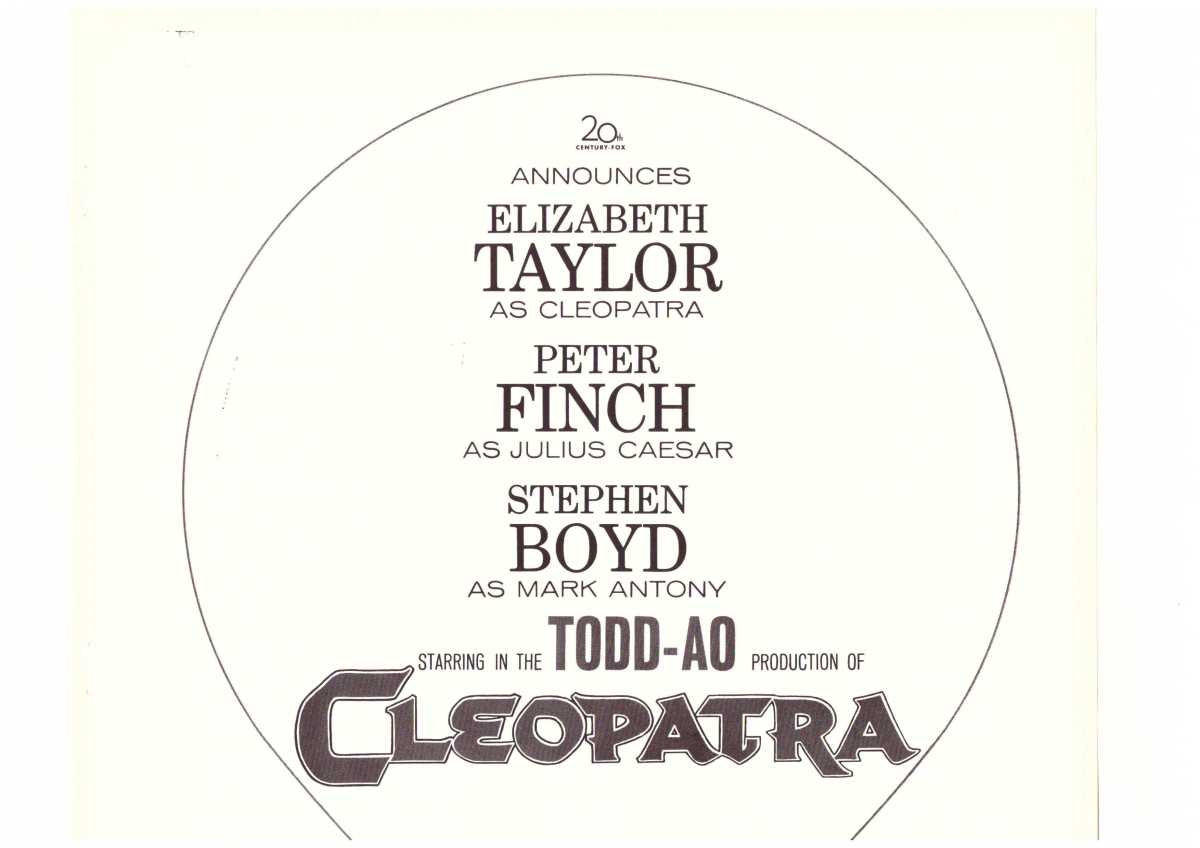
CLEOPATRA VERSION ONE

Producer Walter Wanger headed for Britain to oversee the start of production for Twentieth Century Fox’s Cleopatra. Before the movie was bogged down in illness and budget scandals, Elizabeth Taylor’s co-stars in this initial version were Stephen Boyd, fresh from Ben-Hur, and Peter Finch.  Wanger was mulling over taking the production to Egypt where he also intended to film the adaptation of Lawrence Durrell’s Justine. Rouben Mamoulian was the director of Cleopatra. Durrell had written the screenplay for this version. Fox was promising the movie would be on screens in June 1961. Joseph L. Mankiewicz, at this point down as writer of Justine, would later end up in charge of Cleopatra version two with Richard Burton and Rex Harrison replacing Boyd and Finch.

HITCHCOCK FESTIVAL

Although Alfred Hitchcock Festivals would become one of the major reissue talking points of the 1980s and while Rebecca (1940) had been successfully revived in the 1950s, the director’s first major commercial – as opposed to arthouse – retrospective was in the planning stage courtesy of David O. Selznick. He had in mind a rotating double bill based around three features to which he owned the rights – Spellbound (1945) with Ingrid Bergman and Gregory Peck, Notorious (1946) with Bergman and Cary Grant and The Paradine Case (1947) with Peck and Ann Todd. The project would be marketed as an “Alfred Hitchcock Festival.” Interest in the director was at all-time high after the double whammy of the previous year’s North by Northwest and current box office sensation Psycho. The fact that all three movies had already been shown on television was not seen as a deterrent. Selznick aimed to use as a promotional tool that moviegoers could see the pictures without irritating commercial breaks and on a much larger screen than television would afford.

IN THE PIPELINE

Montezuma was scheduled as Kirk Douglas’s follow-up to Spartacus with a budget in excess of the $12 million spent on the slave revolt epic. John Huston would pen the script and director. Douglas would play Cortez with Marlon Brando being wooed for the title role… Darryl F. Zanuck was setting up The Day Christ Died based on the Jim bishop bestseller in competition to George Stevens’ planned The Greatest Story Ever Told… Steve McQueen was planning to make The Captain under his own production company with Henry Fonda and Ernest Borgnine playing major parts… In fact, only The Day Christ Died ever saw light of day and  then only as a television film in 1980.  

IN OTHER NEWS

Critic Bosley Crowther declared war on subtitles, an unusual move for a writer long considered a purist where foreign movies were concerned…Pope John XXIII ordered a permanent projection room with air conditioning to be installed in the Vatican on the third floor of the Apostolic Palace because he liked movies more than his predecessor…La Dolce Vita was the top grossing film of the 1959-1960 Italian season with $1.125 million, well ahead of the closest runner-up Some Like it Hot with $725,000…Universal ordered a record fifty 70mm prints for SpartacusCharlton Heston was announced as El Cid for the forthcoming Samuel Bronston production…John Wayne held a sneak preview of The Alamo at the 900-seat Aladdin theater in Denver on August 5 with Can-Can kicked off the screen for the night…U.S. movie receipts were up for the first time in five years with the week of July 30 1960  the best since August 4 1956…In Britain, Hercules broke records in 36 of the 39 cinemas in its initial playoff.

SOURCES: “Wanger to Britain as Cleopatra and Justine Both May Shoot in Egypt,” Variety, Aug 3, 1960, p3; “Selznick Plotting Hitchcock Festival,” Variety, Aug 10, 1960, 7; “Kirk Douglas Outlines Plans for Mexican Biopic on Montezuma’s Life,” Variety, Aug 3, 1960, 4; “Zanuck Signs Gallico to Write The Day Christ Died,” Variety, Aug 10, 1960, 10; “Reisner-McQueen- Elkins Co-produce Captain,” Variety, Aug 17, 1960, 4; “Crowther’s Subtitles Must Go Stirs Trades, Uh-Huh but on the Other hand,” Variety, Aug 17, 1960, 4; “Vatican Getting Its Own Projection Room,” Variety, Aug 13, 1960, 13; “Italo Film in sharp Upbeat at ’59-’60 B.O.,” Variety, Aug 24, 1960, 11; “UI’s Big 70M Print Order for Spartacus,” Variety, Aug 24, 1960, 13; advertisement, El Cid, Variety, Aug 3, 1960, 16; “Wayne Sneaks Alamo,” Variety, Aug 10, 1960, 5; “Pictures $82,831,000 Take for Week Jul 30 Best Since Aug 4 1956,” Variety, Aug 10, 1960, 3; “Hercules Sets 36 New House Records out of 39 Spots in England,” Variety, Aug 10, 1960, 10.

Discover WordPress

A daily selection of the best content published on WordPress, collected for you by humans who love to read.

The Atavist Magazine

by Brian Hannan

WordPress.com News

The latest news on WordPress.com and the WordPress community.