The Doomsday Flight (1966) ***

Early entry to the hijack subgenre – this one pivoting on the bomb-on-a-plane. Could almost deem it a template for what to do and not do in this particular field. Airport (1970) was the most obvious beneficiary although Speed (1994) could be reckoned to be something of a homage. And though “what if” was largely the preserve of sci fi, this posed very scary questions for audiences only beginning to enjoy the benefits of cheaper international travel. A quartet of excellent twists and three examples of men under pressure heat up the concept.

Unusually, the writer was the main selling point, Rod Serling (Seven Days in May, 1964) being more famous than most screenwriters thanks to The Twilight Zone (1959-1964) scaring the pants off viewers in ways that nobody thought television would dare to do.

Propped up by an interesting cast – Jack Lord (The Name of the Game Is Kill!, 1968), former major league movie star Van Johnson (Wives and Lovers, 1963), Edmond O’Brien (Rio Conchos, 1964), John Saxon (The Appaloosa, 1966), Ed Asner (The Satan Bug, 1965) and Michael Sarrazin (They Shoot Horses, Don’t They, 1969).

Unusual in that the two main characters lose it and the movie is probably the first to touch upon PTSD in Vietnam. While Special Agent Frank Thompson (Jack Lord), leading the task force on the ground, appears to be in complete control, in fact he’s hidden the fact that his wife is on the hijacked plane. That’s only revealed in the final climactic twist, so you have to cast your mind back over the movie and reassess Jack Lord’s apparently unflappable performance.

The anonymous hijacker (Edmond O’Brien) is a pretty cunning individual. He’s set a bomb to explode on the plane’s descent and removed the easy option of making a speedy landing by forcing the jet to remain above a certain height otherwise an altitude-sensitive trigger will blow the passengers to kingdom come. He demands a $100,000 ransom which the airline is only too willing to pay.
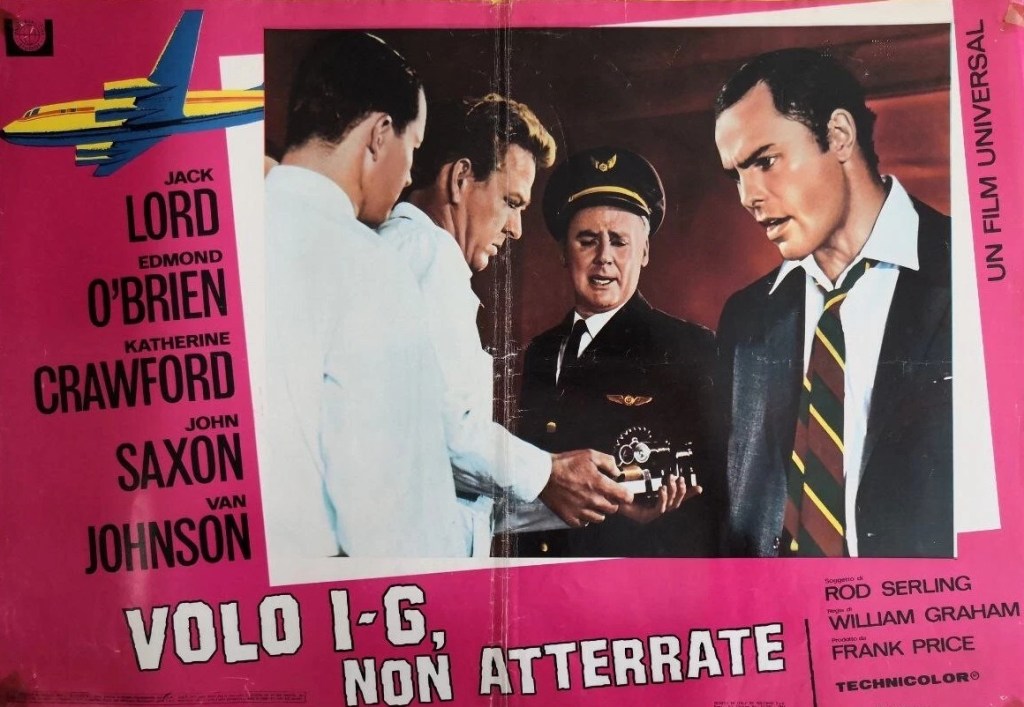
Meanwhile, Capt Anderson (Van Johnson), who had appeared the insouciant handsome epitome of the airline pilot of the kind you saw in advertisements, is sweating profusely under the pressure as the cabin crew begin to search for the bomb. The passengers are not quite as terrified as you’d expect, most sitting in their seats, and i’ts left to celebrity George Ducette (John Saxon) to kick up a ruckus until put in his place by an anonymous army corporal (Michael Sarrazin) who has a distinct aversion to bombs and so far has sat rigid in his seat.

The hijacker keeps everyone on their toes by constantly moving from phone to phone. There’s a hiccup when the delivery van carrying the ransom has an accident and the cash is obliterated. By this point the hijacker, in a bar, is getting drunk and his iron control is tested by the news. The plane, meanwhile, is running out of fuel and Capt Anderson has long run out of patience.

Turns out the bomber isn’t the evil genius you expect. He’s been cast aside by the American dream, his considerable talents overlooked, and he wants everyone to know that he’s worth more. Unfortunately, he doesn’t get his moment in the sun, either literally having made off with the money, or by having his face splashed over the front pages of newspapers.

When he dies of a heart attack, the plane still circling and fuel levels dangerously low and now unable to locate the bomb, that’s a heck of a fabulous twist. But what Rod Serling takes away with one hand, he gives with the other, and the pilot soon works out that if he lands at a high altitude airfield he’ll prevent the bomb exploding.

Safely on the ground, we come to the third twist. The hijacker had deposited the bomb in Capt Anderson’s flight bag, carelessly left lying around at the airport. The final twist is the revelation that Thompson’s wife was on board.

What had every opportunity of becoming a run-of-the-mill thriller, especially since we are light on passenger drama (no pregnant women about to give birth, no kids or nuns to claw at our sentiments), segues into something more interesting as it delves into the cracking up of the hijacker and intimation that soldiers returning from Vietnam do not feel like heroes.

Edmond O’Brien is the pick, but Van Johnson possibly the most courageous in filleting his screen persona. You wouldn’t have predicted Michael Sarrazin’s later success from this performance, nor that Jack Lord would hit a home run in television’s Hawaii Five-O (1968-1980).

Ably directed by William Graham (Waterhole #3, 1967) and although, technically, all he has to do is point the picture in the direction of the twists, he brings more by allowing Edmond O’Brien to humanize his character.   

I saw this as the supporting feature to Carry On Doctor and as a youngster never came out of a cinema more scared. Originally it was a made-for-television number though yanked after only one screening after airlines, not surprisingly, objected, so, as with many hard-to-find pictures it entered the cult zone in the USA.

As YouTube is often the curator of cult you can find it there.
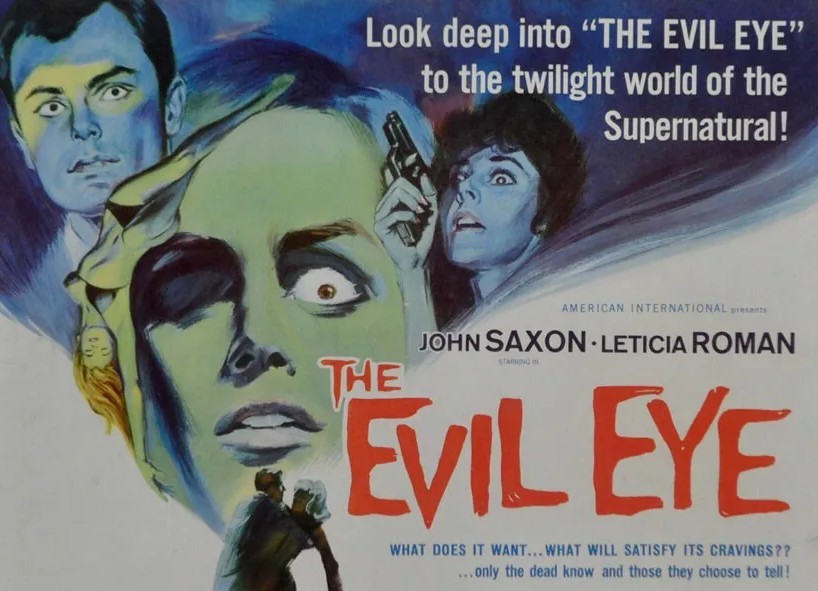
The Evil Eye / The Girl Who Knew Too Much (1963) ***

Don’t be taken in by claims that, since it was directed by Mario Bava, it kicked off the giallo sub-genre. More of the tropes come from mainstream horror – windows banging shut, locked doors, disembodied voices, stalkers, gaslighting, mysterious phone calls, premonition, retrocognition. And just for good measure, striking compositions that wouldn’t be out of place in an arthouse picture. But essentially it’s neo-noir – a woman can’t prove she’s witnessed a murder.

The Evil Eye was the American title, which makes little sense, although eye-popping eyes were in fashion from movies like Village of the Damned (1960), but in fact the original title of The Girl Who Knew Too Much is much more appropriate. This film is about a female character and what she discovers that threatens her life. The American version was chopped about by the distributor but, apparently, copies of that have gone astray so if locate a copy of the picture what you are likely to see if the Italian original.

American tourist Nora (Leticia Roman) is knocked out by a robber in Rome. On waking up she sees a murderer sticking a knife into a woman’s back. Only problem is – there’s no corpse to be found. But, strangely, a murder was committed on that spot a decade ago. So she might be having a vision of the past. But the murderer Straccianeve was caught.

The victim was the sister of Laura (Valentina Cortese), a new friend, whose apartment Nora temporarily occupies. There, Laura discovers newspaper clippings relating to the “alphabet killer”, a serial murderer whose victims’ surnames began with A, B, and C. Once Nora begins her investigations, it looks like she’ll be next on the list since her surname begins with “D”.  Meanwhile, she has struck a romantic vibe with Dr Marcello Bassi (John Saxon). But, of course, he might be not what he seems, sneaking off for assignations with strange women, following her.

Much of this is played out on deserted streets where the tourist sites acquire a dangerous veneer.

The finger points at journalist Landini (Dante DiPaulo), who has been following her. But he is as much a basket case as a potential murderer. He was instrumental in collecting the evidence that trapped the murderer but now believes Straccianeve was innocent.

In due course, after some more deaths, Nora traps the murderer, who comes out of left field, one of those where you think the writer has decided to pin the blame on the least likely suspect and come up with a spurious reason for the murders, so the twists pile up in helter skelter fashion at the end, including one which suggests Nora might well have the gift of seeing into the future.

Leticia Roman, in her debut, is mostly called upon to look baffled or frightened, there’s rather too much of the pop-eyes, and John Saxon (The Appaloosa, 1966) has the rare opportunity to play a hero. Valentina Cortese (Barabbas, 1961) drifts in and out of the tale. Written by future director Sergio Corbucci (Django, 1966), Oscar-winner Ennio De Concini (Divorce, Italian Style, 1963) and Eliana De Sabato (Marco Polo, 1962).

If it hadn’t been directed – and occasionally so stylishly – by Mario Bava (The Whip and the Body, 1963), it would have attracted considerably less contemporary attention. One of this main themes – the conflict between illusion and reality – is given a good airing. You can well believe that Nora is going mad. But it’s atmospheric enough and the director makes unusual use of the standard Rome tourist traps and this picture gives notice that he will move onto greater movies.

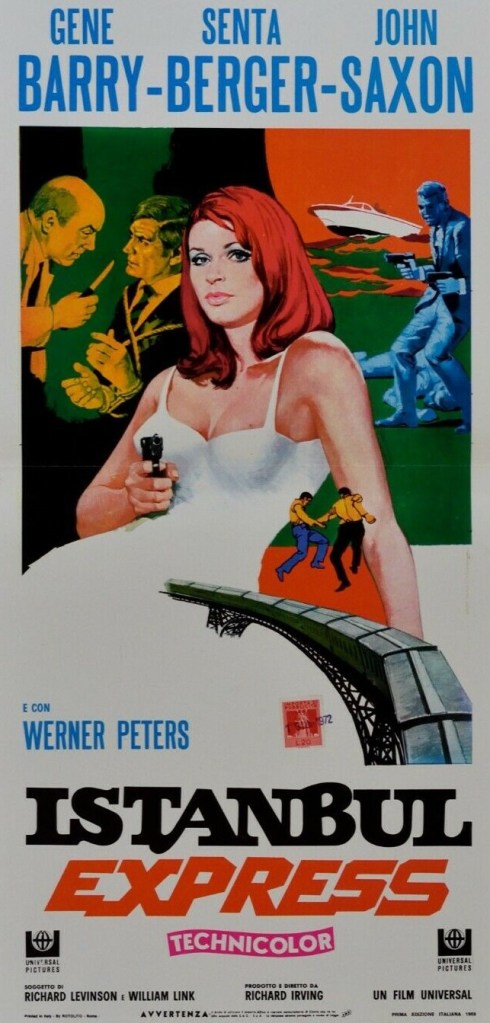
Istanbul Express (1968) ***

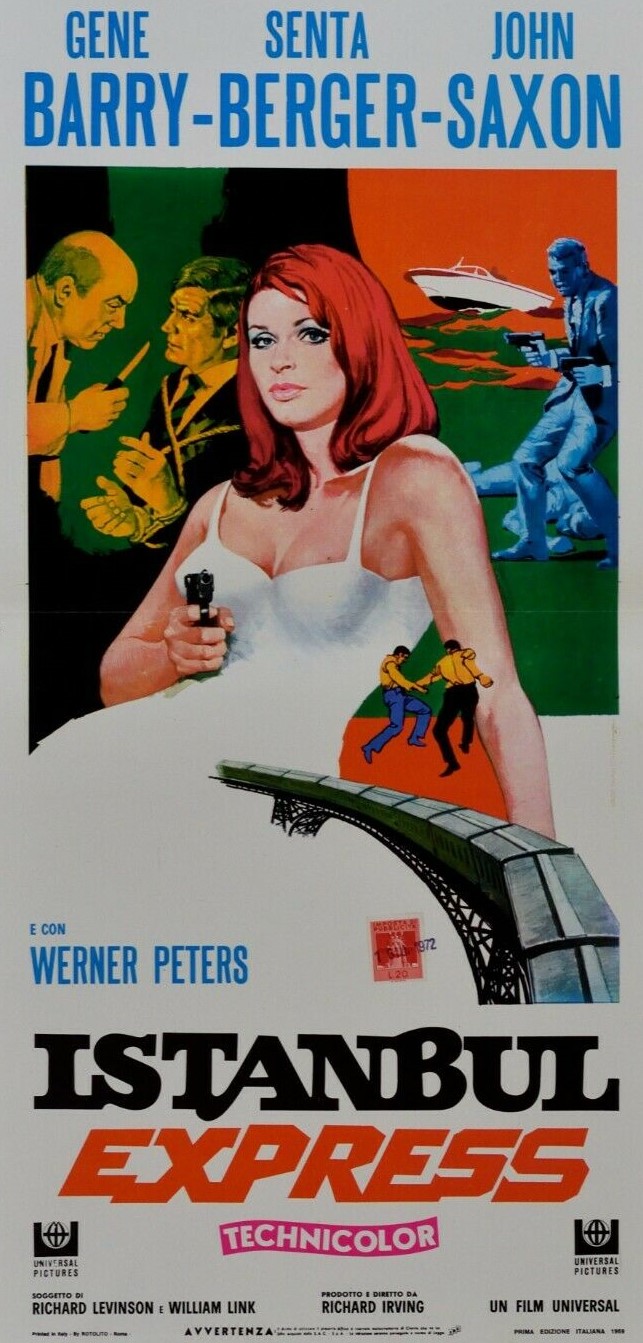
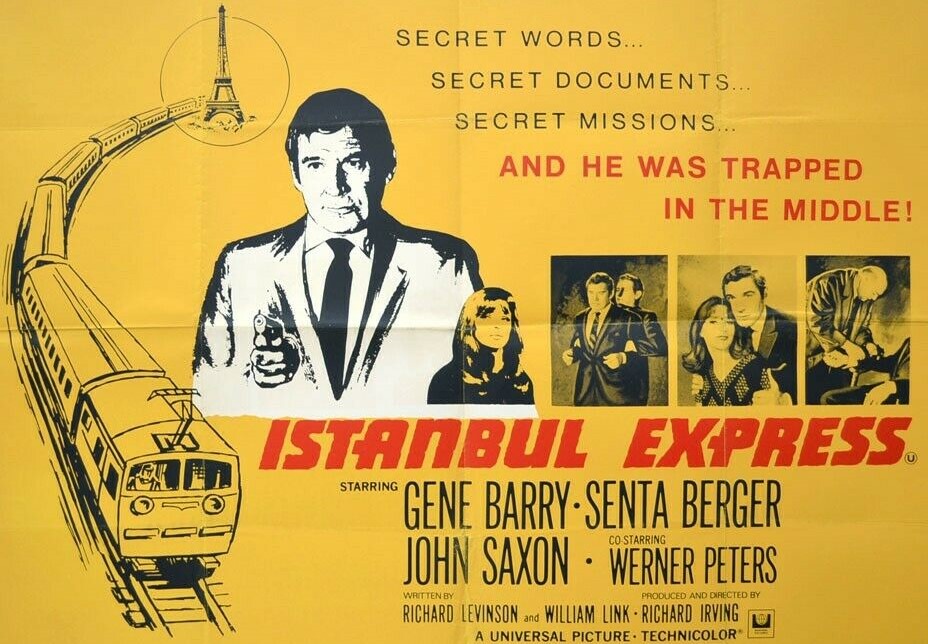
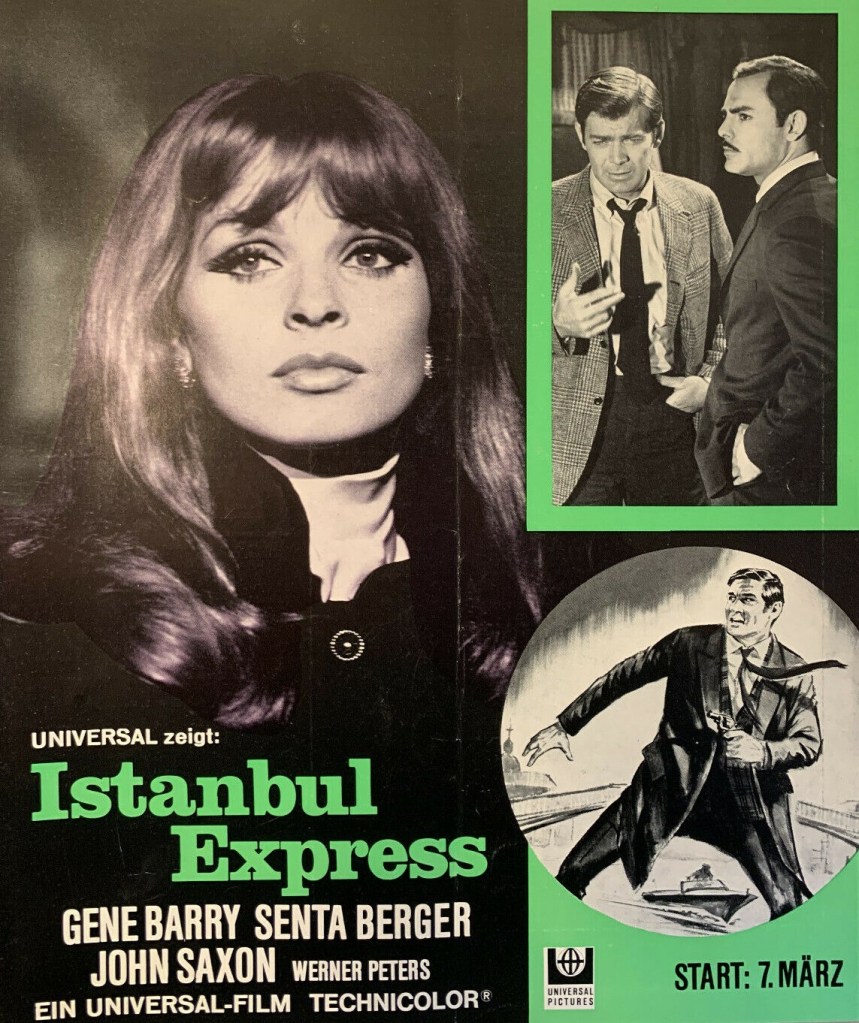
Calling this a by-the-numbers spy thriller does this movie no disservice since numbers are crucial to the complicated plot. On the one hand it’s quite a simple set up. Suave high-living art dealer-cum-spy Michael London (Gene Barry) travels from Paris to Istanbul on the Orient Express to bid for secret papers in a secret auction. The complication: he must pick up the auction money from a bank in Istanbul using a code given to him along the way, each number by a different unknown person. On his side are train security chief Cheval (John Saxon), investigative journalist Leland McCord (Tom Simcox) and colleague Peggy (Mary Ann Mobley). Out to get him are Mila Darvos (Senta Berger) and Dr Lenz (Werner Peters).

The numbers business is an interesting addition to the usual spy picture formula of scenic location – Venice and the Eastern bloc as well as the other famous cities – violence and beautiful, sometimes deadly, women. You spend a good time guessing just how the numbers will be passed on and let me warn you it is sometime by inanimate means while the numbers themselves come with a twist.

There’s also a truth serum, bomb threat, a traitor and every obstacle possible put in London’s way to prevent him completing his mission. London is about the world’s worst passenger, always missing the train as it sets off on the next leg of its journey, and requiring alternative modes of transport to catch up. But it’s as much about quick thinking as action and ends with a couple of unexpected twists. And it’s darned clever at times where the numbers are concerned.

Admittedly, the plot is a tad over-complicated but it’s fun to see London wriggle his way out of situations and for Cheval and McCord to turn up unexpectedly to provide assistance.

Gene Barry (Maroc 7, 1967) is little more than his television alter ego from Burke’s Law but he has an easy screen presence, never flustered, tough but charming and a winning way with the ladies. John Saxon (The Appaloosa, 1966) is the surprise turn, on the side of the angels rather than a villain, and equally commanding on screen, and certainly given one of his better roles. Senta Berger (Major Dundee, 1965) is not given as much screen time as you would like – a long way from being set up as the normal espionage femme fatale – but is certainly a convincing adversary.

This was only a movie if you saw it outside of the United States. There it was shown on television. But it had high production values for a television movie and director Richard Irving, who directed the television feature that introduced Columbo (Prescription Murder, 1968), keeps it moving at a healthy clip.  The numbers idea was probably a television device, allowing the opportunity for timed breaks in the action, Writers Richard Levinson and William Link were a class television act, creating Columbo, and prior to that the Jericho (1966-1967) and Mannix (1967-1975) television series. 

Interestingly, Senta Berger, John Saxon, Gene Barry, Levinson/Link and Richard Irving were all at various points involved in the groundbreaking U.S. television series The Name of the Game (1968-1971).

I had not realized Istanbul Express was a made-for-TV picture until I had finished watching it and in that case found it a superior piece of television and a decent-enough rift on the spy movie.

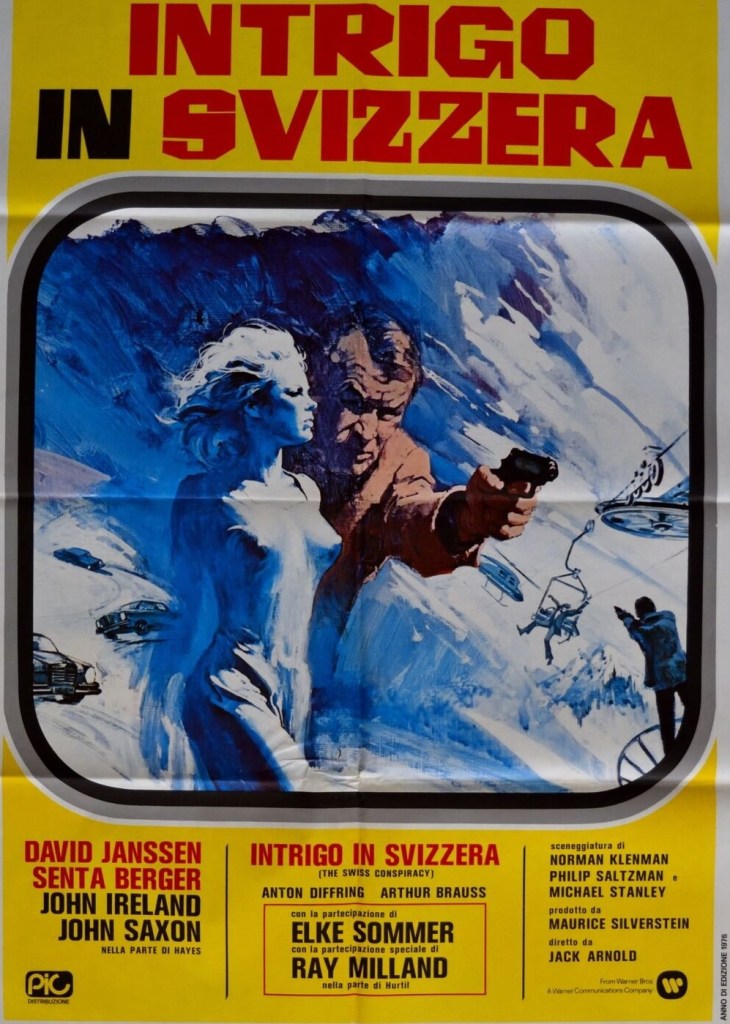
The Swiss Conspiracy (1976) ***

One of those thrillers that only makes sense at the end. Lazy critics, too annoyed to wait or not able to work it out themselves, take out their bafflement on the picture. Or they carp at what they see as overmuch tourist influence instead of admiring the clever use made of Switzerland’s scenic attractions, the twisty cobbled streets, corkscrew highways teetering over ravines, and the apparatus of skiing – the chug-chug trains and lifts.  

Attractive too for the cast. You might put me down as overly fond of leading lady Senta Berger (Bang! Bang! You’re Dead! / Our Man in Marrakesh, 1966) but I’m equally appreciative of the casual charm and realistic qualities brought to the screen by the underrated David Janssen (The Warning Shot, 1967). And that’s before we come to Elke Sommer (The Prize, 1963) and veteran Hollywood star Ray Milland (Hostile Witness, 1969), not to mention character actors John Saxon (The Appaloosa / Southwest to Sonora, 1966) and John Ireland (Faces in the Dark, 1961).

Poster designer gives himself a bit of leeway here, suggesting a lass is going to be striding around the Alps in such clingy clothing.

Former U.S. Treasury Agent David Christopher (David Janssen) is called in by Swiss bank owner Johann Hurtil (Ray Milland) to investigate a threat to expose the clients hiding behind the country’s infamous secret numbered accounts. Five clients, in particular, have been targeted including the glamorous Denise Abbott (Senta Berger), whom David first encounters in what would in other circumstances be deemed a clever meet-cute with the woman getting the upper hand.

One client is already dead, murdered in the opening sequence, as a warning. Of the others, Robert Hayes (John Saxon) is a mobster depositing illicit gains for money-laundering purposes, Dwight McGowan (John Ireland) a shady businessman on his last legs, while Kosta (Curt Lowans) equally operates in the shadows. And all is not well with the bank deputy Franz Benninger (Anton Diffring), involved in an affair with another client, Rita Jensen (Elke Sommer). On top of that, Swiss cops are on the trail of Hayes and hit men are tailing Christopher.

Christopher quickly surmises that the victims have been targeted for their undercover dealings, even the uber-glam Denise is blackmailing a former lover. But Hurtil, fearing a public and media scandal, and for whom the gangster’s demands are a mere drop in the ocean compared to the bank’s overall wealth, decides to meet their terms, which is payment of 15 million Swiss francs (equating to several million U.S. dollars, I guess) in uncut diamonds.

But before that we have a punch-up and shoot-out in a parking garage, a chase on foot on those famous narrow cobbled twisty streets with a speeding car giving the thugs unfair advantage, a race of seduction a la On Her Majesty’s Secret Service (1970) along those aforementioned treacherous mountainous roads, a literal cliffhanger in the vein of The Italian Job (1969), and one of those luscious romances beloved of the upmarket thriller (think The Thomas Crown Affair, 1968).  

While Christopher is painstakingly putting together the clues and keeping the suspicious Swiss police off his back and avoiding being killed, there’s a deadline to meet, the usual race against time, while the audience is having to fend off a surprising number of red herrings.

It’s not only glamorous, it’s short, and there’s more than enough going on, characters played by interesting actors, to keep the viewer involved. And I defy you to guess the ending. So, enough thrills, sufficient mystery, great scenery, and a female contingent (even Christopher’s secretary fits that category) with brains to match their sexiness who appear to have the upper hand in relationships with the opposite sex.

This is David Janssen at his best, that outward diffidence concealing a harder inner core, exuding a guy-next-door appeal that was never properly utilised by Hollywood, who preferred him just to reveal character by squinting. The scene where he takes in the extent of the luxury of Denise’s hotel penthouse is one of those that, while not knocking on Oscar’s door, demands true acting skills. He’s never in your face, and the camera loves him for it.

Of course, Senta Berger, what can you say, another under-rated actress never given her due in Hollywood, here finds a plum role that allows her to switch from confidence to vulnerability at the drop of a hat. John Saxon and John Ireland, as ever, are value for money. And Ray Milland keeps the show on the road.

A modern audience would be more at home with the multiplicity of plot angles and probably worked out in their own heads all that couldn’t find a place on screen, ensuring that what seemed like plot holes were anything but.

Jack Arnold (The Creature from the Black Lagoon, 1953) handles the scheming and dealing with ease. Norman Klenman (Ivy League Killers, 1959), and two television writers in their movie debuts, Michael Stanley and Philip Saltzman, wove the intricate screenplay.

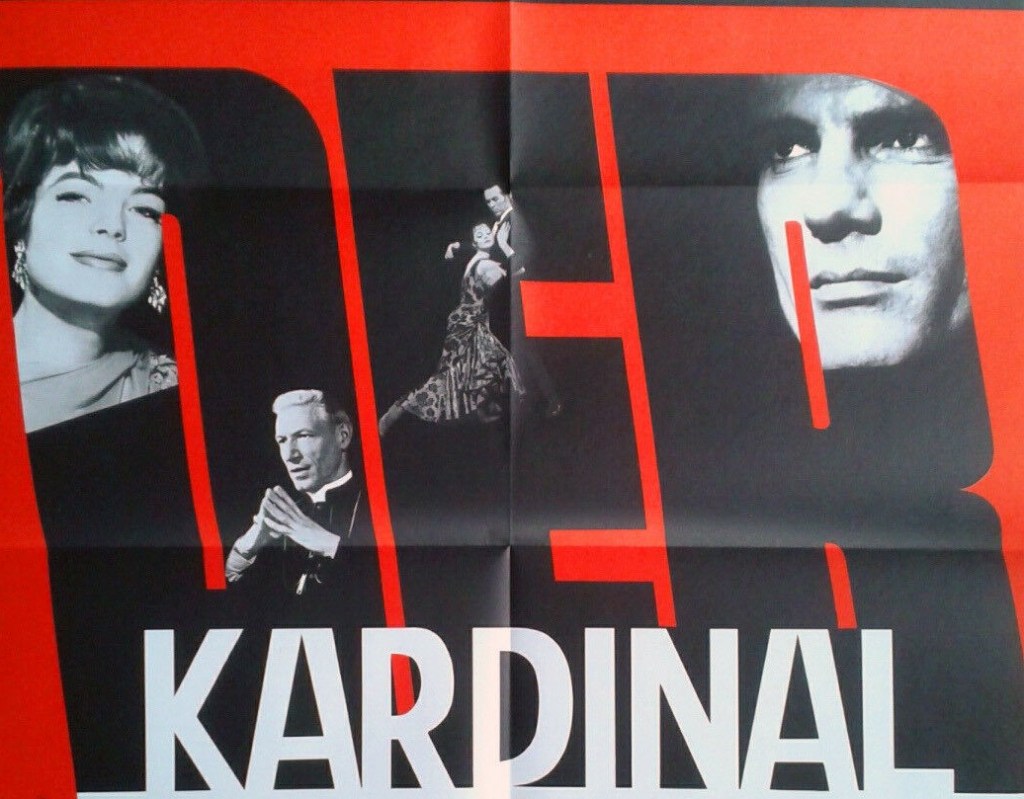
The Cardinal (1963) ****

Would appear resolutely old-fashioned except for Forrest Gump (1994) adopting same premise of the main character present at major events. Here it’s issues affecting the Catholic Church between last century’s two world wars and the protagonist is an American priest, Father Stephen Fermoyle (Tom Tryon) of Irish stock,  who rises to the position of Cardinal.

So we move at a relatively stately pace through abortion, inter-denominational marriage, racism, a miracle, challenging church philosophy, and Hitler’s annexation of Austria on the eve of the Second World War, in which the church played an inglorious part. Along the way Fr Fermoyle is afflicted so badly by doubt that he takes a sabbatical only for his flesh to be sorely tempted.

Astonishingly, I saw this on YouTube (it’s still there) in a beautiful 70mm print preserved by the National Film and Television Archive. The roadshow print, to be exact, which begins with a marvellous five-minute overture. Oddly enough there’s something very settling about sitting in the darkness with the curtains drawn watching a blank (black) screen and listening to the majestic score by Jerome Moross (The Big Country, 1958).

And then it’s another few minutes of a stunning credit sequence, all sunlight and shadow, before the movie begins. The movie itself is over three hours long, so if you are put off by this kind of epic now’s the time to check out. But if you do, you will miss something genuinely to be savored.

For Otto Preminger (Hurry Sundown, 1967) certainly knows how to tell a story, even one as sweeping as this. For all its pomp, he manages to retain intimacy.

Immediately after his ordination just as America enters the First World War, Fr Fermoyle faces a crisis. His sister Mona (Carol Lynley) wants to marry a Jewish dentist (John Saxon) who refuses to convert to Catholicism. Fermoyle’s advice, in keeping with the church’s stringent rules: give him up.

A noted intellectual, Fermoyle is astonished to be sent by the worldly piano-playing cigar-chomping Archbishop Glennon (John Huston) to an impoverished parish to learn humility. There, he encounters the blind faith of parishioners and a pastor, Fr Halley (Burgess Meredith), so inclined to put others first that he will not seek help for a debilitating disease.

Meanwhile Mona, now a dancer and drinker, has become pregnant, and not by the dentist. But complications arise and she is forced to choose between herself and the unborn child. According to Church doctrine, as Fermoyle, advises, abortion being illegal, the mother must die to save the baby. Mona, not the sacrificial kind, does the opposite. Fermoyle, racked with guilt, wants to quit the church. Instead, he is promoted to Monsignor, and given a two-year timeout which he spends lecturing in Vienna.

There he falls in love with Annemarie (Romy Scheider). In the nick of time, he is recalled to the States and sent to the Deep South to help the black Fr Gillis (Ossie Davis) who is being harassed by the Ku Klux Klan. In standing by his colleague, Fermoyle undergoes a brutal whipping. Promoted to bishop, he is despatched to Austria “to instruct the princes of the church in the realities of the modern world.” Unfortunately, the clergy, siding with the Nazis, presides over the marriage of Germany and Austria.

Meanwhile, he is reacquainted with Annemarie, who has married a Jewish banker, and witnesses at first-hand Nazi treatment of the Jews, her husband so fearful of his future he jumps out a window.   When a mob ransacks a church, Fermoyle isn’t so intent on facing up to them and instead, with Annemarie, manages to escape.

At its best and its worst by the narrative being forced through the prism of an individual. His reactions to issues are regulated by his employers, the Church, which exerts as much control over personal thought as the Communist Party, so, in effect, it becomes a tale of a person initially bristling against authority until, it turns out, the Church shares the same antipathy to the worst of the century’s scandals, the Ku Klux Klan and the Nazis.

Father Fermoyle hardly seems suited to high office, given he is so often inclined to temptation, either in a sexual sense, or in taking the opposite view of the Church. And it’s almost as though the splendid backdrop as represented by the immense wealth of the Church has only been achieving by subjugation of the individual. That the worldly Glennon appears as the poster boy for the Church hierarchy is almost Preminger playing with the audience.

It might be sumptuously mounted, but once again Preminger takes no prisoners, showing up an institution that while purportedly set up for the benefit of mankind so often sabotages noble endeavor.

Tom Tryon (In Harm’s Way, 1965) is excellent in the leading role, personal conviction getting in the way of the easy path to the top. But the pick of the performers are the supporting stars, especially John Huston, more famous as a director (The Night of the Iguana, 1964) and here making his acting debut, and Romy Scheider (Triple Cross, 1966). Look out for Carol Lynley (Bunny Lake Is Missing, 1965), silent film star Dorothy Gish in her final movie appearance, Maggie McNamara (The Moon Is Blue, 1953) in her first picture in eight years, and John Saxon (The Appaloosa, 1966) before he was typecast as a heavy.

Otto Preminger (In Harm’s Way) directs in stately fashion from a screenplay by Robert Dozier (The Big Bounce, 1969) and Ring Lardner Jr. (The Cincinnati Kid, 1965).

Thoughtful and striking.

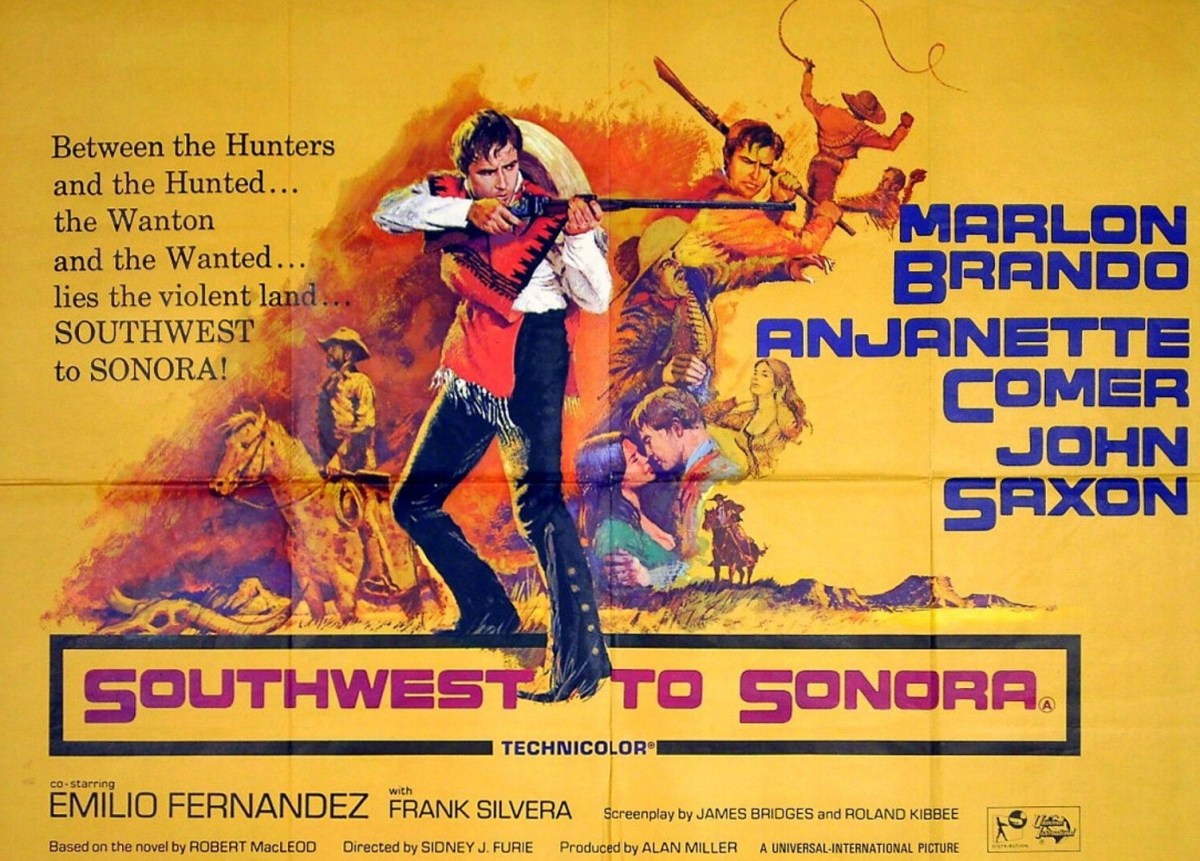
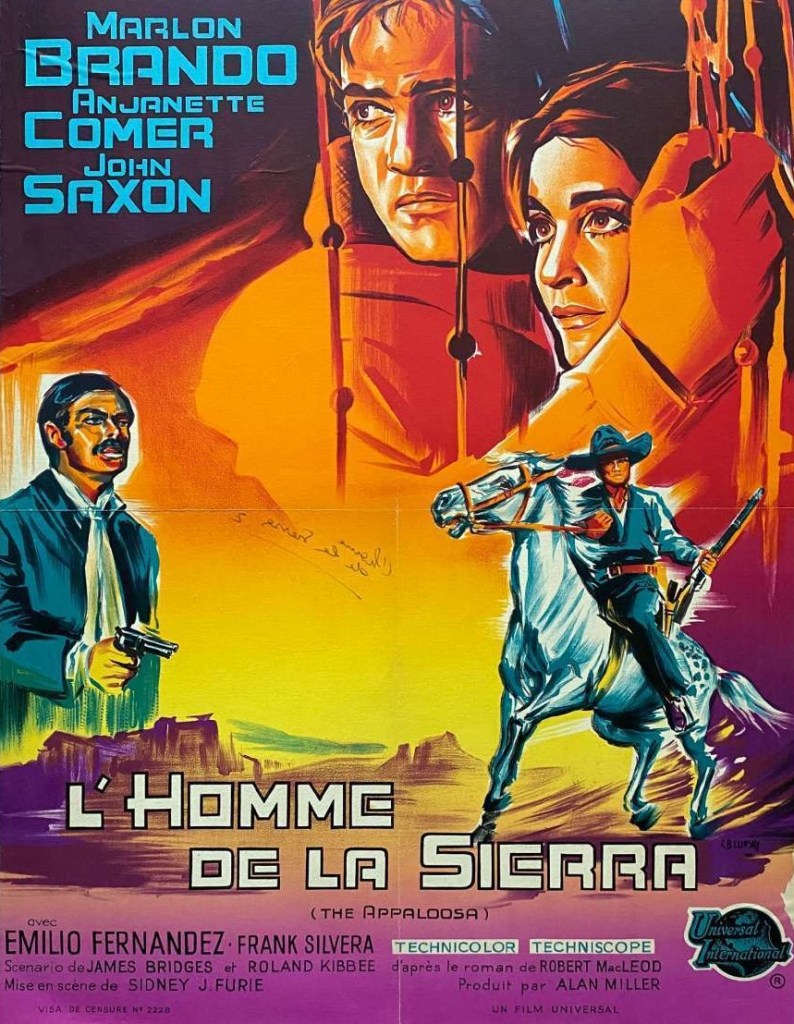
The Appaloosa/Southwest to Sonora (1966) ****

High expectation can kill a picture. Low expectation can have the opposite result. I came at The Appaloosa with the latter attitude in mind. I knew the picture had been a big flop and that critics had carped – as they had done through most of the 1960s – about the performance of Marlon Brando.

Neither was director Sidney J. Furie’s style to everyone’s taste. And it seemed an odd subject – Texan takes on Mexican warlord to recover a stolen horse. It is surely a slow burn, but it certainly worked well beyond my anticipation. There’s not much more to the story than two guys fighting over a horse.

First of all, Brando’s performance came across as natural, not mannered. Secondly, this was a real character. He was not a John Wayne striding into action to protect the underdog or a woman or out of some goddam principle.

At first it did seem odd that Matt Fletcher (Marlon Brando) placed so much importance on the horse given that said warlord Chuy Meena (John Saxon) had offered him a more than fair price for it. But in one brilliant two-minute scene, expertly directed and with virtually no close-ups – the actor caught mostly with his back to the camera or in silhouette – we discover why. Fletcher has been such a disappointment to his father that bringing home such an animal was proof that he had made something of himself. A buffalo hunter to trade, he was on the verge of starting a new life.

The second aspect of this intriguing picture was that Medena placed so much importance on a horse when he could easily buy any horse he wanted. But he was faced with losing face. His wife Trini (Anjanette Comer) had tried to escape from him on the horse and the only remedy was to persuade the watching federales that Fletcher had previously sold him the horse.

When Fletcher refuses, Medena takes the horse by force. Fletcher, in retaliation, and to save his own sense of pride, tries to take it back. He is not represented as a superhuman John Wayne or savage Clint Eastwood, but an ordinary guy who soon finds himself out of his depth. So ordinary that the first time he aims his rifle he misses the target by a mile.

Nor is he burdened with an over-enlarged empathy gland. He not only refuses to help Trini, but steadfastly refuses to take her with him, not even as far as the border, until in another of the film’s lengthy scenes she explains the reasons for her escape attempt.

Few films have exceeded it for atmosphere. This Mexico is grim, pitiless. Hostility and suspicion are endemic. Women are abused and discarded. The standout scene is Medena and Fletcher arm-wrestling over scorpions, played out against a soundtrack of scraping chairs and the poisonous insects scrabbling on the table. 

This is a brooding western featuring the actor with the best eye for brooding in the business. Sidney J Furie (The Ipcress File, 1965) is gifted – or afflicted depending on your point of view – with an eye for the unusual camera angle. Here I think the gift not the affliction is on show.

When you watch this and The Chase (1966) together it’s hard to see what on earth got the critics so rattled about Brando’s mid-decade performances. This is realistic acting at his best. Where John Wayne or Clint Eastwood present a superhuman screen persona, even if for part of a picture they are downtrodden, Brando was happy to play very human characters. In both pictures he is just an ordinary joe – forced into action by circumstance.

Mr Hobbs Takes A Vacation (1963) ***

Audiences reared on the actor’s westerns and Hitchcock thrillers of the 1950s might have been somewhat taken aback to see the hard-hitting star turning up in a comedy. Setting aside Bell, Book and Candle (1958), he hadn’t been seen in anything that would resemble a Hollywood confection since a couple of lack-luster Post-War comedies – Magic Town (1947), Jackpot (1950) –  when he was trying to regain the marquee status he had lost by going off to fight. Of course, having gone heavyweight with Anatomy of a Murder (1959), Two Rode Together (1961) and The Man Who Shot Liberty Valance (1962) he might have thought he was due some movie R’n’R.

Whether this contemporary equivalent of a beachside air bnb gone wrong was the ideal choice is a moot point. But he would certainly be playing against type. After all those tough guys, principled leaders and occasional dodgy characters, you wouldn’t have to go far to find people who might enjoy seeing him taken down a peg or two.

Harassed banker Roger (James Stewart) wants a quiet getaway with wife Peggy (Maureen O’Hara). But she has different ideas and he finds himself bunked down with a brood too many, his own family, in-laws and unexpected guests. Naturally some of these unexpected guests included rats, happily infesting this shambling house that could have been second-choice for Bates Motel, and there are plenty running gags about what doesn’t work or falls off and a shared telephone line.

If there was such a sub-genre as the mature coming-of-age picture, this would be it, Roger realizing he has a lot of catching up to do in the emotional relationship department.

Mostly, it’s one episode after another. The cook quits, his daughter and son-in-law have eschewed the traditional approach to child-rearing, son Danny wants to be left alone to play his computer games, sorry watch television, teenage daughter Katey (Lauri Peters) is turning into a wallflower, rather well-endowed neighbors catch his eye. To show willing, he’s the yachtsman who gets lost and bored bird-watcher.

But if audiences have learned one thing from a decade of Stewart-watching, it’s that he’s generally far from hapless and although it’s not his fault he’s trapped in the shower room with a naked woman (Marie Wilson), he’s not so much a do-gooder as a do-er, setting out to repair as much as possible the fractured relationships, not above a bit of bribery or cutting a few corners.

This is amiable enough stuff, a few good laughs, and much merriment to be had from the mere sight of the banker, lord of his domain at work cast adrift outside it, and having to adapt to different perspectives. There’s a harder edge than you might expect and some of the scenes of relationships under pressure don’t make easy viewing.

These days, everything wouldn’t work out so well, but in the 1960s I guess the tension was derived from working out exactly how it would work out. And waiting for teen heartthrob Fabian (North to Alaska, 1960) to sing. It seems a contradiction in terms that a pop star trying to prove himself as an actor has to fall back on singing. But them’s the breaks.

A mixture of situational comedy and sharp repartee, it never falls apart at the seams, enough in the tank to keep everything on an even keel.

James Stewart moves from coldness at finding himself in awkward situations to warmth as he finds ways to retrieve the best elements out of them. Stewart doesn’t have to adapt his screen persona that much, he was always a tad grouchy, and he’s packed a briefcase full of sarcastic remarks. But the scene where he reconnects with his son is very touching, Stewart at his heartfelt best.

Maureen O’Hara (The Battle of the Villa Fiorita, 1965) who also has a few icy veins sets those aside to mother all and sundry. Stewart and O’Hara prove an excellent screen partnership and they would be paired again in The Rare Breed (1966), where he was on more solid ground.

John Saxon (The Appaloosa, 1966) gets a chance to show what he can do besides being tough and John McGiver (My Six Loves, 1963) adds another interesting character to his portfolio of offbeat roles.

Veteran Henry Koster (Harvey, 1950) knows how to handle any amount of handfuls and when to pick out the comedy or head straight for the drama. Nunnally Johnson (The Dirty Dozen, 1967) based the screenplay on the bestseller by Edward Streeter, an expert in domestic upsets, previously penning Father of the Bride.

Istanbul Express (1968) ***

Calling this a by-the-numbers spy thriller does this movie no disservice since numbers are crucial to the complicated plot. On the one hand it’s quite a simple set up. Suave high-living art-dealer-cum-spy Michael London (Gene Barry) travels from Paris to Istanbul on the Orient Express to bid for secret papers in a secret auction. The complication: he must pick up the auction money from a bank in Istanbul using a code given to him along the way, each number by a different unknown person. On his side are train security chief Cheval (John Saxon), investigative journalist Leland McCord (Tom Simcox) and colleague Peggy (Mary Ann Mobley). Out to get him are Mila Darvos (Senta Berger) and Dr Lenz (Werner Peters).

The numbers business is an interesting addition to the usual spy picture formula of scenic location – Venice and the Eastern bloc as well as the other famous cities – violence and beautiful, sometimes deadly, women. You spend a good time guessing just how the numbers will be passed on and let me warn you it is sometime by inanimate means while the numbers themselves come with a twist. There’s also a truth serum, bomb threat, a traitor and every obstacle possible put in London’s way to prevent him completing his mission. London is about the world’s worst passenger, always missing the train as it sets off on the next leg of its journey, and requiring alternative modes of transport to catch up. But it’s as much about quick thinking as action and ends with a couple of unexpected twists. And it’s darned clever at times where the numbers are concerned.

Admittedly, the plot is a tad over-complicated but it’s fun to see London wriggle his way out of situations and for Cheval and McCord to turn up unexpectedly to provide assistance.

Gene Barry (Maroc 7, 1967) is little more than his television alter ego from Burke’s Law but he has an easy screen presence, never flustered, tough but charming and a winning way with the ladies. John Saxon (The Appaloosa, 1966) is the surprise turn, on the side of the angels rather than a villain, and equally commanding on screen, and certainly in one of his better roles. Austrian Senta Berger (Major Dundee, 1965) is not given as much screen time as you would like – a long way from being set up as the normal espionage femme fatale – but is certainly a convincing adversary.

This was only a movie if you saw it outside of the United States. There it was shown on television. But it had high production values for a television movie and director Richard Irving, who directed the television feature that introduced Columbo (Prescription Murder, 1968), keeps it moving at a healthy clip.  The numbers idea was probably a television device, allowing the opportunity for timed breaks in the action. Writers Richard Levinson and William Link were a class television act, creating Columbo, and prior to that the Jericho (1966-1967) and Mannix (1967-1975) television series.  

Interestingly, Senta Berger, John Saxon, Gene Barry, Levinson/Link and Richard Irving were all at various points involved in the groundbreaking U.S. television series The Name of the Game (1968-1971).

I had not realized Istanbul Express was a made-for-TV picture until I had finished watching it and in that case found it a superior piece of television and a decent-enough riff on the spy movie. You can catch it on Amazon Prime.

CATCH-UP: Senta Berger has featured in the Blog in The Secret Ways (1961), Sherlock Holmes and the Secret Necklace (1962), Major Dundee (1965), Bang! Bang! You’re Dead! (1966), Cast a Giant Shadow (1966) and The Quiller Memorandum (1966).

Discover WordPress

A daily selection of the best content published on WordPress, collected for you by humans who love to read.

The Atavist Magazine

by Brian Hannan

WordPress.com News

The latest news on WordPress.com and the WordPress community.