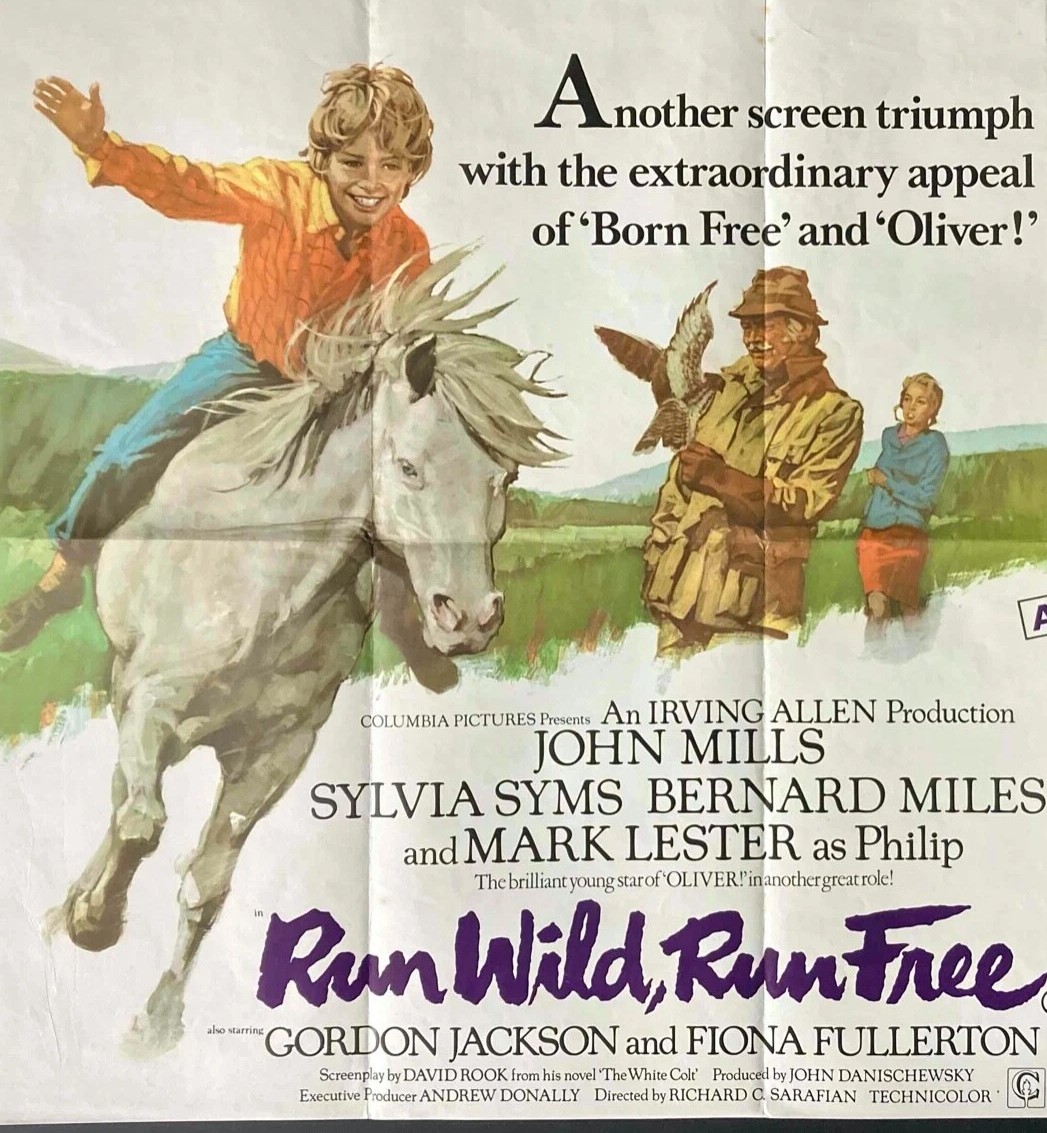
Run Wild, Run Free (1969) ****

Surprisingly absorbing, precisely because of the distinct lack of the soppiness or mawkishness associated with the genre. Nature “red in tooth and claw” scarcely puts in an appearance and even then is a good bit less dangerous than a wanton child unable to understand or control his emotions. Parents are very well-drawn, too, in an era that scarcely ran to much comprehension about child psychology, a mother rejecting her son because she is convinced he has rejected her, a traditional father who lacks the skills to convey his love for his son. And you wouldn’t get away these days with an old fellow taking more than a passing interest in a small bewildered boy with the audience immediately conjuring up images of abuse.

The film also prefigures the Gaia movement. Both the old fellow and his young charge are given to lying prostate on the grass, the better to listen to the beating heart of the Earth. And you wouldn’t think of pinning this one on director Richard C. Sarafian, best known for his biker epic Vanishing Point (1971). Far less imagine how you’d get a whole stack of actors to spend a great deal of time wading through a swamp “in camera” rather than utilizing some form of CGI or to volunteer their fingers to be bitten by a predatory bird.
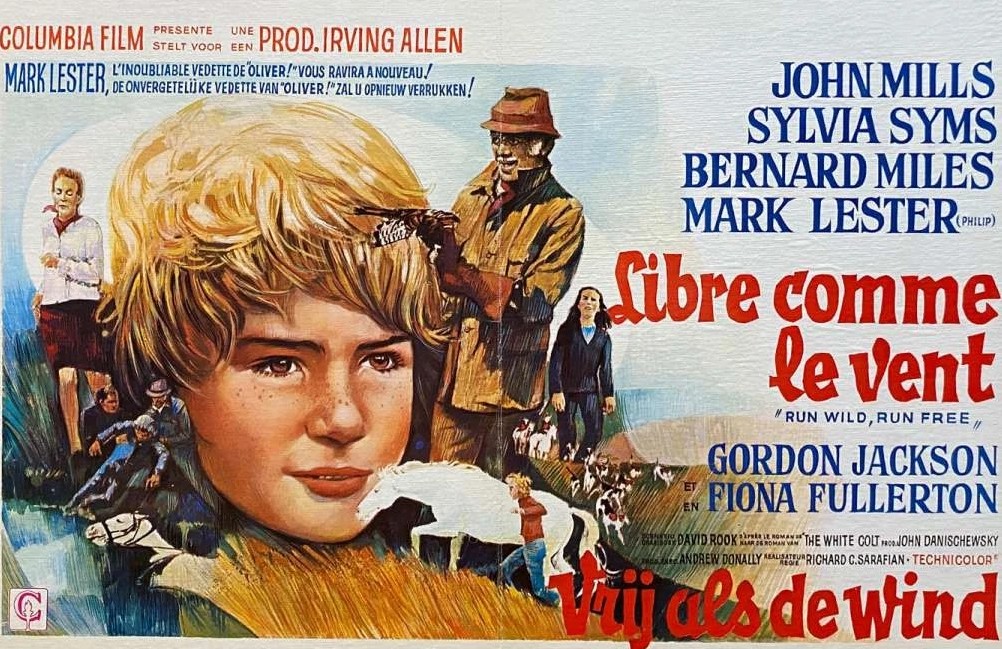
If you’re searching for the kind of twist that’s so common these days, look no further than the location. Those wild moors look fantastic in the sunshine, especially for compositions that outline characters against the sky, but they’re treacherous too, when the fog comes down and you’re trapped without a signpost home, and they’re not all hard grass or spurs or rock but conceal sections of perilous swamp.

Living on the edge of the moors, small wonder Philip (Mark Lester) is attracted, even as a toddler, to the wilderness. That’s exacerbated when he’s afflicted by muteness after developing a stammer around the age of four. It’s assumed there’s a psychosomatic cause, but we’ve got no time and the parents no inclination to dwell upon that.

He develops an obsession with a wild white pony, one of a herd that runs free on the moors, and spends most of his time out trying to find it. Col Ransome (John Mills), nature lover and amateur ornithologist, befriends Philip, helping him to understand nature, and teaching him to ride – bareback – the pony. Ransome also shows him to manage a kestrel.
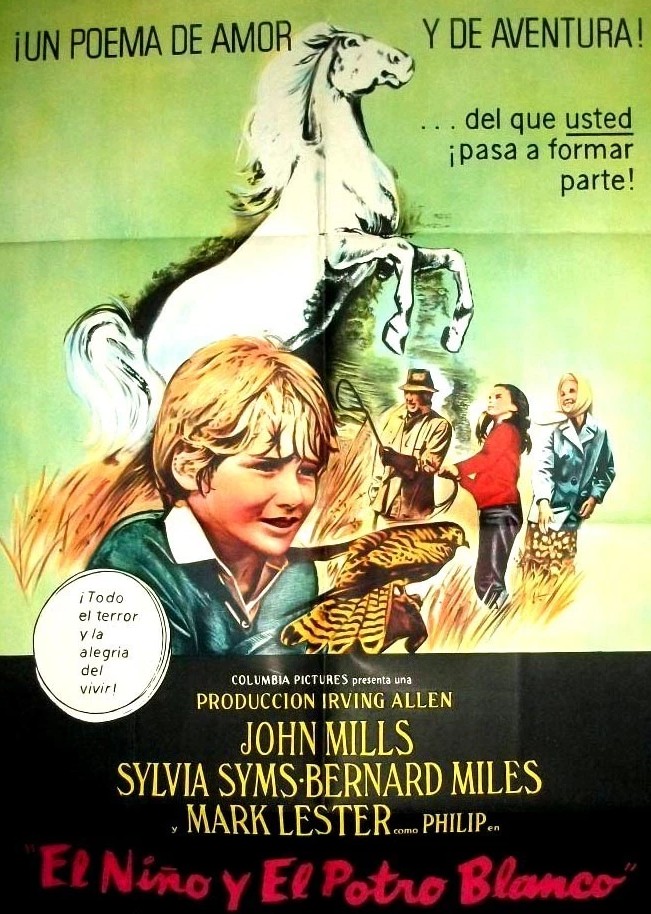
Scenes of characters working with horses or other animals are usually limited to  bit of nose stroking or whispering to calm said animal down, but here we go into a lot more intricate detail of how to win the cooperation of a horse, the kind of lore that nobody’s got much time for these days. So if you want to ride a horse bareback first off you need to just lie on top across its back and stroke its sides. And for a predator, you have to be willing to accept the occasional peck on your fingers while, again, you evoke a stroking mechanism. You might also be surprised to learn that the easiest way to mend a broken wing is by the use of glue.

While Philip and the Colonel and a young girl Diana (Fiona Fullerton) are happily communing with nature, Mr Ransome (Gordon Jackson) and wife (Sylvia Syms) are scarcely able to work out their feelings at being abandoned by their child. The mother tends to get angry, the father, in a very touching scene, is left desolate after Philip ignores a present the father believes would have brought more solidity to their relationship, and in another effective scene it’s the Colonel who explains that it doesn’t take much for a child to understand how devoted an apparently distant father can be.

Any potential soppiness is killed off when Philip in a wild fit of obsession nearly kills the kestrel and in another sequence of disregard almost kills the horse. Occasionally, Philip speaks a few words to the old man but refuses to express himself in front of the parents.  So it will come as little surprise that when the parents finally hear the son speak it’s at the quite gripping climax when all the adults have failed to rescue the white horse from a swamp.

And anyone expecting that cute kid from Oliver! (1968) would have their hopes dashed when Mark Lester displays all the natural truculence and wantonness of a child. He’s pretty good, I have to say, in being forced to confine his emotions to facial expression.

John Mills (Guns at Batasi, 1964) is excellent and Sylvia Syms (East of Sudan, 1964), shorn of glamor, and Gordon Jackson (The Ipcress File, 1965) as her emotionally inarticulate husband, both dump their screen personas in favor of highly believable characters. Fiona Fullerton makes her screen debut.

Richard C. Sarafian does a splendid job. Screenplay by David Rook based on his novel.

Emotionally true.
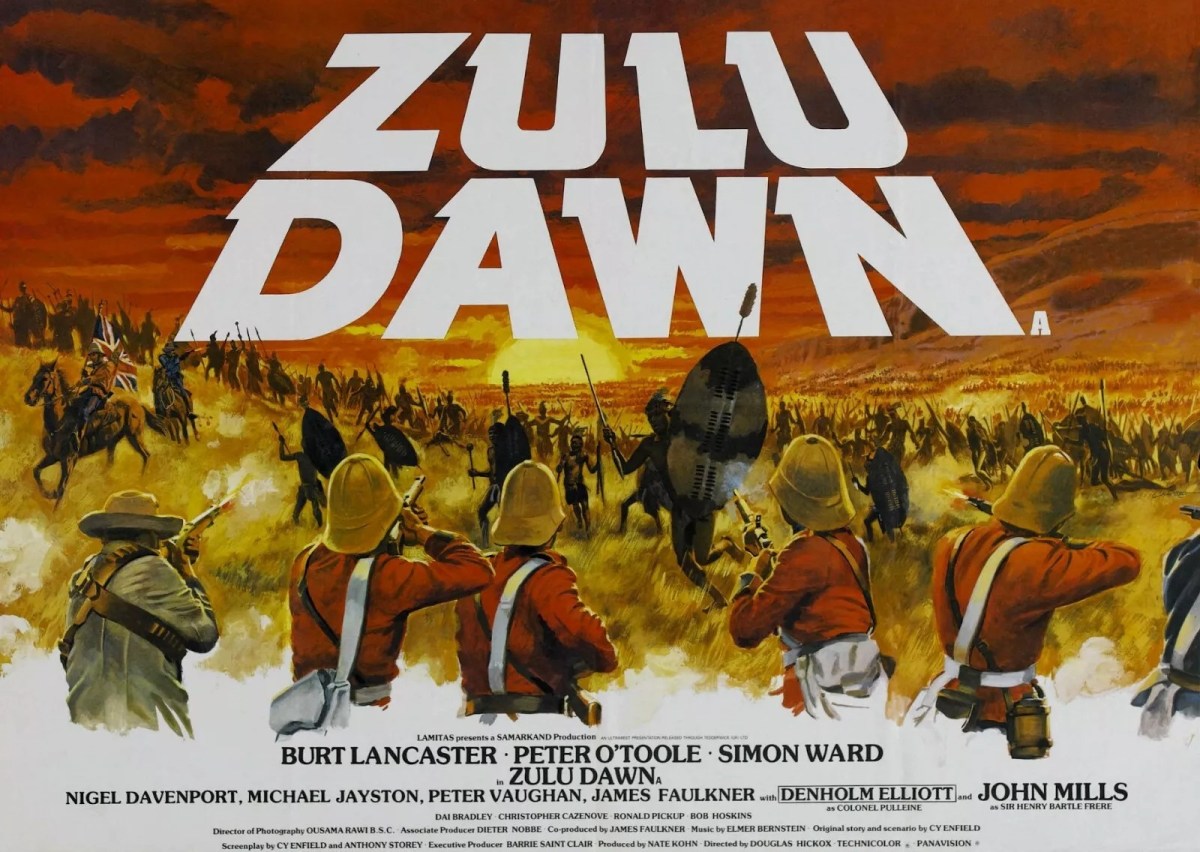
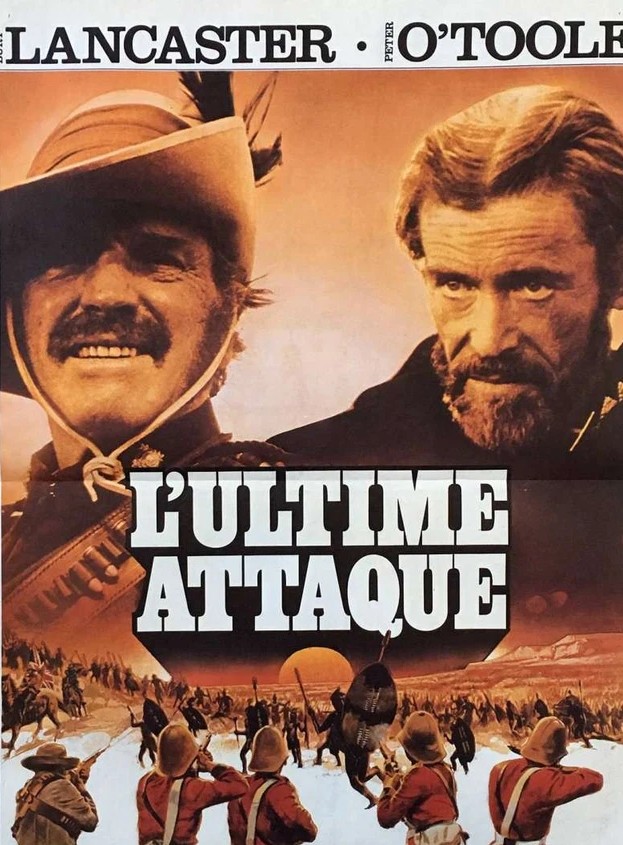
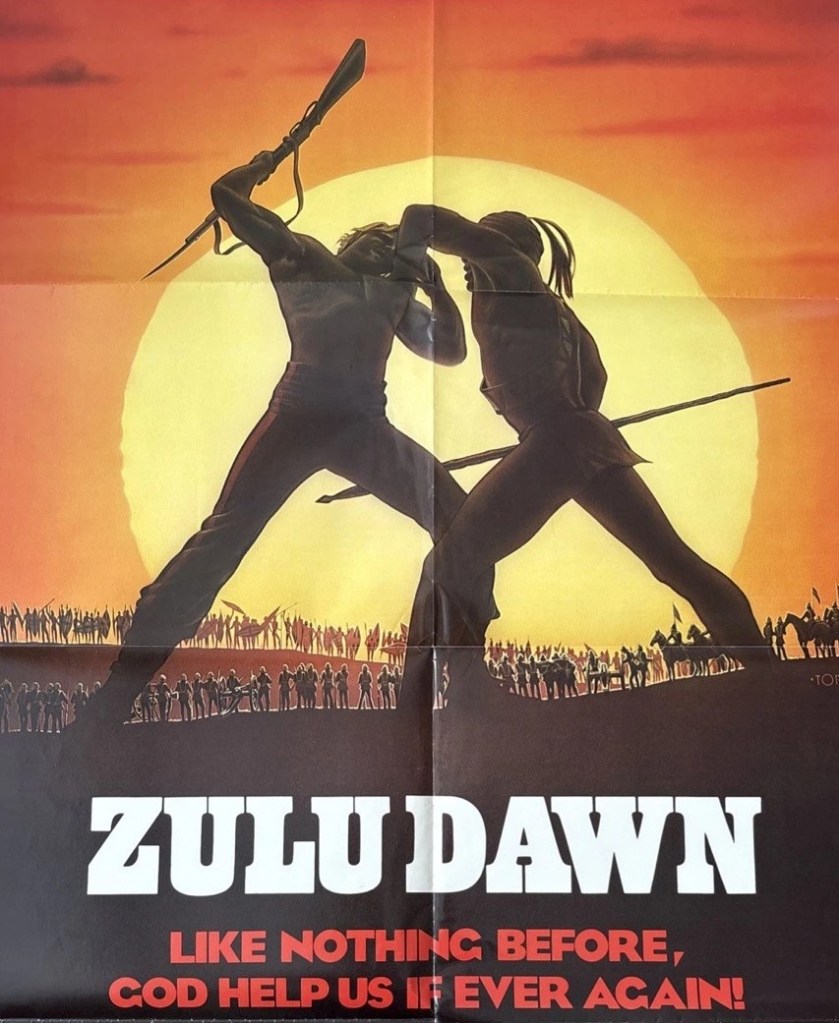
Zulu Dawn (1979) ****

You’d wonder why anyone would want to make a film about this calamitous military disaster, the Battle of Isandlwana in 1879. Yet, such subjects have always attracted Hollywood, especially if some kind of triumph can be snatched from defeat – Dunkirk (1958 and 2017) – or some charismatic figure of the order of General Custer is involved – They Died With Their Boots On (1941), Custer of the West (1967).   Or you can make something mythical such as The Charge of the Light Brigade (1936) and with the assistance of the screen presence of Errol Flynn tilt it towards glory or you can take the same subject (the 1968 version) and make merry with satire should you wish to poke fun at the British Empire.

The latter could easily have been the starting point for Zulu Dawn, a prequel to the majestic Zulu (1964). However, although the Brits were outthought, out-maneuvered and outnumbered, the errors made on the battlefield were generally not through hubris or commanders competing for glory. And you would have to assume that no matter what the British Army could do, in terms of size it was minute compared to the Zulus, and even armed with rifles and artillery was hardly going to withstand a sustained attack.

So it’s fairly solid stuff, buoyed up by decent performances, though Burt Lancaster playing an Irishman seems tacked on to increase marquee appeal. The final shot of the eyes of Peter O’Toole would easily stand in the annals of war pictures as one of the best testaments to the horror of defeat and impending humiliation.

There is certainly some unsavory business at the start as British commander Lord Chelmsford (Peter O’Toole) and diplomat Sir Henry Bartle Frere (John Mills) unwittingly poke the lion of Zulu King Cetawayo whose rising strength they perceive as a threat to the British colonies in the southern regions of Africa. Chelmsford makes the mistake of invading Zululand.

Hoping to pin down the enemy to the traditional pitched battle on territory that would give him an advantage, he finds he’s chasing ghosts. They can’t locate the Zulus until the enemy wants to be found. And in an echo of the later Lawrence of Arabia, Cetawayo does the impossible and leads his troops on what was considered an unlikely line of attack.

The British strategy of lining up troops in two lines and shooting alternately certainly reduces the oncoming force, but four times the amount of firepower would still have had trouble preventing the onslaught. Critically, in search of more favorable ground, Chelmsford splits his forces, but, again, even had the British been one unit, it would have made little difference.

I’m not sure how true is the portrayal of the officious quartermaster Bloomfield (Peter Vaughn) who, even in the heat of battle, demands soldiers form an orderly queue to receive a supply of bullets, and that may just be a potshot at overbearing bureaucracy.

The narrative flits from various characters, dashing cavalry types like Col Durnford (Burt Lancaster) and Lt Vereker (Simon Ward), commanders Chelmsford and Col Pulleine (Denholm Elliott), those representing different points of view such as Col Hamilton-Brown (Nigel Davenport) and Col Crealock (Michael Jayston), and lowly grunts in the form of Colour Sergeant Williams (Bob Hoskins) and Boy Pullen (Phil Daniels).

There’s certainly a sense of the higher-ups still enjoying the pleasures of life, wine served at dinner, plated service, but the lesser ranks still have largely an easy time of it, when they are not marching spending most of the time in idleness. It’s a very civil environment. Commands aren’t barked out. “I say, would you mind…” is the tone.

But it’s the marching that’s the killer. The heat’s not as bad as in Crimea and there’s no disease decimating the ranks but they still have to do a lot of walking on uneven terrain. There’s enough difference of opinion at all levels of the Army to keep tensions high.

And there’s more of a focus on the brutality of war – Lt Vereker laments the death of a Zulu child, you can easily be killed by your own troops and truth is viciously beaten out captives (who, as it happens, have been sent to become captives and mislead the Brits.) I was wondering if audiences had come to expect a scene with native girls dancing half-naked, as had occurred in the sequel, and the censor turned a blind eye to.

Peter O’Toole (The Lion in Winter, 1968) has the best role, especially when he counts the cost of defeat. Burt Lancaster (Valdez Is Coming, 1971) offers some star power but little else and the rest of the cast is virtually a roll-call of Who’s Who in British acting.

Luckily, the picture is more than even-handed and while not pillorying the Army and the Establishment in the manner of The Charge of the Light Brigade (1968) plays fair with the circumstances and exalts Zulu victory as much as British defeat.

Directed by Douglas Hickox (Les Bicyclettes de Belsize, 1968) with perhaps overmuch concentration on marching. Zulu director Cy Endfield had shot his bolt by this point and wasn’t invited back except in the capacity of screenwriter along with Anthony Storey making his movie debut.

Much better than I expected.

If you fancy checking out how it compares to Zulu (1964), you can check out my review on the Blog.

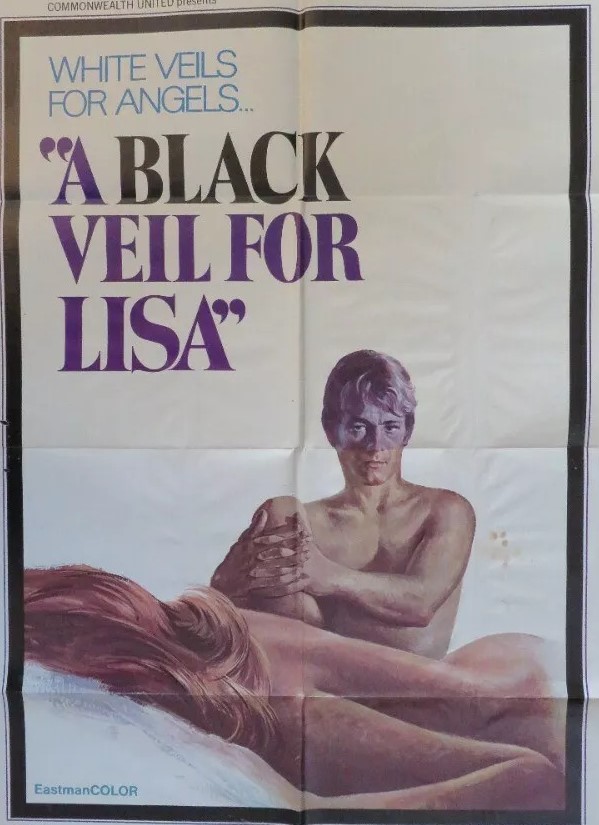
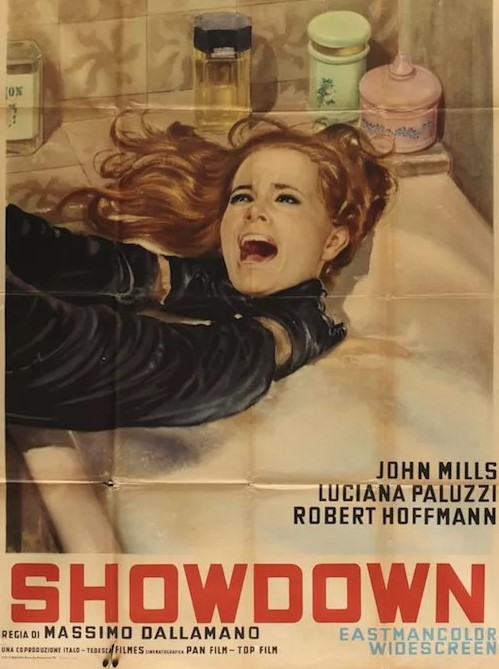
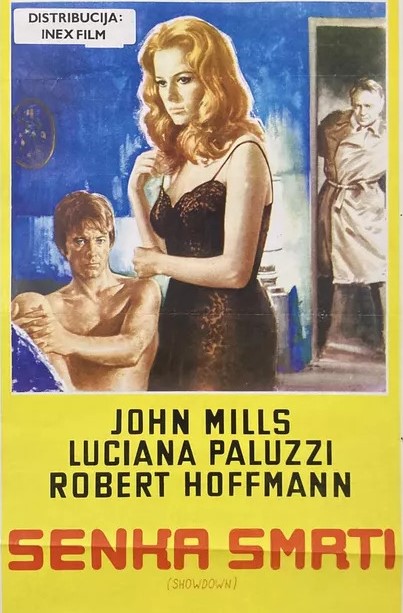
A Black Veil for Lisa (1968) ***

John Mills ventures back into Tunes of Glory (1960) territory as a top official coming apart at the seams. This time it’s not the British Army but the Italian Police where, as Franz Buloff, he heads up the narcotics squad. And this time he’s not the complacent victim but decides to take action against his tormentor.

Closing in on drugs kingpin Scheurermann, he finds that one witness after another is being silenced by an assassin with a deadly knife. He suspects a leak in his department, unaware the traitor is much closer to home. And despite the usual dissatisfied boss Ostermeyer (Tillio Altamura) breathing down his neck, he would be making more headway if it wasn’t for the fact that his head is constantly filled with images of his wife Lisa making love to another man.

For her part, Lisa seems determined to unhinge her husband, eliciting jealousy at every turn, by never answering the phone at night and always an excuse, when he tracks her down, for not being where was supposed to be. Rather than calming him down, her occasional seduction of her husband only serves to ramp up his fury.

In any case, it’s an odd set-up, he’s much older and the security he offers is not just financial. She was once a suspect herself and being married to a top cop has put a force field between her and suspicion. There’s clearly an unspoken assertion that somehow she has duped the cop, making him fall in love with an apparently innocent woman. They couldn’t be more opposite. “I like danger,” is her mantra.

He breaks open the case after following up a clue dropped at the scene of the crime. After arresting Max (Robert Hoffman), he strikes a deal with the killer. In return for his freedom, the murderer has to take out Lisa. But, of course, it’s not as simple as that. When Buloff realizes the deep water he is treading, he calls off the assassination. But then when he discovers that Max has helped himself to a bonus – beginning an affair with Lisa – he recants and puts the man back on the spot.

So, now, it’s Max who faces the quandary of having to kill his lover. And that puts up square in cat-and-mouse territory.

This isn’t quite giallo, the genre was still in the process of being born, in part because there’s no mystery about the killer, in part because the murders aren’t bloody enough, and in part because the dead aren’t sexy young women. So it’s more a series of character studies, each driven to an edge by an action that otherwise would be out of character.

A top cop like Buloff should have been a better judge of character than to fall for Lisa’s wiles in the first place. Lisa, too, should have recognized her penchant for the seedier side of life rather than being as she puts it “too young to be buried alive” in a stifling marriage to a jealous husband. But, she, too, is a poor judge of character, expecting to win back the favor of the drug overlord after she had so openly crossed the tracks to the other side of the law.

And Max, one of the first of a series of killers in movies who wanted out (see The Brotherhood, 1968, and Stiletto, 1969), is trapped into more killing because nowhere is safe. Getting rid of Buloff was never in his plans, as that would draw even more unwelcome attention. But then neither was falling in love with the cop’s wife. There’s still a few twists to go not least when Lisa discovers that the husband she felt she had under control had broken free and was intending to have her killed.

John Mills, a surprising addition to the Brits heading for Italy, is excellent especially as the big flaw in Tunes of Glory was his inability to find the cunning to strike back at his chief tormentor. Here, he might have second thoughts about dispatching his wife, but revenge is always the best weapon.

Luciana Paluzzi (Chuka, 1967, which, incidentally, also featured Mills) gets her teeth into a decent role rather than been saddled in lightweight fare since swanning around in swimwear in Thunderball (1965). Austrian Robert Hoffman (Assignment K, 1968) is given a surprising range of emotions to deal with.

Massimo Dallamano (Venus in Furs, 1969) handles the material well and gets the best out of his cast without taking the bloodier route of the later giallo. He was one of four writers contributing to the screenplay. This was one of the feature films made by new American mini-major Commonwealth United, one of the stack of “instant majors” popping up around this time.

John Mills is always watchable and the twists make this one play.

The Truth about Spring (1965) ***

Although a truly innocent movie about young love, wrapped up in a sunken treasure scenario, the marketeers then and now could not resist trying to inject elements of sexuality, the poster for the original movie highlighting what would be Hayley Mills’ second screen kiss (following a smacker from Peter McEnery in The Moon-Spinners the year before), the poster for the DVD sticking the star in a bikini that she does not wear in the film.

The film was based on the 1921 novel Satan: A Romance of the Bahamas (filmed as Satan’s Sister in 1925 with Betty Balfour) by Henry de Vere Stacpoole, who had previously dallied with young love in The Blue Lagoon.  Despite the title, there was a complete absence of the demonic. In the book, she is sailing with her brother. That character was eliminated in favour of a father.

The 1960s teen movie that could as easily morph into angst (Splendor in the Grass, 1961), blackmail (Kitten with a Whip, 1964) or madness (Lilith, 1964) was generally more at home with innocence. The beach party movies and series like Gidget rarely involved more than a stolen kiss, the characters all clearly virgins, and certainly did not go down the brazen sexuality route that would mark the second half of the decade.

Hayley Mills is on charming form as tomboy Spring Tyler (hence the title) sailing the Caribbean as mate to her conman father Tommy (played by her real-life father John Mills). Their idyllic life is heading for the rocks since the father didn’t “figure on the little girl growing up.” With one eye on providing a suitor for his daughter, the skipper takes on board a Harvard Law School graduate William (James MacArthur) ostensibly to give him experience of fishing.

True love takes its time since the girl has no intention of growing up and prefers a life of independence. Initially, they are sparring partners – she mocks the fact that he wears pyjamas. But once the story kicks off, they find they have more in common.

The sunken treasure element, while slim, is enlivened by some over-the-top acting by Jose (Lionel Jeffries) and Judd (Harry Andrews). The three leads are actually quite good, John Mills (Tunes of Glory, 1960) totally convincing as a effectively a spiv on the high seas with Hayley Mills (The Family Way, 1966) as the independent woman (“I’m me so don’t expect anything else”) and the confident sailor becoming entangled in unexpected emotions.

Surprisingly, James MacArthur, also a graduate from the Disney acting school, though a decade older than Hayley Mills, shows unexpected subtlety, and this would be a springboard to more demanding roles in cold war thriller The Bedford Incident (1965) and WW2 epic Battle of the Bulge (1965). Cocky and rich, he is quickly brought down earth when she proves a faster swimmer and plays tricks on him. But he soon proves his worth.

Director Richard Thorpe’s career was winding down after four decades in the business and this was a far cry from MGM spectaculars Ivanhoe (1952) and Knights of the Round Table (1953) and even Jailhouse Rock (1957) but he keeps a tight rein on the narrative, makes good use of the scenery (Spain doubling for the Caribbean) and walks the delicate line of allowing the adolescents to explore their feelings with tipping over into anything more overt.

He was a better director than the material deserved, but then so was writer James Lee Barrett who the same year would receive screen credit for The Greatest Story Ever Told and western Shenandoah. However, their involvement made it an accomplished little picture and gave audiences a taste of what Hayley Mills could do in a film that did not tether her to child star mode.

The New York Times second-string reviewer Howard Thompson, in tagging the star “this delectable miss, now all of 18” opined (review, June 17, 1965) that the “two young people are the most winning advertisement for young love in a long time.”

https://amzn.to/3SKJ4Q2

The Wrong Box (1966) ***

Somewhere between SBIG (So Bad It’s Good) and WAL (Worth a Look), The Wrong Box is a black comedy in the wrong directorial hands. Better known for thriller Seance on a Wet Afternoon (1964) and POW drama King Rat (1965) Bryan Forbes struggles to bring enough comedy into the proceedings or to wring sufficient laughs out of what he has.

Neither the wit nor the slapstick is sharp enough. But it does exhibit a certain charm. Essentially an inheritance story, it pivots on the notion that the two potential inheritors are on their last legs and putting one, Joseph Finsbury (Ralph Richardson), out of action will benefit dastardly nephews Morris Finsbury (Peter Cook) and John Finsbury (Dudley Moore) of the sole survivor Masterman Finsbury (John Mills).

It turns out Joseph Finsbury is not dead. That does not cue as much hilarity as it should., as the nephews plot to send him to his grave. Given the idea was dreamed by none other than Robert Louis Stevenson of Dr Jekyll and Mr Hyde fame, you can imagine it was written less with comedy in mind.

With so much dependent on set-pieces, it’s rather a hit-and-miss affair, with the conspirators’ failures not matching the humor of watching potential victims escape their proposed doom. Only occasionally does it sparkle.

Surprisingly, the film relies on affecting performances from the shy, retiring Michael Finsbury (Michael Caine), a gentle soul, who enjoys a very innocent romance with Julia Finsbury (Nanette Newman), a young woman terrified of being murdered, which condition provides ample opportunity for her to be rescued/consoled. who enjoy a very innocent romance.

Ralph Richardson steals the movie as a dotty pedant, weighted down with erudition and a knack, equally, for boring the pants off anyone within earshot and for escaping from the jaws of death including a massive train pile-up and several murderous attempts.

Michael Caine, in a follow-up to The Ipcress File (1965) and Alfie (1966) convincingly plays against type. John Mills (The Family Way, 1966) also plays against type as a villain rather than Hitherto, I had been rather sniffy about Nanette Newman (Deadfall, 1968),wife of the director, but here she is delightful.

Peter Cook (A Dandy in Aspic, 19680 and Dudley Moore, in his movie debut, let the show down by being so obviously the personalities from their comedy series Not Only…But Also (1964-1970), a partnership that works so well on television just frittered away here from what looks like characterization with nowhere else to go. But there is a nice cameo from Peter Sellers (The Millionairess, 1960) as an inebriated doctor.

Hard to say whether the blame lies with Larry Gelbart (The Thrill of It All, 1963) for his screenplay or Bryan Forbes for his direction.

Michael Caine got it spot-on when pointing out in his autobiography that it was a “gentle success in most places except Britain” precisely because to foreigners it represented an acceptably stereotypical view of a country full of eccentrics while to Brits it was all too stereotypical. So if you’re from America or other points global you might like it and if you are British you might not. On the other hand, the score by John Barry is one of his best with a wonderful theme tune.

The Family Way (1966) ****

Nudity was not an option for previous child stars attempting to make the leap into adult roles. Shirley Temple in the 1930s and Margaret O’Brien in the 1940s were kids when they played kids and when they outgrew their cuteness audiences proved indifferent.

Being older when playing younger characters increased the chances of career survival. Silent movie superstar Mary Pickford was 22 when she first tackled child heroine Tess of the Storm Country (1914) and 30 for the remake and she made an absolute fortune from these kinds of roles. Judy Garland was 17 when The Wizard of Oz (1939) appeared and managed another 15 years at the top before drugs and drink took their toll, still worthy of supporting roles after A Star Is Born (1954) and even star billing in her last film I Could Go On Singing (1963). But she was fired from Valley of the Dolls (1967), ironically enough given the film’s subject matter, due to alcohol and drug dependency.

Hayley Mills was 14 when her first Disney picture Pollyanna (1960) was released and for the next five years at that studio never played anyone approaching her true age. She was protected from studio abuse because this was Disney and because her father was actor John Mills, who often appeared in her movies. When the Disney contract ended, Sky, West and Crooked (1966), her father’s directorial debut, attempted to refashion her screen persona with a more challenging role.

But The Family Way forced audiences to set aside all preconceptions. Not only did she show her naked derriere, but this was a film essentially about sex. No sex is actually shown because  newly-weds Jenny (Hayley Mills) and Arthur (Hywel Bennett) have problems consummating their marriage. You can thank the Carry On films for the snigger-snigger British mindset to sex. The promiscuous and often predatory characters of Darling (1965) and Alfie (1965) occupied a different world, almost a foreign country as far as the inhabitants of this solid working-class town were concerned.

They would have looked askance at such permissiveness. Here, at this particular point in history, both sexes were still expected to be virgins when they married. Sex in Darling and Alfie, for example, carries little emotional overtones. The Family Way is novel in treating sex as fundamental to happiness within marriage.

The subject of impotence would not be first on your list when you set out to make a warm-hearted drama. But here screenwriter Bill Naughton (Alfie) in adapting his play All in Good Time uses the theme to explore family values. But where recrimination – and subsequent confrontation – might be the first port of call for another writer, Naughton foregoes that obvious route to concentrate on the way impotence eats at a man’s self-worth. Two secrets drive the plot but the second is preserved right to the end, resulting in possibly the most moving finale you will ever watch.

In documenting working-class life it is superior to the earlier Saturday Night and Sunday Morning (1960). It is life without inbuilt bitterness. Families are still crammed into small houses, a visit to the housing department – to get a new council house or just be put on the waiting list – an invitation to humiliation, but there is full employment and enjoyment to be found in simple pleasures.

Family dynamics are expertly explored. Arthur, with a shelf load of books and penchant for classical music, is diametrically opposed to his down-to-earth but exceptionally obtuse father Ezra (John Mills), and there is a wonderful scene early on where Arthur seeing how badly his father takes defeat allows him to win an arm-wrestling competition.

Ezra is the standout, devoted to the memory of a long-departed childhood pal and struggling with his position as patriarch especially in the face of perennial sniping by wife Lucy (Marjorie Rhodes). Ezra is so expressive of longing and emotion, and it is he who has the heart-breaking final scene.

The older characters are fully rounded, bluff exteriors concealing fragile emotion. Hard-faced Lucy appears almost fey when she recalls a moment of love. Jenny’s burly father (John Comer) cannot cope with her departure from his household, especially as that leaves him at the mercy of his shrewish wife (stand-up comedienne Avril Angers).

Hywel Bennett begins a successful movie career with a difficult part, an introspective role calling for him to contain his emotions – not venting his spleen like the endlessly complaining Arthur Seaton of Saturday Night – until they erupt in a spectacular fist fight that does not go at all the way you would expect.

Barry Foster (Frenzy, 1972) has the showy part as the rough-edged  workmate and Murray Head (later part of the love triangle in Sunday, Bloody Sunday, 1971) also makes his debut in an equally showy role as Bennett’s brother who makes advances to his frustrated sister-in-law.

Even without the nudity, Hayley Mills, the denoted star, makes the transition to movie adulthood with ease. In part, all she had to do was drop the unnatural excitement that appeared essential to her Disney portfolio. Her delivery, her reading of a line, had always been good and she had clearly worked out she was going to be an actress not a sex symbol so there was no exaggerated use of her physicality.

Even the nudity worked in her favor, startled to be disturbed emerging from a bath, genuinely shy, not the mock-shy or reveling in her naked state that was de rigeur in Hollywood. She was also helped by being a light foil to the brooding, gloomy Bennett, her natural bright personality, while affected by their problem, still capable of enjoying harmless pleasures.  

This was a distinct change of pace for the fraternal producer-directing team John and Roy Boulting, stalwarts of British production since the 1940s with a host of well-regarded dramas and comedies, often with Peter Sellers, to their name.  Generally, they took turns about in the director’s chair – the former putting his name to thriller Brighton Rock (1948) and comedies Lucky Jim (1957)  and I’m Alright, Jack (1959), the latter claiming credit for drama Fame Is the Spur (1947), thriller Run for the Sun (1956) and comedy A French Mistress (1960). Occasionally, they shared the directing chore as with thriller Seven Days to Noon (1950), comedy Heavens Above (1963) and in this contemporary drama.

Their approach to The Family Way went against the grain of the gritty working-class dramas in the vein of Saturday Night and Sunday Morning and This Sporting Life (1962). Nobody here has a job they hate or comes home covered in grime. In fact, since the central thrust (pardon the pun) of the movie is about pleasure (sexual, that is), it is set against a background of enjoyment. Both principals have jobs in entertainment, Arthur an assistant projectionist in a cinema, Jenny working in a record store and also seen at a disco and a motocross event. Alcohol plays a role, of course, but not to the extent of over-indulgence, not drinking yourself to oblivion like Arthur Seaton, and its main purpose is to present the father as an amiable host.

What impact the burgeoning affair between Hayley Mills and Roy Boulting (33 years her senior) had on the production is anyone’s guess but possibly it helped steady the star’s nerves when it came to the nude scene. From today’s perspective the nudity appears gratuitous. And certainly back then it was shocking, ensuring an X-certificate (although the subject matter probably already guaranteed that).

Actually, it was social comment. While living in a decent-enough house, the family lacked one particular amenity – an indoor toilet. Washing took place at a communal sink or in the privacy of a bedroom with a bowl of water. A bath was a mobile unit, a zinc item dragged out of the scullery into the living room, filled with endless pots or kettles of hot water.

But for a young woman to take a bath demanded privacy. So when Jenny is interrupted in her ablutions, males and females in the audience had opposite reactions. It would not be unreasonable to suggest that males simply enjoyed the sight of the naked posterior. Women, on the other hand, would wince.

Aversion to nudity may have played a part but more likely women would feel deeply the humiliation at the lack of privacy in such a household, that someone could come upon you at your most vulnerable at any time. Sure, nothing went hidden in such houses, the sounds of any activity would carry through walls, but such a deep personal activity as exposure while taking a bath said far more about the brutal congestion of family life than jokes about hearing someone urinating into a container in the next room.

Paul McCartney contributed a very hummable melody as part of his debut movie score.

American audiences did not respond so well to Hayley Mills’ emergence as an adult actor and the movie failed to click at the box office there. But by that point it was already in profit, a runaway British hit (among the top twelve films of the year) and set the female star up for an adult career, pointed Hywel Bennett in the right direction and gave John Mills one of his most memorable turns.  

Very entertaining with terrific acting.

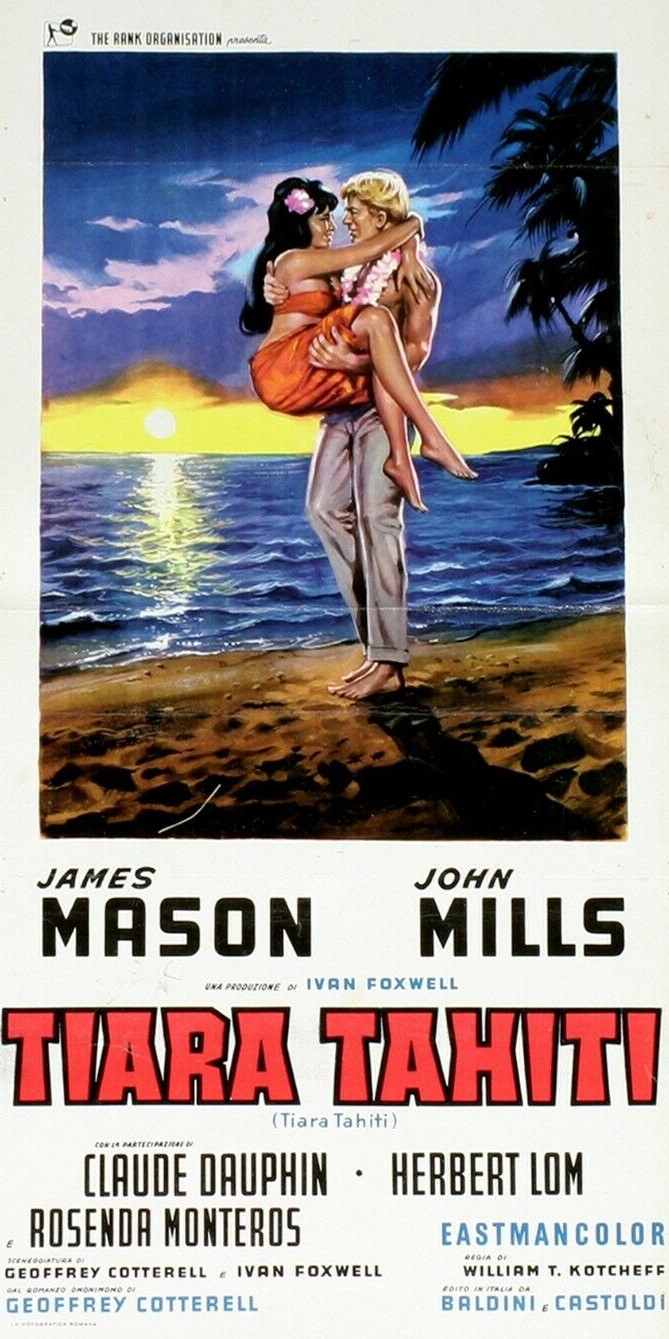
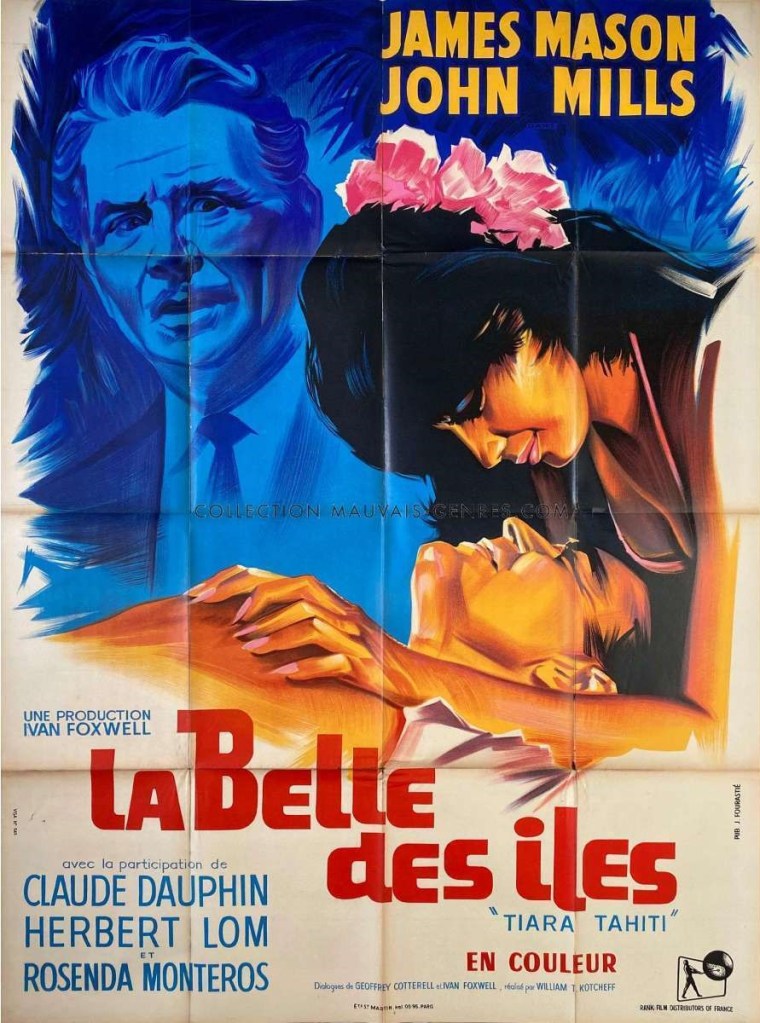
Tiara Tahiti (1962) ****

There’s an odd tone to this comedy about that British obsession: class. The narrative arc is basically about come-uppance. But you would expect in any movie dealing with the upper-class that it is the poor man who comes out on top. But that’s not the case here and it’s not the case because, basically, the movie makers have decided that the confident charming guy buoyed up by a wealthy background should hold sway over the insecure chap undermined by his lack of breeding.

I doubt if they expected audiences to feel sorry for the jumped-up martinet Lt.Col Southey (John Mills) whose cushy number in post-war Germany is disrupted by the arrival of suave  Capt Ainslie (James Mason). The former is reminded by the latter that he was once a lowly clerk in the stockbroking firm of which the captain, by dint of birth, held a managerial position. Soon Ainslie wins over the officers and humiliates Southey at every turn. To gain revenge, Southey informs on the junior officer who is arrested with illicit goods at the customs.

Several years later, Ainslie lives the life of Riley in Tahiti, beautiful girl Belle Annie (Rosenda Monteros) in tow catering to his every whim and under the false impression that he will soon take her back with him to London. He makes a living playing poker, and when luck runs against him can rely on the easily corrupted local police officer to keep his creditors at bay. Into this ostensible paradise arrives Southey, now chairman of an international hotel company, so important he can swan around the world answering to no one.

I had expected that having made it to the top of his profession by dint of hard work rather than accident of birth or having made the right connections, that Southey would have rid himself of his inferiority complex and that, somehow, he would get revenge on Ainslie for the humiliation in Germany. But that proves not to be the case and, in fact, any mention that  Southey was once Ainslie’s mere clerk brings the high-flying businessman down to earth and he reverts to his previous jumped-up bumptious persona.

Only momentarily does Southey gain the upper hand, when the broke Ainslie seeks employment, but that lasts only until Southey reveals the part he played in Ainslie being cashiered from the Army. All along there’s been a sub-plot of a jealous Chinese storekeeper Chong (Herbert Lom, would you believe) trying to ease Ainslie out of the way so that Belle Annie will return to him. Chong arranges for a thug to bump off Ainslie. But when Ainslie survives the assault he blames Southey so that he can have the pleasure of ruining Southey’s career when he is kicked off the island.

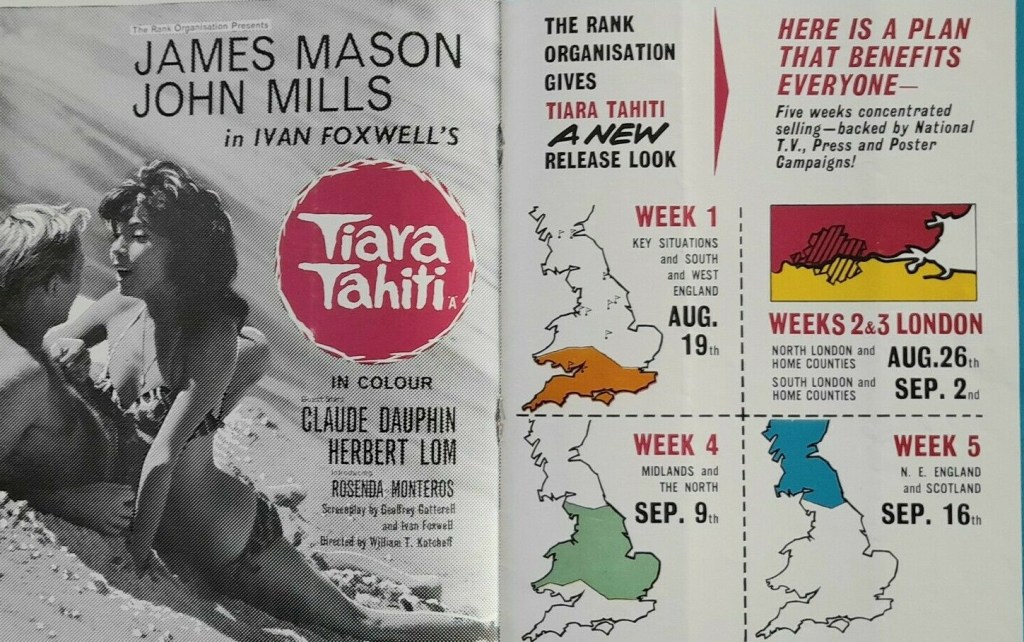
A significant change to the way films were distirbuted in Britain. Normally, it was London which got first bite of the cherry. Opening a film outside London was a bold move

I can’t have been the only viewer to sympathise with Southey, the man who got to high-ranking positions in the Army and business through his own hard graft while charmers like Ainslie used their class to ease their passage. I had imagined that it would be Southey who got his revenge, employing Ainslie in a lowly position rather than the other way round. And it may just be me but I didn’t believe the suggestion in the final scene that any enmity Ainslie felt towards Southey was all in Southey’s head.

Be that as it may, the acting carries this one. John Mills adds a comic element to his stiff-upper-lip officer last seen in the more dramatic Tunes of Glory (1960) while James Mason (Age of Consent, 1969) is the essential cad who can get away with anything thanks to bucketloads of charm.

Several scenes stand out. You wonder if the famed Robert De Niro “you talkin’ to me” in Taxi Driver (1976) had its origins in the scene where Mills talks to himself in a mirror to build up his confidence before confronting Mason. The scenes where Mason dupes the police officer into believing the cop’s novel is a work of genius are very funny. Mason also takes the mickey out of a middle-aged Englishwomen by pretending to be a native Hawaiian.

And that’s not forgetting the exuberance of Rosenda Monteros – mistakenly given the “and introducing” credit when she had previously appeared as the love interest in The Magnificent Seven (1960) – not quite as dumb as she sometimes appears, able to con Chong out of new dresses and ready at a moment’s notice to run away with an athletic young sailor. Not to mention, too, that her bare derriere makes an appearance in a bathing scene rather risqué for the period.

Debut of Canadian director Ted Kotcheff (Life at the Top, 1965, also dealing primarily with class) who has the sense to leave the actors to it. Written by Ivan Foxwell (A Touch of Larceny, 1960), it sticks too closely to the source novel by Geoffrey Cotterell, lumbering the movie with one sub-plot and a couple of characters too many, but excellent when concentrating on the warring protagonists.

Setting the class elements apart, this is all good fun, and the jousting between two of the greatest British actors of all time makes it more than well worth a viewing. It was a big hit in Britain at the time, not quite in the category of Dr No – oddly termed “a bizarre comedy drama” by trade magazine Kine Weekly and – second to Cliff Richard musical The Young Ones in the annual box office chart – but easily in the Top 25.

Setting aside my reservations about the tone and the perspective, I found this far more enjoyable than I expected as result of witnessing two class acts at the top of their game.

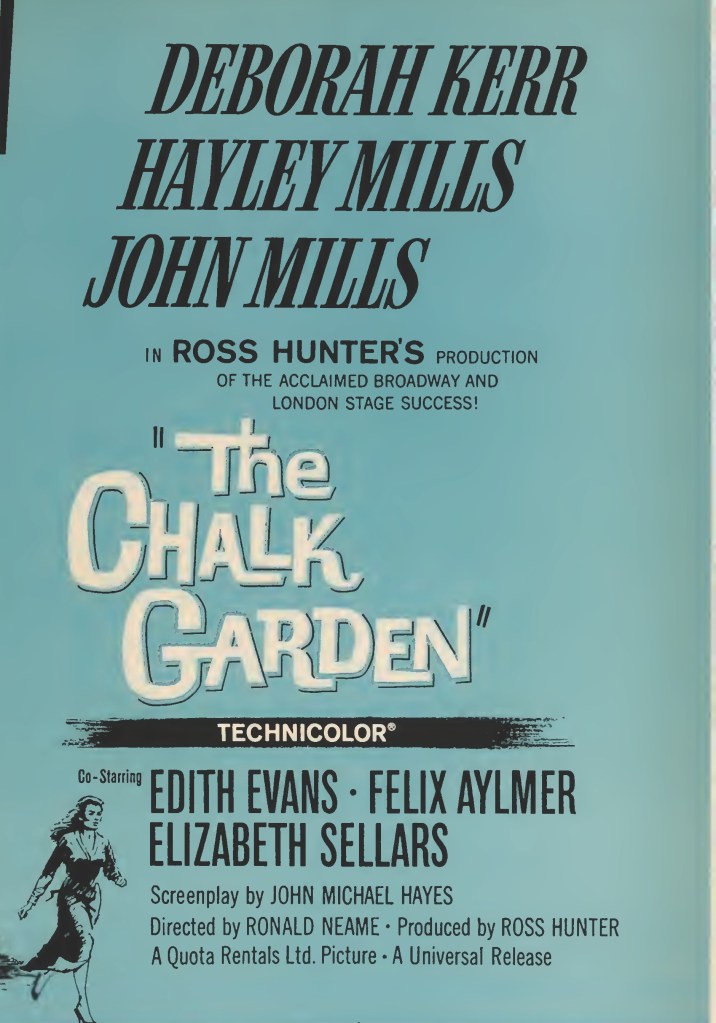
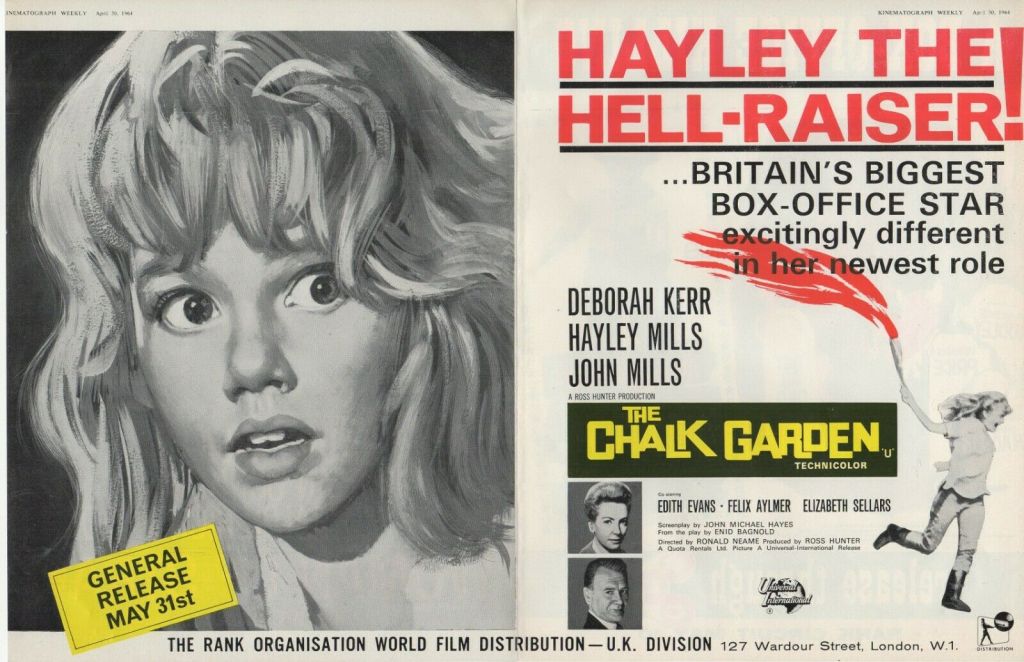
The Chalk Garden (1964) ***

You couldn’t make a movie like this now because (plot spoiler, I’m afraid) even the dottiest of old ladies would make at least a better attempt at collecting a reference from a prospective employee for fear she might be hiring someone disreputable. Though I doubt if many employers would expect a governess to turn out to be a murderess.

That this movie chimes with a contemporary trope – the criminal wanting to prevent others from following in their footsteps – makes it far ahead of its time. Made today, of course, the unruly child rather than merely threatening to unleash her arson impulses would probably have burned the house down.

So it’s more a drama of manners, if you like. Very presentable but clearly down-on-her-luck Miss Madrigal (Deborah Kerr) is taken on by Mrs St Maugham (Edith Evans) as governess for her grandchild Laurel (Hayley Mills) because nobody else wants the job. Laurel’s outrageous behavior has sent a score perfectly well qualified ladies scurrying. Madrigal is hardly fazed by anything Laurel can get up to.

But the child is clearly suffering abandonment issues, her beautiful mother Olivia (Elizabeth Sellars) having gone off with another man. Grandmother incites grandchild to hate the mother. But Olivia’s maternal instincts have kicked in and she wants her child back. While Madrigal can deal with Laurel’s tantrums she is less fortified against the child’s inveterate snooping. Finding a mysterious suitcase leads Laurel to fantasize about Madrigal’s past.

Mostly the film is a four-hander, butler Maitland (John Mills) playing a significant role in proceedings, not least in his effortless management of the wild child. Quite why a such a pragmatic and assured gentleman should end up in this remote mansion is another mystery and thankfully there is no attempt made at playing up the cliff-top location in a suspenseful manner.

Mrs St Maugham is imperious but not entirely practical, either in setting child against mother or in trying to grow flowers in such chalky soil, though Madrigal appears to have sufficient horticultural knowledge to set her straight on the latter and attempt to intervene on the former.

There’s a deadline of sorts. Olivia is coming to remove the child. Whether she goes willingly or not doesn’t matter. Madrigal sees her role as trying to prepare a child to love her mother and be more grown-up than the adults around her and forgive her.  

Madrigal’s guilt unnecessarily causes her to reveal that she had been jailed for murdering her stepsister, having been as resentful and jealous of the girl as Laurel currently is of her mother. Mrs St Maugham had called on old acquaintance Judge (Felix Aylmer ) for legal advice on how to prevent Olivia getting the child. He was the presiding judge in Madrigal’s case. Imagining he had not forgotten the trial – which of course he has – she feels duty bound to blurt out the truth before she is humiliated.  The confession helps Laurel realise how dangerous a path she is on and pushes her towards reconciliation rather than revenge.

It has all the making of a well-made play which is hardly surprising since it is based on Enid Bagnold’s Broadway success, at one time mooted as a film to star Joanne Woodward and Sandra Dee. So it moves along in the traditional three-act manner, plenty space given to establishing characters, introducing the undercurrents and leading to revelation and resolution.

So, mostly, it depends on the acting. Luckily, it is excellent. This was Hayley Mills in transition, far removed from Disney saccharine of The Parent Trap (1961) and about the same distance from the full-blown adult bottom-baring of The Family Way (1966). She projects a great deal more torment than in either of those films and comes across as believable, not exactly a young hoodlum but left to her own devices and starved of parental love only a matter of time before she would commit a crime of some kind.

Deborah Kerr hadn’t made a film in three years but her screen persona had shifted from the passionate – From Here to Eternity (1953), An Affair to Remember (1957), The Sundowners (1960) – to the repressed. Her spinster introduced in The Innocents (1961) had a great deal in common with her spinster of The Night of the Iguana (1965). But this is a different kettle of fish. Here, she exudes capability but with a self-awareness that undercuts such confidence, trying to keep a lid of emotions she struggles to handle.

John Mills (Tunes of Glory, 1960) casts a sardonic eye on the household while Edith Evans (The Whisperers) portrays a sorely wounded matriarch. Director Ronald Neame (Gambit, 1966) cleverly opens up the play, using the cliffs, gardens and rocky beach to considerable effect, but keeps the drama taut. John Michael Hayes (Nevada Smith, 1966) produced a workable screenplay.

Apologies for giving away the story, a good watch more for the acting than the twist.

Chuka (1967) ****

I’m astonished this highly original western has disappeared into critical oblivion. As cruel as it is unusual, overturning every cliché, brimming with realism, more drama that action, some stunning scenes, and an ending only the bold would ever consider, this is desperately in need of reappraisal.

A refuge becomes a trap. The hero never wins. A spurned lover remains spurned. The cavalry are the dregs of society. Nobody listens to common sense. There’s no sending for help to relieve the beleaguered garrison. What chance does anyone have when the commanding officer is proud to die “by the book” rather than engineer a simple escape.

Gunslinger Chuka (Rod Taylor), arriving from the wintry north, shares some of his provisions with starving Arapaho Native Americans, comes upon a broken down stage containing two high-born Mexicans en route to California, Veronica (Luciana Paluzzi) and Helena (Victoria Vetri), his presence, thanks to that simple act of generosity, ensuring the marauding Arapahoes spare their lives. At the fort, a deserter is being whipped on the orders of martinet English commander Col Valois (John Mills). A patrol has failed to return so Valois won’t let the newcomers leave.

Chuka, sympathetic to the situation of the starving Arapahoes, suggests the colonel gives them food and sufficient weapons to allow them to hunt their own food. Veronica, now a widow, turns out to be Chuka’s long-lost love. Romance beckons but his unsavory occupation turns her stomach. Hired gun Chuka is not the only one to exploit need. Major Benson (Louis Hayward), the fort’s second-in-command, has a squaw (Herlinda Del Carmen), trading shelter for sex, stashed away.

Valois convenes a dinner party in honor of his guests – “I miss conversation and the elegance of dining in mixed company” – only to torpedo the occasion by revealing “what a uniform can conceal,” the sins of his officers: Benson a card cheat, Lt Daly (Gerald York) court-martialed for treason, the company doctor a coward. An arrow through the window ends dinner prematurely, Chuka demonstrating his skills in shooting the perpetrators.

Bit of artistic license here – Luciana Paluzzi is buttoned up all the way, no naked back,
and Rod Taylor is not quite so athletic.

Honor plays no part in Chuka’s life and he refuses to help out Valois unless paid $200, enough he thinks to start life afresh with Veronica, and only after a knockdown no-holds-barred fight with faithful Sgt Otto Hahnsbach (Ernest Borgnine), the only man on the post who doesn’t despise Valois – an upper-class stranger in a  strange land – prevents Chuka leaving in any case.

On a scouting mission, Chuka finds the patrol strung up and a massive Arapaho war party on the verge of attack. He returns to a mutiny, led by Benson, quelled by a single shot by Valois, the first time, it transpires, he has killed a man.  In a very moving speech, Hahnsbach reveals that Valois saved his life, but in consequence was tortured and castrated. Benson turns out to have a very soft spot for his squaw, feelings naturally unreciprocated. Valois refuses Chuka’s entreaty to abandon the fort, leaving the supplies and guns behind, but saving the lives of everyone.

This time it’s the Native Americans who exhibit the strategic martial skill. It doesn’t end well. And here’s no stirring music to comfort the audience. Defeat here is raw, none of the manufactured heroics of The Alamo (1960) or The Wild Bunch (1969).

Sure, I expected a tad more action, but in its place was a more than satisfying drama that honed to the reality of the American West, a pitiless region exploited by the pitiless. The rule of authority doesn’t just commit commanding officers to suicidal action, it also condemns civilians like Veronica, who flees her home rather than confronting her father over another forced marriage.

The ranks of the U.S. Cavalry – beatified by the likes of John Ford for whom occasional drunkenness and a fondness for fisticuffs were the only sins – must in reality, like armies the world over, have been filled with the scum of the earth, wanted men, killers, thieves and vagabonds, using new identities to escape their past. As if the best source of recruitment was characters on a par with The Dirty Dozen. While Valois and Hahnsbach believe they have whipped the men into shape, there wouldn’t be any whipping of deserters if that were true.

Valois the martinet certainly has parallels with the commanding officer of Tunes of Glory (1960), also played by John Mills, on the verge of a nervous breakdown  as a result of his war experience. And we are led to believe that Valois is as “guilty” as the rest of the outfit when, in fact, he keeps his heroism hidden. Hahnsbach begins with an impersonation of Victor McLaglen, John Ford’s high priest of rowdiness, but he also reveals hidden depths.

This is Rod Taylor reinvented, far removed from the romantic charmer of the Doris Day comedies or the tough hero of The Mercenaries/Dark of the Sun (1968). And Taylor, himself, was very much responsible for bringing this laid-back but deadly gunslinger to the screen. He was the film’s producer, had an uncredited hand in the screenplay, redefining the role as he saw fit. And it was an audacious character to put on the screen. The gunslingers of The Magnificent Seven bemoaned their lot, lack of family, wives, emotional baggage, but they didn’t bring the Revisionist Western to life.

And although Clint Eastwood would put a different spin on the hired gun, the Leone films were not released in the U.S. until after this was made so would not have influenced the production. As well as sharing his food with the starving Arapaho, Taylor ensures his character puts their case in straightforward language.

And a sense of foreboding, courtesy of the opening scenes, hangs over the whole enterprise, and part of the skill of director Gordon Douglas (Stagecoach, 1966) is to lull us into a false sense of security, that somehow the main characters will escape the foretold destiny. I have mentioned before my surprise that Douglas is treated just as a journeyman director. Sure, his western output can’t be mentioned in the same breath as Ford, Howard Hawks or Sergio Leone, but this is not far off not just for its down’n’dirty attitude to the West, but for some moments of pure cinema. Not only does the ending echo the opening but our introduction to Taylor, via an aerial shot, echoes our last image of him, in both cases eyes gazing upwards in apprehension.

The dinner party scene is quite superb, and Mills goes from hidebound martinet to sympathetic character, his wistfulness as he recalls wooing women in the past likely to stay in the memory, as does his reaction to shooting the mutineer, while Borgnine’s recollection of Mills’ heroism is beautifully done, Borgnine, too, morphing from cliché bully to proper  character. In another film, a star of Taylor’s caliber would have fought for a happy ending, but every opportunity for one, Taylor and Paluzzi scampering off into the sunset, for example, or being reconciled, is denied.

Good to see Luciana Paluzzi (Thunderball, 1965) in a more interesting role and Victoria Vetri (credited here as Angela Dorian), prior to her Playboy fame, given the chance to play a more rounded character than when she went down the Raquel Welch route in When Dinosaurs Ruled the Earth (1970). Richard Jessup (The Cincinnati Kid, 1965) wrote the taut screenplay based on his own novel.

Couple of minor quibbles – why doesn’t the window break when an arrow comes through it but shatters when Chuka jumps out, how come the Native Americans have enough guns to launch a major attack on the fort but not enough to hunt for food? But those are very minor points.

Very worth seeing.

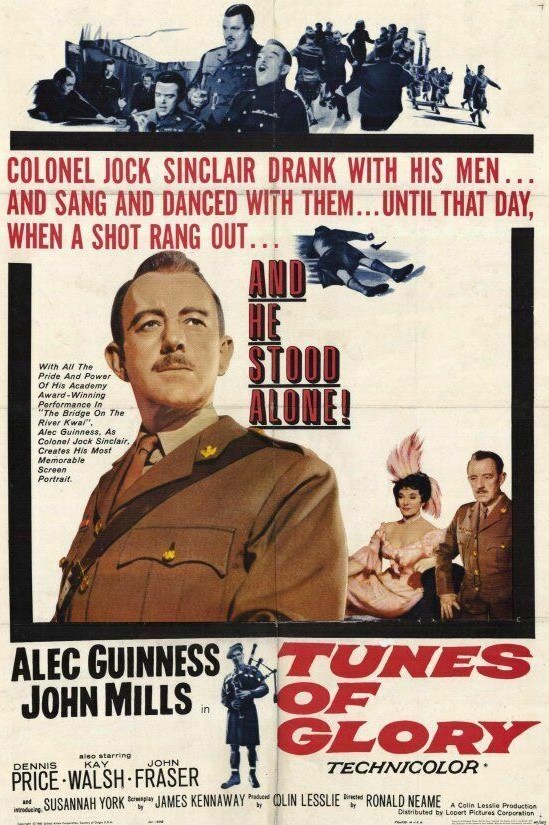
Tunes of Glory (1960) ****

Fans of Succession will appreciate this power struggle in a Scottish army regiment set in 1948. In a reverse of The Godfather (1972) where the Corleones complain about needing a “wartime consigliore,” here the powers-that-be have decided this unnamed distinctly Highlander company requires a commanding officer with skills more appropriate to peace time.

Major Jock Sinclair (Alec Guinness) has been in charge of the battalion since the North Africa campaign in World War Two when the original commander was killed. But he has never been promoted to full Lt. Col. Naturally, having been in charge for six years, he feels the job should be his. At a time when the currency of command was wartime experience he’s less than pleased when he loses out to Col. Barrow (John Mills) who spent most of the war as a Japanese POW.

It doesn’t help that they are complete opposites. Sinclair is a tough, hard-drinking, attention-seeking Scotsman who enlisted as an ordinary soldier and rose through the ranks winning two medals for courage during the conflict. Barrow is Oxford-educated English upper-class, a lecturer at Sandhurst Military Academy, and recalls his war experience with terror rather than the braggadocio of Sinclair. Worse, he doesn’t drink.

It doesn’t take long for the pair to clash. Sinclair, who has ruled as much by preying on weakness as force of personality, is quick to start to look for flaws in his opponent’s make-up. Barrow feels discipline has been slipping and enforces tougher measures. That might make him unpopular but an army is built on discipline so soldiers can hardly complain.

But Barrow slips up by misreading the men. He chooses the worst of all issues to make a stand. For the first post-war official barracks party, Barrow insists the soldiers embark on traditional Highland dancing in regulation fashion rather than in their normal exuberant, not to say rowdy, manner. The soldiers are infuriated when Barrow insists they take lessons.

He has just lit the fuse. Naturally, nothing goes according to plan. Barrow is humiliated, Sinclair triumphant. But victory does not turn out the way Sinclair expected.

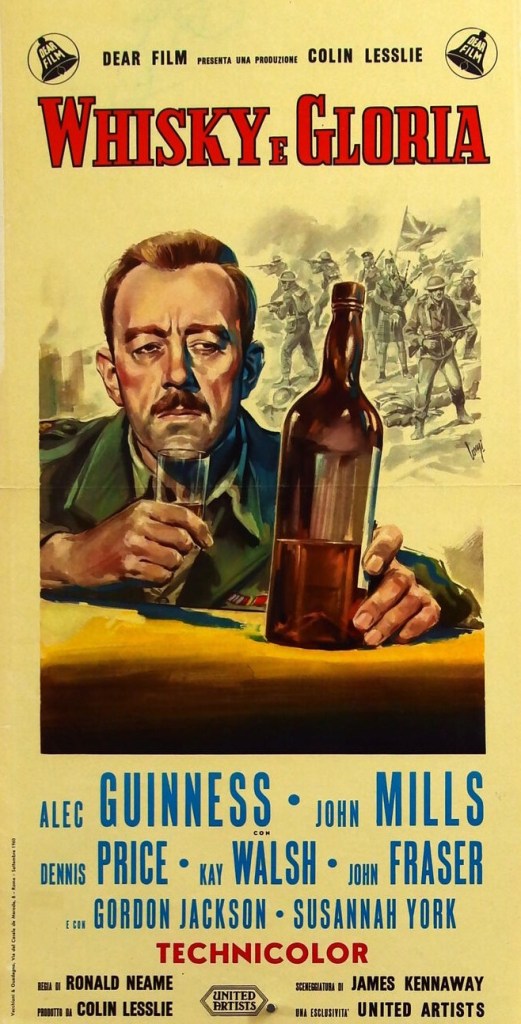
Somewhat cynical rebranding of the film in Italy as “Whisky and Glory,” possibly trying to cash in on the success of “Whisky Galore” and also misleading in suggesting actual conflict with the fighting in the background.

The main thrust of the narrative, as you might expect, is the stand-off between Sinclair and Barrow and the tensions felt all round, as would be the case in any business (Succession, now, of course the classic example) when a new boss takes control. While everyone might expect, and perhaps fear, change, in the military (as in the navy) there is always the danger, should the new broom try to sweep too clean, of mutiny.

This might not amount to a raising of arms. But there are other effective methods of mounting opposition – laxity, questioning or outright refusal to obey orders – or giving the new chief the cold shoulder. Here, in the background, are other simmering tensions. Not everyone is comfortable with Sinclair’s very laddish approach to command, the back-stabbing and double-dealing Major Charles Scott (Dennis Price) ready to pounce at any opportunity.

Sinclair is also having to deal with his daughter Morag (Susannah York) asserting her independence, having the temerity not just to take a boyfriend, Corporal Fraser (John Fraser), but one from the ranks rather than the officer class. And he feels the harsh tongue of his own paramour Mary (Kay Walsh).

Emotional isolation is rarely commented upon in matters of the armed forces and yet it is so much a driving force. If not adequately compensated by camaraderie, a man at the top can be very lonely indeed, and prone to the most vicious self-torment.

Director Ronald Neame (The Prime of Miss Jean Brodie, 1969) superbly invokes an army atmosphere away from the more usual battleground backdrop. The picture is anchored by brilliant performances all round and a roll-call of strong supporting characters. An unflinching look at power, especially leadership and the personal toll it takes. And it was astonishing that the movie could hit the target so well without relying on the usual round of sex, violence or that old stand-by the comic subordinate. It also probes the issues of what happens – in any industry – when the wrong person is put in charge. No less an authority than Alfred Hitchcock called it “one of the best films ever made.”

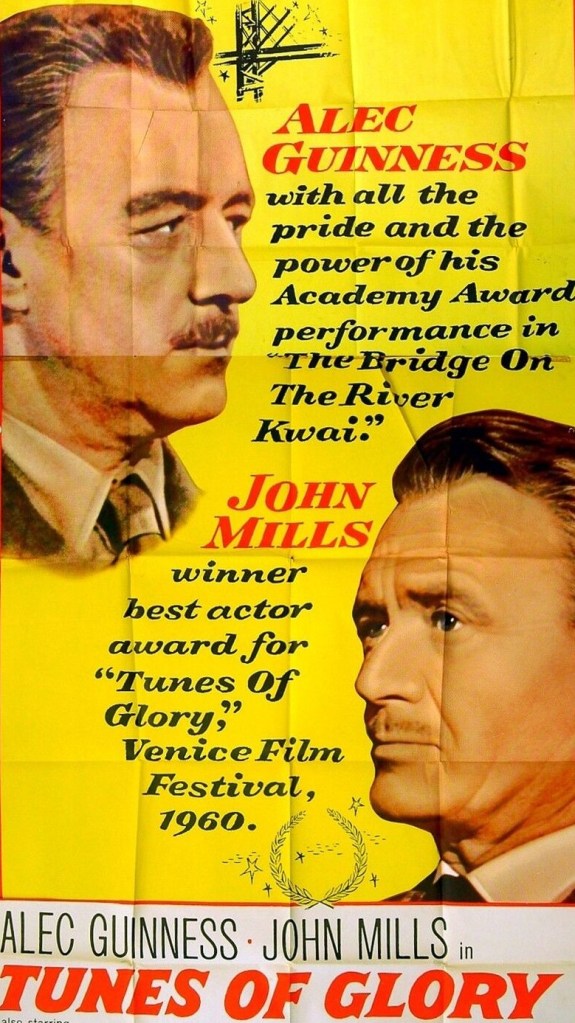
The sparring between Oscar-winning Alec Guinness (The Quiller Memorandum, 1966) and John Mills (The Family Way, 1966), who won the Best Actor Award at the Venice Film Festival for this role, is of the highest quality. Dennis Price (The Comedy Man, 1964) is the pick of the support while Susannah York (Sands of the Kalahari, 1965) makes an auspicious debut.

Few films could boast a better supporting cast: former British leading lady Kay Walsh (A Study in Terror, 1965), Gordon Jackson (The Ipcress File, 1965), Duncan Macrae (Best of Enemies, 1961), John Fraser (Tamahine, 1963), Gerard Harper (Adam Adamant Lives!, 1966-1967, TV series) and Peter McEnery (The Moon-Spinners, 1964).

James Kennaway (The Shoes of the Fisherman, 1968) wrote the screenplay based on his own novel.

Discover WordPress

A daily selection of the best content published on WordPress, collected for you by humans who love to read.

The Atavist Magazine

by Brian Hannan

WordPress.com News

The latest news on WordPress.com and the WordPress community.