The Criminal / The Concrete Jungle (1960) ****

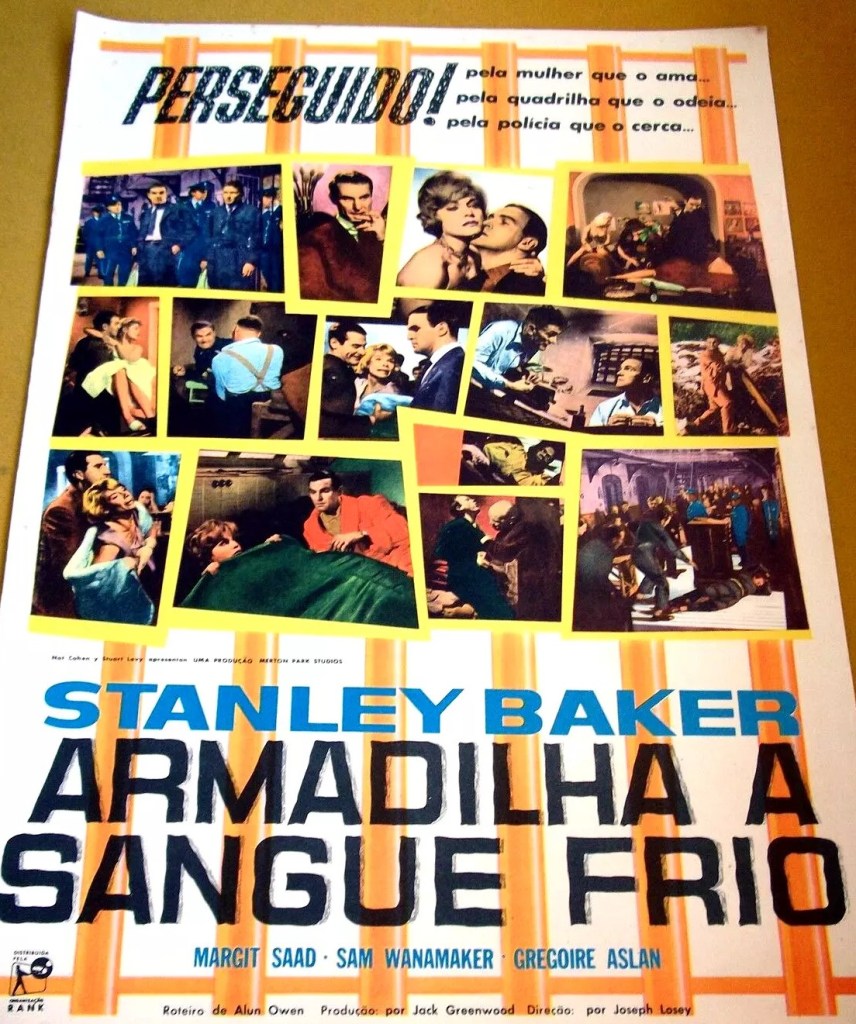
You’d be hard put to imagine from this hard-nosed gangster picture that both director Joseph Losey and star Stanley Baker would be capable of a more discreet arthouse offering like Accident (1966). Except for the director’s penchant for introducing a jazz score more often than suits the material – witness a brutal beating in a prison – this is an exceptionally gruelling blast through the British underworld, as though the domestic film industry had suddenly inhaled a narcotic comprised of Cagney and Bogart at their meanest.

With hardly a redemptive character in sight, it makes terrific demands of both director and star that anyone comes out achieving audience sympathy. Hollywood usually fell back on the trope of the innocent prisoner to instigate character empathy, but there’s no question from the outset that career criminal Bannion (Stanley Baker) is as tough as they come. In the opening section he arranges for rival Kelly (Kenneth Cope) to be viciously beaten with prison guard Barrows (Patrick Magee) turning a blind eye.

Out after a three-year stretch, Bannion plans a robbery of a race track with a partner, American Mike (Sam Wanamaker). But it turns out the track is owned by another gangster. After that, the double-crosses come thick and fast, nobody to be trusted, everyone out for themselves. He ends up back in prison, wanted by both sides of the law, the gangsters desperate to get their hands on the hidden loot.

Inside, he is protected by Italian mob boss Saffron (Gregoire Aslan), ruling his empire from prison, in return for a share of the loot. In due course, he instigates a riot, and double-crossing the other inmates, secures a shift to a low-security prison, and he is rescued from the transfer van. But there’s no escape. It’s a bleak ending all round. He dies on a beach, but without revealing where he has stowed the loot.

There are a couple of gals in the mix. The first, his ex-, Maggie (Jill Bennett) he treats in appalling fashion. The second, something of a present for his release, Suzanne (Margit Saad), sees the better side of him, although you have a sneaking feeling that she’s a plant.

But, really, nobody’s got a better side here. The prison scenes are grittier than had previously been the case in British movies, but the whole gangster set-up has a realistic “goodfellas” feel to it, boozing gangsters welcoming him home even as they are planning to stitch him up. And while Bannion may be unaware of ownership of the race track, clearly Mike isn’t, and Bannion is being set up to take the fall.

Joseph Losey (The Damned, 1962) takes an original approach to the material, cutting out the “big job” element entirely in favor of repercussion. He keeps up a brisk pace, which helps build tension, instead focussing on the relationships between the criminals and the prison hierarchy. Especially in the early prison scenes, more is made of vulnerability than toughness, many of Bannion’s confederates presented as weak and easily controlled rather than constantly challenging, prison guards complicit.

Stanley Baker (Where’s Jack, 1969) has such a malevolent appearance he was often as his best in the toughest arenas and perhaps Losey is making the point that even the toughest of tough guys can be duped by gangsters with more brains. There’s a terrific support cast: Sam Wanamaker (Warning Shot, 1966), Gregoire Aslan (Lost Command, 1966), Patrick Magee (Hard Contract, 1969), Jill Bennett (The Charge of the Light Brigade, 1968), Patrick Wymark (Where Eagles Dare, 1968) and  Laurence Naismith (Jason and the Argonauts, 1963). German star Margit Saad (The Magnificent Two, 1967) lends an air of mystery to her character.

This was the third – of four – teamings for Losey and Baker. The British censor took a mighty mild attitude to the unexpected levels of nudity and violence. Alan Owen (A Hard Day’s Night, 1964) and Jimmy Sangster (The Devil-Ship Pirates, 1964) are credited with the script.

Takes no prisoners.

The Charge of the Light Brigade (1968) ****

It’s worth remembering that Britain, led by roughly the same type of commander lampooned here, won the Crimean War and that initially this particular engagement, despite the deaths, was celebrated for its valour by poet Lord Tennyson, in much the same way as famous defeats like Dunkirk and The Alamo somehow managed to achieve the status of some kind of victory in the public perception. It’s also worth noting that the documentary-style realisation of Dunkirk, (2017) and to that extent Coppola’s Apocalypse Now (1979) owe much to Tony Richardson’s approach, both films more interested in the bigger picture than individual acts of heroism.

And our conscience here, dashing cavalry officer Nolan (David Hemmings), is not quite saintly, engaged in an affair with the wife Clarissa (Vanessa Redgrave) of a friend. Despite the director’s rush to judgement, his approach displays a refreshing change to a genre where acts of selfless courage were the norm. Setting aside the occasional self-reverential artistic lapse, it’s an excellent depiction of class-ridden Britain at war in 1854, an era when military advancement was purchased without any consideration to the leadership skills such high-ranking officers required. I’m never sure if John Ford invented the camaraderie of his Cavalry in westerns, where at dances  the officers mixed with the ordinary soldiers, but here the two classes are kept apart.

And while Richardson clearly wants to blame the class system for the military calamity, the outcome is a no-holds-barred ultra-realistic portrayal of war in in all its sordid glory. At its heart are the machinations of senior commanders jostling for position and control and, much as with Field Marshal Montgomery and General Patton in World War Two, allowing personal enmity to affect decisions.

The two biggest culprits are Lord Cardigan (Trevor Howard) and brother-in-law Lord Lucan (Harry Andrews) in charge of the ill-fated charge who openly spout bile at each other, remain deliberately obtuse, and are, nonetheless, a joy to watch. Cardigan is irascible to the point of apoplexy, incredibly brave, vainglorious, a vindictive sex-mad peacock, with an odd selection of principles (refuses to deal with spies, for example). Nothing can beat a quite marvellous spat between the pair over how to pitch tents. Both, however, are a vast improvement on the ineffectual commander-in-chief Lord Raglan (John Gielgud) whose idea of tactics is to “form the infantry nicely” and another commander who refuses to let the simple matter of being under attack ruin his breakfast.

At the other end of the scale are the poor recruits, drawn from the lower classes, so ill-educated they don’t know their left foot from their right (something of a necessity in obeying orders in the field), lured by the promise of glory and a job, and find themselves turned into horsemen in the most brutal fashion.

In the middle is the effete Nolan, initially introduced as the good guy, who believes horses should be treated with kindness and stands up to Cardigan. His romance with Clarissa is a masterpiece of nuance, all furtive glances, hardly a word spoken. And he has a pivotal role in sending the cavalry in the wrong direction at the Battle of Balaclava, causing the fatal charge.

It’s episodic in structure, characters bobbing in and out, some for comedic purposes, and without the battle it’s doubtful the picture would have been made for, excepting the high-level squabbling, there’s little inherently dramatic. And possibly that’s to the movie’s benefit for it clears the way to concentrate on how an army operates and goes to war, the focus, unlike most war or historical pictures, being as much on what goes wrong as goes right. So the horses dying during the voyage and callously dumped overboard and the men marching through Crimean heat and afflicted by cholera take centre stage rather than lavish sequences of soldiers on splendid parade.

On the downside, you have to accept the director’s version of the war’s causes, British imperialism don’t you know, rather than Russian aggression as a result of religious conflict in the Middle East. And there’s narrative indecision, various characters permitted interior monologue for no particular reason except artistic impulse. Mrs Duberley (Jill Bennett) wife of the paymaster (Peter Bowles) is permitted to accompany the expedition for the sole purpose it would appear of being shagged by Cardigan.

The detail of what exactly went wrong on the battlefield is obscured by the fact that Nolan, who hand-delivered the famous order to attack, itself unclear, died in battle, so it’s like one of those Netflix documentaries about unsolved murders, fascinating but ultimately annoying. If incompetence is measured in casualties, apart from this one charge the British came out better than the other participants, 40,000 dead compared to three times as many among their French allies and more than ten times as many among the Russian enemy.

The acting is of a very high quality, David Hemmings (Alfred the Great, 1968) as good as I’ve ever seen him, Vanessa Redgrave (Blow-Up, 1966), except for her deception a Stepford Wife Victorian-style, Trevor Howard (Von Ryan’s Express, 1965) brilliantly outrageous and John Gielgud (Sebastian, 1968) who turns befuddlement into a high art.

Tony Richardson (Tom Jones, 1963) makes some bold choices, not least in what is included and what is left out, the battle of the tents, fake news (from The Times!), soldiers facing the lash, the dashing charge and its terrible aftermath, the animated sequences, and his revolutionary soundtrack. Sergio Leone might have claimed the artistic high ground with the buzzing fly at the start of Once Upon a Time in the West (1969) but there’s little in film music of the time – beyond Bernard Herrmann’s Psycho score – to compare with the sound of a fly playing over the end credits or its inclusion during the march when men are literally dropping like flies. This is a very different kind of curate’s egg, absolutely brilliant in parts, and never dull.

Unfortunately, there’s a topical parallel, Crimea having been invaded several years back by Russia and now the whole region aflame.

This was the first home-grown excursion into the all-star-cast business – other British movies in that ilk, originating from these shores, previously headlined by a Hollywood star like Gregory Peck (The Guns of Navarone, 1961),  Kirk Douglas (The Heroes of Telemark, 1965) or George Peppard (The Blue Max, 1966). And I can see why the new box office stars David Hemmings and Vanessa Redgrave, repeating their Blow-Up (1966) teaming, would have, in the narrative sense, occupied center stage. But given nobody knew for certain what caused the disastrous charge and that it would taken place anyway in the picture, the far more entertaining approach would be to concentrate entirely on the likes of the feuding Cardigan and Lucan, two characters who leapt off the screen. Outside of the battle itself, Nolan’s sole purpose, it would seem, was to point out that the army treated its horses badly, a point the audience would have easily picked up without Nolan’s display of alternative horsemanship. Still, all told, at the risk of repeating myself, an excellent watch.

The Skull (1965) *****

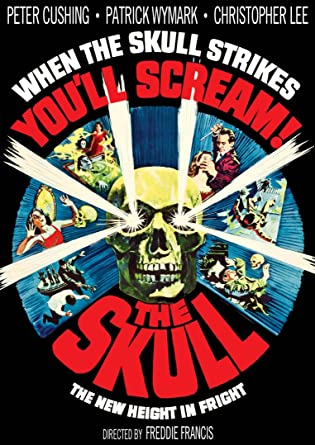
I have no idea why this masterpiece has not been acclaimed. For virtually half the picture, there is no dialogue, the entire focus on camerawork and reaction. Even Stanley Kubrick in The Shining (1980) gave in to grand guignol and The Exorcist (1973) was filled with over-the-top scenes but here the psychological impact of possession remains confined.

Initially, it appears we are in familiar Hammer territory, a grave-robber detaching a skull from a corpse only to meet an untimely end. There is another flashback to the gothic where the presence of the skull drives an ordinary man to murder. But this is an Amicus production and set in contemporary times with Christopher Lee and Peter Cushing once again in opposition, but this time only in an auction house bidding for demonic artefacts. Exposition is straightforward. A dealer (Patrick Wymark) sells Cushing a book about De Sade bound in human skin. Wymark may be a con man. He claims to possess the skull of the Marquis de Sade but his attitude towards it, kissing its head, plucking its nose socket, and the fact that he willing to halve his asking price, suggest otherwise. Lee, who once owned the skull, warns Cushing against it.

The rest of the film covers Cushing’s possession of the skull and the skull’s possession of him. There is a notable Kafkaesque sequence where Cushing is arrested, taken before a judge and forced three times to play Russian roulette before ending up in the house of the dealer where he steals the skull. What is less often commented upon is that this nigh-on 15-minute sequence including a 90-second taxi ride conducted in virtual silence, the camera mostly on Cushing’s face, that silence only broken by the feeding of bullets into the barrel of the gun and the barrel being rolled round. It is not long before Cushing commits his first murder.

There is a famous scene in the Last Tycoon (1976) in which Robert De Niro explains to a truculent word-obsessed British writer why dialogue is redundant in the movies. All you need is camera and reaction. That sets up The Skull’s greatest scene, a 17-minute dialogue-free climax, where Cushing is effectively preyed upon and consumed. The skull itself appears to have a point-of-view, various shots of Cushing through the skull’s eyes. The actual special effects are limited to what is imminently achievable, the skulls glows, it moves through the air. The impact of its presence is shown on Cushing’s face and by his action. It is just hypnotic.

Various directors have been anointed for the way they move their camera – Antonioni’s 360-degree turn in The Passenger (1975) comes to mind, large chunks of 2001: A Space Odyssey (1968), the long wait for sunrise in Lawrence of Arabia (1962), the lengthy shots of James Stewart driving a car in Vertigo (1958). But I have never seen anything as innovative as the silent sequences in The Skull which would be a waste of innovation were the sequences not so effective, especially on the small screen. Freddie Francis directed from a story by Robert Bloch. Equally innovative is the jarring music by avant-garde composer Elizabeth Lutyens.

Many of the films from the 1960s are to be found free of charge on TCM and Sony Movies and the British Talking Pictures as well as mainstream television channels. But if this film is not available through these routes, then here is the link to the DVD and/or streaming service.

Discover WordPress

A daily selection of the best content published on WordPress, collected for you by humans who love to read.

The Atavist Magazine

by Brian Hannan

WordPress.com News

The latest news on WordPress.com and the WordPress community.