
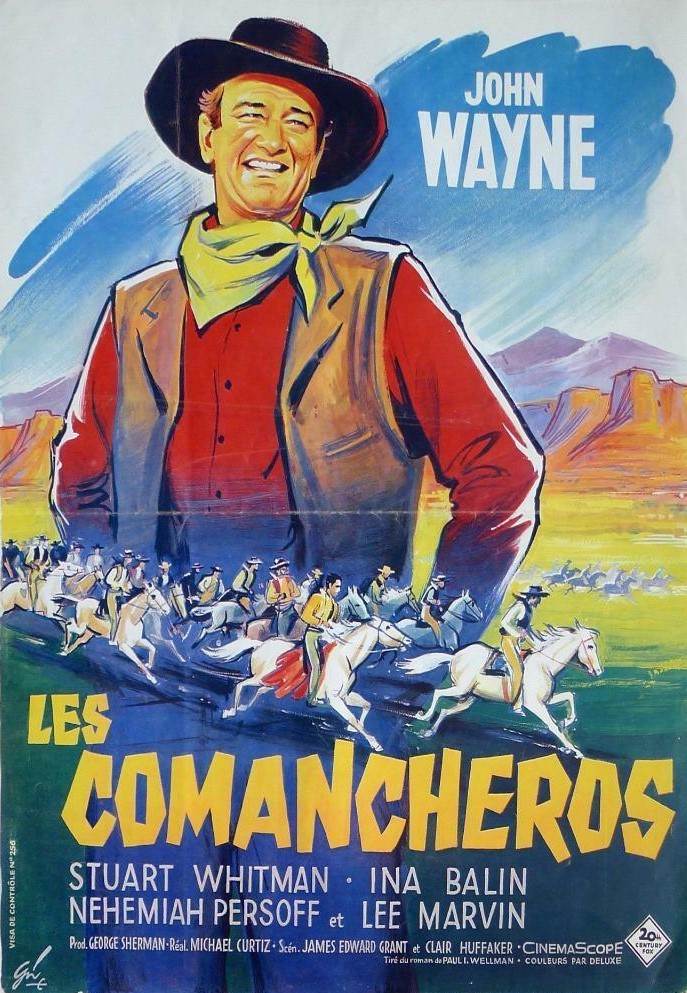
You can always tell a studio is piling a lot behind a rising actor when the top-billed star is absent, except for a fleeting moment during the credits, for the first 10 minutes. In this case, Twentieth Century Fox was showcasing two new talents, Stuart Whitman (Murder, Inc. 1960) and Ina Balin (From the Terrace, 1960).
I’m sticking my neck out a little on this one, not considered as top-notch as Duke’s other great westerns of the decade – The Man Who Shot Liberty Valance (1962), El Dorado (1967) and True Grit (1969) – but it’s an unusual story, hardly following a standard narrative, has a great score by Elmer Bernstein but most importantly because it’s real old-school film-making with the emphasis on the classic long shot and the horizon line.
And it takes a surprisingly feminist approach with gypsy Pilar (Ina Balin) making the running in the seduction stakes. Indeed, should she be willing to surrender an iota of her hard-won independence for a long-term relationship sticks to the view that in love there is always a dominant one and a subservient one, with no question about which she is. Plus, although the nickname “Pilgrim” became a famed element of The Man Who Shot Liberty Valance this is where the nickname notion began when lawman Jake (John Wayne) assigns prisoner Paul Regret (Stuart Whitman) the appellation “Monsoor” because he’s of French heritage.
Meshes effortlessly three storylines – Jake taking prisoner Regret back to base, Regret turning from western tenderfoot to accomplished hand, and Jake and his captive infiltrating the Comancheros of the title, a secret society of white men who utilize Comanche power to its own ends. You could argue this is ushered in the “buddy” movie, the repartee between the two principals a delight. Plus, you would have to take note that legendary director Michael Curtiz (Casablanca, 1942), in his final picture, has done something remarkable in getting the Duke to speak proper, not hi-hat English, but without that Wayne trick of breaking up his sentences so it appears he’s thinking.
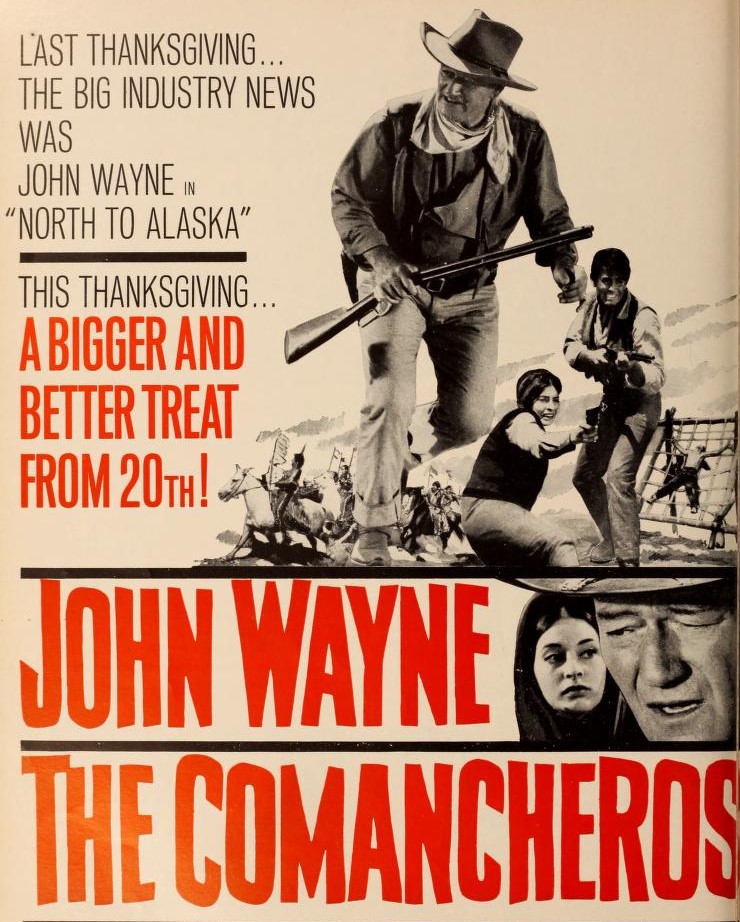
Curtiz is pretty nifty when it comes to setting up scenes, interrupting gentle moments with elements of stunning ferocity. When Jake arrives at a ranch, the camera tracks back from his arrival to reveal the corpses hanging upside down under the ranch gateway. Later, Jake is tucking into a meal at the home of another rancher when that man’s pregnant wife in the background suddenly sits up and from her point-of-view we see through a window as big as the entire screen a band of renegades in attack mode charging through a river.
Regret isn’t one to hang around either when he can escape during the ensuing melee, but no sooner has he gone than he returns with a bunch of Texas Rangers, thus redeeming himself in Jake’s eyes. And there’s a great cut between Jake being knocked unconscious in the blazing sun and waking up in the pouring rain.
And it’s chock-full of reversal, not just that Pilar dumps her pick-up Regret when their riverboat docks at Galveston, but Regret, forced to ride a mule in handcuffs to prevent his escape, gets the jump on his captor at the saddest scene in the picture, the burial of a family killed by Comanches. Later, after taking on the alias McBain, he encounters Regret at a poker table and the wanted man does not give him away.
After a bit of legal chicanery, Regret is a free man, although with the proviso he teams up with Jake to go undercover into the Comancheros camp. This doesn’t work out too well, the pair strung up by suspicious crippled leader Graile (Nehemiah Persoff) until rescued by, surprise, Pilar. Love works its mysterious way and soon Pilar is on Regret’s side, resulting in a classy finale.
Along the way we encounter Lee Marvin (Raintree County, 1957) having another scene-stealing ball as the Comancheros contact. Clever screenwriters James Edward Grant (Circus World/The Magnificent Showman, 1964) and Clair Huffaker (Hellfighters, 1968) find an entirely believable method of getting him out of the way. And in passing we learn that Jake’s wife died “two years, two months and 13 days” ago and without an ounce of revealing dialog between them that Jake would like to take up with widow Melinda (Joan O’Brien). Meanwhile, initially presented as a man of such honor that he will fight a duel to protect such notions of nobility, Regret goes from gambler, wanton lover, and prisoner to revert to his original state.
Expect chunks of western lore – don’t give a hot horse water until it has cooled down is one takeaway. And men who swear by an unwritten code. Here, it’s “words are what men live by.” What’s so refreshing is that lore and code alike arequickly punctured. The follow-up to the code annoncement to which Regret shows indiference is a pronouncement from Jake: “You must’ve had a real careless upbringing. ” that’s not forgetting characters remembering to be characters in the midst of all the uproar as with the bedridden pregnant wife instructing her husband to make sure Jake eats off the “best china.”
It’s not only a well-structured movie but it’s filled with moments that reveal character and even when Curtiz feels duty bound to include standard tropes such as the bar-room brawl or the drunk there are enough twists to have you believe the clichés have been bitten in half.
A superb ending to Curtiz’s career, terrific performances all round, great double act from Wayne and Whitman, with the latter afforded considerably more leeway acting-wise than any time in his career, and Ina Balin in a prize role.



 The Magnificent 60s