Author William Bradford Huie’s cry of outrage could be heard from one side of Hollywood to the other.
Not that anyone would commiserate. A bestselling writer dealt with the movie industry at his or her peril. If you succumbed to the lure of Hollywood gold you might as well kiss goodbye to any expectation they were actually going to film the book you had written.
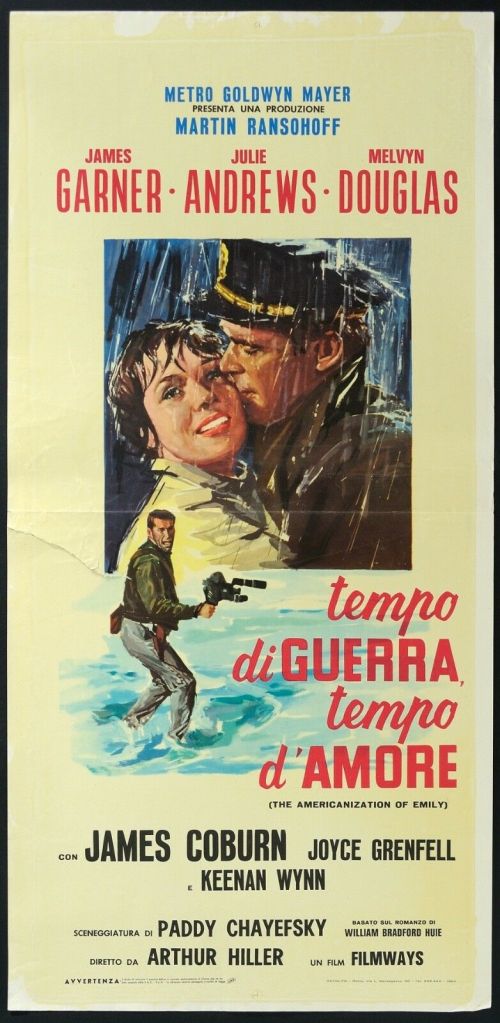
In this case, screenwriter Paddy Chayefsky stuck to the plainest of knitting, the romance between oversexed Yank Lt Col Edison (James Garner) and English rose Emily (Julie Andrews). He kept in the “dog-robbing,”* Edison stashing away crates of steaks, whisky, nylons, chocolates, whatever will keep the admiral happy and at the same time smooth the path for whatever officer or politician he was trying to schmooze.
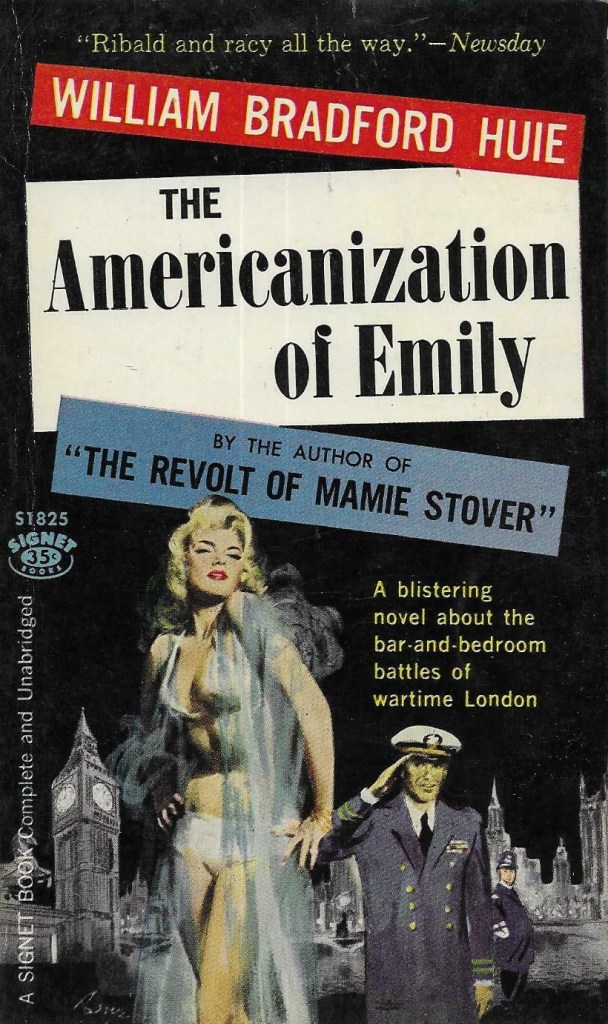
But Huie’s tale went down a different route that Chayefsky chose to ignore. Yes, D-Day played a part, forming the climax, and the author did intend to score a political point. In Huie’s version, Edison’s role in D-Day was merely to film some of the proceedings. Keen to highlight the risk to the common soldier, the hero was prone to film the sordid aspect of war, focusing as much on death and injury as heroism. He even opened with a prologue, a dedication to the three men who died in the making of the film.
But his film never saw the light of day. Or at least not his director’s cut. He was forced to eliminate all scenes of dead Americans. Dead Germans were okay, just not dead Americans. Especially irksome was a sequence showing bulldozers covering American corpses with sand. He only won one battle with his superiors, refusing to stick in the cliché of a chaplain praying over sailors before they embarked on the D-Day vessels, but only because there was no chaplain present and he refused to shoot such a scene.
Of course, since he didn’t die in Huie’s book, there was no reason to come back from the dead. In fact, post D-Day, he and Emily spend a good chunk of time together before he is despatched elsewhere on another task with the admiral and there is a happy ending, fourteen months later, a reunion as Emily turns up where he is now stationed.
So where did all the cowardice malarkey come from? The mind of Paddy Chayefsky is the simple answer. In the book, the hero, as much as the next man, does not want to die in the war, but his fears are the normal ones, he doesn’t go out of his way to avoid action, profess his cowardice and stand up for the rights of cowards everywhere. So the book isn’t larded with long speeches about the horrors of war.
What attracted a producer like Ransohoff to the picture was the film the hero wanted to make. Not one that glorified war. A film that refused to see heroism as a great and noble thing was, of course, the same as sticking up two fingers to all those who could only justify war if it provided the opportunity for heroism as a sop to the wives and children the dead left behind. It was a strong point to make. And, prior to filming, there was plenty Edison had to say on the subject. While the admiral saw the landing as a great success because the casualties were much lower than expected, Edison felt for every man killed.
There’s no need in the book for the admiral to be a loony because it would be quite plausible to film for documentary or PR purposes action on World War Two beaches – what were John Ford and other famous directors doing if not that? Lt Cummings (James Coburn) who comes up with the dastardly idea of killing off Edison does not come up with such a dastardly idea in the book. In fact, in the original novel he’s a relatively minor character. And the much-vaunted nudity, revolving in the main around Cummings, is not particularly obvious in the novel, though Huie is perfectly blunt about the role of the bulk of the women. The novel opens with the classic line: “Twelve Englishwomen, known as Sloane’s Sluts, served America during the Second World War.”
However, the said Sloane is eliminated from the film, in order to provide the immoral Edison with something of a moral tinge. In the movie, with so many women easily available, he doesn’t indulge beyond a bit of bottom slapping. But in the book, he has sex with said Sloane while romancing Emily and again at the end while separated from her.
The Chayefsky version is peppered with dialogue about war that is primarily, even though Edison’s life is at stake, in the aesthetic vein. Huie, on the other hand, provides a salutary commentary on the war, filling the reader in on aspects rarely covered, the kind of unfamiliar material that would later be the bedrock of the airport bestseller like, well, Arthur Hailey’s Airport.
* “A dog-robber is a personal attendant of a general or an admiral. To ensure his superior has the best food and lodging, a dog-robber is willing to rob not only troops, widows and orphans but even the goddam dog.” So runs Huie’s description, a little note at the bottom of a page just in case the reader did not quite work out to what depths this ultra-scrounger would go to satisfy his boss.
Julie Andrews could not have made a more controversial choice in her bid to prove she was more than a Hollywood goody two-shoes as introduced in her debut Mary Poppins (1964). In the months leading up to release, The Americanization of Emily movie made all the wrong sort of headlines, aligning the innocent Andrews with the unsavory matter of producer Martin Ransohoff (The Cincinnati Kid, 1965) challenging the all-powerful Production Code, the self-censorship system in operation in the United States until the late 1960s.
Ransohoff demanded the right to include four scenes of substantial nudity in the film, at a time when any flashes of skin in mainstream pictures were taboo. He argued that the scenes were “necessary for the farcical overtones of the picture.” But more to the point, he was annoyed that foreign filmmakers, who did not have to abide by the stringent rulings of the Code, could show nudity, sometimes even condoned by censor Geoffrey Shurlock who accepted their artistic validity. Ransohoff railed: “We are losing our market because we allow pictures that are full of nudity done in an artistic manner to play our top houses but we can’t get into them because the Code robs us of our artistic creativity.”
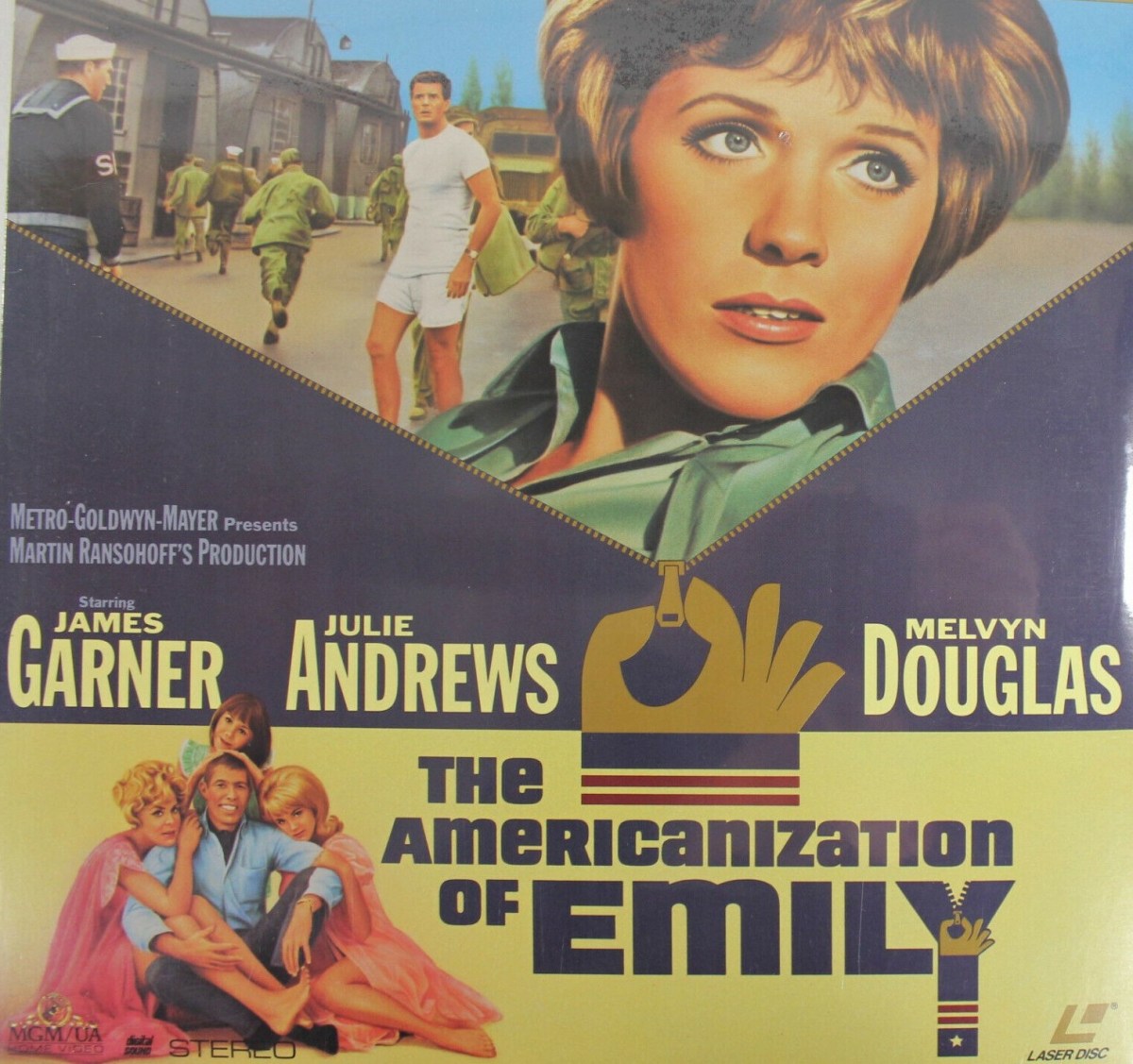
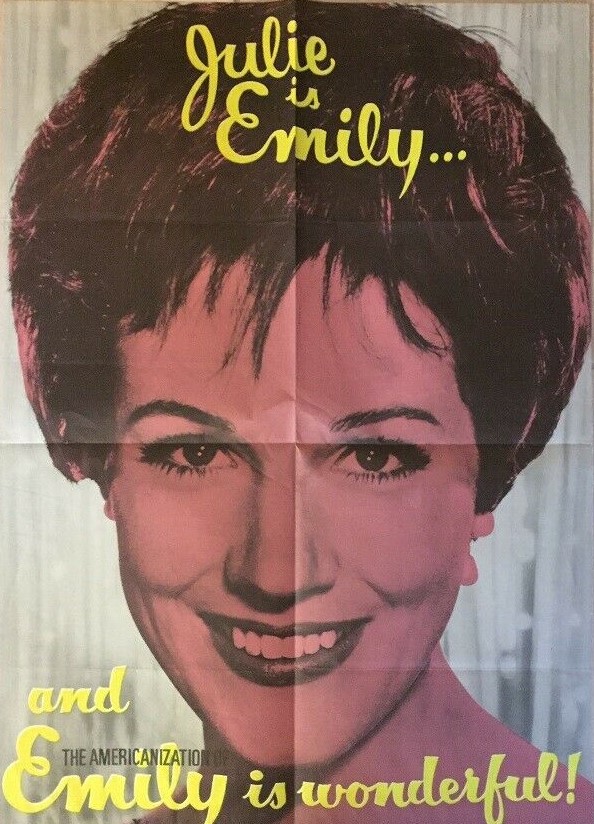
I’m not sure exactly when MGM dropped the “Americanization” element from the title and made Julie Andrews the star by promoting her image more than that of top-billed James Garner.
Faced with a lawsuit from studio MGM for delivering a movie not fit for the Code, Ransohoff conceded he had gone “overboard” with the nudity and that Judy Carne – who later sprang to fame in Rowan and Martin’s Laugh In (1969-1973) – in particular, was “over exposed.” Other actresses named as revealing too much were Janine Gray (The Pumpkin Eater, 1964) and Kathy Kersh in her movie debut. The women were identified in the movie credits as, disgracefully, “Nameless Broad.”
At the outset, such agitation would not have preyed so much on Andrews’ mind as a possibly limitation in her future career, Mary Poppins not due to be unveiled until the summer and few members of the public aware of what a game-changer that would prove for studio and star alike. But once Mary Poppins hit the box office heights, there was every chance the star would quickly lose the adoration of the public if seen to play the female lead in a steamy picture. Ransohoff complicated matters by failing to come out and say whether Andrews was involved in the nude scenes, no matter they were considerably toned down by the time the movie hit cinemas in October 1964. (Had he delayed the picture’s release six months, his approach might have been deemed more acceptable, as, by that time, a flash of breasts had been passed by Shurlock for The Pawnbroker.)
It had been a troubled picture from the start. As early as 1962, Oscar-winner William Holden (The World of Suzie Wong, 1960) had been signed up to star and the movie was due to go before the cameras in London in July 1963 and, following a slight delay, re-scheduled for the next month under the direction of Oscar-winner William Wyler (Ben-Hur, 1959). Production was not quite settled because Andrews was only hired in September 1963. But when Wyler pulled out a month later he was quickly followed by Holden. Andrews was such an unknown quantity that when she signed up, the news did not even receive a headline in Variety, just a few lines at the bottom of a page.
And there were screenplay issues. Norman Rosten had begun work on the adaptation of the William Bradford Huie bestseller in April 1962 only for, 10 months later, the author to be drafted in. But scripting problems would continue until after shooting was complete (see below) with the filmmakers unable to make up their mind about the tone of the picture.
Despite Rosten being assigned, a story later emerged that the book had struggled to reach Hollywood. Huie contended that it had, after all, not been sold to Ransohoff in 1962 and that the sale only occurred later after the author had written the screenplay on spec and sold it to the producer. He tied this up with another contention, little borne out by fact, that producers had turned against buying blockbuster novels in favour of original screenplays.
At that point Ransohoff was on a roll as one of the biggest independent producers in Hollywood, on his slate The Sandpiper, which would appear in 1965, Topkapi (1964), The Loved One (1965), The Wheeler Dealers (1963) and The Americanization of Emily, a fantastic batting average for a neophyte producer. Emily would be his third production, The Sandpiper, with two of the biggest stars in the world, Elizabeth Taylor and Richard Burton, his fourth.
James Garner, who had blown his entire fee of $100,000 from three years’ work on television series Maverick on getting out of his contract with Warner Brothers, had been given a helping hand by Ransohoff, winning second billing behind Kim Novak in Boys Night Out (1962) and Lee Remick in The Wheeler Dealers. Ransohoff gambled Garner was ready to make the jump up to top billing in The Americanization of Emily.
In fact, it would take several years before Garner was considered a proper star, thanks to Support Your Local Sheriff (1969), with the kind of marquee appeal that produced box office commensurate with his fees. In fact, James Coburn was considered a better prospect with a seven-picture deal with Twentieth Century Fox – for whom he would make his breakthrough movie Our Man Flint (1966) – a five-film deal with Ransohoff and Major Dundee (1965) on the starting grid with Columbia.
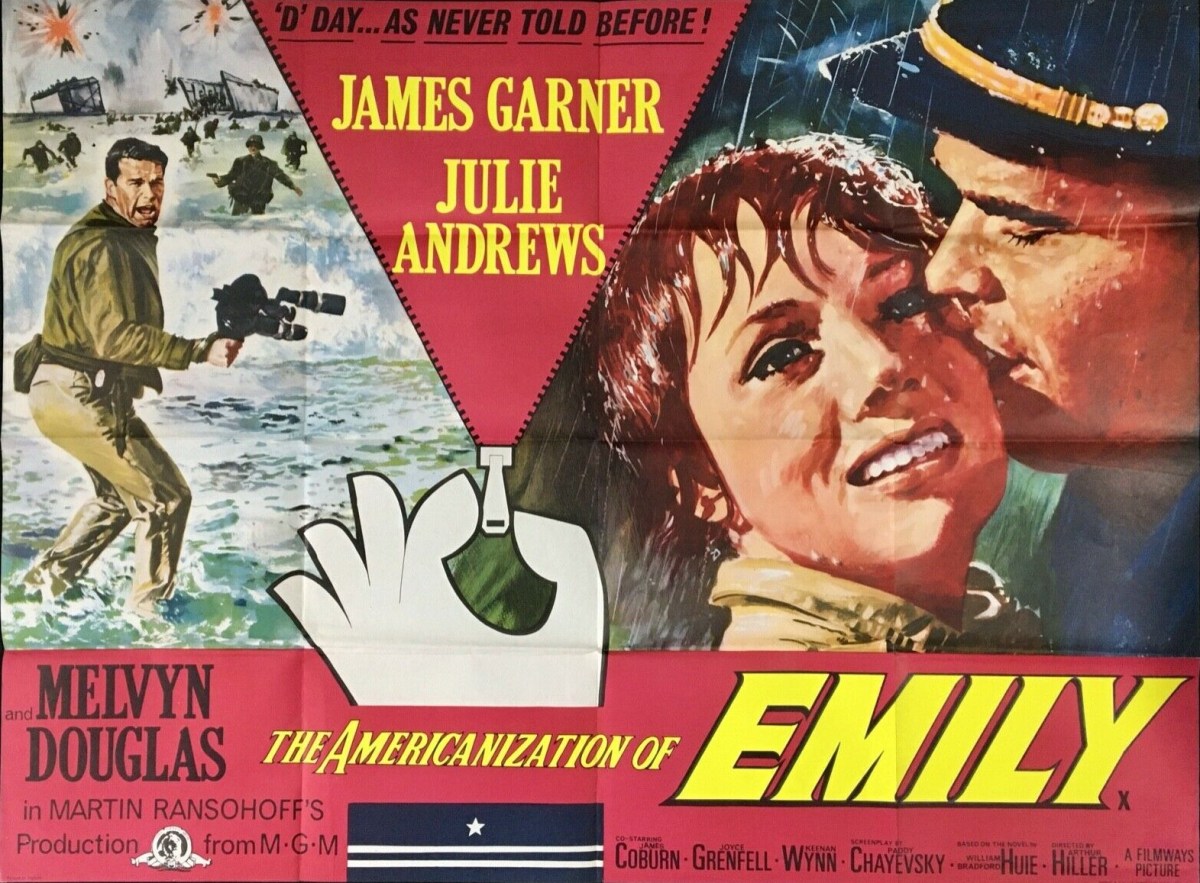
The three-minute sequence of the D-Day beach landing cost $250,000. It was shot in California, sixty miles north of Hollywood, on a public beach though anyone happening upon the site would possibly be put off by signs proclaiming “Explosives next ½ mile.” The shoot involved 5,000lb of explosives, mostly dynamite and black powder, planted in iron tubs buried in the sand and connected by wires to a central control board. The complicated set-up involved four cameras rolling simultaneously with a 250ft high crane lifting a camera platform into the sky for aerial shots. Another platform was sited in the surf. Special effects expert Paul Byrd was on hand to point out to participants where explosions would occur. Eighty smoke pots were lit, each in an assigned position. Rehearsals soaked James Garner and while he waited for the scene to be set up again he lay down on the beach, still in n his wet clothes, but covered in a towel.
Preparing the segment had taken four months with bulldozers clearing the area. Ransohoff himself climbed into a camera platform to test the rig. Camera positions were selected to capture close-ups of the actors going ashore. To maximize daylight the lunch break was limited to 30 minutes.
Ransohoff, as much a maverick in marketing as in production, took out a double-page advertisement in Variety in July 1964 – nearly four months before the movie opened – to promote the response of the preview audiences. And although the comment cards returned easily promotable lines like “you have a blockbuster on your hand” and “one of those rare films that combine tragedy, comedy and drama properly,” Ransohoff was clearly intending to continue to court controversy by including quotes along the lines of “I’m broadminded but this time you’ve gone too far” and “a disturbing and terrible thing.”
But you couldn’t argue with Ransohoff seeking an alternative marketing strategy with such a recalcitrant publicist as Garner. The actor had a marked aversion to talking about his private life, which, of course, meant the focus would have to shift to his dubious star quality or the controversial scenes. Nothing infuriated journalists more, especially in those days when the media was not so tightly controlled, than to turn up for an interview with an actor who had nothing to say. “My private life is just that and I’ll keep it that way,” he averred.
Quite why the movie took so long to open is not really a mystery. Sneak previews might be followed by a little tweaking but the film would expect to be in cinemas within a month or so, the previews intended to build public awareness and word-of-mouth buzz rather than tell the director where he had gone wrong. But clearly Ransohoff held back in order to capitalize on the box office of Mary Poppins. Despite the wrangling with the Code being over and done with by March 1964 and the preview taking place three months later, the film did not open until October, going wide at Xmas, with the additional purpose of aiming for Oscar voters.
Even as Ransohoff was adding the finishing touches to the advertising campaign, there were doubts about what kind of picture the public would be shown. Four endings were considered, two filmed with Edison (James Garner) dead which turned the movie into a straightforward black comedy, but the other two retained the romantic ending.
The black comedy approach dictated that the unsuspecting Edison (James Garner) was lured to his death on Omaha Beach by the glory-hunting Cummings (James Coburn). With no return from the dead, this left Emily (Julie Andrews) in one version to carry the movie to a dutiful conclusion, commiserating with Admiral Jessup, who had been committed to a mental asylum, while a parade commemorating Edison’s sacrifice and led by the treacherous Cummings took place in the background. This was junked when the parade prove too expensive an addition.
All the other endings kept Edison alive, but in one, partly filmed, Cummings was banished to the North Pole, the producers going as far as to film Coburn with penguins.
The major adjustment in all versions was to present Jessup as off his head when he conceived the plan. That meant the Navy could not be blamed for outrageous publicity-seeking, with the finger instead pointed at a maverick officer, whose decisions could be tempered by his temporary instability.
SOURCES: “Holden’s Americanization,” Variety, May 23, 1962, p11; “Screenplay (Ready to Shoot) Cost-Conscious Producers Goal in Retreat from Pre-Sold,” Variety, January 30, `1963, p3; “Emily Screenplay to Be Done by William Bradford Huie,” Box Office, February 11, 1963, pW1; “Ransohoff’s Big Spurt of Features,” Variety, February 17, 1963, p3; “Ransohoff To Start Five Films in 6 Month Period,” Box Office, June 17, 1963, p27; “Julie Andrews,” Variety, September 11, 1963, p16; “Bill Holden Follows Wyler in Leaving Emily,” Box Office, October 7, 1963, pW2; “Garner Gets Emily Lead,” Box Office, October 14, 1963, p9; Michael Fessier Jr., “Can’t Be Americanized With Duds On,” Variety, November 20, 1963, p5; “Martin Ransohoff To Seek Production Code Seal,” Box Office, November 26, 1963, p6; “Emily and Her Attire Settled,” Variety, March 25, 1964, p5;“Nudies In Emily Are Cut to Get MPAA’s Seal,” Box Office, March 30, 1964, pW4; “Advertisement,” Variety, July , 1964, p14; “Admiral’s Glory Seeking Is Final Ending of Metro’s Emily,” Variety, November 4, 1964, p5; “Mad Film Promotion,” Variety, November 4, 1964, p15; “Promo Credo of Hollywood Actor,” Variety, November 4, 1964, p15; Action on the Beach (1964) MGM promotional featurette.
It’s an immoral job but someone’s got to do it. In wartime, generals need their perks – Winston Churchill with his cigars and champagne the best advocate. And those who supply the perks – Dog-Robbers in American parlance – expect their own perks in the form of a backroom job where they are never exposed to danger. Top U.S. Navy dog-robber in World War Two London on the eve of D-Day is Lt. Commander Edison (James Garner) who can spirit up whisky, steaks, nylon stockings and women, happy even to deliver shoulder massages for boss Admiral Jessop (Melvyn Douglas).
And like the recently-reviewed The Charge of the Light Brigade (1968) what’s mostly on the minds of top commanders is jostling for power, how to win the public relations battle on D-Day and prevent the politicians considering scrapping the service post-war. So Jessup comes up with a brilliant wheeze. What if the first man to die on Omaha Beach was a sailor? Allowing for the construction of a memorial to the “unknown sailor,” a feasible proposition given the Navy demolition unit is scheduled to land on French shores in advance of the invasion force. Edison is enlisted to film the anticipated death.
But Edison, whose brother died at Anzio, is a coward and does everything possible to avoid the job. He struggles to get English girlfriend Emily (Julie Andrews), whose father and brother died in the war, to share his perspective and is counting on buddy Lt. Commander Cummings (James Coburn) to get him out of it. But Cummings has his own ideas and Edison ends up the sacrificial lamb.
And it would be a brilliant black comedy except that, in the interests of a happy ending, Edison, despite being shot on the beach by Cummings, turns up alive.
In that case it becomes a fascinating exploration of the realities of war, the moral and immoral coming to grief in a moral vacuum that ensures that the higher up the food chain the less likelihood there is of dying and, ironically enough, the better opportunity to enjoy, while the masses are on strict rations, the good things of life. Emily would act as the movie’s conscience except that Edison is having none of war’s hypocrisy. He doesn’t want to die for his country and may be following to the letter General Patton’s dictat of making the “other poor bastard die for his country.” He doesn’t so much take a stand against the absurdities of war as stand up for the sanctity of life, in particular his own life, unwilling to fall for the “futile gesture of virtue.”
There’s plenty of what you should and shouldn’t do during wartime, arguments passionately argued for and against duty, though even the self-appointed conscience Emily stops short of turning her nose up at the finer things of life, no matter by what dodgy means they fall her way. that her life teeters on hypocrisy is scarcely explored.
And it does its utmost not to fall into the trap of the wartime romance genre, will-he-won’t-he survive the dangerous mission, precisely because you could never mistake Edison for a hero. And you need a hero not an ordinary joe for that particular genre to work. So what you’re left with is something else entirely, a man brave enough to be seen naked, exhibiting exactly the same lack of scruples in saving his own life as his commanders would employ to have him lose it. It’s kind of complicated that way.
Throw in another get-out clause on behalf of the Allied command, the notion that no high-up would embark on such a selfish vainglorious action, and that Jessup only does so because he is temporarily unhinged after the loss of his wife, when in fact history is littered with generals committing troops to wholesale slaughter for their own reasons.
Ediuon is such a charming character that if you wanted someone to plead the case on behalf of the cowardly you couldn’t make a better choice. The whole idea shouldn’t work at all because it’s only the bad guys, the shifty ones that turn up in every war movie, who carry the cowardice flag. The film is so cleverly structured, with examples of the impact of loss all around, that it’s virtually impossible to vote against Edison. And part of the cleverness is the casting. If such a good egg as Emily can fall in love with Edison it somehow makes him a less despicable character. He’s certainly not as shifty as Jessup who dreamed up the bizarre stunt in the first place or Cummings, intent on exploiting it.
James Garner (36 Hours, 1964) excelled at playing the morally dubious, the cowardly sheriff played for laughs in Support Your Local Sheriff (1969) his biggest box office hit, but this isn’t far short of his very best work, and an exceptionally bold role for a star. Julie Andrews was already trying to move away from her goody-two-shoes debut in Mary Poppins (1965) that would be further enhanced by The Sound of Music (1965) and while her characterisation is not, on the surface, that far away from either role, the depth she displays here, the sorrow and the soulfulness, give this a edgier riff.
Good support from James Coburn (Dead Heat on a Merry-Go-Round, 1966), Melvyn Douglas (Hotel, 1967), Keenan Wynn (Man in the Middle/The Winston Affair, 1964) and Joyce Grenfell (The Yellow Rolls Royce, 1964).
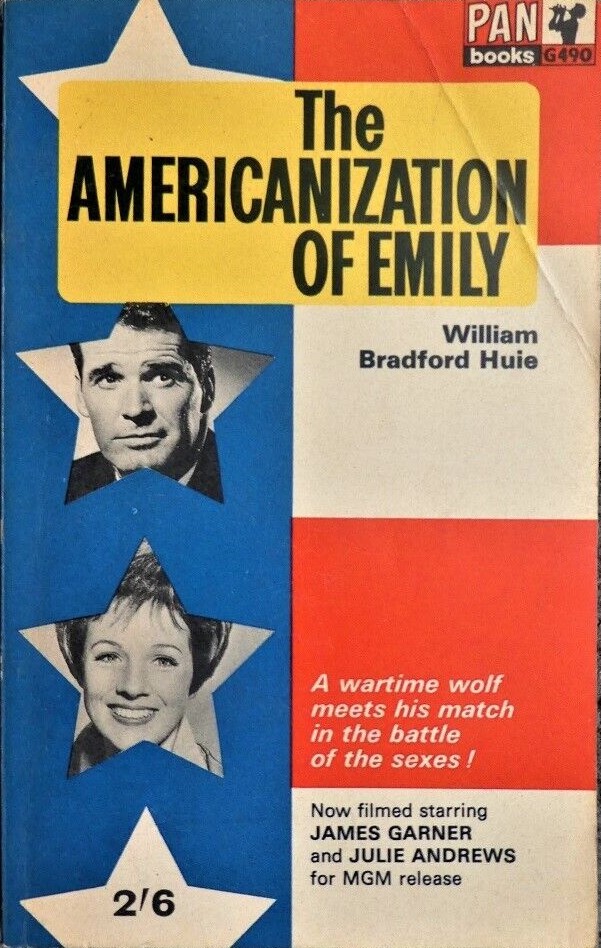
Director Arthur Hiller (Tobruk, 1967) most of the time walks a very fine line but manages to create a very thoughtful movie that humanized what other anti-war pictures failed to make personal. Oscar-winner Paddy Chayefsky (Marty, 1955) based the screenplay on the bestseller by William Bradford Huie (Wild River, 1960).
Another in the mini-genre concerning power politics in the Armed Forces. Would make a good triple bill if teamed with The Charge of the Light Brigade and Man in the Middle.
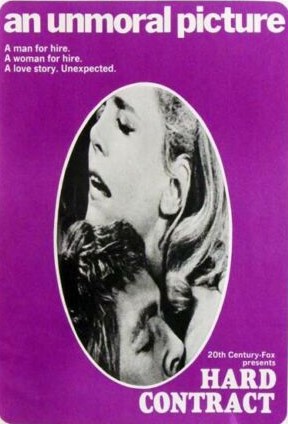
A hitman movie that verges on the existential is always going to be intriguing. Stone cold killer John Cunningham (James Coburn) manages to keep the world at a distance until he runs into the vibrant Sheila (Lee Remick) in Spain. The film is a curiosity of an admittedly small genre dominated by such disparate offerings as The Killers (1946 and 1964), Yojimbo (1961), Le Samourai (1967) and Stiletto (1969). Here, although Cunningham does bump people off, you never see the violence. We’ve come to expect hitmen to be introspective, but there’s never been anyone as closed-off as Cunningham. No romance in his life, only hookers, no apparent depth, in fact we learn very little about him.
He only runs into Sheila because for a laugh she pretends to be a sex worker. In reality she’s a wealthy divorced socialite running with a fast set that include Adrianne (Lili Palmer) and ex-Nazi Alexi (Patrick Magee) whom she loves to taunt but whose contacts allow Cunningham to be effectively stalked. And as unsavory that might be from today’s perspective, it sheds light both on her power and whimsicality.
There’s an unusual background. Amid the extensive jet-setting in Torremolinos, Madrid and Tangiers, there are reality counterpoints, reflecting the issues of the decade – violent demonstrations with police using water cannon to control the crowds, the American elections and discussions about God, world hunger, the Holocaust, terrorism and population growth.
No doubt the script is wordy, but there’s hardly a word that doesn’t challenge convention. It’s steeped in amorality – a touchstone of the decade – good only occurs “when evil takes a rest” and the world is “immune to murder.” And you certainly get the impression that the rich can confront anything because, not having to live in the ordinary world, they can get away with it. Conversely, this is also one of those films where you wonder who did the wardrobe (Gladys de Segonzac, since you ask, who ran fashion house Schiaparelli in the 1950s) because not only does Sheila sport clothes that would have delighted Audrey Hepburn but Cunningham gets away with wearing a white jacket.
And if Korean vet Cunningham is enigmatic, the insomniac Sheila is cut from a similar cloth, and while a potential source for redemption is as likely to have sex with a casual pickup in a filthy alley. The story does not go quite the way you would expect – Cunningham’s growing dissatisfaction with his profession revealed when he can’t perform in a Brussels brothel. And his mindset allows him to consider mass murder as a solution to an emotional problem he cannot solve.
At core, of course, is whether once Cunningham’s emotional defenses are breached he can continue as a hitman, and whether Sheila can accept his profession. The stakes rise when it transpires that (like Stiletto made the same year) retirement is not an option.
And for all the seriousness on show, there are some imaginative moments of hilarity – Cunningham’s idea of a love song is “To the Shores of Tripoli” and Adrianne proves determinedly indiscreet. In keeping with the paranoia cycle that was about to explode, you never find out why people are being murdered, or even who they are, far less the group which his boss Ramsay (Burgess Meredith) is fronting.
Far removed from the Derek Flint persona that had turned him into a star, James Coburn delved deeper into the amoral territory he had previously explored in Waterhole 3 (1967). Lee Remick (The Detective, 1968) is sheer madcap delight even when espousing her odd takes on philosophy. Lili Palmer (The Counterfeit Traitor, 1962), who by this point in her career was usually the wife or girlfriend, creates a very original character. Veteran Sterling Hayden had only made one film (Dr Strangelove, 1962) in a decade and is excellent as a contemplative retired hitman. Patrick Magee (The Skull) gives another of his tight-lipped performances. Karen Black (Easy Rider, 1969) has a small role as does Sabine Sun (The Sicilian Clan, 1969).
This marked both the debut and the demise of the directorial career of S. Lee Pogostin, best known at this point as the screenwriter of Pressure Point (1962) and Synanon (1965). In terms of argument over issues it stands comparison with Pressure Point but without that film’s intensity.
I remember being baffled by the picture when it came out and I was a teenager because the action I believed I had been promised never materialized but otherwise I could remember little about it so now it appears as an interesting antidote to the mindless action pictures.




 The Magnificent 60s