Light in the Piazza (1962) ****

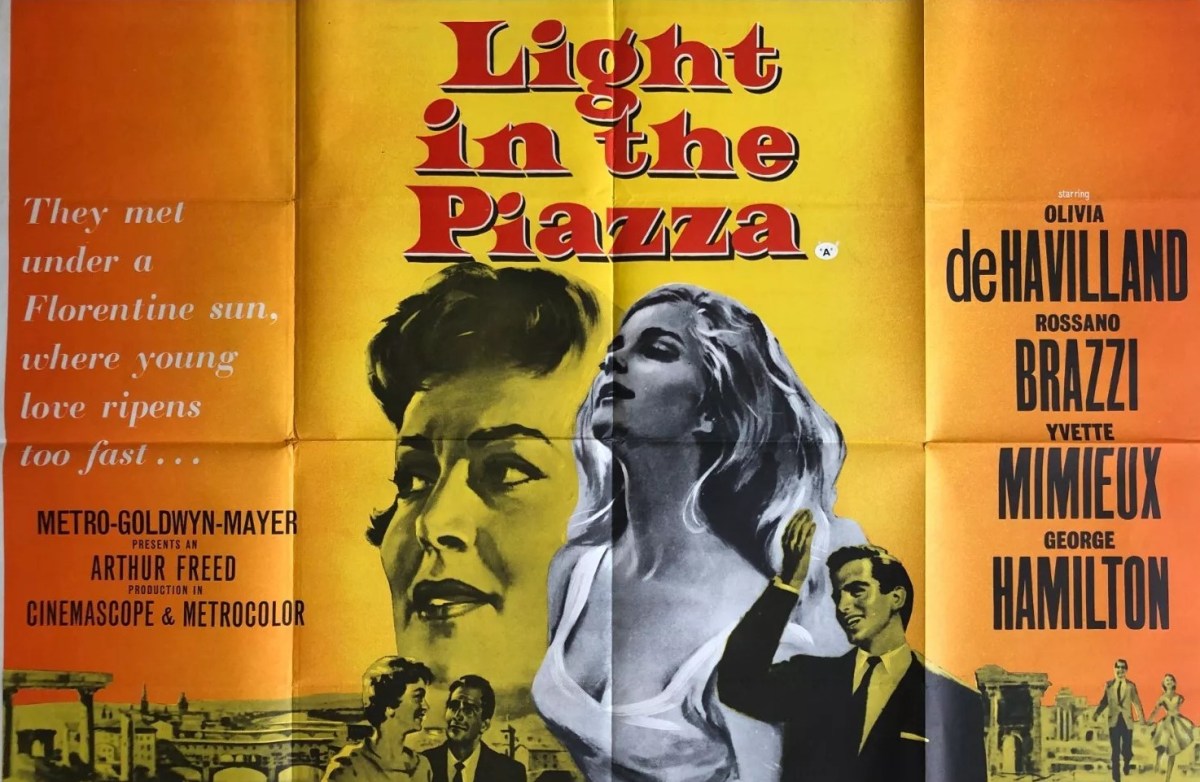
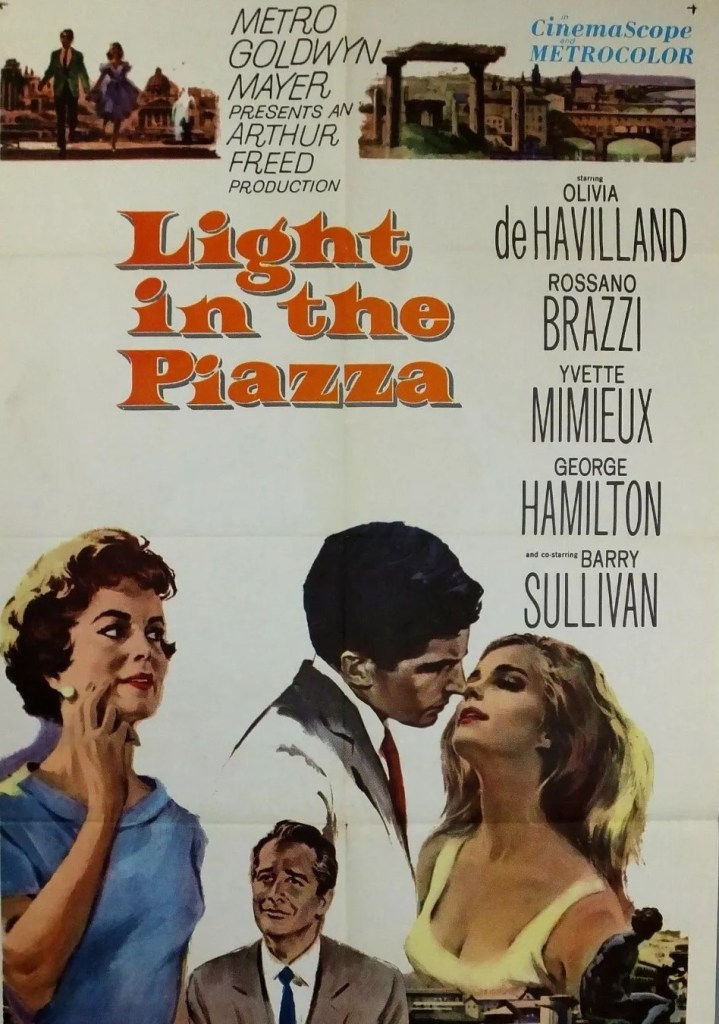
Will resonate more strongly today. Never intended as a light-hearted confection, despite the obvious premise of young love catching fire in Italy, this was a bold picture in its day and a more subtle examination of the wider impact of mental illness than those later movies set in institutions such as Lilith (1962) or Shock Treatment (1964). Bold, too, of Olivia de Havilland to take on a role that is so transparently maternal. Instead of her middle-aged character succumbing to romantic opportunity as the billing might suggest, to a holiday affair with a rich handsome Italian, she is first and foremost a mother.

Initially, standard romance meet-cute as young Italian Fabrizio (an unlikely George Hamilton) catches the runaway hat of young blonde Clara (Yvette Mimieux) in a piazza in Florence. His ardent pursuit is thwarted at every turn by Clara’s mother Meg (Olivia de Havilland). At first this appears to be for the most obvious of reasons. Who wants their naïve daughter to be swept away by a passionate Italian with heartbreak and possibly worse consequence (what mother does not immediately conjure up pregnancy?) to come.

Sure, Clara seems flighty and a tad over-exuberant and perhaps prone to tantrums but then back in the day this was possibly just an expression of entitlement by rich indulged young women. Turns out there’s a more worrying cause of her sometimes-infantile behavior. She was kicked in the head by a pony and has the mental age of a child of ten. If she is not protected, she might end up as prey to any charming young man.

Clara needs tucked up in bed with a stuffed toy, and her mother to check the room for ghosts and read her a bedtime story before she can go to sleep. Even when Fabrizio’s credentials check out – his father Signor Naccarelli (Rossano Brazzi) vouches for his good intentions, but, in the way of the passionate Italians, would not want to stand in the path of true love.

Clara’s father Noel (Barry Sullivan) is the one who spells out the reality. That pony didn’t just kick his daughter in the head it “kicked the life out of” his marriage. His wife lives in a dreamland, hoping for a miracle, and if that is not forthcoming quite happy to live with a daughter who never grows up. He wants to send her to “a school,” convincing himself it’s “more like a country club.”

Meg fights her own feelings that she knows better than her daughter and that love will not provide the cure, at the same time as batting away the affections of the elder Naccarelli. When she finally gives in to her daughter’s desire, wedding plans fall apart at the last minute when Naccarelli Snr discovers that his 20-year-old son is marrying not, as he imagined, a woman of roughly the same age or slightly younger, but actually someone six years older. Eventually, the wedding goes ahead. Meg convinces herself she did the right thing in permitting the marriage to go ahead.

But this is one of those happy ever afters that don’t quite wash and you might find yourself wondering exactly how it played out when the husband discovered exactly what kind of wife she had. Her instability isn’t genetic so no danger of a subsequent child encountering the same issue. And having to care for someone other than herself might well bring out the same level of maternity as her mother shows, but equally clearly Fabrizio is unaware of exactly what he’s taking on. How will he feel when asked to read her a bedtime story or scour the cupboards for imaginary monsters.

The movie didn’t do well enough to warrant a sequel – audiences expecting romantic confection were disappointed – and just hope Clara didn’t turn into the kind of inmate seen in Lilith and Shock Treatment.

Still, takes a very realistic approach to the problems of someone with such problems maturing into adulthood.

The Oscar-garlanded Olivia de Havilland  (two times winner, three times nominee), in her first picture in three years, clearly didn’t want to see out her maturity in those May-December roles that others of her age fell prey to. She is excellent here, no attempt to dress herself up as a sex bomb, and refreshing to see her approach. Yvette Mimieux (Diamond Head, 1962) is excellent as the confused youngster. George Hamilton  (The Power, 1968) lets the side down with his speaka-da-Italian Italian but Rossano Brazzi (The Battle of the Villa Fiorita, 1965), who is Italian, has no trouble with the lingo or with being a smooth seducer.

Director Guy Green (Diamond Head, 1962) adds in some unusual Florentine tourist color, but doesn’t shirk the difficult storyline. Julius J. Epstein (Casablanca, 1942) wrote the script.

Worth a look

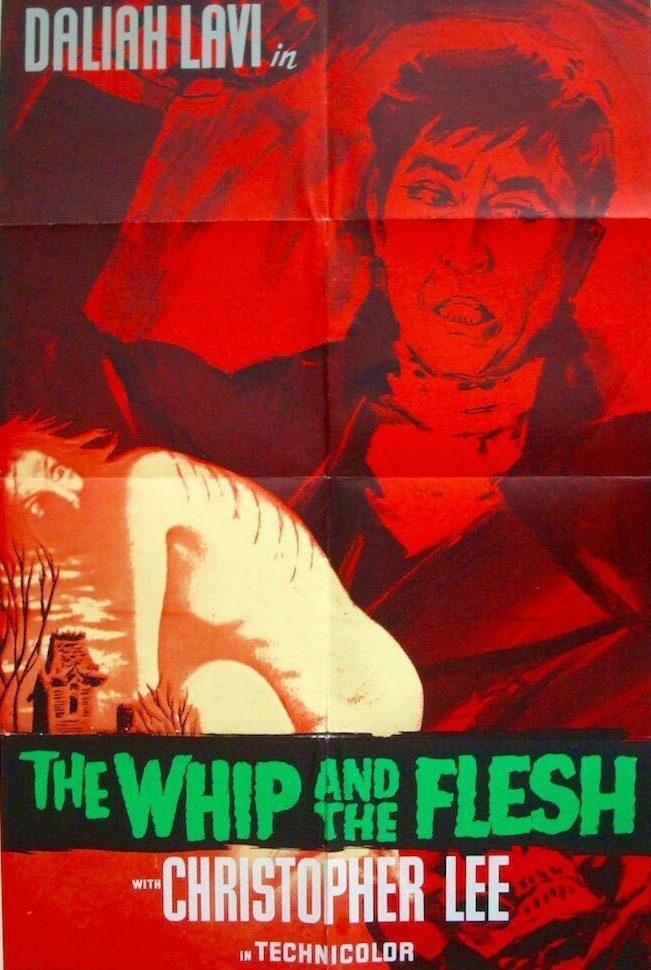
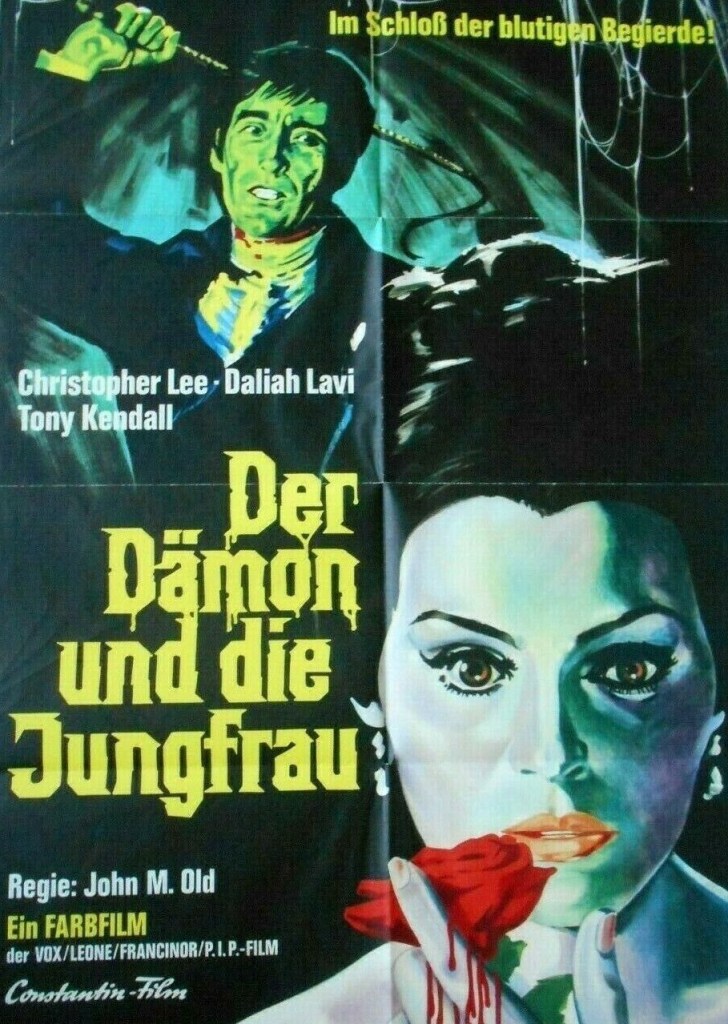
The Whip and the Flesh / The Whip and the Body (1963) ****

Has there ever been actress so skilled at displaying fear as Daliah Lavi? Where the female stars of horror movies too quickly succumbed to the scream and goggle eyes, Lavi could run a whole gamut of terror without uttering a sound and continue doing so for virtually an entire picture. Top-billed ahead of the reigning king of British horror Christopher Lee, this is another acting tour de force, not quite sustaining the intensity of The Demon (1963) but at times not far off it.

Italian director Mario Bava (Black Sabbath, 1963), here masquerading as John M. Old, has stitched together a mixture of horror, and an early form of giallo, the picture taking place in the classic old dark house, in this case a castle perched on a rock above the sea, the deaths grisly, and almost fits into the “locked room” subgenre of the detective story, where the murders appear impossible to carry out.

The disgraced Kurt Menliff (Christopher Lee) returns to his ancestral home, begging forgiveness from his father Count Vladimir (Gustavo De Nardo) and hoping to reclaim his inheritance and his betrothed Nevenka (Daliah Lavi). While his father exonerates him, Kurt is denied the rest, Nevenka already committed to marriage to his brother Christian (Tony Kendall). Other tensions are soon evident: the housekeeper Giorgia wants revenge on Kurt for the death of her daughter and Christian is in love with another, Katia (Evelyn Stewart).

Nevenka who outwardly protests how much she hates Kurt quickly reveals masochistic tendencies as she gives in to a whipping. But Kurt’s sudden inexplicable murder instigates an investigation, suspicion falling firstly on the father, then Christian and finally Giorgia.

But Nevenka is convinced Kurt is not dead, although his body has been entombed in the castle crypt. Torment creeps into her face at his funeral and we can almost see her grow gaunt in front of our eyes. In a brilliant scene where she tracks what she imagines to be the sound of a whip it turns out to be a branch lashing a window in a storm. Some of her supposed visions are easily explained, muddy footsteps leading from Kurt’s tomb actually belonging to the limping manservant Losat (Luciano Pigozzi). But how do you account for the hand, in an almost 3D shape, reaching out to her in the darkness? Or her ecstasy in still being whipped, her nightdress stripped from her back?

Although sometimes relying too heavily on atmospherics – windows swinging open at night, storm outside – Bava brilliantly marshals the real and the imagined, until the investigation into murder involves all the characters. Once the film begins, the drawbridge in a sense comes down, and nobody else enters the castle, and so we move from one character to another, each with their own motive for possibly committing dire deed. And with each passing moment we return to the demented Nevenka, who wishes Kurt dead but cannot live without him, and, craving the whip, cannot escape his sadistic power. Her faith in Kurt’s resurrection is so intense that the others are soon seeking signs that the dead man is still alive.

This is a horror superior to Hammer. Using the same leading man, the British studio generally expected Lee to be over-the-top, his innate malevolence generally very obvious from the start. Here, he is at his most handsome and although definitely sadistic, the emphasis is less on his pleasure than that of his victim. And while Bava resorts to a similar kind of set, this castle is remote, has no relationship with villagers, and exudes regal dominance rather than just the normal fear of a Dracula picture. Bava employs a more subtle color palette and the piano theme tune by Carlo Rusticelli has a romantic tone.

But for all Bava’s proven skill, this would not be the same without Lavi. I doubt if there is a single actress in the horror domain throughout the 1960s who could match the actress for portraying fright, as she marches up the scale from mere anxiety to full-blown terror. And although women in Dracula movies succumbed to vampire teeth with more than a frisson of sexuality, there is a different deeper sensuality at work here, in what must rank as one of the greatest-ever portrayals of masochism embedded in love.

As noted previously, Lavi, in stepping onto the bigger Hollywood canvas of Lord Jim (1965) and The Silencers (1966), lost the intensity she displayed here and never came close to matching this performance or that of The Demon. Christopher Lee, although claiming to dislike his experience, continued to rule the horror world until he was afforded a wider audience through James Bond, Star Wars, J.R.R. Tolkien and Tim Burton. 

Tony Kendall, making his debut, soon graduated to the Kommissar X series, spaghetti westerns (he played Django twice), horror (Return of the Evil Dead, 1973), and thrillers such as Machine Gun McCain (1969). Evelyn Stewart went down much the same route, her long career sprinkled with gems like Django Shoots First (1966), The Sweet Body of Deborah (1968) and The Psychic (1977).

Mario Bava continued to exploit the horror vein including Blood and Black Lace (1964), Planet of the Vampires (1965) and Lisa and the Devil (1973) with Telly Savalas and Elke Sommer.

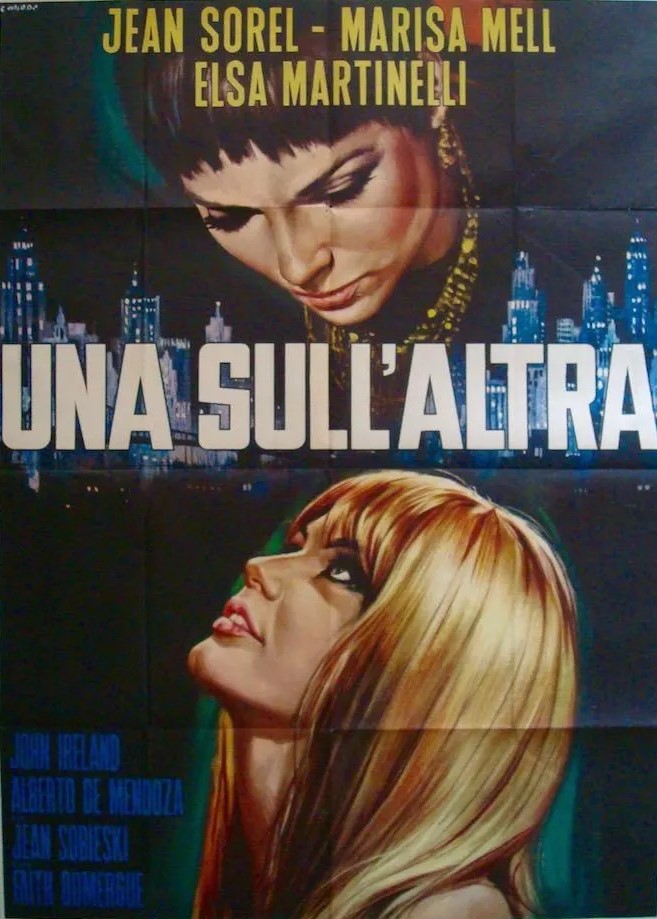
One on Top of the Other / Perversion Story (1969) ****

No idea how they thought they’d market this one. Neither of these titles would recommend it to first run, more likely sending it down the exploitation route. Which would be a pity because, although there is enough nudity and sex to satisfy those patrons, it is, almost to the very end, clever noir, femme fatales to the fore, and the kind of male patsy who would later decorate the likes of Body Heat  (1981). And if it played out as all instinct – except that of a happy ending – told you, it would have been an absolute cracker. As it is, it’s more Hitchcock than giallo, director Lucio Fulci’s, known at that time for comedies, first dabble in crime, and with excellent cinematography and plot twists.

As it is, said sucker has a hell of a time, turned inside, beset by paranoia and trickery until he’s all set for the electric chair and it boasts a classy cast. It’s set in San Francisco, though I found those hilly streets a distraction as any minute I expected to see Bullitt racing over the top or Sean Connery demolishing a streetcar before heading to The Rock.

Asthmatic sickly wife Susan of top surgeon George (Jean Sorel) dies from accidental overdose in the first few minutes. The good doctor isn’t so upset, he’s having an affair with fashion photographer Jane (Elsa Martinelli) and is astonished to discover he’s about to inherit a couple of million from her insurance. That’ll come in handy because his business is going down the tubes.

But an anonymous tip sends him into a topless bar where the star performer and sometime sex worker Monica (Marisa Mell) bears a startling resemblance to his wife, blonde where she was brunette, brown eyes rather than green, but otherwise almost a dead ringer. But he’s seen his wife’s stone-cold corpse so he gets the doppelganger heebie-jeebies. Still, it’s not long before he’s testing out his theory and in the most intimate fashion.

But there’s an insurance agent on his tail, taking note of the philandering, and his concerns force the cops to re-open the case and discover Susan was poisoned and with George the obvious beneficiary that makes him the obvious suspect. Meanwhile, Jane’s trying to find out what’s Monica’s game, to the extent of giving her a fashion gig that goes a few steps beyond the Blow-Up playbook.

Top cop (John Ireland) isn’t slow to put two and two together and reckon Monica and George are in it together and bumped off Susan. He finds evidence of Monica perfecting Susan’s signature. But while Monica skedaddles, George is on the hook and eliminating all that annoying courtroom guilty/not guilty objection sustained  palaver, the movie cuts to the chase and the surgeon is lined up for an appointment with the chair, knowing full well he’s innocent.

In a terrific twist I didn’t see coming turns out his brother Henry (Alberto de Mendoza), partner in the business, has been having an affair for years with Susan who – yep – is Monica after all, and takes delight in telling George what a sucker he’s been. Henry will inherit the dosh and take up where he left off with Monica/Susan. George hasn’t exactly elicited audience sympathy, although he’s occasionally staring moodily in the camera as his brain can’t compute what’s going on, and he’s a two-timing swine – no, make that three-timing – no, two-timing if Monica actually is his wife. Anyway, he doesn’t cover himself in glory whereas Monica is a class act, not just sexy as all-get-out but playing him beautifully, so you kind of want her to get away with it especially as you didn’t see the brother angle coming, and you just marvel at how cleverly George has been duped.

George is saved and the picture unaccountably suffers at the last minute when out of the blue a jealous client Benjamin (Riccardo Cucciolla) turns on the getting-away-with-it pair and blasts them to high heaven.

George is an unusual character, dominated by both women. When we first encounter Jane she’s on the point of dumping him, after a bout of sex first of course, and he’s the one who chases after her. But Susan clearly enjoys stringing George along, taking control in their lovemaking in a manner she clearly didn’t when being Susan, as if her new-found has freed her from her inhibitions.

My guess is this was heavily cut for U.S. and U.K. release and also that the moviegoers coming along expecting sexploitation might have been somewhat surprised to find themselves watching a Hitchcockian homage, but with the bad girl as the heroine.

A few plot flaws don’t hole this beneath the waterline. Great acting all round, Marisa Mell (Danger: Diabolik, 1968) the pick, but Elsa Martinelli (Hatari!, 1962) every bit as calculating and seductive. You feel sorry for Jean Sorel (Belle de Jour, 1967) caught between the two.

Lucio Fulci (A Lizard in a Woman’s Skin, 1971) makes the most of the locations and ensures the women, rather than the man, take center stage.

Take away the exploitation elements and you’ve still got a great thriller that turns on its head all expectations.

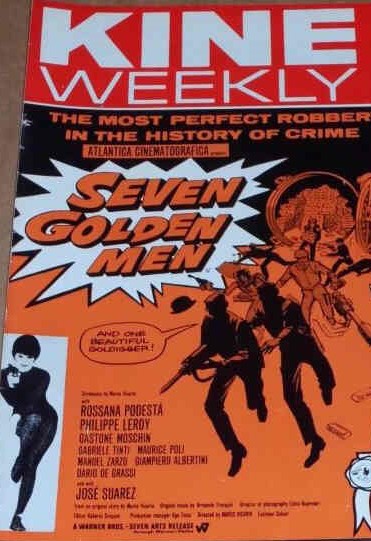
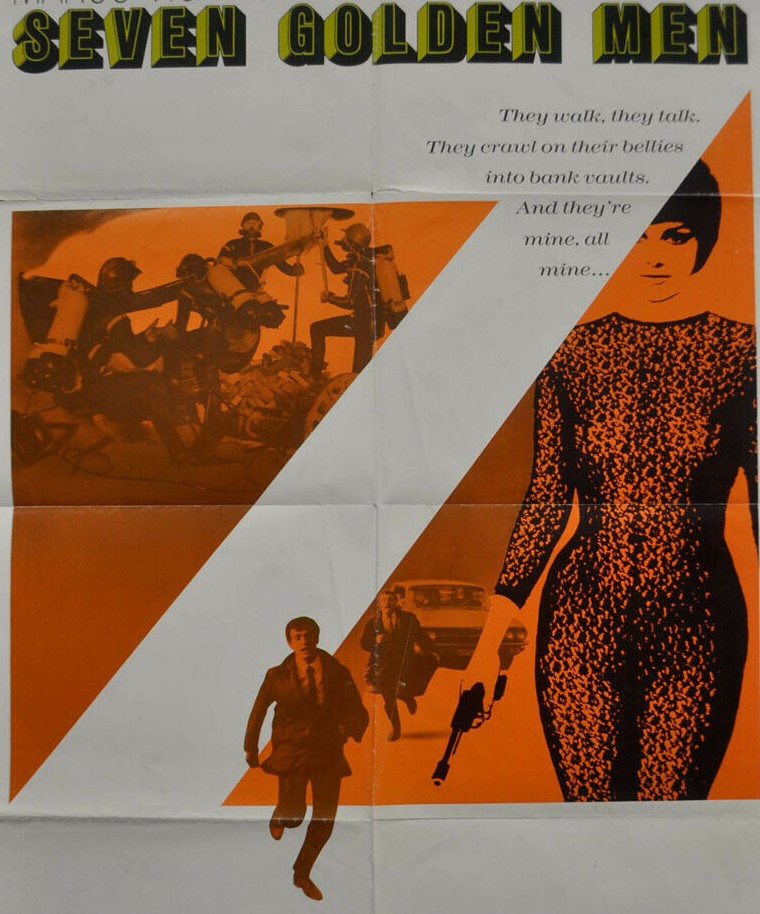
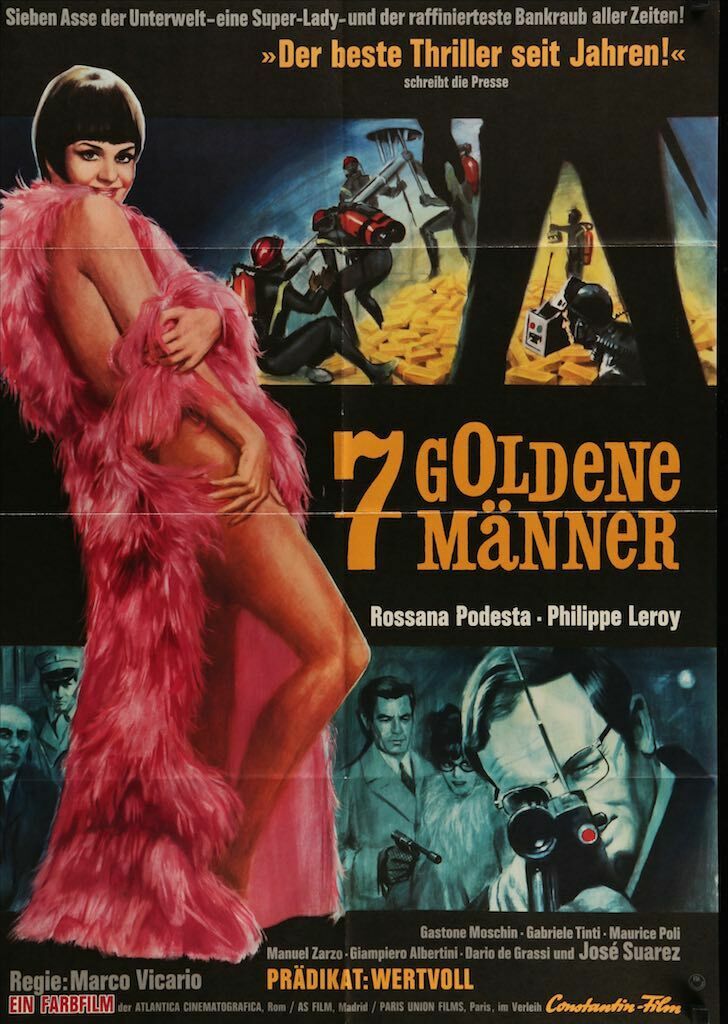
Seven Golden Men (1965) ****

Very stylish caper picture that dispenses with the recruitment section, the ingenious hi-tech robbery accounting for the first half, escape and double-cross the second, a slinky Rosanna Podesta an added attraction/distraction. The Professor (Phillippe Leroy), in bowler hat and umbrella, orchestrates the gold bullion theft from an uber-secure bank using hidden microphones and cameras and a host of electronic equipment, the inch-perfect heist organized to mathematical perfection and timed to the second.

His team, disguised as manual workers, dig under the road, don scuba gear to negotiate a sewer, drill up into the gigantic vault and then suck out the gold bars using travelators and hoists. Giorgia (Podesta), sometimes wearing cat-shaped spectacles, a body stocking and other times not very much, causes the necessary diversions and plants a homing device in a safety deposit box adjacent to the vault. Occasionally her attractiveness causes problems, priests in the neighboring block complaining she is putting too much on show.

It’s not all plain sailing. A cop complains about the workmen working during the sacrosanct siesta, a bureaucrat insists on paperwork, a radio ham picks up communication suggesting a robbery in progress, the police appear on the point of sabotaging the plan.

But the whole thing is brilliantly done, the calm professor congratulating himself on his brilliance, Giorgia seduction on legs. The getaway is superbly handled, the loot smuggled out in exemplary fashion, its destination designed to confuse. Then it is double-cross, triple-cross and whatever-cross comes after that, with every reversal no idea what is going to happen next. It is twist after twist after twist. Some of the criminals are slick and some are dumb. As well as the high drama there are moments of exquisite comedy.

Italian writer-director Mario Vicario (The Naked Hours, 1964) handles this European co-production with considerable verve and although, minus the normal recruitment section, we don’t get to know the team very well except for the professor and Giorgia, each is still given some little identity marker and in any case by the time they come to split the proceeds we are already hooked.

Frenchman Phillippe Leroy (Castle of the Living Dead, 1964) is the standout as a mastermind in the British mold, stickler for accuracy, calm under pressure, working with military precision. Podesta (also The Naked Hours) has no problem catching the camera’s attention or playing with the emotions of the gang to fulfill her own agenda. The gang is multi-national – German, French, Italian, Spanish Portuguese, Irish – with only Gabriel Tinti likely to be recognized by modern audiences.

And there is a terrific score by Armando Trovajoli (Marriage Italian Style, 1964) that changes mood instantly scene by scene. One minute it is hip and cool jazz, the next jaunty, and then tense.

Worth a watch.

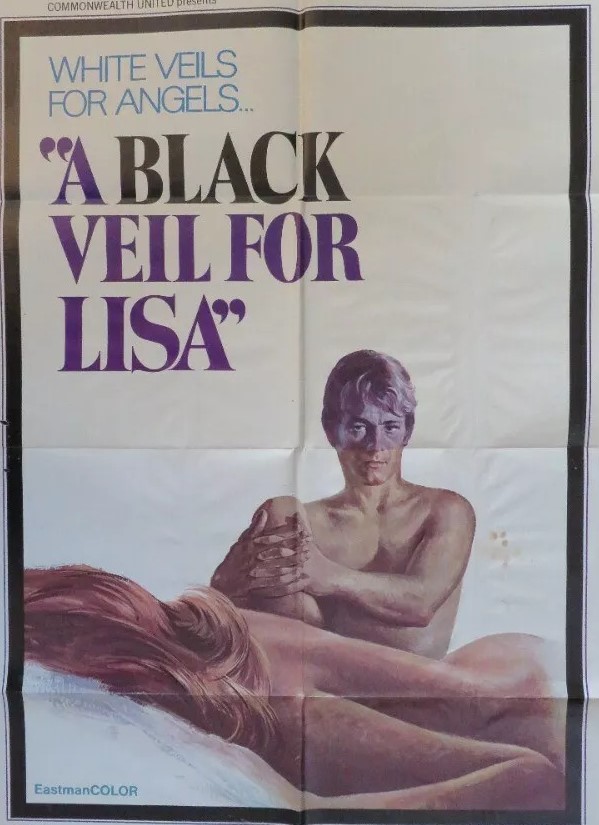
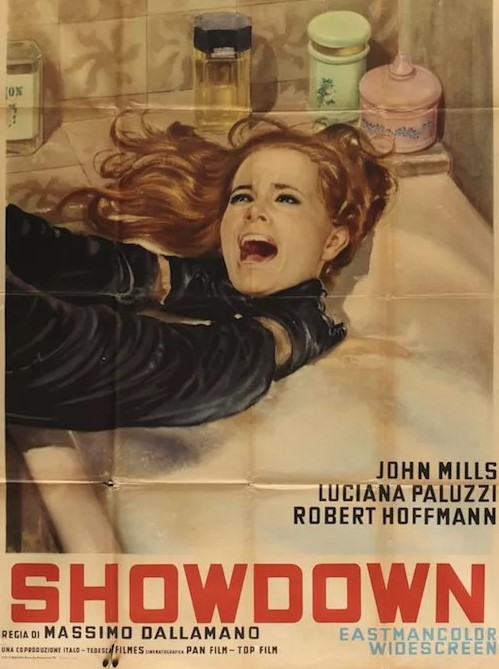
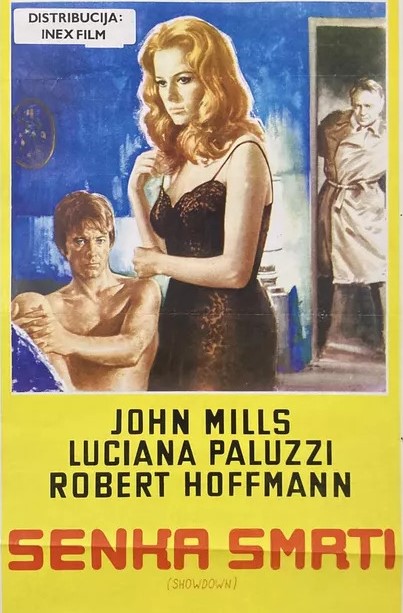
A Black Veil for Lisa (1968) ***

John Mills ventures back into Tunes of Glory (1960) territory as a top official coming apart at the seams. This time it’s not the British Army but the Italian Police where, as Franz Buloff, he heads up the narcotics squad. And this time he’s not the complacent victim but decides to take action against his tormentor.

Closing in on drugs kingpin Scheurermann, he finds that one witness after another is being silenced by an assassin with a deadly knife. He suspects a leak in his department, unaware the traitor is much closer to home. And despite the usual dissatisfied boss Ostermeyer (Tillio Altamura) breathing down his neck, he would be making more headway if it wasn’t for the fact that his head is constantly filled with images of his wife Lisa making love to another man.

For her part, Lisa seems determined to unhinge her husband, eliciting jealousy at every turn, by never answering the phone at night and always an excuse, when he tracks her down, for not being where was supposed to be. Rather than calming him down, her occasional seduction of her husband only serves to ramp up his fury.

In any case, it’s an odd set-up, he’s much older and the security he offers is not just financial. She was once a suspect herself and being married to a top cop has put a force field between her and suspicion. There’s clearly an unspoken assertion that somehow she has duped the cop, making him fall in love with an apparently innocent woman. They couldn’t be more opposite. “I like danger,” is her mantra.

He breaks open the case after following up a clue dropped at the scene of the crime. After arresting Max (Robert Hoffman), he strikes a deal with the killer. In return for his freedom, the murderer has to take out Lisa. But, of course, it’s not as simple as that. When Buloff realizes the deep water he is treading, he calls off the assassination. But then when he discovers that Max has helped himself to a bonus – beginning an affair with Lisa – he recants and puts the man back on the spot.

So, now, it’s Max who faces the quandary of having to kill his lover. And that puts up square in cat-and-mouse territory.

This isn’t quite giallo, the genre was still in the process of being born, in part because there’s no mystery about the killer, in part because the murders aren’t bloody enough, and in part because the dead aren’t sexy young women. So it’s more a series of character studies, each driven to an edge by an action that otherwise would be out of character.

A top cop like Buloff should have been a better judge of character than to fall for Lisa’s wiles in the first place. Lisa, too, should have recognized her penchant for the seedier side of life rather than being as she puts it “too young to be buried alive” in a stifling marriage to a jealous husband. But, she, too, is a poor judge of character, expecting to win back the favor of the drug overlord after she had so openly crossed the tracks to the other side of the law.

And Max, one of the first of a series of killers in movies who wanted out (see The Brotherhood, 1968, and Stiletto, 1969), is trapped into more killing because nowhere is safe. Getting rid of Buloff was never in his plans, as that would draw even more unwelcome attention. But then neither was falling in love with the cop’s wife. There’s still a few twists to go not least when Lisa discovers that the husband she felt she had under control had broken free and was intending to have her killed.

John Mills, a surprising addition to the Brits heading for Italy, is excellent especially as the big flaw in Tunes of Glory was his inability to find the cunning to strike back at his chief tormentor. Here, he might have second thoughts about dispatching his wife, but revenge is always the best weapon.

Luciana Paluzzi (Chuka, 1967, which, incidentally, also featured Mills) gets her teeth into a decent role rather than been saddled in lightweight fare since swanning around in swimwear in Thunderball (1965). Austrian Robert Hoffman (Assignment K, 1968) is given a surprising range of emotions to deal with.

Massimo Dallamano (Venus in Furs, 1969) handles the material well and gets the best out of his cast without taking the bloodier route of the later giallo. He was one of four writers contributing to the screenplay. This was one of the feature films made by new American mini-major Commonwealth United, one of the stack of “instant majors” popping up around this time.

John Mills is always watchable and the twists make this one play.

Darling (1965) ****

Amorality tale. Compulsive opening but contradictory ending. Nobody comes out of this well as male and female alike use each other with little compunction shown. British film making that at one point appeared to be disappearing down the kitchen sink explodes into life with an exploration of just how far the Swinging Sixties can swing. Julie Christie picked up the Oscar for her portrayal of the impulsive, wilful, yet vulnerable model sleeping her way to the top, an unpopular theme in today’s climate.

The credits open with a striking image. A poster for global hunger relief being pasted over by one advertising model Diana (Julie Christie), the face of the decade. There are various other potshots at the hypocritical rich, fawned over for deigning to distribute some of their wealth to the poor, but it doesn’t quite complete the circle, because it’s exactly this kind of virtue-signalling philanthropic society to which Diana, with no sense of judgement, aspires.

It would be more convenient to view Diana as exploited, but, in fact, once she loses her puppy innocence, she is as good at the exploitation game as anyone else. First port of call is dull BBC arts journalist Robert (Dirk Bogarde) who provides her with an opening into the fashionable London set. Both, I should mention, are married, but ditch partners (and children in Robert’s case) and set up home together, she in demand as a hostess at charity events.

Trading sexual favors with advertising executive Miles (Laurence Harvey), she wins a role in a B-picture and his backing to make her the face of a campaign advertising chocolates, that commercial filmed in a palazzo in Italy owned by uber-wealthy but older Cesare (Jose Luis de Vilallonga), a prince, from whom she eventually accepts a marriage proposal, only to find she’s just as bored in Italy as elsewhere. There’s a speedy return to London and Robert’s bed, but he dumps her. Theoretically, she’s so powerless and vulnerable, poor lamb, that she submits to his plan to send her back to Italy, rather than, by now considerably more powerful, starting all over again with someone else.

Possibly the morality of the time or in keeping with some movie dictat required an unhappy ending (of sorts). But this seems to contradict her personality. Bear in mind she had already shown how readily she traded men, and you could already see her running off with a wealthy playboy in Italy and dumping  the prince.

At the remove of over half a century, the wild goings-on would be viewed as tame by contemporary standards, and the flashiness of the style, which attracted criticism, would be ignored in favor of the stunning performance by Julie Christie and her empowered female. Sure, she’s emotionally immature, shallow and all the rest of it, and as likely to become a member of the hypocritically rich, but she’s managed to finesse a life as a model into a high-flying princess with the world at her feet and sure as heck she would soon learn how to manipulate that world as easily as Swinging London.

The only dated aspect is the sexuality, much of which was sneaked in under the censor’s nose (though I would imagine would be considerably cut for U.S. audiences) but that acts as a time capsule for a period when homosexuality was still in Britain punishable by law. Nonetheless, there are fleeting references to cross dressing, an orgy, a threesome and oral sex. (Although a cynic might observe how effective courting controversy was for publicity purposes). In some senses, the obsession of director John Schlesinger with thumbing his nose at the censor gets in the way of the central section which is meant to show how far, in terms of decadence, Diana has fallen when in reality she seems to enjoy exploring the wilder and more sensual parts of her personality.

There’s a clever role-reversal. Usually, it’s the man who plays away from home but expects to still be accepted back by a resigned partner. Here it’s Diana. If the men in her life are to be blamed at all it’s for being dumb, not recognizing her ambition and demanding nature. A lover who continues to tap away at his typewriter while Diana exhibits signs of restlessness is as dumb as they come. Miles and Cesare are more her type, the sexually voracious former switching partners at the drop of a hat, while the older man probably already has a mistress stashed away and expects his trophy wife to pick up a discreet lover in the way of aristocracy the world over.

So, at the remove of several decades, a different Diana emerges, one very much in control of her own destiny, picking up men as it suits her purpose, yes still some emotional growing-up to do, but you could easily see her turning into one of the dowager duchesses who run these fundraising balls with young bucks like Miles lionising her and leaving a few other husbands and/or lovers in her wake, possibly still unhappy, but the rich rather than the poor version.

Not sure if she’d qualify as a feminist icon, but she certainly navigated the world of the male gaze and used it to her advantage.

Turned director John Schlesinger (Midnight Cowboy, 1969) into a brand name. Nominated for five Oscars including Best Picture and winning for three, Julie Christie as Best Actress, Frederic Raphael (Two for the Road, 1967) for the script and Julie Harris for costume design. Bogarde, as well as Christie, reigned supreme at the Baftas. Commercially, one of the most successful British films ever, on a budget of around $1 million earning over $4 million in U.S. rentals alone.

Ending doesn’t ring true, but the rest does.

Hornets Nest (1970) ****

Given exceedingly short shrift in its day. Viewed as in exceptionally poor taste. Marketed in some respects as Lord of the Flies Meets The Dirty Dozen. Audiences accepting of kids putting on a show or, the modern equivalent, making a movie, not so keen on youngsters going to war. In any case there’s an inbuilt repugnance as you get the distinct impression some of these kids would have been ideal recruits for Hitler Youth or the Mussolini version.  And Italy, one-time ally of Hitler, becoming suddenly heroic seemed to jibe. Not to mention Rock Hudson’s marquee value fading fast after a gigantic turkey called Darling Lili (1969). Despite some distinctly unsavory aspects, bordering on exploitation, this seems enormously underrated, not just as an actioner, but for a raw depiction of war, far more realistic than many in the genre that toplined on violence.

Sure, it’s an odd concept, Italian kids, in the absence of adults, turned into a fighting force by dint of letting loose their innate venality and savagery. But they’ve not been washed up, adult-free, on a desert island. This small bunch have been orphaned and bloodily. Germans on the hunt for local partisans execute an entire village and then, finding a quisling, proceed to massacre the local resistance and for good measure destroy a team of American parachutists dropped into the area to facilitate the Allied advance.

The kids come across the one survivor, Turner (Rock Hudson), hide him from the enemy and dupe German doctor Bianca (Sylva Koscina), sympathetic to the plight of the innocent, into caring for the wounded soldier. Rather than hang around and accept the ministrations of such a beauty and see out the war with a view to possible romance, Turner is intent on single-handedly completing his mission of blowing up a dam.

Given the kids have amassed a secret armory and are trigger-happy, desperate to avenge their parents, and getting down to the gung-ho aspects of war, Turner, with appalling disregard for their safety, decides to commandeer them for his own unit. Bianca objects and watches with horror and for most of the rest of the picture confines herself to the pair too young to be considered combatants and who reek of desolation or to find ways of killing Turner or betraying him to the Germans.

Meanwhile, the kids have their own ruthless leader, Aldo (Mark Colleano), one part John Wayne, one part the creepy Maggott (Telly Savalas in case you’ve forgotten) from The Dirty Dozen, who objects to taking orders. Training consists of little more than a bit of marching in file and learning how to quickly reload a machine gun. Turner’s clever plan is to use their perceived innocence to distract the Germans guarding the dam. The distraught Bianca, stepping out of line once too often, is raped for her trouble.

Oddly enough, Koscina does take a machine gun to the Germans, which you would have thought would be catnip to the marketeers, but that image is excluded from the poster.

Setting aside all audience misgivings about the premise and the sexual undertones, the mission is very well done, plenty tension, a workable plan, and the eventual dam-burst impressive on the budget.

But the misgivings are not glossed over. There’s a dicey moment when it looks as if the kids, crawling all over the nurse, tearing off her clothes, are about to embark on mass juvenile rape. And the bloodlust will only be slaked when, by dint of secreting the detonators essential to the plan, they force Turner to lead them on a raid on the Germans, tossing hand grenades into houses and opening fire from the back of a truck on the unsuspecting enemy.

Aldo, in particular, gets a taste for killing and in a later battle doesn’t hold back when one of his comrades inadvertently gets in his way.

Sold as a junior edition of a mission picture, the trailer would have probably been enough to put off large sections of the audience, uncomfortable with kids being employed in such mercenary fashion. Kids grow up in war but not that fast seemed to be the general reaction. Okay if they’re portrayed as victims, less acceptable as gun-happy butchers.

So, the best elements of the movie is in not avoiding such misgivings. It was soon clear from the American experience – though this is not specifically alluded to – that hordes of kids in Vietnam were going down this route. The point at which kids cross over into bloody adulthood and lose the essence of childhood is dealt with too. That scene on the face of it and in isolation appears maudlin but in the context of the picture works very well. But the violence or its aftermath are not the most striking images. Again and again, the camera returns to the dirty, clothes-tattered, Bianca clutching the two infants, the detritus of conflict.

Setting aside his moustachioed muscle, Rock Hudson (Seconds, 1966) gives a well-judged performance and Sylva Koscina (A Lovely Way To Die, 1968), shorn of glamor, holds the emotional center. Mark Colleano (The Boys of Paul St, 1968) gives a vicious impression of a young hood on the rise. Directed by sometime cult director Phil Karlson (A Time for Killing, 1967) from a script by S.S. Schweitzer (Change of Habit, 1969) and producer Stanley Colbert. Great score from Ennio Morricone.

It’s worth pointing out that the idea of kids taking up arms received positive critical approval when it was applied to such an arthouse darling as If… (1969) but of course they were public schoolboys forced into action by bad teachers and in reaction to “the establishment” and not after seeing their families slaughtered. Double standards, methinks.

Worth reassessment.

Stiletto (1969) ***

The bursting of the B-movie bubble dealt a death blow to the careers of the two stars here. In the past, rising talent who failed to make the marquee grade could find almost a lifetime of contentment in low-budget westerns, neo-noir thrillers and down’n’dirty exploitationers with the hope of an occasional supporting role in a bigger picture to ease their path. By the end of the decade, just about the only option were Roger Corman biker flicks or spaghetti westerns. Especially if they had gone down the tough guy route, B-pictures might have provided an exemplary move for both Alex Cord and Patrick O’Neal. As it was, this was their last shot at the big time. And it was lean pickings.  

Retirement can be a tough call any time for a high-flying businessman. But when you’re at the top of your profession in the Mafia, loosening such ties can prove problematic. Count Cesare (Alex Cord) is a part-time assassin, spending the rest of his time as a fun-loving playboy with a string of women, fast cars and racehorses. Only problem is, he wants to retire from the Family – and not in normal fashion, weighted down by a block of cement. Unfortunately, his dilemma doesn’t solicit sympathy from boss Matteo (Joseph Wiseman).

Adding to his problems is tough cop Baker (Patrick O’Neal) on his tail who fastens onto illegal immigrant Illeana (Britt Ekland), Cesare’s girlfriend when he’s not pursuing Ann (Barbara McNair). A strictly by-the-numbers thriller it’s enlivened by two underrated tough screen hombres. Alex Cord (The Brotherhood, 1968) isn’t given enough of a character here to  tug at audience heartstrings although elsewhere he had proved better-than-expected value. If anything, he’s an existential kind of hero.

Cord made a brief splash as an action hero in the monosyllabic Clint Eastwood/Charles Bronson mold after debuting in the John Wayne role of the Ringo Kid in the remake of Stagecoach (1966) and didn’t have more than half a dozen stabs at making his name on the big screen before disappearing into the television hinterlands. So he’s something of an acquired taste, maybe the small output enough to qualify him for cult status. Here, he’s a decent fit for the violence but saddled with a role that makes little sense.

Patrick O’Neal (El Condor, 1970) followed a similar career trajectory, swapping television with the occasional movie and even managing a screen persona as a snarky type of villain/supporting character. A few more tough-guy roles and he might well have built a stronger footing in the business.

This is another thankless role for Britt Ekland (Machine Gun McCain, 1969), there to add glamor, but, surprisingly, she manages to bring pathos to the part. Barbara McNair (If He Hollers Let Him Go, 1968), always worth watching and who had made an auspicious debut the year before, hardly gets any screen time. 

Director Bernard L. Kowalski (Krakatoa, East of Java, 1968) proves better at the action than the characterization, though, luckily nobody needs to be anything other than tough. Three scenes, in particular, are well handled – the opening murder in a casino, a shoot-out a penthouse and the climax on a deserted island which has more than a hint of a spaghetti western. Joseph Wiseman (Dr No, 1962) rustles up another interesting performance and collectors of trivia might note Roy Scheider (Jaws, 1975) putting in an appearance.

This old-style tough-guy thriller would have been better off had the Cord vs. O’Neal set-up taken center stage, with the assassin on murderous overkill hunted down by the zealous cop. As it is, it’s a missed opportunity for Cord to develop an Eastwood/Bronson persona and enter the action star hall of fame.

Based on a thin Harold Robbins bestseller, the screenplay by W.R. Burnett (The Great Escape, 1963) and A.J. Russell (A Lovely Way to Die, 1968) doesn’t take any prisoners.

Doesn’t quite deliver what it says on the tin, but interesting to see Cord and O’Neal battle it out.

Ripley (2024) ***

I’m not sure I can take eight episodes of this especially in this trendy audience-alienating black-and-white version. Going all monochrome is like a bit like a novelist never deigning to describe the weather or what clothes their characters are wearing and I don’t go for the argument that the B/W is to prevent audiences being distracted by glorious Italian scenery when that’s the exact reason Dickie Greenleaf (Johnny Flynn), spoiled son of shipping mogul, went there.

I don’t know what time of year the tale was set because even the Italian seaside, warm enough presumably for Greenleaf and girlfriend Marge (Dakota Fanning) to go for a swim (Ripley remaining on the beach because his parents drowned, maybe), just looks gloomy. Anyone who can render Italy gloomy needs their head examined.

This isn’t Schindler’s List (1993) – which director Steve Zaillian wrote – that used B/W to sensible artistic effect or even Belfast (2021) where it was employed to depict the grimness of life.

I’m not even convinced by Ripley (Andrew Scott). Sure, the grifter was much more charming and personable, if occasionally awkward, as portrayed by Matt Damon (The Talented Mr Ripley, 1999) or John Malkovich (Ripley’s Game, 2002). This Ripley is just glum. Sure, his little cons don’t always work, but he can’t be as doom-struck as this.

Anyway, the story (eventually) starts when Greenleaf’s father pays Ripley, whom he believes to be a university chum of his son, to bring the errant boy, wasting his time on painting, writing and general idling, back from Italy, presumably to take on the role of inheriting the family business instead of living off his trust fund.

Like Sydney Sweeney’s character in Immaculate (2024) it hasn’t occurred to him that not everyone in Italy can speak English and so is thwarted trying to find directions to his prey’s pad. There’s a seemingly endless scene of Ripley climbing endless flights of stairs (how unfit can he be, Denzel Washington in The Equalizer 3 at least had a decent excuse) and this Ripley seems incapable of worming his way in (at least in Episode One) to his prey’s affections.

Yes, there are a couple of interesting scenes, Ripley changing seats on the subway because he sees a man staring at him on a different train. But most of the directorial art is devoted to snippets of images that have no relevance to the story or even the mood. There’s quite a barmy opening scene, too, of Ripley bumping a corpse down a flight of stairs in a tenement, not, to minimize noise,  wrapping it up in a carpet or hoisting it on his shoulders. But that is clearly a denouement and it could be an awfully dull time away.

All build-up and not much else so far.

Immaculate (2024) ***

As you know we live in a Big Brother pampered society and even going to the movies comes with a health warning. But, I have to tell you, Dear British Censor, “strong bloody violence” doesn’t cut it. Now, I’m as happy to be scared out of my wits as the next guy, jump-out-of-your-seat shocks are part of the fun of horror pictures. But having to close your eyes to plain sadistic action – tongues cut off, feet branded, bellies of pregant women cut open, babies stoned to death – sorry that’s a bit more than “strong.” Maybe torture porn should have a category of its own.

Which is a shame because this is a clever twist on the old trope of the demonic child as proferred by Rosemary’s Baby (1968) and The Omen (1976) – possibly no coincidence either that’s beaten the Omen remake to the punch. Instead of satanic satanists it’s satanic priests and nuns mainlining on some kind of more scientific genetic Da Vinci Code.

And thanks to the runaway success of last year’s Anybody But You, there’s another element at play here, the breakout star’s follow-up picture to gauge if breakout picture was fluke or welcoming a new star into the firmament. Julia Roberts followed up massive hit Pretty Women (1990) with tepid thriller Sleeping with the Enemy (1991) and the soppy Dying Young (1991) but nobody cared how indifferent the follow-ups were and both turned into big hits and wow a star is born. Sandra Bullock arrives out of nowhere in Speed (1994) and follows up with ropey romance While You Were Sleeping (1995) and tepid thriller The Net (1995) and bingo a star is born.

So this is breakout star Sydney Sweeney’s follow-up – excluding Madame Web of course – and I’m not sure if it will sweep up that many of her newfound followers in its wake. Not because it doesn’t deliver the horror goods because outside of the torture porn it’s pretty creepy and with effective twists and if you want to see a bloodied Sydney creep out of a hole in the ground and give birth and then, as if confounding her newfound bubbly screen personality, beat the baby to death then this one is for you.

Anyway, let’s backtrack. Cecilia (Sydney Sweeney), a young American who had a near-death experience, hives off to an Italian convent filled mostly with the devout, the lost and the broken. It’s not Nun of Monza, and it’s not terribly strict either and even though she couldn’t be bothered learning Italian (don’t these nuns speak English?) there’s always someone on hand to help translate. She makes one friend and one enemy, but, hey, like any boarding school that’d be par for the course.

So, here she is settling in, becoming a bride of Christ, taking vows of chastity, obedience and poverty when suddenly charming Fr Tedeschi  (Alvaro Monte) comes over all nasty, questioning whether she is a vigin or not. Just when that is established to everyone’s content comes the zinger – she’s pregnant by what is known in Catholic Church parlance as immaculate conception. Quite how this occurred is never explained, except the convent has an artefact claimed to be one of the nails that stuck Jesus to the cross and therefore containing remants of blood (we’re going Jurassic Park here) and thus his genetic code.

You won’t be surprised to learn that she’s not the first victim of this kind of conception. Things start to get fairly nasty after this – someone tries to drown here and then we’re in for the tongue-cutting, branding etc – and Cecilia goes from docile to vengeful. She comes up with a clever trick to escape and when that doesn’t work has to find another way out of her dilemma and if that involves strangling someone with rosary beads that seems nicely ironic in the circumstances.

It was certainly a day of mean mothers in my Quadruple Bill on Monday, this being the last of my quartet. It was certainly well done and the concept no more barmy than any of the demonic baby tropes, if a bit more up-to-date medically, and there was enough of the claustrophic creepiness that comes with the convent territory and the throwback barbarity of the Church (Spanish Inquisition, anyone?). Apart from the torture porn, a good entry into the genre but, despite Sweeney’s performance, this would not have put her in the break-out league. So I think this will just be put behind her as she charts a new rom-com course. Incidentally, like Anna Hathaway and Jessica Chastain in Mother’s Instinct, she was the producer.

Worth seeing for Sweeney, though, and the clever plot ploy.

Discover WordPress

A daily selection of the best content published on WordPress, collected for you by humans who love to read.

The Atavist Magazine

by Brian Hannan

WordPress.com News

The latest news on WordPress.com and the WordPress community.