Behind the Scenes: “True Grit” (1969)

Not cut out for the musicals, comedies, historical adventures (let’s not count The Greatest Story Ever Told, 1965), thrillers, dramas, and spy pictures that dominated that 1960s the western was John Wayne’s default. After his initial battle with lung cancer, he enjoyed an extended period of success in Henry Hathaway’s The Sons of Katie Elder (1965), Howard Hawks’ El Dorado (1967) and Burt Kennedy’s The War Wagon (1967) before diversifying in Vietnam war picture The Green Berets (1968), which he directed and was also a hit, and Andrew V. McLaglen oil drama Hellfighters which did, however, fall short of his high box office standards. So when any big western picture was mooted, it was either Wayne or James Stewart to whom producers first came calling. But when the actor particularly wanted a part, he usually got it.

Charles Portis was a journalist with one modern novel, Norwood published in 1966, to his name when he wrote True Grit, published in 1968, which, unusually for a western, spent 22 weeks in the New York Times bestseller list. The main attraction for a reader was the equally unusual first-person narrator, Mattie Ross, towards the end of her life telling the tale of how as a 14-year-old in Arkansas she sought bloody revenge for the death of her father. The narrative voice was highly individual with colorful phrases, punchy dialogue, and a taut storyline.
Producer Hal Wallis snapped it up for $300,000, beating out Wayne’s Batjac operation. Wallis had been making his own pictures for over two decades, having originally overseen films as varied as swashbuckler Captain Blood (1935) and Casablanca (1942). He also had a western pedigree, having set up John Sturges’ Gunfight at the O.K. Corral (1957), The Sons of Katie Elder and Five Card Stud (1968) with Dean Martin and Robert Mitchum.

The movie went into speedy production, barely a year from the novel’s publication to the world premiere. From the start Wallis had Wayne in mind for Rooster Cogburn, with Robert Mitchum as back-up. Mia Farrow turned down the role of Mattie Ross when she found out the director was to be Henry Hathaway. Genevieve Bujold turned it down because she didn’t want to work with Wayne. Wayne favored Katharine Ross (The Hellfighters, 1968) or Michele Carey (El Dorado) or his daughter Aissa whom Hathaway ruled out. Sally Field from the television series The Flying Nun was also considered, but the part finally went to 21-year-old Kim Darby.

 She had been in the movies since 1963 (an uncredited role in Bye, Bye, Birdie) and, excepting small roles in Bus Riley’s Back in Town (1965) starring Ann-Margret, fourth-billing in both the low-budget The Restless Ones (1965) and Arthur Penn television movie Flesh and Blood (1968), confined to guest roles in routine television series such as The Fugitive, Star Trek, Gunsmoke and Bonanza.
Elvis Presley was touted for the role of Le Boeuf but manager Col. Parker insisted his client receive top billing and the role went to another popular singer Glen Campbell, who had made his movie debut in The Cool Ones (1967). Robert Duvall, filling the boots of Lucky Ned Pepper, was also a refugee from television (The Outer Limits, The Fugitive, Combat) although he had delivered a memorable performance as Boo Radley in To Kill a Mockingbird (1962) and had risen to third-billing for Francis Ford Coppola’s The Rain People (1969).

Henry Hathaway, a former child actor, had directed 60 movies beginning in 1932. But he had learned about direction at the feet of Josef von Sternberg and Victor Fleming, both hard taskmasters, and only made the move into megging at the third  attempt. First of all, he had spent nine months touring India with the idea of making a film in the style of silent documentaries Grass: A Nation’s Battle for Life (1925) or Chang: A Drama of the Wilderness (1927). He managed to attract the interest of Irving G. Thalberg but the producer died before funding materialized. Next, Paramount planned to hire him when the studio planned an early 1930s investment in color but got cold feet and the idea was dropped. Finally, when Paramount decided it was going to make its own westerns, rather than buying them in, he was hired to direct Heritage of the Desert (1932) starring Randolph Scott but after six more in that genre – being paid $100 a week for the first two and then $65 a week for the next two after the Depression bit – he hit pay dirt with adventure The Lives of a Bengal Lancer (1935) with Gary Cooper and comedy Go West Young Man (1936) with Mae West.

When Paramount finally embraced three-color Technicolor they chose Hathaway to direct adventure The Trail of the Lonesome Pine (1936) starring Sylvia Sidney and Fred MacMurray. “It cannot be merely accidental that he was selected,” commented historian Kingley Canham, arguing that Hathaway had “more than just an aptitude for freshening familiar material through technical resourcefulness.”

And like John Ford he was economical with the camera. “I only shoot what can be used so the producer has no choice…I always cut in the camera, the cutter just has to put the ends together,” he said. Determined to achieve verisimilitude, instead of using studio hand-made locusts for biopic Brigham Young (1940), he travelled to Nevada where had been a big invasion of the insects. Except for this film and The Shepherd of the Hills (1941), starring Wayne, he steered clear of westerns, preferring action and drama. However, he was instrumental in helping Wayne extend his acting style. For Shepherd of the Hills, Hathaway “added new subtleties to the already characteristic western hero persona – the roiling gait and economy of dialog were still very much in evidence but his acting was more mature, more sensitive, and more assured.”

He was called upon to demonstrate further technical mastery in the first of Twentieth Century Fox’s semi-documentary dramas The House on 92nd St (1945) followed by film noir Dark Corner (1946) and Kiss of Death (1947). He made his first western in a decade with Rawhide (1951) toplining Tyrone Power and Susan Hayward and only two other westerns in the 1950s – Garden of Evil (1954), teaming Cooper and Hayward, and Hell to Texas (1958) with Audie Murphy, the twist in this one being the hero rather than the villain subjected to a manhunt. Another technical innovation came with The Desert Fox (1951), where he “did the whole raid before the titles,” the first time any action had been shown prior to the rolling of the opening credits.

He was so impressed with the acting skills of Marilyn Monroe in Niagara (1953) that he purchased Somerset Maugham’s Of Human Bondage intending to team her with Montgomery Clift, but nothing came of the concept. He worked with Wayne again in Legend of the Lost (1957) co-starring Sophia Loren.

But, like Wayne, he returned in triumph to the western in the 1960s, all bar two of his movies in this decade in this genre, the first four of the decade starring Wayne – North to Alaska (1960), How the West Was Won (1962), Circus World (1964) and The Sons of Katie Elder. He had finished up on Five Card Stud when Hal Wallis invited him to direct True Grit. He had only received one Oscar nomination, four decades previously, for The Lives of a Bengal Lancer, and no avant garde French film critic was reassessing his work, but he was known to bring movies in on time, and had his own distinct style if anyone could be bothered looking for it.

Certain themes did reappear, revenge for one, which was central to The Trail of the Lonesome Pine, Kiss of Death, historical adventure The Black Rose (1950), Prince Valiant (1954) with James Mason, The Sons of Katie Elder and Nevada Smith (1966) starring Steve McQueen. He also focused on disruption within the family, and situations where an older man aids an impetuous youngster, both instrumental to True Grit. “He is the only director I know,” observed Kingsley Canham, “to have specialized in films about backwoods and mountains.”

Screenwriter Marguerite Roberts was also old-school, born in 1905, with over 30 screen credits. She sold her first script while working as a secretary at Fox, had her first screen credit in 1933 for Sailor’s Luck. By 1939 she was earning $2,500 a week at MGM and turned out Honky Tonk (1941) with Clark Gable and Lana Turner, Sea of Grass (1946) with Katharine Hepburn and Spencer Tracy,  Gunga Din remake Soldiers Three (1951) and big-budget historical adventure Ivanhoe (1951) with Robert Taylor and Elizabeth Taylor.

Like Abraham Polonsky she fell out of favor with Hollywood for her left-wing sympathies and was blacklisted for nearly a decade until Daniel Petrie’s The Main Attraction (1962) with Pat Boone and Nancy Kwan, Guy Green’s Diamond Head (1962) with Charlton Heston and Rampage (1963) with Robert Mitchum. She, too, had been working for Hal Wallis on Five Card Stud before receiving the commission to adapt the Portis book.

Roberts was familiar with the Old West, since her father had been a lawman in Colorado. Screenwriter Wendell Mayes, who wrote From Hell to Texas, commented that “Henry Hathaway is very easy for a writer to work with.”  “When a screenplay is finished,” said Hathaway, “I go through it and work on it. I worked on True Grit with Marguerite Roberts because there was a great deal of repetition in the book and I eliminated a lot of things.” John Wayne felt Hathaway “never got the creative credit I think is due him…He was sort of a story doctor…a fine, instinctive, creator.”

Her first problem was how to translate the book’s distinctive first-person style onto the screen without the entire movie sounding too archaic and although many speeches were lifted verbatim from the book it was Roberts who established Mattie Ross as an authority figure from the outset by introducer the teenager  as her father’s “bookkeeper” and inventing the argument about the type of horses he intended to buy.

The result is an unusual composite of tight storyline, exuberant characterization and wonderful dialog.  The movie was filmed mainly in Colorado – Ouray, Owl Creek Pass, Ridgway, Canon City, Montrose, Bishop, and Gunnison – as well as Durango in Mexico and Inyo National Park in California where Hot Creek was used for the outlaw’s cabin and also Sherwin Summit.  

The critics, who had slaughtered The Green Berets the previous year, and been largely indifferent to many of his previous westerns during the 1960s, virtually gave him a standing ovation. Variety called it a “top adventure drama…Wayne towers over everything in the film – the actors, script and even the magnificent Colorado mountains.”

Vincent Canby of the New York Times called it “a triumph…one of the major movies of the year.” The New York Daily News claimed it was “John Wayne’s finest moment.” The New York Post came closest to defining its appeal: “Few westerns will come along this or any other year that can be as fully enjoyed by as many people of varying ages and sex.” Vernon Scott of United Press was not alone in predicting “Wayne should win the Oscar.” 

Joyce Haber of the Los Angeles Times said, “come Oscar time Wayne will be a leading contender.” Norma Lee Browning of the Chicago Tribune informed readers that “there’s already talk that he may, at long last, get an Oscar nomination.” Charles McHarry of the New York Daily News held the same view. Time opined “a flawless portrait of a flawed man.” International Motion Picture Exhibitor found it “the perfect vehicle for Henry Hathaway’s directorial style. He approached the simple western story in the most straightforward manner…garnished it with a delightful humor that springs right out of the vagaries of the homespun characters…and giving it a rhythm that carries the viewer along despite its lengthy running time.”

Allen Eyles in Focus on Film summed up the film’s appeal: “That True Grit could end up being the best western of the year is a tribute to old Hollywood – to a producer, director, star, cameraman and others who’ve been at the top of the film business for more than three decades. Their solid, unpretentious professionalism enables them to meet the challenge of filming a first-rate novel with pleasing assurance and directness…it is far superior to…the poorly-shaped but occasionally striking The Wild Bunch from Peckinpah…(it) is not innovatory in style but the details are communicated with a freshness that is appealing.”

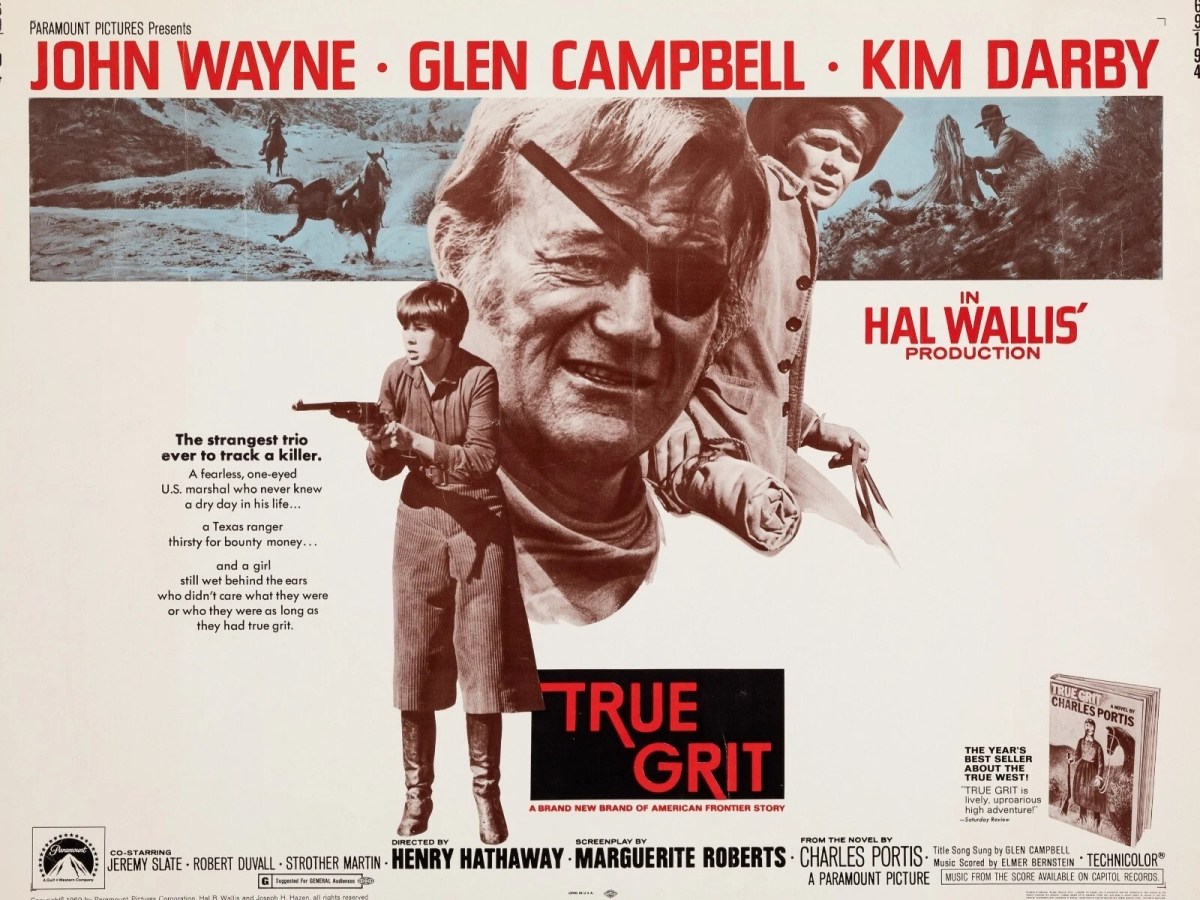
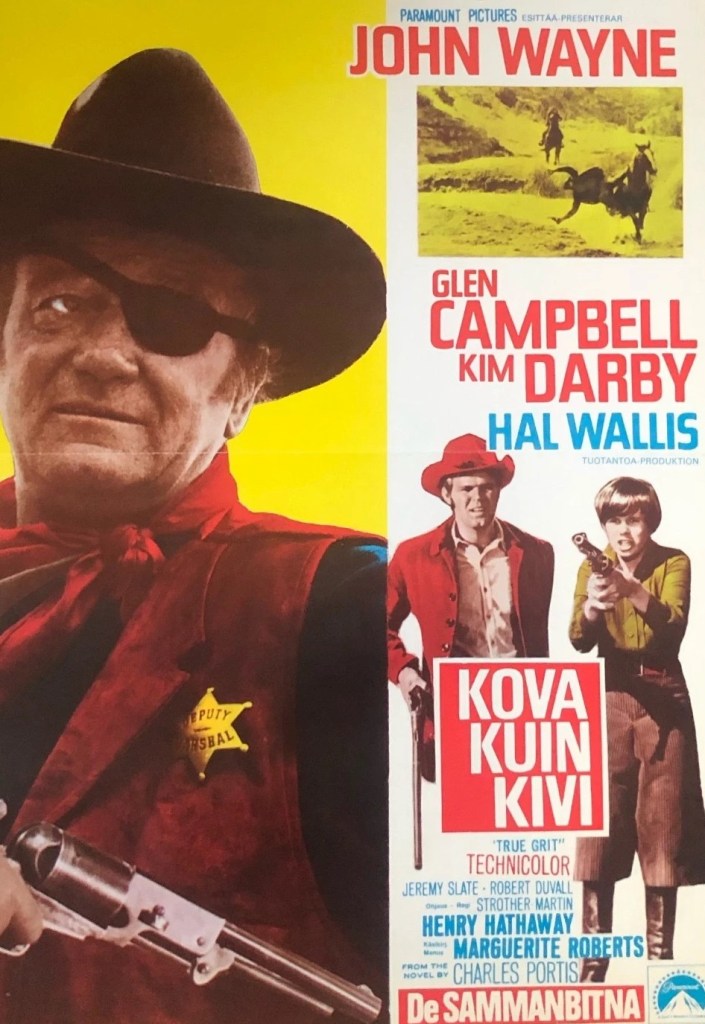
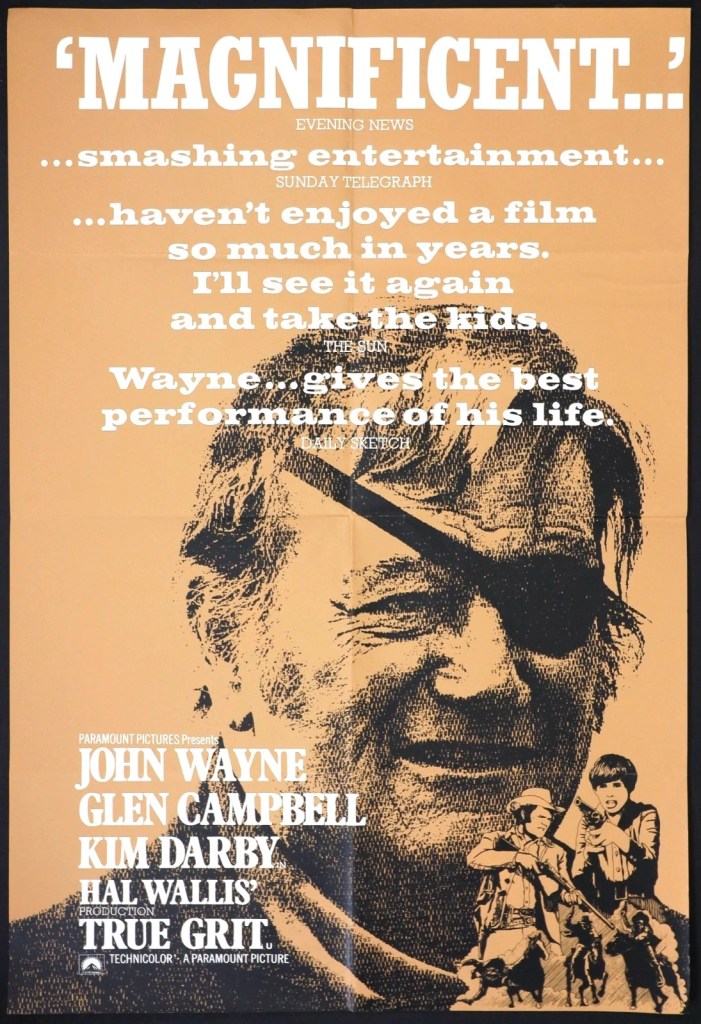
Unusually, for a film of the period, the movie repeated a single image in all of its advertising, Wayne’s face dominating the composition, with below him Mattie Ross standing gun in hand and Glen Campbell behind him. That Campbell sang the title song over the credits led to the release of a record, and there was a New American Library book tie-in. Ancillary promotional items included a t-shirt embellished with the words “This Man Has True Grit,” and buttons announcing “I Have True Grit” and, alternatively, “Give Me a Man with True Grit.” Stetson created a special hat called “The Duke,” with a special one costing $1,500 to be presented to Johnny Carson on his show, with an advertising campaign that included Playboy and Esquire while Aramis created a special line of “Grit Soap.”

Time magazine had raised expectations for the picture by putting John Wayne on the front cover, on August 8, although this was in part retaliation to Life’s joint cover story on Wayne and Dustin Hoffman which ran in the Jul 11 issue, and Paramount took a gamble opening it in New York at the Radio City Music Hall, partly a ploy to boost European revenues, the first western to be so honored, although the theater covered itself by claiming the movie was an “outdoor adventure” rather than a western per se. The picture broke all sorts of records there and went on to conquer America, shattering Dallas records, for example, and then helped along by the Time cover story. For a few months it looked set to become the best performing western of all time, but was soon overtaken by the release of Butch Cassidy and the Sundance Kid. Even so, it took $11.5 million in rentals to finish sixth in the annual chart. It was reissued after Wayne’s Oscar triumph the following year in an unlikely double bill with Oscar-nominated The Sterile Cuckoo and grossed $3.7 million in the twelve days. But Paramount, trying to offset calamitous losses, prematurely sold off the western to television so its reissue value was sharply curtailed.
SOURCE: Brian Hannan, The Gunslingers of ’69: Western Movies’ Greatest Year, (McFarland, 2019).
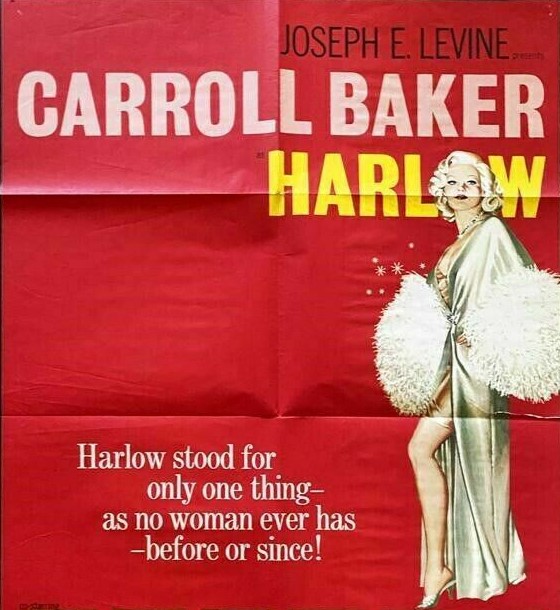
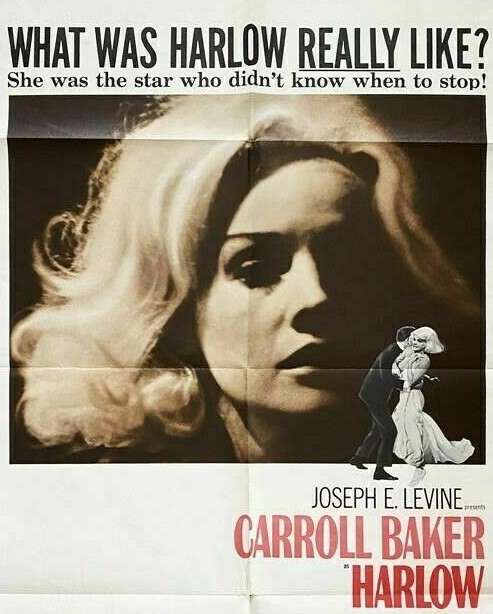
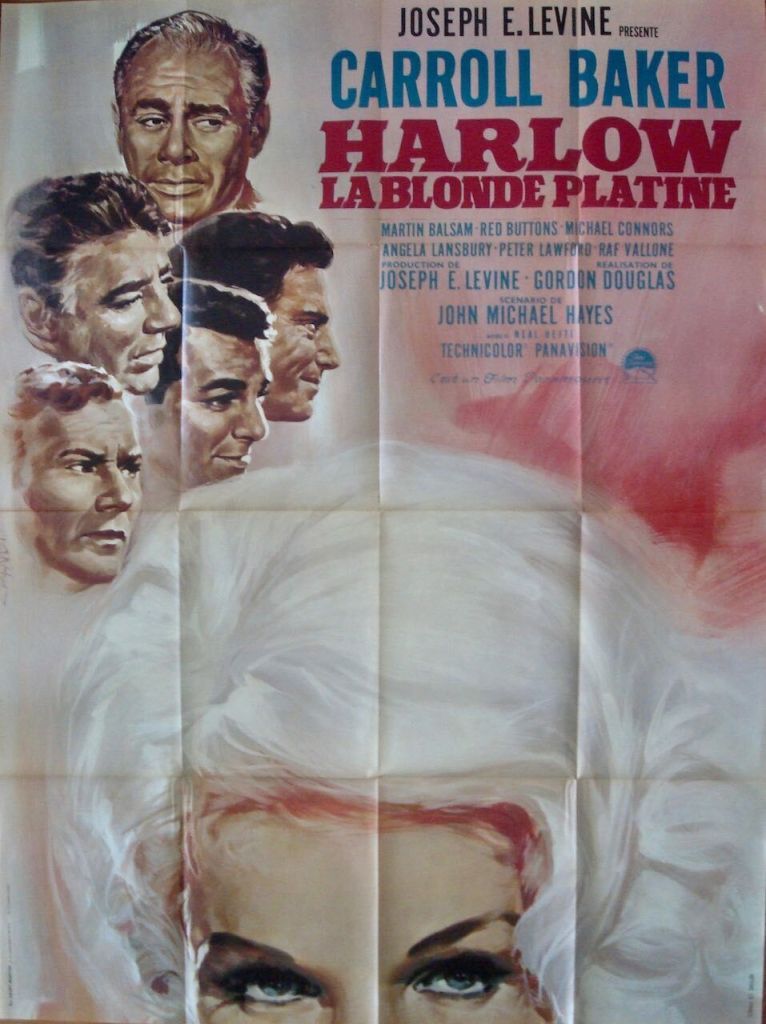
Harlow (1965) ***

Harlow presents such a convincing picture of Hollywood abuse that I was astonished to discover that it was not entirely truthful where the title character was concerned.

Jean Harlow was a hugely popular star in the 1930s before her untimely death at the age of 36. This film depicts her as a virgin (not true) who turns neurotic (not true) after her impotent husband commits suicide (debatable) on their wedding night (not true) leading to her go off the rails and die from pneumonia (not true). But in terms of the Hollywood system a great deal rings true and if the Me Too movement had existed in the late 1920s the finger would be pointed at a huge number of men.

The film is at its best when dissecting the movie business. A five-minute opening sequence demonstrates its “factory” aspect as extras and bit players clock in, are given parts and shuffle through great barns to be clothed and made up, often to be discarded at the end of the process.

No sooner has this version of Jean Harlow (Carroll Baker) been given a small part than she encounters the casting couch, operated by a lowly assistant director, who bluntly offers five days’ work instead of one if she submits to his advances. When she turns him down, work is hard to come by and she resorts to stealing lunch before rescued by agent Arthur Landau (Red Buttons). After tiny parts that mostly consist of her losing her clothing, receiving pies or eggs in the face and displaying her wares in bathtubs, she geta a big break only for that producer to demand his pound of flesh – “I’ve already bought and paid for you.” Here she has “the body of a woman and the emotions of a child” and ends up choosing the wrong suitor which leads to a calamitous outcome.

However, the pressures of stardom are well-presented: she is the breadwinner for her unemployed mother Jean (Angela Lansbury) and lazy stepfather Marino (Raf Vallone) and soon box office dynamite for studio chief Everett (Martin Balsam) who sees in her the opportunity to sell good clean sex. The negotiations/bribery/blackmail involved in fixing salaries are also explored.

But the film earns negative points by mixing the real and the fictional. The agent and husband Paul Bern (Peter Lawford) existed but most of the others are invented or amalgamations of different people. MGM is represented as “Majestic” and among her films there is no Red Dust (1932) or China Seas (1935) but lurid inventions like Sin City

Director Gordon Douglas was a versatile veteran, with over 90 films to his credit, from comedies Saps at Sea (1940) and Call Me Bwana (1963) to westerns The Iron Mistress (1952) and Rio Conchos (1964) and musicals Follow That Dream (1962) and dramas The Sins of Rachel Cade (1961) and Sylvia (1965) which also starred Baker. The opening scene apart, which is a seamless construction, he is adept at this kind of helter-skelter drama. John Michael Hayes (Rear Window, 1954) has produced a punchy script based on the book by Arthur Landau and Irving Shulman.

In the title role Carroll Baker (Sylvia) has probably never been better, comedian Red Buttons (Stagecoach, 1966) excellent in a straight role while the smarmy Raf Vallone (Nevada Smith, 1966) is the stand-out among an excellent supporting cast that also includes Angela Lansbury (In the Cool of the Day, 1963), Peter Lawford (Sylvia), Leslie Nielsen (Beau Geste, 1966), Martin Balsam (Seven Days in May, 1964) and Mike Connors (Stagecoach, 1966).

Except that virtually none of the movie is true, I would have given it four stars for its portrayal of Hollywood but I have come to expect that biopics, while moving facts around for dramatic purposes, are required to be good more faithful to their subjects than this. 

Behind the Scenes: “Secret Ceremony” (1968)

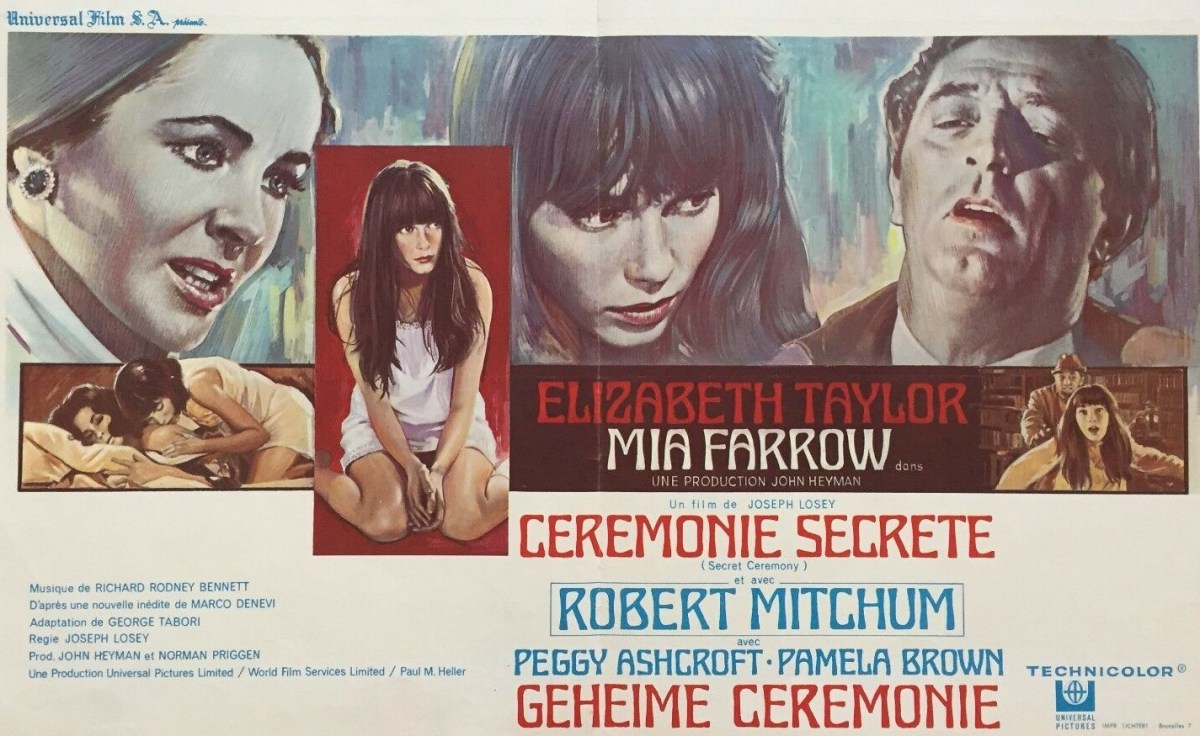
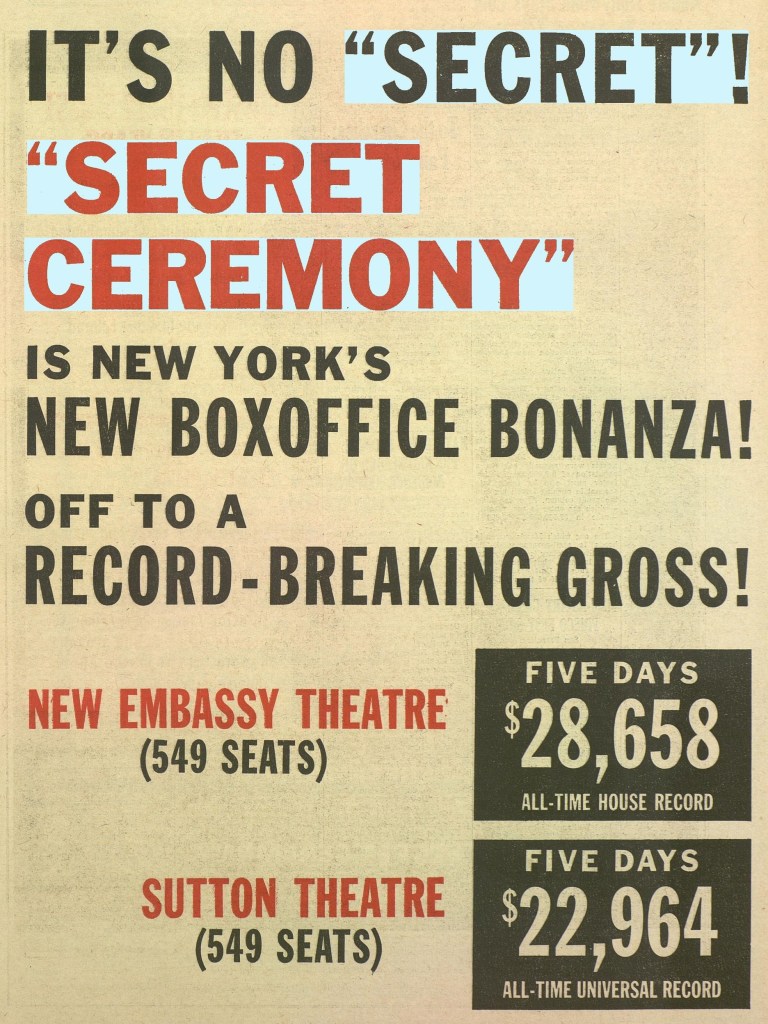
I was probably as surprised as anyone to discover that far from being a flop, Secret Ceremony was in fact a hit, taking $3 million in rentals in the  U.S., ranking among the Top 20 foreign movies at the French box office, and hitting the target in Italy, Germany and Australia. Yet, outside of France, it was universally derided by the critics.

Joseph Losey (The Servant, 1964) held the unusual position of being a cult director working in Britain. He was the “object of a vociferous cult….his following grown in scope and size with each new film” and, conversely, as his popularity among the arthouse fraternity increased, he attracted more critical ire. Courting popularity by entering the spy genre with Modesty Blaise (1966) and linking up with the Elizabeth Taylor/Richard Burton box office colossus for Boom! (1967) seemed to go against the critical grain. Losey ascribed the critical coruscation Boom! received as less to do with the merits of the film itself than “people using the opportunity to launch personal attacks on the Burtons.”

Boom! had been packaged John Heyman, who coupled acting as agent for Burton and Taylor with being the producer, not necessarily a good combination. Universal was convinced it had “Virginia Woolf in color,” a reference to the previous enormous hit, although the box office told a different story. Jay Kanter, Universal’s London production chief who greenlit the project, commented: “When the Burtons were involved a lot of my judgement was colored by the magnitude of the star she (Taylor) was considered to be.”

So it was something of a surprise to find Losey and Taylor teaming up again for Secret Ceremony. Of course, it may have been the money, Taylor at this point still holding out for a million-dollar purse. Heyman said, “We were regarded as whizz-kids just for making two consecutive films with Elizabeth Taylor and bringing them in under budget.”  

Losey’s world reflects a “highly selective form of naturalism.” Except for Accident (1966), from Sleeping Tiger (1954) through to Secret Ceremony, Losey worked with the same design consultant/production designer Richard MacDonald whom the director treated as a sounding board, to “test (ideas) and reject them in the telling.” This is a director for whom “patterned exoticism is extraordinarily precise.” A more important collaborator had been playwright Harold Pinter who had fashioned The Servant (1963) and Accident, bringing to both films his distinctive ear for dialogue. He was hardly required for Boom! whose screenwriter was the even more famous playwright Tennessee Williams (A Streetcar Named Desire, 1951) and for Secret Ceremony Losey went elsewhere for his screenwriter.

Losey was among the string of American talent who taken refuge in Britain in the wake of the anti-Communist hysteria of the late 1940s/early 1950s – others included producer Carl Foreman (The Guns of Navarone, 1961), and directors Cy Enfield (Sands of the Kalahari, 1966) and Edward Dmytryk (Mirage, 1965). By the time of Secret Ceremony, Losey had been working in Britain for nearly a quarter of a century and established himself as a director of distinctive vision, a critical fave in his adopted homeland, wildly appreciated by the French, with an occasional box office home run.

But although regarded as a British film-maker, Losey made Secret Ceremony – and Boom! for that matter – exclusively with Hollywood money, the budget 100 per cent supplied by Universal, that studio having decided that anything coming out of Britain would appeal to younger audiences. There was an untapped pool of talent available in British television who could be hired for substantially less than their U.S. counterparts. In three years Universal’s London production unit, headed by Jay Kanter, spent $30 million on a dozen projects. The biggest budget was allocated to Boom! with $3.9 million followed by $3.5 million to The Countess from Hong Kong (1967) starring Marlon Brando and Sophia Loren.  The Night of the Following Day (1968) cost $1.5 million as did Fahrenheit 451 (1967) and Three into Two Won’t Go (1968). Secret Ceremony came in at $2.45 million.

Robert Mitchum and Joseph Losey went way back to a time in Hollywood when both were working their way up the RKO ladder. As well as Losey, Mitchum had been friends with many who would fall foul of the blacklist including screenwriter Dalton Trumbo, Dmytryk and Howard Koch (Casablanca, 1942). When Mitchum’s dalliance with drugs brought him a jail sentence, Losey visited him and brought him chilli from a famed restaurant.

Mitchum was recommended for the role in Secret Ceremony by Roddy McDowell, a friend of Taylor, who had been working with the actor on Henry Hathaway western Five Card Stud (1968). Mitchum received the job offer while on holiday in Mexico. For two weeks’ work he would earn $150,000. The role itself was scarcely onerous, drawing on aspects of the loathsome character he had created for Night of the Hunter (1955), but it did require an English accent of some kind and to his amusement Mitchum found himself on the telephone, like a salesman listing available product, going through the variety of accents he bring to the part.

Whether it was almost having to sell himself to the director or some previous incident, Mitchum and Losey did not resume their friendship. In fact, their relationship was the polar opposite. “He was very unpleasant,” recalled the director, “it was extremely hard for me to work with him.” Losey never found the source of Mitchum’s contempt. “In some curious way I must have made some mistake with him; I don’t know what it was.” Even attempts to recall Mitchum’s collaboration with Charles Laughton on Night of the Hunter failed to break the ice. Losey believed that Mitchum played tough to mask “an intense sense of failure.”

Mitchum wasn’t above sneaking away from the set. On one occasion taking himself off to visit old friend Robert Parrish, he knocked back some tequila and complained about the movie. On the Holland section of the shoot, Mitchum got into a food fight with a hotel diner. In the end, Losey was so disturbed by Mitchum that he was grateful when he departed as per contract despite the fact that some scenes had not been shot, including, according to the actor, the bathtub sequence, which would have accentuated the incest theme rather than the hint of lesbianism. Mitchum’s epitaph to the movie was that he talked Mia Farrow out of True Grit (1969) claiming Hathaway was a terror to work with.

The bath scene turned out to be the cause of some marital anguish. The set was cleared for its shooting of the scene after Taylor froze on emerging from her dressing room to see so many people gathered. But this was hardly Taylor at her beautiful best as she had been gaining weight. Even so Losey filmed her at times as though she was the grand Hollywood star with hair framing her face and the camera glimpsing her cleavage, but at other times her weight was a source of determining her character, when she eats with her mouth full and belches.

Halfway through filming Taylor was afflicted by severe physical pain and she was rushed to hospital for a hysterectomy, an operation that lasted over three and a half hours. Complications followed the surgery and she was given drugs that caused her to hallucinate. Writing in his diaries, Richard Burton noted: “This is the first time I’ve seen a loved one in screaming agony for two days, hallucinated by drugs, sometimes knowing who I was and sometimes not, a virago one minute, an angel the next.” She went from commanding him to leave the room to crying out for him to return. Sometimes she believed she was on board their yacht, other times that a film was playing on the switched-off television set.

The loss of her uterus may have affected her performance since in the film she plays a mother who has lost a child and in reality was a woman who had lost the ability to have another child.

The film exacerbated the tensions in the Burton-Taylor marriage. It was usually Taylor who was the one who had to keep a watchful eye on her partner in case he strayed. In this case, ironically, it was Burton who exhibited the jealous streak. The way Losey had whispered in the actress’s ear to build up her confidence during the bath scene while getting rid of extraneous crew found its way back to Burton who misinterpreted the action as intimacy.  “My wife and Joe Losey are having a professional love affair,” he claimed. He spent a lot more time than usual on the set of his wife’s film. He even offered to take on the Mitchum role.

Losey had long been fascinated by a strange-looking house in West Kensington, London, and managed to hire it for the shoot. Debenham House in Addison Road, between Holland Park Avenue and High St Kensington, is one of a handful of truly Gothic London buildings. The church used was in Little Venice, St Mary Magdalene in Rowington Close, also in London, and the antique shop was located at the corner of St Stephen’s Mews and Westbourne Green. When the production shifted to Holland it was to the coastal town of Noordwjik with use made of the Grand Hotel there.  

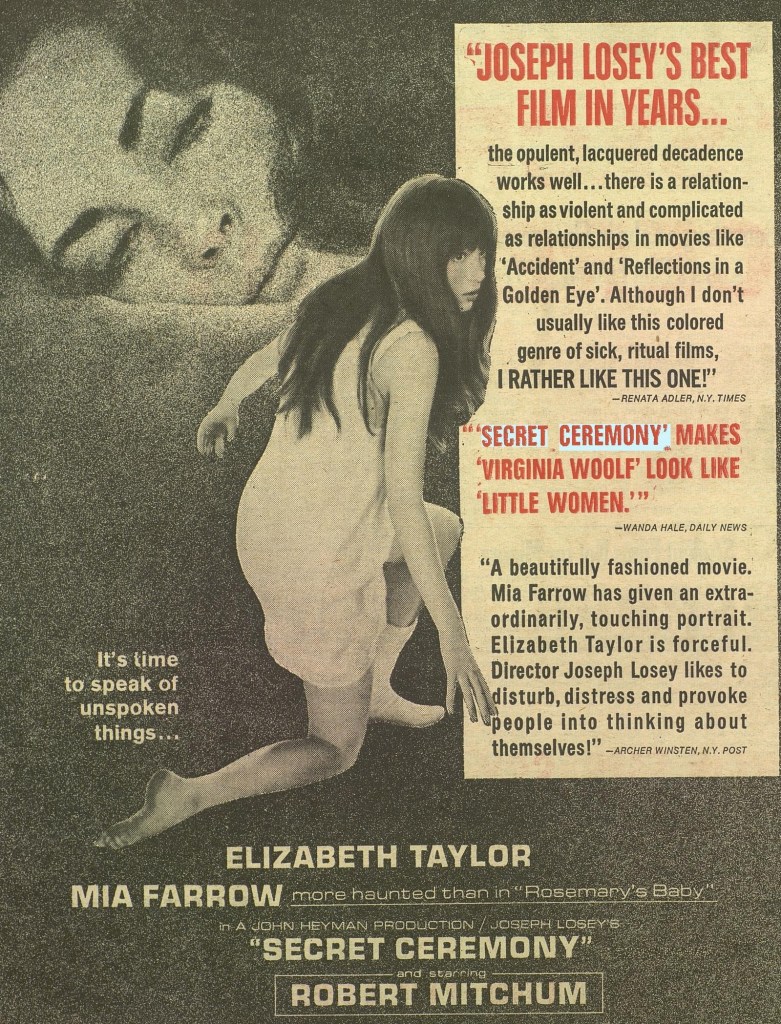
By the time the film opened, Taylor found herself in the middle of a storm over foul language (“gutter talk” in Variety parlance) for which she was seen as the “chief exponent.” It was an ironic position for Taylor to find herself in given her expletive-ridden performance in Who’s Afraid of Virginia Woolf (1966) had not only been critically acclaimed and a huge box office hit but seen as helping to break down the censorship barriers. However, it appeared that the “urination expression” and a word that was prefixed by “bull” were beyond the pale and Variety proclaimed that it was “evidently assumed that if a star of her (Taylor’s) magnitude can be gotten to speak the words, everyone else – actors, actresses, distributors, exhibitors and the public – will be accustomed to strong lingo in pix.” It was hardly coincidence that on the same day that this article was the leading story on the trade paper’s front page that inside six out of seven New York critics gave Secret Ceremony a drubbing, the exception being Renata Adler of the New York Times who called it Losey’s “best film in years.”

Even producer Heyman had his doubts about the material. “It should have been the story of two people who need and trust each other,” he said, “until one leans on the other a little bit more than she should. Unfortunately, the kind of sympathy which Losey shows for people in real life was absent from the relationship which is what I think made it unacceptable.” He summed up, “A cold picture.” (This has the taint of someone trying to work out why the film was a critical failure because otherwise I think Heyman got it exactly right for the movie I saw I did not view as cold nor unacceptable.)

And neither, strangely enough, did the public. Although making a poor showing in Britain, it was not a box office disaster. That was averted by astute marketing, the potency of the stars and a public who, not for the first time, ignored the critics.  The movie broke records when it opened at the New York arthouse pair, the Sutton and the New Embassy, and further afield in cities like Dallas. Arthouse success would have been anticipated but nobody would have expected that when it went wide in New York the second week improved upon the first. As well as a decent showing in the States, it hit the ground running around the world, and “ought to be credited” as one of Universal’s “most successful pictures from either domestic or foreign source.” In the French box office rankings, it placed above The Detective (1968) and Hang ‘Em High (1968) and just below The Thomas Crown Affair (1968). Acclaimed by that country’s critics, the Academie du Cinema named it best foreign film with Taylor and Farrow taking the gongs for best foreign actresses.

When Universal sold the movie to television for $1.25 million, a fee which certainly provided the picture with a decent extra profit margin, fourteen minutes were cut out and replaced by a 500 lines of extra dialog and a filmed discussion of the psychological issues raised, prompting Losey to demand his name be removed, claiming it “exactly reversed the meaning an intention of my film.”

SOURCES: Lee Server, Robert Mitchum, Baby I Don’t Care, (Faber and Faber, 2001) p169, 232, 509-512; Sam Kashner & Nancy Schoenberger, Furious Love, (JR Books, 2011)p240, 242-243,2; Alexander Walker, Hollywood England, (Orion Books, 2005) p200, 345, 354-257; “Screen: Secret Ceremony,” New York Times, October 26, 1968; “Joseph Losey Following Has Grown,” Box Office, October 28, 1968, pE1;   “No End to Gutter Talk,” Variety, October 30, 1968, p1; “N.Y. Critics This Week: Ouch,” Variety, October 30, 1968, p12; “Secret Ceremony Sets House Mark at Sutton, New Embassy,” Box Office, November 4, 1968, pE2; “Secret Ceremony Setting New Records in Dallas,” Box Office, January 13, 1969, pSW1; “This Week’s N.Y. Showcases,” Variety, February 5, 1969, p9; “Jay Kanter,” Variety, February 26, 1969, p78; “Kanter No Martyr,” Variety, March 19, 1969, p26; “Ceremony, Z Nab Kudos,” Variety, May 7, 1969, p107; “French Filmgoing,” Variety, January 28, 1970, P27; “Paris First Runs,” Variety, April 29, 1970, p76;  “Losey Wants His Credit Blipped from Vidversion of U’s Secret Ceremony,” Variety, September 16, 1970, p70; “All-Time Film Rental Champs,” Variety, October 15, 1990, pM184.

Discover WordPress

A daily selection of the best content published on WordPress, collected for you by humans who love to read.

The Atavist Magazine

by Brian Hannan

WordPress.com News

The latest news on WordPress.com and the WordPress community.