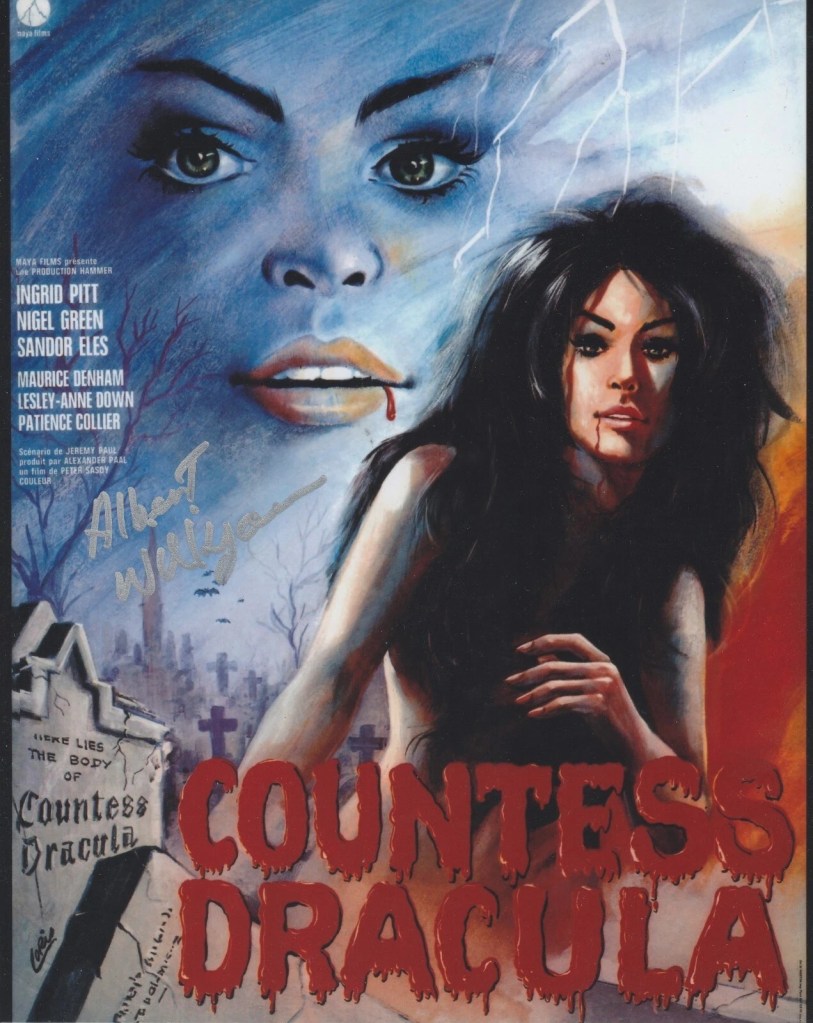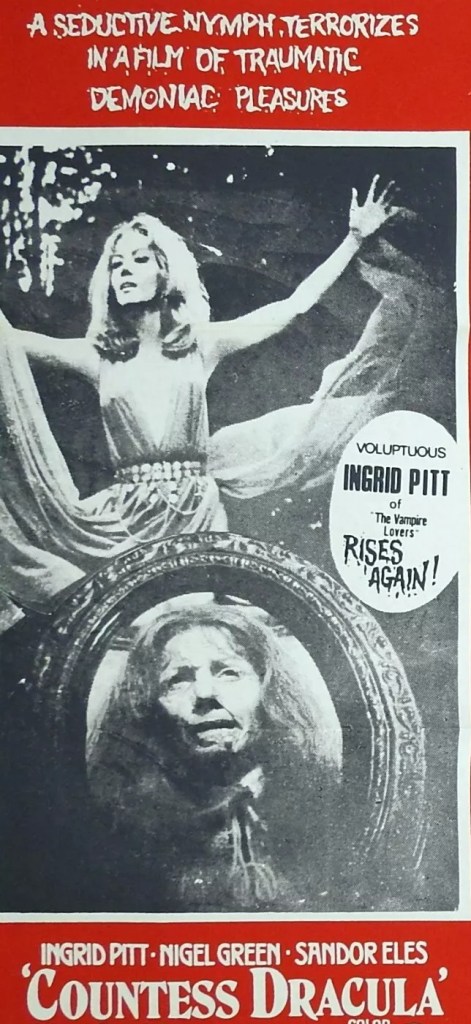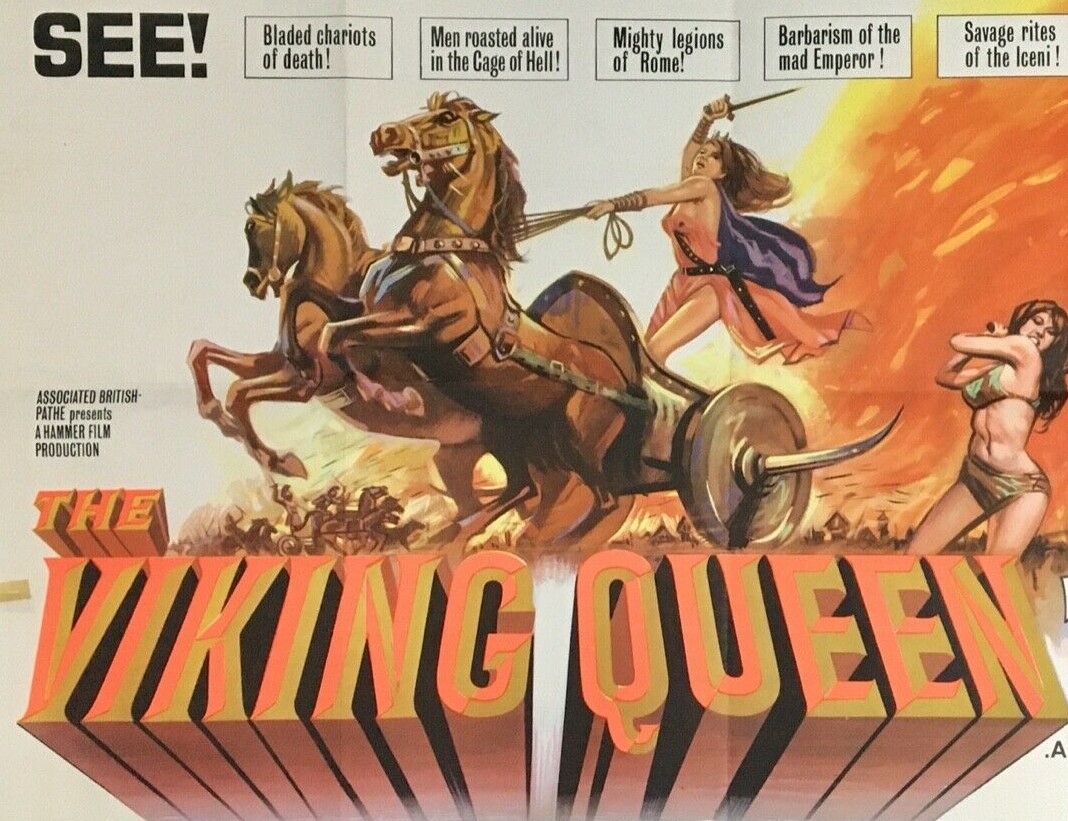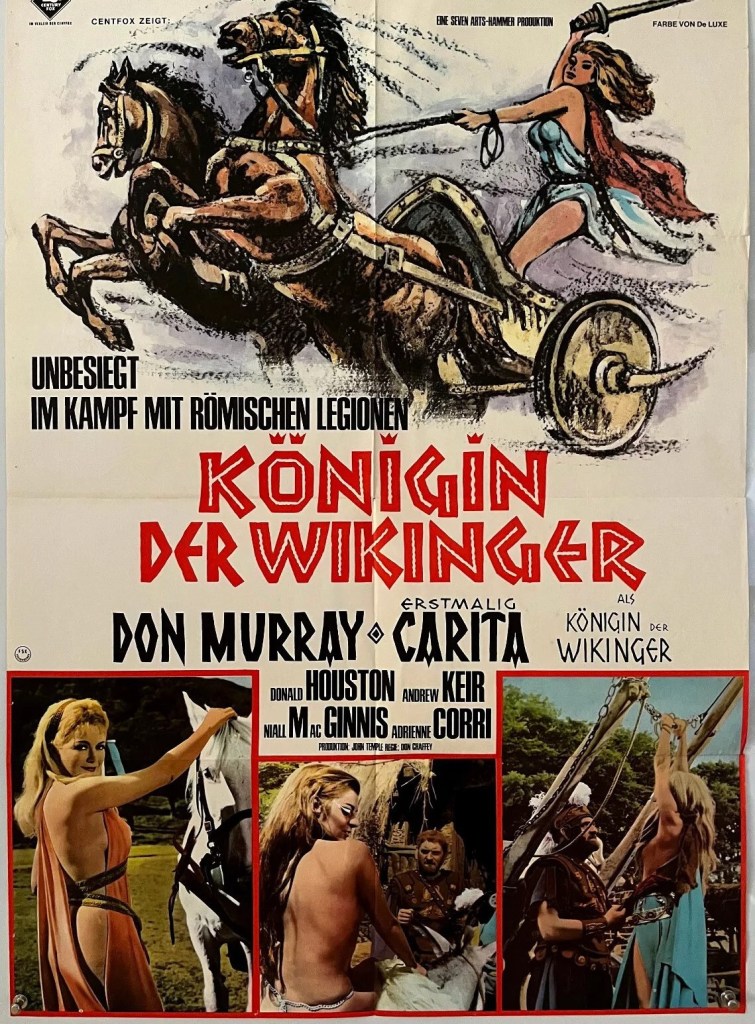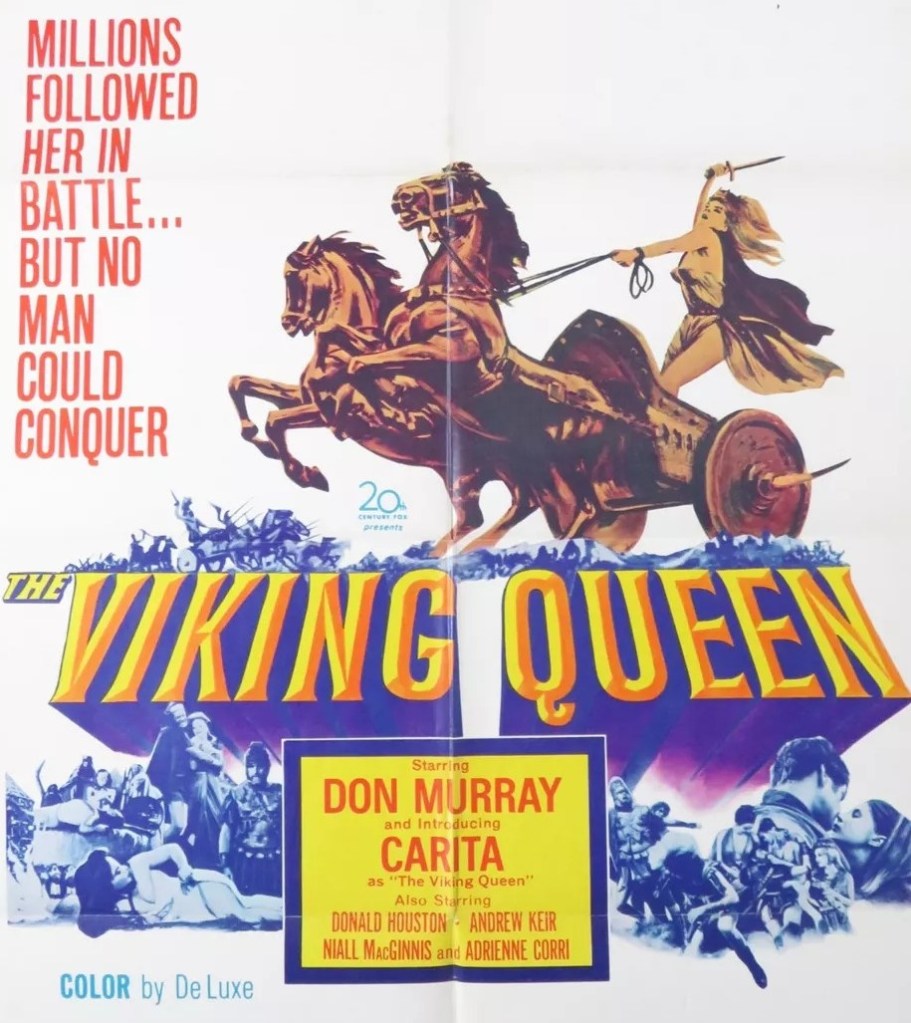
Politics, conspiracy, thwarted romance and historical inaccuracy take center stage in this Hammer romp that attempted to create another sex symbol to follow in the footsteps of Ursula Andress (She, 1965) and Raquel Welch (One Million Years B.C., 1966) in the shape of Finnish model Carita. Let’s put the dodgy historical elements to one side given Hollywood trampled over history all the time, but the title is a misnomer, the story owing more to folk heroine Boadicea than anyone who came from longship land.
On his deathbed British tribal king (Wilfred Lawson), against the wishes of powerful Druid chieftain Maelgan (Donald Houston), signs a peace treaty with Roman governor general Justinius (Donald Murray) against the wishes of his lieutenant Octavian (Andrew Keir). In different ways, the Druid and Octavian conspire to end the peace. Had new queen Salina (Carita), after falling in love with Justinius, been permitted to marry him that would have created a peaceful bond, but that is also prevented.
There’s a lot more sex and violence than you would have expected for the period, plenty scantily-clad slaves administering to the rich and the Romans, an extended brutal flogging sequence involving Salina, an offscreen rape, a cageful of Roman prisoners dropped into a burning pit, and when the British strap scythes onto the wheels of their chariots it’s a bloodbath. (Quite why the Romans never thought of importing their own chariots, given their popularity in the Colosseum, is never explained.) The chariots, whether in a race or battle, are the best thing about the picture, adding tremendous energy.
It takes quite a while for Salina to take up arms but when she does the film catches fire. She leads from the front, tearing through the Roman legions, and handy too with a sword. Ambushes appear the order of the day so any marching column or peaceful village soon ends up in a spot of bother.
There’s some of “what did the Romans ever do for us” with a snatch of Robin Hood thrown in – Justinius takes from the rich to give to the poor – plus religious fanaticism to stir the pot into a heady brew. But mostly it’s hokum, if rather plot-heavy. Quite how the Oscar-nominated Don Murray (Advise and Consent, 1962) was talked into this is anybody’s guess. Carita, of course, would have believed she was on a surefire route to stardom but in fact this was her last picture. The two stars don’t really have that much to do and do it well enough. In supporting roles you will spot Patrick Troughton (a BBC Dr Who), Nicola Pagett making her movie debut and Adrienne Corri (Africa – Texas Style, 1967). Director Don Caffey (One Million Years B.C., 1966) is better at action than drama.
Directed by Don Chaffey (Jason and the Argonauts, 1963) from a screenplay by Clarke Reynolds (Genghis Khan, 1965) and the movie’s producer John Temple-Smith.
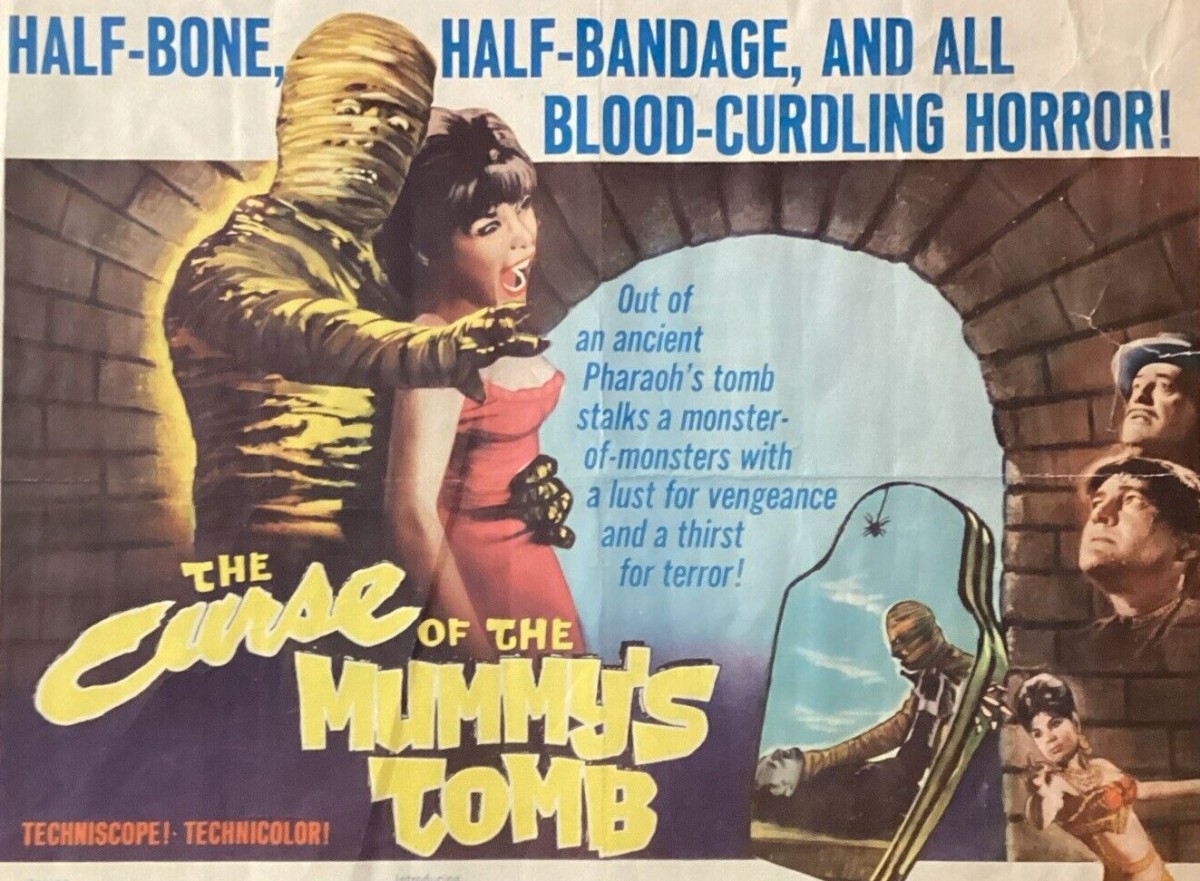
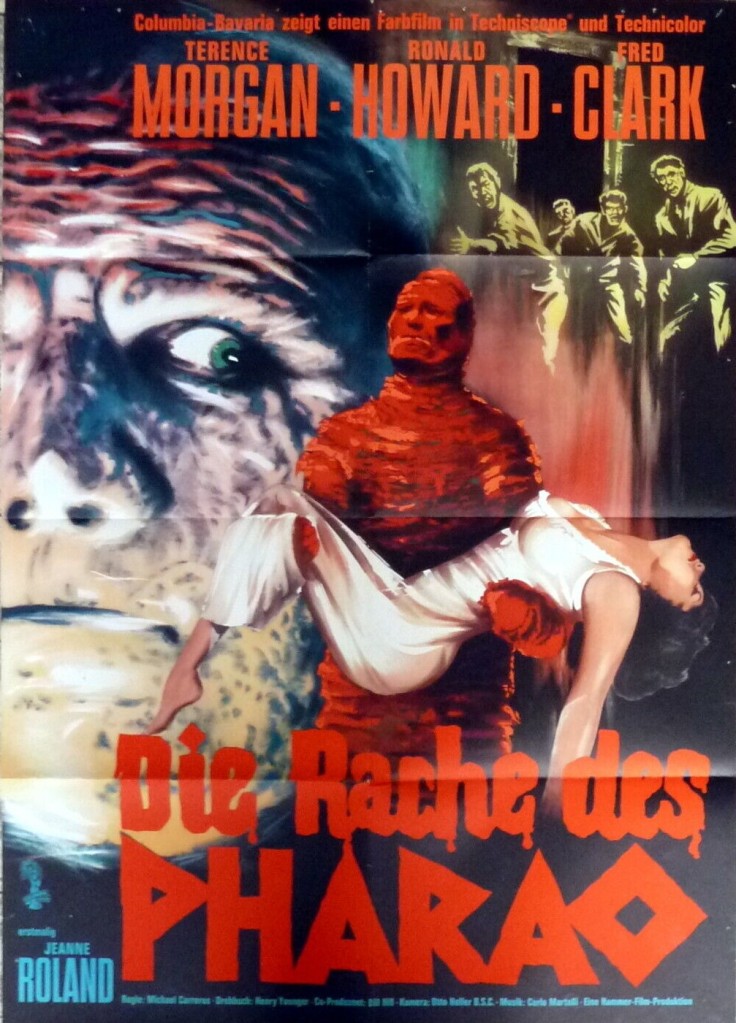
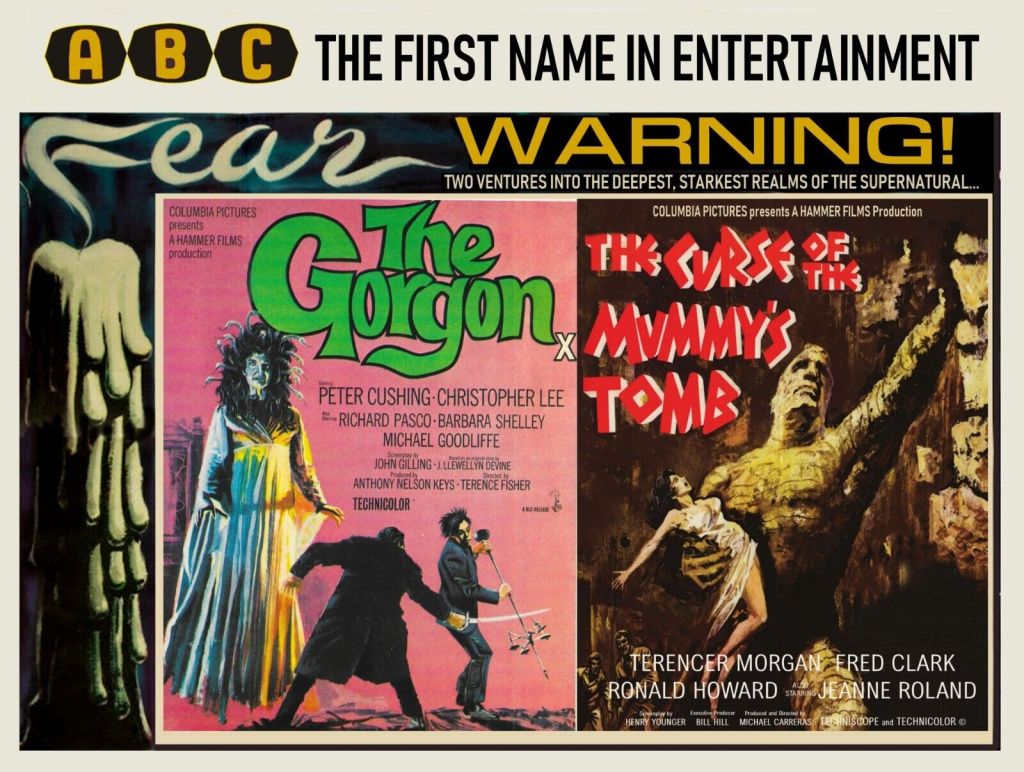
Approach with affection and you will be rewarded. This is third tier Hammer, way down the pecking order behind Dracula and Frankenstein and after attracting studio stalwarts Christopher Lee and Peter Cushing for its first venture into this territory (The Mummy, 1959) dumps them for the sequel. And in the absence of the CGI that transformed the Stephen Sommers version in 1999 – and triggered the misguided Universal Monsterverse – struggles these days to prevent audiences laughing at the special effects. The titular beast was little more than a bandaged version of the lurching creature created by Dr Frankenstein so chills were always going to be in short supply, especially minus the plague of scarabs that dominated the later proceedings.
More interesting is the backstory that drives the narrative, warring siblings in ancient Egypt, the death of the rightful monarch and a reincarnation curse that travels down the centuries. Throw in bombastic King Kong-style showman Alexander King (Fred Clark) determined to monetize an archaeological find, shift the story to London, bring in a damsel Annette (Jeanne Roland) infatuated with the villain, and you have the makings of a decent tale. Alternatively, if you’re of a different mind, that could all be to cover up shortcomings in the plot and the wrong reasons for delaying the appearance of said monster.
People tampering with Egyptian graves tend to get their hands chopped off, but that’s as much warning we get of evil afoot although there are hints of malignancy in the flashback that shows the murder of Ra-Antef, son of Rameses VIII. But triumphant returning Egyptologists John Bray (Ronald Howard), Sir Giles Dalrymple (Jack Gwillim) and Annette, daughter of famed Professor Dubois who died in the line of duty, are inclined to take no precautions.
Poetic license – the mummy just ain’t that big in the movie.
Until the mummy is let loose, much of the tale centres around the ruthless grasping King and a love triangle developing between Annette, her fiancé John and the newcomer Adam (Terence Morgan) she met on the voyage home. While John is kept busy by King arranging for the grand public opening of the tomb, Adam slips in to romance Annette, not letting on of course that he possesses the amulet that can revive the sleeping monster. The setting – sophisticated London rather than remote Transylvania – and the delay of the murderous onslaught ensures that most of the picture survives on intelligent conversation, motivations and characters set out in non-cliché manner, and no squads of villagers set up for a marauding.
The monster is pretty effective when he does deign to appear, bursting through windows, picking up the damsel in a pose that I’m convinced Oliver Stone snaffled for Platoon (1986), and making his way to the nearest sewer, unlikely locale for a climax. There’s a propensity for lopping off hands and when that loses its impact stomping on heads.
But it’s not camp, is well-acted and the storyline makes sense. It probably helps that it’s free of Cushing and Lee because with unfamiliar actors the audience has to work harder. Terence Morgan (The Penthouse, 1967) is the pick of the stars because he carries most of the mystery. But Fred Clark (Move Over, Darling, 1963) steals the show by making a meal out of his outrageously greedy businessman. Top marks to Hammer for making Burmese-born Jeanne Roland (You Only Live Twice, 1965 and Casino Royale, 1967) a professional – she is an archaeologist – rather than a cleavage-ridden damsel in distress. And for those of a nervous disposition you will be pleased to know that the monkey is not present just to nibble poison intended for one of the principals.
However, from the outset it was destined for the lower half of a Hammer horror double bill, so the kind of budget that could do it justice was never in evidence. Studio boss Michael Carreras (Prehistoric Women, 1967) always gave the impression of over-extending himself but here as writer-producer-director he manages to keep the picture on an even keel long enough for the monster to do its worst.
Can a dash of feminism rescue campy trash? Or even a genetics overload? Or is it enough to wonder what career hole Carol White (Never Let Go, 1960) found herself in to end up here? Or should we just sit back and watch the Pan’s People-style choreography and admire the astute re-use of all those bikinis left over from Hammer’s previous venture into this territory, the much more successful One Million Years B.C. (1966). Whatever, there’s no escaping the wooden acting and the one-note direction.
Dennis Wheatley (The Fabulous Valley, The Lost Continent, They Found Atlantis) and C.S. Lewis for that matter had the knack of transporting characters back in time or into other worlds. There’s usually some routine artefact, door or whatnot, that allows access to an amazing kingdom, or, in this case, queendom.
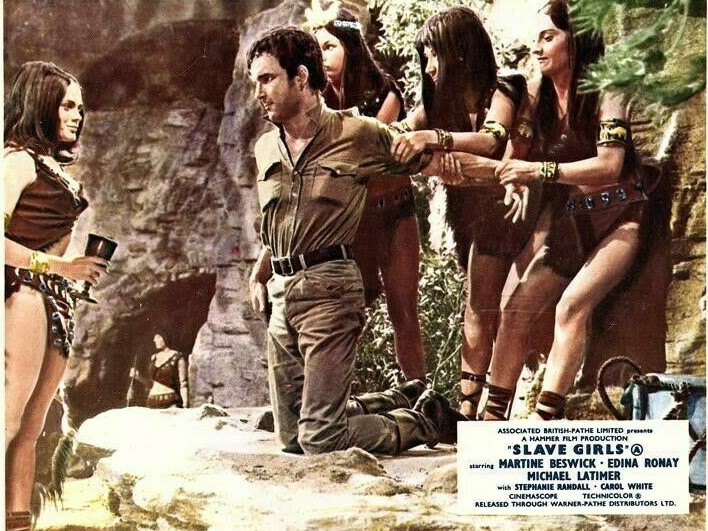
Here, big game hunter David (Michael Latimer), about to be sacrificed to some pagan African god, instead finds himself thrown back in time, chasing bewitching blonde Saria (Edina Romay), who, unfortunately is on the run, so when she is apprehended, so is he. Queen Kari (Martine Beswick) takes him as her lover. But he’s less keen, repulsed by her harsh rule. When one of her subjects rebels, the queen doesn’t delegate the task of bringing her into line but takes her on mano-a-mano. David, put to work with the other male prisoners, soon plots his escape.
Setting aside the expected mumbo-jumbo – the tribe worships a mythical white rhino (phallic symbol anyone?) for example – if you want to extract anything more from this, there are fresh fields to plunder. For example, brunettes, such as Kari, are in control, but only after rebelling against the blondes who had subjugated the black-haired women in similar fashion as Kari. As well as having a female ruler, the movie makes a relatively pertinent point that gender scarcely comes into it when a dictator imposes such harsh conditions on their subject, Kari, for example, making the blondes eat off the dirt.
I’m not convinced the irony is deliberate. David, scion no doubt of Victorian nobility who made their pile from scarcely paying their downtrodden peasants a living wage, and who goes around shooting leopards, is hardly in a position to ask the queen to cool it. When she even considers giving him some equality – a big role reversal right there – he wants her to treat everyone in a nicer fashion.
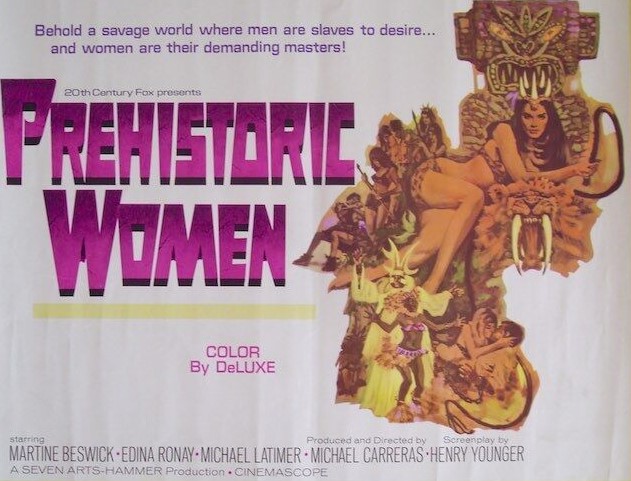
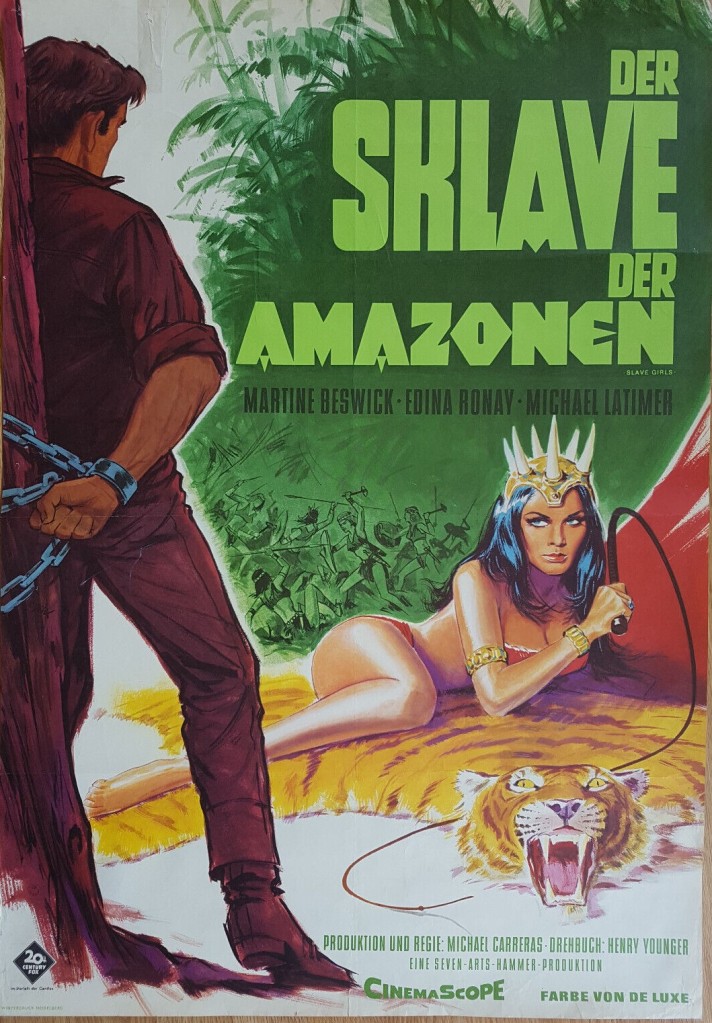
The movie had an unsual history. Made quickly after “One Million Years B.C.” it was released in the U.S. as “Prehistoric Women” in 1967 but flopped so it was heavily cut, re-titled “Slave Girls” and sent out in 1968 in the UK as the support to “The Devil Rides Out.” The new title is a bit of misnomer because her kingdom is as full of slave men. The girls refers to the blondes.It was released in the U.S. in February 1967 by Twentieth Century Fox and managed a tie-in in one city with Cara Nome perfume.Actually, U.S. grosses were not as bad as have been reported – a “good” $25,000 in first run in Detroit, second only to “Grand Prix” there for the week, and decent enough openings in Boston, Minneapolis and San Francisco.
And she has the insecurity of Napoleon, needs to be loved, and not in mercenary fashion, and willing to attempt some form of rudimentary seduction if that’s what it takes to tempt the suddenly high-principled David into her bed. There’s an element of upending the Gentlemen Prefer Blondes trope, as though brunettes have always hankered after putting those ditzy blondes in their place.
Hammer lost sight of the fact that One Million Years B.C. owed as much to Ray Harryhausen as the statuesque temptations of Raquel Welch in a fur bikini and in its haste to cash in on that film’s big box office rushed into production a movie minus the battling dinosaurs. Although, of course, they could merely be making historical amends, since everyone knows dinosaurs and man (never mind women in fur bikinis) did not co-exist. And possibly ignored the fact that the puny Michael Latimer was no substitute for the brawnier John Richardson of the previous picture.
If you’re not so interested in gender politics, you can always enjoy the dancing, which appears to take up a disproportionate amount of time (well, all those bikinis, need to be used). I was disappointed to discover the choreography was not the work of Flick Colby of the legendary BBC TV Top of the Pops dance troupe, but by one Denys Palmer, an actor it appears, whose main claim to fame was appearing in a classic Dr Who episode.
This was triple-hyphenate job, so blame Michael Carreras (The Lost Continent, 1968) for the screenplay and the direction and for taking on the production duties, or praise him for seeding a campy knock-off with issues that register more strongly today.
This was intended to be a big step-up for Michael Latimer but he was so charisma-free that he didn’t score another movie credit until low-budget British B-picture Man of Violence (1970). Martin Beswick (The Penthouse, 1967) never got another shot at a top-billed role. Carol White did better, next up was Poor Cow (1967) and from there it weas a small step to Daddy’s Gone A-Hunting (1969), but she doesn’t stand out here the way she did in Never Let Go (1960). If anyone stole the show it was Edina Ronay, and much good it did her, her next outing was in the lamentable Three (1969).
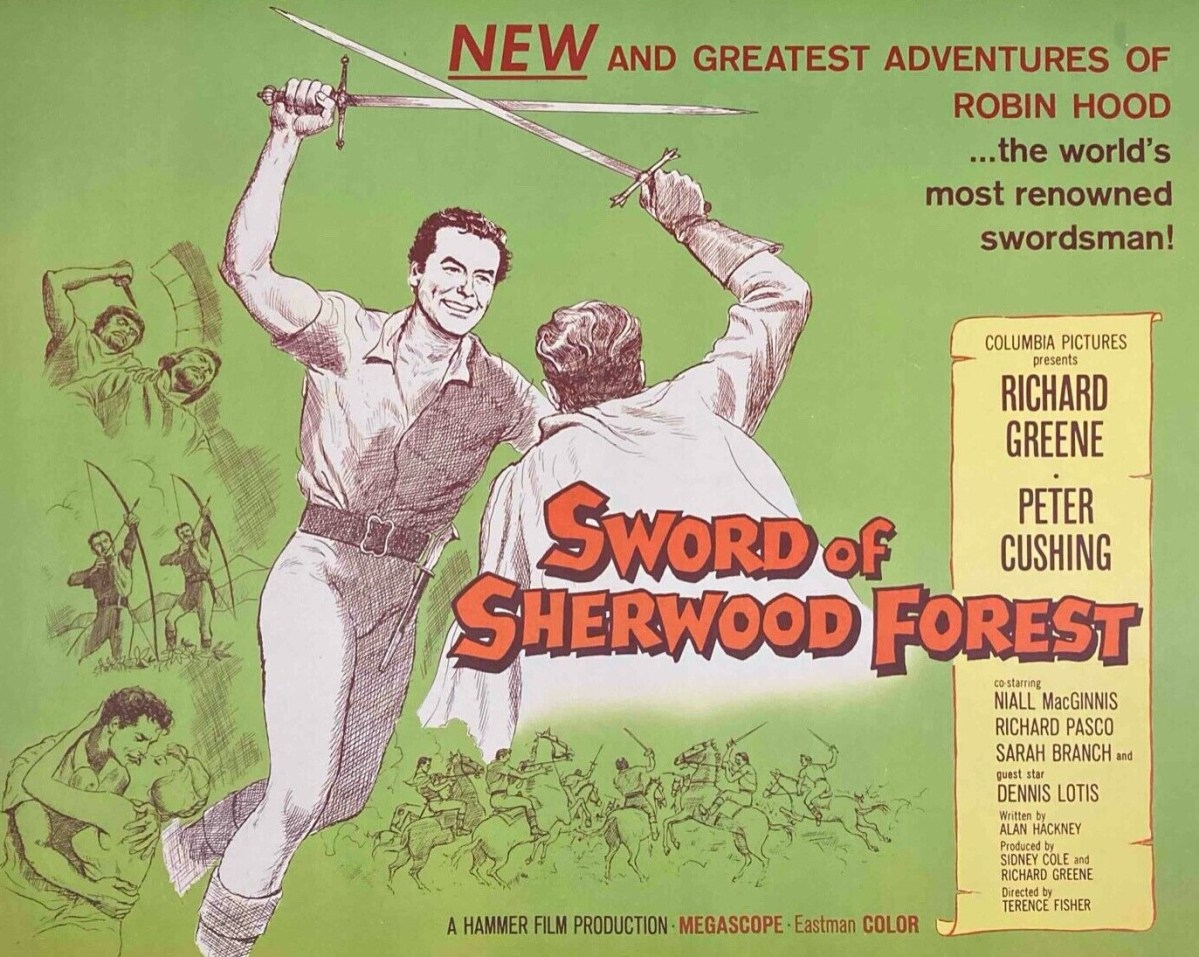
The last swashbuckler to cut a genuine dash was The Crimson Pirate (1952) with an athletic Burt Lancaster romancing Virginia Mayo in a big-budget Hollywood spectacular. The chance of Hollywood ponying up for further offerings of this caliber was remote once television began to cut the swashbuckler genre down to small-screen size. Britain’s ITV network churned out series based on Sir Lancelot, William Tell and The Count of Monte Cristo and 30-minute episodes (143 in all) of The Adventures of Robin Hood. So when Hammer decided to rework the series as Sword of Sherwood Forest their first port-of-call was series star Richard Greene.
And to encourage television viewers to follow the adventures of their hero on the big screen, Hammer sensibly dumped the small screen’s black-and-white photography in favour of widescreen color and then lit up the canvas at the outset with aerial tracking shots of the glorious bucolic greenery of the English countryside. Further temptation for staid television viewers came in the form of Maid Marian (Sarah Branch) bathing naked in a lake. Robin Hood is soon hooked.
Two main plots run side-by-side. The first is obvious. The Sheriff of Nottingham (Peter Cushing) is quietly defrauding people through legal means. The second takes a while to come to fruition. Robin Hood is hired by for his archery skills by the Earl of Newark (Richard Pasco) – he shoots a pumpkin through a spinning wheel, a moving bell and a bullseye through a slit – before it becomes apparent he is being recruited as an assassin. Oliver Reed and Derren Nesbitt put in uncredited appearances and the usual suspects are played by Niall MacGinnis (as Friar Tuck) and Nigel Green (as Little John).
There is sufficient swordfighting to satisfy. Director Terence Fisher (The Gorgon, 1964), more at home with the Hammer horror portfolio, demonstrates a facility with action. Richard Greene (The Blood of Fu Manchu, 1968) makes a breezy hero and Peter Cushing (The Gorgon) resists the tmeptation to camp it up. Screenplay honors went to Alan Hackney (You Must Be Joking! 1965).
Six years on from Sword of Sherwood Forest, the challenge of reviving a moribund genre proved too much for A Challenge for Robin Hood but this second Hammer swashbuckler is a valiant and enjoyable attempt. More in the way of an origin story, this explains how a nobleman turned into an outlaw and how the merry band was formed. For in this tale Robin Hood (Barry Ingham) is a Norman nobleman framed for murder, Will Scarlet (Douglas Mitchell) and Little John (Leon Greene) are castle servants – also Normans – while Maid Marian (Gay Hamilton) is in disguise. Some liberties are taken with the traditional version – there is no fight with Little John, instead, as noted above, they are already acquainted.
There are a couple of excellent set pieces and although the swordfights are not in the athletic league of Errol Flynn they are more inventive than the previous Hammer outing and there is enough derring-do to keep the plot ticking along. Robin’s cousin Roger de Courtenay (Peter Blythe) is the prime villain this time round, the sheriff (John Arnatt), although involved up to the hilt at the end, content to offer acerbic comment from the sidelines.
When Robin and Friar Tuck escape the castle by jumping into the moat, Will Scarlet is caught and later used as bait. Meanwhile Robin’s archery prowess and leadership skills have impressed the Saxon outlaws hiding in the forest and he takes over as their head. But there are clever ruses, jousting, Robin disguised as a masked monk, torture, and a pie fight.
Director C. M. Pennington-Richards had some swashbuckling form having helmed several episodes of The Buccaneers and Ivanhoe television series but his big screen experience was limited to routine films like Ladies Who Do (1963) with Peggy Mount. This was a departure for scriptwriter Peter Bryan, more used to churning out horror films like The Brides of Dracula (1960) and The Plague of the Zombies (1966), and he has invested the picture with more wittier lines and humorous situations than you might expect.
It’s certainly an escapist holiday treat and unless compared to the likes of the Pirates of the Caribbean or the classic Errol Flynn adventure it stands up very well on its own.
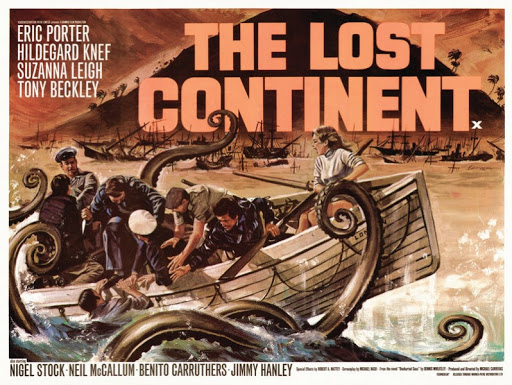
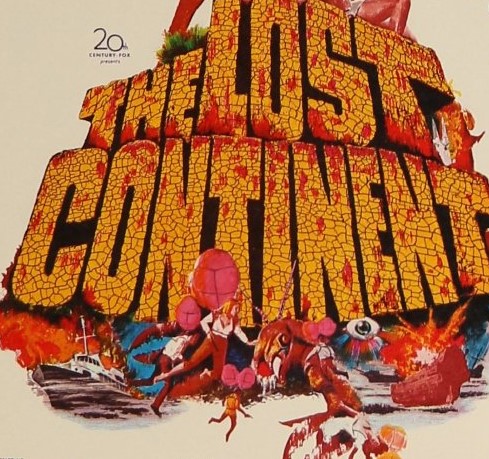
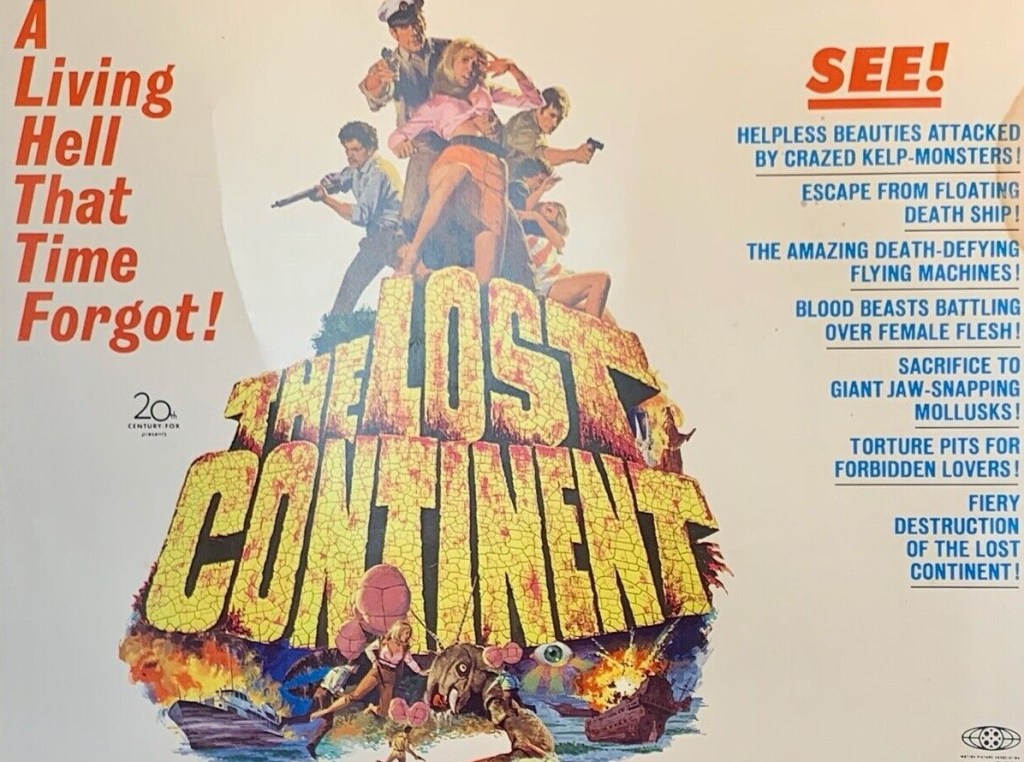
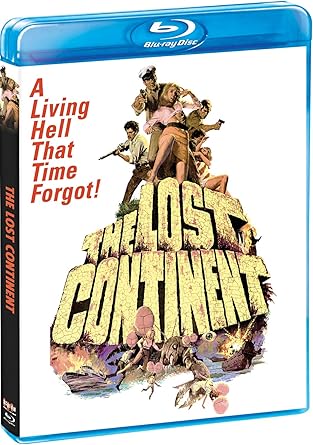
Hammer had struck gold revisiting ancient civilization in One Million Years B.C. (1966) and with its adaptation of Dennis Wheatley’s The Devil Rides Out (1967). The Lost Continent was another Wheatley number (source novel Uncharted Seas) mixing dangerous voyage, hints of the legendary Atlantis, and monsters. While the first half could have been marketed as The Wages of FearAt Sea the second half would come under the heading “The Greatest Oddball Film Ever Made.”
It boasts one of the most intriguing setting-the-scene openings not just of a Hammer picture but of any film – a camera pans along a steamship on whose deck are: people dressed in furs, others in modern clothing and – Conquistadors. Attention is focused on a coffin. How and why they got there is told in flashback. A first half of taut drama, mutiny, sharks, a ferocious octopus, and lost-at-sea a thousand miles from land segues into sci-fi with carnivorous weeds, monsters, and a weird, weird world.
It’s hard to know what’s worse, Captain Lansen (Eric Porter) with a cargo of toxic chemicals made combustible when touched by water or the equally combustible passengers all with murky pasts, so determined to escape their previous lives that they refuse to turn back in the face of a hurricane. Heading the Dodgy Half-Dozen is dictator’s mistress Eva (Hildegarde Knef) with two million dollars in stolen securities and bonds. Dr Webster (Nigel Stock), a back-street abortionist, is at odds with daughter Unity (Suzanna Leigh), who has cornered the market in backless dresses. Harry (Tony Beckley) (The Penthouse, 1967) plays a conman while Ricaldi (Ben Carruthers) is trying to recover the pilfered bonds.
But the arrival of cleavage queen Sarah (Dana Gillespie) as an escapee from the weird world signals a shift to Planet Oddball. The only way to navigate the weeds trapping the ship is with a primitive version of snowshoes with balloons attached to the shoulders. Soon they are trapped in the past, not as prehistoric as One Million Years BC (1966), just a few centuries back to the Spanish Conquistador era. The film steals the idea from the Raquel Welch picture of giant creatures locked in battle but without going to the necessity of hiring Ray Harryhausen.
You couldn’t legislate for the movie’s logic and you shouldn’t even try, just go with the weird flow. It’s on safe enough territory until like The Hangover (20090 it has to explain the bizarre opening sequence. If ever a film has bitten off more than the special effects can chew, it’s this, but it’s still fun watching it try.
The casting relied heavily on actors best known from television or rising stars. Eric Porter was straight from BBC television mini-series mega-hit The Forsyte Saga (1967). Nigel Stock essayed Dr Watson in the BBC Sherlock Holmes series (1964-1968). Falling into the emerging-star category were: Tony Beckley (The Penthouse, 1967), Suzanna Leigh (The Pleasure Girls, 1965) Neil McCallum (Catacombs / The Woman Who Wouldn’t Die, 1965), and Dana Gillespie (Secrets of a Windmill Girl, 1966). Hildegarde Knef (Mozambique, 1964) was just about the most experienced.
In this kind of picture, without being sexist about it, if a woman is required to do more than just scream, it often indicates she has the better part. And so it is here. Leigh and Knef hog the dramatic highlights while Gillespie, courtesy of her outfit and footwear, can’t help but steal the show.
On board ship, director Michael Carreras, fresh from Prehistoric Women (1967), does well, the characters are all solidly presented with decent back stories, but once he enters weird world budget deficiencies sabotage the picture. Even so, it’s worth a look just to see what you’re missing. If you’re looking for a genuine freak show, this ticks the boxes.
Now this is what you’re looking for when you take an unguided tour into the British B-movie. A tight gripping thriller with a parcel of twists, clever character perspective, some stunning cinematography, and pivoting on perception of insanity.
The opening is a cracker. Teenager Janet (Jennie Linden) stumbles along a dark prison-like corridor with little light hearing someone call her name. Entering a door, she spies a woman in a white nightgown lurking in the corner. She responds to the gentle calling. But once she lets the door close behind her and can’t get out, the woman screams that now they are both mad. And that’s just the first, atmospherically brilliant, nightmare.
Janet is soon removed from her posh boarding school, her constant nightmares too frightening for the other pupils. Driven home in a Rolls-Royce, accompanied by teacher Mary (Brenda Bruce) she passes the asylum where her mother is an inmate, but is surprised to find her legal guardian, charming lawyer Henry (David Knight), isn’t there to greet her. Instead there’s a nurse, Grace (Moira Redmond).
We soon learn she’s been effectively orphaned by her mother, who killed her father, Janet, eleven at the time, witnessing the murder. But without any proper home life, looked after primarily by kindly chauffeur John (George A. Cooper) and maternal maid Anne (Julie Samuel) and with the married Henry often absent, there’s little done to quieten down her obsession that she will follow her mother into madness.
The movie takes her perspective, watching her watching out for mystery, or in her point of view as she catches fleeting glimpses of a woman in white. The apparition looking only too realistic, not dashing out of view but turning and apparently beckoning Janet on and it doesn’t take much to push a disordered mind further out of kilter, leading to attempted suicide. Imagining Henry’s wife is the ghost, she stabs her to death.
End of Act One. Start of Twist No 1. You would expect the movie to follow Janet to the asylum where she would be reunited with her mother, knowing she had inherited those terrible genes, trapped in her insanity. But it goes somewhere more delicious instead.
Turns out nice Henry is not very nice at all. He contrived a situation to be rid of his wife and marry lover Grace instead. But, once married, it is Grace who becomes disturbed and the movie follows a similar arc in the second half. Unexplained goings-on. She believes Henry has another, secret, lover and is trying to drive his new wife crazy. She finds strange cigarettes in his pocket, a barman at a hotel recognizes him even though he claims never to have been there before.
The marriage quickly deteriorates although she stands her ground, telling him in no uncertain terms that she won’t put up with any philandering and slapping his face. He is charm itself, easily turning aside her insinuations and from his casual and disarming manner it’s easy to believe he is perfectly innocent. Of course, that’s before Janet’s doll turns up and locked doors open and there’s an apparition.
The beauty of this picture is the atmosphere, the intensity of the camera, the concentration on two vulnerable females, convinced by genuine or imagined guilt that they will succumb to the madness that appears to pervade this particular house. You think it’s going down one route and are annoyed you didn’t see the next twist coming.
There’s the kind of cinematic repetition that enamored critics of more critically acclaimed pieces like The Searchers (1956). It’s almost as though there’s a beam of insanity identifying the next victim. And that’s helped immeasurably by the lighting which allows no shadow on faces. Like an inverted film noir, where the light has nowhere to go, no atmospheric shadow to create, except to land square on the faces of those involved. This would be the Old Dark House except never has a building been so illuminated, not bright throughout, the illumination predisposed to land on faces rather than rooms.
There are a couple of finely composed scenes, one viewed through a staircase, neat revelations, visual and verbal, a fabulous ending with one character screaming and a telephone dangling off the hook.
You might be astonished to discover this is a Hammer picture. Nary a monster in sight. But then little is scarier than what happens inside the mind, when imagination runs riot without external assistance. That the victim is a teenager, prone to the mood swings of that age, makes it easier for Jennie Linden (Women in Love, 1969) to ramp up the emotions without her seeming too barmy from the outset. David Knight (The Devil’s Agent, 1962) is excellent, conniving he may be but the general demeanor of bonhomie never slips into stage villain. But Moira Redmond (The Limbo Line, 1968) is the pick as she morphs from accomplished accomplice to prospective victim.
Tightly written by Jimmy Sangster (Maniac, 1963), characters fully evolved, twists cleverly concealed, and with excellent direction by Freddie Francis (The Skull, 1965), not just the visuals but in drawing out of a fairly standard set of actors exactly what he needs to make this tick.
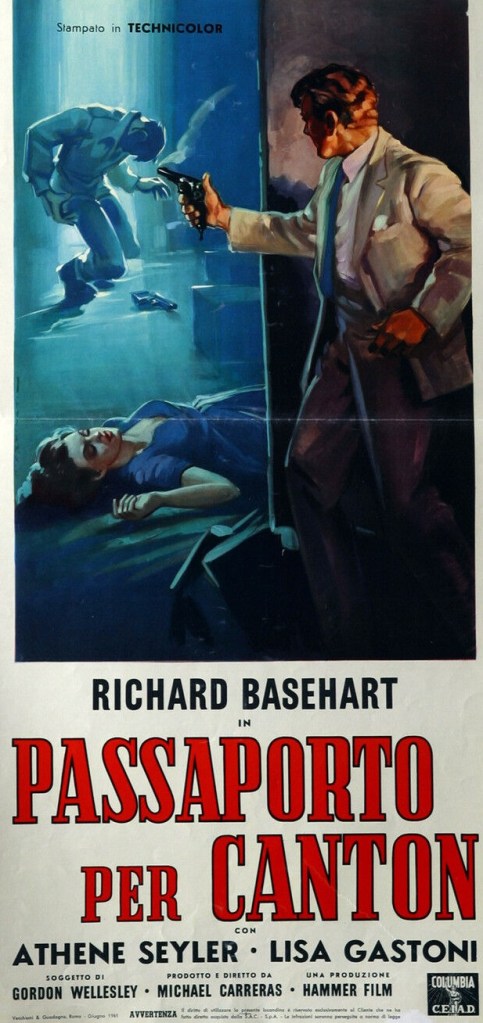
Marked down for sheer laziness. Another Hammer “thriller,” this time with fading American star Richard Basehart and Italian glamor puss Lisa Gastoni. But mostly a hodge-podge travelog of stock footage with dialog taking the place of action, a tedious voice-over far removed from the snappy one-liners we are accustomed to getting from Chandleresque investigators. And let’s forget the red-eyed Chinese replete with drooping moustaches who pepper the picture.
A plane has gone down in Red China with an American courier carrying vital “scientific” information, Approached to help by US government personnel, snappily-dressed Hong Kong travel agent Benton (Richard Basehart) refuses. But when he discovers the pilot is Jimmy (Burt Kwouk), a member of a Chinese family he has befriended during World War Two, he mounts his own rescue mission. Which consists, by the way, of nothing more than floating a sampan up a river, avoiding a few bullets and whisking the lad away.
But he is blackmailed into rescuing the courier when Hong Kong police imprison Jimmy. So off he trots to Macao and then Canton aided along the way, in the opulent back room of a casino, by Chinese businessman Kong (Eric Pohlmann) who you might mistake for a James Bond villain such is his fondness for being surrounded by women – or such is his girth mistake him for a Robert Morley lookalike. Kong happens to be a Russian spy.
No sneaking into China by parachute or perhaps motor boat is required, Kong simply furnishes him with the visa of the title. Benton, vaguely assisted by a maker of fake porcelain, has clues – Three Fishes, The Stream of the Willows.
In his hotel bedroom sits the courier, blonde Lola (Lisa Gastoni), held prisoner. But no sooner have they kissed, as you might expect of any self-respecting travel agent doubling as a spy, than they are interrupted by Kong. She disappears. Naturally, Benton finds her easily enough. She doesn’t have papers, instead a photographic memory.
But she’s not working for the Americans. She’s an espionage freelance, working for the highest bidder. She does it for the danger, perhaps like a certain James Bond, danger is the drug, heightens her senses.
But she’s also pretty damn clever. Knowing Kong is a double agent and can’t just snatch her out of China, she starts an auction for her information. Benton offers more. Therefore she is his property. To get over the tickly issue of Kong, in revenge, keeping her prisoner in China, he is conveniently accidentally shot.
So now they have to escape. But in the shoot-out at the docks (in a barn full of hay for some reason she gets shot) so the movie suddenly turns into one of those post-Bond thrillers where all that effort has been expended for no result.
But you might have thought a producer (Michael Carreras) would have introduced Lola much earlier in femme fatale fashion. But then this producer who, as it happens was also the director, seems to think that voice-over will solve all the tedious problems of actually creating a screenplay that works.
You shouldn’t have cared less about a snappy-suited character such as the one played by Gene Barry in his informal espionage trilogy – Maroc 7 (1967), Istanbul Express (1968) and Subterfuge (1968) – he’s about on a par as an actor as Basehart. But those movies at least had proper stories that made sense and were not just a series of jumps explained by voice-over, the hero neither having to undertake any shamus digging or go into harm’s way, or battle his way out of perilous situation.
It’s not even bad enough to eventually win over a cult audience. The problem is it’s well-made up to a point and the story is intriguing up to a point, but that mark is very low.
Richard Basehart (The Satan Bug, 1965) isn’t called upon to do much except act as the storyteller he’s okay and Lisa Gastoni (Maddalena, 1971) isn’t accorded sufficient screen time to really make a mark. Which is the biggest shame because an amoral spy like her would have made a brilliant femme fatale had she been introduced early on and then turned out to be the mercenary she was.
The rest of the cast are caricatures, though interesting to see Burt Kwouk in pre-Pink Panther persona but cringe-worthy to see Bernard Cribbins (You Must Be Joking, 1965) mangle a foreign accent. Clearly Carreras learned a lesson from this implosion of talent and story because two pictures on he directed taut thriller Maniac (1963).
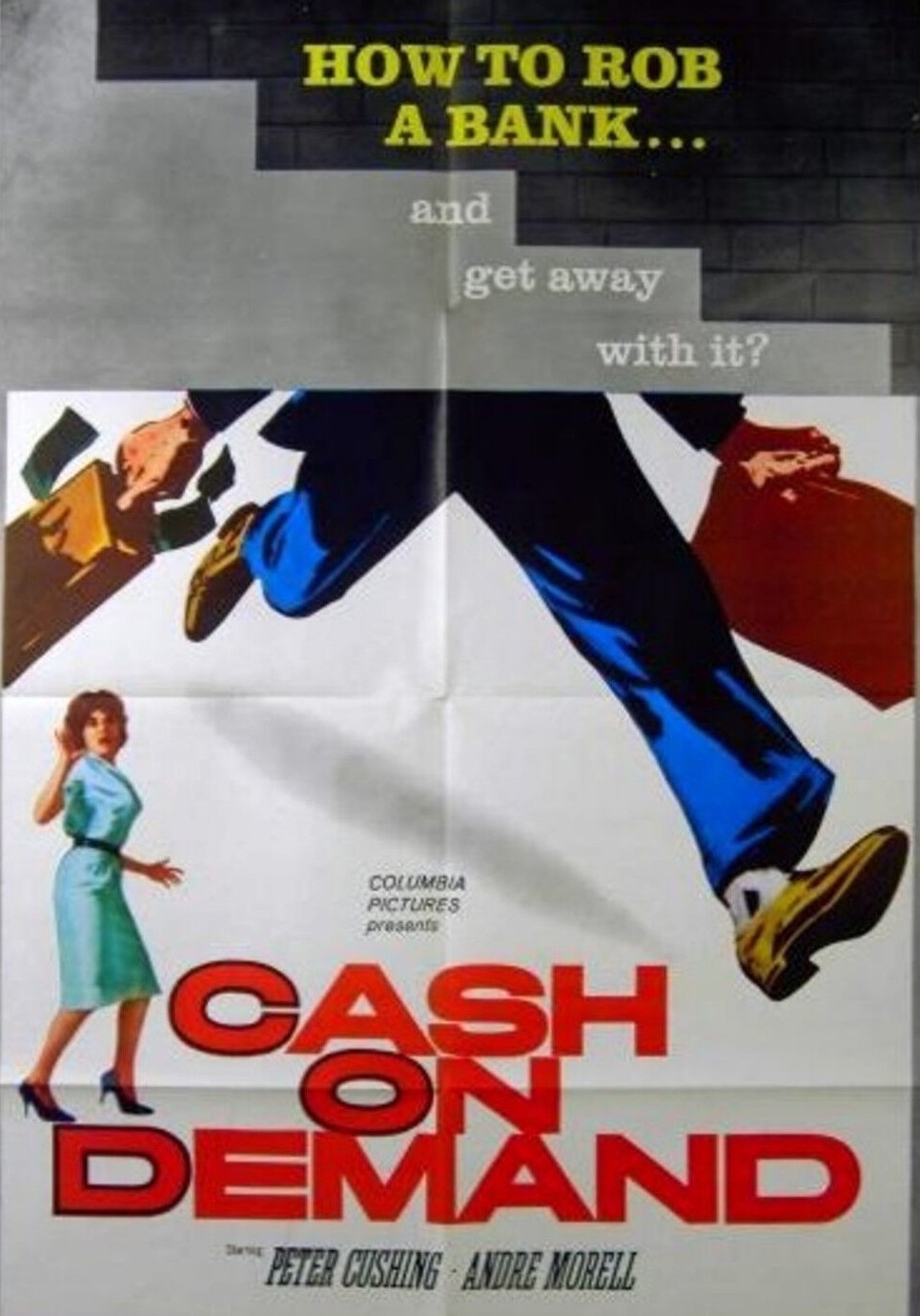
Ideal crime B-picture. No femme fatale, but a tight one-location two-hander. Set a couple of days before Xmas in a rural English market town, while possessing sufficient twists to see it through, in the main it is a battle of wills between urbane thief Col Gore Hepburn (Andre Morell) and his victim, stuffed-shirt bank manager Harry Fordyce (Peter Cushing). Combines slick heist with An Inspector Calls mentality where the morally superior are taken down a peg.
Fordyce is the kind of martinet who makes his staff remove Xmas cards from display, nit-picks about the state of nibs (in the days when pens were dipped in ink) and threatens to sack chief clerk Pearson (Harry Vernon) over a minor error that he has worked up into potential embezzlement. So unpopular, he is not invited to the staff party.
Under the guise of carrying out a security inspection Hepburn sets up a robbery, tying Fordyce in moral knots, his unwilling collaboration ensured by threatening to stick electrodes to the bank manager’s wife’s head. Hepburn has done his research, aware of all aspects of security, but, more importantly, knows his man, how to exert pressure, how to keep Fordyce on edge. Hepburn reeks of self-assurance, Fordyce of insecurity, a friendless man who bullies his staff, living a life suffused with discipline and bereft of enjoyment.
Though there are a couple of red herrings, and an unexpected incident, what mostly endangers Hepburn’s bitingly clever plan is the unforeseen, that the cold-hearted bank manager will come apart under pressure.
Underlying the action is class conflict. But not the usual working- class vs upper class. Instead it is aspiring middle class vs assured well-educated upper class. Hepburn is the kind of well-dressed smoothie who could talk his way into any company and out of any situation. He puts everyone at their ease, knows how to enjoy himself, would make any party go with a swing, could flirt convincingly with your grandmother, and you would trust within an inch of your life. Fordyce, on the other hand, is one of life’s scrapers, everything by the book, creeping into management painfully slowly, and once acquiring a position of authority letting everyone know who is boss and terrified of losing his standing in society. It’s “class” of another kind too, that of the winning personality versus the eternal loser.
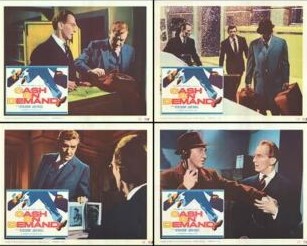
Peter Cushing as the bank manager.
This plays against expectation. Normally, in a heist scenario, there’s one employee who’s trying to beat the baddies, some clever device or trick up their sleeve. That’s not the case here. Instead, we’re served up a character study, the supposedly upright pillar of the community revealed as a coward and moral bankrupt.
And the unexpected also comes in the casting. Both Peter Cushing and Andre Morell play against type. At this point they were best known as Sherlock Holmes and Dr Watson in The Hound of the Baskervilles (1959), an upright team on the side of the angels. Cushing, while often tight-lipped, generally exhibited a morally superior screen persona. Here, that trademark persona rapidly vanishes under pressure.
Quentin Lawrence (The Secret of Blood Island, 1965) directs within a very tight timeframe.
The movie had unusual origins. It was expanded from a short-lived series called Theatre 70 on British ITV, the number relating to time, the program running for 70 minutes rather than the usual hour. And it had just as unusual a release. Perhaps for copyright reasons, it didn’t see the inside of a cinema in the UK until December 1963 when it went out as the support to musical Bye Bye Birdie (1963) on the Odeon circuit. But it had already been released by Columbia in the US in 1961 as the support to Twist Around the Clock (1961).
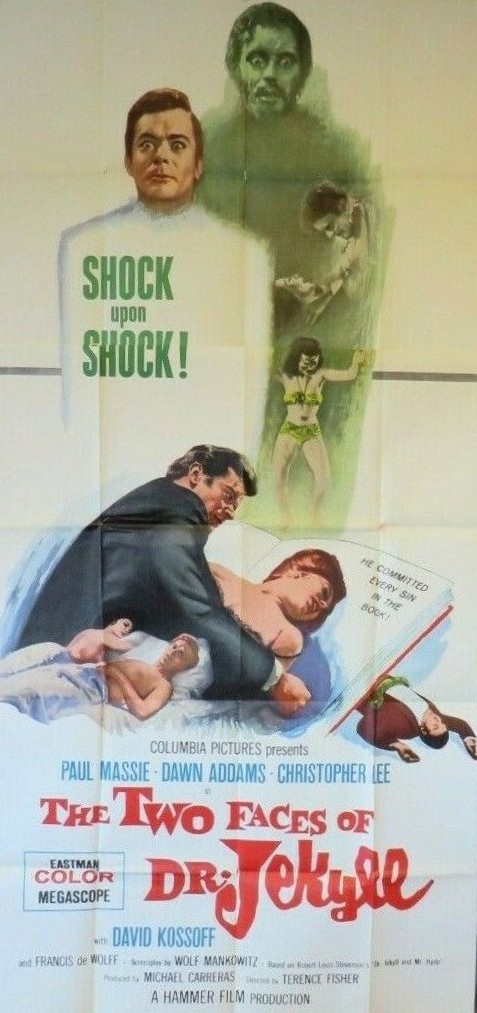
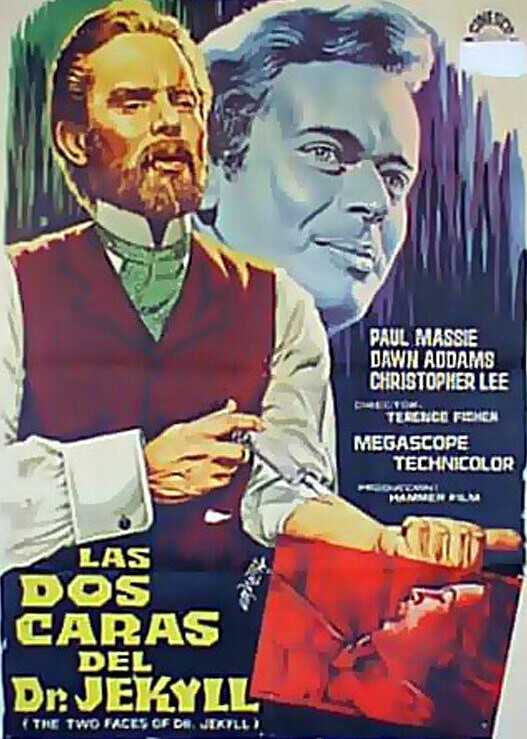
One of the most shocking films of its day with its unusual focus on sex and violence, this takes the famed Robert Louis Stevenson tale down a different direction in that Dr Jekyll enjoys the base animal instincts he has unleashed with his experiments rather than expressing remorse or guilt. Evil has never been more demonstrably enjoyed.
Dr Jekyll (Paul Massie) is a shy cuckolded scientist when he takes the magic elixir that diverts his dull personality towards a more dynamic, if ultimately perverted, destination. From being fearful of life, he begins to sample its more exotic pleasures under the guidance of louche best friend Paul (Christopher Lee) who is carrying on an affair with the good doctor’s wife Kitty (Dawn Addams).
Not only does the reincarnation of Jekyll as the lusty Hyde consort with prostitutes and manage to snare exotic dancer Maria (Norma Marla), a beautiful woman who would normally be way out of his league, he develops a fetish for violence, almost beating to death a hooligan (Oliver Reed) in a dodgy club, only prevented from committing his first murder by the intervention of his friend.
Sure, there’s some philosophising about the nature of good and evil and whether violence is inborn or nurtured and there are moments when guilt rears its ugly head, but these are pretty fleeting to be honest, and most of the time he can hardly wait for another draught of his poison in order to shake off his insipid persona and revel in the new creation.
But magic will only take you so far. Believing he is now irresistible to women he fancies his chances with Paul’s amour, who is of course none other than his wife, but she will have none of it, finding him a poor alternative to the charming Paul. In one of the most controversial scenes of the day, and perhaps only ironically acceptable at the time, Hyde proceeds to rape the resisting Kitty. This skirts so close to the edge of taste, not just the worst type of domestic abuse (though husband assaulting wife would be no less unusual in Victorian times than it is now), but almost the neanderthal man taking what he wants, that it makes for uncomfortable viewing, especially as it is presented as a come-uppance for the adulterous hoity-toity Kitty.
Perhaps more interesting is that having won over the cold Maria, a trophy lover on a par with the higher-born Kitty, that’s not enough for Hyde.
Also, for the time, is an extremely risqué scene involving Maria and her snake, especially when having completed the usual survey of her curves, the reptile ends up down her throat. That the Victorians were masters of the art of hypocrisy comes as little surprise, but the extent of it takes the viewer aback.
There’s another twist. When it becomes apparent that his crimes are about to catch up with him the cunning Jekyll attempts to blame Hyde.
Sumptuously mounted by Terence Fisher (Dracula, Prince of Darkness, 1966) and with nary an attractive character in sight – none of the innocent victims of the vampire sagas, for example – to leaven the sight of such unmitigated wickedness, the director offers an unique vision of how easy human beings will degenerate given the chance. At the outset Paul appears the most obvious villain, leeching on his friend to pay his gambling debts, while at the same time making hay with his wife. But initial audience sympathy for a wife, presented as a beautiful woman who for the sake of security has made a bad marriage and who needs an outlet for passion, soon dissipates as her true character is revealed.
The refusal to temper the ongoing degeneracy with one good character is a bold choice. Budgetary restrictions eliminated the usual transformation scene but that was probably for the best, since Hyde merges as though from a chrysalis into a stronger personality rather than undergoing some body-wracking physical change. It’s almost as if the director is determined to show how easy, given opportunity, a good but essentially weak man will embrace the dark side.
Accusations that Fisher has failed to bring sufficient suspense to the film I find unfair. Certainly, there’s not the tension of the will-he-be-found-out vein, but since the story is so well-known that appears a redundant course sensibly avoided. The director replaces that with ongoing friction between Jekyll and his friend on the one hand and his wife on the other, both of whom are unaware that the man they know as Jekyll is aware of just what a fool has been made of his alter-ego.
The emphasis instead falls on how and when the cuckold will take his revenge. And although the rape scene is unwelcome, there’s a certain ironic sadness for Jekyll to discover that his new persona is no more attractive to his wife than his old one.
Paul Massie (Call Me Genius, 1961) is of course far removed from an actor like Spencer Tracy (Dr Jekyll and Mr Hyde, 1941) and he relies overmuch on rolling the eyes but even so this is a decent performance. Christopher Lee (Dracula, Prince of Darkness) is the revelation, creating a very believable insidiously charming man who never quite approaches outright villainy. Dawn Addams is excellent as the spoiled entitled wife.
One of the unusual aspects of the picture is that where Hammer had been and would remain a breeding ground for new stars – Christopher Lee a most obvious example – everyone else featured here came to, in cinematic terms only I assure you, an untimely end.
This turned out to be Paul Massie’s only starring role – he only made another three films during the entire decade – and was soon relegated to television. Dawn Addams only managed another nine and, apart from House of Sin/The Liars (1961), spy flick Where the Bullets Fly (1966) might be counted the peak.
David Kossof only made another four, and none beyond 1964. And this was the final film in an extremely brief two-picture career for Norma Marla. Only the uncredited Oliver Reed (Women in Love, 1969) and of course Christopher Lee (Dracula, Prince of Darkness, 1966) went on to bigger and better things.
As did Terence Fisher who helmed most of the best Hammer pictures of the decade. Wolf Mankowitz (The Day the Earth Caught Fire, 1961) wrote the script.
Generally dismissed at the time, this has for good reasons acquired a substantial following and is well worth a look.
The three ages of man: child watches this film for the dinosaurs, teenager for Raquel Welch, mature male for the dinosaurs now he knows who Ray Harruhausen is.
Guilty pleasures multiplied. Add the Mario Nascimbene (The Vengeance of She, 1968) score to the delights of Raquel Welch in a fur bikini and Ray Harryhausen’s sensational stop-motion animation. Generally dismissed as high-level hokum, it features an intriguing gender role reversal, and is virtually, not to be too academic about it, a throwback to silent cinema, minus the title cards that helped audiences a century ago work out what was going on. Everything relies on facial expression and gesticulation.
Luckily, there’s not too much in the way of narrative complication. Tumak (John Richardson), the son of the chief of the Rock Tribe, is chucked out into the wilderness for standing up to his father. He probably wouldn’t be crying too much about that, given the strong rule over the weak, old men are left behind to die, and the feeble are last in line for food. Plus, his brother Sakana (Percy Herbert) is prone to stabbing people in the back.
Unusually, the picture went straight out into U.S. wide release (saturation). It was an 80-theater break. Twentieth Centry Fox mounted a huge advertising campaign based on the fur bikini image, but by this point she wasn’t an unknown star, already seen in “Fantastic Voyage.” The New York Times might be wincing now at its “monument to womankind” now.
Reaching a distant shore, Tumak is rescued by Loana (Raquel Welch) of the Shell Tribe who takes an instant fancy to him, helping protect him from a huge marauding creature. But his aggressive temperament doesn’t sit too well among this peace-loving democratic group either, despite him saving some kids from another marauding creature. But when he’s chucked out this time, Loana goes with him.
But you know that any journey pretty much takes them into the heart of dinosaur heaven, and Tumak makes the mistake of retuning to his own tribe, where Loana is made unwelcome by Nupondi (Martine Beswick), Tumak’s previous squeeze. It’s power politics all over again until marauding creatures and a convenient volcano intervene and matters can be settled.
All eyes are on Loana and her miraculous bikini until a dinosaur appears, which occurs at frequent intervals. Then you can’t take your eyes off Ray Harryhausen’s creativity, at first expecting the match between humans and his wizardry to be so obvious the illusion will be shattered, but once you realize that is not going to be the case you just sit back in wonder.
Spoof newspaper from the Pressbook.
Harryhausen has made dramatic improvements in his techniques since previous highpoint Jason and the Argonauts (1963). Cleverly, he builds anticipation by matte work to present scenes of live creatures. The first, the warthog, is of normal proportions, and its capture suggests man’s domination over beast. But that proves a false assumption. Anything later is just gigantic – iguana, turtle and tarantula. In normal circumstances only the giant spider might appear a threat but in the distant past it would appear any creature bigger than man looked upon humans as an easy meal.
And that’s before the allosaurus rampages into sight and a pteranodon swoops out of the sky snaring Loana and then has to battle a rhamphorhynchus over its prey, almost as if Harryhausen was determined to animate the most difficult creatures possible in order to prove his innate skill.
Sure, hostility is much easier to telegraph than other emotions and a fair bit of the picture is people getting cross with each other, but meet-cute between Loana and Tumak involves little as significant, glances and eye contact the core of communication. It’s pure cinema. Stripped of any meaningful dialog, the camera captures everything we need to know. It’s a brutal world, dog eat dog, man eat warthog, dinosaur eat woman, every living thing is a snack of one kind or another and when they’re not killing for food they’re battering each other out of power lust, rivalry or jealousy.
And although nobody could have guessed the impact Ms Welch would have on the male pulse, Hammer had previous in the department of introducing a stunning female into a tale, and it may be pure coincidence that both Loana and Ayesha in She (1965) were woman of power, rather than mere playthings of men. Ayesha is introduced in stunning fashion, her presence pre-empted, most of the picture prior to her appearance serving merely to build her up. Obviously, Ursula Andress did not disappoint but she was introduced in majestic fashion rather than catching fish at the seashore. Albeit Loana sported a bikini, so did all the other fisherwomen and director Don Chaffey resisted the temptation to present her in more statuesque fashion, regardless of the image presented on the poster.
Just as it’s hard to underestimate the iconic impact of Raquel Welch in a fur bikini, so, too, is the work of Harryhausen. And I would also add the innovative score of Nascimbene, with sounds Ennio Morricone would have been proud of.
Despite myth to the contrary, it’s rare for an unknown to emerge from a movie a real star, but Raquel Welch certainly did, though her image on a million posters might have had something to do with her sudden success.
As he did with Jason and the Argonauts, Don Chaffey keeps the story spinning along, makes the best of the lunar landscape and raw actors like Welch and John Richardson (She). Michael Carreras (The Lost Continent, 1968) based his screenplay on One Million B.C. (1940).
The problems of creating believable dinosaurs were so evident that nobody really tackled pre-history until Steven Spielberg waded in with Jurassic Park (1993). It’s a measure of how successful this effort is that the director eschews the cute kids that seemed endemic to the later genre and had his characters facing up to the monsters rather than running away like crazy or expecting that somehow man could control them.
Much more entertaining than I expected, high class special effects, strong narrative, and more than enough to wonder at.