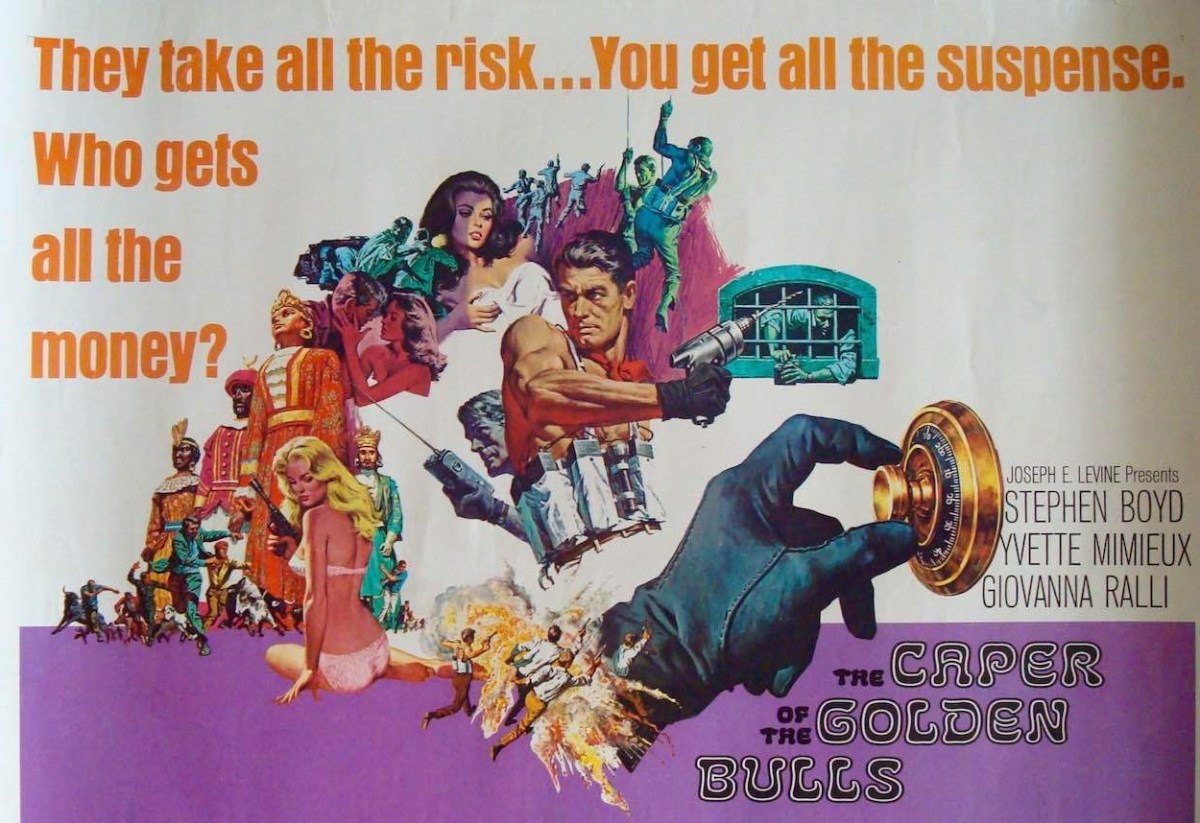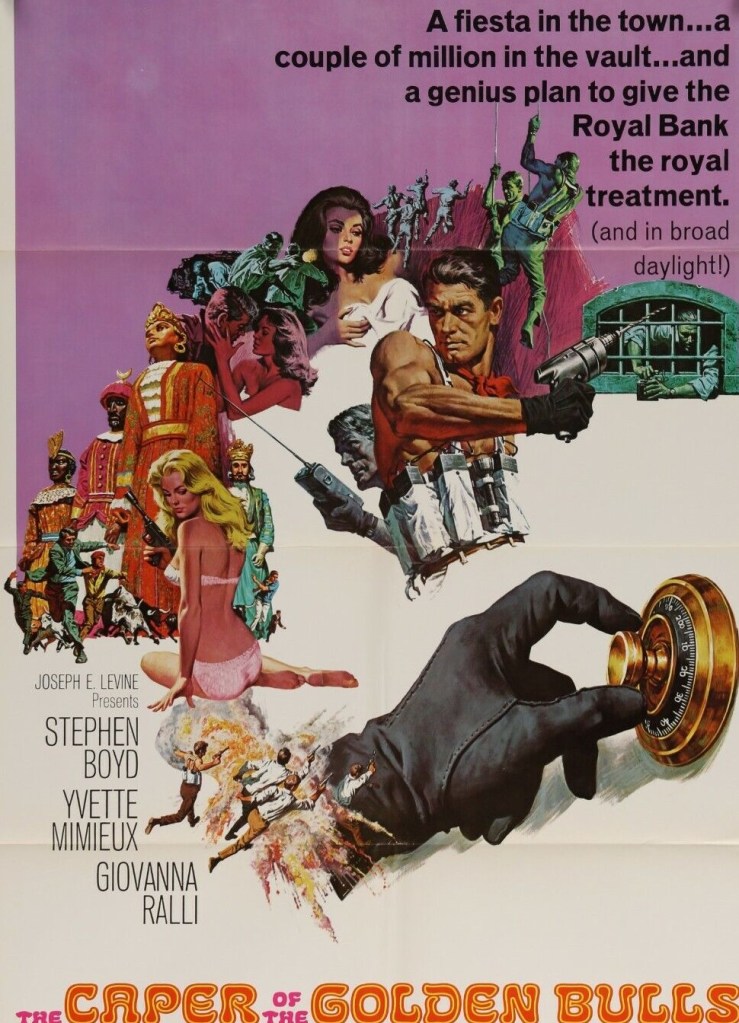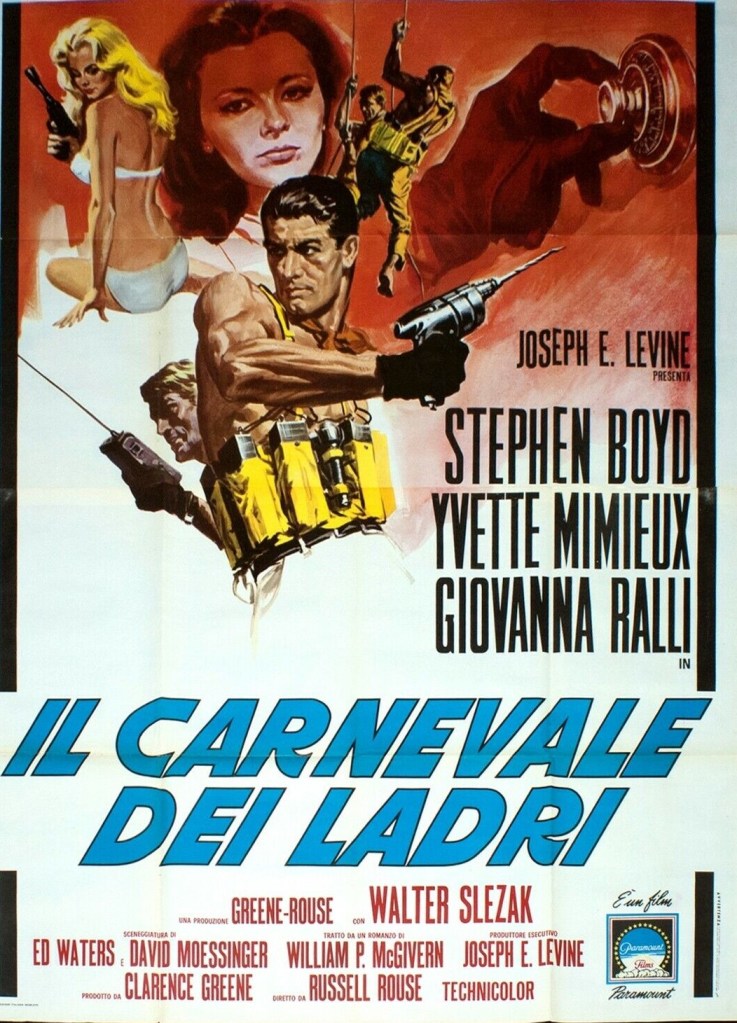
The Caper of the Golden Bulls / Carnival of Thieves (1967) ***

Just to be clear. Nobody is stealing a golden bull, though the annual running of the bulls in Pamplona in Spain is a plot element. No, this gang, led by former bank-robber Churchman (Stephen Boyd) is only going to break into an impregnable bank (par for the course) and steal priceless royal jewels.

There’s an audacious, certainly unorthodox, plan, tension throughout between Churchman’s  sexy former lover Angela (Giovanna Ralli) and current more demure squeeze Grace (Yvette Mimieux), a couple of unexpected comedy sequences, a silent heist and a superb final twist.

Just to be clear – there’s no bikini blonde with a pistol.

Churchman is not your ordinary robber. He only hit banks to make reparation for, while a World War Two pilot, mistakenly dropping bombs on a French cathedral, donating the loot to the reconstruction. Angela, with no such ideals, has spent her share of the dosh and intent on a financial top-up  blackmails Churchman, now a respected businessman, into the one-final-caper scenario.  

Key to getting the jewels out is becoming involved in the annual fiesta, of which the bull-running is a minor part. The bull-running, too, shifts the dynamic of the job, and what appears an irrelevant sub-plot of former resistance fighters hunting a traitor provides an essential pay-off.

When moral Grace uncovers the plot she is inveigled to participate, ensuring some spicy bitchy dialog between herself and the more obviously immoral Angela.  Unwittingly helping out is Spanish cop (Walter Slezak) and with Churchman committed the only person Angela needs use her wiles on is a giant, friendlier by the minute as he responds to her seductive smiles.

While this lacks the panache, guile or gloss of a Topkapi (1964) or Gambit (1966), it’s certainly well-done enough. It’s one of those films you appreciate more after you’ve watched it than during, the structure of the screenplay most of all, as all the little pieces of a finely-tuned jigsaw lock into place.

There’s a couple of excellent reversals, an ambush where firecrackers pass for bullets, imminent discovery of explosives thwarted by a quick-thinking Grace, and some split-second timing.  Explosives, timed to match the firing of a cannon, allow a bystander cop to remark, “that cannon gets louder every time.” At first the fiesta appears standard time-filling tourist-fodder but both the parade and the bull-running are allocated genuine spots in the narrative.

The sensuous, devious Giovanna Ralli (Deadfall, 1968) is the pick, a femme fatale straight out of film noir, with a knowing twist in her main seduction scene. Fans of Stephen Boyd (Assignment K, 1968) will enjoy seeing him dally with conscience rather than rely on a straight down the line hardman, albeit with more than an ounce of charm. What Yvette Mimieux (Dark of the Sun, 1968) ultimately brings to the occasion is hidden until the end so her character has more depth than initially surmised.

There was a sense here, though, of three stars still trying to make their mark on Hollywood, establishing their marquee credentials. Although Boyd had enjoyed box office success in Fantastic Voyage (1966) and The Bible (1966) he was not seen as the main element in those film’s hitting the target. Other films relying on his star potential to pull in an audience had flopped.

Outside possibly of Disney confection Monkeys, Go Home! (1967) and The Time Machine (1960) Yvette Mimieux had yet to enjoy a proper hit. Giovanna Ralli was the latest in a string of European imports, a low-level gamble since they were cheaper than Hollywood alternatives even though most never made the grade or did so only fleetingly.

You wouldn’t pick this picture to put either of the trio back on the very top since for the sake of later twists the screenplay plays around with motivation and the very lack of gloss limits the movie’s potential. But although we’ve seen much of this before, it’s still suspenseful enough.

Russell Rouse (A House Is Not A Home, 1964) directs from a screenplay by David Moessinger (Number One, 1969) and Ed Waters, who had form in this area with Man-Trap (1961).

An engrossing enough matinee.

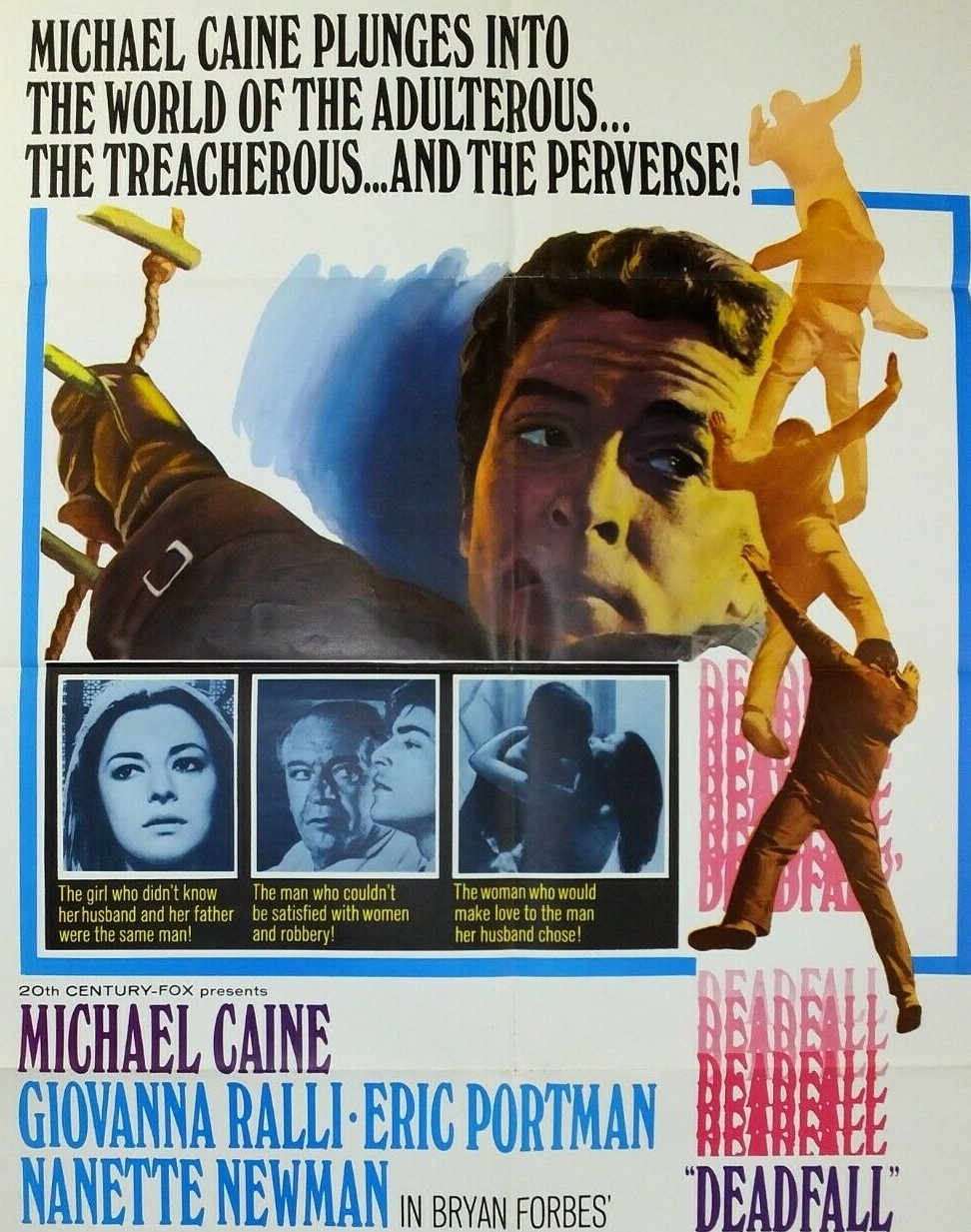
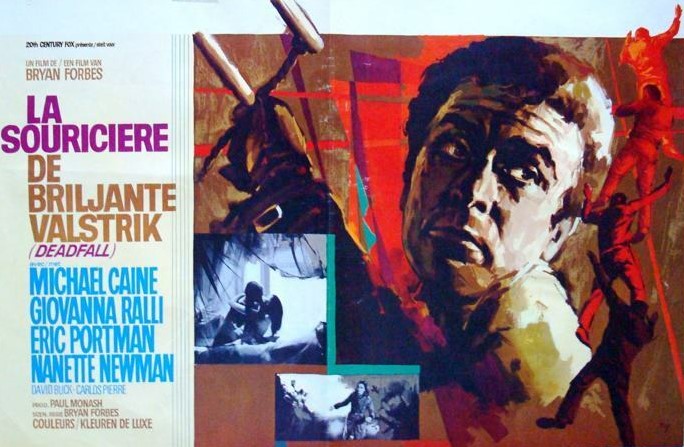
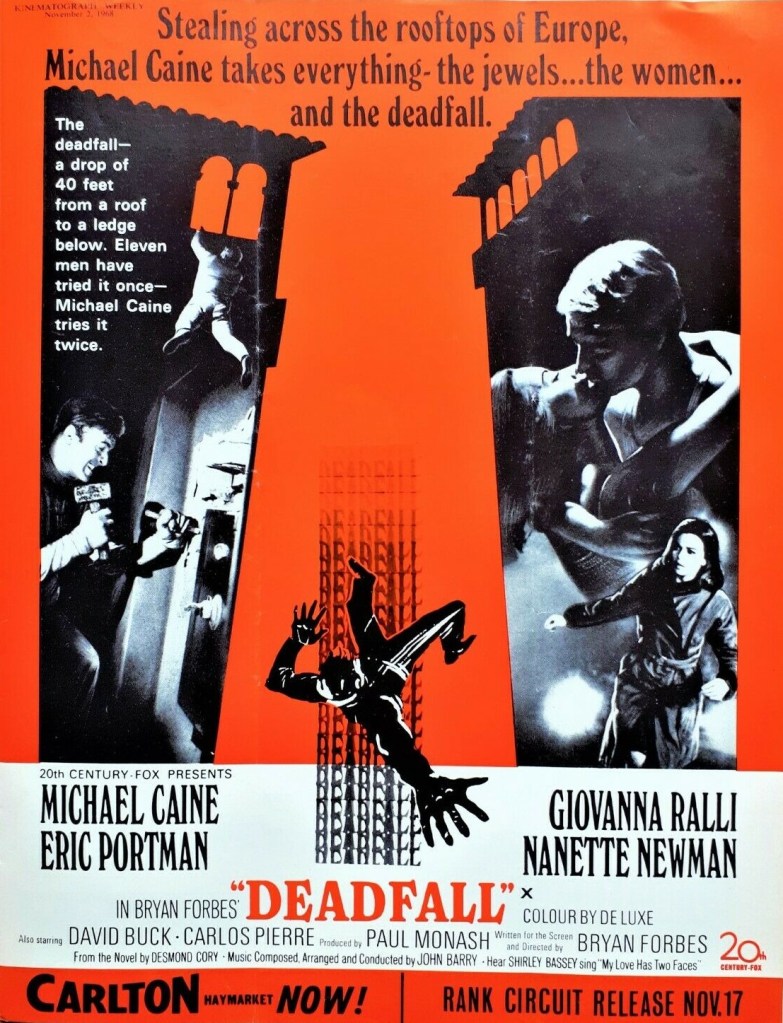
Deadfall (1968) **

“The Big Reveal” comes too late to save this heist-cum-melodrama. It can’t make up its mind whether it wants to join the canon of superlative 1960s caper pictures – in which case it needed to make a greater effort on the cat burglary front – or whether it’s an odd addition to the menage a trois category, in which case it needed characters you could actually believe. Worst of all, it contains one of the great artistic follies, a robbery carried out in time with an  orchestra playing one of the great John Barry compositions, “Romance for a Guitar and Orchestra.”

The only problem, there’s no dramatic reason for this. Since the concert is miles away from the robbery, it’s not as if the music drowns out the shenanigans. Director Bryan Forbes (King Rat, 1965) shoots himself in the foot. It’s too clever a device by half, even if the music is intended as a counterpoint to the  robbery’s more dramatic themes or the silence which had become a trope.

Cat burglar Henry (Michael Caine) forms a business partnership with elderly safecracker Moreau (Eric Portman) and falls for his wife Fe (Giovanna Ralli). The husband-wife relationship is off to begin with, he preferring males, and the wife admitting she doesn’t always find men attractive, though quite what she is hinting at is never made clear. The target is millionaire Salinas (David Buck), whom Henry is investigating to the point of pretending to be an alcoholic so he can get to know Salinas in a sanatorium.

Any other movie would get straight to the point – draw up plans and get on with it. But here, for no real reason except delay, Moreau wants them to do a trial run,  a safecracking job on the mansion of the kind of couple who drive off in a posh car to attend a concert. The effort put into the planning isn’t really up to scratch, not when compared to the likes of Topkapi (1964) – to which every heist film of the era was measured – or Gambit (1966) or even the less well-known The Happy Thieves (1960) or Seven Thieves (1960).

Apart from some cat burglary skills the whole episode is perfunctory, guard dogs knocked out by drugs. The background music, the aforementioned John Barry opus, just about kills off any prospect of tension. It only sparks into life when Moreau admits the safe is beyond him and Henry has to prise it out of the wall and cart it to the waiting car.

The second heist would have been far more interesting had we known from the start that Salinas welcomes burglary attempts, seeing it as some kind of duel of wits with malfeasants.

In between the two robberies there is time enough – too much time in fact – for Henry and Fe to get it together, for Fe to run off and then return only to learn in The Big Reveal the kind of despicable man her husband is. The movie can’t even deal with the incestuous sub-plot and just lets it hang there. But by that stage you couldn’t care less. Fe isn’t the type of femme fatale to bother crossing the road for, the romance seems too prescribed and the downbeat ending makes no sense.

I’m only giving this any points at all really because it stars Michael Caine (Hurry Sundown, 1967) and features a lengthy slice of John Barry music. Caine has been in enough duds for sure, but this doesn’t have the ring of one of his doing-it-for-the-money numbers or a stab at the Hollywood big-budget scene. Caine is good enough and Eric Portman (The Bedford Incident, 1965) is an interesting study. But it just doesn’t gel, not just let down by Giovanna Ralli (The Caper of the Golden Bulls, 1967) but by the pretentious direction and dramatic miscalculation of Bryan Forbes.

Forbes’ wife Nanette Newman (The Wrong Box, 1966) makes a puzzling appearance in a small role with no dramatic credibility. Leonard Rossiter (Deadlier than the Male, 1967) provides another cameo. For many the high spot will be to see John Barry in the flesh, conducting the orchestra playing his composition.

Discover WordPress

A daily selection of the best content published on WordPress, collected for you by humans who love to read.

The Atavist Magazine

by Brian Hannan

WordPress.com News

The latest news on WordPress.com and the WordPress community.