Woman of Straw (1964) ***

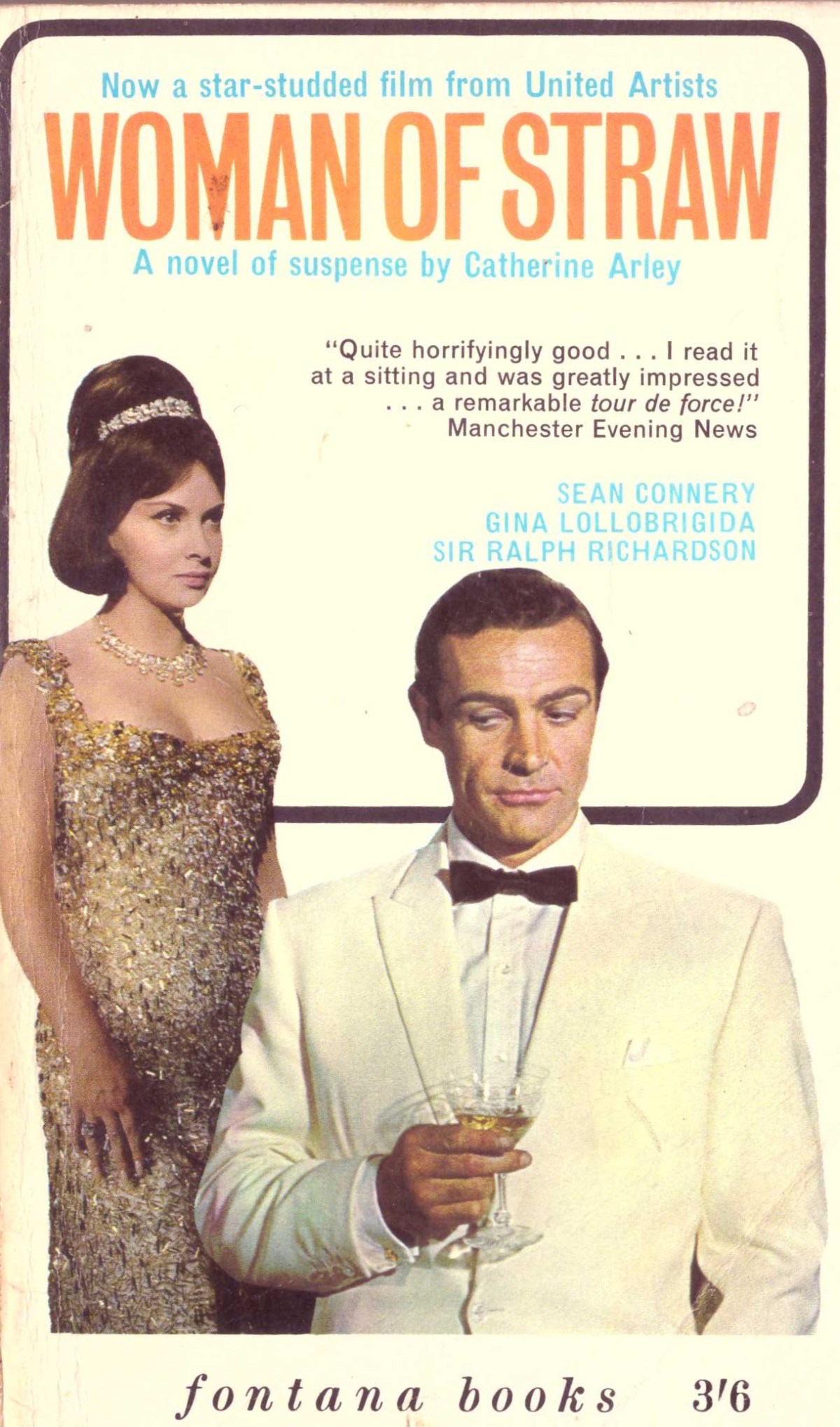
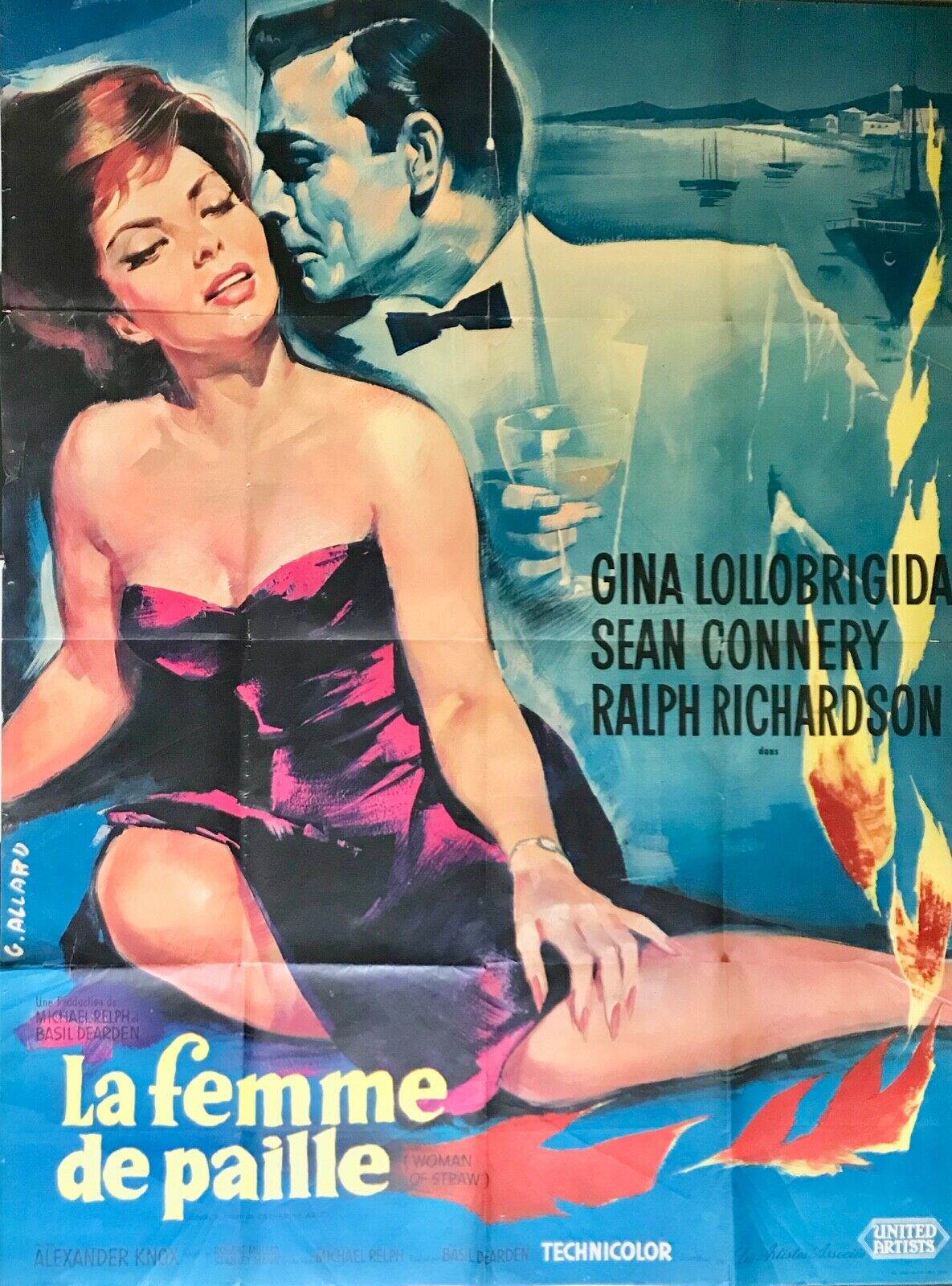
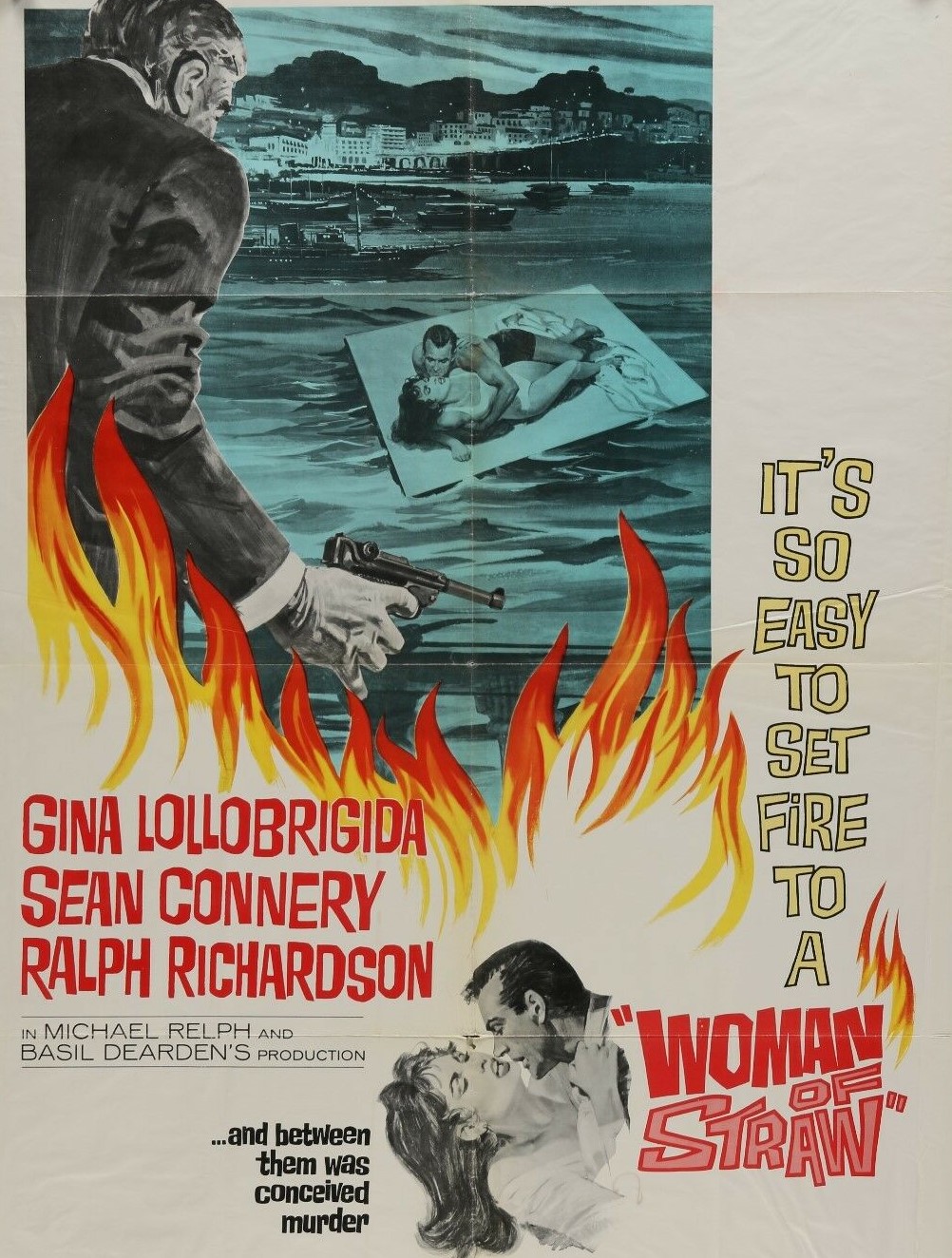
In a plot worthy of Hitchcock without that director’s sly malice, rich playboy Tony (Sean Connery) conspires with not-so-innocent nurse Maria (Gina Lollobrigida) to rid himself of  heinous upper-class racist misogynistic bully Charles (Ralph Richardson), his uncle. Beyond  a savage case of entitlement, Tony has good reason to hate the wheelchair-bound multi-millionaire, blaming him for his father’s suicide and for seducing his widowed mother, now dead. Tony’s ploy, in part by opposing the very idea, is to get Maria to marry Charles, inherit his fortune and provide himself a £1 million finder’s fee when the seriously ill old man dies.

Maria’s refusal to kowtow to the old man and her initial resistance to Tony make her all the more desirable to both. When Maria saves the old man from a potential heart attack, he is moved enough to marry her and draw up exactly the will the pair want. But when he suddenly dies, Maria surprises herself by the depth of emotion she feels.
But that soon changes when she comes under suspicion. A bundle of complications swiftly change the expected outcome. A police inspector (Alexander Knox) doubts cause and place of death.

The first half is the set-up, the various figures being moved into place, not quite as easily as might have been anticipated, which adds another element of tension. Charles is such a hideous person nobody could lament his passing, but still his vulnerability, not just his wheelchair confinement but his love of music, his better qualities coming to the fore as the result of Maria’s presence, accord him greater sympathy than you would imagine.

That the otherwise gallant Tony’s entitled life depends entirely on his uncle’s good wishes lends him an appealing frailty. The nurse’s principles safeguard her against being taken in by riches alone, but there is a sense that she has used her physical attraction in the past to her advantage.

After the first two James Bond pictures, this was Sean Connery’s first attempt to move away from the secret agent stereotype and in large part he is successful. As amoral as Bond, he could as easily be a Bond villain, smooth and charming and larger than life and superbly gifted in the art of manipulation, the kind of putting all the pieces in place that Bond villains excelled in.
It will come as a surprise to contemporary viewers that he is merely the leading man, not the star. Gina Lollobrigida (Go Naked in the World, 1961) receives top-billing because she carries the emotional weight, initially perhaps as cold as Tony, but her attitude to Charles changing after marriage, meeting a need that Tony would not consider his to fulfill, and beginning to regret going along with any devious plan. That she then discovers she may merely be a pawn rather than a partner creates the dilemma on which the final section of the film depends for tension.

Both actors are excellent, exuding star wattage, the screen charisma between them evident, and audiences craving the pairing of Connery with an European female superstar will be well satisfied. Lollobrigida has the better role, requiring greater depth, but it is romance as duel most of the way. Ralph Richardson (Khartoum,1966) has never been better as one of the worst human beings ever to grace a screen. Johnny Sekka (The Southern Star, 1969) brings dignity to the maligned servant and Alexander Knox (Khartoum) is a crusty cop. 

A slick offering from Basil Dearden (The Mind Benders, 1963), with one proviso – see seaparate article for the racism in this film. Written by Robert Muller (The Beauty Jungle, 1964) and Stanley Mann (The Collector, 1965) based on the novel by Catherine Arley.

Could have done with expending less time on the set-up and getting to the meat of the thriller quicker.

Come September (1961) ***

The quite superb concept that underpins the traditional unsettling of Rock Hudson is sabotaged by the inclusion of an unnecessary generation gap element and because one of the youngsters is singer Bobby Darin that throws a musical spanner into the works. The basic set-up is that Lisa (Gina Lollobrigida), the Italian lover of wealthy American Robert (Rock Hudson), is fed up with the part-time nature of their relationship. Although their affair dates back six years, it only lasts for the one month (September) he vacations each year in his luxurious villa on the Ligurian coast.

She’s so annoyed at his lack of commitment that she’s about to marry posh Englishman Spencer (Ronald Howard), that imminent event only put off by the unexpected earlier-than-usual arrival of Robert. Matters are further complicated because his enterprising Italian butler Maurice (Walter Slezak) hires out the villa to paying guests for the other eleven months. To explain the owner’s sudden arrival, Maurice persuades his guests to go along with the notion that Robert is a former owner fallen on hard times deluded into thinking he still possesses the property.

The guests are a gaggle of young women, including psychology major Sandy (Sandra Dee) who proceeds to analyze Robert, and they are herded around by formidable chaperone Margaret (Brenda de Banzie) who prevents Lisa sneaking into her lover’s bedroom.

So enough plot to be getting on with. You’d assume Spencer is going to turn up, maybe with his equally formidable sisters, to cause ructions at the villa. Lisa appears to enjoy making Robert wait the way he has kept her wait, so a gentle shift in power, and there’s going to be an inevitable bust-up so we expect a quick shift into the will-she-won’t-she scenario. Plus, there’s the whole issue of Robert claiming back his villa and dealing with the over-entrepreneurial Maurice.

Instead, the second act enters a whole new realm. Unless one of the girls was going to make a play for Robert, there’s not much reason for them to be there except for the nuisance value and to allow Margaret to flex her authority. An unwelcome quartet of young men, led by Tony (Bobby Darin), embark on the equally unwelcome task of wooing of the young ladies, Tony having his eyes on Sandy. Although various romantic entanglements are enacted, that’s not what takes center stage.

Instead, the bulk of the middle section scarcely involves the Robert-Lisa quandary and instead it’s devoted to an endless battle between Tony and Robert as the younger specimen attempts to prove he is mentally and physically superior. Now the one element that had made these Rock Hudson comedies work was his helplessness. He may occasionally be smart or wealthy but the whole point of these stories was for a woman to run rings around him or at the very least drag him way out of his comfort zone.

Seeing Robert best Tony – endlessly – takes the shine off the picture and it’s not until Robert is revealed as a sanctimonious hypocrite, living by a double standard, that the movie catches fire again as Lisa storms off in a huff and we can settle down to some good old-fashioned will-she-won’t-she.

This proves a very successful change of pace for Gina Lollobrigida, and she reveals herself to be such a splendid comedienne that it became part of her repertoire – reunited with Hudson for Strange Bedfellows (1965) and leading a pack of men a merry dance in Buona Sera Mrs Campbell (1968).

There’s nothing particularly wrong with Rock Hudson. He’s good comedy value, but the second act ruins it. Bobby Darin (Pressure Point, 1962) and Sandra Dee (A Man Could Get Killed, 1966) act as if they’re in a completely different movie, of the frothy beach variety. Walter Slezak (The Caper of the Golden Bulls, 1967) is an adept scene-stealer. Look out for Joel Grey (Cabaret, 1972) in an early role and Brenda de Banzie (I Thank a Fool, 1962).

Directed by Robert Mulligan (The Stalking Moon, 1969) with a screenplay by Oscar-winning Stanley Shapiro (Bedtime Story, 1964) and Maurice Richlin (All in a Night’s Work, 1961).

A hybrid that rocks the wrong boat.

All-Time Top 50

It’s five years now since I started this Blog.  This little exercise that I generally undertake twice a year reflects the films viewed most often since the Blog began in June 2020. There’s no shaking Ann-Margret, a brace of her movies embedded in the top three, though the sequence has been punctured by the sudden arrival of Anora (2024) and followed by Pamela Anderson as The Last Showgirl (2024), both films making the highest ranking of any contemporary films I’ve reviewed, though I hated the former and adored the latter.  

The figures in brackets represent the positions in December 2024 and New Entry is self-explanatory. I’ve expanded the list from 40 movies to 50, which still represents a small fraction of the 1600 pictures I’ve reviewed since I started.

  1. (1) The Swinger (1966). Despite shaking her booty as only she knows how, Ann-Margret brings a sprinkling of innocence to this sex comedy.. 
  2. (New Entry) Anora (2024). Mikey Madison’s sex worker woos a Russian in Oscar-winner.
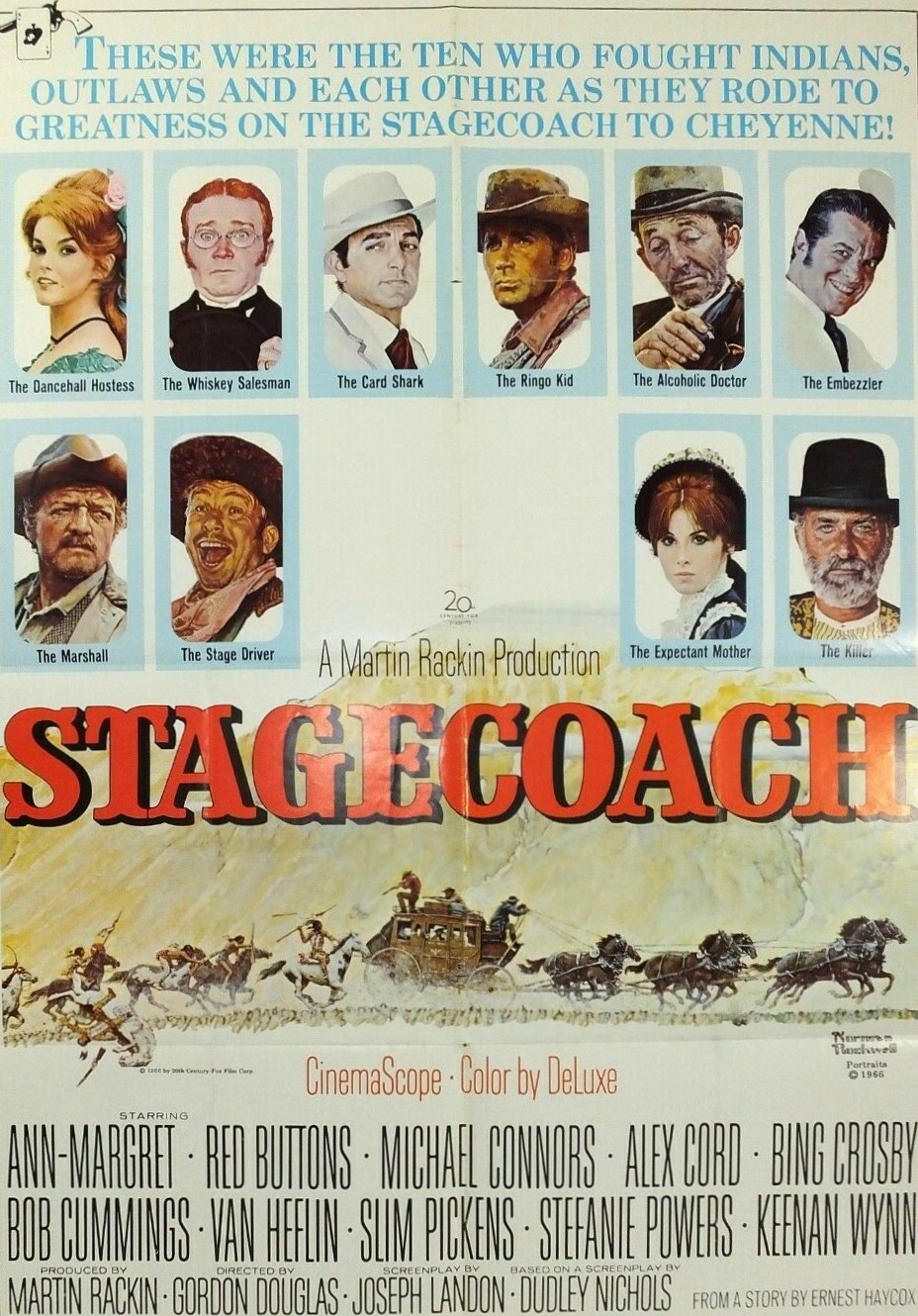
  3. (2) Stagecoach (1966). Under-rated remake of the John Ford western. But it’s Ann-Margret who steals the show ahead of Alex Cord in the role that brought John Wayne stardom.  
  4. (New Entry)) The Last Showgirl (2024). Pamela Anderson proves she can act and how in this touching portrayal of a fading Las Vegas dancer.
  5. (4) In Harm’s Way (1965). Under-rated John Wayne World War Two number. Co-starring Kirk Douglas, Patricia Neal, Tom Tryon and Paula Prentiss, director Otto Preminger surveys Pearl Harbor and after.
  6. (3) Fraulein Doktor (1969). Grisly realistic battle scenes and a superb score from Ennio Morricone help this Suzy Kendall vehicle as a World War One German spy going head-to-head with Brit Kenneth More and taking time out for romantic dalliance with Capucine.
  7. (5) Fireball XL5. The famous British television series (1962-1963) from Gerry and Sylvia Anderson, now colorized. “My heart will be a fireball…”
  8. (6) Once Upon a Time in the West (1969). Along with The Searchers (1956) now considered the most influential western of all time. Sergio Leone rounds up Claudia Cardinale, Henry Fonda and Charles Bronson and that fabulous Morricone score.
  9. (New Entry) Squad 36 / Bastion 36 (2025). Corruption and interdepartmental rivalry fuel this French flic directed by Olivier Marchal.
  10. (7) Jessica (1962). Angie Dickinson doesn’t mean to cause trouble but as a young widow arriving in a small Italian town she causes friction, so much so the local wives go on a sex strike..
  11. (20) Young Cassidy (1965). Julie Christie came out of this best, winning her role in Doctor Zhivago as a result. Rod Taylor as Irish playwright Sean O’Casey.
  12. (8) Thank You Very Much/ A Touch of Love (1969). Sandy Dennis dazzles as an academic single mother in London impregnated by Ian McKellen.
  13. (10) Baby Love (1969). Controversy was the initial selling point but now it’s morphed into a morality tale as orphaned Linda Hayden tries to fit into an upper-class London household.
  14. (30) The Girl on a Motorcycle / Naked under Leather (1968). How much you saw of star Marianne Faithfull depended on where you saw it. The U.S. censor came down heavily on the titular fantasizing heroine, the British censor more liberal. Alain Delon co-stars. These says, of course, you can see everything.
  15. (9) Pharoah (1966). Polish epic set in Egypt sees the country’s ruler at odds with the religious hierarchy.
  16. (24) A Dandy in Aspic (1968). Cold War thriller with Laurence Harvey as a double agent who wants out. Mia Farrow co-stars.  
  17. (31) Claudelle Inglish (1961). Diane McBain seeks revenge for being stood up at the altar in the Deep South.
  18. (New Entry) The Family Way (1966). Hayley Mills comes of age in this very adult drama. Co-starring her father John Mills and Hywel Bennett.
  19. (12) Vendetta for the Saint (1969). Prior to James Bond, Roger Moor was better known as television’s The Saint. Two television episodes combined sees our hero tackle the Mafia.
  20. (15) Go Naked in the World (1961). Gina Lollobrigida finds that love for a wealthy playboy clashes with her profession (the oldest). Look out for highly emotional turn from the usually taciturn Ernest Borgnine.
  21. (13) The Appointment (1969). Inhibited lawyer Omar Sharif discovers the secrets of wife Anouk Aimee in under-rated and little-seen Italian-set drama from Sidney Lumet.
  22. (New Entry) Istanbul Express (1968). Gene Barry plays a weird numbers game in spy thriller that sets him up against Senta Berger.
  23. (19) Pressure Point (1962). Nazi extremist Bobby Darin causes chaos for psychiatrist Sidney Poitier. Stunning dream sequences.
  24. (25) Pendulum (1968). Fast-rising cop George Peppard accused of murdering unfaithful wife Jean Seberg
  25. (11) The Sins of Rachel Cade (1961) Angie Dickinson (again) as African missionary falling foul of the natives and Commissioner Peter Finch. Roger Moore (again) in an early role.
  26. (16) Diamond Head (1962). Over-ambitious hypocritical landowner Charlton Heston comes unstuck in love, politics and business in Hawaii. George Chakiris, Yvette Mimieux and France Nuyen turn up the heat.
  27. (27) Fathom (1967). When not dodging the villains in an entertaining thriller, Raquel Welch models a string of bikinis as a skydiver caught up in spy malarkey.
  28. (36) Prehistoric Women / Slave Girls (1967). Martine Beswick attempts to steal the Raquel Welch crown as Hammer tries to repeat the success of One Million Years B.C
  29. (18) The Golden Claws of the Cat Girl (1968). Cults don’t come any sexier than Daniele Gaubert as a French cat burglar.
  30. (14) The Sisters (1969). Incest rears its head as Nathalie Delon and Susan Strasberg ignore husbands and lovers in favor of each other. 
  31.  (17) Moment to Moment (1966). Hitchcockian thriller set in Hitchcock country – the South of France – as unfaithful Jean Seberg is on the hook for the murder of her lover.  Also featuring Honor Blackman. 
  32. (New Entry) Age of Consent (1969). Helen Mirren frolics nude in her debut as the freewheeling damsel drawn to disillusioned painter James Mason.
  33. (28) Farewell, Friend / Adieu L’Ami (1968). A star is born – at least in France, the States was a good few years behind in recognizing the marquee attractions of Charles Bronson. Alain Delon co-stars in twisty French heist thriller featuring Olga Georges-Picot and Brigitte Fossey.
  34. (35) Horizon: An American Saga – Chapter 1 (2024). Kevin Costner’s majestic western that became one of the biggest flops of the year was underrated in my opinion.
  35. (New Entry) Genghis Khan (1965). Omar Sharif as the titular warrior up against Stephen Boyd. Co-starring James Mason and Francoise Dorleac. Robert Morley is hilariously miscast as the Chinese Empteror.
  36. (26) Once a Thief (1965). Ann-Margret again, in a less sexy incarnation, as a working mother whose ex-jailbird thief Alain Delon takes a detour back into crime.
  37. (29) Woman of Straw (1964). More Hitchockian goings-on as Sean Connery tries to frame Gina Lollobrigida in a dubious scheme.
  38. (New entry) The Demon / Il Demonio (1963). Extraordinary performance by Daliah Lavi in Italian drama as she produces the performance of her career.
  39. (New entry) Guns of Darkness (1962). David Niven and Leslie Caron on the run from South American revolutionaries.
  40. (New Entry) Operation Crossbow (1965). George Peppard is the man with the mission in Occupied France during World War Two. Co-stars Sophia Loren.
  41. (34) She Died with Her Boots On / Whirlpool (1969). More sleaze than cult. Spanish director Jose Ramon Larraz’s thriller sees kinky photographer Karl Lanchbury targeting real-life MTA Vivien Neves.  
  42. (21) Can Heironymus Merkin Ever Forget Mercy Humpe and Find True Happiness? Fellini would turn in his grave at the self-indulgence of singer Anthony Newley who manages to lament that women falling at his feet cause him so much strife. Joan Collins co-stars.
  43. (23) The Chalk Garden (1964). Wild child Hayley Mills, trying to break out of her Disney straitjacket, duels with governess Deborah Kerr.
  44. (New Entry) Dark of the Sun / The Mercenaries (1968). Rod Taylor’s guns-for-hire break out the action in war-torn Africa. Jim Brown and Yvette Mimieux co-star.
  45. (New entry) La Belle Noiseuse (1991). Emmanuelle Beart is the mostly naked model taking painter Michel Piccoli to his artistic limits.
  46. (New Entry) A Fine Pair (1968). Rock Hudson and Claudia Cardinale join forces for a heist picture.
  47. (33) Lady in Cement (1969). Raquel Welch models more bikinis as the gangster’s moll taken on as a client by private eye Frank Sinatra in his second outing as Tony Rome.
  48. (New Entry) Carry On Up the Khyber (1968). The most successful of the Carry On satires poking fun at the British in India.
  49. (New Entry) The Venetian Affair (1966). Robert Vaughn investigates spate of suicide bombs. Elke Sommer provides the glamor.
  50. (22) The Secret Ways (1961). The first of the Alistair MacLean adaptations to hit the big screen features Richard Widmark trapped in Hungary during the Cold War. Senta Berger in an early role.

Buona Sera Mrs Campbell (1968) ****

Works a treat. And works like clockwork, the set-up so meticulous, it doesn’t put a comedic foot wrong and even allows space, at exactly the right time, for the ticking timebomb to be sorted out. Gags galore. Sight gags, sound gags and observational gags, but most, unusually, are snippy, the kind of sharp remarks that people make under tension. And, heaven help us, there’s farce, and that works, too. It rarely does in American movies because it’s usually an adaptation of a Broadway play and the movie director feels hidebound by stage conventions. Here, this is an original screenplay, so writer-director Melvin Frank (Strange Bedfellows, 1963) works to his own beat.

You’ll remember the “who’s the father” narrative ploy from Mamma Mia (2008) – though this preceded the Abba bash by four decades. Twenty years after the Yanks liberated an Italian village in World War Two they are back to commemorate the event. Amongst the soldiers, three men desperate to meet the daughter, Gia (Janet Margolin), they each think they sired with Carla (Gina Lollobrigida) and have been supporting with monthly cheques ever since. They don’t know about each other’s involvement but between them have provided an excellent upbringing for Gia who speaks perfect English, having attended American School in Geneva, with enough left over for Carla to live in a fancy house with a maid.

The guys are a disparate bunch. Justin (Peter Lawford) is a philanderer whose wife Lauren (Marian McCargo) dare not let him out of her sight. Phil (Phil Silvers) has a brood and hardly escapes emotional Shirley (Shelley Winters) without one – or all – being attached. The loudmouth exuberant Walter (Telly Savalas) has to bite his tongue when wife Fritzie (Lee Grant) constantly reminds him she hasn’t provided her with a child, when, secretly, he believes she’s the infertile one and Gia the proof.

Initially, this goes the way you expect – and then it doesn’t, confounding all audience expectations. Carla, who had planned to skip town until the celebrations are over, is forced by other circumstances to remain. She’s involved in two subplots – Gia is planning to run off with an older married man to Brazil, and Gina can’t resist the opportunity to get one over on the sniffy local Contessa (Giovanna Galletti). Actually, there’s three subplots if you include Gina trying to keep hold of handsome lover Vittorio (Phillipe Leroy), who initially fears one of the returning soldiers will sweep Carla off her feet and whisk her off to the States, but then becomes very dismissive of her taste in men.

When the secret is revealed, rather than turning on their deceitful husbands, the women are full of praise for them. But that’s only because it’s not the whole secret. They think they discover that out of the goodness of their hearts the men have been sending cash to Carla in memory of their (fictitious) colleague Eddie Campbell who died in the war. The guys, meanwhile, turn against Carla when they become aware of each other’s existence and the fact that not so much just that they have been rooked, collectively, out of $200,000 but that they have individually been helping to bring up what could be another man’s child. Gia, too, on learning of the deceit, is furious and runs away, leaving Carla distraught.

When the true secret emerges, naturally there’s one almighty bust up, with wives and husband and daughter all railing against Carla until Vittorio steps in and explains just what a wonderful mother she has been.  This neatly steps over the timebomb, just what possessed Carla to have sex with three men in ten days beyond that they pumped up her ego and brought her food and treats.

There are some brilliant scenes – the streetwalker, the hospital, the car horn that doesn’t work, the missing laundry, the mean Contessa finding a clever way to put down Carla – but mostly it’s held together with the stiffest of glues by an inspired performance by Gina Lollobrigida. Telly Savalas (The Assassination Bureau, 1969) is the pick of the others, playing against type.

Class act from Melvin Frank.

Go Naked in the World (1961) ***

Overshadowed at the box office by MGM’s other venture into the world of the good-time-girl, Butterfield 8 (1960), under-rated at the time and ever since, this raw slice of emotion delivers on every front and may be even more pertinent today with its unashamed depiction of paternal love. Spoiled brat Nick Stratton (Anthony Franciosca), trying to escape controlling millionaire Greek father Pete (Ernest Borgnine), falls in love with widow Guilietta (Gina Lollobridgida), unaware that she is a high-class hooker, among whose clients number Pete.

Three tales run in parallel – the main love story, Pete’s attempts to drag his son into the family construction business, and the father’s undying love for his son. Guilietta is only too aware that her profession prohibits the development of true love, her world consisting of putting on a happy face for grey-haired men, while avoiding commitment. Where Butterfield 8 evaded the reality of prostitution, that is not the case here, Guilietta tormented by the prospect of bumping into former clients or her lover unable to accept her past. Overwhelmed by guilt, she believes she is beyond forgiveness. Nick wants none of the benefits of a rich man’s son but all the entitlement. 

Never mind the story, which was always going to tumble into tragedy, it’s the performers who steal the picture. Lollobrigida (Strange Bedfellows, 1965) gives a terrific performance, carrying the emotional baggage of the love story, devastation only inches away, self-destruction possibly the only path to destruction, constantly aware that taking he easy path to riches and independence now stands in the way of happiness. The scenes where her self-loathing breaks through the patina of sexy gloss are tremendous as is her touching belief that somehow she can escape destiny.

While this might appear to be nothing but an over-the-top performance from Borgnine (The Split, 1968), it is anything but, and any man in an early 1960s picture who can demand a kiss from his grown-up son and constantly tells him how much he loves him is a pretty unusual character for the period. Of course, this overt show of emotion is explained by him being Greek, but it’s clearly more than that. While attempting to control all around him, with hypocrisy in full spate, as heavy on religion as playing away from home, this is actually a superb piece of characterization, of a powerful man rendered impotent by the loss of love. He has the two best scenes, almost having a heart attack as he watches his son walk across a sky-high girder and later begging Guilietta’s forgiveness for attempting to wreck the romance.

Franciosca (Fathom, 1967) is the weak link. For all that he is saddled with a spineless character, moping and running away his default, he never quite seems worthy of romance with Guilietta nor for that matter of equality with his father. Former child star Luana Patten (Song of the South, 1946) makes an impact as the rebellious daughter while Nancy R. Pollock (The Pawnbroker,1964) brings dignity to her role as the doormat wife.

This was the fourth outing as a hyphenate for writer-director Ranald McDougall (The World, the Flesh and the Devil, 1959) but he was better known for screenplays such as Mildred Pierce (1945), The Naked Jungle (1954) and, later, Cleopatra (1963) and you can see he is accustomed to creating great roles for independent women and filling his picture with sharp dialogue and lines that sound like epithets. There’s more than enough going on to keep the various plots spinning and emotions teetering over a cliff edge.

The All-Time Top 40

Traditionally, this is an opportunity for me to blow the trumpet on behalf of my loyal and growing band of readers. But this time out I’m also taking the opportunity to blow my own trumpet or in the patois of my home city “bum ma load.” I began this blog in June 2020 and my monthly viewing figures scarcely topped a few hundred in the first year. Now I’m hitting 10,000 views a month. Being a self-effacing kind of guy, I thought the world should know.

Now, back to the main task in hand. It’s been a major aspect of the Blog to see which films are most favored by my readers.  As regular readers will know, I run this feature every six months.

It’s worth pointing out that for such a testosterone-driven decade the Top Ten is dominated by female stars with Ann-Marget and Angie Dickinson in the ascendancy.  Raquel Welch, Hayley Mills and Jean Seberg also make a splash. As well as top male figures like Frank Sinatra, John Wayne, Robert Mitchum and Dean Martin readers have been highly appreciative of underdogs like Alain Delon, Richard Johnson and Alex Cord.

Surprisingly high number of new entries include Young Cassidy, Fathom, The Appointment, Diamond Head, The Family Way and The Venetian Affair.

The figures in brackets represent the previous year’s position.

  1. (1) The Swinger (1966). Queen of the Blog Ann-Margret in bouncy sex comedy that manages a sprinkling of innocence. 
  2. (2) Stagecoach (1966). Double whammy from Ann-Margret in this more than acceptable remake of the John Ford western with the male lead taken by Alex Cord, another star in need of reassessment.  
  3. (4) Fraulein Doktor (1969). German spy Suzy Kendall out-foxes Kenneth More in this World War One adventure with surprisingly grisly battle scenes and a superb score from Ennio Morricone.
  4. (3) Jessica (1962). Angie Dickinson as a young widow incurring the wrath of wives in a small Italian town.
  5. (7) Once Upon a Time in the West (1969). For many, including myself,  the greatest western ever made. Sergio Leone fashions a masterpiece from a stunning cast of Claudia Cardinale, Henry Fonda and Charles Bronson and that fabulous Morricone score.
  6. (6) Fireball XL5. (1962) The height of a television cult. Famous British series from Gerry and Sylvia Anderson, now colorized. “My heart will be a fireball…”
  7. (5) The Sins of Rachel Cade. (1961) Angie Dickinson (again) as African missionary falling foul of the natives and commissioner Peter Finch. Roger Moore in an early role.
  8. (10) Vendetta for the Saint. (1968) More television cultism. Movie made by combining two episodes of the series featuring the immortal Simon Templar. Roger Moore tackles the Mafia.
  9. (12) The Sisters (1969). Complicated French love triangle featuring Nathalie Delon and Susan Strasberg.
  10. (11)  Baby Love (1969). Controversy was the initial selling point but now it’s morphed into a morality tale as orphaned Linda Hayden tries to fit into an upper-class London household.
  11. (13) Pharoah (1966). Sensational Polish epic set in Ancient Egypt centering on the battle between the country’s ruler and the religious hierarchy.
  12. (9) Moment to Moment (1966). Hitchcockian-style thriller set in the south of France with Jean Seberg caught out in illicit love affair. Co-starring Honor Blackman.
  13. (21) Go Naked in the World (1961). Steamy drama with Gina Lollobrigida discovering that her profession (the oldest) and true love (with rich Anthony Franciosa) don’t mix. Great turn from Ernest Borgnine as a doting father.
  14. (8) The Secret Ways (1961). The first of the Alistair MacLean adaptations to hit the big screen features Richard Widmark trapped in Hungary during the Cold War. Senta Berger has a small role.
  15. (36)  In Harm’s Way (1965). Otto Preminger’s Pearl Harbor epic sets John Wayne and Kirk Douglas at each other’s throats.
  16. (20) The Golden Claws of the Cat Girl (1968). Genuine French cult film with Daniele Gaubert as a sexy cat burglar.
  17. (14) Can Heironymus Merkin Ever Forget Mercy Humpe and Find True Happiness? (1969) Self-indulgence reaches new heights as singer Anthony Newley invokes his inner Fellini that somehow involves bedding lots of women. Then-current wife Joan Collins co-stars.
  18. (New Entry) Young Cassidy (1965). Rod Taylor and Julie Christie in Jack Cardiff’s Irish drama. He took over from an ill John Ford.
  19. (22) Pressure Point (1962). No escape for racist patient Bobby Darin when psychiatrist Sidney Poitier is around.
  20. (New Entry) The Appointment (1969). Complete change of pace for Omar Sharif in unusual Italian drama directed by Sidney Lumet. Anouk Aimee is the tantalizing female lead.  
  21. (New Entry) Fathom (1967) Raquel Welch swaps her skydiving kit for the more comfortable environs of a bikini in thriller. Anthony Franciosa co-stars.
  22. (22) Pendulum (1969). Cop George Peppard accused of murdering unfaithful wife Jean Seberg.
  23. (New Entry) The Family Way (1966). Hayley Mills grows up – and how – in marital drama with new British star Hywel Bennett.
  24. (New Entry) Diamond Head (1962). Ruthless hypocritical land baron Charlton Heston causes chaos in Hawaii. With Yvette Mimieux and George Chakiris.
  25. (26) A Dandy in Aspic (1968). Cold War thriller with Laurence Harvey as a double agent who wants out. Mia Farrow co-stars.  
  26. (New Entry) The Venetian Affair (1966). Robert Vaughn turns in a terrific performance as an ex-alcoholic spy dealing with former lover Elke Sommer in slippery Venice-set thriller.
  27. (21) The Best House in London (1969). That’s a euphemism for a brothel, let’s get that straight. David Hemmings tries to do right by the sex workers.
  28. (25) Lady in Cement (1969). Frank Sinatra reprises private eye Tony Rome with mobster’s moll Raquel Welch as his client.
  29. (31) The Girl on a Motorcycle / Naked under Leather (1968). Heavily-censored in the U.S., erotic drama with singer Marianne Faithfull as the titular fantasizing heroine. Alain Delon co-stars.
  30. (New Entry) Genghis Khan (1965). Omar Sharif as the all-conquering Mongol chieftain. Stephen Boyd, James Mason, Eli Wallach, Telly Savalas and Francoise Dorleac lend support.
  31. (New Entry) The Chalk Garden (1964). Hayley Mills again, being brought to heel by governess Deborah Kerr with a hidden secret.
  32. (New Entry) Plane (2023). Gerard Butler channels his inner Bruce Willis as he attempts to avoid dying hard on an island inhabited by rebels.  
  33. (23) Oceans 11.  Frank Sinatra heads the Rat Pack line-up, inspiring an industry of  remakes and with everyone starting with Tarantino ripping off one scene.
  34. (New Entry) Five Card Stud (1968). Surprising mix of feminism and noir in revenge western. Dean Martin, Robert Mitchum and Inger Stevens topline.
  35. (34) The Misfits (1960). Last hurrah for Clark Gable, fabulous turns from Montgomery Clift and Marilyn Monroe in John Huston tale of losers. 
  36. (28) Once a Thief (1965). Change of pace for Ann-Margret as working mother whose ex-jailbird husband Alain Delon is forced into another job.
  37. (27)  Deadlier than the Male (1967). Espionage with a sting in the tale as venomous female villains including Elke Sommer and Sylva Koscina target Bulldog Drummond
  38. (35) Rage (1966). Glenn Ford and Stella Stevens combat pandemic in Mexican town.
  39. (New Entry) Blonde (2022). Ana de Armas in stylized biopic of Marilyn Monroe
  40. (33) She Died with Her Boots On / Whirlpool (1969). Sleazy British film from cult Spanish director Jose Ramon Larraz sees kinky photographer Karl Lanchbury seduce real-life MTA Vivien Neves.  

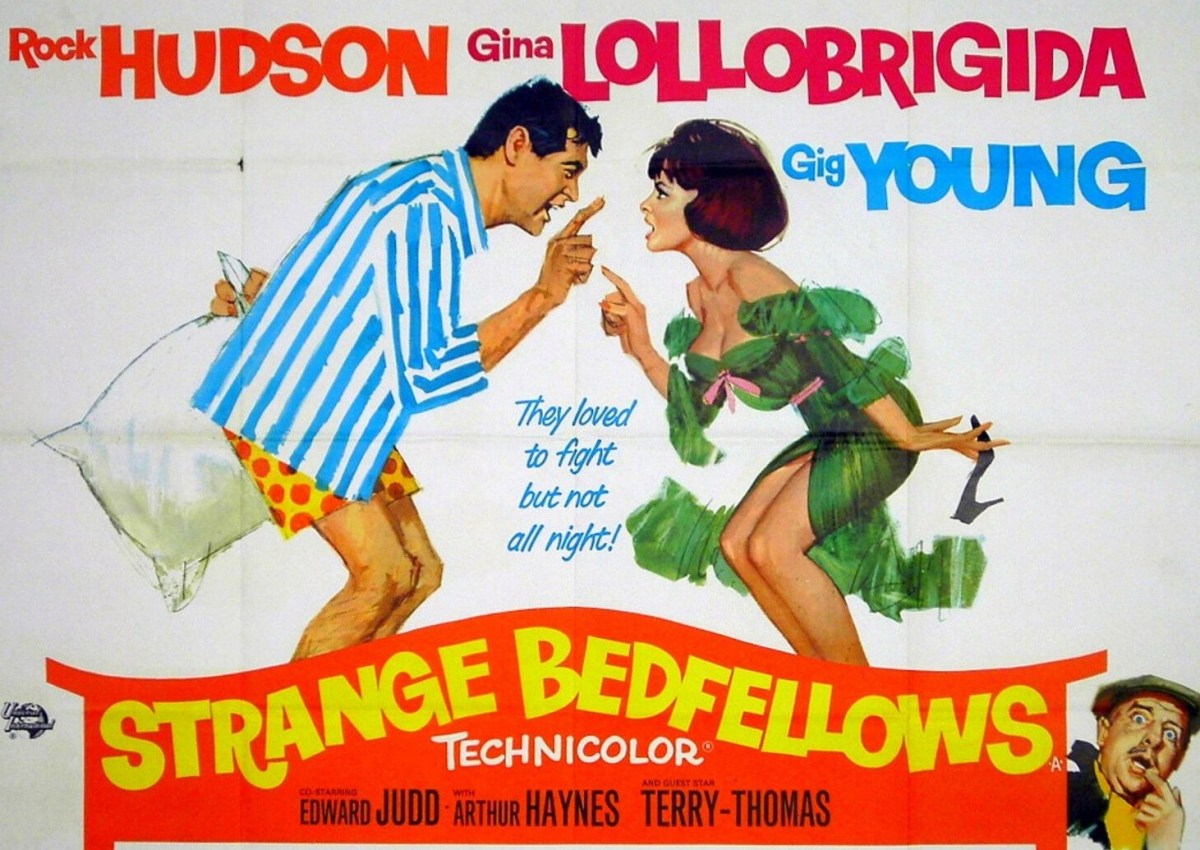
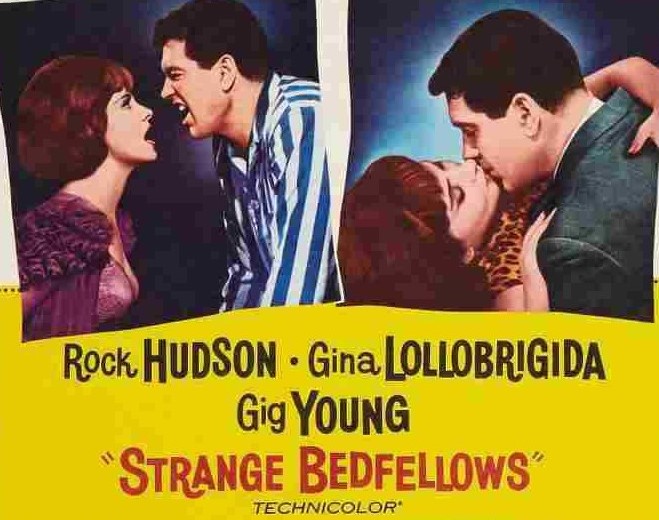
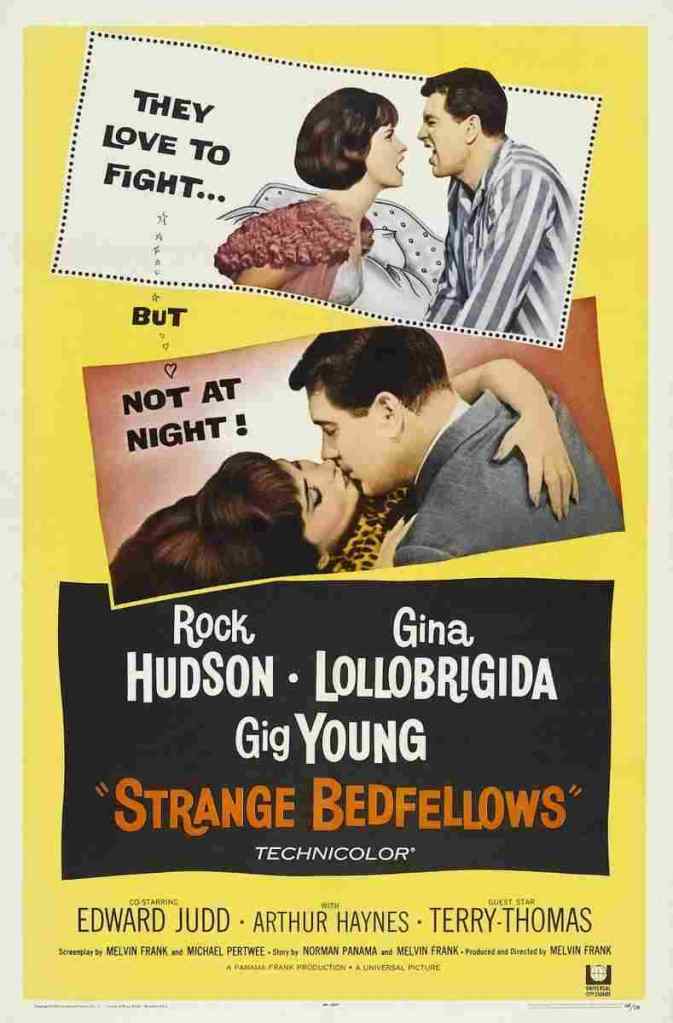
Strange Bedfellows (1963) ****

I had my first belly-laugh within seconds, a wonderful sight gag and was chortling all the way through this London-set battle-of-the-sexes comedy. Carter Harrison (Rock Hudson) is a high-flying businessman who needs to win back long-estranged wife Toni (Gina Lollobrigida) in order to gain promotion at a family-conscious oil company. Initially, Carter re-discovers the reasons he had first fallen in love with her but then, of course, only too bitterly, why they split. Hudson and La Lollo had previously teamed up for Come September (1963) and Hudson had spent most of the 1960s in romantic mishap with Doris Day so he could call on an extensive range of baffled and enraged expressions. Toni is an artist-cum-political-firebrand which sets up hilarious consequence. Richard Bramwell (Gig Young) is on hand to act as referee.

There’s some marvelous comic invention, a conversation between the two principals relayed through taxi controllers turns into a masterpiece of the misheard and misunderstood. Complications arise from Toni’s Lollobrigida’s fiancé Harry  (Edward Judd from First Men in the Moon, 1964), also an activist, but on the pompous side, and an Italian lothario. Taking advantage of the less than congenial London weather, there are jokes aplenty about umbrellas and in a nod to farce occasions for Carter to lose his trousers and share a bed with the fiancé. Smoldering sexual tension also kindles many laughs. By the time the film enters its stride it’s one comedic situation after another. It being England, naturally enough Lady Godiva is involved.

Hudson in suave mode trying to cope with the feisty Lollobrigida is an ideal comedy match. Costume designer Jean Louis has swathed the actress in a stunning array of outfits, some of which leave little to the imagination. When Doris Day got angry you tended to laugh, not quite believing this was anything more than a moderate hissy fit, but if you crossed Lollobrigida you were apt to get both barrels and it never looked like acting, she was a very convincing when she switched on the fury engine, plus, of course, whatever she threw added both to the comedy and her character’s conviction.   Both have terrific comic timing.

Writer-director Melvin Frank was something of a comedy specialist, a dab hand at suiting comedy to screen persona having previously set up Road to Hong Kong (1962) and Mr.  Blandings Builds a Dream House (1948). Terry-Thomas makes an appearance as a comic mortician and there are parts for English comedian Arthur Haynes and Dave King. Hudson and Lollobrigida exude screen charisma and while not in the class of Come September this delivers enough laughs to make you wonder why they don’t make them like that anymore.

All-Time Top 40

I started this Blog two years ago this month and to my astonished delight it is now read in over 120 countries. I am now well past over 500 reviews. So I thought you might be interested to know which of these reviews has attracted the most attention. This isn’t my choice of the top films in the Blog, but yours, my loyal readers. The chart covers the films viewed the most times since the Blog began, from June 1, 2020 to May 31, 2022.

  1. The Secret Ways (1961). Richard Widmark exudes menace in this adaptation of an early Alistair MacLean spy thriller set in Hungary during the Cold War. Senta Berger  has a small role.
  2. Jessica (1962). Innocently gorgeous widow Angie Dickinson finds her looks turn so many male heads in a small Italian town that the female population seeks revenge.
  3. Ocean’s 11 (1960). The Rat Pack makes its debut – Frank Sinatra, Dean Martin, Sammy Davis Jr. et al plan an audacious Las Vegas robbery. 
  4. Pharoah (1966). Priests battle kings in Polish epic set in ancient Egypt. Fabulous to look at and thoughtful.
  5. Fraulein Doktor (1969). Suzy Kendall in the best role of her career as a sexy German spy in World War One.
  6. The Golden Claws of the Cat Girl (1968). Cult French movie starring Daniele Gaubert as a sexy cat burglar.
  7. The Swinger (1966). Ann-Margret struts her stuff as a magazine journalist trying to persuade Tony Franciosca she is as sexy as the character she has written about.
  8. It’s Not All Rock’n’Roll (2020).  Ageing rocker Dave Doughman aims to mix a career with being a father in this fascinating documentary
  9. A Place for Lovers (1969). Faye Dunaway and Marcello Mastroianni in doomed love affair directed by Vittorio De Sica.
  10. The Venetian Affair (1966). Robert Vaughn hits his acting stride as a former CIA operative turned journalist investigating suicide bombings in Venice. Great supporting cast includes Elke Sommer and Boris Karloff.
  11. Moment to Moment (1966). Hitchcockian-style thriller with Jean Seberg caught up in  murder plot in the French Riviera. Also features Honor Blackman.
  12. 4 for Texas (1963). Frank Sinatra and Dean Martin face off in a Robert Aldrich western featuring Ursula Andress and Anita Ekberg with Charles Bronson in a smaller part.
  13. Age of Consent (1969). Helen Mirren stars as the nubile muse of jaded painter James Mason returning to his Australian roots.
  14. The Double Man (1967). Yul Brynner chases his doppelganger in the Swiss Alps with Britt Ekland adding a touch of glamour.
  15.  Subterfuge (1968). C.I.A. operative Gene Barry hunts an M.I.5 mole in London. Intrigue all round with Joan Collins supplying the romance and a scene-stealing Suzanna Leigh as a villain.
  16. A House Is Not a Home (1965). Biopic of notorious madam Polly Adler (played by Shelley Winters) who rubbed shoulders with the cream of Prohibition gangsters.
  17. Can Heironymous Merkin Ever Forget Mercy Humpe and Find True Happiness? (1969). Off-the-wall musical directed by star Anthony Newley that has to be seen to be believed. Joan Collins pops up. 
  18. Pressure Point (1962). Prison psychiatrist Sidney Poitier must help racist Nazi Bobby Darin.
  19. Deadlier than the Male (1967). Richard Johnson as Bulldog Drummond is led a merry dance by spear-gun-toting Elke Sommer and Sylva Koscina in outlandish thriller.
  20. Valley of Gwangi (1969). Special effects genius Ray Harryhausen the star here as James Franciscus and Gila Golen encounter prehistoric monsters in a forbidden valley.
  21. The Naked Runner (1967). With his son held hostage, Frank Sinatra is forced to carry out an assassination in East Germany.
  22. Orgy of the Dead (1965). Bearing the Ed Wood imprint, mad monster mash-up with the naked dead.
  23. Once a Thief (1965). Ann-Margret is a revelation in crime drama with ex-con Alain Delon coerced into a robbery despite trying to go straight. Supporting cast boasts Jack Palance, Van Heflin and Jeff Corey. 
  24. The Sicilian Clan (1969). Stunning caper with thief Alain Delon and Mafia chief Jean Gabin teaming up for audacious jewel heist with cop Lino Ventura on their trail. French thriller directed by Henri Verneuil. Great score by Ennio Morricone.
  25. Dark of the Sun / The Mercenaries (1968). More diamonds at stake as Rod Taylor leads a gang of mercenaries into war-torn Congo.  Jim Brown, Yvette Mimieux and Kenneth More co-star. Based on the Wilbur Smith bestseller
  26. Stiletto (1969). Mafia hitman Alex Cord pursued by tough cop Patrick O’Neal. Britt Ekland as the treacherous girlfriend heads a supporting cast including Roy Scheider, Barbara McNair and Joseph Wiseman.
  27. Maroc 7 (1967). Yet more jewel skullduggery with Gene Barry infiltrating a gang of thieves in Morocco who use the cover of a fashion shoot. Top female cast comprises Elsa Martinelli, Cyd Charisse, Tracy Reed and Alexandra Stewart.
  28. The Rock (1996). Former inmate Sean Connery breaks into Alcatraz with Nicolas Cage to prevent mad general Ed Harris blowing up San Francisco. Michael Bay over-the-top thriller with blistering pace.
  29. The Swimmer (1968). Burt Lancaster’s life falls apart as he swims pool-by-pool across the county. Superlative performance. 
  30. Hour of the Gun (1967). James Garner as a ruthless Wyatt Earp and Jason Robards as Doc Holliday in John Sturges’ realistic re-telling of events after the Gunfight at the O.K. Corral.
  31. Fade In (1968). Long-lost modern western with Burt Reynolds serenading low-level movie executive Barbara Loden whose company is actually filming Terence Stamp picture Blue.
  32. Dr Syn Alias the Scarecrow (1963). The British movie version of Disney American television mini-series sees Patrick McGoohan as a Robin Hood-type character assisting local smugglers.
  33. P.J./New Face in Hell (1968). Private eye George Peppard is duped by shady millionaire Raymond Burr and mistress Gayle Hunnicutt in murder mystery.
  34. Sol Madrid/The Heroin Gang (1968). In his second top-billed role David MacCallum drags hooker Stella Stevens to Mexico to capture drugs kingpin Telly Savalas.
  35. A Twist of Sand (1968). Diamonds again. Smugglers Richard Johnson and Jeremy Kemp hunt long-lost jewels in Africa. Honor Blackman is along for the voyage.
  36. Genghis Khan (1965). Omar Sharif plays the legendary warlord who unites warring Mongol tribes. Stellar cast includes Stephen Boyd, James Mason, Francoise Dorleac, Eli Wallach, Telly Savalas and Robert Morley.
  37. Interlude (1968). Bittersweet romance between famed conductor Oskar Wener and young reporter Barbara Ferris.
  38. Woman of Straw (1964). Sean Connery tangles with Gina Lollobrigida in lurid tale of murder and inheritance.
  39. Bedtime Story (1964). Marlon Brando and David Niven are rival seducers on the Riviera targeting wealthy women.
  40. Sisters (1969). Intrigue, adultery and incest haunt Nathalie Delon and Susan Strasberg as they try to recapture the innocence of the past.

We Need To Talk About Sir Sean, Part II: Who Wrote That Heinous Racist Scene: Book into Film – “Woman of Straw” (1964)

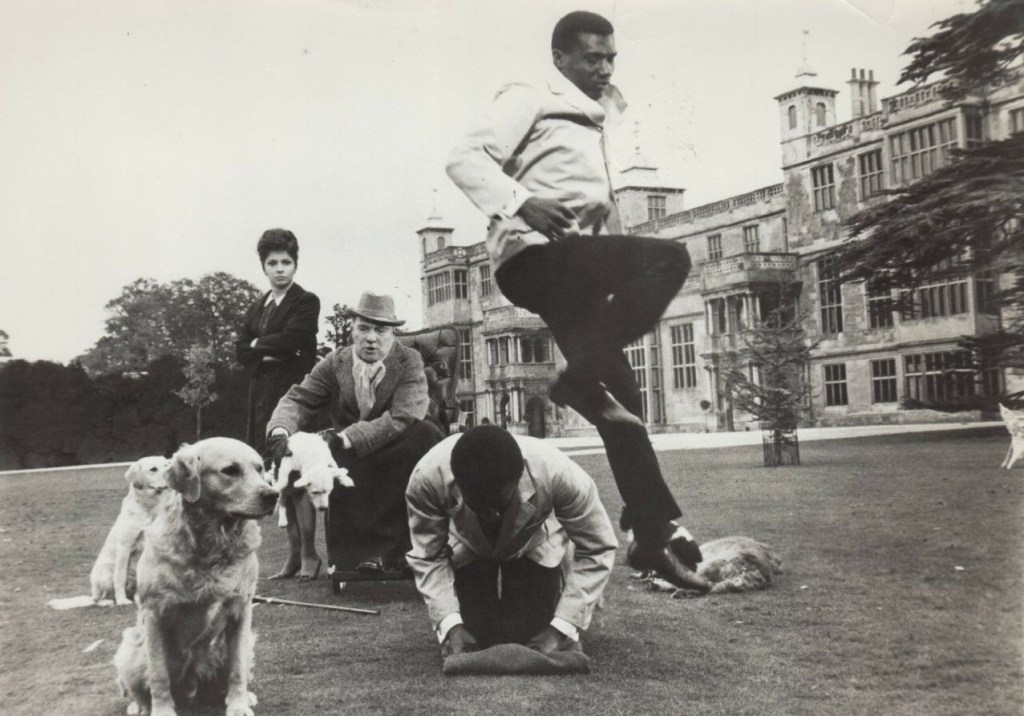
You can blame one of the screenwriters, either Robert Muller (Contest Girl, 1964) or Stanley Mann (The Collector, 1965), for coming up with the scene in Woman of Straw where the grotesque millionaire Charles Richmond (Ralph Richardson) forces his two black servants to pretend to be dogs to show his own dogs how to jump over each other. It’s not in the book. However, in fairness to the screenwriters they must have thought this preferable to the scene in the original book by Catherine Arley where Richmond offers a gold watch to the best imitation of a dog by his servants. This includes them getting down on all fours and eating food like a dog. Disgusting though this is, it is tempered by being a competition with a more than decent reward (a gold watch) for the winner.

The offensive scene in “Woman of Straw.”

And now we get into a difficult position since one of the most highly-praised episodes of Succession involved employees of grotesque millionaire Logan Roy (Brian Cox) being forced to get down on the floor and pretend to be boars and eat sausages like a boar (Boar on the Floor, Succession, Season Two, Episode Two). This sequence has a 94% rating on Rotten Tomatoes, the critical accumulation website. The episode won an Emmy for director Andrij Parekh. Scott Tobias of Vulture gave it five stars and Randall Colburn of The A.V. Club an A-minus. Various commentators referenced the Stanford Experiments, the culture of fear inherent in working with wealthy individuals, and the animalistic collapse of civilization.

So that has left me wondering if my objection to Woman of Straw was merely on racist grounds and to wonder if there would have been an outcry if the Succession episode had featured a black person grovelling on the ground.

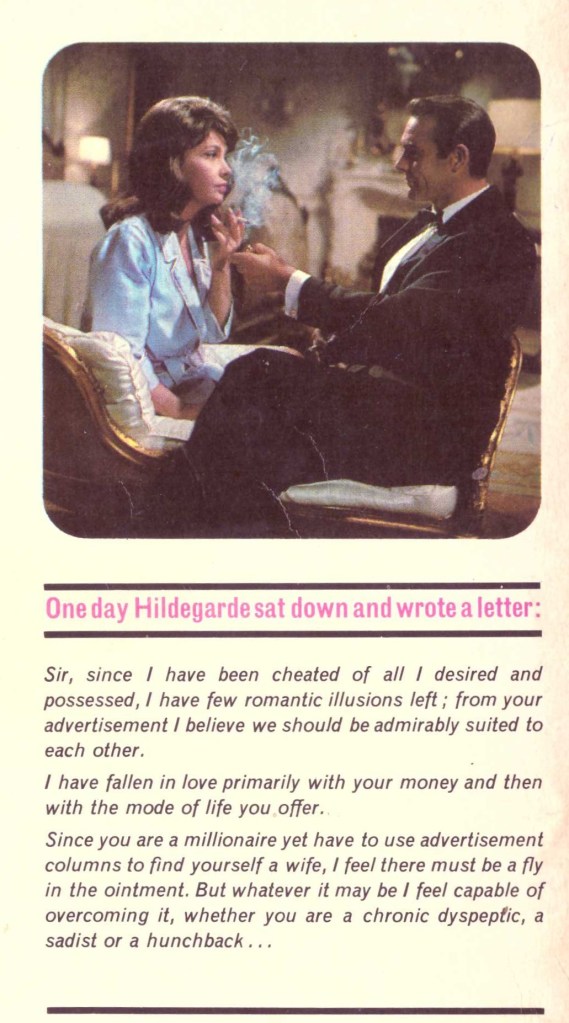
The screenwriters made significant changes to the source novel. For a start in the book both the woman and the millionaire were German. Hildegarde Meiner in the book becomes the Italian Maria (Gina Lollobrigida) in the film. But Hildegarde is not a relatively innocent nurse as in the film. Instead, she is an out-and-out gold-digger, determined to marry a wealthy man in order to make up for a desperate life in the aftermath of the Second World War.

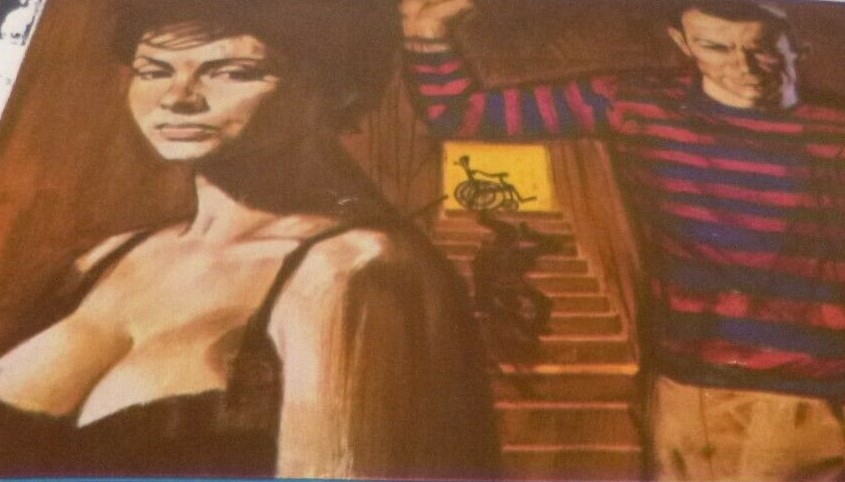
Back cover of the movie tie-in edition of the British paperback.

In the book the villain of the piece is also German, Korff, not British like Sean Connery. And he is simply the millionaire’s secretary not his nephew. The pivotal element of the story is the same, Tony Richmond (Connery) feeling he is owed much more of the old man’s fortune than the pittance provided for him in the will. Korff is also 60 years old and although Hildegarde makes a play for him, any romantic liaison is out of the question because the secretary wants to adopt her as his daughter.  Korff sets Hildegarde up as the nurse and instructs her to play it aloof and principled. Hildegarde does not fall into the category of beauty but, with better clothes and professional make-up, oozes class.

The rest of the story plays out much like the film except there is no rescue at sea and the millionaire does not listen to classical music. The novel narrative, while not in the first person, is told from the woman’s perspective. However, Korff is more devious than Anthony Richmond, ensuring in several ways that the nurse will take the rap.

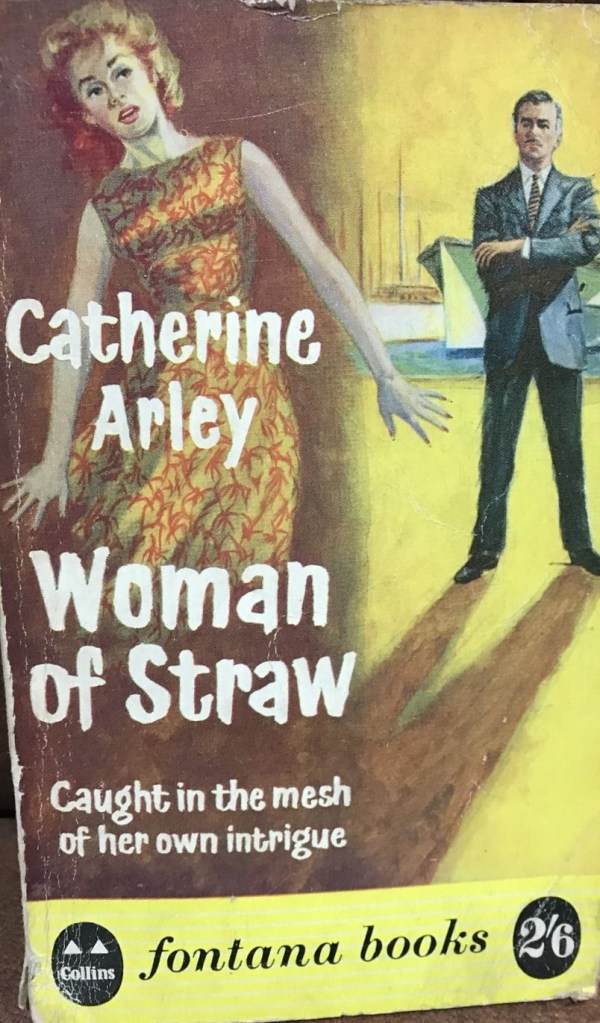
Front over of earlier British paperback, not a movie tie-in.

The film’s ending is driven by the need for some kind of happy resolution, for the guilty to be brought to justice, the dupe exonerated to some extent. But the book belongs more to the film noir genre and the ending is quite different, the villain getting away with and Hildegarde seeing no way out but to commit suicide.

The deprivations that Hildegarde has undergone as a consequence of her Hamburg family being killed during the war and her struggle for survival thereafter and her desperation to find a wealthy white knight make her a more  sympathetic character.

The book is an excellent thriller in its own right.

We Need To Talk About Sir Sean – Racism in “Woman of Straw” (1964)

Of course racism was endemic in Britain and the remainder of the British colonies in the 1960s where people of whatever color were treated as inferiors, underlings and at times with a brutality that bordered on slavery. So I’m not intending to say anything new here. But I was incredibly shocked by one scene of racism in Woman of Straw (1964) that I reviewed yesterday, a thriller in the Hitchcock mould starring Sean Connery and Gina Lollobrigida with Ralph Richardson as the wealthy man the subject of a murder plot.

Richardson’s character, Charles, is completely heinous, treating everyone badly, and they being in his thrall cannot bite back, unlike his dogs.

This is a still from the picture showing the offensive incident and would have been
used to promote the movie. As good an indication as any of the prevalent
racism is that clearly nobody believed this to be in bad taste.

For reasons best known to himself, Charles wants his dogs to be able to jump over each other. And when they fail to obey his commands, he instructs his two black servants, played by Johnny Sekka and Danny Daniels, to show them how it is done. One has to kneel on the grass like a dog and the other to jump over him. In due course, the dogs get the hang of it, leaping over the humiliated man on the ground.

There are enough other instances in the film to ensure the audience gets the right idea about Charles without this.

But I was shocked to the core. I have seen many instances of black people treated much worse in films, but in 1964 I guess such treatment would not have been permitted by the censor and this was the closest they could get to the abject degradation required. I can’t have been the only person shocked by it. But nobody was in 1964 otherwise it would not have got past the British censor – eliminating the scene would not have affected the plot – not a murmur from a critic, and certainly no sign of audiences leaving in droves.

But why should it be left to post-production? Did Sean Connery really think there was nothing untoward in the script? If it had been a Scotsman being used in this fashion might he have complained? Did Gina Lollobrigida think nothing of the scene? Similarly, had it been an Italian servant might she have objected? Connery and Lollobrigida either individually or collectively had far more box office cachet than the director – in fact this was Dearden’s move into the big time – so could easily have asked for the scene to be eliminated.

And what of Sir Ralph Richardson, at the time considered one of the great theatrical triumvirate (Olivier and Gielgud the others) who played the character? A forthright person in many other ways, but not here. Perhaps the most surprising person to be blind to the offensiveness of the scene was director Basil Dearden, especially since a previous film Victim (1961) was sympathetic to gay men. I would like to know if the scene was in the source novel by Catherine Arlay.

Whatever, one of the reasons that racism remained so endemic in the 1960s and far beyond was because people failed to see it when it was right in front of their eyes. I’ve no idea who owns the rights to this otherwise good thriller but it might be a good idea for them to take a look and excise this scene or at least give warning that it exists.

The British Board of Film Censors gave this a “12” rating when it came out on DVD. I contacted the BBFC to see if anybody had ever re-watched the film to come to the ratings conclusion. Naturally, I am still waiting to hear back.

You can check out what I’m referring to on YouTube which has a reasonable print. This incident occurs at the 16-17 minute mark. 

Discover WordPress

A daily selection of the best content published on WordPress, collected for you by humans who love to read.

The Atavist Magazine

by Brian Hannan

WordPress.com News

The latest news on WordPress.com and the WordPress community.