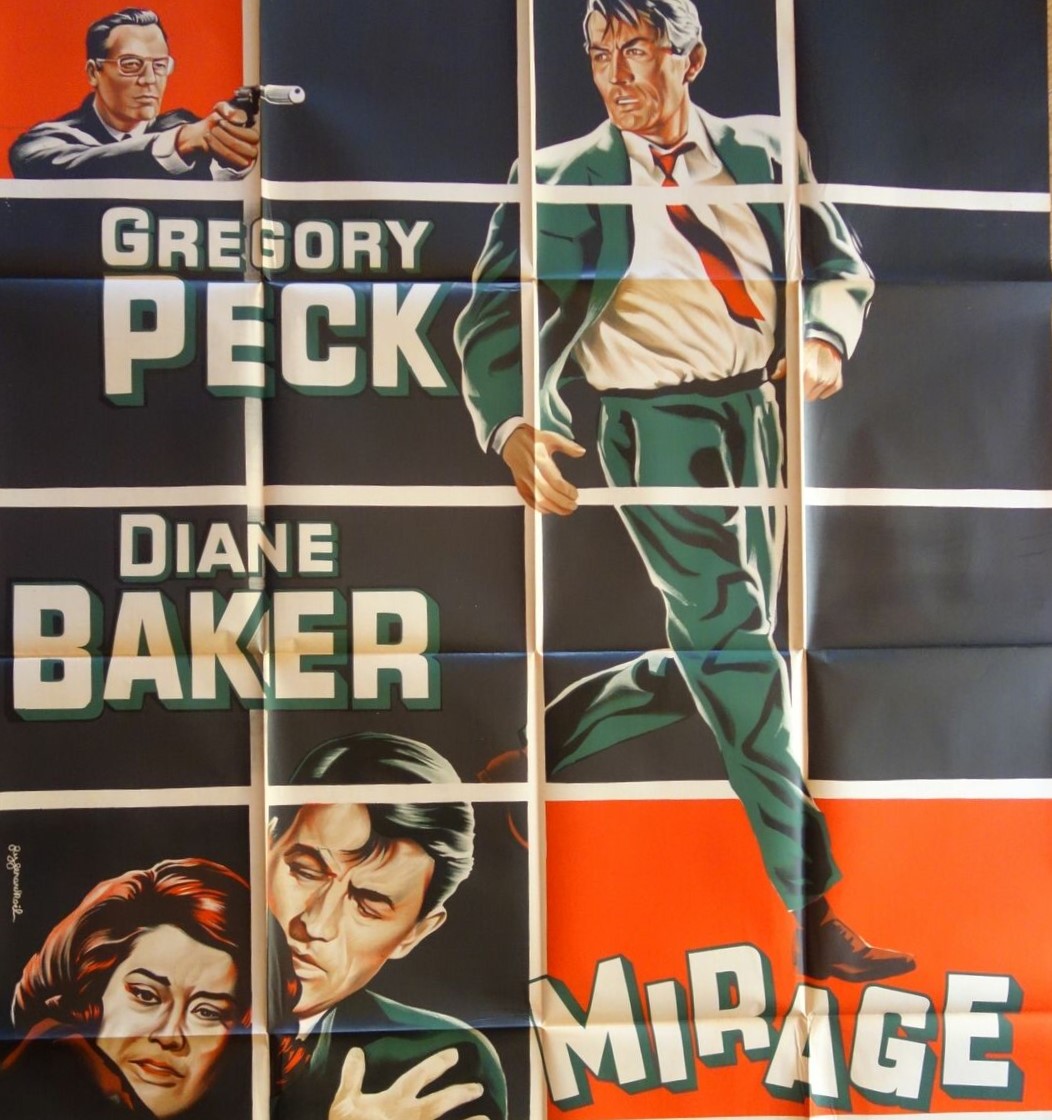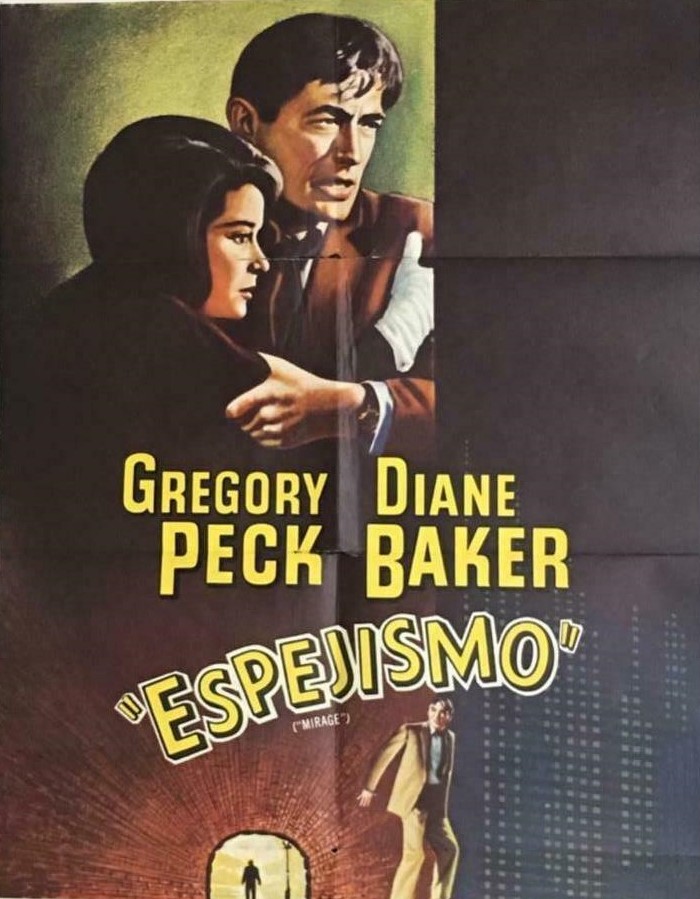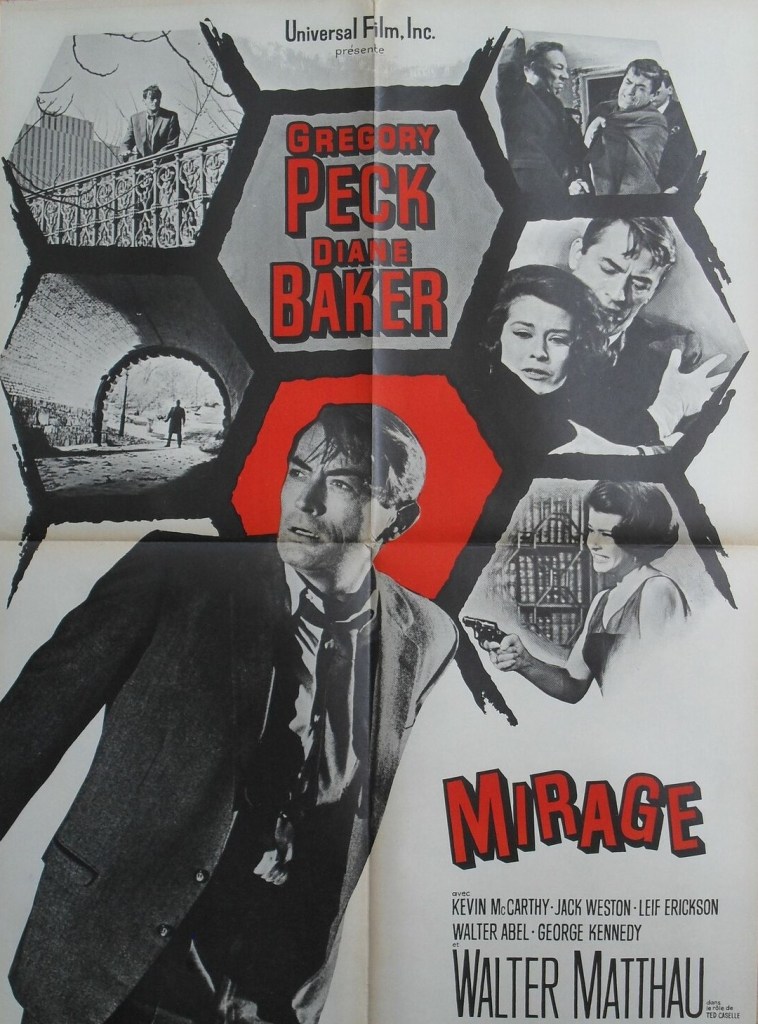
Mirage (1965) ****

“I owe you some pain,” barks the heavy to hero in one of the memorable lines in this classy thriller with surprisingly contemporary overtones. Underlying this tale of amnesiac David Stillwell (Gregory Peck) recovering his memory are themes of personal commitment, commitment to cause (“if you’re not committed to anything you’re just taking up space”), of individuals taking a stand against powerful forces seeking to thwart democracy, and of malevolent pandemic, the oldest of them all, greed, that infects even the most philanthropic enterprises.

The structure is brilliant. To every question David Stillwell (Gregory Peck) asks in trying to establish his identity, the answers are mystifying. He doubts his sanity and is plunged into a  life-threatening conspiracy.   

The film opens superbly. The camera pans across a New York skyline at night, every skyscraper lit up. Suddenly, one of the buildings goes dark. Cut to confusion inside as workers deal with the electricity cut-out. Among them Stillwell who is surprised to meet a woman on the stairs, Shela (Diane Baker), who not only recognizes him but seems to know a lot about him that is unfamiliar to him. They end up in the fourth level of the basement and on leaving discover that Charles Colvin (Walter Abel), a name that’s only vaguely familiar to Stilwell, has committed suicide by jumping from the building.

When he gets home to his apartment he is accosted by gunman Lester (Jack Weston) who tells him “The Major” wants to see him. Stillwell escapes but on reporting the incident to the police can’t remember his date of birth. After his amnesia being rejected by a psychiatrist he turns to private eye Ted Caselle (Walter Matthau) who takes up the case. But in Stillwell’s apartment a fridge he recalls as being empty is now full, the same with a dispatch case, the opposite with a closet, and in the building where he thinks he works there is now a wall where his office should be.

Stillwell believes he was employed as a cost accountant without a notion what that job entails. The building has no fourth level. Another gunman Willard (George Kennedy) is also in pursuit. Corpses pop up with increasing regularity. To add to the mystery, nobody actually wants him dead. He is too valuable alive. He has a secret only he doesn’t know what. The police connect him to the suicide.

And so the movie plays out brilliantly, with the audience only knowing what Stillwell knows, as confused as he, until piece by piece the jigsaw comes together although at times with cunning sleight-of-hand the pieces are the wrong shape or, worse, don’t fit the jigsaw in hand. There’s an emotional jigsaw to be put back together too, one that requires proper commitment, Shela’s “togetherness is not enough” could have been a mantra for today’s generation.

All the time Shela bobs in and out, hard to tell whether she is a victim or conspirator, whether to be trusted or merit suspicion, and she has an interesting philosophy of her own in terms of the trapped and caged.

As in the best thrillers we have been given the clues all the time, just not realized them for what they were, and in a series of brilliant scenes you cannot help but applaud the entire mystery is carefully stitched together. You will never in a million years guess the cause of Colvin’s mysterious death.

The ending is satisfying on a variety of levels. Yes, mystery solved, the secret Stillwell holds a good one, but the climax involves characters taking sides, displaying commitment, challenging their consciences, circumstances reflecting very much the world in which we find ourselves now.

One of the beauties of the movie is how it plays with our expectations. Peck has done amnesia before in Hitchcock’s Spellbound (1945) but since then his screen persona has been men of upstanding character, Atticus Finch in To Kill a Mockingbird (1962) the personification, confusion not a trait readily identified with him. Equally, the heavies look anything but,  Jack Weston small and rotund, George Kennedy bespectacled and slim.

Diane Baker, enigmatic throughout, far from the glamorous thriller female lead (think Audrey Hepburn in Charade or Sophia Loren who partnered Peck on Arabesque or Claudia Cardinale in Blindfold teamed with Rock Hudson), describes herself as a “lonely woman with a low opinion of herself due to many mistakes.” In the middle of the high tension, with Stillwell being pursued by cops, there is a wonderful scene where a little girl lets him hide in her apartment and on making him coffee it turns out to be the pretend coffee little girls make.

Gregory Peck (Arabesque, 1966) is superb, his face absorbing shock at his condition, at once welcoming unravelling mystery at the same time as doubting its source, wending his way through a past he cannot believe is true, a personality that occasionally appears abhorrent, and having to make the same decisions that he feared making in the past. Diane Baker (Marnie, 1964) has a difficult role, introspective where most heroines in this kind of film are more voluble, and frightened of her own vulnerability.

You can see from here how much George Kennedy bulked up for his breakthrough movie Cool Hand Luke (1967). Walter Matthau, too, was a stage away from interesting supporting roles to full-blown star in The Fortune Cookie (1966). Jack Weston might have been rehearsing his role as the stalker in Wait until Dark (1967). I am not going to mention the other sterling supporting players since that will give the game away.

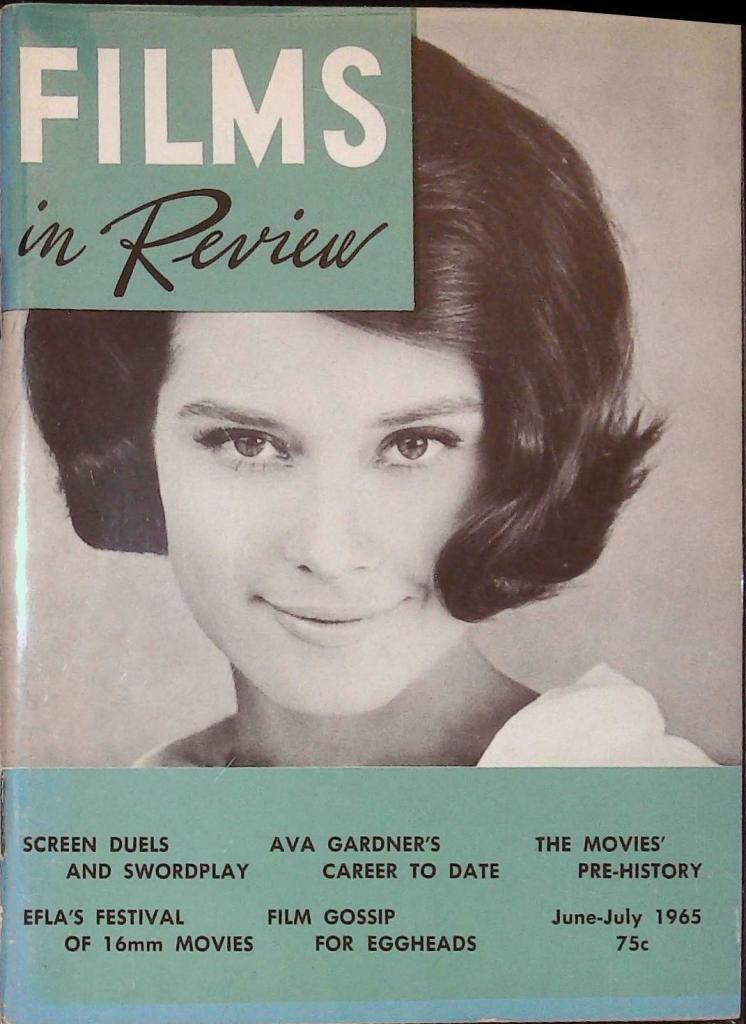
Diane Baker makes the cover of Films in Review magazine.

Veteran director Edward Dymytryk (Alvarez Kelly, 1966) is on song, stringing the audience along beautifully, extracting wonderful performances, not frightened to give the film deeper meaning. The theme of commitment, of standing up to malevolent forces, seems an odd one for a straightforward thriller but it reflected Dmytryk’s experience as a victim of the anti-Communist witch-hunt of the 1950s.  

On the debit side, I can’t see any reason why this was made in black-and-white and it certainly served to put off the public, the film’s box office poor, but I dispute the criticism of what appeared too-frequent flashbacks. Rather than re-emphasizing plot points for the audience, I saw this instead as Stillwell holding up a mirror to a memory he doubted he could trust.  

Top-notch screenplay by Peter Stone who knows his way around this genre, having previously written Charade and with Arabesque round the corner, from the novel called Fallen Angel by ,surprisingly, given he is best known for Spartacus, Howard Fast under the pseudonym Walter Ericson. At least a dozen quotable lines included this cracker relating greed to a pandemic: “You’re a carrier, you infected him and he died from it.”

All told, an excellent thriller with modern resonance.

Oddly enough, Mirage was remade a couple of years later as Jigsaw (1968), directed by James Goldstone and starring Harry Guardino.

P.S. I see you that the “I owe you” line was adapted for use by Willow in the Buffy, The Vampire Slayer TV series. There’s even a link to that scene on YouTube. Glad to see it has found some kind of immortality. It’s the kind of line that should be a gimme for t-shirt manufacturers.  

Thunderbolt and Lightfoot (1974) ***

There’s a reason this has largely slipped from view, why it’s rarely included in any examination of the Clint Eastwood canon. For the most part it’s plain dull. When the best thing in it for large periods of time is the screen composition, then you know this is going to be an odd, not to mention tough, watch.

It’s confused as hell. Starts out as a road movie – and a desultory one at that – with a side hustle of a shaggy dog story, straightens out enough to fit into the nascent buddy movie genre before settling down into a heist. And all the time director Michael Cimino, with his use of widescreen and traditional arranging of the sometimes majestic scenery into thirds, thinks he is making a western.

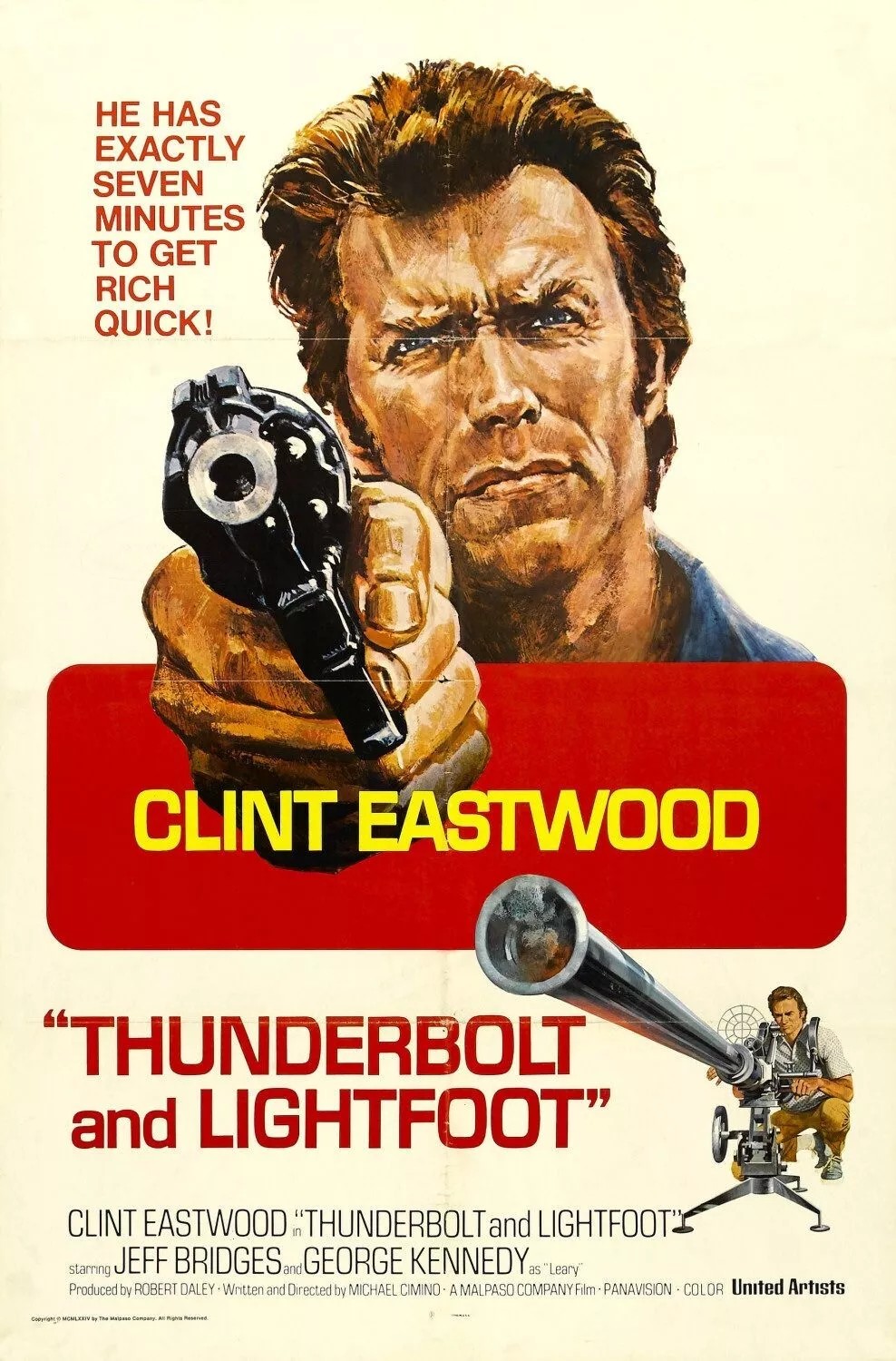
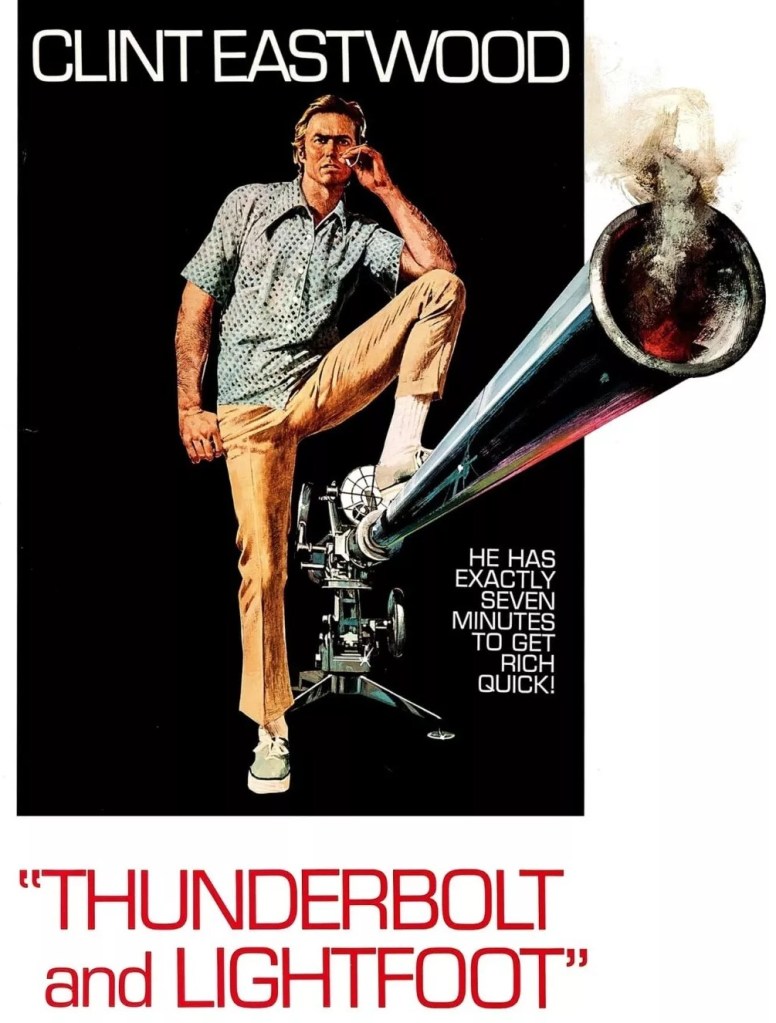
Let’s play the phallic symbol card.

None of the characters seems to be much good at what they do. Thunderbolt (Clint Eastwood), on the run, doesn’t appear capable of evading the pursuing Red (George Kennedy), not a cop or bounty hunter as you’d expect, but an irate member of Thunderbolt’s former gang. And while Red seems excellent at tracking down his quarry, whose shifts of direction are almost whimsical, and even though he’s armed with the modern-day equivalent of a Gatling gun, he makes the basic mistake of not getting close enough to his target to make the bullets count.

The only one who comes out on top in the too-long opening section is Thunderbolt’s happy-go-lucky sidekick Lightfoot (Jeff Bridges) who has the knack of pulling the ladies and can drive. But their relationship is desultory, no zap, no funny lines in the vein of Butch Cassidy and the Sundance Kid (1969), and while clearly like the pair in Midnight Cowboy (1969) inclined to hold onto each other in the absence of anyone else it lacks the emotional power of the latter.

It takes forever to get to the point. Or the three narrative triggers, one of which involves Eastwood committing the most grievous sin a major star can ever commit – to be the one who carries the exposition. And boy does he go on. Anyways, he’s a bank robber and he planked his haul in a small two-room schoolhouse. But, blow me down, someone’s demolished the schoolhouse, without presumably happening upon the cash, and built a brand new one in its place.

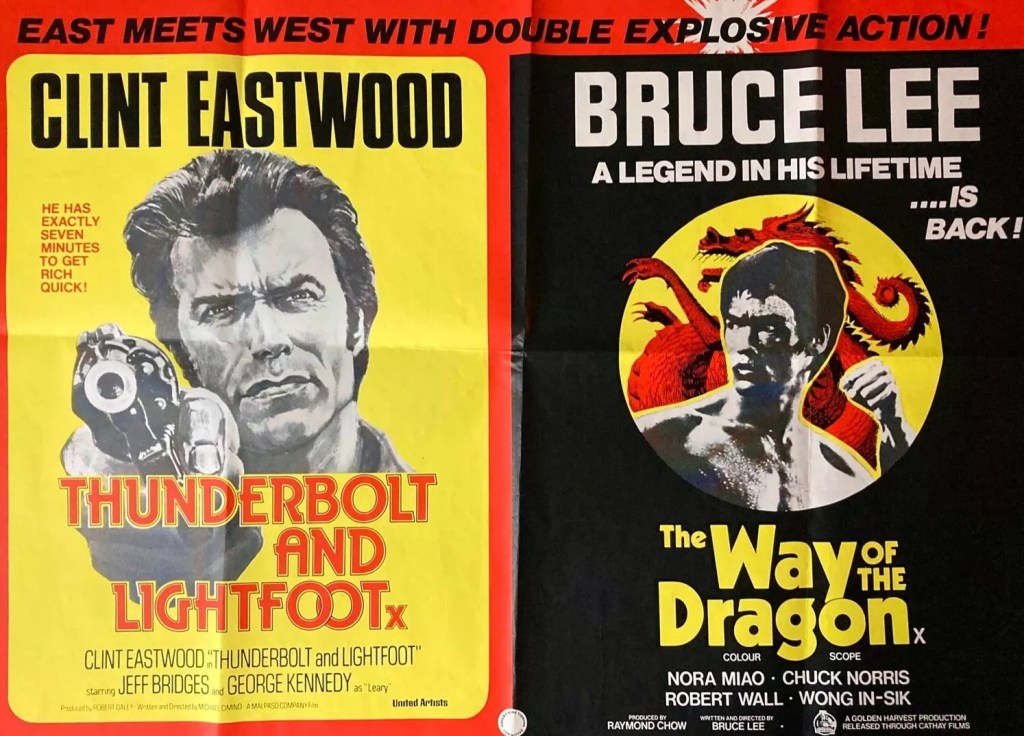
Clint Eastwood…Bruce Lee…Together!

Then, just to annoy Thunderbolt, the police, because this is just how cunning they can be, have given out that they recovered the loot. Red hasn’t fallen for this ploy, believing Thunderbolt has duped the gang and made off with the stash. Eventually, Red and Thunderbolt reconcile and Lightfoot suggests they hit the bank that was originally robbed because nobody would expect it.

Thunderbolt has acquired his nickname because his idea of a heist is not to bring on board some clever dick safecracker and employ an ounce of patience but merely to barrel through any obstacle with the help of 20mm cannon.

So now – at last – we have a story, but that’s over halfway through the picture and way too late to save it. So, yes, there’s some decent action and excitement, a double cross, car chase, shoot-out, and just to complete the shaggy dog element one of the robbers is killed by a dog.

Once it gets going it’s within the Eastwood bailiwick. At the time there was a mini-trend, started off by Easy Rider (1969), for road movies so moviegoers back in the day would probably accept this more than a contemporary audience who, like me, is sitting there wondering when the heck are they going to get on with it.

Something of change of pace for Eastwood, in that he plays his age, the older man, one in not so good physical shape at that, and not catnip for the ladies. Jeff Bridges (The Big Lebowski, 1998) certainly brightens up the screen, but George Kennedy (Cool Hand Luke, 1967) overacts.

Writer-director Michael Cimino, in his debut, exhibits the strengths that would elevate The Deer Hunter (1978) and the self-indulgence that would cripple Heaven’s Gate (1980).

A long haul.

The Ballad of Josie (1967) ***

What was viewed as an oddity by the star’s legion of fans has turned out to have considerable contemporary appeal, situating Doris Day as an unlikely feminist icon. It was almost the opposite of her current template. She didn’t sing and the narrative was not driven by romantic mishap. It didn’t endear director Andrew V. McLaglen to his fans either after the tough-guy heroics of Shenandoah (1965). And you might also ask the question – was the feminism watered down by slapstick in order to make it more acceptable to the general audience.

One issue extremely relevant today is pretty much skated over. Josie (Doris Day) kills her drunken husband after setting about him with a pool cue. His death was largely misadventure, he fell down the stairs escaping her intended blow rather than as the result of it. What’s the world coming to, muse the men of the town, if a woman could get away with defending herself against a brute of a husband in such a fashion, given it’s accepted that a wife needs knocked about once in a while.

That she gets off seems less to do with understanding than narrative convenience. It turns her into a widow, and deprived of her son (removed by the threat of legal action by her father-in-law) that means she will come in handy for married men fancying an affair. Unable to find respectable work, she has one catastrophic shift as a waitress. In narrative terms this is intended to act as the ultimate humiliation but in terms of screen treatment it’s convenient excuse for slapstick.

For some reason best known to screenwriter Harold Swanton (Rascal, 1969), she appears best placed to influence the female townspeople on a delicate political point. Whether such influence is due to her getting away with bumping off her husband is never made clear. Turns out that women in Wyoming have the vote and in their battle for statehood the men believe that will count against them and want Josie to get them to agree to drop that right. (History tells us that the good folks didn’t enforce that and allowed women to keep the vote, so three cheers for Josie.)

Those two elements – wife-beating and voting – would make a darn good movie right there but they seem to just dip in and out of proceedings unless in some lame humorous instance. What does take center stage though is Josie’s battle for independence,  not wishing to “be taken care of” by some man. She argues that “you can’t kick under the rug that women are also people” and agin the notion that a woman is “a species of idiot kept in the back closet and spoon-fed three times a day.”

So she decides to become a cattle rancher. That inflames the ire in equal measure of suitor Jason (Peter Graves) and deadly enemy Arch (George Kennedy). And pretty much she is setting herself up for failure until she comes up with the notion of raising sheep rather than cows. The sheep vs. cows argument has been surprisingly well covered in the western – witness The Sheepman (1958), Heaven with a Gun (1969) and, in more recent times, 1923 (2022) – and here they decide the two animals are best kept apart by geographical divide. The sheep are really another narrative device, cue for more slapstick-style sequences, and as you know a sheepdog will tear the britches off anyone foolish enough to get in its way.

It’s somewhat astonishing that within this unwieldy set of confounding narratives that this works at all. And mostly that is down to Doris Day (With Six You Get Eggroll, 1968)  junking her previous persona of feisty female willing to be wooed by ardent or cunning male. While her anger often comes over as more like petulance and you would never mistake her for an Elizabeth Taylor or Maureen O’Hara as a woman not to cross, she does comes out of this with some credit. Peter Graves (Sergeant Ryker, 1968) and George Kennedy (The Pink Jungle, 1968) are merely adequate. Andrew V. McLaglen doesn’t show much gift for comedy apart from the most obvious but presumably he’s to be thanked for even venturing into such difficult territory.

Whether it was, as I said, a deliberate attempt to bring feminist issues to the fore, or to sneak them in under the guise of comedy, is a moot point. The star always claimed she was duped into the role, finding her husband Martin Melcher had signed her up for it without her knowing.

The Pink Jungle (1968) ***

Near miss rather than the spectacular crash dive the poor box office returns suggested. Though it’s scarcely surfaced in five decades. Espionage adventure-cum-treasure hunt is slightly undone by knowing winks to the camera and it won’t take an eagle eye to spot that most of the action doesn’t take place in the jungle at all, although the title is explained in a clever twist at the end.

Shame the script goes AWOL and you might be left lamenting what might have been had it been a hit and the boost it could have given the careers of George Kennedy (Cool Hand Luke, 1967), playing ebulliently against type, and Eva Renzi (A Taste of Excitement, 1967) who proved to have lot more screen charisma than her ensuing roles suggested. Not to mention James Garner (Duel at Diablo, 1966), marquee value taking a hit after a string of flops.   

However, if you can accept James Garner as a fashion photographer, and a gag that sees all three male principals decked in out varying shades of lipstick, and shut out the noise of Garner’s character offering commentary on what is about to happen, it’s a pleasant, non-demanding ride, with a believable central romance.

And I learned diamond arithmetic: five carats equals one gram, 28 grams is one ounce so you’re talking a phenomenal amount for a diamond weighing a few ounces never mind a 20lb haul which is where the endless MacGuffins lead. And if Ann-Margret can elect to shoot a fashion spread against the backdrop of motocross (C.C. and Company, 1970), choosing the South American jungle as the ideal spot for a lipstick advert is scarcely a stretch.

The long-winded tale begins with photographer Ben (James Garner) having his consignment of lipstick confiscated by police chief Ortega (Michael Ansara) who suspects they conceal hidden microfilm from the C.I.A. for rebel insurgents. When model Alison (Eva Renzi) arrives by helicopter that’s promptly stolen by South African illegal diamond dealer Ryderbeit (George Kennedy). The stranded couple repair to the nearest town, followed by the cops and by a pair of thugs, where Ryderbeit connects them to Englishman Capt Stopes (George Rose) who boasts a map leading to the lost diamond haul.

There’s no great reason for Ben to get involved, and the script offers nothing compelling, but let’s go for the ride, so suitably prepared (cigars and whisky essentials apparently) they set off with mules into the desert (yep, no jungle) where the model demonstrates her rodeo skills. There, they encounter Australian McClune (Nigel Green), the supposed deceased partner of Stopes, but he dupes them, leaving them stranded without water or mules, in the desert and heads off to find the loot himself. Of course, that does mean he has to come back the same way so the inevitable shootout, compounded by villains and cops, ensues.

Though determinedly sluggish in parts and the introduction of McClune adding little to the scenario, for the most part, although treading a thin line between cliches, it’s enjoyable enough. Ben is surprisingly handy with his fists, Alison has unusual depths and Ryderbeit is an engaging conman.

For a time there’s a bit of a tussle over Alison, as she’s clearly at times more attracted to the “masterful” adventurer Ryderbeit, a cool dude especially when he demonstrates his dance moves, than the cynical Ben. McClune takes a more predatory interest in Alison. But the growing romance between Ben and Alison is gentle stuff and almost required acting of the highest caliber given that the two actors hated each other according to the scuttlebutt.

Guilty of over-plotting and trying hard not to take the scenario seriously enough, even when it’s clear it won’t work unless that does occur, and that as a previous Garner episode proved, as in A Man Could Get Killed (1966), you can easily skirt around dense narrative and espionage malarkey without getting too bogged down. Over-populated, though, with characters and accents vary.

I’m used to Garner’s schtick by now, but Eva Renzi and George Kennedy were revelations, as was Nigel Green (Fraulein Doktor, 1969) also having a ball as a duplicitous character far removed from his usual ramrod-straight persona.

Oscar-winning director Delbert Mann (Mister Buddwing / Buddwing, 1966) does his best but he could have moved it on a bit for the pace seriously slackens at times. Charles Williams (Joy House, 1964) contributed the screenplay based on the novel by namesake Alan Williams.

Far more enjoyable than I expected and worth it for Renzi and Kennedy.

PREVIOUSLY REVIEWED IN THE BLOG: James Garner in Cash McCall (1960), The Wheeler Dealers (1963), Move Over, Darling (1963), The Americanization of Emily (1964), 36 Hours (1965), The Art of Love (1965), A Man Could Get Killed (1966), Duel at Diablo (1966), Buddwing/Mister Buddwing (1966), Grand Prix (1967), Hour of the Gun (1967), Marlowe (1969); Eva Renzi in Taste of Excitement (1969); George Kennedy in Lonely Are the Brave (1962); Charade (1963), In Harm’s Way (1965), Mirage (1965), Shenandoah (1965), The Sons of Katie Elder (1965), The Flight of the Phoenix (1965), Hurry Sundown (1967), Cool Hand Luke (1967), Bandolero! (1968), Guns of the Magnificent Seven (1969); Delbert Mann directed A Gathering of Eagles (1963), Buddwing/Mister Buddwing (1966), Fitzwilly/Fitzwilly Strikes Back (1967).

Behind the Scenes: “The Sons of Katie Elder” (1965)

The property had been bouncing around Hollywood for over decade. It had its origins in the true-life tale of the five Marlow brothers involving murder, revenge, and jailbreak, the story making national headlines when the case was heard at the U.S. Supreme Court in 1892. Based on the book The Fighting Marlows by Glenn Shirley,William H. Wright (Assignment in Brittany, 1943) shopped around a screenplay, jointly written with Talbot Jennings (Northwest Passage, 1940), that was purchased by Paramount in 1955.

Alan Ladd (Shane, 1953), who owed the studio a movie, was cast in the lead and the script went through rewrites by Frank Burt (The Man from Laramie, 1955) and Noel Langley (Knights of the Round Table, 1953) with shooting scheduled for 1956. John Sturges (The Magnificent Seven, 1960) was set to direct until Ladd quit, having bought his way out of his contract. Burt Lancaster (The Train, 1966) was brought in as his replacement.

When Lancaster dropped out, producer Hal Wallis took over the movie in 1959 and considered replacing him with James Stewart (Shenandoah, 1965) or Charlton Heston (The Hawaiians, 1970) with Dean Martin (Rio Bravo, 1959) as the second lead. But still the movie stalled for another five years before Wallis settled on John Wayne who signed on for $600,000 plus a one-third share of the profits and one-third ownership of the negative (a bounty that would continue to pay off through reissues and leasing to television). Henry Hathaway was paid a flat $200,000.

Wayne and Hathaway had history dating back to The Shepherd of the Hills (1941) based on the million-copy bestseller by Harold Bell Wright, and groundbreaking in its use of Technicolor, then in its infancy. They didn’t work again until desert treasure hunt Legend of the Lost (1957) which teamed Wayne with Sophia Loren. A few years later came North to Alaska (1960) followed by Circus World / The Magnificent Showman (1964).

Despite this long-term relationship, the most the director could offer about his star was that “Wayne is more particular about the pants he wears than anything in the world…unless he gets the thinnest kind of material it drives him crazy.”

When the script was finally knocked into shape, the Marlow siblings had been trimmed from five to four, and that family had been replaced by the Elders, a nod to western aficionados who would recognize the name Katie Elder (“Big Nose Kate”), occasional companion of Doc Holliday whose story Wallis had previously filmed as Gunfight at the O.K. Corral (1957). Even though Elder wasn’t dead enough – she lived till 1940 – to conform to this picture, it seemed an odd decision to choose that name unless resonance was expected.

But it was still far from a done deal because Wayne’s cancer threatened to scupper the picture. Start of shooting scheduled for October 20, 1964, was shuttered when the disease was diagnosed on September 13 following the completion of Otto Preminger WW2 epic In Harm’s Way (1965). Aware surgery might jeopardize the picture, Wayne suggested Wallis replace him with Kirk Douglas (Cast a Giant Shadow, 1966).   

Hathaway rejected the notion, but while neither star nor producer had any idea whether the operation would be successful, and whether Wayne would be even fit enough to work, or – God forbid, that the actor might already have made his last picture – Wallis took an optimistic approach and announced the picture would be delayed for a month and “even a little later.” Hathaway’s optimism was based on the fact that he had survived colon cancer a decade before.

At least the surgeon moved fast, operating four days after diagnosis, and again five days later. As well as fighting the damage surgery and pain had done to his body, Wayne found himself slipping into depression, convinced the operation would render him unemployable. “I’ll never work again if they find out how sick I am. If they think an actor is sick, they won’t hire him,” he said, a legitimate observation given the cost of shutting down a picture should the actor be unable to play his role.

Wallis’s business partner Joseph Hazen shared Wayne’s pessimism and urged the producer to recast with either William Holder (The 7th Dawn, 1964) or Robert Mitchum (The Way West, 1967). Paramount, too, fretted about insurance, the studio couldn’t risk hiring an uninsurable actor. Wallis refused to abandon Wayne and the studio finally agreed to tough conditions from the insurance company. So, on January 6, 1965, the principals gathered in Durango to commence the 46-day shoot on a production budgeted at $3.19 million.

The high elevations – 8,500 ft in places – were not conducive to someone recovering from a lung cancer operation and Wayne found it difficult to breathe. It didn’t help that on the fourth day of shooting Wayne was expected to jump into icy water for the sequence where the brothers were ambushed by the villains. It didn’t help, either, that Wayne was too big to wear a rubber suit to stave off the cold like his fellow actors.

Wayne never complained that Hathaway “worked me like a damn dog.” He realized that it “was the best thing ever happened to me. It meant I got no chance to walk around looking for sympathy.” The star put on a brave front, publicly acknowledging his battle with cancer as a way of giving hope to others while privately terrified not so much of dying but of being helpless. “I just couldn’t see myself lying in bed…no damn good to anybody.”

“He had to be the macho man,” commented Earl Holliman (The Power, 1968), a late substitute for original star Tommy Kirk (Swiss Family Robinson, 1960) who was sacked after being caught smoking marijuana, “he had to have more drinks than the next guy.” And despite the severity of his condition, and although publicly pretending he had given up tobacco, he continued smoking cigars.

Recalled Dean Martin (Rough Night in Jericho, 1967), “He’s two loud-speaking guys in one.” George Kennedy (Cool Hand Luke, 1967) asserted, “If you put him in a group with other movie stars, the eye went to him and that is the ultimate marker of respect. He was John Wayne. He was very real. It didn’t matter if he wasn’t Olivier; Olivier wasn’t John Wayne.”

But there were outward signs of the effect the illness had upon him. He was less sure of himself on a horse, riding with a shorter rein out of fear a horse would get away from under him, trying to minimize the chances of falling or being bucked from the animal. And as the film wore on, an oxygen inhaler was set up beside him on set.

Dennis Hopper (Easy Rider, 1969) was wary of working again with Hathaway after a difficult experience with him on From Hell to Texas (1958) starring Don Murray and Diane Varsi where the actor suffered the indignity of endless takes. Hopper quit three times and for good measure the director put the word around and virtually grounded the actor’s career. Hopper only made one movie in six years. In the interim he had married Brooke Hayward, daughter of actress Margaret Sullavan whom Hathaway respected, and peace was brokered.  

Although on his best behavior on the shoot, Hopper was no less impressed. “He was a primitive director, he rarely moved his camera, the movement came from the actors.”

“Westerns are art,” declared Wayne. “They’ve got simplicity and simplicity is art…There’s simplicity of conflict you can’t beat…Westerns are our folklore and folklore is international…In Europe they understand that better than we do over here. “

Whether it was public sympathy for an ailing star and his resolve to fight cancer, or audience delight that he was back in a western after a gap of a few years, The Sons of Katie Elder was a huge hit with $5 million in initial rentals (what studios were left with after cinemas had taken their share). It earned more later in reissues but that initial sum was enough for thirteenth spot in the annual box office rankings though beaten by both Shenandoah and Cat Ballou. Its foreign earning would probably match domestic, to make it one of Wayne’s biggest earners for the decade.

SOURCES: Scott Eyman, John Wayne: His Life and Legend (Simon and Schuster Paperbacks, 2014) p111, p387-396 ; Ronald L. Davis, Duke: The Life and Image of John Wayne (University of Oklahoma Press, 1998) p266; Hal Wallis Collection, Margaret Herrick Library; Hedda Hopper, “Ladd To Star in Film of Pioneers’ Reunion,” Chicago Daily Tribune, November 9, 1955, p16; Thomas M. Pryor, “Hecht-Lancaster Obtains 2 Novels,” New York Times, January 12, 1956, p22; Oscar Godbout, “TV Movies Extras Get Salary Rises,” New York Times, July 3, 1956, p17; John Wayne, “Me? I Feel Fine,” Los Angeles Times, January 18, 1965; James Bacon, “Wayne’s Biggest Bout vs. Killer Cancer,” Los Angeles Herald Examiner, March 14, 1965; Roderick Mann, “John Wayne – A Natural as The Shootist, Los Angeles Times, March 7, 1976.

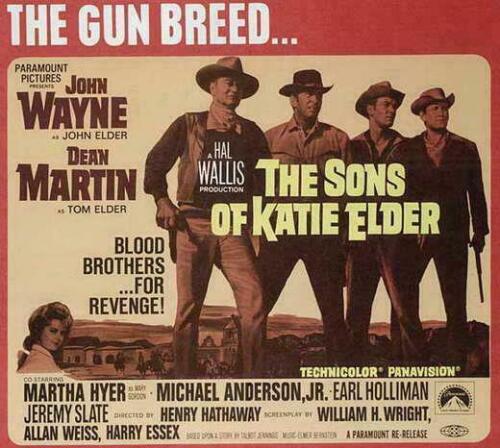
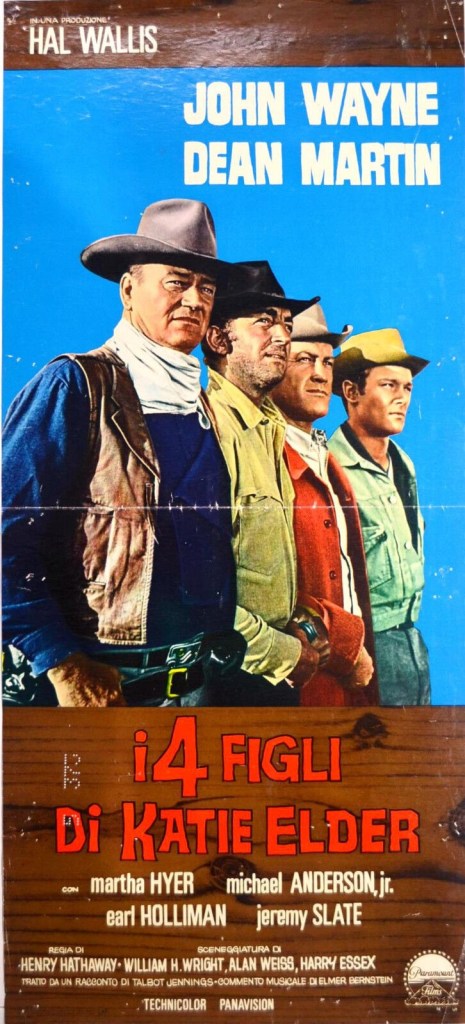
The Sons of Katie Elder (1965) ****

The rocking chair motif in this underrated film is ignored while the door opening and closing in The Searchers (1956) is hailed as one of cinema’s greatest images. Welcome to the world of director Henry Hathaway (Nevada Smith, 1966). Way down the pecking order when it comes to the makers of great westerns, below Sergio Leone (Once Upon a Time in the West, 1969) who only made four and Howard Hawks (Rio Bravo, 1959) only three.

Closer inspection, too, of The Wild Bunch (1969) might reveal cinematic ideas that turned up here first. Closer inspection of John Wayne (The Commancheros, 1961) might reveal a mighty fine, very touching, performance.

The genre was chock-full of vengeance, but here that is tempered by mystery over the death of their father, a drunken gambler, that has led to the loss of the family ranch, leaving the mother, for whose funeral the titular sons return, living hand-to-mouth, supplementing the usual sewing and mending with giving guitar lessons.

Hastings (James Gregory),  a businessman with big ideas, has taken over the ranch and pretty much the local town of Clearwater. And he’s just hired extra muscle, notorious gunslinger Curley (George Kennedy), to swell his already-growing army.

Only the youngest son, Bud (Michael Anderson Jr), a reluctant college student, is clear of the taint of wrong-doing. John Elder (John Wayne) has a reputation as a gunfighter but unlike shifty younger brother Tom (Dean Martin) doesn’t have a wanted poster following him around. The other son Matt (Earl Holliman) takes after John, some shady action but no legal consequence.

This is certainly not a great fraternal union. When they’re not engaged in low-level investigation or trying to prevent themselves being lynched, they’re bickering and fighting. The only thing that unites them, beyond love of the deceased woman, is determination to continue paying for Bud’s education.

Apart from the ranch, one of Hastings’ other lucrative investments is a firearms business, which allows him to tote around a telescopic rifle which, of course, ensures he can bump off those who get in his way from a distance, without fear of discovery. The easiest way to get rid of the brothers is to have them arrested for murder and to kill off the one man, Sheriff Wilson (Paul Fix), who might have the brains and experience to work out something fishy was going on.

John Wayne is more emotional here than in any picture since The Searchers, though, as you’ll be aware, his emotion is registered through his eyes or bits of business rather than a lengthy speech. And given double duty of looking after the youngest while holding back the more tempestuous Tom.

Dean Martin’s (Five Card Stud, 1968) charm runs thin, as is intended, no woman to gull, and no cliché alcoholism a la Rio Bravo to fall back on. It’s a part he plays completely against type, although you can sense he’s bursting out of those confines in the false eye con. He’s pretty much always brought to heel by Wayne. The one time he defies big brother ends in personal calamity. Imagine a marquee name as big as Dean Martin taking on a role where the part sets him up to be walking in the Duke’s shadow, despite his efforts to break loose.

In fact, unusually for a western, until Butch Cassidy and the Sundance Kid (1969) came long, it’s replete with reversals. Hathaway plays with expectations from the outset, the opening sequence of big beast of a train puffing through fabulous scenery doesn’t bring John, instead, unknown to the waiting brothers, Curley disembarks. Katie Elder’s friend Mary (Martha Hayer) cuts off at the pass any idea the audience might have of incipient romance when she gives John both barrels.

Thanks to the screenplay, Michael Anderson Jr.(Major Dundee, 1965) and Earl Holliman (The Power, 1968) are given more bite than their roles might suggest and James Gregory (The Manchurian Candidate, 1962) makes his villain meaty though you suspect the presence of George Kennedy (Cool Hand Luke, 1967) is another lure, creating audience expectation that is not fulfilled. Martha Hyer (The Chase, 1966) is more conscience than glamor,  spending most of the time on the sidelines.

You’d be surprised just how lean a production this is, and equally how deftly Hathaway avoids cliches. Just because there’s a kid you don’t need to teach him how to be a man. A huge herd of horses doesn’t need to stampede. Beautiful woman in the vicinity doesn’t necessarily call for a heated love affair. Ending up in jail doesn’t necessitate a bust-out. Villainous gunslinger doesn’t set up obligatory shootout in an empty street.

Hathaway’s unusual, too, in the way he anchors his pictures in reality. Here it’s a funeral director washing the wheels of his hearse, a blacksmith applying shackles.

You’d marvel, too, at just who was involved in fashioning the terrific screenplay: veteran William H. Wright, his first in two decades, Harry Essex (Creature from the Black Lagoon, 1954) in his first in eight years, and Allan Weiss whose six other movies were all Elvis Presley vehicles. Hardly the pedigree to produce one of the best westerns of the decade. This is the kind of screenplay where no line is wasted, not when a retort can be used to define  character.

Most people remember the rousing theme by Elmer Bernstein (The Scalphunters, 1968), but actually there are also some very innovative musical passages worth listening out for.

Curiously, it was Andrew Sarris,  hardly a John Wayne fan, who recognized the movie’s attributes, though in niggardly fashion, “The spectacle of people in Hollywood trying to do something different in a western at this late date is reassuring.”

It’s about time those differences and the picture’s excellence were recognized.

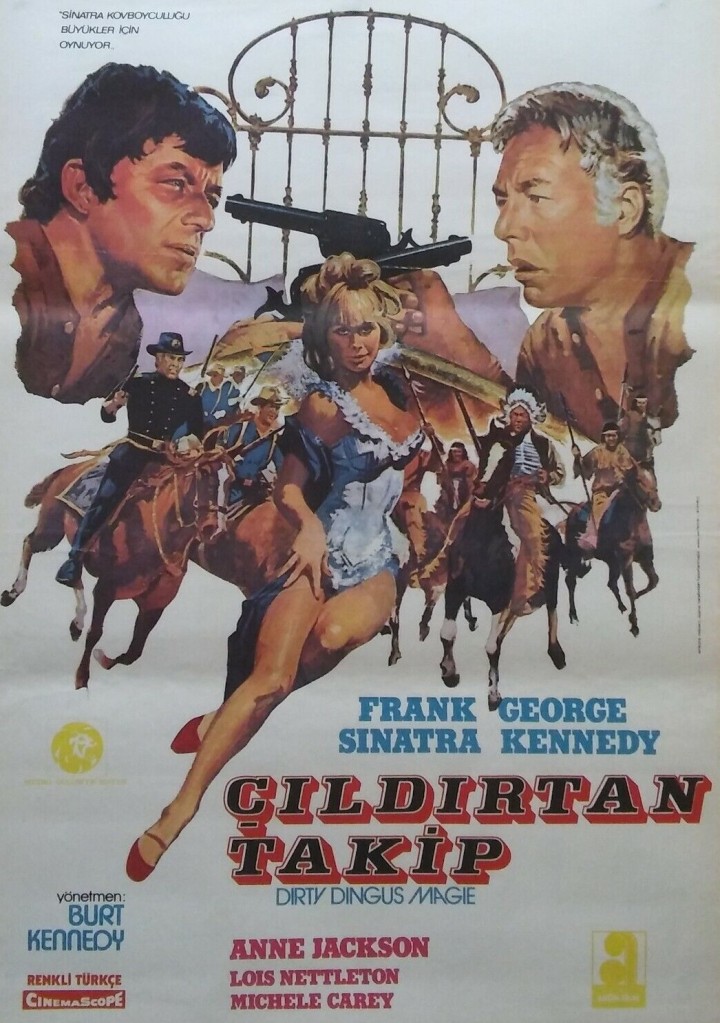
Dirty Dingus Magee (1970) ***

The boldest role ever undertaken by a major star of Frank Sinatra’s generation – and little thanks he got for it. Not only was he virtually unrecognisable under a slab of make-up that George Hamilton would have envied but the role was a complete reversal of his screen persona. Admittedly, he had flipped that persona for Tony Rome (1967) and as the cuckolded cop in The Detective (1968), but this was on a completely different level.

Sinatra was no Tom Hanks or Daniel Day-Lewis, known for inhabiting different types of characters, and, while he did have a vulnerability that he put to good use in The Manchurian Candidate (1962) and The Man with the Golden Arm (1955), he was best known on screen as the guy in charge.

That was far from the case here. Dumb and dumber might be more apposite. Dingus Magee (Frank Sinatra) is a scamp, an outlaw so useless he is worth only $10 in reward money, who steals the stash of old rival Hoke Birdsill (George Kennedy), triggering a revenge caper that is complicated by a host of unnecessary complications by director Burt Kennedy (Welcome to Hard Times, 1967) who has set his heart on some kind of satirical comedy western with a revisionist slant.

So we get a female mayor, Belle (Anne Jackson), who happens to own the local brothel, whose commercial prospects are endangered when the local Cavalry are called away to fight the Native Americans, an Indian chief Crazy Blanket desperate to trade his daughter for a rifle, and when that looks like not working out calling on any available squaw to seal the deal,  predatory schoolteacher Prudence (Lois Nettleton) and a running gag involving a Brown Derby hat that results in a gunfighter (Jack Elam) being mistaken for Magee.

It’s a bit long on complications and short on satire and is rescued by the double act of Magee and Birdsill, who constantly get in each other’s way or try to pull a fast one. Birdsill, as it happens, is appointed sheriff, since that’s in the purview of the mayor, and, on the right side of the law for the first time in his life, makes an ill-fated attempt to do good.

Magee tries to help him along. In exchange for the sheriff turning a blind eye for a period of time to Magee’s nefarious activities, the reward for the outlaw will mushroom, permitting greater kudos for the sheriff on his capture.

The main problem is that Kennedy directs with a very heavy hand, very obvious musical cues for a start, and there’s not enough that’s intrinsically funny. Though there is a reversal of an obvious joke of Birdsall being sent to the brothel to locate the mayor, expecting to find a client not the owner.

But both Sinatra and George Kennedy (The Sons of Katie Elder, 1965) are a delight, the latter also playing against type rather than his usual dominating character. Their dumbness takes some beating. Sinatra just about gets the upper hand, but there’s not much in it.

The best thing about the picture is the sense of reality. The U.S. Cavalry spend more time in the brothel than out hunting Native Americans. Law and order can go to hell as long as everyone is having illicit fun. The respectable schoolmarm proves a skilled seductress. Peace is desirable because it is more profitable than war. And the bulk of the outlaws in the Wild West are far from achieving legendary status, just two-bit punks.

Not surprisingly, this was a massive flop and killed off Sinatra’s movie career for the rest of the decade – not that he was overly concerned, “My Way” having reignited his singing career and he was a Vegas regular. But it’s a shame the acting was so vilified, Roger Ebert blamed Sinatra rather than the director for its failure, in particular taking him to task for the one-take approach that Gena Rowlands previously exalted (but what does she know, she’s just an acclaimed actress and knows how a movie works better than a critic).

Well overdue for a reappraisal and if you go in duly warned you might even enjoy it, or at least the Sinatra-Kennedy double act.

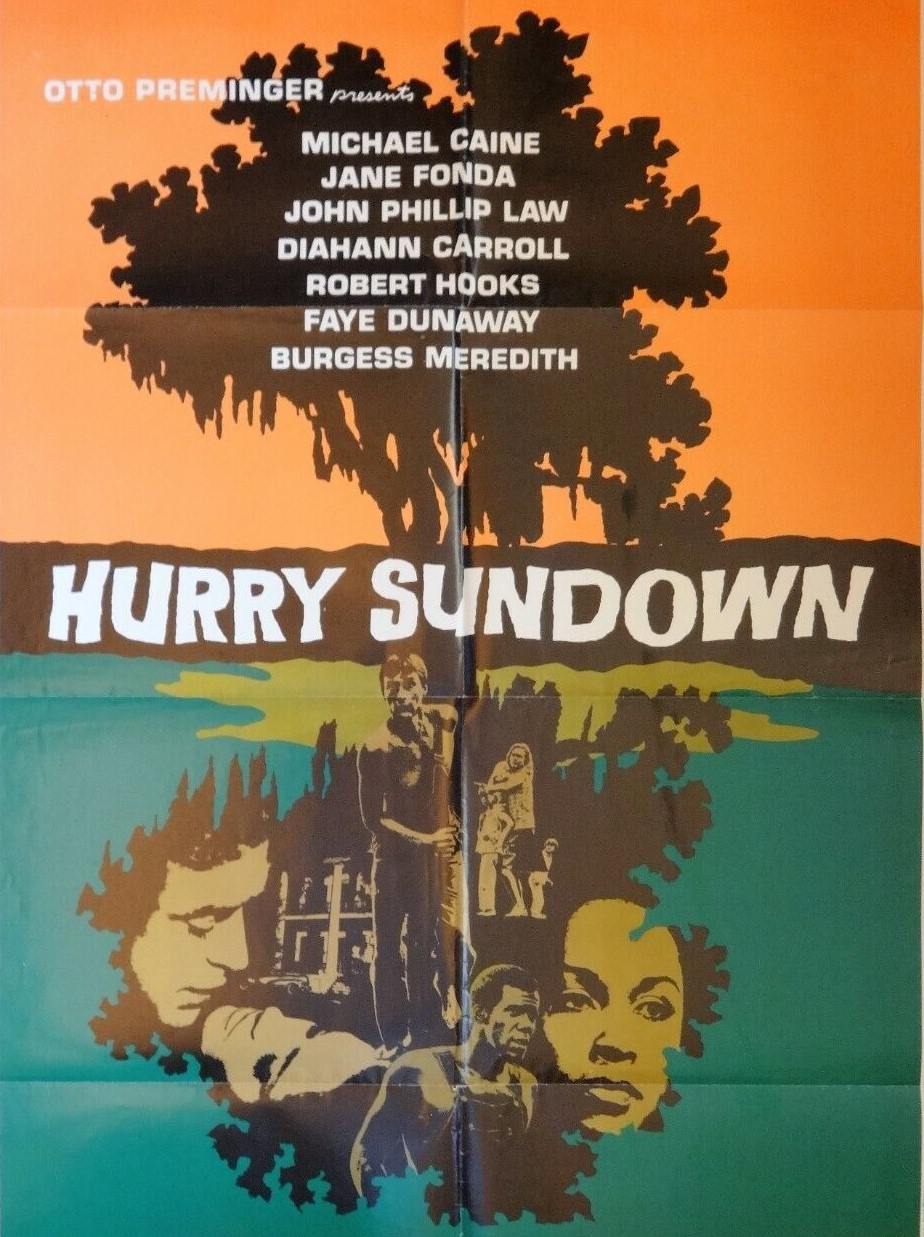
Hurry Sundown (1967) *****

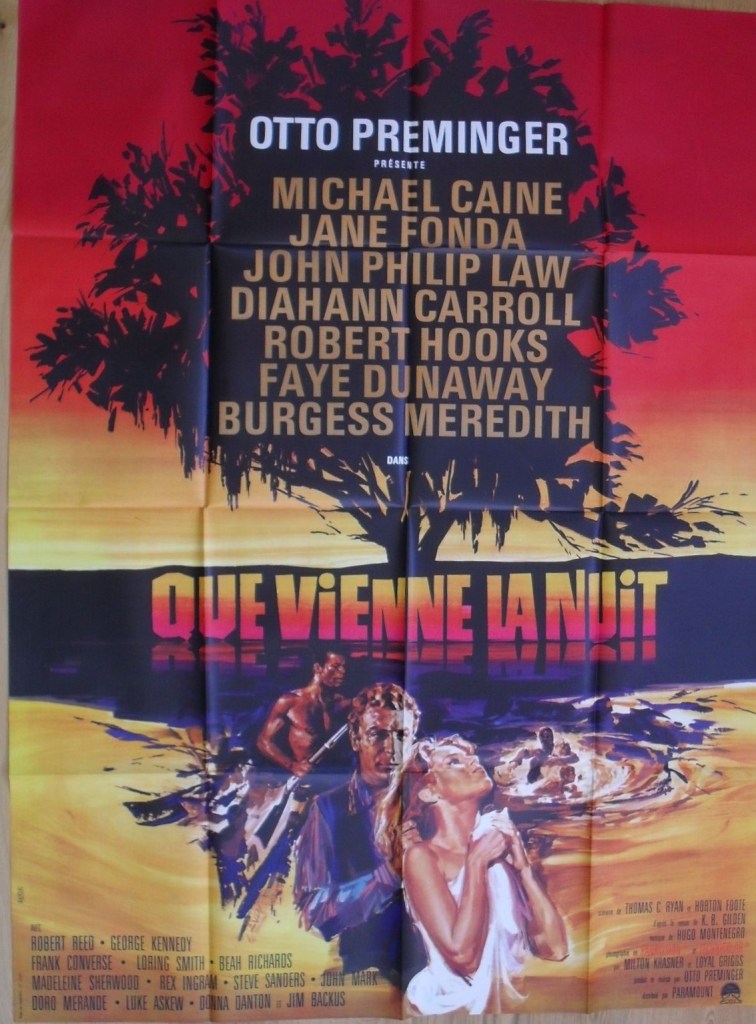
Otto Preminger’s drama was the first of a trio of heavyweight films in 1967 – the others being In the Heat of the Night and Guess Who’s Coming to Dinner – that took African American issues seriously. In post-war Georgia land-grabbing by ambitious Henry Warren (Michael Caine) pits him against World War Two vet Rod (John Philip Law) and African American farmer Reeve (Robert Hooks) who team up. Throw in a quintet of feisty women – Henry’s wife Julie Ann (Jane Fonda), Rod’s wife Lou (Faye Dunaway), schoolteacher Vivian (Diahann Carroll) – Reeve’s love interest – Henry’s lover Sukie (Donnie Banton) and Rod’s mother (Beah Richards) – and emotional confrontation comes thick and fast.

Preminger had spent most of the decade making films about big subjects – Exodus (1960), the politics behind the formation of Israel; Advise and Consent (1962), just politics; The Cardinal (1963), politics within the Roman Catholic Church; and In Harm’s Way (1965), Army politics and bluster around Pearl Harbor

Preminger is both economic and elegant. From opening dialogue to climactic court scene, the picture races along, and continuous use of tracking shots ensures the movie never gets bogged down. While there is no lynching, racist abuse, whether direct or indirect (through patronizing attitude) is never far from the surface. Corrupt Judge Purcell (Burgess Meredith) is by far the most vicious, his unrestrained language making you wince. But even those with more measured approaches have to play the game, Reeve gives a lift to Rod but has to let him off before they reach town in case anyone spots this, Rod forbidden, for example, to buy dynamite.

But the racists do not get it all their own way. Julie Ann stands up to the judge and her position in the community is so strong that others boycott the judge’s daughter’s wedding leading to the judge receiving a tongue-lashing from his wife. Weak Sheriff Coombs (George Kennedy) coming to arrest Rod is bamboozled by his female relatives while  Vivian charms her way past the judge.

The women are uniformly strong. Julia Ann goes from seductive wife to distraught mother, but in between capable of defrauding Rod’s mother, her childhood nanny, out of her inheritance. Lou resents her husband’s return after in his absence taking on a full-time job while running the farm and now resisting the idea of selling up to Henry. Rod’s mother, beholden to white men all her life, now turns against them. The judge’s daughter (Donnie Banton) makes no bones about the fact that she is marrying her “dull” fiancé for his money. This is no spoiler because you will have guessed some similar outcome but at the end it is Vivian who takes the initiative in her relationship with Rod and  marches into his house with her baggage, declaring she has come to stay.

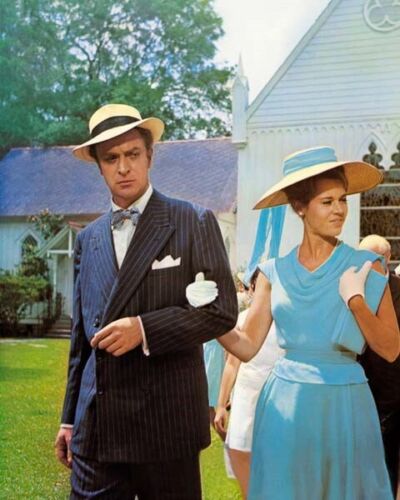
Caine and Fonda.

And although the ruthless Henry is the bad guy, he, too, is afforded insight, soothing himself by playing a musical instrument, a man with talent who had “distracted” himself by pursuit of money. And there is another touching moment when he takes in a runaway child. Acting-wise, Michael Caine (Gambit, 1966) is a revelation. Gone is the trademark drawl and the laid- back physical characteristics. Here he talks snappily – and no quibbles with his Southern accent either – and strides quickly. That we can believe he is brutal, gentle, remorseful and ruthless is testament to his performance.

Similarly, this is a massive step forward in Jane Fonda’s (Cat Ballou, 1965) career, away from Hollywood comedies and sexed-up French dramas, and her internal conflict springs from being forced to choose between husband and son, between her innate sexiness that oozes out in every intimate scene and maternal longing to comfort her disturbed child. Her usual shrill delivery is tempered somewhat by the deeper emotions she is forced to bear. While her attempt to defraud Rod’s mother comes from a desire to keep her husband, her eyes tell you she knows that is no excuse.

What’s perhaps most surprising of all is the tenderness. There are wonderful, gentle love scenes between Caine and Fonda and Law and Dunaway.

Children, too, also unusually, play a central role. Henry’s callousness is no better demonstrated than in his earlier treatment of his son. Reeve’s eldest son also resents his father’s return and, viewing Henry as a more suitable adult, betrays his father. The Judge is obliged to drop one of the worst aspects of his racism in order to appease his daughter.  

The acting throughout is uniformly good. Dunaway’s debut won her a six-picture contract with Preminger. Singer Diahann Carroll’s role as a confident young woman led to a television series. Robert Hooks would also enjoy small-screen fame. The surprisingly effective John Philip Law would partner Fonda in sci-fi Barbarella (1968) and link up with Preminger again in the ill-fated Skidoo (1969). Horton Foote (To Kill a Mockingbird, 1962) and Thomas C. Ryan (The Heart Is A Lonely Hunter, 1968) wrote the screenplay based on the bestseller by K.B. Gilden.

Unfairly overlooked by Oscar votes, who preferred the other Poitier films, Hurry Sundown, despite the rawness of the language and the innate brutality meted out to African-Americans, has been vastly under-rated. It is worth another look because at its core is not just racism but big business which scarcely cares about the color of those it exploits. It is as much about the power shift in relationships and ambition.  

Charade (1963) *****

Arguably the slickest thriller ever made. Two stars at the top of their game, three rising stars giving notice of their talent, more twists than you could shake a Hitchcock at, the chance to frighten the life out of the most fashionable actress of her generation, and standout scene after standout scene.

Three characters are presented upfront as bad guys, but whole enterprise is so laden with suspicion you are not all surprised when the finger points at Peter (Cary Grant) and Reggie (Audrey Hepburn), not least because Peter keeps changing his name, but also because audiences with lingering memories of film noir could easily imagine Reggie as a femme fatale especially when she comes on to a man whose got three decades on her.

Basic story: Reggie returns from a ski holiday where she met divorced Peter to find her husband dead and Parisian apartment empty. She is menaced by three men – Tex (James Coburn), Herman (George Kennedy) and Leopold (Ned Glass) – convinced she knows the whereabouts of $250,000 they lay claim to. Bartholomew (Walter Matthau) of the C.I.A. also stakes a claim. Tex has a nasty habit of throwing lighted matches at her, Herman threatening her with his steel hand. And there are doubts about Peter, initially perceived as a savior.

It is a film of such constant twists, you never know quite where you are, and forced to follow the lead of a befuddled and confused Reggie you question everything, so it’s an unsettling watch. Given the permutations, you could easily come up with a number of different endings.

And although this is virtually thrill-a-minute stuff it has the most endearing light romance, full of beautifully-scripted sparkling cross-purpose banter, and managing to work in marvellous scraps of Parisian atmosphere, some tourist-hinged (a market, boat ride on the Seine), others (a subway chase) less exhilarating. At times, Reggie turns spy and comes up with clever ruses to evade pursuit.

You can have this amount of conflict – baffling clues, perplexed French Inspector Grandpierre (Jacques Marin) kidnap, rooftop fight – without corpses soon mounting up. Alleviating the tension are a myriad of little jokes: a small boy with a water pistol, time out in a night club to play the rather frisky orange game, Peter showering with his clothes on. The romance might have helped except every time Reggie trusts Peter he gives her good reason to distrust him. And, of course, she could as easily have squirreled the money away herself.

The whole ensemble is delivered with such style and attention to detail (a bored man at a funeral clips his nails, cigarettes are expensive in France, voices echo when a boat passes under a bridge, phone booths are both refuges and traps) that it’s as if every single second was storyboarded to achieve the greatest effect.

It’s not just the entrance of the bad guys, door slamming in an empty church, that signals a director alert to every nuance, but the fact they all proceed, in different ways, to check Reggie’s husband is actually dead. A man has drowned in his bed. “I sprained my pride,” explains Peter after coming off worse in a fight. Apart from the core tale of suspicion, betrayals, theft and murder, everything else in the thriller genre is completely revitalized, in dialog and visuals this is nothing you have ever seen before.

The principals invest it with a rare freshness. Cary Grant (Walk, Don’t Walk, 1966) and Audrey Hepburn (Two for the Road, 1967) are such natural screen partners you wonder why (expense apart) the exercise was never repeated. And in typical John Wayne fashion, to minimise the May-December romance element, it’s Hepburn who makes all the running in that department, and you get the impression that she had been married to an older man anyway. Grant’s character is surprisingly adept at the old fisticuffs while Hepburn is more feisty than helpless, and devious, too, not above using the old screaming routine as a device to bring Grant running for romantic reasons.

James Coburn has his best role since The Magnificent Seven (1960), Walter Matthau (Lonely Are the Brave, 1962), at this point not considered comedian material, brings very human touches to his role, and George Kennedy (Mirage, 1965) presents a memorable villain.

And that’s not forgetting an absolutely outstanding score by Henry Mancini (Hatari!, 1962), jaunty one minute, romantic the next, and for the most thrilling sequences creating the type of effect David Shire achieved in All the President’s Men (1976) of steadily mounting tension rather than instruments shrieking terror. And the Saul Bass-style title credits were actually conceived by Maurice Binder of James Bond fame.

Outside of his musicals, this is the peak of Stanley Donen’s (Two for the Road) career. The gripping screenplay was the work of Peter Stone (Mirage), based on a story by Marc Boehm (Help!, 1965).

One of the few twist-heavy thrillers that rises effortlessly above the material.

Behind the Scenes: “Bandolero” (1968)

A western dream team. Beginning with Winchester ’73 (1950) James Stewart had revived his career post-World War Two with a string of tough westerns and had made seven movies in the genre in the 1960s including The Man Who Shot Liberty Valance (1962) and Shenandoah (1965). Starting with Rio Bravo (1959) Dean Martin had made six including The Sons of Katie Elder (1965). Genre debutante Raquel Welch had hit the box office running with One Million Years B.C. (1966) and Fantastic Voyage (1966). Following McLintock (1963) and Shenandoah, director Andrew V. McLaglen was considered one of the hottest western directors around.

Legendary Twentieth Century Fox producer Darryl F. Zanuck put together the cast and director as a “package” before calling in screenwriter James Lee Barrett (Shenandoah) to shape an idea by producer Stan Hough. McLaglen explained: “It was a Zanuck thing from the beginning.” He was working on another picture when he took a call from Zanuck. “I got a six-page outline for a western,” said Zanuck, “and I figure you ought to direct it. James Lee Barrett out to write it and Jimmy Stewart, Dean Martin and Raquel Welch ought to be in it. Nobody else. That’s the combination I want.” McLaglen took Hough’s six-page outline to Barrett who wrote it based on the actors involved.

Originally entitled Mace after the James Stewart character, the movie quickly became Bandolero!, the exclamation mark possibly to differentiate it from the 1924 Spanish picture of the same name which had been made for Metro-Goldwyn (as the studio was then known).

Despite the success of the Matt Helm spy pictures and a number of decent westerns, Dean Martin ceded top billing to James Stewart (had they shared the billing, Martin would have come first in the traditional alphabetical order).

Marc Eliot, one of Stewart’s biographers, arrived at a more unlikely scenario for the movie being greenlit, concluding that because Martin and Stewart had got on so well when the latter appeared on the former’s television show they decided to make a picture together. Given the show was taped in summer 1967 and the movie went into production a few months later it left an improbable amount of time for the picture to be set up.  

Director Andrew V. McLaglen would be reunited with two of his favorite movie characters – screenwriter James Lee Barrett and James Stewart, both key to Shenandoah. The actor had been the driving force behind McLaglen’s recruitment for that Civil War picture. “I just loved working with him,” said the director, “it got to the point where any time he did a movie he wanted me to direct it.” He viewed Barrett as “one of the best dialog writers I’ve ever known in movies.”

Although theoretically, the movie was set up as a package, with stars and director in place, Dean Martin remained a doubt since he was already committed to a film with Columbia that might clash. And Stewart might easily have dropped out if producer Frank McCarthy’s plans for Patton, with Burt Lancaster in the title role and Stewart as General Omar Bradley, had come to early fruition.

Raquel Welch was on a publicity high, featured on 400 magazine covers, generating such industry buzz that she had been named “International Star of the Year 1967” by U.S. cinema owners, her growing screen popularity ranking her eleventh in Box Office magazine’s female “All-American Favorites of 1968.” Dean Martin, incidentally, came ninth on the corresponding male chart, two places above Clint Eastwood, Paul Newman topping the poll.

George Kennedy (Cool Hand Luke, 1967) had small parts in Shenandoah and The Sons of Katie Elder before graduating to second male lead in McLaglen’s previous western The Ballad of Josie (1967). McLaglen, you might like to know, was highly regarded by the trade as “more concerned with entertaining the public than making intellectual and emotional demands on the audience.” Just after the movie’s launch the director signed a two-picture deal with Fox, The Undefeated (1969) next on his dance card.

One of the few studios to persist with a talent school – Welch claimed as the most recent high-flying graduate – Fox gave current student Clint Ritchie a role in Bandolero!, others in the Class of 1968 including Jacqueline Bisset (The Sweet Ride, 1968) and Linda Harrison (Planet of the Apes, 1968). Relative newcomer Andrew Prine had acted with Martin in Texas Across the River (1966) and enjoyed a supporting role in McLaglen war picture The Devil’s Brigade (1968).

As well as genre newcomers Welch and Ritchie, the cast included western character actors like Will Geer (Winchester ’73), Don “Red” Barry (The Adventures of Red Ryder, 1940) and  Harry Carey Jr. who had appeared in three previous McLaglen westerns. Even current “Tarzan,” Jock Mahoney, who played Maria’s husband, had a string of B-westerns in his portfolio. Possibly as important was the presence of James Stewart’s horse Pie, his onscreen companion for two decades.

Shooting began in Paige, Arizona, on October 2, 1967, before shifting two weeks later to Brackettville and the Shaban ranch where The Alamo (1960) was filmed. Parts of the San Antonio de Bexar set were revamped as the Texan town of Val Verde where the hanging in the film took place, while The Alamo doubled as the Mexican village of Sabinas which provided the action for the climax. Seven buildings were added to the San Antonio set including the jail, while a curio shop was transformed into a bank, a gift shop became a hotel and, conversely, an old hotel was turned into a general store. Thirty-five thousand traditionally-cast adobe bricks were made on site to create the dozen buildings required for Sabinas plus the locale’s arch, fountain, wells and wall.  

Other locations included Arizona, Utah and Texas with interiors filmed at the Fox studios. The shootout between the posse and the outlaws was filmed near Turkey Mountain in Texas. The Rio Grande was forded at Devil’s River but Mace crossed the river at Pinto Creek. Glen Canyon National Recreation Area was utilized for the bandit attack and, naturally enough,  for sequences requiring canyons. Other scenes were shot at Lee’s Ferry in Arizona, Balanced Rocks, and Big Water in Utah. But the first time we view Sabinas is an effects shot.

You do wonder why this film entered the studio books as costing $5 million. None of the principals were in the million-dollar salary range and the cost of 40 days shooting at the Shaban ranch was put at $25,000 a day.

The principals eventually enjoyed on-set camaraderie. Initially, Welch was too serious for the others, bombarding the director and more experienced actors with questions about her character’s motivation and psychology. “I wouldn’t say creativity was the primary concern on that picture,” commented the actress. “Barrett was there mainly because everybody said nobody could write dialog for Jimmy like he could. As far as other things in the script were concerned, they weren’t really supposed to be questioned.

“And with McLaglen it was all by the book. McLaglen created a very constrained atmosphere. It was an inoffensive nine-to-five project with a lot of very senior people, the old John Ford gang. Very cliquish. Except for Jimmy who’d always kind of throw out little things. I felt pretty lonely the whole shoot.”

To “loosen her up,” the two stars invited her out to dinner and “got her good and drunk.” Remembers McLaglen, “Dean and Jimmy and I would take Raquel Welch to dinner and we’d kid around with her.” Quite whether that was sufficient to rid Welch of her feelings of alienation was never established. However, she did register that she was surrounded by talent. Stewart “could cry on cue. No mess, no fuss. Just like that you could see tears in his eyes.

McLaglen equally enjoyed an esprit de corps with the male stars. “When I think of my time with Dean, there’s nothing but joy in my heart…without doubt the most conscientious actor I have ever worked with,” adding, “I think Jimmy had more fun on that location than he ever had.”

Texas was chosen for the June 1968 launch on the grounds that Shenandoah had done so well there. Instead of a city-by-city premiere lasting a week with many stars in attendance, the studio opted for a “new kind of premiere,” opening night at the Majestic in Dallas accompanied by a 30-minute live telecast broadcast to 23 Texas television stations. Also available was a 16mm featurette on Welch promising “an intimate look at a new star.” Welch contributed her vital statistics and preferences to a computer program that would help select the winner in a beauty contest to find the woman closest to the star in looks and personality.

Stewart, of the tub-thumping generation, believed stars should hit the publicity trail, public appearances adding 10 per cent to the gross, rather than insisting it was beneath their dignity or not worthy of their time. He claimed publicity tours were “good for the soul. Unless he has a real bitter selfish attitude (an actor) has to enjoy getting out to different parts of the country and meeting people.” Raquel Welch was one of the stars he chided for adopting the wrong attitude with autograph hunters.

Little of the weaponry seen on screen was from the period, the movie being set in 1867. And even the supposed Remington 1858 New Army revolver used by Martin, Kennedy and Welch, was improvised from another pistol. But Stewart used a genuine Single Action Army “artillery” revolver. There was some cheating going on, Martin firing a Winchester 1892 saddle ring carbine, and others using a Winchester model 1892 rifle and a Winchester Model 1873 carbine.

Despite claims by James Stewart biographer Gary Fishgall that the “film opened to near-instant obscurity” Bandolero! proved a solid box office success in the United States, where it was the top western for the year, finishing 18th in the annual chart, collecting $5.5 million in rentals (not gross) and performing very well overseas. It was a signal year for westerns, though some languished. Hang ‘Em High was 20th with $5 million, The Good, The Bad and the Ugly 24th ($4.5 million), Five Card Stud 34th ($3.5 million) and The Scalphunters 43rd ($2.8 million).  In the flop category were Will Penny in 54th spot ($1.8 million), Villa Rides 75th ($1.2 million), Firecreek 79th ($1.2 million) and Shalako 85th ($1.1m).

SOURCES: Gary Fishgall, Pieces of Time, The Life of James Stewart, (Scribner, 1997) p314; Marc Elliot, James Stewart, A Biography, (Aurum, 2007, paperback) p365; Howard Hughes, “Welch Out West Part 1,” Cinema Retro, Vol 11, Issue 31, 2015, p10-17; internet movie firemarms database; “Raquel Welch To Get Int’l Star Award,” Box Office, February 19, 1967, p4; “Mace Retitled Bandolero!,” Box Office, August 7, 1967, pE6; “Cast Patton and Bradley,” Variety, September 20, 1967, p13; “Bandolero! Moves to Texas Oct 16,” Box Office, October 16, 1967, pC1; “Filming of Bandolero! Ending at Bracketville,” Box Office, December 4, 1967, pSW1; “Fox On Texas Trail for Kickoffs,” Variety, May 15, 1968, p32; “James Stewart: Stars Should Tout Films in Television Age,” Variety, May 29, 1968, p19; “Now There’s A New Kind of Premiere,” advertisement, Variety, June 12, 1968, p17; “Bandolero! Dallas World Premiere Covered Live By 23 TV Stations,” Box Office, June 24, 1968, pSW1; “Fox’s Talent School,” Variety, June 26, 1968, p13; “20th-Fox Signs McLaglen to Two-Picture Pact,” Box Office, August 26, 1968, pW1; “Big Rental Films of 1968,” Variety, January 8, 1969, p15.

Discover WordPress

A daily selection of the best content published on WordPress, collected for you by humans who love to read.

The Atavist Magazine

by Brian Hannan

WordPress.com News

The latest news on WordPress.com and the WordPress community.