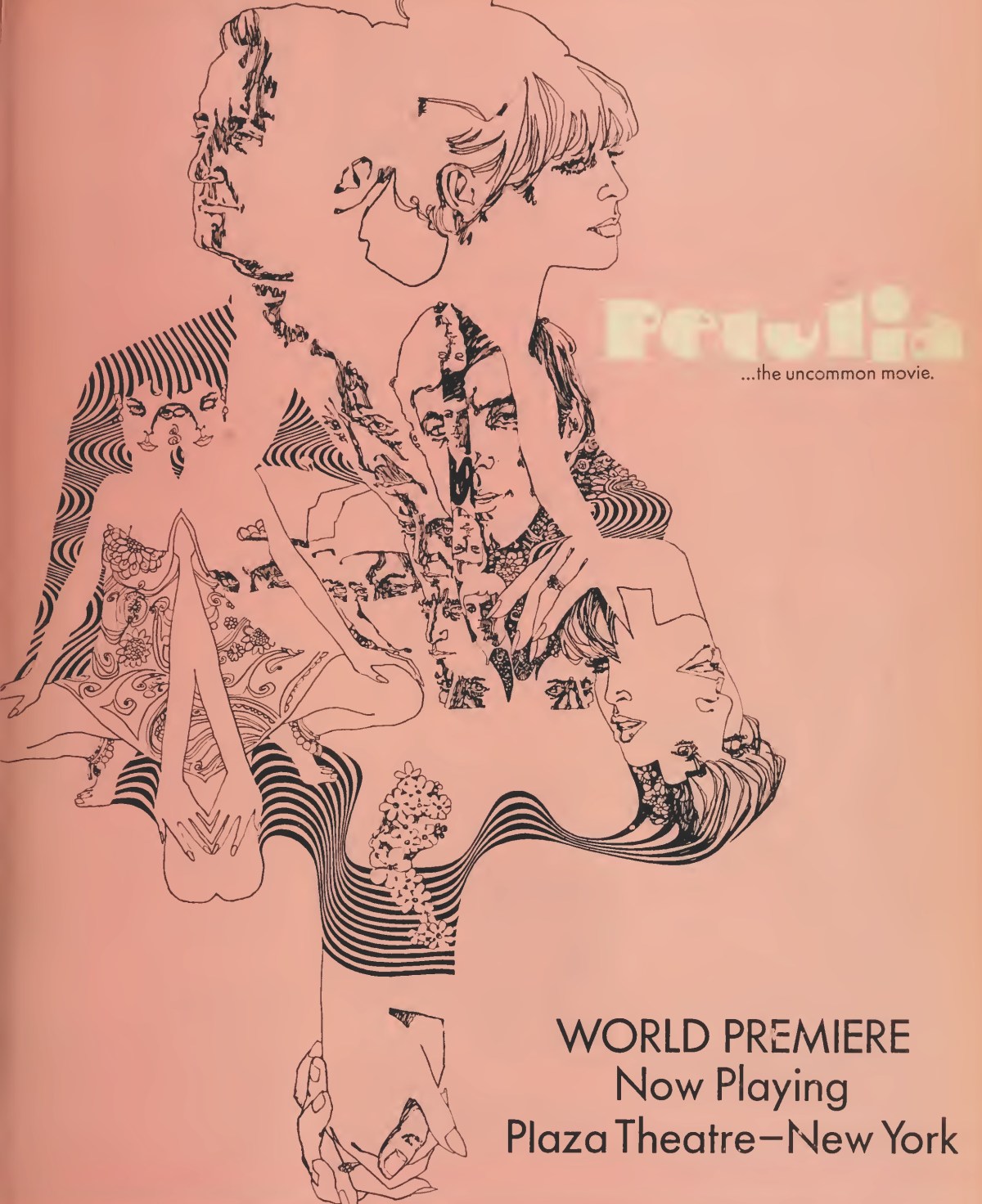
A dislocated, fractured film about disjointed, fractured people. Takes a heck of a long time to work what’s going on because director Richard Lester in the elliptical style of the times tells us bits of the story a bit at a time and no guarantee anything is in logical order or that the characters tell the truth about themselves or their actions. And, unusually, outside of a western, all the men appear prone to violence.
Petulia (Julie Christie), a self-appointed “kookie” (in the vernacular of the times) and married for just six months to wealthy naval architect David (Richard Chamberlain), for no reason at all begins an affair with surgeon Archie (George C. Scott) that she encounters at a posh function. Archie, getting divorced for no reason at all except boredom from Polo (Shirley Knight), already has a girlfriend, all-round-sensible boutique-owner May (Pippa Scott). Petulia and Archie may or may not have consummated the affair, she certainly puts him off often enough. Petulia may or may not be the daughter and sister of prostitutes. You see where this is going? Unreliable narrator, par excellence.
A broken rib may be the result of stealing a tuba from a shop. She could have cracked her head open after a dizzy spell. A Mexican boy keeps turning up and, it has to be said, nuns. It’s all very avant-garde: an automated hotel where the key comes out of slot and the fob sets off flashing lights at the bedroom door, the televisions in hospital rooms are dummies, Janis Joplin is the singer in a band, characters viewed in longshot down corridors, up car park ramps, emerging from tunnels.
Eventually the demented jigsaw puzzle comes together but not after a tsunami of overlapping dialog, flash scenes and snippets that have nothing to do with the film. It’s San Francisco so there’s a scene in Alcatraz. But little is constant, every marriage seems on the verge of break-up, even the contented Wilma (Kathleen Weddoes), wife of another surgeon, wishes she had Archie’s courage in ending his marriage.
But Petulia is anything but free-spirited. She is trapped and doesn’t know how to get what she wants. She may be a tad unconventional and big-hearted and occasionally small-minded but once you get to the end of the film and find what she really wants the rest of her behavior makes sense. And although Archie is able to verbalize what he doesn’t want from marriage, the only option open to Petulia is one apparently mad action after another.
Although set in the Swinging Sixties, the male hierarchical system remains dominant. Archie’s ex-wife relies on him for money, David and his father (Joseph Cotten) hold sway over Petulia regardless of her bids for freedom. David is unsavory, his father is willing to provide a false alibi, another surgeon Barney (Arthur Hill) lets loose with a vicious rant and even the harmless soft spoken Archie lets loose on Polo.
Julie Christie (Doctor Zhivago, 1965) makes Petulia as irritating as she is endearing, the freedom she expects to embrace in the counterculture impossible to grasp, leaving her only with the vulnerability of the vanquished. George C. Scott (The Hustler, 1961) has forsaken his growling persona, the volcanic screen presence set to one side, to portray a more interesting character, bemused by Petulia but ultimately standing up for her.
There’s an excellent supporting cast in Richard Chamberlain, still in the process of shucking off Dr Kildare (1961-1966), Arthur Hill (Moment to Moment, 1966), Shirley Knight (Flight from Ashiya, 1964) and Joseph Cotten (The Third Man, 1949).
Britisher Richard Lester (A Hard Day’s Night) was a director du jour who, while fulfilling the expectation of delivering cutting-edge techniques and casting a wry eye on contemporary mores, offered some surprisingly more homely family scenes and for a movie which is so much about the distance between characters many scenes of just touching, Petulia stroking Archie’s hands, Archie stroking is wife’s neck, even when the intimacy they seek is a forlorn hope. The incident with the tuba which would be a meet-cute to end all meet-cutes in other pictures turns into a cumbersome irrelevance. You get the impression that the chopping up of the time frames and the points of view reflects the characters’ feelings that they can impose their own reality on a situation. Lawrence B. Marcus (Justine, 1969) wrote the screenplay from the novel Me and the Arch Kook Petulia by John Hasse.
Check out a Behind the Scenes on this film’s Pressbook.
While Twentieth Century Fox head honcho Spyros Skouras initially balked at the title, with its connotations of prostitution, by the time the movie appeared that subject matter was less contentious thanks to critical and commercial big hitters Butterfield 8 (1960) and Never on Sunday (1960). Given that the idea of a movie set in a poolroom was going to be a hard sell to a female audience, despite the marquee lure of Paul Newman, the studio gave marketeers free rein to pitch it as a raw, sex-oriented drama.
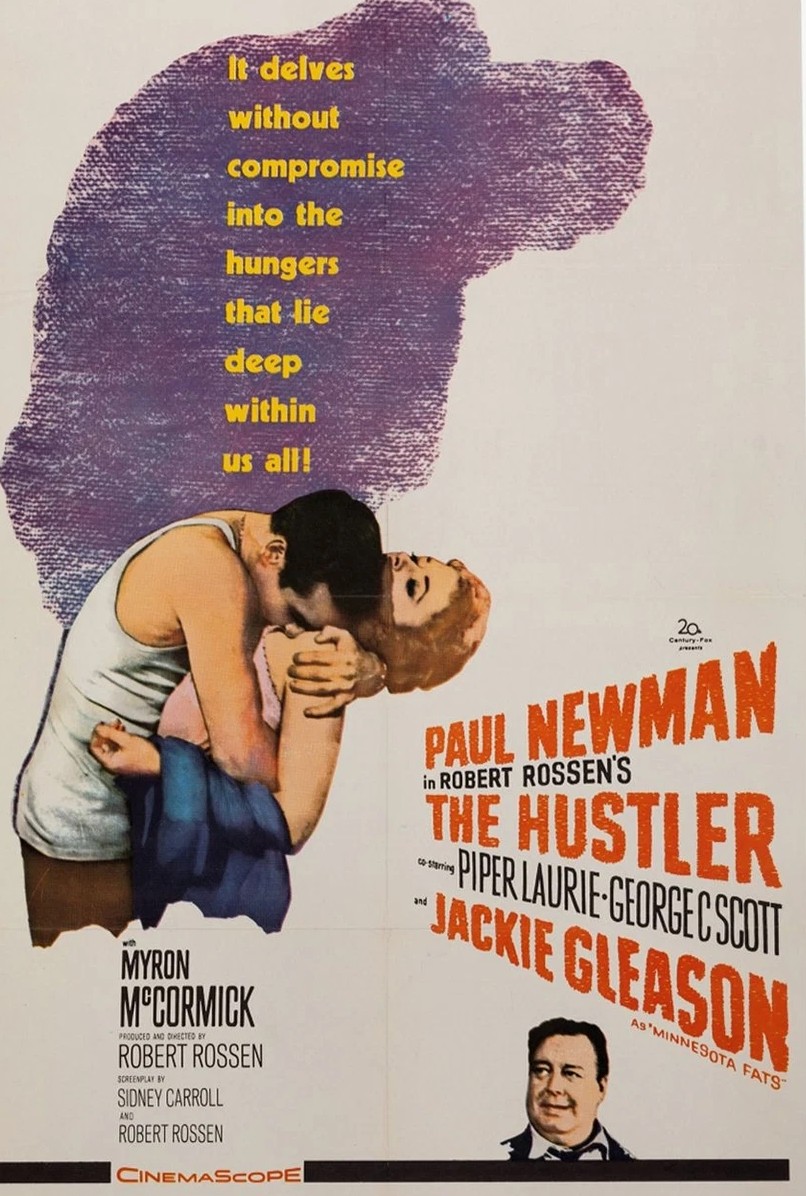
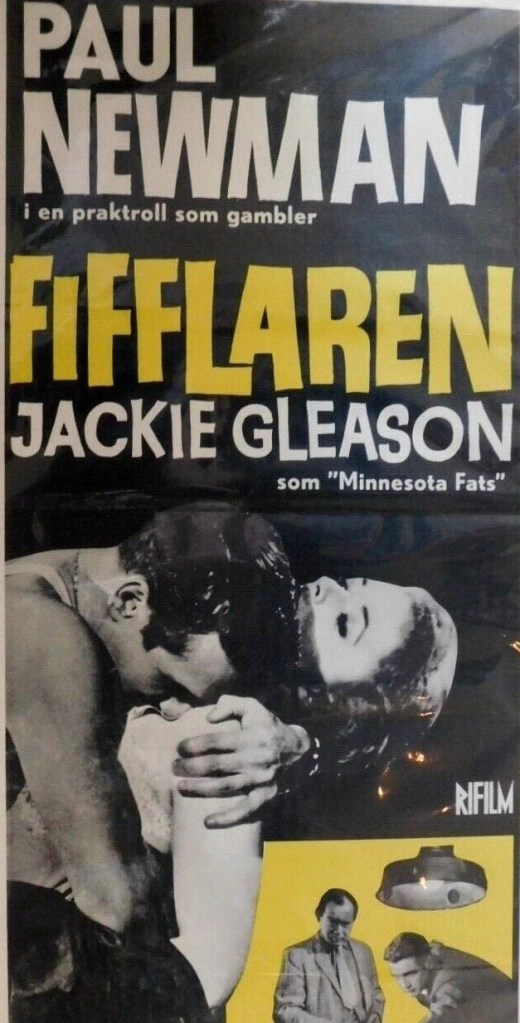
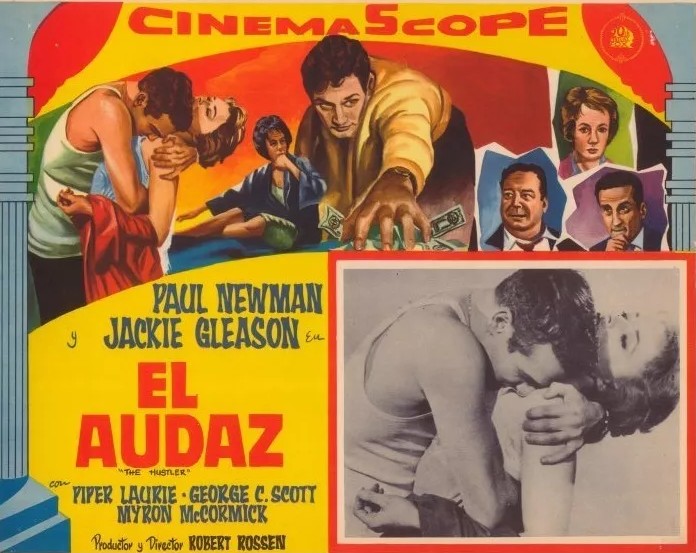
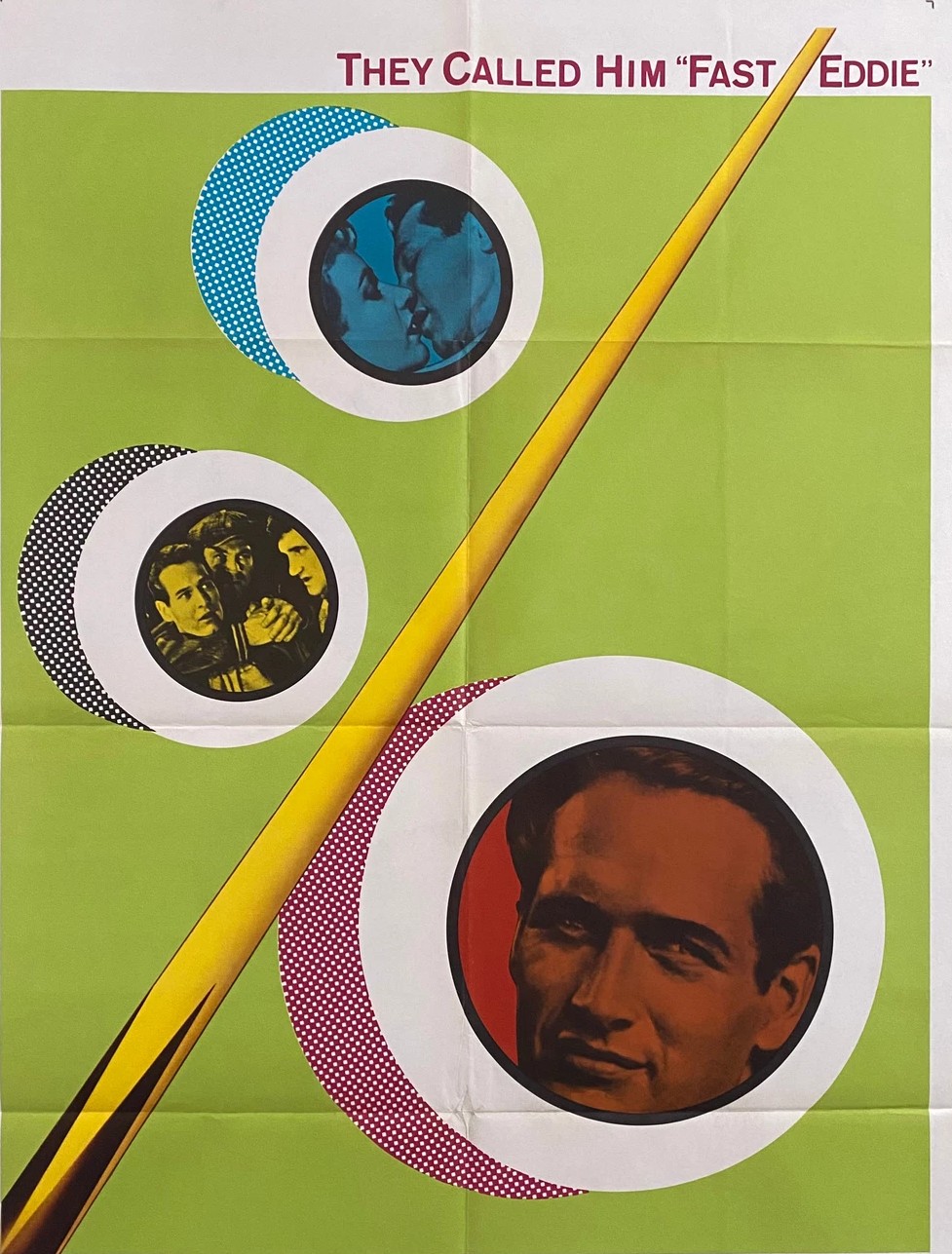
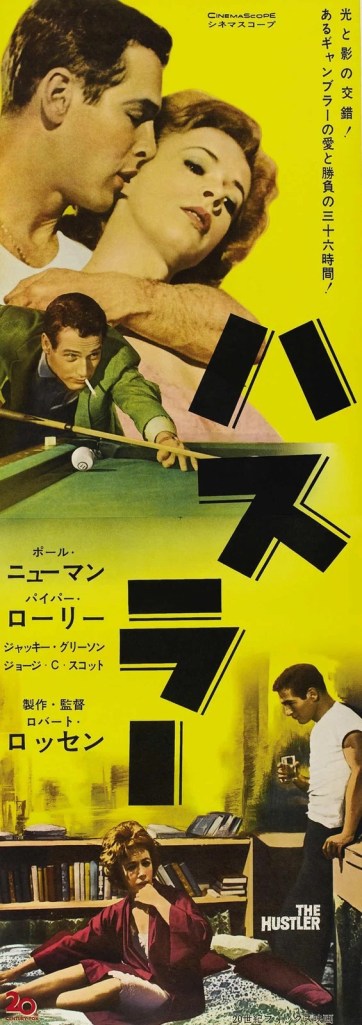
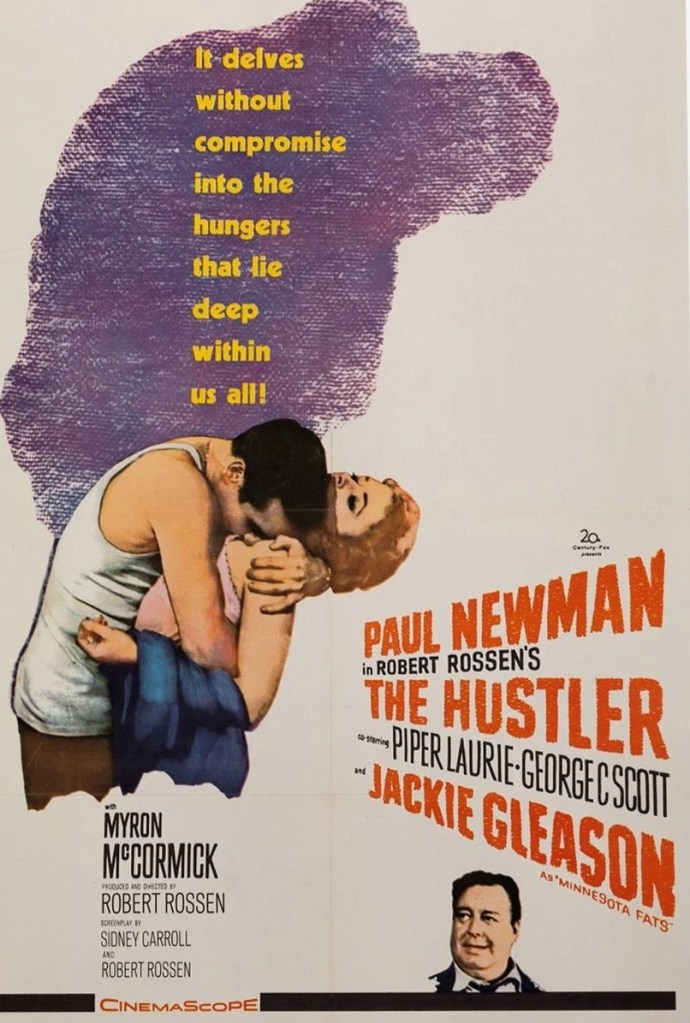
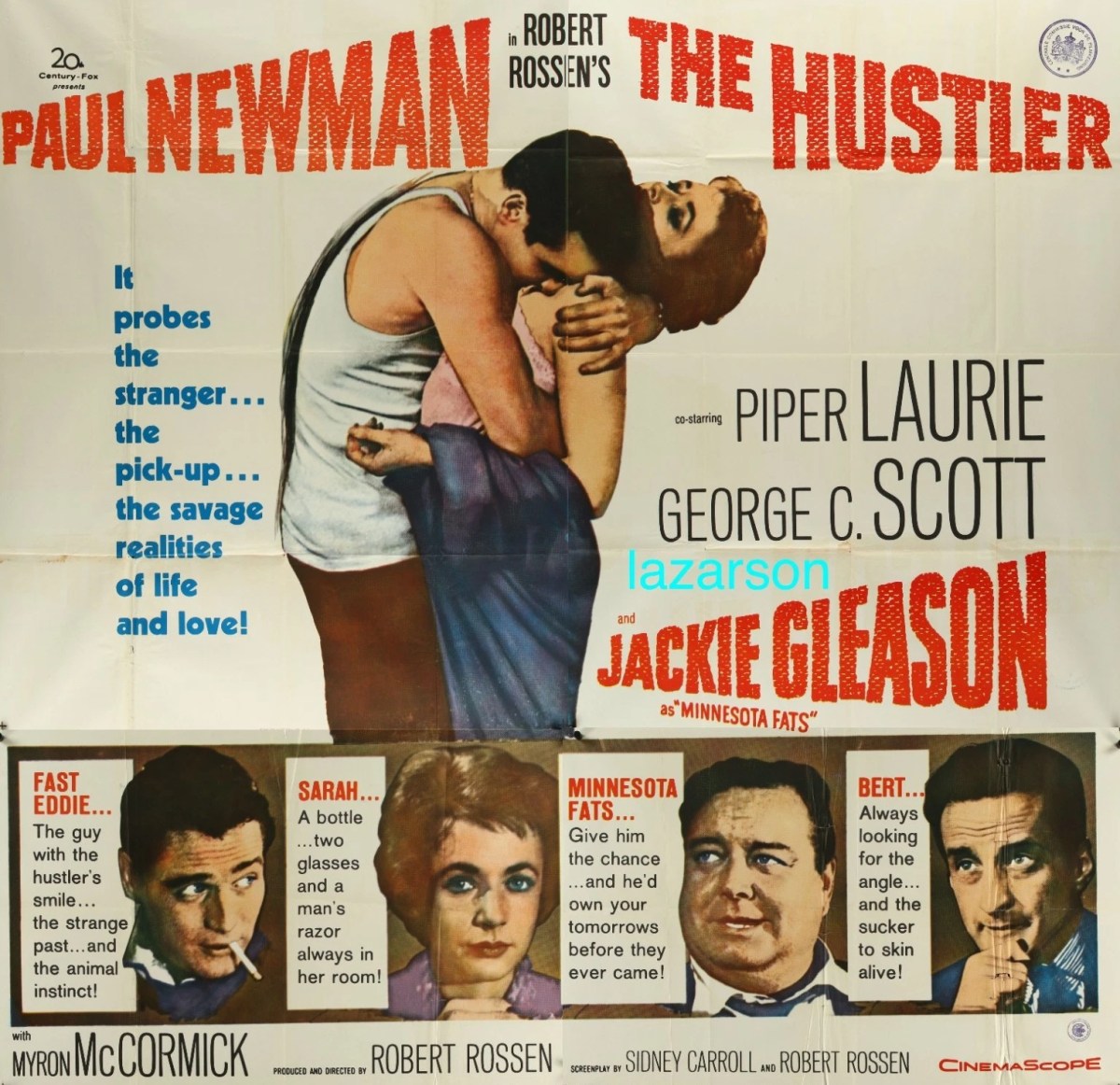
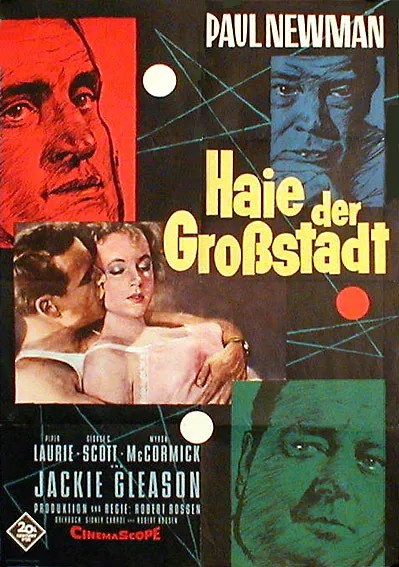
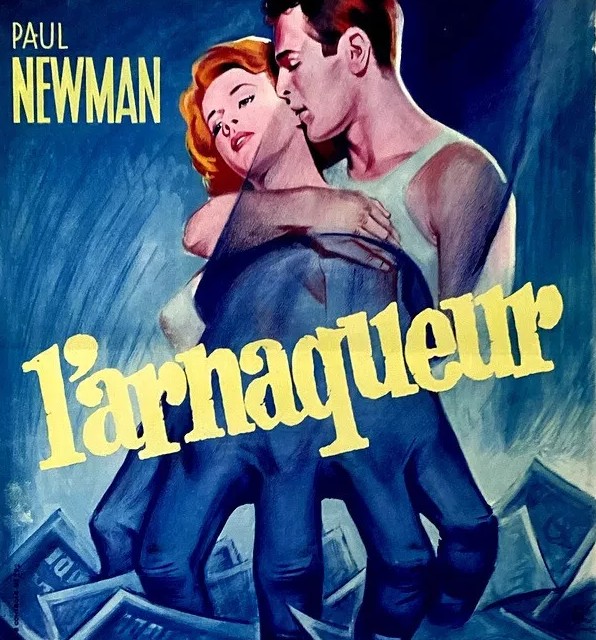
There’s little sign of a pool cue in some of the artwork. Instead, we have Paul Newman lustily nuzzling Piper Laurie’s neck or bosom. The taglines promise something far removed from a sports picture.
“It probes the stranger…the pick up…the savage realities,” screamed the main tagline. Another tempted with: “It delves without compromise into the inner loneliness and hunger that lie deep within us all!” In other words we’re talking about sex, not love, and casual sex at that, the world of the one-night stand between consenting adults for whom marriage is the last thing on their minds. “The word for Robert Rossen’s The Hustler is prim-i-tive” suggested out of control lust.
Fast Eddie Felson (Newman) has “the animal instinct.” Sarah (Piper Laurie) has a “bottle, two glasses and a man’s razor always in her room.” Bert (George C. Scott) is on the look-out for the “sucker to skin alive.”
Those images which did show a cue and pool balls did not suggest an august sport like football or baseball, not with a tagline like “he was a winner, he was a loser, he was a hustler.”
With such talented actors to hand, the Pressbook wasn’t short of good stories relating to the actual movie rather than the kind of snippets that might appeal to an editor on a slow news day. So we learn that Piper Laurie continually limped, Method-style, around on the set. “When I limp in the picture, I don’t want to act it. It’s something that has to be a part of me, something of which I am no longer conscious, apart from its being a physical defect. I must be able to limp as if I had a bad foot from birth.”
Laurie had made so few pictures that her name wouldn’t be on any director’s wanted list and what she was best known for – ingénue roles when a contract player for Universal (who gave out that she bathed in milk to keep her skin soft) opposite the likes of Tony Curtis – wouldn’t have inspired confidence. Robert Rossen might well have spotted her in two Emmy-nominated performances in successive years including Days of Wine and Roses (1958), but instead said he remembered her for “a sensitive characterization” from a stage production of Rosemary.
Ames Billiards Academy had once been a Chinese restaurant so boasted a balcony. This was unseen in the picture but allowed director Robert Rossen to shoot from widely varied overhead angles. The crew took over the Manhattan Bus Terminal for a day and a night. A row of lunch booths was constructed in front of the existing lunch counter. “It looked so real,” we are told, “that passers-by sat down and waited for their orders to be taken.” A nice story, and the kind often furnished by Pressbook journos, but rather fanciful, since it would be obvious what with the crew milling around and the lights and cameras and miles of cable that this was a movie set with security posted to prevent trespassing.
Just how good a pool player was Jackie Gleason, who came to the picture with a reputation for handling a cue? Well, at one point, the affable television comedian with a top-rated show, potted 96 consecutive balls.
Paul Newman plays the iconic hero as a “figure cut from the fabric of our time.” He had a firm grasp of the character. “With him it’s a question of commitment. He is so wrapped up in his drive to win and be somebody that he has no time to give of himself that which others need. It is a disease of our time, both the ambition and the isolation. I want him to be understood.”
Needless to say there was no mention of author Walter Tevis. That wasn’t so unusual in the make-up of Pressbooks, but if the marketeers these days were looking for something to write about the eclectic Tevis would be prime. He followed up The Hustler, published in 1959, four years later with sci fi The Man Who Fell to Earth, filmed in 1976 with David Bowie. A sequel to The Hustler, The Color of Money, was directed in 1986 by Martin Scorsese with Newman reprising his role and managing Tom Cruise. Tevis also wrote The Queen’s Gambit, turned into an acclaimed television mini-series in 2020 with Anya Taylor-Joy.
It should have been Frank Sinatra in the leading role, not Newman. Sinatra acquired the rights to the Walter Tevis semi-biographical novel published in 1959. When Sinatra moved onto something else and director Robert Rossen took up the slack still Newman should have been ruled out courtesy of a planned re-teaming with Elizabeth Taylor – they had worked together on Cat on a Hot Tin Roof (1959) – for the screen adaptation of Broadway hit Two for a Seesaw. Bobby Darin (Pressure Point, 1962) was being lined up instead. When illness put paid to Taylor’s involvement, Newman would have remained tied to Two for the Seesaw except he had co-star approval and none of the actresses suggested measured up.
Based on reading half the script, Newman, calling his agent at six o’clock in the morning to confirm interest, jumped at the role. Though Exodus (1960) had been a success, and he had managed to ease himself out of his contract with Warner Bros, he was not considered hot box office and he needed a part not just to consolidate his commercial standing but to provide a professional springboard that would shape his career. His previous outing, Paris Blues (1961), hadn’t carved out a clear path. As well as his salary, the actor was in line for ten per cent of the profits.
Initially, the picture was backed by United Artists and it featured in their adverts in the trade magazines in 1959. The studio had shelled out an advance to Rossen to option the rights. But when the director couldn’t find a “box office star as insurance” UA pulled out. By this point, the end of 1959, there was at least a screenplay, Rossen having called upon the services of Sydney Carroll (Big Deal at Dodge City, 1966).
Rossen shopped the package to Twentieth Century Fox which, somewhat surprisingly, signed up to the project when no major star was attached, especially as, according to Rossen, the picture “pulled no punches” with its “frank approach to people and life.” UA had promoted itself as the go-to studio for independents but by Rossen’s reckoning Fox was superior in that department because backing the movie “took some guts.”
Fox chief Spyros Skouras wasn’t keen on the title, believing, understandably, that The Hustler might signal to audiences that it was a story about prostitution. It was changed first of all to A Stroke of Luck and then to Sin of Angels. However, UA objected to the latter title on the grounds it had already registered a similar title The Side of the Angels and with some reluctance Skouras agreed to go with the original title.
It was a critical picture for Rossen, who hadn’t had a solid hit in a decade and hadn’t made a picture that could be mentioned in the same breath as All the King’s Men (1949). In part his low output was due to being blacklisted during the anti-Communist witch hunt of the early 1950s, although finally cleared. But it was as much due to his unusual method of working. “You gamble time which is money,” he said, “because you may work for six months or a year then realize the property is not quite right and your drop the while idea.” That ran counter to the general Hollywood practice where studios would press ahead with inferior product precisely because so much time and money had been spent on it. Rossen’s office was littered with abandoned projects.
Female lead Piper Laurie was also in the market for a comeback. She had bowed out of the business after Until They Sail (1958) – also starring Newman – fed up with ingénue parts, although the director had initially favored daughter Carole Rossen (The Arrangement, 1969) for the role. At one point Rossen identified Yves Montand for a top supporting role. Co-star Jackie Gleason (Soldier in the Rain, 1963), known at this time as a television comedy actor, was already a decent pool player and Newman was coached by Willie Mosconi, a fourteen-time world billiards champ. Except for one maneuver the two actors managed to achieve all the shots caught on camera. Newman believed he was good enough to beat Gleason and it cost him $50 to be proved wrong.
George C. Scott, primarily known for his work on the stage, had attracted attention with an Oscar-nominated turn in Otto Preminger courtroom drama Anatomy of a Murder (1959).
The film, budgeted at $2.1 million, was shot on location in New York City in the winter and spring of 1961. “You get certain values,” noted Rossen, “ in New York that you can’t get on the Coast (Hollywood).” The pool scenes were filmed at Ames Billiard Academy, established in 1946, near Times Square and McGirr’s. Other locations included a townhouse on East 82nd St which doubled as the Louisville home of the billiard player Findley and the Greyhound Bus Station in Manhattan even though it lacked a dining area and the one built on the premises confused regular customers.
Rossen spent five weeks of the 10-week schedule on the pool action. Sarah’s apartment, however, was located on a sound stage. The director, under pressure to revive his career and suffering from diabetes, was tough on the crew but went easy on the cast. He hired street thugs as extras to add authenticity. He fell foul of electricians and they fell foul of him after he exposed a blackmail scam whereby the electricians responsible for inspecting the unit complained of code violations when it was the same inspectors who should have ensured everything complied with regulations. .
The part was custom-made for Newman. “I spent the first thirty years of my life looking for a way to explode,” recalled the actor. He found an outlet for that problem through acting and he reckoned for Fast Eddie Felson it was pool. “It was one of those movies when you woke every day and could hardly wait to get to work because you knew it was so good that nobody was going to be able to louse it up.”
Though studio 20th Century Fox did its best to louse it up, originally objecting to the location shoot, looking to cut down the running time, especially telescoping the pool sequences it felt might bore the female audience. Desperate to hold onto his vision, Rossen hired Arthur P. Jacobs, then a top-flight PR honcho (and later producer of Planet of the Apes, 1968), who contrived to set up a celebrity screening where the positive response stopped Fox in its interfering tracks. Due to the Actors Strike the previous year, product was in short supply, so although The Hustler was one of 19 pictures opening in September 1961 it didn’t face tough competition, the biggest movies it contended with were Rock Hudson-Gina Lollobrigida comedy Come September and upscale horror The Innocents with Deborah Kerr.
Reviews were positive although in an editorial Box Office magazine railed against a picture which cinemas could not sell to a family audience for a matinee performance.
A surprise box office hit, at least initially, in first run in the big cities, The Hustler creamed a “wow” $64,000 in opening week at the 3,665-seat Paramount in New York. There was a “boffo” $36,000 in Chicago, a “fast” $20,000 in Detroit, a “hotsy” $15,000 in Cleveland, a “wow” $14,000 in Pittsburgh and a “smash” $11,000 in Providence. The poster which effectively showed Paul Newman thrusting his head into Piper Laurie’s bosom attracted adverse criticism and caused Chicago newspapers to take a stronger line on movie ads.
It was nominated for nine Oscars with Newman, Laurie, Gleason and Scott all earning acting nods, and Rossen up for two gongs in his capacity as director and producer, as well as potentially sharing one with Sydney Carroll for the screenplay. In the event the only winners were for Eugen Schufftan for Cinematography and Harry Horner and Gene Callahan for Art Direction. At the Baftas it was named Best Film while Newman won Best Foreign Actor and Piper Laurie was also nominated.
Oscar nominations ensured the picture went out on speedy reissue in February and March 1962 resulting in domestic rentals of $2.8 million and a decent run abroad.
Robert Rossen only made one more picture. Paul Newman reconfigured his career and George C. Scott added to his lustre. Jackie Gleason got a shot at top billing with Gigot (1962) but Piper Laurie didn’t make another movie until Carrie (1976).
SOURCES: Daniel O’Brien, Paul Newman (Faber & Faber, 2005) pp79-85; Shawn Levy, Paul Newman, A Life (Aurum, 2009) pp 175-182; Aubrey Solomon, Twentieth Century Fox, (Scarecrow Press, 2002) p229 and p253; Advertisement, United Artists, Variety, June 24, 1959, p21; “New York Sound Track,” Variety, August 12, 1959, p17; “Gleaned on a Gondola,” Variety, August 26, 1959, p20; “New York Sound Track,” Variety, November 16, 1960, p17; “Fox Nicer to Indies than UA,” Variety, March 8, 1961, p3; “New York Electrical Inspectors,” Variety, March 29, 1961, p5; “Sins of Angels Tag disputed,” Variety, March 29, 1961, p7; “Artistic Comeback,” Variety, May 24, 1961, p4; “Skinpix Can’t See,” Variety, October 18, 1961, p17; “Hustler Re-Release,” Box Office, January 22, 1962, pSW8. Box office figures: Variety October-November 1961.
You get the impression this is the kind of movie that contemporary “visionary” directors think they are making when they focus on an unlikeable obsessive character causing chaos all around. It’s not just star quality they are missing – who wouldn’t give their eyeteeth for a Paul Newman to get behind a movie with poor commercial prospects, especially one tackling a sport that is guaranteed to put off the female element of the audience. Without Newman’s involvement you didn’t have a hope in hell of getting anywhere near the female audience.
And this was quite a different Paul Newman. In the first of his iconic roles, he’s far from the traditional hero. He’s an obsessive loner. But you are drawn towards him because of both the intensity and vulnerability of this character. He could as easily be the loser, the last thing an audience wants, he’s often accused of being, the bottler looking for an excuse for not going the extra mile it takes to win. And even when he does win, triumph comes with loss, of love and his avowed profession.
And it takes a heck of a confident director – Robert Rossen (Lilith, 1964) – to lock us into the dark prison of a pool room for virtually the first 30 minutes of the picture. If you don’t know the rules of American pool – as opposed to billiards and snooker – you’re not going to learn them here. “Fast” Eddie Felson (Paul Newman) has spent years on the road, hustling in small town poolrooms, to built up the kind of cash stack he requires to take on the greatest name in pool, Minnesota Fats (Jackie Gleason) whose unbeaten run stretches back a decade and a half.
And the movie should be over in that first half hour – or at the very least turned into a very different kind of picture, the one where the champ squanders his fortune – because Felson has thumped Fats. He’s $18,000 ahead at one point. In any other sport that should be mean he’s not just won but he’s won in style. Except it doesn’t work that way here. Fats has to concede. And Fats won’t concede because this is a marathon and despite his bulk Fats is better built for a 40-hour match than his slimmer opponent. And so it proves.
Felson is back to the beginning, welshing on his business partner Charlie (Myron McCormick) and heading out into the night. Where he meets alcoholic Sarah (Piper Laurie) who’s sitting in a bus station in the early morning sipping coffee until the liquor stores open. She’s not your usual easy pick-up, she knocks him back easily and in an idiosyncratic manner. She nearly does the same again, but relents and they start a relationship that’s built on nothing except ships passing in the night. She’s a lush, he’s a has-been. She’s a bit of a cultured lush, reads, writes short stories, but still booze is her first love.
If he’s not down enough, here comes the kicker. Thugs in a poolroom object to being hustled and break his thumbs. But she’s not very maternal and he’s not the kind of man who wants to be looked after in that fashion.
Eventually, he hooks up with another backer, a shady underworld character, Bert Gordon (George C Scott) whose first move is to break up Felson’s relationship, attempting to belittle Sarah, getting her smashed and putting the moves on her as if free sex is part of the deal. Felson gets badly hustled by wealthy Louisville Findley (Murray Hamilton), duped into playing billiards instead of pool, and the potential loss might well have slammed the door on the deal with Gordon. But Gordon gets his pound of flesh, literally, and Sarah, clearly better versed in the ways of the world than Felson, gives in to her lover’s manager and then is so disgusted with herself that she commits suicide.
Felson gains his revenge on both Minnesota Fats and Gordon but at a cost, lover lost, and kicked out of his profession. Victory has never been so negative.
While the acting all round is superb, all four principals plus the director Oscar-nominated, it’s the feel of the piece and the obsessiveness of the characters that resonates. Robert Rossen makes no concessions to the audience. He doesn’t explain the game and he doesn’t, as would be par for the course anywhere else, show how Felson learned how to handle a cue a different way after his thumbs were broken and there’s a distinct lack of the triumphalism that generally comes with the territory.
Says everything about Raquel Welch’s position in the global box office firmament that she was chosen to head up the launch of a new production company formed by J. Ronald Getty, son of the billionaire oil tycoon. Given she was a lot more affordable than the likes of John Wayne, Paul Newman and Doris Day, nonetheless in terms of audience recognition and fanboy delight, Welch was, thanks to endless magazine spreads, just about the best-known star on the planet, with a popularity among editors that came close to emulating Elizabeth Taylor at her Cleopatra-controversy height. While still the most popular cover star of the popular magazine, she also featured in a 10-page spread in Vogue.
Welch was at a box office peak. The success of One Million Years B.C. (1966) and Fantastic Voyage (1966) had catapulted her into the marquee stratosphere. Bandolero (1968), Lady in Cement (1969) and 100 Rifles (1969) consolidated her position and her involvement guaranteed her films opening in countries that weren’t so keen on private eye capers or even Frank Sinatra for that matter.
Not more artistic license! Suffice to say, Welch doesn’t don this outfit.
She was high on the wanted list for major studios – 20th Century Fox had signed her up for Myra Breckenridge (1970) and Columbia for Dubious Patriots (renamed You Can’t Win ‘EmAll, 1970, but minus her presence). Italian producer Franco Cristaldi had her in mind for An Average Man (not made either after she dropped out) with Karl Malden and Peter Falk.
Commonwealth United, another major start-up, had joined forces with her husband Patrick Curtis to make Tilda, based on the novel by Elizabeth Kate (Patch of Blue, 1965). And Curtwel, the Welch-Curtis production arm, had also set her to star in Laurie Lee in Movies, “a vicious Hollywood love story” to be directed by actor Robert Culp (Bob and Carol and Ted and Alice, 1969).
It didn’t seem odd at the time for someone more familiar with the oil business to be jumping into the Hollywood nest of vipers. The takeover splurge of the 1960s had seen traditional conglomerates such as Gulf & Western enter the movie business. In fact, Getty was viewed as representative of “one of the most significant developments in the current trend of investment by leading industrial and financial figures.”
Getty (aged 34) teamed up with accountant Richard McDonald and veteran producer Leon Fromkess (57) to form GMF. Best known for Edgar Ulmer film noir Detour (1945), from an industry perspective Fromkess, a former production executive for Eagle Lion and Samuel Goldwyn, was admired for turning out low-budget numbers like Ramar of the Jungle (1952). Getty was determined not to plough a huge chunk of money into risky ventures.
“We intend to become a dominant factor in the industry,” he proclaimed. And like many outsiders considered Hollywood too bloated for its own good. “Sound business practices are equally applicable everywhere. Small hard-hitting outfits with a short chain of command can run rings round (the) major complex studio structures.”
Fromkess averred, “We are convinced that there is always a marketplace for films which are made independently, economically and in tune with today’s entertainment requirements.”
Welch and GMF turned out to be well-suited. The actress wanted to move away from the cheesecake roles on which her fame was based. And while the majors would have rejected the idea of Welch not spending an entire film in skimpy costume, or rolling around in bed with a co-star, or otherwise exuding sex by the inch, a newcomer would be more likely to allow concessions.
A budget of just $1.3 million, a substantial chunk of which ended up in her pocket, did not extend to providing her with a name co-star, so she was happy to be reunited with James Stacy, leading actor in her debut picture A Swingin’ Summer (1965), whose laid-back persona made a change from the testosterone heavy Jim Brown and Burt Reynolds and Hollywood veterans like James Stewart and Frank Sinatra.
In this film she would not be viewed as an adornment, and in fact was able to exert her authority, demanding that the company change the ending so that she drives away on her own rather than end up as prospective wife. A woman who had just dispatched the villain by dousing him in petrol and setting him alight was hardly going to settle for hearth and home. (The cliché ending, it has to be said, was what made it into the final picture. But the finale chosen by the producers, rather than the one Welch assumed had been agreed, was an expression of male dominance. Originally, the boyfriend had agreed to accompany her to Mexico but when he got cold feet she drove off. And I have to agree that seemed an apposite end. Except, for no reason at all, she turns back.)
The film was shot on location in Las Vegas and Palm Springs with interiors at the Goldwyn Studios. The zoo, focus of a womanhunt, was the original Los Angeles Zoo which had closed in 1966. Although the soundtrack suggested some animals had been left behind, that was a construct. The Los Angeles go-go club featured had been a favorite talent-scouting spot for soft porn king Russ Meyer.
GMF aimed to be self-funding, turning to the majors only for their distribution know-how. It says everything about Raquel Welch’s box office prowess that MGM ponied up for global distribution rights just four months after Flareup began shooting, the studio, at that time, not known for pick-ups. With the tiny budget, that probably spelled immediate profit.
Despite its poor box office in the United States – only one week on the Showcase circuit in New York, with Elvis vehicle The Trouble with Girls (1969) in support – her face on the poster guaranteed the movie opened globally. MGM wasted no time sticking it out on the reissue circuit as a support and it was heavily promoted in the 1972 television feature film season.
While it may have not achieved its aims at the box office, her performance was noted more favorably by critics than ever before. Box Office opined it “proved her dramatic ability,” Kine Weekly maintained that “Raquel Welch who normally is not asked to rely on anything but her looks adds some acting to her performance” and even Variety agreed she did “a good job.”
GMF soon had five more movies set to go – cop drama Brutes in Brass (later retitled Not Yet a Widow), comedy drama Charlie Olive, World War One adventures Zeppelin and Lion of Africa, and Sheila to star Brenda Sykes. In keeping with its lean operation, budgets remained modest. Just $1.2 million was set aside for Charlie Olive, $1.25 million for Sheila. Recreating World War One was perceived as more tricky financially, Zeppelin budgeted at $1.7 million but topping out at $2 million and Lion of Africa with $2.5 million. Warner Brothers had come on board as distributor.
While only two pictures – Zeppelin (1971) and Honky (1971, the former Sheila) of the initial five announced by GMF – went into production, Getty remained in the movie business, the company slimmed down to Getty & Fromkess for George C. Scott vehicle Rage (1972) and just to Getty Pictures for Jack Cardiff horror picture The Mutations (1974).
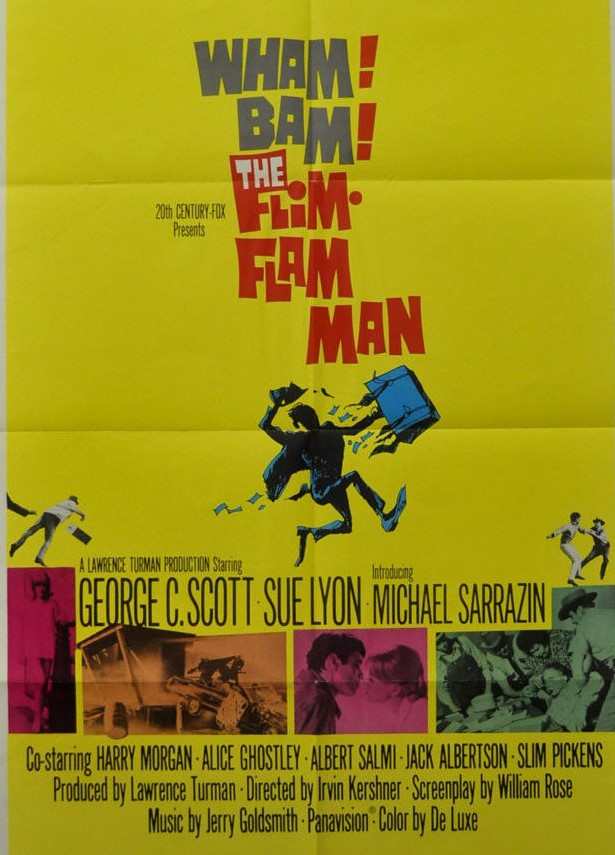
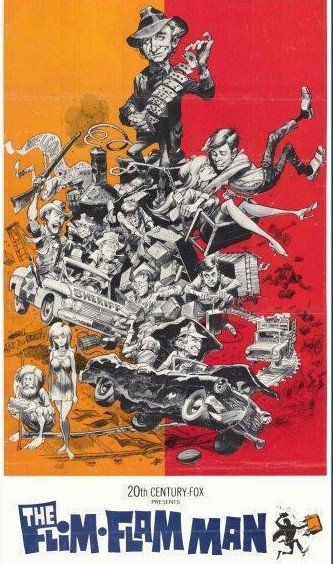
Throwback to It’s A Mad, Mad, Mad, Mad World (1963), prelude to Smokey and the Bandit (1977) and in the middle of the car chases and town wrecking a character study of a pair of grifters, one veteran, the other his pupil.
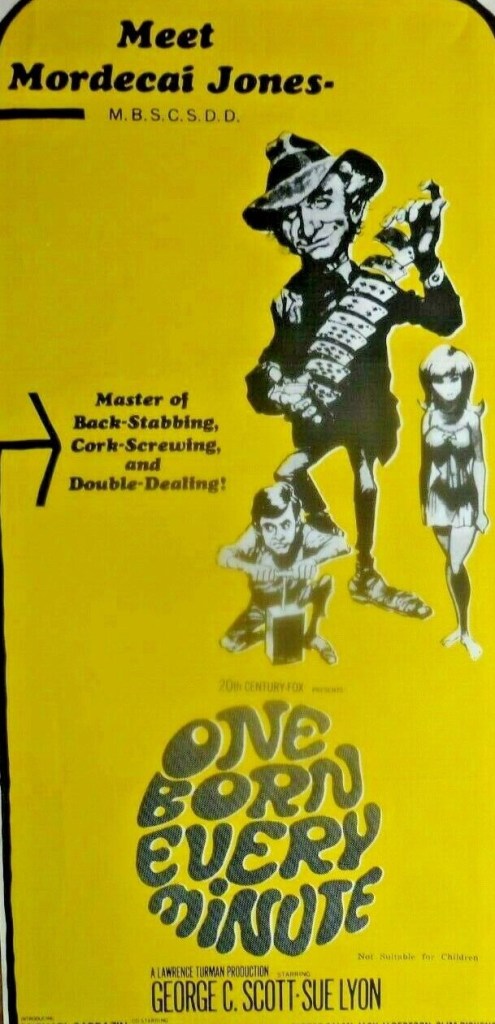
U.S. Army deserter Curley (Michael Sarrazin) teams up with veteran con man Mordecai (George C Scott) who teaches him the tricks of the trade. There’s nothing particularly innovative about the older man’s techniques – Find the Queen, The Lost Wallet, selling hooch as genuine whiskey – and the rewards are not particularly rewarding unless you are living at scavenger level in whatever run-down habitat you can find.
The dumb cops, Sheriff Slade (Harry Morgan) and Deputy Meshaw (Albert Salmi), aren’t quite so stupid otherwise they wouldn’t occasionally happen upon their quarry. And the larcenous duo offer nothing more clever by way of escape except to hijack vehicles.
So once you get past the aforementioned car chases and town wrecking it settles down into a gentle old-fashioned drama. Luckily all the good ol’ boy shenanigans are limited to the police, and neither main character is afflicted by over-emphatic accents.
Mordecai ain’t no Robin Hood nor a criminal mastermind who might have his eyes on a big- money heist. His ethos is stealing not so much from the gullible but the greedy. All his suckers think they can make an easy killing from a guy who appears a harmless old duffer.
He’s not looking for a big score because he’s got nobody to settle down with and because, although on a wanted list (as “The Flim-Flam Man” of local legend) he’s not going to exercise the authorities except cops with very little otherwise to do. He is as laid-back a drifter as they come.
Curley offers the drama. He starts to have qualms not so much about stealing from the greedy but about the repair bills for the cars they wrecked, especially one belonging to the young innocent Bonnie Lee (Sue Lyon), to whom he takes a fancy. While she reciprocates it’s only up to a point, having the good sense not to hook up with a criminal, so eventually he has to choose between giving himself up and serving time in the hope Bonnie Lee will hang around and severing his links with Mordecai, whom he treats as a father figure.
How he works that out is probably the best scene, especially given his temporary profession. Whether this is the first picture to feature so prominently incompetent cops rather than either the tough or corrupt kind I’m not sure but Slade and Meshaw take some beating.
In his first starring role, Michael Sarrazin (Eye of the Cat, 1969) is the cinematic catch. All the more so because director Irvin Kershner doesn’t take the easy route of focusing on his soulful eyes, permitting the actor to deliver a more rounded performance. He’s certainly more natural here than any future movie where he clearly relied far more on the aforementioned soulful eyes.
While I’m not sure the ageing make-up does much for him, George C. Scott (Petulia, 1968), in his first top-billed role, tones down the usual operatics and makes a convincing loner who can make one good romantic memory last a lifetime. He switches between completely relaxed to, on spotting a likely victim, sharp as a tack. The harmless old man guise falls away once he smells greed, replaced by cunning small-time ruthlessness.
Sue Lyon (Night of the Iguana, 1964) has little to do except not be the sex-pot of her usual screen incarnation and that’s to the good of the picture. By this stage of his career Harry Morgan was more likely to be found in television so it’s a treat to see him make the most of a meaty supporting part. Look out for Strother Martin (Cool Hand Luke, 1967) and Slim Pickens (Rough Night in Jericho, 1967).
Irvin Kershner (A Fine Madness, 1966) appears on firmer ground with the drama than the wild car chase/town wrecking but I suspect it takes more skills to pull off the latter than the former where the actors can help you out. Though I notice Yakima Canutt is down as second unit director so he might be due more of the credit. Screenwriter William Rose had already plundered the greed theme and, to that extent the car chase, for his seminal It’s A Mad, Mad, Mad, Mad World.
The outlandish elements, fun though they are, give this an uneven quality that gets in the way of a tidy little picture.


 The Magnificent 60s