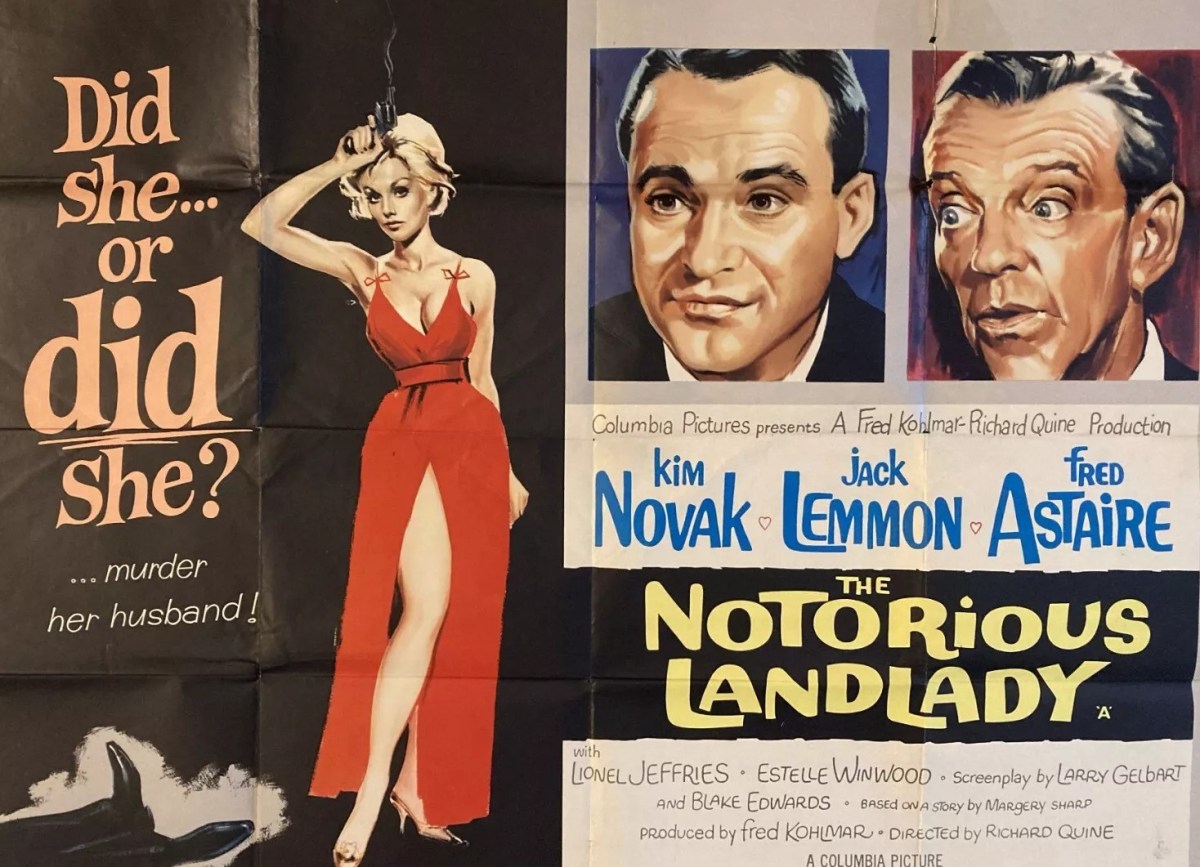
The Notorious Landlady (1962) **

Botched job. Not an all-out stinker. Something that should easily have worked – and didn’t. Thanks to the principals involved. Biggest finger of blame points at Jack Lemmon (How To Murder Your Wife, 1965), who jitters and jabbers, arms waving, eyeballs swivelling, classic example of over-mugging the pudding.

But Kim Novak (Strangers When We Meet, 1960) is as bad for the opposite reason. She’s completely insipid. Sure, she’s meant to be playing someone frightened out of her wits but she could as easily be worrying about how to lay the table for all the energy we get.
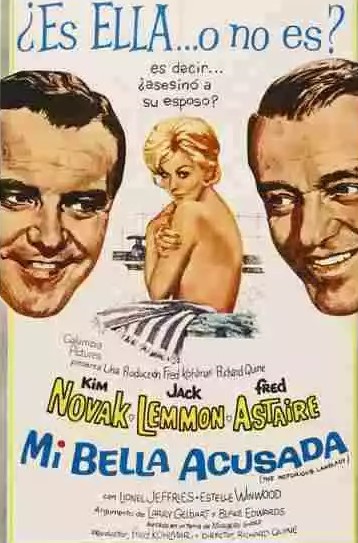
Director Richard Quine (Strangers When We Meet)  hardly gets off scot-free for allowing this to happen as well as quite bizarre shifts in tone from a fog-wreathed London straight out of Sherlock Holmes, to a denouement with Novak naked in the bath – Lemmon averts his eyes but the camera and hence the audience doesn’t – and a climax straight out of the Keystone Cops. I know Quine had a fling with Novak but it looks like he’s trying to share her physical charms with all and sundry, scarcely a scene goes by where’s she’s not in her underwear, night-time apparel, soaking wet one way or another or wearing revealing outfits. The “Notorious Cleavage” might have been a better title.

As I say, this should have worked. The story is straightforward enough, a mystery, red herrings aplenty, mysterious lurking figures, enough twists to give it edge.

Diplomat William Gridley (Jack Lemmon), newly arrived from the States, comes to view an apartment to rent in Mayfair only to find landlady Mrs Hardwicke (Kim Novak) most unwelcoming. Unfortunately for her, it’s love at first sight for him, so she can do no wrong. Which is unfortunate for him, for she is suspected of murdering her husband. That doesn’t sit well with Gridley’s boss Ambruster (Fred Astaire) who feels staff should be completely above board and not risk the good name of the U.S. by consorting with film noir style damsels.

Ambruster is already in cahoots with Inspector Oliphant (Lionel Jeffries) and it’s not long before Gridley is enrolled to act in an undercover capacity, sneaking into her bedroom, finding a gun in a drawer and overhearing suspicious phone calls all the while continuing to romance her. Meanwhile, he’s woken up in the middle of the night with her playing an organ. He’s such a clumsy clot he manages to set fire to a garage, which attracts front page headlines and puts his career in jeopardy.
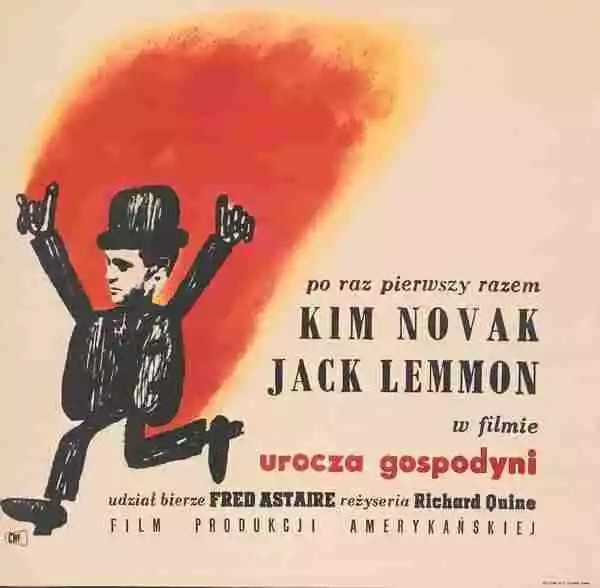
Anyway, various red herrings later and Ambruster somewhat mollified after falling for Hardwicke’s charms himself, we discover that her husband isn’t missing after all, but when he turns up, she shoots him dead and so ends up in court charged with his murder. His death, while convenient, is treated as accidental.

But the fun’s only just beginning. What could have been a shade close to film noir or the kind of romantic thriller Hitchcock turned out in his sleep, now takes a quite bizarre turn. It transpires that her husband, a thief, has hidden stolen jewels in a candelabra which, because she’s short of cash, she has sold to a pawnshop. This emerges in the aforementioned bathtub contretemps. But Hardwicke is being blackmailed by the witness whose evidence cleared her. Said witness has made off with the jewels and now plans to kill off the real witness. So they all end up at a retirement village in, where else, Penzance. Gridley has to save the real witness from being run off the edge of a cliff in a wheelchair while Hardwicke and the fake witness would have had a real old catfight if either of them could have managed to land a punch, instead of hitting the ground or falling backwards into bushes, so the entire climax suddenly takes a distinct comedic turn.

There’s not even a decent performance from Fred Astaire (The Midas Run, 1969) or Lionel Jeffries (First Men in the Moon, 1964) to lift proceedings. In fact, the best performance comes from villain Miles Hardwicke (Maxwell Reed) who rejoices in lines like, “ I like you better when you’re frightened.”   

Written by Larry Gelbart (The Wrong Box, 1966) and Blake Edwards (The Great Race, 1965), which would make you think comedy, and that this was a spoof in the wrong directorial hands, except that Edwards was responsible for Experiment in Terror / Grip of Fear (1962) so knew how to extract thrills.

Coulda been, shoulda been – wasn’t.

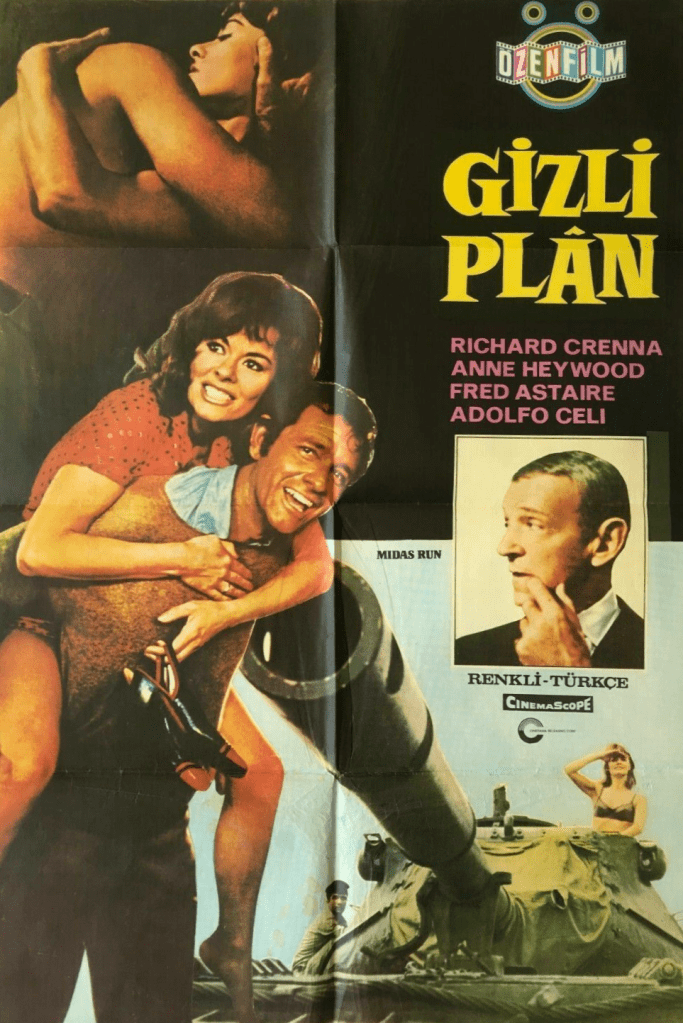
The Midas Run (1969) ***

You ever wonder what triggers criminality? Don’t deny an upper class English civil servant his knighthood, don’t fire an American university lecturer for an anti-war demonstration, don’t humiliate your beautiful wife by making her part of a business transaction. They might all feel robbery is the best revenge.

The highly respected Pedley (Fred Astaire) has talked his superiors in government into the notion that the best way to ship a consignment of gold is by passenger rather than commercial airplane. He recruits wannabe author Mike (Richard Crenna) who, in turn, comes to the rescue of glamorous Sylvia (Anne Heywood) when she is being sold off to sweeten a business deal.

The apparently eccentric casting was based on unfulfilled promise. Fred Astaire, who had not starred in a film for over decade, had made a comeback for Finian’s Rainbow (1968). But that had flopped, putting a dent in his marquee credentials and dramatic roles were hardly the forte of this twinkle-toed dancer. Richard Crenna’s bid for leading man status in Star! (1968) had spectacularly derailed at the box office.

Anne Heywood, the only one of the three principles to have a recent hit, in unexpected sleeper The Fox (1967), found no demand consequently for her services except from lover, future husband and biggest fan, producer Raymond Stross who had bankrolled the lesbian drama, and assigned her female lead here. You could extend your incredulity to the involvement of Swedish director Alf Kjellin,who hadn’t made a picture since Siska seven years before, and like most of his countrymen was seen as producing arthouse fare.

The biggest problem in a gold heist, as anyone watching the current television series The Gold will be aware, is shifting loot that weighs a ton. So Mike and Sylvia hire some Italian crooks to supply a couple of petrol tankers to hide and transport the bullion after the airplane has been forced down over Italian airspace by an Albanian fighter plane, Mike driving the World War Two tank that supplies the ground-based pressure.

As with any heist picture, robbery is only the beginning, double-cross the middle and triple-cross the end. Pedley, who has accompanied the shipment, is delegated by the British secret service to recover the gold, aided by suspicious assistant Wister (Roddy McDowall).  The twist here is that he not only recovers most of the gold, apart from some secreted away by the now romantically-inclined twosome, but points the finger at his accomplices, including the fence General Ferranti (Adolfo Celi).

It then becomes a question of whether the younger crooks can evade his clutches, whether Wister can confirm his suspicions that the investigation has proceeded a tad too conveniently, and discover what the heck the bowler-hatted Englishman is up to. And, of course, whether Mike can trust Sylvia. It wouldn’t be the first – or last (see Perfect Friday, 1970) – grand theft in which the male has been the dupe.

Along the way there is some clever comedy, a play on the British assumption that everyone in the world naturally speaks English, the implicit trust that the upper-classes place in each other, and the stock view that any Italian, law enforcer or crook, can be distracted by a pretty face or comely derriere.

On the downside, the set-up takes too long coming to fruition, especially a mid-movie  interlude that seems intend on channelling the worst romantic notions of the era, idyllic strolls in fields, that I half-expected a burst of slow-motion trotting, or some metaphor for the orgasm. There is some little understood banter about war games. And, for obvious reasons, La Heywood strips down to brassiere in the overheated tank (Mike manages to resist such un-English impulses) though she has previously indulged her innovative ideas about dress, turning a bedsheet into a fashionable toga at a moment’s notice.

There’s nothing particularly new here but Fred Astaire makes a deft impression as a typical upper-class Englishman, accent not found wanting, and successfully reinvents himself as a dramatic actor, that highpoint an Oscar nomination for The Towering Inferno (1974). Anne Heywood, once you realise she is playing all sides against each other, slips easily into the femme fatale role. Richard Crenna’s acting appears limited since his character, despite occasional initiative, is outwitted by all and sundry, and that was scarcely a good look in those days for the leading man to be out-thought by the leading woman.

Effortless, and harmless enough for a matinee.

Discover WordPress

A daily selection of the best content published on WordPress, collected for you by humans who love to read.

The Atavist Magazine

by Brian Hannan

WordPress.com News

The latest news on WordPress.com and the WordPress community.