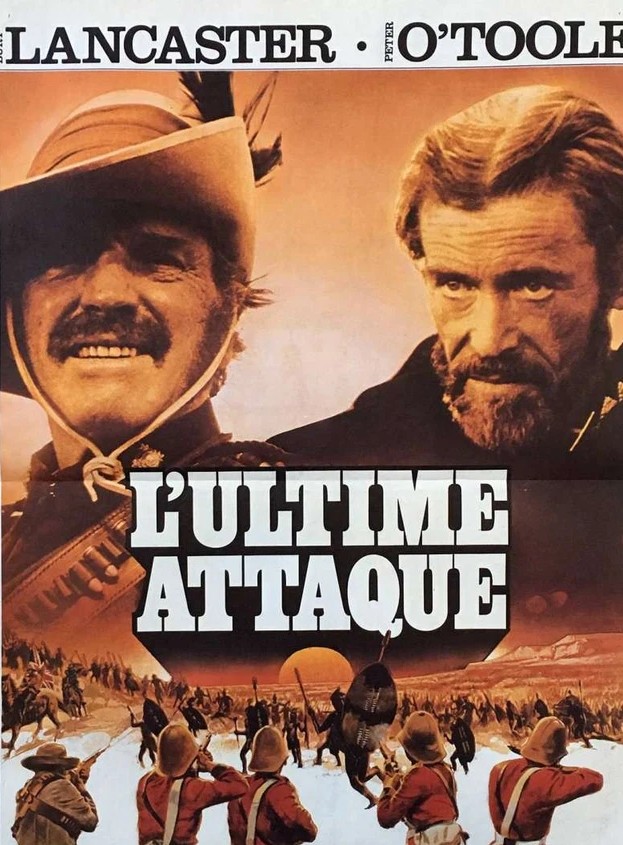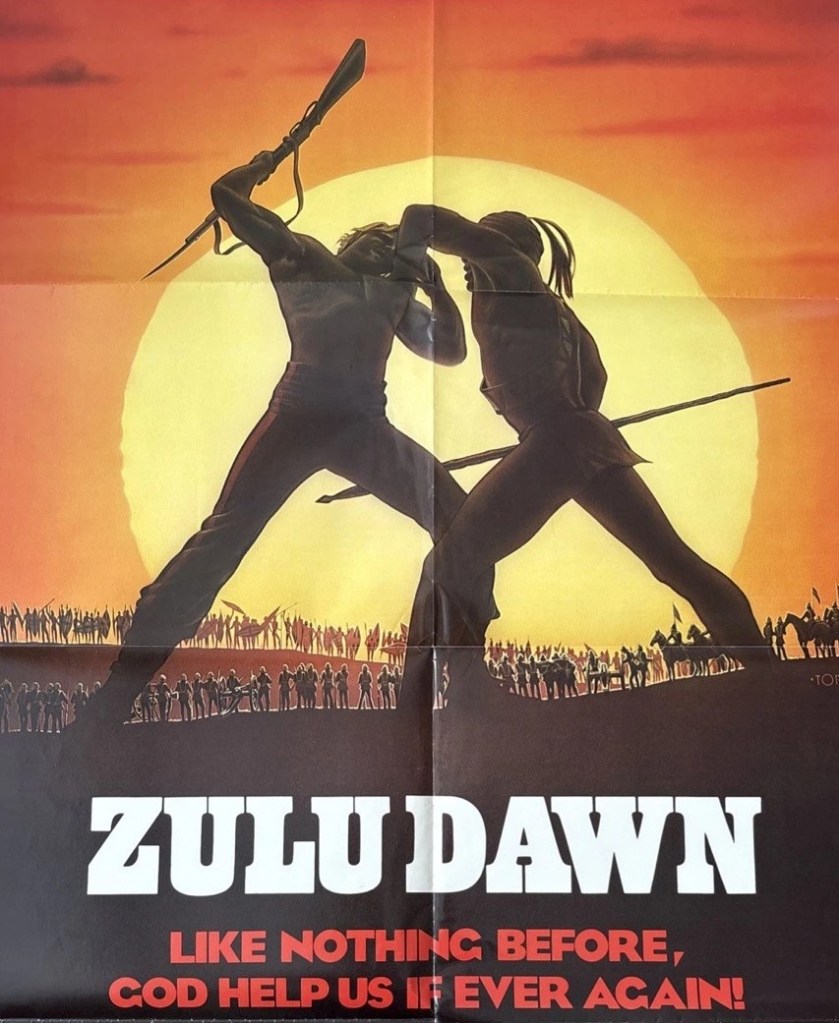
Holiday in Spain / Scent of Mystery (1960) **

There were five our great reasons to see this picture. Firstly, it was in Cinerama. Secondly, it was the first attempt in that special format to tell a dramatic story rather than offer just a travelog. Though How the West Was Won (1962) was promoted at the first dramatic use of Cinerama, that was actually untrue. This came first. Third, there was a terrific gimmick – Smell-O-Vision – which allowed audiences to inhale around 30 fragrances at the same time as the onscreen characters. Fourthly, it was produced by Mike Todd Jr., son of the Oscar-winning producer of Around the World in 80 Days (1956) and second husband of Elizabeth Taylor who was instrumental in bringing Cinerama to the big screen in the first place., Lastly, it was the first top-billed appearance of rising British star Denholm Elliott.

Unfortunately, none of these hit the target and it remains a novelty in the Cinerama canon. For a start, there wasn’t much of a story – it’s a chase tale of sorts with crime novelist Oliver (Denholm Elliott) uncovering a plan to kill American heiress Sally Kennedy. In setting out to thwart it he travels all over Spain in the company of philosophic wise-cracking taxi driver Smiley (Peter Lorre). Cue travelog of scenic Spain including fiestas, dances and the running of the bulls, which appears not to have been specially staged but filmed documentary-style as it occurred with the bulls inflicting considerable damage on the humans foolish enough to think it’s a lark.

The hook is the mystery woman who can only be detected by her Schiaparelli perfume while the giveaway for the villain, hired assassin Baron saradin (Paul Lukas), is his tobacco. Cue an onslaught of scents. But the smells don’t just pop up when characters are involved. When a barrel of wine smashes, that produces another smell.

Astonishingly, the movie manages to bring in some of the Cinerama trademarks – the runaway element seen from the audience POV, not just the traditional vehicle but also  barrels of wine.

The smell gimmick worked well enough in cinemas set up for such technical aspects, but that amounted to very few screens, and outside of those the movie just seemed a random series of scenes with only panoramic views of Spain to lessen the boredom.

It did nothing for the career of Denholm Elliott and he did little for the movie. He lacked the edge or innocence required to make such a character come alive and mostly he looks as though he doesn’t know what to do. He didn’t make another movie for three years and on his return for Station Six Sahara (1963) he was no longer the star but quickly shifting into the character actor he would be for the rest of his screen career.

It was nearly the last hurrah for Peter Lorre. He suffered heart attack during filming so the real Peter Lorre is only seen in half the picture, for the other half it’s a stand-in.

The presence of Elizabeth Taylor (Butterfield 8, 1960) could conceivably have redeemed the picture but she puts in only a fleeting appearance, so speedy her distinctive features barely register. You see more of Diana Dors (Baby Love, 1969).

In the hands of Alfred Hitchcock (Psycho, 1960) or imitators like Stanley Donen (Charade, 1963) and with a more finely worked screenplay, reliant on neither visual nor olfactory gimmick, this might have worked. But it was in hands of Jack Cardiff (The Girl on a Motorcycle, 1968), famed cinematographer but only his third outing as a director, and he clearly didn’t know how to balance the various ingredients and so it limps home.

The minute the location of the source novel by Audrey Kelley and William Roos shifted  from New York to Spain and the number of investigators halved, the trouble started. The hunt for a woman whose existence is in question was a standard mystery trope and might very well have worked here minus the smells and Cinerama.

A curiosity.

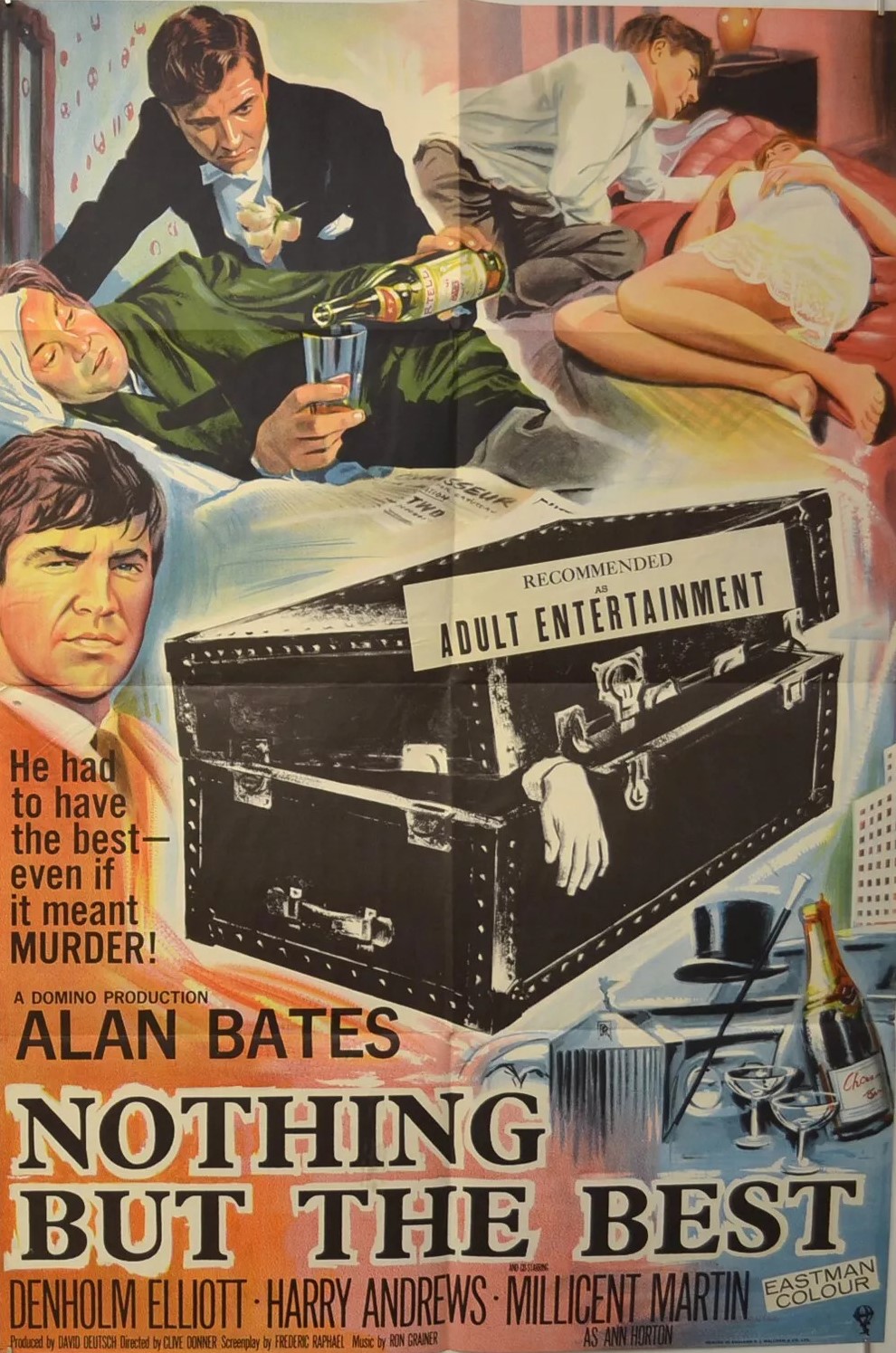
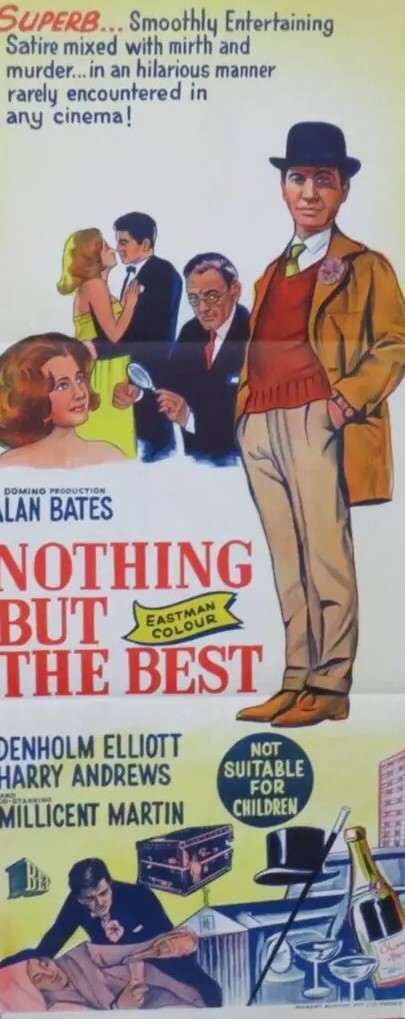
Nothing but the Best (1964) ***

Hardly surprising Denholm Elliott comes a cropper in this delicious British upper class black comedy – he steals the show from denoted star Alan Bates. Had he kept going any longer you would hardly have noticed Bates even featured, such was the clever impact of Elliott’s insiduous playing.

The toff version of Room at the Top (1958) meets Alfie (1966) as “ambitious young yob” Jimmy Brewster (Alan Bates) manipulates his way to the top. Too many people not coming up to scratch for his upwardly mobile purposes are cast aside – or strangled. Arrogance and bluff are the key to getting ahead in the upper-class world towards which he pivots. Doing absolutely nothing at all also works wonders in high society as does dismissing one’s hugely expensive education.

Jimmy is initially helped on his way, given an insider’s guide, by dissolute layabout toff Charles (Denholm Elliott) with a marked predilection for forgery, and other minor criminal schemes, but whose chief skill appears to be sponging off everyone else. Jimmy is a lowly executive in an upmarket estate agent, fighting for promotion against people with silver spoons rattling around every part of their anatomy and who have the genuine class their business appears to call for.

Every now and then the satire still contains contemporary bite, the difference between universities still relevant, as is that most people are not swayed by actual knowledge but by the fact that you can toss out the names of various academics. But, mostly, it’s bluff that opens the doors. Jimmy misses an appointment with an important banker, a dereliction that should have scuppered his chances of negotiating a better deal for his client. But, in fact, the banker takes this as Jimmy having gone elsewhere and immediately offers a better deal.

When confronted by a colleague for ignoring another appointment, Jimmy merely vaguely waffles on about being detained by “Sir Charles,” true identity left shrouded in mystery, contentious colleague silenced by either not being on speaking terms with the person mentioned or unwilling to admit his ignorance.

Having seduced every secretary within reach – none of whom meet his lofty standards – Jimmy manages to wangle his way into catching the eye of wealthy boss Horton (Harry Andrews) and his attractive daughter Ann (Millicent Martin), whom he marries.

While this would have been sharp as a tack in satirical terms back in the day, most of that weaponry is now out-dated. Suffers because none of the upper-class characters show any sense whatsoever – they can’t all be duffers and most seem to have tumbled out of central casting’s idea of an upper class twit. Charles is the exception, but even he is something of an innocent, not quite aware of what ruthlessness he has unwittingly set afire.

The lower classes aren’t much better. Secretaries and switchboard girls fall at Jimmy’s feet, handsome beggar that he is, though his landlady Mrs March (Pauline Delaney) appears to have his measure and is not above indulging in hypocrisy.

The voice-over works to the detriment of the picture. Because that device is doing so much of the heavy lifting, filling in the audience on Jimmy’s true feelings, the actor doesn’t have to do much acting and we’re presented with a kind of wooden figure who hides behind a mask. Of course since he’s masking his feelings, you might be inclined to give Alan Bates the benefit of the doubt.

And it would work very well if there wasn’t Denholm Elliott giving a master class in duplicity. He exhibits genuine charm.

I’m guessing that the voice-over was already there in Frederic Raphael’s script and not added to compensate for Alan Bates’s one-note performance. So if it was, that certainly presented a problem for the actor since most of what made his character interesting was at one remove, not presented in dialog or confrontation as would be the norm.

Alfie solved the problem by breaking the fourth wall – all the rage these days – and having the character directly address the audience, which allowed Michael Caine to present his own case.

So, if Alan Bates felt limited in what he could show on screen, he certainly does a good job of maintaining the façade. But Denholm Elliott (Station Six Sahara, 1963) steals the show. Harry Andrews (The Charge of the Light Brigade, 1968) is permitted no nuance to his normal bluff persona, singer Millicent Martin (Alfie, 1966) sparkles, and a bunch of British character actors including James Villiers (Some Girls Do, 1969) and Nigel Stock (The Lost Continent, 1968) put in an appearance.

Directed with some glee by Clive Donner (Alfred the Great, 1969) from a script by Frederic Raphael (Darling, 1965) adapted from a short story by Stanley Ellin (House of Cards, 1968).

Not as coruscating now as originally intended.

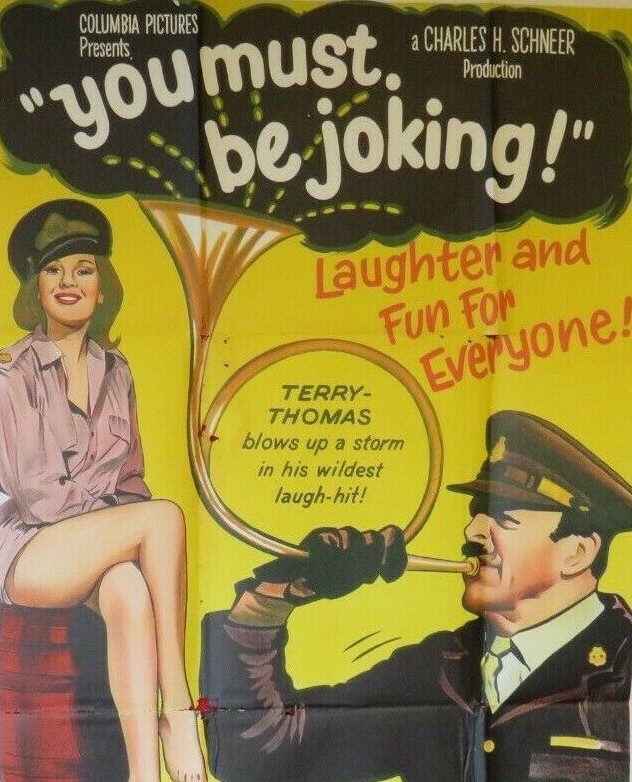
You Must Be Joking! (1965) ***

British thriller specialist Michael Winner (Death Wish, 1974) learned all about structure churning out low-budget comedies like this unusually contemporary number. A precursor of the reality television trope of a variety of characters in competition to complete a series of odd tasks, this has a military set-up, aiming to find, oddly enough in an organisation where strict hierarchy dominates, people capable of bending the rules. Initiative, in other words.

Some of the motley crew, of course, have no intention of bending any rules if they can get everyone else to do the work for them, namely upper-class Capt Tabasco (Denholm Elliott) who gets the game rolling by calling in a helicopter as a favor from an old school chum to rescue him from a maze, the first task. He spends most of the time pampered in a hotel suite while dispatching girlfriend Poppy (Tracy Reed) on various expeditions.

Saved by the double bill: Winner’s comedy found a bigger audience
by being booked as the support for hit “Cat Ballou.”

There’s a Yank involved, of course, to target the all-important American market, Lt Tim Morton (Michael Callan) also using assistance in the form of upmarket girlfriend Annabelle (Gabriella Licudi) whose specialty is causing vehicle pile-ups. We’ve got a whisky-drinking Scot, Sgt Major MacGregor (Lionel Jeffries), stiff upper back rather than stiff upper lip with his constant snapping to attention, and two graduates from the Army Hapless Division in Sgt Clegg (Bernard Cribbins) and Staff Sgt Mansfield (Lee Montague). Directing proceedings are Major Foskett (Terry-Thomas) and General Lockwood (Wilfred Hyde-White), at opposite ends of the character arc, the former frantic, the latter laid back.

A couple of the five tasks involve unravelling clues, finding a particular rose, for example, but the whole purpose of the exercise is to have the soldiers constantly getting in each other’s way, trying to outwit one another, falling into bizarre scenarios – a fox hunt the cleverest – and generally getting all muddled up one way or another, so that initiative is the last thing they display.

What the movie does have in abundance is imagination, otherwise how to explain the involvement of a seductive housewife, pop star, television show, tunnelling, Lloyd’s of London, Rolls Royce and a greyhound racetrack. On the other hand this might be a smaller-scale precursor to If It’s Tuesday, It Must Be Belgium (1969) in shovelling together all sorts of British institutions and tourist attractions. And certainly Capt Tabasco with his love of the finer things of life demonstrates just how much fun it can be to be British if you’re upper class, wealthy, went to the right school and are not above a bit of blackmail.

As you might expect, the pace is hectic, which is just as well, because if you stopped to think about what was going on you might well throw in the towel. That’s not to say it’s not enjoyable in a riotous sort of way, running jokes almost in a separate competition of their own, and if you always hankered to see Michael Callan’s dance moves this is for you – suffice to say he’s not in the Fred Astaire class. But everyone here is there to be made a fool of, except Capt Tabasco, who rises above it all in classy fashion and when he’s out for the count appears blessedly delighted.

Denholm Elliott (Station Six Sahara, 1963) comes off best, testing out his lazy scoundrel, but  the top-billed Michael Callan (The Interns, 1962) might never have signed up if he’d known the consequence was being relegated to television for seven years. However, given we are well accustomed to the shtick of the likes of Bernard Cribbins (The Railway Children, 1970), Lionel Jeffries (First Men in the Moon, 1964), Terry-Thomas (Bang! Bang! You’re Dead! 1966) and Wilfred Hyde-White (The Liquidator, 1965), he does at least have the advantage of standing out, if only as a novelty.

And just in case the goings-on don’t hold your attention, Winner has recruited a platoon of top British stars in bit parts including Leslie Phillips (Maroc 7, 1967) and James Robertson Justice (Guns of Darkness, 1962) and rising stars such as Tracy Reed (Hammerhead, 1968), Gabriella Licudi (The Liquidator) and Gwendolyn Watts (The Wrong Box, 1966) and future British television treasures Clive Dunn (Dad’s Army, 1968-1977), Richard Wattis (Copper’s End, 1971) and Peter Barkworth (Telford’s Change, 1979). So if you get fed up trying to work out what’s what you can play who’s who.

Alan Hackney (Sword of Sherwood Forest, 1960) wrote the screenplay based on a story by director Winner.

Not non-stop hilarity but definitely non-stop something with a good few chuckles thrown in.

Maroc 7 (1967) ***

With a string of Swinging Sixties fashion models providing the requisite bevy of beauties, a gang of thieves, a Moroccan heist, superb locations, great cast and a touch of archaeology with secret chambers and a long-lost relic thrown in, this splendid espionage frolic proves a welcome return to big screen top billing for Gene Barry after nearly a decade in television in Bat Masterson (1958-1961) and  Burke’s Law (1963-1966).

Something of a cat burglar himself, Simon Grant (Barry) infiltrates a gang which uses fashion as a cover and whose ingenious speciality is to steal famous heirlooms and replace them with fake ones in the assumption that on their departure from a foreign country the customs officers will not be able to tell the difference. Louise Henderson (Cyd Charisse) and Raymond Lowe (Leslie Phillips) head up the gang while Claudia (Else Martinelli) may or may not be in on the act.

Her dalliance with Simon suggests an inclination towards the right side of the law but the fact that she has been involved with the pair for so long sets up the intriguing notion that she is stringing the American agent along. Initially, she rejects Simon’s advances until told by Louise to comply and pump him for information leading to one of the movie’s best lines (and innuendo that a British audience in particular would adore). Says Simon: “We haven’t done much about pumping but maybe that will come later.”  Doubts also surround the intentions of Michelle Craig (Alexandra Stewart).  On their trail is Inspector Barrada (Denholm Elliott).

There is mystery aplenty and a fair quotient of punch-ups, romance, shoot-outs and murder while the unearthing of the hidden treasure is less heist amd more straightforward Indiana Jones. The fashion is the icing on the cake. The Moroccan fashion shoots are more than merely decorative, or an excuse to bare the charms of the gorgeous models. Instead, the shoots would not disgrace Vogue or any of the other glossy magazine temples to haute couture, with that Sixties focus on fabulous clothes, genuine location and outlandish hairstyles.

On top of that, several of the stars are either playing against type or out of their comfort zones. Legendary Hollywood dancer Cyd Charisse famed for such classic musicals as The Bandwagon (1953) and Silk Stockings (1957) sets such fluff aside to essay a criminal mastermind, whose cunning often gets the better of Simon. Leslie Phillips (Crooks Anonymous, 1962), better known as a charming Englishman with an eye for the ladies, is as ruthless a photographer as he is a criminal. Director Gerry O’Hara (The Pleasure Girls, 1965) has managed to get both Phillips and Denholm Elliott to drop their standard methods of delivery, usually embracing a drawl, making their characterisations a good bit more fresh than normal. Phillips was clearly intending to make some kind of career change since he was the producer.

Gene Barry makes a perfect entrance as an adventurer-spy, as confident in his seduction techniques without women falling at his feet like James Bond, with a nice line in self-deprecation and more than able to look after himself. Before being side-tracked by television, Barry had shown movie star potential in War of the Worlds (1953) and Thunder Road (1958) and now he delivers on that earlier promise. Elsa Martinelli (Hatari!, 1962) is the femme fatale who may or may not wish to play that role, keeping the audience completely on edge as to which side of the law she is likely to come down on. Added bonuses are Alexandra Stewart (Only When I Larf, 1968), Angela Douglas (Carry On Screaming!, 1966), Tracy Reed (Hammerhead, 1968), dancer Lionel Blair (A Hard Day’s Night, 1964) and Maggie London.

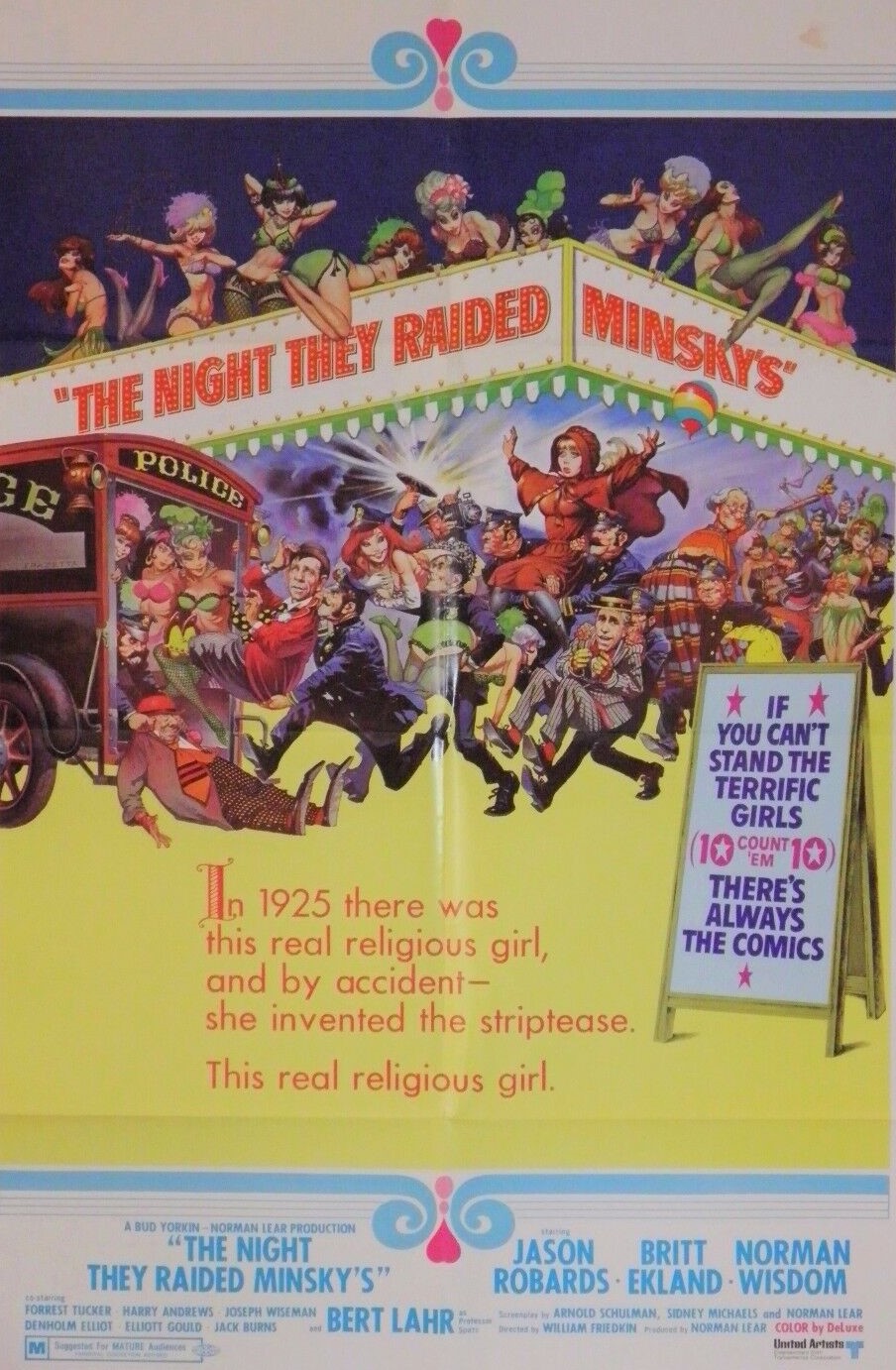
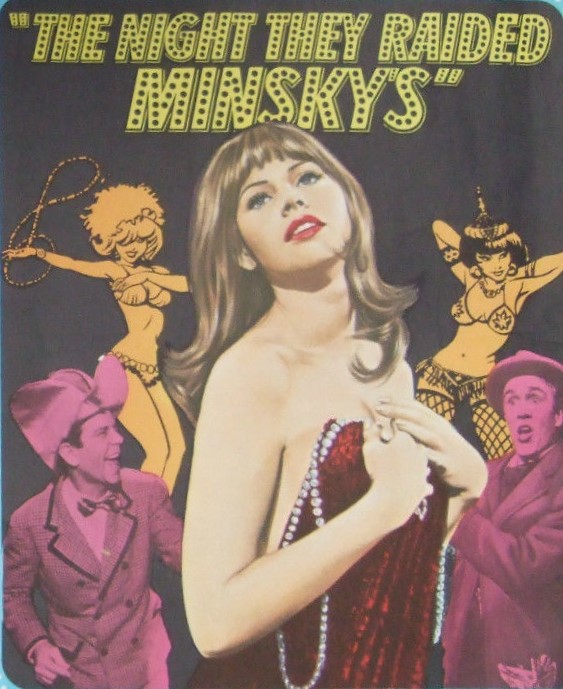
The Night They Raided Minsky’s (1968) **

This affectionate homage to 1920s vaudeville goes awfully astray under the heavy-handed direction of William Friedkin. Never mind the sexist approach, there’s an epidemic of over-acting apart from a delightful turn from Britt Ekland as the innocent star-struck Amish who accidentally invents striptease and former British music hall star Norman Wisdom who knows what he’s doing on the stage. The plot is minimal – burlesque theater manager (Elliott Gould) needs to save theater from going bust in a few days’ time. That’s it – honest!

The rest of the story looks tacked on – the overbearing leering other half (Jason Robards) of the Norman Wisdom double act tries to bed anything that moves, Amish father (Harry Andrews) in pursuit of his daughter, vice squad official (Denholm Elliott) determined to shut the theater down.

The saving grace of this debacle is Ekland’s performance which carries off a difficult part. Could anyone really be so dumb? She is endearing in a murky world but still capable of interpreting the Bible to her own ends (there is dance in the Good Book, for example) and she has confidence that the Lord will give her the go-ahead to have sex. Her innocence appears to transcend reality and since she doesn’t know a showbiz shark when she sees one she carries on as if life is just wonderful. Somehow this should never work but Ekland is so convincing that it does.

What might have been another saving grace is the documentary feel of much of the background, black-and-white pictures of the epoch transmuting into color, but too often the movie simply cuts to that without any real purpose. Equally, the various song-and-dance acts, chorus lines and comic turns provide an insight into burlesque reality but, again, all too often, that goes nowhere. There are plenty of people trying to be funny without much in the way of decent laughs. There’s altogether too much of everything else and not enough of the ingredients you might have considered essential.

This scarcely sounds like William Friedkin material given that although this preceded The French Connection and The Exorcist, by this point he had already made his mark with an adaptation of Harold Pinter play The Birthday Party (1968). In fact, his original cut was re-edited once he had departed the picture. Might it have worked better with Tony Curtis in the Jason Robards role as originally planned – he certainly had more charm than the jaundiced Robards. Regardless of who was cast what it needed most was a better story and less in the way of stock characters. And since in American theater folklore Minsky’s is synonymous with the invention of the striptease it meant that quite a few of the audience were there just to see how much skin would be revealed – which is not really the basis for a good mainstream picture.

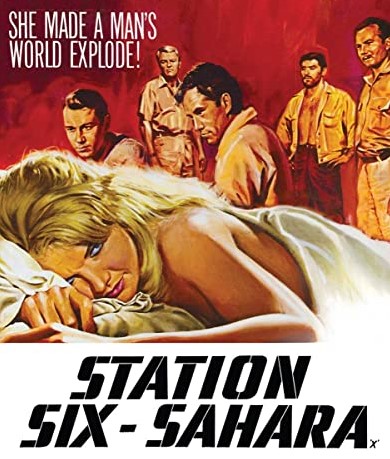
Station Six Sahara (1963) ***

David Lean spent months in Jordan capturing his vision of the desert for Lawrence of Arabia. Seth Holt was granted no such luxury, a few weeks at Shepperton Studios in England to make this British-German co-production.  

It is a surprisingly tight and effective drama made on a low budget excepting whatever fee induced Hollywood star Carroll Baker to join. Five men trapped on an oil pipeline maintenance unit drive each other to distraction. Loud Scot Ian Bannen constantly needles stiff upper-class Denholm Elliott while overbearing German boss Peter Van Eyck cheats at poker. The arrival of steely-eyed German Hansjorg Felmy alters the status quo as he refuses in his own quiet way to knuckle down to authority.

There is a wonderful psychological battle going on between Bannen and Elliott. Extremely envious of the number of letters Elliott receives, Bannen offers a month’s pay for just one. When the offer is accepted, Elliott cannot stop fretting about what he might have given away and what secrets it revealed about himself.

The arrival of Carroll Baker upsets the equilibrium further as the men attempt to win her affections. While apparently promiscuous, she is steelier than the lot of them, and tensions climb high when she begins to spread around her favors. Interestingly, she does no wooing but waits for men to come to her.

Given the budget restraints, or possibly because of them, it is surprisingly well directed. Two scenes stand out in directorial terms. In one featuring Bannen and Elliott, the Scot is only partly visible behind a piece of furniture but his dialogue continues even when out of sight. In the other, one of Baker’s suitors finds her door locked and as she is about to reply a hand appears (not in aggressive fashion) to cover her mouth, indicating she already has chosen her bedmate. Naturally, this can only lead to a grim end.

The cast of male unknowns are uniformly good but Baker steals the show as you would expect. Given the times, there was no nudity, but the overt sexuality certainly skirted the bounds of what passed as decency and Baker is alluring however little or much she wears. But her sexuality takes second place to her individuality. Her independence will not be surrendered to a man. Despite the budget restrictions it stands up very well.  

Discover WordPress

A daily selection of the best content published on WordPress, collected for you by humans who love to read.

The Atavist Magazine

by Brian Hannan

WordPress.com News

The latest news on WordPress.com and the WordPress community.