A Man for All Seasons (1966) ****

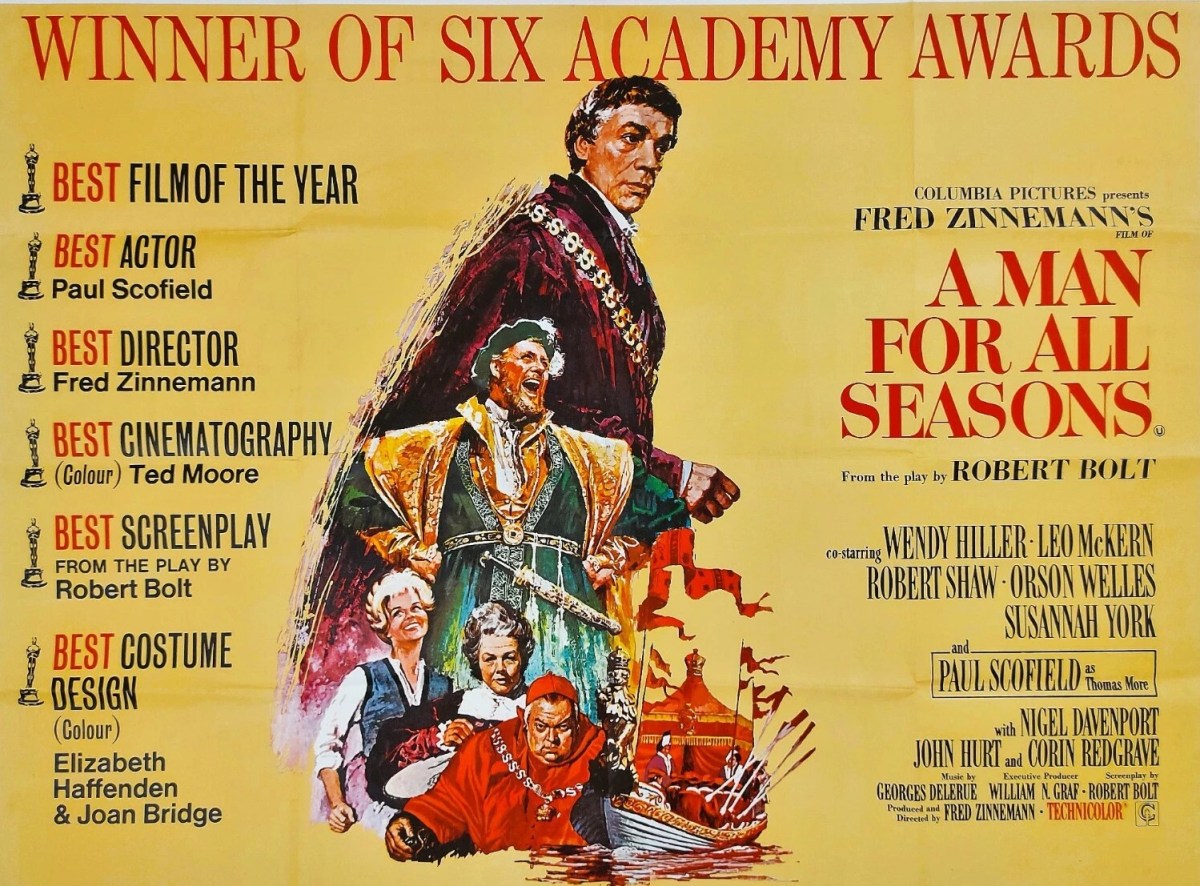
Columbia offset the gamble of turning an award-winning play with a stage star with no movie marquee luster, a co-star who had just about the same pulling power for audiences, and a host of actors nobody had ever heard of by cutting the budget to the bone – the $ 2million spent would barely be enough for a mid-level Hollywood production – even though director Fred Zinnemann belonged in the upper reaches of the Oscar hierarchy with one win and six nominations to his name.

You could even argue that the best-known person in the cast was female lead Susannah York (Sands of the Kalahari, 1965, The 7th Dawn, 1964) or the legendary Orson Welles or even screenwriter Robert Bolt, acclaimed for his work on Lawrence of Arabia (1962) and Doctor Zhivago (1965).
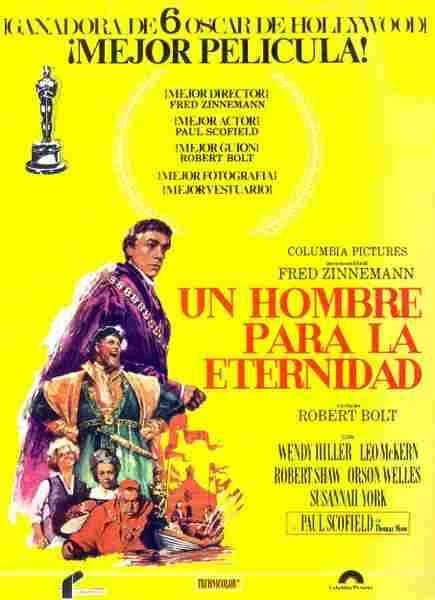
Movie audiences of the period would be hard put to even recognize male lead Paul Scofield, in only his second major screen role after The Train (1964), while Robert Shaw had little more popularity unless you were familiar with From Russia with Love (1963) in which he played a bad guy and Battle of the Bulge (1965). There was a fair chance that Scofield could hit the mark among the upscale stage audiences in London and New York, where he had won a Tony. The play, by Robert Bolt, had proved substantially more popular in terms of length of run and critical esteem in New York than London.

But Zinnemann hadn’t made a picture in six years, not since The Sundowners (1960), having become embroiled in two projects The Day Custer Died (never made) and Hawaii (made but without him) without anything to show for it.

This was a virtue-signaling picture long before the term became over-used. England’s Lord Chancellor Sir Thomas More (Paul Scofield) makes a principled stand against King Henry VIII (Robert Shaw). From today’s perspective, the principled stand is more complex. The idea that the ruler of a country would have to bend the knee to the leader of a religion would not sit well today. You might be unlikely to blame Henry VIII for wanting to break the rules, given he was in dire need of a male heir that his current wife could not supply, especially as without said heir the country would most likely fall into civil war.

You could make a case for Henry VIII being the heroic one, standing up to the Pope, who, for political reasons, as much as anything else, refused to annul the king’s existing marriage. When the Pope didn’t see it the king’s way, Henry VIII decided the only alternative was to break away from the Catholic Church and set himself up as the secular head of the church in England.
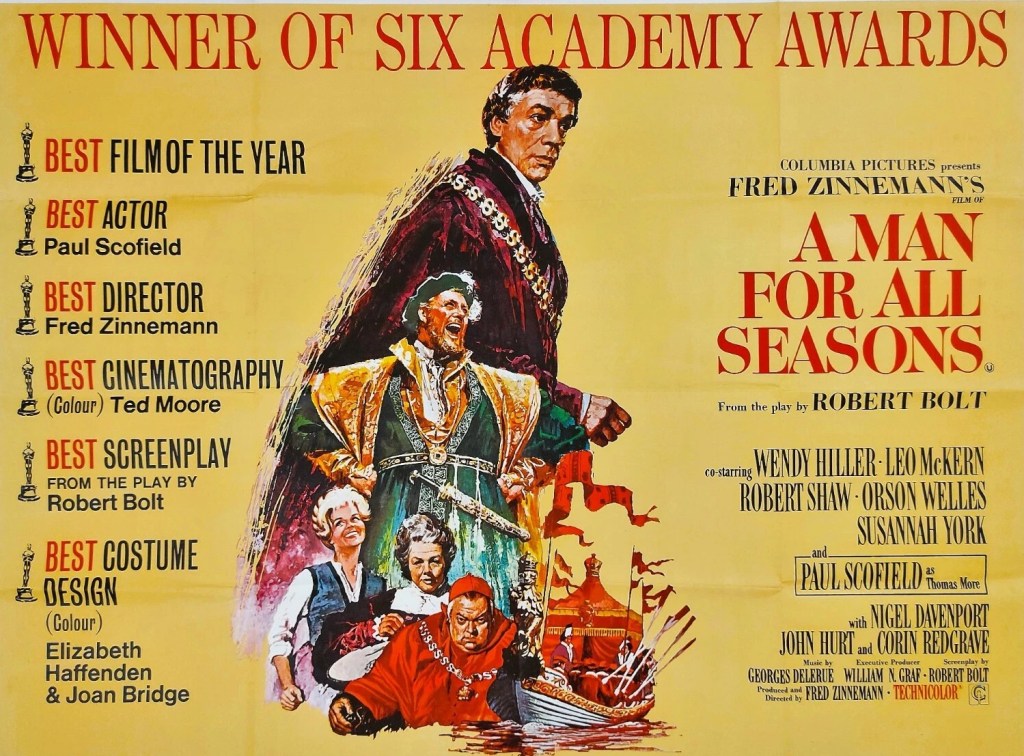
And although Thomas More has a fair following today for his philosophy – he wrote Utopia – Robert Bolt was guilty of leaving out aspects of his character which were more unsavory. He was a prime mover in the persecution of Protestants, condemned as “heretics,” but that’s been excised from the story told here in order to present Thomas More as a man of conscience.

Apart from the verbal duel between More and Henry VIII, there’s a rich backdrop of political machination bringing in such names as Thomas Cromwell (Leo McKern) – of Wolf Hall fame – Cardinal Wolsey (Orson Welles), the Duke of Norfolk (Nigel Davenport), William Roper (Corin Redgrave) and Richard Rich (John Hurt). There’s corruption, bribery and betrayal and at times it appears that More is the only one to place any significance on the law.   

But More’s no innocent, he’s well used to playing the political game and arguing his case. He only becomes undone by his stand against a king who will brook no opposition.

Paul Scofield has a fine time of it with a well-developed character, gently spoken, appealing to sense and sensibility, and generally well loved by the populace. Although in retrospect I think other Oscar nominees Richard Burton for Who’s Afraid of Virginia Woolf and Michael Caine for Alfie might have been more deserving of the Oscar gong.

Robert Shaw makes a fine opponent, tempering the monarch’s known bluster with a sense of humor.  While Paul Scofield tended to steer clear of Hollywood except for films like Scorpio (1973), Robert Shaw went immediately into the male lead in Custer of the West (1967) and eventually became a genuine draw.

The uncredited Vanessa Redgrave (Blow-Up, 1966) was otherwise the star-picker’s pick. Future years would invest greater luster in the supporting cast. John Hurt (Sinful Davey, 1969) the first to be given a tilt at marquee splendor. Leo McKern (Assignment K, 1968) achieved small-screen deification through Rumpole of the Bailey (TV series, 1978-1992). Colin Blakely (The Vengeance of She, 1968) played Dr Watson in Billy Wilder’s The Private Life of Sherlock Holmes (1970).

Robert Bolt deserved his Oscar for the considerable work he put in to converting his stage version for the screen. The staging looks quite stagey to me, but Zinnemann did an excellent job of adding the necessary richness and ensuring the tale was rounded-out.

Not sure I’d place it in the Top Fifty Best-Ever British Films, but it’s still enjoyable even though you might take issue with the issues presented.
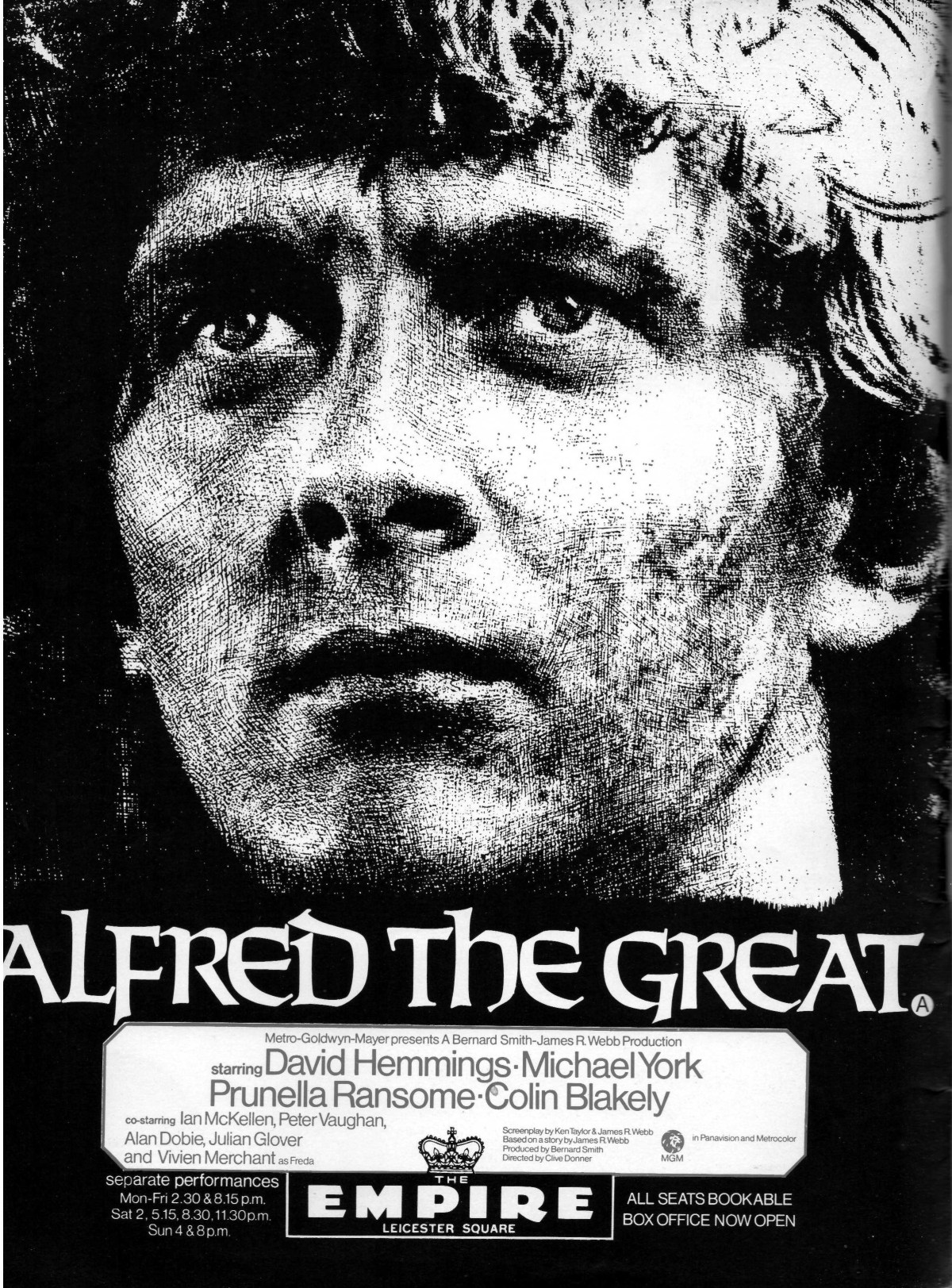
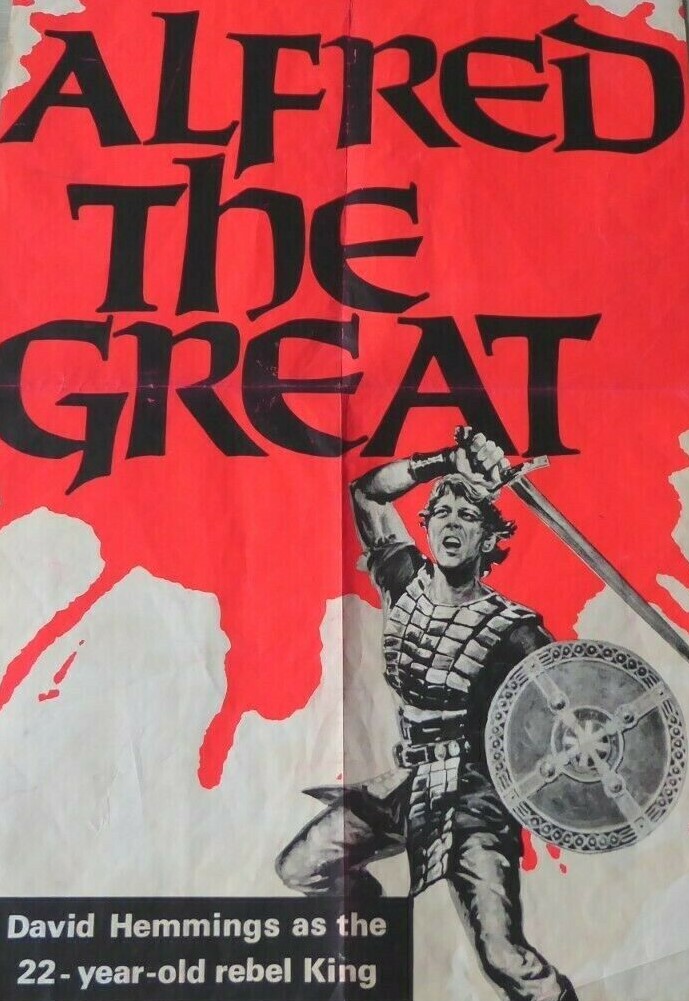
Alfred the Great (1969) ****

The Prince Who Wanted To Be A Priest. The King Who Didn’t Want To Fight. The Husband Who Raped His Wife.

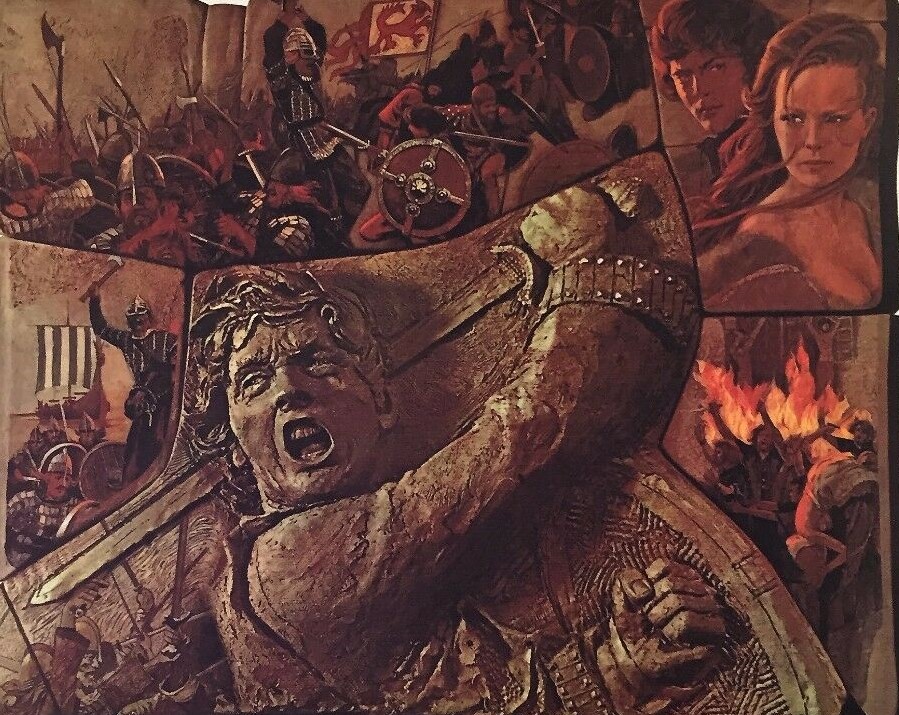
Not exactly taglines in the grand tradition of Gladiator (1999), but a succinct analysis of a Film That Wanted To Be A Roadshow. This is almost an anti-epic, a down-n-dirty historical movie far removed from El Cid (1961), Lawrence of Arabia (1962) and The Fall of the Roman Empire (1964). And one element that has to be taken into consideration when making a historical picture set in Britain in AD 871, if you are aiming for realism, is the rain. The battles in the three movies mentioned, as with virtually every historical movie of the decade, took place in bright sunshine on hard ground, not in the rain on mud-soaked fields. Director Clive Donner lacks the genius of an Akira Kurosawa who turned rain into a glorious image in Seven Samurai (1954) or even Ridley Scott whose first battle in Gladiator took place in a snowstorm. But he does make a battleground reflect the grim reality.

Alfred (David Hemmings) was fifth in line to the throne – and just to a small region of England called Wessex – and as was common practice all set, quite happily, for a career in the priesthood. So it was not surprising, envisioning religion as a mark of civilization, and the priesthood guaranteeing an education, that he was loathe to become a warrior just because his brother King Ethelred (Alan Dobie) was a useless leader. The price of taking on the warrior’s mantle and, after his brother’s death, of ascending to the throne is that Alfred must not only cast away his priestly ambition but his chastity in order to get married to unify rival kingdoms and produce an heir. So there’s a good deal of the religious quandary of El Cid and the sexual ambivalence of Lawrence of Arabia.

So repelled by what he is forced to do, that on his wedding night Alfred rapes new wife Aelhswith (Prunella Ransome) and when the marauding Vikings win a decisive battle and the price of peace is the wife taken in hostage Alfred offers no great protestation. So Alfred is hardly an appealing character. His wife hates him so much that she conceals her pregnancy from him. If you were an Englishman you might well prefer the straightforward lustful Viking leader Guthrun (Michael York) whose men are not restrained by Christianity – “it’s a strange religion,” he mulls, “ that wars with everything your flesh and your blood cries out for” – who makes a better fist of wooing Aelswith, whom he could as easily rape, than Alfred.  

Eventually, of course, Alfred gets it together, rallies a bunch of outlaws and steals back wife and son (now four years old). However, there is no romantic reunion. Instead, he plans to imprison her for life, “the whore shall rot in silence.” Nonetheless, Alfred has acquired some tactical skills, adopting the old Roman infantry tactic of forming his troops up in a phalanx behind a wall of shields. His battlefield address is to promise ordinary people a set of laws that will give them equality with the wealthy and powerful.

Given there are no castles and this is indeed the Dark Ages as far as costume and interior design is concerned and that therefore the camera cannot, for respite, be turned onto some glorious image, Clive Donner (Here We Go Round the Mulberry Bush, 1968) concentrates on character rather than scenery. There are a couple of inspired touches. For a start, in permitting various characters to offer prayers to God, he introduces a number of soliloquies which take us to the heart of troubled souls, and then he does a clever split-screen number to effect a transition. You can’t blame him for British weather and the battles are well-staged. He does show the courage of his convictions in making the film concentrate on conflicted character rather than going along the easier heroic route of underdog rallying people to a cause.

David Hemmings (Blow-Up, 1966) is both the film’s strength and weakness. He is excellent at capturing the torment, the soul divided, and the inherent arrogance as well as the preference for peace instead of war. But in terms of his leadership skills he is on a par with Orlando Bloom in Kingdom of Heaven (2005). That part was originally intended for Russell Crowe and Peter O’Toole was first choice for Alfred and you can’t help thinking both would have been a substantial improvement. On the other hand, Alfred was just 22 when he became king and for someone intent on the priesthood there would be no need for him to develop his physique or political skills. So this is a far cry from your typical Hollywood hero and in that regard the casting makes perfect sense and Hemmings a bold actor to take on such an unlikeable character.

Prunella Ransome (Man in the Wilderness, 1971) does well in her first leading role, suggesting both vulnerability and independence and while virtually imprisoned by both Alfred and Guthrun remaining principled. Michael York (Justine, 1969) was a definite rising star at this point and plays the Viking with considerably more gusto than his tendency towards passive characters would suggest.  

There’s virtually a legion of excellent supporting players in Colin Blakely (The Vengeance of She, 1968), Alan Dobie (The Comedy Man, 1964), Ian McKellen (Lords of the Rings and X-Men), Peter Vaughan (A Twist of Sand, 1968), Vivien Merchant (Accident, 1967),  Barry Evans (Here We Go Round the Mulberry Bush, 1968), Sinead Cusack (Hoffman, 1970), Christopher Timothy (All Creatures Great and Small, 1978-1990) and Robin Askwith (Confessions of a Window Cleaner, 1974).

Oscar-winner James R. Webb (How the West Was Won, 1963) was an improbable name to be attached to a British screenplay. But this was a pet project he had been trying to get made since 1964. Ken Taylor (Web of Evidence, 1959) was brought in to lend a hand.

Not being a student of English history but familiar with the ways of the movie business, I am sure the picture has many historical inaccuracies, but it does present one of the most complex individuals ever to feature in a historical film of the period, when audiences preferred their heroes more black-and-white. So it is a significant achievement in the canon.

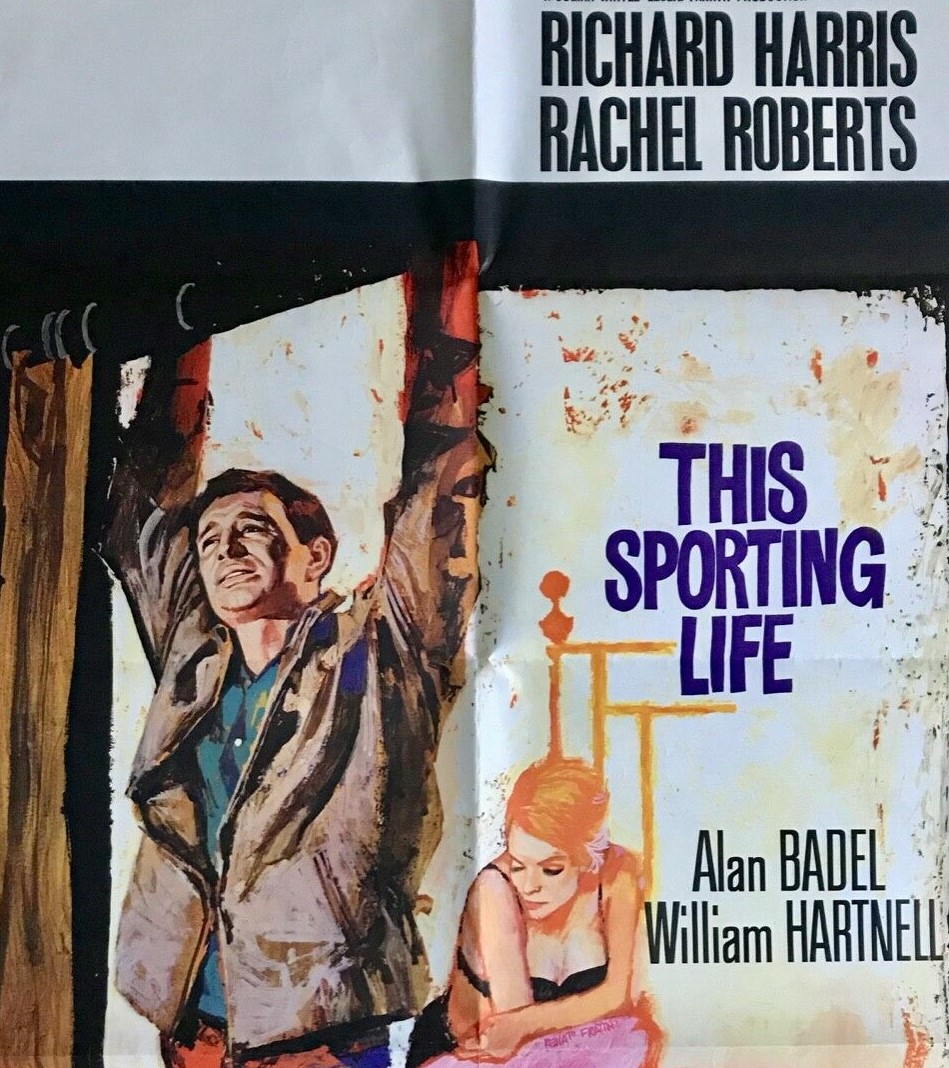
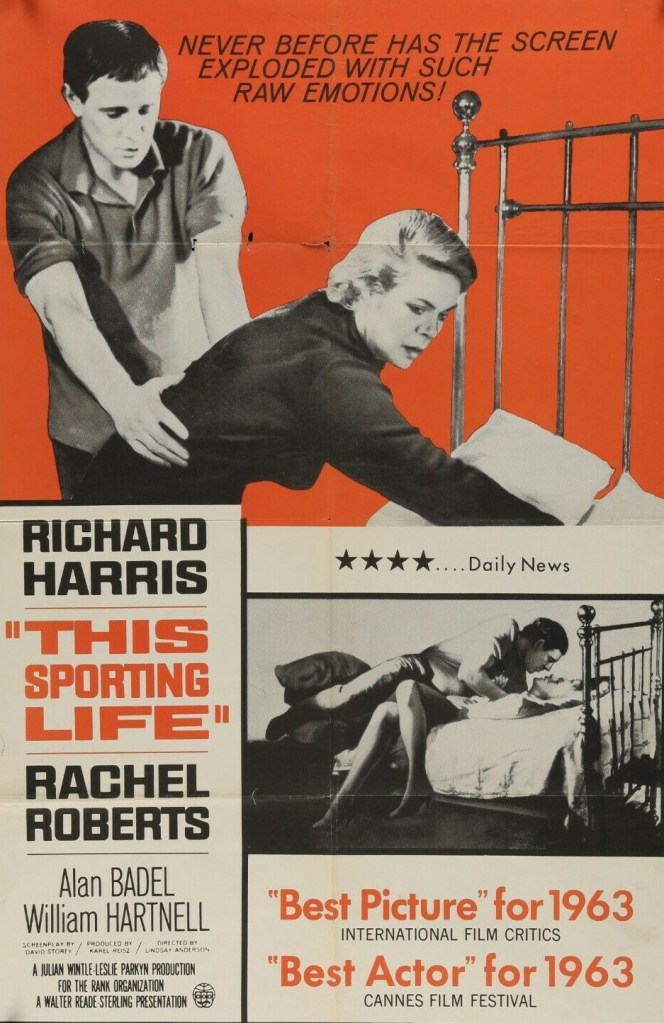
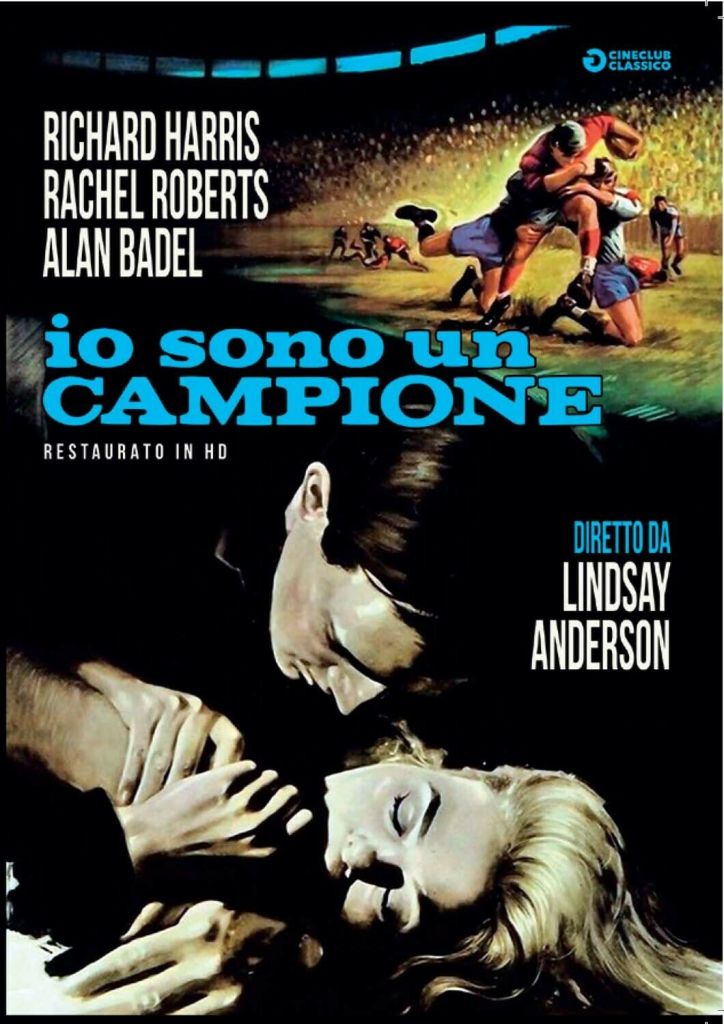
This Sporting Life (1963) ****

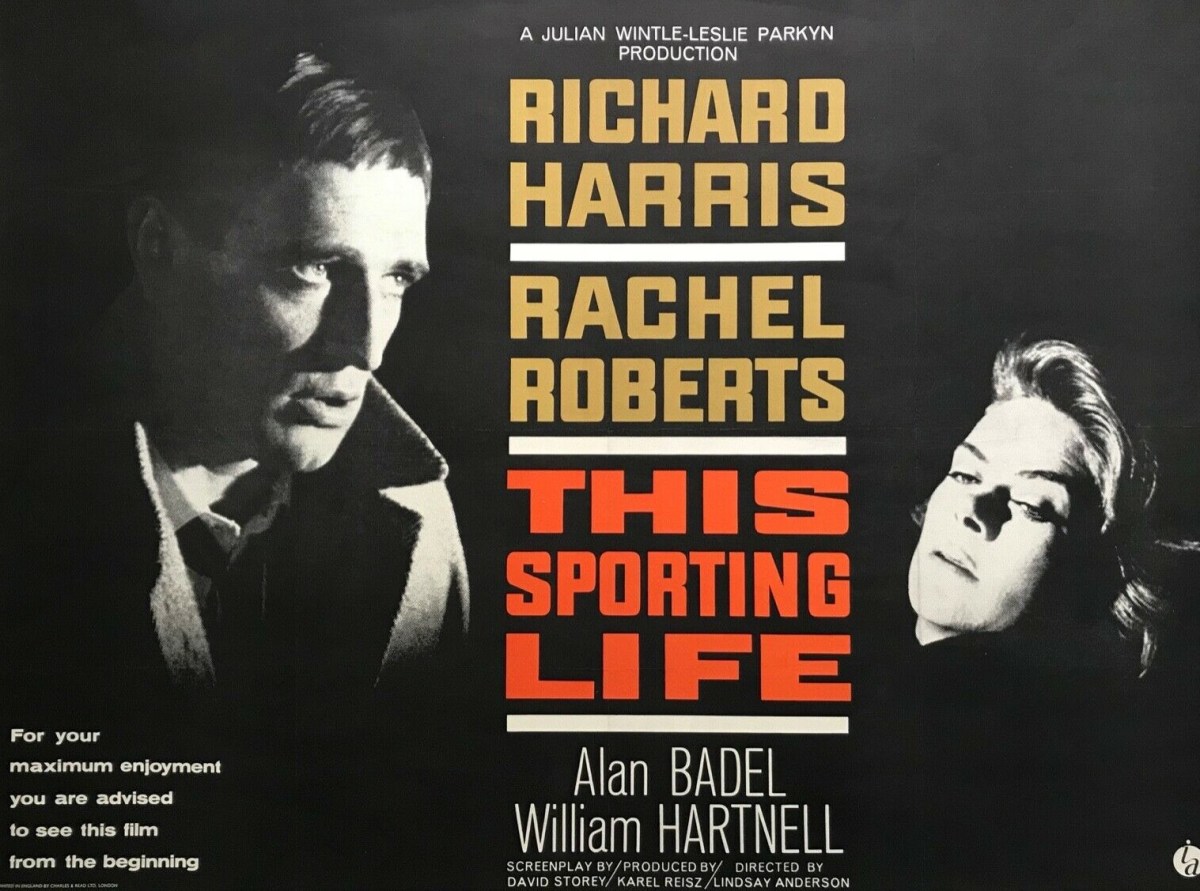
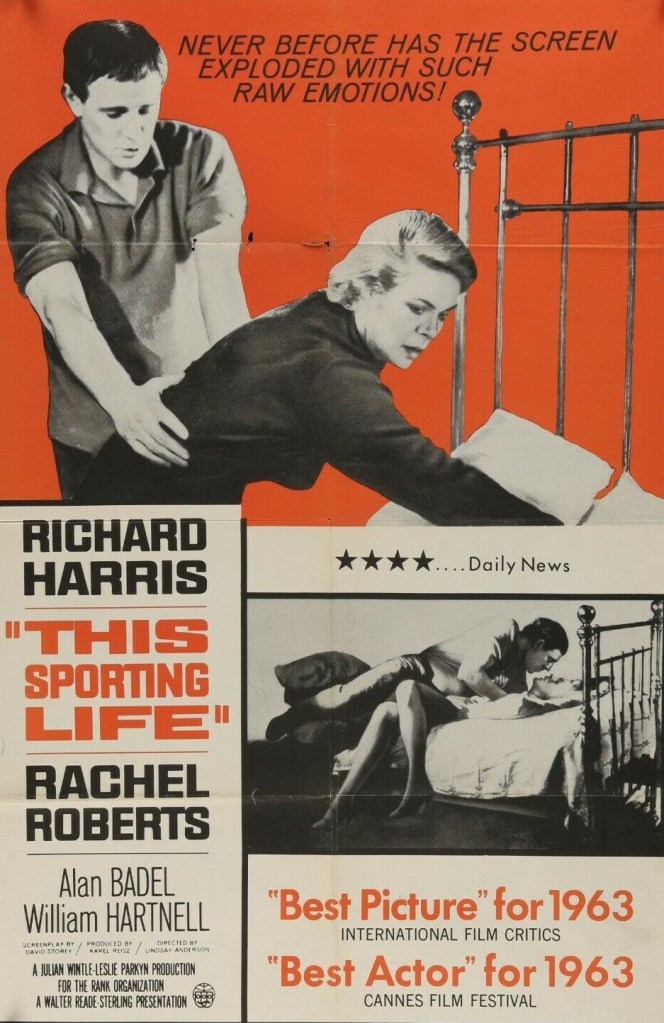
What began as the last gasp of the British New Wave working class kitchen sink drama has now after a six-decade gap resolved into a struggle over political and sexual ownership. Macho athlete Frank Machin (Richard Harris) jibes against his paymasters at a Yorkshire rugby league club – in similar fashion to Charlton Heston in Number One (1969) – while trying to hold sway over widowed landlady Margaret (Rachel Roberts). While documenting the class divide over which British writers and directors obsess, Lindsay Anderson’s debut takes a wry look at power.

Machin belongs to the Arthur Seaton (Saturday Night and Sunday Morning, 1960) class of loudmouth boors, determined to take as much as they can, riding roughshod over anyone who gets in their way, even attacking players of his own team. Although a fan favorite, his position at the club still requires backing from the moneyed directors, support that appears go awry when he rejects overtures from Mrs Weaver (Vanda Godsell), wife of a board director (Alan Badel). While Margaret eventually succumbs, her actions fill her with shame, the presents he buys making her feel like a kept woman.

Both Machin and Margaret are the rawest of creatures, forever appearing ready to topple into some emotional crevasse of their own making. At a time when marriage was the rock of society and women had little independence, a woman could dwindle away from the scorn of neighbors, while a man lacking emotional intelligence would crumble in the face of his own fears.

The non-linear narrative blurs some aspects of the story. There is no reference to Machin’s background save that he was once a miner and still works somewhere unspecified to supplement his footballer’s income. He rejects the paternalism of ageing scout Johnson (William Hartnell) while appearing to be seeking to resolve maternal issues, the widow with two small children at least a decade older, and although he could easily afford better accommodation refuses to move out.

His obsession with Margaret is never properly explained, except by her, who sees him as acting like an owner. Equally, Margaret is the opposite of the women in virtually every movie of the period, for whom marriage is the sole ambition. Whether she still grieves the loss of her factory worker husband, who may have committed suicide, or loathes Machin’s dominant nature is never explained. It might have been better if both had married for unhappy husbands and wives tend to give each other both barrels, emotions never concealed. Or she could be in the throes of an undiagnosed depression expressed as anger.

Machin is the other side of the British Dream – that anyone who escapes going down the pits or the mindless grind of the factory will automatically enjoy happiness. While Machin revels in his celebrity, he has no idea how to make his life happier. This is in contrast to the other footballers who either enjoy womanizing and drinking or are married or engaged and accept the unwritten rules of the game rather than fighting everyone.

There is plenty grime on show, and the football field has never been so pitiless, and as a social document it fits in well to the small sub-genre of films depicting working class life, but the picture’s thrust remains that of two opposites who will clearly never meet except in the delusional head of Machin.

Power is demonstrated in various ways. Weaver has the clout to give Machin a hefty signing-on fee against the wishes of the board, his wife takes her pick of the footballers to satisfy her sexual needs, Machin believes he is entitled to berate waiters in an upmarket restaurant, while Margaret is demeaned by accepting his present of a fur coat.

As ever with these films of the early 1960s there is a wealth of acting talent. Both Harris and Roberts were Oscar-nominated. Others making a splash in the cast were Alan Badel (Arabesque, 1966), Colin Blakely (The Vengeance of She, 1968), Jack Watson (The Hill, 1965), and if look closely you will spot double Oscar-winner Glenda Jackson (Women in Love, 1969). Future television stalwarts included William Hartnell (the first Doctor Who), Arthur Lowe (Dad’s Army, 1968-1977), Leonard Rossiter (Rising Damp, 1974-1978), Frank Windsor (Softly, Softly, 1966-1969) and George Sewell (Paul Temple, 1969-1971).

Lindsay Anderson (If… 1969) no doubt believed he was making an excoriating drama about the class struggle, but in fact has delivered a classic thwarted love story. David Storey wrote the screenplay based on his own novel.

The Vengeance of She (1968) ***

Sequels boomed in the 1960s mainly thanks to multiple spy spin-offs in the James Bond/Matt Helm/Derek Flint vein but for every From Russia with Love (1963) and In Like Flint (1967) there was a more tepid entry like Return of the Seven (1966). One of the prerequisites of the series business was that the original star reappeared. But Ursula Andress who played the title character in Hammer’s She (1966) declined to reprise the role.

John Richardson did return from the first picture but in a different role, as the immortal Killikrates within the lost city of Zuma. So Hammer brought in Andress lookalike statuesque Czech blonde Olinka Berova (The 25th Hour, 1967), even emulating the Swiss star’s famous entrance in Dr No (1962), although instead of coming out of the sea Berova is going in and substituting the bikini with bra and panties, but the effect is much the same.

Story, set in the 1960s, has supposed Scandinavian Carol (Berova) mysteriously drawn south against her will and driven by voices in her head conjuring up the name Ayesha. We first encounter her walking down a mountain road in high heels only to be chased through the woods by a truck driver. It transpires she had unusual powers, or someone protecting her has, for the lorry brake slips and the truck crushes the driver. Next means of transport is a yacht owned by dodgy drunken businessman George (Colin Blakely) and before you know it she is in Algeria, assisted by Kassim (Andre Morell) who attempts to forestall those trying to control her mind, but to no avail.

Philip (Edward Judd), whose character is effectively “handsome guy from the yacht,” follows as she continues south and eventually the pair reach Kuma, where she is acclaimed as Ayesha aka She. Kallikrates’ immortality depends on her with some urgency crossing through the cold flames of the sacred fire. There’s a sub-plot involving high priest Men-hari (Derek Godfrey) promised immortality for returning Ayesha to Kuma and further intrigue that comes a little too late to help proceedings. You can probably guess the rest.

There’s no “vengeance” that I can see and certainly no whip-cracking as suggested in the poster. Berova, while attractive enough, lacks the screen magnetism of Andress and the mystery of who Carol is and where she’s headed is no substitute for either pace or tension and Berova isn’t a good enough actress to convey the fear she must be experiencing. The script could have done without weighting down the Kuma high priests with lengthy exposition explaining the whys and wherefores. Neither a patch on the original nor the expected star-making turn for Berova, this is strictly Saturday afternoon matinee fare and the slinky actress, despite her best sex-kitten efforts, cannot compensate.

Director Cliff Owen (A Man Could Get Killed, 1966) assembles a strong supporting cast, headed by Edward Judd (First Men in the Moon,1964) and Colin Blakely (a future Dr Watson in Billy Wilder’s The Private Life of Sherlock Holmes, 1970). You can also spot Andre Morell (Dark of the Sun, 1968), George Sewell (who later enjoyed a long-running role in British television series Special Branch, 1969-1974) and television regular Jill Melford. 

Curious change of pace for writer Peter O’Donnell, best known at this point for creating another sultry heroine, Modesty Blaise (1966).

This Sporting Life (1963) ****

What began as the last gasp of the British New Wave working class kitchen sink drama has now after a six-decade gap resolved into a struggle over political and sexual ownership. Macho athlete Frank Machin (Richard Harris) jibes against his paymasters at a Yorkshire rugby league club – in similar fashion to Charlton Heston in Number One (1969) –  while trying to hold sway over widowed landlady Margaret (Rachel Roberts). While documenting the class divide over which British writers and directors obsess, Lindsay Anderson’s debut takes a wry look at power.

Machin belongs to the Arthur Seaton (Saturday Night and Sunday Morning) class of loudmouth boors, determined to take as much as they can, riding roughshod over anyone who gets in their way, even attacking players of his own team. Although a fan favorite, his position at the club still requires backing from the moneyed directors, support that appears go awry when he rejects overtures from Mrs Weaver (Vanda Godsell), wife of a board director (Alan Badel). While Margaret eventually succumbs, her actions fill her with shame, the presents he buys making her feel like a kept woman.

Both Machin and Margaret are the rawest of creatures, forever appearing ready to topple into some emotional crevasse of their own making. At a time when marriage was the rock of society and women had little independence, a woman could dwindle away in face of scorn from neighbours, while a man lacking emotional intelligence would crumble in the face of his own fears.

The non-linear narrative blurs some aspects of the story. There is no reference to Machin’s background save that he was once a miner and still works somewhere unspecified to supplement his footballer’s income. He rejects the paternalism of ageing scout Johnson (William Hartnell) while appears to be seeking to resolve maternal issues, the widow with two small children at least a decade older, and although he could easily afford better accommodation refuses to move out.

His obsession with Margaret is never properly explained, except by her, who sees him as acting like an owner. Equally, Margaret is the opposite of the women in virtually every movie of the period, for whom marriage is the sole ambition. Whether she still grieves over the loss of her factory worker husband, who may have committed suicide, or loathes Machin’s dominant nature is never explained. It might have been better if they had married for unhappy husbands and wives tend to give each other both barrels, emotions never concealed. Or she could be in the throes of an undiagnosed depression – author David Storey suffered from this all his life – expressed as anger.

Machin is the other side of the British Dream – the assumption that anyone who escapes going down the pits or the mindless grind of the factory will automatically enjoy happiness. While Machin revels in his celebrity, he has no idea how to make his life happier. This is in contrast to the other footballers who either enjoy womanizing and drinking or are married or engaged and accept the unwritten rules of the game rather than fighting everyone.

There is plenty grime on show, and the football field has never been so pitilessly portrayed, and as a social document the movie fits in well to the small sub-genre of films depicting working class life, but the picture’s thrust remains that of two opposites who will clearly never meet except in the delusional head of Machin.

Power is demonstrated in various ways. Weaver has the clout to give Machin a hefty signing-on fee against the wishes of the board, Weaver’s wife takes her pick of the footballers to satisfy her sexual needs, Machin believes he is entitled to berate waiters in an upmarket restaurant, while Margaret is demeaned by accepting his present of a fur coat.

As ever with these films of the early 1960s there is a wealth of acting talent. Both Harris and Roberts were Oscar-nominated. Others making a splash in the cast were Alan Badel (Arabesque, 1966), Colin Blakely (The Vengeance of She, 1968), Jack Watson (The Hill, 1965), and if look closely you will spot double Oscar-winner Glenda Jackson (Women in Love, 1969). Future television stalwarts included William Hartnell (the first Doctor Who), Arthur Lowe (Dad’s Army, 1968-1977), Leonard Rossiter (Rising Damp, 1974-1978), Frank Windsor (Softly, Softly, 1966-1969) and George Sewell (Paul Temple, 1969-1971).

Lindsay Anderson (If… 1969) no doubt believed he was making an excoriating drama about the class struggle, but in fact has delivered a classic thwarted love story. David Storey wrote the screenplay based on his own novel.

The Vengeance of She (1968) ***

Sequels boomed in the 1960s mainly thanks to multiple spy spin-offs in the James Bond/Matt Helm/Derek Flint vein but for every From Russia with Love (1963) and In Like Flint (1967) there was a more tepid entry like Return of the Seven (1966). One of the prerequisites of the series business was that the original star reappeared. But Ursula Andress who played the title character in Hammer’s She (1966) declined to reprise the role.

John Richardson did return from the first picture but in a different role, as the immortal Killikrates within the lost city of Zuma. So Hammer brought in Andress lookalike statuesque Czech blonde Olinka Berova (The 25th Hour, 1967), even emulating the Swiss star’s famous entrance in Dr No (1962), although instead of coming out of the sea Berova is going in and substituting the bikini with bra and panties, but the effect is much the same.

Story, set in the 1960s, has supposed Scandinavian Carol (Berova) mysteriously drawn south against her will driven by voices in her head conjuring up the name Ayesha. We first encounter her walking down a mountain road in high heels only to be chased through the woods by a truck driver. It transpires she has unusual powers, or someone protecting her has, for the lorry brake slips and the truck crushes the driver. Next means of transport is a yacht owned by dodgy drunken businessman George (Colin Blakely) and before you know it she is in Algeria, assisted by Kassim (Andre Morrell) who attempts to forestall those trying to control her mind, but to no avail.

Philip (Edward Judd), whose character is effectively “handsome guy from the yacht,” follows as she continues south and eventually the pair reach Kuma, where she is acclaimed as Ayesha aka She. Kallikrates’ immortality depends upon her with some urgency crossing through the cold flames of the sacred fire. There’s a sub-plot involving high priest Men-hari (Derek Godfrey) promised immortality for returning Ayesha to Kuma and further intrigue that comes a little too late to help proceedings. You can probably guess the rest.

There’s no “vengeance” that I can see and certainly no whip-cracking as suggested in the poster. Berova, while attractive enough, lacks the screen magnetism of Andress and the mystery of who Carol is and where she’s headed is no substitute for either pace or tension and Berova isn’t a good enough actress to convey the fear she must be experiencing. The  script could have done without weighting down the Kuma high priests with lengthy exposition explaining the whys and wherefores. Neither a patch on the original nor the expected star-making turn for Berova, this is strictly Saturday afternoon matinee fare and the slinky actress, despite her best sex-kitten efforts, cannot compensate.

Director Cliff Owen (A Man Could Get Killed, 1966) assembles a strong supporting cast, headed by Edward Judd (First Men in the Moon,1964) and Colin Blakely (a future Dr Watson in Billy Wilder’s The Private Life of Sherlock Holmes, 1970). You can also spot Andre Morrell (Dark of the Sun, 1968),  George Sewell (who later enjoyed a long-running role in British television series Special Branch, 1969-1974) and television regular Jill Melford.  

Discover WordPress

A daily selection of the best content published on WordPress, collected for you by humans who love to read.

The Atavist Magazine

by Brian Hannan

WordPress.com News

The latest news on WordPress.com and the WordPress community.