A Prize of Arms (1962) ****

Will easily hook a contemporary audience. Especially stylish in its narrative choices and visually carries a punch. Slips cleverly between the two standard tropes of the heist picture – the theft where we know in advance what the target is, e.g. Topkapi (1964) and the one where we’re kept in the dark about what exactly is going on for some time e.g Dead Heat on a Merry-Go-Round (1966). Here, director Cliff Owen teases audiences from the start. The sizzling opening sequence involving two explosions and a flame-thrower aren’t rehearsals for the heist but a dry run for the escape.

All we know for about half the picture is that Turpin (Stanley Baker), a former Captain bearing a grudge against the Army, wartime Polish buddy Swavek (Helmut Schmid) and young gun Fenner (Tom Bell) who’s too fond of the booze, are, courtesy of the opening sequence, up to no good. Once they don Army uniforms, but without any relevant papers, on the eve of the British invasion of Suez in 1956, it’s clear that for some reason an Army barracks is their target.
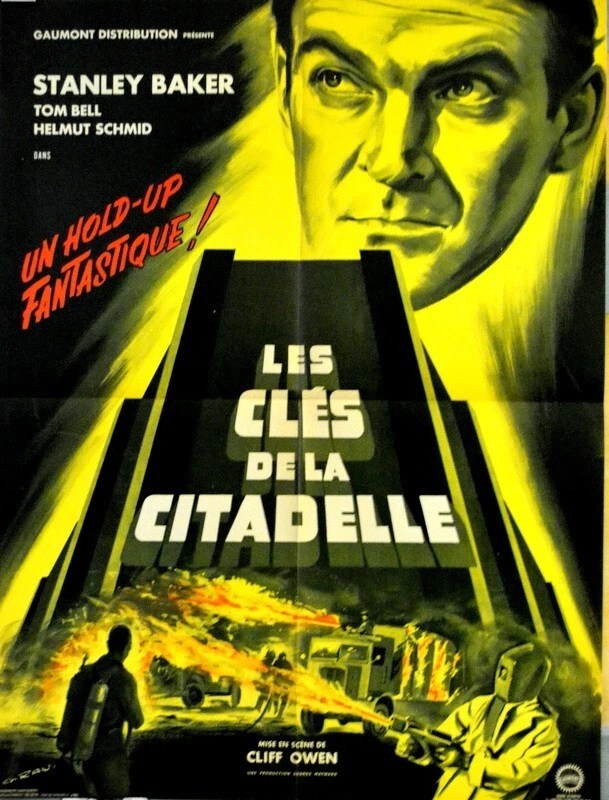
Bureaucracy both works in their favor and against them. A guard at the gate is easily duped into thinking that office error accounts for the lack of paperwork as they drive an Army truck into the establishment. But then bureaucracy hampers their efforts. For standing around too idly, Fenner is forced into a spot of pot-washing. When Turpin fakes an illness, he’s commandeered by a male nurse who refuses to let him leave until he’s been examined. Attempts to steal a stretcher, essential it transpires to their plan, are thwarted.

Turpin is forced to constantly revise his plans in the face of unexpected adversity and the realization that Fenner is something of a liability. Integrating themselves into the Army base is not as easy as it might appear because everyone has designated duties and people without purpose stand out.

Turns out, pretending to be Military Police, they’re planning to make off with a £100,000 payroll (£2.1 million in today’s money). Their plan, once it kicks in, is exceptionally clever and works well.

The stretcher element, however, causes a problem and soon both Army personnel and cops are on their tail. But they’re one step ahead. Even when they appear to be cornered, don’t forget they’ve got that flame-thrower tucked away for emergencies.
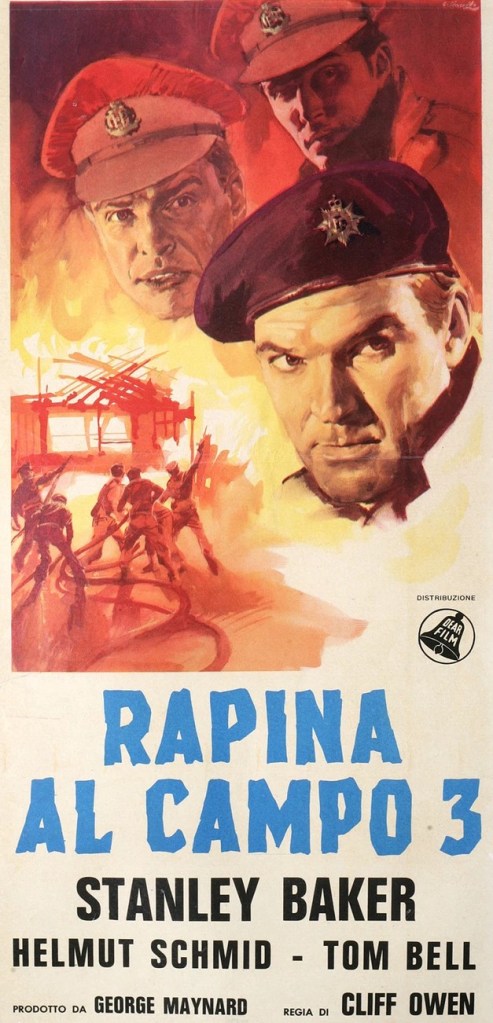
The heist itself, while a clever enough ruse and crackling with suspense, is only the bridge between the tension-filled sections before and after, the build-up and the chase. Part of the fun is that what can go wrong comes from the most unexpected sources.

Although Stanley Baker had headlined a few movies this was a breakthrough in screen persona, the tough guy cool under pressure with a meticulous understand of detail that would be shown to better effect in the likes of Zulu (1964). He’d return to the scene of crime in Robbery (1967) and Perfect Friday (1970). Tom Bell (Lock up Your Daughters, 1969) impresses as the nervy unreliable sidekick, and while German actor Helmud Schid (The Salzburg Connection, 1972) has less to do.

You certainly won’t miss Patrick Magee (Zulu) as a terrifying sergeant-major but you’ll need to be quick to spot the debuts of Rodney Bewes (The Likely Lads TV series, 1964-1966) and character actor Glynn Edwards (Zulu). And you might think it worth mentioning that future director Nicolas Roeg (Don’t Look Now, 1973) had a hand in the screenplay credited to Paul Ryder (A Matter of Choice, 1963)

This is a no-frills exercise, with romance and sex excised so no sub-plot to get in the way. Cliff Owen (The Vengeance of She, 1968) sticks to the knitting.

Crisply told.  

The Vengeance of She (1968) ***

Sequels boomed in the 1960s mainly thanks to multiple spy spin-offs in the James Bond/Matt Helm/Derek Flint vein but for every From Russia with Love (1963) and In Like Flint (1967) there was a more tepid entry like Return of the Seven (1966). One of the prerequisites of the series business was that the original star reappeared. But Ursula Andress who played the title character in Hammer’s She (1966) declined to reprise the role.

John Richardson did return from the first picture but in a different role, as the immortal Killikrates within the lost city of Zuma. So Hammer brought in Andress lookalike statuesque Czech blonde Olinka Berova (The 25th Hour, 1967), even emulating the Swiss star’s famous entrance in Dr No (1962), although instead of coming out of the sea Berova is going in and substituting the bikini with bra and panties, but the effect is much the same.

Story, set in the 1960s, has supposed Scandinavian Carol (Berova) mysteriously drawn south against her will and driven by voices in her head conjuring up the name Ayesha. We first encounter her walking down a mountain road in high heels only to be chased through the woods by a truck driver. It transpires she had unusual powers, or someone protecting her has, for the lorry brake slips and the truck crushes the driver. Next means of transport is a yacht owned by dodgy drunken businessman George (Colin Blakely) and before you know it she is in Algeria, assisted by Kassim (Andre Morell) who attempts to forestall those trying to control her mind, but to no avail.

Philip (Edward Judd), whose character is effectively “handsome guy from the yacht,” follows as she continues south and eventually the pair reach Kuma, where she is acclaimed as Ayesha aka She. Kallikrates’ immortality depends on her with some urgency crossing through the cold flames of the sacred fire. There’s a sub-plot involving high priest Men-hari (Derek Godfrey) promised immortality for returning Ayesha to Kuma and further intrigue that comes a little too late to help proceedings. You can probably guess the rest.

There’s no “vengeance” that I can see and certainly no whip-cracking as suggested in the poster. Berova, while attractive enough, lacks the screen magnetism of Andress and the mystery of who Carol is and where she’s headed is no substitute for either pace or tension and Berova isn’t a good enough actress to convey the fear she must be experiencing. The script could have done without weighting down the Kuma high priests with lengthy exposition explaining the whys and wherefores. Neither a patch on the original nor the expected star-making turn for Berova, this is strictly Saturday afternoon matinee fare and the slinky actress, despite her best sex-kitten efforts, cannot compensate.

Director Cliff Owen (A Man Could Get Killed, 1966) assembles a strong supporting cast, headed by Edward Judd (First Men in the Moon,1964) and Colin Blakely (a future Dr Watson in Billy Wilder’s The Private Life of Sherlock Holmes, 1970). You can also spot Andre Morell (Dark of the Sun, 1968), George Sewell (who later enjoyed a long-running role in British television series Special Branch, 1969-1974) and television regular Jill Melford. 

Curious change of pace for writer Peter O’Donnell, best known at this point for creating another sultry heroine, Modesty Blaise (1966).

A Man Could Get Killed (1966) ****

An unexpected delight. More farce than spoof and more Hitchcockian thriller than espionage adventure, but bursting with laughs. Spinning on the premise of mistaken identity, a New York banker becomes mixed up with diamond smugglers while being pursued by a posse of Europe’s shadiest characters and a very determined femme fatale. All the more enjoyable because identity confusion is very difficult to pull off unless you have a top class cast like Cary Grant and Eva Marie Saint in North by Northwest (1959).

Landing in Lisbon, New York banker William Beddoes (James Garner) is mistaken for the emergency replacement for a recently-deceased British spy. It’s not just embassy officials like Hatton Jones (Robert Coote) who are afflicted by this notion, the villains are so determined to get rid of their man two bombs are planted in his car. Attending his supposed predecessor’s funeral brings Beddoes into contact with glamorous Aurora (Melina Mercouri). Smuggler Steve (Anthony Franciosca) offers his service to Beddoes to help recover $5 million in stolen industrial diamonds. To complicate matters, identity is also an issue for Steve, who while working under an assumed name is outed by Amy (Sandra Dee) who recognizes him as her family’s former gardener.

Unable to convince anyone he is not who he says he is, Beddoes is swept into the conspiracy, his every move under surveillance by rival villains, including Florian (Gregoire Aslan) and Milo the Murderer (Arnold Diamond), while Aurora attempts seduction to bring him to heel.  Eventually, while never ruling out double-cross, Beddoes, Aurora, Steve, Amy and embassy officials work together to decipher a series of clues revolving around rice, azaleas, a red pig and a man who sneezes, none of which align with obvious meanings and naturally are interpreted as something to do Red China or the Iron Curtain.

A picture based on a simple premise is better than a spoof that labors to create a plot and so it’s true here. Everything springs from the mistaken identity and the diamond hunt, and as one twist effortlessly follows another characters with conflicting agendas collide. Beddoes spends all his time trying to escape from kidnap, assassination or seduction. It’s helter-skelter stuff, so no surprise that chases, of the Buster Keaton variety, produce laughs. I found myself laughing out loud at the scene where Steve can’t find anywhere to sit in a café that is not next to a villain, Beddoes getting attacked by drapes, an ambassador (Cecil Parker) more concerned with knotty chess problems than espionage, and a great visual gag where Beddoes  wallops a cop. Escaping pursers, Steve takes a short cut that leads him straight back into danger.

Naturally, the whole enterprise is loaded with confusion, not least because making the wrong decision, taking the wrong turn and making the wrong assumption sets up the next gag. Throw in ambulance theft, Beddoes sitting in a row of hookers in jail, a tape recording turning up in a bread roll and you get the idea.

The cast could have been hand-picked for this kind of picture. James Garner (The Hour of the Gun, 1967) is the  natural successor to Cary Grant in the double-take department. This role is a play on previous ones where he was the trickster and not the patsy. He’s more stiff-upper-lip than the Brits. Comedy skills honed on this one that were put to terrific use in Support Your Local Sherriff (1969). And while Melina Mercouri (Topkapi, 1964) is more than a little over-the-top, the dominant woman from whom ordinarily Beddoes would run a mile, but also possessing the cunning survival instincts lacking in an innocent like him. One scene that depicts their contrasting characters so well is when she runs around half-naked to create a diversion and he chases after trying to cover her up, clearly no idea that distraction is necessary.

Tony Franciosca (The Swinger, 1966) leads with his teeth, his smarminess undercut by Sandra Dee reminding him he is a glorified gardener. Dee (Tammy and the Doctor, 1964), however, never manages to stray from her ingénue roots. An excellent supporting cast includes Robert Coote (The Swinger), Gregoire Aslan (Moment to Monet, 1966), Cecil Parker (A Study in Terror, 1965). This was British actress Dulcie Gray’s final film.

The movie had a fractured genesis. Original director Cliff Owen (The Vengeance of She, 1968) fell out with the stars and was shunted aside in favor of Ronald Neame (Gambit, 1966), more adept at male-female chicanery. The screenplay originated from comedic masters – Richard Breen (Do Not Disturb, 1965) and T.E.B. Clarke (The Lavender Hill Mob, 1951)  – based on the book Diamonds for Danger by David E. Walker. And there are many delightful lines. “I’m my own bait,” spouts Aurora. Trying to placate Amy, Steve explains “It’s unusual to find this many dead spies in one day.”

The movie failed to register with the public which was astonishing. At a time when theme songs helped turn other films like Alfie (1965) into successes, the movie contained the tune that would give Frank Sinatra his first number one single in over a decade, “Strangers in the Night.” Unfortunately, the movie did not carry Sinatra’s imprimatur. The music in the film was an instrumental. Had Sinatra’s voice been heard in the movie it might have turned it into a hit.

For a long time, this under-rated delightful comedy was hard to find. There still is not a Region 1 DVD, but you can find it on Region 2 and YouTube has kindly provided a free copy.

Discover WordPress

A daily selection of the best content published on WordPress, collected for you by humans who love to read.

The Atavist Magazine

by Brian Hannan

WordPress.com News

The latest news on WordPress.com and the WordPress community.