All-Time Top 50

It’s five years now since I started this Blog.  This little exercise that I generally undertake twice a year reflects the films viewed most often since the Blog began in June 2020. There’s no shaking Ann-Margret, a brace of her movies embedded in the top three, though the sequence has been punctured by the sudden arrival of Anora (2024) and followed by Pamela Anderson as The Last Showgirl (2024), both films making the highest ranking of any contemporary films I’ve reviewed, though I hated the former and adored the latter.  

The figures in brackets represent the positions in December 2024 and New Entry is self-explanatory. I’ve expanded the list from 40 movies to 50, which still represents a small fraction of the 1600 pictures I’ve reviewed since I started.

  1. (1) The Swinger (1966). Despite shaking her booty as only she knows how, Ann-Margret brings a sprinkling of innocence to this sex comedy.. 
  2. (New Entry) Anora (2024). Mikey Madison’s sex worker woos a Russian in Oscar-winner.
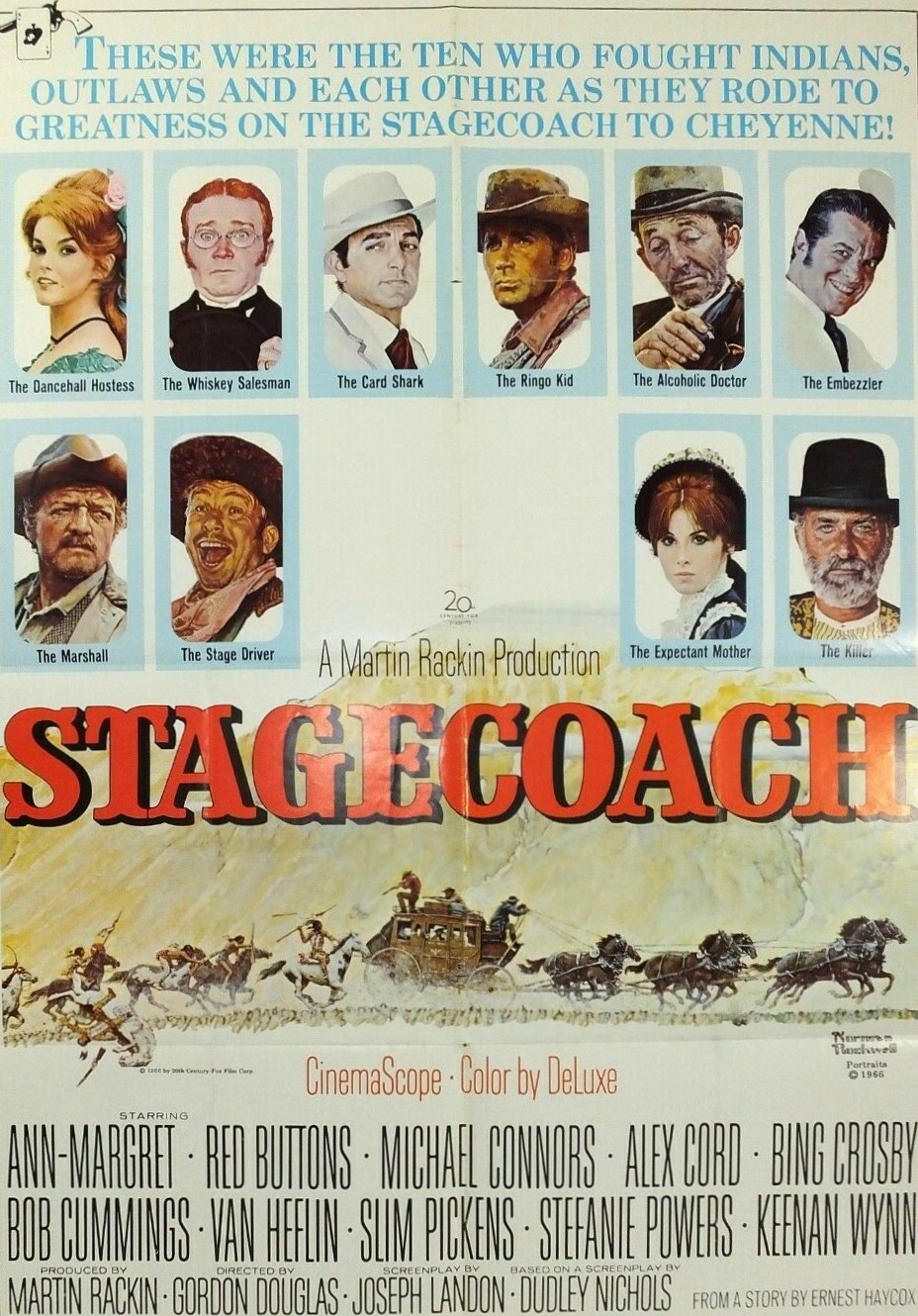
  3. (2) Stagecoach (1966). Under-rated remake of the John Ford western. But it’s Ann-Margret who steals the show ahead of Alex Cord in the role that brought John Wayne stardom.  
  4. (New Entry)) The Last Showgirl (2024). Pamela Anderson proves she can act and how in this touching portrayal of a fading Las Vegas dancer.
  5. (4) In Harm’s Way (1965). Under-rated John Wayne World War Two number. Co-starring Kirk Douglas, Patricia Neal, Tom Tryon and Paula Prentiss, director Otto Preminger surveys Pearl Harbor and after.
  6. (3) Fraulein Doktor (1969). Grisly realistic battle scenes and a superb score from Ennio Morricone help this Suzy Kendall vehicle as a World War One German spy going head-to-head with Brit Kenneth More and taking time out for romantic dalliance with Capucine.
  7. (5) Fireball XL5. The famous British television series (1962-1963) from Gerry and Sylvia Anderson, now colorized. “My heart will be a fireball…”
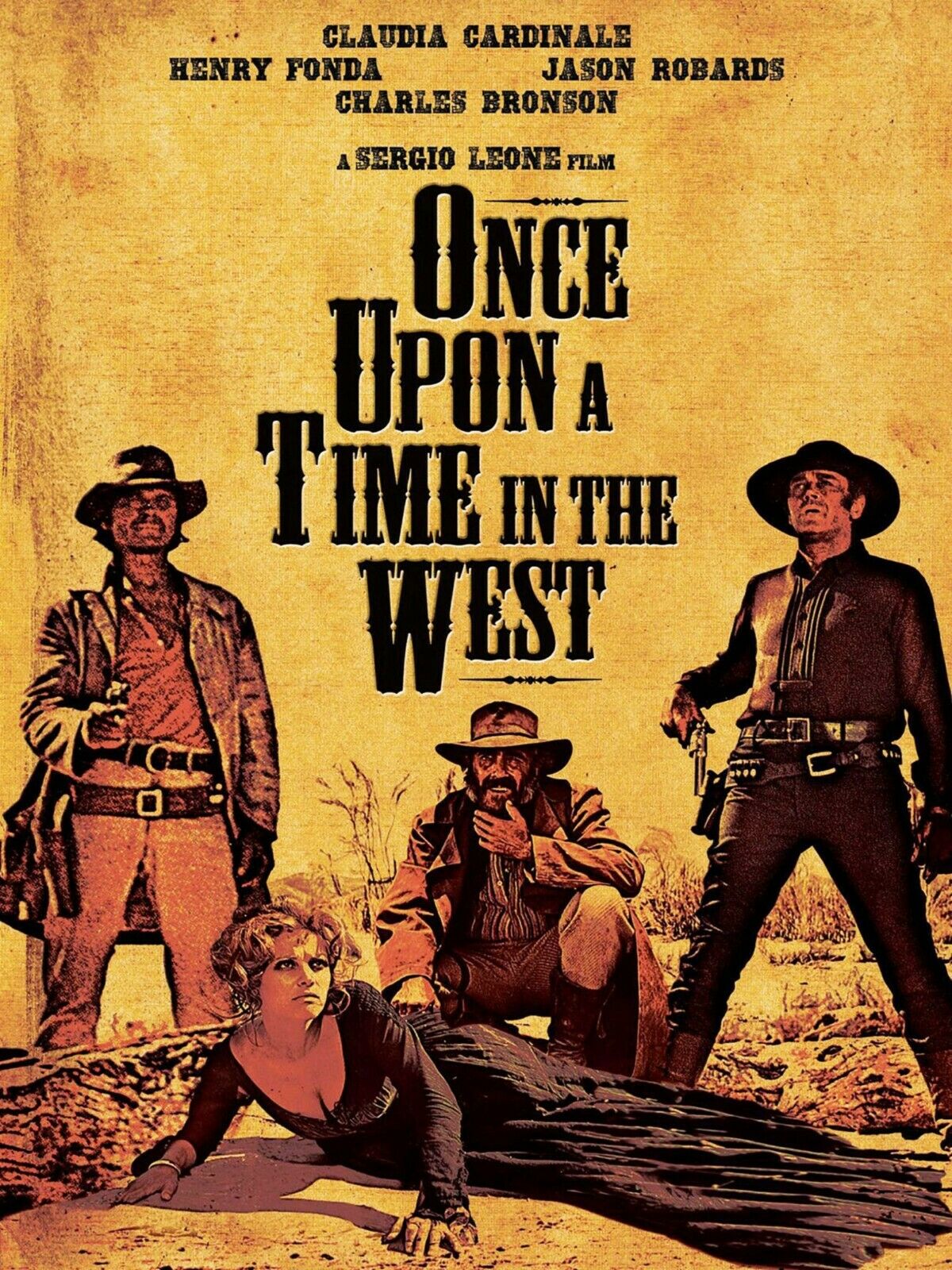
  8. (6) Once Upon a Time in the West (1969). Along with The Searchers (1956) now considered the most influential western of all time. Sergio Leone rounds up Claudia Cardinale, Henry Fonda and Charles Bronson and that fabulous Morricone score.
  9. (New Entry) Squad 36 / Bastion 36 (2025). Corruption and interdepartmental rivalry fuel this French flic directed by Olivier Marchal.
  10. (7) Jessica (1962). Angie Dickinson doesn’t mean to cause trouble but as a young widow arriving in a small Italian town she causes friction, so much so the local wives go on a sex strike..
  11. (20) Young Cassidy (1965). Julie Christie came out of this best, winning her role in Doctor Zhivago as a result. Rod Taylor as Irish playwright Sean O’Casey.
  12. (8) Thank You Very Much/ A Touch of Love (1969). Sandy Dennis dazzles as an academic single mother in London impregnated by Ian McKellen.
  13. (10) Baby Love (1969). Controversy was the initial selling point but now it’s morphed into a morality tale as orphaned Linda Hayden tries to fit into an upper-class London household.
  14. (30) The Girl on a Motorcycle / Naked under Leather (1968). How much you saw of star Marianne Faithfull depended on where you saw it. The U.S. censor came down heavily on the titular fantasizing heroine, the British censor more liberal. Alain Delon co-stars. These says, of course, you can see everything.
  15. (9) Pharoah (1966). Polish epic set in Egypt sees the country’s ruler at odds with the religious hierarchy.
  16. (24) A Dandy in Aspic (1968). Cold War thriller with Laurence Harvey as a double agent who wants out. Mia Farrow co-stars.  
  17. (31) Claudelle Inglish (1961). Diane McBain seeks revenge for being stood up at the altar in the Deep South.
  18. (New Entry) The Family Way (1966). Hayley Mills comes of age in this very adult drama. Co-starring her father John Mills and Hywel Bennett.
  19. (12) Vendetta for the Saint (1969). Prior to James Bond, Roger Moor was better known as television’s The Saint. Two television episodes combined sees our hero tackle the Mafia.
  20. (15) Go Naked in the World (1961). Gina Lollobrigida finds that love for a wealthy playboy clashes with her profession (the oldest). Look out for highly emotional turn from the usually taciturn Ernest Borgnine.
  21. (13) The Appointment (1969). Inhibited lawyer Omar Sharif discovers the secrets of wife Anouk Aimee in under-rated and little-seen Italian-set drama from Sidney Lumet.
  22. (New Entry) Istanbul Express (1968). Gene Barry plays a weird numbers game in spy thriller that sets him up against Senta Berger.
  23. (19) Pressure Point (1962). Nazi extremist Bobby Darin causes chaos for psychiatrist Sidney Poitier. Stunning dream sequences.
  24. (25) Pendulum (1968). Fast-rising cop George Peppard accused of murdering unfaithful wife Jean Seberg
  25. (11) The Sins of Rachel Cade (1961) Angie Dickinson (again) as African missionary falling foul of the natives and Commissioner Peter Finch. Roger Moore (again) in an early role.
  26. (16) Diamond Head (1962). Over-ambitious hypocritical landowner Charlton Heston comes unstuck in love, politics and business in Hawaii. George Chakiris, Yvette Mimieux and France Nuyen turn up the heat.
  27. (27) Fathom (1967). When not dodging the villains in an entertaining thriller, Raquel Welch models a string of bikinis as a skydiver caught up in spy malarkey.
  28. (36) Prehistoric Women / Slave Girls (1967). Martine Beswick attempts to steal the Raquel Welch crown as Hammer tries to repeat the success of One Million Years B.C
  29. (18) The Golden Claws of the Cat Girl (1968). Cults don’t come any sexier than Daniele Gaubert as a French cat burglar.
  30. (14) The Sisters (1969). Incest rears its head as Nathalie Delon and Susan Strasberg ignore husbands and lovers in favor of each other. 
  31.  (17) Moment to Moment (1966). Hitchcockian thriller set in Hitchcock country – the South of France – as unfaithful Jean Seberg is on the hook for the murder of her lover.  Also featuring Honor Blackman. 
  32. (New Entry) Age of Consent (1969). Helen Mirren frolics nude in her debut as the freewheeling damsel drawn to disillusioned painter James Mason.
  33. (28) Farewell, Friend / Adieu L’Ami (1968). A star is born – at least in France, the States was a good few years behind in recognizing the marquee attractions of Charles Bronson. Alain Delon co-stars in twisty French heist thriller featuring Olga Georges-Picot and Brigitte Fossey.
  34. (35) Horizon: An American Saga – Chapter 1 (2024). Kevin Costner’s majestic western that became one of the biggest flops of the year was underrated in my opinion.
  35. (New Entry) Genghis Khan (1965). Omar Sharif as the titular warrior up against Stephen Boyd. Co-starring James Mason and Francoise Dorleac. Robert Morley is hilariously miscast as the Chinese Empteror.
  36. (26) Once a Thief (1965). Ann-Margret again, in a less sexy incarnation, as a working mother whose ex-jailbird thief Alain Delon takes a detour back into crime.
  37. (29) Woman of Straw (1964). More Hitchockian goings-on as Sean Connery tries to frame Gina Lollobrigida in a dubious scheme.
  38. (New entry) The Demon / Il Demonio (1963). Extraordinary performance by Daliah Lavi in Italian drama as she produces the performance of her career.
  39. (New entry) Guns of Darkness (1962). David Niven and Leslie Caron on the run from South American revolutionaries.
  40. (New Entry) Operation Crossbow (1965). George Peppard is the man with the mission in Occupied France during World War Two. Co-stars Sophia Loren.
  41. (34) She Died with Her Boots On / Whirlpool (1969). More sleaze than cult. Spanish director Jose Ramon Larraz’s thriller sees kinky photographer Karl Lanchbury targeting real-life MTA Vivien Neves.  
  42. (21) Can Heironymus Merkin Ever Forget Mercy Humpe and Find True Happiness? Fellini would turn in his grave at the self-indulgence of singer Anthony Newley who manages to lament that women falling at his feet cause him so much strife. Joan Collins co-stars.
  43. (23) The Chalk Garden (1964). Wild child Hayley Mills, trying to break out of her Disney straitjacket, duels with governess Deborah Kerr.
  44. (New Entry) Dark of the Sun / The Mercenaries (1968). Rod Taylor’s guns-for-hire break out the action in war-torn Africa. Jim Brown and Yvette Mimieux co-star.
  45. (New entry) La Belle Noiseuse (1991). Emmanuelle Beart is the mostly naked model taking painter Michel Piccoli to his artistic limits.
  46. (New Entry) A Fine Pair (1968). Rock Hudson and Claudia Cardinale join forces for a heist picture.
  47. (33) Lady in Cement (1969). Raquel Welch models more bikinis as the gangster’s moll taken on as a client by private eye Frank Sinatra in his second outing as Tony Rome.
  48. (New Entry) Carry On Up the Khyber (1968). The most successful of the Carry On satires poking fun at the British in India.
  49. (New Entry) The Venetian Affair (1966). Robert Vaughn investigates spate of suicide bombs. Elke Sommer provides the glamor.
  50. (22) The Secret Ways (1961). The first of the Alistair MacLean adaptations to hit the big screen features Richard Widmark trapped in Hungary during the Cold War. Senta Berger in an early role.

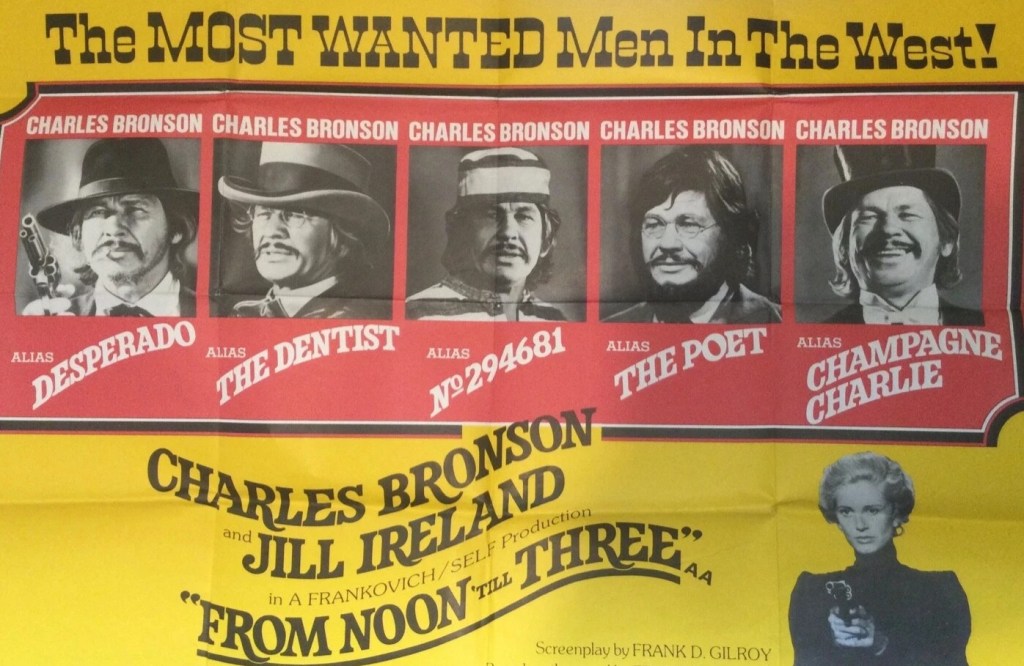
From Noon Till Three (1976) *****

Charles Bronson in a feelgood movie? Charles Bronson the romantic comedy lead? Charles Bronson’s character impotent? The hell you say!

Certainly, Bronson’s boldest role, and if the original concept had played out the way audiences might have expected, the star’s career might have taken the kind of pivot afforded Arnold Schwarzenegger when he took on Twins (1988).  But a third act which probably baffled audiences half a century ago plays straight into the hands of the contemporary filmgoer and spins such a twist – almost a horror version of “print the legend” – that nobody has ever invented a better one.

This isn’t just Bronson as you’ve never seen him before but it’s also Jill Ireland in the role of her life, proving not just that she can act but putting on a brilliant performance.

So, this isn’t like any Charles Bronson character you’ve ever seen, light years away from the monosyllabic justified or unjustified killers he had hitherto portrayed for most of the decade. He’s not even the leader of the gang of outlaws and has a decidedly cowardly streak. And this isn’t Jill Ireland, his wife, either, in some punched-up supporting role. Here she essays her inner Katharine Hepburn or prissy Maggie Smith and engages in the kind of male-female verbal duel that hasn’t been seen since The African Queen (1952).  

When his horse pulls up lame Graham Dorsey (Charles Bronson) decides not to accompany his four outlaw buddies on a bank robbing expedition and despite the prospect of “borrowing” a horse from rich widow Amanda Starbuck (Jill Ireland) he goes along with her pretense that no such beast exists because he’s had a presentiment that the heist will go awry. The gang agree to pick him up on their return at a tension-sodden three o’clock – hence the title, a mild play on High Noon (1952).

Amanda is more than capable of dealing with his kind despite him spinning her a tale of having lost a similar mansion to her grand three-storey affair after the Civil War and being widowed for seven years and so depressed at his impotency he’s contemplating suicide.

In the way of opposites attracting, one thing leads to another and soon they are waltzing, dressed up to the nines, in her elaborate rooms and taking a dip au natural in a lake. When word comes back that the robbers have been caught and are all set to hang, much against his natural inclination not to jeopardize his newfound love, he agrees, at her behest, to go save them. Although he intends doing nothing of the sort and simply lying low, he is pursued by a posse and only evades capture by swapping clothes with a dentist he captures.

And then the tale deftly switches. The posse kills the real dentist. Seeing only his blood-drenched clothes at a distance, Amanda believes it’s Graham. Meanwhile, he’s locked up after being convicted of the dentist’s crimes. She’s so enthralled by the unlikely romance that she writes a book about it that turns into the kind of publishing phenomenon that triggers tours of Graham’s grave and the house where it all happened.

When Graham is released, you expect the sting in the tale will be that she’ll have gone off and married someone else. But she hasn’t. Except she doesn’t recognize him. Because in the writing she transformed him into a much taller more handsome figure and her imagination can’t deal with reality. Any time he reminds her of an intimate moment, she cries out “it’s in the book.” Finally, somewhat rudely, he does convince her but then, afraid of letting down the millions of fans captivated by the legend, rather than reviving their romance, she kills herself so the story cannot be challenged.

Worse, nobody believes Graham and he is accused of being a fraud and ends up in a lunatic asylum. Charles Bronson the madman, you didn’t see that coming I bet.

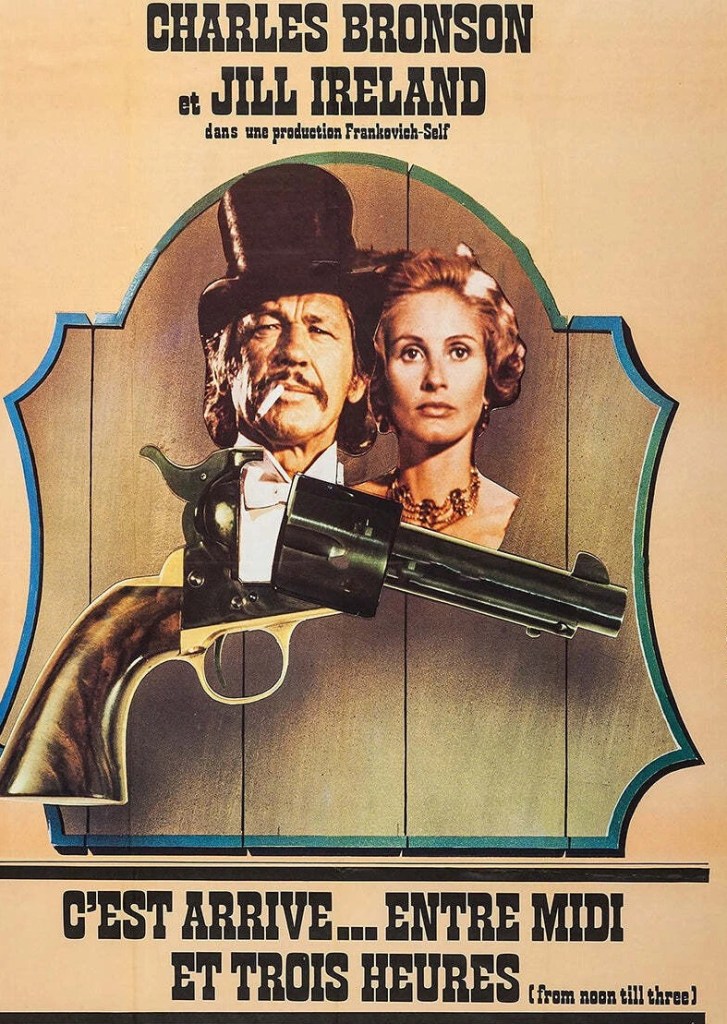
As you can tell from the posters, United Artists had no idea how to sell it and it lacked the single immediately visually-appealing gag of Twins, so it was a rare flop at this point in Bronson’s career. But a third act that was viewed as somewhat deranged satire has, in the half century since, now come into its own when questions about identity and point of view and “your own truth” and “recollections may vary” and imposter narrative and reality reinvention and fake news are endemic. In this case “print the legend” comes to haunt Graham.

But what was a flop in 1976 deserves reassessment and should be welcomed by a contemporary audience more able to deal with the sudden shift in tone. It might also put to rest the notions that neither Charles Bronson (Once Upon a Time in the West, 1969) nor Jill Ireland (Rider on the Rain, 1970) could act. This is a wonderfully spirited double act and had the movie been remotely successful might have set them up as a latter-day Tracy-Hepburn. I should note in passing a wonderful tune, “The Trouble With Hello Is Goodbye,” lyrics by Alan and Marilyn Bergman and music by Elmer Bernstein. Had the movie not been so quickly dismissed, that had all the making of a torch song.

Writer-director Frank D. Gilroy (Desperate Characters, 1971) has produced some scintillating dialog as well as bringing out the best in the couple. As clever on the spoofery front as Blazing Saddles (1974) and Support Your Local Sheriff (1969) but with a harder satirical edge.

I chuckled all the way through. It was a delight to see Bronson and Ireland playing such refreshing characters and the rom-com element worked out really well. So two bangs for your buck – a reinvented Bronson in the kind of role you never thought he could manage, and the kind of satire that hits home today.

Put aside all thoughts about what Charles Bronson and for that matter Jill Ireland can do or should do and sit back and enjoy this unexpected gem.

You can catch it on Amazon Prime.

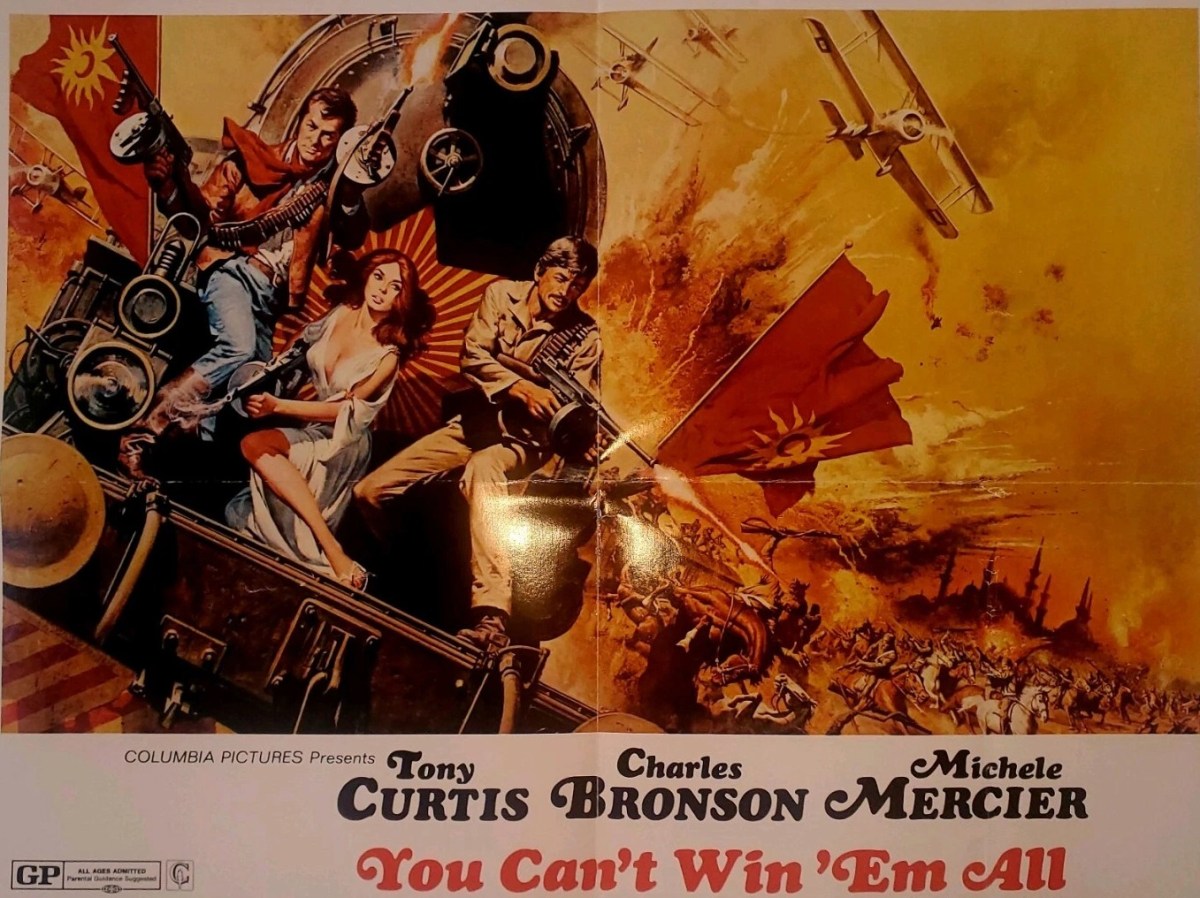
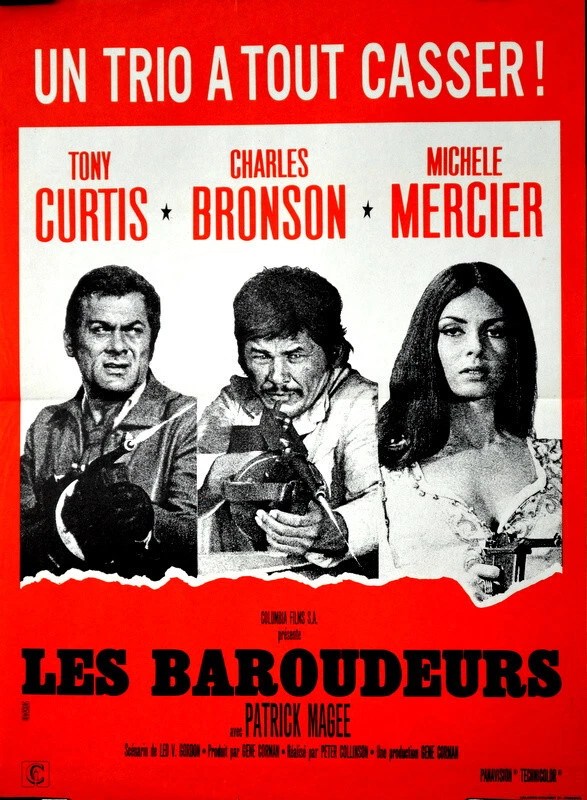
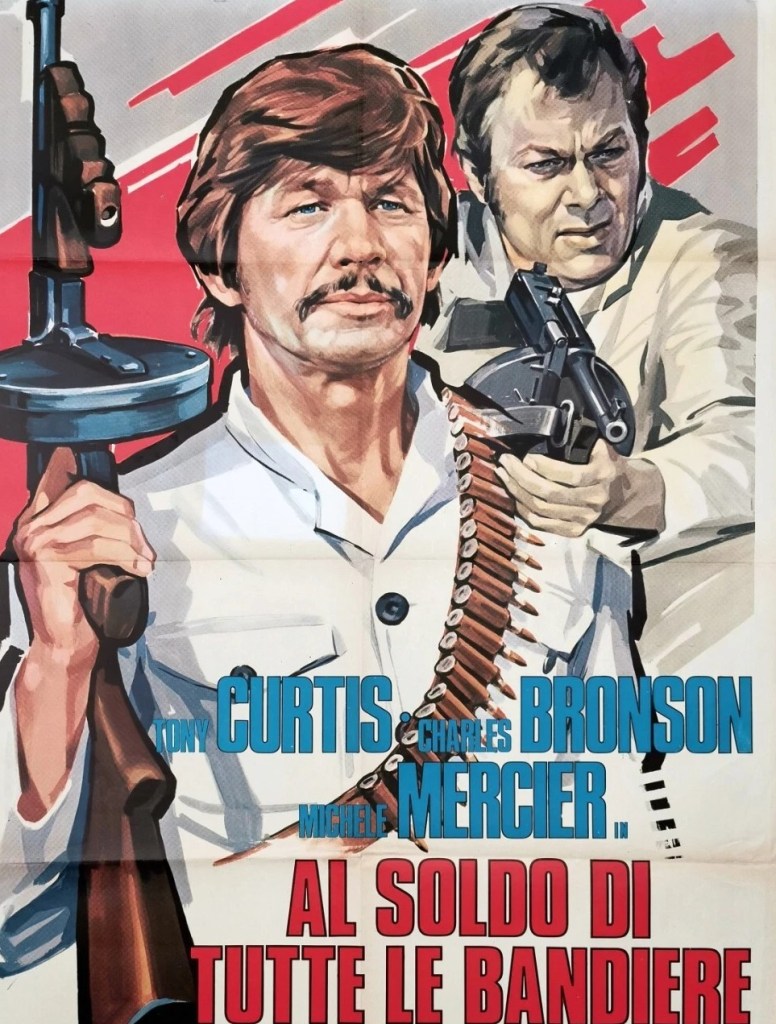
You Can’t Win ‘Em All (1970) ***

Charles Bronson travelogue. Slowest action picture you will ever come across. Director Peter Collinson forgets all he learned about tension from The Penthouse (1967) and action from The Italian Job (1969) and in trying to create a Turkish version of the visual delights of David Lean’s Lawrence of Arabia (1962) comes a cropper, not least because he hasn’t counted on the dust resulting in endless scenes of men on horseback being obscured. There must be about 10-15 minutes of just travelling by horse, train and boat through boring scenery.

There’s an interesting story in here somewhere but you’ll need all your patience to stick with it.  Soldiers of fortune Adam (Tony Curtis) and Josh (Charles Bronson) are the type of characters who buddy up one minute and stitch each other up the next. Their attitudes are ingrained from the outset – Josh robs shipwrecked Adam who takes revenge by stealing his boat. They team up to take advantage of the chaos ensuing in Turkey in 1922 following the collapse of the Ottoman Empire, setting themselves up as mercenaries before their small force of like-minded fellows, armed with Tommy guns,  is hired by Governor Osman Bey (Gregoire Aslan) to escort a consignment of gold to Cairo. They soon discover that’s just a cover. The only gold on the gold bars is as much as it takes to provide a golden sheen to blocks of lead. There are actually more valuable prizes: Bey’s daughters and a trunk of priceless jewellery.

So far, they’ve beaten off various attacks, the submachine guns making short work of rebels armed only with rifles, and this looks as if it’s heading into fairly standard territory whereby the scoundrels will evade their captors and make off with the loot. But halfway through it does a U-turn. We discover that Adam is actually in the country to repossess one of his father’s ships lost in World War One. This is tweaked into an important plot point – the Turks have been blockaded by the Brits but a ship flying an American flag would be permitted safe passage.

Then it twists on its axis once again and we’re dropped into femme fatale land. The daughters are being escorted by the beautiful but wily Aila (Michele Mercier). She’s a step up from the usual two-timing female of the species. She’s a three-timer, attempting to woo in turn the governor, Adam and Josh. Actually, she returns to two-timing when she knifes the governor to death. And her plans go awry when Josh rejects her advances with a vicious slap.

Even so, he’s not averse to teaming up with her to betray Adam and make off with the loot. Adam, who has considered himself worldly wise, is furious and eventually traces Josh and Aila to the port of Smyrna.

It doesn’t end well, Josh and Adam are captured. But then it does end well. Aila, revealed as a spy, negotiates their freedom. After all, inadvertently, they helped her to transport the real treasure, an ancient Koran, while keeping the jewels for herself.

Leo Gordon (Tobruk, 1967) has penned a very wayward screenplay. Charles Bronson (Farewell, Friend, 1968) and Tony Curtis (The Boston Strangler, 1968) play well off each other, occasionally exchanging decent quips, with the kind of personalities that might congeal into an acceptable screen pairing, guys, while minus an honor code, who don’t stray into unacceptable behaviour. And it might have worked equally as well if the Michele Mercier (Angelique, 1964) strand had been introduced at the beginning and we had a three-way romantic dilemma. But director Collinson takes forever to get the two elements of the tale to mesh and wastes countless minutes, as previously noted, as our heroes laboriously grind their way towards their destination. The introduction of Mercier – sudden light catching her eyes in the darkness – is the only composition of note. And while Bronson and Curtis are a sparky pairing most of the time they flounder in an incomprehensible tale.

You can either catch this on YouTube and have your viewing interrupted by an advert every two minutes or on Amazon Prime where such interference is minimal.

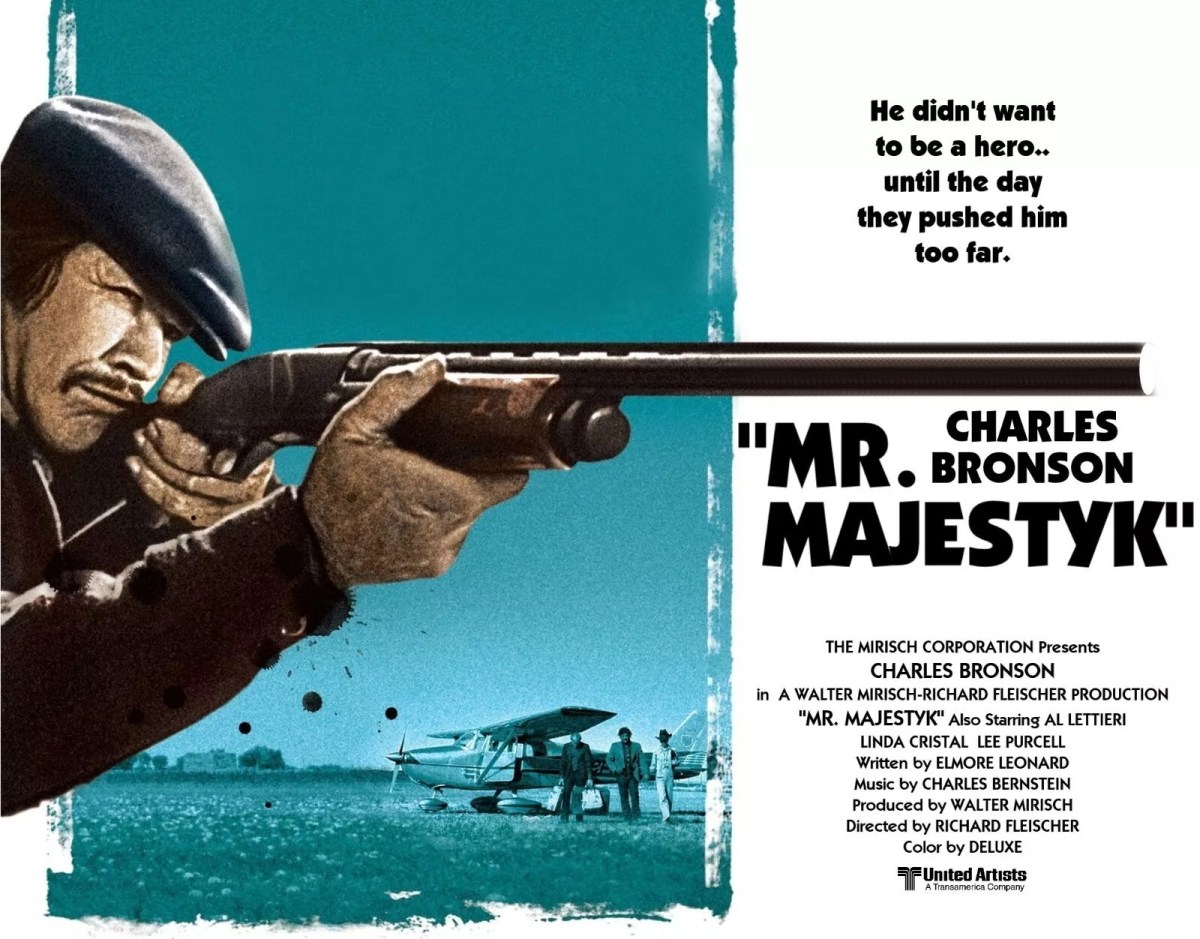
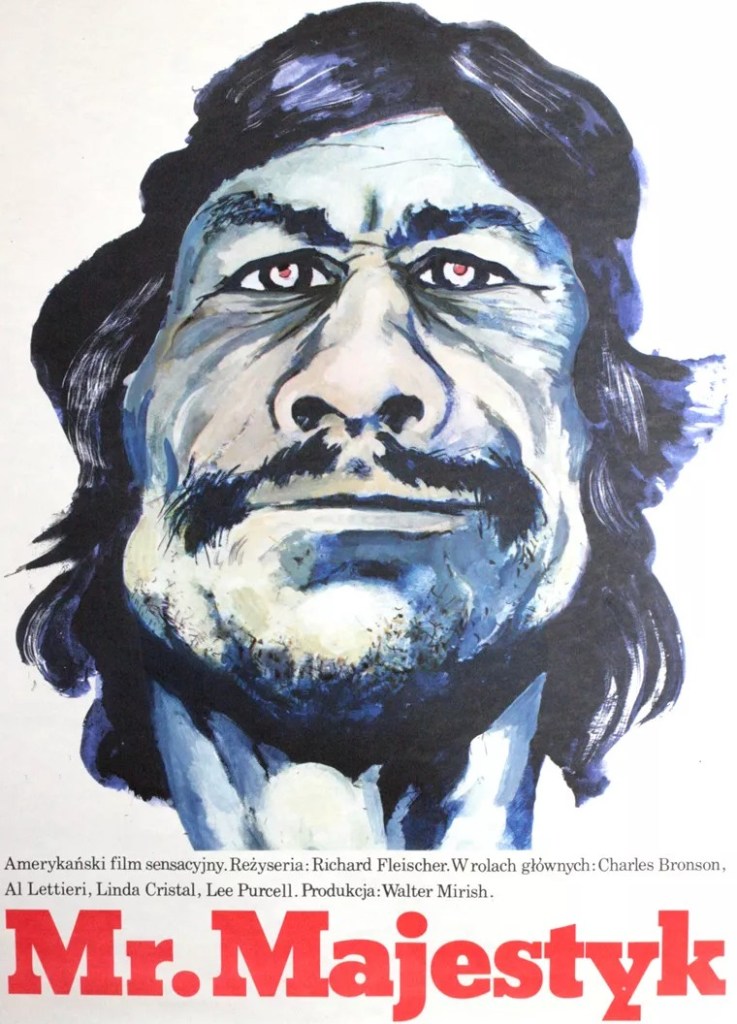
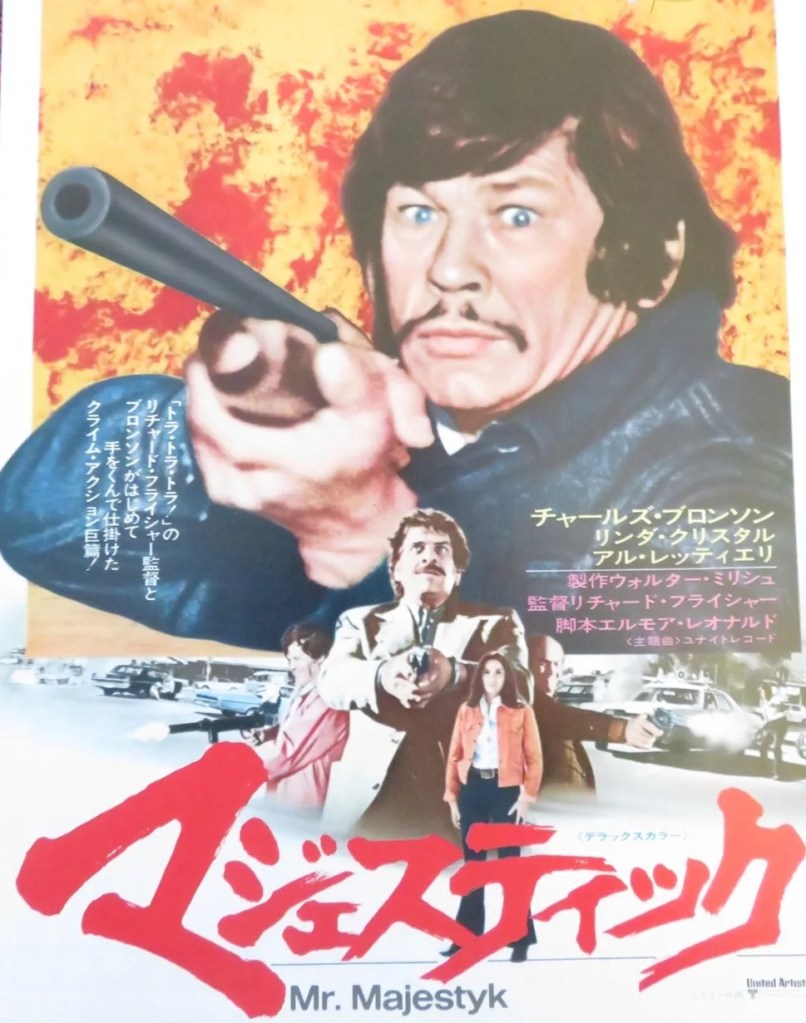
Mr Majestyk (1974) ****

I interrupt the current program to bring you the hugely under-rated Mr Majestyk, now showing on Amazon Prime.

You read any critical assessment of the 1970s and if they talk about male actors at all it’ll be the “new wave” of Al Pacino, Robert DeNiro, Dustin Hoffman, Jack Nicholson, Gene Hackman, Oscar nominees/winners all. There’ll be nary a mention of the actors who kept the box office straight on a consistent basis for most of the decade. Clint Eastwood would come into the equation, but it wouldn’t be for Dirty Harry (1971) or Every Which Way but Loose (1978) but only when he flexed his directorial muscles. Charles Bronson never harbored any ideas of picking up a megaphone so he wouldn’t even have that saving grace.

Yet Eastwood and Bronson saved Hollywood before the big blockbuster like Jaws (1975) or Star Wars (1977) took off and for one specific reason. They attracted a global audience. When foreign receipts started to matter more than ever, these two delivered. And while the critically-adored actors dithered over choices and could scarcely be guaranteed to put out a picture a year, Eastwood and Bronson were dependable, occasionally ramping up output to three a year (1971 and 1973 for Eastwood, 1972, 1974 and 1976 for Bronson). They were old-school reliable performers. .

Mr Majestyk has been somewhat overshadowed because it appeared just before what some ill-informed observers deemed to be Bronson’s breakout picture, Death Wish (1974), and because it was helmed by the under-rated Richard Fleischer (The Boston Strangler, 1968) who never seemed to generate critical traction.

In fact, it’s a cracker – a pair of stunning car chases, full-on blow-away street battle, and the actor is one of his best roles. If anyone could play a farmer convincingly it’s Bronson, who looks as if he knows exactly what it’s like to put in a mucky day’s work (he was a miner). Vince Majestyk (Charles Bronson), in the watermelon line, falls foul of small-time organized crime in the shape of one of the most hapless hoods you’ll come across, Bobby Kopas (Paul Koslo). When Majestyk doesn’t take too kindly to Kopas trying to muscle in on the employment market, the farmer ends up in jail.

During a routine transportation, gangsters try to hijack Mob hitman Frank Renda (Al Lettieri) but despite going in all guns blazing the racketeers haven’t counted on Majestyk, who steals the bus, sees of the pursuing cops and robbers and hides out in a shack in the hills. He trades the mobster for the cancellation of charges against him by Det Lt McAllen (Frank Maxwell). But he’s duped by Renda’s backgammon-playing fashionable moll Wiley (Lee Purcell). On the loose, Renda is determined to get his revenge. The cops are happy to use Majestyk as bait.

Mexican Nancy (Linda Christal), a crop picker and union organizer, also enters the frame, and despite Majestyk, having recognized imminent danger, trying to stifle burgeoning romance, she keeps coming back. She’s a straightforward gal. “You want to go to bed with me, why don’t you just ask?”

But bait becomes bait-and-switch and soon it’s the gangsters who are on a wild goose chase, car passengers driven off the road during a wild chase over dusty mountainous country, others picked off by rifle until it comes down to a showdown at an isolated house.

While Majestyk has the muscle to give Renda an occasional slapping, he’s also got the sucker punch, duping the hoodlum time and again.

One of the elements that distinguishes this is that, apart from Renda, all the characters, good or bad, male or female, are soft spoken. Even Lt McAllen isn’t always chewing someone out.

Although the car chases have been compared to Bullitt (1968) and The French Connection (1971) they have much more in common with Fear Is the Key (1972) where we are miles away from slick city roads. Plenty opportunity for vehicles to sail through the air. Nancy proves something of find behind the wheel, and Vince pretty game in the back of the truck being bounced six ways to Sunday by her driving.

Outside the action, several excellent scenes – the gangsters shooting up the watermelon crop, headlights ominous in the dark, a crop-picker being smashed by a car, Kopas being put in his place by Renda. Not only is the romance in a low register, but Bronson is in a low key, resigned to what he cannot change, but taking charge with blistering speed when he can.

This was a deliberate change of pace in terms of characterization from Bronson following the more action-oriented Chato’s Land (1972), The Mechanic (1972) and The Stone Killer (1973). There’s none of the usual brooding menace. He’s a farmer, not a killer.

Despite a long stretch in The High Chaparral (1967-1971), this was the first movie in six years for Argentinian Linda Cristal who’s effective rather than a scene-stealer which the cool Lee Purcell (Kid Blue, 1973) definitely is in non-showy fashion. By contrast Al Lettieri (The Godfather, 1972) eats the scenery, which is his job, as he turns from cat into mouse.

More than ably directed by Richard Fleischer from an original screenplay by Elmore Leonard (The Big Bounce, 1969).

A must see.

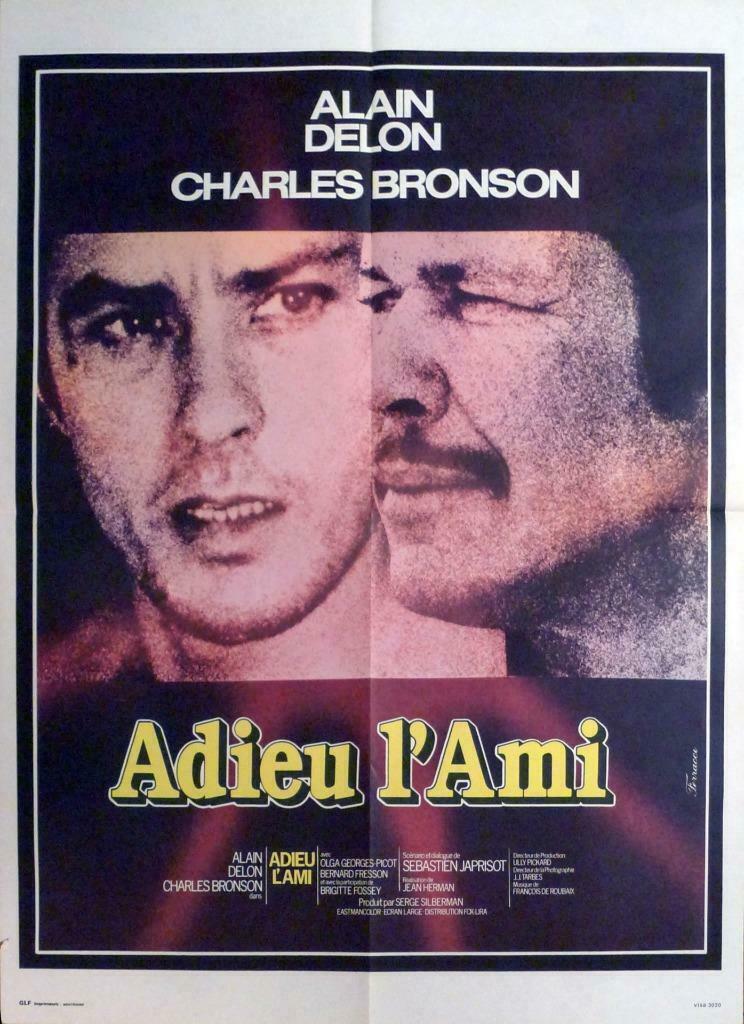
Farewell, Friend / Adieu, L’ami (1968) ****

This heist picture made Charles Bronson a star, though, like Clint Eastwood a few years previously, he had to go to Europe, in this case France, to find an audience appreciable of his particular skill set. This was such a box office smash in France that it was the reason that Once upon a Time in the West (1968), a major flop virtually everyone else, turned into a huge hit in Paris. After a decade as a supporting actor, albeit in some quality offerings like The Magnificent Seven (1960), The Great Escape (1963) and The Dirty Dozen (1967), Bronson developed a big following, if only initially in Europe.

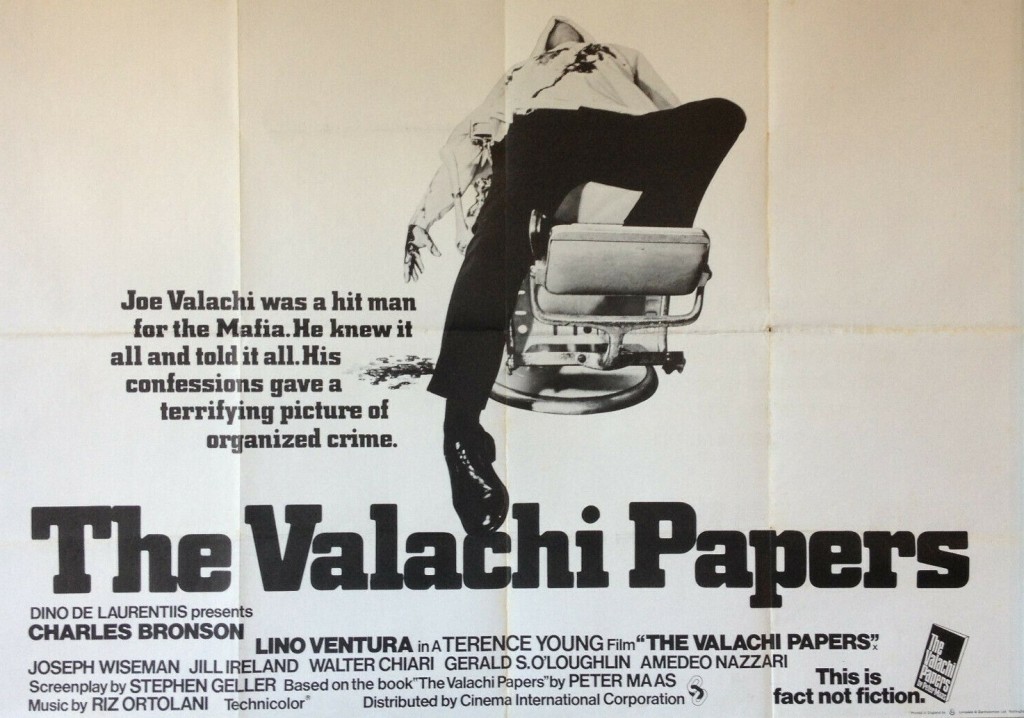
It could also lay fair claim to stealing the title of  “first buddy movie” from the following year’s Butch Cassidy and the Sundance Kid (1969) because, apart from the heist that is central to the story, it is essentially about the forging of a friendship. But it wasn’t released in the U.S. for another five years, in the wake of Bronson’s Hollywood breakthrough in The Valachi Papers (1972), and then under a different title, Honor Among Thieves.

And you can see why it was such a star-making vehicle. Bronson goes toe-to-toe with France’s number one male star Alain Delon. He had the walk and the stance and the look and he was given acres of screen time to allow audiences to fully appreciate for the first time what he had to offer. Like Butch Cassidy, the duo share a lot of screen time, and after initial dislike, they slowly turn, through circumstance and a shared code of honor, into friends.

Dino Barran (Alain Delon) is the principled one, after a final stint as a doctor in the French Foreign Legion, originally turning down Bronson’s overtures to become involved in a separate major robbery. Franz Propp (Charles Bronson) is an unsavory customer, making his living as a small-time thief who uses a stripper to dupe wealthy marks. Barran agrees to rob a corporation’s safe during the three-day Xmas holiday of two million dollars as a favor to the slinky widow Isabelle (Olga Georges-Picot) of a former colleague, for whose death he retains guilt. Propp more or less barges his way into the caper.

It’s a clever heist. Isabelle gets Barran a job as a company doctor whose office is next door to the giant vault. But there’s a twist. Surveillance reveals only three of the seven numbers required to open the vault. But Barran reckons three days is sufficient to try out the 10,000 possible combinations.

Barran and Propp despise each other and pass the time playing juvenile tricks, locking each other into a room, stealing all the food from the one dispensing machine, winding each other up, while they take turns trying different combinations. But it opens after only 3,400 attempts and they face a shock. The vault is empty. They have been set up to take the fall for a previous robbery that must have been completed before the building closed for Xmas.  

And there’s no way out. They are in lockdown, deep in a basement. The elevators can only be opened by a small squadron of guards upstairs. Food long gone, they are going to run out of water. If they use a lighter to see in the dark, or build a fire to get warm, the flames will eat up the oxygen they need to survive in the enclosed space. So the heist turns into a battle for survival and brute force, facing a deadline to escape before the building re-opens and they are discovered, exhausted and clearly guilty.

But that’s only the second act. There is a better one to follow, as their friendship is defined in an unusual manner. And there are any number of twists to maintain the suspense and tension. Butch Cassidy and the Sundance Kid were close friends when that western began. Here, we see the evolution of a friendship between two forceful characters who express their feelings with their fists.

Delon was a known quantity, but Bronson really comes to the fore, more than holding his own against a top star who oozed charisma. This is Bronson in chrysalis, the emergence of the tough guy leading man screen persona that would turn him into one of the biggest stars in the world. Surprisingly, given his later penchant for the monosyllabic, here he does a lot of talking, perhaps more actual acting than he ever did later when his roles tended to fall into a stereotype.

He has the two best scenes, both character-defining, but in different ways. He has a little scam, getting people to gamble on how many coins it would take for an already full-to-the-brim glass to overflow when a certain number of coins were dropped in. While this is a cute, it’s that of a small-time con artist, but watching it play out, as it does at critical moments, is surprisingly suspenseful. The second is the strip scene which shows him, as a potential leading man, in a very poor light, and although thievery is the ultimate aim, it is not far short of pimping, with Bronson standing back while the woman (Marianna Falk) is routinely humiliated. It’s the kind of scene that would be given to a supporting actor, for whom later redemption was not on the cards. It says something for Bronson’s command of the screen and the development of his character that by the end of the picture the audience has long forgotten that he could stoop so low.

It is a film of such twists I would not want to say much more for fear of giving away too much, suffice to say that Olga Georges-Picot and her friend, mousy nurse Dominique (Brigitte Fossey), are also stand-outs, and not just in the sense of their allure.

Director Jean Herman, in his sophomore outing, takes the bold step of dispensing with music virtually throughout, which means the audience is deprived of the usual musical beats, indicating threat or suspense or change of mood, during the critical heist sequence, but which has the benefit of keeping the camera squarely on the two leading characters without favoring either. Most pictures focusing on character rely on slow-burn drama. In the bulk of heist pictures characters appear fully-formed. Here, unusually, and almost uniquely in the movie canon, character development takes place during an action film.

Even without Bronson, this would have been a terrific heist picture. With him, it takes on a new dimension.

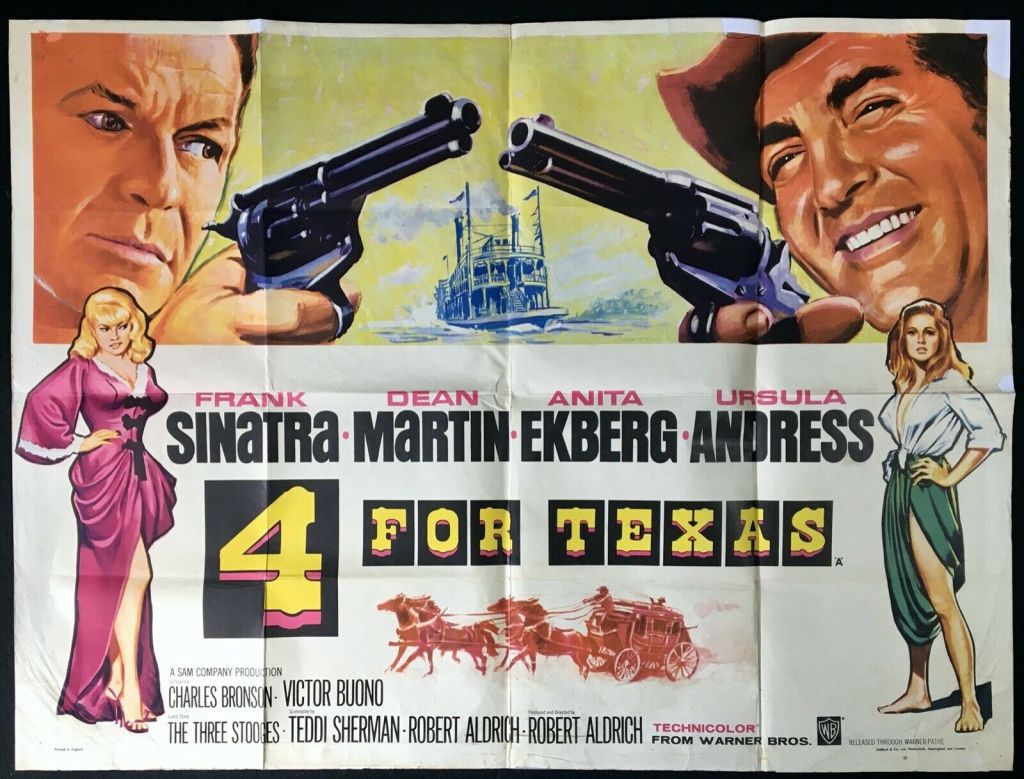
4 for Texas (1963) ****

To my mind the best of the Frank Sinatra-Dean Martin collaborations, outside of the more straightforwardly dramatic Some Came Running (1958), and for the simple reason that here the two stars are rivals rather than buddies. The banter of previous “Rat Pack” outings is given a harder edge and it is shorn of extraneous songs.

I came at this picture with some trepidation, since it did not receive kind reviews, “stinks to high heaven” being a sample. But I thought it worked tremendously well, the ongoing intrigue intercut with occasional outright dramatic moments and a few good laughs.

It’s unfair to term it a comedy western since for a contemporary audience that invariably means a spoof of some kind, rather than a movie that dips into a variety of genres. In some respects it defies pigeonholing. For example, it begins with a dramatic shoot-out, stagecoach passengers Zack Thomson (Frank Sinatra), a crack shot with a rifle, and pistolero Joe Jarrett (Dean Martin) out-shooting an outlaw gang headed by Matson (Charles Bronson). When director Robert Aldrich (Sodom and Gomorrah, 1962) has the cojones to kill off legendary villain Jack Elam in the opening section you know you are in for something different.

After out-foxing Matson, Jarrett attempts to steal the $100,000 the stagecoach has been carrying from its owner Thomas. Jarrett looks to be getting away with it until he realizes he is still in range of Thomas’s rifle. Then Thomas looks to have secured the money until Jarrett produces a pistol from his hat. And that sets the template for the movie, Thomas trying to outsmart Jarrett, the thief always one step ahead, and the pair of them locking horns with corrupt banker Harvey Burden (Victor Buono), in whose employ is Matson.

The movie is full of clever twists, cunning ruses, scams, double-crosses, reversals and sparkling dialog. Whenever Jarrett and Thomas are heading for a showdown, something or someone (such as Matson) gets in the way. While Thomas has the perfect domestic life, fawned over by buxom maids and girlfriend Elya (Anita Ekberg), Jarrett encounters much tougher widow Maxine (Ursula Andress) who greets his attempts to invest in her riverboat casino by shooting at him. 

Take away the comedic elements and you would have a plot worthy of Wall Street and ruthless financiers. The story is occasionally complicated without being complex and the characters, as illustrated by their devious intent, are all perfectly believable.

It’s a great mix of action and comedy – with some extra spice added by The Three Stooges in a laugh-out-loud sequence – and it’s a quintessential example of the Sinatra-Martin schtick, one of the great screen partnerships, illuminated by sharp exchanges neither lazily scripted nor delivered. Even the blatant sexism is played for laughs.

Sinatra and Martin, especially, are at the top of their game. Forget all you’ve read about Aldrich and Sinatra not getting on. Sinatra never got on with any director. But an actor and director not getting on does not spell a poor picture. Sinatra brings enough to the table to make it work, especially as he is playing against type, essentially a dodgy businessman who is taken to the cleaners by both Martin and Buono.

The only flaw is that Ursula Andress (Dr No, 1962) does not turn up sooner. She has a great role, mixing seductiveness and maternal instinct with a stiff shot of ruthlessness, not someone to be fooled with at all, qualities that would resonate more in the career-making She (1965).  Anita Ekberg (La Dolce Vita, 1960) on the other hand is all bosom and not much else. Charles Bronson (The Magnificent Seven, 1960) demonstrates a surprising grasp of the essentials of comedy for someone so often categorized as the tough guy’s tough guy.

The biggest bonus for the picture overall is the absence of the other clan members – Sammy Davis Jr, Peter Lawford and Joey Bishop – who appeared in previous Rat Pack endeavors Oceans 11 (1960) and Sergeants 3 (1963). Without having to laboriously fit all these other characters in, this film seems to fly along much better. As I mentioned, the fact that Sinatra and Martin play deadly enemies provides greater dramatic intensity.

Robert Aldrich was a versatile director, by this point having turned out westerns (Vera Cruz, 1954), thrillers (Kiss Me Deadly, 1955), war pictures (The Angry Hills, 1959), Biblical epic Sodom and Gomorrah (1962) and horror picture Whatever Happened to Baby Jane? (1962). But 4 for Texas called for even greater versatility, combining action with quickfire dialog, a bit of slapstick and romance and shepherding the whole thing with some visual flair.

If you are a fan of Oceans 11 and Sergeants 3 you will probably like this. If you are not, it’s worth giving this a go since it takes on such a different dynamic to those two pictures.

Behind the Scenes: The Box Office Bump Part Two – Foreign Saves the Day

In previous decades, box office outside of the U.S., while a growing part of the ancillary equation, only in very rare circumstances outscored domestic. The general expectation, in part due to tougher competition for screens and extra distribution costs, was on average studios could expect to earn about half of domestic revenues.

There was one obvious exemption to this rule. James Bond overseas blew all the competition out of the water. And so it proved in the early 1970s from an examination of United Artists books for the period. Live and Let Die (1973) was the standout performer, knocking up $27 million in rentals (the studio share of the overall box office gross) from foreign cinemas compared to $16.4 million at home. Diamonds Are Forever (1971) did equally well – $22 million abroad, $20 million domestic.

James Bond was such a cash cow that surprised no one. Last Tango in Paris (1973) was considered an anomaly, controversy stoked by UA four-walling the picture when it couldn’t find enough screens. It came in third in the foreign market league, adding $16 million to domestic $21 million.

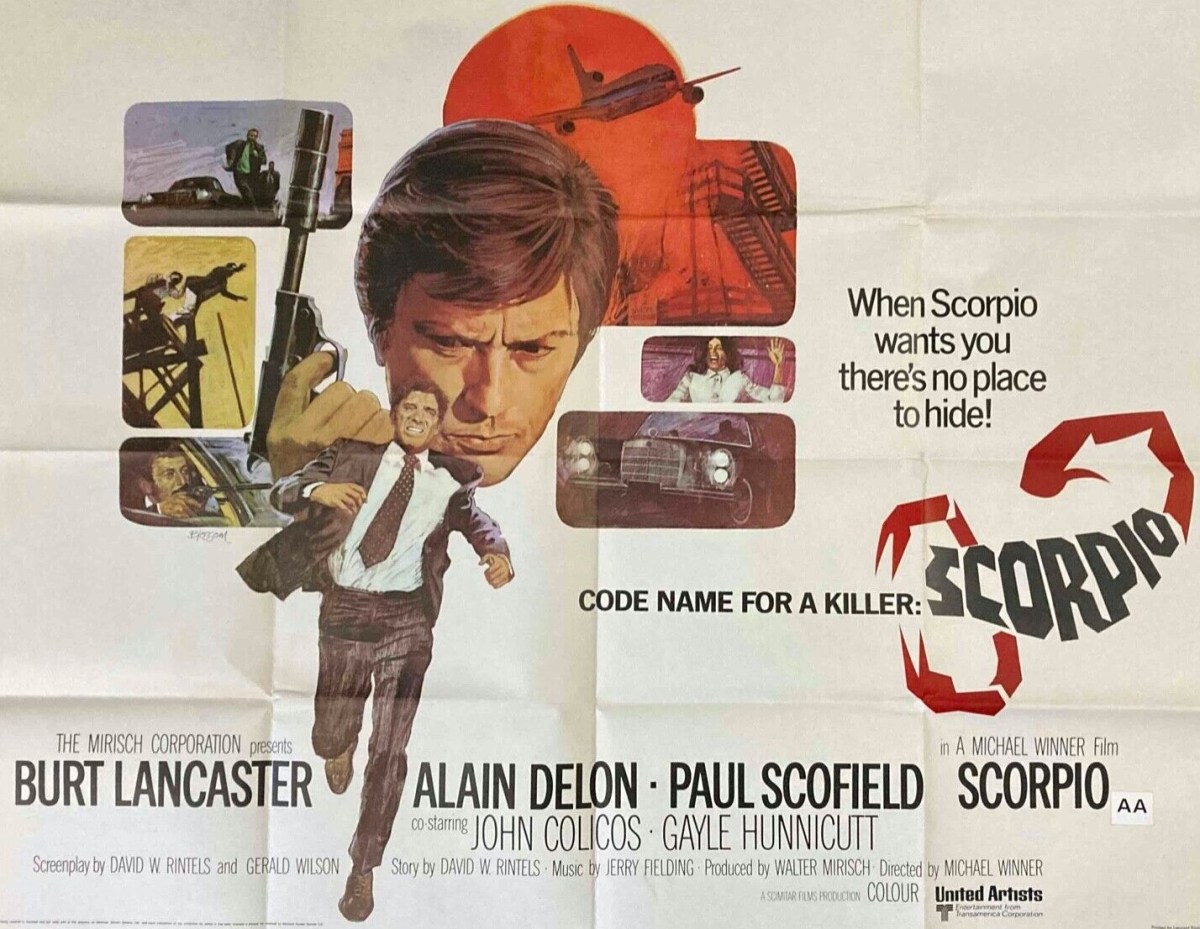
What did take Hollywood’s breath away was how often under-performers – flops even – at the U.S. ticket wickets did gangbusters elsewhere. The biggest winner was the aptly-named Michael Winner, director of westerns Lawman (1971) and Chato’s Land (1972), hitman thriller The Mechanic (1972) and spy drama Scorpio (1973). Total American rentals a shade over $7 million, total foreign rentals three times as much a colossal $21.8 million.

There was hardly a greater example of the disparity between American audience tastes and the rest of the world. And it made Hollywood studios more adventurous when it came to choosing subject matter, and in backing stars, aware that they could make their investment back – and more – from foreign markets.

It was probably astonishing to any studio executive that Burt Lancaster – for over two decades a high-flying marquee name from action-oriented fare like The Crimson Pirate (1952) and controversial drama From Here to Eternity (1953) to his Oscar-winning turn as Elmer Gantry (1960) and hardnosed western The Professionals (1966) – had lost his domestic audience especially after he had fronted up disaster movie smash Airport (1970).

But Lancaster could only scrape up $1.35 million at home for Scorpio, $2.1 million for Lawman and $2.8 million for another western Valdez Is Coming. Scorpio was the biggest hit abroad, with a massive $7 million, over five times domestic, while Lawman shot up $3.2 million (50 per cent above domestic) and Valdez Is Coming $2.65 million.

Charles Bronson was another beneficiary of foreign largesse. The Mechanic, too, targeted $7 million abroad, nearly three times the domestic tally of $2.6 million. Chato’s Land (1972) only delivered $1.27 million in the U.S. but $4.6 million abroad.

Westerns were a mixed bag. Oliver Reed-Candice Bergen-Gene Hackman number The Hunting Party (1971) was an almighty flop at home, just $800,000 in the kitty, but rallied somewhat abroad, not enough to turn profit but at least add a sheen of respectability, with $2.4 million elsewhere, three times domestic. The Magnificent Seven Ride! (1972), proof the sequels had outstayed their welcome, brought in just $750,000 domestically but again did triple the business abroad with $2.15 million and given the paltry budget enough to sit in the black.

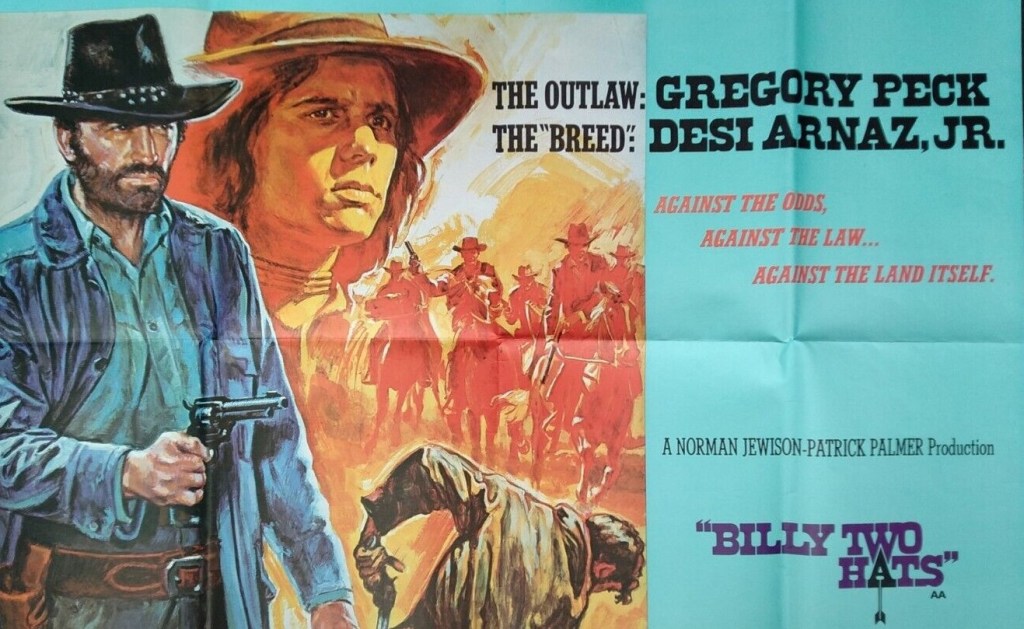
Revisionist effort Billy Two Hats (1974) starring Gregory Peck added $900,000 abroad to a miserable $440,000 at home – foreign revenues not enough to save it from flop. But foreign couldn’t save the second remake of the Gunfight at the OK Corral legend, Doc (1971) with Stacy Keach and Faye Dunaway which moseyed along to $1.35 million abroad to add to $1.8 million domestic. And another western sequel Support Your Local Gunfighter (1971) notched up just $970,000 abroad compared to $2.1 million. Modern western The Honkers (1972) with James Coburn managed just $550,000 abroad and $1 million at home.

It didn’t really matter that Michael Caine comedy thriller Pulp (1972) did better abroad, figures everywhere nothing to write home about, $600,000 in total, five-sixths of that abroad. Fiddler on the Roof (1970), for other reasons, underwhelmed but nobody was going to complain too much when foreign audiences stuck $10 million in till, about a quarter of domestic.

There were some conundrums in the foreign-domestic share-out. Typically, American comedies didn’t travel. But Billy Wilder’s Avanti! (1972) starring Jack Lemmon, perhaps because of the Italian setting, did better abroad – $2.5 million to $1.6 million. Glenda Jackson British-made menage a trois Sunday, Bloody Sunday (1970) not surprisingly did better abroad, but only just, $1.8 million to $1.77 million.

Sidney Poitier in second sequel The Organization (1971) tapped into $2.9 million abroad and $2.45 million at home but generally too-specifically-American features struggled overseas, The Hospital (1971) snaring only $1.9 million compared to $9 million, White Lightning (1973) snagging $1.8 million compared to $6.9 million, Fuzz (1972) holstering $1.7 million against $3.1 million.

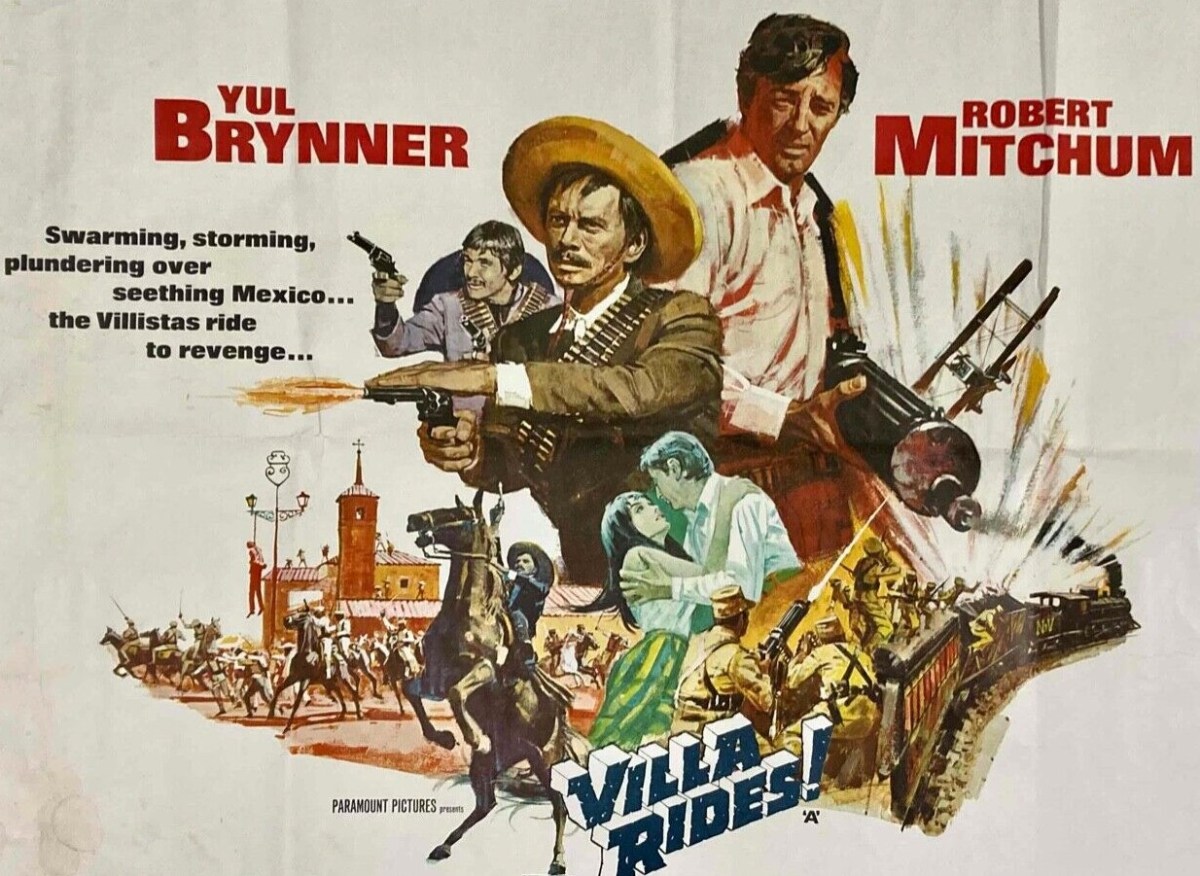
Villa Rides (1968) ***

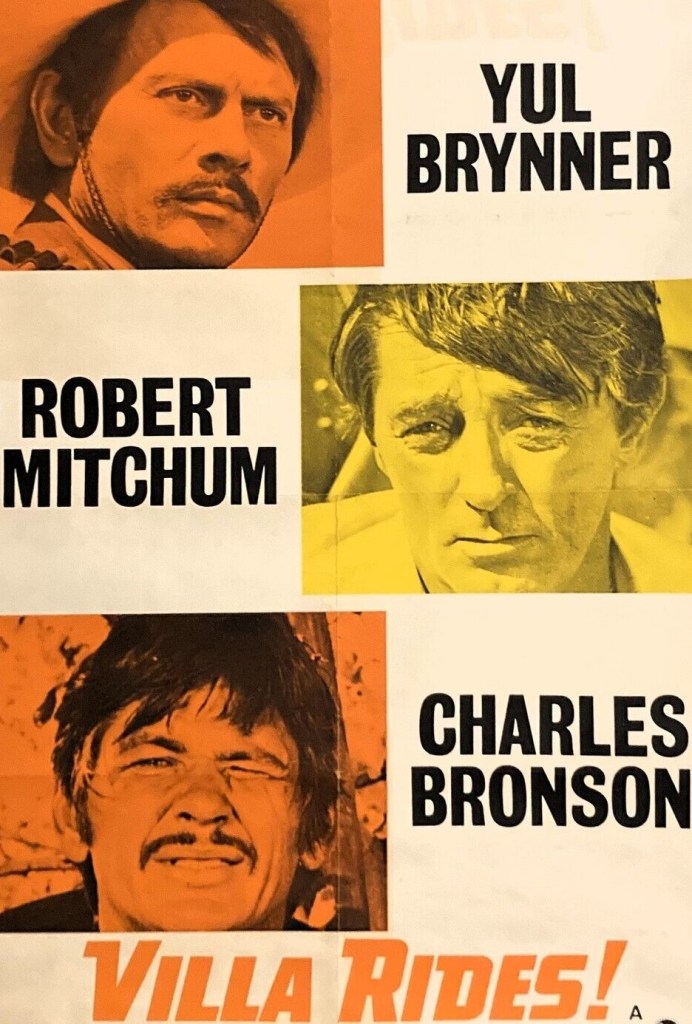
Best viewed as Charles Bronson’s breakout movie. Yes, he had played supporting roles in The Magnificent Seven, The Great Escape and The Dirty Dozen, but these had all been versions of the same dour, almost monosyllabic, persona. Here, though somewhat ruthless, he steals the show from the top-billed Robert Mitchum and Yul Brynner with many of the best lines and best situations with an extra slice of humor (make that first-ever slice of humor) to add to the mix. He is the most interesting of the three main characters, in part because he does not have to spout any of the “good revolution/bad revolution” dialog that falls to the other two.

Villa (Brynner) is fighting the Colorados but his superior General Huertas (Herbert Lom) is planning to overthrow President Madero (Alexander Knox). Mitchum is an aeronautical gun-runner from El Paso, initially against the revolutionaries, stranded in Mexico when his plane breaks down. He has just about time to romance a local woman Fina (Maria Grazia  Buccello) before the Colorados arrive, take over the village, start hanging the leaders and raping Fina. Villa saves them, Bronson slaughtering the Colorados with a Gatling gun on the rooftop. Faced with the one-man firing squad that is Bronson, Mitchum turns sides. His plane comes in handy for scouting the enemy, then bombing them.

The actions sequences are terrific especially Villa’s attack on a troop train. To get Villa out of the way, Huertas puts him in the front line in a suicidal attack on a heavily-defended stronghold which turns into another brilliant set-piece with cavalry charges.  The plot is constantly interrupted by politics of one kind or another and comes to dead stop when Villa is arrested by Heurtas and Villa demands a proper trial. It’s kind of hard to take when a murdering bandit, no matter how legendary, decides that he has been hard done by.

That aside, there are interesting attempts to build up his legend. He doesn’t want power for himself, but to give it to the people, although he has sat back and let the first village be attacked so that the people there learn to hate the Colorados enough to join the fight. There’s not really any good guys – Brynner and Bronson are stone-cold killers, Mitchum a mercenary. But Brynner does marry Fina in order to prove that a raped woman should not be treated with dishonor, though he has a tendency to marry other women as well.

Bronson’s unusual one-man firing squad involves him laying on the ground with a pistol in each hand and giving prisoners the opportunity to escape before he shoots them. After all that hard work, he bathes his hands. Then he decides he can kill three men with one bullet, lining them up exactly so he can drill them all in the heart. But he’s also the one who shoots a molester in a cantina, then delivers the classic line: “Go outside and die, where are your manners?” He is at the heart of some well-judged comedy – continually sending back his meals and trying to get out of getting into a plane with Mitchum. Without him, there would be too much justification of slaughter (Brynner) and arguments against (Mitchum). This is the first time in the kind of action role that suits him that he has an expanded characterization.

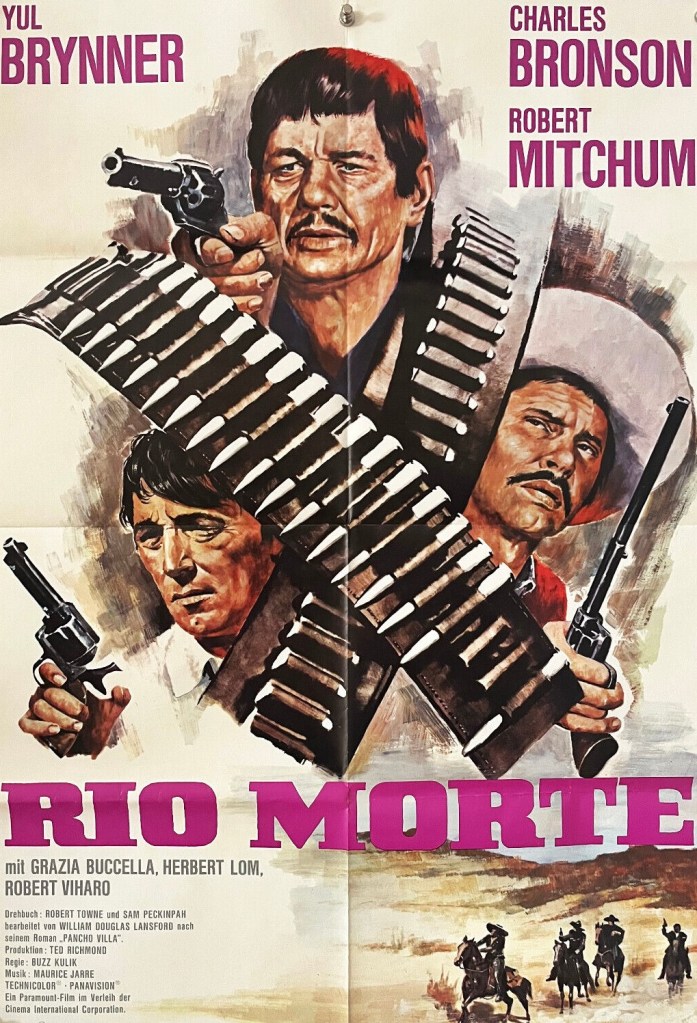
Brynner did not like Sam Peckinpah’s original script so Robert Towne (Chinatown) was brought in to present Villa in a more appealing light. Bronson (Adieu L’Ami/Farewell Friend, 1968) shows hints of the screen persona that would so appeal to the French. Yul Brynner (The Double Man, 1967) adorns his character with many shades of grey, but Robert Mitchum (Secret Ceremony, 1969) has less to do.  Buzz Kulik (Warning Shot, 19660 has great fun with the action, less fun with some of the turgid dialog-ridden scenes.   

Good for action and Bronson.

Cold Sweat (1970) ***

One great scene doesn’t make a great movie, but I’ll tell you about it anyway and we can all wonder what went wrong with the rest of the picture. Through a swinging louvre door we catch glimpses of Joe (Charles Bronson) putting a headlock on a thug. The motion of the door  slows down as the villain is slowly choked to death. As the door closes we cut to Joe’s terrified wife Fabienne (Liv Ullman) and watch her reaction as she hears the neck snap.

Pretty good, eh? If only the rest of the movie were in that class. Except for a rollicking good car chase, it’s hampered by an over-complicated plot, kidnappings in retaliation for kidnappings, a dippie hippie (Jill Ireland) and one of the worst accents you will ever hear – quite why director Terence Young (Mayerling, 1969) wasn’t able to tell James Mason that his American South impersonation didn’t cut it is anybody’s guess.

Made before Bronson was a major global star, there’s a fair chance
the kung fu picture was a stronger attration.

Joe charters out a yacht in the south of France, but prefers gambling and drinking to spending evenings with his wife. But then his past catches up with him. Cue complicated backstory – he was a soldier who got mixed up in a robbery but ran away from the theft when the going got tough and was the only one who escaped a jail term. Now his old buddies want revenge but will accept instead Joe doing another job for them.

Joe doesn’t agree so Captain Ross (James Mason) kidnaps his wife and child. So Joe kidnaps the captain’s girlfriend Moira (Jill Ireland), stashing her away in a remote cabin filled with creepy-crawlies where she has “nothing to eat but money.” So they do a trade, except Ross reneges, and then gets shot, potentially leaving wife and child at the mercy of his creepy sidekick.

There’s a fair bit of action, and when Joe is beating people up or driving like crazy over inhospitable terrain, it makes like a thriller but when he’s left to try and lift a flare gun up with his foot it’s on shakier territory. The two elements of the story split too quickly and while wife and daughter make the most of being scared out of their wits, terrified women aren’t what people come to see a Bronson picture for.

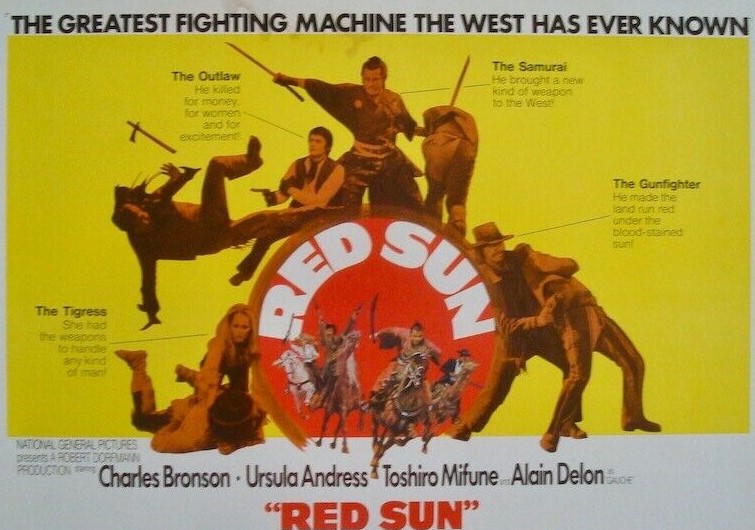
So it’s too much of a mixed bag. To compensate for the dire Mason (A Touch of Larceny, 1960), Liv Ullman offers a fresh perspective on the female lead in a Bronson picture, an actress who can actually act, her extremely expressive features meaning she doesn’t need to over-act. In her first mainstream picture, Ullman junks the Ingmar Bergman angst and comes across as a normal wife and mother thrown into a desperate situation. Her presence lightens up Bronson, though at this stage in his career, as evidenced by Someone Behind the Door (1970), Violent City / Family (1970) and Red Sun (1971), he presents quite a different screen persona to the grimacing/growling that was his post-Death Wish (1974) trademark.

Young seems caught between the action of his James Bond trilogy and the emotion-led drama of Mayerling and falls between two stools and hadn’t quite worked out how to get the best out of Bronson, a problem he rectified in Red Sun. Based, theoretically, on a novel by Richard Matheson (The Devil Rides Out, 1968), the screenplay has gone through too many hands, four at the last count, which probably accounts for the dodgy plot.

Not Bronson at his best, probably not a highlight of Ullman’s career either, and definitely a low point for Mason.

For Bronson completists only.

NOTE: There’s a vicious rumor going round, spread on Imdb, that this movie ended up on television only three days after cinematic release. Total nonsense of course. It was released in Britain in July 1973, gaining a two-week London West End run at the ABC-2 (“West End Soars, Variety, July 25, 1973, p19) and going out on a circuit release. It failed to find a U.S. distributor until 1974 in the wake of the success of Death Wish whne it was given a PG certificate by the Motion Picture Code and Rating Program and subsequently distributed by independents like Marcus Film and Emerson. It premiered in Denver – seen as a testing ground for difficult pictures, the city viewed “as a good barometer” of how movies will perform nationwide – in May 1974 (“Denver Used As Testing Ground For New Movies,” Box Office, May 20, 1974, pW4). Total rentals were estimated at around $250,000 (“Variety Chart Summary,” Variety, May 7, 1975, p134) and it placed 247th in the chart. It made its U.S. television debut on ABC in February 1975. (“Only ABC Enters Second Season With Quantity of First-Run films,” Variety, January 29, 1975, p43) but didn’t score highly with viewers finishing in 119th place for the year (“Theatrical Movie Rankings 1974-1975,” Variety, September 17, 1975, p40).

Violent City /Family (1970) ****

Of all the lazy, incompetent streamers this has to take the biscuit. Not content with branding as new films made over half a century ago, now we have films being screened which clearly nobody has bothered to watch even once. Otherwise, how to explain a picture where the language lapses into Italian at critical moments without the benefit of sub-titles.

Which is a big shame because, confusing through the movie is, it takes an unique approach to the femme fatale angle and serves up a noted screen tough guy as one whose heart is genuinely broken – suck that up, pale imitators going by the name of Stallone, Schwarzenner, Willis et al.

Post-Bullitt (1968) but pre-The French Connection (1971) we open with a dazzling car chase where the pursued race up stairs rather than down as is the current trope and batter their way through closely-packed streets in the Virgin Islands. That’s before wannabe retired assassin Jeff (Charles Bronson) is gunned down, although he’s still capable of diving under a burning car to escape immediate detection.

Jeff is on the lam with lover Vanessa (Jill Ireland). Dumped in jail with time to repent (no, strike that), mull over his circumstances, in the meantime dodging a tarantula (a real one!) crawling over his body, and coming to the conclusion that the moll has set him up and has returned to her previous lover, ace racing driver Coogan (no idea who plays him, imdb doesn’t know either). Despite having abandoned his profession, Jeff, not getting the hang of the broken-hearted moping malarkey, decides he’ll come out of retirement for the usual one last job, this time laying waste to Coogan.

But someone spots him and he’s blackmailed by Mafia chief Weber (Telly Savalas) into continuing his murderous ways. But here’s a sting in the tail – a wonderful twist to end all twists: Weber is Vanessa’s husband. She’s not a femme fatale at all just a sexual butterfly who dances from one lover to the next with Weber’s tacit approval.

But, in fact, in another twist, she is, after all, the femme fatale to end all femme fatales, setting up Jeff to bump off Weber so that she and attorney lover (what, another one) Steve (Umberto Orsini), Jeff’s best buddy, can take over her husband’s organization now that it has gone legit. And in the final twist to end all twists this ends with Jeff’s broken heart turning him suicidal (beat that Schwarzenneger, Stallone, Willis et al).

This is a very down’n’dirty Italian thriller, dashing from deadbeat locale to Southern Belle balls, from rusting riverboats to swampland, from factories to fashion shoots, the confusion factor infused further by the sudden incursions into Italian, often in mid-scene, as if this was some kind of artistic coup, determined to leave the viewer baffled.

Despite going the whole nine yards in the broken-heareted department, Jeff isn’t quite the full-blown romantic, an attempted rape of Vanessa in New Orleans only interrupted by (wait for it) three thugs beating another character to death. Naturally, Jeff isn’t the kind of good bad guy who intervenes, and these characters, even more naturally, have nothing to do with the plot (except as Jeff points out it’s a violent city after all). But what the hell, it’s that kind of film.

I’ve cutting Amazon Prime a big break here with my rating, because despite the language problems, it’s a cut above your normal thriller, and Charles Bronson (Red Sun, 1971) before being typecast by Death Wish (1974) gives a very good account of himself, certainly a lot more to do than just grimace, and, heck, you even feel sorry for him twisted inside out by emotion. Telly Savalas (A Town Called Hell, 1971) is a bit more polished and emotionally aware than his usual villain.

You might be tempted to call Jill Ireland (Rider on the Rain, 1970) the stand-out. She still can’t act for toffee, but she is well suited to playing this kind of jinxed minx, whose beauty snags dupes well below her league. And (spoiler alert) she does let it all hang out, indulging in copious nudity.

Directed with some flair by Sergio Sollima (The Big Gundown, 1967) and extra marks for coaxing unusual performances from the three principals. Six screenwriters (can’t you tell) put this together including Lina Wertmuller (The Belle Starr Story, 1968). Great score by Ennio Morricone.

Given I couldn’t understand half of what was going on thanks to streamer disinterest in sub-titles, I was still very impressed. Worth a watch.

NOTE: Amazon Prime has this under the title Family but once the credits roll it switches to original title Violent City.

Youtube has the trailer.

Discover WordPress

A daily selection of the best content published on WordPress, collected for you by humans who love to read.

The Atavist Magazine

by Brian Hannan

WordPress.com News

The latest news on WordPress.com and the WordPress community.